Category Archives: Analysis

The flow of time is central to human experience. Why isn’t it central to physics?

traffic (1)

Gene Tracy writes: The flow of time is certainly one of the most immediate aspects of our waking experience. It is essential to how we see ourselves and to how we think we should live our lives. Our memories help fix who we are; other thoughts reach forward to what we might become. Surely our modern scientific sense of time, as it grows ever more sophisticated, should provide meaningful insights here.

Yet today’s physicists rarely debate what time is and why we experience it the way we do, remembering the past but never the future. Instead, researchers build ever-more accurate clocks. The current record-holder, at the Joint Institute for Laboratory Astrophysics in Colorado, measures the vibration of strontium atoms; it is accurate to 1 second in 15 billion years, roughly the entire age of the known universe. Impressive, but it does not answer ‘What is time?’

To declare that question outside the pale of physical theory doesn’t make it meaningless. The flow of time could still be real as part of our internal experience, just real in a different way from a proton or a galaxy. Is our experience of time’s flow akin to watching a live play, where things occur in the moment but not before or after, a flickering in and out of existence around the ‘now’? Or, is it like watching a movie, where all eternity is already in the can, and we are watching a discrete sequence of static images, fooled by our limited perceptual apparatus into thinking the action flows smoothly?

The Newtonian and Einsteinian world theories offer little guidance. They are both eternalised ‘block’ universes, in which time is a dimension not unlike space, so everything exists all at once. Einstein’s equations allow different observers to disagree about the duration of time intervals, but the spacetime continuum itself, so beloved of Star Trek’s Mr Spock, is an invariant stage upon which the drama of the world takes place. In quantum mechanics, as in Newton’s mechanics and Einstein’s relativistic theories, the laws of physics that govern the microscopic world look the same going forward or backward in time. Even the innovative speculations of theorists such as Sean Carroll at Caltech in Pasadena – who conceives of time as an emergent phenomenon that arises out of a more primordial, timeless state – concern themselves more with what time does than what time feels like. Time’s flow appears nowhere in current theories of physics. [Continue reading…]


Facebooktwittermail

World heading for catastrophe over natural disasters, risk expert warns

The Guardian reports: The world’s failure to prepare for natural disasters will have “inconceivably bad” consequences as climate change fuels a huge increase in catastrophic droughts and floods and the humanitarian crises that follow, the UN’s head of disaster planning has warned.

Last year, earthquakes, floods, heatwaves and landslides left 22,773 people dead, affected 98.6 million others and caused $66.5bn (£47bn) of economic damage (pdf). Yet the international community spends less than half of one per cent of the global aid budget on mitigating the risks posed by such hazards.

Robert Glasser, the special representative of the secretary general for disaster risk reduction, said that with the world already “falling short” in its response to humanitarian emergencies, things would only get worse as climate change adds to the pressure. [Continue reading…]

Facebooktwittermail

‘My soul is in Damascus’: Portraits of life on the refugee trail

In a moving series of sketches, Ghaith Abdul-Ahad captures grueling journeys blighted by poverty and exploitation: Last summer, the Turkish port city of Izmir became the springboard for hundreds of thousands of refugees hoping to reach Greece. They came looking for smugglers to take them to sea – and lifejackets to keep them alive. Every third shop on Fevzi Pasha Boulevard, a wide shopping street that led to the smugglers’ quarter, was happy to oblige.

“Original Yamaha,” shopkeepers would shout to passing refugees. “Come in and try one.” Some shoe-sellers and tailors put their usual stock in the basements, and started selling crudely made lifejackets instead. Smugglers block-booked the rooms of nearby hotels for their clients. Greece lay just across the Aegean.

In 2015, if there was a ground zero for Europe’s migration crisis, it was here, on the western Turkish coast. But a few months on, a deal has been struck between the EU and Ankara which should see most migrants arriving in Greece being deported back to Turkey, and the picture is very different. The hotels are empty. And the shopkeepers on Fevzi Pasha Boulevard are largely back to their original stock.

Sitting in a cafe in front of the train station, a thick orange scarf wrapped around his neck, a Syrian tailor watches people timidly as his son makes castles out of sugar cubes. A few weeks ago this cafe and the square teemed with smugglers conducting their illicit trade in the open, and refugees negotiating prices. Today, two Turkish police officers stand on a street corner to scare away smugglers and their clients. [Continue reading…]

Facebooktwittermail

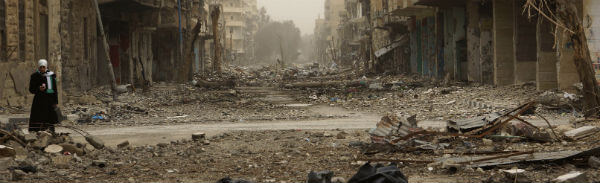
Frozen life in wartime Syria

Syria1

Janine di Giovanni writes: Five years is a long time to be frozen in the grip of war. Five years is a primary-school education. Five years is hundreds of thousands of memories in a single human life.

“I have not seen or eaten a tomato in a year,” Ahmed Mujahid, 23, recently told me by Skype. His home in Darayya, Syria, has been bombed several times; now he stays with friends, or wherever he can. “I think it was last summer when I last tasted a tomato, and that was uneatable, because it was green. There are children who have been born in these five years who don’t know the taste of fruit.”

Syria has now endured five years of war. We know the figures that illustrate that time passing: as many as 470,000 dead; nearly five million refugees; some six million displaced inside the battered country. The opposition walked out of peace talks in Geneva last week. No one seemed surprised. Those in Syria have little hope. When you live through war for that long, you become accustomed to the misery, the drudgery, to not having water, electricity or medical care.

After a while, you forget the book you were reading when the war started, or the love affair you had just ended. Your life is put on hold. With a terrible nonchalance, you get used to the sound of bombs falling.

“This is the background music in which we live our lives,” a friend told me in Aleppo in 2012 as a rocket crashed nearby.

Four years later, my friend is dead, so I can’t ask him what background music he hears now.

Something else happens, as well, when wars continue for too long. The rest of the world grows tired of the photographs of the dead, the smashed hospitals and destroyed schools, tired of the statistics on hunger and rape and how many shells have landed in civilian areas. Five years deadens compassion. [Continue reading…]

Facebooktwittermail

An amateur vs. ISIS (and the FBI): A car salesman investigates and ends up in prison

The New York Times reports: By his own account, Toby Lopez was a supremely ordinary guy. He sold Toyotas and lived with his mother in a tidy rancher here with a cherry tree out front. He was proud that he could connect with customers — anyone from a Superior Court judge to, as he put it, “Redneck Bill from down on the farm.” What passed for excitement was the time his young niece won a beauty contest and he chauffeured her in a red Corvette in a local parade.

Then a high school friend was killed in Afghanistan, and the Islamic State began beheading American journalists. Horrified, Mr. Lopez heard on CNN one day in the fall of 2014 that the Islamic State was active on Twitter, and he went online to see what he could find. “I was intrigued,” said Mr. Lopez, 42. “What could they possibly be saying on Twitter?”

What followed was a radical break from his humdrum life. He was pulled into the murky world of Internet jihadists, sparring with them from his office at the car dealership and late into the night at home. Before long, he was talking for hours on Skype with a man who claimed — falsely, as it would turn out — to be a top ISIS military commander, trying to negotiate the release of hostages. Mr. Lopez contacted the F.B.I. and began a testy relationship with counterterrorism agents who came to believe he might pose a danger. In the end, he landed in federal prison, where he was held for nearly 14 months without trial.

The story of one man’s deepening obsession with a terrorist group is a reminder of how the Internet provides easy portals to distant, sometimes dangerous worlds. It shows the complications for law enforcement agents who confront an overeager amateur encroaching on their turf. [Continue reading…]

Facebooktwittermail

The Defense Department made a big gaffe that helps Putin and Assad in Syria

Business Insider reports: The spokesman for the US military operation against ISIS made a comment in a Wednesday press briefing in Baghdad that helps justify Russia’s continued attacks on Syria’s largest city in the midst of a truce.

US Army Col. Steve Warren, the spokesman for Operation Inherent Resolve in Iraq, was asked whether Russian airstrikes on Aleppo, the current epicenter of the war, meant that Moscow was preparing to end the cessation of hostilities (CoH) agreement between government forces and the opposition signed on February 29.

Warren responded that it was “complicated” because al-Nusra “holds Aleppo” and is not party to the agreement.

Warren said of Russia:

I’m not going to predict what their intentions are. What I do know is that we have seen, you know, regime forces with some Russian support as well begin to mass and concentrate combat power around Aleppo. … That said, it’s primarily al-Nusra who holds Aleppo, and of course, al-Nusra is not part of the cessation of hostilities. So it’s complicated.

As Middle East analyst Kyle Orton noted on Twitter, Warren came “pretty close” to saying that the coalition supports Russia’s airstrikes in the city. Those strikes, however, are aimed at degrading any and all opposition to Bashar Assad — the embattled Syrian president who the Obama administration has repeatedly insisted “has to go.” [Continue reading…]

Facebooktwittermail

Bernie Sanders is aligned with mainstream America on Israel

Dina Smeltz writes: Rarely — if ever — has a presidential candidate been so publicly critical of Israeli policy toward the Palestinians as Sen. Bernie Sanders was last week during the CNN Democratic primary debate in Brooklyn. Media outlets seized the moment, with headlines such as “Bernie Sanders smashes the Israel status quo,” “Bernie Sanders just shattered an American taboo on Israel” and “Why Does Bernie Sanders hate Israel?”

Some writers have pitched this as a “watershed moment” in Democratic Party politics. For the political class, perhaps it is. But public opinion surveys show that Sanders’s views are representative of many Americans, and particularly Democrats, who are critical of some Israeli policies yet remain favorable toward Israel.

At the debate, the senator from Vermont stuck by a previous comment that the 2014 Israeli incursion into Gaza was “disproportionate.” Sanders further advocated a more balanced U.S. role in the Israel-Palestinian conflict, saying “there will never be peace in that region unless the United States plays a role, an even-handed role trying to bring people together and recognizing the serious problems that exist among the Palestinian people.”

Survey results from the past decade demonstrate that a majority of Americans has consistently favored an impartial role for the United States in the Israel-Palestinian conflict. A CNN-ORC poll from 2015 showed that two-thirds of Americans said the United States should refrain from taking either side, while 29 percent favored taking Israel’s side and 2 percent favored taking the Palestinians’ side. Although this sentiment is strongest among self-described Democrats (76 percent), a majority of independents (70 percent) and even a substantial number of Republicans (47 percent) agree. [Continue reading…]

Facebooktwittermail

The ‘nasty effect,’ and why Donald Trump supporters mistrust the media

Callum Borchers writes: Here’s a theory: Trump backers feel personally offended by coverage that suggests they must be stupid to support him. Insulted, they refuse to accept information presented by media outlets that disrespect them.

Think about it: When someone calls you an idiot, then tells you what to do (or not do), do you listen? Even if the instructions are sound, your wounded brain is inclined to tune them out and go the opposite direction.

A study published this week by the Associated Press-NORC Center for Public Affairs Research and the American Press Institute suggests that insulting news consumers is indeed a major problem. In a survey of more than 2,000 people, 38 percent said “yes” when asked, “Have you ever had an experience with a news and information source that made you trust it less for any reason?”

What were the reasons? Factual errors and perceived biases were the top answers. No surprise there. But the third-biggest cause of diminished trust — cited by 24 percent of those who have had a bad experience — was finding “something about the content personally offensive.” [Continue reading…]

Facebooktwittermail

Trump’s new image-maker honed his ‘dark’ arts in Ukraine

trump-bw

Financial Times reports: The Donald Trump who greeted supporters in the lobby of Trump Tower on Tuesday night bore little resemblance to the Republican frontrunner of yore.

Atypically gracious and restrained, Mr Trump spoke coherently on jobs and the economy, referred respectfully to his Republican opponents as “Senator Cruz” and “Governor Kasich” and stuck to his prepared remarks. Gone were the lewd insults or jabs at the press.

It was a political makeover like few had seen before — and it bore all the trappings of his new campaign chief, Paul Manafort.

A DC veteran political operative who has worked for the likes of Gerald Ford and George H W Bush, Mr Manafort, 67, was hired by Mr Trump last month to bring order to the Trump campaign and cement Mr Trump’s delegate count, a thorny issue ahead of the Republican National Convention.
Yet Mr Manafort’s true gift lies in political resuscitations and re-brandings, say former business associates.
Over a 40-year career in Washington, he has attempted to engineer them for a cast of, sometimes unsavoury, clients that include Angola’s Jonas Savimbi, the Saudi government, and the Philippines’ Ferdinand Marcos.

But it is his work with Ukraine’s former president, Viktor Yanukovich, that stands out as a particular showcase both of Mr Manafort’s talents — and the controversy surrounding their use. [Continue reading…]

Facebooktwittermail

How Facebook plans to take over the world

The Guardian reports: When Zuckerberg addresses the F8 audience [at Facebook’s annual developer conference] it is with the composure and conviction of a president addressing his citizens. “We’ve gone from a world of isolated communities to one global community, and we are all better off for it,” he says as he hammers home his “mission” to connect the world.

He warns of “people and nations turning inwards – against this idea of a connected world and community”, a position that fits both with his ideology and that of Facebook. This is not a speech about technical tweaks, but a state of the union address.

“It takes courage to choose hope over fear,” he adds. Behind the rhetoric and the casual clothes, the message is clear: Facebook is one of the big boys now, taking on huge global challenges and planning for prosperity.

The scale of Facebook’s audience is unprecedented. More than 1.6 billion people use Facebook at least once a month, or half of all internet users. That’s before you count users on other Facebook-owned sites including WhatsApp, which has more than 1 billion monthly active users, and photo-sharing site Instagram, which has 400 million.

Facebook has also introduced its free basics service to 37 countries, offering a free but limited package of apps to mobile phone users, but which some critics say allows Facebook to tightly control the online experience of potentially the next billion people to come online.

“You hear all the platitudes about Facebook connecting the planet, but to say they are doing it for benevolent reasons is absolute nonsense. It’s about connecting commerce, not people,” says venture capitalist and former journalist Om Malik, who reminds us of the hidden agenda of social networking firms: if you’re not paying, you’re the product. [Continue reading…]

Facebooktwittermail

It took Barack Obama to crush the Brexit fantasy

Jonathan Freedland writes: o wonder they were desperate that he keep his mouth shut. At his podium in Downing Street Barack Obama flattered his hosts, paid lip service to the notion that the referendum on British membership of the European Union on 23 June is a matter for the British people – and then calmly ripped apart the case for Brexit.

It was the Vote Leavers’ worst nightmare. For years – no, decades – the anti-EU camp has suggested that Britain’s natural habitat is not among its continental neighbours but in “the Anglosphere”, that solar system of English-speaking planets which revolves around the United States. Break free from Brussels and we could embrace our kindred spirits in Sydney, Toronto and especially New York, Washington and Los Angeles. The Brexit camp has long been like the man who dreams of leaving his wife for another woman, one who really understands him.

Obama is that other woman. And today he told the outers their fantasies were no more than that. First in print and then, more explicitly, in person he spelled out that America has no intention of forming some new, closer relationship with a Brexited Britain. On the contrary, a post-EU Britain would be at “the back of the queue” if it sought to agree its own, new trade treaty with the US.

America, he told his British audience – hence his use of “queue”, not “line” – likes the fact that Britain is already married: it works out really well for all three parties involved. His message was unambiguous. Don’t rush into a hasty divorce because you think we’re waiting for you with open arms. We’re not. [Continue reading…]

Facebooktwittermail

The problem with rebuilding a Palmyra ruin destroyed by ISIS – does it simply help Assad?

Adam Taylor writes: London Mayor Boris Johnson unveiled a stunning site in his city’s historic Trafalgar Square on Tuesday: a replica of the 2,000-year-old Arch de Triumph from Palmyra, Syria.

The original arch, once part of the internationally famous UNESCO world heritage site in Palmyra, was destroyed in an explosion by the Islamic State after it took control of the city last year. This new 20-foot-tall re-creation of the monument was crafted by the Institute of Digital Archaeology, a joint venture among Harvard University, the University of Oxford and Dubai’s Museum of the Future, which used 3-D imaging technology to map the arch and digital tools to carve it out of Egyptian marble.

During the unveiling ceremony, Johnson told spectators that they were gathered “in defiance of the barbarians” who destroyed the arch, the BBC reports. But despite the triumphant nature of the day and the clear delight that many had in the rebuilding of the historic ruin, some were concerned about what, exactly, Palmyra had come to represent.

Although few would argue that the ancient sites of Palmyra shouldn’t be protected, there are concerns that the city’s ancient wonders could become a propaganda tool for the regime of Syrian President Bashar al-Assad. Annie Sartre-Fauriat, an expert on Syrian heritage who works with UNESCO, said the Palmyra site should be evaluated and perhaps restored once the conflict is over.

“For the moment, we should not be fooled of the manipulations of opinion by a bloody dictator,” Sartre-Fauriat said.

Syria’s government declared just last month that it had forced the Islamic State from Palmyra after a prolonged campaign. “The liberation of the historic city of Palmyra today is an important achievement and another indication of the success of the strategy pursued by the Syrian army and its allies in the war against terrorism,” Assad said at the time.

For Assad and the Syrian regime, the capture of Palmyra seems to have been not only a symbol of the newfound prowess the Syrian military had on the battlefield with Russian air support, but also a claim that Syrians were the only ones who could protect Syria’s heritage. Palmyra itself had relatively little strategic value for the Islamic State, Aymenn Jawad al-Tamimi, a fellow at the Middle East Forum think tank, told Al Jazeera as the city was liberated. “Palmyra is more important for the regime, symbolically, to present itself as the defender of civilisation against barbarism,” Tamimi said.

This message has an international audience, too. The Islamic State’s destruction of Palmyra had created a global outcry. Now the Syrian regime and its Russian backers were able to portray themselves as the protectors of the ancient cultural site. In the days after their troops took Palmyra, the Syrian regime quickly took Western journalists to the ancient city to show them what the Islamic State had destroyed and what, by extension, Syrian troops had saved.

In doing so, the Syrian regime was ignoring the damage it had caused to Palmyra, Sartre-Fauriat said. Assad’s troops had inflicted their own damage on the site, Sartre-Fauriat explained, firing shells and rockets into ancient sites and also looting graves. [Continue reading…]

Facebooktwittermail

Fate of world’s coastlines rests on melting Antarctic ice

marshland

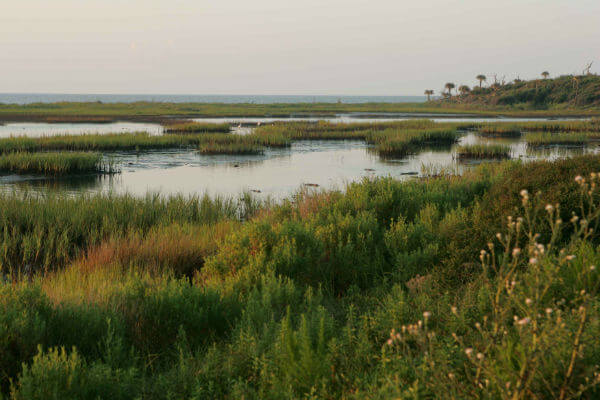
John Upton writes: Councilmembers of an island town in Georgia met in a police station near sandy beaches last week to mull a plan for coping with worsening floods. The meeting followed unprecedented king tide floods in the fall that inundated the island and nearby Savannah, and shut down the highway that connects them.

“We’ve had more frequent flooding in areas that haven’t flooded before,” said Jason Buelterman, mayor of the beach town on the eastern shore of Tybee Island, where the population of a few thousand residents swells each summer with vacationers. “In November, water was coming into people’s garages and stuff. It had never happened before.”

The meeting was held eight days before world leaders were due to converge in New York this Friday to ratify a United Nations treaty, aiming to avert the worst impacts of climate change. If the treaty succeeds, Tybee Island and other coastal communities may flood terribly in the coming decades, but will most likely remain mostly above sea level, recent Antarctic modeling suggests. Vast scientific uncertainties, however, mean even that cannot be assured.

Mayors from small towns, planners from the world’s largest cities and U.N. diplomats are being guided on the details of a looming coastal crisis by sea level projections compiled by a U.N. science panel. The panel’s work includes warnings about the amount of flooding that could be caused by melting in Antarctica, and those warnings have been growing bleaker.

The barren continent — the planet’s greatest reservoir of ice — remains shrouded in frigid mystery, and a lack of scientific knowledge about its ice sheet means scientists can’t yet predict how much flooding it could cause as temperatures continue to climb. A recent study, though, added to concerns that it could begin disintegrating, inundating coastal neighborhoods around the world, unless the heady goals of the new U.N. climate pact are achieved.

The Intergovernmental Panel on Climate Change’s most recent findings, from three years ago, appear to have underestimated the potential seriousness of the Antarctic problem, with sweeping implications for the urgency of pollution cuts — and for the futures of coastal communities like Tybee Island’s.

Instead of the anticipated several feet of sea level rise this century if current pollution rates continue, the latest modeling-based science warns that melting could lead to twice that amount. That sobering estimate is a rough one. [Continue reading…]

Facebooktwittermail

Failed state: Can a unity government succeed in divided Libya?

Der Spiegel reports: This may be the only thing you need to know about the situation in Libya: For security reasons, the headquarters of the United Nations Special Representative for Libya is situated 500 kilometers (311 miles) away from Tripoli in the Tunisian capital of Tunis. Martin Kobler’s office is located in a non-descript building in the city’s Les Berges du Lac diplomatic quarter.

For trips to Libya, he has an 18-seat propeller plane at his disposal, parked at the nearby airport. He uses it to commute several times each month to Libya. But sometimes, he isn’t given permission to land, for no apparent reason. On such occasions, the plane remains grounded, along with Kobler, in Tunis.

On a recent Sunday in April, Kobler has invited us to a meal in the restaurant Au Bon Vieux Temps in a posh suburb of Tunis. The view of the Mediterranean is spectacular. A slight man with a warm glint in his eyes, Kobler, 63, was once chief of staff to former German Foreign Minister Joschka Fischer. He has also served as German ambassador to Cairo and Iraq and, most recently, as the UN special representative to the Democratic Republic of Congo.

Today he has one of the most difficult jobs in the world. His task is to help create a state out of Libya at the behest of the international community. The fact that Libya was never truly a state, even under dictator Muammar Gadhafi, who was toppled in 2011, doesn’t make things any easier. Considering what he’s up against, Kobler is pursuing his mission with astounding optimism.

The situation in Libya is important for Europe for two reasons. First, because Islamic State (IS) is continuing to spread unhindered in the civil war-torn country. Second, because one of the most important routes for migrants making their way to Europe runs through Libya. [Continue reading…]

The New York Times reports: The United States on Tuesday imposed sanctions on a prominent Libyan politician as part of a broader Western effort to force Libya’s warring factions to accept the authority of a unity government backed by the United Nations.

The Treasury Department said it was adding the politician, Khalifa al-Ghweil, the leader of a self-declared government in the capital, Tripoli, to its sanctions list and would freeze any assets he might have in the United States.

The sanctions are a boost to the new unity government, which was formed under the auspices of the United Nations in December, has strong support from Western countries that are desperate to end years of turmoil in Libya. It also enjoys the allegiance of Libya’s national oil company, the central bank and some of the militias that guard the country’s oil fields. [Continue reading…]

The Guardian reports: The United Nations envoy to Libya, Martin Kobler, has called for western forces to help combat Islamic State in partnership with the country’s new government.

With Barack Obama due to meet four European leaders in Germany on Monday for a summit that is likely to focus on Libya, Kobler said foreign powers should offer training and military support, combined with an end to the UN arms embargo.

“The Daesh [Isis] expansion can only be stopped militarily,” he said. “There is a consensus that a united Libyan army needs training; the lifting of the weapons embargo is very important. We need the most modern weapons to finish Daesh.”

Isis has been stepping up its offensive against Libya’s oilfields. An assessment circulating in foreign missions reports that in the last two weeks the group has broken out of its base in the coastal town of Sirte in three thrusts. [Continue reading…]

Facebooktwittermail

Think Merkel’s got problems now? Wait until she takes on Libya

Arne Delfs writes: Angela Merkel is pushing the boundaries of her realpolitik.

A leader whose pragmatism trumps ideology every time, the German chancellor faces international criticism, alienated voters and a rift in her coalition because of her choices in combating the refugee crisis.

That might just be the start of her difficulties. With the European Union deal she pushed with Turkey beginning to deter illegal migration, Merkel is shifting her focus to the surge in refugee flows across the central Mediterranean to Italy. And that means engaging with Libya and Egypt.

Merkel will host U.S. President Barack Obama and the leaders of the U.K., France and Italy in Hanover, western Germany, on Monday to discuss Libya and migration, Syria and Islamic State, along with what the White House described as additional steps NATO allies must take to address the “challenges on Europe’s eastern and southern periphery.”

German intelligence suggests some one million refugees are waiting in the Maghreb countries to cross to Europe, causing alarm in the Chancellery in Berlin, according to an official from Merkel’s party who asked not to be named discussing internal deliberations.

German foreign policy is now “driven by the domestic imperative to bring down the number of refugees: this is Merkel’s live-or-die issue,” said Josef Janning, head of the Berlin office of the European Council on Foreign Relations. Germany is set to become “much more active” in North Africa, and “for Merkel this is a challenge, because you have to be cautious about doing things that the public doesn’t understand.” [Continue reading…]

Facebooktwittermail

Invasion of Iraq ‘undoubtedly increased the threat’ of terrorist attacks in UK, said then-head of MI5

Richard Norton-Taylor writes: We can confidently make some assumptions about the Chilcot inquiry, whose report has just been delivered to the Cabinet Office for “national security checks”. It will strongly criticise Tony Blair for promising George Bush that the UK would join the US-led invasion of Iraq in 2003 but keeping parliament and the public in the dark; attack ministers, mandarins and top brass alike for allowing Blair to delay military preparations; and damn the catastrophic failure to prepare for the subsequent occupation of the country.

What has received far less attention is the devastating evidence Chilcot heard about the invasion making Britain more vulnerable to terrorism. Blair has always dismissed suggestions that his foreign policy decisions were in any way responsible for encouraging terrorist attacks and “radicalising” young British Muslims as a charge perpetuated by “the left”.

The evidence to Chilcot contradicts his assertion. Lady Manningham-Buller, head of MI5 at the time, bluntly told the inquiry the invasion “undoubtedly increased the threat” of terrorist attacks in Britain.

She said she communicated her view to Blair via Whitehall’s Joint Intelligence Committee (JIC). “The number of plots, the number of leads, the number of people identified, and statements of people as to why they were involved,” all pointed to the increased terrorist threat to the UK. [Continue reading…]

Facebooktwittermail

Europe says U.S. regulations keeping it from trade with Iran

The New York Times reports: With the completion of the nuclear deal with Iran and the opening of its market, European businesses expected a trade bonanza.

But three months after the lifting of many sanctions against Iran, there is growing frustration among European politicians, diplomats and businesspeople over the inability to complete dozens of energy, aviation and construction deals with the Iranians.

The main obstacle, the Europeans say, is their ally, and the driving force behind the historic nuclear agreement, the United States. Wary of running afoul of new sanctions imposed by Washington over Iran’s missile program and accusations that Iran sponsors terrorism, European banks are refusing to finance any of the deals, effectively perpetuating Iran’s isolation from the global financial system.

Europeans also point to new American visa regulations that make it more difficult for them to enter the United States if they have traveled to Iran. Those financial and travel restrictions, they say, make it nearly impossible to reach agreements with their Iranian counterparts. [Continue reading…]

Facebooktwittermail

This is why the U.S. still backs Saudi Arabia

Christopher Dickey writes: Long before his visit to Riyadh this week, when President Barack Obama was asked if the Saudis were America’s friends, he said coyly, “It’s complicated.” During his visit, a veteran of the Saudi intelligence services told me, with a similar note of irony, “It’s a special relationship — and there are special differences.”

No kidding.

How are Americans supposed to get behind a government that carries out dozens of beheadings on a single day, that has shown a recent penchant for waging wars it can’t manage to win, that supports the preaching of an extreme version of Islam that helps prepare the way for jihadists being groomed around the world, and has such a screwy relationship with women, giving them strong educations (they are 55 percent of the students in Saudi universities) then refusing to allow them to drive cars or walk the streets without head coverings?

Add to that, the suspicion lingering for the last 15 years that Saudi officials, not just Saudi citizens, were involved in some way with the September 11, 2001, attacks on the United States. [Continue reading…]

Facebooktwittermail