



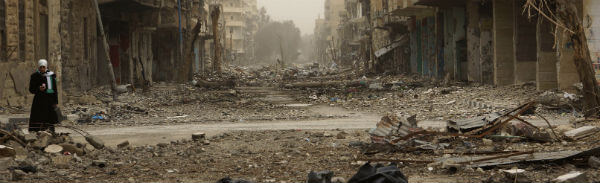
David Axe reports: Russia has ramped up its air war in Syria — big time. And it’s starting to show. Relentless and indiscriminate, Moscow’s bombing runs have devastated military and civilian strongholds and cleared a path for Syrian regime forces to counterattack against ISIS militants and rebels.
Five months after the first Russian warplanes slipped into Syria to reinforce the embattled regime of President Bashar al-Assad, the Kremlin’s air wing near Latakia — on Syria’s Mediterranean coast in the heart of regime territory — has found its rhythm, launching roughly one air strike every 20 minutes targeting Islamic State militants, U.S.-backed rebels and civilians in rebel-controlled areas.
“From Feb. 10 to 16, aircraft of the Russian aviation group in the Syrian Arab Republic have performed 444 combat sorties engaging 1,593 terrorist objects in the provinces of Deir Ez Zor, Daraa, Homs, Hama, Latakia and Aleppo,” the Russian defense ministry claimed in a statement.
That’s double the rate of air strikes that the much larger U.S.-led coalition has managed to sustain in its own, much older campaign against ISIS in Syria and Iraq. Leave out the coalition airstrikes in Iraq, where there are no Russian forces, and the disparity appears even greater. While lately Russia has launched around 60 air raids every day in Syria, the U.S. and its allies have pulled off just seven, on average, since launching their first attacks in Syria in September 2014. [Continue reading…]
Syria Direct reports: Regime forces are battling to reopen their only supply route into Aleppo city and the surrounding countryside, the Ithriya-Khnaser road, after the Islamic State cut if off entirely on Tuesday, local journalists and a rebel commander tell Syria Direct.
The supply road originates in Hama city, runs approximately 100km northeast to Ithriya in the south Aleppo countryside, and continues 110km northwest through Khnaser and into Aleppo city.
As of Tuesday, Islamic State forces control a 35km section of the road between Ithriya and Khnaser, Mujahid Hreitan, a citizen journalist in the southern Aleppo countryside, told Syria Direct Wednesday.
After capturing regime checkpoints along the Khnaser-Ithriya supply route Monday, the Islamic State took full control of Khnaser town on Tuesday, cementing their control over the stretch of road, reported IS’s semi-official news agency Amaq.
IS’s latest campaign is different from previous attempts to cut off the same regime supply route. The Islamic State has now managed to capture the town of Khnaser in its entirety, whereas in the past “IS would take a couple of small areas [along the road] that the regime quickly recaptured,” Ahmed A-Ruwaished, a citizen journalist in the southern Aleppo countryside, told Syria Direct Wednesday. [Continue reading…]
The National reports: The capture of Sheikh Miskeen by president Bashar Al Assad’s forces last month was their most significant victory in years on Syria’s southern front, but for the rebels, the manner of their defeat was more alarming than the loss itself.
Rebel commanders and fighters described a litany of tactical mistakes, logistical confusion and destructive infighting that contributed to the loss of the town in Deraa province. One commander summed up the performance of the rebel alliance as a “major failure”.
The inability of the rebels and their international backers to come up with an answer to Russian air power was a significant factor in the battle, and is likely to prove critical over the coming weeks and months, as the fight for Syria’s south continues. [Continue reading…]
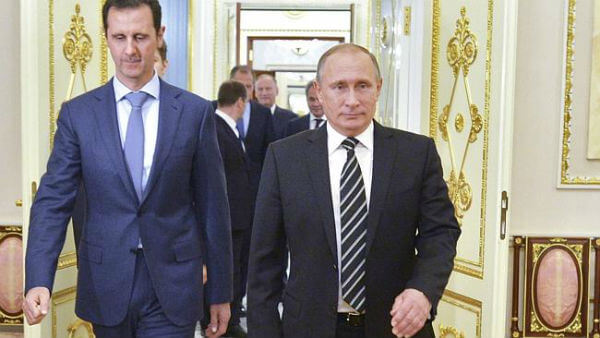
The New York Times reports: The partial truce that Russia and the United States have thrashed out in Syria capped something of a foreign policy trifecta for President Vladimir V. Putin, with the Kremlin strong-arming itself into a pivotal role in the Middle East, Ukraine floundering and the European Union developing cracks like a badly glazed pot.
Beyond what could well be a high point for Mr. Putin, however, lingering questions about Russia’s endgame arise in all three directions.
In Syria, Russia achieved its main goal of shoring up the government of President Bashar al-Assad, long the Kremlin’s foremost Arab ally. Yet its ultimate objectives remain murky, not least navigating a graceful exit from the messy conflict.
In Ukraine, Russia maintains a public commitment to put in place a year-old peace agreement. Renewed fighting in the Russian-backed breakaway regions, however, suggests that Moscow seeks to further destabilize the Kiev government, already wobbly from internal political brawling.
In Europe, Mr. Putin wants to deepen cracks in the European Union, hoping to break the 28-nation consensus behind the economic sanctions imposed on Russia over its annexation of Crimea in 2014. The Kremlin recently cranked up its propaganda machine to malign the German chancellor, Angela Merkel — viewed here as the central figure in the confrontation against Moscow — portraying her as barren and her country as suffering violent indigestion from too many immigrants.
The target audience for these achievements is the Russian populace, partly to distract people from their deepening economic woes.
“On screen we can see that we are so strong, we are so important, we are so great,” Nikolai Petrov, a professor of political science at the Moscow School for Higher Economics, said sarcastically. [Continue reading…]

The Wall Street Journal reports: As world powers struggle to agree on a solution to Syria’s war, a United Nations report points to a paradox it says is hindering peace plans: the same countries pushing for peace are the ones fueling the war.
This ambiguity has radicalized the conflict, raised the political stakes and contributed to civilian suffering, said Paulo Pinheiro, the chairman of the U.N.-backed Independent Syria Commission group in an interview Monday.
“We have said this to the states themselves. We have said it’s better to be fully committed to the political process instead,” said Mr. Pinheiro. “The airspace [above Syria] is overcrowded and it has humanitarian consequences.”
The 31-page report, which laid out a detailed account of a nation at the brink of collapse, is the 11th produced since the commission was formed in 2011 to investigate and document Syria’s war. The report offers a list of recommendations for a lasting peace to Syria’s government, the opposition and the international and regional powers involved directly or through proxy groups. Most of what it has so far recommended has fallen on deaf ears. [Continue reading…]
The Washington Post reports: A picture of a U.S.-made advanced anti-tank missile, apparently in the hands of a group Kurdish forces fighting near the northern Syrian town of Shaddadi, was posted to social media Tuesday.
If confirmed, it would be one of the first documented uses of a FGM-148 Javelin in the war against the Islamic State and a marked escalation in U.S. material being funneled to local groups. [Continue reading…]
Middle East Monitor reports: Until now the Syrian story has been a fabrication of assumptions and sensationalism spun by the media. Burning Country is an attempt to counter this, a chance for real Syrians to tell their own stories. As co-author Robin Yassin-Kassab puts it: “We felt that people had been coming at it from narratives of big stories that zoomed out so far they couldn’t hear the people on the ground that had made the revolution and were suffering the counter-revolution. We wanted to amplify those voices.”
Yassin-Kassab and fellow co-author Leila Al-Shami have weaved together the testimonies of revolutionaries, activists, refugees, fighters, democracy activists, pro-regime Alawites and Islamists with their own analysis to create an account of Syria that takes us back further than Ottoman rule and up to October 2015. Published by Pluto Press this year, the book describes how Al-Assad was once respected for adopting an anti-Zionist, anti-Western and pro-Arab rhetoric and today garners western sympathy for his so-called opposition to US-led imperialism, a position the authors describe as “populist opportunism”.
“I think his rhetoric was very anti-imperialist and that was in line with popular sentiment in the Arab street and I think for that reason he was popular for his foreign policy stance both inside Syria and more broadly around the Arab world,” says Al-Shami. “But that didn’t match up in practice and when you see the actions of the Baathist regime whether they’re under Bashar or his predecessor, his father, they certainly didn’t match that rhetoric. You had the massacres of Palestinians in Tel Zaatar camp in Lebanon, you had the intervention against the Black September movement in Jordan and then under Bashar you had collusion with imperialism because you had people that were basically deported, tortured by proxy, to the Assad regime under the US rendition programme as part of its ‘War on Terror’.”
Though the nationalist rhetoric did work among some sections of the population, Yassin-Kassab explains, most people living in Syria were unhappy under the regime. But prior to 2011 economic stability was more important than foreign policy and Hafez Al-Assad had achieved this stability by building roads and installing electricity in long neglected areas of the countryside and subsidising fuel and food. When Bashar succeeded his father, he retracted many of these benefits. “I think these things were important and when these things were pulled out everybody said, ‘look this nationalist rhetoric which we’ve gone along with is rubbish isn’t it?’ When they got hungry, which is what happened when Bashar Al-Assad came and did these neo-liberal reforms which were really crony-capitalist reforms and removed a lot of the safety nets that had allowed people to keep quiet. I think that’s more important, I don’t think they stayed in power because of the nationalist rhetoric.” [Continue reading…]

The New York Times reports: As alibis go, this one would seem to be airtight: Your honor, my client was only a year old at the time of the crime.
But it did not stop an Egyptian military court from convicting the accused, a boy now 3 ½, of killing three people, carrying guns and firebombs, blocking a road with burning tires, and trying to damage government buildings — and sentencing him to life in prison.
The verdict came last week in a mass trial of 107 people suspected of being members of the outlawed Muslim Brotherhood, and the charges stemmed from the protests, street clashes and police crackdowns in Egypt after the military overthrow of the elected Islamist president, Mohamed Morsi, in 2013. Hundreds of people were killed and thousands were jailed.
After an uproar over the conviction of the boy — Ahmed Mansour Qorani Sharara, who was never arrested — the military said that it was a case of mistaken identity, and that the authorities had actually meant to try a 16-year-old student with the same name. The teenager is on the run, the military added in a post on its official Facebook page.
But that, too, may be a mistake: Before the military statement, a police spokesman, Abu Bakr Abdel-Karim, said in a television interview that the wanted culprit was the toddler’s uncle, a 51-year-old man who has a similar name. [Continue reading…]
Since Catholics make up the largest religious denomination in the U.S. (69.5 million members, which is 22% of the population), it makes sense that their political leanings would be close to the average among Americans of all and no religious affiliations.
Still, since in the media there is a tendency to associate religious with right-wing, it’s worth noting that Catholics lean Democratic rather than Republican — 44% vs. 37% — by exactly the same proportions as do all U.S. adults.
Pew Research breaks down the numbers for all religious groups:



Michael Schulson writes: n the 1970s, a young American anthropologist named Michael Dove set out for Indonesia, intending to solve an ethnographic mystery. Then a graduate student at Stanford, Dove had been reading about the Kantu’, a group of subsistence farmers who live in the tropical forests of Borneo. The Kantu’ practise the kind of shifting agriculture known to anthropologists as swidden farming, and to everyone else as slash-and-burn. Swidden farmers usually grow crops in nutrient-poor soil. They use fire to clear their fields, which they abandon at the end of each growing season.
Like other swidden farmers, the Kantu’ would establish new farming sites ever year in which to grow rice and other crops. Unlike most other swidden farmers, the Kantu’ choose where to place these fields through a ritualised form of birdwatching. They believe that certain species of bird – the Scarlet-rumped Trogon, the Rufous Piculet, and five others – are the sons-in-law of God. The appearances of these birds guide the affairs of human beings. So, in order to select a site for cultivation, a Kantu’ farmer would walk through the forest until he spotted the right combination of omen birds. And there he would clear a field and plant his crops.
Dove figured that the birds must be serving as some kind of ecological indicator. Perhaps they gravitated toward good soil, or smaller trees, or some other useful characteristic of a swidden site. After all, the Kantu’ had been using bird augury for generations, and they hadn’t starved yet. The birds, Dove assumed, had to be telling the Kantu’ something about the land. But neither he, nor any other anthropologist, had any notion of what that something was. [Continue reading…]

The Washington Post reports: A group of scientists says it has now reconstructed the history of the planet’s sea levels arcing back over some 3,000 years — leading it to conclude that the rate of increase experienced in the 20th century was “extremely likely” to have been faster than during nearly the entire period.
“We can say with 95 percent probability that the 20th-century rise was faster than any of the previous 27 centuries,” said Bob Kopp, a climate scientist at Rutgers University who led the research with nine colleagues from several U.S. and global universities. Kopp said it’s not that seas rose faster before that – they probably didn’t – but merely that the ability to say as much with the same level of confidence declines.
The study was published Monday in the Proceedings of the National Academy of Sciences.
Seas rose about 14 centimeters (5.5 inches) from 1900 to 2000, the new study suggests, for a rate of 1.4 millimeters per year. The current rate, according to NASA, is 3.4 millimeters per year, suggesting that sea level rise is still accelerating.
Unsurprisingly, the study blames the anomalous 20th-century rise on global warming — and not just that. It also calculates that, had humans not been warming the planet, there’s very little chance that seas would have risen so much during the century, finding that instead of a 14 centimeter rise, we would have seen somewhere between a 3 centimeter fall and a 7 centimeter rise. [Continue reading…]
Fred Hof writes: In his excellent Black Flags: The Rise of ISIS, Joby Warrick quotes White House wordsmith Benjamin Rhodes as saying, “I think, candidly, that a lot of people have used this debate to position themselves for posterity as being for doing something in Syria when in fact it wouldn’t have made much difference.” Leave aside that the use of the word “candidly” is an indicator that the thought articulated is anything but candid. Leave aside the broad brush nature of the accusation. What is important is not the view of a staffer, but that of his boss. If President Obama thinks that his critics are poseurs and their ideas are all useless, what does it imply about his willingness to correct a disastrous course during the time left to him in the presidency?
Mr. Kerry too is perfectly free to claim that nary a “realistic alternative” has been offered by critics. This critic takes special exception to the claim. What is important, however, is whether or not the President of the United States recognizes that a significant policy shift is required. What is critical is whether or not he is energizing his national security apparatus to produce alternatives for his consideration. If he is satisfied with the present course, if he is at peace with the political implications for allies of Syria emptying itself, and if he is satisfied that mass murder in Syria can go unanswered on the grounds that it is not genocide, then it will likely be up to his successor to stop digging and eventually climb out of the hole. [Continue reading…]
The phrase, surplus powerlessness, comes from Michael Lerner, who in his 1991 book of the same name, defined it this way:
the set of feelings and beliefs that make people think of themselves as even more powerless than the actual power situation requires, and then leads them to act in ways that actually confirm them in their powerlessness.
Lerner describes the shift from idealism to cynicism that has shaped the thinking of so many of our generation — including a president who once in office, traded hope for realism:
The cynical chic that dominates social and political discourse in the 1990s — and which finds its highest expression in the elitist put-downs of all forms of idealism that weekly emanate from The New Republic, national columnists, and television news commentators and analysts — is a defensive compensation for the pain that many people experienced when they found that their unrealistic hopes for total transformation could not immediately be gratified. The tendency of the mass media to foster a desire for immediate gratification of all our desires made many people expect that the minute they could formulate the notion of a very different kind of world, the moment they could see its importance and desirability, they should be able to achieve it without too much struggle. A year or two, perhaps. But if nothing happened that quickly, then perhaps nothing would ever happen, and the very possibility of things changing must be an illusion. How quickly the demand for instant gratification turns revolutionaries into cynics. Suddenly the Saddam Husseins and Mu’ammar Qaddafis, the virulent nationalists of Eastern Europe, the totalitarian oppressors in China, the multinational firms that seem to have little compassion for the communities they uproot or destroy or the ecology they pollute in pursuit of their profits — all seem to be inevitable, as though built into the structure of necessity. All we can do as individuals, we begin to believe, is to become “realistic,” which is to say, to act in the same selfish and self-centered way as everyone else, expecting that anyone who can will hurt us if we don’t get the advantage first.
The power of an American president can be overstated and yet the description — most powerful man on Earth — remains true, even at this time of dwindling American power.
The president might view Syria as though he is no different from the millions of other onlookers who feel powerless to influence events and yet his posture has always involved the exercise of choice.
Some might argue that Obama now serves as a much needed role model in a rare, unappreciated virtue: American humility.
I suspect, however, that the lesson more commonly drawn from his example will be that presidents can’t actually accomplish much. Having fueled hope, he ended up breeding apathy.
Whether that turns out to be the case will likely become evident as the Bernie Sanders campaign advances.
Some of the early signs are not too promising as strong youth support fails to be matched in voter turnout.
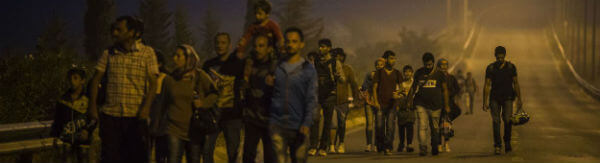
Hugh Eakin writes: In country after country across Europe, the Syrian refugee crisis has put intense pressure on the political establishment. In Poland, voters have brought to power a right-wing party whose leader, Jarosław Kaczyński, warns that migrants are bringing “dangerous diseases” and “various types of parasites” to Europe. In France’s regional elections in December, some Socialist candidates withdrew at the last minute to support the conservatives and prevent the far-right National Front from winning. Even Germany, which took in more than a million asylum-seekers in 2015, has been forced to pull back in the face of a growing revolt from Chancellor Angela Merkel’s own party and the recent New Year’s attacks on women in Cologne, allegedly by groups of men of North African origin.
And then there is Denmark. A small, wealthy Scandinavian democracy of 5.6 million people, it is according to most measures one of the most open and egalitarian countries in the world. It has the highest income equality and one of the lowest poverty rates of any Western nation. Known for its nearly carbon-neutral cities, its free health care and university education for all, its bus drivers who are paid like accountants, its robust defense of gay rights and social freedoms, and its vigorous culture of social and political debate, the country has long been envied as a social-democratic success, a place where the state has an improbably durable record of doing good. Danish leaders also have a history of protecting religious minorities: the country was unique in Nazi-occupied Europe in prosecuting anti-Semitism and rescuing almost its entire Jewish population.
When it comes to refugees, however, Denmark has long led the continent in its shift to the right—and in its growing domestic consensus that large-scale Muslim immigration is incompatible with European social democracy. To the visitor, the country’s resistance to immigrants from Africa and the Middle East can seem implacable. In last June’s Danish national election—months before the Syrian refugee crisis hit Europe—the debate centered around whether the incumbent, center-left Social Democrats or their challengers, the center-right Liberal Party, were tougher on asylum-seekers. The main victor was the Danish People’s Party, a populist, openly anti-immigration party, which drew 21 percent of the vote, its best performance ever. Its founder, Pia Kjærsgaard, for years known for suggesting that Muslims “are at a lower stage of civilization,” is now speaker of the Danish parliament. With the backing of the Danish People’s Party, the center-right Liberals formed a minority government that has taken one of the hardest lines on refugees of any European nation. [Continue reading…]

Olivier Guez writes: Even though radical Islam, mass migrations, Russian revanchism and military interventions are challenges that no European state can meet alone, political sentiments across the Continent are all in the wrong direction. Frightened Europeans retreat into their sovereign little states, propelled by the popular right and xenophobia. In Hungary and Poland, those forces have taken power. By 2017, they may well do so in France, and Britons may have quit Europe altogether. That would leave no nation in a position to take the reins from France or Germany in leading Europe’s imperfect union.
So what comes next? Can we reasonably believe Europe will snap out of it? Will there be a Franco-German turnaround in shamed memory of the slaughter at Verdun 100 years ago? I don’t think so.
It is a matter of leadership. In the 1990s, François Mitterrand and Helmut Kohl, like Adenauer and De Gaulle before them, could work together, in part because they had experienced the ultimate alternative — the horrors of war. But those giants have long left the stage. There exists today neither any guiding program nor true solidarity, and historical memories have grown very short. Ms. Merkel and Mr. Hollande are more than ever focused on their own national conundrums: for France, how to control terrorism; for Germany, how to treat refugees.
What Europe’s heads of state have not done, and simply must begin to do, is prepare their citizens for the one great requirement for progress toward more unity — an enormous leap of faith and optimism, even while in the grip of fear. Instead, they betray their peoples’ fondest dreams by pecking at one another. And even my generation, who were 15 to 20 years old when the Berlin Wall fell, fails to stand up to them and demand that they save the dream we were promised — a Europe finally at permanent peace and working in unison after all the divisions and horrors of the 20th century. [Continue reading…]
Josh Rogin and Eli Lake write: Syrian Kurds are now attacking U.S.-supported rebels, but U.S. officials disagree about whether the Kurds have switched sides — and about whether the U.S. should continue increasing its arms support for them, as opposed to focusing support on Sunni Arab rebels.
Kurdish fighters have taken advantage of the Russian-backed Syrian regime offensives in the north of the country, seizing territory from U.S.-backed rebels who are on the defensive. But factions within the Obama administration disagree about whether the Kurds are simply being opportunistic, or have coordinated their attacks with Russia, Iran and the Syrian regime.
Some administration officials told us that U.S. intelligence has documented meetings between the Kurds’ armed group and officials in the Iranian Revolutionary Guards Quds Force, which has fought alongside the Assad regime against the opposition since 2011. This faction also says the Kurdish group, the YPG, is closely working with the PKK, a Kurdish terrorist organization at war with Turkey. [Continue reading…]
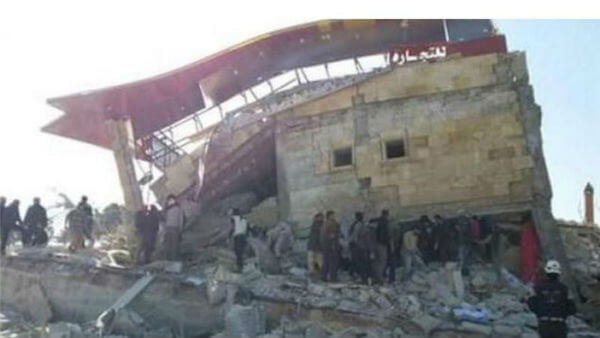
The New York Times reports: First, the government soldiers made sure no food could get into rebel-held towns. Then, government planes bombed what health centers remained in those towns, making sure that those who got sick from hunger had no medical care to save them.
That is the harrowing picture painted by the latest report of the United Nations Commission of Inquiry on the war in Syria. The report, released Monday, chronicles a series of attacks on health care centers by government forces and the Islamic State, and it says the “deliberate destruction of health care infrastructure” was responsible for driving up deaths and permanent disabilities.
To follow the commission’s work in Syria — it has written 11 reports since August 2011 — is to witness how blatantly the laws of war have been broken, with no prospects of accountability.
The commission flatly asserts in the latest report that “war crimes are rampant” by government forces and their armed rivals, and for the first time it sharply points to the very countries that are bargaining over a peace deal for fueling the violence. [Continue reading…]

Julian Sanchez writes: Loudly as the Justice Department protests that this dispute is simply about one particular phone, that’s fairly clearly not the case. Forget other even more dangerous ways Apple could be compelled to use their private key and let’s stay focused on breaking iPhones for the moment. The Manhattan DA’s office alone has at least 175 iPhones that they’d like Apple to help them break into, and DOJ itself has 12 other ongoing lawsuits seeking access to iPhones. Realistically, if Apple loses here — and especially if they lose at the appellate level, which is where this is likely going given Apple’s decision to hire superstar lawyer Ted Olson for the case — they’re going to be fielding thousands of similar demands every year. As a practical matter, they’re going to need a dedicated team dedicated to developing, debugging, testing, customizing, and deploying the code used to brute force passcodes.
Now, when it comes to the Holy Grail of Apple’s security infrastructure — the private key — it’s almost certainly stored in secure vaults, on a Hardware Security Module that makes it difficult or impossible to copy the key itself off that dedicated hardware, and likely protected by elaborate procedures that have to be followed to authenticate major new software releases. If your adversaries realistically include, say, the Chinese and Russian intelligence services — and for Apple, you’d better believe it — it’s a serious enough security problem to guard against exfiltration or use of that Holy Grail private key. Doing the same for a continuously updated and deployed hacking tool is likely to be hugely more difficult. As the company explains:
Apple would do our best to protect that key, but in a world where all of our data is under constant threat, it would be relentlessly attacked by hackers and cybercriminals. As recent attacks on the IRS systems and countless other data breaches have shown, no one is immune to cyberattacks.
The Justice Department might not intend to “set a master key loose on the land” — but the predictable consequence of mandating compliance with requests of this type will be to significantly increase the chance of exactly that occurring. And that’s an increased risk that every individual or enterprise customer relying on iOS devices to secure critical data will need to take into account. [Continue reading…]
In October 2001, the U.S. launched its invasion of Afghanistan largely through proxy Afghan fighters with the help of Special Operations forces, American air power, and CIA dollars. The results were swift and stunning. The Taliban was whipped, a new government headed by Hamid Karzai soon installed in Kabul, and the country declared “liberated.”
More than 14 years later, how’d it go? What’s “liberated” Afghanistan like and, if you were making a list, what would be the accomplishments of Washington all these years later? Hmm… at this very moment, according to the latest reports, the Taliban control more territory than at any moment since December 2001. Meanwhile, the Afghan security forces that the U.S. built up and funded to the tune of more than $65 billion are experiencing “unsustainable” casualties, their ranks evidently filled with “ghost” soldiers and policemen — up to 40% in some places — whose salaries, often paid by the U.S., are being pocketed by their commanders and other officials. In 2015, according to the U.N., Afghan civilian casualties were, for the seventh year in a row, at record levels. Add to all this the fact that American soldiers, their “combat mission” officially concluded in 2014, are now being sent by the hundreds back into the fray (along with the U.S. Air Force) to support hard-pressed Afghan troops in a situation which seems to be fast “deteriorating.”
Oh, and economically speaking, how did the “reconstruction” of the country work out, given that Washington pumped more money (in real dollars) into Afghanistan in these years than it did into the rebuilding of Western Europe after World War II? Leaving aside the pit of official corruption into which many of those dollars disappeared, the country is today hemorrhaging desperate young people who can’t find jobs or make a living and now constitute what may be the second largest contingent of refugees heading for Europe.
As for that list of Washington’s accomplishments, it might be accurate to say that only one thing was “liberated” in Afghanistan over the last 14-plus years and that was, as TomDispatch regular Alfred McCoy points out today, the opium poppy. It might also be said that, with the opium trade now fully embedded in both the operations of the Afghan government and of the Taliban, Washington’s single and singular accomplishment in all its years there has been to oversee the country’s transformation into the planet’s number one narco-state. McCoy, who began his career in the Vietnam War era by writing The Politics of Heroin, a now-classic book on the CIA and the heroin trade (that the Agency tried to suppress) and who has written on the subject of drugs and Afghanistan before for this site, now offers a truly monumental look at opium and the U.S. from the moment this country’s first Afghan War began in 1979 to late last night. Tom Engelhardt
How a pink flower defeated the world’s sole superpower
America’s opium war in Afghanistan
By Alfred W. McCoyAfter fighting the longest war in its history, the United States stands at the brink of defeat in Afghanistan. How can this be possible? How could the world’s sole superpower have battled continuously for 15 years, deploying 100,000 of its finest troops, sacrificing the lives of 2,200 of those soldiers, spending more than a trillion dollars on its military operations, lavishing a record hundred billion more on “nation-building” and “reconstruction,” helping raise, fund, equip, and train an army of 350,000 Afghan allies, and still not be able to pacify one of the world’s most impoverished nations? So dismal is the prospect for stability in Afghanistan in 2016 that the Obama White House has recently cancelled a planned further withdrawal of its forces and will leave an estimated 10,000 troops in the country indefinitely.
Were you to cut through the Gordian knot of complexity that is the Afghan War, you would find that in the American failure there lies the greatest policy paradox of the century: Washington’s massive military juggernaut has been stopped dead in its steel tracks by a pink flower, the opium poppy.

Politico reports: Few of the Adelsons’ associates wanted to be quoted talking about the famously temperamental self-made billionaire, who is known for valuing loyalty and holding grudges. But, with Tuesday’s GOP presidential caucuses in his backyard looming, several expressed concern that Adelson’s hesitance could have long-lasting consequences. Time is running short, they say, for major donors to fund an assault to try to slow the momentum of GOP front-runner Donald Trump.
While Adelson, whose political involvement is largely animated by his support for Israel’s defense, is thought to distrust Trump on the issue, an Adelson adviser suggested his boss had no plans to spend big on behalf of — or against — any candidate in the tumultuous GOP primary.
“I don’t see any involvement until there is a nominee,” the adviser told POLITICO.
If Adelson sticks with that plan — a big “if” given his reputation for writing massive checks with little warning — it could remove a major source of anti-Trump cash and also could hamper Republicans’ general election chances up and down the ballot.
The prospect is a serious source of concern for other Republican megadonors and operatives, who have offered a range of explanations for Adelson’s sudden tightening of his purse strings.
“Nobody knows exactly why he’s still on the sidelines or when he might come off,” said one operative with ties to Adelson, “but the party needs him to get in the game before it’s too late.” [Continue reading…]
In the past, Adelson’s concern has been to back the candidate who he thinks would best serve his interests. His greater interest right now might not be to support the stop-Trump campaign but instead to avoid making Trump his enemy. Both Trump and Adelson operate in a world where loyalty gets rewarded and enemies get punished.