Category Archives: Analysis

Russia oil output hits post-Soviet high

Reuters reports: Russia’s 2014 oil output hit a post-Soviet record high average of 10.58 million barrels per day (bpd), rising by 0.7 percent helped by small non-state producers, Energy Ministry data showed on Friday.

Oil and gas condensate production in December hit 10.67 million bpd, also a record high since the collapse of the Soviet Union.

The data showed Russia’s so-called small producers, mostly privately held, increased their output by 11 percent to just over 1 million barrels per day.

Crude oil exports via state monopoly Transneft fell 5 percent to 195.5 million tonnes due to rising domestic demand and refinery runs.

Exports to China reached a new high of 22.6 million tonnes (452,000 bpd), up 43 percent on the year as Russia seeks to diversify its energy customers. [Continue reading..]

Reuters adds: Iraq’s oil exports hit a record high average of 2.940 million barrels per day (bpd) in December, their highest level since 1980, an oil ministry spokesman said on Friday.

Oil officials said exports from the country’s southern terminals hit a record high 2.760 million bpd.

The ministry spokesman said the average selling price in December was $57 per barrel with revenues reaching $5.247 billion. Revenues for the full year were $84.215 billion, he said.

Facebooktwittermail

Syria deaths hit new high in 2014, observer group says

The New York Times reports: More than 76,000 people died in Syria’s civil war in 2014, including more than 3,500 children, a monitoring group reported on Thursday. The figures would make last year the deadliest in Syria since the conflict began in March 2011.

The figures from the monitoring group, the Syrian Observatory for Human Rights, put the total number of dead in the conflict as of Wednesday at 206,603.

The group, based in Britain, uses a network of contacts inside Syria to tally casualties, and its figures cannot be independently corroborated. The United Nations, which once regularly documented the numbers of dead and wounded in Syria, discontinued the practice some time ago. [Continue reading…]

Facebooktwittermail

Unruly factions hurt Taliban’s bid to capture Afghan hearts, and territory

The New York Times reports: A series of kidnappings and robberies struck northern Helmand Province this summer, paralyzing residents and embarrassing the Taliban leaders who controlled the area.

Responding to growing complaints, the Taliban leadership based in Pakistan ordered a hunt to find the criminals, but soon discovered an inconvenient truth: Their own people were behind the banditry, earning thousands of dollars in ransoms every month. Within a matter of days, the culprits had been captured and executed, including two notorious fighters known as Pickax and Shovel.

Though the episode went largely unnoticed outside the Taliban stronghold, it highlights a question that is on the minds of many: More than 13 years after the war here started, who exactly are the Taliban? Are they the bandits responsible for the abduction and killings of numerous villagers? Or are they the disciplined leaders who hanged the fighters who had taken to criminal tyranny?

Increasingly, it appears, they are both. [Continue reading…]

Facebooktwittermail

Now I understand how and why the Palestinians lost Palestine

Ghazi Hamad, deputy foreign minister of Hamas, recently wrote an op-ed in Arabic appearing on Arabic websites and which has now been translated into English and published with his permission by the Times of Israel: I was very hesitant before I wrote this “harsh” title. I erased it time after time and rewrote it. But every time I reread the article, the title jumps to my mind and drags me towards it.

The title hit me while I was attending a meeting of some political powers. I was listening to them talk for more than three hours and it seemed futile, lost, insipid.

It was not the first meeting I left feeling aggravated. I had previously taken part in discussions, be it bilateral between Hamas and Fatah or “national” dialogue that brings everyone together. I attended tens of conferences, seminars and workshops for “brainstorming.” But this time a profound sadness overcame me and feelings began to consume me. What are they saying? What are they doing? What time are they wasting? What world are they living in? Suddenly, a thought popped into my mind, unbidden: Now do you understand why Palestine is lost?

It was dangerous, frightening and scary. I no longer have any doubt that these sterile seminars and workshops that were repeated a thousand times, were nothing but blabbering, rumination of the past and fleeing from facing the facts.

I recalled many of these summits, agreements and understandings that have been signed since 1993 until the Shati Agreement in 2014… they passed in a moment and disappeared.

It seemed to me that we had lost dozens of years in haggling, disagreements and differences over texts that did not bring us anything but more resentment and fragmented, failed solutions. And because of the devolvement of these issues, I look at where we have arrived after a twenty year political process of failure and searching for success on paper, and I look at the state of the Palestinian Authority (PA) in terms of its weakness and attenuation, and I look at the political and societal division and how our divisions have sharpened until it became an indispensable tradition?

What calamity did the Palestinians create by themselves for themselves?

We have always held the Arab regimes responsible for the loss of Palestine, which is an indisputable matter, and have equally faulted the Western regimes for their collusion and unlimited support for Israel… But what is our share in bearing responsibility? [Continue reading…]

Facebooktwittermail

Joining International Criminal Court wouldn’t guarantee Palestinians a war crimes case

The New York Times reports: The political fallout from the Palestinian move Wednesday to join the International Criminal Court is likely to be swift and profound.

Israel is expected to withhold tax transfers to the Palestinian Authority, restrict officials’ travel and possibly advance settlement activity in sensitive spots in the West Bank. The United States Congress may cut off $400 million in aid to the Palestinians. The already dim prospects for renewing peace talks now seem null.

But legal repercussions from last summer’s war between Israel and Palestinian militants in the Gaza Strip, or Israel’s settlements, would take longer and face many hurdles.

The cases Palestinians plan to bring against Israel, and potential counterclaims against Palestinian officials, are unlike any the International Criminal Court has tackled in its dozen-year history. The Hague court, facing new scrutiny after the collapse last month of its case against the president of Kenya, may be wary of wading into the fraught politics of the Middle East, though doing so could help it rebuff longstanding criticism of its emphasis on pursuing African despots.

“It may jump at the chance because it’s under fire,” Geoffrey Robertson, a British lawyer and author, said of the court, which he follows closely. “This is an opportunity to get out of the endless African wars and to do something which is very much in the public eye, and very much of public importance,” he added. “It would be a new and possibly productive way to deal with the cloudy legalities.” [Continue reading…]

Facebooktwittermail

The brothers who ambushed ISIS

Mohammed A. Salih reports: It was a sunny day in late November when Ahmed Ismael, 22, went with a group of seven other fighters to ambush militants from the self-proclaimed Islamic State, or ISIS, on the eastern flank of this besieged town.

Then the plan went terribly wrong. The would-be ambushers were themselves ambushed. Two car bombs exploded and a group of jihadists blocked their way from behind, cutting off their exit route. During the intense firefight that followed, four Kurdish fighters died, including three of Ahmed’s cousins.

“They had heavy weapons but we only had AK-47s,” says Ahmed, his voice still shaky as he recounts the details. “It was my first real fight. We stayed there for four hours. We ran out of ammunition. I was next to my cousins when they died.”

As the fight raged on, Ahmed and the three women fighters who were part of the mission, sent out calls for help. Finally, a squad of reinforcements arrived and they were able to retreat.

Since then, there have been many other skirmishes, so many that war has come to seem a ways of life for Ahmed and his older brother Nusin. But neither had ever thought before that they were destined to become fighters. They had led a quiet life in this otherwise rural and peripheral town in northern Syria that, until a few months ago, few people had ever heard of outside the region. They were carpenters making chairs, beds and other rudimentary pieces of furniture for the locals.

But when the jihadists from ISIS launched a large-scale assault on Kobani in September, the two brothers had to make a choice. “We wondered what to do,” says 24-year-old Nushin. “We sent our family to Turkey,” he says, “But this is our town. The two of us did not want to leave. Where could we go? We decided to stay here and defend our home.” [Continue reading…]

Facebooktwittermail

Vanguard of Syria’s uprising, now on the run from ISIS, weighs a bleak future

The New York Times reports: The cigarette smoke in the hotel room grew as thick as the cottony fog outside in this Turkish border town, as Syrian men, night after night, told their war stories. Their memories veered from exhilaration to black humor to terror, but mostly they told of what they had lost: Friends. A fiancée. An arm. A country. None were out of their mid-20s.

Three were insurgents, or had been. One had helped capture an army tank; another had hidden in tall grass as tank fire killed his raiding party. They told of abandoning one insurgent group after another, finding commanders too violent, too corrupt, too disorganized, too pious, not pious enough.

Three others, civilian antigovernment activists who broadcast war news on social media, were on the run from Islamic State extremists. For them, the fog was a comfort, shrouding their movements as they drove to the hotel. They had trekked for days from the remote Syrian provincial capital of Deir al-Zour, holding their breath at Islamic State checkpoints, hoping to find safety here in southern Turkey.

But they still felt hunted, sure that the group had eyes and ears everywhere, among bearded strangers in Syrian-run cafes or in hotels welcoming foreign fighters. They did not tell friends where they were staying, and they did not know when or whether they could go home.

Not long ago, these men would have felt secure here. Early in the Syrian conflict Antakya, long a sleepy provincial town, became the high-octane hub of an insurgency that thought it was winning. Back then, young fighters and activists, including some of those recently huddling in the hotel room, filled cafes to brainstorm, dreaming of new power and new freedoms.

But some of those flocking to Antakya would later become their enemies. The city was becoming a way station for foreign jihadists, who spent lavishly, even spurring a market for Taliban-style dress. They ultimately transformed Syria’s battlefield, many of them coalescing into the radical Islamic State group, which routed or co-opted other insurgents and shifted the West’s focus from ousting President Bashar al-Assad to countering the extremist group’s momentum. Now, the group has turned violently against any Assad opponents who fail to flock to its banner — like the young men in the hotel room.

Those men are part of what is looming as a lost generation of young Syrians. They are marooned in southern Turkey, unsure how to envision their future, and their hopes are deflating as rapidly as Antakya’s wartime boom. [Continue reading…]

Facebooktwittermail

Tropical forests soak up much more carbon than we thought

Motherboard reports: Another reason to be grateful for Earth’s tropical forests: Not only do they r​elease massive quantities of oxygen, creating a pleasantly breathable atmosphere, not only do they harbor over half​ the planet’s biodiversity, they’re also doing a bang-up job mopping up all that extra carbon we’ve been pouring into the atmosphere.

That’s the conclusion of a new​ study led by researchers at NASA and the National Center for Atmospheric Research, which finds tropical forests may be absorbing far more human-emitted carbon dioxide than we thought. To wit, some 1.4 billion metric tons of CO2 annually—roughly the same amount of carbon that’s emitted every year as we slash and burn our way through them.

“This is good news, because uptake in northern forests may already be slowing, while tropical forests may continue to take up carbon for many years,” said lead study author David Schimel in a press re​lease.

By pumping carbon into the atmosphere, we’re not just warming the planet directly, we’re setting in motion a number of different “feedback” cycles. Some of these feedbacks — methane release due to permafrost melting, for instance — accelerate climate change. But our CO2 emissions also stimulate plants to grow and suck down more carbon, a negative feedback known as the “fertilization” effect.

The CO2 fertilization effect has been known for decades, but actual data on the effect is spotty, and comes from a range of sources that aren’t necessarily comparable: ecosystem and atmospheric models, satellite images, experimental plots and so forth. And while in theory, the effect should be greater in warmer climates—plant growth depends on temperature as well as CO2—most atmospheric models have observed stronger CO2 fertilization at high latitudes. [Continue reading…]

Facebooktwittermail

The story of one of the Cold War’s greatest unsolved mysteries — and the new effort to solve it

Ishaan Tharoor writes: Around midnight on Sept. 18, 1961, a plane carrying U.N. Secretary General Dag Hammarskjold crashed nine miles from its intended destination, the town of Ndola in Northern Rhodesia, now the independent republic of Zambia. The 56-year-old Swede and 15 other people aboard the aircraft perished.

According to one account, Hammarskjold’s body was found in the forest near the wreckage. He was “lying on his back, propped up against an ant hill, immaculately dressed as always, in neatly pressed trousers and a white shirt with cuff links.” Hammarskjold is the only U.N. secretary general to have died while in office.

At the time, both the governments of Sweden and Northern Rhodesia claimed the incident was the result of pilot error. There was little evidence to be gleaned from the flight’s sole survivor, an American sergeant who, before succumbing to his injuries, had said the plane experienced a series of explosions. A U.N. investigation the following year yielded no clear conclusion. It downplayed testimony from local villagers that a smaller, second aircraft may have shot down the plane.

Not surprisingly, the circumstances of Hammarskjold’s death have always carried a suspicion of foul play. The Swedish diplomat was to meet with representatives from a breakaway state in the Congo — a mineral-rich, fledgling nation that was coveted still by outside powers. There were many parties, even some in the United States, who perhaps did not want to see Hammarskjold’s peace mission bear fruit.

On Monday, the U.N. General Assembly unanimously approved a motion asking current Secretary General Ban Ki-moon to appoint an independent panel of experts to investigate new evidence that has come to light regarding the 1961 plane crash. [Continue reading…]

Facebooktwittermail

Broadcasting violence

Jeff Sparrow writes: What we would now call the anarchist terrorism of the 1890s has been largely forgotten. Yet in no other period have as many heads of state been murdered as during that brief spate of time, with Sadi Carnot, president of France, killed in 1894; Antonio Cánovas, prime minister of Spain killed in 1897; the Empress Elizabeth of Austria in 1898; King Humbert of Italy in 1900; and US President William McKinley in 1901.

The assassinations of political leaders were accompanied by other, less discriminate attacks, such as the bombing of Paris’ Chamber of Deputies in 1893 and the Café Terminus in 1894, and then, most bloodily, the explosion at the Barcelona religious procession in 1906 that killed 23 people.

Politically, the ideas of the anarchist bombers could not have been more different from those of today’s jihadis. For one thing, most of them were avowed atheists.

The Frenchman Ravachol, perhaps the most famous of the dynamitards, inspired a popular song (with the chorus: “Long live the sound of the explosion!”) after he threw an “infernal machine” at a judge notorious for his treatment of political prisoners. On the way to the guillotine, Ravachol chanted: “To be happy, God damn it, you have to kill those who own property! To be happy, God damn it, you must cut the priests in two!”

Later, when Emile Henry, an admirer of Ravachol, tossed dynamite into a fashionable restaurant, a prosecutor wondered how he justified killing random patrons.

“We will not spare the women and children of the bourgeois,” Henry snapped, “for the women and children of those we love have not been spared.”

The resemblance between that sentiment and the justification given by the Pakistani Taliban for school massacres (“If our women and children die as martyrs, your children will not escape,” explained Taliban leader Umar Mansoor) should give pause to those who understand contemporary terrorism as specifically Islamic or solely religious.

The scholar Richard Jensen reminds us that the “age of of anarchist terrorism coincided with the beginning of the age of mass journalism”. [Continue reading…]

Facebooktwittermail

More civilians killed in Syria since 2011 than British civilians killed in World War Two

London during The Blitz, December 1940.

NFZSyria reports: For the entire conflict, the Violations Documentation Center in Syria has recorded 78,867 civilians killed to date, greater than the recorded number of British civilians killed in the Second World War.

The VDC is unable to record all violent deaths. By comparing their numbers to the UN’s most recent minimum count, it appears the true figure of civilians violently killed in Syria since March 2011 may well be over 137,000. All violent deaths, civilian and military, are now well over 200,000.

The UN’s minimum count of 191,369 violent deaths to the end of April 2014 was greater than Iraq Body Count’s number for total violent deaths in Iraq in the ten years from 2003 to 2013: 174,000 including combatants. [Continue reading…]

Facebooktwittermail

Syria year-end predictions and analysis by Joshua Landis

Joshua Landis writes: Syria will become increasingly fragmented in 2015. The Somalia-ization of the country is inevitable so long as the international community degrades all centers of power in Syria and the opposition fails to unite.

Who owns what?

The four strongest authorities in Syria are the Assad government, ISIS, Nusra, and the Kurds. They rule close to 95% of Syrian territory. The Assad government rules 45% of the land and perhaps 65% of the population, give or take. ISIS rules 35%, but controls less than 3 million people. Kurds may control about 8% or 9% of Syria and Nusra another 5%. This leaves the hundreds of additional militias controlling the remaining 5%, but in some areas “No FSA faction can operate without Nusra’s approval.” Jihadis prevailed in 2014.


Thanks to @deSyracuse for his maps. Click on it to go to his site and use interactive features

All authorities will become weaker, with the possible exception of the Kurds. The United States is at war with all important Arab factions. It is actively bombing ISIS and Nusra, while sanctioning Assad. Although Washington has been funding a “train and equip” project to the tune of half a billion dollars, it appears to have neither urgency nor teeth. Coalition forces are divided on objectives. This means that all centers of authority in Syria are being degraded while none are being built up. It means no one can win. The Assad regime, ISIS, and Nusra are all likely to see their power diminish over the coming year. The FSA militias have become practically irrelevant and must take orders from the radicals. The educated and worldly activists who played such a vital role in launching the revolution have been pushed aside and are today without influence. One can interpret this either as: a) Liberals and democrats in Syria were such a small elite that they were quickly swept aside by the tide of sectarians, fascists, and Islamists; or B) Assad intentionally destroyed the liberals and moderates so that he would face only extremists, leaving the world to face an either-or choice: Assad or al-Qaida. The reality is probably a measure of both.

The Assad government strengthened its control over major cities, while losing control over rural areas. It gained ground in the Damascus suburbs, Kalamoun, Homs and Aleppo, but it lost territory in others, such as Idlib, the Golan, Deraa and the Jazira. This strategy reveals Assad’s urban bias. He believes he can regain the support of the urban middle classes who fear the radicalized and poorer country-folk. The Baath originally relied on rural support against the cities. But as it went bankrupt and turned away from subsidies and socialism toward neo-liberal policies mixed with a heavy dose of corruption, it turned its back on the urban poor and struggling countryside. Today the regime is trying to turn the rich against the poor in an effort to convince them that the revolution was a pipe-dream and that they must fight “terrorism.” Collapsing oil revenues in Iran and Russia mean that Assad will have to suffer with less money in 2015. But so too will the rebels because they are as reliant on oil money as the regime. All incomes will take a nosedive. Ninety percent of Syrians live below the poverty line, according to the UN. But poverty can get worse. [Continue reading…]

Facebooktwittermail

The Intercept and others fall for a hoax Sony hacker ‘threat’

The Daily Mail reports: A hacking threat against CNN that rose to the FBI attention is actually a hoax, claims a freelance writer from Tennessee who is claiming responsibility for the post.

David Garrett Jr., from Nashville, says he we the one who posted to the anonymous site ‘pastebin’ claiming to be Sony hackers the ‘Guardians of Peace.’ It included the bizarre demand that CNN should turn over anchor Wolf Blitzer.

It is believed that the FBI issued a Joint Intelligence Bulletin based on that post that warned CNN and other media companies that hack attacks could be in the works.

Mr Garrett, who rights[sic] about security issues for Examiner.com, revealed himself on Twitter today after news media organizations, including Daily Mail Online, picked up the story about the FBI warning.

‘My fake pastbin post is being investigated by the FBI. I wrote for CNN to “give us the Wolf” and the FBI is actually taking it as a threat,’ he tweeted.

‘It was a joke. And to show that no one investigates anything. Everything is rumors. I had no idea it would be taken seriously.’

Judith Miller applauded The Intercept:


At this time The Intercept has so far failed to correct or update its original report:

intercept-hoaxed

Facebooktwittermail

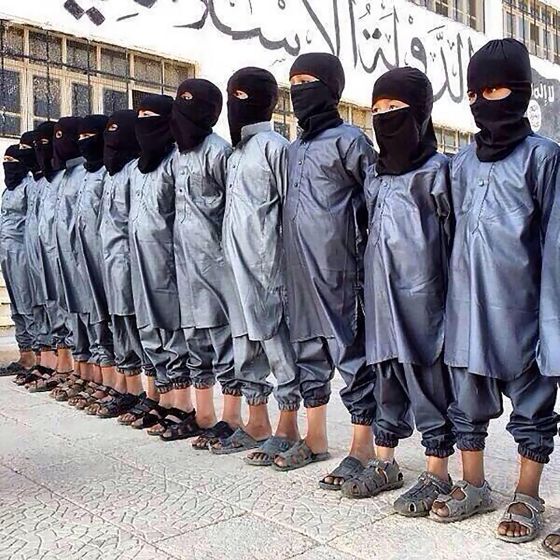
A war against childhood

isis-children

The Wall Street Journal reports: Jomah, a 17-year-old Syrian who joined Islamic State last year, sat in a circle of trainees for a lesson in beheading, a course taught to boys as young as 8.

Teachers brought in three frightened Syrian soldiers, who were jeered and forced to their knees. “It was like learning to chop an onion,” Jomah said. “You grab him by the forehead and then slowly slice across the neck.”

A teacher asked for volunteers and said, “Those who behead the infidels will receive gifts from God,” recalled Jomah, who didn’t want his full name revealed. The youngest boys shot up their hands and several were chosen to participate. Afterward, the teachers ordered the students to pass around the severed heads.

“I’d become desensitized by that time,” said Jomah, who has since defected to Turkey with his family. “The beheading videos they’d shown us helped.”

The enrollment of hundreds of boys in such militant training camps is another tragic facet of Syria’s nearly four-year-long civil war — and its impact could trouble the Middle East for years to come. Parents worry their boys will be forever lost to the indoctrination of Islamic State. [Continue reading…]

A TSG IntelBrief concludes:
• Through systemic indoctrination, intimidation, and extermination, violent extremist groups such as the Islamic State, Boko Haram, and both Afghan and Pakistan Taliban, are targeting children with unprecedented ferocity

• Children are no longer accidental casualties in extremist conflicts but rather they are a primary target

• Extremists are trying to steal the future away from vulnerable regions by stealing the future generation through relentless messaging and violence that separates the youth from their society, government, and culture

• The damage already done by the Syrian civil war, the Islamic State, Boko Haram, and violent extremist groups in in Pakistan pales in comparison to what is yet to come if even a small percentage of their focus on youth pays off.

In the midst of pervasive war-weariness and deeply felt opposition to military intervention following the war in Iraq, social media has not only desensitized children living under ISIS’s rule, serving as a primer on brutality, but it has also desensitized opponents of war.

Images which provoke instinctive revulsion, trigger a desire not only to look away, but also turn away in every way possible, such that both ISIS and those who have become its victims can be cloaked in otherness.

When we see children in masks, it’s easier to see the masks than see the children.

Paradoxically, among the many who readily acknowledge that ISIS came into existence primarily as a result of the war in Iraq and that in this sense, ISIS is an American creation, far fewer are willing to admit that the U.S. has a huge responsibility in now trying to thwart the monster that it unwittingly released.

At the same time, even if we acknowledge that we are part-owners of the problem, no one will be served well by casting America in its traditional self-ascribed role as rescuer.

Now, as has long been the case, the U.S. needs to break out of its bipolar relationship with the rest of the world, neither seeking to dominate, nor retreat.

Facebooktwittermail

Backlash in Berlin over NSA spying recedes as threat from ISIS rises

The Washington Post reports: In a crescendo of anger over American espionage, Germany expelled the CIA’s top operative, launched an investigation of the vast U.S. surveillance programs exposed by Edward Snowden and extracted an apology from President Obama for the years that U.S. spies had reportedly spent monitoring German Chancellor Angela Merkel’s cellphone.

In an address to Parliament last year, Merkel warned that U.S.-German cooperation would be curtailed and declared that “trust needs to be rebuilt.”

But the cooperation never really stopped. The public backlash over Snowden often obscured a more complicated reality for Germany and other aggrieved U.S. allies. They may be dismayed by the omnivorous nature of the intelligence apparatus the United States has built since the Sept. 11, 2001, attacks, but they are also deeply dependent on it.

Over the past year, Germany has secretly provided detailed information to U.S. spy services on hundreds of German citizens and legal residents suspected of having joined insurgent groups in Syria and Iraq, U.S. and German officials said.

Germany has done so reluctantly to enlist U.S. help in tracking departed fighters, determining whether they have joined al-Qaeda or the Islamic State and, perhaps most importantly, whether they might seek to bring those groups’ violent agendas back to Germany.

The stream of information includes names, cellphone numbers, e-mail addresses and other sensitive data that German security services — ever mindful of the abuses by the Nazi and Stasi secret police — have been reluctant even to collect, let alone turn over to a suspect ally. [Continue reading…]

Facebooktwittermail

U.S. troops return to Iraq to train force to fight ISIS

The New York Times reports: The United States has begun training a first wave of Iraqi Army recruits, in recent days putting them through morning fitness exercises and instructing them in marksmanship and infantry tactics, in an effort to gather enough forces to mount a spring offensive against the extremists of the Islamic State.

Military officials here say the first of the American-trained recruits, who answered the call to arms by Iraqi religious leaders over the summer and have completed some basic training under the Iraqis, will be ready to join the fight against the Islamic State, also known as ISIS or ISIL, by mid-February. Pushing forward, officials say the goal is to train 5,000 new recruits every six weeks.

“These are new patriots of Iraq, that have actually signed up, have been through basic training and are now ready to go through some advanced training,” said Maj. Gen. Paul E. Funk II, the American commander who is overseeing the training program.

More than six months after the Islamic State’s lightning advance through northern Iraq forced a reluctant President Obama to order a new United States military mission here, an American training program for the Iraqi security forces has begun to take shape. In recent days, the first recruits, about 1,600 men in four battalions, have been received by American instructors at Camp Taji, a base north of Baghdad. Others have begun arriving at Al Asad Air Base in Anbar Province, joining roughly 200 American Marines and Special Forces soldiers.

The American presence in Iraq is expected to grow in the coming weeks, to more than 3,000 personnel from about 1,800. The American military already has a presence in Baghdad and Erbil, the Kurdish capital in the north, and has plans for two more training sites: one for Special Forces in Baghdad and another in Besmaya, south of the capital. [Continue reading…]

Facebooktwittermail

Shi’ite militias expand influence, redraw map in central Iraq

Reuters reports: Behind black gates and high walls, Iraqi national security agents watch 200 women and children.

Boys and girls play in the yard and then dart inside their trailers, located in a former U.S. military camp and onetime headquarters for Saddam Hussein’s officials in Babel province’s capital Hilla.

The women and children are unwilling guests, rounded up as they fled with their male relatives in October from Jurf al-Sakhr, a bastion of Islamic State, during a Shi’ite militia and military operation to clear the farming community.

Once they were arrested, security forces separated out the men, accusing them of being Islamic State fighters. They have not been heard from since.

Security forces say the women and children are being investigated, but have not been brought to court.

Their status shows how central Iraq’s mixed Shi’ite and Sunni regions are being altered.

As Shi’ite forces push into territories held by Islamic State, many Sunnis have fled for fear of both the Shi’ite-led government and the Sunni jihadists.

Shi’ite leaders insist Islamic State must never be allowed to strike them again, nor return to areas now abandoned.

Shi’ite groups now decide who can stay in a community and who should leave; whose houses should be destroyed and whose can stand. [Continue reading…]

Facebooktwittermail