Category Archives: Analysis

What drives Westerners to join the jihadist fight?

New Scientist: It’s a question being asked around the world. How can you stem the flow of foreign jihadis making their way to Syria and Iraq? As New Scientist went to press, politicians on both sides of the Atlantic were finalising their game plans to tackle the rise of Sunni jihadist group Islamic State, but the issue of homegrown fighters won’t be far from their minds.

The answers will be based partly on research that a handful of counter-terrorism scientists have carried out since 9/11. But piecing together the mindset of a jihadi hasn’t been easy because of a scarcity of field data, which means that much foreign policy, and media coverage, is underpinned by speculation rather than hard data. In recent months, several researchers have called on the US government to allow academics access to intelligence data, such as intercepted communications and transcripts of interviews, to help them understand how fighters become radicalised.

Despite the shortage of first-hand material, some things seem clear. For instance, the idea that hundreds of British and other European Muslims fighting for IS were brainwashed or coerced by jihadist recruiters into joining is almost certainly wrong.

Those who study terrorist behaviour claim that the vast majority of fighters originating in the West are radicalised at home, influenced largely by their own circle of friends. “The brainwashing theory is baloney,” says Scott Atran of France’s National Centre for Scientific Research in Paris. This is more about “young people hooking up with their friends and going on a glorious mission”.

Evidence collected by the International Centre for the Study of Radicalisation (ICSR) at King’s College London supports this view. The ICSR has been following about 450 foreign fighters in Syria and Iraq, communicating with dozens of them through social media tools such as Facebook and WhatsApp and conducting interviews on the Syrian border. It estimates that 80-85 per cent of them mobilised with their peer group. [Continue reading…]

Facebooktwittermail

The criminal shape of terror to come

Christopher Dickey writes: He is the very model of a modern ISIS terrorist: not very smart, not very religious, certainly sadistic, hugely egotistical, a minor criminal most of his life who’s looking to kill whoever he can whenever he can to make a name for himself. The territories now held by the so-called Islamic State (aka ISIS or ISIL) were his training ground but not his battleground: He was a jailor alternately torturing Western hostages and singing to them. But his sights were set on bigger Western targets. And he became such a loose Kalashnikov that, in the view of some European counterterrorism experts, even ISIS wanted to be rid of him.

Mehdi-NemmoucheSuch a man, according to his victims and his prosecutors, is 29-year-old Mehdi Nemmouche. On May 24, the young Frenchman allegedly walked into a Jewish museum in Brussels and killed four people.

At the time, before ISIS had conquered Mosul, the second-largest city in Iraq, the attack evoked outrage but not hysteria. Today, amid the furor created by the realization that ISIS is redrawing the map of the Middle East, and after the horror evoked by the beheadings of American journalists James Foley and Steven Sotloff, such an attack would have much more dramatic repercussions.

Over the weekend the French press published reports, unconfirmed, that when Nemmouche acted as one of the jailors for French hostages held in Syria in 2013, and possibly for the Americans James Foley and Steven Sotloff, as well, he bragged about ambitious plans to attack the July 14 Bastille Day parade in Paris.

There are many reasons to worry that ISIS will, at some point, try to carry out a major terrorist attack in Europe or the United States. (It will claim it was forced to do so by the American bombing campaigns, just as it says it was forced to behead American journalists James Foley and Steven Sotloff.) But the immediate risk is from disorganized, undisciplined, and nonetheless very deadly characters who want to see their names go down in their own half-assed version of history.

Maybe like Nemmouche they’ve spent some “jihad tourism” time in Syria or Iraq—many hundreds of Europeans and a substantial number of Americans are believed to have done so. Or perhaps they’ve only been “inspired” by ISIS from afar. All can claim the black banner of “the Caliphate,” and in the emotionally fraught environment of today, a little terrorism goes a long way.

When President Barack Obama addresses the nation on Wednesday, not the least of his goals will be to rein in the rampant rhetoric surrounding ISIS. But it won’t be easy. Obama would rather talk about “managing” ISIL than “destroying” or “defeating” it—words he has used but with obvious reluctance. In classic Obama fashion, he wants to keep his options open, only to discover he’s lost control of the narrative altogether.

Veteran terrorism expert Brian Jenkins notes the alarmism in Washington has reached such proportions, there’s a kind of “shock and awe in reverse.” Thus, as Jenkins writes, Defense Secretary Chuck Hagel proclaims ISIS is an “imminent threat to every interest we have.” A congressional staffer argues that it is “highly probable ISIS will…obtain nuclear, chemical, biological or other weapons of mass death…to use in attacks against New York [or] Washington.” Texas Governor Rick Perry claims there is a “very real possibility” that ISIS forces may have crossed the U.S.-Mexican border. Senator James Inhofe asserted, “We are in the most dangerous position we’ve ever been in as a nation,” and retired Marine four-star Gen. John Allen goes so far as to say, “World War III is at hand.” [Continue reading…]

Facebooktwittermail

ISIS will not be beaten by a kneejerk reaction from the West

Jane Kinninmont writes: Isis’s viciousness makes it all too easy to portray the group as an evil force that has come out of the blue, which could be defeated by decisive western military action. But it is essential to remember the recent history of Iraq and Syria, and the west’s involvement there, and to understand the factors that have enabled the group to expand from a few thousand extremists to a wealthy movement controlling swaths of territory.

There are two factors. The first is the chronic deficit of government legitimacy in Iraq and Syria, where systematically marginalised and excluded people create a supportive environment for radical groups promising change. The second is the brutality of recent politics in both those countries, which has been fuelled by regional and international proxy wars and by decades of coalition of support from disaffected tribes and de-facto disenfranchised Iraqi Sunnis. Outgoing prime minister Nouri al-Maliki bears much of the blame for this; Iraq’s Sunni tribes were his best ally against al-Qaida militants, but he squandered this by treating them as terrorists and locking up their sons.

But pinning all the blame on Maliki conveniently absolves the US and UK of responsibility for helping to create a political system where violence and sectarianism are the usual mechanisms for staying in power. Over the past 30 years, the west first supported and armed a genocidal dictator, then crippled the country with sanctions that failed to remove him, then invaded the country and dismantled the state and army. After 2003, the US and UK helped design a system of sectarian “power-sharing” where “power-sharing” means carving up government ministries – made extremely lucrative by raging corruption – between a tiny elite drawn from each ethnicity and sect.

Meanwhile, anti-western sentiment has been spiralling in Syria, not only among supporters of the government, but among the opposition. By saying Assad had to go, the west promised them change, but it did not stop Assad staying in power and killing many thousands of people. Western policymakers may doubt their capacity to resolve the crisis, but in the region, where the US in particular is seen as incredibly powerful, people simply think it lacked the will. [Continue reading…]

Facebooktwittermail

Anjem Choudary: The British extremist who backs the caliphate

The Observer reports: Anjem Choudary is well practised in the art of making contentious or provocative statements. An acolyte of the extremist cleric Omar Bakri Muhammed, who fled the UK for Lebanon, the 47-year-old former lawyer was a founding member of Al-Muhajiroun, which celebrated the 9/11 attacks, and was proscribed along with several other groups that Choudary has fronted, including Islam4UK.

So it’s no surprise that when I spoke to him last week he dismissed all allegations of Islamic State (Isis) atrocities, defended the use of crucifixion, and acknowledged Isis leader Abu Bakr al-Baghdadi as “the caliph of all Muslims and the prince of the believers”.

Because of his large claims and small following, Choudary has often been derided, not least by fellow Muslims, as a joke figure of no significance. Yet he is known to have had links with a number of people convicted under anti-terrorism laws, as well as the killer of Lee Rigby, Michael Adebolajo.

His views may be unpalatable but, with as many as several hundred British-born Muslims thought to be fighting in Syria and Iraq with Isis and other jihadi groups, they cannot be ignored. Some reports suggest that many of the British jihadis want to return home, having grown disillusioned with the internecine warfare between rebel forces – which prompts the question of what or who inspired them to go in the first place. [Continue reading…]

Facebooktwittermail

Failure in Gaza

Assaf Sharon writes: The Israeli-Palestinian conflict has long ago become a shouting match over moral superiority. With seventy Israelis and more than two thousand Palestinians, most of them civilians, dead, the latest round of violence in Gaza, too, is being analyzed and discussed mostly on ethical grounds. But as fighting goes on, moral condemnation will likely do little to prevent the next round. Understanding how we got to this point — and, more importantly, how we can move beyond it — calls for an examination of the political events that led up to the operation and the political context in which it took place.

In Israel, endless controversy over Gaza has overlooked one question: How did we get here in the first place? Why, after a considerable period of relative calm, did Hamas resume rocket fire into Israel?

Before the current operation began, Hamas was at one of the lowest points in its history. Its alliance with Syria and Iran, its two main sources of support, had grown weak. Hamas’s ideological and political affinity with the Muslim Brotherhood turned from an asset into a burden, with the downfall of the Brotherhood in Egypt and the rise of its fierce opponent, General Abdel Fatah el-Sisi. Egypt’s closure of the Rafah crossing and the tunnels on its border with Gaza undermined Hamas’s economic infrastructure. In these circumstances, Hamas agreed last April to reconciliation with its political rival Fatah, based on Fatah’s terms. For example, the agreement called for a government of technocrats largely under the control of the Palestinian Authority led by Mahmoud Abbas.

But Benjamin Netanyahu viewed the reconciliation as a threat rather than an opportunity. While the separation of Gaza from the West Bank may not serve Israel’s interest (namely, effective government in the Palestinian Territories), it benefits Netanyahu’s policy of rejecting solutions that would lead to a separate Palestinian state. The reconciliation agreement robbed him of the claim that in the absence of effective rule over Gaza, there is no point in striking a deal with Abbas. [Continue reading…]

Facebooktwittermail

As ISIS advances in Syria, Israel tightens its grip on the Golan Heights

The Economist: IS’s advance is prompting the 20,000 Druze who inhabit the Golan Heights, alongside a similar number of Israelis, to shift their allegiance. For decades under Israeli occupation they professed their loyalty to Syria. But now, as adherents of an esoteric offshoot of Islam that IS and Jabhat al-Nusra excoriate, they are quietly loosening their ties to Syria. They have stopped exporting their apples there—and their brides. Druze applications for Israeli citizenship have risen sharply, says the Israeli-appointed mayor of Majdal Shams, the biggest of the four Druze towns. Many Druze now look to Israel (and particularly to its Israeli Druze soldiers stationed on the heights) to protect their secular world, where women walk and drive their cars unveiled.

This raises the hopes of those in Israel’s hawkish government who want to extend the annexation of the Golan Heights indefinitely. Whereas a more dovish Israeli government in 1999 came close to a land-for-peace deal with Syria, few Israelis nowadays contemplate such a thing. Indeed, Israel’s current leaders often remind their voters how vulnerable Israel would have been to the threat of jihadists if its border with Syria had been realigned along the shore of Lake Galilee, as was mooted.

An army division, newly equipped with drones, and a new iron fence, are meant to secure the border. The nearby vineyards look set to provide Israel with excellent, if expensive, wine for some years to come.

Facebooktwittermail

The Hannibal Directive: How Israel killed its own troops and massacred Palestinians to prevent soldiers’ capture

Max Blumenthal writes: In the southern city of Rafah in the Gaza Strip, Aug. 1, 2014 is known as Black Friday. This was the day the Israeli military bombarded the city with almost every mode of destruction available to it, from F-16 missiles to Apache rockets to naval shelling to drone strikes and mortars.

Bulldozers ripped down homes at random while tanks barreled through neighborhoods, shelling anything in sight. In a matter of hours, at least 500 artillery shells and hundreds of missiles were dumped on the city, almost entirely in civilian areas. By the end, at least 190 people had been killed, so many that unequipped local hospitals were forced to store their corpses and body parts in ice cream coolers.

The target of the operation was not necessarily Rafah’s civilian population, though attacking it was part of the Israeli military’s underlying logic. Instead, the army apparently aimed to kill one of its own. Indeed, Israeli forces had invoked the Hannibal Directive, opening up an indiscriminate assault on the entire circumference of the area where one of its soldiers, Lt. Hadar Goldin, was allegedly taken captive by an ambush team from the Hamas military wing known as the Qassam Brigades.

It was one of possibly three instances during Israel’s 51-day war with Hamas that it initiated the Hannibal Directive. [Continue reading…]

Facebooktwittermail

Al Qaeda’s new front: Jihadi rap

Amil Khan writes: Abdel Majed Abdel Bary, the rapper suspected of murdering American journalist James Foley somewhere between Syria and Iraq, is the product of a British youth culture that has managed to merge two seemingly contradictory lifestyles: gangsta rap and jihad. Like Douglas McAuthur McCain — an American hip-hop fan who was recently killed fighting for the Islamic State — Abdel Bary represents a new and very scary evolution in modern jihadi history.

U.S. Secretary of Defense Chuck Hagel recently described the Islamic State as a threat “beyond anything we’ve ever seen.” Yet we are only just beginning to grasp what is different about this group. One reason is that it includes men in its ranks whom you might expect to see in a nightclub rather than fighting in the desert for an organization that would, traditionally, whip you for listening to music.

As a result of this cultural elasticity, the Islamic State has succeeded in attracting supporters outside its natural recruiting pool. Both McCain and another Westerner, Denis Mamadou Cuspert, a German citizen who died fighting with the Islamic State — and had a previous life as rapper Deso Dogg with three albums to his name — became converts as part of this broader appeal.

I first began to look into this hybrid phenomenon in 2008 when I was a journalist researching a subculture that had fused the extremism and violence of gangsta rap with that of al Qaeda — or at least a version of it. During a months-long investigation for British television station Channel 4, I met dozens of young men across London who tended to have three things in common: a history of criminal activity, an ambition to be a gangsta rapper and a fixation with the terrorist group begun by Osama bin Laden. [Continue reading…]

Facebooktwittermail

Is the PKK becoming a new Middle East power?

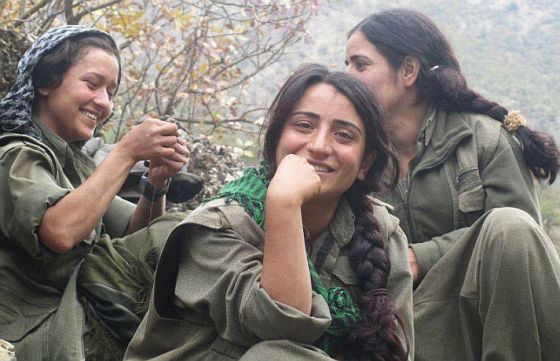
30% of PKK fighters are women.

30% of the PKK’s fighters are women.

The Turkish columnist, Kadri Gursel, writes: [T]he PYD [the Democratic Union Party, the PKK’s Syrian branch] has been able to hold on to these three regions [Ras al-Ain, Kobani and Afrin, in northern Syria] and resist the jihadists for more than two years. Hence, long before IS’ capture of Mosul, the PKK already deserved to be recognized as the Middle East’s only fighting force to defy and resist IS for the struggle it has waged in Rojava [Syrian Kurdistan].

The Kurdish forces in Syria have surprised the world not only with their resolve against the jihadists but also with their female fighters. Against a barbarian mindset that enslaves and sells women as concubines, the PYD has displayed a secular mindset embracing gender equality, which has enormously contributed to its international image.

In Iraq, on the other hand, the PKK has put aside disagreements with the Kurdistan Democratic Party (KDP) to form a national military alliance against the jihadist threat to Iraqi Kurdistan.

That the Western public is already discussing the prospect of the PKK’s removal from the lists of terrorist organizations is a clear indication of how much the PKK’s struggle against the jihadists has contributed to its international standing.

Lauren Bohn reports: Standing in a parched field far from any roads in Turkey’s southeastern mountains, a teary-eyed Sokrun Gunduz clutched photographs of her two absent sons.

Mazlum, 15, is in a Turkish prison under suspicion of collaborating with the Kurdistan Workers Party (PKK), a group branded a terrorist organization by Turkey, the European Union and the United States.

Agit, 22, is in northern Iraq battling the jihadist Islamic State in Iraq and Syria (ISIS) with the same group. The young man is one of thousands of PKK soldiers who have joined the war against ISIS in Kurdish areas of Syria and Iraq, and who have become vital to the international community’s battle against the powerful Islamist insurgency.

“The Kurdish fight has spread,” the 43-year-old grocer said at a recent rally marking the anniversary of the PKK’s armed struggle against Turkey. The group has battled the Turkish state for cultural and political rights and Kurdish self-rule for 30 years in a conflict that has claimed more than 30,000 lives.

“We must protect our Kurdish brothers and sisters,” she said amid a crowd of thousands of PKK fighters and supporters celebrating the 30th anniversary of the group’s struggle. “In doing so, we will finally get our own Kurdish state.”

Many of Turkey’s Kurds – a disenfranchised minority that makes up a fifth of the country’s population – feel revitalized by the PKK’s role in Syria and Iraq, and hope their successes on the battlefield will produce political victories such as greater autonomy, more rights and perhaps even an independent state.

“In a way, we have to thank the Islamic State. They’ve united us, reviving the great Kurdish cause,” said Seyid Narin, a municipal mayor in Diyarbakir, long the center of the Kurdish resistance and separatist movement in southeast Turkey. Ten months ago he lost a son who was fighting in Syria — a second one is now in northern Iraq with the PKK.

“Our struggle is reborn,” he said.

This struggle poses a potential threat to Turkey’s ruling Justice and Development Party (AK Party) which has spearheaded efforts to restart peace talks with the terror group and now tolerates its military role in Turkey.

“Both the (ruling party) and PKK know that ISIS must be stopped … if anything, this fight will bring the AK party and Kurds closer together,” said Bedirhan Akyol, a Kurdish Justice and Development official in Diyarbakir. “The PKK is becoming stronger through this fight, but that won’t have a bad effect on peace talks.”

But Akyol’s positive spin belies a deep unease in Turkey about the PKK’s role fighting ISIS in Syria and its place in society at large. That the long reviled organization has been cast as the hero in the war against homicidal Islamist fighters has prompted alarm and anger in some circles.

The ruling party and the PKK are essentially creating laws that would result in the break- up of Turkey, said Oktay Vural, a leading Turkish opposition politician.

“The terrorists failed to divide Turkey for 30 years, but the country is now being brought to the brink of partition in the name of [Recep Tayyip] Erdogan’s political future,” he wrote in an editorial, referring to the country’s powerful prime minister and president elect.

Even some who do not consider talks with the PKK treasonous, like Vural does, worry that Turkey already has enough on its plate with the regional threat posed by ISIS and a teeming Syrian refugee population, before dealing with the legitimization of a group long branded as terrorists. [Continue reading…]

Facebooktwittermail

ISIS is a disgrace to true fundamentalism

Slavoj Zizek writes: Long ago Friedrich Nietzsche perceived how Western civilization was moving in the direction of the Last Man, an apathetic creature with no great passion or commitment. Unable to dream, tired of life, he takes no risks, seeking only comfort and security: “A little poison now and then: that makes for pleasant dreams. And much poison at the end, for a pleasant death. They have their little pleasures for the day, and their little pleasures for the night, but they have a regard for health. ‘We have discovered happiness,’ say the Last Men, and they blink.”

It may appear that the split between the permissive First World and the fundamentalist reaction to it runs more and more along the lines of the opposition between leading a long satisfying life full of material and cultural wealth and dedicating one’s life to some transcendent cause. Is this antagonism not the one between what Nietzsche called “passive” and “active” nihilism? We in the West are the Nietzschean Last Men, immersed in stupid daily pleasures, while the Muslim radicals are ready to risk everything, engaged in the struggle up to their self-destruction. William Butler Yeats’ “Second Coming” seems perfectly to render our present predicament: “The best lack all conviction, while the worst are full of passionate intensity.” This is an excellent description of the current split between anemic liberals and impassioned fundamentalists. “The best” are no longer able fully to engage, while “the worst” engage in racist, religious, sexist fanaticism.

But are the terrorist fundamentalists really fundamentalists in the authentic sense of the term? Do they really believe? What they lack is a feature that is easy to discern in all authentic fundamentalists, from Tibetan Buddhists to the Amish in the United States — the absence of resentment and envy, the deep indifference towards the nonbelievers’ way of life. If today’s so-called fundamentalists really believe they have found their way to Truth, why should they feel threatened by nonbelievers. Why should they envy them? When a Buddhist encounters a Western hedonist, he hardly condemns. He just benevolently notes that the hedonist’s search for happiness is self-defeating. In contrast to true fundamentalists, the terrorist pseudo-fundamentalists are deeply bothered, intrigued and fascinated by the sinful life of the nonbelievers. One can feel that, in fighting the sinful other, they are fighting their own temptation. This is why the so-called fundamentalists of ISIS are a disgrace to true fundamentalism. [Continue reading…]

Facebooktwittermail

Is translating jihadist texts on the internet a crime?

Mark Joseph Stern writes: In the spring of 2005, Tarek Mehanna began translating radical Arabic books and videos into English for the website At Tibyan. The materials had an undeniable flavor of terrorism, encouraging readers to join al-Qaida and kill American soldiers in Iraq. But even the government acknowledges that Mehanna never translated anything at the direct behest of al-Qaida operatives—which is why it’s rather surprising that the government successfully prosecuted him for providing “material support” to a terrorist organization and sentenced him to 210 months in prison.

Everybody agrees that Mehanna supported al-Qaida’s cause; At Tibyan is a fairly popular terrorist forum, and Mehanna translated its content with the clear intention of swaying opinion toward the jihadist cause. But translating, publishing, and praising ideological texts, no matter how morally vile, is generally considered to be a basic free speech activity. Everyone knows that the First Amendment protects translations of Mein Kampf. Why did Mehanna’s translation of jihadist hosannas land him behind bars?

That’s the question Mehanna is asking the Supreme Court, which will decide whether to take his case later in September. If the justices do agree to review Mehanna’s conviction, it’ll be wading into a constitutional controversy at once timeless and novel. The court has long recognized that cheerleading for terrorism may eventually cross the line from free speech to a criminal act. But the Internet’s ability to spread ideas and connect like-minded people may now force the justices to reconsider that boundary. And if the court lets Mehanna’s conviction stand, it may wind up drawing the line dangerously close to the kind of Internet activity some of us engage in without a second thought.

The Supreme Court has been grappling with the question of dangerous speech for as long as America has been attempting to suppress dissent in the name of national security — that is, pretty much forever. For our first century or so, nobody thought that criminalizing anti-American speech raised a real First Amendment concern. But in a 1919 case called Abrams v. United States, Justice Oliver Wendell Holmes, joined by Justice Louis Brandeis, cracked the orthodoxy wide open, issuing a stunning dissent from the conviction of a revolutionary anarchist who advocated a violent overthrow of the U.S. government. Holmes described a constitutional command to tolerate anti-government speech, explaining that censorship of “opinions that we loathe and believe to be fraught with death” is unacceptable unless those opinions “imminently threaten” the country’s safety.

Today, Holmes’ view is more or less the law. But that hasn’t kept Congress from passing censorship laws on the theory that a certain group’s speech qualifies as a clear and present danger to the country. [Continue reading…]

Facebooktwittermail

The existential threat posed by ISIS to the Middle East and beyond

Gareth Stansfield writes: ISIS have exposed a great strategic illusion/miscalculation by Western powers. This is to say that the West is clinging to a traditional, statist response to a cross-border terrorist/insurgent threat from a non-state actor. This is actually a choice of the West not to recognise the expanding threat not because ‘we’ cannot see it, but because political leaders are scared to acknowledge it – scared by the still-fresh memories of the public backlash following the invasion of Iraq in 2003, and scared by the prospect of engaging in the no-win world of Middle East politics. But the situation now is different to then. ISIS is a terrorist organisation (and a spectacularly effective one) and remains border-less. But it has also acquired a substantial chunk of territory (a development which is convincing – insofar as it substantiates the idea of the caliphate – to impressionable recruits). So we have supremely violent, ideologically rampant terrorism fused with a new, border-less version of something like a modern state. This is a new development and one that seems to be studiously, and perilously, ignored.

It is not possible to defeat ISIS by attacking their forward-placed troops on the Great Zab river as they look east towards Erbil: the ‘state’ itself would have to be targeted at its points of concentration – Mosul, Fallujah, Raqqa, Hassekeh – if the challenge of ISIS is to be met. If one were to be privy to ISIS strategy meetings around Ibrahim al-Baghdadi and his policy team in Raqqa, (and, unlike everyone else, they have articulated their vision, they do seem to have a strategy, and they certainly have policies) one would probably see a plan that sees ISIS grow in the Middle East through a combination of pushing the message of their success and thus seeing recruitment grow and neighbouring states undermined. It would be combined with an aggressive policy of territorial expansion, with Lebanon and Jordan both being prime targets. Indeed, the black flag of ISIS has already been raised in these countries.

ISIS therefore do not play by the rules of the game that still underpin much of the West’s responses to such challenges. They are making a new rule book – one that combines the most modern approaches of strategic planning, media messaging, psychological warfare, and counter-insurgency (consider how they have shut down opposition among their close partners/potential threats and implemented their own version of identifying those who could be ‘reconciled’, and those who are ‘irreconcilables’ – a technique perfected by the US in Iraq in 2007-8), with the most brutal, inhuman techniques of control imaginable. Their methods then see the organisation grow either because some followers are genuinely impressed by what is seem to be a strong organisation for once being able to stand up for them, or because some are simply too fearful of the consequences of not being in the biggest and nastiest gang around.

As their plan has unfolded, ISIS have brought two thresholds forward – one is their own advance and the reformation of realities on the ground on the Middle East; the second is the reaction of Western populations and the pressure they could bring to bear on their governments to take actions to roll back ISIS.

The question to ask now is simply which threshold will be passed first? Will ISIS succeed and strengthen the so-called Caliphate so it can no longer be dismissed as the fantasy of a self-proclaimed leader on a remarkably lucky streak, or will the international community recognise the threat of ISIS as being an actor with real agency and with aspirations that are absolutely antagonistic not only to Western interests, but to allies in the Middle East, and stop them? Neither prospect is palatable, but then neither, it seems, is muddling through and banally hoping for the best.

Facebooktwittermail

ISIS’s political-military power in Iraq

Michael Knights write: The Islamic State in Iraq and the Levant (ISIL) has the world on edge. Since its nadir in the spring of 2010, ISIL is considered to have evolved from a terrorist group on-the-ropes to “a full-blown army,” in the words of U.S. Deputy Assistant Secretary of State for Near Eastern Affairs Brett McGurk. As the Institute for the Study of War noted, ISIL’s overall strategy of consolidating and expanding its caliphate “fundamentally relies upon military superiority to wrest control of land and cities from modern states.”

An analysis of ISIL’s recent military accomplishments is difficult due to the lack of confirmed facts about much of what has transpired in Iraq, particularly during the hectic months since the collapse of federal security forces in Mosul on June 10, 2014. Questions still remain over the actual contribution that ISIL made to the loss of federal control and over the mix of ISIL and non-ISIL forces fighting since June. Nevertheless, using a range of case studies from the Iraqi side of ISIL’s area of operations, this article explores what is currently known about the movement from a military standpoint. If ISIL is an army, what kind of army is it and what are its weaknesses?

This article finds that ISIL is a military power mostly because of the weakness and unpreparedness of its enemies. Lengthy shaping of the battlefield, surprise and mobility made its recent successes possible, but all these factors are diminishing. As a defensive force, ISIL may struggle to hold terrain if it is attacked simultaneously at multiple points or if its auxiliary allies begin to defect. [Continue reading…]

Facebooktwittermail

ISIS’s carefully crafted multimedia message

The New York Times reports: ISIS propaganda … has strikingly few calls for attacks on the West, even though its most notorious video, among Americans, released 12 days ago, showed the beheading of the American journalist James Foley, threatened another American hostage, and said that American attacks on ISIS “would result in the bloodshed” of Americans. This diverged from nearly all of ISIS’s varied output, which promotes its paramount goal: to secure and expand the Islamic state. Experts say that could change overnight, but for now it sharply distinguishes ISIS from Al Qaeda, which has long made attacks on the West its top priority.

And while ISIS may be built on bloodshed, it seems intent on demonstrating the bureaucratic acumen of the state that it claims to be building. Its two annual reports so far are replete with a sort of jihadist-style bookkeeping, tracking statistics on everything from “cities taken over” and “knife murders” committed by ISIS forces to “checkpoints set up” and even “apostates repented.”

ISIS media frames its campaign in epochal terms, mounting a frontal assault on the national divisions and boundaries in the Middle East drawn by Western powers after World War I. These “Crusader partitions” and their modern Arab leaders, ISIS argues in its English-language magazine, were a divide-and-conquer strategy intended to prevent Muslims from unifying “under one imam carrying the banner of truth.”

That sense of historical grievance is an old theme for Al Qaeda and more moderate Islamist groups. The difference is that by capturing expansive territory and heavy weaponry, and flush with wealth from kidnappings, oil piracy, bank robbery and extortion, ISIS claims to have taken a major first step toward righting what it sees as this ancient wrong, creating a unified Muslim state that will subsume existing nations. [Continue reading…]

Facebooktwittermail

Obama’s reluctance to strike ISIS inside Syria

The Daily Beast reports: After a week of talk of eliminating the “cancer” of ISIS, President Obama said Thursday that he was not planning to significantly expand the war against the Islamic extremist movement anytime soon.

His remarks came after days of heated debate inside the top levels of his own national security bureaucracy about how, where, and whether to strike ISIS in Syria. But those deliberations – which included a bleak intelligence assessment of America’s potential allies in Syria — failed to produce a consensus battle plan. And so Obama, who has long been reluctant to enter into the Syrian conflict, told reporters Thursday that “we don’t have a strategy yet” for confronting ISIS on a regional level.

Those inside the administration advocating for going after ISIS in both Iraq and Syria were sorely disappointed – and lamented their boss’s lack of urgency in rooting out a threat that only days before was being described in near-apocalyptic terms.

“Senior strategists in the U.S. government have been working hard all week to gather multiple options that the president had asked for to strike ISIS in Syria. There was a deep rooted belief among many — especially among military circles — that the ISIS threat can’t be kicked down the road, that it needs to be confronted now, and in a holistic way,” said one Obama administration official who works on the Middle East. “This press conference is going to lead to even more doubt by those that thought that this White House was ready to take meaningful action against ISIS across the board.”

Obama addressed the White House press corps Thursday afternoon just before personally chairing a meeting of his National Security Council, his top cabinet members and national security staffers. The meeting was the culmination of an intense week-long process that included series of lower level meetings and at last one Principals’ Committee that officials described as an effort to convince Obama to expand his air war against ISIS in Iraq to Syria as well.

But before the meeting even started, the president seemed to have made up his mind.

The President said that although he had ordered up options for striking ISIS in Syria, the administration’s priority was shoring up the integrity of Iraq, instead. Syria would have to wait. He also said he would send Secretary of State John Kerry to the region because “We don’t have a strategy yet,” to confront ISIS on a regional level.

To many outside the administration who have worked on Syria and the ISIS problem, Obama’s decision not to decide on a broader course of action will have negative implications for the war against ISIS. The administration raised expectations about altering its three-year policy of avoiding intervention in Syria, before Obama dashed those expectations Thursday.

“One has to wonder what sort of signal this administration is sending to ISIS by using tough rhetoric on one hand and then contravening what top officials just said,” said a former Pentagon official who served in Iraq. “It’s not just demoralizing to those who want to stop ISIS in its tracks, but ISIS is just going to act with greater impunity now if they believe they got a free pass. Every single ISIS leader was watching that.” [Continue reading…]

Facebooktwittermail