Category Archives: Analysis

Victories for Putin will help Assad

a13-iconAaron David Miller writes: As go Putin’s fortunes, so go those of Syrian President Bashar al-Assad. However the crisis turns out, with one possible exception, the Syrian regime is likely to benefit. And that exception is the highly unlikely contingency that Putin is so weakened from a botched policy in Ukraine or an uncharacteristically bold response from the United States and the West that he is permanently damaged and diminished, or removed from power. Not likely.

The possibility that events in Ukraine will leave Putin victorious will only buck up al-Assad further and demonstrate that Russian street cred is rising. After all, in September, Putin masterfully intervened and used diplomacy to stay a U.S. military response against al-Assad’s use of chemical weapons against civilians.

Now Putin appears to be standing up to the international community and ready to use force to protect Russia’s interests in Ukraine. He’s clearly not prepared to do that for Syria. But victories for Russia, particularly in the face of the West’s empty rhetoric and red lines, can only reinforce al-Assad’s conviction that he’s betting on the right ally.


Facebooktwittermail

U.S. intelligence not sharp enough to spot Russian invasion of Ukraine

a13-iconThe Daily Beast reports: On Thursday night, the best assessment from the U.S. intelligence community — and for that matter most experts observing events in Ukraine — was that Vladimir Putin’s military would not invade Ukraine. Less than 24 hours later, however, there are reports from the ground of Russian troops pushing into the Ukrainian province of Crimea; the newly-installed Crimean prime minister has appealed to Putin to help him secure the country; Putin, in turn, is officially asking for parliament’s permission to send Russian forces into Ukraine. It’s not a full-blown invasion—at least, not yet. But it’s not the picture U.S. analysts were painting just a day before, either.

There was good reason to think Putin wouldn’t do it. Russia’s Foreign Minister, Sergei Lavrov told Secretary of State John Kerry that Russia respected the territorial integrity of the Ukraine. U.S. intelligence assessments concluded that the 150,000-man Russian military exercises announced by Putin on Wednesday were not preparations for an invasion of Ukraine because no medical units accompanied the troops. And Russian and U.S. diplomats were still working on Iran and Syrian diplomacy. All of this followed a successful Winter Olympic games for Putin’s Russia.

Yet private security contractors, working for the Russian military, seized control of two airports in Crimea on Friday. And Ukrainian border officials said that Russian cargo planes had landed inside the province, and that 10 military helicopters flew into Ukrainian airspace.

U.S. officials familiar with the intelligence on the fast moving situation in Ukraine tell The Daily Beast that analytic products from the intelligence community this week did not discount the prospect of Russian provocations and even light incursions in the Russian majority province of Crimea, the home of Russia’s fleet in the Black Sea.

Nonetheless, until Friday, no one anticipated a Russian invasion of Ukrainian territory. [Continue reading…]

Facebooktwittermail

Why has Russia moved so fast?

a13-iconJohn Lough writes: Moscow’s readiness to escalate the crisis in Ukraine reflects panic at what it undoubtedly sees as a potentially dramatic loss of influence in the country as a result of the “Maidan” revolution. It has calculated that the risks of not intervening in Ukraine are greater than those of intervening, even though those risks include the danger of provoking widespread violent conflict and a serious breakdown in relations with the West.

Regardless, Russia’s earlier strategy is in shreds. It bet heavily on the survival of Ukrainian President Viktor Yanukovych, in effect offering him late last year a $15 billion bailout package and other sweeteners in return for not signing an association agreement with the European Union.

Russia looked to have outmaneuvered the European Union and to have kept Ukraine firmly in its sphere of influence. After all, the association agreement with the EU, if implemented, would have laid the foundations for anchoring Ukraine in the west.

Since then, however, Moscow has been stunned by the speed at which Yanukovych’s rule collapsed. It blames the West for fomenting the revolution and seems to believe that it needs to counter an unprecedented surge of Western influence in Ukraine and prevent the consolidation of the revolution.

By signaling its readiness to support the secession of Crimea, Moscow is opening the door to further unraveling of Ukraine by encouraging supporters of closer ties with Russia in Ukraine’s eastern regions to call for Russian protection and not to recognize the authority of the interim government in Kiev. All this could easily make it impossible to hold the presidential election scheduled for May 25 in those parts of the country that identify strongly with Russia.

The scenario of Ukraine’s partition has moved significantly closer.

Facebooktwittermail

Russia’s nebulous definition of sovereignty

a13-iconJames Meek writes: Over the past twenty years Russia has removed a set of territories from other countries. It removed the eastern part of Moldova, now known as Transdniestria; it removed the north-western Black Sea part of Georgia, Abkhazia; and it snipped away the territory controlling Georgia’s main road to the Caucasus mountains, South Ossetia. The intention now appears to be to carry out the same operation in Crimea, removing it from Ukraine.

In each case, the procedure, not necessarily planned as such, has nonetheless followed a similar pattern. The territories contain large populations who, with varying degrees of justification, objected to the governments handed them in the post-Soviet order of newly independent states. The Slavs of Transdniestria feared Moldova would force them to speak Moldovan, and would unite with Romania. The Abkhazians wanted greater autonomy within, or independence from, Georgia. The South Ossetians, historically close to Russia, feared being cut off, within Georgia, from their northern kin in Russia, on the other side of the mountains.

In each case, clandestine Russian military support, helped by the presence of Russian bases in or near the territories concerned, found willing takers in the form of local military, paramilitary forces and self-proclaimed ‘Cossacks’; Russian troops only became involved openly as ‘peacekeepers’. In each case, the internationally recognised governments supposedly in charge of the discontented territories took military steps to enforce their claim. The presence of ‘peacekeepers’ and Russian-armed militias led to clashes, giving the Russian military cause to intervene decisively on the side of the separatists. (Newly independent Georgia’s first military response to Abkhazian separatism was particularly heavy-handed.)

Russia’s explanation is that the territories concerned should never have been allowed to go beyond Moscow’s caring embrace, and that in each case, they are fulfilling the wishes of, and protecting, the majority of the territories’ inhabitants. There is some truth in the latter point; but it is a dangerous argument for Moscow to make, given that it could be equally applied, against Russia, to Chechnya. [Continue reading…]

Facebooktwittermail

What, me? Biased?

a13-iconTom Jacobs writes: Pretty much all of us are prone to “bias blindness.” We can easily spot prejudice in others, but we’re oblivious to our own, insisting on our impartiality in spite of any and all evidence to the contrary.

Newly published research suggests this problem is actually worse than we thought. It finds that even when people use an evaluation strategy they concede is biased, they continue to insist their judgments are objective.

“Recognizing one’s bias is a critical first step in trying to correct for it,” writes a research team led by Emily Pronin and Katherine Hansen of Princeton University. “These experiments make clear how difficult that first step can be to reach.”

Although their findings have clear implications regarding political opinions, the researchers avoided such fraught topics and focused on art. In two experiments, participants (74 Princeton undergraduates in the first, 85 adults recruited online in the second) looked at a series of 80 paintings and rated the artistic merit of each on a one-to-nine scale. [Continue reading…]

Facebooktwittermail

The ultimate interactive weather map

a13-iconCurrent wind and temperature at 500hPa:

The current wind conditions in the polar vortex at 10hPa:

Click on the Earth button to see an interactive view where you can:

  • select current condition, +/- 3hrs, +/- 1 day (Control: Now « – ‹ – › – »);
  • switch between atmospheric and ocean conditions (Mode: Air – Ocean);
  • select a height from surface upwards (Height: Sfc – 1000 – 850 – 700 – 500 – 250 – 70 – 10 hPa);
  • choose an overlay showing wind, temperature, relative humidity, air density, etc. (Overlay: Wind – Temp – RH – AD – WPD – TPW – TCW – MSLP);
  • and select a projection.

Drag the image to view different locations and double-click for larger scale. Click on projection “O” to return to an orthographic view of the planet.

Source: http://earth.nullschool.net/ Creator: Cameron Beccario

Facebooktwittermail

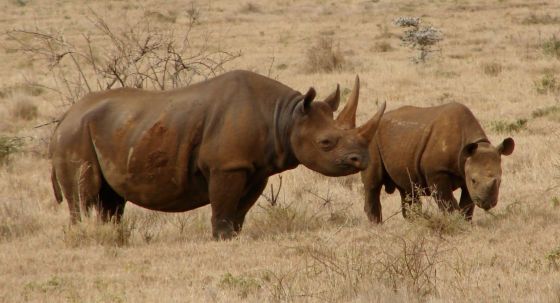
The threat to rhinos also endangers their habitat

rhinos

Rachel Nuwer reports: Some large animals influence their surroundings more than others. Elephants are known as ecosystem engineers for their tendency to push over trees and stomp shrubby areas in the savannah into submission. This keeps forests at bay, which otherwise would overtake open grasslands. Wolves, on the other hand, are apex predators. They keep other species like deer in check, preventing herbivore populations from getting out of hand and eating all the plants into oblivion. Both elephants and wolves are keystone species, or ones that have a relatively large impact on their environment in relation to their actual population numbers.

African rhinos, it turns out, also seem to be a keystone species. According to a recent study published by Scandinavian and South African researchers in the Journal of Ecology, rhinos maintain the diverse African grasslands on which countless other species depend.

Surprisingly, prior to this study no one had looked closely rhinos’ roles in shaping the ecosystem. Most researchers focused on elephants instead. Suspecting that these large animals influence their environment, the authors took a close look at rhinos in Kruger National Park in South Africa. [Continue reading…]

Facebooktwittermail

The new Great Game: Why Ukraine matters to so many other nations

a13-iconBloomberg Businessweek reports: Ukraine doesn’t seem like the kind of place that world powers would want to tussle over. It’s as poor as Paraguay and as corrupt as Iran. During the 20th century it was home to a deadly famine under Stalin (the Holomodor, 1933), a historic massacre of Jews (Babi Yar, 1941), and one of the world’s worst nuclear disasters (Chernobyl, 1986). Now, with former President Viktor Yanukovych in hiding, it’s struggling to form a government, its credit rating is down to CCC, a recession looms, and foreign reserves are running low. Arseniy Yatsenyuk, head of the opposition party affiliated with former Prime Minister Yulia Tymoshenko, said on Feb. 24 in Parliament, “Ukraine has never faced such a terrible financial catastrophe in all its years of independence.”

But Ukraine is also a breadbasket, a natural gas chokepoint, and a nation of 45 million people in a pivotal spot north of the Black Sea. Ukraine matters—to Russia, Europe, the U.S., and even China. President Obama denied on Feb. 19 that it’s a piece on “some Cold War chessboard.” But the best hope for Ukraine is that it will get special treatment precisely because it is a valued pawn in a new version of the Great Game, the 19th century struggle for influence between Russia and Britain.

Russia, which straddles Europe and Asia, has sought a role in the rest of Europe since the reign of Peter the Great in the early 18th century. An alliance with Ukraine preserves that. “Without Ukraine, Russia ceases to be a Eurasian empire,” the American political scientist Zbigniew Brzezinski wrote in 1998. Russian President Vladimir Putin wants Ukraine to join his Eurasian Union trade bloc, not the European Union. Russia’s Black Sea naval fleet is headquartered in Sevastopol, a formerly Russian city that now belongs to Ukraine. [Continue reading…]

Facebooktwittermail

Egypt’s ‘AIDS curing device’ may be a fake bomb detector

a13-iconMashable: On Saturday, the Egyptian army unveiled a “miraculous” device it claims will detect and cure AIDS and Hepatitis. But the device, named C-Fast, looks eerily similar to a fake bomb detector sold by a British company to Iraq in the late 2000s.

That device, codenamed ADE 651, was later found to be a scam. One that reportedly cost the Iraqi government as much as $85 million dollars, and perhaps hundreds of lives. Its creator, James McCormick, was indicted and later sentenced to 10 years in prison.

The possible link between the C-Fast and the fake bomb detector, named ADE 651, was first spotted by the Libyan Youth Movement, a citizen organization born after the Egyptian revolution of 2011. The group posted a picture of the two devices on Twitter.

Facebooktwittermail

Watch: Zeynep Tufekci on social media-fueled protest style from Arab Spring to Gezi protests in Turkey

a13-iconWhat can we learn from the protest wave of the last years? How does social media impact the capacity for collective action? Does social media contribute to blunting movement impacts by facilitating horizontal, non-institutional and “leaderless” movements? How do these movements compare with their predecessors like the civil-rights or anti-colonial movements? In this talk Zeynep Tufekci — assistant professor at the University of North Carolina, a faculty associate at Berkman Center for Internet & Society, and a fellow at the Center for Information Technology Policy at Princeton University — discusses these questions by drawing from research on a variety of social movements including the “Arab Spring”, European indignados movements, Occupy and Turkey’s Gezi protests. (October 15, 2013, Berkman Center for Internet & Society, Harvard University.)

Facebooktwittermail

Why AT&T’s surveillance report omits 80 million NSA targets

Wired reports: AT&T this week released for the first time in the phone company’s 140-year history a rough accounting of how often the U.S. government secretly demands records on telephone customers. But to those who’ve been following the National Security Agency leaks, Ma Bell’s numbers come up short by more than 80 million spied-upon Americans.

AT&T’s transparency report counts 301,816 total requests for information — spread between subpoenas, court orders and search warrants — in 2013. That includes between 2,000 and 4,000 under the category “national security demands,” which collectively gathered information on about 39,000 to 42,000 different accounts.

There was a time when that number would have seemed high. Today, it’s suspiciously low, given the disclosures by whistleblower Edward Snowden about the NSA’s bulk metadata program. We now know that the secretive Foreign Intelligence Surveillance Court is ordering the major telecoms to provide the NSA a firehose of metadata covering every phone call that crosses their networks. [Continue reading…]

Facebooktwittermail

Half of U.S. farmland being eyed by private equity

a13-iconIPS reports: An estimated 400 million acres of farmland in the United States will likely change hands over the coming two decades as older farmers retire, even as new evidence indicates this land is being strongly pursued by private equity investors.

Mirroring a trend being experienced across the globe, this strengthening focus on agriculture-related investment by the private sector is already leading to a spike in U.S. farmland prices. Coupled with relatively weak federal policies, these rising prices are barring many young farmers from continuing or starting up small-scale agricultural operations of their own.

In the long term, critics say, this dynamic could speed up the already fast-consolidating U.S. food industry, with broad ramifications for both human and environmental health.

“When non-operators own farms, they tend to source out the oversight to management companies, leading in part to horrific conditions around labour and how we treat the land,” Anuradha Mittal, the executive director of the Oakland Institute, a U.S. watchdog group focusing on global large-scale land acquisitions, told IPS.

“They also reprioritise what commodities are grown on that land, based on what can yield the highest return. This is no longer necessarily about food at all, but rather is a way to reap financial profits. Unfortunately, that’s far removed from the central role that land ultimately plays in terms of climate change, growing hunger and the stability of the global economy.”

In a new report released Tuesday, the Oakland Institute tracks rising interest from some of the financial industry’s largest players. Citing information from Freedom of Information Act requests, the group says this includes bank subsidiaries (the Swiss UBS Agrivest), pension funds (the U.S. TIAA-CREF) and other private equity interests (such as HAIG, a subsidiary of Canada’s largest insurance group). [Continue reading…]

Facebooktwittermail

Muqtada al-Sadr lambastes Maliki as dictator, looter and resigns from politics (again)

a13-iconMustafa Habib writes: He ended his ten year-long political campaign in a televised speech lasting around 11 minutes. In that speech Iraqi cleric Muqtada al-Sadr said a number of disturbing things: that current Iraqi Prime Minister Nouri al-Maliki is a dictator, that Iraq’s Parliament is paralyzed and that the country’s judiciary is too politicized.

But perhaps the most disturbing things were the questions left unanswered. And there were many.

Al-Sadr was born in 1973, the child of a well known and well respected Shiite Muslim family, based in Najaf. As the Middle East Quarterly reported back in 2004, he is “the fourth son of Ayatollah Muhammad Sadiq al-Sadr, who was, between 1992 and 1999, one of the most renowned leaders in the Hawza, the centre of Shiite religious seminaries and scholarship”. Muqtada’s father “cultivated good relations with the predominantly Shiite tribes of central and southern Iraq, even publishing a book on tribal Islamic jurisprudence,” the journal wrote.

The Sadr family were persecuted during the regime of former Iraqi leader Saddam Hussein and after the death of his father and two brothers at, most likely, the hands of government assassins, Muqtada assumed a leadership role in the family – and therefore with their many followers.

And after many years of guiding those followers – in both bad, violent times that saw them take military action against the US as well as in calmer times, when he disarmed the Sadrist militia – it appears that al-Sadr is now ready to stand down.

“I will not interfere in political affairs,” al-Sadr said in his statement of resignation on Saturday. “There is no political entity that represents me anymore nor any position in parliament or government.”

In order to clarify his decision, al-Sadr then made a televised speech on Tuesday in which he said his decision was irreversible. [Continue reading…]

Facebooktwittermail

Iran boosts military support in Syria to bolster Assad

a13-iconReuters reports: As Syria’s war nears the start of its fourth year, Iran has stepped up support on the ground for President Bashar al-Assad, providing elite teams to gather intelligence and train troops, sources with knowledge of military movements say.

This further backing from Tehran, along with deliveries of munitions and equipment from Moscow, is helping to keep Assad in power at a time when neither his own forces nor opposition fighters have a decisive edge on the battlefield.

Assad’s forces have failed to capitalise fully on advances they made last summer with the help of Iran, his major backer in the region, and the Hezbollah fighters that Tehran backs and which have provided important battlefield support for Assad.

But the Syrian leader has drawn comfort from the withdrawal of the threat of U.S. bombing raids following a deal under which he has agreed to give up his chemical weapons.

Shi’te Iran has already spent billions of dollars propping up Assad in what has turned into a sectarian proxy war with Sunni Arab states. And while the presence of Iranian military personnel in Syria is not new, military experts believe Tehran has in recent months sent in more specialists to enable Assad to outlast his enemies at home and abroad.

Analysts believe this renewed support means Assad felt no need to make concessions at currently deadlocked peace talks in Geneva. [Continue reading…]

Facebooktwittermail

Google Plus works for Google

a13-iconThe New York Times reports: Google Plus, the company’s social network, is like a ghost town. Want to see your old roommate’s baby or post your vacation status? Chances are, you’ll use Facebook instead.

But Google isn’t worried. Google Plus may not be much of a competitor to Facebook as a social network, but it is central to Google’s future — a lens that allows the company to peer more broadly into people’s digital life, and to gather an ever-richer trove of the personal information that advertisers covet. Some analysts even say that Google understands more about people’s social activity than Facebook does.

The reason is that once you sign up for Plus, it becomes your account for all Google products, from Gmail to YouTube to maps, so Google sees who you are and what you do across its services, even if you never once return to the social network itself.

Before Google released Plus, the company might not have known that you were the same person when you searched, watched videos and used maps. With a single Plus account, the company can build a database of your affinities.

Google says Plus has 540 million monthly active users, but almost half do not visit the social network. [Continue reading…]

Facebooktwittermail

How Arctic warming is causing bitter winters

a13-iconAFP reports: A warmer Arctic could permanently affect the pattern of the high-altitude polar jet stream, resulting in longer and colder winters over North America and northern Europe, US scientists say.

The jet stream, a ribbon of high altitude, high-speed wind in northern latitudes that blows from west to east, is formed when the cold Arctic air clashes with warmer air from further south.

The greater the difference in temperature, the faster the jet stream moves.

According to Jennifer Francis, a climate expert at Rutgers University, the Arctic air has warmed in recent years as a result of melting polar ice caps, meaning there is now less of a difference in temperatures when it hits air from lower latitudes.

“The jet stream is a very fast moving river of air over our head,” she said Saturday at a meeting of the American Association for the Advancement of Science.

“But over the past two decades the jet stream has weakened. This is something we can measure,” she said.

As a result, instead of circling the earth in the far north, the jet stream has begun to meander, like a river heading off course.

This has brought chilly Arctic weather further south than normal, and warmer temperatures up north. Perhaps most disturbingly, it remains in place for longer periods of time.

The United States is currently enduring an especially bitter winter, with the midwestern and southern US states experiencing unusually low temperatures.

In contrast, far northern regions like Alaska are going through an unusually warm winter this year.

This suggests “that weather patterns are changing,” Francis said. “We can expect more of the same and we can expect it to happen more frequently.” [Continue reading…]

Facebooktwittermail

Syria’s jihadist Twitter wars

a13-iconThe Daily Beast reports: In March 2012, Omar Hammami, the American jihadist who called himself Abu Mansour al Amriki and fought for Shabaab, al-Qaeda’s branch in Somalia, released a short videotape claiming his life was in danger. But Hammami wasn’t fearful that American or Somali forces were pursuing him. Instead, he feared that Shabaab’s emir might kill him him due to differences with strategy and the implementation of Islamic law.

Shabaab responded on its Twitter account, and denied that Hammami was targeted for death. Hammami followed his video by taking to Twitter to lash out at Shabaab and its emir. Hammami even released his autobiography via Twitter.

The Twitter War between Hammami and Shabaab continued for 18 months until Shabaab finally tired of the American’s critiques and sent its secret intelligence unit to execute him and a Brit follower.

The Hammami/Shabaab Twitter war was one of the first instances in which jihadists, who once were voiceless or confined to more structured forums, have aired their dirty laundry in public. [Continue reading…]

Facebooktwittermail