Category Archives: Analysis

Opponents of Palestinian state push for Greater Israel and advocate ethnic cleansing

The Washington Post reports: As Secretary of State John F. Kerry resumes talks here Wednesday in the quest to create “two states for two people,” a vocal faction in Israeli Prime Minister Benjamin Netanyahu’s government is, more openly than ever, opposing the very idea of a Palestinian state — and putting forward its own plans to take, rather than give away, territory.

Ministers in Netanyahu’s ruling coalition and leaders of his party, the Likud, are in revolt against the international community’s long-held consensus that there should be two states between the Jordan River and the Mediterranean Sea. In the process, they are seeking to overturn the commitments of every U.S. president since Bill Clinton and at least four Israeli prime ministers, including the current one.

While once content to simply voice their opposition to giving up what they see as Jewish land or rights in the West Bank, these two-state opponents have gone beyond shouting “no” and are preparing details of their own vision for how Israel should proceed unilaterally after the current round of peace talks fails — which they say is inevitable.

“The day after peace talks fail, we need to have Plan B,” said Knesset member Tzipi Hotovely, a rising star in the Likud party and deputy minister of transportation in Netanyahu’s government.

Instead of a sovereign Palestinian nation arising in the West Bank and Gaza, with East Jerusalem as its capital — which has been the focus of on-again, off-again peace negotiations since the Oslo Accords in 1993 — the two-state opponents envision Israel annexing large swaths of the West Bank. [Continue reading…]

Facebooktwittermail

The U.S. plan to build a Libyan army

Frederic Wehrey writes: Last month, discussing the Obama administration’s plans for a more modest Middle East policy, National Security Adviser Susan Rice noted that Washington “can’t just be consumed 24/7 by one region, important as it is.” From now on, she implied, countries in the region, including Libya, would be relegated to second-tier priority.

As she spoke, the U.S. military’s Africa Command (AFRICOM) was preparing to step up its assistance in Libya to help the country rebuild its weak security sector. Over the summer, AFRICOM, along with the militaries of Italy, Turkey, and the United Kingdom committed to help train, advise, and equip a new Libyan army — a “general purpose force,” in formal military terms — with the United States responsible for approximately 5,000 to 8,000 soldiers. The plan seems reasonable on paper. Trained at overseas bases outside Libya, the new force will allow the government to project its own authority, protect elected officials and institutions from the militias operating within the country, and compel the militias to demobilize and disarm. Washington sees the effort as a crucial step in Libya’s democratic transition and as a way to halt extremism and prevent the country’s lawlessness from spilling over its borders.

But the force’s composition, the details of its training, the extent to which Libyan civilians will oversee it, and its ability to deal with the range of threats that the country faces are all unclear. And the stakes are enormous. There are signs that some militias within Libya are trying to bloody the new army’s nose before it even enters the fight: a campaign of shadowy assassinations against military officers, particularly in the east, is likely half vendetta against representatives of the old order and half attempt to deter the central government’s monopolization of military force.

The case of a separate and underreported U.S. effort to train a small Libyan counterterrorism unit inside Libya earlier this year is instructive. The unit, set up by U.S. special operations forces, was hardly representative of Libya’s regional makeup: recruitment appeared to be drawn overwhelmingly from westerners to the exclusion of the long-neglected east. In addition, the absence of clear lines of authority — nearly inevitable given Libya’s fragmented security sector — meant that the force’s capabilities could just have easily ended up being used against political enemies as against terrorists.

Things came to a head in August, when a tribal militia launched a pre-dawn raid on the poorly guarded training camp near Tripoli. No U.S. soldiers were there, but the militia did make off with sensitive U.S. military equipment. And that spelled the end of the mission; the effort was aborted and U.S. forces went home. (The Libyan government and U.S. special operations forces are currently searching for a new training site inside Libya to restart it.) Drawing lessons from this fiasco, the United States and its NATO partners have wisely decided that the new training mission for the general purpose force will take place outside Libya — in Bulgaria, Italy, Turkey, and the United Kingdom. But that alone won’t be enough to ensure that the effort doesn’t face more significant hurdles. [Continue reading…]

Reuters reports: Heavy fighting between militias using rifles, grenades and anti-aircraft weapons erupted in several parts of Tripoli on Tuesday in the worst violence in the Libyan capital for weeks.

Fighting started in Tripoli’s eastern Suq al-Juma district and a central area where two burned out pick-ups belonging to a militia on the government payroll could be seen. Libyan news websites said at least one person had been wounded.

The shooting started after a member of a militia was detained at a checkpoint after which fellow fighters arrived trying to free him, a militia source said.

Reuters reporters in Tripoli could hear shots from rocket propelled-grenades and anti-aircraft guns throughout the night. Tripoli was quiet on Tuesday morning but occasional rifle shots could still be heard.

Facebooktwittermail

Syria: A war with no end in sight

Stuart Montgomery writes: The Syrian Civil War has been raging for two years. Countless casualties have been sustained on each side, and the humanitarian problem continues to worsen.

So how do you end a civil war?

There are three potential outcomes: regime victory, rebel victory and a negotiated settlement. Currently, the last option is the championed outcome in the international context of the Syrian Civil War. Recently, the United States and Russia, reeling on the recent success of the chemical weapons deal, announced plans to convene an international conference to negotiate peace. Turkey, France and the United Kingdom, countries once considering military action, now support a peace settlement. Political pundits point to the example of Kosovo, as they argue for a quick, clean and negotiated peace. Respected strategist Edward Luttwak argued that a negotiated settlement would best serve U.S. interests. This option has appeal, because it avoids a messy military intervention. However, a negotiated peace is not risk-free.

Historically, negotiated settlements ending civil wars, are temporary at best. Angola, Sudan and Lebanon provide unfortunate examples of civil wars that were only temporarily halted by a negotiated peace. Another example, Kosovo is now relatively stable, but has been governed by a large, expensive, U.N. force for over a decade.

Why do negotiated settlements break apart?

Conflict reignites, because the issues that are at the root of the war are never truly resolved. Monica Duffy Toft, professor at Oxford’s Blavatnik School of Government, argues that rebel victories result in a more stable peace in her book Securing the Peace, on civil war termination. Shouldn’t the choice be clear? Unfortunately supporting Syrian rebels is unpalatable, because of their fractious nature and key groups’ affiliation with Al Qaeda. Supporting Bashar al-Assad is equally unattractive, and unrealistic. Therefore, wouldn’t a negotiated settlement, even if temporary, best protect U.S. security interests?

A negotiated peace is not without problems. First, both Assad’s regime and Al Qaeda affiliates would continue to exist and be armed in some power sharing structure in Syria. Without the presence of a large peacekeeping force, which is unlikely with the lack of support and enthusiasm in the United States and abroad, each side would have little incentive to disarm and cooperate. Instead, these factions would focus on outmaneuvering each other for survival, rather than rebuilding Syria. [Continue reading…]

CNN reports: Al Qaeda has swept to power with the aim of imposing a strict Islamist ideology on Syrians across large swathes of Syria’s rebel-held north, according to a CNN survey of towns, activists and analysts that reveals an alarming increase in al Qaeda-linked control in just the past month.

Al Qaeda-backed militants known as the Islamic State of Iraq and Syria (ISIS) are the predominant military force in northern Syria, according to activists and seasoned observers, and have a powerful influence over the majority of population centers in the rebel-held north.

Rami Abdul Rahman, from the Syrian Observatory for Human Rights, said: “ISIS is the strongest group in Northern Syria — 100% — and anyone who tells you anything else is lying.”

CNN conducted dozens of interviews with activists, local and international observers and residents of the towns affected by ISIS in preparing this study. Many of the Syrians CNN spoke to talked anonymously for fear of angering ISIS, saying ISIS has in some areas made it a crime punishable by flogging to even say their name.

The swift al Qaeda expansion poses a severe policy dilemma for the United States and its European allies who have long delayed their promised armed assistance to rebel groups as they struggled with fears that the weapons could end up in the hands of al Qaeda-backed extremists.

Observers say the delay has provided a vacuum in the often chaotic rebel ranks that the organized and fearless Islamists have moved to fill.

Many observers explain that the extent of ISIS’s discipline and resources — they are said to have considerable cash at their disposal — means that the other rebel groups operating in the north do not seek to confront them.

Charles Lister, analyst at IHS Jane’s Terrorism and Insurgency Centre, said: “Although not a numerically dominant force, ISIS is playing an increasingly pre-eminent role in the northern Syrian insurgency.

“Much of this is a result of its capability to exploit superior levels of financing and resources — essentially, to spread itself thinly enough to exert influence and/or control, but not too thin as to be overpowered by rivals.”

Most activists point to a clear strategy by ISIS — which aims to dominate a large swathe of the north from the north-western town of Idlib to the north-eastern city of Raqqa and beyond — of focusing on population centers on the edges of rebel-held territory and slowly choking off central areas. Some ISIS figures have described a broader aim of trying to link the Sunni province of Anbar in Iraq to the Mediterranean coast, near the Syrian town of Latakia.

Reuters reports: The international body tasked with eliminating Syria’s chemical weapons has raised only enough money so far to fund its mission through this month, and more cash will have to be found soon to pay for the destruction of poison gas stocks next year.

The Organisation for the Prohibition of Chemical Weapons, which won the Nobel Peace Prize last month, is overseeing the destruction of Syria’s nerve agent stocks under a U.S.-Russian agreement reached in September.

It has so far raised about 10 million euros ($13.5 million) for the task.

“It is the assessment of the Secretariat that its existing personnel resources are sufficient for operations to be conducted in October and November 2013,” said an October 25 OPCW document seen by Reuters. At the time, its account held just 4 million euros.

Lally Weymouth interviews Saudi Arabia’s Prince Turki:

What do you and your country think is the best outcome in Syria?

The best outcome is to stop the killing.

How?

We had a proposal, put forth by our foreign minister, that you have to level the playing field. And that means Bashar’s military superiority has to be checked by giving the opposition the means to defend themselves. You’re not talking about sending troops on the ground. Over the past two and half years, if anti-tank, anti-aircraft defensive weapons had been distributed to the opposition—and not all the opposition, [but] the opposition that is for an inclusive Syria—then they would have been able to checkmate the military superiority of Bashar al-Assad and force him to come to the negotiating table. Unfortunately, that did not happen. While Europe and America continued to deny the opposition the means to defend against Bashar’s lethal weapons, the Russians and the Iranians continued to supply Bashar with whatever he needed.

So it’s up to the United States and the Europeans to arm the opposition?

Absolutely. The Europeans put an embargo on arms to Syria. They could see … that that embargo wasn’t affecting Assad but it was definitely denying his opponents … weapons. It took the Europeans two and a half years to change their view and finally say “OK, we can afford to sell these weapons to the opposition.” But none of these countries did. The Americans have not only not sold them, but they have declared they have no intention of providing these weapons to the opposition. So how can you level the playing ground if one side is continually supplied with what it needs by the Russians and the Iranians, and the other side is continually denied those things?

Do you think your country will sit by?

My country has been trying to push not just the United States but the Europeans as well.

Do you feel Saudi explanations fall on deaf ears with the Obama administration?

Every day there are more than 50 to 100 people killed in Syria. And the world sits back and watches.

Do you feel President Obama just doesn’t get it?

I don’t know if he gets it or not. But I think the world community is definitely at fault here. The Russians because they are supporting Bashar and allowing him to do the killing. The Chinese because they have vetoed any measures in the United Nations to prevent him from doing that. The Europeans for not supplying the opposition with weapons. The United States for continually not supplying the opposition with what they need. It’s a worldwide apathy—a criminally negligent attitude toward the Syrian people.

So what do you think will happen in Syria?

They are going to continue the killing.

And Assad will stay in power as things stand now?

As things stand now, Bashar al-Assad is under the protection of the Security Council because of the chemical weapons resolution.

Facebooktwittermail

NSA hack is blatantly illegal and they know it

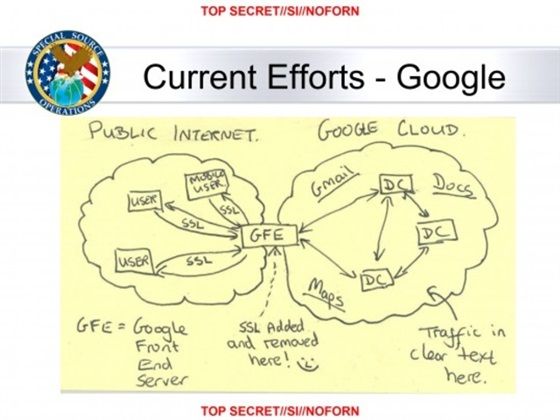
current-efforts-google

Robert X. Cringely writes: The latest Edward Snowden bombshell that the National Security Agency has been hacking foreign Google and Yahoo data centers is particularly disturbing. Plenty has been written about it so I normally wouldn’t comment except that the general press has, I think, too shallow an understanding of the technology involved. The hack is even more insidious than they know.

The superficial story is in the NSA slide (above) that you’ve probably seen already. The major point being that somehow the NSA — probably through the GCHQ in Britain — is grabbing virtually all Google non-spider web traffic from the Google Front End Servers, because that’s where the SSL encryption is decoded.

Yahoo has no such encryption.

The major point being missed, I think, by the general press is how the Google File System and Yahoo’s Hadoop Distributed File System play into this story. Both of these Big Data file systems are functionally similar. Google refers to its data as being in chunks while Hadoop refers to blocks of data, but they are really similar — large flat databases that are replicated and continuously updated in many locations across the application and across the globe so the exact same data can be searched more or less locally from anywhere on Earth, maintaining at all costs what’s called data coherency.

Data replication, which is there for reasons of both performance and fault tolerance, means that when the GCHQ in London is accessing the Google data center there, they have access to all Google data, not just Google’s UK data or Google’s European data. All Google data for all users no matter where they are is reachable through any Google data center anywhere, thanks to the Google File System.

This knocks a huge hole in the legal safe harbor the NSA has been relying on in its use of data acquired overseas, which assumes that overseas data primarily concerns non-U.S. citizens who aren’t protected by U.S. privacy laws or the FISA Court. The artifice is that by GCHQ grabbing data for the NSA and the NSA presumably grabbing data for GCHQ, both agencies can comply with domestic laws and technically aren’t spying on their own citizens when in fact that’s exactly what they have been doing. [Continue reading…]

Facebooktwittermail

Syria: What chance to stop the slaughter?

Kenneth Roth writes: Close to seven million Syrians in the country now depend on humanitarian assistance for basic necessities.

The Assad government has acted with callous disregard for them, placing bureaucratic obstacles in the way of desperately needed relief. It has refused to register all but a handful of the most capable and experienced international aid agencies. It has held up urgently needed assistance in customs, and required multiple official sign-offs that doom aid shipments to extreme delays. Most harmful, it has insisted that aid be sent from government-held territory. The most direct route to many of those in need would be across the borders of neighboring Turkey, Jordan, or Lebanon, but Damascus insists on circuitous routes that require aid workers to travel up to ten times farther through dozens of checkpoints. As a result, only a trickle of aid reaches civilians in rebel-held territory. The proliferation of rebel groups, some hostile to foreign assistance, has also impeded aid delivery.

Some governments, including the United States, have begun quietly funding private humanitarian groups to provide cross-border assistance. But the quantities required are too great, and the threats of violence too grave, for private groups to meet these demands on their own. A major UN-led operation is needed.

The United Nations will ordinarily not undertake such operations without the consent of the government whose population requires assistance. The Syrian government has been loath to permit such cross-border humanitarian aid because that would undermine its efforts to make life miserable in rebel-held areas. The UN Security Council could order Syria to allow cross-border assistance, but through the end of September, Russia would have none of it. Nyet prevailed.

The chemical weapons accord provided an opportunity to address these humanitarian needs. Just five days after the Security Council resolution affirming the deal, on September 27, Russia accepted a Security Council presidential statement urging Syria to “take immediate steps to facilitate the expansion of humanitarian relief operations,” including, “where appropriate, across borders from neighboring countries.” A presidential statement is less authoritative than a formal resolution, but that should not obscure the fact that Russia, Syria’s most important ally, has now effectively ordered it to allow such aid. The Security Council asked the UN secretary-general to report back on how the statement was being implemented, opening the way for additional steps by the council should blockages persist.

The United Nations should seize this opportunity, make concrete demands for access by specific deadlines, and report any further resistance promptly to the Security Council. Unfortunately, Valerie Amos, the UN under-secretary-general for humanitarian affairs and emergency relief coordinator, has remained vague in public about the main obstacles to distributing humanitarian aid. Apparently fearful that blaming the Syrian government would jeopardize UN access to government-controlled areas, Amos has too often resorted to anodyne statements about the problem. One can only hope that, with the Security Council now behind it, the UN will find a more assertive voice.

Yet even if the disastrous humanitarian situation begins to improve, no serious effort is underway to stop the killing of civilians by conventional weapons. As front lines have hardened, the ratio of civilian to combatant deaths has dropped, but some two thousand of the recent average monthly death toll of five thousand have been civilians. What can be done to stop this slaughter?

The Obama administration’s primary answer has been peace talks. Kerry has revived efforts to convene “Geneva II” negotiations — a follow-up to the accord negotiated in June 2012 under UN and Arab League auspices that called on the warring parties to agree to a cease-fire and begin a political transition. Yet prospects for Geneva II are not encouraging. The rebel groups are not unified and say they won’t negotiate with Assad. Assad, in turn, says he won’t negotiate with most of the rebel groups.

A negotiated peace may well be the best way to avoid a complete collapse of the Syrian state. Mindful of the disastrous precedent of Iraq, even many die-hard Assad opponents hope the basic structure of the state will remain intact, though without Assad and his senior lieutenants. A negotiated peace also would provide a chance of ensuring the security of all Syrians, without regard to the sectarian animosities now dividing the country.

But few believe a negotiated peace is anywhere near. Civilian deaths continue, making it urgent to find some way to curtail the slaughter in the interim. Most paths for doing so go through Moscow. The chemical weapons deal shows that when Russian President Vladimir Putin tells Assad to do something, he does it. In view of the rapidity of Lavrov’s acceptance of Kerry’s outline of a chemical deal, there seems to have been little if any negotiation with Damascus. Moscow simply set the terms. But if Moscow has the power to stop the killing by chemical weapons, why not also stop the slaughter of civilians by conventional means? Why not insist on a new “red line” against the deliberate and indiscriminate killing of civilians? Even if the fighting continues, why not force Assad to concentrate on limiting civilian casualties — to attack only the fish and leave the sea alone?

Russia has not given a remotely adequate answer. Conversations on the subject tend to turn to atrocities committed by the rebels and to the growing numbers of extreme Islamist groups in rebel ranks. These are serious concerns, particularly in light of Russian fears that Syria has become a magnet for disgruntled young men from the former Soviet Union who might eventually attack their home governments. But they cannot justify Syrian government atrocities. [Continue reading…]

Facebooktwittermail

Egypt: No investigations after 1,300 protesters have been killed

Human Rights Watch: Egypt’s authorities have yet to announce any move to investigate security force killings of protesters on October 6, 2013. Almost four weeks after police used lethal force to break up protests by Muslim Brotherhood supporters, the authorities have not said they have questioned, or intend to question, security forces about their use of firearms that day.

The clashes left 57 people dead throughout Egypt, according to the Health Ministry, with no police deaths reported.

“In dealing with protest after protest, Egyptian security forces escalate quickly and without warning to live ammunition, with deadly results,” said Joe Stork, deputy Middle East and North Africa director at Human Rights Watch. “Thirteen hundred people have died since July. What will it take for the authorities to rein in security forces or even set up a fact-finding committee into their use of deadly force?”

Judicial authorities have held security services to account in only one case since the military removed President Mohamed Morsy from power in early July, setting off a wave of protests by supporters of the Muslim Brotherhood. On October 22, Public Prosecutor Hisham Barakat ordered the pretrial detention of four police officers for the deaths of 37 detainees they were transporting to Abu Zaabal prison on August 18. He referred them for trial on charges of “negligence and involuntary manslaughter” for shooting tear gas into the locked van. The detainees suffocated. The trial of the police officers opened on October 29.

“Egypt showed in the case of the police officers who fired teargas into a truck full of detainees that it is capable of holding security forces accountable,” Stork said. “It should do the same when police officers open fire on largely peaceful demonstrators.”

Throughout the past three months, in spite of over 1,300 people killed during demonstrations, the authorities have not established a fact-finding committee or attempted to rein in security services.

Facebooktwittermail

What’s bugging The Weasel at the NSA?

Jeff Stein writes: Around the CIA’s executive suites a few years ago, General Keith Alexander was known as “The Weasel.” Not a weasel, The Weasel.

“He’d leave the room after some briefing or meeting or whatever and we’d all look at each other,” a former denizen of the spy agency’s seventh floor told me. “Sometimes we’d just laugh. We knew he’d just lied to us, or been less than truthful about something we were supposedly working on together.”

Now everybody in the world knows Alexander can be a proficient liar, thanks to Edward Snowden’s dripping spigot of top-secret NSA documents.

Senator Patrick Leahy, chairman of the Senate Judiciary Committee, got a taste of the NSA director’s “weaseliness” this summer when he learned that Alexander’s claim that the agency’s massive data collection programs had thwarted 54 terrorist plots was a big fat lie. “The American people are getting left with the inaccurate impression of the effectiveness of NSA programs,” Leahy told Alexander.

When Google and Yahoo, who’ve made billions tracking our shopping habits, are upset about the NSA breaking into their servers, as was reported by The Washington Post this week, you know the agency is out of control.

Or is it?

The phrase “rogue elephant” comes to mind. It entered the political lexicon 40 years ago, after a series of revelations that Army intelligence, the NSA and the FBI had been spying on American citizens, particularly antiwar and civil rights activists, and that the CIA had been concocting assassination plots against Cuba’s Fidel Castro and other foreign leaders. [Continue reading…]

Facebooktwittermail

NSA’s MUSCULAR secretly breaks into the cloud of U.S. tech companies, siphons off data, fouls up revenues overseas

Wolf Richter writes: The cloud is where the NSA goes to pick through everyone’s data. Under the PRISM program, revealed by Snowden some time ago, the NSA has enjoyed easy access to user accounts and their data. Companies cooperate. It’s permitted under the Foreign Intelligence Surveillance Act and overseen by the Foreign Intelligence Surveillance Court. We just didn’t know about it.

MUSCULAR is darker. It secretly targets American companies. Google and Yahoo have been named in top-secret documents that Snowden had pilfered and that landed at the Washington Post. To get around legality issues in the US, the NSA broke into Google’s and Yahoo’s overseas data centers. If you have anything in the cloud – and you do, whether you want to or not – it’s stored in numerous locations, including overseas.

In March last year, when David Petraeus was still CIA Director, before emails, ironically, about an extramarital affair unraveled his career, he spoke at the In-Q-Tel CEO Summit. He was accompanied by NSA specialists. He raved about how startups that had been funded by In-Q-Tel – the CIA’s venture capital branch – were “providing enormous support to us as we execute various critical intelligence missions.” He talked about “innovative technologies developed by the firms represented in this room.”

It was just a speech, and no one really paid attention. But he was disclosing the true nature of our perfect surveillance society, on the eve of the Snowden revelations.

“We have to rethink our notions of identity and secrecy. In the digital world, data is everywhere,” he said. “Data is created constantly, often unknowingly and without permission” – emphasis mine. “Every byte left behind reveals information about location, habits, and, by extrapolation, intent, and probable behavior.” The data “that can be collected is virtually limitless,” he said, which presented “enormous intelligence opportunities.” And in closing he thanked the executives and tech gurus for “helping to keep America’s Intelligence Community at the forefront of global innovation.”

So far, the Snowden revelations have shown exactly that: an intense, hand-in-glove cooperation between the Intelligence Community and American tech companies, from scrappy startups to corporate mastodons, at every level, whether adding backdoors to Windows operating systems or compromising the keys to encryption.

But the revelations about the MUSCULAR program show that, in parallel, the NSA also worked against these tech companies – Google and Yahoo so far, but more documents are likely to trickle out, as they have done in the past, like Chinese water torture, to reveal that other American companies got hit as well. [Continue reading…]

Facebooktwittermail

NSA issues non-denial denial of infiltrating Google and Yahoo’s networks

TechDirt: While NSA boss Keith Alexander issued a misleading denial of this morning’s report of how the NSA has infiltrated Yahoo and Google’s networks by hacking into their private network connections between datacenters, the NSA has now come out with its official statement which is yet another typical non-denial denial. They deny things that weren’t quite said while refusing to address the actual point:

NSA has multiple authorities that it uses to accomplish its mission, which is centered on defending the nation. The Washington Post’s assertion that we use Executive Order 12333 collection to get around the limitations imposed by the Foreign Intelligence Surveillance Act and FAA 702 is not true.

The assertion that we collect vast quantities of US persons’ data from this type of collection is also not true. NSA applies attorney general-approved processes to protect the privacy of US persons – minimizing the likelihood of their information in our targeting, collection, processing, exploitation, retention, and dissemination.

NSA is a foreign intelligence agency. And we’re focused on discovering and developing intelligence about valid foreign intelligence targets only.

Note what is missing from all of this. They do not deny hacking into the data center connection lines outside of the US. They do not deny getting access to all that data, especially on non-US persons. As for the claim that they’re protecting the privacy of US persons, previous statements from Robert Litt, the general counsel for the Office of the Director of National Intelligence, have already made it clear that if they collect info on Americans, they’re going to use this loophole to search them:

“If we’re validly targeting foreigners and we happen to collect communications of Americans, we don’t have to close our eyes to that,” Litt said. “I’m not aware of other situations where once we have lawfully collected information, we have to go back and get a warrant to look at the information we’ve already collected.”

So, for all the claims that this kind of information will be “minimized,” it certainly looks like they’ve already admitted they don’t do that. [Continue reading…]

Facebooktwittermail

The real privacy problem

Evgeny Morozov writes: In 1967, The Public Interest, then a leading venue for highbrow policy debate, published a provocative essay by Paul Baran, one of the fathers of the data transmission method known as packet switching. Titled “The Future Computer Utility,” the essay speculated that someday a few big, centralized computers would provide “information processing … the same way one now buys electricity.”

Our home computer console will be used to send and receive messages—like telegrams. We could check to see whether the local department store has the advertised sports shirt in stock in the desired color and size. We could ask when delivery would be guaranteed, if we ordered. The information would be up-to-the-minute and accurate. We could pay our bills and compute our taxes via the console. We would ask questions and receive answers from “information banks”—automated versions of today’s libraries. We would obtain up-to-the-minute listing of all television and radio programs … The computer could, itself, send a message to remind us of an impending anniversary and save us from the disastrous consequences of forgetfulness.

It took decades for cloud computing to fulfill Baran’s vision. But he was prescient enough to worry that utility computing would need its own regulatory model. Here was an employee of the RAND Corporation—hardly a redoubt of Marxist thought—fretting about the concentration of market power in the hands of large computer utilities and demanding state intervention. Baran also wanted policies that could “offer maximum protection to the preservation of the rights of privacy of information”:

Highly sensitive personal and important business information will be stored in many of the contemplated systems … At present, nothing more than trust—or, at best, a lack of technical sophistication—stands in the way of a would-be eavesdropper … Today we lack the mechanisms to insure adequate safeguards. Because of the difficulty in rebuilding complex systems to incorporate safeguards at a later date, it appears desirable to anticipate these problems.

Sharp, bullshit-free analysis: techno-futurism has been in decline ever since.

To read Baran’s essay (just one of the many on utility computing published at the time) is to realize that our contemporary privacy problem is not contemporary. It’s not just a consequence of Mark Zuckerberg’s selling his soul and our profiles to the NSA. The problem was recognized early on, and little was done about it. [Continue reading…]

Facebooktwittermail

The military’s toxic burn pits are making soldiers sick

Katie Drummond writes: At the height of the war in Iraq, US forces operated out of 505 bases scattered across the country. Joint Base Balad, a 15-square-mile outpost north of Baghdad, was the second largest. Home to 36,000 military personnel and contractors at its peak, the base was considered a vital hub for operations throughout Iraq — largely thanks to two 11,000-foot runways and one of the best and biggest trauma centers in the region. Balad also boasted a notorious array of amenities: troops living in the makeshift mini-city could dine on Burger King or Subway, play miniature golf or relax in an air-conditioned movie theater, and browse for TVs or iPods at two different shopping centers.

But when Le Roy arrived at Balad in the summer of 2007, the first thing he noticed was the smell. A noxious, overwhelming stench reminiscent of burning rubber. “I was like, ‘Wow, that is something really bad, really really bad,’” he recalls. Soon, he also noticed the smoke: plumes of it curling into the air at all hours of the day, sometimes lingering over the base as dark, foreboding clouds. That smoke, Le Roy soon learned, was coming from the same place as the stench that had first grabbed him: Balad’s open-air burn pit.

The pit, a shallow excavation measuring a gargantuan 10 acres, was used to incinerate every single piece of refuse generated by Balad’s thousands of residents. That meant seemingly innocuous items, like food scraps or paper. But it also meant plastic, styrofoam, electronics, metal cans, rubber tires, ammunition, explosives, human feces, animal carcasses, lithium batteries, asbestos insulation, and human body parts — all of it doused in jet fuel and lit on fire. The pit wasn’t unique to Balad: open-air burn pits, operated either by servicemembers or contractors, were used to dispose of trash at bases all across Iraq and Afghanistan.

“I remember waking up with soot on me; you’d come out and barely see the sun because it was so dark from the smoke,” says Dan Meyer, a 28-year-old Air Force veteran who lived adjacent to the burn pit at Afghanistan’s Kandahar Air Base. Meyer is now confined to a wheelchair because of inoperable tumors in his knees, and breathes using an oxygen tank due to an obstructive lung disease. “It would just rain down on us. We always called it ‘black snow.’”

It’s no secret that open-air burning poses health hazards. The Environmental Protection Agency (EPA) has long warned that burning waste — even organic refuse like brush or tree branches — is dangerous. Burning items like plastic water bottles or computer parts is even worse. “It’s appalling,” says Anthony Wexler, PhD, director of the Air Quality Research Center at UC Davis and the co-author of a 2010 review of the military’s air-quality surveillance programs in Iraq and Afghanistan. “From a health perspective, this kind of open-pit burning, especially when you’re burning everything under the sun, creates a real mess.” That’s because of both the size of the particulate matter emitted from the pits and its composition. Smoke from any combustion process fills the air with what are known as “fine particles” or PM2.5. Because they’re so small — measuring 2.5 microns in diameter or less — these particles burrow more deeply into the lungs than larger airborne pollutants, and from there can leach into the bloodstream and circulate through the body. The military’s burn pits emitted particulate matter laced with heavy metals and toxins — like sulfur dioxide, arsenic, dioxins, and hydrochloric acid — that are linked to serious health ailments. Among them are chronic respiratory and cardiovascular problems, allergies, neurological conditions, several kinds of cancer, and weakened immune systems. [Continue reading…]

For more information, see Burnpits 360.

Facebooktwittermail

How science is calling for a global revolution

Naomi Klein writes: In December 2012, a pink-haired complex systems researcher named Brad Werner made his way through the throng of 24,000 earth and space scientists at the Fall Meeting of the American Geophysical Union, held annually in San Francisco. This year’s conference had some big-name participants, from Ed Stone of Nasa’s Voyager project, explaining a new milestone on the path to interstellar space, to the film-maker James Cameron, discussing his adventures in deep-sea submersibles.

But it was Werner’s own session that was attracting much of the buzz. It was titled “Is Earth F**ked?” (full title: “Is Earth F**ked? Dynamical Futility of Global Environmental Management and Possibilities for Sustainability via Direct Action Activism”).

Standing at the front of the conference room, the geophysicist from the University of California, San Diego walked the crowd through the advanced computer model he was using to answer that question. He talked about system boundaries, perturbations, dissipation, attractors, bifurcations and a whole bunch of other stuff largely incomprehensible to those of us uninitiated in complex systems theory. But the bottom line was clear enough: global capitalism has made the depletion of resources so rapid, convenient and barrier-free that “earth-human systems” are becoming dangerously unstable in response. When pressed by a journalist for a clear answer on the “are we f**ked” question, Werner set the jargon aside and replied, “More or less.”

There was one dynamic in the model, however, that offered some hope. Werner termed it “resistance” – movements of “people or groups of people” who “adopt a certain set of dynamics that does not fit within the capitalist culture”. According to the abstract for his presentation, this includes “environmental direct action, resistance taken from outside the dominant culture, as in protests, blockades and sabotage by indigenous peoples, workers, anarchists and other activist groups”. [Continue reading…]

Facebooktwittermail

Obama’s diplomatic deficit

The idea that heads of state can become bosom buddies is a bit contrived, yet the ability to develop friendly relationships with foreign counterparts would seem like a job requirement. It’s part of the job in which Barack Obama has displayed little interest.

Back in 2009 when Obama was a global celebrity, other world leaders eagerly jostled for opportunities to be photographed alongside the new political rock star. Obama’s response seems to suggest he didn’t anticipate that his presidency might last far longer than his popularity. Indeed, it even casts some doubt about whether he recognizes the value of making friends.

Gregor Peter Schmitz writes: Obama was scheduled to visit the Church of Our Lady cathedral in Dresden during a June 2009 whistle-stop visit to Germany. Diplomats from the German Foreign Ministry had painstakingly planned every last detail. They were looking forward to the photographs of Chancellor Angela Merkel with the US president in front of cheering crowds.

But the White House bristled. The president didn’t want to do that — that was the word in Washington. He reportedly placed little value on such photo ops, and he had to leave as quickly as possible, to get to an appearance at the Buchenwald concentration camp. The haggling went back and forth for weeks, and in the end the White House gave in, but only a little. Obama raced through Dresden. After their visit inside the church, Merkel had to shake hands with visitors by herself. The president had already disappeared.

On this day, at the latest, it must have dawned on diplomats that this US president was different from his predecessors. He was someone who did not attach value to diplomatic niceties nor to the sensitivities of his close friends, which he already had proven as a presidential candidate. At that time he put Chancellor Merkel in an awkward position by wanting to make a campaign speech in front of the Brandenburg Gate. This site was traditionally set aside for sitting presidents, which Obama also knew.

The Democrat, who prefers to spend his evenings with his family or alone in front of his computer, has made it no secret in Washington that he does not want to make new friends. That maxim especially applies to his foreign diplomacy. Unlike his predecessor George W. Bush, Obama is loved by the people of the world, but much less by their heads of government. On the heels of recent revelations that US spy agencies might have monitored Chancellor Merkel’s cell phone, the complaints about Merkel’s “lost friend” Obama are misplaced. Obama doesn’t want to be a friend.

During a recent visit by a European head of government to Washington, the atmosphere was described as frosty by those in the entourage from Europe. Obama didn’t find the time for even a little small talk, the sources said, and “it seemed to some like an appointment with a lawyer.” [Continue reading…]

Facebooktwittermail

NSA disclosures put U.S. on defense

Politico reports: The NSA spying controversy is quickly transforming from a domestic headache for the Obama administration into a global public relations fiasco for the United States government.

After months of public and congressional debate over the National Security Agency’s collection of details on U.S. telephone calls, a series of reports about alleged spying on foreign countries and their leaders has unleashed an angry global reaction that appears likely to swamp the debate about gathering of metadata within American borders.

While prospects for a legislative or judicial curtailment of the U.S. call-tracking program are doubtful, damage from public revelations about NSA’s global surveillance is already evident and seems to be growing.

Citing the snooping disclosed by former NSA contractor Edward Snowden, Brazil’s president canceled a state visit to the U.S. set for this week. Leaders in France and Italy and Germany have lodged heated protests with Washington, with the Germans announcing plans to dispatch a delegation to Washington to discuss the issue. Boeing airplane sales are in jeopardy. And the European Union is threatening to slap restrictions on U.S. technology firms that profit from tens of millions of users on the Continent.

“Europe is talking about this. Some people in Europe are upset and may take steps to block us,” former Rep. Jane Harman (D-Calif.) said in a telephone interview from Rome on Friday. “The reaction of retail politicians is to mirror the upset of the people who elected them.”

“Confidence between countries and confidence between governments are important and sometime decisive and there’s almost no confidence between the United States of America and Europe” now, former German intelligence chief Hansjörg Geiger said. “I’m quite convinced there will be an impact…. It will be a real impact and not only the [intelligence] services will have some turbulence.”

Some analysts see immediate trouble for U.S.-European arrangements to share information about airline passengers, financial transactions and more.

“The bigger problems are not in Berlin or Paris, but in the future out of Brussels,” said Michael Leiter, former head of the National Counterterrorism Center. “At the EU, I expect them to be very, very resistant to any increase — and to have problems even with maintenance — of some of the information sharing we have now…..All of this complicates those discussions exponentially.”

For the average person, American or from elsewhere, the knowledge that their own communications are subject to NSA surveillance is likely to be a matter of relatively little concern. Even if they vehimently object to such collection as a matter of principle, they also are likely to feel reasonably confident that for all intents and purposes, this data gets lost almost as rapidly as it gets collected. It instantly becomes buried in vast databases where it will almost certainly never receive further scrutiny. Not only is the collection process unjustifiably intrusive, but it also seems grossly wasteful.

In response to this week’s revelations, Glenn Greenwald wrote:

[N]ote how leaders such as Chancellor Angela Merkel reacted with basic indifference when it was revealed months ago that the NSA was bulk-spying on all German citizens, but suddenly found her indignation only when it turned out that she personally was also targeted. That reaction gives potent insight into the true mindset of many western leaders.

No doubt our political leaders are guilty of all kinds of hypocrisy, but in this case, surveillance of heads of state can hardly be put on a par with surveillance of ordinary citizens.

When the NSA was monitoring Merkel’s communications, it’s reasonable to assume that the monitoring went far beyond recording. They were not getting tossed into a database where they might reside until the day there was some justification to examine them. Much more likely, they were subject to daily analysis.

The NSA might be listening to everyone, but it focuses its attention on far fewer, including as we now know, some of America’s closest allies.

Facebooktwittermail

On monsterphilia and Assad

Muhammad Idrees Ahmad writes: Earlier this month, the British street artist Banksy produced a video on Syria that attracted over five million viewers in three days. At a time of intensifying state repression, the target of Bansky’s satire was not the regime in Damascus but its opponents. By contrast, the most-watched video from the chemical attack in August, showing a traumatized young survivor, managed only half a million hits in over a month.

Six weeks after the attacks on Ghouta, the belt of densely populated suburbs of Damascus, that killed hundreds of civilians, regime forces have choked off food supplies to the targeted neighborhoods. Survivors of the chemical attack are now facing the threat of starvation. Children have been reduced to eating leaves; clerics have issued fatwas allowing people to eat cats and dogs.

The belated discovery of the Syrian conflict by “anti-imperialists” after the US government threatened war has inspired impassioned commentary. The strangulation of its vulnerable population has occasioned silence. But dog whistles from issue-surfing provocateurs like Banksy are unexceptional; they merit closer scrutiny when they come from respected essayists like David Bromwich.

In a recent front-page article for the London Review of Books, Bromwich identifies many rogues in the Syrian drama: Barack Obama, John Kerry, Saudi Arabia, Qatar, “the jihadists.” Conspicuously absent is Assad’s Baathist regime. Vladimir Putin is the closest Bromwich admits to a hero. The Syrian people are denied even a cameo.

When the Yale literature professor uses a tautology like “anti-government insurgency” to refer to Assad’s opponents, it is reasonable to assume intention. The word “government” conveys a certain benign authority; and when it is also said to be opposed by the universally reviled “jihadists,” then there is only one place a bien pensant reader can invest sympathy — and it’s not with the opposition. [Continue reading…]

Facebooktwittermail

The information-gathering paradox

The New York Times reports: Consumer trust is a vital currency for every big Internet company, which helps to explain why the giants of Silicon Valley have gone to great lengths in recent months to show how hard they are fighting back against government surveillance. Companies have released transparency reports, many for the first time, enumerating how many times law enforcement agencies demand user data; their executives have issued blistering statements; and several firms, including Facebook and Google, have filed lawsuits in a bid to reveal more about secret government orders.

All the while, though, a central contradiction has become ever harder to conceal. The Internet industry, having nudged consumers to share heaps of information about themselves, has built a trove of personal data for government agencies to mine — erecting, perhaps unintentionally, what Alessandro Acquisti, a Carnegie Mellon University behavioral economist, calls “the de facto infrastructure of surveillance.”

Nearly five months after Edward J. Snowden, the former National Security Agency contractor, went public with classified documents detailing the agency’s widespread spying, the Internet industry has only sharpened its efforts to track users online, which it considers essential to profitability. Behaviorally targeted advertising is the principal revenue source for a host of online companies.

Earlier this month Google announced plans to feature users’ names, photos and posts to promote products in Web ads. Facebook recently expanded its search offerings and made it harder to hide from strangers trying to find you. Meanwhile, digital advertising networks are developing sophisticated new ways to track consumers on cellphones, gleaning intimate insights into who you are and what you like. And Twitter, which recently announced plans for a public offering, has partnered with a company that tracks whether ads on Twitter can influence what you buy offline.

Commercial surveillance has been booming in recent months. “It’s certainly striking to hear the companies’ use of fiery rhetoric to criticize mass collection of bulk data since they themselves are engaging in mass collection of bulk data,” said Woodrow Hartzog, who teaches privacy law at Samford University in Birmingham, Ala. “The N.S.A. targeting has done nothing to dampen the appetite of private entities for information.” [Continue reading…]

Facebooktwittermail

Confessions of an American drone operator

Matthew Power writes: From the darkness of a box in the Nevada desert, he watched as three men trudged down a dirt road in Afghanistan. The box was kept cold—precisely sixty-eight degrees—and the only light inside came from the glow of monitors. The air smelled spectrally of stale sweat and cigarette smoke. On his console, the image showed the midwinter landscape of eastern Afghanistan’s Kunar Province—a palette of browns and grays, fields cut to stubble, dark forests climbing the rocky foothills of the Hindu Kush. He zoomed the camera in on the suspected insurgents, each dressed in traditional shalwar kameez, long shirts and baggy pants. He knew nothing else about them: not their names, not their thoughts, not the thousand mundane and profound details of their lives.

He was told that they were carrying rifles on their shoulders, but for all he knew, they were shepherd’s staffs. Still, the directive from somewhere above, a mysterious chain of command that led straight to his headset, was clear: confirmed weapons. He switched from the visible spectrum—the muted grays and browns of “day-TV”—to the sharp contrast of infrared, and the insurgents’ heat signatures stood out ghostly white against the cool black earth. A safety observer loomed behind him to make sure the “weapon release” was by the book. A long verbal checklist, his targeting laser locked on the two men walking in front. A countdown—three…two…one…—then the flat delivery of the phrase “missile off the rail.” Seventy-five hundred miles away, a Hellfire flared to life, detached from its mount, and reached supersonic speed in seconds.

It was quiet in the dark, cold box in the desert, except for the low hum of machines.

He kept the targeting laser trained on the two lead men and stared so intently that each individual pixel stood out, a glowing pointillist dot abstracted from the image it was meant to form. Time became almost ductile, the seconds stretched and slowed in a strange electronic limbo. As he watched the men walk, the one who had fallen behind seemed to hear something and broke into a run to catch up with the other two. Then, bright and silent as a camera flash, the screen lit up with white flame.

Airman First Class Brandon Bryant stared at the scene, unblinking in the white-hot clarity of infrared. He recalls it even now, years later, burned into his memory like a photo negative: “The smoke clears, and there’s pieces of the two guys around the crater. And there’s this guy over here, and he’s missing his right leg above his knee. He’s holding it, and he’s rolling around, and the blood is squirting out of his leg, and it’s hitting the ground, and it’s hot. His blood is hot. But when it hits the ground, it starts to cool off; the pool cools fast. It took him a long time to die. I just watched him. I watched him become the same color as the ground he was lying on.”

That was Brandon Bryant’s first shot. It was early 2007, a few weeks after his twenty-first birthday, and Bryant was a remotely-piloted-aircraft sensor operator—a “sensor” for short—part of a U.S. Air Force squadron that flew Predator drones in the skies above Iraq and Afghanistan. Beginning in 2006, he worked in the windowless metal box of a Ground Control Station (GCS) at Nellis Air Force Base, a vast sprawl of tarmac and maintenance hangars at the edge of Las Vegas.

The airmen kept the control station dark so they could focus on controlling their MQ-1B Predators circling two miles above the Afghan countryside. Bryant sat in a padded cockpit chair. He had a wrestler’s compact build, a smooth-shaved head, and a piercing ice blue gaze frequently offset by a dimpled grin. As a sensor, his job was to work in tandem with the drone’s pilot, who sat in the chair next to him. While the pilot controlled the drone’s flight maneuvers, Bryant acted as the Predator’s eyes, focusing its array of cameras and aiming its targeting laser. When a Hellfire was launched, it was a joint operation: the pilot pulled a trigger, and Bryant was responsible for the missile’s “terminal guidance,” directing the high-explosive warhead by laser to its desired objective. Both men wore regulation green flight suits, an unironic Air Force nod to the continuity of military decorum in the age of drone warfare.

Since its inception, the drone program has been largely hidden, its operational details gathered piecemeal from heavily redacted classified reports or stage-managed media tours by military public-affairs flacks. Bryant is one of very few people with firsthand experience as an operator who has been willing to talk openly, to describe his experience from the inside. While Bryant considers leakers like Chelsea Manning and Edward Snowden heroes willing to sacrifice themselves for their principles, he’s cautious about discussing some of the details to which his top-secret clearance gave him access. Still, he is a curtain drawn back on the program that has killed thousands on our behalf. [Continue reading…]

Facebooktwittermail

The NSA has harmed global cybersecurity. It needs to reveal what it’s done

Computer scientists Nadia Heninger and J. Alex Halderman write: Of all of the revelations about the NSA that have come to light in recent months, two stand out as the most worrisome and surprising to cybersecurity experts. The first is that the NSA has worked to weaken the international cryptographic standards that define how computers secure communications and data. The second is that the NSA has deliberately introduced backdoors into security-critical software and hardware. If the NSA has indeed engaged in such activities, it has risked the computer security of the United States (and the world) as much as any malicious attacks have to date.

No one is surprised that the NSA breaks codes; the agency is famous for its cryptanalytic prowess. And, in general, the race between designers who try to build strong codes and cryptanalysts who try to break them ultimately benefits security. But surreptitiously implanting deliberate weaknesses or actively encouraging the public to use codes that have secretly been broken — especially under the aegis of government authority — is a dirty trick. It diminishes computer security for everyone and harms the United States’ national cyberdefense interests in a number of ways.

Few people realize the extent to which the cryptography that underpins Internet security relies on trust. One of the dirty secrets of the crypto world is that nobody knows how to prove mathematically that core crypto algorithms — the foundations of online financial transactions and encrypted laptops — are secure. Instead, we trust that they are secure because they were created by some of the world’s most experienced cryptographers and because other specialists tried diligently to break them and failed.

Since the 1970s, the U.S. National Institute of Standards and Technology (NIST) has played a central role in coordinating this trust, and in deciding which algorithms are worthwhile, by setting the cryptographic standards used by governments and industries the world over. NIST has done an admirable job of organizing the efforts of cryptographic experts to design and evaluate ciphers. It has also been able to harness the clout of the U.S. government to get those designs — including such state-of-the-art technology as the AES cipher, the SHA-2 hash functions, and public-key cryptography based on elliptic curves — adopted by industry. In turn, American industry believed that it could trust that these technologies had been designed by a competent organization with its interests at heart.

There is now credible evidence that the NSA has pushed NIST, in at least one case, to canonize an inferior algorithm designed with a backdoor for NSA use. Dozens of companies implemented the standardized algorithm in their software, which means that the NSA could potentially get around security software on millions of computers worldwide. Many in the crypto community now fear that other NIST algorithms may have been subverted as well. Since no one knows which ones, though, some renowned cryptographers are questioning the trustworthiness of all NIST standards. [Continue reading…]

Facebooktwittermail