Category Archives: Editorials

Has the digital medium become the message?

David Carr writes about Ezra Klein’s departure from the Washington Post. Klein, the Post’s highest profile blogger, is “going to Vox Media, the online home of SB Nation, a sports site, and The Verge, a fast-growing technology site.”

In making the switch, Mr. Klein is part of a movement of big-name journalists who are migrating from newspaper companies to digital start-ups. Walter Mossberg and Kara Swisher left Dow Jones to form Re/code with NBC. David Pogue left The New York Times for Yahoo and Nate Silver for ESPN. At the same time, independent news sites like Business Insider, BuzzFeed and Vox have all received abundant new funding, while traffic on viral sites like Upworthy and ViralNova has exploded.

All the frothy news has led to speculation that a bubble is forming in the content business, but something more real is underway. I was part of the first bubble as a journalist at Inside.com in 2001 — an idea a decade ahead of its time — and this feels very different.

The web was more like a set of tin cans and a thin wire back then, so news media upstarts had trouble being heard. With high broadband penetration, the web has become a fully realized consumer medium where pages load in a flash and video plays without stuttering. With those pipes now built, we are in a time very similar to the early 1980s, when big cities were finally wired for cable. What followed was an explosion of new channels, many of which have become big businesses today.

The same holds true for digital. Organizations like BuzzFeed, Gawker, The Huffington Post, Vice and Vox, which have huge traffic but are still relatively small in terms of profit, will eventually mature into the legacy media of tomorrow.

More and more, it’s becoming apparent that digital publishing is its own thing, not an additional platform for established news companies. They can buy their way into it, but their historical advantages are often offset by legacy costs and bureaucracy.

In digital media, technology is not a wingman, it is The Man. Kenneth Lerer, manager of Lerer Ventures and one of the backers of BuzzFeed and The Huffington Post, says that whenever he is pitched an editorial idea, he always asks who the technology partner is. How something is made and published is often as important as what is made.

Carr declares: “Great digital journalists consume and produce content at the same time, constantly publishing what they are reading and hearing.”

That’s true if “great” means popular and fast.

But speed is the fetish of the digital religion and there’s no merit in being able to get everything fast if the price is that it becomes stripped of value.

The commercial success of digital journalism may well depend on the creation junk media that’s just as palatable as junk food — cheap, fast, and with little nutritional value. But maybe what we really need is something less tailored to mass appeal — a counterpart to the slow food movement, where content is carefully prepared, chewed slowly, digested well, and less inclined to cause heartburn.

Facebooktwittermail

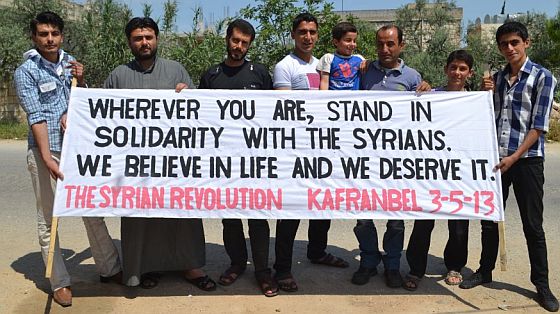
Should the fate of Syria concern you?

The Guardian reports: The cache of evidence smuggled out of Syria showing the “systematic killing” of 11,000 detainees in Syrian jails may only be the tip of the iceberg, international aid agencies have said.

The International Committee of the Red Cross, various United Nations bodies and Human Rights Watch have repeatedly complained of having next to no access to detainees and being stone-walled by Syrian authorities despite repeated requests to visit infamous detention sites, such as Sayednaya prison in Damascus.

They said Monday’s report by three eminent international lawyers that at least 11,000 victims have been killed while in detention represents numbers in only one part of the country.

“All I know after years of trying to get access is that this is likely to eventually shock the world,” one senior official from an international body told the Guardian, on condition of anonymity. “What we have seen in the [war crimes lawyers’] report broadly reflects what we have pieced together over the past few years.”

Syrian activists say an estimated 50,000 detainees remain unaccounted for. Tens of thousands of Syrians have been held in the country’s infamous detention centres and released, often after months of deprivation and torture.

In reaction to this report, here is a sampling of the comments from readers at The Guardian. While there are a few expressions of outrage, the comments I’ve picked out are fairly representative of the prevailing sentiment.

— “Assad, while not being the best of leaders, is arguably what many Arab countries need in the face of aggressive militant fanatics.”

— “Propaganda alert somebody wants to bomb them back to the stone age”

— “we should keep out of it. We can do no good here. Any attempt to intervene will inevitably result in uncoordinated disaster.”

— “All these allegations just before the peace conference smack of propaganda and manipulation. Obama was so sure that Assad had used sarin until it was shown to be a lie. But, of course, no one in the land of the free would report it (nor the Guardian). Cry wolf too many times and many will be skeptical. The timing of this report and the fact it was sponsored by Qatar is very suspicious.”

— “I supposed they need some Anti-Assad material before the scheduled talks. One last try by Qatar and the Saudi’s to propaganda us into their view. Won’t work.”

— “the west should be backing assad in his fight against the islamists/ as bad as assad might be, he is far better than the islamists/ al qaeda would butcher far more people if they took power”

— “This is nothing to do with us. We have nothing to gain from involving ourselves in this war and we’re in no position to make things better. We need to just leave them to it.”

— “Look, I’m sorry that I’m so cynical, but it’s really not my fault. They lied us into Iraq, twice! Once using the ‘babies being thrown out of incubators’ lie and once using Curveball’s lies. They have already tried to lie us into Syria once, with what looked very much like a false flag sarin attack (in that nobody could provide any real evidence of culpability). Now they are trying a new tack.”

— “I don’t think we can trust any mainstream report on issues in the middle east and elsewhere. There are to many untrustworthy players, Saudis Israel, the US can’t be trusted on Syria. You can’t trust report coming from the other side as they are not much better. Best we stop interfering in other countries affairs and most of these problems will resolve themselves.”

— “Whilst I have no doubt that the Syrian government is responsible for atrocities in Syria, I have misgivings about this report. It seems to have come out at a very convenient time, just before the peace talks, and is sponsored by the Qatar government (who back the rebels), so is hardly subjective. Seems to be another attempt to persuade Western governments to start yet another war.”

— “Haven’t we seen regimes we backed torture their population and kill thousands without a murmur of objection from our political masters? It’s time we kept out of this type of conflict. We only make things worse for the innocents.”

Never has a war been fought in which so many lives were lost, so many families displaced, and so much destruction wrought, while an antiwar “movement” was seized by one concern alone: that the West not intervene.

Of course this isn’t really an antiwar movement since with no Western government on the brink or even considering military intervention, there is nothing to protest against.

Neither is it really antiwar, since there is much less interest in ending this war than there is in making sure it not become our war.

Look at the level of public interest in Syria as measured through Google searches since the uprising began in March 2011. The only major spike came after the Ghouta chemical attack when briefly there was the prospect of very limited Western military intervention. For about three weeks, Syria — or to be more precise, the fear of war — overshadowed America’s fascination with Justin Bieber.

I used to think that being opposed to war had something to do with wanting to make the world a better place, yet in recent years the deeply conservative underpinnings of this orientation have become increasingly evident.

When Western opponents of war look at Syria or pretty much anywhere else in the Middle East, the answer to the question — am I my brother’s keeper? — appears to be a resounding, no.

Granted, whether it’s in the geopolitical realm or within the narrow sphere of ones own life, it is always necessary to balance ones aspirations with a realistic assessment of ones capabilities. And the principal of do no harm applies just as well to international affairs as it does to medicine.

But to be able to casually dismiss a report on “industrial-scale killing” seems to have less to do with expressing humility in the face of what looks like an intractable conflict and more to do with a very mundane mentality: I’ve got enough problems of my own; I don’t need to hear about yours.

Yet it’s not as though anyone reading about the latest accounts of Syria’s horrors in The Guardian has been asked to do anything. It’s not as though we have to decide whether we might be willing to make some personal sacrifice and, for instance, accommodate some refugees.

We do indeed live in a world where for vast numbers of people the demands of everyday life make it next to impossible to pay attention to the plight of people living far away.

There are however significant numbers of people who profess a concern about social justice and in the name of some kind of global conscience, champion causes such as supporting the rights of Palestinians, yet for many, their internationalism inexplicably halts at the Syrian border.

In the name of not “starting another war” (no one bothers to explain how it’s possible to start a war half way through), the antiwar camp is content to absolve itself of all concern on the basis that in Syria there are supposedly no “good guys”; that to oppose Assad is to support al Qaeda; and because it’s not our job to solve the world’s problems.

OK. But if you think Syria looks so difficult, forget about climate change, forget about inequality, and forget about opposing war. You might as well just go fishing and forget about the world.

syrian-solidarity

Facebooktwittermail

Rogers and Feinstein promote farcical ‘defection’ story about Snowden

NBC reports: Bruce Riedel, director of the Intelligence Project at the Brookings Institution in Washington and a former CIA official, said Friday that one key question now in the Snowden affair is “Is it really Edward Snowden who is doing this, or is there a larger apparatus? I know that many people in the intelligence community… now no longer regard Edward Snowden as a thief or a traitor…. They regard him as a defector” who has gone over to a foreign intelligence agency.

It’s possible that Riedel, along with Rep. Mike Rogers and Sen. Dianne Feinstein and the members of the intelligence community they talk to are all complete idiots.

That’s definitely possible.

What’s more likely though, is that an assumption being made by the heads of the intelligence agencies is that the average American is an idiot. They imagine that if the word “defector” gets repeated often enough, the idea will catch on and through the power of muddled thinking — or no thinking at all — an increasing number of people will start to believe that we’re back in the Cold War and Snowden switched sides.

Here’s the syllogism:

Defectors go to Russia. Edward Snowden went to Russia. Therefore Snowden must be a defector.

Here’s the problem with this “logic”: If Snowden really was a defector, he wouldn’t have gone via Hong Kong and met Glenn Greenwald and Laura Poitras on the way. He wouldn’t have communicated with anyone other than his Russian handlers. All the intelligence in his possession would have remained secret, thus retaining its maximum value to its recipients.

The current debate would not be taking place because hardly anyone in the world would have heard of Snowden. His name would have been placed on missing persons’ lists and his disappearance would attracted little attention beyond his family. The NSA, given Snowden’s lowly position as an employee and subsequent contractor, would most likely still remain blissfully ignorant about his breach of its security.

Edward Snowden, happy to be enjoying his anonymity and the rewards for his services would now be enjoying his new life in Russia with far more freedom than he currently has.

Meanwhile, the only defection that has actually taken place is that of common sense departing from the minds of a large number of Snowden’s critics.

Facebooktwittermail

Where is First Look heading?

Earlier this month, Pierre Omidyar announced the addition of Bill Gannon to First Look Media’s editorial leadership team. Gannon comes from from Time Inc.’s EntertainmentWeekly.com.

Drawing on his extensive experience in digital media as well as his diverse background in developing new editorial strategies and creating great user experiences, Bill will leverage all of his talents to help us build a next-generation media platform for a broad audience.

Gannon’s job title hasn’t been specified but his is presumably the lead editorial position. “Bill will assemble a specialized team to create a unique, digital approach to breaking news – from politics and business to sports and entertainment.”

Ray Rosen, from NYU, who is acting as an adviser to FLM and who is an opponent of what he calls The View From Nowhere (the pseudo impartiality that prevails in the mainstream media) was asked the following question in an interview with The Atlantic in December:

You’ve written that The View From Nowhere is, in part, a defense mechanism against charges of bias originating in partisan politics. If you won’t be invoking it, what will your defense be when those charges happen?

There are two answers to that. 1) We told you where we’re coming from. 2) High standards of verification. You need both.

Is “we told you where we’re coming from” referring to the organization itself, or the journalists it publishes, or both?

Both. Like I said: NewCo [renamed First Look] will not present itself as the Voice of God. Neither will its contributors. NewCo will not always be in harmony with itself, either. It will be messier than that.

Rosen did a short interview earlier this month with Gannon and given that Gannon is unknown to most people who are interested in FLM, it would have been great if Rosen had asked where Gannon is coming from. He didn’t and based on what Gannon says, the glibbest answer to that question is probably the most accurate: Entertainment Weekly.

The closest answer Gannon provided to the question of where he’s coming from was his explanation on his reasons for joining this venture:

I was initially attracted to the idea because it seemed to be a unique opportunity where my background in creating new editorial strategies and new user experiences could add value. I’ll be focusing on continuous news coverage and aggregation across a wide range of sections: world news, politics, business, entertainment, sports and more.

That’s marketing boilerplate — and a rehash of Omidyar’s press release. It’s the kind of statement I’d expect from someone entering a similar position in any new media outlet from Huffington Post to Buzzfeed. I get no sense of where Gannon is coming from other than that he believes he can devise ways of boosting the site’s popularity — on the unquestioned supposition that popularity is the best measure of success.

After the interview, Rosen adds an observation about the importance of establishing the right balance of “flow” and “stock” — terms defined by Robin Sloan:

Flow is the feed. It’s the posts and the tweets. It’s the stream of daily and sub-daily updates that remind people that you exist.

Stock is the durable stuff. It’s the content you produce that’s as interesting in two months (or two years) as it is today. It’s what people discover via search. It’s what spreads slowly but surely, building fans over time.

From the little that Gannon reveals, it sounds like he’ll be the kind of editor who focuses more on flow than stock — he’s no Lewis Lapham, that’s for sure.

If that’s the case, I remain skeptical about where FLM is heading since I firmly believe that any new media venture in America, for which investigative journalism is central, will for that very reason have limited popularity.

In attempting to legitimize the pursuit of a mass general interest audience, Gannon says: “The audience becomes aware of our our investigative journalism en route to their other news needs.”

On their way to catch up on Justin Bieber’s latest egg-throwing antics, users (who should not be narrowly defined as readers) will be enticed by the irresistible draw of reporting on fracking, climate change, or net neutrality.

From what I can tell, Huffington Post has already cracked this nut and established it goes the other way around: the serious bleeds to the trivial.

Facebooktwittermail

Nuclear weapons and the illusion of ‘safe hands’

At the beginning of 2004, Graham Allison wrote:

The Bush administration has yet to develop a coherent strategy for combating the threat of nuclear terror. Although it has made progress on some fronts, Washington has failed to take scores of specific actions that would measurably reduce the risk to the country. Unless it changes course — and fast — a nuclear terrorist attack on the United States will be more likely than not in the decade ahead.

A decade later hardly anyone seems to be pushing that particular panic button and yet the world still bristles with an estimated 17,300 nuclear weapons.

Apart from the fewer than 10 weapons North Korea is estimated to possess, the rest of the world’s nuclear arsenal is supposedly protected by ‘safe hands.’ How safe those might be in Pakistan is highly debatable and likewise there is little reason to have complete confidence in nuclear security in India, Russia, or Israel. But most Americans are probably confident that the nuclear arsenal in this country is the most carefully protected in the world, and maybe it is — on paper.

But it turns out — and this should come as no surprise — that the real nuclear peril here and everywhere else derives not from the designs of madmen, but rather from human frailty. Or to put it in words every American understands: because shit happens.

We already know that in 1961 two hydrogen bombs with a combined power of more than 500 Hiroshimas were accidentally dropped over North Carolina. Subsequently, a “secret investigation concluded that in the case of one of the devices only a single low-voltage switch stood between the US and catastrophe.”

The New York Times now reports that 34 of the U.S. Air Force officers who are directly in control of launching nuclear weapons have been suspended because they were found to be cheating on “proficiency tests that assess their knowledge of how to operate the warheads.”

This comes just weeks after an Air Force general was fired because of his drunken antics.

The officer, Maj. Gen. Michael J. Carey, was removed as commander of the 20th Air Force, which maintains and operates intercontinental ballistic missiles, after being accused of drinking heavily, insulting his guests, consorting with someone identified as the “cigar shop lady,” and slurring his speech while weaving in Red Square, “pouting and stumbling.”

Last May the Air Force disclosed that it removed 17 officers assigned to stand watch over nuclear-tipped Minuteman missiles after finding safety violations, potential violations in protecting codes and attitude problems.

And last November, The Associated Press reported that Air Force officers with nuclear launch authority had twice been caught napping with the blast door open. That is a violation of security regulations meant to prevent a terrorist or intruder from entering the underground command post and compromising secret launch codes.

When these are the vulnerabilities of the U.S. nuclear arsenal, there’s little reason to assume that these weapons are being guarded any more carefully elsewhere.

Posit a threat as external and no effort or expense will be spared to erect every imaginable barrier whose claimed effect will be to enhance everyone’s safety.

But when a much larger threat comes from within and comes from the simple fact that people make mistakes — that no system is absolutely unbreakable — and the only rational solution is one that hardly any politician has the guts to advocate: global nuclear disarmament.

It isn’t a question of whether this can be accomplished; it’s simply a question of whether this will happen before or after a catastrophic nuclear accident.

Facebooktwittermail

Understanding the psychology shaping negotiations with Iran

“The only way for interaction with Iran is dialogue on an equal footing, confidence-building and mutual respect as well as reducing antagonism and aggression,” Iranian President Hassan Rouhani said in a speech after taking the oath of office last August.

“If you want the right response, don’t speak with Iran in the language of sanctions, speak in the language of respect.”

In the following article, Nicholas Wright and Karim Sadjadpour describe how an understanding of neuroscience — or lack of it — may determine the outcome of negotiations with Iran.

The whole piece is worth reading, but keep this in mind: every single insight that gets attributed to neuroscience has been clearly established without the need to conduct a single brain scan. Indeed, everything that is here being attributed to the “exquisite neural machinery” of the brain can be understood by studying the workings of the human mind and how thought shapes behavior.

It is important to draw a sharp distinction between the examination of the mind and observing the workings of the brain because the latter is totally dependent on the output of intermediary electronic scanning devices, whereas minds can study themselves and each other directly and through shared language.

One of the insidious effects of neuroscience is that it promotes a view that understanding the ways brains work has greater intrinsic value than understanding how minds work. What the negotiations with Iran demonstrate, however, is that the exact opposite is true.

To the extent that through the development of trust, negotiations are able to advance, this will have nothing to do with anyone’s confidence about what is happening inside anyone’s brain. On the contrary, it will depend on a meeting of minds and mutual understanding. No one will need to understand what is happening in their own or anyone else’s insula cortex, but what will most likely make or break the talks will be whether the Iranians believe they are being treated fairly. The determination of fairness does not depend on the presence or absence of a particular configuration of neural activity but rather on an assessment of reality.

Treat us as equals, Iran’s president said — and that was almost 15 years ago!

Nicholas Wright and Karim Sadjadpour write: “Imagine being told that you cannot do what everyone else is doing,” appealed Iranian Foreign Minister Javad Zarif in a somber YouTube message defending the country’s nuclear program in November. “Would you back down? Would you relent? Or would you stand your ground?”

While only 14 nations, including Iran, enrich uranium (e.g. “what everyone else is doing”), Zarif’s message raises a question at the heart of ongoing talks to implement a final nuclear settlement with Tehran: Why has the Iranian government subjected its population to the most onerous sanctions regime in contemporary history in order to do this? Indeed, it’s estimated that Iran’s antiquated nuclear program needs one year to enrich as much uranium as Europe’s top facility produces in five hours.

To many, the answer is obvious: Iran is seeking a nuclear weapons capability (which it has arguably already attained), if not nuclear weapons. Yet the numerous frameworks used to explain Iranian motivations—including geopolitics, ideology, nationalism, domestic politics, and threat perception—lead analysts to different conclusions. Does Iran want nuclear weapons to dominate the Middle East, or does it simply want the option to defend itself from hostile opponents both near and far? While there’s no single explanation for Tehran’s actions, if there is a common thread that connects these frameworks and may help illuminate Iranian thinking, it is the brain.

Although neuroscience can’t be divorced from culture, history, and geography, there is no Orientalism of the brain: The fundamental biology of social motivations is the same in Tokyo, Tehran, and Tennessee. It anticipates, for instance, how the mind’s natural instinct to reject perceived unfairness can impede similarly innate desires for accommodation, and how fairness can lead to tragedy. It tells us that genuinely conciliatory gestures are more likely and natural than many believe, and how to make our own conciliatory gestures more effective.

Distilled to their essence, nations are led by and comprised of humans, and the success of social animals like humans rests on our ability to control the balance between cooperation and self-interest. The following four lessons from neuroscience may help us understand the obstacles that were surmounted to reach an interim nuclear deal with Iran, and the enormous challenges that still must be overcome in order to reach a comprehensive agreement. [Continue reading…]

Facebooktwittermail

Al Qaeda’s real impotence and the threat from Iraq’s prime minister Maliki

A lot of ink has been spilled in recent weeks about the rising power of al Qaeda.

“Fallujah fall just the beginning — Al Qaeda virus is virulent and spreading,” an op-ed by the Heritage Foundation’s Peter Brookes, captures the spirit of this perception of a resurgence of what some people portray as the greatest source of evil ever to appear on Planet Earth.

The thing is, viral growth of any kind cannot be reliably measured by the ability to grab headlines. However widely dispersed groups branded as al Qaeda affiliates become, the feature that distinguishes each of them is that their predilection for violence makes them unpopular. They are like psychopathic gatecrashers. Everyone knows when they show up at a party and everyone wishes they’d go some place else.

Scaring everyone around you is a good way of getting noticed but it’s not a good way of making friends and at the end of the day, whatever else one might say about these men of violence, they have profound problems making and sustaining meaningful relationships. Their dysfunctionality makes it impossible for them to become the driving force behind any popular social movement; their direct impact on the wider world will never be more than marginal.

The real global impact of al Qaeda is not one that it has the capacity to generate itself; it is the impact created by governments which either cynically or paranoiacally react to a threat whose scope they been blown out of all proportion.

Anthony H. Cordesman writes: No one can deny that al Qaeda is a violent extremist threat wherever it operates. It poses a threat in terms of transnational terrorism in the United States and Europe, and a far more direct threat to the people who live in every area it operates. It has consistently been horribly repressive, violent, and often murderous in enforcing its political control and demands for a form of social behavior that reflect the worst in tribalism and offers almost nothing in terms of real Islamic values.

Like all extreme neo-Salafi movements, al Qaeda is also an economic and social dead end. It does not offer any practical way of operating and competing in a global economy, it is too dysfunctional to allow meaningful education and social interaction, and it finances itself largely through extortion in ways that cripple the existing local economy. Moreover, it does not tolerate competition even from other Islamist fighters. In Syria, it has provoked its own civil war with other hardline Islamist movements – a civil war it now seems to be decisively losing to other Sunni rebel factions.

It is precisely that type of behavior, however, which should lead U.S. officials, analysts, and media to do a far, far better job of reporting on exactly what has really happened in Anbar, and in cities like Fallujah and Ramadi. Bad as Al Qaeda in Iraq (AQI) is, far too much of the evidence points to Prime Minister Maliki as an equal threat to Iraq and to U.S. interests. Ever since the 2010 election, he has become steadily more repressive, manipulated Iraq’s security forces to serve his own interests, and created a growing Sunni resistance to his practice of using Shi’ite political support to gain his own advantage.

He has refused to honor the Erbil power-sharing agreement that was supposed to create a national government that could tie together Arab Sunni and Arab Shi’ite, and he has increased tensions with Iraq’s Kurds. As the U.S. State Department human rights reports for Iraq, Amnesty International, and the United Nations Assistance Mission for Iraq (UNAMI) make all too clear; Maliki’s search for power has steadily repressed and alienated Iraq’s Sunnis on a national level. It has led to show trials and death sentences against one of Iraq’s leading Sunni politicians including former Vice President Taqris al-Hashimi, who has been living in asylum in Turkey since being convicted and sentenced to death in absentia by an Iraqi court. It has shifted the promotion structure in the Iraqi Security Forces to both give the Prime Minister personal control and has turned them into an instrument he can use against Sunnis.

Al Qaeda in Iraq – nor its recent incarnation the Islamic State of Iraq and Syria (ISIS) or the Islamic State of Iraq and the Levant (ISIL) – has not risen up as a rebirth of the opposition the U.S. faced in 2005-2008. In spite of attempts by the Maliki government to label virtually any major Sunni opposition as terrorists, the steady increase in that opposition orginated primarily in the form of peaceful and legitimate political protests against Maliki’s purges of elected Iraqi Sunni leaders, and a regular exclusion of Sunnis from the government – including the Sons of Iraq in areas like Anbar. It came because Maliki used the Iraqi Security Forces against segments of his own population in the name of fighting terrorists and extremists. It came because of the failure to use Iraq’s oil wealth effectively and fairly – resulting with an economy that the CIA ranks Iraq 140th in the world in per capita income. The opposition to Maliki’s government also resulted from corruption so extreme that in December 2013 Transparency International ranked Iraq the seventh most corrupt country in the world, with only Libya, South Sudan, Sudan, Afghanistan, North Korea, and Somalia ranking worse than Iraq in terms of corruption.

Any analysis or news report that focuses only on al Qaeda’s very real abuses is little more than worthless – it encourages the tendency to demonize terrorism without dealing with the fact that terrorism almost always only succeeds when governments fail their people. Just as serious counterinsurgency can never be successful if it only addresses the military dimension, counterterrorism cannot succeed if it is not coupled with an effort to address the quality of the nation’s political leadership and governance, and the legitimate concerns of its people.

Any failure to analyze Maliki’s actions since the 2010 election – his disregard for the Erbil agreement that called for a true national government, his manipulation of the courts to create multiple trails and death sentences for political oppponents, including one of Iraq’s vice presidents – Tariq al-Hashemi; his use of temporary appointments to take control of key command positions in the Iraqi Security Forces; his efforts to bribe senior Iraqi Sunni politicians to support him with ministerial posts; and his steadily increasing suppression of Sunni popular opposition and protests – is dishonest, lazy, intellectual rubbish. [Continue reading…]

Facebooktwittermail

Studying ritual in order to understand politics in Libya

When I was an undergraduate, early on I learned about the value of interdisciplinary studies. Had I been on a conventional academic track, that probably wouldn’t have happened, but I was lucky enough to be in a department that brought together anthropologists, sociologists, philosophers, theologians, and religious studies scholars. In such an environment, the sharp defense of disciplinary turf was not only unwelcome — it simply made no sense.

Even so, universities remain structurally antagonistic to interdisciplinarity, both for intellectual reasons but perhaps more than anything for professional reasons. Anyone who wants to set themselves on a track towards tenure needs to get published and academic journals all fall within and help sustain disciplinary boundaries.

I mention this because when questions are raised such as what’s happening in Libya? or the more loaded, what’s gone wrong in Libya? the range of experts who get called on to respond, tends to be quite limited. There will be regional experts, political scientists, and perhaps economists. But calling on someone with an understanding of the human function of ritual along with the role different forms of ritual may have had in the development of civilization, is not an obvious way of trying to gain insight into events in Benghazi.

Moreover, within discourse that is heavily influenced by secular assumptions about the problematic nature of religion and the irrational roots of extremism, there is a social bias in the West that favors a popular dismissal.

What’s wrong with Libya? Those people are nuts.

Philip Weiss helped popularize the expression Progressive Except on Palestine — an accusation that most frequently gets directed at American liberal Zionists. But over the last two years a new variant which is perhaps even more commonplace has proliferated across the Left which with only slight overstatement could be called Progressive Except on the Middle East.

From this perspective, a suspicion of Muslim men with beards — especially those in Libya and Syria — has become a way through which a Clash of Civilizations narrative is unwittingly being reborn. Add to that the influence of the likes of Richard Dawkins and his cohorts on their mission to “decry supernaturalism in all its forms” and what you end up with is a stifling of curiosity — a lack of any genuine interest in trying to understand why people behave the way they do if you’ve already concluded that their behavior is something to be condemned.

A year ago, the science journal Nature, published an article on human rituals, their role in the growth of community and the emergence of civilization.

The report focuses on a global project one of whose principal aims is to test a theory that rituals come in two basic forms: one that through intense and often traumatic experience can forge tight bonds in small groups and the other that provides social cohesion less intensely but on a larger scale through doctrinal unity.

Last week, the State department designated three branches of Ansar al Shariah — two in Libya and one in Tunisia — as terrorist organizations. The information provided gives no indication about how or if the groups are linked beyond the fact that they share the same name — a name used by separate groups in eight different countries.

There’s reason to suspect that the U.S. government is engaged in its own form of ritualistic behavior much like the Spanish Inquisition busily branding heretics.

Maybe if the Obama administration spent a bit more time talking to anthropologists and archeologists rather than political consultants and security advisers, they would be able to develop a more coherent and constructive policy on Libya. I’m not kidding.

In Nature, Dan Jones writes: By July 2011, when Brian McQuinn made the 18-hour boat trip from Malta to the Libyan port of Misrata, the bloody uprising against Libyan dictator Muammar Gaddafi had already been under way for five months.

“The whole city was under siege, with Gaddafi forces on all sides,” recalls Canadian-born McQuinn. He was no stranger to such situations, having spent the previous decade working for peace-building organizations in countries including Rwanda and Bosnia. But this time, as a doctoral student in anthropology at the University of Oxford, UK, he was taking the risk for the sake of research. His plan was to make contact with rebel groups and travel with them as they fought, studying how they used ritual to create solidarity and loyalty amid constant violence.

It worked: McQuinn stayed with the rebels for seven months, compiling a strikingly close and personal case study of how rituals evolved through combat and eventual victory. And his work was just one part of a much bigger project: a £3.2-million (US$5-million) investigation into ritual, community and conflict, which is funded until 2016 by the UK Economic and Social Research Council (ESRC) and headed by McQuinn’s supervisor, Oxford anthropologist Harvey Whitehouse.

Rituals are a human universal — “the glue that holds social groups together”, explains Whitehouse, who leads the team of anthropologists, psychologists, historians, economists and archaeologists from 12 universities in the United Kingdom, the United States and Canada. Rituals can vary enormously, from the recitation of prayers in church, to the sometimes violent and humiliating initiations of US college fraternity pledges, to the bleeding of a young man’s penis with bamboo razors and pig incisors in purity rituals among the Ilahita Arapesh of New Guinea. But beneath that diversity, Whitehouse believes, rituals are always about building community — which arguably makes them central to understanding how civilization itself began.

To explore these possibilities, and to tease apart how this social glue works, Whitehouse’s project will combine fieldwork such as McQuinn’s with archaeological digs and laboratory studies around the world, from Vancouver, Canada, to the island archipelago of Vanuatu in the south Pacific Ocean. “This is the most wide-ranging scientific project on rituals attempted to date,” says Scott Atran, director of anthropological research at the CNRS, the French national research organization, in Paris, and an adviser to the project.
Human rites

A major aim of the investigation is to test Whitehouse’s theory that rituals come in two broad types, which have different effects on group bonding. Routine actions such as prayers at church, mosque or synagogue, or the daily pledge of allegiance recited in many US elementary schools, are rituals operating in what Whitehouse calls the ‘doctrinal mode’. He argues that these rituals, which are easily transmitted to children and strangers, are well suited to forging religions, tribes, cities and nations — broad-based communities that do not depend on face-to-face contact.

Rare, traumatic activities such as beating, scarring or self-mutilation, by contrast, are rituals operating in what Whitehouse calls the ‘imagistic mode’. “Traumatic rituals create strong bonds among those who experience them together,” he says, which makes them especially suited to creating small, intensely committed groups such as cults, military platoons or terrorist cells. “With the imagistic mode, we never find groups of the same kind of scale, uniformity, centralization or hierarchical structure that typifies the doctrinal mode,” he says.

Whitehouse has been developing this theory of ‘divergent modes of ritual and religion’ since the late 1980s, based on his field work in Papua New Guinea and elsewhere. His ideas have attracted the attention of psychologists, archaeologists and historians.

Until recently, however, the theory was largely based on selected ethnographic and historical case studies, leaving it open to the charge of cherry-picking. The current rituals project is an effort by Whitehouse and his colleagues to answer that charge with deeper, more systematic data.

The pursuit of such data sent McQuinn to Libya. His strategy was to look at how the defining features of the imagistic and doctrinal modes — emotionally intense experiences shared among a small number of people, compared with routine, daily practices that large numbers of people engage in — fed into the evolution of rebel fighting groups from small bands to large brigades.

At first, says McQuinn, neighbourhood friends formed small groups comprising “the number of people you could fit in a car”. Later, fighters began living together in groups of 25–40 in disused buildings and the mansions of rich supporters. Finally, after Gaddafi’s forces were pushed out of Misrata, much larger and hierarchically organized brigades emerged that patrolled long stretches of the defensive border of the city. There was even a Misratan Union of Revolutionaries, which by November 2011 had registered 236 rebel brigades.

McQuinn interviewed more than 300 fighters from 21 of these rebel groups, which varied in size from 12 to just over 1,000 members. He found that the early, smaller brigades tended to form around pre-existing personal ties, and became more cohesive and the members more committed to each other as they collectively experienced the fear and excitement of fighting a civil war on the streets of Misrata.

But six of the groups evolved into super-brigades of more than 750 fighters, becoming “something more like a corporate entity with their own organizational rituals”, says McQuinn. A number of the group leaders had run successful businesses, and would bring everyone together each day for collective training, briefings and to reiterate their moral codes of conduct — the kinds of routine group activities characteristic of the doctrinal mode. “These daily practices moved people from being ‘our little group’ to ‘everyone training here is part of our group’,” says McQuinn.

McQuinn and Whitehouse’s work with Libyan fighters underscores how small groups can be tightly fused by the shared trauma of war, just as imagistic rituals induce terror to achieve the same effect. Whitehouse says that he is finding the same thing in as-yet-unpublished studies of the scary, painful and humiliating ‘hazing’ rituals of fraternity and sorority houses on US campuses, as well as in surveys of Vietnam veterans showing how shared trauma shaped loyalty to their fellow soldiers. [Continue reading…]

When people talk about nation-building, they talk about the need to establish security, the rule of law and the development of democratic institutions. They focus on political and civil structures through which social stability takes on a recognizable form — the operation for instance of effective court systems and law enforcement authorities that do not abuse their powers. But what makes all this work, or fail to work, is a sufficient level of social cohesion and if that is lacking, the institutional structures will probably be of little value.

Over the last year and a half, American interest in Libya seems to have been reduced to analysis about what happened on one day in Benghazi. But what might help Libya much more than America’s obsessive need to spot terrorists would be to focus instead on things like promoting football. A win for the national team could work wonders.

*

In the video below, Harvey Whitehouse describes the background to his research.

Facebooktwittermail

Greenwald says Israel is ‘absolutely right’ to link NSA spying to Pollard case

On Monday evening Glenn Greenwald was interviewed on Israel’s Channel 10 television. The interview was conducted in English. (It is preceded by a commercial and then interrupted half-way through with another commercial.)

The NSA intercepts communications by Israeli politicians, so why should the U.S. take issue with Israel gaining access to U.S. intelligence provided to them by Jonathan Pollard?

That appears to be Greenwald’s line of reasoning.

The fact that Pollard was a U.S. citizen employed by the government; that in return for the intelligence he was providing the Israelis he expected to get paid half a million dollars; that it is widely believed that Israel used this intelligence as a bargaining chip in negotiations with the Soviet Union — are these just pesky little details that have little bearing on the principles?

What Greenwald calls ‘hypocrisy’ — for the U.S. to spy on its ‘close ally’ Israel — is in the eyes of many others, good judgement.

Officials are loath to talk publicly about it, but spying on allies is a fact of life: the United States invests billions annually to monitor the communications of its friends. Many American embassies around the world contain a clandestine intercept facility that targets diplomatic communications. The goal is not only to know the military and diplomatic plans of our friends but also to learn what intelligence they may be receiving and with whom they share information.

That doesn’t come from a report on the Snowden revelations. It comes from Seymour Hersh’s report on Pollard written for the New Yorker in 1999.

If Israel was about to launch a unilateral attack on Iran without consulting the U.S., would it be desirable for the U.S. to gain advance warning of such a plan? You bet!

And how would such intelligence be gathered? By trying to recruit Israelis willing to spy on their own government? Fat chance.

Even if they are limited, this is in fact one of the useful services of the NSA: spying on America’s most dangerous ally.

What Pollard did was provide Israel with the means to launch an attack without tipping off the NSA in advance.

Hersh reported:

Israel made dramatic use of the Pollard material on October 1, 1985, seven weeks before his arrest, when its Air Force bombed the headquarters of the Palestine Liberation Organization in Tunisia, killing at least sixty-seven people. The United States, which was surprised by the operation, eventually concluded that the Israeli planners had synergistically combined the day-to-day insights of the SIGINT Requirements List with the strategic intelligence of the FOSIF reports and other data that Pollard provided to completely outwit our government’s huge collection apparatus in the Middle East. Even Pollard himself, the senior official told me, “had no idea what he gave away.”

Facebooktwittermail

Personal brand journalism — where the messenger becomes the message

Michael Wolff writes: There is a new vision of journalism – call it the auteur school – in which the business shifts from being organized by institutions to being organized around individual journalists with discrete followings.

The latest development is the announcement by Ezra Klein that he will likely leave the Washington Post and is looking for investors to back him – with a reported eight figure investment (ie more than $10m!) – in an independent enterprise.

Last week Kara Swisher and Walt Mossberg, who ran the Wall Street Journal tech conference AllThingsD, announced that, following the WSJ ending its relationship with them, they were setting up in business backed by NBC and other investors.

Glenn Greenwald, who broke the NSA-Edward Snowden story for the Guardian, is the headliner in a new left-oriented journalism venture backed by eBay founder Pierre Omidyar.

The former New York Times data wiz-kid, Nate Silver, has left the Times to set up a new site and vertical business under the auspice of ABC and its subsidiary ESPN. Andrew Sullivan, a blogger first at the Atlantic and then at the Daily Beast, may be the grandfather of the auteur school, leaving the Daily Beast a year ago to set up his own subscription site.

In fact, one might as well include here Tina Brown, who used the seemingly attractive economics of the web, along with her personal brand and the backing of Barry Diller, to claim journalistic independence with the Daily Beast – and in the process lost, I am reliably told, an astounding $100m.

And that leads to my cautionary question: is this all journalistic vanity and hubris, ending in certain tears, or is there plausible economic logic to individual journalistic fiefdoms? [Continue reading…]

It’s natural that a lot of attention is focused on the economics of journalism these days, since newspapers are struggling to survive, but even if it turns out that the trend towards personal brand journalism provides a viable business model, it’s questionable whether it will result in good journalism.

There’s no good reason to uncritically accept something just because you read it in the New York Times. Equally, there is no good reason to agree with an opinion just because it was expressed by someone like Glenn Greenwald. Yet one sees this all the time. Instead of his media appearances generating much serious discussion, there’s much more cheering in response to knockout punches. Another opponent eviscerated. Whoopee!

“I’m with …” goes the all-purpose expression of allegiance. Which is as good as saying: I don’t think; I’ve found someone else who can think for me.

Unfortunately, in the political arena — perhaps more so than any other arena where ideas supposedly matter — there is far too much signalling of affiliation and far too little independent analysis.

As a publication, The Economist (a name whose mention might cause some brains to freeze, given its ties to the corporate establishment) has one particular merit: they avoid the use of the byline.

Why? Because they believe “what is written is more important than who writes it.”

That idea is of course completely at odds with the idea of personal brand journalism where what is important is apparently determined by who writes it.

Facebooktwittermail

Less than one third of Americans believe in evolution

(Note: Because of the misleading way in which Pew presents its own findings, multiple reports run with a headline similar to this one in USA Today: “One-third of Americans reject human evolution.” That would appear to imply that two-thirds of Americans accept the theory of evolution that provides the foundation for evolutionary biology. However, the rejectionists that the survey identifies are those who believe in the literal truth of Genesis, Adam and Eve etc.. Those who subscribe to Intelligent Design or other non-scientific Creationist evolutionary narratives are viewed by Pew as believing in human evolution.)

I am not a militant atheist. I have little patience for the anti-religion campaigning engaged in by Richard Dawkins, Sam Harris, and their ilk. The idea of trying to rid the world of religion makes no more sense than trying to abolish sport.

Human beings are not governed by reason and people who become enslaved by rationality, inevitably become emotionally malformed. The human capacity to express and experience love is a capacity without which we would cease to be human. As Pascal said: “The heart has its reasons which reason knows not.”

We live in a world constructed by thought and shared ideas and our ability to make sense of life springs in large part from the fact that we continuously filter our experience through stories — stories through which we tell ourselves who we are, where we live, and why we live.

Because of this, I don’t think that science should or can be thrust down anyone’s throat…

And yet to learn that less than a third of Americans believe in evolution is deeply depressing — even if not surprising.

Those who want to put a strong political spin on the results of a new Pew Research Center poll on views about evolution are emphasizing the fact that the greatest concentration of skepticism on evolution is among Republicans while pointing to the figure of 67% of Democrats believing in evolution.

The pollsters, however, fudged the basic question by implying that it’s possible to believe in evolution without accepting its scientific basis.

Pew’s primary interest was in differentiating between those Americans who take Genesis literally and those who don’t. Those Americans who believe “a supreme being guided the evolution of living things for the purpose of creating humans and other life in the form it exists today” are counted as believing in evolution, even though they don’t believe in natural selection.

The fact that Pew chose to slice the question in this way is itself illustrative of the weak influence science has in American culture. “Evolution” is being treated as an object of belief coming in many varieties, rather than as hard, incontrovertibly proven scientific fact.

No one would conduct a poll asking Americans whether they believe the Earth revolves around the Sun and yet when it comes to the subject of evolution, the deference to religious belief is so engrained that evolution is treated as a completely subjective term — evolution, whatever that means to you.

Why does this matter?

The world cannot tackle climate change if America turns its back on science. And yet as a culture, America currently stands somewhere between the sixteenth and the twentieth century. Copernicus was successful but the jury’s still out on Darwin.

If two-thirds of the population is skeptical about evolution, what chance is there of persuading them that climate change is caused by human activity?

It hardly seems coincidental that almost exactly the same number of Americans who believe in human-caused climate change also believe in evolution through natural selection. (I would hazard a guess that it’s not just the same number, but also the same Americans.)

Facebooktwittermail

Talking to animals

chimpanzee

As a child, I was once taken to a small sad zoo near the Yorkshire seaside town of Scarborough. There were only a handful of animals and my attention was quickly drawn by a solitary chimpanzee.

We soon sat face-to-face within arm’s reach, exchanging calls and became absorbed in what seemed like communication — even if there were no words. Before the eyes of another primate we see mirrors of inquiry. Just as much as I wanted to talk to the chimp, it seemed like he wanted to talk to me. His sorrow, like that of all captives, could not be held tight by silence.

The rest of my family eventually tired of my interest in learning how to speak chimpaneze. After all, talking to animals is something that only small children are willing to take seriously. Supposedly, it is just another childish exercise of the imagination — the kind of behavior that as we grow older we grow out of.

This notion of outgrowing a sense of kinship with other creatures implies an upward advance, yet in truth we don’t outgrow these experiences of connection, we simply move away from them. We imagine we are leaving behind something we no longer need, whereas in fact we are losing something we have forgotten how to appreciate.

Like so many other aspects of maturation, the process through which adults forget their connections to the non-human world involves a dulling of the senses. As we age, we become less alive, less attuned and less receptive to life’s boundless expressions. The insatiable curiosity we had as children, slowly withers as the mental constructs which form a known world cut away and displace our passion for exploration.

Within this known and ordered world, the idea that an adult would describe herself as an animal communicator, naturally provokes skepticism. Is this a person living in a fantasy world? Or is she engaged in a hoax, cynically exploiting the longings of others such as the desire to rediscover a lost childhood?

Whether Anna Breytenbach (who features in the video below) can see inside the minds of animals, I have no way of knowing, but that animals have minds and that they can have what we might regard as intensely human experiences — such as the feeling of loss — I have no doubt.

The cultural impact of science which is often more colored by belief than reason, suggests that whenever we reflect on the experience of animals we are perpetually at risk of falling into the trap of anthropomorphization. The greater risk, however, is that we unquestioningly accept this assumption: that even if as humans we are the culmination of an evolutionary process that goes all the way back to the formation of amino acids, at the apex of this process we somehow stand apart. We can observe the animal kingdom and yet as humans we have risen above it.

But instead, what actually sets us apart in the most significant way is not the collection of attributes that define human uniqueness, but rather it is this very idea of our separateness — the idea that we are here and nature is out there.

Facebooktwittermail

Fantasy news technology from First Look Media

Following an announcement that Pierre Omidyar has doled out $50 million which represents 20 percent of his initial commitment to his new media venture First Look Media, Jay Rosen, an adviser to the project, says the details include the answer to a question he has frequently been asked: is this going to be a business or a non-profit? The answer is both. The news and editorial operation will be a non-profit and helping sustain this will be a new for-profit media technology company.

At the Atlantic, Robinson Meyer is guzzling the Kool-Aid:

First Look is something curious and iridescent — a technology for-profit making products for a news non-profit, selling those products elsewhere, and giving the proceeds back to the non-profit. First Look is two parts, closely joined, feeding and making a home for the other.

One of the first challenges for any new technology company is to convince investors that whatever kind of genius the company’s founders might possess, they also have some idea about how they can make their innovations profitable.

First Look has an advantage over other start-ups in this respect because its lead investor stepped forward before anyone had come up with either an innovative technology or a business plan. The premise seems to be that the Greenwald/Snowden brand has already acquired such immense value, that the new product can be constructed around the brand (and of course thousands of so-far unreleased documents from the NSA).

In Omidyar’s announcement there is one hint of realism:

The journalism operation, which will be incorporated as a 501(c)(3), will enjoy editorial independence, and any profits eventually earned by the technology company are committed to support First Look’s mission of independent journalism.

The key word there is eventually.

Glenn Greenwald, Laura Poitras, Jeremy Scahill, and Jay Rosen, probably aren’t too worried about how long eventually takes, because Omidyar’s investment of $250 million will provide financial security for several years. Moreover, since they are all on the non-profit news side, they can leave it to Omidyar to figure out if or how he’s going to make the technology side profitable.

My prediction is that by the time First Look has either succeeded or failed in demonstrating that it represents a new way of making the news business sustainable, Greenwald will have departed from journalism.

In reference to his role in bringing the Snowden revelations to the world, Greenwald has said: “when you go into journalism, this is exactly the sort of thing that you hope one day you’re going to be able to do.”

I suppose there will come some point in time when I feel like most or all of the documents that are in my possession that ought to be published have been published, and that most of the reporting that I think ought to be done has been done. That won’t necessarily end it, because I’m sure the fallout of that reporting will continue, the public debates over things, the consequences from these revelations will endure. And I will likely play some role in debating those things and talking about them and writing about them, but in terms of the very surreal craziness that has become my life, I’m looking forward to that subsiding.

Having repeatedly said that he has so far published reports on less than half the documents that need reporting, it sounds like Greenwald sees plenty of life left in this story, but it’s an open question whether anything comes after Snowden (apart from the book and the film).

Whether future whistleblowers choose to turn to Greenwald and First Look, may hinge on whether this venture ends up being perceived as a new way of doing journalism or an old way of making money: find a cheap or free raw product and then exploit ones role as an exclusive distributor who can fix prices and control the flow of goods to market.

Facebooktwittermail

The NSA’s goal is to render humanity speechless

Testifying before the European Parliament’s Committee on Civil Liberties and Home Affairs via a video link this week, Glenn Greenwald reiterated what has become his central claim about the significance of the documents leaked by Edward Snowden.

The documents reveal, Greenwald says, that: “the ultimate goal of the NSA is … nothing less than the elimination of individual privacy, worldwide.”

He acknowledges that “at first glance that [claim] might seem like it’s a bit hyperbolic, like it’s a little bit melodramatic, but it isn’t. It is a literal description of what the NSA and its closest surveillance partners are attempting to achieve.”

There is of course a glaring obstacle that the NSA will somehow need to overcome in order to accomplish its objective: the ability of people to speak to each other, face-to-face, privately.

Another loophole is the ability of people to communicate privately through the use of handwritten messages exchanged on pieces of paper — that anachronism known as a letter.

Thankfully, the shift to electronic communication has resulted in a rapid decline in the use of the near redundant handheld device called a pen and likewise, skill in composition is also in decline.

Thanks to the global proliferation of mobile phones and other handheld devices, significant strides have already been made in the effort to prevent people meeting and talking to each other.

The proliferation of opinion-driven journalism which functions as a cognitive echo-chamber, has contributed greatly in diminishing people’s capacities to think.

All in all, the NSA can be increasingly confident that however people communicate, they will have less and less to say.

Some observes may remain skeptical about the NSA’s objective of eliminating privacy, but Greenwald assures the skeptics that his claim is well-founded.

“The reason that I know that that is what they are attempting to achieve is because this is what they say over and over and over again. On occasion they say it publicly and repeatedly they say it in their private documents, which were written when they thought nobody was able to hear what it was they were saying.”

Meanwhile, as the world’s attention remains fixed on the NSA, there is another intelligence organization operating out of sight which deserves much closer attention.

Regulatory Datacorp, Inc. (RDC), based in King Of Prussia, Pennsylvania, is the world’s number one data source. Some people might think that description belongs to Google, so how do we know it belongs to RDC?

The World’s #1 Data Source” — there it is in black and white on the company’s website. For an operation that employs only 50 people and whose estimated annual revenue is a modest $3.5 million, it’s quite an accomplishment to have become number one in anything, but who am I to doubt the accuracy of their self-assessment.

They also claim to have compiled an anti-terrorism database which contains more than one million records of individuals and groups, and we all know that the bigger the database, the more useful will be the information it contains.

That’s why we know that if the NSA can collect everything, they will soon know everything.

At this point, no doubt, there are some readers who are wondering why I’ve gone to these lengths to mock Greenwald’s central claim.

Here’s why: it’s a huge distraction from the key issues. He is pandering to a libertarian fear of government that generates an enormous amount of traffic on the internet, and by so doing diminishing the focus on issues that should be of greater concern. Namely, that government officials have repeatedly lied to the public and to our elected representatives and that while claiming to serve the interests of the public they are squandering public resources.

Even if we take at face value the goal of “collect everything,” it’s an unattainable objective in terms of providing real utility.

We have less reason to imagine it poses a real threat to our privacy than it does to the condition of our roads and the quality of our schools.

Americans are paying for a bloated national security apparatus whose principal goal is its own expansion and perpetuation.

You should be less afraid of how much the NSA intrudes into your communications than of the ease with which it empties your pockets.

And on that front, have no doubt that the NSA is still winning.

The panel which just delivered to President Obama its proposals on NSA reform did not even consider questions about the agency’s budget.

How could they?

As everyone in Washington and across America is fully aware, money spent in the name of national security is sacrosanct. To question such spending is regarded as tantamount to questioning the value of American lives.

If the effort to correct the imbalance between privacy and security is successful and yet the security apparatus retains most of its political and institutional power, we won’t have much to celebrate.

Facebooktwittermail

Who can build a new world?

Quoting the Pope, James Carroll writes: “Who am I to judge?” With those five words, spoken in late July in reply to a reporter’s question about the status of gay priests in the Church, Pope Francis stepped away from the disapproving tone, the explicit moralizing typical of Popes and bishops. This gesture of openness, which startled the Catholic world, would prove not to be an isolated event. In a series of interviews and speeches in the first few months after his election, in March, the Pope unilaterally declared a kind of truce in the culture wars that have divided the Vatican and much of the world. Repeatedly, he argued that the Church’s purpose was more to proclaim God’s merciful love for all people than to condemn sinners for having fallen short of strictures, especially those having to do with gender and sexual orientation. His break from his immediate predecessors—John Paul II, who died in 2005, and Benedict XVI, the traditionalist German theologian who stepped down from the papacy in February—is less ideological than intuitive, an inclusive vision of the Church centered on an identification with the poor. From this vision, theological and organizational innovations flow. The move from rule by non-negotiable imperatives to leadership by invitation and welcome is as fundamental to the meaning of the faith as any dogma.

Of the world’s 1.2 billion Catholics, about forty-one per cent live in Latin America. Catholicism has declined in Europe and the United States, but the pews of churches throughout the developing world are crowded. The election by the College of Cardinals of the first Latin-American Pope is a signal of the Church’s demographic pivot. Francis’s place of origin alone would make him a historic figure, but the statements he has made, and the example he has set, with gestures of modesty and compassion, show a man determined to realign the vast institution with the core message of Jesus.

Late last month, Francis issued the first major declaration of his pontificate, an “apostolic exhortation,” a long document addressed to Catholics which covers a range of issues. Titled “The Joy of the Gospel” and reflecting Francis’s style — there is no pontifical “we” — the exhortation is unrelentingly positive in tone. Francis writes, “We want to enter fully into the fabric of society, sharing the lives of all, listening to their concerns, helping them materially and spiritually in their needs, rejoicing with those who rejoice, weeping with those who weep; arm in arm with others, we are committed to building a new world.”

Time magazine’s choice of Pope Francis as “Person of the Year” provoked some indignant reactions from those who felt that the award should have gone to Edward Snowden. After all, it was hard to dispute that Snowden had gained much greater media prominence around the world in 2013.

While the argument is in many ways petty — after all, it’s not about an accolade that is of any lasting significance — the contrast between the two newsmakers is useful in as much as it provides an opportunity for reflection about the issues that most profoundly affect humanity.

In an open letter, Snowden writes that “the surveillance of whole populations without any suspicion of wrongdoing … threatens to become the greatest human rights challenge of our time.”

Let’s imagine that Snowden’s actions are ultimately successful and through a combination of public and legal pressure, the U.S. and other governments roll back their mass surveillance programs and intelligence agencies serve their national security objectives while respecting the privacy and constitutional rights of ordinary citizens.

In this scenario, Snowden would deserve to be recognized as arguably the most successful whistleblower in history.

At the same time, it’s reasonable to ask whether this victory would have a significant impact on the lives of most people on this planet. I suspect it would not.

Glenn Greenwald has said: “I don’t begrudge the choice of Pope Francis: some of his pronouncements are impressive with the potential to achieve real change.” But in America, it often seems like the best kind of real change most people hope for, is little more than that things not become even worse.

Thanks in large measure to the false hopes peddled by Barack Obama, there seems very little change Americans continue to believe in.

Given the recent history of the Catholic Church and the secular trends shaping society, it’s hardly surprising that there are some people who view Pope Francis with skepticism. Yet for those who believe that humanity is set on a death spiral caused by a self-destructive economic system, it would be terrible to overlook the potential of a real radical simply because we don’t share his theology or find his institutional trappings repugnant.

For an individual to have the potential to change the world, they need much more than a world-changing message. Their word needs to command some kind of authority giving them a measure of instrumental power. But above all they need to embody what they say. Whether Francis qualifies in these terms, it is too early to judge, but he clearly has that potential.

What kind of new world is the Pope striving to create? A world, to paraphrase the economist E.F. Schumacher, in which people matter.

While Pope Francis is being denounced by American conservatives as a “liberation theologian,” one observer sees less Marxism in his denunciations of capitalism than a restatement of the views of the political economist, Karl Polanyi:

Karl Polanyi is most famous for his book The Great Transformation, and in particular for one idea in that book: the distinction between an “economy being embedded in social relations” and “social relations [being] embedded in the economic system.”

Economic activity, Polanyi says, started off as just one of many outgrowths of human activity. And so, economics originally served human needs. But over time, people (particularly, policy-making people) got the idea that markets regulated themselves if laws and regulations got out of their way. The free market converts told people that “only such policies and measures are in order which help to ensure the self-regulation of the market by creating the conditions which make the market the only organizing power in the economic sphere.” Gradually, as free market-based thinking was extended throughout society, humans and nature came to be seen as commodities called “labor” and “land.” The “market economy” had turned human society into a “market society.”

In short (as social sciences professors prepare to slam their heads into their tables at my reductionism), instead of the market existing to help humans live better lives, humans were ordering their lives to fit into the economy.

Now, back to the pope. Pope Francis, in his exhortation, notably does not call for a complete overhaul of the economy. He doesn’t talk revolution, and there’s certainly no Marxist talk of inexorable historical forces.

Instead, Francis denounces, specifically, the complete rule of the market over human beings—not its existence, but its domination.

“Today everything comes under the laws of competition and the survival of the fittest,” he writes. “Human beings are themselves considered consumer goods to be used and then discarded,” and “man is reduced to one of his needs alone: consumption.” He rejects the idea that “economic growth, encouraged by a free market, will inevitably succeed in bringing about greater justice and inclusiveness in the world.” Instead, he argues, growing inequality is “the result of ideologies which defend the absolute autonomy of the marketplace and financial speculation,” which “reject the right of states, charged with vigilance for the common good, to exercise any form of control.” And he repeats the exact language he used in an early address: “Money must serve, not rule!”

Facebooktwittermail

Roger Waters, the ‘crushingly obvious’ parallels to Israel and the parallels we prefer to ignore

Keith Kahn-Harris writes: It’s happening increasingly often: a prominent public figure makes a vituperative criticism of Israel, accusations of antisemitism follow and then come emphatic denials. This time it’s Roger Waters, the Pink Floyd vocalist, who has fanned the constantly glowing embers of controversy. Among other things, he has claimed that the “parallels [between Israel’s actions against the Palestinians] with what went on in the 1930s in Germany are so crushingly obvious”, that the Israeli rabbinate views Palestinians as “sub-humans”, and that the “Jewish lobby” is “extraordinarily powerful”. This comes on the back of Waters’ long history of pro-Palestinian activity, including supporting a cultural boycott of Israel.

In response, Waters has been accused of antisemitism by firebrands such as Rabbi Shmuley Boteach and more measured voices such as Karen Pollock of the Holocaust Educational Trust. Waters vociferously denies antisemitism, complaining that defenders of Israel “routinely drag the critic into a public arena and accuse them of being an antisemite”.

So who is right? Is Waters guilty of antisemitism?

The problem with viewing the Waters controversy through the lens of the antisemitism debate is that it becomes a zero-sum game: whether his words were antisemitic or not. If they were not, then the assumption is that they would be acceptable.

Yet there are other ways to analyse discourse on Israel. What would happen if one temporarily (and, yes, artificially) removes the question of antisemitism and looks at Waters’ remarks the way one might look at other forms of political discourse? This leads to other questions: was Waters’ intervention useful? Were his words proportionate and reasonable? Should we take what he says seriously?

Accusations that Israel is behaving in a Nazi-like manner are hardly novel. In fact they are something of a cliche not just in the controversy over Israel but in a wide range of other debates. Godwin’s Law draws attention to the wearisome regularity with which Nazi Germany is invoked; for some, its corollary is that in any debate the first one to mention the Nazis has lost.

Not only is comparing Israel to Nazi Germany predictable, even the harshest reading of Israel’s actions shows that the analogy is completely over the top. Israel can arguably be accused of subtle and not-so-subtle forms of discrimination and even ethnic cleansing of Palestinians over its history, but it has never committed systematic mass murder and the existence of Palestinian citizens of Israel (albeit often marginalised) is something that no genuinely neo-Nazi regime could tolerate. [Continue reading…]

I suspect that part of the reason Waters and others grab the Nazi analogy is that breaking this kind of taboo is a kind of act of defiance through which someone can feel they are demonstrating an unswerving commitment to truth. It’s a way of attempting to say: I will speak the truth, whatever the consequences.

As Kahn-Harris points out, however, this particular choice of analogy is cliched — it also has the appearance (intentionally or not) of serving as a form of baiting.

There are numerous other “crushingly obvious” parallels Waters could have pointed to, such as the treatment of Native Americans by European settlers who asserted a God-given right to claim this continent as their own.

Then there are parallels that most observers in the West would apparently rather ignore, namely, those in Syria where after the Palestinian occupied territories, Israel, and Jordan, the largest exiled Palestinian population resides.

By whatever metric one chooses to use, the scale of destruction wrought by the Assad regime over the last two years dwarfs the crimes of the Israelis over the last 65 years, yet so many of those who express outrage over massacres in Gaza, appear unmoved when the aggressors are not Zionists.

Israelis have been fittingly scorned for professing a humanitarian sensibility as they “shoot and cry” (Yorim u’Vochim), but among Israel’s critics who are willing to hold up a mirror there may be visible a similarly flimsy humanitarian impulse.

We often seem more concerned about who fired the gun and who manufactured the bullet than who got killed.

Facebooktwittermail

Is the NSA trying to blackmail Snowden?

On 60 Minutes last night, CBS News was provided with an “unprecedented” view inside the NSA. This included an interview with Rick Ledgett, who is leading an NSA task force conducting damage assessment on the Snowden leaks.

John Miller: Of all the things he took is there anything in there that worries you or concerns you more than anything else?

Rick Ledgett: It’s an exhaustive list of the requirements that have been levied against– against the National Security Agency. And what that gives is, what topics we’re interested in, where our gaps are. But additional information about U.S. capabilities and U.S. gaps is provided as part of that.

John Miller: So, I’m going to assume that there’s one in there about China, and there’s one in there about Iran, and there’s another in there about Russia.

Rick Ledgett: Many more than one.

John Miller: Many more than one?

Rick Ledgett: Yes.

John Miller: How many of those are there?

Rick Ledgett: About 31,000.

John Miller: If those documents fell into their hands? What good would it do them?

Rick Ledgett: It would give them a roadmap of what we know, what we don’t know, and give them– implicitly, a way to– protect their information from the U.S. intelligence community’s view.

John Miller: For an adversary in the intelligence game, that’s a gold mine?

Rick Ledgett: It is the keys to the kingdom.

Note that in no point in this exchange does Ledgett assert that the NSA knows Snowden took this particular document collection, while Miller — who comes across more like a Hollywood parody of a journalist — fails to raise this question.

But suppose the NSA truly believes that Snowden took this collection of 31,000 documents. Not only would this be a cause of immense concern to the agency, but the belief itself would be a closely guarded secret.

What possible interest does the United States have in publicizing to its adversaries, that it has lost control of its most valuable intelligence assessments?

If Snowden’s life was not already in great danger, then now, thanks to the NSA (and CBS) he just became even more exposed. And maybe that’s the point.

The NSA wants Snowden to become more afraid of remaining outside the United States than afraid of returning.

Snowden clearly understood that the longer he retained possession of however many documents he took, the more vulnerable he would become, but he waited several months before revealing to the New York Times that he had handed over all the documents to Glenn Greenwald and Laura Poitras when they met him in Hong Kong in June.

The NSA — with CBS News’ help — however, wants to promote the view that Snowden has currently in his possession 1.7 million documents.

Even if Snowden follows up his earlier denial with another denial, he will remain under intense scrutiny by foreign intelligence services.

Facebooktwittermail

The pharmaceutical industry and the fight against gun control

The Washington Post reports: One year ago, 20 children and six staff members at Sandy Hook Elementary School in Newtown, Conn., were gunned down by Adam Lanza. In the aftermath, there was hope among gun-control advocates that the event would spark pro-control reform. They’ve set their eyes on on a few states, but over the past year, more of them have loosened gun restrictions than tightened them. While gun control may face an uphill battle, though, a related policy area has seen change in the wake of the tragedy.

“We think that Sandy Hook opened up the eyes of governors and state legislators and policymakers around the country that mental health has been cut enough,” Andrew Sperling, the director of legislative advocacy at the National Alliance on Mental Illness, told Post TV’s “In Play.”

Some 36 states increased their mental health-care budgets in 2013, according to NAMI. In Colorado, where James Holmes opened fire on a crowded movie theater a little over a year ago, the mental-health budget was increased by 13.5 percent.

State-level efforts have focused on five broad categories — the mental-health system, crisis and inpatient care, community mental health, criminal justice and mental health, and civil rights and stigma reduction — NAMI wrote in a fall report.

The Post fails to note that the innocuously named NAMI, receives most of its funding from the pharmaceutical industry.

It’s not that pharma has a natural alignment with the opponents of gun control, yet what the NRA and its supporters have succeeded in doing in the wake of Newtown is to shift the debate away from gun control onto mental health — a shift which clearly serves the interests of the drug industry.

27% of all mental health services in the United States come through Medicaid and Medicaid is a cash cow for the pharmaceutical industry.

In the 1980s and ’90s, the psychiatric system went through a major transformation as psychiatric medication replaced psychotherapy as the standard of care. This broadened the scope of psychiatry in two ways. With patient care being reduced to medication management, doctors could see more patients. And with a massive growth in the number of Americans receiving disability for mental illness, the market for psychiatric medication has been booming, thanks in part to Medicaid funding.

The pharmaceutical industry has only one interest: selling drugs. It can reasonably be described as the most successful form of organized crime in human history. When companies repeatedly pay billions of dollars in settlements, it is clear that they regard such settlements as simply a component in the operating costs.

That the drug manufacturers are really nothing more than sophisticated drug pushers can be illustrated in numerous ways — consider for instance the way in which attention deficit disorder has become such a profitable diagnosis.

After more than 50 years leading the fight to legitimize attention deficit hyperactivity disorder, Keith Conners could be celebrating.

Severely hyperactive and impulsive children, once shunned as bad seeds, are now recognized as having a real neurological problem. Doctors and parents have largely accepted drugs like Adderall and Concerta to temper the traits of classic A.D.H.D., helping youngsters succeed in school and beyond.

But Dr. Conners did not feel triumphant this fall as he addressed a group of fellow A.D.H.D. specialists in Washington. He noted that recent data from the Centers for Disease Control and Prevention show that the diagnosis had been made in 15 percent of high school-age children, and that the number of children on medication for the disorder had soared to 3.5 million from 600,000 in 1990. He questioned the rising rates of diagnosis and called them “a national disaster of dangerous proportions.”

“The numbers make it look like an epidemic. Well, it’s not. It’s preposterous,” Dr. Conners, a psychologist and professor emeritus at Duke University, said in a subsequent interview. “This is a concoction to justify the giving out of medication at unprecedented and unjustifiable levels.”

The rise of A.D.H.D. diagnoses and prescriptions for stimulants over the years coincided with a remarkably successful two-decade campaign by pharmaceutical companies to publicize the syndrome and promote the pills to doctors, educators and parents. With the children’s market booming, the industry is now employing similar marketing techniques as it focuses on adult A.D.H.D., which could become even more profitable.

None of the above considerations should be taken to imply that mental health services are not indeed neglected in this country — simply that drugging and forced treatment are not the answer.

As for the issue of the epidemic of school shootings, ironically this has mostly served as a distraction from the much larger issue of gun violence.

Following the Gabrielle Giffords shooting in 2011, Emily Badger wrote:

Today, gun laws that target the mentally ill — alongside convicted felons — are founded on a series of assumptions: that people with mental illness are particularly dangerous, that legislation restricting their gun ownership will lead to decreased violence, and that this strategy will make a difference in the overall safety of society.

Such laws also assume that the background-check system is an effective means in the first place of keeping guns out of the hands of any type of dangerous person.

“In a society like ours where firearms are so prevalent — there are more handguns than there are people in the U.S. today — that seems like a highly dubious proposition,” [the director of the Division of Law, Ethics, and Psychiatry at Columbia University, Paul] Appelbaum said. “People who really want guns are arguably likely to be able to get them whether they are covered by this statute or not. It’s an empirical question as to whether this actually works in keeping guns out of anybody’s hands, or at least very many people’s hands.”

The best data Appelbaum has found, which dates to the late 1980s and early ’90s, also suggests that, at most, 3-5 percent of violent acts in the U.S. are attributable to serious mental illnesses as a risk factor — and most of those acts don’t involve guns. More recent studies in England and Sweden suggest that number for violent acts may be as low as 1-2 percent.

“To say that another way, if no one with a mental illness committed a violent act, we would still have 95-97 percent of the baseline level of violence,” Appelbaum said. “However you cut it, it looks as though we’re just talking about the tip of the iceberg in terms of problems of violence in our society, which raises the quite reasonable question as to why we’re so focused on the mentally ill?”

Not only is that focus a distraction, he adds, but it comes with the significant downside of further stigmatizing people with mental illness and confusing the public as to the notion that mental illness is a significant cause of violence in this country.

Facebooktwittermail