Category Archives: Editorials

The disappearance of CIA contractor Robert Levinson: A rogue operation or a rogue intelligence agency? Updated

An Associated Press investigation has revealed that Robert Levinson, a former FBI agent who went missing in Iran in 2007 and who was at that time described by the State Department as “a private citizen involved in private business in Iran,” was in fact working for the CIA. He had been hired by a team of analysts who were running a rogue intelligence operation.

A 28-year veteran of the Drug Enforcement Administration and the FBI, Robert Levinson had a natural ability to cultivate informants. Former colleagues say he was an easy conversationalist who had the patience to draw out people and win their confidence. He’d talk to anyone.

“Bob, in that sense, was fearless,” said retired FBI Assistant Director Mark Mershon, who worked with Levinson in Miami in the 1980s. “He wasn’t concerned about being turned down or turned away.”

As the Soviet Union collapsed, Levinson turned his attention away from Mafia bosses and cocaine cartels and began watching the Russian gangsters who made their homes in Florida. Russian organized crime was a niche then and Levinson made a name as one of the few investigators who understood it.

At a Justice Department organized crime conference in Santa Fe, N.M., in the early 1990s, Levinson listened to a presentation by a CIA analyst named Anne Jablonski and spotted a kindred spirit.

Jablonski was perhaps the government’s foremost expert on Russian organized crime. Former colleagues say she had an encyclopedic memory and could, at the mere mention of a crime figure, quickly explain his place in the hierarchy and his method of moving money. When White House officials had questions about Russian organized crime, they often called Jablonski directly.

In the relatively staid world of CIA analysts, Jablonski was also a quirky character, a yoga devotee who made her own cat food, a woman who skipped off to Las Vegas to renew her vows in an Elvis-themed chapel.

After the Santa Fe conference, Levinson left a note for Jablonski at her hotel and the two began exchanging thoughts on organized crime. Jablonski invited Levinson to CIA headquarters in Langley, Va., to speak to her colleagues in the Office of Russian and European Analysis.

By the time Levinson retired from the FBI in 1998, he and Jablonski were close friends. She attended his going-away party in Florida, met his family and harvested his knowledge of organized crime.

In retirement, Levinson worked as a private investigator, traveling the world and gathering information for corporate clients. Jablonski, meanwhile, thrived at the CIA. After the Sept. 11 attacks, former colleagues say, she was assigned to brief Attorney General John Ashcroft and FBI Director Robert Mueller about terrorist threats every morning.

In 2005, Jablonski moved to the Office of Transnational Issues, the CIA team that tracks threats across borders. Right away, she arranged for Levinson to speak to the money-laundering experts in the office’s Illicit Finance Group.

In a sixth-floor CIA conference room, Levinson explained how to track dirty money. Unlike the analysts in the audience, Levinson came from the field. He generated his own information.

In June 2006, the head of Illicit Finance, Tim Sampson, hired Levinson on a contract with the CIA, former officials said. Like most CIA contracts, it was not a matter of public record. But it also wasn’t classified. [Continue reading…]

Following an internal investigation into the events leading up to Levinson’s disappearance, Jablonski and Sampson were forced to resign. [The New York Times reports that Jablonski says she refused to resign and was fired. See update below.]

Jablonski later became chief data officer for Regulatory DataCorp, Inc. (RDC), a private intelligence company serving major banks. Yesterday evening the company’s website leadership page included this description of her:

jablonski

Today a company representative I spoke to said that she no longer works there but couldn’t tell me when she left. Presumably it was within hours of the publication of the Associated Press report.

USA Today reports that the White House strongly urged AP not to run the story:

“Without commenting on any purported affiliation between Mr. Levinson and the U.S. government, the White House and others in the U.S. Government strongly urged the AP not to run this story out of concern for Mr. Levinson’s life,” said a statement from Caitlin Hayden, a spokesperson for the National Security Council.

NBC News, however, reports that Levinson’s family believe the disclosure may be helpful:

Friends and relatives of Robert Levinson, a retired FBI agent who disappeared in Iran more than six years ago, say they hope new disclosures that he was working for the CIA will lead to more action to get him home.

“Bob is a courageous man who has dedicated himself, including risking his own life, in service to the U.S. government,” Levinson’s family said in a statement provided to NBC News. “But the U.S. government has failed to make saving this good man’s life the priority it should be.”

While the account told by the AP places emphasis on the role of Anne Jablonski, characterizing her as “quirky” (like 20 million other Americans she practices yoga) and implies that as “kindred spirits” she and Levinson perhaps carry equal responsibility for conducting a rogue operation, the story says nothing about the prevailing culture in the CIA after Vice President Dick Cheney had said that it would need to operate on “the dark side.”

The idea of a group of analysts contracting an American to conduct a clandestine mission inside Iran might sound reckless, but the fact is, they were working inside an agency that was engaged in targeted killing, torture, kidnapping, and the operation of secret prisons.

Governments, their agencies, and companies, all expect unswerving loyalty from their employees, but the obligations of loyalty invariably seem to flow in only one direction.

Update: Following the publication of the AP report, the New York Times has also released a report which it has published after receiving the Levinson family’s permission. The report contains a great deal of additional information about the fruitless efforts to find Levinson. It also contains details that raise questions about whether Jablonski was turned into a scapegoat by the CIA. It should be noted that the agency’s own investigation was triggered by the intervention of Levinson’s senator, who had himself be informed about the case by the Levinson family’s lawyer.

In March 2008, a year after Mr. Levinson’s disappearance, his wife was called to a meeting at F.B.I. headquarters. There C.I.A. officials acknowledged for the first time that he had worked for them. Had it been left up to the C.I.A., it is unlikely that meeting would have occurred.

Mr. McGee [the family lawyer] and Mr. Silverman [a retired NBC investigative producer who had arranged Levinson’s meeting in Iran] had given records from Mr. Levinson’s files that documented his C.I.A. work to the Senate Select Committee on Intelligence. Senator Bill Nelson, Democrat of Florida, called in top agency officials and demanded an explanation. Those officials said they had never been alerted that an agency contractor was missing and promised to investigate.

Not long afterward, two C.I.A. officials met with Ms. Levinson and Mr. McGee at his office in Pensacola, Fla. They started by delivering a message. “They wanted to officially apologize on behalf of the C.I.A. to the Levinson family,” Mr. McGee recalled.

According to Mr. McGee, the C.I.A. officials said that while an inquiry had not found a “smoking gun” proving that the agency knew in advance about Mr. Levinson’s trip, it did conclude that Ms. Jablonski and her boss, Mr. Sampson, had misled officials about his work.

The agency gave Ms. Jablonski, Mr. Sampson and another top C.I.A. analytical official a choice: They could resign from the agency or be fired, according to several people familiar with the matter. Mr. Sampson and the other official resigned. Ms. Jablonski said she had refused and had been fired. In 2008, when Mr. McGee made it clear he was prepared to sue the C.I.A., the agency agreed to pay $2.25 million to Christine Levinson, whether or not her husband returned.

Ms. Jablonski later said in an interview that the C.I.A.’s suggestion she had abandoned a friend to protect her career was a lie. She said she had never imagined Mr. Levinson would go to Kish and insisted that she would have stopped him had she known.

She described herself as a convenient scapegoat for the C.I.A. She said that during the agency’s internal inquiry she had been repeatedly interrogated inside a windowless room by two former operatives. The men belittled Mr. Levinson’s intelligence reports as useless and suggested she might have been complicit in his disappearance.

“For all we know, you were angry with your friend and sent him to Iran to be killed,” she said one of them told her.


Facebooktwittermail

How computers are making people stupid

The pursuit of artificial intelligence has been driven by the assumption that if human intelligence can be replicated or advanced upon by machines then this accomplishment will in various ways serve the human good. At the same time, thanks to the technophobia promoted in some dystopian science fiction, there is a popular fear that if machines become smarter than people we will end up becoming their slaves.

It turns out that even if there are some irrational fears wrapped up in technophobia, there are good reasons to regard computing devices as a threat to human intelligence.

It’s not that we are creating machines that harbor evil designs to take over the world, but simply that each time we delegate a function of the brain to an external piece of circuitry, our mental faculties inevitably atrophy.

Use it or lose it applies just as much to the brain as it does to any other part of the body.

Carolyn Gregoire writes: Take a moment to think about the last time you memorized someone’s phone number. Was it way back when, perhaps circa 2001? And when was the last time you were at a dinner party or having a conversation with friends, when you whipped out your smartphone to Google the answer to someone’s question? Probably last week.

Technology changes the way we live our daily lives, the way we learn, and the way we use our faculties of attention — and a growing body of research has suggested that it may have profound effects on our memories (particularly the short-term, or working, memory), altering and in some cases impairing its function.

The implications of a poor working memory on our brain functioning and overall intelligence levels are difficult to over-estimate.

“The depth of our intelligence hinges on our ability to transfer information from working memory, the scratch pad of consciousness, to long-term memory, the mind’s filing system,” Nicholas Carr, author of The Shallows: What The Internet Is Doing To Our Brains, wrote in Wired in 2010. “When facts and experiences enter our long-term memory, we are able to weave them into the complex ideas that give richness to our thought.”

While our long-term memory has a nearly unlimited capacity, the short-term memory has more limited storage, and that storage is very fragile. “A break in our attention can sweep its contents from our mind,” Carr explains.

Meanwhile, new research has found that taking photos — an increasingly ubiquitous practice in our smartphone-obsessed culture — actually hinders our ability to remember that which we’re capturing on camera.

Concerned about premature memory loss? You probably should be. Here are five things you should know about the way technology is affecting your memory.

1. Information overload makes it harder to retain information.

Even a single session of Internet usage can make it more difficult to file away information in your memory, says Erik Fransén, computer science professor at Sweden’s KTH Royal Institute of Technology. And according to Tony Schwartz, productivity expert and author of The Way We’re Working Isn’t Working, most of us aren’t able to effectively manage the overload of information we’re constantly bombarded with. [Continue reading…]

As I pointed out in a recent post, the externalization of intelligence long preceded the creation of smart phones and personal computers. Indeed, it goes all the way back to the beginning of civilization when we first learned how to transform language into a material form as the written word, thereby creating a substitute for memory.

Plato foresaw the consequences of writing.

In Phaedrus, he describes an exchange between the god Thamus, king and ruler of all Egypt, and the god Theuth, who has invented writing. Theuth, who is very proud of what he has created says: “This invention, O king, will make the Egyptians wiser and will improve their memories; for it is an elixir of memory and wisdom that I have discovered.” But Thamus points out that while one man has the ability to invent, the ability to judge an invention’s usefulness or harmfulness belongs to another.

If men learn this, it will implant forgetfulness in their souls; they will cease to exercise memory because they rely on that which is written, calling things to remembrance no longer from within themselves, but by means of external marks. What you have discovered is a recipe not for memory, but for reminder. And it is no true wisdom that you offer your disciples, but only its semblance, for by telling them of many things without teaching them you will make them seem to know much, while for the most part they know nothing, and as men filled, not with wisdom, but with the conceit of wisdom, they will be a burden to their fellows.

Bedazzled by our ingenuity and its creations, we are fast forgetting the value of this quality that can never be implanted in a machine (or a text): wisdom.

Facebooktwittermail

How easy is it to make sarin?

“It’s not hard to make sarin. You could mix it in the backyard. Two chemicals melded together.”Seymour Hersh interviewed on CNN, December 9, 2013.

The idea that the chemical warfare agent, sarin, is easy to make is central to Seymour Hersh’s claim that the August 21 attacks killing hundreds of Syrians could have been carried out by the rebel group, the Al Nusra Front. (With unquestioning confidence in the reliability of his source(s), Hersh rests this claim on classified intelligence reports none of which he claims to have seen.)

Hersh’s backyard sarin production appears to be concocted from fiction. The only non-state actor known to have engaged in large-scale sarin production was the Japanese cult, Aum Shinrikyo. They invested $30 million in this endeavor which included the creation of a production facility.

The plant was a free-standing three-story building, staffed by workers with chemistry and chemical-engineering expertise who designed and built proper process controls. It was a complex, expensive operation, and its production capacity was approximately 2 gallons of sarin per batch.

Dan Kaszeta, a former officer in the U.S. Army Chemical Corps and former member of the U.S. Secret Service, estimates that the August attack would have required one ton of sarin — far more than Aum Shinrikyo was able to produce even with their dedicated facility.

Hersh says “there’s two inert substances” used for producing sarin. But Kaszeta points out that the precursors are neither easy to obtain nor inert. Methylphosphonyl difluoride is both reactive and corrosive and as a Schedule 1 substance under the Chemical Weapons Convention, is tightly controlled.

Even if the precursors are obtainable, anyone trying to make sarin in an at-home lab would face a challenge because, in many ways, the ingredients are more dangerous than the final product. An intermediate step in the production, for example, requires the use of hydrogen fluoride gas at a high temperature. Hydrogen fluoride is nasty stuff, and a lot of it is needed to make sarin. Even in its more stable liquid form, the smallest leak would destroy all the chemistry equipment and almost everything else in a modern kitchen. Anyone trying to combine these ingredients may kill or seriously harm himself and anyone nearby.

Amy E. Smithson, a researcher on chemical and biological weapons at the Henry L. Stimson Center in Washington, who investigated the Aum Shinrikyo attacks in Japan emphasized that in assessing the capacity of non-state actors to use chemical weapons there is a huge gulf between the “theoretical possibility” and the “operational reality.” And keep in mind that Aum Shinrikyo was operating in the tranquility of peacetime Japan — it’s obstacles were all technical with none from the battlefield.

“By almost any standard, Aum was a terrorist nightmare – a cult flush with money and technical skills led by a con-man guru with an apocalyptic vision, an obsession with chemical and biological weaponry, and no qualms about killing,” Smithson writes.

But by almost any standard, Aum Shinrikyo’s chemical weapons program, and an earlier attempt to develop biological agents, failed to produce anything close to the killing power the group desired.

The cult started off by trying to simply acquire chemical weapons from a rogue U.S. operation peddling nerve gas on the black market – but found itself dealing with a front for the U.S. Customs Service.

For terrorists, the lesson here is plain: Worldwide law enforcement and intelligence agencies represent no small obstacle.

When Aum Shinrikyo then turned to producing its own stockpiles of chemicals in 1993, it soon ran into complex problems involved in dispersing nerve gas in ways that kill lots of people.

“Weaponizing” chemical agents requires munitions that disperse the substances in droplets, which can kill on skin contact, or vapor, which can be lethal if inhaled. But most explosive devices within the technological reach of terrorists would either destroy most of the chemical agents upon detonation or fail to effectively disperse them.

Spraying also can effectively disperse chemical agents. But most experts believe that 90 percent of any agent sprayed outdoors will not reach its intended targets in lethal form, given the vagaries of temperature, sunlight, wind and rain. Pumping chemical or biological agents into a building’s indoor ventilation system is no easy task either, requiring detailed knowledge of how air is distributed from floor to floor.

In Aum Shinrikyo’s first attempt to attack a rival group by spraying sarin gas from a moving van, Smithson notes, “the sprayer completely malfunctioned and sprayed backwards.” The second attempt ended up exposing the group’s security chief to the toxic nerve agent.

When the cult finally executed its climactic subway attack, its dispersal method of choice was poking holes in plastic bags with sharpened umbrella points. Noxious fumes then seeped from the bags into the subway cars.

The resulting chaos and death shocked the world. “Rescue crews found pandemonium, with scores of commuters stumbling about, vision-impaired and struggling to breathe,” Smithson writes. “Casualties littered the sidewalks and subway station exits. Some foaming at the mouth, some vomiting and others prone and convulsing.”

But in the final analysis, she notes, 85 percent of the 5,510 people treated at Tokyo hospitals and clinics were simply worried, not harmed. Twelve ultimately died from sarin exposure, about 40 others were seriously injured, and slightly less than 1,000 were “moderately ill.”

I recently launched my new website, Attention to the Unseen.

If you find it interesting, please sign up for email updates (via Feedburner).

Facebooktwittermail

America outside the world

In September 2001, 80% of Americans thought that protecting the U.S. from terrorist attacks should be the nation’s top foreign policy priority — and that was before the 9/11 attacks.

The culture of fear that the Bush administration promoted and exploited, engaged tendencies that permeate this nation’s history and wasn’t simply the product of opportunistic manipulation of a traumatic event.

Al Qaeda had tapped deep into the American psyche dramatically confirming a sense that the United States and the world somehow stand apart. Paradoxically, the attacks both challenged and affirmed the idea of a homeland providing safety, divided from a world that always harbors danger.

Twelve years after 9/11, protecting the U.S. from terrorism remains for 83% of Americans the number one foreign policy goal for this nation. In contrast, a mere 37% think that tackling climate change should be the top priority, down from 44% in 2001 and 50% in 1997.

And even as President Obama’s overall job approval ratings continue to slide, his rating for handling the threat of terrorism is higher than on any other issue of foreign policy.

51% of Americans think this president is “not tough enough,” while 50% say that his use of drones makes them feel safer, in contrast to a mere 14% who say that the use of drones makes this country less safe.

Somehow the world appears to only exist beyond these shores and largely outside American awareness. And to the extent that it impinges on our awareness it is invariably presented as problematic.

Pew Research reports:

For the first time since 1964, more than half (52%) agree that the U.S. should “mind its own business internationally and let other countries get along the best they can on their own;” 38% disagree. Two years ago, the public was nearly evenly divided (46% agreed and 50% disagreed in May 2011) and, as recently as 2006, more disagreed than agreed that the U.S. should mind its own business internationally (53% vs. 42%).

Similarly, 80% agree with the statement, “We should not think so much in international terms but concentrate more on our own national problems and building up our strength and prosperity here at home,” up slightly from 76% in 2011. The level of support for this statement, which has been tested since 1964, now rivals the previous high set in the early 1990s.

Views on global engagement do not vary much across party lines. Majorities or pluralities of Republicans (52%), Democrats (46%) and independents (55%) think the U.S. does too much to try to help solve world problems, and agree that the U.S. should mind its own business internationally (53%, 46% and 55%, respectively). And close to eight-in-ten among each group agree that the U.S. should concentrate more on our own national problems, rather than thinking so much in international terms (82% of Republicans, 76% of Democrats and 79% of independents).

No doubt American attitudes towards global engagement are shaped predominantly by two factors:

1. A realistic assessment that the results from a decade of war show that U.S. military engagement overseas has accomplished next to nothing positive.

2. A widespread yet baseless view that the United States government disperses foreign aid more generously than any other nation. According to OECD figures for 2012, development aid from the U.S. as a percentage of GDP places the U.S. behind eighteen other countries. In absolute terms, $30.46 billion aid from the U.S. (population 317 million) compares with $43.36 billion from the five largest European countries, the UK, France, Germany, Italy, and Spain (combined population 315 million).

But aside from these factors, there is an underlying mindset which pollsters cannot attempt to quantify and which many Americans would struggle to articulate or perhaps even recognize.

It is this spirit through which America sets itself apart. This is the shadow of American exceptionalism; a sense of insecurity that masks itself with an attitude of superiority. For within America’s many self-aggrandizing postures is a core of self-doubt.

How can America be so much greater than a world about which most Americans know so little?

Facebooktwittermail

The twilight zone: When Seymour Hersh and Pamela Geller start singing from the same song sheet

“It’s one lie after another…more perilous, more sinister, more deadly.”

That’s Pamela Geller’s reaction to a “bombshell allegation” dropped by Seymour Hersh alleging that President Obama lied about the August 21 chemical attack in Syria.

Barack Obama did not tell the whole story this autumn when he tried to make the case that Bashar al-Assad was responsible for the chemical weapons attack near Damascus on 21 August. In some instances, he omitted important intelligence, and in others he presented assumptions as facts. Most significant, he failed to acknowledge something known to the US intelligence community: that the Syrian army is not the only party in the country’s civil war with access to sarin, the nerve agent that a UN study concluded – without assessing responsibility – had been used in the rocket attack. In the months before the attack, the American intelligence agencies produced a series of highly classified reports, culminating in a formal Operations Order – a planning document that precedes a ground invasion – citing evidence that the al-Nusra Front, a jihadi group affiliated with al-Qaida, had mastered the mechanics of creating sarin and was capable of manufacturing it in quantity. When the attack occurred al-Nusra should have been a suspect, but the administration cherry-picked intelligence to justify a strike against Assad.

I know that a lot of people revere Hersh’s reporting as though it was the voice of God, but as an atheist I reserve the right to suspect that sometimes he’s delusional.

Cherry picking intelligence to justify war — yep, we’re back in Iraq.

But wait a minute. In this administration’s mad rush to war, how come Obama, Kerry et al, were falling over themselves in their eagerness to grab the unexpected lifeline thrown to them by Russia and Syria with the promise of chemical weapons destruction?

And consider this: it would seem that Hersh’s sources know more about what’s going on in Syria, than most of the key players. Hersh must have no more than two degrees of separation from Assad — which could well be the case and maybe provides all the more reason for casting a skeptical eye on his reporting.

Note: while Hersh says that al-Nusra should have been viewed as a suspect, he doesn’t actually provide any direct evidence that they were involved — he simply cites alleged evidence that they had the capacity to be involved.

Contrast this with what is thus far the most detailed reporting on the attacks that appeared in the Wall Street Journal on November 22:

The Wall Street Journal has pieced together a reconstruction of that fateful day from battlefield reports and dozens of interviews with eyewitnesses, rebels, medics, activists and Western intelligence officials. It reveals both the horror of the attack and the months of miscalculations by the Syrian regime, opposition groups and U.S. government that left them all unprepared for what happened.

U.S. and Israeli communications intercepts reveal chaos inside the Syrian regime that night. When the reports of mass casualties filtered back from the field, according to the officials briefed on the intelligence, panicked Syrian commanders shot messages to the front line: Stop using the chemicals!

Calls came in to the presidential palace from Syrian allies Russia and Iran, as well as from Hezbollah, the Lebanese militant group whose fighters were inadvertently caught up in the gassing, according to previously undisclosed intelligence gathered by U.S., European and Middle Eastern spy agencies. The callers told the Syrians that the attack was a blunder that could have profound international repercussions, U.S. officials say.

Now if al-Nusra had launched the attack, apparently the Assad regime, Russia, Iran, and Hezbollah were all ignorant of this.

Hersh’s bombshells usually appear in the New Yorker. Maybe their unswerving loyalty to Obama forced them to take a pass on what could have been a hot-selling cover story.

Or, maybe they concluded Hersh must have been smoking crack cocaine while he pumped out this masterpiece.

A note on Hersh’s sources: A “former senior intelligence official” and a “senior intelligence consultant” are cited as the primary sources for the information in this report. Ray McGovern, for instance, is a former senior intelligence official and he’s been outside government for 23 years and he seems to rely on sources like Mint Press to learn about Syria. A lot of journalists hope their readers will be duly impressed by the phrase senior intelligence official and ignore the prefix former. In reality, former officials often have no better access to current intelligence information than anyone else. As for a senior intelligence consultant, we might as well be told “some guy in Washington.”

It’s too easy to dress up hearsay and make it sound like inside information if your readers are inclined to believe everything you write simply because you happen to be a veteran investigative reporter. As always, it’s much more important to study the content than the packaging.

Facebooktwittermail

The specter of global domination

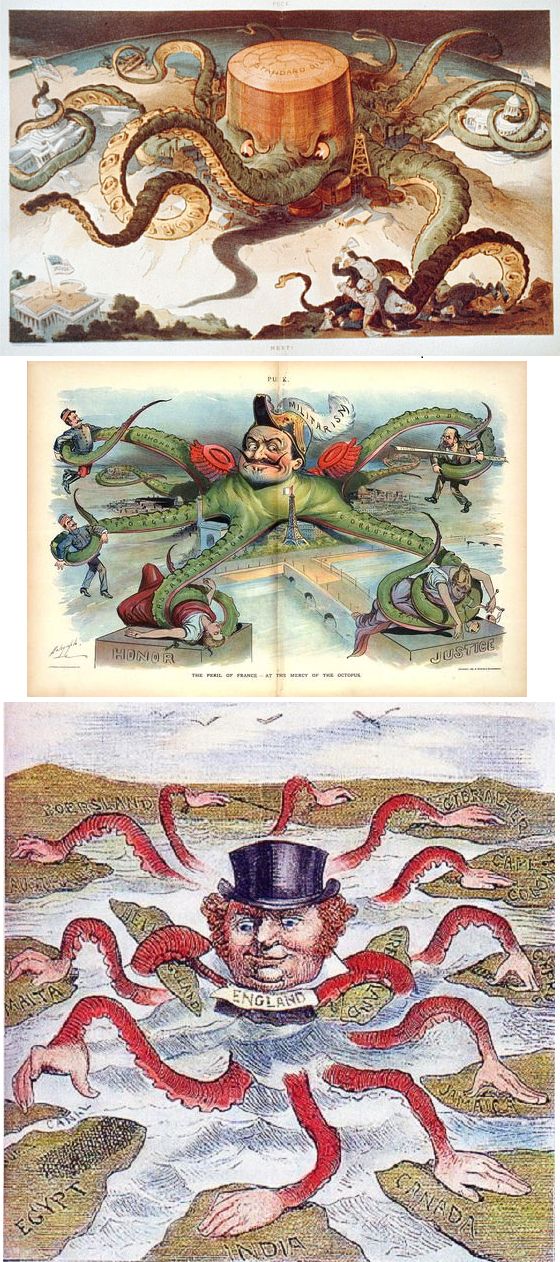
spectreWhen Ian Flemming created the fictional SPECTRE (SPecial Executive for Counter-intelligence, Terrorism, Revenge and Extortion), a terrorist organisation aimed at world domination, he chose a familiar icon — the octopus — long favored by those who want to evoke images of evil. Its tentacles represent strength, stealth, ugliness, vast reach, and ruthlessness.

nrolFor the National Reconnaissance Office (NRO), which chose a world-grasping octopus and the slogan “Nothing is Beyond Our Reach” to adorn its latest spy satellite that launched from California on Thursday, the octopus represents “a versatile, adaptable, and highly intelligent creature.”

That’s an accurate description of an octopus as a creature but not of an octopus as a symbol.

While the mission of NROL-39 is classified, it is believed to be a remnant of the Future Imagery Architecture, a program which was described in the New York Times in 2007 as “perhaps the most spectacular and expensive failure in the 50-year history of American spy satellite projects.”

nrol-39

In a recent interview with the BBC, Glenn Greenwald said:

The goal of the United States government and the UK government, its closest surveillance ally, is to eliminate all privacy globally, by which I mean, to make every form of electronic communication by and between all human beings, collected, stored, analyzed, and monitored by the U.S. and its four English-speaking Five Eyes partners in the surveillance world.

One can view NROL-39 and its choice of symbols as yet another example of this relentless drive towards global domination in surveillance that Greenwald describes, or, one can apply a bit of analysis in a more fruitful, realistic but perhaps less hyperbolic direction.

As news reports appeared showing the NRO’s poor choice of imagery, I expect that inside the Pentagon and across the intelligence community, there was no shortage of individuals who smacked their own foreheads as they wondered: who could be so clueless? U.S. intelligence already has a massive image problem. It just got worse.

As a defense establishment agency, I’m sure the NRO does not have an artist-in-residence who is given a free hand to design and deploy a spy satellite logo of their choice. On the contrary, like any other government bureaucracy, the NRO no doubt has a careful review process through which draft designs are viewed and approved or rejected. So it’s very unlikely that when NROL-39 blasted into orbit, the global dominating octopus on its side lacked any of the sign-offs in the stages of authorization required by the agency. In other words, government officials across multiple ranks of seniority saw the logo and said: “Looks good to me.”

What the octopus logo reveals says much less about the ability of the intelligence agencies to control the world than it says about the competence and judgement of the people in charge.

The NRO is run by Betty J. Sapp and she isn’t a rocket scientist — business management is supposedly her expertise.

When those aspects of an intelligence agency’s work that are on public display evince this level of cluelessness, there’s no reason to imagine that under a cloak of secrecy it operations are more efficient.

We probably have less reason to be worried about our freedoms being curtailed than we have reason to be angry about the vast waste of resources all incurred in the name of national security.

octopus-domination

Facebooktwittermail

Do you love your country?

Yesterday I got a new pair of glasses and as the optician made sure they were spotless, I was amused to see she was using a cloth in the form of a small British flag — a Union Jack.

“It’s fortunate that the British don’t view their flag the same way Americans view theirs, otherwise I might take offense,” I told her. She seemed to have no idea what I meant as I alluded to American traditions regarding the respectful handling of Old Glory.

The ambiguity of British national identity is embedded right in the structure of the flag, with its English, Scottish, and Irish elements.

If Scotland votes in favor of independence next September, perhaps there should be a debate about whether the Union Jack retains its St Andrew’s Cross — St. Andrew being Scotland’s patron saint. Maybe the time will have come to toss out the name and concept of a United Kingdom.

Following yesterday’s parliamentary interrogation of the newspaper’s editor, Alan Rusbridger, by British MPs, The Guardian reported:

In perhaps the most unexpected exchange of the session, [Keith] Vaz [chairman of the home affairs select committee] asked Rusbridger if he loved his country – an apparent reference to critics of the Guardian who have accused it of weakening its security. Vaz [who was born in Aden, which is now part of Yemen] asked : “You and I were both born outside this country, but I love this country. Do you love this country?”

Rusbridger [who was born in Northern Rhodesia, which later became Zambia]: “I’m slightly surprised to be asked the question but, yes, we are patriots and one of the things we are patriotic about is the nature of democracy, the nature of a free press and the fact that one can, in this country, discuss and report these things.”

Vaz: “So the reason why you’ve done this has not been to damage the country, it is to help the country understand what is going on as far as surveillance is concerned?”

Rusbridger: “I think there are countries, and they’re not generally democracies, where the press are not free to write about these things, and where the security services do tell editors what to write, and where politicians do censor newspapers. That’s not the country that we live in, in Britain, that’s not the country that America is and it’s one of the things I love about this country – is that we have that freedom to write, and report, and to think.”

Mindful of the way his answer would be reported, Rusbridger did not hesitate to identify himself as a patriot, but even if this was not Vaz’s intention, the mere asking of the question brought to the hearing a tinge of McCarthyism.

As much as Britain has marched in lockstep with the United States since 9/11, its susceptibility to engage in slavish imitation has not extended as far as politicians or other public figures feeling duty-bound to sport Union Jack lapel buttons. Fortunately, for the British, the flag remains an ambiguous symbol.

If Rusbridger had been born in Edinburgh instead of Rhodesia, Vaz might have refrained from raising the question of patriotism. After all, if the vote on independence was phrased in the most emotive way, it could simply ask those being polled: which country do you love more: Britain or Scotland?

No doubt the voters themselves will largely be confronting more practical questions about economics and the future and their choice will not be wholly guided by sentiment.

Both in Britain and America and elsewhere, the ultimate test of patriotic loyalty goes far beyond love of country.

Are you willing to die for your country?

Even during an era in which martyrdom has become identified with religious extremism, not many Americans view the willingness to die while defending the United States as an expression of extremism. And yet those Americans who have been called on in recent years to demonstrate that willingness have disproportionately been under-privileged.

In contrast, those Americans who are willing to send other Americans to die for their country, have rarely even been willing to give up their job — let alone sacrifice their life — for the sake of the nation.

Before anyone makes a bold declaration about the extent and depth of their love of country, it’s worth asking: what do you mean by “love” and “country”?

Is this love simply another name for blind obedience? And do we confuse countries with their national emblems?

Wisely, Rusbridger qualified his love of Britain by identifying some of the things that make it lovable — such as freedom of expression and the ability to publish without seeking permission from a state censor. But the mere fact that he was being questioned was indicative of a trend being pushed by those who prize loyalty and obedience to state-defined interests, more than they prize a free and independent press.

Countries can change fast and one of the surest signs they are changing for the worse is when journalists are accused of being insufficiently patriotic.

Had Rusbridger been more blunt he might have said: I love what my country represents but not what it is becoming.

Facebooktwittermail

Amazon’s brave new world

“Fulfillment,” in Amazon’s lexicon, is all about getting what you want and getting it now. It is the acme of the consumer age through which the maximum number of desires can be fulfilled in the minimum amount of time. And it is in the service of this debased expression of human existence, that Amazon dedicates all its efforts.

But Amazon’s commitment to fostering customer loyalty, creates the impression of a human interest, concealing the indifference that the company displays towards its own workers — workers who are treated so badly that they probably envy their counterparts at Walmart.

The fact that Amazon calls its warehouses “fulfillment centers” shows the degree to which as a company, Amazon views its employees as simply expendable cogs in a machine. And since the closest most Amazon customers ever come to a human interaction with the company comes indirectly via UPS deliverers, most of Amazon’s actual workers toil invisibly in conditions far removed from anything that could be defined as fulfilling. Adding insult to injury, these workers then get branded with job titles like “Pick Ambassador” — tokens of respect, clearly designed to obscure the lack of respect with which Amazon views its employees.

In 2011, the Allentown Morning Call reported on conditions inside Amazon’s Lehigh Valley warehouse:

Workers said they were forced to endure brutal heat inside the sprawling warehouse and were pushed to work at a pace many could not sustain. Employees were frequently reprimanded regarding their productivity and threatened with termination, workers said. The consequences of not meeting work expectations were regularly on display, as employees lost their jobs and got escorted out of the warehouse. Such sights encouraged some workers to conceal pain and push through injury lest they get fired as well, workers said.

During summer heat waves, Amazon arranged to have paramedics parked in ambulances outside, ready to treat any workers who dehydrated or suffered other forms of heat stress. Those who couldn’t quickly cool off and return to work were sent home or taken out in stretchers and wheelchairs and transported to area hospitals. And new applicants were ready to begin work at any time.

An emergency room doctor in June called federal regulators to report an “unsafe environment” after he treated several Amazon warehouse workers for heat-related problems. The doctor’s report was echoed by warehouse workers who also complained to regulators, including a security guard who reported seeing pregnant employees suffering in the heat.

In a better economy, not as many people would line up for jobs that pay $11 or $12 an hour moving inventory through a hot warehouse. But with job openings scarce, Amazon and Integrity Staffing Solutions, the temporary employment firm that is hiring workers for Amazon, have found eager applicants in the swollen ranks of the unemployed.

Many warehouse workers are hired for temporary positions by Integrity Staffing Solutions, or ISS, and are told that if they work hard they may be converted to permanent positions with Amazon, current and former employees said. The temporary assignments end after a designated number of hours, and those not hired to permanent Amazon jobs can reapply for temporary positions again after a few months, workers said.

Temporary employees interviewed said few people in their working groups actually made it to a permanent Amazon position. Instead, they said they were pushed harder and harder to work faster and faster until they were terminated, they quit or they got injured. Those interviewed say turnover at the warehouse is high and many hires don’t last more than a few months.

From Jeff Bezos’s point of view, Amazon represents nothing less than the nature of the future and in saying this he is expressing a kind of technological determinism — the latest face of unstoppable progress.

But what he is articulating is more importantly a philosophy of commerce in which human interaction is seen as redundant or a form of inefficiency.

Sure, he wants to cultivate strong relationships, but these aren’t relationships between people; they are relationships between customers and an amorphous corporate entity towards which we are meant to turn for the fulfillment of all our needs.

Finally, just in case anyone took the bait of the promise of goods delivered by drones (a prospect that should be viewed as skeptically as the chances of Santa Claus climbing down a chimney), James Ball lists a few of the logistical problems:

It’s all well and good for the unmanned vehicles to fly to a particular GPS site, but how does it then find the package’s intended recipient? How is the transfer of the package enacted? What stops someone else stealing the package along the way? And what happens when next door’s kid decides to shoot the drone with his BB rifle?

None of that starts to come close to the legal minefield using drones in this way entails. At present, flying drones of this sort for commercial use would be illegal in the US. The Federal Aviation Administration (FAA), which regulates this area, intends to make commercial drones legally viable and workable by 2015, but this deadline is all-but impossible: managing the skies with this much low-level traffic is a problem people are nowhere near solving. Opening up crowded urban areas full of terror targets to large numbers of flying platforms is always going to be packed with conflicting interests and difficulties. And all this has come before the first lawsuit caused after someone is injured by a faulty drone (or that one your neighbour shot), crashing down to earth.

What Jeff Bezos announced amounted, essentially, to an aspiration to change how his company delivers products, in about five years time, if technology advances and regulation falls his way. If his TV appearance hadn’t included the magic word “drones”, Bezos’s vague aspirations to change an aspect of his company’s logistics probably wouldn’t have made waves. Lucky for him, he did – winning his company positive publicity just ahead of what is usually the biggest online shopping day of the year, the dreadfully named Cyber Monday.

Floating an exciting-but-impractical innovation for a swath of press coverage is such an old PR tactic you’d hope no one would fall for it, and yet everyone still does.

Facebooktwittermail

Google’s plan to prolong human suffering

The idiots in Silicon Valley — many of whom aren’t yet old enough to have experienced adventures of aging like getting a colonoscopy — seem to picture “life-extension” as though it means more time to improve one’s tennis strokes in a future turned into a never-ending vacation. But what life extension will much more likely simply mean is prolonged infirmity.

If it was possible to build an economy around “health care” — which should much more accurately be called disease management — then the prospect of a perpetually expanding population of the infirm might look like a golden business opportunity, but what we’re really looking at is an economy built on false promises.

Daniel Callahan writes: This fall Google announced that it would venture into territory far removed from Internet search. Through a new company, Calico, it will be “tackling” the “challenge” of aging.

The announcement, though, was vague about what exactly the challenge is and how exactly Google means to tackle it. Calico may, with the aid of Big Data, simply intensify present efforts to treat the usual chronic diseases that afflict the elderly, like cancer, heart disease and Alzheimer’s. But there is a more ambitious possibility: to “treat” the aging process itself, in an attempt to slow it.

Of course, the dream of beating back time is an old one. Shakespeare had King Lear lament the tortures of aging, while the myth of Ponce de Leon’s Fountain of Youth in Florida and the eternal life of the Struldbrugs in “Gulliver’s Travels” both fed the notion of overcoming aging.

For some scientists, recent anti-aging research — on gene therapy, body-part replacement by regeneration and nanotechnology for repairing aging cells — has breathed new life into this dream. Optimists about average life expectancy’s surpassing 100 years in the coming century, like James W. Vaupel, the founder and director of the Max Planck Institute for Demographic Research in Germany, cite promising animal studies in which the lives of mice have been extended through genetic manipulation and low-calorie diets. They also point to the many life-extending medical advances of the past century as precedents, with no end in sight, and note that average life expectancy in the United States has long been rising, from 47.3 in 1900 to 78.7 in 2010. Others are less sanguine. S. Jay Olshansky, a research associate at the Center on Aging at the University of Chicago, has pointed out that sharp reductions in infant mortality explain most of that rise. Even if some people lived well into old age, the death of 50 percent or more of infants and children for most of history kept the average life expectancy down. As those deaths fell drastically over the past century, life expectancy increased, helped by improvements in nutrition, a decline in infectious disease and advances in medicine. But there is no reason to think another sharp drop of that sort is in the cards.

Even if anti-aging research could give us radically longer lives someday, though, should we even be seeking them? Regardless of what science makes possible, or what individual people want, aging is a public issue with social consequences, and these must be thought through.

Consider how dire the cost projections for Medicare already are. In 2010 more than 40 million Americans were over 65. In 2030 there will be slightly more than 72 million, and in 2050 more than 83 million. The Congressional Budget Office has projected a rise of Medicare expenditures to 5.8 percent of gross domestic product in 2038 from 3.5 percent today, a burden often declared unsustainable.

Modern medicine is very good at keeping elderly people with chronic diseases expensively alive. At 83, I’m a good example. I’m on oxygen at night for emphysema, and three years ago I needed a seven-hour emergency heart operation to save my life. Just 10 percent of the population — mainly the elderly — consumes about 80 percent of health care expenditures, primarily on expensive chronic illnesses and end-of-life costs. Historically, the longer lives that medical advances have given us have run exactly parallel to the increase in chronic illness and the explosion in costs. Can we possibly afford to live even longer — much less radically longer?

At the heart of the idiocy which Silicon Valley cultivates are a host of profound misconceptions about the nature of time.

Having become slaves of technology, we take it as given that time is measured by clocks and calendars. Life extension is thus conceived in purely numerical terms. Yet the time that matters is not the time that can be measured by any device.

That’s why in an age in which technology was supposed to reward us all with extra time, instead we experience time as being perpetually compressed.

Having been provided with the means to do more and more things at the same time — text, tweet, talk etc. — our attention gets sliced into narrower and narrower slivers, and the more time gets filled, the more time-impoverished we become.

For the narcissist, there can be no greater fear than the prospect of the termination of individual existence, yet death is truly intrinsic to life. What it enables is not simply annihilation but more importantly, renewal.

Facebooktwittermail

Google’s bold and deceptive Partition ad campaign

People think of Google, Apple, Coca-Cola and so forth as brands, but these names are better thought of as branding irons designed to leave an indelible imprint on their customers’ brains. We are the cattle and even though the branding process is seemingly anodyne — generally producing pleasure rather than pain — when branding “works” it yields a form of ownership. Except unlike livestock which have no loyalty to their owners, we allow ourselves to be corralled and tethered with no visible restraint. We have become the most successfully domesticated of animals.

Advertising is all about short-circuiting reason and misappropriating emotion in the service of a commercial goal. It aims to sear a brand onto the brain in conjunction with a positive feeling, so that the brand on its own can later trigger the same feeling.

The Partition of British India in 1947 resulting in the creation of the republics of India and Pakistan involved the displacement of 14 million people and the deaths of as many as one million. Many of the wounds have still not healed after the subcontinent was ripped apart. But here comes Google with an ad called ‘Reunion’, offering a balm in the form of a touching short story.

“I don’t work on a computer and I have no idea what Google is. But I am glad to be a part of what I thought was a very sentimental story,” said M.S. Sathyu, who plays “Yusuf”, an elderly sweet seller in Lahore who features in the advertisement.

The Indian Express reports:

The three-and-half minute ad was shot in different areas in Delhi, including an old haveli in Connaught Place, Red Fort, India Gate and a small scene in Lahore, Pakistan. “We have all heard stories about Partition and how friends and families were separated. So the background for the ad was set. But we wanted to make sure we did not adhere to clichés,” says Mumbai-based Amit Sharma of Chrome Pictures who directed the commercial.

As the ad begins we see an 80-something-year Baldev (VM Badola) in his small store in Delhi narrate the stories of his childhood to his granddaughter Suman (Auritra Ghosh). He reminiscences about times with his best friend, Yusuf (MS Sathyu), flying kites in a park in Lahore and stealing jhajariyas from Yusuf’s Fazal Sweet shop. This sends the granddaughter on an online search until she speaks to Yusuf himself. And on her grandfather’s birthday, she arranges a reunion between Yusuf and Baldev.

Google offered its advertising agency broad latitude in crafting a message:

The scriptwriter for the ad, Sukesh Kumar Nayak of Ogilvy and Mather, says that he was pleasantly surprised when a tech giant like Google specified in their brief that the only thing they wanted was to see was how meaningful the search engine is in real life. “Our entire life revolves around Google, it is our instant response to something we don’t know. But we wanted to dig deeper, and make the connection between real life and Google, magical,” says Nayak.

Or to put it another way, to contrive a connection between real life and fantasy, since as Hamna Zubair points out, the barriers between India and Pakistan are far more extensive than any that can be bridged by Google.

It is notoriously hard for an Indian national to get a visa to Pakistan and vice versa. In fact, as little as five years ago, after the Mumbai bombings, it was near impossible. A series of false starts, misunderstandings, and in some cases, outright armed conflicts have plagued the neighbors ever since they came into existence in 1947.

Whereas an American citizen, for example, can get a visa to India that is valid for 5 or even 10 years without much fuss, a Pakistani citizen has to fill out a “Special Pakistan Application” and get an Indian national living in India to write him or her a letter of sponsorship. Even then, a visa isn’t guaranteed, and your passport could be held for many months as you’re screened. Indian citizens who want to visit Pakistan don’t have it much easier.

For the many, many Indians and Pakistanis who have families across the border and want to visit them, this is a constant source of grief. We all wish it were easier to traverse the India-Pakistan border, but this is not the case, and never has been.

So while Google’s ad does tap into a desire many Pakistanis and Indians have – that is, to end long-standing political conflict and just visit a land their ancestors lived on – it isn’t an accurate representation of reality. At best, one hopes this ad may generate a greater push to relax visa restrictions. Until then, however, just like India and Pakistan posture about making peace, one has to wonder if Google isn’t indulging a little fantasy as well.

Ironically, a real life connection that Google hopes its audience must have forgotten was evident in the Mumbai attacks themselves in which the terrorists used Google Earth to locate their targets.

If Google was really making this a better world, the more reliable evidence of that might be seen in search trends — not feel-good commercials.

What are the hottest searches right now? Indians are preoccupied with the departure of cricketer Sachin Tendulkar, while Americans focus on the Ultimate Fighting Championship.

Still, since a commercial like Reunion conveys such a positive sentiment, can’t it at least be viewed as harmless? And might it not provide a useful if small nudge in the direction of India-Pakistan reconciliation?

Those who define the strategic interests of each state have much more interest in shaping rather than being shaped by public opinion. Moreover, the resolution of conflicts such as the one that centers on Kashmir hinges on much more than a desire among people to get along and reconnect. Google has no interest in changing the political landscape; it simply wants to expand its market share.

Aside from the fact that a commercial likes this conveniently ignores the messiness of politics, the more pernicious effect of advertising in general is cultural.

The talent of storytellers and artists is being wasted in advertising agencies where creativity is employed to strengthen the bottom line — not expand the imagination.

Even worse, metaphor — the means through which the human mind can most evocatively and directly perceive connections — has been corrupted because above all, advertising trades in the promotion of false connections through its cynical use of metaphorical imagery. Advertising always promises more than the product; it equates the product with a better life.

Just as Coca-Cola once promised to create a world in perfect harmony, now Google promises to bring together long lost friends.

Both are seductive lies and we gladly yield to the manipulation — acting as though our exposure to such a ceaseless torrent of commercial lies will have no detrimental impact on the way we think.

Facebooktwittermail

Vanishing tribal cultures

Before They Pass Away,” by British photographer Jimmy Nelson, is described by an Amazon reviewer as “an essential item on everyone’s coffee table.”

It’s ironically fitting that this description comes from a “place” whose name — at least in the U.S. — now more frequently refers to the online mega-store rather than to the South American region. An indication perhaps that we care more about what we buy that what we breath.

Leaving aside the question as to whether anything can be said to be essential on a coffee table, the fact that a record of vanishing peoples would be trivialized by being ascribed this value says a lot about why they are vanishing.

Are we to superficially mourn the loss of cultures yet simultaneously be glad that something was preserved in the form of exquisite photographs? Content, perhaps, that before their demise we were able to snatch images of their exotic dress and thereby from the comfort of a couch somehow enhance our own appreciation of a world gradually being lost?

One could view cultural loss as a representation of cultural failure — that those under threat are those who proved least capable of adaptation. Or, one can see the failure as ours — that this represents yet another frontier in the destructive impact of those who have claimed global cultural domination and in so doing are busy destroying the atmosphere, the biosphere, and the ethnosphere.

Maori

Facebooktwittermail

Plato foresaw the danger of automation

Automation takes many forms and as members of a culture that reveres technology, we generally perceive automation in terms of its output: what it accomplishes, be that through manufacturing, financial transactions, flying aircraft, and so forth.

But automation doesn’t merely accomplish things for human beings; it simultaneously changes us by externalizing intelligence. The intelligence required by a person is transferred to a machine with its embedded commands, allowing the person to turn his intelligence elsewhere — or nowhere.

Automation is invariably sold on the twin claims that it offers greater efficiency, while freeing people from tedious tasks so that — at least in theory — they can give their attention to something more fulfilling.

There’s no disputing the efficiency argument — there could never have been such a thing as mass production without automation — but the promise of freedom has always been oversold. Automation has resulted in the creation of many of the most tedious, soul-destroying forms of labor in human history.

Automated systems are, however, never perfect, and when they break, they reveal the corrupting effect they have had on human intelligence — intelligence whose skilful application has atrophied through lack of use.

Nicholas Carr writes: On the evening of February 12, 2009, a Continental Connection commuter flight made its way through blustery weather between Newark, New Jersey, and Buffalo, New York. As is typical of commercial flights today, the pilots didn’t have all that much to do during the hour-long trip. The captain, Marvin Renslow, manned the controls briefly during takeoff, guiding the Bombardier Q400 turboprop into the air, then switched on the autopilot and let the software do the flying. He and his co-pilot, Rebecca Shaw, chatted — about their families, their careers, the personalities of air-traffic controllers — as the plane cruised uneventfully along its northwesterly route at 16,000 feet. The Q400 was well into its approach to the Buffalo airport, its landing gear down, its wing flaps out, when the pilot’s control yoke began to shudder noisily, a signal that the plane was losing lift and risked going into an aerodynamic stall. The autopilot disconnected, and the captain took over the controls. He reacted quickly, but he did precisely the wrong thing: he jerked back on the yoke, lifting the plane’s nose and reducing its airspeed, instead of pushing the yoke forward to gain velocity. Rather than preventing a stall, Renslow’s action caused one. The plane spun out of control, then plummeted. “We’re down,” the captain said, just before the Q400 slammed into a house in a Buffalo suburb.

The crash, which killed all 49 people on board as well as one person on the ground, should never have happened. A National Transportation Safety Board investigation concluded that the cause of the accident was pilot error. The captain’s response to the stall warning, the investigators reported, “should have been automatic, but his improper flight control inputs were inconsistent with his training” and instead revealed “startle and confusion.” An executive from the company that operated the flight, the regional carrier Colgan Air, admitted that the pilots seemed to lack “situational awareness” as the emergency unfolded.

The Buffalo crash was not an isolated incident. An eerily similar disaster, with far more casualties, occurred a few months later. On the night of May 31, an Air France Airbus A330 took off from Rio de Janeiro, bound for Paris. The jumbo jet ran into a storm over the Atlantic about three hours after takeoff. Its air-speed sensors, coated with ice, began giving faulty readings, causing the autopilot to disengage. Bewildered, the pilot flying the plane, Pierre-Cédric Bonin, yanked back on the stick. The plane rose and a stall warning sounded, but he continued to pull back heedlessly. As the plane climbed sharply, it lost velocity. The airspeed sensors began working again, providing the crew with accurate numbers. Yet Bonin continued to slow the plane. The jet stalled and began to fall. If he had simply let go of the control, the A330 would likely have righted itself. But he didn’t. The plane dropped 35,000 feet in three minutes before hitting the ocean. All 228 passengers and crew members died.

The first automatic pilot, dubbed a “metal airman” in a 1930 Popular Science article, consisted of two gyroscopes, one mounted horizontally, the other vertically, that were connected to a plane’s controls and powered by a wind-driven generator behind the propeller. The horizontal gyroscope kept the wings level, while the vertical one did the steering. Modern autopilot systems bear little resemblance to that rudimentary device. Controlled by onboard computers running immensely complex software, they gather information from electronic sensors and continuously adjust a plane’s attitude, speed, and bearings. Pilots today work inside what they call “glass cockpits.” The old analog dials and gauges are mostly gone. They’ve been replaced by banks of digital displays. Automation has become so sophisticated that on a typical passenger flight, a human pilot holds the controls for a grand total of just three minutes. What pilots spend a lot of time doing is monitoring screens and keying in data. They’ve become, it’s not much of an exaggeration to say, computer operators.

And that, many aviation and automation experts have concluded, is a problem. Overuse of automation erodes pilots’ expertise and dulls their reflexes, leading to what Jan Noyes, an ergonomics expert at Britain’s University of Bristol, terms “a de-skilling of the crew.” No one doubts that autopilot has contributed to improvements in flight safety over the years. It reduces pilot fatigue and provides advance warnings of problems, and it can keep a plane airborne should the crew become disabled. But the steady overall decline in plane crashes masks the recent arrival of “a spectacularly new type of accident,” says Raja Parasuraman, a psychology professor at George Mason University and a leading authority on automation. When an autopilot system fails, too many pilots, thrust abruptly into what has become a rare role, make mistakes. Rory Kay, a veteran United captain who has served as the top safety official of the Air Line Pilots Association, put the problem bluntly in a 2011 interview with the Associated Press: “We’re forgetting how to fly.” The Federal Aviation Administration has become so concerned that in January it issued a “safety alert” to airlines, urging them to get their pilots to do more manual flying. An overreliance on automation, the agency warned, could put planes and passengers at risk.

The experience of airlines should give us pause. It reveals that automation, for all its benefits, can take a toll on the performance and talents of those who rely on it. The implications go well beyond safety. Because automation alters how we act, how we learn, and what we know, it has an ethical dimension. The choices we make, or fail to make, about which tasks we hand off to machines shape our lives and the place we make for ourselves in the world. That has always been true, but in recent years, as the locus of labor-saving technology has shifted from machinery to software, automation has become ever more pervasive, even as its workings have become more hidden from us. Seeking convenience, speed, and efficiency, we rush to off-load work to computers without reflecting on what we might be sacrificing as a result. [Continue reading…]

Now if we think of automation as a form of forgetfulness, we will see that it extends much more deeply into civilization than just its modern manifestations through mechanization and digitization.

In the beginning was the Word and later came the Fall: the point at which language — the primary tool for shaping, expressing and sharing human intelligence — was cut adrift from the human mind and given autonomy in the form of writing.

Through the written word, thought can be immortalized and made universal. No other mechanism could have ever had such a dramatic effect on the exchange of ideas. Without writing, there would have been no such thing as humanity. But we also incurred a loss and because we have such little awareness of this loss, we might find it hard to imagine that preliterate people possessed forms of intelligence we now lack.

Plato described what writing would do — and by extension, what would happen to pilots.

In Phaedrus, he describes an exchange between the god Thamus, king and ruler of all Egypt, and the god Theuth, who has invented writing. Theuth, who is very proud of what he has created says: “This invention, O king, will make the Egyptians wiser and will improve their memories; for it is an elixir of memory and wisdom that I have discovered.” But Thamus points out that while one man has the ability to invent, the ability to judge an invention’s usefulness or harmfulness belongs to another.

If men learn this, it will implant forgetfulness in their souls; they will cease to exercise memory because they rely on that which is written, calling things to remembrance no longer from within themselves, but by means of external marks. What you have discovered is a recipe not for memory, but for reminder. And it is no true wisdom that you offer your disciples, but only its semblance, for by telling them of many things without teaching them you will make them seem to know much, while for the most part they know nothing, and as men filled, not with wisdom, but with the conceit of wisdom, they will be a burden to their fellows.

Bedazzled by our ingenuity and its creations, we are fast forgetting the value of this quality that can never be implanted in a machine (or a text): wisdom.

Even the word itself is beginning to sound arcane — as though it should be reserved for philosophers and storytellers and is no longer something we should all strive to possess.

Facebooktwittermail

With latest drone strike, CIA may have sabotaged peace talks in Pakistan

“The death of the [Tehrik-i-Taliban Pakistan] leader, Hakimullah Mehsud, is a signal achievement for the covert CIA program at a time when drones themselves have come under criticism from human rights groups and other critics in Pakistan and the United States over the issue of civilian casualties.”

Thus declares a lead editorial in the New York Times. But wait a minute — this isn’t an editorial. It purports to be a news report. “Signal achievement” is not exactly the language of unbiased reporting.

Only a week ago the Times editorial board, echoing Amnesty International and Human Rights Watch, was challenging the argument that drone strikes can be supported because of their “surgical precision.” Times reporters seem to regard the death of Mehsud as a vindication for the CIA, rebuffing its critics. Needless to say, 24 hours after the attack we have absolutely no way of knowing whether any civilians were killed.

What we do know however, is that the “collateral damage” from this particular drone strike may extend far beyond Waziristan.

The Times reporters say:

Hunted by American drones, Mr. Mehsud adopted a low profile in recent months and was rarely seen in the news media. But in a BBC interview that was broadcast in October, he vowed to continue his campaign of violence. He was aware that the C.I.A. was seeking to kill him, he said, adding: “Don’t be afraid. We all have to die someday.”

Yet for the BBC journalist who interviewed him, Mehsud’s observation about mortality was an incidental detail. The news which the BBC highlighted and the New York Times seems to dismiss, was that Mehsud said the Taliban were ready for peace talks.

Asked about the possibility of peace talks with the government, Mehsud said: “We believe in serious talks but the government has taken no steps to approach us. The government needs to sit with us, then we will present our conditions.”

Mehsud said he was not prepared to discuss conditions through the media.

“The proper way to do it is that if the government appoints a formal team, and they sit with us, and we discuss our respective positions.”

Leader of the Pakistani Taliban, Hakimullah Mehsud: “The government needs to sit with us, then we will present our conditions”

Mehsud said he would guarantee the security of any government negotiators.

He said that for any ceasefire to be credible “it is important that drone strikes are stopped”.

The CIA however, has less interest in supporting conditions for peace in Pakistan than it has in retaliating for the 2009 suicide attack on Camp Chapman in which seven were CIA personnel were killed.

Moreover, having been transformed from an intelligence gathering organization into a paramilitary force specializing in drone strikes, the perpetuation of violence in Pakistan would seem to serve the CIA’s interests.

Mehsud’s death not only undermines the chances for the Taliban and the Pakistan government to engage in serious talks but it diminishes the ability of a loosely affiliated group of militants to be able to speak with one voice.

Mehsud’s replacement, Khan Said ‘Sajna’, was chosen in a shura (council) today, but out of 60 members Sanja only had the support of 43. Several senior Taliban commanders are opposed to his promotion.

In the standard rhetoric of counterterrorism, the Taliban have been dealt a major blow — as though men like Hakimullah Mehsud are irreplaceable. The more predictable outcome is that the Taliban’s enemies will understand less about its leadership and those who might be willing to enter negotiations will be outflanked by those who favor more violence.

The Pakistan government insists that it will move forward with peace talks, but with whom they intend to engage in dialogue seems unclear.

Facebooktwittermail

Former NSA director says all Snowden files should be released — bad news doesn’t improve with age

A New York Times feature article on the NSA, almost 5,000 words in length, is like a haystack loaded with stray details. But Scott Shane saves the most interesting passage for readers who manage to get all the way to the end:

William E. Binney, a former senior N.S.A. official who has become an outspoken critic, says he has no problem with spying on foreign targets like Brazil’s president or the German chancellor, Angela Merkel. “That’s pretty much what every government does,” he said. “It’s the foundation of diplomacy.” But Mr. Binney said that without new leadership, new laws and top-to-bottom reform, the agency will represent a threat of “turnkey totalitarianism” — the capability to turn its awesome power, now directed mainly against other countries, on the American public.

“I think it’s already starting to happen,” he said. “That’s what we have to stop.”

Whatever reforms may come, Bobby R. Inman, who weathered his own turbulent period as N.S.A. director from 1977 to 1981, offers his hyper-secret former agency a radical suggestion for right now. “My advice would be to take everything you think Snowden has and get it out yourself,” he said. “It would certainly be a shock to the agency. But bad news doesn’t get better with age. The sooner they get it out and put it behind them, the faster they can begin to rebuild.”

Radical indeed and a suggestion far too bold for either President Obama or Gen. Alexander to be willing to consider. But even if this approach to damage control is not pursued, Inman is also alluding to another part of the Snowden story that has thus far largely been ignored.

Alongside growing calls for intelligence reform, a predictable yet wholly unintended effect of the leaks will be that when intelligence officials put in their next budget requests to Congress, the Black Budget will end up larger than ever.

For all the ‘damage’ Snowden has wrought there will now supposedly be a ‘necessity’ for all kinds of reconstruction. By the logic that Washington can never resist, the only remedy for failure is to spend more taxpayer money.

Facebooktwittermail

Drone warfare as a form of terrorism

In their efforts to deflect criticism of drone warfare, President Obama and senior officials overseeing strikes in Pakistan and Yemen have repeatedly insisted that missiles are only fired when there is minimal risk to civilians and that the primary virtue of this weapons system is its precision.

This week, after Rafiq Rehman and his two children came all the way from Waziristan to testify before Congress on the impact of drone warfare, only five lawmakers bothered to show up. The assumption among campaigners seems to have been that the consciences of ordinary Americans would be stirred if they were to hear children describe what it’s like witnessing your 67-year-old grandmother getting blown up in a drone strike.

The death of Momina Bibi exactly a year ago illustrates how little value precision has if the target is a nameless figure on a computer screen. Yet the testimony of the Rehman family seems unlikely to have much impact on public opinion when Washington finds it so easy to ignore.

Al Jazeera reports:

[E]ven after what his family has been through, Rafiq Rehman said he does not resent the United States. In fact, even after witnessing his first Halloween weekend in the States, he does not believe all that much separates him from Americans.

“It’s very peaceful here. For the most part, there’s a lot of freedom and people get along with each other. They’re nice, they respect each other, and I appreciate that,” Rafiq told Al Jazeera.

“We’re all human beings,” he said. “I knew that Americans would have a heart, that they would be sympathetic to me. That’s why I came here — I thought if they heard my story, they would want to listen to me and influence their politicians.”

The attitude of the Obama administration seems to have been reflected in the decision to prevent the family’s lawyer, Shahzad Akbar, from accompanying them on their visit.

Akbar, a legal fellow with Reprieve, the U.K.-based advocacy organization that helped bring the family to the Washington, believes that his work has something to do with the denial. He only had trouble obtaining a visa after he started to litigate on the behalf of drone victims.

In an interview at his Islamabad office, Akbar told me that he was first denied entry to the United States in 2010, even though he had an open visa at the time. He said that the head of visa services at the U.S. embassy in Islamabad told him his visa could not be processed there because of his history. “And I looked at her and I said what do you mean by history? She just smiled and she said, ‘You know very well what I mean by history.’”

He assumes she was referring to his decision that year to sue the CIA station chief in Islamabad. “It’s very simple,” Akbar said. “You mess with [the] CIA and they mess with you to the extent they can.”

Even if Akbar had been there and even if the hearings had been well attended, I suspect that many lawmakers and other Americans would find it easy to marginalize the Rehman family’s experience.

America never tires of expressing its good intentions. We mean well. Accidents happen. Momina Bibi’s death was a mistake.

This month the Obama administration decided to release more than $1.6 billion in military and economic aid to Pakistan and in what looks like a rather transparent quid pro quo, the Pakistani government today issued a statement drastically reducing its claims about the number of civilians killed in drone attacks.

They now say that since 2008, 2,160 militants and 67 civilians have been killed.

There was no indication why the new data seem to differ so much from past government calculations and outside estimates.

A U.N. expert investigating drone strikes, Ben Emmerson, said this month that the Pakistani Foreign Ministry told him that at least 400 civilians have been killed by drone attacks in the country since they started in 2004.

Emmerson called on the Islamabad government to explain the apparent discrepancy, with the Foreign Ministry figure indicating a much higher percentage of civilian casualties.

The Bureau of Investigative Journalism, based in London, has estimated that drones have killed at least 300 civilians in Pakistan since 2008, while the Washington-based New America Foundation puts the figure at 185 civilians. Such estimates are often compiled from news media reports about the attacks.

Having made drone warfare one of the signatures of his presidency, Barack Obama’s level of comfort in utilizing this form of technology can be seen both through his willingness to joke about it, and his insistence on its judicious use. In his mind, the drone has somehow been turned into a symbol of restraint. Shock and awe has been replaced by carefully calibrated violence — even while it employs the far too infrequently cited brand: Hellfire.

The propaganda campaign the Obama administration has engaged in — now with the collusion of the Pakistani government — has always been a numbers game. It attempts to justify drone warfare on the basis of its supposed efficiency. Through a false equivalence — that drone strikes kill far fewer people and do less damage than air strikes — the drone is cast as the lesser of two evils. (This is a false equivalence because drone strikes are rarely employed as an alternative to an air strike. The 317 drone strikes in Pakistan Obama has authorized could not have been substituted by 317 air strikes.) And the measure of the drones’ success can be reduced to a numerical formula such as the one Pakistan just produced.

The effect of claiming that “just” 67 civilians have been killed (leaving aside the issue that this number is implausibly low) is that it masks the wider effect of drone warfare: that it has terrorized the populations in the areas where its use has become prevalent.

A reporter for the Washington Post interviewed a journalist in Pakistan and tried to get a sense of the psychological impact of drones. Was it, she asked, like living somewhere where there are lots of drive-by shootings? (Fear of random acts of violence might usefully offer some common ground, though the comparison might be a bit more realistic if one imagines a neighborhood where the shooters are armed with shoulder-launched missiles rather than handguns.)

Kiran Nazish describes what the presence of drones really means: that the fear of sudden death becomes ever-present.

Along with the few victims that Washington acknowledges, there are thousands more. Facing the risk of missile strikes, these are people afraid to go to market or to leave their own homes. And when the sky is blue, the danger rises, as high above, unseen but constantly heard, drones circle like vultures in search of their prey.

Powerless and with nowhere to flee, for the living victims of drone warfare, America has become an invisible and blind executioner.

Facebooktwittermail

Intelligence officials confirm Obama misled Merkel

Obama pretending he can't see Merkel's text message.

Obama pretending he can't see Merkel texting.

The Los Angeles Times reports: The White House and State Department signed off on surveillance targeting phone conversations of friendly foreign leaders, current and former U.S. intelligence officials said Monday, pushing back against assertions that President Obama and his aides were unaware of the high-level eavesdropping.

Professional staff members at the National Security Agency and other U.S. intelligence agencies are angry, these officials say, believing the president has cast them adrift as he tries to distance himself from the disclosures by former NSA contractor Edward Snowden that have strained ties with close allies.

The resistance emerged as the White House said it would curtail foreign intelligence collection in some cases and two senior U.S. senators called for investigations of the practice.

Precisely how the surveillance is conducted is unclear. But if a foreign leader is targeted for eavesdropping, the relevant U.S. ambassador and the National Security Council staffer at the White House who deals with the country are given regular reports, said two former senior intelligence officials, who spoke on condition of anonymity in discussing classified information.

Obama may not have been specifically briefed on NSA operations targeting a foreign leader’s cellphone or email communications, one of the officials said. “But certainly the National Security Council and senior people across the intelligence community knew exactly what was going on, and to suggest otherwise is ridiculous.”

If U.S. spying on key foreign leaders was news to the White House, current and former officials said, then White House officials have not been reading their briefing books.

Some U.S. intelligence officials said they were being blamed by the White House for conducting surveillance that was authorized under the law and utilized at the White House.

“People are furious,” said a senior intelligence official who would not be identified discussing classified information. “This is officially the White House cutting off the intelligence community.”

Any decision to spy on friendly foreign leaders is made with input from the State Department, which considers the political risk, the official said. Any useful intelligence is then given to the president’s counter-terrorism advisor, Lisa Monaco, among other White House officials.

When Angela Merkel phoned Barack Obama to tell him she didn’t appreciate being spied on by the NSA, it’s not as though Obama got blind-sided by the call. “You have a call on line one Mr President. It’s a woman with a German accent. She sounds pissed off.

On the contrary, it’s reasonable to assume that Obama, in consultation with his staff, had time to craft a response, and if that response was not exactly crafted then it should at least have sounded halfway plausible.

Senior White House adviser: Just tell her you knew nothing about it but you promise it’ll never happen again.

Obama: But that’s going to sound like the lame excuse a 12-year-old would give in response to a reprimand from a school teacher.

Adviser: You got any better ideas?

The Most Powerful Man in the World: ….

What should he have said? How about:

I am aware of the reports you are referring to. I understand your concerns. I have ordered a comprehensive review of our surveillance policies and I am fully committed to taking whatever steps are necessary to restore trust between the United States and Germany. To that end, I’d like to invite you to send a team of your intelligence officials to meet their counterparts in Washington and in that context we will be able to address more specific issues and hopefully arrive at a common understanding.

You remain dear to my heart, Angela.

Well, maybe not the last bit.

Facebooktwittermail

Alexander did not ‘discuss’ Merkel surveillance with Obama, but was he briefed?

I think the main thing I want to emphasize is I don’t have an interest and the people at the NSA don’t have an interest in doing anything other than making sure that where we can prevent a terrorist attack, where we can get information ahead of time, that we’re able to carry out that critical task. We do not have an interest in doing anything other than that. — President Obama, August 9, 2013.

A report in the German newspaper Bild cites NSA sources claiming that in 2010, Gen. Keith Alexander briefed President Obama on the targeting of Chancellor Angela Merkel’s cellphone.

The NSA has responded with a statement saying:

[General] Alexander did not discuss with President Obama in 2010 an alleged foreign intelligence operation involving German Chancellor Merkel, nor has he ever discussed alleged operations involving Chancellor Merkel.

That sounds very much like a non-denial denial.

Given that as it was widely reported in the English-language press that Obama had been “briefed” on the surveillance, an unambiguous denial from the NSA would have simply said that Obama had not been briefed on this matter. He had not been briefed by Alexander or anyone else in the intelligence community.

A briefing involves nothing more than the exchange of information. Whether that exchange provokes discussion is another matter. Every U.S. president will be briefed on matters every single day during which he is a passive recipient of information.

That Obama presents the appearance of being a disengaged president, is well documented.

If Alexander presented Obama with a list of heads of state currently under U.S. surveillance — a list including Merkel’s name and/or position — and Obama scanned the list, noting who was being spied on and for how long, but this information provoked neither comments nor questions from the president, then he could certainly have been briefed while having no discussion.

Officials choose their words very carefully precisely because they are afraid of accused of lying. That they might at the same time be engaged in an effort to be deceptive is another matter, since in response to the suggestion that a statement might be misleading, they can always plead ignorance or regret or blame the press. Sorry if that wasn’t clear. Sorry if there’s a misunderstanding. You misinterpreted my statement.

The charade of a press briefing won’t, however, alleviate the credibility issue that Obama now has with Merkel. In her eyes the U.S. president must now appear to be either a liar, incompetent, or both.

Facebooktwittermail

Barack Obama: a disengaged president

Obama reflectingFor Barack Obama, the turning point in the 2008 presidential election came as a gift, courtesy of the collapse of Lehman Brothers. While his opponent, Sen. John McCain, reacted to the crisis like a headless chicken, Obama emerged as the man who looked like a cool and competent economic manager — a better bet for steering the nation at a time of financial turmoil. But bear in mind that prior to the collapse on Wall Street, the Obama campaign was struggling to figure out how to respond to another awesome challenge… that posed by Sarah Palin.

So, we should never forget that to the extent that Obama entered office with an aura of competence, that was never more than competence defined by contrast with the scary prospect of a McCain-Palin administration.

In his book, The Amateur, Edward Klein writes:

While on vacation in Martha’s Vineyard [in August 2010], Obama invited New York mayor Michael Bloomberg to play a round of golf at the Vineyard Golf Club in Edgartown, Massachusetts. A self-made billionaire, Bloomberg had been touted as a possible replacement for Timothy Geithner as secretary of the treasury. Bloomberg flew to the island on his private jet, eager to give Obama advice on how to get the country moving again. Obama and Bloomberg were joined by Vernon Jordan, a Lazard Frères & Co. senior managing director and longtime Democratic Party wise man, and Marvin Nicholson, the White House trip director who keeps Obama organized and on schedule. When the round of golf was over, the president left immediately. Bloomberg looked nonplussed. He turned to his golfing colleagues and said, “I played four hours of golf with the president and he didn’t ask me a goddam thing.”

It’s worth noting that at that time, a White House spokesman made a point of noting that Obama’s round of golf had been preceded by a 15-minute discussion with Bloomberg on the economy. The intended image was of a president who goes on vacation but refuses to leave work behind.

Bloomberg’s own account, however, paints a picture of a man who not only gladly disengages from work but also from the people around him.

Given the unique challenges Obama faced from day one, it’s easy to see that sooner or later he might become over-burdened, but there are accounts of his lack of engagement right from the beginning.

[Gen. Stanley McChrystal who in early 2009 was Director of the Joint Staff] first encountered Obama a week after he took office, when the president met with a dozen senior military officials in a room at the Pentagon known as the Tank. According to sources familiar with the meeting, McChrystal thought Obama looked “uncomfortable and intimidated” by the roomful of military brass. Their first one-on-one meeting took place in the Oval Office four months later, after McChrystal got the Afghanistan job, and it didn’t go much better. “It was a 10-minute photo op,” says an adviser to McChrystal. “Obama clearly didn’t know anything about him, who he was. Here’s the guy who’s going to run his fucking war, but he didn’t seem very engaged.”

Four years later, Obama still created the sense that he was disengaged when faced with challenging issues.

Even as the debate about arming the rebels [in Syria] took on a new urgency, Mr. Obama rarely voiced strong opinions during senior staff meetings. But current and former officials said his body language was telling: he often appeared impatient or disengaged while listening to the debate, sometimes scrolling through messages on his BlackBerry or slouching and chewing gum.

While many of Obama’s most ardent admirers have been overseas — their admiration largely being inspired by his character seeming to be the antithesis of George Bush’s — they do not include Angela Merkel.

Merkel’s connection to Obama wasn’t particularly good before the spying scandal. The chancellor is said to consider the president overrated — a politician who talks a lot but does little, and is unreliable to boot.

One example, from Berlin’s perspective, was the military operation in Libya almost three years ago, which Obama initially rejected. When then-Secretary of State Hillary Clinton convinced him to change his mind, he did so without consulting his allies. Berlin saw this as evidence of his fickleness and disregard for their concerns.

The chancellor also finds Washington’s regular advice on how to solve the euro crisis irritating. She would prefer not to receive instruction from the country that caused the collapse of the global financial system in the first place.

Facebooktwittermail