An editorial in The Observer says: Iran’s acquisition of nuclear weapons is seen as a threat for reasons partly of Israel’s own making – foremost its absolute reliance on a policy of military supremacy and deterrence to underpin security. A nuclear-armed Iran would hole that policy below the waterline, making it far more difficult, for instance, to launch the kind of war it waged against Hezbollah in Lebanon in 2006.
Israel’s recent posturing ahead of the IAEA meeting, which included testing a new long-range missile and launching a long-range air strike exercise, is a doubly dangerous game. For while some senior Israeli air force officers are understood to support Netanyahu’s desire to strike Iran sooner rather than later, other independent analysis is far more sceptical of Israel’s ability to cause lasting damage on Iran’s nuclear programme, suggesting that it might require up to a fifth of the country’s operational aircraft to inflict serious harm, which could still fall short of Israel’s desired outcome. Some experts have estimated that even a successful raid on Iran would buy Israel only four years at best while encouraging Iran to redouble its efforts to acquire nuclear weapons.
If that is the short-term analysis, then in the medium term the risks for Israel perhaps would be greater still. With its regional alliances with friendly states quickly unravelling in the fall-out from the Arab Spring, from Israel’s botched attack on the Turkish-flagged MV Mavi Marmara and from its war against Gaza, an attack on the scale required to halt Iran’s nuclear programme is unlikely to improve either its relations with its neighbours or Israel’s security environment.
All of which leads to the question – if the consequences carry such risk for so little benefit, why are Netanyahu and his defence minister, Ehud Barak, pushing the plan?
One possibility is that Netanyahu is determined to impose the terms of the debate about the issues raised by the IAEA report at a time when it is clear that both Russia and China are lukewarm on the prospect of further sanctions against Tehran. If that is Netanyahu’s aim – to use the threat of war to leverage diplomatic effect – it is the behaviour of a tinpot state, not the mature democracy Israel claims to be.
Far more worrying is the notion that Netanyahu, who has long chafed against President Obama’s strictures on settlement building and the peace process, and is said to be obsessed with the issue of Iran, is contemplating an attack having calculated he has sufficient friends in Congress to defy the White House.
Whatever Netanyahu is thinking, he is playing a high-risk game for even higher stakes, betting Israel’s security and international prestige against an uncertain outcome, even by allowing it to be suggested that Israel might strike. After Israel’s failure to defeat Hezbollah in Lebanon in 2006, its failure to break Hamas in Gaza in 2009 – and with the international opprobrium that followed that operation – Israel risks talking itself into a corner where it appears weak if it doesn’t act and perhaps weaker if it does, a country increasingly bereft of any notion of how to manage relations with its neighbours except through the threat of aggression.
Category Archives: Obama administration
U.S.-Israeli military ties ‘broader, deeper and more intense than ever before’
Haaretz reports: Israel and the U.S. will embark on the “largest” and “most significant” joint exercise in the allies’ history, said Andrew Shapiro, U.S. assistant secretary for political-military affairs, on Saturday.
Speaking to the Washington Institute for Near East Policy, Shapiro said the exercise will involve more than 5,000 U.S. and Israeli forces, and will simulate Israel’s ballistic missile defense.
“Joint exercises allow us to learn from Israel’s experience in urban warfare and counterterrorism,” said Shapiro.
“Israeli technology is proving critical to improving our Homeland Security and protecting our troops,” he added, explaining that Israeli armor plating technology and the specially designed “Israeli bandage”, being used on American troops in Afghanistan and Iraq, are proven successes.
In addition, he said, Israel will soon gain access to an expedited Congressional Notification process, which will allow for faster trade of smaller, routine sales and purchases of arms between the allies. Countries already subject to expedited Congressional Notification processes are NATO members, Japan, South Korea, Australia and New Zealand.
Shapiro emphasized the Obama Administration’s support for Israel, despite comments by a senior U.S. official on Friday, who expressed concern that Israel would not warn the U.S. before taking military action against Iran’s nuclear facilities.
“Our security relationship with Israel is broader, deeper and more intense than ever before,” said Shapiro, adding that Israel’s military edge was a “top priority” for himself, U.S. Secretary of State Hillary Clinton and U.S. President Barack Obama.
The U.S. has a $3 billion per year commitment to Israel, which Shapiro said the Obama Administration would continue to honor over the next ten years, “even in challenging budgetary times”.
Speaking of the economic impact of the U.S.-Israeli relationship, Shapira said it was important to note that U.S. security assistance to Israel helps support American jobs, since the “vast majority of security assistance” is spent on American-made goods and services. “We don’t provide assistance out of charity. We provide assistance because it benefits our security,” he said.
“We support Israel because it is in our national interests to do so,” said Shapiro, echoing the recent report by the Washington Institute for Near East Policy, entitled, “Israel: A Strategic Asset for the United States”, which argues that Israel is a strategic asset to the U.S. “If Israel were weaker, its enemies would be bolder. This would make broader conflict more likely, which would be catastrophic to American interests in the region. It is the very strength of Israel’s military which deters potential aggressors and helps foster peace and stability.”
In Pakistan, drones kill the innocent
Clive Stafford Smith writes: Last Friday, I took part in an unusual meeting in Pakistan’s capital, Islamabad.
The meeting had been organized so that Pashtun tribal elders who lived along the Pakistani-Afghan frontier could meet with Westerners for the first time to offer their perspectives on the shadowy drone war being waged by the Central Intelligence Agency in their region. Twenty men came to air their views; some brought their young sons along to experience this rare interaction with Americans. In all, 60 villagers made the journey.
The meeting was organized as a traditional jirga. In Pashtun culture, a jirga acts as both a parliament and a courtroom: it is the time-honored way in which Pashtuns have tried to establish rules and settle differences amicably with those who they feel have wronged them.
On the night before the meeting, we had a dinner, to break the ice. During the meal, I met a boy named Tariq Aziz. He was 16. As we ate, the stern, bearded faces all around me slowly melted into smiles. Tariq smiled much sooner; he was too young to boast much facial hair, and too young to have learned to hate.
The next day, the jirga lasted several hours. I had a translator, but the gist of each man’s speech was clear. American drones would circle their homes all day before unleashing Hellfire missiles, often in the dark hours between midnight and dawn. Death lurked everywhere around them.
When it was my turn to speak, I mentioned the official American position: that these were precision strikes and no innocent civilian had been killed in 15 months. My comment was met with snorts of derision.
I told the elders that the only way to convince the American people of their suffering was to accumulate physical proof that civilians had been killed. Three of the men, at considerable personal risk, had collected the detritus of half a dozen missiles; they had taken 100 pictures of the carnage.
In one instance, they matched missile fragments with a photograph of a dead child, killed in August 2010 during the C.I.A.’s period of supposed infallibility. This made their grievances much more tangible.
Collecting evidence is a dangerous business. The drones are not the only enemy. The Pakistani military has sealed the area off from journalists, so the truth is hard to come by. One man investigating drone strikes that killed civilians was captured by the Taliban and held for 63 days on suspicion of spying for the United States.
At the end of the day, Tariq stepped forward. He volunteered to gather proof if it would help to protect his family from future harm. We told him to think about it some more before moving forward; if he carried a camera he might attract the hostility of the extremists.
But the militants never had the chance to harm him. On Monday, he was killed by a C.I.A. drone strike, along with his 12-year-old cousin, Waheed Khan. The two of them had been dispatched, with Tariq driving, to pick up their aunt and bring her home to the village of Norak, when their short lives were ended by a Hellfire missile.
My mistake had been to see the drone war in Waziristan in terms of abstract legal theory — as a blatantly illegal invasion of Pakistan’s sovereignty, akin to President Richard M. Nixon’s bombing of Cambodia in 1970.
But now, the issue has suddenly become very real and personal. Tariq was a good kid, and courageous. My warm hand recently touched his in friendship; yet, within three days, his would be cold in death, the rigor mortis inflicted by my government.
And Tariq’s extended family, so recently hoping to be our allies for peace, has now been ripped apart by an American missile — most likely making any effort we make at reconciliation futile.
Iran says U.S. plot suspect is anti-Tehran militant
Reuters reports: Iran has complained to the United Nations about a U.S. accusation it tried to assassinate a Saudi diplomat, saying one of the alleged plotters Washington calls an Iranian military official is really a member of an anti-Tehran rebel group.
Foreign Minister Ali Akbar Salehi said on Saturday the plot was part of a multi-pronged U.S. strategy to smear Tehran, a process he said would continue next week when the U.N. nuclear agency publishes a report western diplomats say will contain new evidence about Iran’s nuclear program.
The complaint to U.N. Secretary-General Ban Ki-moon turned the U.S. accusation that Tehran supports terrorism back onto Washington, Salehi said.
“This letter contains our complaint about the plots of the United States, reliable information that we have of the U.S. involvement in those plots,” he said in a news conference broadcast live on the English language channel Press TV.
On its website, Press TV reported the letter said a suspect who U.S. prosecutors have identified as an Iranian military official is actually a member of the exiled Iranian rebel group Mujahideen Khalq Organization (MKO).
Debunking the Iran “terror plot”
Gareth Porter writes: At a press conference on October 11, the Obama administration unveiled a spectacular charge against the government of Iran: The Qods Force of the Islamic Revolutionary Guard Corps had plotted to assassinate the Saudi ambassador to the United States, Adel al-Jubeir, right in Washington, DC, in a place where large numbers of innocent bystanders could have been killed. High-level officials of the Qods Force were said to be involved, the only question being how far up in the Iranian government the complicity went.
The US tale of the Iranian plot was greeted with unusual skepticism on the part of Iran specialists and independent policy analysts, and even elements of the mainstream media. The critics observed that the alleged assassination scheme was not in Iran’s interest, and that it bore scant resemblance to past operations attributed to the foreign special operations branch of Iranian intelligence. The Qods Force, it was widely believed, would not send a person like Iranian-American used car dealer Manssor Arbabsiar, known to friends in Corpus Christi, Texas as forgetful and disorganized, to hire the hit squad for such a sensitive covert action.
But administration officials claimed they had hard evidence to back up the charge. They cited a 21-page deposition by a supervising FBI agent in the “amended criminal complaint” filed against Arbabsiar and an accomplice who remains at large, Gholam Shakuri. [1] It was all there, the officials insisted: several meetings between Arbabsiar and a man he thought was a member of a leading Mexican drug cartel, Los Zetas, with a reputation for cold-blooded killing; incriminating statements, all secretly recorded, by Arbabsiar and Shakuri, his alleged handler in Tehran; and finally, Arbabsiar’s confession after his arrest, which clearly implicates Qods Force agents in a plan to murder a foreign diplomat on US soil.
A close analysis of the FBI deposition reveals, however, that independent evidence for the charge that Arbabsiar was sent by the Qods Force on a mission to arrange for the assassination of Jubeir is lacking. The FBI account is full of holes and contradictions, moreover. The document gives good reason to doubt that Arbabsiar and his confederates in Iran had the intention of assassinating Jubeir, and to believe instead that the FBI hatched the plot as part of a sting operation. [Continue reading…]
World history at warp speed
Helena Cobban asks: From Afghanistan, to Iraq, to Pakistan, to Somalia, to Yemen– and now, to Libya… What has the U.S. military brought in its wake?? The collapse of communities, of whole economies, of institutions, and families… Tragedies, wherever you look.
This is not to indict individual members of the military, which as a group of people probably contains as great a proportion of decent, competent people as any group of that size. What has happened has not been the fault of the individual people in the military, but in the fact that it was the military that was used at all in response to all these problems. For each and every one of those “problems”, there were non-military policies that were available and could have been pursued– most likely with, at the end of the day, a lot more success from the American people’s point of view than we ended up winning. But the rush, the urge, the unseemly push to use military force proved overwhelming. Especially to those three presidents– Clinton, George W. Bush, and Obama– who had never themselves experienced the horrors of war.
Almost none of this destruction need have happened– if only these men and their advisers had kept fast to the older, more principled visions of America as a country that upholds and strengthen the rule of international law and all the institutions built up around it… If only these men had not been so easily tempted by the ‘flash-bang’ wizardry and testosterone-driven arrogance of war.
But here we are. And at the other end of the Mediterranean this week, there have been two notably different kind of gatherings. At one of them, on Monday, world leaders gave a strong vote to Palestine’s application to become a member of the UN’s Educational, Scientific, and Cultural organization (UNESCO). In that vote, 107 nations (including several substantial European allies of Washington) defied vigorous American arm-twisting to support the Palestinian request.
The U.S. State Department announced almost immediately that it would stop providing the funding it has been giving to UNESCO. Far-reaching legislation passed over recent years by the strongly Israeli-controlled U.S. Congress means that the administration may have to extend its funding cut-off to other agencies, too.
How very, very far the United States has come from those idealistic days, 60 years ago, when it was a victorious America, standing unchallenged astride the the whole world, that exercised wisdom and restraint by setting up the United Nations as a set of institutions based on the key principles of human equality, respect for the rule of law, and the need to stress nonviolent, negotiated ways to resolved conflicts whenever possible.
Fresh or refreshed fears about a nuclear Iran?
Tony Karon writes: President Obama’s point man on Iran, Dennis Ross, had written before joining the Administration that if governments reluctant to impose harsh measures on Iran believed the alternative was Israel starting a war, they would be more inclined to back new sanctions. And there’s certain a new sanctions push in the works, right now. The “intelligence” being cited by the Guardian’s sources to suggest a new urgency is hardly new — it’s material collected some time ago by Western agencies that purports to show that Iran has been doing theoretical work on designs for a nuclear warhead. What’s new is the fact that the U.S. has been pressing the International Atomic Energy Agency (IAEA) to include those allegations in its latest report on Iran, scheduled for release later this month. The IAEA has questioned Iran’s intent and raised questions about many of is activities, but it has not until now accused Iran of running an active nuclear weapons program. A Western official told the Guardian that revelations about bomb-design work will be a “game-changer” that forces Russia and China to get on board with U.S. sanctions efforts.
It’s not clear, though, whether those charges will make it into the IAEA report — China and Russia are lobbying against what they see as an attempt to enlist the nuclear watchdog in the service of a U.S. agenda — but even if they’re in the report, Moscow and Beijing are unlikely to join the sanctions push. It wouldn’t be the first time the U.S. had assumed that some new ‘gotcha’ piece of intelligence would change the game, only to be disappointed.
Indeed, former Bush Administration national security staffer Michael Singh argued in Foreign Policy this week that the only way to change China’s position on sanctions would be to prepare for a military attack, which, if it went ahead, would disrupt China’s energy supplies. A familiar argument, that one.
As to the claim by the Guardian’s sources that Iran had lately adopted a more belligerent posture, the evidence offered was the bizarre Saudi embassy bombing plot, which much of the international community remains to be convinced was actually an official Iranian effort.
For the rest, there’s not much new: Iran is restoring its uranium enrichment capability damaged by the Stuxnet computer worm and protecting it in hardened facilities. But none of that provides anything close to a casus belli that might be deemed credible by most of the international community. The chances of getting legal authorization for a military strike on Iran’s nuclear facilities from the U.N. Security Council right now are slender, at best.
The Guardian piece, in fact, deflates its own alarmist premise when a government source notes that there has been “no acceleration toward military action by the U.S. but that could change.” Well, yes, although it’s hard to imagine why a government source would require anonymity for sharing a truism. There’s no obvious reason for the urgency of the timetables suggested by the officials briefing the Guardian — they suggested Obama would have to make a fateful decision next spring — other than the fact that the Iranians haven’t changed tack, despite four rounds of U.N. sanctions plus a raft of additional measures adopted unilaterally by Western powers, and considerable saber rattling by the Israelis. The urgency would need to be politically generated, however, because of the assumption that Iran wins the long game absent some dramatic game-changing action on the part of its adversaries. And then there’s the fact that the U.S. is entering an election year.
In a companion piece to its UK preparations for military action story, the Guardian notes that despite Obama’s reluctance to drag the U.S. into another Middle East war with potentially disastrous consequences, he enters his reelection year under pressure from Israel over Iran. Prime Minister Netanyahu could even force Obama’s hand by initiating an attack on Iran that the U.S. might feel compelled to join in order to ensure its success. (The Israeli leader has certainly shown a willingness to defy Obama on issues where he believes he has the support of Capitol Hill, and attacking Iran would certainly be one of those.) Obama is no closer to persuading or pressuring Iran into backing down on its nuclear program than when he ran for office four years ago, promising the engagement he said had been missing from the Bush approach. Washington hawks say engagement was tried and failed, and it’s time to ratchet up the pressure. Doves argue that engagement wasn’t given a serious go or was disrupted by Iran’s internal power struggle, and should be resumed.
Electoral calculations, however, would more likely prompt Obama to toughen up his stance. The problem, of course, is that a harder line appears no more likely to persuade Iran to back down than a softer one, but more bellicose rhetoric from Obama could have the unintended effect of narrowing his options. A U.S. military strike on Iran would not mark the first time in history that a country had found itself marching to war without having really intended to do so.
UK military steps up plans for Iran attack amid fresh nuclear fears
The Guardian reports: Britain’s armed forces are stepping up their contingency planning for potential military action against Iran amid mounting concern about Tehran’s nuclear enrichment programme, the Guardian has learned.
The Ministry of Defence believes the US may decide to fast-forward plans for targeted missile strikes at some key Iranian facilities. British officials say that if Washington presses ahead it will seek, and receive, UK military help for any mission, despite some deep reservations within the coalition government.
In anticipation of a potential attack, British military planners are examining where best to deploy Royal Navy ships and submarines equipped with Tomahawk cruise missiles over the coming months as part of what would be an air and sea campaign.
They also believe the US would ask permission to launch attacks from Diego Garcia, the British Indian ocean territory, which the Americans have used previously for conflicts in the Middle East.
The Guardian has spoken to a number of Whitehall and defence officials over recent weeks who said Iran was once again becoming the focus of diplomatic concern after the revolution in Libya.
They made clear that Barack Obama, has no wish to embark on a new and provocative military venture before next November’s presidential election.
But they warned the calculations could change because of mounting anxiety over intelligence gathered by western agencies, and the more belligerent posture that Iran appears to have been taking.
For Pakistan, deep ties to Haqqani network may trump U.S. pressure
The New York Times reports: Secretary of State Hillary Rodham Clinton and other senior administration officials visited Pakistan in October to demand that Pakistan’s spy agency either deliver the Haqqani network, a virulent part of the insurgency fighting American forces in Afghanistan, to the negotiating table or help fight them in their stronghold in Pakistan’s rugged tribal areas.
But there are any number of reasons why the Pakistanis may disappoint the Americans. Not least is that the Haqqani leadership — contrary to the American emphasis on drone strikes in the tribal areas — does not have to hide in Pakistan’s ungoverned fringes. So close are the Haqqanis’ ties to Pakistan’s military and intelligence service that one might just as well look for them around the capital, Islamabad, or in the closely guarded military quarters of Rawalpindi.
Osama bin Laden was thought to have been hiding in the tribal areas, too, said a tribal elder reached by telephone in the Haqqani stronghold of North Waziristan. Instead, Bin Laden was killed by American commandos in Abbottabad, a small city deep in Pakistan that is home to a top military academy. Whether he was there with the knowledge of Pakistan’s spy agency is still unclear.
“The Americans have taken the hell out of us through drones all these years trying to target O.B.L.,” said the elder, referring to Bin Laden, and not wanting to be named for fear of his safety. “But they found him in Abbottabad. The same will happen with the Haqqanis, too.”
The freedom of movement the Haqqanis enjoy in Pakistan could be witnessed on a sweltering July day last year at a graduation ceremony at one of Pakistan’s largest religious schools, Darul Uloom Haqqania, well known for producing the ranks of the Afghan and Pakistani Taliban.
Among the thousands who had gathered that day in Akora Khattak, just an hour from the capital, were top members of the Haqqani family. The family patriarch, Jalaluddin Haqqani, is a graduate of the school and draws his last name from it.
The Haqqanis stayed for several hours at the event, which was almost certainly monitored by Pakistani intelligence agents, and, after lunch, left in a car with Islamabad license plates.
The Haqqani family, which runs the network like a mafia, maintains several town houses, including in Islamabad and elsewhere, and they have been known to visit military facilities in Rawalpindi, attend tribal gatherings and even travel abroad on pilgrimages, say military and political analysts who follow militant activity in Pakistan.
Senators predict massive U.S. withdrawal from international organizations
The Cable reports: Following the State Department’s announcement that it had cut off U.S. funding from UNESCO in response to its overwhelming vote in favor of accepting the Palestinian bid for full membership, senators from both parties predicted the United States would cut funding or even withdraw from several other international organizations the Palestinians seek to join.
As The Cable reported last month, the Obama administration is required by existing U.S. law to cut off funding for any international organization that grants the Palestinians full membership. . Membership in UNESCO also grants the Palestinians membership in the World Intellectual Property Organization (WIPO) and the United Nations Industrial Development Organization (UNIDO). The United States is not a member of UNIDO, but will be forced to stop contributing to WIPO.
But that’s only the tip of the iceberg. The Palestinians could seek membership in more prominent international organizations, which could result in the United States defunding or even withdrawing from institutions such as the World Health Organization and the International Atomic Energy Agency. The AP reported today that the Palestinian Authority was examining seeking membership in 16 more U.N. organizations.
While leading senators in both parties acknowledge that such an outcome would be negative for U.S. interests and influence, they have no intention of intervening to change the law. To the contrary, several top senators in both parties told The Cable they support the policy and will work to enforce it, despite the consequences.
Ian Williams writes: By reflexively withdrawing from Unesco in response to Palestine’s admission, the Obama-Clinton state department has taken the lunatic fringe and put them centre stage. Representative Ileana Ros-Lehtinen, a Florida Republican who chairs the House foreign affairs committee, combines a Likudnik support of Israel with a recidivist hatred of the UN and has been trying to de-fund the UN and its agencies.
In contrast, Hillary Clinton, who visited Unesco’s Paris HQ earlier this year, had announced: “I am proud to be the first secretary of state from the United States ever to come to Unesco, and I come because I believe strongly in your mission.” Indeed. So strongly does she believe in it that she is prepared to pull out of the organisation for recognising the Palestinian statehood that Obama had himself called for at the UN general assembly in September 2010.
The voting lineup on Monday was indicative. France, much more diplomatically adroit than the US, and mindful of its global standing, supported Palestinian membership. Even subservient Britain could not bring itself to vote with the US and pusillanimously abstained. The voting suggests that when the security council resolution on Palestinian UN membership comes up next week, it will get the nine affirmative votes needed – which means the US will have to use its veto and risk consequences, such as those threatened by the Saudis.
If the US had put nearly as much pressure on Israel as it had on others to avoid using its threatened veto, it would be a much more credible and creditable world power. As it is, its desperate attempts to avoid a veto by getting others to do its dirty work for it have made the Obama administration look like a toddler who hides his head behind the curtains and cannot understand why everyone can still see him.
The security council vote apart, the Unesco vote presages Palestinian admission to other agencies. One looks forward to US withdrawal from the International Atomic Energy Agency, relieving the pressure in Iran, or from the World Health Organisation, as soon as Palestine is allowed to join.
Compounding the irony, Israel itself has so far not indicated it is pulling out of Unesco, nor indeed any other UN agency. On the contrary, WikiLeaks recently revealed that Israel was angling for a major position in Unesco.
The nature of the US approach is clear. There is a general lack of principle. For example, the route being followed by Palestine in its effort to join multilateral institutions replicates that of the Vatican, whose far more dubious claim to statehood derives from its original membership of the Universal Postal Union, since the postage stamp-sized enclave did indeed issue its own stamps.
The actual legislation the state department invokes is a 1990 prohibition on funding “the United Nations or any specialised agency thereof which accords the Palestine Liberation Organisation the same standing as a member state”, and another in 1994 banning payments to “any affiliated organisation of the United Nations which grants full membership as a state to any organisation or group that does not have the internationally recognised attributes of statehood”.
Any president, as we have seen, has ways to get around congressional mandates like this. For example, there are questions about which manifestation of Palestine is applying: the PLO or the Palestinian Authority. The congressional legislation was passed before the Oslo accords – and before the US began funding the Palestinians directly, so an executive decision could have declared that events had overtaken the intent of the law, and, what is more, that it was not the PLO but the Palestinian state that had been admitted.
Celebrations as UNESCO welcomes Palestine as full member
Karl Vick writes: Monday’s lopsided 106-14 vote in Paris serves as a reminder of the popularity most of the world feels for the Palestinian bid for full membership in the U.N. itself. That application is now pending before the U.N. Security Council, where the United States is threatening to use its veto — but really, really would rather not. In light of the Arab Spring and other perceptual challenges, Washington would much prefer that the Palestinians simply fail to muster the nine votes necessary to move the application forward at all. At least a couple of non-permanent Council members are on the fence, and the hope in Ramallah is that this gust from the Unesco vote — cheers went up in the assembly hall when the final tally was announced — might tip them their way.
Elise Labott at CNN writes: The U.S. didn’t waste any time cutting funding for UNESCO after the United Nations devoted to promoting education, culture and science granted the Palestinians full membership.
Currently the U.S. covers approximately one fifth of the UNESCO costs but by cutting that funding it will be even harder for the American agenda at UNESCO to be accomplished.
That agenda is not just about protecting previous cultural sites, or teaching Afghan women, children and even police officers to read, or about helping to continue the Tsunami early warning system. It’s also about protecting Israel.
The irony of the decision to cut funding is that UNESCO is one of the few United Nations groups where the U.S. finds a sympathetic ear on issues related to Israel. UNESCO is actively working with America to promote tolerance and is working to deepen understanding of the Holocaust in countries where people don’t even believe it existed.
Even more important U.S. interests will be at stake if the World Intellectual Property Organization grants Palestinians membership, which as an affiliate of UNESCO they are almost certain to do. That is where you start directly encountering obvious and significant interests to American business. When an intellectual property dispute involves the Googles or the Apples of the world and China, it is critical for the U.S. to be a member of good standing, which it will not be if Congress cuts funding.
Even more concerning is when the Palestinians make good on their promise to apply for membership to other U.N. bodies, like the International Atomic Energy Organization, which the U.S. views as critical to curbing Iran’s nuclear program. Or the World Heath Organization, where US money spent goes directly to keeping people alive.
A cut in funding to these UN agencies will mean more than a loss of U.S. influence and prestige. It has the potential to affect American national security in ways lawmakers may not have envisioned when it passed the legislation as a punitive measure.
Unless Congress grants President Obama waiver authority to continue funding to specific U.N. agencies that grant Palestinian membership, it won’t just be the Palestinians who are punished.
Nuclear powers plan weapons spending spree, report finds
The Guardian reports: The world’s nuclear powers are planning to spend hundreds of billions of pounds modernising and upgrading weapons warheads and delivery systems over the next decade, according to an authoritative report [PDF] published on Monday.
Despite government budget pressures and international rhetoric about disarmament, evidence points to a new and dangerous “era of nuclear weapons”, the report for the British American Security Information Council (Basic) warns. It says the US will spend $700bn (£434bn) on the nuclear weapons industry over the next decade, while Russia will spend at least $70bn on delivery systems alone. Other countries including China, India, Israel, France and Pakistan are expected to devote formidable sums on tactical and strategic missile systems.
For several countries, including Russia, Pakistan, Israel and France, nuclear weapons are being assigned roles that go well beyond deterrence, says the report. In Russia and Pakistan, it warns, nuclear weapons are assigned “war-fighting roles in military planning”.
Max Fisher writes: After 10 years of close but unproductive talks, the U.S. and China still fail to understand one another’s nuclear weapons policies, according to a disturbing report by Global Security Newswire and the Nuclear Threat Initiative. In other words, neither the U.S. nor China knows when the other will or will not use a nuclear weapon against the other. That’s not due to hostility, secrecy, or deliberate foreign policy — it’s a combination of mistrust between individual negotiators and poor communication; at times, something as simple as a shoddy translation has prevented the two major powers from coming together. Though nuclear war between the U.S. and China is still extremely unlikely, because the two countries do not fully understand when the other will and will not deploy nuclear weapons, the odds of starting an accidental nuclear conflict are much higher.
Neither the U.S. nor China has any interest in any kind of war with one other, nuclear or non-nuclear. The greater risk is an accident. Here’s how it would happen. First, an unforeseen event that sparks a small conflict or threat of conflict. Second, a rapid escalation that moves too fast for either side to defuse. And, third, a mutual misunderstanding of one another’s intentions.
Attacks on Americans in Kabul get Haqqani network’s message across
Rod Nordland reports: Every bomb, they say, has a return address.
When car bombs blew up in West Beirut, or explosions cut down worshipers in Sadr City mosques, survivors generally knew who was to blame, and more or less why — even when no one claimed responsibility.
So, too, with the suicide car bomb that on Saturday delivered the worst blow that NATO forces have suffered yet in Kabul, smashing into an armored bus full of troops and killing 13 foreigners, most of them Americans, and at least 4 Afghans.
The Taliban immediately claimed responsibility, but Afghan and American officials suspect that, more specifically, it was the fearsome Haqqani faction, whose fighters have proved better trained and organized than many Taliban, and which in recent months especially has focused its attacks on military targets rather than civilian ones.
The message the Haqqanis are sending — to the world and, especially, to the Afghan public — is that they are willing and able to kill foreign troops. And with the Haqqani bombs comes a particularly troublesome return address: Pakistan, where the group is based.
One Western diplomat, speaking on the condition of anonymity under diplomatic ground rules, said it was clear that if the Haqqanis were behind the attack, the militants were reacting to Secretary of State Hillary Rodham Clinton’s recent trip to Pakistan. During the visit, she again demanded that the government do something about the Haqqanis, whose bases are in the Pakistani territory of North Waziristan.
“No one goes to this much trouble if they don’t think you’ll get the message,” the diplomat said.
An Afghan political analyst, Haroun Mir, agreed. “These are planned attacks in response to the pressure from the United States on Pakistan against the Haqqani network,” Mr. Mir said. Beyond that, he added, “the Pakistanis are sending another message, too: They are not willing to abandon their support of the Taliban.”
The New York Times also reports: Just a month after accusing Pakistan’s spy agency of secretly supporting the Haqqani terrorist network, which has mounted attacks on Americans, the Obama administration is now relying on the same intelligence service to help organize and kick-start reconciliation talks aimed at ending the war in Afghanistan.
The revamped approach, which Secretary of State Hillary Rodham Clinton called “Fight, Talk, Build” during a high-level United States delegation’s visit to Kabul and Islamabad this month, combines continued American air and ground strikes against the Haqqani network and the Taliban with an insistence that Pakistan’s Inter-Services Intelligence agency get them to the negotiating table.
But some elements of the ISI see little advantage in forcing those negotiations, because they see the insurgents as perhaps their best bet for maintaining influence in Afghanistan as the United States reduces its presence there.
The strategy is emerging amid an increase in the pace of attacks against Americans in Kabul, including a suicide attack on Saturday that killed as many as 10 Americans and in which the Haqqanis are suspected . It is the latest effort at brokering a deal with militants before the last of 33,000 American “surge” troops prepare to pull out of Afghanistan by September, and comes as early hopes in the White House about having the outlines of a deal in time for a multinational conference Dec. 5 in Bonn, Germany, have been all but abandoned.
But even inside the Obama administration, the new initiative has been met with deep skepticism, in part because the Pakistani government has developed its own strategy, one at odds with Mrs. Clinton’s on several key points. One senior American official summarized the Pakistani position as “Cease-fire, Talk, Wait for the Americans to Leave.”
In short, the United States is in the position of having to rely heavily on the ISI to help broker a deal with the same group of militants that leaders in Washington say the spy agency is financing and supporting.
“The Pakistanis see the contradictions in the American approach,” said Shamila N. Chaudhary, a former top Obama White House aide on Pakistan and Afghanistan. “The big question for the administration is, What can the Pakistanis actually deliver? Pakistan is holding its cards very closely.”
Obama administration plans to increase military support for autocratic Gulf rulers
The New York Times reports: The Obama administration plans to bolster the American military presence in the Persian Gulf after it withdraws the remaining troops from Iraq this year, according to officials and diplomats. That repositioning could include new combat forces in Kuwait able to respond to a collapse of security in Iraq or a military confrontation with Iran.
The plans, under discussion for months, gained new urgency after President Obama’s announcement this month that the last American soldiers would be brought home from Iraq by the end of December. Ending the eight-year war was a central pledge of his presidential campaign, but American military officers and diplomats, as well as officials of several countries in the region, worry that the withdrawal could leave instability or worse in its wake.
After unsuccessfully pressing both the Obama administration and the Iraqi government to permit as many as 20,000 American troops to remain in Iraq beyond 2011, the Pentagon is now drawing up an alternative.
In addition to negotiations over maintaining a ground combat presence in Kuwait, the United States is considering sending more naval warships through international waters in the region.
With an eye on the threat of a belligerent Iran, the administration is also seeking to expand military ties with the six nations in the Gulf Cooperation Council — Saudi Arabia, Kuwait, Bahrain, Qatar, the United Arab Emirates and Oman. While the United States has close bilateral military relationships with each, the administration and the military are trying to foster a new “security architecture” for the Persian Gulf that would integrate air and naval patrols and missile defense.
The size of the standby American combat force to be based in Kuwait remains the subject of negotiations, with an answer expected in coming days. Officers at the Central Command headquarters here declined to discuss specifics of the proposals, but it was clear that successful deployment plans from past decades could be incorporated into plans for a post-Iraq footprint in the region.
For example, in the time between the Persian Gulf war in 1991 and the invasion of Iraq in 2003, the United States Army kept at least a combat battalion — and sometimes a full combat brigade — in Kuwait year-round, along with an enormous arsenal ready to be unpacked should even more troops have been called to the region.
“Back to the future” is how Maj. Gen. Karl R. Horst, Central Command’s chief of staff, described planning for a new posture in the Gulf. He said the command was focusing on smaller but highly capable deployments and training partnerships with regional militaries. “We are kind of thinking of going back to the way it was before we had a big ‘boots on the ground’ presence,” General Horst said. “I think it is healthy. I think it is efficient. I think it is practical.”
Mr. Obama and his senior national security advisers have sought to reassure allies and answer critics, including many Republicans, that the United States will not abandon its commitments in the Persian Gulf even as it winds down the war in Iraq and looks ahead to doing the same in Afghanistan by the end of 2014.
U.S. drone kills 28 in south Somalia
Another attack by a US assassination drone has claimed the lives of at least 28 civilians, while injuring dozens of others in southern Somalia, Press TV reports.
The incident took place in the town of Gilib, 350 kilometers south of Mogadishu, a Press TV correspondent reported on Sunday.
The Washington Post reported on Thursday: The Air Force has been secretly flying Reaper drones on counterterrorism missions from a remote civilian airport in southern Ethiopia as part of a rapidly expanding U.S.-led proxy war against an al-Qaeda affiliate in East Africa, U.S. military officials said.
The Air Force has invested millions of dollars to upgrade an airfield in Arba Minch, Ethiopia, where it has built a small annex to house a fleet of drones that can be equipped with Hellfire missiles and satellite-guided bombs. The Reapers began flying missions earlier this year over neighboring Somalia, where the United States and its allies in the region have been targeting al-Shabab, a militant Islamist group connected to al-Qaeda.
On Friday, the Pentagon said the drones are unarmed and have been used only for surveillance and collecting intelligence, though it would not rule out the possibility that they would be used to launch lethal strikes in the future.
Mindful of the 1993 “Black Hawk Down” debacle in which two U.S. military helicopters were shot down in the Somali capital of Mogadishu and 18 Americans killed, the Obama administration has sought to avoid deploying troops to the country.
As a result, the United States has relied on lethal drone attacks, a burgeoning CIA presence in Mogadishu and small-scale missions carried out by U.S. Special Forces. In addition, the United States has increased its funding for and training of African peacekeeping forces in Somalia that fight al-Shabab.
The Washington Post reported last month that the Obama administration is building a constellation of secret drone bases in the Arabian Peninsula and the Horn of Africa, including one site in Ethiopia. The location of the Ethiopian base and the fact that it became operational this year, however, have not been previously disclosed. Some bases in the region also have been used to carry out operations against the al-Qaeda affiliate in Yemen.
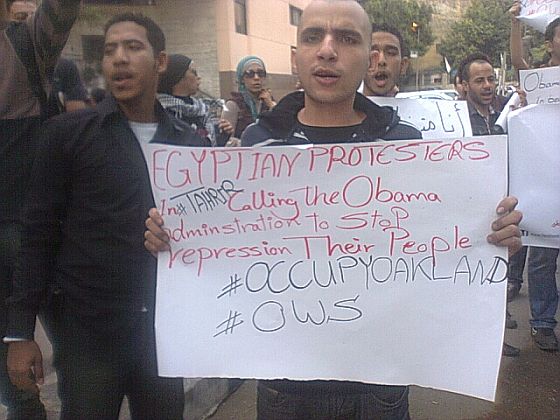
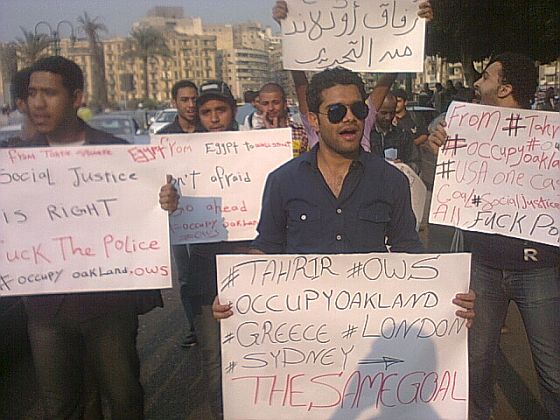
Egyptian protesters’ message to Obama: Stop repression of your own people
Xeni Jardin writes: As they vowed earlier this week to do, Egyptian pro-democracy protesters marched from Tahrir square to the U.S. Embassy today to march in support of Occupy Oakland—and against the type of police brutality witnessed in Oakland on Tuesday night, and commonly experienced in Egypt.
In this post, photos from Egyptian blogger Mohammed Maree, who is there at the march live-tweeting these snapshots. He is a journalist with Egytimes.org, a human rights activist, and a veterinarian; all photos are his.

Meanwhile, the New York Times reports on questions being raised about the violent tactics used by police in Oakland where the weapons being used are the same as those used lethally by Israeli soldiers against non-violent Palestinian protesters in the West Bank and by Egyptian security services against non-violent Egyptian protesters in Tahrir Square.
Two days after an Iraq war veteran suffered a serious head wound at a protest in Oakland, Calif., questions are being asked about the way police officers tried to disperse Occupy Oakland protesters with tear gas and other “less-lethal” munitions.The condition of the wounded veteran, Scott Olsen, was upgraded to fair from critical at Highland Hospital in Oakland on Thursday The San Francisco Chronicle reported. On Friday morning, Mr. Olsen’s roommate, Keith Shannon, who served with him in the Marines, told CNN that doctors expect him to make a full recovery, although he is still unable to speak and still has some trouble writing.
Oakland’s mayor, Jean Quan, visited Mr. Olsen in the hospital to apologize for his injuries and promised an investigation, a hospital spokesman told The Chronicle. The mayor also tried to address protesters near City Hall late Thursday night but was “greeted with cries of ‘Go home!’ and ‘Citizen’s Arrest,’” The Bay Citizen, a local news site, reported.
Another spokesman told reporters that Mr. Olsen “responded with a very large smile” to a visit from his parents on Thursday.
As The Lede reported on Wednesday, Mr. Olsen is a 24-year-old former Marine and a member of two veterans peace groups. He works at a San Francisco software firm.
Video uploaded to YouTube on Thursday appeared to show that Mr. Olsen was standing peacefully in front on police lines just before he was struck in the head. This edit of clips from various sources by a video blogger named Raleigh Latham shows Mr. Olsen standing still as projectiles were fired into the crowd of protesters on Tuesday night:
Occupy Wall Street: The primary the president never had?
Matt Stoller writes: It’s been a little over a month since this bolt of political lightning known as Occupy Wall Street jolted through the political establishment. It’s time to assess just what Occupy Wall Street has gotten done. That it has accomplished a great deal is beyond dispute. Franklin Foer in the New Republic and John Nichols in the Nation have both noted that Occupy Wall Street profoundly challenged President Obama and the Republicans. But what an odd challenge. A few thousand people camped out in parks around the country? Really?
Yet this challenge has completely changed the dominant theme in Washington. Less than a year ago, JP Morgan’s Bill Daley was the glad-handling centrist du jour, praised by everyone from Howard Dean to Bob Reich. The “austerity class,” as Ari Berman so nicely put it, was in control of the debate, with the Tea Party waiting in the wings ready to slash and burn.
Fast forward to October 2011. Obama is increasingly taking on a populist tone and using executive orders to attempt stimulating the economy, with Democrats smacking around Mitt Romney for encouraging foreclosures as a way to clear the market (a policy Obama administration officials like HUD Secretary Shaun Donovan agree with. The centrists are losing, perhaps not power, but certainly the debate. Third Way, the political brain behind this centrist White House and Senate, is one of the few groups warning Democrats away from Occupy Wall Street, but few are listening.
There’s a reason; the themes put out by the protesters are overwhelmingly popular. The poll numbers are out. If Occupy Wall Street were a national candidate for president, it would be blowing away every other candidate on the stage, including Barack Obama and Mitt Romney. Fifty-four percent of Americans agree with the protesters, versus 44 percent who think President Obama is doing a good job. Seventy-three percent of Americans want prosecutions for Wall Street executives for the crisis. Seventy-nine percent think the gap between rich and poor is too large. Eighty-six percent say Wall Street and its lobbyists have too much power in Washington. Sixty-eight percent think the rich should pay more in taxes. Twenty-five percent of the public considers itself upset, 45 percent is concerned about the country and 25 percent is downright angry.
That these themes are dominating establishment debates now is somewhat bizarre. It’s not as if people didn’t hate banks in 2008, 2009 or 2010. And when you think about it, camping out in various cities isn’t a particularly radical act, in and of itself. Occupy Wall Street can’t project political power, at least not in any traditional sense. It can’t make decisions about how to relate to the police, or politicians. It is ideologically incoherent. It can’t even stop drum circles from drumming at night, because drummers don’t recognize the legitimacy of the general assemblies that try to cut deals with the neighborhood. There are increasing reports of medical and safety problems in parks around the country. One person at the protests told me the World War I disease called trenchfoot is making an appearance due to damp conditions. The protests are a ball of raw energy, with one basic message: The 1 percent on Wall Street have taken advantage of the 99 percent of the rest of us.