Category Archives: Obama administration

U.S. warns Israel: New Jerusalem construction will aid Palestinian bid at UN

Haaretz reports: The United States urged Israel on Wednesday to halt a plan that would approve new construction in a contentious Jerusalem neighborhood, saying that such a move would harm U.S. efforts to thwart the Palestinian bid for statehood at the United Nations.

The Jerusalem District Planning Committee announced late last month that it would approve the construction of 1,100 new housing units in Gilo, despite past U.S. objections concerning any work that would expand the neighborhood further beyond the Green Line.

The proposal would allot 20 percent of the units in the neighborhood to young couples, in compliance with a directive given by Interior Minister Eli Yishai. The plan also includes the construction of a boardwalk, public structures, and a commercial center.

U.S. envoy to Israel, Dan Shapiro, met with Yishai on Wednesday, and urged him to shelf the Gilo construction plan, warning it could push international support in favor of the Palestinians in their move for UN recognition.

Yishai reportedly rejected Shapiro’s request, saying that construction in Jerusalem has never stopped – even during left-wing governments – and that it would not stop now.

Israel’s plan for Gilo has already drawn considerable international criticism. Earlier this month, German Chancellor Angela Merkel took Prime Minister Benjamin Netanyahu harshly to task over the move, precipitating an unprecedented diplomatic crisis.

A senior Israeli official said the plan greatly angered Merkel, after she had enlisted massive support of Israel over the past few weeks to help in thwarting a Security Council vote approving Palestinian membership in the United Nations.

Senior German officials told their Israeli counterparts that Merkel was “furious” and “does not believe a word [Netanyahu] says.”

At Netanyahu’s request, Merkel had also put major pressure on Palestinian President Mahmoud Abbas to accept the Quartet’s initiative and renew peace talks immediately, the Israeli official said, adding that Germany may now reconsider and support upgrading the PA’s status to that of a non-member state in the UN General Assembly.

Netanyahu rejected criticism against the construction plan, saying that Gilo is not a settlement, but rather a Jerusalem neighborhood five minutes from the center of the capital. He noted that all Israeli governments built in such neighborhoods.

Facebooktwittermail

Why Occupy Wall Street wants nothing to do with our politicians

Heather Gautney asks: Is this what democracy looks like? That’s perhaps the first question prompted by the swirl of tents, signs, news choppers and police motorcycles that have colored the Occupy Wall Street protests. But there are two other questions we should be asking as well. Is democracy even possible in a context of extreme instability and social inequality, in which 1 percent of the population owns and polices the other 99 percent? And who, among our distinguished set of 2012 candidates, really wants to narrow this gap?

Thus far, the Occupy movement is checking “None of the Above” on the ballot box. Since mid-September, it has instead decided to represent itself in the streets. And if you think there aren’t concrete, policy-related demands being made there, have another look: Everything from education to housing, health care, environment, energy and security are up for grabs. All of these institutions are in need of fixing, and all of them are making the list.

These acts of self-representation—or direct democracy—do not compute among mainstream politicians and their pundits. Occupy does not speak the language of party or ideology, and this has not boded well for a system that relies on polls, predictability and reductive thought. Social movements are, by their very nature, complex, organic and indeterminate. They operate at the deepest levels of how we view each other and the world we live in.

This movement is no exception. You can’t reduce this kind of public outcry to dichotomies like liberal and conservative, or Blue and Red. And you certainly can’t dismiss it as fringe and un-American. Occupy is a popular movement, not a Tea Party, and the act of sticking up for yourself is as American as apple pie.

Despite this apparent disconnect, the Occupy movement has received honorable mention at the highest levels of government, though I suspect this has more to do with polls and constituencies than with genuine understanding. After a Time Magazine survey revealed that 54 percent of Americans actually support these rabble-rousers, our politicians started to take notice. Occupy is actually more popular among the American people than the U.S. Congress—and that must really hurt.

That 54-percent figure was likely behind flip-flopper Mitt Romney’s overnight change of heart. Just days into October, Romney called the protesters “dangerous” instigators of “class warfare.” A week later, he switched gears and expressed “worry” for the 99 percenters. All the sudden this multi-millionaire, private-sector guru has become a man of the people. Who knew?

Then there’s Barack Obama. The guy we all wanted to love. With his usual charm, he empathized with the Occupy-ers, said not everyone in Corporate America was playing by the rules and, once again, took us on a stroll down Main Street. But in the tug of war between Main Street and Wall Street, Obama has made his loyalties clear. Just take a look at the long list of Wall Street contributors to his campaign. Unfortunately, Mr. President, you are the company you keep.

Facebooktwittermail

U.S. backs probe into circumstances of Gaddafi death

Reuters reports: Secretary of State Hillary Clinton on Sunday backed a possible U.N. investigation into the death of deposed Libyan leader Muammar Gaddafi and called for the convicted Lockerbie bomber to be jailed again.

There is growing international disquiet about the chaotic scenes surrounding Gaddafi’s apparent summary execution following the fall of his hometown of Sirte on Thursday.

“I would strongly support both a U.N. investigation that has been called for and the investigation that the Transitional National Council said they will conduct,” Clinton told the NBC program “Meet the Press,” referring to Libya’s interim rulers.

“You know, I think it’s important that this new government, this effort to have a democratic Libya, start with the rule of law, start with accountability,” she said.

U.N. Human Rights Commissioner Navi Pillay has called for an investigation into the killing.

Libya’s outgoing prime minister said on Sunday a bullet that hit Muammar Gaddafi’s head may have been fired by one of his own guards during a shootout with government forces in Sirte.

“So I view the investigation on its own merits as important but also as part of a process that will give Libya the best possible chance to navigate toward a stable, secure, democratic future,” Clinton said.

Perhaps the Libyans regard the US as a democratic role model and on that basis assumed that it would be OK and indeed be the American way to administer swift justice to Gaddafi.

If someone like Anwar al-Awlaki could be deemed such an imminent threat to the United States that he could be assassinated and there be no legal justification presented for his killing nor any investigation, should anyone in the Obama administration now wonder why Gaddafi’s captors might have felt similarly empowered to end Gaddafi’s life? After all, Awlaki never killed a single American, whereas Gaddafi was responsible for killing thousands of Libyans.

Facebooktwittermail

Iraq’s government, not Obama, called time on the U.S. troop presence

Tony Karon writes: President Barack Obama’s announcement on Friday that all 40,000 U.S. troops still in Iraq will leave the country by New Year’s Eve will, inevitably, draw howls of derision from GOP presidential hopefuls — this is, after all, early election season. But the decision to leave Iraq by that date was not actually taken by President Obama — it was taken by President George W. Bush, and by the Iraqi government.

In one of his final acts in office, President Bush in December of 2008 had signed a Status of Forces Agreement (SOFA) with the Iraqi government that set the clock ticking on ending the war he’d launched in March of 2003. The SOFA provided a legal basis for the presence of U.S. forces in Iraq after the United Nations Security Council mandate for the occupation mission expired at the end of 2008. But it required that all U.S. forces be gone from Iraq by January 1, 2012, unless the Iraqi government was willing to negotiate a new agreement that would extend their mandate. And as Middle East historian Juan Cole has noted, “Bush had to sign what the [Iraqi] parliament gave him or face the prospect that U.S. troops would have to leave by 31 December, 2008, something that would have been interpreted as a defeat… Bush and his generals clearly expected, however, that over time Washington would be able to wriggle out of the treaty and would find a way to keep a division or so in Iraq past that deadline.”

But ending the U.S. troop presence in Iraq was an overwhelmingly popular demand among Iraqis, and Prime Minister Nuri al-Maliki appears to have been unwilling to take the political risk of extending it. While he was inclined to see a small number of American soldiers stay behind to continue mentoring Iraqi forces, the likes of Shi’ite cleric Moqtada al-Sadr, on whose support Maliki’s ruling coalition depends, were having none of it. Even the Obama Administration’s plan to keep some 3,000 trainers behind failed because the Iraqis were unwilling to grant them the legal immunity from local prosecution that is common to SOF agreements in most countries where U.S. forces are based.

So, while U.S. commanders would have liked to have kept a division or more behind in Iraq to face any contingencies — and, increasingly, Administration figures had begun citing the challenge of Iran, next door — it was Iraqi democracy that put the kibosh on that goal. The Bush Administration had agreed in 2004 to restore Iraqi sovereignty, and in 2005 put the country’s elected government in charge of shaping its destiny. But President Bush hadn’t anticipated that Iraqi democracy would see pro-U.S. parties sidelined and would, instead, consistently return governments closer to Tehran than they are to Washington. Contra expectations, a democratic Iraq has turned out to be at odds with much of U.S. regional strategy — first and foremost its campaign to isolate Iran.

Facebooktwittermail

Obama’s gift to the Koch brothers and curse to the planet

Jamie Henn, Co-founder and Communications Director of 350.org, writes: Here’s a unique political strategy for you: in the lead up to a crucial election, as anti-corporate sentiment is sweeping the nation, consider giving a huge handout to a major corporation that happens to be your biggest political enemy and is already spending hundreds of millions to defeat you and your agenda.

If that seems too crazy to believe, welcome to the Obama 2012 campaign.

Right now, President Obama is faced with the most crucial environmental decisions he is going to face before the 2012 election: whether or not to approve the permit for the controversial Keystone XL pipeline, a 1,700 mile fuse to the largest carbon bomb on the continent, the Canadian tar sands.

The Keystone XL isn’t just an XL environmental disaster — the nation’s top climate scientists say that fully exploiting the tar sands could mean “essentially game over” for the climate — it also happens to be an XL sized handout to Big Oil and, you guessed it, the Brothers Koch. You want fries with that?

Earlier this year, when Representative Henry Waxman (D-Calif.) attempted to investigate whether or not the Koch Brothers stood to gain from the pipeline, the chairman of the House Committee on Energy and Commerce, Fred Upton (R-Mich.) called the idea an “outrageous accusation” and “blatant political sideshow.” Is it even necessary to mention that reports show Koch and its employees gave $279,500 to 22 of the energy committee’s 31 Republicans and $32,000 to five Democrats?

As you might expect, Upton was completely wrong. Reporters at InsideClimateNews and elsewhere proved that the Koch’s stand to make a fortune with the construction of the pipeline. The brothers already control close to 25 percent of the tar sands crude that is imported into the United State and own mining companies, oil terminals, and refineries all along the pipeline route. You can bet that the champagne will be flowing in Koch HQ when toxic tar sands crude starts moving down the pipe.

Which brings us back to Obama. It’s not too late for the president to intervene and stop the Koch Brothers from pocketing another profit at the expense of the American people. Because it crosses an international border, in order for the Keystone XL pipeline to be built the Obama administration must grant it a “presidential permit” that states that the construction project is in the national interest of the United States.

President Obama can deny the permit, right now, and shut down this flow of cash to the Kochs. In doing so, he’ll show that our national interest isn’t always determined by the 1%, in this case a few big oil companies and the Koch Brothers, but by the 99% of us who have to pay the price for their greed.

Denying the permit will also send a jolt of electricity through President Obama’s base, the millions of us who went out and volunteered and donated to the campaign because we believed in a candidate who said that it was time to “end the tyranny of oil.” In fact, this November 6, thousands of us former believers will be descending on Washington, DC to surround the White House with people carrying placards with the President’s own words in an attempt to resuscitate the 2008 Obama who seemed capable of standing up to folks like the Kochs. You can join here.

I can’t say that I’m privy to what the Obama 2012 campaign will advise the president to do when it comes to the pipeline. But if I was sitting in Chicago watching the Koch Brothers assembled their army of lobbyists across the nation, I’d be thinking that XL handout wasn’t such a good idea.

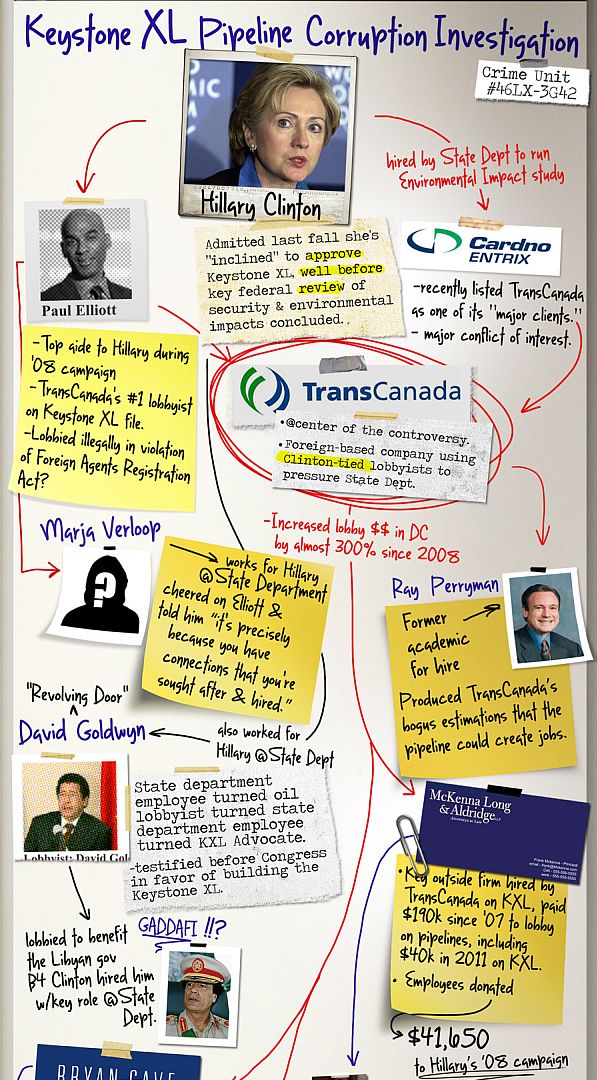
The Keystone XL pipeline network of corruption revealed through an investigation by DeSmogBlog, Oil Change International, The Other 98% and Friends of the Earth (click on the image below to view the complete network):

Facebooktwittermail

Obama flush with Wall Street cash

The Washington Post reports: Despite frosty relations with the titans of Wall Street, President Obama has still managed to raise far more money this year from the financial and banking sector than Mitt Romney or any other Republican presidential candidate, according to new fundraising data.

Obama’s key advantage over the GOP field is the ability to collect bigger checks because he raises money for both his own campaign committee and for the Democratic National Committee, which will aid in his reelection effort.

As a result, Obama has brought in more money from employees of banks, hedge funds and other financial service companies than all of the GOP candidates combined, according to a Washington Post analysis of contribution data. The numbers show that Obama retains a persistent reservoir of support among Democratic financiers who have backed him since he was an underdog presidential candidate four years ago.

Obama’s fundraising advantage is clear in the case of Bain Capital, the Boston-based private-equity firm that was co-founded by Romney, and where the Republican made his fortune. Not surprisingly, Romney has strong support at the firm, raking in $34,000 from 18 Bain employees, according to the analysis of data from the Center for Responsive Politics.

But Obama has outdone Romney on his own turf, collecting $76,600 from Bain Capital employees through September — and he needed only three donors to do it.
[…]
Obama’s ties to Wall Street donors could complicate Democratic plans to paint Republicans as puppets of the financial industry, particularly in light of the Occupy Wall Street protests that have gone global over the past week.

In response to the protests, the Obama campaign and other Democrats have stepped up their attacks on Romney and other Republicans for their opposition to Wall Street regulations.

One top banking executive who raises money for Obama, discussing fundraising efforts on the condition of anonymity, said reports of disaffection with the president “are exaggerated and overblown.” He said a strong contingent of financiers in New York, Chicago and California remains supportive of Obama and his economic policies, even as some have turned on him.

But, this donor added, “it probably helps from a political perspective if he’s not seen as a Wall Street guy.”
[…]
Obama has raised a total of $15.6 million from employees in the industry, according to the Post analysis. Nearly $12 million of that went to the DNC, the analysis shows.

Romney has raised less than half that much from the industry, while Texas Gov. Rick Perry brought in about $2 million. No other Republican candidate has raised more than $402,000 from the finance sector, which also includes insurance and real estate interests.

Even so, Obama clearly has trouble appealing to Wall Street fundraisers, who have emerged in recent years as among the most important sources of campaign cash for major national politicians.

Put aside the DNC money, for example, and Obama’s numbers look much worse: just $3.9 million from the financial sector, compared with Romney’s $7.5 million.

Obama’s campaign committee has raised notably less money from major banking firms such as Goldman Sachs, whose employees gave him more than $1 million in the 2008 cycle. So far this year, about two dozen Goldman employees together have given Obama’s committee about $45,000, one-sixth of the amount Romney’s campaign has taken in.

But six Goldman employees also gave a total of $92,000 to the DNC side of Obama’s fundraising effort.
[…]
Obama retains a core group of supporters on Wall Street who are central to his fundraising efforts. About a third of his top 40 fundraisers, who have helped bundle together $500,000 or more in contributions, hail from the finance sector, including big names such as former New Jersey governor Jon S. Corzine of MF Global, hedge-fund manager Orin Kramer and UBS executive Robert Wolf.

Obama’s chief of staff, William M. Daley, was also vice chairman at J.P. Morgan Chase before coming to the White House this year.

Obama’s support within the financial industry tends to be more diffuse than the top Wall Street firms. One of his primary sources of cash, for example, is a small Chicago firm called Chopper Trading, which employs a technique of rapid, computer-assisted trading that some experts blame for volatility in the stock market.

Facebooktwittermail

A presidency rotten at its core

What’s the good of calling yourself a Democrat if you don’t practice democracy? President Obama’s first allegiance has proved not to be the upholding of democracy, but instead the preservation and expansion of secrecy.

It is revealing that a man who in so many other domains often appears like a pushover, unable to find any principle too high to be compromised, when it comes to the issue of secrecy, is utterly uncompromising.

There is only one other practice in which Obama shows equal resolve: assassination.

In response to the killing of Abdulrahman al-Awlaki, the 16 year-old American son of Anwar Awlaki, Glenn Greenwald writes:

It is unknown whether the U.S. targeted the teenager or whether he was merely “collateral damage.” The reason that’s unknown is because the Obama administration refuses to tell us. Said the Post: “The officials would not discuss the attack in any detail, including who the target was.” So here we have yet again one of the most consequential acts a government can take — killing one of its own citizens, in this case a teenage boy — and the government refuses even to talk about what it did, why it did it, what its justification is, what evidence it possesses, or what principles it has embraced in general for such actions. Indeed, it refuses even to admit it did this, since it refuses even to admit that it has a drone program at all and that it is engaged in military action in Yemen. It’s just all shrouded in secrecy.

Of course, the same thing happened with the killing of Awlaki himself. The Executive Branch decided it has the authority to target U.S. citizens for death without due process, but told nobody (until it was leaked) and refuses to identify the principles that guide these decisions. It then concluded in a secret legal memo that Awlaki specifically could be killed, but refuses to disclose what it ruled or in which principles this ruling was grounded. And although the Obama administration repeatedly accused Awlaki of having an “operational role” in Terrorist plots, it has — as Davidson put it — “so far kept the evidence for that to itself.”

This is all part and parcel with the Obama administration’s extreme — at times unprecedentedfixation on secrecy. Even with Senators in the President’s own party warning that the administration’s secret interpretation of its domestic surveillance powers under the Patriot Act is so warped and radical that it would shock the public if they knew, Obama officials simply refuse even to release its legal memos setting forth how it is applying those powers. As EFF’s Trevor Timm told The Daily Beast today: “The government classified a staggering 77 million documents last year, a 40 percent increase on the year before.”

Facebooktwittermail

American 16-year-old boy — latest victim in Obama’s global drone war

The Washington Post reports: In the days before a CIA drone strike killed al-Qaeda operative Anwar al-Awlaki last month, his 16-year-old son ran away from the family home in Yemen’s capital of Sanaa to try to find him, relatives say. When he, too, was killed in a U.S. airstrike Friday, the Awlaki family decided to speak out for the first time since the attacks.

“To kill a teenager is just unbelievable, really, and they claim that he is an al-Qaeda militant. It’s nonsense,” said Nasser al-Awlaki, a former Yemeni agriculture minister who was Anwar al-Awlaki’s father and the boy’s grandfather, speaking in a phone interview from Sanaa on Monday. “They want to justify his killing, that’s all.”

The teenager, Abdulrahman al-Awlaki, a U.S. citizen who was born in Denver in 1995, and his 17-year-old Yemeni cousin were killed in a U.S. military strike that left nine people dead in southeastern Yemen.

The young Awlaki was the third American killed in Yemen in as many weeks. Samir Khan, an al-Qaeda propagandist from North Carolina, died alongside Anwar al-Awlaki.

Yemeni officials said the dead from the strike included Ibrahim al-Banna, the Egyptian media chief for al-Qaeda’s Yemeni affiliate, and also a brother of Fahd al-Quso, a senior al-Qaeda operative who was indicted in New York in the 2000 attack on the USS Cole in the port of Aden.

The strike occurred near the town of Azzan, an Islamist stronghold. The Defense Ministry in Yemen described Banna as one of the “most dangerous operatives” in al-Qaeda in the Arabian Peninsula, often referred to by the acronym AQAP.

U.S. officials said they were still assessing the results of the strike Monday evening to determine who was killed. The officials would not discuss the attack in any detail, including who the target was, but typically the CIA and the Pentagon focus on senior figures in al-Qaeda’s affiliate in Yemen.

“We have seen press reports that AQAP senior official Ibrahim al-Banna was killed last Friday in Yemen and that several others, including the son of Anwar al-Awlaki, were with al-Banna at the time,” said Thomas F. Vietor, a spokesman for the National Security Council. “For over the past year, the Department of State has publicly urged U.S. citizens not to travel to Yemen and has encouraged those already in Yemen to leave because of the continuing threat of violence and the presence of terrorist organizations, including AQAP, throughout the country.”

A senior congressional official who is familiar with U.S. operations in Yemen and spoke on the condition of anonymity to discuss sensitive policy issues said, “If they knew a 16-year-old was there, I think that would be cause for them to say: ‘Gee, we ought not to hit this guy. That would be considered collateral damage.’ ”

The official said that the CIA and the military’s Joint Special Operations Command are expected to ensure that women and children are not killed in airstrikes in Pakistan and Yemen but that sometimes it might not be possible to distinguish a teenager from militants.

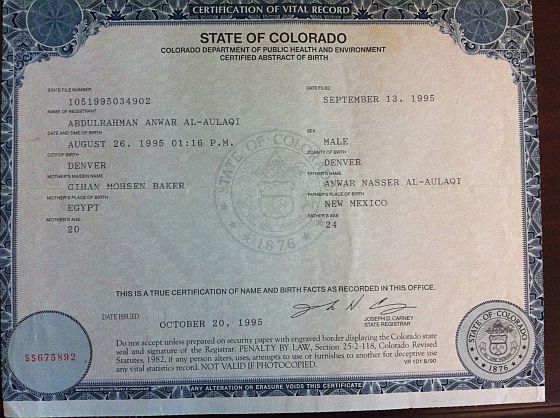
Amy Davidson writes: Here is a birth certificate, for a boy who was born in Denver, Colorado, on September 13, 1995. (Via the Washington Post.) He turned sixteen a month ago, and a few days ago he died, killed when one of his country’s drones hit him and a number of other people in Yemen. His name was Abdulrahman al-Awlaki. His father, Anwar al-Awlaki, who, as the birth certificate notes, was himself born in New Mexico, and was twenty-four years older than his son, was killed a couple of weeks ago, in a separate attack. The father was targeted for assassination. He was an American citizen, and there were no judicial proceedings against him, just, reportedly, a White House legal opinion that concluded that it would be fine to kill him anyway, because the Administration thought he was dangerous. Anwar al-Awlaki was a member of Al Qaeda in the Arabian Peninsula and wrote angry and ugly sermons for them. The Administration says that it had to kill him because he had become “operational,” but so far it has kept the evidence for that to itself.

Was the son targeted, too? The Yemeni government says that another person, a grown man, was the target in the attack that killed Abdulrahman. Maybe he was just in the wrong place, like the Yemeni seventeen-year-old who reportedly died, too. Abdulrahman’s family said that he had been at a barbecue, and told the Post that they were speaking to the paper to answer reports said that Abdulrahman was a fighter in his twenties. Looking at his birth certificate, one wonders what those assertions say either about the the quality of the government’s evidence—or the honesty of its claims—and about our own capacity for self-deception. Where does the Obama Administration see the limits of its right to kill an American citizen without a trial? (The last time I wrote about Awlaki, a reader commented that “Awlaki was a citizen in name only”; but that name is the name of the law, and is, when it comes down to it, all any of us have, unless we want to rely on how charming our government finds us.) And what are the protections for an American child?

You can, in many ways, blame Abdulrahman’s death on his father—for not staying in Colorado, for introducing his son to the wrong people, for being who he was. That would be a fair part of an assessment of Anwar al-Awlaki’s character. But it’s not sufficient. He may have put his child in a bad situation, but we were the ones with the drone. One fault does not preclude another. We have to ask ourselves what we are doing, and at what cost.

Facebooktwittermail

As assassination plot becomes a sideshow, U.S.-Iran tensions hinge on the nuclear issue

Tony Karon writes: A used car salesman, a Mexican narco snitch, and an Iranian spook walk into a bar. What is this, says the ex-CIA barman, some kind of a joke?

Let’s just say that the ostensibly Iranian plot to blow up Saudi Arabia’s ambassador to Washington is not yet proving to be the smoking gun that allows the Obama Administration to rally uncommitted governments to the cause of isolating Tehran. Sure, the Saudis have brought the matter to the attention of the U.N. Security Council, although they have not as yet indicated that they intend to call for any specific response. But with skepticism rife even in Washington about this plot having been authorized by the Iranian leadership, the narco-proxy terror scheme may not change the minds of Russia, China, Turkey and other opponents of any new sanctions. After being briefed on the plot by U.S. diplomats, those countries and others have said they want more information before making up their minds — as have the Iranians, although Tehran has also tossed out a curveball by suggesting that the fugitive accused in the case is, in fact, an operative of the Mujahedeen e-Khalq, an exiled opposition group currently listed as a terrorist organization by the U.S. State Department.

But the Administration is reportedly unlikely to provide further evidence, for fear of compromising sources and methods.

So, as things stand, the Saudi ambassador plot looks unlikely to be a game-changer. Of course, the same hawkish crowd in Washington that agitated for the Iraq invasion are demanding military action against Iran, but despite President Obama’s tough talk last week about imposing “the toughest sanctions” and keeping the proverbial “all options” on the table, it’s the five-year nuclear stalemate, rather than the alleged assassination plot, that will frame the international response to Iran.

Facebooktwittermail

U.S. awaits inquiry ahead of Bahrain arms deal

Al Jazeera reports: The US has said that it will consider a special investigation of alleged human rights abuses in Bahrain before moving ahead with a $53m arms deal to the Gulf kingdom.

In a letter to Ron Wyden, a US Democratic senator, and in public statement, the state department said on Tuesday that it shared congressional misgivings about Bahrain’s treatment of protesters and would await the results of a special inquiry established by the king.

The commission’s report to King Hamad bin Isa Al Khalifa is due on October 30.

“That’s something we would look at closely,” Mark Toner, the State Department spokesman, said, speaking about the commission’s report.

“We’re going to continue to take human rights considerations into account as we move toward the finalization of this deal.”

He added that several procedural steps remain before the US could deliver the weapons to Bahrain and noted the sale pertained to equipment for Bahrain’s “external defence purposes”.

Wyden and Jim McGovern, a US Democratic representative, have introduced a resolution to block the arms sale to Bahrain, which includes Humvee combat vehicles and missiles.

Facebooktwittermail

Time for the U.S. to stop bankrolling Israel’s defense

Walter Pincus, in a column for the Washington Post, writes: As the country reviews its spending on defense and foreign assistance, it is time to examine the funding the United States provides to Israel.

Let me put it another way: Nine days ago, the Israeli cabinet reacted to months of demonstrations against the high cost of living there and agreed to raise taxes on corporations and people with high incomes ($130,000 a year). It also approved cutting more than $850 million, or about 5 percent, from its roughly $16 billion defense budget in each of the next two years.

If Israel can reduce its defense spending because of its domestic economic problems, shouldn’t the United States — which must cut military costs because of its major budget deficit — consider reducing its aid to Israel?

First, a review of what the American taxpayer provides to Israel.

In late March 2003, just days after the invasion of Iraq, President George W. Bush requested the approval of $4.7 billion in military assistance for more than 20 countries that had contributed to the conflict or the broader fight against terrorism. Israel, Jordan, Egypt, Afghanistan, Pakistan and Turkey were on that list.

A major share of the money, $1 billion, went to Israel, “on top of the $2.7 billion regular fiscal year 2003 assistance and $9 billion in economic loans guaranteed by the U.S. government over the next three years,” according to a 2003 study by the Congressional Research Service (CRS).

Then in 2007, the Bush administration worked out an agreement to raise the annual military aid grant, which had grown to $2.5 billion, incrementally over the next 10 years. This year, it has reached just over $3 billion. That is almost half of all such military assistance that Washington gives out each year and represents about 18 percent of the Israeli defense budget.

In addition, the military funding for Israel is handled differently than it is for other countries. Israel’s $3 billion is put almost immediately into an interest-bearing account with the Federal Reserve Bank. The interest, collected by Israel on its military aid balance, is used to pay down debt from earlier Israeli non-guaranteed loans from the United States.

Another unique aspect of the assistance package is that about 25 percent of it can be used to buy arms from Israeli companies. No other country has that privilege, according to a September 2010 CRS report.

The U.S. purchases subsidize the Israeli arms business, but Washington maintains a veto over sales of Israeli weapons that may contain U.S. technology.

Look for a minute at the bizarre formula that has become an element of U.S.-Israel military aid, the so-called qualitative military edge (QME). Enshrined in congressional legislation, it requires certification that any proposed arms sale to any other country in the Middle East “will not adversely affect Israel’s qualitative military edge over military threats to Israel.”

In 2009 meetings with defense officials in Israel, Undersecretary of State Ellen Tauscher “reiterated the United States’ strong commitment” to the formula and “expressed appreciation” for Israel’s willingness to work with newly created “QME working groups,” according to a cable of her meetings that was released by WikiLeaks.

The formula has an obvious problem. Because some neighboring countries, such as Saudi Arabia and Egypt, are U.S. allies but also considered threats by Israel, arms provided to them automatically mean that better weapons must go to Israel. The result is a U.S.-generated arms race.

MJ Rosenberg writes: Aid to Israel is virtually the only program, domestic or foreign, that is exempt from every budget cutting proposal pending in Congress. No matter that our own military is facing major cuts along with Medicare, cancer research and hundreds of other programs, Israel’s friends in Congress in both parties make sure that aid to Israel is protected at current levels.

Back when I was a Congressional staffer, I was part of the process by which aid to Israel was secured. Every member of the Congressional Appropriations Committees sent a “wish list” to the chairman of the committee telling him or her which programs he wanted funded and by what amounts. Each letter reflected the particular interest of a particular Representative or Senator and of his own district or state.

There was always one exception: aid to Israel, which apparently is a local issue for every legislator. The American Israel Public Affairs Committee (AIPAC) would provide the list of Israel’s aid requirements for the coming year and, with few if any exceptions, every letter would include the AIPAC language. Not a punctuation mark would be changed.

At the end of the process, the AIPAC wish list would become law of the land. (Woe to any Member of Congress who dared to resist the AIPAC juggernaut).

That is how it has been for decades and not even the current economic crisis is likely to change it. On this issue, Congress is hopeless and will remain so as long as its members rely so heavily on campaign contributions (PAC or individual) delivered by AIPAC.

JTA reports: Mitt Romney said he would increase defense assistance to Israel, raise the U.S. military profile near Iran and recognize Israel as a Jewish state.

Facebooktwittermail

With $53 million arms sale, U.S condones ongoing repression of Bahraini people

Last week, Josh Rogin reported: Five Democratic senators wrote to Secretary of State Hillary Clinton on Wednesday to ask her to delay a planned $53 million arms sale to Bahrain because of the island kingdom’s continued violence against protesters.

“We recognize the administration’s commitment to the United States’ strategic relationship with Bahrain… However, the Bahrain government’s repressive treatment of peaceful protesters during the past several months is unacceptable,” the senators wrote in their Oct. 12 letter [PDF], obtained by The Cable.

“The United States must make it clear to the government of Bahrain that its ongoing human rights violations and unwillingness to acknowledge legitimate demands for reform have a negative impact on its relationship with the United States.”

The letter’s signatories were Senate Foreign Relations Middle East and North Africa Subcommittee chairman Robert Casey (D-PA), Senate Majority Whip Richard Durbin (D-IL), and Sens. Robert Menendez (D-NJ), Benjamin Cardin (D-MD), and Ron Wyden (D-OR).

The letter accuses the Bahrain government of torture and notes reporting by Human Rights Watch that states Bahrain’s government has killed 34 protesters, arrested 1,400 more, and dismissed 3,600 people from their jobs for anti-government activities.

“Completing an arms sale to Bahrain under the current circumstances would weaken U.S. credibility at a critical time of democratic transition in the Middle East,” the senators wrote.

Today, Gulf News reports: Washington has finalised a $53 million (Dh195 million) weapons deal with Bahrain, a top US diplomat has said. “Congress has expressed no opposition to this sale,” said Stephen Seche, Deputy US Assistant Secretary of State for Arabian Peninsula Affairs.

The deal is part of a move to defend Bahrain from aggression, Seche said at a roundtable meeting, local media reported.

The official said that the US looked forward to the recommendations by an international panel that investigated the events that hit Bahrain in February and March and their consequences.

The Bahrain Independent Commission of Inquiry (BICI), set up in June, is scheduled to announce its findings on October 30. The BICI, locally known as the Bassiouni Commission, after its leader Professor M. Cherif Bassiouni an expert in international criminal, human rights and humanitarian law, has interviewed thousands of people in its quest to appreciate what really happened.

“I think we would like to wait for the Commission report to speak for itself. We have been encouraged by the process that has ensued here since the Commission first arrived in Bahrain. They have been very thorough and Mahmoud Cherif Bassiouni has spoken publicly about the response. He has been encouraged by the receptivity of all aspects of the Bahraini government to probe into the different questions, their need to get to as much information in the time they had,” Seche said.

“This is a positive development and we believe that the Commission’s findings will reflect a process which has been thorough and comprehensive and very professional. We will look forward to the recommendations,” he was quoted as saying.

This week, the “Manama Document: Bahrain’s road to freedom and democracy,” a joint document written by opposition groups, was released. It calls on the monarchy to relinquish political power.

In the presence of an unelected government under statesmanship of a single person for 40 years, some 80 per cent of public land ended being controlled by senior members from the royal family and other influential figures. Consequently, this has placed constraints on availability of lands for the purposes of developing projects for housing, municipality, education and health facilities.

Still, the country suffers from an acute poor distribution of wealth and widespread poverty notwithstanding Bahrain being an oil exporting nation, exporting some 200,000 barrels per day. Wrong policies like extending citizenship to foreign nationals have further undermined distribution of wealth in the country.

Against a backdrop of political dictatorship, economic failure and social confusion of government policies, people of Bahrain had pressed for change. Popular demands date back to 1923 with calls made for participation in decision making and 1938 for having an elected assembly with full legislator and regulatory powers. In reality, popular uprisings kept reemerging almost like those of 1954, 1965 and still 1994-2000, the largest of its kind at the time. Thus, there were the revolts of 1954 plus that of March 1965 as well as that of 1994-2000.

Still, affected primarily by events in Tunisia and Egypt as part of Arab Spring, nearly half of Bahrain’s people took to the streets in early 2011 pressing for democracy, respect of human rights and sustained human development. Yet, the demands call for retaining the royal family in terms of ruling and governing without powers, as a true constitutional monarchy.

In short, Bahrain is undergoing rivalry between two camps, one demanding democracy, comprising of people of all walks of life and diverse ideologies with another struggling to maintain the status quo despite need for addressing political, economic and social challenges.

Last month, in an editorial, the Washington Post called on Congress to block the sale of arms to a regime that continues to repress its people.

The rulers of Bahrain, an island nation in the Persian Gulf that hosts the U.S. 5th Fleet, undoubtedly worry that their harsh crackdown on a peaceful pro-democracy movement could damage vital relations with Washington. The government has hired a pricey Washington lobbying firm and regularly dispatches senior officials to stroke the administration and Congress. It has repeatedly promised to free political prisoners, reverse a mass purge of suspected protesters from government jobs and negotiate meaningful reforms of the al-Khalifa monarchy, a Sunni dynasty that rules over a majority-Shiite population.

Yet the regime hasn’t kept its promises — and its unjustified and self-defeating repression goes on. The latest brazen step came Thursday, when a special security court sentenced 20 doctors and other medical professionals to lengthy prison terms after a grossly unfair trial. The doctors were charged with stockpiling weapons and trying to overthrow the regime; in fact, their offense was treating injured protesters who arrived at their hospital and reporting what they saw to international media. A host of human rights groups, including Human Rights Watch and Amnesty International, pronounced the trial a travesty; Human Rights First said the medics had given “consistent and credible accounts of being tortured into giving confessions.”

The convictions came just a day after a court upheld the convictions of 21 opposition leaders, including clerics, members of political parties, human rights activists and bloggers. None are guilty of violence, but all were nonetheless accused of terrorism; eight received life sentences. They, too, have offered credible reports of torture. Another human rights group, Freedom House, said the rulings continued “a pattern of repression that belies any promises of meaningful reform by the government.”

Such a unanimous verdict from human rights groups ought to spell trouble for a government that depends on the United States for defense and enjoys a free-trade agreement with it. Yet there is no sign of serious friction between the Obama administration and the al-Khalifa family. Administration spokesmen have largely kept quiet as the crackdown has proceeded. On the military front, it is business as usual. This month the Pentagon notified Congress of a plan to sell Bahrain armored Humvees and anti-tank missiles worth $53 million.

The message this sends is unmistakable: The regime’s crackdown will not affect its cozy relationship with the United States. This is dangerous for the United States as well as for Bahrain, because the government’s attempt to suppress legitimate demands for change from a majority of the population is ultimately doomed to failure. Bahrain’s ruling family should be given more reason to worry about its standing in Washington. A congressional hold on the arms package would be a good way to start.

Facebooktwittermail

Significant holes in U.S. legal case against alleged Iran plotter

Marcy Wheeler writes: In the wake of the Obama Administration’s announcement that an Iranian-American used car salesman had set up a plot to kill the Saudi Ambassador to the U.S., a number of Iran and intelligence experts have raised questions about the plausibility of the alleged Iranian plot.

But few have commented on problems in the legal case presented against the used car salesman, Manssor Arbabsiar, and his alleged co-conspirators from Iran’s Quds Force, a branch of its special forces. There is a handful of what appear to be holes in the complaint. Though individually they are small, taken together they raise difficult questions about the government’s case. The apparent holes also seem to match up with some of the same concerns raised by skeptical Iran analysts, such as Arbabsiar’s rationale in confessing and the extent of his connection to the Quds Force.

The government claims that Arbabsiar sought out someone he thought was a Mexican drug cartel member in May; he was actually a Drug Enforcement Agency confidential informant. Over a series of meetings, the government alleges, Arbabsiar arranged to forward $100,000 to the informant as down payment for the attack, promised $1.5 million more, and agreed that the informant should kill Saudi Ambassador Adel al-Jubeir with a bomb blast at a DC restaurant, one that would possibly be full of civilians and U.S. members of Congress.

In the complaint [PDF] against Arbabsiar, the government has described four pieces of evidence to support its allegations (it undoubtedly has more intelligence that it doesn’t describe in the complaint):

  • Taped conversations and phone calls between the informant and Arbabsiar
  • Details about a $100,000 bank transfer described as a down payment for the assassination
  • Taped conversations Arbabsiar had with his alleged co-conspirator, Quds Force member Gholam Shakuri, while Arbabsiar was in FBI custody
  • A confession Arbabsiar made after he was arrested on September 29

Two of the conversations between Arbabsiar and the informant, on July 14 and July 17, include very damning comments. Arbabsiar tells the informant, “he wants you to kill this guy” and goes on to say that it is “no big deal” if the informant kills hundreds of civilians and some Senators in the course of the assassination.

But there is a problem with each of these four key pieces of evidence.

Al Jazeera reports: Mahmoud Ahmadinejad, the president of Iran, has said that an alleged plot to kill the Saudi ambassador to the Washington was fabricated by the US to cause a rift between Tehran and Riyadh, and to divert attention from US economic problems.

In an exclusive interview with Al Jazeera in Tehran on Monday, Ahmadinejad said that anyone who hears the claims “laughs”, but warned the US to be mindful of the allegations it makes.

“We’re not worried about expressing our opposition … The US administration is sorely mistaken. The US administration might want to divert attention from what’s going on inside the US,” he said, speaking through a translator, during an interview broadcast live.

“The economic problems of the US are very serious, and by accusing Iran it’s not going to solve any problem.”

Facebooktwittermail

What’s behind the “Iranian plot”?

Laura Secor writes: The weirdness of the Arbabsiar case has, unfortunately, fed a mill that already loves to churn up conspiracies. Who benefits? Blowing up a Washington, D.C., restaurant to kill a Saudi ambassador: exactly what would Iran stand to gain? Is that particular Saudi ambassador really in the way of any Iranian political objective? It doesn’t take a foreign-policy mastermind or an evil genius to see that assassinating him could only result in increased hostilities between Iran and the United States, Saudi Arabia, and Israel. At worst, it could furnish the perfect pretext for a military attack on Iran. At best, it might provoke Saudi Arabia to harass Iran with all the means at its disposal: driving down the price of oil, suppressing Bahraini Shiites, stirring up sectarian trouble in Iraq, and encouraging the Syrian opposition, to name a few.

I’ve long believed that the Iranian regime stands to gain from provoking external antagonism— up to a point. Not war, but rumors of war: the Iranian regime excels in dancing up to the line, then drawing back. (Here again the current plot looks out of character: too brash, too clumsy, too direct.) From its very inception, the Islamic Republic defined and strengthened itself by promoting an atmosphere of siege, whether the external enemy was Iraq, the United States, or the West more generally. That the Islamic Republic is an affront to America, and that America presents a military threat and a cultural onslaught, is practically a raison d’être. After 1989, with the end of the Iran-Iraq war and the petering out of the Cold War, sustaining this atmosphere became more difficult. Fortunately for the Supreme Leader, Ali Khamenei, it got a lot easier during the Bush years, with the Axis of Evil and with U.S. troops in two neighboring countries.

The Obama Administration, however, confounded all that. It came in with a rhetoric of engagement and dialogue. And yet it took less than two years for parties on all sides to once again sound the alarm about a coming U.S. war with Iran.

I’m skeptical. Part of that is experience: the alarm has been sounding for decades, and the war never comes. Part is the creeping suspicion that too many people have too much invested in stoking hysteria. The Iranian regime wants its people to believe the Americans will attack, because it believes this will help it hang on to power. The U.S. government wants the Iranians to believe it just might attack, because otherwise the United States has very little leverage in nuclear negotiations. The Israelis want the Iranians to fear an American attack, because they believe this will deter Iranian moves against Israeli interests. The Saudis, too, would like to use a bellicose American ally as leverage against Iran, their regional rival. Then, there’s American domestic politics. The Republicans bluster against Iran to prove that they are tough and that the Democrats are appeasers; the Democrats bluster against Iran to prove that they are no such thing. The neoconservative right encourages the conclusion that the only solution is military; the anti-imperialist left forever argues that the neoconservatives are secretly steering America toward war. It could be my sheer perversity that prevents me from believing what everyone wants me to believe. Or it could be that none of these parties have satisfactorily proved that anyone actually in power believes an attack on Iran would advance American interests more than it would set them back.

Gareth Porter writes: On May 24, when Arbabsiar first met with the DEA informant he thought was part of a Mexican drug cartel, it was not to hire a hit squad to kill the ambassador. Rather, there is reason to believe that the main purpose was to arrange a deal to sell large amounts of opium from Afghanistan.

In the complaint, the closest to a semblance of evidence that Arbabsiar sought help during that first meeting to assassinate the Saudi ambassador is the allegation, attributed to the DEA informant, that Arbabsiar said he was “interested in, among other things, attacking an embassy of Saudi Arabia”.

Among the “other things” was almost certainly a deal on heroin controlled by officers in the Islamic Revolutionary Guard Corps (IRGC). Three Bloomberg reporters, citing a “federal law enforcement official”, wrote that Arbabsiar told the DEA informant he represented Iranians who “controlled drug smuggling and could provide tons of opium”.

Because of opium entering Iran from Afghanistan, Iranian authorities hold 85 percent of the world’s opium seizures, according to Iran’s Fars News Agency. Iranian security personnel, including those in the IRGC and its Quds Force, then have the opportunity to sell the opium to traffickers in the Middle East, Europe and now Mexico.

Mexican drug cartels have begun connecting with Middle Eastern drug traffickers, in many cases stationing operatives in Middle East locations to facilitate heroin production and sales, according to a report last January in Borderland Beat.

But the FBI account of the contacts between Arbabsiar and the DEA informant does not reference any discussions of drugs.

Interview with Gareth Porter — Part One:

Interview with Gareth Porter — Part Two:

Facebooktwittermail

To isolate Iran, U.S. presses inspectors on nuclear data

The New York Times reports: President Obama is pressing United Nations nuclear inspectors to release classified intelligence information showing that Iran is designing and experimenting with nuclear weapons technology. The president’s push is part of a larger American effort to further isolate and increase pressure on Iran after accusing it of a plot to assassinate Saudi Arabia’s ambassador to the United States.

If the United Nations’ watchdog group agrees to publicize the evidence, including new data from recent months, it would almost certainly revive a debate that has been dormant during the Arab Spring about how aggressively the United States and its allies, including Israel, should move to halt Iran’s suspected weapons program.

Over the longer term, several senior Obama administration officials said in interviews, they are mulling a ban on financial transactions with Iran’s central bank — a move that has been opposed by China and other Asian nations. Also being considered is an expansion of the ban on the purchase of petroleum products sold by companies controlled by the country’s elite military force, the Islamic Revolutionary Guards Corps.

The Revolutionary Guards are also believed to oversee the military side of the nuclear program, and they are the parent of the Quds Force, which Washington has accused of directing the assassination plot.

The proposed sanctions come as administration officials confront skepticism around the world about their allegations that Iran was behind the plot and limited options about what they can do — as well as growing pressure from Republicans and some Democrats in Congress to take tougher action against Iran, with the central bank and the oil industry high on lawmakers’ lists.

All of the proposed sanctions carry with them considerable political and economic risks. Yukiya Amano, the cautious director general of the United Nations group, the International Atomic Energy Agency, talked publicly in September about publishing some of the most delicate data suggesting Iran worked on nuclear triggers and warheads. But officials who have spoken with him say he is concerned that his inspectors could be ejected from Iran, shutting the best, though narrow, window into its nuclear activities.

Similarly, China and Russia, among other major Iranian trading partners, have resisted further oil and financial sanctions, saying the goal of isolating Iran is a poor strategy. Even inside the Obama administration, some officials say they fear any crackdown on Iranian oil exports could drive up oil prices when the United States and European economies are weak. As one senior official put it, “You don’t want to tip the U.S. into a downturn just to punish the Iranians.”

Facebooktwittermail

Obama plans to hijack Occupy Wall Street

The Washington Post reports: President Obama and his team have decided to turn public anger at Wall Street into a central tenet of their reelection strategy.

The move comes as the Occupy Wall Street protests gain momentum across the country and as polls show deep public distrust of the nation’s major financial institutions.

And it sets up what strategists see as a potent line of attack against Republican front-runner Mitt Romney, a former investment executive whom Obama aides plan to portray as a wealthy Wall Street sympathizer.

Many Democrats consider Romney, the former Massachusetts governor, the greatest threat to Obama when it comes to wooing centrist independents next year, and Romney this week has begun to present himself as a champion of middle-income Americans.

Obama aides point to recent surveys that show anger at Wall Street spanning ideologies, including a new Washington Post-ABC News poll in which 68 percent of independents and 60 percent of Republicans say they have unfavorable impressions of the big financial institutions.

But the strategy of channeling anti-Wall Street anger carries risks. Many of Obama’s senior advisers have ties to the financial industry — a point that makes Occupy protesters wary of the president and his party.

In recent days, Obama has ramped up his rhetoric. He took the unusual step of targeting an individual company when he attacked Bank of America for its new $5 monthly debit-card fee, calling it “exactly the sort of stuff that folks are frustrated by.” And his campaign and the White House have distributed messages blasting GOP candidates and lawmakers for wanting to repeal Wall Street regulations pushed by Obama and opposing the confirmation of a leader for the consumer protection bureau created as part of the overhaul.

“We intend to make it one of the central elements of the campaign next year,” Obama senior adviser David Plouffe said in an interview. “One of the main elements of the contrast will be that the president passed Wall Street reform and our opponent and the other party want to repeal it.”

“I’m pretty confident 12 months from now, as people make the decision about who to go vote for, the gut check is going to be about, ‘Who would make decisions more about helping my life than Wall Street?’ ” Plouffe added.

Romney, no doubt anticipating the White House’s new attack line, sought to show solidarity with the demonstrators during this week’s GOP candidates debate.

“The reason you’re seeing protests . . . is middle-income Americans are having a hard time making ends meet,” he said.

GOP leaders say the Wall Street law is government overreach, and Romney’s economic plan calls for replacing it with a “streamlined regulatory framework.”

Obama has tried this line of attack before, railing in 2009 against “fat-cat bankers” who he accused of taking excessive bonuses in the wake of the financial meltdown. But after complaints from Democrats on Wall Street and business leaders, the president has spent much of the past year courting companies — even hiring a new chief of staff, William Daley, from the banking industry.

And many on the left have attacked Obama and his administration for its ties to Wall Street, arguing that the financial regulatory overhaul fell far short of an industry makeover that many critics believed necessary.

Much of his top economic team has roots in the financial services industry, and in recent months Daley and top campaign aides have devoted much of their time improving the relationship with big-dollar donors on Wall Street.

Facebooktwittermail

American teenager killed in drone strike

An American teenager gets blown up in a US drone strike and the only explanation provided for why he was killed is that his father was alleged to be a terrorist. And given the small amount of reporting on yesterday’s killings it appears that having covered the Obama-kills-an-American story last month, Obama-kills-another-American is a story of no great interest. But this isn’t just a story about the abuse of executive power. It would now appear that individuals can be snuffed out just because the US government objects to what they are saying.

The New York Times reports: Airstrikes, believed to have been carried out by American drones, killed at least nine people in southern Yemen, including a senior official of the regional branch of Al Qaeda and an American, the 17-year-old son of a Qaeda official killed by the United States last month, according to the government and local reports on Saturday.

Fighting also escalated in the capital, Sana, where at least 12 antigovernment protesters were killed by security forces near the Foreign Ministry and at least four civilians were killed in a battle near the airport, opposition officials said.

The fighting in Sana was the deadliest since President Ali Abdullah Saleh returned to the country last month, and coincided with rising political tensions as all sides await a statement by the United Nations Security Council expected in weeks.

Yemen has been in turmoil for months, as protesters demanding the ouster of Mr. Saleh, who has ruled for 33 years, have filled the streets, and rival political factions have fought for power. Despite tremendous domestic opposition, international pressure and an assassination attempt that severely wounded him in June, Mr. Saleh has refused to step down.

Islamic militant groups, including Al Qaeda in the Arabian Peninsula, the Yemeni branch of the terrorist organization, have exploited the chaos, taking over large regions in Shabwa and Abyan Provinces in the south.

The American drone strike last month that killed the Qaeda official, Anwar al-Awlaki, has been particularly controversial in the United States. Despite being an American citizen, Mr. Awlaki, a Qaeda propagandist, was killed without a trial. The United States has argued that he had taken on an operational role in the organization, plotting attacks against Americans, which made him a legitimate target.

The killing of his son in a drone attack on Friday night, if confirmed, would be the third time an American was killed by such a United States attack in Yemen, although it was not clear if the son was an intended target. A second American, Samir Khan, the editor of Al Qaeda’s online magazine, was killed in the attack on Mr. Awlaki, which was launched from a new secret C.I.A. base on the Arabian Peninsula.

Facebooktwittermail