Category Archives: Obama administration

Is a no-fly zone what Libyans want?

Jerry Haber observes:

[L]iberal interventionists are highly selective in their moral outrage, and … suffer from a “Saving-Private-Ryan” complex – they will intervene to save people with whom they identify, people on their side. But if the civilians happen to be on other the side of their tribal divide, they become silent.

Indeed. None of those now calling for a no-fly zone over Libya have called for a no-fly zone over Gaza. The difference clearly hinges on whether one has a greater affiliation with those dropping the bombs or those getting bombed.

But does this shed any light on the question of whether a no-fly zone should be enforced over Libya? Not really.

If we reduce such questions to questions of affiliation then all we will ever do is look to see where “my people” stand. If enough progressives start calling for a no-fly zone, then suddenly it becomes the right thing. But if its advocates are all neocons or neo-liberals, then it can’t be right.

This isn’t analysis — it’s politics reduced to the expression of allegiance.

So, turning back to the question of a no-fly zone, let’s forget about whether Charles Krauthammer or Sarah Palin think it’s a good idea, and let’s at least expose the array of questions embedded in what is falsely being presented as a single question. The question is not simply, do you favor or oppose a no-fly zone being imposed over Libya?

The first question is: who, if anyone, has the capability to effectively impose a no-fly zone?

I can’t give an authoritative answer to that question, but I would assume that a combined NATO force would have the capacity — though I might be wrong, given the commitments in Afghanistan and Iraq. The Arab League now backs a no-fly zone. If some of its members also contributed forces, this might diminish the perception that a no-fly zone was strictly a Western intervention.

The second question is: would a no-fly zone have a desirable impact on the civil war?

So far, Gaddafi does not seem to have relied heavily on his ability to bomb or fire missiles on his opponents, so even if a no-fly zone was already in place, it’s not clear that it would have had much impact on the fight thus far. Even so, if Benghazi ends up getting flattened, no one will be served by the hindsight that a no-fly zone could have prevented that from happening.

The third question is: on whose authority could a no-fly zone be implemented?

This can be viewed as a legal question but it’s really a question of political legitimacy.

As with so many good intentions, there is a narcissistic current underlying many of the current calls for intervention:

  • the perceived need that “we must do something” even when it’s not clear that the proposed course of action can be implemented or will be effective
  • the need to promote the image of the United States as a force for good in the world
  • the need to show the world that the US is capable of limiting the power of tyrants
  • the need for prominent figures to assume a proactive political posture in order to sharpen the contrast with their political opponents

None of these serves well as a lens for focusing on the actual needs of the Libyan people.
In an editorial, The Guardian notes:

Some Libyan rebels have called for a no-fly zone, but until now – and this may change – the mood of the Libyan uprising is that this is their fight and their fight alone. Quite apart from the unwarranted legitimacy a bombing campaign would (once again) confer on the Libyan leader among his rump support in Tripoli and the damage it would do to attempts to split his camp, a major western military intervention could have unforeseen political consequences for the very forces it would be designed to support. A no-fly zone saved lives in Kurdish northern Iraq, but failed to protect the Shias in the south under Saddam Hussein. The moral strength of the Libyan rebels and their political claim to represent the true voice of the people both rest partly on the fact that, like the Egyptians and the Tunisians, they have come this far alone. The revolt is theirs, they are no one else’s proxy, and the struggle is about ending tyranny rather than searching for new masters. Even if Gaddafi’s forces succeed in checking the advance of rebel forces, and the civil war becomes protracted, it is the home-grown nature of this revolt that contains the ultimate seeds of the destruction of Gaddafi’s regime. Thus far, it is Gaddafi and his sons who have had to import hired guns from abroad.

The need to maintain a self-reliant revolution can be overstated. I doubt that any of the weaponry of any value that either side is using right now was manufactured in Libya. This is a fight engaging Libyan hands and hearts but using foreign arms. What those outside the fight must attend to above all else is the Libyan voice.

President Obama has already said that Muammar Gaddafi has lost his legitimacy as Libya’s leader, so an important and necessary precursor to the whole debate about providing military or non-military assistance to Libya’s revolutionaries, is formal recognition of their leadership: the Interim National Transitional Council in Benghazi.

The Council has formed an executive team headed by Dr Mahmoud Jebril Ibrahim El-Werfali and Dr Ali Aziz Al-Eisawi who will represent Libya’s foreign affairs and have been delegated the authority to negotiate and communicate with all members of the international community and to seek international recognition.

The Transitional Council’s third decree dated March 5, ends: “we request from the international community to fulfil its obligations to protect the Libyan people from any further genocide and crimes against humanity without any direct military intervention on Libyan soil.”

That seems to leave open the question about whether a no-fly zone is being sought.

If Obama want to show he’s a man of action, the most decisive thing he could do right now is recognize the Transitional Council and send an official US representative to Benghazi to find out exactly what forms of assistance the revolutionaries seek and see what kinds of assistance the US and its allies might be able to provide.


Facebooktwittermail

America is NOT broke

Michael Moore, speaking yesterday in Madison, Wisconsin:

Contrary to what those in power would like you to believe so that you’ll give up your pension, cut your wages, and settle for the life your great-grandparents had, America is not broke. Not by a long shot. The country is awash in wealth and cash. It’s just that it’s not in your hands. It has been transferred, in the greatest heist in history, from the workers and consumers to the banks and the portfolios of the uber-rich.

Right now, this afternoon, just 400 Americans have more wealth than half of all Americans combined.

Let me say that again — and please, someone in the mainstream media, just repeat this fact once. We’re not greedy. We’ll be happy to just hear it once: 400 obscenely wealthy individuals — 400 little Mubaraks — most of whom benefited in some way from the multi-trillion dollar taxpayer “bailout” of 2008, now have more cash, stock and property than the assets of 155 million Americans combined.

[Crowd chants: Shame! Shame! Shame!]

If you can’t bring yourself to call that a financial coup d’état, then you are simply not being honest about what you know in your heart to be true.

And I can see why. For us to admit that we have let a small group of men abscond with and hoard the bulk of the wealth that runs our economy, would mean that we’d have to accept the humiliating acknowledgment that we have indeed surrendered our precious Democracy to the moneyed elite. Wall Street, the banks and the Fortune 500 now run this Republic — and, until this past month here in Madison Wisconsin, the rest of us have felt completely helpless, unable to find a way to do anything about it.

Facebooktwittermail

Obama conspires with Mideast despots to slow the advance of democracy

“Everybody realized that Bahrain was just too important to fail,” said an Obama administration official. And what would cause failure? For the monarchy to be overthrown and replaced with a democracy.

From Washington’s perspective, the people in Bahrain, the other Gulf states and especially in Saudi Arabia cannot be trusted with the power to determine their own futures.

Saudi Arabia is preparing to launch a ruthless crackdown on dissent and when pro-democracy demonstrators get slaughtered, as they probably will, if President Obama has anything to say we can be sure he will go no further than issue one of his usual mealy-mouthed appeals for restraint. The House of Saud has already been given the green light to do whatever it must in the name of preserving “stability.”

The stability to which the Middle East’s rulers and their American friends now cling, is a stability whose foundation is built on graves and torture cells.

Robert Fisk writes:

Saudi Arabia was yesterday drafting up to 10,000 security personnel into its north-eastern Shia Muslim provinces, clogging the highways into Dammam and other cities with busloads of troops in fear of next week’s “day of rage” by what is now called the “Hunayn Revolution”.

Saudi Arabia’s worst nightmare – the arrival of the new Arab awakening of rebellion and insurrection in the kingdom – is now casting its long shadow over the House of Saud. Provoked by the Shia majority uprising in the neighbouring Sunni-dominated island of Bahrain, where protesters are calling for the overthrow of the ruling al-Khalifa family, King Abdullah of Saudi Arabia is widely reported to have told the Bahraini authorities that if they do not crush their Shia revolt, his own forces will.

The opposition is expecting at least 20,000 Saudis to gather in Riyadh and in the Shia Muslim provinces of the north-east of the country in six days, to demand an end to corruption and, if necessary, the overthrow of the House of Saud. Saudi security forces have deployed troops and armed police across the Qatif area – where most of Saudi Arabia’s Shia Muslims live – and yesterday would-be protesters circulated photographs of armoured vehicles and buses of the state-security police on a highway near the port city of Dammam.

Although desperate to avoid any outside news of the extent of the protests spreading, Saudi security officials have known for more than a month that the revolt of Shia Muslims in the tiny island of Bahrain was expected to spread to Saudi Arabia. Within the Saudi kingdom, thousands of emails and Facebook messages have encouraged Saudi Sunni Muslims to join the planned demonstrations across the “conservative” and highly corrupt kingdom. They suggest – and this idea is clearly co-ordinated – that during confrontations with armed police or the army next Friday, Saudi women should be placed among the front ranks of the protesters to dissuade the Saudi security forces from opening fire.

If the Saudi royal family decides to use maximum violence against demonstrators, US President Barack Obama will be confronted by one of the most sensitive Middle East decisions of his administration. In Egypt, he only supported the demonstrators after the police used unrestrained firepower against protesters. But in Saudi Arabia – supposedly a “key ally” of the US and one of the world’s principal oil producers – he will be loath to protect the innocent.

The Wall Street Journal reports:

After weeks of internal debate on how to respond to uprisings in the Arab world, the Obama administration is settling on a Middle East strategy: help keep longtime allies who are willing to reform in power, even if that means the full democratic demands of their newly emboldened citizens might have to wait.

Instead of pushing for immediate regime change—as it did to varying degrees in Egypt and now Libya—the U.S. is urging protesters from Bahrain to Morocco to work with existing rulers toward what some officials and diplomats are now calling “regime alteration.”

The approach has emerged amid furious lobbying of the administration by Arab governments, who were alarmed that President Barack Obama had abandoned Egyptian President Hosni Mubarak and worried that, if the U.S. did the same to the beleaguered king of Bahrain, a chain of revolts could sweep them from power, too, and further upend the region’s stability.

The strategy also comes in the face of domestic U.S. criticism that the administration sent mixed messages at first in Egypt, tentatively backing Mr. Mubarak before deciding to throw its full support behind the protesters demanding his ouster. Likewise in Bahrain, the U.S. decision to throw a lifeline to the ruling family came after sharp criticism of its handling of protests there. On Friday, the kingdom’s opposition mounted one of its largest rallies, underlining the challenge the administration faces selling a strategy of more gradual change to the population.

Administration officials say they have been consistent throughout, urging rulers to avoid violence and make democratic reforms that address the demands of their populations. Still, a senior administration official acknowledged the past month has been a learning process for policy makers. “What we have said throughout this is that there is a need for political, economic and social reform, but the particular approach will be country by country,” the official said.

A pivotal moment came in late February, in the tense hours after Mr. Obama publicly berated King Hamad bin Isa al-Khalifa for cracking down violently on antigovernment demonstrators in Bahrain’s capital. Envoys for the king and his Arab allies shuttled from the Pentagon to the State Department and the White House with a carefully coordinated message.

If the Obama administration did not reverse course and stand squarely behind the monarchy, they warned, Bahrain’s government could fall, costing America a critical ally and potentially moving the country toward Iran’s orbit. Adding to the sense of urgency was a scenario being watched by U.S. intelligence agencies: the possibility that Saudi Arabia might invade its tiny neighbor to silence the Shiite-led protesters, threatening decades-old partnerships and creating vast political and economic upheaval.

“We need the full support of the United States,” a top Bahraini diplomat beseeched the Americans, including Joint Chiefs of Staff Chairman Adm. Michael Mullen, Assistant Secretary of State Jeffery Feltman, Deputy National Security Adviser Denis McDonough, and other top policy makers.

Arab diplomats believe the push worked. Defense Secretary Robert Gates and Secretary of State Hillary Clinton emerged as leading voices inside the administration urging greater U.S. support for the Bahraini king coupled with a reform agenda that Washington insisted would be have to be credible to street protesters. Instead of backing cries for the king’s removal, Mr. Obama asked protesters to negotiate with the ruling family, which is promising major changes.

Israel was also making its voice heard. As Mr. Mubarak’s grip on power slipped away in Egypt, Israeli officials lobbied Washington to move cautiously and reassure Mideast allies that they were not being abandoned. Israeli leaders have made clear that they fear extremist forces could try to exploit new-found freedoms and undercut Israel’s security, diplomats said.

“Starting with Bahrain, the administration has moved a few notches toward emphasizing stability over majority rule,” said a U.S. official. “Everybody realized that Bahrain was just too important to fail.”

The BBC reports:

All protests and marches are to be banned in Saudi Arabia, the interior ministry has announced on state TV.

Its statement said security forces would use all measures to prevent any attempt to disrupt public order.

The announcement follows a series of protests by the kingdom’s Shia minority in the oil-producing eastern province.

Last month, King Abdullah unveiled a series of benefits in an apparent bid to protect the kingdom from the revolts spreading throughout many Arab states.

“Regulations in the kingdom forbid categorically all sorts of demonstrations, marches and sit-ins, as they contradict Islamic Sharia law and the values and traditions of Saudi society,” the Saudi interior ministry statement said.

It added that police were “authorised by law to take all measures needed against those who try to break the law”.

Facebooktwittermail

This is war, not revolution

The #Libyan people are no longer protesting, we’re simply trying to survive. This is war, not revolution. #Gaddafi changed the game. @Libyan4life

CNN reports:

At least 15 people have been killed and 200 more wounded in the Libyan city of Zawiya, an eyewitness told CNN.

Wounded people started arriving at the hospital Friday morning. Most of the injuries resulted from gunshots, and many of the injuries were to the head and chest.

The eyewitness said the hospital is running out of medical supplies.

“There is a river of blood here in the hospital. The situation is very bad,” he said.

The Washington Post reports:

Forces loyal to Libyan leader Moammar Gaddafi unleashed their fiercest counterattack yet against the opposition on Friday, assaulting rebel-held positions by ground and air and firing on demonstrators in the government stronghold of Tripoli.

The lethal force of the government offensive – including what rebels described as a “bloodbath” in the strategic western port city of Zawiyah – raised the stakes for Washington and its western allies. They have threatened military intervention should the Gaddafi government cross red lines including the systematic endangerment of defenseless civilians or if the battle for Libya evolved into a long-term, bloody stalemate.

Yet if anything, the events Friday underscored Gaddafi’s ability to press defiantly ahead with a brutal campaign to reclaim land already lost to the rebels and squelch dissent within bastions of government control. The government appeared to be attempting to secure a buffer zone around Tripoli and target areas vital to the country’s oil industry, taking aim at cities and ports that have given the rebels a foothold close to the capital.

The White House expressed renewed alarm, saying that President Obama is “appalled by the use of force against unarmed, peaceful civilians.” Obama is being briefed on Libya three times a day, and “we’re not taking any options off the table,” said Jay Carney, the White House press secretary.

With thousands of refugees stuck on the Tunisian border with Libya, the U.S. Air Force flew in humanitarian supplies for them Friday aboard two C-130 cargo planes and planned to return Saturday to pick up Egyptian refugees and fly them home.

The fiercest attack on Friday fell on the opposition-held city of Zawiyah, home to one of Libya’s largest oil refineries and situated just 27 miles west of Tripoli. Official Libyan media claimed the government had retaken the city, though the rebels there denied it. As of late Friday, however, the city remained under siege.

“We are still in the square,” said Mohamed Magid, an opposition spokesman. “Zawiyah has not fallen.”

Gaddafi loyalists armed with tanks and heavy machine guns and reportedly led by his son, Khamis Gaddafi, launched an offensive around midday, rebels said. Forces loyal to Gaddafi entered the city from several directions, using tanks, SUVs and trucks armed with heavy machine guns, witnesses said. They also laid siege to the city with mortar fire.

Though details were impossible to verify, witnesses in Zawiyah said at least 15 people were killed and 200 wounded, with a senior rebel leader reported to be among the dead. Some reports put the death toll as high as 50.

The Cable reports:

Libyan Ambassador to the United States Ali Aujali, who joined the opposition in the early days of the crisis, issued an urgent plea for the United States to take more aggressive actions against the Libyan government in an interview with Foreign Policy today.

Aujali strongly supported the implementation of a no-fly zone over Libya, calling it “a historic responsibility for the United States.” He also criticized the arguments about the risks of no-fly zone, which have been made by U.S. Defense Secretary Robert Gates and other military officials. “When we say, for example, that the no-fly zone will take a long time, that it is complicated — please don’t give this regime any time to crush the Libyan people,” he said.

The ambassador, who began his diplomatic career four decades ago, raised the flag of the Libyan opposition over the ambassador’s residence in Washington after resigning last week. He told Foreign Policy that he decided to resign following Saif al-Qaddafi’s speech on Feb. 21, in which Qaddafi’s favored son warned protesters of “rivers of blood” if they did not cease their demonstrations.

Aujali warned that further delay in organizing an international response raised the risk that Qaddafi would be able to reconstitute his strength. “Time means losing lives, time means that Qaddafi will regain control,” he said. “He has weapons, he has rockets with about 450 kilometers’ distance, and we have to protect the people. These mercenaries now are everywhere.”

The Guardian reports:

Britain is to send a team of experts capable of giving military advice into eastern Libya to make contact with opposition leaders as the struggle for control of the country escalates.

The move is a clear intervention on the ground to bolster the anti-Gaddafi uprising, learn more about its leadership, and see what logistical support it needs. Whitehall sources said the diplomatic taskforce would not be providing arms to the rebels, as there is an international arms embargo.

It came as Libya’s deputy foreign minister, Khaled Kaim, said that Tripoli had accepted a peace initiative put forward by Venezuela’s president Hugo Chávez, which was heavily criticised by the White House. Kaim said it stated that a committee would be formed by African, Asian and Latin American countries “to help the international dialogue and to help the restoration of peace and stability”.

Interpol issued a global alert against Muammar Gaddafi and 15 other Libyans, including his daughter and seven sons, in an effort to enforce sanctions.

Facebooktwittermail

The fight for Libya

The BBC reports:

In Benghazi, the opposition National Libyan Council said there was no room for talks, following reports that Col Gaddafi had ordered an intelligence chief to negotiate with the rebels.

The council is led by former Libyan Interior Minister Mustafa Abdel-Jalil, who defected last month.

“If there is any negotiation it will be on one single thing – how Gaddafi is going to leave the country or step down so we can save lives. There is nothing else to negotiate,” Ahmed Jabreel, a spokesman for Mr Abdel-Jalil, told Reuters news agency.

The BBC’s Kevin Connolly in Benghazi says it appears that neither side has the capacity to move large amounts of manpower or firepower over vast expanses of desert.

He says that raises the grim prospect of a military stalemate and a political vacuum after the revolt that began in the east of the country in mid-February.

Al Jazeera reports:

Muammar Gaddafi has accepted an offer from Venezuela to mediate in Libya’s political crisis after talks with Hugo Chavez, the Venezuelan president, Al Jazeera has learnt.

Sources told our correspondent in Caracas that Nicolas Maduro, Venezuelan’s foreign minister, had discussed the offer with Amr Moussa, the head of the Arab League, and that details of the plan could be announced by the Arab League in Cairo on Thursday.

Mustafa Abdel Jalil, the head of the opposition National Libyan Council, told Al Jazeera he totally rejected the concept of talks with Gaddafi, and said that no one been in contact with him regarding the Venezuelan initiative.

The plan would involve a commission from Latin America, Europe and the Middle East trying to reach a negotiated outcome between the Libyan leader and opposition forces which have seized control of large areas of the North African oil-producing country.

AFP reports:

After decades of financing and training rebels and liberation movements, Libya’s Moamer Gathafi is accused of using his influence to amass an army of mercenaries from across sub-Saharan Africa.

Liberia, Sierra Leone, Uganda, Chad, Mali and Zimbabwe: One only has to name a conflict, rebel group or despot in Africa to find someone the Libyan leader has offered finance, training or backing to during his 41-year reign.

He has also aided peacekeeping operations, given aid and built infrastructure.

And now, waving oil money to the south, Gathafi is said to have lured some 25,000 mercenaries to quash a popular revolt against his regime.

Peter Beaumont writes:

Gaddafi can no more quickly attack Benghazi with his armour than the rebels can advance on Tripoli in sufficient numbers to force the issue decisively. For either side to move the hundreds of kilometres to come into contact would require a huge logistical operation using tank and armour carriers which could not drive the long distances and still be ready to fight.

Why this matters is simple. Foreign policy – including the increasing threat of military intervention – is being driven by what the media is reporting from Libya, and that is being driven largely by reports from the opposition, some of which are true, some of them dubious. The Libyan government says that. But for once, in the midst of all the regime’s evasions, lies and fantastical notions, it may just have a point.

We are being drawn into a crisis where credible information about so much of what is happening is not simply at a premium, it is often impossible to mine from among all the exaggerations and misinformation.

Martin Chulov reports on the battle for Brega:

To the rebels of eastern Libya, it was always a matter of when. On Wednesday morning, sooner than many had expected, Gaddafi’s men came for them.

A thundering burst of machine-gun fire just before 6.30am heralded the attack on the outskirts of Brega, a sand-strewn service town about 150 miles south of Benghazi. The loyalist forces had crept in during the night, patiently set up in an industrial area on the city limits, and dug in.

“They arrived in 60-70 Toyota trucks,” said Wais Werfali, 40, who works in a nearby ammonia production plant. “They have set up a perimeter and are using families from the area as human shields.”

By sunset, the battle had been joined by rebels streaming down from the city of Ajdabiya. A decisive phase in this war for control of eastern Libya had begun.

Peter Beaumont reports from the Tripoli suburb of Tajura, the target of a crackdown on rebels where ‘disappearances’ are increasing.

Tajura, with its population of about 100,000, is made up mainly of poor and middle-class Libyans who live in three-storey apartment blocks and houses built around little squares and alleys.

It is here that residents say gunmen in pickup trucks fired wildly into the crowd last week. It now feels like a ghost town, with shops shuttered and few people on the streets, which still bear the scars of the clashes.

We had been met on a dark corner by a group of youths keeping watch on the street. They were suspicious of the driver, who was sent away after being questioned briefly. There was evidence on the roadside of felled palm trees that had been used as barricades and anti-government graffiti, painted over with red paint.

“Fifteen of them came and kicked in the door,” Bilhaj says inside the house. “They turned the house upside down. In this neighbourhood, 20 have disappeared. We don’t know where they have gone.

“The people in this area feel threatened. They are scared. The government says if there are any protests in the streets here they will burn them.”

We ask what his brothers did to be arrested. “They spoke out. They were targeted because they were ones who oppose the government. Tonight they will come and take more people. Our street is almost empty. The men have been taken and the families fled elsewhere.”

Al Jazeera reports:

Thousands of people continue to flee the violence in Libya, with most refugees attempting to enter neighbouring Tunisia or Egypt, though there are pressing concerns regarding African migrants who remain trapped in the country, unable to leave for fear of being attacked by both the government and the opposition.

Officials say that tens of thousands of people remain just inside Libya’s borders, awaiting evacuation, safe passage or the granting of asylum, while thousands more have so far not attempted to leave their homes for fear of their own safety.

International Organisation for Migration officials say that almost 200,000 people have fled Libya since violence began several weeks ago, headed towards neighbouring Egypt, Tunisia and Niger.

The New York Times reports:

President Obama demanded Thursday that the embattled Libyan leader, Col. Muammar el-Qaddafi, “step down and leave” immediately, and said he would consider a full range of options to stem the bloodshed there, though he did not commit the United States to any direct military action.

In his most forceful response to the near-civil war in Libya, Mr. Obama said the United States would consider imposing a “no-fly zone” over the country — a step his defense secretary, Robert M. Gates, warned a day earlier would carry major risks, requiring the United States to destroy Libya’s air defenses.

Mr. Obama said the United States and the world were outraged by Colonel Qaddafi’s “appalling violence against the Libyan people.” Speaking after he met with President Felipe Calderón of Mexico at the White House, he declared, “Muammar Qaddafi has lost the legitimacy to lead, and must leave.”

The president’s statement, while robust, left important questions unanswered: Where would Colonel Qaddafi go, given the lack of countries that have offered him sanctuary? And what kind of intervention, beyond airlifting refugees on military planes, would the United States be willing to undertake?

Facebooktwittermail

Washington’s instinct to meddle in the Mideast

Andrew Bacevich writes:

The upheaval engulfing the Arab world presents the United States with two choices. Washington can either embrace change, stand on the sidelines, and accept whatever results. Or it can intervene, insert itself in the process, and try to shape the outcome. Advocating the latter would be to assume reserves of power, not to mention wisdom, at Washington’s disposal. At the moment, however, the U.S. possesses neither.
But history, too, argues for restraint. Consider what several decades of outside meddling in the Islamic world has accomplished. Out of the ruins of the Ottoman Empire after World War I came a new map of the vast region, designed not to promote the well-being of its inhabitants, but to satisfy European (chiefly British) interests. The Allies drew boundaries, created nation-states, and installed monarchs to ensure Western access to oil and control of the Suez Canal.
British success proved fleeting, however. The many tasks proved expensive, and in the wake of World War II, cash-strapped Britain devolved its responsibilities onto the U.S., which had grown hungry for global leadership. Although American aims differed little from Great Britain’s, the Cold War enabled Washington to camouflage its purposes. It portrayed Iran’s Mohammad Mossadegh as a communist dupe to justify his overthrow, depicted Egypt’s Gamal Abdel Nasser as a puppet of the Kremlin rather than as an Arab nationalist, and endorsed Israel’s image of itself as a lonely bastion of democracy in a sea of Soviet-armed authoritarians.

By the end of the 20th century, Washington’s ambitions had ballooned rapidly. Yet the unintended consequences of America’s informal empire, which began as a trickle, rushed on as an unwelcome flood. Chief among them: the emergence in Iran of an Islamic Republic deeply hostile to the United States; Israeli insecurities finding expression in a penchant for an excessive reliance on force, recklessly and aggressively employed; the rise of widespread anti-Americanism throughout much of the Islamic world; and the incubation of radical Islamist organizations committed to expelling the U.S., purging the region of its corrupt local rulers, and unifying the umma.

Facebooktwittermail

Obama administration silent as Iraqi security forces kill, detain and abuse protesters

ProPublica reports:

As the Mideast protests and government crackdowns continue, one country to watch closely is Iraq, with whom the U.S. has a long-term partnership and where clashes between protesters and government forces recently turned violent. Even as Iraqi security forces detained and abused hundreds of intellectuals and journalists, the U.S. government—in keeping with a pattern of silence on Iraq’s abuses—has withheld criticism of its strategic ally. (Salon noticed this too.)

Asked generally about the violence against Iraqi demonstrators on Friday, White House Press Secretary Jay Carney said only “the approach we’ve taken with regard to Iraq is the same that we’ve taken with regard to the region,” which he said was to call on governments to respond to the protests peacefully. Neither the White House nor the State Department seem to have mentioned the matter since. Yesterday’s State Department briefing discussed Libya, Egypt, Iran, Oman, Saudi Arabia, South Korea, China, Pakistan, Argentina, South Africa and Haiti—Iraq was never discussed.

Facebooktwittermail

Iraq’s burgeoning protest movement

Alice Fordham writes:

The only way to get to Baghdad’s Tahrir Square — yes, it has one too — on Feb. 25 was to walk. It was a treat to stride down roads usually solid with traffic, but the silent city also felt ominous. Prime Minister Nouri al-Maliki had warned that the long-planned “Day of Rage” protests would be infiltrated by al Qaeda and remnants of Saddam Hussein’s Baathist regime, and imposed a ban on all vehicles within city limits to reduce the risk of car bombs. Religious leaders warned people to stay away, while security officials made doom-laden predictions of violence. Most people were too scared to venture outside.

The hush throughout Baghdad made the clamor in Tahrir Square seem all the louder. Thousands of demonstrators had walked for miles to gather there, not even bothering to go to Friday prayers first. They were mostly men — some university graduates, others day laborers, but all with the same grievances. We have no electricity and no water, scant job opportunities, and our politicians are liars and thieves, they said. They flung themselves against the blast walls blocking the entrance to the Green Zone, a symbol of the distant and unaccountable elite that they were raging against.

The protesters’ banners were homemade and simple in their demands. “The government in the Green Zone is afraid of the people,” said one. “Yes to democracy and public services,” another proclaimed.

Settar al-Sammarai, a soldier with six children who had been retired on a pension of $200 a month when Saddam Hussein’s army was disbanded, said, “I would like my voice to be heard by the government — I would like to be heard condemning the robbery of public funds.”

The Baghdad protests highlight the same frustrations that led Tunisians and Egyptians to topple their autocrats. A generation of Iraqis has grown up with even less control over their lives than youth elsewhere in the Arab world. They went from brutality and scarcity under Saddam Hussein to a U.S.-led liberation they never asked for. Foreign troops patrolled their streets, searched their houses at night, yelled at them in a language they didn’t understand, and, as the WikiLeaked war logs show, killed without good reason. The ensuing chaos placed them at the mercy of Iraq’s fearsome militias. And now, they’re living under a prime minister who is undermining some of the crucial checks and balances that are meant to make the Iraqi government accountable to its people.

Facebooktwittermail

Obama’s tall order: a democratic Mideast that shares U.S. priorities

Tony Karon writes:

President Obama has reportedly told White House aides that he wants a “new Middle East policy” — one that urges beleaguered allies threatened by popular rebellions to “enact reforms that would satisfy the popular craving for change while preserving valuable partnerships on crucial U.S. interests, from soil security to counter-terrorism and containing Iran.”

But there’s not much “new” there, to be frank: The Obama Administration, like the Bush Administration before it, has consistently urged Arab allies to make reforms, while prioritizing U.S. regional concerns such as oil, counterterrorism, confronting Iran and protecting Israel. What is new, of course, is the fear that Washington’s influence in the Middle East, which had already been waning steadily in recent years, is tied almost exclusively to regimes that are looking a lot more like relics of the past than stewards of the future.
And there may be no easy way for the U.S. to switch horses carrying its baggage of priorities, or even to shape any emerging democratic order to meet its own strategic requirements. Indeed, the reason Washington is so wedded to autocratic regimes of dwindling legitimacy and authority in the Arab world is the fact that not all U.S. priorities are shared by the Arab public.

No country pumping oil is going to resist the urge to sell it on world markets, so a regime change won’t likely endanger energy supplies. And countries that face a problem of extremist terrorism directed at their own populations will likely cooperate on that front – while the logic of deterrence and consequences can persuade others to prevent their territory being used to stage terror attacks on third countries.

But the idea that the newly empowered Arab public is going to produce governments that will march in lockstep with the U.S. on issues such as Iran and Israel is simply fanciful.

Facebooktwittermail

Libya uprising

The New York Times reports from Zawiya:

In this city 30 miles west of Tripoli, hundreds of people rejoiced in a central square on Sunday, waving the red, black and green flag that has come to signify a free Libya and shouting the chants that foretold the downfall of governments in Tunisia and Egypt: “The people want to bring down the regime.”

Rebels, in control of the city, had reinforced its boundaries with informal barricades, and military units that had defected stood guard with rifles, six tanks and anti-aircraft guns mounted on the backs of trucks. In the central square here, a mosque was riddled with enormous holes, evidence of the government’s failed attempt to take back this city on Thursday. Nearby lay seven freshly dug graves belonging to protesters who had fallen in that siege, witnesses said.

“We are really suffering for 42 years, and people are asking here for the same things as other people of the world — they want the real democracy,” said Ahmed El-Hadi Remeh, an engineer standing in the square. He and other residents told how they had used stones to repel the government’s forces.

Proving how close opposition control has come to the capital, where Col. Muammar el-Qaddafi maintains tight control, the confidence of the demonstrators in Zawiya was remarkable, all the more so because it was witnessed as part of the official tour for international journalists that Colonel Qaddafi’s government organized. The public relations effort, apparently intended to show a stable Libya to the outside world, appeared to backfire, as a tour of Tripoli had on Saturday.

Instead, the tour, whose minders were forced to wait at the city’s outskirts, showed a nation where the uprising had reached the capital’s doorstep, underscoring a growing impression that the ring of rebel control around Tripoli was tightening. But in a sign that the fight was far from over, armed government forces were seen massing around the city.

The Associated Press reports:

Two prominent U.S. Senators said Washington should recognize and arm a provisional government in rebel-held areas of eastern Libya and impose a no-fly zone over the area — enforced by U.S. warplanes — to stop attacks by the regime. U.S. Secretary of State Hillary Rodham Clinton echoed President Barack Obama’s demand for Gadhafi to relinquish power.

“We want him to leave,” she told reporters traveling with her Sunday to a U.N. meeting on Libya planned for Monday. “We want him to end his regime and call off the mercenaries and forces loyal to him. How he manages that is up to him.”

Gadhafi’s son, Seif al-Islam, claimed again that the country was calm and denied the regime used force or airstrikes against its own people. But human rights groups and European officials have put the death toll since unrest began in Libya nearly two weeks ago at hundreds, or perhaps thousands, though it has been virtually impossible to verify the numbers.

AP also reports:

The U.N. Security Council moved as a powerful bloc Saturday to try to halt Libyan leader Moammar Gadhafi’s deadly crackdown on protesters, slapping sanctions on him, his children and top associates.

Voting 15-0 after daylong discussions interrupted with breaks to consult with capitals back home, the council imposed an arms embargo and urged U.N. member countries to freeze the assets of Gadhafi, four of his sons and a daughter. The council also backed a travel ban on the Gadhafi family and close associates, including leaders of the revolutionary committees accused of much of the violence against opponents.

Council members additionally agreed to refer the Gadhafi regime’s deadly crackdown on people protesting his rule to a permanent war crimes tribunal for an investigation of possible crimes against humanity.

Carne Ross, a former British diplomat at the UN, comments:

[T]here are some strking things about this resolution:

  • Clear and early referral to the ICC (paras 4-8), including a demand that the ICC prosecutor brief the Council in two months’ time: this is remarkable. This is I think (and Barbara Plett thinks too) the first time the Council has voted unanimously for ICC referral. This resolution has also taken place very early in a conflict, only days after it began. In other words, the Council is moving in welcome fashion towards the preventive signalling required under the Responsibility to Protect doctrine (see my blog comment below). It is reacting almost as fast as news breaks of killing.
  • The second remarkable thing is that the Libya situation is clearly internal. The Council may have denoted it as a “threat to international peace and security” in the preambular paragraphs (though I think this reference has been watered down in negotiation) and by putting the res under Chapter VII of the Charter, but to any outside observer it’s pretty clear that the conflict is confined within Libya’s borders, so far. There is a clear and unambiguous reference to Responsibility to Protect in the preambular paras. This is in my memory the first time that the Council has acted so quickly and so decisively on an internal situation. I am very surprised that the Chinese, Indians etc went along with such clear language. International public opinion seems to be moving them. This is an important precedent too.
  • Thirdly, on a more political note, this resolution is putting the Libyan regime in the freezer – big time. The assets freeze, travel ban etc apply to named members of the regime. These measures will be legally obligatory for all member states to impose – the resolution is under Chapter VII of the charter. And the measures will be in place indefinitely. These sanctions are not time-limited and will require a further positive vote of the Council to be lifted. In other words, all P5 will have to agree, plus 9 non-permanents. Moreover, the criteria for sanctions lift are left very unclear. What this means in practice is the total international isolation of members of the Gadhaffi regime indefinitely.

Reuters reports:

Britain said on Sunday it had revoked Muammar Gaddafi’s diplomatic immunity, putting pressure on the Libyan leader to step down after his government’s bloody crackdown on a revolt against his rule.

Officials said the move, which backs up U.N. Security Council sanctions agreed on Saturday, was an unprecedented step by Britain against a serving head of state.

“It is time for Colonel Gaddafi to go,” Foreign Secretary William Hague told the BBC, in the strongest language Britain’s nine-month-old coalition has used so far about the crisis.

The diplomatic immunity of Gaddafi’s sons, family and household had also been revoked, Hague said.

Hague said Gaddafi appeared to have stocks of mustard gas, a potentially deadly chemical weapon, that had not been destroyed under a 2003 agreement to dismantle weapons of mass destruction (WMD).

“Some of those stocks do appear to exist although we are not sure what condition they are in,” Hague said.

Separately, Peter Mandelson, a close confidant of former British Prime Minister Tony Blair, said that Blair had been in contact with Gaddafi in the last few days.

The Independent adds:

According to Whitehall sources, Mr Blair made an initial call to the Libyan President, who has ordered helicopter gunships to fire on protesters he described as “rats” and “cockroaches”. The Middle East envoy urged him to cease the attacks. The sources suggested that, after consultations with the British Foreign Office, Mr Blair was told that the UK Government would prefer the Libyan President to step down, and so he agreed to phone him again and transmit that message. There was no comment from Mr Blair’s office yesterday. Government sources could not say last night whether ministers knew in advance about the initial phone call.

The first oblique hint that Mr Blair might be in active contact with the Libyan regime came in a routine briefing on Friday in which US State Department spokesman P J Crowley said the former PM was among the international figures that Secretary of State Hillary Clinton had spoken to during the day. Asked why Mrs Clinton called Mr Blair and if it was because of “his dealings with Gaddafi over the Lockerbie bomber”, the spokesman said of Mr Blair: “He has very important and valuable contacts inside of Libya.”

The Daily Telegraph reports:

Mercenaries captured in Libya are facing an uncertain future, writes Nick Meo in Al-Bayda.

Crowded into an empty classroom which was stinking of unwashed bodies and reeking of fear, Colonel Muammar Gaddafi’s defeated mercenary killers awaited their fate.

A week earlier the men – Libyan loyalists of the dictator and black African recruits – had been landed at airports throughout eastern Libya and sent out into the streets to shoot protesters in a murderous rampage. They killed dozens before they were overwhelmed by anti-Gaddafi militias.

The survivors were exhausted, filthy, far from home, and fearful of execution, even though they had been assured of good treatment. Fifty of them lay on mattresses on the floor in one classroom alone, with nearly 100 more in the same school building which was being used as a temporary prison. Most looked dazed. Some were virtually children.

“A man at the bus station in Sabha offered me a job and said I would get a free flight to Tripoli,” said Mohammed, a boy of about 16 who said he had arrived looking for work in the southern Libyan town only two weeks ago from Chad, where he had earned a living as a shepherd.

Facebooktwittermail

Libya uprising

The New York Times reports:

A bold effort by Col. Muammar el-Qaddafi to prove that he was firmly in control of Libya appeared to backfire Saturday as foreign journalists he invited to the capital discovered blocks of the city in open revolt.

Witnesses described snipers and antiaircraft guns firing at unarmed civilians, and security forces were removing the dead and wounded from streets and hospitals, apparently in an effort to hide the mounting toll.

When government-picked drivers escorted journalists on tours of the city on Saturday morning, the evidence of the extent of the unrest was unmistakable. Workers were still hastily painting over graffiti calling Colonel Qaddafi a “bloodsucker” or demanding his ouster. Just off the tour route were long bread lines where residents said they were afraid to be seen talking to journalists.

And though heavily armed checkpoints dominated some precincts of the city, in other neighborhoods the streets were blocked by makeshift barricades of broken televisions, charred tree trunks and cinder blocks left over from protests and street fights the night before.

“I have seen more than 68 people killed,” said a doctor who gave his name only as Hussein. “But the people who have died, they don’t leave them in the same place. We have seen them taking them in the Qaddafi cars, and nobody knows who there are taking the people who have died.” He added, “Even the ones with just a broken hand or something they are taking away.”

In some ways, the mixed results of Colonel Qaddafi’s publicity stunt — opening the curtains to the world with great fanfare, even though the stage is in near-chaotic disarray — is an apt metaphor for the increasingly untenable situation in the country.

On Friday, before the journalists arrived, his forces put down a demonstration in the capital only after firing on the protesters. There were reports that an armed rebel force was approaching the city on Saturday, but Colonel Qaddafi’s forces are believed to have blocked the way at the city of Surt, a stronghold of his tribe.

He is no longer in full control of the countryside either. Rebels now control about half the populous Mediterranean coast, including the strategic towns of Zawiyah and Misurata, not far from the capital and near important oil facilities.

Misurata (225km east of Tripoli) – Rally in front of the People’s Hall after city is liberated:

Press TV reports:

The youngest son of the embattled ruler Muammar Gaddafi has joined the pro-democracy protesters in Libya amid an unabated outpouring of rage against Gaddafi, reports say.

According to the reports, Saif al-Arab, Gaddafi’s youngest son, who was sent by his father to cooperate with Libyan security forces in the massive crackdown on pro-democracy protesters joined forces with the demonstrators in the eastern city of Benghazi on Thursday.

Saif al-Arab, who is widely regarded as the most low-profile of Gaddafi’s sons have also hinted that his father would commit suicide or flee to Latin America in the face of rising public outcry over his tyrannical rule.

Saif al-Arab is said to have had the backing of combat troops and had military equipment that was dispatched to the eastern parts of turmoil-hit Libya.

Bloomberg reports:

Libyan leader Muammar Qaddafi spent most of his 41 year-regime trying to sideline the country’s tribes. That may be something he’s now regretting as his power unravels.

Akram al-Qarfalli, a senior member of the Warfalla tribe, on Feb. 20 announced it was withdrawing support from Qaddafi, saying “he is no longer a brother.” The Al-Zawiya tribe threatened to halt the flow of oil if Qaddafi doesn’t stop killing protesters. By Feb. 23 most tribes were united in their opposition, says former interior minister, Abdul Fattah Younis.

“The tribes are powerful, especially outside urban centers,” said Charles Gurdon, a Libya analyst and managing director of the London-based Menas Associates political risk consulting firm, in a phone interview. “The fact the majority of them are now opposed to Qaddafi is probably the last nail in the coffin.”

Tribal loyalties form the bedrock of Libyan society. While Qaddafi says the patchwork of more than 100 tribes makes a slide into civil war inevitable if he’s ousted, academics and opposition members say they have been key in uniting Libyans against the regime and will help shape the country’s political future.

McClatchy reports:

Citing human rights abuses against peaceful demonstrators in Libya, President Barack Obama late Friday ordered that all the assets of dictator Moammar Gadhafi, his children and their wives be frozen in the United States, or in branches of U.S. banks.

The order comes as Gadhafi is losing his grip on power against massive opposition in his oil-rich nation, which began on Feb. 15. Eyewitnesses reported murders and abductions by Gadhafi’s security forces and by hired mercenaries from other African nations.

“I . . . find that there is a serious risk that Libyan state assets will be misappropriated by Gadhafi, members of his government, members of his family, or his close associates if those assets are not protected, ” Obama said in the order.

And in a statement, Obama said: “By any measure, Muammar el-Qaddafi’s government has violated international norms and common decency and must be held accountable. These sanctions therefore target the Qaddafi government, while protecting the assets that belong to the people of Libya.”

The New York Times reports:

One day after the United States closed its embassy in Tripoli and imposed unilateral sanctions against Libya, the United Nations Security Council prepared to meet in New York on Saturday to consider imposing international sanctions, including an arms embargo and an asset freeze and travel ban against Col. Muammar el-Qaddafi, his relatives and key members of his government.

Ahead of the meeting, diplomats from the United States, France, Germany and Britain circulated a draft resolution that also called for the referral of the violent crackdown in Libya to the International Criminal Court to investigate possible crimes against humanity.

But Turkey Prime Minister Recep Tayyip Erdogan on Saturday warned that sanctions would do more harm to Libya’s people than to Colonel Qaddafi, the Associated Press reported. He added: “We call on the international community to act with conscience, justice, laws and universal humane values — not out of oil concerns.”

The international community was being spurred to action by Ban Ki-Moon, the United Nations secretary general, who gave a dire description of the continuing violence against protesters in Libya on Friday, as well as an emotional plea from the Libyan ambassador to help his countrymen.

“Please United Nations, save Libya,” Ambassador Mohammed Shalgham told fellow diplomats in New York on Friday, as he publicly broke with the Qaddafi government. “I tell my brother Qaddafi, leave the Libyans alone.”

Facebooktwittermail

Revolutionary fervor in the Gulf

Kristin Smith Diwan writes:

As the GCC foreign ministers huddled in a Bahraini capital seemingly under siege, it is clear that the predicted stability of the oil states is being put to the test. Most analysts believed the Gulf would be spared the wave of rebellion spreading across the Arab World due to their relative wealth and welfare provisions for their populace. Yet Bahrain’s pre-emptive promises of increased social spending and direct subsidies of $2,700 per family did not prevent robust protests this week. Analysts also suggested that monarchies are less prone to revolutionary fervor than the Arab faux republics; legitimacy is based on religion and paternalistic care of citizenry, not on the false promise of public sovereignty in the republics. Yet it is exactly that paternalistic authority that is being called into question by political activists across the Gulf.

In fact, the demands of Gulf activists, and increasingly Gulf publics, are broadly similar to those coming from Tunisia and Egypt: We want accountable governance, free of corruption. We want popular participation and to have our say on the issues that affect us. And we want to be free to speak our minds — to assemble online and off without fear of intimidation or arrest. In short, Gulf publics, and particularly Gulf youths, want to be full citizens.

Cortni Kerr and Toby C. Jones write:

An uncertain calm has settled over the small island kingdom of Bahrain. The wave of peaceful pro-democracy protests from February 14-17 culminated in bloodshed, including the brutal murder of seven activists, some of whom were asleep in tents, by the armed forces. On orders from above, the army withdrew from the roundabout on the outskirts of the capital of Manama where the protests have been centered, and since shortly after the seven deaths it has observed calls for restraint. Thousands of jubilant protesters seized the moment to reoccupy the roundabout, the now infamous Pearl Circle. In commemoration of the dead, the demonstrators have renamed it Martyrs’ Circle.

The mood in the circle is buoyant, even carnivalesque. It is also dead serious, for the thousands of encamped demonstrators demand nothing short of fundamental change to the kingdom’s autocratic political order. The crown prince, Salman bin Hamad Al Khalifa, has issued a bland call for healing and national dialogue. The country’s formal opposition may be tempted by the prospect of realizing at least some of its long-established demands for reform. But the wounds from the direct assault at dawn on February 17 are deep. Several prominent banners in Martyrs’ Circle display the pledge, “No dialogue with those who killed us in cold blood.” Chants echo: “We will sit here until the fall of the regime!” The fault lines that have long divided rulers and subjects in Bahrain have widened due to the carnage.

Meanwhile, the New York Times reports:

The United States military undermined efforts to improve relations with Bahrain’s Shiite majority and understated abuses by the Sunni royal family, according to one present and one former American government adviser and a Bahraini human rights advocate.

As Bahrain’s leaders struggle to hold back a rising popular revolt against their absolute rule, Washington’s posture toward the Shiite majority, which is spearheading the opposition, could prove crucial to future relations with this strategically valuable Persian Gulf nation. The United States Navy’s Fifth Fleet is based here, helping ensure the flow of oil through the Strait of Hormuz and the gulf, and safeguarding American interests in this volatile region.

Over the years, the military, according to the advisers and the human rights advocate, believed that King Hamad bin Isa al-Khalifa and his court were reform-minded leaders who could advance democracy and preserve stability. That narrative contrasts sharply with the experience of the Shiites, as documented by human rights groups and some of the military’s own advisers.

“The problem has been that we have been doing everything we can to cuddle up to the Khalifas and have been consciously ignoring at best the situation of Bahraini Shiites,” said Gwenyth Todd, a former political adviser to the Navy in Bahrain from 2004 to 2007 who was also an adviser on Middle Eastern and North African affairs at the Pentagon and the White House. “We could find ourselves in a very bad situation if the regime has to make major concessions to the Shia, unless we change our tone.”

Facebooktwittermail

UN Security Council mirrors White House’s inaction on Libya

The UN Security Council just issued a Presidential Statement on Libya — a collective act of hand-wringing that serves as a substitute for a course of action. With so much concern, so many calls and its limp-wristed urging, this statement could have been written by President Obama himself.

The members of the Security Council expressed grave concern at the situation in Libya. They condemned the violence and use of force against civilians, deplored the repression against peaceful demonstrators, and expressed deep regret at the deaths of hundreds of civilians. They called for an immediate end to the violence and for steps to address the legitimate demands of the population, including through national dialogue.

The members of the Security Council called on the Government of Libya to meet its responsibility to protect its population. They called upon the Libyan authorities to act with restraint, to respect human rights and international humanitarian law, and to allow immediate access for international human rights monitors and humanitarian agencies.

The members of the Security Council called for international humanitarian assistance to the people of Libya and expressed concern at the reports of shortages of medical supplies to treat the wounded. They strongly urged the Libyan authorities to ensure the safe passage of humanitarian and medical supplies and humanitarian workers into the country.

The members of the Security Council underlined the need for the government of Libya to respect the freedom of peaceful assembly and of expression, including freedom of the press. They called for the immediate lifting of restrictions on all forms of the media.

The members of the Security Council stressed the importance of accountability. They underscored the need to hold to account those responsible for attacks, including by forces under their control, on civilians.

The members of the Security Council expressed deep concern about the safety of foreign nationals in Libya. They urged the Libyan authorities and all relevant parties to ensure the safety of all foreign nationals and facilitate the departure of those wishing to leave the country. The members of the Security Council will continue to follow the situation closely.

Maybe a Resolution will come later this week, but even if it does, it’s hard to imagine it will have any immediate impact on the bloodshed in Libya.

A sterner message is coming from eastern Libya or “Free Libya” as it is now being called, where captured mercenaries are being executed.

While foreign governments are focused on evacuating their own nationals, they might consider offering free passage to any of the remaining mercenaries to head back to Chad, Darfur or wherever else they came from — the sooner they pack their bags and get out, the better for everyone.

There are reports in the Arabic press that Egyptian officials have notified Tripoli that Egypt could intervene to protect the estimated two million Egyptians resident in Libya.

One of the strongest calls for action coming out of Washington came from Senator John Kerry:

The Qadhafi government’s use of deadly force against its own people should mean the end of the regime itself. It’s beyond despicable, and I hope we are witnessing its last hours in power. Libyans should have the opportunity to choose leaders who respect their basic rights. The question now is what can be done to send that message clearly and effectively. While it’s true that America has less influence in Tripoli than elsewhere in the region, we’re not without options, particularly in partnership with the broader international community. World leaders must together put Colonel Qadhafi on notice that his cowardly actions will have consequences. First, while Qadhafi himself is irredeemable, his senior military commanders need to know that their acquiescence in atrocities could open them to future international war crimes charges. Second, all American and international oil companies should immediately cease operations in Libya until violence against civilians ceases. The Obama administration also should consider reimposing U.S. sanctions that were lifted during the Bush era. Third, United Nations leadership is on the line. Libya’s mission to the U.N. bravely condemned their own government. … Fourth, the Arab League and African Union have an opportunity to create a new precedent in response to the crisis in Libya.

The most pointed message so far, however, has come from the leading Sunni scholar and TV preacher Sheikh Yousuf al-Qaradawi, head of the International Union of Muslim Scholars. In an interview on Al Jazeera yesterday, he said:

The truth is that I do not want to say anything to Al-Gaddafi, because one should only address people who are reasonable. People who are not reasonable should not be addressed. That man is no longer reasonable. He has been crazy for a long time….

Therefore, I address the Libyan army, which is definitely endowed with faith, manliness, and honor. They must not attack their own people. Who would kill their own people?! Would you sacrifice an entire people for the sake of a madman?! . . .

I hereby issue a fatwa to the officers and soldiers who can kill Mu’ammar Al-Gaddafi: Whoever among them can fire a bullet at him, thus relieving the country and the people of him, should do so. This man wants to annihilate the people, so I am protecting the people.

I rule that whoever can fire a bullet, and relieve us, as well as Libya and its great people, of this man’s evil and danger, should do so.

Facebooktwittermail

Israel is America’s obnoxious drunk friend

Adbusters asks:

What do you do when your friend is blind drunk, slurring, staggering and boisterous as they fumble for their car keys? Do you cheer them on, slap them on their back and hand them another shot of whiskey? Of course not, no matter how much they may protest. And when it comes to America’s friendship with Israel, what is true for the ethics of bars holds true for international politics as well.

Israel is America’s obnoxious drunk friend. And for over half a century, America has been Israel’s bartender and enabler: each year dumping billions of dollars in military aid that is used to oppress Palestinians, handing out bribe money to Arab tyrants in exchange for the suppression of their people’s outrage and, most importantly, protecting Israel from the UN Security Council despite repeated, flagrant violations of international law. On Friday, America did it again by vetoing a Security Council resolution that would have declared Israel’s settlements illegal… all other members of the council, longstanding friends of Israel included, had voted in favor of the reprimand.

In the last thirty days, the power dynamics of the Middle East have changed irrevocably. Israel’s biggest ally in the region has been toppled, popular movements are sweeping neighboring countries and a new mood of self-governance has captured the imagination of the world’s citizens. It is time for Israel to sober up and face the reality that their aggressive militarism won’t work any more. Only America has the power to grab Israel’s car keys.

The Guardian reports:

Palestinians are planning a “day of rage” on Friday in response to the US wielding its veto against a UN security council resolution condemning Israeli settlements.

The US decision to use its veto has sparked a furious reaction in the West Bank and Gaza.

Anti-US rallies took place in the West Bank towns of Bethlehem, Tulkarem and Jenin this weekend after the 14-1 vote on the resolution, in which the US stood alone against the rest of the security council, including Britain, Germany and France. It voted in contradiction of its own policy.

In Gaza, Hamas described the US position as outrageous and said Washington was “completely biased” towards Israel.

Ibrahim Sarsour, an Israeli-Arab member of the Israeli parliament, the Knesset, said it was time to tell the US president, Barack Obama, to “go to hell”.

“Obama cannot be trusted,” he wrote in an open letter to the Palestinian president, Mahmoud Abbas. “We knew his promises were lies. The time has come to spit in the face of the Americans.”

Facebooktwittermail

Our diplomat in Pakistan

Glenn Greenwald writes:

On January 27, Raymond Davis, a former U.S. Special Forces soldier, shot and killed two Pakistani citizens in that nation’s second-largest city, Lahore, using a semi-automatic Glock pistol. Davis claims he acted in self-defense when they attacked his car to rob him — both of the dead were armed and had lengthy records of petty crimes — but each was shot five times, and one was killed after Davis was safely back in his car and the victim was fleeing. After shooting the two dead, Davis calmly photographed their bodies and then called other Americans stationed in Pakistan (likely CIA officers) for assistance; one of the Americans’ Land Rovers dispatched to help Davis struck and killed a Pakistani motorcyclist while speeding to the scene. The Pakistani wife of one of Davis’ victims then committed suicide by swallowing rat poison, saying on her deathbed that she had serious doubts that Davis would be held accountable.

For reasons easy to understand — four dead Pakistanis at the hands of Americans, two of whom (at least) were completely innocent — this episode has become a major scandal in that nation. From the start, the U.S. Government has demanded Davis’ release on the grounds of “diplomatic immunity.” But the very murky status of Davis and his work in Pakistan has clouded that claim. The State Department first said he worked for the consulate, not the embassy, which would make him subject to weaker immunity rights than diplomats enjoy (State now says that its original claim was a “mistake” and that Davis worked for the embassy). President Obama then publicly demanded the release of what he absurdly called “our diplomat in Pakistan”; when he was arrested, Davis “was carrying a 9mm gun and 75 bullets, bolt cutters, a GPS unit, an infrared light, telescope, a digital camera, an air ticket, two mobile phones and a blank cheque.” Late last week, a Pakistani court ordered a three-week investigation to determine if Davis merits diplomatic immunity, during which time he will remain in custody. And now it turns out, according The Guardian last night, that “our diplomat” was actually working for the CIA.

The Guardian reports:

Pakistani prosecutors accuse the spy of excessive force, saying he fired 10 shots and got out of his car to shoot one man twice in the back as he fled. The man’s body was found 30 feet from his motorbike.

“It went way beyond what we define as self-defence. It was not commensurate with the threat,” a senior police official involved in the case told the Guardian.

The Pakistani government is aware of Davis’s CIA status yet has kept quiet in the face of immense American pressure to free him under the Vienna convention. Last week President Barack Obama described Davis as “our diplomat” and dispatched his chief diplomatic troubleshooter, Senator John Kerry, to Islamabad. Kerry returned home empty-handed.

Many Pakistanis are outraged at the idea of an armed American rampaging through their second-largest city. Analysts have warned of Egyptian-style protests if Davis is released. The government, fearful of a backlash, says it needs until 14 March to decide whether Davis enjoys immunity.

A third man was crushed by an American vehicle as it rushed to Davis’s aid. Pakistani officials believe its occupants were CIA because they came from the house where Davis lived and were armed.

The US refused Pakistani demands to interrogate the two men and on Sunday a senior Pakistani intelligence official said they had left the country. “They have flown the coop, they are already in America,” he said.

ABC News reported that the men had the same diplomatic visas as Davis. It is not unusual for US intelligence officers, like their counterparts round the world, to carry diplomatic passports.

The US has accused Pakistan of illegally detaining him and riding roughshod over international treaties. Angry politicians have proposed slashing Islamabad’s $1.5bn (£900m) annual aid.

But Washington’s case is hobbled by its resounding silence on Davis’s role. He served in the US special forces for 10 years before leaving in 2003 to become a security contractor. A senior Pakistani official said he believed Davis had worked with Xe, the firm formerly known as Blackwater.

Pakistani suspicions about Davis’s role were stoked by the equipment police confiscated from his car: an unlicensed pistol, a long-range radio, a GPS device, an infrared torch and a camera with pictures of buildings around Lahore.

“This is not the work of a diplomat. He was doing espionage and surveillance activities,” said the Punjab law minister, Rana Sanaullah, adding he had “confirmation” that Davis was a CIA employee.

A number of US media outlets learned about Davis’s CIA role but have kept it under wraps at the request of the Obama administration. A Colorado television station, 9NEWS, made a connection after speaking to Davis’s wife. She referred its inquiries to a number in Washington which turned out to be the CIA. The station removed the CIA reference from its website at the request of the US government.

Facebooktwittermail

Intervention in Libya

Marc Lynch writes:

The unfolding situation in Libya has been horrible to behold. No matter how many times we warn that dictators will do what they must to stay in power, it is still shocking to see the images of brutalized civilians which have been flooding al-Jazeera and circulating on the internet. We should not be fooled by Libya’s geographic proximity to Egypt and Tunisia, or guided by the debates over how the United States could best help a peaceful protest movement achieve democratic change. The appropriate comparison is Bosnia or Kosovo, or even Rwanda where a massacre is unfolding on live television and the world is challenged to act. It is time for the United States, NATO, the United Nations and the Arab League to act forcefully to try to prevent the already bloody situation from degenerating into something much worse.

By acting, I mean a response sufficiently forceful and direct to deter or prevent the Libyan regime from using its military resources to butcher its opponents. I have already seen reports that NATO has sternly warned Libya against further violence against its people. Making that credible could mean the declaration and enforcement of a no-fly zone over Libya, presumably by NATO, to prevent the use of military aircraft against the protestors. It could also mean a clear declaration that members of the regime and military will be held individually responsible for any future deaths. The U.S. should call for an urgent, immediate Security Council meeting and push for a strong resolution condeming Libya’s use of violence and authorizing targeted sanctions against the regime. Such steps could stand a chance of reversing the course of a rapidly deteriorating situation. An effective international response could not only save many Libyan lives, it might also send a powerful warning to other Arab leaders who might contemplate following suit against their own protest movements.

Mark Leon Goldberg responds:

There has been a sort-of coalescing around the idea that a No Fly Zone is useful way to intervene to stop the killing. I am not so sure. While it is true that some of the slaughter has been perpetrated by Libyan air force, air assets alone are not responsible for the killing. If Qaddafi and his inner circle are intent on violently suppressing this revolt, they will use their superior ground forces as well.

A No Fly Zone is a humanitarian half measure. It would let the international community say that it is doing something, but there is very little a No Fly Zone can actually do to stop ongoing slaughter. Using Lynch’s comparisons to slaughters of the 1990s, people need to ask themselves: would a no-fly zone have stopped the Machete wielding Interhamwe from perpetrating the Rwandan genocide? Definitely not. In Bosnia, there was an effective NATO enforced no fly zone over in 1995 when Srebrenica occurred. During the 1999 Kosovo air campaign, as NATO was bombing Serbia, Serb forces accelerated their ethnic cleansing in Kosovo. No Fly Zone’s may be good at enforcing a stalemate like interwar Iraq, but it is lousy at preventing slaughter.

This is not to say there is no utility in trying to enforce one over Libya—as Marc Lynch says, it could be one of several demonstrations of the resolve of the international community (along with multilateral sanctions and, perhaps, a Security Council referral to the ICC.) But we should not delude ourselves into thinking that a no-fly zone is an effective humanitarian response to a mass slaughter event. It is a gesture. Not a response.

If stopping a slaughter is our top priority, then a more robust response is probably required. That means not just preventing airplanes and attack helicopters from flying over Libya, but defeating the Libyan military infrastructure that is perpetrating the violence. The word for that is war.

At a moment of crisis — a moment when there are global expectations that an American president might act or at least speak out in a decisive way — Barack Obama goes missing.

At the height of Israel’s war on Gaza, when Iran’s Green Movement was being crushed, and when Mubarak’s thugs were attacking peaceful protesters in Egypt, what did Obama do? He monitored the situation. And at the darkest hour, he took cover and had nothing to say.

The Wall Street Journal reports:

The Obama administration expressed fears Libya could be headed for civil war, as a decade of U.S. diplomatic outreach to Col. Moammar Gadhafi still appeared to leave Washington with little influence in the north African country.

U.S. officials Monday appealed for end of violence in Libya, amid signs of splits inside Col. Gadhafi’s military and diplomatic corps. The State Department, meanwhile, ordered its embassy staff out of Tripoli.

“It’s a deteriorating situation, and you can’t rule out at this stage a civil war,” said a senior U.S. official briefed on Libya. “We don’t have significant influence over the events, given the regime seems willing to do anything to survive.”

Only yesterday, the administration was clinging onto the fanciful possibility that Saif al-Islam Gaddafi might be offering some kind of “meaningful reform.”

Now, as observers (and Libyans) start calling for intervention, it’s not clear whether there’s an effective form this could take and even less clear that an international consensus will emerge, least of all inside the UN Security Council.

Yet if Obama breaks his silence, he could say this: “Libya’s fate is in the hands of the Libyan people and I join with Yusuf al-Qaradawi in hoping this crisis reaches a swift and decisive conclusion.”

Facebooktwittermail

Libya uprising — updated

Update — Gadaffi’s insanely desperate and brutal effort to hold on to power has reached a new extreme: the Libyan air force is now reported to be bombing Tripoli!

Al Jazeera Arabic is speaking to a political activist in Tripoli, who tells us there are airstrikes “all over Tripoli”.

There is death, fear – and women are crying everywhere. The strikes are concentrated against areas that sent large number of protestors to the streets and there are cars full of foreign fighters firing on people.

He says at least 250 people were killed in the past 24 hours alone and is calling for international help. He tells us Tripoli is “under siege by foreign fighters” – that water and electricity have been cut and there is a shortage of food and medical supplies. “It is a genocide,” he says.

A rapidly growing succession of Libya’s ambassadors have resigned in protest against Gadaffi’s actions: UK (ambassador and embassy staff); India; Arab League; China (senior diplomat); Bangladesh; Indonesia; EU…

Original post follows:
In one of the latest developments, Reuters reports that Libya’s justice minister has resigned in protest at “excessive use of violence against protesters.” The best way to follow the rapidly changing events in Libya is through Twitter #Feb17 and #Libya.

The BBC reports:

On Monday, reports from Tripoli suggested the streets were mainly quiet, with government forces still patrolling Green Square after crushing protests in what witnesses called a “massacre”.

It followed a night of violence between supporters of Col Gaddafi and anti-government protesters.

Gunfire was heard into the early hours of the morning and firefighters struggled to contain a fire at a central government building, the People’s Hall, which was earlier set ablaze.

Libya’s envoy to the Arab League, Abdel Moneim al-Honi, announced he was “joining the revolution” and its ambassador to India, Ali al-Essawi, told the BBC he was resigning in protest against his government’s violent crackdown on demonstrators.

Mohamed Bayou, who until a month ago was chief spokesman for the Libyan government, said the leadership was wrong to threaten violence against its opponents.

“I hope that [Saif Gaddafi] will… change his speech to acknowledge the existence of an internal popular opposition, to enter into dialogue with them regarding thorough changes in the Libyan system,” Mr Bayou said in a statement obtained by the Reuters news agency that appeared to indicate disagreement within the ruling elite.

In another blow to Col Gaddafi’s rule, two tribes – including Libya’s largest tribe, the Warfla – have backed the protesters.

With Tripoli in ferment, the government has already lost control of much of the east of the country, says the BBC’s Jon Leyne in neighbouring Egypt.

It is beginning to look like just a matter of time before Col Gaddafi’s rule finally collapses, adds our correspondent. However Libyans are worried about how much more violence lies in store in the days ahead.

Mapping Violence Against Pro-Democracy Protests in Libya:

View Mapping Violence Against Pro-Democracy Protests in Libya in a larger map

Ian Black writes:

The crushing of protests in Benghazi and elsewhere bears the hallmark of [Muammar Gaddafi’s] instinctive brutality when faced with challenges to his rule, analysts say.

In the 1980s he sent hit squads to murder exiled “stray dogs” who challenged the revolution. Islamist rebels at home were crushed in the 1990s and in 1996 1,000 prisoners were gunned down in an infamous prison massacre.

“For Gaddafi it’s kill or be killed,” said opposition writer Ashour Shamis. “Now he’s gone straight for the kill.”

The uprisings in neighbouring countries do not appear to have shaken his resolve to stay in power. He sent messages of support to Tunisia’s Zine al-Abdine Ben Ali and to Egypt’s Hosni Mubarak before they stepped down.

Regime survival has marked Gaddafi’s moves in recent years – from the handover of the Lockerbie bombing suspects to the surrender of his WMD programme after the invasion of Iraq in 2003. No-one expects him to give up peacefully. He may make gestures such as promising closer consultation or boosting investment in housing and social services, but that seems unlikely to satisfy protesters after such brutality towards ordinary Libyans.

“Gaddafi will find it hard to make concessions in order to survive,” said Sir Richard Dalton, a former British ambassador to Libya. “The attitude of the regime is that it’s all or nothing.”

In a televised speech, Gaddafi’s son, Saif al-Islam Gaddafi said on Sunday evening: “We will keep fighting until the last man standing, even to the last woman standing.”

Saif al-Islam Gaddafi Addresses the Nation – Part One
Saif al-Islam Gaddafi Addresses the Nation – Part Two
Saif al-Islam Gaddafi Addresses the Nation – Part Three

“We are analyzing the speech of Saif al-Islam Gaddafi to see what possibilities it contains for meaningful reform,” a U.S. official said in Washington, Reuters reports.

In an indication that the Obama administration is poised to challenge Gaddafi with the toughest language it’s capable of deploying, after President Obama on Friday said he was “deeply concerned” by reports of violence from Libya and elsewhere in the region, the State Department now says it is “gravely concerned.”

How much further can US “concern” be ratcheted up?

Maybe Washington is preparing to move into a new and dangerous rhetorical dimension. Maybe Obama’s concern is about to escalate to the level of distress, or even deeply distressed.

Perhaps it’s time to warn the Libyan leader that if he doesn’t stop slaughtering his own people, then Obama will get very upset.

Facebooktwittermail

Palestinians shout: ‘Obama, you despicable man, we want self-determination!’

Gideon Levy writes:

This weekend, a new member enrolled in Likud – and not just in the ruling party, but in its most hawkish wing. Located somewhere between Tzipi Hotovely and Danny Danon, U.S. President Barack Obama bypassed Dan Meridor and Michael Eitan on the right and weakened their position.
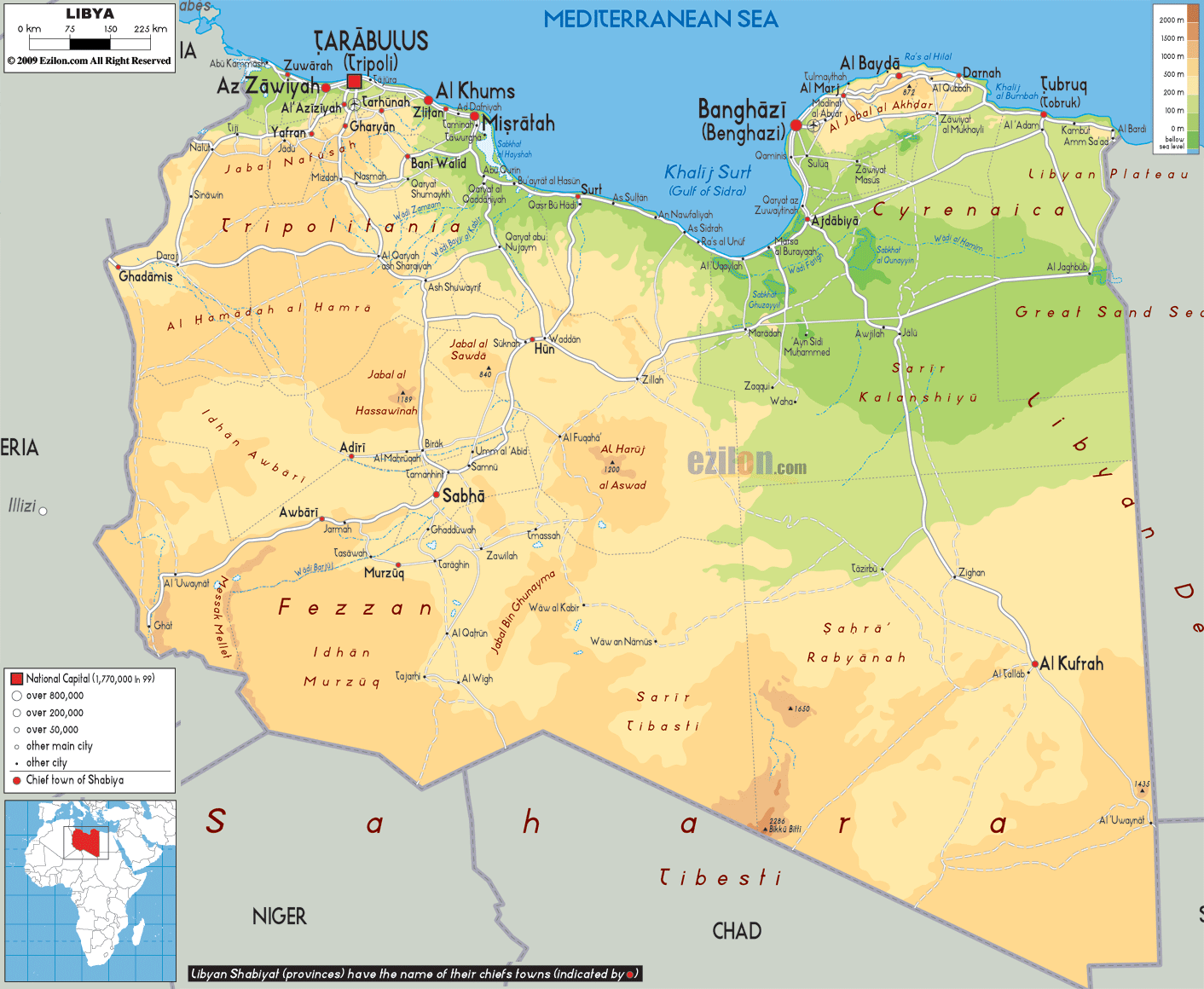
The first veto cast by the United States during Obama’s term, a veto he promised in vain not to use as his predecessors did, was a veto against the chance and promise of change, a veto against hope. This is a veto that is not friendly to Israel; it supports the settlers and the Israeli right, and them alone.

The excuses of the American ambassador to the UN won’t help, and neither will the words of thanks from the Prime Minister’s Office: This is a step that is nothing less than hostile to Israel. America, which Israel depends on more than ever, said yes to settlements. That is the one and only meaning of its decision, and in so doing, it supported the enterprise most damaging to Israel.

Moreover, it did so at a time when winds of change are blowing in the Middle East. A promise of change was heard from America, but instead, it continued with its automatic responses and its blind support of Israel’s settlement building. This is not an America that will be able to change its standing among the peoples of the region. And Israel, an international pariah, once again found itself supported only by America.

This should have disturbed every Israeli. Is that what we are? Alone and condemned? And all for the continuation of that worthless enterprise? Is it really worth the price? To hell with the UN and the whole world is against us?

We can’t wrap ourselves in this hollow iron dome forever. We must open our eyes and understand that if no country, aside from weakening America, supports this caprice of ours, then something fundamental is wrong here.

Israel, which is condemned by the entire world but continues merrily on its way, is a country that is losing its connection to reality. It is also a country that will ultimately find itself left entirely to its fate. That is why America’s decision harmed Israel’s interests: It continued to blind and stupefy Israel into thinking it can go on this way forever.

Jerry Haber writes:

In 1969, the United States voted with the rest of the Security Council to condemn Israel’s annexation of East Jerusalem and plans to build Jewish settlements in East Jerusalem. The Security Council “urgently calls once more upon Israel to rescind forthwith all measure taken by it which may tend to change the status of the City of Jerusalem.” And it explicitly mentioned expropriation of land.

Several days earlier, the US ambassador the United Nations had said in a speech to the UN:

The United States considers that the part of Jerusalem that came under the control of Israel in the 1967 war, like all other areas occupied by Israel, is occupied territory and hence subject to the provisions of international law governing the rights and obligations of an occupying Power. Among the provision of international law which bind Israel, as they would bind any occupier, are the provisions that the occupier has no right to make changes in law or in administration other than those which are temporarily necessitated by his security interests, and that an occupier may not confiscate or destroy private property. The pattern of behavior authorized under the Geneva Convention of 12 August 1949 and international law is clear: the occupier must maintain the occupied area as intact and unaltered as possible, without interfering with the customary life of the area, and any changes must be necessitated by the immediate needs of the occupation. I regret to say that the actions by Israel in the occupied portion of Jerusalem present a different picture, one which gives understandable concern that the eventual disposition of East Jerusalem may be prejudiced, and that the private rights and activities of the population are already being affected and altered. (Cited in Separate and Unequal: The Inside Story of Israeli Rule in East Jerusalem, by Amir S. Cheshin, Bil Hutman, and Avi Melamed (Cambridge: Harvard, 1999), pp. 46-7.

I should point out that this statement was made before a single Jewish settlement had been built outside of Jerusalem. The censure was in reaction to Israel construction of Jewish settlements over the Green Line in East Jerusalem – settlements that are now the “neighborhoods” of Ramot Eshkol and Ma’a lot dafna, East Talpiyot and Neveh Ya’akov.

AFP reports:

Around 3,000 Palestinians gathered in the West Bank city of Ramallah on Sunday to protest the US veto that nixed a Security Council resolution on Israeli settlements.

The crowd massed in Manara Square, a central traffic circle in the West Bank city, waving banners and shouting slogans against the American administration.

“Obama, you despicable man, we want self-determination!” shouted the demonstrators, many of them members of Palestinian president Mahmud Abbas’s Fatah party.

Ynet reports:

While the Palestinians continue to express their anger over the US veto against a UN vote condemning Israel’s settlement construction policy, new details have surfaced regarding the pre-veto discussions. Fatah elements claimed Saturday that US Secretary of State Hillary Clinton threatened to halt financial aid should the Palestinian Authority not withdraw its draft from the Security Council’s agenda. Nevertheless, Palestinian President Mahmoud Abbas stressed that the PA will not boycott the US.

A senior Fatah element told the Palestinian news agency Sama that Clinton threatened Abbas on Friday to cancel US aid. According to the source, US President Barack Obama told Abbas on Thursday night that no other American president has promoted the Palestinian issue more vigorously.

The Obama administration — which has yet to find a Bush policy it’s unwilling to promote — is continuing the practice of ideological exclusion (a Soviet-style policy of excluding political critics from entering the US). Omar Barghouti, author of Boycott, Divestment, Sanctions: The Global Struggle for Palestinian Rights, has been refused a visa for his upcoming speaking tour. He writes:

Ms. Clinton can sing the tunes of freedom all she wants when watching the news of Arab popular revolts from Morocco to Bahrain, but she is not fooling any average-intelligence person in the Arab world. US policy, especially after the veto cast yesterday against the most benign UN Security Council resolution, simply reiterating universal, long-held facts that Israel’s colonial settlements are illegal and thwart just peace, is being exposed to the new generation of restive, fearless, freedom-aspiring Arab youth as the main cause of their oppression, of buttressing and protecting the tyrants that have denied them all freedoms for decades. It has long been exposed, too, as the key partner of Israel in its occupation, colonialism and apartheid. Without US largess, Israel’s multi-tiered system of racist and colonial oppression cannot possibly survive.

Facebooktwittermail