Category Archives: Obama administration

Obama’s support for Bahrain’s hereditary dictatorship

The New York Times reports:

At a town-hall-style meeting in Bahrain two months ago, Secretary of State Hillary Rodham Clinton got a pointed question from a member of Bahrain’s Parliament: was the United States letting Bahrain, a Persian Gulf ally, off the hook for a string of arrests of lawyers and human rights activists?

The moderator rebuked the questioner for “hijacking the mike,” but Mrs. Clinton replied anyway. “I see the glass as half full,” she said, pointing to Bahrain’s recent elections. “I think the changes that are happening in Bahrain are much greater than what I see in many other countries in the region and beyond.”

When it came to Bahrain, Mrs. Clinton was not the only American diplomat who tended to see the glass as half full. Her rosy assessment, which seems incongruous in light of the army’s bloody crackdown on protesters, illustrates how the United States government has overlooked recent complaints about human rights abuses in a kingdom that is an economic and military hub in the Persian Gulf.

And it leaves the White House once again scrambling to deal with an Arab ally facing a tide of popular discontent. In this case, its calculations are complicated by signs that Bahrain is being pressed by its neighbor Saudi Arabia, the most strategically important country in the region.

In cables made public by WikiLeaks, the Bush and Obama administrations repeatedly characterized Bahrain as more open and reform-minded than its neighbors, and pushed back when human rights groups criticized the government.

In a January 2010 cable, the American Embassy in Bahrain criticized the human rights group Freedom House for downgrading Bahrain’s rating from “partly free” to “not free” in its global survey of political rights and civil liberties. The cable asserted that Freedom House had been successfully lobbied by a radical Shiite movement, known as Haq, which rejects the government’s reform efforts.

Another cable passed along doubts about a Human Rights Watch report that said the police were using torture in interrogations — saying it relied heavily on allegations made by members of the same group — though the embassy did urge the Bahraini authorities to undertake a “timely and credible” investigation.

“The embassy was feeding this happy talk for years,” said Tom Malinowski, Washington director for Human Rights Watch. “Bahrain was moving on a genuine reform path for several years, but it did a significant U-turn in the last year, and I think the U.S. government was well behind the curve.”

A year ago, Human Rights Watch released an 89-page report, Torture Redux: The Revival of Physical Coercion during Interrogations in Bahrain:

“Torture is back in the repertoire of Bahrain’s security services,” said Joe Stork, deputy Middle East director at Human Rights Watch. “The return of torture is especially distressing since Bahrain showed the political will a decade ago to end this scourge.”

Bahrain’s reversion to these discredited practices has come with rising political tensions. Street demonstrations by young men from the country’s majority Shia Muslim population protesting alleged discrimination by the Sunni-dominated government have deteriorated with increasing regularity into violent confrontations with security forces. Arrests have often followed. Security officials appear to be using painful physical techniques to elicit confessions from many of those arrested.

These techniques include electro-shock devices, suspension in painful positions, and beatings. Some of those who were detained reported that security officials threatened to kill or rape them or members of their families. Many were subjected to more than one of these practices.

A month later, the State Department’s annual report on human rights downplayed the torture allegations and seemed to insinuate that the victims’ credibility should be questioned. The report repeatedly cited official denials of the use of torture as though such denials constituted some form of evidence. It also repeatedly referred to rioters using Molotov cocktails — as though anyone engaged in political violence should expect to become a target of violence when held in detention, or, that anyone who riots can’t be trusted.

There are indications that the Obama administration did not simply view Bahrain in the way its rulers wanted the kingdom to be seen. State Department cables revealed by WikiLeaks to the Daily Telegraph, show in detail the administration’s interest in the power dynamics within the royal family and perhaps expose the US government’s desire to manipulate how the Al Khalifa family exercises its power.

To the extent that the US feels empowered and entitled to control other states, it would seem inevitable that a transition to democracy in those states would be regarded as a threat to American interests.

The US State Department secretly asked its diplomats in Bahrain to report any “derogatory” information about two of the King’s sons and evidence of “rivalry” with senior members of the ruling royal family, leaked documents show.

The office of Hillary Clinton, the Secretary of State, wanted to know if Prince Nasir bin Hamad al Khalifa or Prince Khalid bin Hamad al Khalifa took drugs, drank alcohol or “caused problems” within the monarchy.

Embassy staff in the Bahraini capital of Manama were also asked whether the princes had any friends among the country’s Shia Muslim majority, which is behind this week’s protests against the minority rule of the Sunni regime.

Prince Nasir, 23, who is serving in the Bahrain Defence Force, and Prince Khalid, 21, are King Hamad’s sons by his second wife and there have been fears in the region that hardliners from neighbouring countries might try to influence them.

In October 2009 a diplomatic cable from Mrs Clinton’s office, marked “secret”, described the princes as “important emerging targets of leadership analysis”.

Another cable reveals that the princes’ father, King Hamad, saw Bahrain’s strategic relationship with the US as so indispensable that he wanted to be sure the US Fifth Fleet would remain for decades:

He said he wanted to ensure a U.S. naval presence in Bahrain “for the next fifty years” and wondered aloud what kind of commitment Bahrain could offer that would serve this purpose. He suggested, for example, that Bahrain could increase production of crude or refined products to meet the Navy’s fuel requirements.

As an extra incentive, Bahrain considered offering the US Navy long-term fuel contracts at a fixed price. And keep in mind that Bahrain is a relatively minor oil producer.

Meanwhile, Eric Avebury provides some political background on the tiny Gulf state.

Bahrain is an hereditary dictatorship masquerading as a parliamentary democracy. The state has been ruled by the al-Khalifa family since the end of the 18th century, and still today all ministers are appointed by the King, who chooses 80 per cent from his near relations. The Prime Minister, who is the King’s uncle, has occupied the post since 1971, when Bahrain got its independence.

The al-Khalifas are Sunnis, but the majority of the population was Shia, at least until very recently. The regime has engaged in long-term demographic engineering, by granting citizenship, jobs and housing to Sunni immigrants. At the same time a clandestine organisation headed by another relative, Shaikh Ahmed bin Ateyatalla Al Khalifa, works to ensure that the Shia remain powerless, economically and politically. Gerrymandering at the last election saw to it that although 60 per cent of the votes were for Shia candidates, only 16 of them were elected to the lower house of parliament.


Facebooktwittermail

The moral bankruptcy of Barack Obama

Who would have thought that two years after George W Bush’s departure from the White House we could look back and say: there was a man with greater integrity and moral stature than the current occupant.

Believe me, that is not a compliment to Bush. It is an expression of utter contempt for Barack Obama and his inability to take a stand and speak unequivocally with moral clarity (a virtue the neocons insisted they owned yet never convincingly displayed).

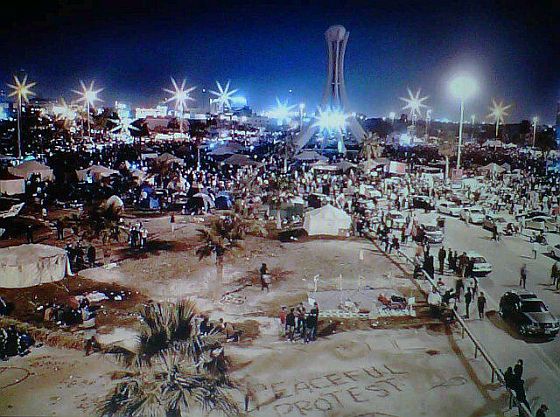
This is what happened today in Bahrain on one of the streets approaching Pearl Roundabout. No commentary or explanation is required.

This is how the Al Khalifa royal family handles non-violent political dissent.

And this is Obama’s response:

I am deeply concerned by reports of violence in Bahrain, Libya and Yemen.

The United States condemns the use of violence by governments against peaceful protesters in those countries and wherever else it may occur. We express our condolences to the family and friends of those who have been killed during the demonstrations.

Wherever they are, people have certain universal rights including the right to peaceful assembly.

The United States urges the governments of Bahrain, Libya and Yemen to show restraint in responding to peaceful protests, and to respect the rights of their people.

The United States is deeply indebted to the Al Khalifa family for being so gracious as to host the US Fifth Fleet. It would be impolite to do anything more than urge them to show restraint. After all, if — God forbid — in the near future they were all to end strung up through a swift application of justice as Bahrain came under Shia majority rule, then the strategic implications for the United States would be unthinkable.

So, a strong but carefully tempered presidential condemnation was in order. But note that America’s “model partner” did not get singled out. The rebuke was dished out collectively and universally as an observation about behavior that the United States condemns without consequence.

And this is what the world has come to see as Obama’s signature: empty words from a hollow man.

Facebooktwittermail

Obama stands for democracy — but only after all other alternatives have failed

Yet again, Bahrain’s government has initiated a brutal crackdown on demonstrators — and this time the army is reported to be firing live rounds. A doctor has been killed and paramedics injured while trying to help injured protesters. Ambulances are being denied access to the scene of the massacre.

The BBC reports:

Thousands of people have been voicing anger against Bahrain’s authorities at the funerals of victims of Thursday’s clashes which left four dead.

Crowds attending Friday prayers joined the funeral processions, calling for the overthrow of the ruling family.

At the prayers a Shia cleric described the clashes as a “massacre”, saying the government had shut the door to talks.

The Washington Post reports:

The United States last year provided Bahrain about $20.8 million in military assistance, a substantial amount for such a small country and almost double what it received in 2009. The vast majority of the funds went to pay for improvements to Bahrain’s F-16 fighter fleet and to its navy’s flagship frigate, supplied by the United States in 1996.

In the past, Bahrain has sent more than 100 police to Afghanistan to help build up that country’s force. Overall U.S. counterterrorism aid to Bahrain doubled last year to almost $1.1 million.

Much of that assistance likely went to police and military forces that are suppressing the current protests.

Mark Levine writes:

If the US is Egypt’s primary patron, in Bahrain it is among the ruling family’s biggest tenants, as the country is home to the Fifth Fleet, one of the US military’s most important naval armadas, crucial to protecting Persian Gulf shipping and projecting US power against Iran.

But while Bahrain has long been depicted as relatively moderate compared with its Salafi neighbor, Saudi Arabia, the reality is that the country is repressive and far from free, as citizens have almost no ability to transform their government, which according to the State Department “restricts civil liberties, freedoms of press, speech, assembly, association, and some religious practices.”

In the wake of Egypt, where many people harbor resentment against the Administration for its lack of early support for the democracy movement what can Obama do now? Can he in good conscience acquiesce to the brutal suppression of pro-democracy protesters so soon after his eloquent words and late coming to supporting the Egyptian revolution?

The larger question is: What is more essential to American security today, convenient bases for its ships, planes and troops across the Middle East, or a full transition to democracy throughout the region?

The answer is clearly the latter, as evidenced by the fact that America’s two primary antagonists in the Middle East, al-Qaeda and the Iranian government, have seen their standing sink in proportion to the rise of the pro-democracy movements.

In any war, cold or hot, propaganda is crucial, and here it is impossible to lose sight of the fact that al-Qaeda has had little if anything to say about the Egyptian revolution precisely because it was a massive non-violent jihad that succeeded miraculously where a decade of al-Qaeda blood and vitriol have miserably failed.

As for Iran, the government’s rhetorical support for the Egyptian revolution while it continues to suppress its own democracy movement is clearly emptying the Iranian regime of any remaining credibility as an alternative to the US-dominated order.

In this sense the success-so far-of the Egyptian revolution has presented Obama with a unique window of opportunity to forcefully advocate and press for the same kind of democratic transition across the Middle East and North Africa.

The signs on Tuesday were somewhat optimistic, as the President warned all regional leaders that they should “get ahead of the wave of protest” by moving towards democracy as quickly as possible. Yet Obama refused to mention Bahrain by name in his press conference, even as the government was cracking down on the protesters.

Instead, the US president argued that “each country is different, each country has its own traditions; America can’t dictate how they run their societies,” an utterly meaningless declaration since it contradicts the very advocacy of democracy that the President has made out of the other side of his mouth.

And now, once again, in the wake of government violence against peaceful citizens, the Obama administration stands silent, refusing to openly condemn the Bahraini government. Is the administration incapable of learning from mistakes in the immediate past?

Facebooktwittermail

US-backed state-terrorism in the Middle East

The pro-democracy rally at Bahrain’s Lulu Roundabout was brought to a violent end at 3am this morning when police launched a brutal assault against what at that time were mostly sleeping protesters.

Was this one of the “difficulties along the way” down “the democratic path that Bahrain is walking on” for the nation Hillary Clinton described as a “model partner” for the US less than three months ago?

When security forces launch a brutal crackdown on peaceful protesters, killing five, injuring hundreds and then the government prevents ambulances reaching the injured, there’s only one way this can be described: state terrorism.

And when the state in which this is occurring, Bahrain, is of preeminent importance to the US government because it serves as the base for the US Fifth Fleet and US naval operations in the Gulf, this becomes US-back state terrorism.

Mealy-mouthed statements from the White House on the need for “both sides” to exercise restraint and avoid violence, do nothing to disguise American complicity as yet again Washington attempts to shield one of its allies.

Here’s some of what the New York Times‘ Nicholas Kristof has reported in the last few hours:

  • At hospital in #Bahrain. 600 brought here w/ injuries as of 8 am, more since. Beatings, shotgun pellets, rubber bullets.
  • Nurse told me she saw handcuffed prisoner beaten by police, then executed with gun.
  • Abt 10 ambulance paramedics attacked by #Bahrain police. I interviewed them, saw their injuries.
  • #Bahrain govt has ordered ambulances to stop going out, hospital says.
  • 1 #Bahrain ambulance driver told me #Saudi army officer held gun to his head, said wld kill him if helped injured.
  • Witnesses say #Bahrain police cursed Shia as they attacked peaceful demonstrators. I haven’t found 1 Sunni victim.
  • Crowd growing at main #Bahrain hospital, chanting slogans against royal family. Will govt attack them here?
  • In morgue, I spoke to brother of 22 year old killed by police shotgun blast. He says King Hamad must step down.

Maryam Alkhawaja from the Bahrain Centre for Human Rights tweets that “several Bahraini officers are being prosecuted for refusing to take part in violence against peaceful protesters.”

Meanwhile, Amnesty International provides the following chilling account of torture conducted by the Egyptian army, just days before Hosni Mubarak stepped down:

An 18-year-old secondary school student from Cairo told Amnesty International that he was tortured after he was arrested at about 1500hrs on 3 February 2011 by soldiers near Tahrir Square:

“I was walking with a friend towards the square when soldiers stopped us and asked for our IDs. They seemed to be suspicious of my friend, because he holds a UK residence permit. They took us to the area museum which is controlled by the army and held us there in an outdoor area. After some while we were blindfolded and handcuffed and I could not see what happened to my friend. I could only hear him screaming and believe he was severely beaten. I was only slapped in the face but not severely beaten while held at the museum.

“That night we were transferred to another location about 30 minutes away from Tahrir Square. When we got out we had to lie down on the floor and were beaten. Then I was taken for interrogation where they insulted me and my family. They said things one should not say. They took off my handcuffs, because they ordered me to take off my clothes, except my underwear, but I remained blindfolded. Then they handcuffed me again and tied my legs. They put a chain or rope to my legs and lifted me up, so that my head was hanging down. From time to time they would let me down into a barrel that was filled with water. They told me to confess that I was trained by Israel or by Iran. They also put electric shocks to my body and I fainted. This continued for several hours. After the torture finished I was so exhausted that I slept for hours.

“The next day I was taken in a group of about 30 people to another location, which – as I learned later – was Sign al-Harbi [a military prison at El Heiksteb, northeast of Cairo]. When we got out of the vehicle our blindfolds were taken off and soldiers started beating us with whips and truncheons. There are still scares on my back from the beatings. We were lead to our cells where I soon fell asleep. They kept beating us, including when we went to the bathroom. The last days of my detention I refused to eat to protest against the treatment. Finally we were released. They left us on the road to Cairo and told us to walk back.”

He was released with hundreds of other detainees from the military prison on 10 February 2011. Amnesty International delegates interviewed him several days later when scars were still visible on his back.

During an era in which Americans have been told that the threat from terrorism should be preeminent among this nation’s national security concerns, the gravest omission in public debate on this issue has been consideration of the relationship between state-sanctioned brutality and terrorism.

We have been led to believe that terrorism arising in the Middle East is spawned by extremist Islamist ideology while overlooking its much more transparent secular roots: the willingness of autocratic rulers to use violence as an instrumental and indispensable tool through which they can exercise and sustain their power.

When the word “stability” gets bandied around as though it was describing a condition of civic calmness and social order, we should remember that when someone has a gun pointed to their head they are able to sit in perfect stillness — this is stability under the threat of violence, the condition in which most people in the Middle East have lived for generations.

Where violence provides the backbone of governance, should we be surprised that similar forms of brutality would be adopted by some individuals and groups that want to challenge their rulers? And should we imagine that when these rulers are counted as America’s friends, that the US could provide its support with impunity?

What we should really marvel at is the fact that people across the region are now rising in their thousands driven, in part, by the audacious idea that non-violence can overcome violence.

Facebooktwittermail

Police in lethal crack down on peaceful mass protest in Bahrain

Peaceful protest at Pearl Roundabout several hours before police launched a deadly assault at 3am Thursday morning.

Al Jazeera is now reporting that at least two people have been killed and dozens injured as Bahrain police attacked sleeping demonstrators in the early hours of Thursday morning. The New York Times said:

Hundreds of riot police surrounded the nation’s symbolic center, Pearl Square, in the early morning Thursday, raining tear gas and percussion grenades on thousands of demonstrators who had poured into the square all day Wednesday to challenge the country’s absolute monarchy.

The protesters, including women and children, had been camping out and the atmosphere had been festive only hours before. But by about 3:30 a.m. Thursday, people were fleeing, screaming “We were sleeping. We were sleeping,” and ambulances, sirens blaring, were trying to make their way through the crowds.

Witnesses, some of them vomiting from the gas, said they had no warning the police were going to crack down on their peaceful protest before rows of police vehicles with blue flashing lights began to circle the area.

Shiite opposition leaders had spent the day Wednesday issuing assurances that they were not being influenced by Iran and were not interested in transforming the monarchy into a religious theocracy like the Islamic republic in Iran.

But that did not stop what appeared to be government attempts to deter the demonstrators who had laid claim to the square, the symbolic heart of the nation. Hours before the police action, the Internet was jammed to a crawl and cellphone service was intermittent. Those efforts, however, only seemed to energize the roaring crowds, which spilled out of the square, tied up roads for as far as the eye could see and united in a celebration of empowerment unparalleled for Bahrain’s Shiites, who make up about 70 percent of the country’s 600,000 citizens.

The following report from Al Jazeera was broadcast before the latest deaths. The position of the Bahrain royal family must now be even more precarious.

Graham Fuller writes:

Where’s the next place to blow in the Arab revolution? Candidates are many, but there’s one whose geopolitical impact vastly exceeds its diminutive size — the island of Bahrain.

This is a place run by an oppressive and corrupt little regime, long coddled by Washington because the U.S. Navy’s Fifth Fleet is headquartered there. The future of the base is far from secure if the regime falls.

A few hard facts about the island that should give pause for thought:

First, Bahrain is a Shiite island. You won’t see it described that way, but it is — 70 percent of the population, more than the percentage of Shiites in Iraq. And like Iraq under Saddam Hussein, these Arab Shiites have been systematically discriminated against, repressed, and denied meaningful roles by a Sunni tribal government determined to maintain its solid grip on the country. The emergence of real democracy, as in Iraq, will push the country over into the Shiite column — sending shivers down the spines of other Gulf rulers, and especially in Riyadh.

Appearances are deceiving. Go to Bahrain and on the surface you won’t feel the same heavy hand that dominates so many other Arab authoritarian states. The island is liberal in its social freedoms. Expats feel at home — you can get a drink, go to nightclubs, go to the beach, party.

But if you look behind the Western and elite-populated high-rises you’ll encounter the Shiite ghettoes — poor and neglected, with high unemployment, walls smeared with anti-regime graffiti.

Free market? Sure, except the regime imports politically neutered laborers from passive, apolitical states that need the money: Filipinos, Bangladeshis, Sri Lankans and other South Asians who won’t make waves or they’re on the next plane out.

The regime also imports its thugs. The ranks of the police are heavily staffed with expat police who often speak no Arabic, have no attachments to the country and who will beat, jail, torture and shoot Bahraini protesters with impunity.

Facebooktwittermail

Egypt’s useless friend in Washington

In President Obama’s latest statement on events in Egypt, he does not swerve from the position he has maintained from day one: that of a concerned but impotent spectator.

“In these difficult times, I know that the Egyptian people will persevere, and they must know that they will continue to have a friend in the United States of America.”

But does this friend intend to do anything other than express beliefs and hopes about a desirable outcome?

“As we have said from the beginning of this unrest, the future of Egypt will be determined by the Egyptian people.” And in another nod to people power: “The Egyptian people have made it clear that there is no going back to the way things were: Egypt has changed, and its future is in the hands of the people.”

And yet the whole world knows that the US is not an impotent and innocent onlooker — it is deeply invested in supporting Egypt’s military.

The White House claims it supports democracy in Egypt and that the US should have no role in determining who governs, yet Obama can certainly make the continuation of military aid contingent on the existence of a democratic government.

At this decisive moment when the Egyptian military has to choose between supporting an embattled and increasingly desperate president or siding with the people, the risk of losing one third of the country’s military funding could bring some much-needed clarity to the generals’ thinking.

Facebooktwittermail

What now in Egypt?

Robert Gibbs, White House spokesman, says: “The president is watching the same thing you are. I don’t know what the outcome will be.”

WATCH AL JAZEERA LIVE

Whatever Mubarak has to say, the people in Tahrir Square will deliver the verdict. The more certain Mubarak’s departure seems, the bigger the question mark hanging over Omar Suleiman.

The fundamental question is whether the Egyptian military is ready to relinquish its grip on the state and usher in a new era of civilian and democratic governance.

Facebooktwittermail

The American-Israeli led anti-democratic alliance

“Never insult the Arabs,” advised Amos Gilead, former head of Israel’s Political-Military Bureau, speaking on Monday at the influential Herzliya national security conference.

But he wasn’t appealing for an improvement in Israeli-Arab relations since he only had a few Arabs in mind — Hosni Mubarak and other leaders “that are supporting stability and are coping with terror and have proven themselves along decades.”

As for Gilead’s views about the advance of democracy in the region, such a prospect presents nothing less than a path to hell.

“If we allow,” Gilead said, then edited himself realizing that democracy should not be presented as something Israel can allow (or forbid) and thus he continued in less instrumental terms, “or if there is democrative process in the Middle East, it will bring for sure — or, let’s say, quite sure — dictatorships which will make this area like hell.”

The Obama administration — which has yet to face any form of governmental pressure it was willing to resist — is now showing itself in much deeper sympathy with those voices who present democracy as a threat than those who claim democracy as their right.

The New York Times reports:

As the Obama administration gropes for the right response to the uprising in Egypt, it has not lacked for advice from democracy advocates, academics, pundits, even members of the previous administration. But few voices have been as urgent, insistent or persuasive as those of Egypt’s neighbors.

Israel, Saudi Arabia, Jordan and the United Arab Emirates have each repeatedly pressed the United States not to cut loose Egypt’s president, Hosni Mubarak, too hastily, or to throw its weight behind the democracy movement in a way that could further destabilize the region, diplomats say. One Middle Eastern envoy said that on a single day, he spent 12 hours on the phone with American officials.

There is evidence that the pressure has paid off. On Saturday, just days after suggesting that it wanted immediate change, the administration said it would support an “orderly transition” managed by Vice President Omar Suleiman. Secretary of State Hillary Rodham Clinton said that Mr. Mubarak’s immediate resignation might complicate, rather than clear, Egypt’s path to democracy, given the requirements of Egypt’s Constitution.

“Everyone is taking a little breath,” said a diplomat from the region, who spoke on the condition of anonymity because he was discussing private conversations. “There’s a sense that we’re getting our message through.”

While each country has its own concerns, all worry that a sudden, chaotic change in Egypt would destabilize the region or, in the Arab nations, even jeopardize their own leaders, many of whom are also autocrats facing restive populations.

Like frogs that refuse to jump out of pot of hot water because its temperature is only rising slowly, those autocrats and their Western allies who now equate stability with their ability to act as a judicious brake on change, have a will to survive that is guiding them down a path of self-destruction.

Slow but sure are the watchwords of the proponents of an “orderly transition” to democracy in Egypt. Yet even as they profess a desire to see democratic change unfold and claim no interest in dictating the outcome of a democratic process, this posture of non-interference is contradicted by a clear intent to dictate the pace of change. The will of the Egyptian people will be respected — but not just yet.

What the West is telling the Arab world is this: be patient living under dictators we like because if you get rid of them you’ll end up being ruled by dictators we don’t like. Now, as ever, the West treats Arabs as being incapable of building their own democracies.

But beneath this veneer of contempt lies a much deeper fear: that a Middle East made up of truly self-governing independent nations fully in control of resources upon which the West depends will no longer bow to Western interests. That’s a prospect the West dreads to contemplate.

Facebooktwittermail

Time for the United States to stop poisoning the Middle East

To assert that the United States has been poisoning the Middle East for decades might sound like too strong language to the ears of many Americans. Yet what kind of effect can we expect from the long-standing practice of supporting rulers who habitually torture their own people, other than a poisonous effect?

Much as we can celebrate the Egyptian revolution as an expression of the universal human desire for freedom, it is also the beginning of a process through which Egypt must detoxify itself.

The Obama administration still clings to the phrase orderly transition as though the process of change on which Egypt is just embarking might be as seamless as the changeless change which saw George W Bush’s departure from and Barack Obama’s arrival into the White House.

Real change is more disruptive. It can’t be stage-managed by Hosni Mubarak or his deputies.

Graham Fuller writes:

It had to come. Where, when, and how exactly one of many smoldering sparks in this agonized region might actually burst forth into the present conflagration was unknowable, but tension and anger was palpably rising over a long period.

Where all these uprisings across the region will go is still unknowable, but one thing is clear – the imperative to break the long and ugly pattern of harsh, incompetent, and corrupt rule that sucks optimism, hope, and creativity out of these societies and made them breeding grounds for radicalism.

What the people of the region demand is to be able to take control of their own lives and destinies. But that in turn depends on an end to the constant external intervention of the United States in the region.

In the near term, the prescription is stark – Washington must back off and leave these societies alone, ending the long political infantilization of Middle Eastern populations. We must end our incessant and obsessive efforts to intervene and micromanage the political life of foreign states based on a myopic vision of “American interests.”

Today the Middle East is the last redoubt in the world of regimes bought, maintained, and guided by Washington. Is it any wonder that this region is now the cauldron of numerous rebellions and anti-American expression?

And just why are we maintaining this damaging, hated quasi-imperial role in the Middle East? Is it for the oil? Yet what tin-pot dictator has ever refused us oil? Furthermore, we don’t even rely that much on Middle East oil – Saudi Arabia ranks only number three among our top five providers: Canada, Mexico, Saudi Arabia, Venezuela, and Nigeria.

Or is it perhaps all about Israel? Yet why should that state constitute the seeming touchstone of everything that we do in the region? After all, Israel is overwhelmingly the most powerful military state in the Middle East, acts at will in the Middle East under the protection of American veto, manipulates our own domestic politics in its favor, and is now run by the most inflexible and ultra-right-wing government in Israeli history, while soaking up more American foreign aid per capita than any other state. The US still backs Israel against the Palestinians in an Israeli occupation now into its fifth decade.

Facebooktwittermail

America’s feudal friends

As the saying goes, a man is known by the company he keeps. President Obama’s choice of Frank Wisner as his special envoy to Cairo shows that corruption has become so deeply institutionalized in Washington that it cannot be exposed — it is so commonplace, so much regarded as an inherent dimension of politics that politics and corruption are indivisible. The fact that bundles of unmarked bills in brown paper bags are rarely exchanged for political services is not evidence of a clean political system. On the contrary: it is evidence that corruption has been legalized.

Robert Fisk writes:

Frank Wisner, President Barack Obama’s envoy to Cairo who infuriated the White House this weekend by urging Hosni Mubarak to remain President of Egypt, works for a New York and Washington law firm which works for the dictator’s own Egyptian government.

Mr Wisner’s astonishing remarks – “President Mubarak’s continued leadership is critical: it’s his opportunity to write his own legacy” – shocked the democratic opposition in Egypt and called into question Mr Obama’s judgement, as well as that of Secretary of State Hillary Clinton.

The US State Department and Mr Wisner himself have now both claimed that his remarks were made in a “personal capacity”. But there is nothing “personal” about Mr Wisner’s connections with the litigation firm Patton Boggs, which openly boasts that it advises “the Egyptian military, the Egyptian Economic Development Agency, and has handled arbitrations and litigation on the [Mubarak] government’s behalf in Europe and the US”. Oddly, not a single journalist raised this extraordinary connection with US government officials – nor the blatant conflict of interest it appears to represent.

Mr Wisner is a retired State Department 36-year career diplomat – he served as US ambassador to Egypt, Zambia, the Philippines and India under eight American presidents. In other words, he was not a political appointee. But it is inconceivable Hillary Clinton did not know of his employment by a company that works for the very dictator which Mr Wisner now defends in the face of a massive democratic opposition in Egypt.

So why on earth was he sent to talk to Mubarak, who is in effect a client of Mr Wisner’s current employers?

Patton Boggs states that its attorneys “represent some of the leading Egyptian commercial families and their companies” and “have been involved in oil and gas and telecommunications infrastructure projects on their behalf”. One of its partners served as chairman of the US-Egyptian Chamber of Commerce promoting foreign investment in the Egyptian economy. The company has also managed contractor disputes in military-sales agreements arising under the US Foreign Military Sales Act. Washington gives around $1.3bn (£800m) a year to the Egyptian military.

Mr Wisner joined Patton Boggs almost two years ago – more than enough time for both the White House and the State Department to learn of his company’s intimate connections with the Mubarak regime. The New York Times ran a glowing profile of Mr Wisner in its pages two weeks ago – but mysteriously did not mention his ties to Egypt.

Nicholas Noe, an American political researcher now based in Beirut, has spent weeks investigating Mr Wisner’s links to Patton Boggs. Mr Noe is also a former researcher for Hillary Clinton and questions the implications of his discoveries.

“The key problem with Wisner being sent to Cairo at the behest of Hillary,” he says, “is the conflict-of-interest aspect… More than this, the idea that the US is now subcontracting or ‘privatising’ crisis management is another problem. Do the US lack diplomats?

“Even in past examples where presidents have sent someone ‘respected’ or ‘close’ to a foreign leader in order to lubricate an exit,” Mr Noe adds, “the envoys in question were not actually paid by the leader they were supposed to squeeze out!”

While the rationalization provided by so-called political realism ascribes US support for Mubarak to the need for “stability” in an unstable region, he also belongs to the class of leaders America has always preferred to support: those unburdened by ideological affiliations whose insatiable greed makes them dependable US allies. In other words, the US government likes rulers who are so rotten they can be trusted — which is to say, trusted to serve US interests.

What does this tell us about American values and the American view of the world?

That every man can be bought — it’s just a matter of finding the right price.

It’s not a mentality one would hope to find in the cradle of modern democracy but hardly surprising to be seen prevailing in a nation built on slavery.

There is of course nothing uniquely American in this mentality — it’s the way imperial powers have always extended their reach, but as Barack Obama said on the day of his inauguration, “the world has changed and we must change with it.”

Indeed. But, if his response to the Egyptian revolution provides a reliable measure, we have yet more evidence this president lacks the will to become the agent of such change.

Salwa Ismail writes:

There is a lot more behind Hosni Mubarak digging in his heels and setting his thugs on the peaceful protests in Cairo’s Tahrir Square than pure politics. This is also about money. Mubarak and the clique surrounding him have long treated Egypt as their fiefdom and its resources as spoils to be divided among them.

Under sweeping privatisation policies, they appropriated profitable public enterprises and vast areas of state-owned lands. A small group of businessmen seized public assets and acquired monopoly positions in strategic commodity markets such as iron and steel, cement and wood. While crony capitalism flourished, local industries that were once the backbone of the economy were left to decline. At the same time, private sector industries making environmentally hazardous products like ceramics, marble and fertilisers have expanded without effective regulation at a great cost to the health of the population.

A tiny economic elite controlling consumption-geared production and imports has accumulated great wealth. This elite includes representatives of foreign companies with exclusive import rights in electronics, electric cables and automobiles. It also includes real estate developers who created a construction boom in gated communities and resorts for the super-rich. Much of this development is on public land acquired at very low prices, with no proper tendering or bidding.

Facebooktwittermail

After Mubarak

Adam Shatz writes:

Mubarak, when he stands down, is not likely to be missed by many people in Egypt, where he has pledged to spend his last days, but he will be missed in Washington and, above all, in Tel Aviv. Mubarak and Omar Suleiman, now the interim vice president, worked closely with Israel on everything from the Gaza blockade to intelligence-gathering; they allowed Israeli warships into the Suez Canal to prevent weapons smuggling into Gaza from Sudan, and did their best to stir up tensions between Fatah and Hamas. The Egyptian public is well aware of this intimate collaboration, and ashamed of it: democratisation could spell its end. A democratic government isn’t likely to abolish the peace treaty with Israel – even some of the leaders of the Muslim Brotherhood have said they would respect it. But Egyptian foreign policy would be set in Cairo rather than in Washington and Tel Aviv, and the cold peace would grow colder. A democratic government in Cairo would have to take public opinion into account, much as Erdogan’s government does in Turkey: another former US client state but one that, in marked contrast to Egypt, has escaped American tutelage, made the transition to democracy under an Islamist government, and pursued an independent foreign policy that is widely admired in the Muslim world. If Egypt became a democracy, it might work to achieve Palestinian unity, open up the crossing from Gaza and improve relations with Iran and Hizbullah: shifts which would be anathema to Israel.

Meanwhile, the New York Times reports on the Obama administration’s latest moves to back Mubarak II: Egypt’s torture chief, Omar Suleiman:

The United States and leading European nations on Saturday threw their weight behind a gradual transition in Egypt, backing attempts by the country’s vice president, Omar Suleiman, to negotiate with opposition groups without immediately removing President Hosni Mubarak from power.

The strong endorsement came as Mr. Suleiman, a longtime security official and confidante of Mr. Mubarak, told opposition leaders that he would not press his boss to resign before September and ruled out any delegation of Mr. Mubarak’s power, central demands of the opposition.

Mr. Mubarak’s ruling party then announced a shake-up that removed its old guard, including his son Gamal, while installing younger, more reform-minded figures as a modest gesture to protesters.

The moves amounted to a rebuff to protesters who have posed the most serious challenge to the nearly three-decade rule of Mr. Mubarak, a pillar of the American-backed order in the Middle East.

Hundreds of thousands of demonstrators have demanded faster and more sweeping changes to the military-dominated government that has relied on an ossified ruling party, police, and a powerful clique of businessmen at the center of power.

By emphasizing the need for a gradual transition, only days after emphasizing that change there must begin immediately, the Obama administration was viewed as shifting away from protesters in the streets and toward stronger backing for Mr. Mubarak’s hand-picked elite.

Issandr El Amrani adds:

There is a vast repositioning taking place in elite Egyptian politics. Just an hour ago or so it was announced that Hosni and Gamal Mubarak had resigned from their positions in the NDP (chairman and deputy sec-gen / head of Policies Committee respectively), as had Safwat al-Sherif (formerly Secretary General). You can see the old structure in the chart I put up a few days ago. Moufid Shehab has also lost his position, as has Zakariya Azmi (crucially, Mubarak’s longstanding chief of staff). No doubt we’ll hear of more.

This is a game of musical chairs to install a new political elite, some of which will be those who survived the old one. The new secretary-general of the NDP is Hossam Badrawy, once a enthusiastic backer of Gamal and MP between 2000-2005. Badrawy one was of the liberal, reformist NDPers who wanted to bring change from the inside. He was one of the most reasonable figures in the party and did not simply ignore problems like human rights. However, we was also associated with efforts at educational reform that bore little fruit and an attempt at a reform to the health sector that seemed to benefit his main business, private healthcare.

In part of the ongoing coup carried out by Omar Suleiman and his army buddies (with Mubarak remaining as a fig leaf so it is not seen as such) they need a new political class. Badrawy has class, money and social clout.

Facebooktwittermail

Egypt’s aftershocks shake the Washington debate

Mark Perry writes:

It is commonplace for historians to compare revolutions to earthquakes, but the metaphor remains powerful. The Egyptian revolution is much like an earthquake: its epicenter may be Cairo, but its shockwaves have reached all the way to Washington. Since the first crowds began to appear in Tahrir Square, the Egyptian trembler has so shaken the U.S. that small but perceptible cracks have begun to appear in the foundations of America’s Middle East policies — and in the comity of opinion that has guided U.S. views of the region for 60 years. The changes were first evidenced last week, when policymakers, pundits and government officials made the rounds of the Sunday morning television news shows.

When Secretary of State Hillary Clinton appeared on CNN, interviewer Candy Crowley was blunt: which side is the U.S. on — “Mubarak or the people in the streets?” she asked. Clinton laughed slightly, then rejected the question: “Well, there’s another choice, it’s the Egyptian people,” she said. “We are on the side, as we have been for more than 30 years, of a democratic Egypt that provides both political and economic rights of its people, that respects the universal human rights of all Egyptians.” Of course, Crowley knew (as we all knew) that if Clinton had been asked the same question just the week before, her answer would have been entirely different: that our friendship with Egypt is based on its peace treaty with Israel, its opposition to Iran and its hostility to political Islam.

The difference between the two answers is less a reflection of America’s Orwellian relationship with the truth (“we are on the side, as we have been for more than 30 years, of a democratic Egypt”), than it is of the Obama administration’s realization that a new constellation of leaders will soon take office in Cairo — and we’re going to have to deal with them, like it or not. Washington’s pro-Israel lobby is scrambling to reverse this view, because talking to a new set of leaders means talking to the Muslim Brotherhood — which might be bad for Israel. This was made clear on the same day that Hillary Clinton appeared on CNN.

Facebooktwittermail

Freedom lies behind a closed door that can only be broken down by a bleeding Arab fist

Tariq Ali writes:

“Freedom lies behind a door closed shut,” the great Egyptian poet Ahmed Shawqi wrote in the last century. “It can only be knocked down with a bleeding fist.” More than that is bleeding in the Arab world at the moment.

The uprisings we are witnessing in Egypt have been a rude awakening for all those who imagined that the despots of the Arab world could be kept in place provided they continued to serve the needs of the West and their harsh methods weren’t aired on CNN and BBC World. But while Western establishments lull themselves to sleep with fairy tales, ordinary citizens, who are defeated and demoralized, mull their revenge.

The French government seriously considered sending its paratroopers to save former President Zine El Abidine Ben Ali in Tunisia. Israeli Prime Minister Benjamin Netanyahu is pleading with officials in Washington to delay Hosni Mubarak’s departure from Egypt so that Israel has time to prepare for the likely outcome. Former U.K. Prime Minister Tony Blair is even describing the Egyptian dictator as a “force for good.”

The almost 200 pro-democracy citizens who have been killed don’t bother him too much. That’s small beer compared with the tens of thousands dead in Iraq. And a desperate Palestine Liberation Organization is backing Mubarak and repressing solidarity demonstrations in Ramallah on the West Bank.

Facebooktwittermail

Mubarak’s last gasps

Esam Al-Amin writes:

On Saturday Jan. 29, The National Security Council advised the president to ask Mubarak in no uncertain terms to immediately step down. However, Benjamin Netanyahu of Israel and King Abdullah of Saudi Arabia, whom the president consulted, strenuously objected and pleaded for time to allow Mubarak to stay in power at least until he finishes his term in September.

Openly criticizing Obama, former Israeli Defense minister, Binyamin Ben-Eliezer, a longtime friend of Mubarak, said, “I don’t think the Americans understand yet the disaster they have pushed the Middle East into.” The Israeli lobby and Saudi Ambassador Adel Al-Jubeir went overdrive and intensified their lobbying efforts in Congress in order to exert immense pressure on the administration. Reluctantly, the U.S. president relented.

Meanwhile, the last touches of a crude plan to abort the protests and attack the demonstrators were being finalized in the Interior Ministry. In the mean time, the leaders of the NPD met with the committee of forty, which is a committee of corrupt oligarchs and tycoons, who have taken over major sections of Egypt’s economy in the last decade and are close associates to Jamal Mubarak, the president’s son. The committee included Ahmad Ezz, Ibrahim Kamel, Mohamad Abu el-Enein, Magdy Ashour and others.

Each businessman pledged to recruit as many people from their businesses and industries as well as mobsters and hoodlums known as Baltagies – people who are paid to fight and cause chaos and terror. Abu el-Enein and Kamel pledged to finance the whole operation.Meanwhile,the Interior Minister reconstituted some of the most notorious officers of his secret police to join the counter-revolutionary demonstrators slated for Wednesday, with a specific plan of attack the pro-democracy protesters.

About a dozen security officers, who were to supervise the plan in the field, also recruited former dangerous ex-prisoners who escaped the prison last Saturday, promising them money and presidential pardons against their convictions. This plan was to be executed in Cairo, Alexandria, Suez, Port Said, Damanhour, Asyout, among other cities across Egypt.

Facebooktwittermail

It’s not radical Islam that worries the US – it’s independence

Noam Chomsky writes:

‘The Arab world is on fire,” al-Jazeera reported last week, while throughout the region, western allies “are quickly losing their influence”. The shock wave was set in motion by the dramatic uprising in Tunisia that drove out a western-backed dictator, with reverberations especially in Egypt, where demonstrators overwhelmed a dictator’s brutal police.

Observers compared it to the toppling of Russian domains in 1989, but there are important differences. Crucially, no Mikhail Gorbachev exists among the great powers that support the Arab dictators. Rather, Washington and its allies keep to the well-established principle that democracy is acceptable only insofar as it conforms to strategic and economic objectives: fine in enemy territory (up to a point), but not in our backyard, please, unless properly tamed.

One 1989 comparison has some validity: Romania, where Washington maintained its support for Nicolae Ceausescu, the most vicious of the east European dictators, until the allegiance became untenable. Then Washington hailed his overthrow while the past was erased. That is a standard pattern: Ferdinand Marcos, Jean-Claude Duvalier, Chun Doo-hwan, Suharto and many other useful gangsters. It may be under way in the case of Hosni Mubarak, along with routine efforts to try to ensure a successor regime will not veer far from the approved path. The current hope appears to be Mubarak loyalist General Omar Suleiman, just named Egypt’s vice-president. Suleiman, the longtime head of the intelligence services, is despised by the rebelling public almost as much as the dictator himself.

Facebooktwittermail

Washington’s newly shaped Mubarak-must-go-now posture

Bloomberg reports:

Senior members of the U.S. Congress are debating whether to halt foreign aid to Egypt as a way to hasten President Hosni Mubarak’s exit from power amid continuing protests against his three-decade rule.

Senator Patrick Leahy, the chairman of the panel that controls foreign aid, said he’s prepared to stop all U.S. financial assistance to Egypt — which topped $1.5 billion last year — unless Mubarak steps aside immediately and allows a transitional government to take over.

“If he doesn’t leave, there will not be foreign aid; I mean, it’s as simple as that,” Leahy, a Vermont Democrat, told Bloomberg Television in an interview yesterday. U.S. money “will not go to the Mubarak administration,” Leahy said, adding, “that’s a pipeline that can easily be turned off.”

Today, the Senate passed a resolution calling on Mubarak to begin the transfer of power to an “inclusive, interim caretaker government.”

The New York Times this evening reports:

The Obama administration is discussing with Egyptian officials a proposal for President Hosni Mubarak to resign immediately, turning over power to a transitional government headed by Vice President Omar Suleiman with the support of the Egyptian military, administration officials and Arab diplomats said Thursday.

Even though Mr. Mubarak has balked, so far, at leaving now, officials from both governments are continuing talks about a plan in which, Mr. Suleiman, backed by Sami Enan, chief of the Egyptian armed forces, and Field Marshal Mohamed Tantawi, the Defense Minister, would immediately begin a process of constitutional reform.

The proposal also calls for the transitional government to invite members from a broad range of opposition groups, including the banned Muslim Brotherhood, to begin work to open up the country’s electoral system in an effort to bring about free and fair elections in September, the officials said.

Senior administration officials said that the proposal is one of several options under discussion with high-level Egyptian officials around Mr. Mubarak, though not him directly, in an effort to convince him to step down now.

The officials cautioned that the outcome depended on several factors, not least of all the mood of the protesters on the streets of Cairo and other Egyptian cities and the dynamics within the Egyptian government. Some officials said there was not yet any indication that either Mr. Suleiman or the military were willing to abandon Mr. Mubarak.

Facebooktwittermail

The Egyptian opposition is ready to lead an orderly transition to create a democratic republic

President Obama has promoted the lie that Hosni Mubarak as the capacity to lead an orderly transition towards a democratic Egypt. Mubarak’s thugs, by spilling the blood of Egyptian people on the streets of Cairo today, have exposed the lie.

It’s time for Obama to stop hiding from the press and come out and call for Mubarak to resign now.

Mustafa el-Gindy, a former independent member of the Egyptian parliament and current member of the opposition, presents the opposition’s plan through which the opposition in concert with the army can lead the the post-Mubarak transition.

Facebooktwittermail