Category Archives: Obama administration

Obama’s indecision on Libya has pushed Clinton over the edge

The Daily reports:

Fed up with a president “who can’t make his mind up” as Libyan rebels are on the brink of defeat, Secretary of State Hillary Clinton is looking to the exits.

At the tail end of her mission to bolster the Libyan opposition, which has suffered days of losses to Col. Moammar Gadhafi’s forces, Clinton announced that she’s done with Obama after 2012 — even if he wins again.

“Obviously, she’s not happy with dealing with a president who can’t decide if today is Tuesday or Wednesday, who can’t make his mind up,” a Clinton insider told The Daily. “She’s exhausted, tired.”

He went on, “If you take a look at what’s on her plate as compared with what’s on the plates of previous Secretaries of State — there’s more going on now at this particular moment, and it’s like playing sports with a bunch of amateurs. And she doesn’t have any power. She’s trying to do what she can to keep things from imploding.”

Clinton is said to be especially peeved with the president’s waffling over how to encourage the kinds of Arab uprisings that have recently toppled regimes in Egypt and Tunisia, and in particular his refusal to back a no-fly zone over Libya.

In the past week, former President Bill Clinton and Hillary Clinton’s former top adviser Anne-Marie Slaughter lashed out at Obama for the same reason.

The tension has even spilled over into her dealings with European diplomats, with whom she met early this week.

When French president Nicolas Sarkozy urged her to press the White House to take more aggressive action in Libya, Clinton repeatedly replied only, “There are difficulties,” according to Foreign Policy magazine.

“Frankly we are just completely puzzled,” one of the diplomats told Foreign Policy magazine. “We are wondering if this is a priority for the United States.”

Or as the insider described Obama’s foreign policy shop: “It’s amateur night.”

Facebooktwittermail

International alliance forming to stop Gaddafi

Libya’s Deputy Permanent UN Representative warns that a convoy of 400 military vehicles are headed to destroy Ajdabiya and that the UN must intervene in the coming hours.

The New York Times reports:

The prospect of a deadly siege of the rebel stronghold in Benghazi, Libya, has produced a striking shift in tone from the Obama administration, which is now pushing for the United Nations to authorize aerial bombing of Libyan tanks and heavy artillery to try to halt the advance of forces loyal to Col. Muammar el-Qaddafi.

The administration, which remains deeply reluctant to be drawn into an armed conflict in yet another Muslim country, is nevertheless backing a resolution in the Security Council that would give countries a broad range of options for aiding the Libyan rebels, including military steps that go well beyond a no-flight zone.

Administration officials — who have been debating a no-flight zone for weeks — concluded that such a step now would be “too little, too late” for rebels who have been pushed back to Benghazi. That suggests more aggressive measures, which some military analysts have called a no-drive zone, to prevent Colonel Qaddafi from moving tanks and artillery into Benghazi.

The United States is insisting that any military action would have to be carried out by an international coalition, including Libya’s Arab neighbors.

The rapid advance of forces loyal to Colonel Qaddafi, combined with rising calls from the Arab world to prevent a rout of the opposition, has changed the calculations of the administration, which had clung to a belief that interfering in a Middle East uprising could provoke an anti-American backlash.

“The turning point was really the Arab League statement on Saturday,” Secretary of State Hillary Rodham Clinton said Wednesday to reporters traveling with her in Cairo. “That was an extraordinary statement in which the Arab League asked for Security Council action against one of its own members.”

Mrs. Clinton said she was hopeful that the Security Council would vote no later than Thursday. The American ambassador to the United Nations, Susan E. Rice, is in intensive negotiations over the language of a resolution, sponsored by Lebanon, another Arab state, and backed by France and Britain.

This about-turn in the Obama administration’s position is being viewed with a measure of skepticism in some quarters. “Privately, some European officials expressed frustration with the Obama administration, with one saying he believed it was supporting strong measures in an attempt to draw a veto.”

What is particularly noteworthy is that the resolution is sponsored by Lebanon. Even while the country is still in the process of forming a new government, this UN initiative can most likely be attributed to Hezbollah, now the dominant political force in Lebanon.

Soon after the Feb 17 Revolution began, Hezbollah issued a strong condemnation of Gaddafi. On Feb 22, the Ahlul Bayt News Agency reported:

Hezbollah lashed out Monday at the “crimes committed by the Gaddafi regime” in Libya:
“Anyone with honor and consciousness in this world cannot, and should not, keep silent on the massacres that the Gaddafi regime is committing across the country on a daily basis, namely in Benghazi.

Terror and violence do not protect a regime that was founded on corruption and crime, from the will and determination of a people that has taken its decisive decision,” a Hezbollah statement read.

“Hezbollah firmly condemns crimes committed by the Gaddafi regime against the oppressed Libyan people. We also offer our sincere condolences to the families of those who were unjustly killed, just for demanding their rights. Hezbollah expresses support to the revolutionists in Libya and we pray that they will triumph over this arrogant tyrant,” the statement added.

“The criminality of this tyrant had first struck us deeply as Lebanese, when he kidnapped the Imam of the resistance Sayyed Moussa Sadr with his two dear companions. We ask Almighty Allah that the honorable revolutionists in Libya would be able to liberate Imam Sadr and his companions, just as they would be able to free Libya from all of its chains,” the statement concluded.

Facebooktwittermail

CIA killer gets “pardoned” in exchange for $2 million blood money

In order to make sure Hillary Clinton can enjoy cordial exchanges with her counterparts in Pakistan during her upcoming visit, CIA contractor Raymond Davis just got “pardoned” by the families of the men he killed in late January.

Dawn reports:

The US government did not pay any compensation to the families of two Pakistanis killed by Raymond Davis, US Secretary of State Hillary Clinton said on Wednesday.

She said the US did not pay to win Davis’s release, but she didn’t dispute that the men’s families were compensated.

The News reports:

The families of the murdered men, Fahim and Faizan, accepted the blood money of 2.34 million dollars (equal to Rs200 million) while, according to sources, four US visas were also part of the deal.
[…]
The counsel of the bereaved families, Manzoor Butt alleged that the families of Faizan and Fahim were forcibly brought from their homes to the court.

Lawyers for the families said they had been held on gun-point for four hours at the jail court where Davis was being tried on Wednesday, but had not been allowed to witness proceedings. They were also warned against uttering a word before the media, sources said.

Facebooktwittermail

How the West empowered Gaddafi and undermined the Arab democratic revolution

“I am very worried about #Libya. I do not want #Gaddafi to win this, and the complicity of the international community is allowing him to.” @Sandmonkey (Mahmoud Salem), Cairo, March 16.

“The fierce urgency of now” is a concept that Obama abandoned the day he got elected. The Decider got replaced with The Deliberator.

For this president, no decision has ever been so urgent that it couldn’t be mulled over for weeks or months. Meanwhile, what for Obama was empty campaign rhetoric, has for Muammer Gaddafi become his means of survival. As the US and Europe have dawdled and deliberated, the Libyan uprising has effectively been crushed.

The New York Times now reports:

With the advances made by loyalists, there is growing consensus in the Obama administration that imposing a no-flight zone over Libya would no longer make much of a difference, a senior official said. Just moving the ships and planes into place to impose an effective no-flight zone, the official said, would take until April, too late to help rebels hunkered down in Benghazi. While administration officials said the United States would not obstruct efforts by other countries to build support for a no-flight zone in the United Nations, President Obama met with his National Security Council on Tuesday to consider a variety of other options to respond to the deteriorating situation. Among those options are jamming Libyan government radio signals and financing the rebel forces with $32 billion in Libyan government and Qaddafi family funds frozen by the United States. That money could be used either for weapons or relief. The meeting broke without a decision, the official said.

“This is another indication of the constant exploration of different options that we have to increase the pressure on the Qaddafi regime as we go forward,” the White House press secretary, Jay Carney, said Tuesday.

But in fact, the administration’s options have narrowed with the dwindling viability of a no-flight zone. The White House is considering more aggressive airstrikes, which would make targets of Colonel Qaddafi’s tanks and heavy artillery — an option sometimes referred to as a “no-drive zone.” The United States or its allies could also send military personnel to advise and train the rebels, an official said.

But given the lack of consensus behind a no-flight zone, these options are viewed as even less likely.

Simon Tisdall writes:

Disagreement between European countries over Libya has moved from the merely embarrassing to the wholly humiliating, after Germany again blocked Anglo-French no-fly zone proposals at a G8 meeting in Paris. The EU’s Libya debacle is now the foreign policy equivalent of last year’s eurozone meltdown, and similarly damaging to its global credibility and influence. Once again, Europe is being forced to confront an unpalatable truth: unless the US takes the lead, nothing gets done. Europe has not been entirely passive in the face of Muammar Gaddafi’s accelerating counter-attack on rebel forces. The EU has imposed sanctions, frozen the assets of leading figures and backed an arms embargo. It has also loudly proclaimed that Gaddafi must go. But these measures have made no appreciable difference on the ground.

On the question of military intervention, there are almost as many opinions as there are EU members. Britain and France are the most outspoken advocates of a no-fly zone. Germany has been the most vocal opponent. Italy – Libya’s former colonial power – havers and trims like a Berlusconi defence lawyer. Last week’s EU summit refused to back a no-fly zone. So did Nato. Today’s G8 communique does not even mention it.

Alain Juppé, France’s foreign minister, suggested Europe had left it too late to stop Gaddafi winning. “If we had used military force last week to neutralise some airstrips and the several dozen planes that they have, perhaps the reversal taking place to the detriment of the opposition wouldn’t have happened,” Juppé told Europe-1 radio. “But that’s the past. What is happening today shows us that we may have let slip by a chance.”

With outright victory now close at hand, Saif al-Islam Gaddafi, in an interview on Euronews, said that a UN decision on a no-fly zone would be of no consequence: “Military operations are over. Within 48 hours everything will be finished. Our forces are almost in Benghazi. Whatever the decision, it will be too late.”

Since France was the first country to recognize the Transitional National Council in Benghazi, he was asked his opinion of the French president, Nicolas Sarkozy:

Sarkozy must first give back the money he took from Libya to finance his electoral campaign. We funded it and we have all the details and are ready to reveal everything. The first thing we want this clown to do is to give the money back to the Libyan people. He was given assistance so that he could help them. But he’s disappointed us: give us back our money. We have all the bank details and documents for the transfer operations and we will make everything public soon.

Al Jazeera reports:

Members of the European Parliament have blasted the European Union for a weak response to the crisis.

Guy Verhofstadt, a former Belgian prime minister, said, to repeated rounds of applause: “This makes me sick!”

In Libya we can change the course of events. There are thousands of heroes. We know who they are but Gaddafi knows as well. He knows their names and their families. If he takes Benghazi it will be nothing more than a massacre, a new Srbrenica, a new Rwanda, a new Darfur.

This makes me sick of the EU. We have learnt nothing at all of history. When Gaddafi is back shall we say business as usual? Are we going to close our eyes again? Will we add one black page more to European history?

Rebecca Harms, a German MEP, said the EU was “refusing to line up on the right side, on the side of the just, and the Arab world will not forget or pardon this weakness from Europe”.

One piece of commentary effectively sums up the Obama administration’s role in what is becoming a disaster for the people of Libya:

New administrations anticipate foreign policy as if it will be baseball or football—a complicated team sport, bound by rules, at which they will succeed by dint of individual skill, clever plays and their all-knowing coach. They suit up, only to discover that their sport will be rafting on a uncharted river in full flood, filled with rocks and whirlpools, through which the frantic crew paddles in opposite directions.

Thus too the Obama administration. It came into office planning resets, nuclear zeroes and Israeli-Palestinian peace. It finds itself instead coping with a vast revolution of politics, society and thought in the Arab world—unforeseen and unforeseeable, fraught with opportunity and danger.

For the moment, the administration has survived several rapids—ditching Egypt’s President Hosni Mubarak in some confusion and with embarrassing but not indecent haste; nudging the ruler of Bahrain into reform without quite pitching him overboard; and, thus far, avoiding a complete capsizing of the boat in Yemen.

But with regard to Libya it has made mistakes that could haunt this country for years to come. The administration prides itself on the president’s unhurried deliberation, his reluctance to act before considering all the angles, his strategic silences and extended consultations. But steer a raft on a wild river that way, and you end up in the water.

From the outset there were three possible outcomes in Libya: Moammar Gadhafi could go quickly, he could go slowly, or he could stay. The best chance of helping him go quickly would have been an unambiguous declaration of intent to see him off, and the willingness to lead a military effort—most likely a no-fly zone—to help Libyan rebels overthrow his regime.

There was momentum a few weeks ago as one town after another fell to enemies of the regime. A stream of defections, betrayals and surrenders seemed to spell Gadhafi’s doom. The time to intervene is when a small push can have the greatest psychological effect, even if military planners would prefer to do it only after orchestrating a three-week air-defense suppression campaign.

Instead of seizing the opportunity, the administration made cumulative mistakes. It was slow in insisting that Gadhafi had to go—but is now committed to that end, exposing itself to humiliation if he does not. It allowed the Pentagon to publicly disparage military measures, reassuring Gadhafi and dispiriting the rebels, when a discreet and menacing silence would have done far less harm. It called for an international effort when the lesson of decades is that NATO and the United Nations find it impossible to act without American leadership. And when the French government showed strategic initiative and pluck, it undercut a major ally.

The moment has passed. The only question now is whether Gadhafi goes slowly, over months, or not at all. Senior American intelligence officials inconveniently observed the other day in front of Congress that the latter seems the likely outcome. What will happen if they are right?

The administration will have put itself in the position of willing the ends, but not the means—a humiliating position for a great power. Gadhafi will need to recover access to European resources to rebuild his oil industry and regain access to his country’s plundered wealth. He can do that in any of a number of ways. He could threaten to open up the spigot of massive African emigration through Libya, to resume work on weapons of mass destruction, or to sponsor terror—all of which he has done in the past. A divided Europe, which includes a timorous Germany and an Italy preoccupied with the prime minister’s bunga bunga parties, will yield.

The administration is teaching dictators, and the populations they oppress, that you can get away with large-scale mayhem if you avoid YouTube. Instead, let the hard men do their work with assault rifles in alleys and soldering irons in lonely cellars. The thuggish leaders will be emboldened, the populations either despairing or desperate. If one hopes to aid the Arab awakening in the direction of more open and just societies, rather than to empower Islamist terror, this policy is perverse. And, finally, the U. S. has provided cover and reassurance for other unsavory actors—a deafening silence, for example, as Iran arrests leaders of the opposition.

This is a disaster for the people of Libya. It is a moral and political calamity for a generation of Western leaders whose reactions to Rwanda and Srebrenica consisted of ineffectual squeaks of dismay. It may deflect the Arab awakening into directions that will horrify us. And it says dangerous things about American foreign policy. Unless it is reversed, the administration’s Libya policy will convince the world that the U.S. is a feeble friend and an ineffectual foe, paralyzed by its own ambivalence.

That this analysis would come from, Elliot Cohen — a neoconservative proponent of military intervention — is hardly surprising. But to those who have warned about the dire implications of Western involvement in a no-fly zone, I would simply ask: who has been well-served by the West’s non-involvement in what will soon be declared a failed revolution?

Facebooktwittermail

Smile sweetly and say peace for the cameras — and bring in the big guns

Tahiyya Lulu writes:

The international community is taking weeks to decide whether to impose a no-fly zone over Libya. Meanwhile, in the eerie quiet of a Bahraini afternoon a deployment of 1,000 soldiers from the Saudi Arabia who are part of the Pensinsula Shield Force entered the country.
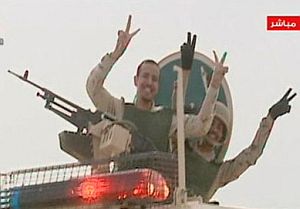
Bahrain TV proudly aired clips showing cheering Saudi soldiers in their tanks and armoured personnel carriers as they rolled across the 16-mile causeway between the two countries. Tellingly, a man at the parapet of a tank sits behind his machine gun waving a peace sign at the camera. This is a snapshot of the regime’s current strategy, smile sweetly and say peace for the cameras – and bring in the big guns.

While pro-government commentators allege Iranian support of the current uprising, US defence secretary Robert Gates, who visited Bahrain on March 12, said there is no evidence of interference from Tehran. Unsurprisingly though, the White House issued a statement on Monday saying it does not consider the entry of Saudi troops on to Bahraini land an invasion.

Since the beginning of this uprising – which calls for constitutional reform, an investigation into theft of public land worth billions of dollars, and an end to systematic discrimination, among other things – the regime has implemented a soft-talk big-stick strategy. Its security personnel killed two protesters, and the king appeared on national television to speak of his regret, promising an independent investigation to hold those responsible accountable. Two days later, government security personnel stormed the encampment of protesters at the now-famous Pearl roundabout, killing four more. Later the same day, the crown prince appeared on TV urging calm, while the Bahraini army opened fire on unarmed demonstrators, killing another two.

The government then said it was open to dialogue with protesters (who are understandably sceptical). Distrust of the government emerges from a history of state oppression and reneged promises much longer than this long month of protest in Bahrain.

Our mothers and fathers, teachers, lawyers, activists and unionists were among the people of Bahrain who expressed their social and political grievances and desires for change in 1954, 1965, 1972, 1994, and 2002. The response of the government has always been the same: unleashing violence against calls for meaningful change, exaggerating the superficial self-imposed changes which include little concession towards sharing of power, and turning to its powerful friends for backing.

Associated Press reports:

Frenzied clashes swept Bahrain Tuesday, a day after a Saudi-led military force entered the country to defend its Sunni monarchy from a Shiite-led protest movement. Hundreds of demonstrators were injured by shotgun blasts and clubs, a doctor said.

As the government’s crackdown intensified, the Bahraini king declared a three-month state of emergency Tuesday that gave his military chief wide authority to battle protesters demanding political reforms and equal rights for Shiites. One demonstrator was shot in the head and killed, and a Saudi official said one of his country’s soldiers was shot dead by a protester.

The force of more than 1,000 Saudi-led troops from several Gulf nations saw its first day of action to help prop up the U.S.-backed regime in Bahrain. Its intervention was the first major cross-border military action to challenge one of the revolts sweeping across the Arab world.

Not surprisingly, the claim by the Saudi official cited in the AP report turned out to be false.

Reuters reports:

A member of Bahrain’s security forces was killed on Tuesday in clashes with thousands of protesters, state television and the information ministry said, denying earlier reports that a Saudi policeman had also died.

“A member of the security forces passed away in Maameer this evening when he was deliberately run over by one of the rioters,” Bahrain’s Ministry of Information said.

And maybe the story will change yet again and we’ll learn that the vehicle involved was one of the security services’ own.

Yesterday, Amnesty accused the government of using excessive force:

Amnesty International has called on the Bahrain authorities to hold security forces accountable over the use of excessive force after police fired rubber bullets at close range at demonstrators in the capital Manama.

Hundreds of protesters are reported to have been injured over the weekend. On Friday, anti-government protesters sought to march to the royal palace in Riffa but were blocked by security forces and armed government supporters.

On Sunday, police used batons and fired tear gas and rubber bullets at protesters who sought to block Manama’s financial district and demonstrated at Bahrain University.

The disturbances were the first major violence since Crown Prince Salman bin Hamad al-Khalifa ordered the military off the streets nearly three weeks ago.

“This further resort to excessive force by Bahrain’s security forces is alarming and unacceptable,” said Malcolm Smart, Amnesty International’s Director for the Middle East and North Africa. “The government must now rein in its forces. Those responsible for attacking peaceful protestors and using excessive force must be held to account.”

Meanwhile, the Committee to Protect Journalists reported that Bahraini security forces and plainclothes officers are obstructing news coverage of ongoing political unrest by attacking journalists.

Facebooktwittermail

The Saudi intervention in Bahrain is a slap in the face of the US

Jean-François Seznec writes:

On Saturday, March 12, U.S. Defense Secretary Robert Gates visited Bahrain, where he called for real reforms to the country’s political system and criticized “baby steps,” which he said would be insufficient to defuse the crisis. The Saudis were called in within a few hours of Gates’s departure, however, showing their disdain for his efforts to reach a negotiated solution. By acting so soon after Gates’s visit, Saudi Arabia has made the United States look at best irrelevant to events in Bahrain, and from the Shiite opposition’s point of view, even complicit in the Saudi military intervention.

The number of foreign troop is so far very small and should not make one iota of difference in Bahrain’s balance of power. The Bahraini military already total 30,000 troops, all of whom are Sunnis. They are under control of Crown Prince Salman bin Hamad al-Khalifa and supposedly fully faithful to King Hamad bin Isa al-Khalifa. Bahrain also has a similar number of police and general security forces, mainly mercenaries from Baluchistan, Yemen, and Syria, reputed to be controlled by the prime minister and his followers in the family.

At this time, therefore, the Saudi intervention is largely a symbolic maneuver. It is so far not an effort to quell the unrest, but intended to scare the more extreme Shiite groups into allowing negotiations to go forward. The crown prince recently laid out six main issues to be discussed in talks, including the establishment of an elected parliament empowered to affect government policy, fairly demarcated electoral constituencies, steps to combat financial and administrative corruption, and moves to limit sectarian polarization. He notably failed to mention one of the opposition’s primary demands — the prime minister’s resignation.

The Saudi move, however, risks backfiring. It is extremely unlikely that the Saudi troops’ presence will entice moderate Shiite and Sunni opposition figures to come to the table — the intervention will force them to harden their position for fear of being seen as Saudi stooges. The demands of the more extreme groups, such as the Shiite al-Haq party, are also likely to increase prior to negotiations. These elements, having seen job opportunities go to foreign workers and political power dominated by the ruling family for decades, have grown steadily disenchanted with prospects of talks.

The crown prince is well aware that the Saudi intervention only makes a negotiated solution to this crisis more challenging, so it is difficult to imagine that he invited the Saudis into Bahrain. The more liberal Khalifas, such as the crown prince, know very well that the only way out of the crisis is to obtain the resignation of the prime minister and some of the more extreme Sunni ministers.

However, the prime minister — with whom Gates did not meet with during his weekend visit — does not appear to have any intention of resigning and is the most likely figure behind the invitation to the Saudis to intervene. Although details are still sketchy, he is likely joining with the Saudi king to pass the message to the United States that he is in charge and no one can tell him what to do. Furthermore, it signals that the Saudis agree with Bahrain’s conservatives that the Shiite must be reined in rather than negotiated with, even at the cost of telling the United States to kiss off.

The Saudi intervention may also have been precipitated by the deepening rift between the extreme Sunni elements and the liberal Khalifas. If the Saudis are indeed heading to Riffa, it is possible they are tasked with defending the Khalifa stronghold not so much against the Shiite rabble but against the Bahraini military, which is under the command of the crown prince. The Saudi intervention would therefore be an effort by the prime minister and the Saudis to pressure the crown prince into not giving in to the protesters’ demands and to fall in line with their plans to secure Bahrain as the personal fiefdom of the Khalifas and their tribal allies.

Facebooktwittermail

Saudis move troops into Bahrain to crush pro-democracy movement

CNN opts for the anodyne and official phrasing “Gulf Cooperation Council security forces,” but the troops who just marched into Bahrain are Saudis.

When US Defense Secretary Gates visited Bahrain on Friday, I assume King Hamad bin Issa al-Khalifah gave the US advance warning that his Kingdom would shortly be under something resembling Saudi martial law — just to make sure Washington would voice no more than minimal objections to the latest effort to crush Bahrain’s strengthening democracy movement.

The New York Times reports:

The White House issued a statement on Sunday that said the United States strongly condemned violence that had occurred in Bahrain and Yemen, and added, “We urge the government of Bahrain to pursue a peaceful and meaningful dialogue with the opposition rather than resorting to the use of force.”

And as the Khalifa family and their Saudi overlords ignore this request, what will the White House do? Withdraw the US Fifth Fleet? Not likely!

The Bahrain Youth Society for Human Rights describes the Saudi military presence as “an overt occupation of the kingdom of Bahrain and a conspiracy against the unarmed people of Bahrain.” Even while the White House urges the Bahrain government to engage the opposition in dialogue, no doubt Washington will dismiss the suggestion that Bahrain is now under occupation.

Given that Bahrainis already face brutality from security services — the majority of whom are foreign — I don’t know whether they will find the Saudi presence any more intimidating.

To have an idea of what protesters have been up against in recent days, just watch this video showing an unarmed man being hit by tear gas cannisters shot at point blank range:

GCC and now Arab League support for a no-fly zone over Libya (which they most likely expect will not be imposed), has I suspect, less to do with any concern about the fate of Libya’s revolutionaries than it does in fostering a permissive climate in which the Gulf states’ autocratic rulers can offer each other mutual support in their own efforts to counter the political demands coming from their own subjects. Support for a NFZ provides these monarchies with an opportunity to posture as defenders of Arab freedom at the same time that they suppress Arab freedom. Likewise, by opposing Gaddafi, the Gulf rulers want to cast their dictatorships as benign in contrast to Gaddafi’s brutal rule.

Facebooktwittermail

The fight for Libya

Samia Nakhoul reports:

By the time the outside world agrees on a response to Libyan leader Muammar Gaddafi’s bloody onslaught against a popular revolt, it could all be over.

The advance of Gaddafi’s better-armed forces, who seem to have shown little regard for civilians when storming in to retake rebel strongholds, has outrun the slow pace of hesitant initiatives being discussed by European, U.S. and Arab leaders.

An Arab League call for the United Nations to impose a no-fly zone to protect the revolt, was welcomed by France, which has taken a lead in backing the rebels and will host G8 foreign ministers in Paris Monday.

But others, notably the United States and other European Union states such as Germany, remain very cautious about military engagement. No U.N. Security Council meeting had yet been scheduled, despite events racing in Libya.

“The international community is dragging its feet,” said Saad Djebbar, a London lawyer and expert on Libyan affairs. “The diplomatic pace is very slow. There is an urgency to act quickly before those people are finished off by Gaddafi’s forces.”

“The international community has to act now — not only to protect Benghazi from an onslaught but because of what it means for the rest of the world if Gaddafi is allowed to remain the leader of Libya,” said Geoff Porter, a U.S.-based political risk consultant who specializes in North Africa.

After the relatively peaceful and speedy overthrow of Arab strongmen in Egypt and Tunisia, Western disarray on Libya may persuade other authoritarian rulers facing unrest, from Yemen to Bahrain, that the best antidote to revolt is violence.

“If they allow Gaddafi to win, that would encourage other Arab despotic regimes to use brutal force against their people to stamp out revolt,” Djebbar said. “This will erase the gains of the people power we have seen in Egypt and Tunis.

“It sends a very bad signal to other movements.”

Reuters reports:

Muammar Gaddafi’s troops seized the strategic Libyan oil town of Brega on Sunday, forcing rebels to retreat eastward and putting extra pressure on world powers still deliberating on a no-fly zone.

The government offensive had already driven the rebels out of Ras Lanuf, another oil terminal 100 km to the west on the coast road, and the seizure of Brega and its refinery deprived the rebels of more territory and yet another source of fuel.

The government, in a message on state television, said it was certain of victory and threatened to “bury” the rebels, who it linked to al Qaeda and “foreign security services.”

Riad Kahwaji writes:

Some Arab defense experts believe it is time for the Arab States to stand up and take responsibilities in their own hands and come to the aid of the Libyans. Retired Major General Khaled Al-Bu Ainnain, former commander of the United Arab Emirates Air Force and Air Defense, believes that some GCC states and Egypt can mount a joint operation and successfully enforce an NFZ over Libya. “The UAE Air Force can deploy couple of squadrons – one F-16 Block 60 and another Mirage 2000-9 – the Saudi Air Force can deploy a couple of F-15S squadrons and Egypt a couple of F-16 squadrons out of Mersi Matrouh Air Base in western Egypt,” Al-Bu Ainnain said. “This would provide 120 fighters and attack aircrafts that would be backed with airborne early warning planes like Egyptian E-2C Hawkeye or Saudi AWACS, some unmanned aerial vehicles (UAV) for reconnaissance, and air-refueling tankers from Saudi Arabia and couple of Egyptian or UAE helicopter squadrons comp osed of Apache Longbow gunships, Blackhawks and Chinook helicopters, for search and rescue missions.” Crews and troops needed for the operation could be quickly airlifted to western Egypt, and even Algeria, within hours using a large fleet of UAE and Egyptian C-130 and Qatari C-17 transporters.

Observers believe the area of operations for any force executing an NFZ over Libya now would be confined to the area between the capital Tripoli and the City of Cert and down south to Sebha in the center. The rest of the country is under rebel control. The Libyan Air Force is comprised of aging Cold War-era Soviet supplied fighters like Su-22, MiG-21 and MiG-23 and one remaining operational Mirage F-1 and some 30 MiMi-24 Helicopter gunships. According to reports out of Libya, only few Su-22 and MiG-23 aircrafts were seen involved in the air raids in addition to MiMi-24 gunships. As for Air Defense, Gadhafi’s forces are believed to be in possession of a few batteries of Soviet-era SAM-2, SAM-3 and SAM-6 surface to air missiles. “All of the Libyan Air Defense SAM’s and radars can be taken out swiftly by the arsenal of smart weapons and cruise missiles in possession today by GCC and Egyptian Air Forces,” Al-Bu Ainnain said. “Runways can be destr oyed with bunker-busters to ground all the jets, and the gunships can be easily destroyed on the ground.” He pointed out that GCC and Egyptian Air Forces have considerably enhanced their joint-operations capabilities as a result of almost annual exercises they have done together along with the U.S. and some EU countries. “Issues related to command and control and interoperability would be resolved quickly which would ensure a smooth running of NFZ operations.”

The Washington Post reports:

Defense Secretary Robert M. Gates said Saturday that the U.S. military, already fighting two wars in Muslim nations, would have no trouble enforcing a no-fly zone over Libya if President Obama orders one.

The comments appeared designed to counter the criticism surrounding his earlier remarks on the issue and came as the Arab League endorsed a no-fly zone to protect Libya’s civilians from forces loyal to Libyan leader Moammar Gaddafi.

Gates indicated earlier this month that the creation of a no-fly zone would be a “big operation.” NATO would need to deploy an array of air power to target not only defense systems and fighter jets, but also the low-flying attack helicopters that Gaddafi has used against rebels and civilian protesters.

The assessment drew criticism, in particular, from those who favor a more aggressive American response to the Libyan conflict, now tilting back in favor of Gaddafi’s better-armed forces. Some accused Gates of inflating the dangers and scope of a no-fly zone mission over a large desert country with a small population.

Facebooktwittermail

Obama’s regime of secrecy

Mark Benjamin reports:

It shouldn’t be much of a surprise that State Department spokesman P.J. Crowley has resigned his post in wake of his too-candid assessment of the incarceration conditions of suspected Wikileaker Private First Class Bradley Manning.

Last Thursday, Crowley told a panel at MIT that the Pentagon’s treatment of Manning at the Marine bring at Quantico, Va., was “ridiculous and counterproductive and stupid.”

The very next day, President Obama told reporters that he felt Manning’s confinement conditions were “appropriate.” His answer telegraphed a problem for Crowley. “I’ve actually asked the Pentagon whether or not the procedures that have been taken in terms of his confinement are appropriate and are meeting our basic standards,” Obama said, suggesting some of those procedures were to protect Manning’s safety. “They have assured me that they are.”

Manning is currently being held alone in his cell 23 hours a day, and was reportedly being stripped naked at night before being given a tear-proof smock for sleeping. Free speech advocates are shocked, and, as I wrote last week on TIME.com, concerned over Obama’s record as the most aggressive prosecutor of suspected government leakers in U.S. history.

Those advocates have wondered whether the penchant for secrecy in the Obama administration comes from the President, or those around him. Obama’s statement on Manning, followed by Crowley’s resignation, seem to suggest some of this comes from the President himself.

Facebooktwittermail

Libya: fear of collapse — ‘we need a no-fly zone’

Jon Lee Anderson writes:

Yesterday, as the government appeared to take control of the western city of Zawiya, Seif al-Islam Qaddafi made a public vow that was extensively texted and retweeted in Libya:

Hear it now, I have only two words for our brothers and sisters in the east: We’re coming.

A Libyan friend reached me by cell phone from Benghazi to ask how things were; people there had heard the news of the crumbling front line and were growing worried, he said. He mentioned the threats made by Seif Qaddafi yesterday. For the first time, it seems, people in “liberated” Libya were beginning to wonder if their freedom was to be short-lived, and if they might soon see Qaddafi’s troops attacking them in Benghazi itself.
There were far fewer reporters and photographers at the front today. We learned that rebel authorities had set up a roadblock outside the city of Ajdabiya—the last before Benghazi—to prevent them from coming to the front. A dozen of us had stayed the night in Brega, however, and were able to reach the front line, where we were immediately accosted by fighters who asked us not to take photographs of them. Zaid, a civil engineer who had accompanied me to the front line from Benghazi, explained: “They believe that the images—especially on television—are helping Qaddafi to find targets to attack.” As the day wore on, though, the fighters’ wariness wore off, and once again they were coming up to anyone who looked foreign to wave “V” signs in front of camera lenses and declare, “Qaddafi majnoun“—crazy—“Where is America?” and “Tell Obama to do something; why hasn’t he done anything? We need a no-fly zone.”

Facebooktwittermail

The fight for Libya

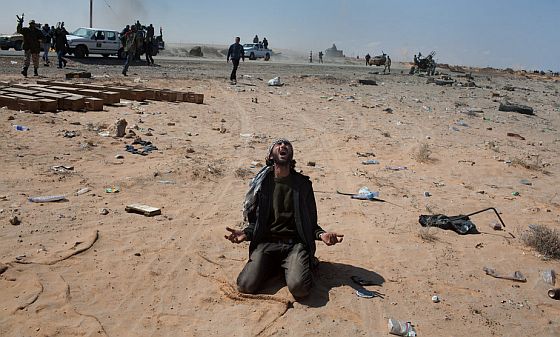
A fighter cried after an airstrike by government forces near the oil refinery in Ras Lanuf.

The New York Times reports:

Only days ago, rebels were boldly promising to march on Surt, Colonel Qaddafi’s hometown, then on to Tripoli, where opposition leaders predicted its residents would rise up. But the week has witnessed a series of setbacks, with a punishing government assault on Zawiyah, near the capital, and a reversal of fortunes in towns near Ras Lanuf, whose refinery makes it a strategic economic prize in a country blessed with vast oil reserves.

There was a growing sense among the opposition, echoed by leaders in opposition-held Benghazi and rebels on the front, that they could not single-handedly defeat Colonel Qaddafi’s forces.

“We can’t prevail unless there’s a no-fly zone,” said Anis Mabrouk, a 35-year-old fighter. “Give us the cover, and we’ll go all the way to Tripoli and kill him.”

That seemed unlikely, though. Even without warplanes, Colonel Qaddafi’s government could still marshal far superior tanks, armor and artillery, along with the finances and organization to prosecute a counteroffensive.

The Los Angeles Times reports:

President Obama signaled Friday that the U.S. military might intervene in Libya at the point that “defenseless civilians” are under attack by forces loyal to Col. Moammar Kadafi, but said even then he would weigh the costs of sending American personnel and carefully consider whether such an operation would be “sustainable.”

In a news conference at the White House, Obama pointedly declined to endorse a view expressed by his director of national intelligence, James Clapper, who testified before Congress this week that rebel forces probably will not be able to defeat Kadafi.

While Obama said the option of military force remains on the table, he made it clear he does not think the situation merits it yet. He said he would want to avoid “defenseless civilians who were massacred by Kadafi’s forces,” repeating past massacres in the Balkans and Rwanda.

Gaddafi has already likened his onslaught on his own population to Israel’s war on Gaza — a war President-elect Obama watched in silence — so perhaps he’ll restrain himself from bombing Benghazi and simply place the city under siege. He can be reasonably confident he’ll suffer no more than a verbal rebuke from Obama, since a massacre in slow motion won’t really look like a massacre.

Leon Wieseltier writes:

Darkness is descending on the Libyan struggle for freedom, and we are helping to lower it. While the various secretaries were articulating their abdications, Qaddafi was committing a slaughter in Zawiyah and employing his monopoly of the skies to drive the rebels out of Ras Lanuf. An eastern offensive is clearly imminent. (This is not a civil war. This is a war by a dictator upon his people. There is no other half of the Libyan population fighting for Qaddafi.) All this, of course, affects the sensitivities of the Libyan freedom fighters. “We’re waiting for the Americans to follow,” a rebel spokesman bitterly told Anthony Shadid and David Kirkpatrick of The New York Times about Sarkozy’s splendid decision to recognize the Libyan provisional government. (Morally America now lags behind France!) Shadid and Kirkpatrick also reported that “as NATO member nations met in Brussels to discuss options for Libya, the rebels cursed the United States and its allies for failing to impose a no-flight zone.” Why is the White House content to foment this variety of anti-Americanism? The answer is that it is so haunted by past Arab anger at American action in the Middle East that it cannot recognize present Arab anger at American inaction in the Middle East.

And the president? He declares that Qaddafi must go and that we will stand with the Libyan people, and then he does nothing. No, that’s not right. He consults and consults, and his staff works round the clock, and economic sanctions are instituted against the rampaging dictator who has tens of billions of dollars in cash. Obama is prepared to act, just not consequentially. He does not want the responsibility for any Arab outcome. He says they must do it for themselves. But they are doing it for themselves. They merely need help. And the help they need is easy for us to provide. (Jam their fucking communications.) And their cause is freedom, which is allegedly our cause. What they seek from Obama is an extended hand. What they are getting is a clenched fist. If Muammar Qaddafi takes Benghazi, it will be Barack Obama’s responsibility. That is what it means to be the American president. The American president cannot but affect the outcome. That is his burden and his privilege. He has the power to stop such an atrocity, so if the atrocity is not stopped it will be because he chose not to use his power. Perhaps that is why Obama has been telling people, rather tastelessly, that it would be easier to be the president of China. Obama will not be rushed. He is a man of the long game. But the Libyan struggle for freedom, and the mission of rescue, is a short game. That is the temporality of such circumstances. If you do not act swiftly, you have misunderstood the situation. Delay means disaster. Does Obama have any idea of what Qaddafi’s victory will mean for the region and its awakening?

We have flinched this way before. For many days I have had a sickening 1992–1995 feeling. Consider these sentences, from a book I lugubriously took off my shelf: “Why does the United States stand so idly by? The most common answer is, ‘We didn’t know.’ This is not true. … A second response to the question of why the United States did so little is that it could not have done much to stop the horrors. [But] the only way to ascertain the consequences of U.S. diplomatic, economic, or military measures would have been to undertake them. … If anything testifies to the U.S. capacity for influence, it is the extent to which the perpetrators kept an eye trained on Washington and other Western capitals as they decided how to proceed. … The real reason the United States did not do what it could and should have done to stop genocide was not a lack of knowledge or influence but a lack of will. Simply put, American leaders did not act because they did not want to.” The Libyan calamity is not genocide, but genocide is not the only horror that has a claim on American agency. I have taken those wise sentences from “A Problem from Hell,” Samantha Power’s sad, great study of earlier American failures to act against mass-murdering tyrants. Is Obama now writing his own chapter in that story? Why do we not still remember that story? It is disgusting, as the Libyan rebels are driven further and further back, to learn that we must discover it all over again.

Facebooktwittermail

Bradley Manning being mistreated says State Department spokesman

The Guardian reports:

Hillary Clinton’s spokesman has launched a public attack on the Pentagon for the way it is treating military prisoner Bradley Manning, the US soldier suspected of handing the US embassy cables to WikiLeaks.

PJ Crowley, the assistant secretary of state for public affairs at the US state department, said Manning was being “mistreated” in the military brig at Quantico, Virginia. “What is being done to Bradley Manning is ridiculous and counterproductive and stupid on the part of the department of defence,” he said.

Crowley’s comments signal a crack within the Obama administration over the handling of the WikiLeaks saga in which hundreds of thousands of confidential documents were handed to the website.

As news of the remarks rippled through Washington, President Obama was forced to address the subject of Manning’s treatment for the first time.

Asked about the controversy at a White House press conference, Obama revealed he had asked the Pentagon “whether or not the procedures that have been taken in terms of his confinement are appropriate and are meeting our basic standards. They assure me that they are.”

Obama would not respond specifically to Crowley’s comments, which are the first critical remarks from within the administration about the handling of Manning. The prisoner is being held for 23 hours in solitary confinement in his cell and stripped naked every night.

Facebooktwittermail

The “Bush-tortured” excuse for indefinite detention

Glenn Greenwald writes:

Yesterday, I wrote about the fictitious excuse being offered to justify why Obama is continuing the indefinite detentions and military commissions which defined the Bush/Cheney Guantanamo detention scheme:  it’s Congress’ fault.  Today we have a new excuse:  it’s Bush’s fault.  Because Bush tortured some of the detainees, this reasoning goes, Obama is incapable of prosecuting them, yet because many of those detainees are Terrorists and/or Too Dangerous to Release (even though they can’t be convicted of anything), he has no real choice but to keep imprisoning them without charges.  Here are the NYT Editors — even as they criticize Obama’s indefinite detention policy — making this case, one frequently heard from Obama supporters offering excuses for his policy of indefinite detention:

[T]he Obama administration has still chosen to accept the concept of indefinite detention without trial, which represents a stain on American justice. The president made that acceptance clear in a speech in May 2009. To some degree, he was forced into it by the Bush administration’s legacy of torture and abuse, which made some important cases impossible to prosecute.

And here’s Andrew Sullivan making a somewhat different but related claim, and then going even further, suggesting that the only thing that ever bothered him about Guantanamo was the torture, not the fact that people were being indefinitely imprisoned without a shred of due process:

My fundamental concern has always been humane treatment. When Gitmo was a torture camp, it was indefensible. . . . [Those equating Obama’s detention policies with Bush’s] omit that the very dilemma – prisoners with no formal charges, no serious evidence, and radicalized by torture and unjust imprisonment – was created by Bush in the first place.  I’d release those against whom there is no credible evidence. But I can understand the security and political concerns of releasing men who could join Jihadists in, say, Yemen.

There’s a serious moral flaw in the NYT‘s reasoning, and two even worse empirical flaws with this excuse-making for indefinite detention.   There are several compelling reasons why the use of torture-obtained evidence is barred by every civilized country for use in prosecution, and has been barred for decades if not centuries.  A primary reason is because the most basic norms of Western morality demand that torture not be rewarded, which is what happens when the fruits of it are admissible in court to prosecute people.  Those who say that Obama is justified in imprisoning people without charges because the evidence against them was obtained via torture and is thus unusable in court are repudiating this long-standing Western moral principle by justifying imprisonment based on evidence obtained by coercion (we know they’re guilty because of the evidence we got from torture, so we have to detain them)

Facebooktwittermail

Obama does not get it

Lamis Andoni writes:

Barack Obama, the US president, has still not fully grasped the essence of the revolutions underway in the Arab world. He genuinely seems to believe that the people rallying for democracy in the region are making a pro-Western, if not pro-Israeli, statement.

“All the forces that we’re seeing at work in Egypt are forces that naturally should be aligned with us, should be aligned with Israel – if we make good decisions now and we understand sort of the sweep of history,” Obama recently told a group of Democrats in Florida.

I am not sure how Obama drew this conclusion, but he is either terribly misinformed or engaged in a serious bout of wishful thinking.

His statements, however, echo the assessments of many American pundits, some of whom have been celebrating the fact that anti-Israeli or American slogans have not dominated the recent and ongoing uprisings.
It is true that the protesters are not focusing on Israel.

But to say that these forces could be natural allies of Israel and the West is to take a huge leap into a highly inaccurate assessment of the situation. The US president is misreading the message of the protesting Arab masses.

Facebooktwittermail

Permanent temporariness

Alastair Crooke writes:

It was in 2003 that I realised something fundamental had changed. The door to the room in which I was sitting flew open. In stalked a figure still dressed in a dark overcoat and scarf. He evidently could contain himself no longer. I was in Downing Street with the prime minister’s foreign affairs adviser, David Manning; the overcoated figure bursting into our meeting was Jack Straw. He wanted to tell Manning that he had persuaded Joschka Fischer, the German foreign minister, to add Hamas to the EU list of terrorist movements. His tale of his conversion of Fischer was wrapped in expressions of outrage at Hamas. It wasn’t so much the proscription that shocked me. A ceasefire, which I had helped facilitate, had broken down. What was new was the elation with which Straw greeted the banning. I don’t know what Manning thought, but he will have been aware that the terrorist ‘list’ is one of those things from which it’s almost impossible to get a name removed. The consequences for diplomacy, for the politics of peace-making, would be profound, possibly irreversible; but Straw wasn’t worried. Manning, I knew, believed strongly that there could be no solution to the Israel-Palestine issue without Hamas involvement and had firmly supported EU efforts at inclusive peace-building. Officially, the EU remained committed to a political solution, but it now seemed that two key member states were heading in the opposite direction – towards a militarised resolution. The wind had changed.

There had already been hints that a political solution was no longer at the forefront of Whitehall thinking. Not long before, a senior British official had told me bluntly that my methods of building popular consent – holding ‘town hall’ meetings with all factions, working with Hamas, shuttling between Palestinians on the ground and President Arafat to ensure broad participation and continued momentum – were passé. We were in a new era, and it required new thinking: ‘The road to Jerusalem now passes through Baghdad,’ the official insisted. He was speaking just before the 2003 invasion. The message was clear: the Islamic resistance in Palestine was to be neutralised, and psychologically defeated, by the massive display of Western force in Iraq, rather than brought into the political process. Britain and the US expected that the chastened Palestinians would then make the necessary concessions to Israel. What was striking was the official’s conviction that such an outcome was inevitable.

These were heady days for American and British officials and enthusiasm for the ‘war on terror’ was soaring. At our first meeting, Manning’s Downing Street successor, Nigel Sheinwald, told me angrily that security in Palestine could be achieved by eradicating the ‘virus’ of Hamas from Gaza, and eliminating its ‘disease’ from the region. He had no interest in helping to create legitimate Palestinian security services, representative of a cross-section of the community. The language was Washington’s. The Palestinian conflict was seen not as a problem in its own right, but as a subset of a war against ‘extremism’ – another domino to be pushed over in order to strengthen the ‘moderates’. A senior Israeli intelligence official later told me, privately, that he believed the change had begun in earnest in September 2003, after Arafat forced Mahmoud Abbas – a favoured figure in Washington – to resign as prime minister. Angry and frustrated, Bush called Blair. He complained that the Europeans ‘were dancing around Arafat’, while the US was left to do the ‘heavy lifting’ with Israel. Bush also complained that he did not see peace-building as compatible with his ‘war on terror’. Al-Jazeera’s recent release of the Palestine Papers has cast some light on all this: the documents include copies of British covert plans from 2003 and 2004 to ‘degrade’ the capabilities of opponents to the Palestinian Authority, to disrupt their communications, intern their members, close their civil and charitable organisations, remove them from public bodies, and seize their assets. Blair had set aside the lessons of peace-building, so recently learned in Northern Ireland, and embraced the doctrine of counter-insurgency.

The shift in the British position, under American pressure, sabotaged European policy. It undermined the EU’s commitment to promoting Palestinian unity by suppressing, at the covert, security level, opposition to the PA, removing from Palestinian institutions not only all members of Hamas and Islamic Jihad but even those elements in Fatah who had been involved in the second intifada. From now on, the EU would ‘talk the talk’ of encouraging Palestinian unity, while several of its most prominent member states were ‘walking the walk’ of a security-led repression of the very movements the EU was trying to encourage into the political arena. The result was that when Hamas – rather than being demoralised or psychologically defeated by shock and awe in Baghdad – comfortably won the 2006 Palestinian parliamentary elections, the EU was forced into a militarised security response. The new commitment to counter-insurgency meant that there was no prospect of exploring the political possibilities of Hamas’s win. After the election the UN envoy to the Middle East, Alvaro de Soto, wrote a memo to the UN secretary general complaining that the conditions for entering into a dialogue with Hamas had been deliberately set so that Hamas would be unable to meet them – thus engineering its exclusion. De Soto resigned from the UN soon afterwards.

Facebooktwittermail

The fight for Libya

Chris McGreal reports from Ras Lanuf, where thousands of young volunteers now provide the bulk of the rebel force that has swept along Libya’s eastern coast:

Gaddafi’s air force has bombed Ras Lanuf repeatedly, cutting off the town’s water supply on Tuesday and destroying housing. On Monday the victims included a civilian, Mohammed Ashtal, who was killed with three of his children when an air strike hit their car.

The bombing has put the inexperienced fighters on edge as they constantly scan the sky for planes. Every now and then a shout goes up. Someone claims there is a MiG jet. No one can see it but hundreds of weapons let loose in a futile wave of fire in every direction. Young men swivel anti-aircraft guns, letting go bursts of shells with a deadening thud. Kalashnikov bullets pop furiously.

Not long after one such false alarm, the young fighters raced out of town towards the front despite the pleas of their more experienced commanders to maintain their defensive lines and positions guarding a nearby oil refinery.

It was all very worrying for Fathi Mohammed, torn between admiration of young men willing to risk their lives in pursuit of freedom and despair at their lack of discipline. The 46-year-old former captain in Gaddafi’s special forces is trying to instil some organisation in the bands of fighters who have descended on Ras Lanuf.

“They’re not under control,” he said. “Some of these guys, they just took guns from the military camp in Benghazi and came here without anyone knowing what they are doing. We are trying to make them into organised teams but it’s not easy.”

Rajab Hasan, another former soldier tasked with training, chipped in: “They need a leader. We don’t have enough leaders.”

Mohammed expressed his concern at the implications of all this carefully. The rebel army has done well until now, advancing and then staving off attempts by Gaddafi’s forces to break through. But he acknowledged that the rebels could face a problem if its enemy is able to launch a sustained attack.

Mohammed does not want to concede that defeat might be a possibility, even though a rumour has swept the rebels that Gaddafi is amassing tanks for a frontal assault. But he does recognise that victory is not certain. “It’s not impossible to get to Tripoli. If God is with us,” he said. Still, Mohammed does not question the courage of the young fighters. “They are brave. They have the courage. It’s a popular war. There’s a lot of enthusiasm.”

The New York Times reports:

In less than three weeks, an inchoate opposition in Libya, one of the world’s most isolated countries, has cobbled together the semblance of a transitional government, fielded a ragtag rebel army and portrayed itself to the West and Libyans as an alternative to Col. Muammar el-Qaddafi’s four decades of freakish rule.

But events this week have tested the viability of an opposition that has yet to coalesce, even as it solicits help from abroad to topple Colonel Qaddafi’s government.

Rebels were dealt military setbacks in Zawiyah and the on outskirts of Ras Lanuf on Tuesday, part of a strengthening government counteroffensive. Meanwhile, the oppostion council’s leaders contradicted one another publicly. The opposition’s calls for foreign aid have amplified divisions over intervention. And provisional leaders warn that a humanitarian crisis may loom as people’s needs overwhelm fledgling local governments.

“I am Libya,” Colonel Qaddafi boasted after the uprising erupted. It was standard fare for one of the world’s most outrageous leaders — megalomania so pronounced that it sounded like parody. It underlined, though, the greatest and perhaps fatal obstacle facing the rebels here — forging a substitute to Colonel Qaddafi in a state that he embodied.

“We’ve found ourselves in a vacuum,” Mustafa Gheriani, an acting spokesman for the provisional leadership, said Tuesday in Benghazi, the rebel capital. “Instead of worrying about establishing a transitional government, all we worry about are the needs — security, what people require, where the uprising is going. Things are moving too fast.”

“This is all that’s left,” he said, lifting his cellphone, “and we can only receive calls.”

The question of the opposition’s capabilities is likely to prove decisive to the fate of the rebellion, which appears outmatched by government forces and troubled by tribal divisions that the government, reverting to form, has sought to exploit. Rebel forces are fired more by enthusiasm than experience. The political leadership has virtually begged the international community to recognize it, but it has yet to marshal opposition forces abroad or impose its authority in regions it nominally controls.

The Guardian reports:

Nato has launched 24-hour air and sea surveillance of Libya as a possible precursor to a no-fly zone, amid signs of growing Arab support for western military intervention to stop the bombing of civilians.

British and French diplomats at the UN headquarters in New York have completed a draft resolution authorising the creation of a no-fly zone which could be put before the security council within hours if aerial bombing by pro-Gaddafi forces causes mass civilian casualties.

“It would require a clear trigger for a resolution to go forward,” a western diplomat said. In such an event, there would be pressure on Russia and China not to use vetoes. Western officials believe support for a no-fly zone from the Islamic world, as well as from the Libyan opposition and Libyan diplomats at the UN, would put Moscow and Beijing on the defensive.

The Gulf Co-operation Council, the Organisation of the Islamic Conference and the secretary general of the Arab League have called for the protection of Libyan civilians while rejecting the intervention of western ground troops. Turkey, the most reluctant Nato member state, has relaxed its opposition and allowed contingency planning to go ahead.

The decision to step up air and sea monitoring was taken on Monday by the North Atlantic Council, a meeting of ambassadors from Nato’s 28 member states.

Foreign Policy reports:

The State Department believes that supplying any arms to the Libyan opposition to support their struggle against Col. Muammar al-Qaddafi would be illegal at the current time.

“It’s very simple. In the U.N. Security Council resolution passed on Libya, there is an arms embargo that affects Libya, which means it’s a violation for any country to provide arms to anyone in Libya,” State Department spokesman P.J. Crowley said on Monday.

Crowley denied reports that the United States had asked Saudi Arabia to provide weapons to the Libyan opposition, and also denied that the United States would arm opposition groups absent explicit international authorization.

Pressed by reporters to clarify whether the Obama administration had any plans to give arms to any of the rebel groups in Libya, Crowley said no.

“It would be illegal for the United States to do that,” he said. “It’s not a legal option.”

Crowley’s blanket statement seemed to go further than comments on Monday by White House spokesman Jay Carney, who said, “On the issue of … arming, providing weapons, it is one of the range of options that is being considered.”

The New York Times reports:

As wealthier nations send boats and planes to rescue their citizens from the violence in Libya, a new refugee crisis is taking shape on the outskirts of Tripoli, where thousands of migrant workers from sub-Saharan Africa have been trapped with scant food and water, no international aid and little hope of escape.

The migrants — many of them illegal immigrants from Ghana and Nigeria who have long constituted an impoverished underclass in Libya — live amid piles of garbage, sleep in makeshift tents of blankets strung from fences and trees, and breathe fumes from a trench of excrement dividing their camp from the parking lot of Tripoli’s airport.

For dinner on Monday night two men killed a scrawny, half-plucked chicken by dunking it in water boiled on a garbage fire, then hacked it apart with a dull knife and cooked it over an open fire. Some residents of the camp are as young as Essem Ighalo, 9 days old, who arrived on his second day of life and has yet to see a doctor. Many refugees said they had seen deaths from hunger and disease every night.

The airport refugees, along with tens of thousands of other African migrants lucky enough to make it across the border to Tunisia, are the most desperate contingent of a vast exodus that has already sent almost 200,000 foreigners fleeing the country since the outbreak of the popular revolt against Col. Muammar el-Qaddafi nearly three weeks ago.

Libya’s Interim Transitional National Council now has a website with this introductory statement:

In this important historical juncture which Libya is passing through right now, we find ourselves at a turning point with only two solutions. Either we achieve freedom and race to catch up with humanity and world developments, or we are shackled and enslaved under the feet of the tyrant Mu’ammar Gaddafi where we shall live in the midst of history. From this junction came the announcement of the Transitional National Council, a step on the road to liberate every part of the Libyan lands from Aamsaad in the east to Raas Ajdair in the west, and from Sirte in the north to Gatrun in the south. To liberate Libya from the hands of the tyrant Mu’ammar Gaddafi who made lawful to himself the exploitation of his people and the wealth of this country. The number of martyrs and wounded and the extreme use of excessive force and mercenaries against his own people requires us to take the initiative and work on the Liberalization of Libya from such insanities.

To reach this goal, the Transitional National Council announced its official establishment on 5th March 2011 in the city of Benghazi, stating its perseverance towards the aim of relocating its headquarters to our capital and bride of the Mediterranean, the city of Tripoli.

To connect with our people at home and abroad, and to deliver our voice to the outside world, we have decided to establish this website as the official window of communication via the world wide web.

May peace and God’s mercy and blessings be upon you
Long live Libya free and dignified

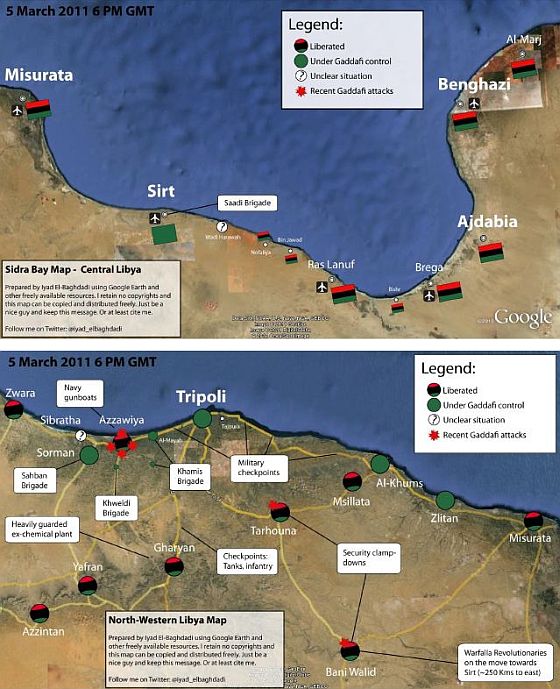
Map of the revolution:

Facebooktwittermail

Obama is the change Bush could believe in

Thanks to Antony Loewenstein for the headline.

Politico reports:

The Obama administration, which famously pledged to be the most transparent in American history, is pursuing an unexpectedly aggressive legal offensive against federal workers who leak secret information to expose wrongdoing, highlight national security threats or pursue a personal agenda.

In just over two years since President Barack Obama took office, prosecutors have filed criminal charges in five separate cases involving unauthorized distribution of classified national security information to the media. And the government is now mulling what would be the most high-profile case of them all – prosecuting WikiLeaks founder Julian Assange.

That’s a sharp break from recent history, when the U.S. government brought such cases on three occasions in roughly 40 years.

The government insists it’s only pursuing individuals who act with reckless disregard for national security, and that it has an obligation to protect the nation’s most sensitive secrets from being revealed. Anyone seeking to expose malfeasance has ample opportunity to do so through proper channels, government lawyers say.

But legal experts and good-government advocates say the hard-line approach to leaks has a chilling effect on whistleblowers, who fear harsh legal reprisals if they dare to speak up.

Not only that, these advocates say, it runs counter to Obama’s pledges of openness by making it a crime to shine a light on the inner workings of government – especially when there are measures that could protect the nation’s interests without hauling journalists into court and government officials off to jail.

The New York Times reports:

President Obama reversed his two-year-old order halting new military charges against detainees at Guantánamo Bay, Cuba, on Monday, permitting a resumption of military trials under rules he said provide adequate rights for defendants but implicitly admitting the failure for now of his pledge to close the prison camp.

Mr. Obama said in a statement he remains committed to closing Guantánamo some day and to charging some terrorist suspects in civilian criminal courts, as occurred throughout the administration of George W. Bush administration and has continued under Mr. Obama. But Congress has blocked the transfer of prisoners from Guantánamo to the United States for trial, undermining at least for the time being the administration’s plan to hold civilian trials for Khalid Shaikh Mohammed, the chief planner of the Sept. 11 attacks, and other accused terrorists.

An executive order signed by the president on Monday sets out new rules requiring a review of all detainees’ status within a year and every three years after that to determine whether they remain a threat to Americans. The order also requires compliance with the Geneva Conventions and the international treaty that bans torture and inhumane treatment.

Civil liberties advocates, who had been expecting the moves since they were forecast in an article in The New York Times in January, expressed deeply mixed feelings about the new policies. On the positive side, some said that the executive order may permit detainees imprisoned for years without trial to have their cases heard and potentially settled by plea agreement. In addition, the executive order avoids enshrining a system of indefinite detention in law and is restricted to the 172 prisoners currently held at Guantánamo.

But Elisa Massimino, president of Human Rights First, said that despite those factors, the continuation of detention at Guantánamo and military commissions more than two years after Mr. Obama took office is a disappointment.

“This is a step down the road toward institutionalizing a preventive detention regime,” Ms. Massimino said. “People in the Mideast are looking to establish new rules for their own societies, and this sends a mixed message at best.”

Facebooktwittermail