So much for President Obama’s ability to steer an orderly transition of power in Egypt. When he laid out his vision last night, it’s no wonder he had so little to say about Mubarak’s response. That Mubarak acknowledged the status quo is unsustainable and change must take place, said nothing about his intentions to realign the balance of power.
As the Egyptian president took the call from the White House, two facts must have been uppermost in his mind: the fact that preparations were already in place through which his thugs could unleash chaos on the streets, and the fact that he was being addressed by a spineless American president.
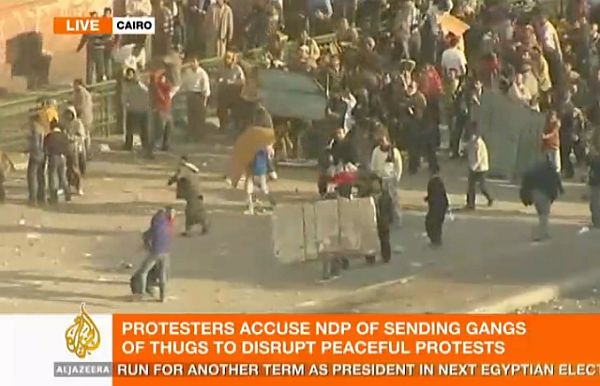
“I urge the [Egyptian] military to continue its efforts to help ensure that this time of change is peaceful,” Obama said last night. Well, as Al Jazeera is now showing, mayhem has been unleashed on the streets around Tahrir Square and the army has done nothing to intervene.
All those in the last few days who have warned about the dangers of mob rule should take note: the mob is on your side.
The New York Times, in its role as state storyteller, spins a fine yarn about how the White House artfully engineered Hosni Mubarak’s removal. A pivotal place in the narrative goes to “Frank G. Wisner, an adroit ex-diplomat whom President Obama had asked hours before to undertake a supremely delicate mission: nudging President Hosni Mubarak of Egypt out of power.”
Senior officials say that as Mr. Wisner traveled to Egypt, Obama officials in Washington were working on his message to Mr. Mubarak: to announce that he would not run for re-election (he did that), and to promise that his son would not run for election (he did not do that).
“No one wanted it to seem as if we were pushing him out,” one administration official said. “That would not serve American interests. It was important for President Mubarak to make the decision.”
Two hours after Mr. Wisner’s plane left Andrews Air Force Base, White House officials sent an e-mail to more than a dozen foreign policy experts in Washington, asking them to come in for a meeting on Monday morning. “Apologies for the short notice in light of a very fluid situation,” the e-mail said.
The Roosevelt Room meeting, led by Benjamin Rhodes, the deputy national security adviser for strategic communications, and two other National Security Council officials, Daniel Shapiro and Samantha Power, examined unrest in the region, and the potential for the protests to spread, according to several attendees.
Significantly, during the meeting, White House staff members “made clear that they did not rule out engagement with the Muslim Brotherhood as part of an orderly process,” according to one attendee, who like others interviewed for this article spoke on condition of anonymity because he did not want to talk publicly about the meeting. The Muslim group had been suppressed by Mr. Mubarak, and Bush administration officials believed it was involved in terrorist activities. It renounced violence years ago.
Several times, two other attendees said, White House staff members said that Mr. Obama believed that Egyptian politics needed to encompass “nonsecular” parties: diplomatic-speak for the Muslim Brotherhood.
“Orderly transition” is now the name of the game, but what remains unclear is whether Mubarak intends on sticking to the script.
After a half-hour conversation this evening, the only element of Mubarak’s thinking that Obama disclosed during his televised remarks was this: “He recognizes that the status quo is not sustainable and that a change must take place.”
That seems to leave open a wide range of possibilities — and one inconvenient fact: Mubarak is still Egypt’s president.
As the Million Egyptian March takes to the streets of Cairo, is President Obama finally ready to take a strong stand on the side of the people?
In The Guardian, Michael Tomasky writes “Obama is in no position to offer the moral thunder the protesters and their supporters everywhere crave.” Why? Because “the US should not be dictating outcomes any more. The modern world requires a US posture that is more fluid and subtle, and that no longer seeks to call the global shots.”
Having watched events over the last week as closely as one can from a great distance, I would say there has been no lack of moral thunder. It has come from the voices of the Egyptian people.
Having demonstrated their pride, dignity, and collective power with such force, I don’t think they crave anything from Washington or anywhere else — bar the fulfillment of their single demand: that Hosni Mubarak stand down.
To the extent that the expectations of many Egyptians and others are directed towards Washington and Obama, it is perhaps with the hope that anyone who supports democracy would celebrate the extraordinary sight of democracy being born.
Obama’s inhibitions probably say less about the fear of being perceived in the Middle East as the leader of an imperial power which still insists on calling the global shots, than in being seen by his fellow Americans supporting a revolution that they fear.
Indeed, as Benjamin Netanyahu compares the Egyptian revolution of 2011 with the Iranian revolution in 1979, Obama surely fears some form of retribution from AIPAC in 2012 if he is portrayed as having undermined Israel’s security. Above all, the 2012 incumbent presidential candidate does not want to be cast as having played a role in shaping Egypt’s future.
The most courageous thing Obama could do at this point would not be to make some grandiose expression of American support for the Egyptian people — an expression which this late in the day would carry little credibility. No, if he wants to stand up in defense of democracy, he should addressing a domestic audience — one that apparently has lost faith that democracy is a good thing.
If Americans can’t support the democratic rights of Egyptians, what does that say about how seriously we want to protect our own rights? After all, the unalienable rights upon which America was founded were not conceived as American rights but universal human rights. If we don’t stand in solidarity with Egyptians, have we not also lost faith in the principles upon which America was founded?
Obama once declared:
I do have an unyielding belief that all people yearn for certain things: the ability to speak your mind and have a say in how you are governed; confidence in the rule of law and the equal administration of justice; government that is transparent and doesn’t steal from the people; the freedom to live as you choose. These are not just American ideas; they are human rights. And that is why we will support them everywhere.
But what held the greater significance? The sentiment and meaning of Obama’s words or the fact that he delivered them as the honored guest of Hosni Mubarak?
Vice President Joe Biden was asked on PBS this evening whether he views Egypt’s president as a dictator. Noting that President Mubarak has been a US ally and has normalized relations with Israel, Biden said: “I would not refer to him as a dictator.”
When asked whether the time has come for Mubarak to go, Biden responded:
No. I think the time has come for President Mubarak to begin to move in the direction that – to be more responsive to some… of the needs of the people out there.
The protesters are not shouting about wanting a better life or the need for political reform. They’re shouting “Down With Mubarak!”
If the Egyptian president had any interest in being responsive to that demand, he’d be gone. But note that Biden was not suggesting that Mubarak be responsive to the Egyptian people’s demands — merely that he should be responsive to some of their needs, and then presumably they will quieten down.
At his most disingenuous, Biden even claims to have no idea what the Egyptians want or whether their aspirations are legitimate.
“We’re encouraging the protesters to – as they assemble, do it peacefully. And we’re encouraging the government to act responsibly and – and to try to engage in a discussion as to what the legitimate claims being made are, if they are, and try to work them out,” Biden said. “I think that what we should continue to do is to encourage reasonable… accommodation and discussion to try to resolve peacefully and amicably the concerns and claims made by those who have taken to the street. And those that are legitimate should be responded to because the economic well-being and the stability of Egypt rests upon that middle class buying into the future of Egypt.”
Thus speaks the patrician who believes everyone has a price. Mubarak doesn’t need to go — he just needs to determine the right price for pacifying his subjects.
“No internet, no SMS, what is next? Mobile phones and land lines? So much for stability. #Jan25 #Egypt” tweets CNN’s Ben Wedeman.
The shutdown came shortly after the release of this AP video showing a protester being gunned down.
With major protests just hours away, scheduled to follow Friday morning prayers, Issandr El Amrani reports:
I have received eyewitness reports from three people that Central Security Forces (the riot control police) are pulling out of multiple locations in Cairo. Plainclothes security has been seen at various locations pouring gasoline on vehicles and setting them on fire, also trying to burn storefronts in the following Downtown Cairo locations:
Falaki Square
Omraneya
Near the American University in Cairo
Earlier in the day, I received an eyewitness report from a friend in Downtown Cairo (near Champollion Street) that policemen were loading vans with clubs, nails, metal bars and other objects that could be used as weapons by Baltaguiya, the hired thugs sometimes used by police to attack protestors.
Anonymous leaflets circulating in Cairo also provide practical and tactical advice for mass demonstrations, confronting riot police, and besieging and taking control of government offices.
Signed “long live Egypt”, the slickly produced 26-page document calls on demonstrators to begin with peaceful protests, carrying roses but no banners, and march on official buildings while persuading policemen and soldiers to join their ranks.
The leaflet ask recipients to redistribute it by email and photocopy, but not to use social media such as Facebook and Twitter, which are being monitored by the security forces.
Alaa Al Aswany, the Arab world’s bestselling novelist, describes his experience of participating in the demonstrations.
It was an unforgettable day for me. I joined the demonstrators in Cairo, along with the hundreds of thousands across Egypt who went on to the streets on Tuesday demanding freedom and bravely facing off the fearsome violence of the police. The regime has a million and a half soldiers in its security apparatus, upon which its spends millions in order to train them for one task: to keep the Egyptian people down.
I found myself in the midst of thousands of young Egyptians, whose only point of similarity was their dazzling bravery and their determination to do one thing – change the regime. Most of them are university students who find themselves with no hope for the future. They are unable to find work, and hence unable to marry. And they are motivated by an untameable anger and a profound sense of injustice.
I will always be in awe of these revolutionaries. Everything they have said shows a sharp political awareness and a death-defying desire for freedom. They asked me to say a few words. Even though I’ve spoken hundreds of times in public, this time it was different: I was speaking to 30,000 demonstrators who were in no mood to hear of compromise and who kept interrupting with shouts of “Down with Hosni Mubarak”, and “The people say, out with the regime”.
I said I was proud of what they had achieved, and that they had brought about the end of the period of repression, adding that even if we get beaten up or arrested we have proved we are not afraid and are stronger than they are. They have the fiercest tools of repression in the world at their disposal, but we have something stronger: our courage and our belief in freedom. The crowd responded by shouting en masse: “We’ll finish what we’ve begun!”
Mohamed ElBaradei, who many in Egypt are calling a latecomer to the revolution, returned to Cairo from Vienna on Thursday.
“This is a critical time in the life of Egypt and I have come to participate with the Egyptian people,” he said. “The regime has not been listening.
“If people, in particular young people, if they want me to lead the transition, I will not let them down. My priority right now … is to see a new regime and to see a new Egypt through peaceful transition.
“I advise the government to listen to the people and not to use violence. There’s no going back.”
In reference to reports from commentators who point to the apparently small role that the Muslim Brotherhood has played in the Egyptian intifada so far, Jonathan Wright says:
From my own experience on the streets (see my earlier reports passim), I believe people are understimating the level of participation by members of the Brotherhood, though I will readily concede that they have not taken part at full strength and at a level which reflects their demographic weight. There are several possible and obvious reasons for this. Let me offer a few of them:
The Brotherhood, from long experience of confrontation with the Egyptian authorities, is always wary of commitment to street protests. It will calibrate its level of participation to its assessment of the chances of success. If it overreaches, it runs the risk of a massive crackdown. For the moment, probably rightly, it is not convinced that the protests will overthrow the regime.
The Brotherhood knows that the world (especially the United States and Europe) are watching events in Egypt closely. If the protests appear to be Brotherhood-led, the government will feel free to use much more brutal methods to disperse protesters. For the moment it suits the Brotherhood’s interests to give the impression that there is a broad coalition united against Hosni Mubarak, including liberals and leftists. This explains why Brotherhood members who have taken part in the protests have refrained from chanting slogans with religious connotations. The impression of a broad coalition also helps domestically — if the Brotherhood take the lead, it would frighten off some of the other groups.
At Wired, David Kravets puts the significance of social media and the internet in perspective.
Don’t call it a Twitter Revolution just yet. Sure, protesters in the Middle East are using the short-messaging service — and other social media tools — to organize. And yes, there are sporadic reports coming out of Egypt that the Mubarak regime has shut off Internet access — despite Secretary of State Hillary Clinton’s call “not to prevent peaceful protests or block communications, including social media.”
But don’t confuse tools with root causes, or means with ends. The protests in Tunisia, Egypt and Yemen are against dictators who’ve held power — and clamped down on their people — for decades. That’s the fuel for the engine of dissent. The dozen or more protesters that self-immolated in Egypt didn’t do it for the tweets.
“It’s about years of repression and dictatorship. Revolutions existed before Twitter and Facebook,” Issandr el-Amrani, a Cairo-based writer and activist, says in a telephone interview from Tunisia. “It’s really not much more complicated than this.”
Only about a quarter of the Egyptian populace is online, el-Amrani estimates. So street protests have grown the old fashioned way: via leaflets and spontaneous amalgamation.
“I’ve seen a lot of small groups of people wandering the streets and people spontaneously joining them. At every house, they would yell, ‘Come Down,’” says an expert on Middle Eastern censorship in an interview from Cairo.
The source, who requested anonymity out of fear of retribution, added: “This is much, much bigger than Twitter and Facebook.”
Rising food prices, corruption, endemic poverty, high levels of youth unemployment and authoritarian governance are common factors linking street protests currently raging through the Arab world from Algeria to Egypt.
But as seasoned Middle East analysts such as the Financial Times‘s Roula Khalaf have noted, grassroots opposition to the increasingly prevalent practice of dynastic succession or tawrith – inherited rule – among non-monarchical, secular regimes is also fuelling the unrest. Across the region, Arab rulers are seeking to perpetuate their rule by passing on power to favoured sons or other male family members. But such cosy succession schemes are anathema to demonstrators pushing for expanded democratic rights. They also underscore the low status afforded to women.
After this month’s successful intifada in Tunisia, which overthrew the self-perpetuating ruling family, would-be dauphins, pretenders and heirs-apparent throughout the Middle East are wondering whether their dynastic great expectations may yet be thwarted.
“The United States of America stands with the people of Tunisia, and supports the democratic aspirations of all people,” President Obama said on Tuesday, but he could not say the US stands with the people of Egypt, even though they are currently making their democratic aspirations crystal clear.
What the people of Egypt know, as do the citizens living under every US-backed autocratic ruler in the Middle East, is that if they are to win the prize of democratic freedom, they must surmount the obstacles that the US government throws in their way.
The Obama administration has made it perfectly evident that in spite of the pro-democracy platitudes it reluctantly espouses, it’s preeminent loyalties are with its undemocratic allies — thus Obama and Secretary of State Hillary Clinton’s reluctance to even utter the word “democracy.”
Instead of backing democracy in Egypt, the administration supports reform and it claims that Hosni Mubarak is capable of bringing about the necessary changes.
At the State Department yesterday, a Middle Eastern reporter challenged Clinton, saying:
[Y]ou seem to imply that the Egyptian Government is capable of reforming itself and meeting the expectation of the people. Yet the mood in the streets of Cairo today contrasts that, and people are demanding for radical change, removal of the government and President Mubarak not to nominate himself for another term. Are you unsure of what’s happening in Cairo?
Clinton responded:
I do think it’s possible for there to be reforms, and that is what we are urging and calling for. And it is something that I think everyone knows must be on the agenda of the government as they not just respond to the protest, but as they look beyond as to what needs to be done economically, socially, politically. And there are a lot of very well informed, active civil society leaders in Egypt who have put forward specific ideas for reform, and we are encouraging and urging the Egyptian Government to be responsive to that.
The message from Egypt is simple: the Egyptian people want democratic freedom and an end to dictatorship. They want an end to a brutal regime that still retains Washington’s support. The demonstrators are not calling on Mubarak to implement reforms; they are demanding that he go — and that is a demand that, so far, the Obama administration refuses to acknowledge.
When the status quo becomes untenable, people take to the streets in order to force political change. But Mubarak’s friends in Washington and Jerusalem are not ready to see him go — their preeminent interest is in stability.
Prime Minister Binyamin Netanyahu has met repeatedly since coming to power in March 2009 with Egyptian President Hosni Mubarak, and has said on a number of occasions that he has great respect for Mubarak as a statesman, and as a leader with vast experience and knowledge. Earlier this month he characterized the Egyptian-Israeli peace agreement as a “foundation for regional stability.”
There is not a prevalent sense among Egypt watchers in Jerusalem that the disturbances pose a threat to Mubarak’s regime. Rather, the concern is what comes after the 82-year-old Mubarak, and whether his successor – whether his son or someone else – will have the same authority and command the same degree of allegiance.
The sense in Jerusalem is that it would be a mistake to look at the events in Egypt and see an extension of what happened in Tunisia.
“This is not a Tunisian domino effect,” one official said.
Egypt, it was pointed out, is not as closed as Tunisia was under ousted president Zine al-Abidine Ben Ali – it has a different political culture, with more organized opposition and more outlets for letting off steam than existed in Tunisia.
Most importantly, the army is considered loyal to the government, whereas the commander of the Tunisian army determined that it would not face down the protestors there.
Labor MK Binyamin Ben-Eliezer, who is close to Mubarak and met on Tuesday with a senior Egyptian official, said Mubarak’s regime was strong and stable. He said there was no Egyptian who was serious enough competition for Mubarak to lead an effort against him.
“I don’t think it is possible [for there to be a revolution in Egypt],” Ben-Eliezer told Army Radio. “I see things calming down soon.
“Israel cannot do anything about what is happening there. All we can do is express our support for Mubarak and hope the riots pass quietly.”
Likewise, in an interview with Al Jazeera‘s Shihab Rattansi [see video below], State Department spokesman PJ Crowley said:
We want to see restraint on both sides. We want to see the Egyptian people have the opportunity to engage their government, to make clear what their aspirations of [sic], and we want to see that government respond in a meaningful way to meet those aspirations. That is our goal. That is the advice we are giving Egypt. We hope that Egypt will allow its people to protest peacefully but also open up the door for meaningful reforms.
Al Jazeera: Right, but we’re not talking in general terms here. Egypt is not letting its people protest peacefully. It’s deploying the full ranks of its US-backed $1.3 billion-backed security forces to beat up those protesters. Isn’t it time perhaps to be a little firmer with President Mubarak?
Crowley: We are giving Egypt advice publicly and privately. We have concerns about what is happening on the street. We are watching the situation carefully. We are in touch with the Egyptian government and we’re making clear that Egypt should allow its citizens to peacefully protest.
AJ: And if it doesn’t, is that funding — is that US support in jeopardy?
Crowley: We don’t see this as an either/or proposition. Egypt is an ally and friend of the United States. It’s an anchor of stability in the Middle East. It is helping us to pursue comprehensive peace in the Middle East.
But what every Egyptian knows today is that the United States government is not a friend of Egypt, it is a friend and ally of the Mubarak regime — a regime that does not represent the Egyptian people, nor should even be afforded the political shorthand of being referred to as “Egypt.”
Democracy is not the United State’s gift to the world and it will not be acquired under American tutelage. Real democrats don’t bankroll dictatorships.
Mohamed ElBaradei is heading back to Egypt despite direct threats against his life. He said this to Newsweek:
When Egypt had parliamentary elections only two months ago, they were completely rigged. The party of President Hosni Mubarak left the opposition with only 3 percent of the seats. Imagine that. And the American government said that it was “dismayed.” Well, frankly, I was dismayed that all it could say is that it was dismayed. The word was hardly adequate to express the way the Egyptian people felt.
Then, as protests built in the streets of Egypt following the overthrow of Tunisia’s dictator, I heard Secretary of State Hillary Clinton’s assessment that the government in Egypt is “stable” and “looking for ways to respond to the legitimate needs and interests of the Egyptian people”. I was flabbergasted—and I was puzzled. What did she mean by stable, and at what price? Is it the stability of 29 years of “emergency” laws, a president with imperial power for 30 years, a parliament that is almost a mockery, a judiciary that is not independent? Is that what you call stability? I am sure not. And I am positive that it is not the standard you apply to other countries. What we see in Egypt is pseudo-stability, because real stability only comes with a democratically elected government.
If you would like to know why the United States does not have credibility in the Middle East, that is precisely the answer. People were absolutely disappointed in the way you reacted to Egypt’s last election. You reaffirmed their belief that you are applying a double standard for your friends, and siding with an authoritarian regime just because you think it represents your interests. We are staring at social disintegration, economic stagnation, political repression, and we do not hear anything from you, the Americans, or for that matter from the Europeans.
So when you say the Egyptian government is looking for ways to respond to the needs of the Egyptian people, I feel like saying, “Well, it’s too late!” This isn’t even good realpolitik. We have seen what happened in Tunisia, and before that in Iran. That should teach people there is no stability except when you have government freely chosen by its own people.
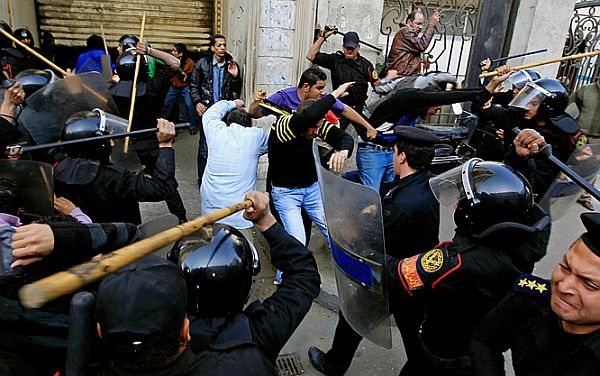
Police in both plain clothes and formal security uniforms were present by the thousands. Riot police were seen sleeping on, and manning, the 6 October and 15 May bridges – the main ones connecting main streets of the city — since last night. Hundreds of people gathered in several streets downtown chanting “People want the government down”, “Copts and Muslims don’t want this system”, and, “Bread, freedom, human integrity.” They were chased and beaten fiercely, many of them also dragged off by force – by thugs and state security agents.
Everywhere, the message was the same: “The people want the fall of the regime,” the protesters chanted as they marched over broken glass. On the Corniche, Cairo’s busy road along the Nile, protesters stopped traffic, setting a dumpster on fire and chanting “Down, Down Mubarak!” Moments later, they scattered after a charge by over a dozen plainclothes thugs, armed with sticks and knives, who chased them in between cars and onto a nearby bridge.
Throughout the evening, TIME’s Cairo reporter continued to hear reports of an impeding rally in the center of the city. And at around 11 p.m., a group of protesters attacked the Foreign Ministry, ransacking an outside office, before being pushed back.
The government released statements on Tuesday and Wednesday that sought to place much of the blame for Tuesday’s protest on Egypt’s largest opposition group, the banned Muslim Brotherhood. Activists who actually participated in the demonstrations say the allegation is bogus. “They’re trying to play the same old cards — by threatening the West and the United States that when this regime leaves power, the Muslim Brotherhood will take over. This is absolutely not true,” says Shadi Taha, a member of the liberal Tomorrow Party, whose leader Ayman Nour — a darling of the Bush administration — was on the street on Tuesday. “What we witnessed yesterday was that more than 90% of those people who took to the streets… it was probably their first time to demonstrate. We used to call them the silent majority — the majority that is not involved in politics, who have never been involved in politics, and who definitely are not involved in the Muslim Brotherhood.”
How can you placate the frustrations of a disenfranchised population without giving them real political power?
The answers to this question describe the common ground that unites Western leaders with their authoritarian counterparts in the Middle East. The game is to come up with political formulae that will make a potentially rebellious population feel heard just enough so that the fire of revolution can be dampened.*
Egyptian Armed Forces Chief-of-Staff Sami Annan, along with a delegation from the Egyptian Army, happen to be visiting Washington this week. I doubt that their counterparts in the Pentagon will be advising them on the fastest way to prepare Egypt for democracy.
Issandr El Amrani comments on al-Sayed Badawi, the president of the Wafd party (the most established of Egypt’s legal opposition parties) who appeared on Al Jazeera, demanding the formation of a new national unity government, the dissolution of parliament, and new elections under a proportional representation system.
My gut reaction: this is either a significant break with the Wafd’s behavior for over 30 years, or he is making this announcement on behalf of the regime. Why the conspiracy theory? Because he doesn’t mention the question of the presidency, a chief demand of the protestors. Perhaps he should be given the benefit of the doubt.
Meanwhile, the National Association for Change has made its own demands, including asking Mubarak to step down and [his son] Gamal to be disqualified from the presidency, as well as the dissolution of the parliament. Other groups have other demands, including a new minimum wage and the firing of the interior minister.
These people should be coordinating — and remember they are not the ones who protested tonight.
The cautiousness of some of the Egyptian opposition leaders demonstrates exactly why an authoritarian regime provides space for an opposition to operate: so that at a moment such as this, opposition leaders will not place themselves at the vanguard of revolutionary change and that by holding back, they will undermine the popular will.
*Am I implying that any Western countries harbor the seeds of revolution? Far from it. The “success” of Western democracy has been to depoliticize populations through the anesthetizing power of consumerism. People don’t care too much if government by the people is a fiction, so long as they can get their hands on the latest iPhone. Once the anesthetic is applied sufficiently widely and sufficiently frequently, there ceases to be such a thing as the will of the people.
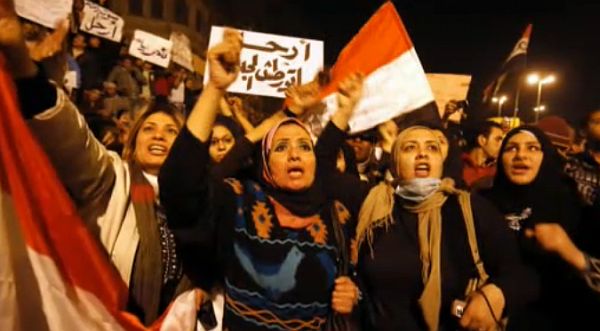
“I’ve never seen men so angry, yet so happy to be expressing their anger,” Courtney Graves, an American living in Giza told the BBC, describing what she witnessed in Tahrir square in Cairo today. “I walked next to girls in hijabs screaming for the downfall of Hosni Mubarak. I walked behind men begging God for freedom.” At least three people died in clashes between police and demonstrators.
In Hillary Clinton’s assessment, “the Egyptian Government is stable,” although Gamal Mubarak, Egyptian president Hosni Mubarak’s son who is widely tipped as his successor, has fled to London with his family, Arabic website Akhbar al-Arab said on Tuesday.
The Mubarak regime is clearly rattled and has blocked Twitter.
A popular uprising in Tunisia may have just pushed out President Zine El Abidine Ben Ali, but Egypt — the Arab world’s largest country with a vast security establishment — is something else again.
But activists, political analysts and average people in Egypt insist that something crucial shifted for Egypt today. Egyptian political scientist Mustapha Kamel Al Sayyid predicts that now the dam has broken, protests will continue. “the reservoir of discontent is huge,” he says. He adds it is much too soon to talk about a revolution in Egypt, where several factors would make a Tunisia-style toppling of Mubarak much more difficult.
Though both nations suffer from high unemployment and a have a large youth population, Egypt has a much smaller middle class than Tunisia. The regime’s power is not only concentrated in the security forces, as Tunisia’s was, but also in the Army. Tunisia’s military is credited with helping to bring about Ben Ali’s demise, while Egypt’s military is loyal to Mubarak, he says.
And while the corruption of Tunisia’s ruling family was a rallying point for protesters, corruption in Egypt extends further, meaning a widespread base of people who would have much to lose from the fall of the regime. Yet Egyptians have hope.
“All this is happening because we are not afraid,” said Shaimaa Morsy Awad, a young woman who held aloft an Egyptian flag during the protest. “Every day more people will join us. We are still weak, and there’s a lot of work we have to do. But there’s a revolution coming.”
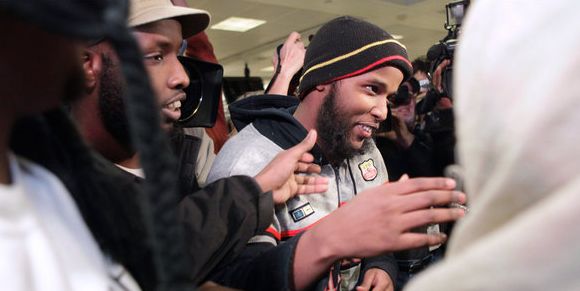
A Northern Virginia teen who had been barred from flying home from Kuwait landed in Washington on Friday morning, four weeks after being detained, allegedly beaten by Kuwait authorities and questioned by FBI agents about possible terrorist connections.
Gulet Mohamed, dressed in a worn hooded sweat shirt and sweat pants, was embraced by his family after he arrived at Dulles International Airport, the end of an ordeal that he said had “made me stronger.”
The United States “is built upon fighting for your rights,” Mohamed, 19, said in an interview.
Civil liberties groups charge that his case is the latest episode in which the U.S. government has temporarily exiled U.S. citizens or legal residents so they can be questioned about possible terrorist links without legal counsel.
The American Civil Liberties Union is suing the U.S. government on behalf of 17 citizens or legal residents who were not allowed to board flights to, from or within the United States, presumably because, like Mohamed, they were on the government’s no-fly list. Of those stranded overseas, all were eventually told they could return, often after they agreed to speak to the FBI. None was arrested upon their return.
The ACLU suit, filed in Portland, Ore., alleges that Americans placed on the no-fly list are denied due process because there is no effective way to challenge their inclusion. The government does not acknowledge that any particular individual is on the no-fly list or its other watch lists. Nor will it reveal the exact criteria it uses to place people on its list.
The drone technology that has revolutionized warfare in Iraq, Afghanistan and Pakistan is entering the national airspace: Unmanned aircraft are patrolling the border with Mexico, searching for missing persons over difficult terrain, flying into hurricanes to collect weather data, photographing traffic accident scenes and tracking the spread of forest fires.
But the operation outside Austin [described at the beginning of this report] presaged what could prove to be one of the most far-reaching and potentially controversial uses of drones: as a new and relatively cheap surveillance tool in domestic law enforcement.
For now, the use of drones for high-risk operations is exceedingly rare. The Federal Aviation Administration – which controls the national airspace – requires the few police departments with drones to seek emergency authorization if they want to deploy one in an actual operation. Because of concerns about safety, it only occasionally grants permission.
But by 2013, the FAA expects to have formulated new rules that would allow police across the country to routinely fly lightweight, unarmed drones up to 400 feet above the ground – high enough for them to be largely invisible eyes in the sky.
Maybe Barack Obama thinks of himself as some kind of Taoist president — attuned to the moment, like water that effortlessly flows around rocks, the warrior who can deflect every blow through the power of non-resistance.
Before he entered office, he exhibited a certain kind of poise that allowed some of us to indulge in fantasies about how radically different he might be from his predecessor.
An abundance of possibility was wrapped in an equal amount of mystery, but once he assumed office we’d all get to find out who Obama really is — except, two years later it sometimes seems harder to determine what, if anything, this president stands for than it was when he was a candidate.
Midway through his first term, some observers will say it’s too early to make judgments about the man, but if we can’t judge him now, what’s the basis on which to judge whether he’s worth voting for again? The next two years during which most of his actions will have been tailored to enhance his re-electability?
When it comes to determining what Obama stands for, I’d say the absence of evidence is already evidence of absence. We don’t know what Obama stands for because he doesn’t stand for anything — which is precisely why some of his wild-eyed enemies see him as some kind of Manchurian candidate.
That suspicion no longer seems so far off the mark. There is plenty of evidence that he has allowed himself to become an instrument of external forces — those forces simply aren’t as exotic as the ones the conspiracy theorists imagined.
Quick quiz: In one sentence, describe FDR’s political philosophy. Good, now summarize Reaganism. Pretty easy, right?
OK, do the same for President Obama. Still thinking? Don’t worry, Mr. Obama is, too. And that’s bad news for all of us. Because no matter how you feel about Obama, his lack of clear philosophical values is not only a political problem for Democrats but a moral problem for America.
It didn’t start like this. Obama surfed into the White House on a wave of seeming principle: change, bipartisanship, reason, deliberation, pragmatism. What we didn’t realize is that all these concepts are methodological. They concern the process of forming public policy. But they are not bedrock principles upon which we can orient the ends of government.
They are so general that they provide little analytical or moral traction. Who objects to deliberation and evidence-based policy? Well, maybe George W. Bush, which is why Obama’s “change” narrative worked so well in the election. But since his inauguration, Obama’s methodological political theory has proved thin and sometimes incoherent. He will never support tax cuts for the rich, until he will. He criticizes Bush’s expansive view of presidential war powers, then adopts it. The list goes on.
It’s not that he breaks his policy promises more than other politicians. It’s not that he seeks compromise – a virtue. It’s not even that his policies are wrongheaded. It’s the fact that when he compromises, when he reaches policy conclusions, there’s no sense that it derives from anything other than ad hoc balancing.
There is no well of enduring principle upon which he seems to draw. Even if he’s a pragmatist, eschewing universal principles in favor of context-specific values and concerns, we still don’t know what those temporal values and concerns are, or why he believes in them. So far he’s the piecemeal president.
“An opinion can be argued with; a conviction is best shot,” wrote TE Lawrence in The Evolution of a Revolt.
Whatever ones views about the legitimacy or morality of the use of violence, it’s hard not to at least sympathize with the sentiment. How indeed is it possible to reason with those who are impervious to reason?
Consider, for instance, the Jewish settler in the video below. This is his argument in favor of the theft of Palestinian land and property: “The Bible says that we have to conquer the land. So we believe… the land is ours. We believe in the Bible.” As if to say, I can’t think; I can only believe. I can’t see through my own eyes; I can only see what the Bible reveals. I am a slave to ideas crafted from afar — ideas whose authority I gladly and blindly trust.
But here’s the problem in Lawrence’s proposition: in the contest between reason and conviction, it’s the man with the conviction who most likely holds the gun.
On October 5, 1995, as the Knesset was meeting to ratify the second Oslo agreement, thirty thousand Greater Israel zealots, Likud Party supporters, militant West Bank settlers, and right-wing nationalists rallied in Jerusalem’s Zion Square. For months, certain ultra-Orthodox rabbis and scholars had been suggesting that, because Prime Minister Yitzhak Rabin was willing to consider territorial concessions in negotiations with the Palestinians, it would be permissible, even obligatory, to kill him. In Zion Square, protesters carried pictures of Rabin, doctored to show him in Nazi uniform or with crosshairs over his face. The crowd chanted “Rabin boged!”—“Rabin is a traitor!”—and, again and again, “Death to Rabin!” From a balcony, prominent opposition politicians, including Benjamin Netanyahu, looked on benevolently and uttered no rebukes. A month later, at another, larger rally, this one for peace, Rabin was assassinated.
In 1995 in Jerusalem, the connection between talk and action was direct and unmistakable. The killer, Yigal Amir, a student of Jewish law, was an activist of the organized religious right. He was neither delusional nor incoherent. “I did this to stop the peace process,” he explained at a court hearing. “We need to be coldhearted.” He acted with a clear political purpose, one that he shared with much of the mainstream religious and secular right. Within six months, Netanyahu was Prime Minister; Rabin’s widow, Leah, and many other Israelis never forgave him for what they saw as his cynical tolerance of the extremist stew that had nurtured the murderer.
The context for Hertzberg’s re-telling of this well-known narrative is the ongoing debate, following the Tucson shootings, about the dangerous effects of hate-filled rhetoric.
In President Obama’s Tucson speech last week — “his finest speech as President, and the truest to his essential character,” at least in Hertzberg’s opinion — Obama noted: “We are far too eager to lay the blame for all that ails the world at the feet of those who happen to think differently than we do.”
Intolerance does indeed color much of the political discourse in America and the attitudes that make this such a fractured world. But let’s not pretend that a shift in tone initiated by conciliatory words from this president either have much depth or will have any lasting effect.
This is a president who, with the words “Predator drones,” once made light of his ability to shred and vaporize the bodies of men, women and children whose names will never be known beyond the villages and valleys where they once lived.
This week we learned that in October, during what in the euphemistic language of war is dubbed the Afghan “surge” — a wave of death and destruction designed to diminish the Taliban’s strength — 25 tons of explosives were used by US forces to reduce a whole village to dust.
Obama might have brought a change in tone and manner to the White House but violence is no less the American way now than it was under the Bush administration.
A Democratic party less inclined to use the vitriolic language of its gun-loving counterparts, is disingenuous in its claim to be a party of civility while it acquiesces to the perpetuation of an unwinnable war and the funding of a military machine that dwarfs all others.
The reactions to the Tucson shootings revealed less about the inflammatory effect of hateful language and much more about America’s unwillingness to face the fact that this is a nation that condones, honors, venerates and at times worships the use of violence.
On the one hand in its religious bearings America adopts the posture of an Old Testament moral absolutism, yet when it comes to that fundamental injunction: thou shalt not kill, there are a hundred and one caveats which expose the chasm separating moral principle and moral practice.
I make this observation, however, not for the purpose of condemning violence but in order to point to a more fundamental issue: the need for truthfulness.
Embedded in the reason which is impervious to reason — the conviction which has a voice but no ears — is a false relationship to language. It demands from its audience the very thing it lacks: receptivity. It simultaneously expresses a demand to communicate and an unwillingness to communicate. It is, in a word, dishonest.
At the same time, those who are to a much lesser degree the slaves of conviction, nevertheless rarely have a greater love of truth, since for most, the guiding force in their approach to politics is not a ruthless honesty but the power of affiliation. Tribal instincts are at play just as much on the left as on the right.
After Obama’s speech, the “atmosphere smelled cleaner,” declared Hertzberg, but is that all that is called for — the occasional squirt of presidential air freshener?
If Obama truly had the capacity and desire to courageously lead, he would have to do something much more profound than change the ambiance in political discourse. He would have to inject a level of honesty that two years into his presidency he no longer has the ability to credibly project. He would have to replace a willow spine with some steel. He would have to acknowledge that the political center is not sacred territory — it provides just as much a refuge for political opportunists as do the ideological extremes.
It was always going to be a struggle for the U.S. to dissuade its Arab allies from going ahead with a U.N. Security Council resolution condemning Israeli settlements. But last week’s “people power” rebellion in Tunisia has made Washington’s effort to lobby against the plan more difficult. Tunisia has given the autocratic leaders of countries such as Egypt and Jordan more reason to fear their own people. For those regimes, symbolically challenging unconditional U.S. support for Israel is a low-cost gesture that will play well on restive streets.
Going ahead with the resolution, which was discussed on Wednesday at the Security Council and demands an immediate halt to all Israeli settlement construction in the West Bank and East Jerusalem, is, of course, a vote of no-confidence in U.S. peacemaking efforts. And it creates a headache for the Obama Administration over whether to invoke the U.S. veto — as Washington has traditionally done on Council resolutions critical of Israel. The twist this time: the substance of the resolution largely echoes the Administration’s own stated positions.
Washington had hoped that signaling its intention to veto such a resolution would force the Palestinians and their Arab backers to hold it back. But they went ahead and placed it on the Council’s agenda (a vote is unlikely for a few more weeks), putting the U.S. on the spot. After all, the Obama Administration has demanded that Israel end settlement construction to allow peace talks to go forward. After a 10-month partial moratorium expired last September, Israel resumed vigorous construction, and has resisted pressure from Washington for any further freeze. U.S. Deputy U.N. Ambassador Rosemary DiCarlo said on Wednesday that the U.S. opposed bringing the settlement issue to the Council “because such action moves us no closer to a goal of a negotiated final settlement” and could even undermine progress toward it. But that argument is unlikely to convince most of the international community, given the obvious stalemate in the peace process — there are no negotiations under way, and the Palestinians have refused to restart them until Israel halts its settlement construction. Initial responses at the Security Council reflect unanimous international support for the demand that Israel stop building settlements. If a vote were held today, the U.S. would be the only possible nay.
To say that the Obama administration’s campaign against WikiLeaks has been based on wildly exaggerated and even false claims is to understate the case. But now, there is evidence that Obama officials have been knowingly lying in public about these matters. The long-time Newsweek reporter Mark Hosenball — now at Reuters — reports that what Obama officials are saying in private about WikiLeaks directly contradicts their public claims:
Internal U.S. government reviews have determined that a mass leak of diplomatic cables caused only limited damage to U.S. interests abroad, despite the Obama administration’s public statements to the contrary.
A congressional official briefed on the reviews said the administration felt compelled to say publicly that the revelations had seriously damaged American interests in order to bolster legal efforts to shut down the WikiLeaks website and bring charges against the leakers. . . .
“We were told (the impact of WikiLeaks revelations) was embarrassing but not damaging,” said the official, who attended a briefing given in late 2010 by State Department officials. . .
But current and former intelligence officials note that while WikiLeaks has released a handful of inconsequential CIA analytical reports, the website has made public few if any real intelligence secrets, including reports from undercover agents or ultra-sensitive technical intelligence reports, such as spy satellite pictures or communications intercepts. . . .
National security officials familiar with the damage assessments being conducted by defense and intelligence agencies told Reuters the reviews so far have shown “pockets” of short-term damage, some of it potentially harmful. Long-term damage to U.S. intelligence and defense operations, however, is unlikely to be serious, they said. . . .
Shortly before WikiLeaks began its gradual release of State Department cables last year, department officials sent emails to contacts on Capitol Hill predicting dire consequences, said one of the two congressional aides briefed on the internal government reviews.
However, shortly after stories about the cables first began to appear in the media, State Department officials were already privately playing down the damage, the two congressional officials said.
In response to Hosenball’s story, Obama officials naturally tried to salvage the integrity of their statements, insisting that “there has been substantial damage” and that there were unspecified “specific cases where damage caused by WikiLeaks’ revelations have been assessed as serious to grave.” But the only specific cases anyone could identify were ones where the U.S. was caught by these documents lying to its own citizens or, at best, concealing vital truths — such as the far greater military role the U.S. is playing in Yemen and Pakistan than Obama officials have publicly acknowledged.
And this, of course, has been the point all along: the WikiLeaks disclosures are significant precisely because they expose government deceit, wrongdoing and brutality, but the damage to innocent people has been deliberately and wildly exaggerated — fabricated — by the very people whose misconduct has been revealed. There is harm from the WikiLeaks documents, but it’s to wrongdoers in power, which is why they are so desperate to malign and then destroy the group.
On Saturday, the New York Times revealed that the Stuxnet malware attack on Iran’s uranium enrichment program was a joint US-Israeli operation. The report illustrates the officially sanctioned relationship between the US government and the US press when it comes to the publication of classified information. Indeed, this relationship is so well understood that on matters of national security, the New York Times can be regarded as effectively serving as the US government’s ministry of information.
Although the report does not cite government sources — even anonymous officials — there seems little doubt that on an intelligence issue such as this (there could not be one of greater sensitivity) the newspaper’s editors would at least have shown the report to administration officials before publication. Which is to say, the New York Times would not publish a story of this nature without government approval. That is not to say that the accuracy of the report was being vouched for but that, at the least, the government could tolerate (and might well welcome) the disclosure of the classified information it contained.
This gets to the heart of the Obama administration’s fight against WikiLeaks: it’s not about the protection of secrecy; it’s about control of classified information. In other words, it’s about the exercising of the political power to pick and choose when the law should be upheld and when it can be disregarded.
WikiLeaks presents a challenge to centralized power; not governance by law.
Ali Gharib lays out the multiplicity of reasons why Dennis Ross — “a three-time-loser on Israeli-Palestinian peace-making” — lacks the competence for any role in the Middle East.
I was struck by an article by Nathan Guttman in the legendary Jewish Daily Forward about Dennis Ross and George Mitchell jockeying for the position of Obama Administration’s point-person in the Middle East peace process. The whole thing is a fascinating read, but this line really jumped out at me:
Others have also described Ross as more skeptical [than Mitchell] about the chances of peace, based on his decades-long experience with trying to bring together the parties.
I don’t want to get all new-agey, but if you think something is difficult or impossible to do, the chances of being able to do it are greatly diminished from the get-go.
So why does this Ross guy keep getting jobs that he doesn’t think are possible? I picked up Ross’ book off of my shelf here in D.C., and it amazed me how many times he says you cannot make any kind of deal with the Iranians. Then, Obama put him in charge of making a deal with the Iranians. Ross, we now learn, doubts that a peace deal can be reached in Israel-Palestine, and Obama gives him a job making peace in Israel-Palestine.
So what does this tell us about Obama? That he’s beholden to AIPAC; that he lacks courage, creativity and imagination. Above all, that lacking confidence in his own capacities of leadership he pays undue deference to the “qualification” that a subordinate possesses talent for no better reason than that he is an old hand — and that’s where Ross has “out performed” George Mitchell: more frequent flyer miles clocked up between the US and the Middle East.
Investors are often among the most sober of political analysts — after all, their single interest is in finding the safest and most profitable places to put their money and right now, Egypt does not look like such a location.
Reuters reports, “Cairo’s stock index tumbled to an 11-week low on Wednesday on fears of a contagion from the unrest that toppled Tunisia’s president and further volatility is expected as investors eye Egypt’s 2011 presidential election.”
At the same time, analysts say that the greater political freedom enjoyed by opposition groups in Egypt — relative to their Tunisian counterparts — serves as a pressure valve that can release political tension without undermining the Mubarak regime.
The Egyptian dissident Mohamed ElBaradei has warned of a “Tunisia-style explosion” in his country as self-immolation protests proliferated and anti-government activists announced plans for a nationwide “day of anger” next week.
But the former UN nuclear weapons chief stopped short of calling on his supporters to take to the streets, prompting scathing criticism from opposition campaigners who believe ElBaradei is squandering a rare opportunity to bring an end to President Hosni Mubarak’s three decades of autocratic rule.
Today Ahmed Hashem el-Sayed, 25, from the Mediterranean port city of Alexandria, died in hospital after setting himself alight on the roof of his home. It was the latest in a series of self-immolation incidents that have spread through Egypt over the past two days, after the Tunisian vegetable trader Muhammad Bouazizi’s self-immolation provided the catalyst for the toppling of his country’s president last week.
“What has transpired in Tunisia is no surprise and should be very instructive both for the political elite in Egypt and those in the west that back dictatorships,” ElBaradei told the Guardian. “Suppression does not equal stability, and anybody who thinks that the existence of authoritarian regimes is the best way to maintain calm is deluding themselves.”
Within hours of Elbaradei refusing to throw his weight behind street protests as he told The Guardian “I would like to use the means available from within the system to effect change, such as the petition we are gathering demanding political reform,” he expressed a different sentiment on Twitter: “Fully support call 4 peaceful demonstrations vs. repression & corruption. When our demands for change fall on deaf ears what options remain?”
Swiftly and sarcastically, Demagh MAK in Cairo responded: “@ElBaradei Are u going to join us in the streets or you just supporting on twitter #Egypt #Jan25?”
Not withstanding pro forma expressions of support for “democratic reform,” it seems unlikely the Obama administration would welcome the prospect of democracy in Egypt.
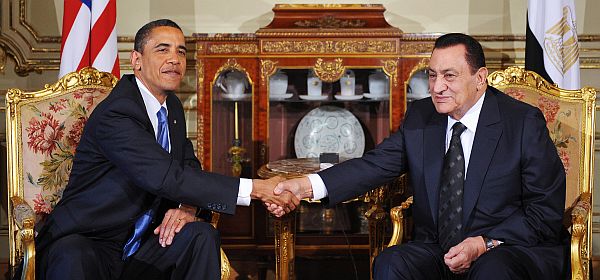
When President Obama addressed the Muslim world from Cairo in 2009 he did so without a murmur of criticism directed at his dictator host, Hosni Mubarak. If Mubarak was to fall from power or fail to successfully pass the presidency to him son Gamal, the inevitable result would be an Egyptian government in which the Muslim Brotherhood would wield significant power — a prospect that both Washington and Israel fear.
While George W Bush was president it was possible to sustain what turned out to be a naive hope: that much of the harm he had done could be undone once he was out of office and the neoconservatives had been dislodged from power. But the harm personified by Bush and Cheney is now being institutionalized and by the removal of ideological baggage, lightened, with the effect that the post-Bush era is nowhere near in sight.
In the early months of Obama’s presidency, the American Right did to him what they do to every Democratic politician: they accused him of being soft on defense (specifically “soft on Terror”) and leaving the nation weak and vulnerable to attack. But that tactic quickly became untenable as everyone (other than his hardest-core followers) was forced to acknowledge that Obama was embracing and even expanding — rather than reversing — the core Bush/Cheney approach to Terrorism. As a result, leading right-wing figures began lavishing Obama with praise — and claiming vindication — based on Obama’s switch from harsh critic of those policies (as a candidate) to their leading advocate (once in power).
As early as May, 2009, former Bush OLC lawyer Jack Goldsmith wrote in The New Republic that Obama was not only continuing Bush/Cheney Terrorism policies, but was strengthening them — both because he was causing them to be codified in law and, more important, converting those policies from right-wing dogma into harmonious bipartisan consensus. Obama’s decision “to continue core Bush terrorism policies is like Nixon going to China,” Goldsmith wrote. Last October, former Bush NSA and CIA Director Michael Hayden — one of the most ideological Bush officials, whose confirmation as CIA chief was opposed by then-Sen. Obama on the ground he had overseen the illegal NSA spying program — gushed with praise for Obama: “there’s been a powerful continuity between the 43rd and the 44th president.” James Jay Carafano, a homeland-security expert at the Heritage Foundation, told The New York Times’ Peter Baker last January: “I don’t think it’s even fair to call it Bush Lite. It’s Bush. It’s really, really hard to find a difference that’s meaningful and not atmospheric.”
Those are the nation’s most extreme conservatives praising Obama’s Terrorism policies. And now Dick Cheney himself — who once led the “soft on Terror” attacks — is sounding the same theme. [Continue reading…]
This website or its third-party tools use cookies, which are necessary to its functioning. By closing this banner, you agree to the use of cookies.