Category Archives: Obama administration

US-trained militias ready to join forces with the Taliban

The Associated Press reported earlier this week:

Tribal militias allied with the government helped block a Taliban advance in this corner of northwest Pakistan close to the Afghan border, but their success has come at a price: the empowerment of untrained, unaccountable private armies that could yet emerge as a threat of their own.

Tensions are emerging between authorities and the dozens of militias that they helped to create predominantly in and near the northwest tribal regions. Operating from fortress-like compounds with anti-aircraft guns on the roofs, the militiamen have made it clear that the state now owes them for their sacrifices. They show photos on their cell phones of Taliban they killed and point to the scrubland outside, with graves of relatives who died in the fight.

The leader of the largest militia near the town of Matani, a wealthy landowner named Dilawar Khan, warns that he will stop cooperating with police unless he gets more money and weapons from authorities. Speaking to The Associated Press, he adds what could be a veiled threat to join the militants.

“Time and time again, the Taliban have contacted us, urging us to change sides,” he said.

The New York Times now reports:

Rival militant organizations on both sides of the Afghanistan-Pakistan border have increasingly been teaming up in deadly raids, in what military and intelligence officials say is the insurgents’ latest attempt to regain the initiative after months of withering attacks from American and allied forces.

New intelligence assessments from the region assert that insurgent factions now are setting aside their historic rivalries to behave like “a syndicate,” joining forces in ways not seen before. After one recent attack on a remote base in eastern Afghanistan, a check of the dead insurgents found evidence that the fighters were from three different factions, military officials said.

In the past, these insurgent groups have been seen as sharing ideology and inspiration, but less often plans for specific missions.

Now the intelligence assessments offer evidence of a worrisome new trend in which extremist commanders and their insurgent organizations are coordinating attacks and even combining their foot soldiers into patchwork patrols sent to carry out specific raids.

Facebooktwittermail

Former CIA chief: ‘I thank god every day for the continuity’ between Bush and Obama

On CNN on Sunday, former Bush officials lined up to praise President Obama:

Former Central Intelligence Agency Director Michael Hayden, a retired Air Force general, also argued that Obama’s approach has been, by and large, the same — regardless of campaign rhetoric.

“When one is in office, it’s, as the admiral has suggested, when one is in office, that responsibility weighs pretty heavily. And so we’ve seen a powerful consistency between two administrations trying to deal with this problem,” Hayden said. “Actually, I’ve seen it over two administrations, and I thank god every day for the continuity.”

“Regardless of which side of the political spectrum you come from or what your political views might be, these threats are very real and very serious. And we have to — have to deal with them in a very serious way,” [ former National Intelligence Director and retired Navy Vice Admiral Michael] McConnell added.

Facebooktwittermail

Financial attacks on WikiLeaks — a low-cost ploy to please Washington

In an editorial, the New York Times says:

The whistle-blowing Web site WikiLeaks has not been convicted of a crime. The Justice Department has not even pressed charges over its disclosure of confidential State Department communications. Nonetheless, the financial industry is trying to shut it down.

Visa, MasterCard and PayPal announced in the past few weeks that they would not process any transaction intended for WikiLeaks. Earlier this month, Bank of America decided to join the group, arguing that WikiLeaks may be doing things that are “inconsistent with our internal policies for processing payments.”

The Federal Reserve, the banking regulator, allows this. Like other companies, banks can choose whom they do business with. Refusing to open an account for some undesirable entity is seen as reasonable risk management. The government even requires banks to keep an eye out for some shady businesses — like drug dealing and money laundering — and refuse to do business with those who engage in them.

But a bank’s ability to block payments to a legal entity raises a troubling prospect. A handful of big banks could potentially bar any organization they disliked from the payments system, essentially cutting them off from the world economy.

The fact of the matter is that banks are not like any other business. They run the payments system. That is one of the main reasons that governments protect them from failure with explicit and implicit guarantees. This makes them look not too unlike other public utilities. A telecommunications company, for example, may not refuse phone or broadband service to an organization it dislikes, arguing that it amounts to risky business.

Our concern is not specifically about payments to WikiLeaks. This isn’t the first time a bank shunned a business on similar risk-management grounds. Banks in Colorado, for instance, have refused to open bank accounts for legal dispensaries of medical marijuana.

Still, there are troubling questions. The decisions to bar the organization came after its founder, Julian Assange, said that next year it will release data revealing corruption in the financial industry. In 2009, Mr. Assange said that WikiLeaks had the hard drive of a Bank of America executive.

What would happen if a clutch of big banks decided that a particularly irksome blogger or other organization was “too risky”? What if they decided — one by one — to shut down financial access to a newspaper that was about to reveal irksome truths about their operations? This decision should not be left solely up to business-as-usual among the banks.

Although the financial companies have used the pretext that WikiLeaks is not complying with the terms each firm specify in the user agreements, we can strongly infer that in each instance these are cases of corporate lying — the kind of lying that lubricates the wheels of commerce. After all, when WikiLeaks in conjunction with several major newspapers started releasing US diplomatic cables, two things were clear:

  • Whatever impermissible action WikiLeaks was being accused of, The Guardian, New York Times and other newspapers engaged in the same actions and yet MasterCard, Visa, Paypal and Bank of America din’t seem to mind — flagrant double standards were in operation.
  • When WikiLeaks launched CableGate, there was no intrinsic difference from its release of intelligence reports about the war in Afghanistan or its earlier leaks. So why did the financial companies wait until now to enforce policies that they apparently had no interest in enforcing before?

What changed was the political climate.

For the Obama administration, WikiLeaks’ actions had crossed the threshold from irritating to intolerable and a few players in the financial industry — perhaps recognizing that they could win a little more favor from an administration that had already treated the sector so kindly — jumped at the opportunity to stand shoulder-to-shoulder with Washington.

What else should we expect from those whose fortunes are so intimately intertwined?

Facebooktwittermail

A happy Christmas — for the rich

Alexander Cockburn writes:

Nicely in time for the end-of-year job ratings, President Obama has crawled from the political graveyard, where only a month ago wreaths were being heaped around his sepulcher. The Commentariat now gravely applauds his recent victories in the US Congress: repeal of the Don’t Ask, Don’t Tell inhibitions on gays in the military; Senate ratification of the new START treaty on nuclear weapons with the Russians; passage of a $4.3bn bill – previously blocked by Republicans – providing health benefits for emergency rescue workers in the 9/11 attacks of 2001.

Something missing from my list? You noticed? Yes indeed: first and absolutely foremost, the successful deal with Republicans on taxes, better described as a $4 trillion gift to America’s rich people, by extending the Bush tax cuts. With the all-important tax surrender under their belts the Republicans don’t seem too upset in having allowing Obama’s his mini-swath of victories. There aren’t too many votes in insisting that 1500 nukes aren’t enough for Uncle Sam, particularly since Obama did his usual trick a year ago of surrendering before the battle began, pledging vast new outlays to the nuclear-industrial-complex. Would it have been that smart to deny benefits to 9/11 responders or say that gays in the military have to stay in the closet. Presumably they’ll fight all the more fiercely now they can stand Out and Proud. On things that really matter, once they reassemble after the break, the Republicans will probably stay awake, though with a President who surrenders with the alacrity of Obama, excessive vigilance probably isn’t necessary.

You give $4 trillion to the rich and they express their thanks in measured terms. Their hired opinion formers laud the spirit of admirable compromise enabling responsible members of Congress to come together in bipartisanship to keep the hogwallow open for business.

Facebooktwittermail

The leaks that aren’t really leaks

Glenn Greenwald praises the New York Times for an article which “exposed” planning for an imminent expansion of Obama’s war in Pakistan:

In my view, the NYT article represents exactly the kind of secret information journalists ought to be revealing; it’s a pure expression of why the First Amendment guarantees a free press. There are few things more damaging to basic democratic values than having the government conduct or escalate a secret war beyond public debate or even awareness. By exposing these classified plans, Mazzetti and Filkins did exactly what good journalists ought to do: inform the public about important actions taken or being considered by their government which the government is attempting to conceal.

Moreover, the Obama administration has a history of deceiving the public about secret wars. Recently revealed WikiLeaks cables demonstrated that it was the U.S. — not Yemen — which launched a December, 2009 air strike in that country which killed dozens of civilians; that was a covert war action about which the U.S. State Department actively misled the public, and was exposed only by WikiLeaks cables. Worse, it was The Nation’s Jeremy Scahill who first reported back in 2009 that the CIA was directing ground operations in Pakistan using both Special Forces and Blackwater operatives: only to be smeared by the Obama State Department which deceitfully dismissed his report as “entirely false,” only for recently released WikiLeaks cables to confirm that what Scahill reported was exactly true. These kinds of leaks are the only way for the public to learn about the secret wars the Obama administration is conducting and actively hiding from the public.

The question that emerges from all of this is obvious, but also critical for those who believe Wikileaks and Julian Assange should be prosecuted for the classified information they have published: should the NYT editors and reporters who just spilled America’s secrets to the world be criminally prosecuted as well? After all, WikiLeaks has only exposed past conduct, and never — like the NYT just did — published imminent covert military plans.

I wish I shared Greenwald’s enthusiasm for the NYT’s investigative journalism but I’m highly skeptical that the reporting in this instance should be regarded as an exposé.

What seems much more likely is that the newspaper is simply serving as the means through which classified information can be made public because doing so is thought (by the leakers) to serve policymaking goals — such as applying pressure on Pakistan.

This merely illustrates the fact that those who make the rules can — whenever they see fit — break the rules. No one is at risk of being caught having leaked classified information to the New York Times. The “leaking” was almost certainly authorized at the highest levels of the administration and the New York Times merely acted as a dutiful servant. The paper is very well-trained when it comes to distinguishing between classified information that it has permission to print and that which is verboten.

Facebooktwittermail

Congress blocks closure of Guantanamo

The New York Times reports:

Congress voted Wednesday to impose strict new limits on transferring detainees out of the Guantánamo Bay prison, dealing a major blow to President Obama’s vows to shut down the center and give federal court trials to many of the prisoners.

The Guantánamo provisions were contained in a major defense authorization bill, which both chambers passed on the last day of Congress’s lame-duck session. It is considered highly unlikely that Mr. Obama will veto the bill because it also authorizes billions in spending for the wars in Afghanistan and Iraq.

Robert M. Chesney, a University of Texas law professor who specializes in national security matters, said the legislation would make it even harder to close the prison, at the American military base in Cuba. He said the next Congress, in which Republicans will have more power, was likely to keep or even intensify the restrictions.

“A Democratic Congress has done its level best to prevent prosecutions in civilian court,” Professor Chesney said.

“It strengthens the relative position of military commissions, and it separately strengthens the likelihood of continuing to rely on military detention” without trial, he said.

Facebooktwittermail

Time to be afraid of everyone and everything

The 1982 Chicago Tylenol murders resulted in seven deaths and spawned an industry: the production of tamper-resistant packaging. Four years earlier mercury-injected Jaffa oranges from Israel caused short-lived panic across Europe. But 32 years later tamper-resistant oranges have yet to make it to the produce shelves.

The same populations that needed at all costs to be protected from the risk of contaminated pharmaceutical products were apparently willing to live with the risk presented by unpackaged food. The difference between the two cases seemed to have had less to do with risk assessment than with the conjunction (or lack of one) between fear and commercial opportunity.

The Government of Fear in Washington is now raising two new alarms — each with security and commercial implications that have yet to become apparent, though right now this looks like good news for McDonalds and bad news for Sizzler.

CBS News has an exclusive report on the latest terrorist plot about which the Department of Homeland Security wants to generate some fear.

The plot uncovered earlier this year is said to involve the use of two poisons – ricin and cyanide – slipped into salad bars and buffets.

Of particular concern: The plotters are believed to be tied to the same terror group that attempted to blow up cargo planes over the east coast in October, al Qaeda in the Arabian Peninsula.

In online propaganda al Qaeda in the Arabian Peninsula has praised the cargo attack, part of what it called “Operation Hemorrhage.”

The propaganda says in part, “…attacking the enemy with smaller but more frequent operations” to “add a heavy economic burden to an already faltering economy.”

Meanwhile, here comes another alarm:

Attorney General Eric Holder says that the growing number of American citizens joining terrorist groups including Al Qaeda is “one of the things that keeps me up at night.”

“You didn’t worry about this even two years ago — about individuals, about Americans, to the extent that we now do,” Holder said in an interview with ABC News airing Tuesday. “And that is of … of great concern.”

Be afraid of what you eat. Be afraid of your fellow Americans.

Happy Holidays from the US Government!

Facebooktwittermail

Will Obama’s war in Pakistan soon escalate to a ground war?

The New York Times reports:

Senior American military commanders in Afghanistan are pushing for an expanded campaign of Special Operations ground raids across the border into Pakistan’s tribal areas, a risky strategy reflecting the growing frustration with Pakistan’s efforts to root out militants there.

The proposal, described by American officials in Washington and Afghanistan, would escalate military activities inside Pakistan, where the movement of American forces has been largely prohibited because of fears of provoking a backlash.

The plan has not yet been approved, but military and political leaders say a renewed sense of urgency has taken hold, as the deadline approaches for the Obama administration to begin withdrawing its forces from Afghanistan. Even with the risks, military commanders say that using American Special Operations troops could bring an intelligence windfall, if militants were captured, brought back across the border into Afghanistan and interrogated.

The Americans are known to have made no more than a handful of forays across the border into Pakistan, in operations that have infuriated Pakistani officials. Now, American military officers appear confident that a shift in policy could allow for more routine incursions.

America’s clandestine war in Pakistan has for the most part been carried out by armed drones operated by the C.I.A.

Additionally, in recent years, Afghan militias backed by the C.I.A. have carried out a number of secret missions into Pakistan’s tribal areas. These operations in Pakistan by Afghan operatives, known as Counterterrorism Pursuit Teams, have been previously reported as solely intelligence-gathering operations. But interviews in recent weeks revealed that on at least one occasion, the Afghans went on the offensive and destroyed a militant weapons cache.

Facebooktwittermail

What if the Palestinians turn to the U.N.?

Tony Karon writes:

Israel is worried, according to press reports in the country, that the United States will not “rush to veto” a planned U.N. Security Council resolution condemning ongoing Israeli settlement construction. The resolution is being drafted by Arab countries exasperated by the failure of the U.S. to pressure the Israelis to halt construction in the West Bank and East Jerusalem, which the U.N. deems illegal. The draft may be introduced as early as this week, according to Israeli media, and the Israeli foreign ministry is reportedly mustering a diplomatic full court press to counter the move. While the U.S. has a longstanding tradition of running interference for Israel at the U.N., the Obama Administration may find itself hard-pressed to veto a resolution condemning the same Israeli behavior that Washington itself has publicly deemed illegitimate — and which the Administration has spent months trying in vain to cajole the Israelis into halting.

The Palestinians have insisted, along with the Obama Administration, that Israel refrain from building settlements in occupied territory as a precondition for peace talks. Though the U.S. dropped that effort two weeks ago, the Palestinians continue to press the matter. Prime Minister Benjamin Netanyahu had late last year instituted a 10-month partial moratorium on construction, and talks between the two sides finally got under way in August. But the Palestinians called a halt a month later as Israel’s moratorium expired and construction resumed. And the best efforts of the Obama Administration to secure even a temporary reinstatement of the moratorium proved fruitless.

While Washington hopes to make progress by conducting parallel negotiations on substantive issues with both sides, the Palestinians and their Arab allies no longer seem willing to stay on that path and leave the matter in U.S. hands.

Facebooktwittermail

FBI delivers subpoenas to four more anti-war, solidarity activists as U.S. Attorney Patrick Fitzgerald expands witch hunt

A press release from the Committee to Stop FBI Repression says:

The FBI came unannounced to knock on doors at two apartments in Chicago this morning. FBI agent Robert Parker, under orders from U.S. Attorney Patrick Fitzgerald’s office, delivered a subpoena to Maureen Murphy. Murphy, like several other individuals served subpoenas, is an organizer with the Palestine Solidarity Group-Chicago.

This continues the repression unleashed by Fitzgerald on the anti-war movement since September 24th, when fourteen subpoenas were delivered to anti-war, labor, and solidarity activists in coordinated raids involving more than 70 federal agents. Armed FBI agents raided homes, taking computers, phones, passports, documents, notebooks, and even children’s artwork. A total of 23 subpoenas have been served to activists around the country.

Maureen Murphy said, “Along with several others, I am being summoned to appear before the Grand Jury on Tuesday, January 25th, in the Dirksen Federal Building in Chicago. We are being targeted for the work we do to end U.S. funding of the Israeli occupation, ending the war in Afghanistan and ending the occupation of Iraq. What is at stake for all of us is our right to dissent and organize to change harmful US foreign policy.” Ms. Murphy is also the Managing Editor of the widely-read website, The Electronic Intifada.

In addition, three women in Minneapolis – Tracy Molm, Anh Pham, and Sara Martin – are threatened with reactivated subpoenas by Fitzgerald’s office and new Grand Jury dates. Tom Burke of the Committee to Stop FBI Repression explained, “It is likely the three individuals, like all the others so far, will continue to refuse to take part in Fitzgerald’s witch hunt. Fitzgerald can then call for putting them in jail as long as he wants.”

Facebooktwittermail

The American Surveillance State

Glenn Greenwald writes:

One of the hallmarks of an authoritarian government is its fixation on hiding everything it does behind a wall of secrecy while simultaneously monitoring, invading and collecting files on everything its citizenry does. Based on the Francis Bacon aphorism that “knowledge is power,” this is the extreme imbalance that renders the ruling class omnipotent and citizens powerless.

In the Washington Post today, Dana Priest and William Arkin continue their “Top Secret America” series by describing how America’s vast and growing Surveillance State now encompasses state and local law enforcement agencies, collecting and storing always-growing amounts of information about even the most innocuous activities undertaken by citizens suspected of no wrongdoing. As was true of the first several installments of their “Top Secret America,” there aren’t any particularly new revelations for those paying attention to such matters, but the picture it paints — and the fact that it is presented in an establishment organ such as the Washington Post — is nonetheless valuable.

Today, the Post reporters document how surveillance and enforcement methods pioneered in America’s foreign wars and occupations are being rapidly imported into domestic surveillance (wireless fingerprint scanners, military-grade infrared cameras, biometric face scanners, drones on the border).

In this respect — whose significance can hardly be overstated — Barack Obama is worse than George Bush: Bush’s excesses and the ideology he represented could be circumscribed by his administration and in theory America could purge itself of the effects through the ritual purification of an election. What Obama is doing is normalizing those excesses so that the Bush era can be perpetuated without being tainted by the names Bush and Cheney.

Facebooktwittermail

Why a nuclear Iran could be good for the US

Chan Akya presents an interesting argument — even if no one in Washington would be so bold as to articulate such thoughts.

Most of the hijackers on September 11, 2001, were of Saudi origin and despite nominally falling under the leadership of Osama bin Laden it stands to reason that they were mainly disenchanted due to the stifling anti-democracy of Saudi Arabia and the inherent hypocrisy of Wahhabism in a country that spent most of its time kowtowing to the Americans.

Fearing the tactical nightmare of dealing with hundreds if not thousands of these disaffected youth, America and Europe chose to make the strategic blunder of supporting the crumbling monarchies as long as they attacked their own youth. This was a stupid bargain, to put it mildly.

A sustainable situation would be to engender wider regime change in the Middle East by booting out the creaking and corrupt monarchies, to be replaced progressively with Islamic leaders capable of taking a development-oriented approach to their countries. To ensure this new generation of Middle East leaders do not get overly tempted by the possibilities of attacking America or Israel, it would be necessary to have a “natural” check in the region – namely Iran.

Facebooktwittermail

WikiLeaks and the hypocrisy of the Obama administration

Maximilian Forte writes:

A regime that banishes truth, shuts down accountability, and ignores its own laws, is a regime that invites anything but peace.

Soon after taking office, President Barack Obama declared on the White House website, on a page devoted to “Transparency and Open Government,” that his,

Administration is committed to creating an unprecedented level of openness in Government. We will work together to ensure the public trust and establish a system of transparency, public participation, and collaboration. Openness will strengthen our democracy and promote efficiency and effectiveness in Government.

Obama then clearly stated, in a section headed by “Government should be transparent,” that, “Transparency promotes accountability and provides information for citizens about what their Government is doing.”

This was not a once-off statement, an accident. It was repeated. On 20 January 2009, on the White House blog, his administration stated, in a section titled “Transparency”: “President Obama has committed to making his administration the most open and transparent in history.” (Unlike the blog of Iranian President Ahamdinejad, the White House blog is closed to comments—and I would have linked to Ahmadinejad’s, except American hackers believe you should not be allowed to see his blog.)

What “transparency” there has been comes in the form of a massive deluge of data that should always be publicly accessible—being about the public itself, and hardly about Obama’s government. Moreover, it is data in such quantity, unsorted and out of context, that no one except one dedicated computer scientist has been able to make much use of, and it proves to be pretty banal stuff.

When it comes to Freedom of Information Access requests, one year into his presidency, with its promise of greater government transparency, “the Obama administration is more often citing exceptions to the nation’s open records law to withhold federal records even as the number of requests for information declines” (source). Major government agencies cited an executive exemption from FOIA at least 70,779 times during the 2009 budget year, up from 47,395 times during President George W. Bush’s final full budget year (source)—the most transparent government in American history is in fact more secretive than Bush’s. Indeed, as AP reported, “the administration has stalled even over records about its own efforts to be more transparent” (source).

Facebooktwittermail

History is repeating itself in Afghanistan

Patrick Cockburn writes:

During the mid-1960s, America’s goal during a crucial stage in the Vietnam war was to defeat the enemy militarily. But it had no realistic political strategy to underpin the goal, and it was this which ultimately led to failure.

America’s strategy in Afghanistan is now suffering from a similar weakness. Barack Obama made the edgy claim this week that the US army is stabilising the military situation, but neither he nor his national security advisers show any signs of understanding the speed at which,politically, the US is losing ground.

Again and again in Kabul one hears Afghans say that the Taliban may not be liked, but that the Afghan government and its US allies are increasingly distrusted, even hated, by the mass of the population. It is this rapidly increasing disaffection, underestimated by foreign governments, that enables a maximum of 25,000 Taliban to hold their own against 140,000 US-led foreign troops in addition to the Afghan government’s army and police. Instead of giving priority to seeking a feasible political approach, the current US strategy is to eliminate the Taliban as an effective military organisation. American generals claim they are beginning to turn the tide by an offensive against enemy strongholds in southern Afghanistan and through the systematic killing of local Taliban commanders by US special forces.

Body counts of enemy dead, a notorious and discredited measure of success in Vietnam, are back in favour. The US military proudly announced this week that it had killed 952 Taliban and captured 2,469 in the 90 days up to the beginning of December. One general boasted: “Every 24 hours on average, we’re killing three to five mid-level enemy leaders.”

Bizarrely, it is the US commander in Afghanistan, David Petraeus, who is leader of this campaign which aims for success through military force alone. Yet it was General Petraeus, lauded as the architect of the military surge in Iraq, who emphasised that in counter-insurgency the US cannot kill its way to victory. As the author of the much-praised field manual for the US armed forces, he stated that success in counter-insurgency is four-fifths political and only one-fifth military action.

Facebooktwittermail

How a secret gets revealed and then becomes secret again

On November 30, The Express Tribune, Pakistan’s first internationally affiliated newspaper (partnered with The International Herald Tribune – the global edition of The New York Times) reported:

A North Waziristan tribesman, whose brother and teenage son were killed in a drone strike last year, said on Monday that he would sue all those US officials supposedly in control of the predator’s operations in Pakistan.

Karim Khan, a local journalist from Mirali town of the lawless tribal district, had sent a $500 million claim for damages to the US Defence Secretary Robert Gates, CIA chief Leon Panetta and its station head in Islamabad Jonathan Banks.

On December 10, a report appearing in the Miami Herald repeated the same claims:

The lawsuit, which stands little chance of being won, is lodged against the CIA station chief in Islamabad, identified as Jonathan Banks; CIA Director Leon Panetta; and Defense Secretary Robert Gates. There’s speculation that the publicity has compromised the position of the CIA chief in Pakistan. The U.S. Embassy in Islamabad refused to confirm that Banks was the right person.

“What CIA station chief? I can’t talk about employees,” embassy spokesman Alberto Rodriguez said.

But yesterday, the New York Times started reporting like a newspaper that takes directions from the government censors.

Just as in Israel, where secrecy can be imposed through censorship even when the “secret” has been made known everywhere else in the world, the New York Times is now following government directions by refusing to reprint the CIA station chief’s name even though it has been widely reported outside and inside the United States.

The Central Intelligence Agency’s top clandestine officer in Pakistan’s capital, Islamabad, was removed from the country on Thursday amid an escalating war of recriminations between American and Pakistani spies, with some American officials convinced that the officer’s cover was deliberately blown by Pakistan’s military intelligence agency.

The American spy’s hurried departure is the latest evidence of mounting tensions between two uneasy allies, with the Obama administration’s strategy for ending the war in Afghanistan hinging on the cooperation of Pakistan in the hunt for militants in the mountains that border those two countries. The tensions could intensify in the coming months with the prospect of more American pressure on Pakistan.

As the cloak-and-dagger drama was playing out in Islamabad, 100 miles to the west the C.I.A. was expanding its covert war using armed drones against militants. Since Thursday, C.I.A. missile strikes have killed dozens of suspects in Khyber Agency, a part of the tribal areas in Pakistan that the spy agency had largely spared until now because of its proximity to the sprawling market city of Peshawar.

American officials said the C.I.A. station chief had received a number of death threats since being publicly identified in a legal complaint sent to the Pakistani police this week by the family of victims of earlier drone campaigns.

So, before his cover was blown and this cloak-and-dagger drama started playing out, are we to suppose that the CIA station chief was happily cruising round Islamabad in an open-top Cadillac proudly flying the Stars and Stripes on the hood?

Even if the station chief who must now not be named was less exposed before a name which might be his name appeared in print, let’s not pretend he operated in Pakistan with anything less than maximum security.

The Washington Post confirms: “Ordinarily, station chiefs in Islamabad rarely stray beyond the sprawling American diplomatic compound, living and working in a warren of apartments and offices set deep inside the embassy complex’s walls.”

Maybe the issue is not threats to the station chief’s life as much as threats to his liberty. Pakistan’s judicial system, unlike its government, has at times displayed what American officials might regard as an irksome level of independence.

A report in Pakistan’s Daily Mail, published on December 1 (part of which appears below without corrections — the English and editing are rough, but the story is strong), provides interesting background on the legal action being brought by Kareem Khan.
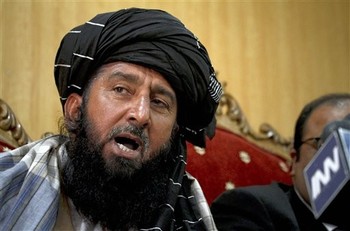
Kareem Khan challenged the precision of drone attacks and specifically questioned the precision of 31st December 2009 attack where in three innocent lives were taken by CIA in a secretive mode. He further challenged that if CIA can establish involvement of any of victims of 31st December attack in terrorism he will pay damages to United States instead.

While talking about the catastrophe he told The Daily Mail how his18 years old son Zaenullah, his young brother Asif Iqbal and a mason who was working on construction of village masque and had came from another village of Khyber Pakhtunkhawa were killed.

Kareem Khan told The Daily Mail that “his family is one of few educated families from the North Waziristan .He himself is M .Phil while his son was employee of Government school in town and his brother was graduate of National University of Modern languages from Islamabad .After compilation of his studies he went back to his town to add his positive contribution in educational uplifting of tribal area. They were innocent Pakistani citizen of Islamic Republic Of Pakistan whose fundamental rights have been guaranteed under the Constitution of Islamic Republic of Pakistan

In the response of one question about the families of victims he told Asif Iqbal left two years old son Muhammad Kafeel and a widow. Mohammad Kafeel has no one to look after as his mother is suffering great emotional and mental trauma. . “I lost my son and brother and now family’s full responsibility is now on me now we are living in uncle’s house waiting for justice or compensation”. He told The Daily Mail

Kareem Khan told the Daily Mail after this tragedy “I went here and there for Justice but all in vain because of undefined and so called system in tribal areas than one of my good friend suggested me to ask for Justice through legal way”. On November 29 2010 I through my lawyer Mirza Shahzad Akbar issued a legal notice to United States Secretary Defence Mr. Robert Gates, Director CIA Leon Panetta CIA Islamabad Station Chief Jonathan Banks for damages of $ 500 Million .he added

He also told that Drone attacks in tribal areas are carried out by CIA in langly, Virginia USA with co-ordination of local intelligence gathered by spies on ground in tribal area. CIA, s Islamabad station Chief, Jonathan Banks coordinates such intelligence through the network of on ground spies, who are paid a hefty amount for pointing out any militant. On these uncorroborated reports, CIA is executing people of tribal areas.

He stated that “CIA Director Leon Panetta has been reported in media saying that ‘Drone attacks are precise and limited in terms of collateral damage’.

“CIA officials are not part of United States armed forces, therefore under international law they are civilians directly participating in hostilities. Furthermore being non-diplomat and non-armed forces members CIA officials, who are operating drone attacks have no immunity and therefore are liable for murder and damages under laws of Pakistan and principles of natural justice throughout the world’ Kareem Khan explained

Kareem Khan also grumbled that media is not playing vibrant role and journalists even don’t bother to find ground realities. Every time we watched in media that numbers of militants are killed in the result of drone attacks. All the time they go for figures they don’t even bother to differentiate the innocent people and militants. Unfortunately they just rely on people who are present there and love to create hype for their own purpose.Kareem Khan gave the example of Hakeem Ullah Mehsood, Jalal Din ,Aimen Alzwari and Sheikh Usamma and told that according to so called reliable sources media published news regarding their, several times deaths . Which is very funny situation because in my limited knowledge a person died once in his or her life .

Shahzad Mirza Akbar ,the legal representative of Kareem khan who was present during the interview told The Daily Mail Drone attacks on house of his client is in clear violation of United Nations declaration of Human Rights ,International Covenant on Civil and Political Rights(ICCRP) and the citizens of Pakistan through the constitution of Islamic Republic of Pakistan .Those who have committed this atrocity are liable to be charged under the Penal Code of Pakistan and no law custom or authority gives CIA the permission to carry out killing in the sovereign territory of another country .So this is illegal act of United States and CIA and cannot be recognized as legal at any judicial or legal forum .The UN special report on extra –judicial ,summery and executions declared in 2004

“Empowering Government to identify and kill “known terrorists” places no verifiable obligation upon them to demonstrate in any way that those against whome lethal force is used are indeed terrorists, or to demonstrate that every other alternative had been exhausted”.

He told Court issued the notice on November 29, 2010 and count down has been started from today .He also talked about next step is to go in American court for justice.

So what’s the story here? Is it about the life of a CIA station chief being placed at risk? Or is it about the struggle among the victims of drone warfare who believe that tribal people should be afforded the same political, legal and human rights and protections as anyone else?

Strangely, the Washington Post and the Wall Street Journal, while acceding to a CIA request not to reprint the station chief’s name, nevertheless provide additional identifying information about him which I have not included here, nor has it appeared in the Pakistani press. That information was, no doubt, provided to them by the CIA!

Facebooktwittermail

The devil’s in the discourse

Nadia Hajib writes:

Three aspects of Secretary of State Hillary Clinton’s Saban Center speech on Friday have escaped general notice. First, though she spoke boldly of asking “tough questions and expecting substantive answers” on the core issues of the conflict, the process will not culminate in a “just, lasting and comprehensive peace” as Clinton claimed, but rather a framework agreement. What is a framework agreement? As defined by United States peace envoy George Mitchell in early September at the short-lived revival of direct Israeli-Palestinian talks, this peculiar American innovation is said to be more than a declaration of principles but less than a full-fledged treaty. It is supposed to establish “the fundamental compromises” that would then be fleshed out in a comprehensive agreement to end the conflict.

This bodes ill for the Palestinians, who have already signed a declaration of principles as well as a dozen other compromise-filled agreements with Israel between 1993 and 2000. Worse, it sounds like they would now be expected to compromise on their right of return, while actual freedom awaits a peace treaty that would then still have to be implemented — who knows when? A second Obama term? Or his successor’s? And meanwhile, Israel would continue to colonize.

Then Clinton, perhaps unwittingly, further exposed the U.S. pretense of even-handedness. She claimed that the Obama administration, like its predecessors, does not accept the “legitimacy of continued settlement activity.” However, some of those predecessors defined all settlements as illegal. This administration’s phrasing, which it has used before, suggests that some settlements are more legitimate than others: it is “continued” activity that is said not to have legitimacy rather than the entire illegal enterprise. This puts the Obama administration in the same camp as George W. Bush, who also supported Israel’s territorial and other ambitions in his April 2004 exchange of letters with former Israeli Prime Minister Ariel Sharon.

Finally, Clinton illustrated how completely the administration has bought into the Israeli discourse. In her eagerness to support an Israel that is both Jewish and democratic, she skated perilously close to racism. She warned that “the long-term population trends that result from the occupation” were endangering the Zionist vision. In other words, that another four million Palestinians might soon demand equal rights in an Israel that has effectively controlled all of mandate Palestine from the Jordan River to the Mediterranean Sea since 1967.

These are murky waters indeed. One cannot imagine a political leader in any real democracy applying the same reasoning to their country. Would U.S. leaders speak of long-term Black, Hispanic, or Muslim population trends that endanger America as a “white and democratic” or as a “Christian” state? In the modern era, democratic states are expected to be constructs in which all citizens are equal under the law, irrespective of race or creed. [Continue reading.]

Facebooktwittermail

If President Obama is sincere …

The Popular Struggle Coordination Committee comments on the Obama administration’s silence on the continued imprisonment of a Palestinian champion of non-violence.

Amid a flurry of European diplomatic attention over the imprisonment of Bil’in’s Abdallah Abu Rahmah, the United States has stayed strangely silent on the issue. Abu Rahmah, a non-violent leader from the West Bank village of Bil’in, has been in an Israeli military jail for over one year stemming from a charge of incitement and illegal protest levied against him after he was arrested in a night raid on his house on December 10th, 2009. After serving his sentence in full, the Israeli military prosecution demanded that he stay in jail while they file an appeal asking for a harsher sentence in order to ‘make an example’ of him.

On Friday, 10 December, AP reporter Matt Lee directly addressed Abdallah Abu Rahmah’s case during a US State Department briefing. US State department spokesman PJ Crowley responded that he was unable to provide a comment on the trial. When Matt Lee pushed, arguing that the EU and other foreign dignitaries had labeled Abu Rahmah a human rights defender, Crowley responded that he will “[find] out what we know.”
At his appeal hearing at the Ofer military court of appeals on 6 December 2010, a dozen European diplomats from France, Spain, the United Kingdom, Germany, Denmark, and Malta were on hand to observe the trial. Sir Vincent Fean gave a short statement to the press, noting his support of EU Foreign Policy Chief Catherine Ashton’s statement labeling Abu Rahmah as a human rights defender. He also pointed out that last month Abu Rahmah had already finished serving his sentence. Last month, British Foreign Minister, William Hague, met with leading Palestinian grassroots organizers in an unprecedented show of support in the face of ongoing Israeli repression.

The current US administration has made repeated statements on the need to support civil society activists, such as the one made by Secretary of State Clinton in July, 2010 the Krakow Community of Democracies meeting, in which she saluted “civil society activists around the world who have recently been harassed, censored, cut off from funding, arrested, prosecuted, even killed.” Clinton explained that when we defend civil society activists “we are defending an idea that has been and will remain essential to the success of every democracy.” She called for action to “protect civil society,” “to do more to defend the freedom of association,” and to “coordinate our diplomatic pressure” “to address situations where freedom of association comes under attack.”

Despite such statements, absent from the diplomatic core were representatives of the United States. In fact, the United States has not yet made any public statements on Abdallah’s imprisonment.

Yesterday, 15 December 2010, the issue of Abu Rahmah was followed up by the AP. Crowley answered that the case is ‘watched closely’ by US representatives in Israel. Far from releasing a statement on Abdallah Abu Rahmah, Crownly confirmed the silent position on Palestinian non-violence that the United States has maintained in recent months.

Facebooktwittermail

How the Afghan counterinsurgency threatens Pakistan

Anatol Lieven writes:

By now, almost all the likely outcomes of US strategy in Afghanistan are bad ones. They range from unending civil war, with government forces barely managing to hold their own against the Taliban, to de facto partition of the country. There is a chance that the Taliban would accept a settlement involving a timetable for the complete withdrawal of US forces and a neutral central government of respected Muslim figures, together with de facto Taliban control of the Pashtun heartland in the south and Western economic aid. In return they would have to promise to exclude Al Qaeda and crack down on opium cultivation in their areas (as they did in 2000).

Given that most ordinary Taliban fighters, as expressed in a survey organized by Graeme Smith of the Toronto Globe and Mail, want the exit of Western troops and a Muslim (but not necessarily Taliban) government, it’s likely that the rejection of such terms by the Taliban leadership would undermine their support on the ground. This solution would, however, be heavily dependent on the help of Pakistan as a mediator and as one of the regional guarantors of the subsequent settlement.

The top leadership of the Afghan Taliban is based in Pakistani Baluchistan under the protection of Pakistani military intelligence, and Pakistan has prevented the United States from launching drone attacks on them there (in contrast with the intensive campaign against targets in the Federally Administered Tribal Areas to the north). Taliban forces use Pakistani territory for rest and recuperation, with the support of the local Pashtun population. Pakistan also has close ties to the two other Afghan Pashtun Islamist forces allied to the Taliban, the Hizb-e-Islami of Gulbuddin Hekmatyar and the Haqqani network in the Afghan region of Greater Paktika. All of this gives Pakistan considerable influence over the Afghan Taliban—though it must be stressed that this influence is also limited. Any settlement brokered by Pakistan would have to be one the Taliban could accept without humiliation.

But if Pakistan is vital to a settlement, Pakistan is also vital in itself. It cannot be emphasized too strongly that the survival of Pakistan, not Afghanistan, is the most important issue for Western and global security in that region. With six times Afghanistan’s population, plus nuclear weapons, a highly trained 500,000-man army and a huge diaspora (especially in Britain), Pakistan would increase the international terrorist threat by orders of magnitude if it collapsed. There is a widespread (though exaggerated) view in the West that the weakness of the Pakistani state and the strength of Islamist support makes the country’s collapse a real possibility. Leaving aside the danger (as exposed by WikiLeaks) of nuclear materials and skills reaching terrorist groups, the disintegration of the Pakistani army, with its highly trained engineers and anti-aircraft forces, would vastly increase the “conventional” terrorist threat to India and the West.

Facebooktwittermail
