Category Archives: Obama administration

Integrity — now you see it, now you don’t

Anyone who believes a resolution to the Israeli-Palestinian conflict hinges on the actions of Barack Obama and Benjamin Netanyahu, might as well turn their attention elsewhere — The moral bankruptcy of both men was on full display at the White House yesterday.

If before engaging in their vacuous performance, they had cared to study what meaningful engagement actually looks like, they could have done nothing better than to witness a recent meeting between two very different men: Haim Bajayo, 75-year old Jew and Hebron’s Palestinian Mayor Khalid Al-Useili.

Ma’an reports:

An elderly Jewish man from Hebron has asked the city’s mayor to permit his burial in a Muslim cemetery when he dies, insisting that his body not be placed in one of the sites now controlled by Israeli settlers.

Haim Bajayo, 75, visited Mayor Khalid Al-Useili at his office in the southern West Bank city and described in detail how Jews and Arabs had generally enjoyed amiable relations until the arrival of tens of thousands of foreign immigrants from the 1920s until 1948, the year Israel was established and most of Hebron’s Jews fled to the new state established in their name.

Bajayo was born in Hebron in 1935 and grew up in its Daboya neighborhood with his family, which owned a home there and held official property documents until 1977. A decade after Israel seized control of the Palestinian city and began permitting its citizens to settle there, Bajayo ceremoniously ceded his home for the benefit of the Palestinian municipality. The mayor at that time was Fahd Al-Qawasmi.

“As long as [the settlers] are in Hebron, there is no chance of reaching an agreement” to end the six-decade conflict, he told the mayor. “I don’t want any of my property or my house back as long as Palestinian homes and lands are not returned. The same day the Palestinians regain what was taken from them in 1948, I’ll come to you and say, ‘I have a house … registered in the real estate department.'”

Facebooktwittermail

Mainstreaming realism

It was widely assumed that George Bush’s departure from Washington would coincide with a revival of strength for the reality-based community — the people the neocons swept aside for the sake of empire. But though the neocon dream was quick to perish, the reality-based community is still struggling to assert itself — at least inside the nation’s capital.

It turns out that Tampa, Florida, where CENTCOM is headquartered (and where General David Petraeus was in charge before being sent to Kabul), is more amenable to the expression of realism.

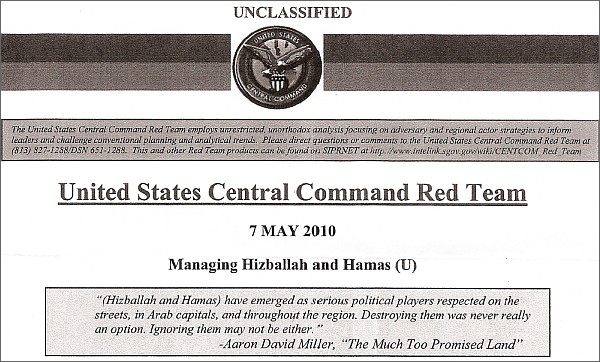
Since its publication in Foreign Policy yesterday, a report by Mark Perry has been causing a stir. In “Red Team — CENTCOM thinks outside the box on Hamas and Hezbollah,” Perry writes:

While it is anathema to broach the subject of engaging militant groups like Hizballah and Hamas in official Washington circles (to say nothing of Israel), that is exactly what a team of senior intelligence officers at U.S. Central Command — CENTCOM — has been doing. In a “Red Team” report issued on May 7 and entitled “Managing Hizballah and Hamas,” senior CENTCOM intelligence officers question the current U.S. policy of isolating and marginalizing the two movements. Instead, the Red Team recommends a mix of strategies that would integrate the two organizations into their respective political mainstreams. While a Red Team exercise is deliberately designed to provide senior commanders with briefings and assumptions that challenge accepted strategies, the report is at once provocative, controversial — and at odds with current U.S. policy.

Among its other findings, the five-page report calls for the integration of Hizballah into the Lebanese Armed Forces, and Hamas into the Palestinian security forces led by Fatah, the party of Palestinian Authority President Mahmoud Abbas. The Red Team’s conclusion, expressed in the final sentence of the executive summary, is perhaps its most controversial finding: “The U.S. role of assistance to an integrated Lebanese defense force that includes Hizballah; and the continued training of Palestinian security forces in a Palestinian entity that includes Hamas in its government, would be more effective than providing assistance to entities — the government of Lebanon and Fatah — that represent only a part of the Lebanese and Palestinian populace respectively” (emphasis in the original). The report goes on to note that while Hizballah and Hamas “embrace staunch anti-Israel rejectionist policies,” the two groups are “pragmatic and opportunistic.”

To call the Red Team report a “deliberately provocative piece” — as Spencer Ackerman describes it — is to misinterpret the intelligence team’s brief in providing what they do call “unorthodox analysis.”

A Red Team’s approach merely attempts to look at an issue from a broader perspective than the one that military culture engenders. The goal, nevertheless, is objectivity. This isn’t simply an exercise in creative thinking.

Consider, for instance, this uncontroversial observation in the report (written before the recent international outcry demanding a swift end to the siege of Gaza):

The hardships in Gaza may be radicalizing more people, especially the young, and increasing the number of potential recruits for HAMAS. This is the opposite effect Israel thought the blockade would have in Gaza, hoping instead that people would see HAMAS as the cause of their suffering and turn against it.

Yet even today while it is clear to rest of the world that Israel’s divide-and-rule strategy in Gaza has failed, Israel’s deputy foreign minister Danny Ayalon wrote on Twitter: “Our position is to differentiate between Hamas, the occupiers of Gaza, and the civilian population.”

Gaza under occupation — by Hamas!

Ayalon might imagine he’s cleverly modifying the concept of “occupation” but the twist will persuade no one in Gaza, which — an ease to the restrictions on the flow of goods notwithstanding — remains the world’s largest prison.

Indeed, the seeming intransigence of Hamas has been in response to this very fact: that the reward for the moderation that the Palestinian Authority has already exhibited and in whose footsteps Hamas is being implored to follow is not self determination but an occupation with no end in sight. In this respect, Hamas, far from representing the extreme position it is claimed to hold, exhibits a sober realism, which is to say, it sees little evidence that concessions by Palestinians are matched with concessions by Israel.

CENTCOM’s Red Team may have concerned themselves only with the issue of “mainstreaming” Hamas and Hezbollah yet the possibility of that happening may depend less on the internal workings of each Islamist organization and more on the extent to which realism can be mainstreamed inside Washington.

The Obama administration’s support for the Supreme Court’s recent ruling in favor of a ridiculously broad interpretation of the meaning of “material support” (as applied to so-called Foreign Terrorist Organizations and thus both Hamas and Hezbollah) is not a promising sign.

Facebooktwittermail

The limits of American power are like the borders of Israel

For much of the last decade, Rory Stewart has provided one of the wisest voices on Afghanistan. A theme he pounds away at relentlessly is the necessity to differentiate between what is desirable and what is possible.

Stewart, now a newly minted member of Britain’s parliament, writes in Der Spiegel:

The only way in which we could move beyond the counter-insurgency theory, or the hundred other theories which buttress and justify the Afghan war, is by rejecting their most basic underlying premises and objectives. Instead of trying to produce an alternative theory (on how to defeat the Taliban, create an effective, legitimate and stable Afghan state, stabilize Pakistan and ensure that al-Qaida could never again threaten the United States) we need to understand that however desirable such things might be, they are not things that we — as foreigners — can do.

We can do other things for Afghanistan but the West — in particular its armies, development agencies and diplomats — are not as powerful, knowledgeable or popular as we pretend. Our officials cannot hope to predict and control the intricate allegiances and loyalties of Afghan communities or the Afghan approach to government. But to acknowledge these limits and their implications would require not so much an anthropology of Afghanistan, but an anthropology of ourselves.

The cures for our predicament do not lie in increasingly detailed adjustments to our current strategy. The solution is to remind ourselves that politics cannot be reduced to a general scientific theory, that we must recognize the will of other peoples and acknowledge our own limits. Most importantly, we must remind our leaders that they always have a choice.

As simple as this message is, it is one that is virtually impossible for American leaders to hear, and even among those who grasp its truth it remains hard to bluntly acknowledge the fact.

The limits of American power are like the borders of Israel — reaching into terrain impossible to control yet just as difficult to relinquish.

And the struggle to adjust to reality is for Americans just as hard as it is for Israelis, since it depends on a resource severely depleted in both nations: humility.

Facebooktwittermail

Grave injustice: Maher Arar and unaccountable America

At Middle East Report Online, Lisa Hajjar writes:

On June 14, the Supreme Court buried the prospect of justice for Maher Arar, a Canadian citizen of Syrian origin who was “extraordinarily rendered” by the United States (via Jordan) to Syria in 2002. Arar was suing the US officials who authorized his secret transfer, without charge, to a country infamous for torture. With the justices’ 22-word statement, the case of Arar v. Ashcroft exited the American legal system and entered the annals of American legal history under the category “grave injustice.” Alphabetically, Arar precedes Dred Scott v. Sanford, which upheld slavery, and Korematsu v. United States, which upheld the internment of Japanese Americans. In this case, however, the grave is literal: Arar spent ten months of his year in Syrian custody confined in what he describes as “an underground grave.”

Facebooktwittermail

Obama about to get tough with Netanyahu?

Preemptive reporting of news that has yet to happen is an irritating phenomenon in and of itself. Accounts about policy statements that yet to be released or about meetings that have yet to take place are transparent ways in which journalists allow themselves to be led by officials who believe that it is a government’s right to control the way its actions are described.

But then there’s a special class of preemptive reporting — reporting things that could conceivably happen but will be less likely to happen if a report itself then prompts a denial. For instance, staff for the Israeli prime minister could describe to an Israeli journalist the worst case scenario of what might result in the upcoming Obama-Netanyahu meeting in the White House. The Israel lobby, duly alerted, will then kick into gear and force White House staff to placate their fears before the meeting has even occurred.

Of course I have no way of knowing whether the following report from Yediot Ahronoth is example of such conniving, but it certainly sounds like it. A translation of the Hebrew article comes from Didi Remez:

The lifting of the blockade on the Gaza Strip and permission for Palestinians to leave the Gaza Strip freely through Israeli border crossings. These are the unequivocal demands that President Barack Obama is expected to make during his meeting with Prime Minister Binyamin Netanyahu in the White House in two weeks.

If anyone thought that lifting the economic blockade of the Gaza Strip would satisfy the Americans, it is now clear to them that is only the beginning. Reliable sources who have been apprised of the preparations that the White House is making for the meeting between Obama and Netanyahu revealed that the demands are much more significant. While Obama voiced his satisfaction with the relief measures that Israel announced, he believes that the situation in which more than a million and a half inhabitants of the Gaza Strip are living is intolerable.

The American president is particularly angry that the inhabitants are not free to leave the Gaza Strip. He sees that as a kind of “collective punishment.” Political sources say that Netanyahu, who has chosen not to change the situation with the Gaza Strip, now finds himself under a great deal of international pressure and must act under pressure from the United States.

Obama also intends to examine the issue of extending the construction freeze with Netanyahu. It may be assumed that Netanyahu will make a continuation of the construction freeze conditional upon going over to direct talks with Abu Mazen.

But considering the firm demands to be made in the private meetings, White House officials are planning quite a warm reception for Netanyahu. Obama’s advisers are preparing quite a few “photo ops” in which the president and Netanyahu will be seen together in public. According to the plan, they will go out into the Rose Garden, which overlooks Obama’s office, where they will answer questions from the media.

Reliable sources say that one of the reasons for the special effort is requests from Jewish Democrats running in the interim Congressional elections this coming November, who are urging the White House to provide them with “friendly pictures” of Obama and Netanyahu.

So all the lobby needs is a few friendly pictures? No way!

Facebooktwittermail

The Obama administration adopts an imperious tone with Turkey

Philip H Gordon is the US Assistant Secretary of State at the Bureau of European and Eurasian Affairs. He sat down with an AP reporter this week to talk about Turkey.

Turkey is alienating US supporters and it needs to demonstrate its commitment to partnership with the West, Gordon says. “We think Turkey remains committed to NATO, Europe and the United States, but that needs to be demonstrated,” he said. “There are people asking questions about it in a way that is new, and that in itself is a bad thing that makes it harder for the United States to support some of the things that Turkey would like to see us support.”

“There are people…” Gordon say. And those people would be? Oh yeah — members of the United States Congress who serve at the pleasure of the Israel lobby.

Gordon cited Turkey’s vote against a U.S.-backed United Nations Security Council resolution on new sanctions against Iran and noted Turkish rhetoric after Israel’s deadly assault on a Gaza-bound flotilla last month. The Security Council vote came shortly after Turkey and Brazil, to Washington’s annoyance, had brokered a nuclear fuel-swap deal with Iran as an effort to delay or avoid new sanctions.

Some U.S. lawmakers who have supported Turkey warned of consequences for Ankara since the Security Council vote and the flotilla raid that left eight Turks and one Turkish-American dead. The lawmakers accused Turkey of supporting a flotilla that aimed to undermine Israel’s blockade of Gaza and of cozying up to Iran.

The raid has led to chilling of ties between Turkey and Israel, countries that have long maintained a strategic alliance in the Middle East.

Turkey’s ambassador to the United States, Namik Tan, expressed surprise at Gordon’s comments. He said Turkey’s commitment to NATO remains strong and should not be questioned.

“I think this is unfair,” he said.

Tan said Turkish officials have explained repeatedly to U.S. counterparts that voting against the proposed sanctions was the only credible decision after the Turkish-brokered deal with Iran. Turkey has opposed sanctions as ineffective and damaging to its interests with an important neighbor. It has said that it hopes to maintain channels with Tehran to continue looking for a solution to the standoff over Iran’s alleged nuclear arms ambitions.

“We couldn’t have voted otherwise,” Tan said. “We put our own credibility behind this thing.”

Tan said that Turkish Prime Minister Recep Tayyip Erdogan was expected to discuss these issues with President Barack Obama on the margins of a summit of world economic powers in Toronto on Saturday.

Gordon said Turkey’s explanations of the U.N. episode have not been widely understood in Washington.

“There is a lot of questioning going on about Turkey’s orientation and its ongoing commitment to strategic partnership with the United States,” he said. “Turkey, as a NATO ally and a strong partner of the United States not only didn’t abstain but voted no, and I think that Americans haven’t understood why.”

Just two weeks ago, before Gordon decided his primary duty was to placate the Israel lobby, in an interview with the BBC he rejected the suggestion that the US and Turkey have become strategic competitors in the Middle East.

“I think the United States and Turkey remain strategic partners,” he said. “We have so many interests in common. We can have disagreements, and there are things we disagree on, not least the vote on Iran at the United Nations. Throughout that process we have been frank with each other about our differences. We’ve explained to them why we think it was important for countries to vote yes in the Iran resolution. They have explained to us why they think the Tehran declaration was something worth pursuing. And we’ve explained to them what we think the shortcomings are. That’s what friends and partners do.”

But can friends be so overbearing that they issue demands for a demonstration of commitment to their partnership?

The US wants Turkey to help advance America’s agenda in the Middle East. Is the Obama administration helping advance Turkey’s agenda in the region? Turkey after all is now in a much stronger position to promote regional stability than any of its Western tutors.

As deeply in debt as the United States is, there is one currency that it can use without fear of ever running short and it’s a currency whose value is appreciated in every corner of the globe. It’s called respect. A little goes a long way.

Facebooktwittermail

Idiocy holds sway on the Supreme Court and inside the Obama administration

It seems hard to fathom but the evidence is now overwhelming: if someone repeats the word “terrorist” often enough their brain will become functionally useless.

Consider the Supreme Court’s decision on Monday in support of the Obama administration’s sweeping definition of “material support” as applied to so-called Foreign Terrorist Organizations (FTO) — a designation applied by the State Department.

If an NGO such as the Humanitarian Law Project (HLP) wants to train a group such as the Kurdistan Workers’ Party (PKK) on how to use humanitarian and international law to peacefully resolve disputes, then the HLP risks criminal prosecution. Why? Such training could help legitimize the PKK and also free up resources that it can dedicate to its terrorist activities.

Solicitor General Elena Kagan (who is nominated to become a Supreme Court Justice) argued the case for the Obama administration.

Kay Guinane described the decision:

The Court ruled that even though pure speech is entitled to a high level of constitutional scrutiny, it would forgo such scrutiny and defer to Congress and the executive branch, which asserted unsupported, theoretical findings that support aimed at countering violence can somehow indirectly support violence. The Court’s reasoning was that the matter involves national security.

With its overly deferential approach, the Court failed to fulfill its responsibilities in the checks-and-balances system that keeps our democracy healthy. If it had looked behind the broad generalizations cited by the government, it would have seen there are no facts either in the Congressional Record or elsewhere that support the Congressional or State Department “findings.” And even if there are some circumstances where conflict mediation and human rights training can be co-opted to support violence, it is not inevitable that it will happen in all cases.

For an obvious example of the fault in the findings, one need look no further than the Good Friday Accords that brought a lasting peace to Northern Ireland for the first time in more than eight centuries. For years, non-governmental organizations (NGOs) had worked to bring violent factions of Catholics and Protestants to the bargaining table. Their work behind the scenes was instrumental in persuading those groups — “terrorists” in the eyes of most of their captive civilian populations, as well as the governments seeking to disarm them — to put down their weapons and negotiate a peaceful resolution to 850 years of violence.

If the “material support” law had been in place, as authorized by the Supreme Court today, those organizations would have been criminals. And the people of Northern Ireland would likely still be victims of sectarian violence that only a very few supported.

“Orwellian” doesn’t begin to describe a law that makes it a crime to promote peaceful conflict resolution.

If the administration actually intends to uphold the law in the way they argue it should be applied, then the Israeli-Palestinian conflict can be expected to continue forever.

There is a rather broad consensus among foreign policy analysts in the US and Europe, that Hamas, a designated FTO, has far too much grassroots political support among ordinary Palestinians for the organization to be destroyed. Neither Israel’s war on Gaza nor it’s internationally supported siege of Gaza, succeeded in bringing the Islamist organization and democratically-elected government to its knees.

If the Obama administration wants to revive the Middle East peace process, sooner or later Hamas will have to be involved. It’s hard if not impossible to anticipate that those involved in the initial efforts to open dialogue with Hamas can avoid falling foul of the broad definition of “material support” that the Supreme Court has just upheld.

The Obama administration told the Supreme Court that the United States is engaged in an effort to “delegitimize and weaken” groups such as Hamas, yet it would behoove Washington and democratic governments everywhere to remember where political legitimacy springs from: not idiotic Supreme Court rulings, but the will of the people — and that includes the Palestinians.

Facebooktwittermail

Was McChrystal ready to get pushed out?

The problem with owning a military strategy the way Gen Stanley McChrystal owned the counterinsurgency strategy at the center of the war in Afghanistan, is that it’s hard to admit it’s not working. It might be easier just to get fired.

Are we really supposed to believe that McChrystal knew so little about journalism or the magazine that he couldn’t have anticipated what kind of material would end up in his Rolling Stone profile? And more to the point, is it conceivable that another story from just two years ago somehow escaped his attention: the Esquire profile of Admiral William Fallon that led to his swift resignation?

On some level, most indiscretions can be seen as a loss of faith.

Meanwhile, in a short follow up to profile that toppled McChrystal, Michael Hastings writes at Rolling Stone:

President Obama, in announcing the replacement of Gen. Stanley McChrystal moments ago, sought to reassure the American people about the war in Afghanistan. “This is a change in personnel,” he declared, “but not a change in policy.”

That’s precisely the problem.

Changing generals isn’t likely to resolve the real trouble in Afghanistan: the fundamental flaws in the U.S. strategy of counterinsurgency.

So why did the president pick David Petraeus, the most political — and media-savvy — general of his generation, to replace McChrystal? Petraeus makes sense. He’s considered the hero of Iraq, and he has the public’s trust. He won’t be caught dead calling the offensive in Marja a “bleeding ulcer,” as McChrystal did. His appointment neutralizes him as a potential (though highly unlikely) political rival for 2012. He literally wrote the book on counterinsurgency, drafting the Army field manual on the U.S. strategy that is being pursued in Afghanistan. Above all, he is a master at crafting a narrative that Americans are eager to hear. He has almost single-handedly convinced many Washington insiders that his “surge” in Iraq resulted in some kind of major victory in Mesopotamia — a notion that is right up there with thinking that Pizza Hut has good pizza.

Here is the narrative we’re about to be sold: Things will be tough in Afghanistan. It’s going to get worse before it gets better. But eventually, with good old American perseverance, violence will drop (fingers crossed). When that happens, U.S. soldiers will stop dying in large numbers — and Americans will stop paying attention in large numbers.

Thomas Barnett, whose Esquire profile led to Admiral Fallon’s undoing, suggests that Petraeus will now have a bigger say in the conduct of the war than does his own commander in chief:

If Petraeus says the strategy needs more time, then Obama’s running for re-election as a wartime president. Period. There’s just no way that Obama can overrule Petraeus on this one without wounding himself politically. McChrystal had been signaling that Obama’s summer 2011 deadline to begin withdrawing combat troops was too optimistic. Expect Petraeus to press that case — however subtly — from day one.

Facebooktwittermail

McChrystal gets the boot

I guess they just couldn’t figure out the seating chart for this morning’s meeting of the national security team in the Situation Room.

Have McChrystal sit between Gen “Clown” Jones and Richard “Wounded Animal” Holbrooke?

Instead, after meeting President Obama for 30 minutes, McChrystal returned to his home in Ft. McNair, Washington, D.C. He is being replaced by Gen David Petraeus.

The Wall Street Journal reports:

The decision to put Gen. Petraeus in command sends a signal that the president stands behind the counterinsurgency tactics pushed hard by Gen. McChrystal and championed by Gen. Petraeus.

Mr. Obama said his acceptance of Gen. McChrystal’s recommendation didn’t reflect a disagreement about strategy or personal insult. “We are in full agreement about our strategy,” he said Wednesday, expressing “great admiration” for the general.

“But war is bigger than any one man,” Mr. Obama said. He said the change was necessary to maintain a “unity of effort” in Afghanistan. “I welcome debate among my team, but I won’t tolerate division.”

As for sentiment among US troops on the ground, that might have been best summed up by a US Marine at Combat Outpost Hanson in Marjah:

A lance corporal from Denver explains that political news tends to trickle down slowly among Marines with limited access to the Internet, newspapers and other creature comforts readily available at rear bases. “Half of these guys don’t even know why we’re here in the first place,” he said with a laugh.

Facebooktwittermail

America’s war and its illusive heroes

The Russian mystic, Gurdjieff, is said to have advised that if a spiritual seeker wants to guard his faith, he should avoid getting too close to a saint. Perfection can rarely withstand close scrutiny.

The same can be said of war heroes.

The legend of General Stanley McChrystal has been years in the making, but even now, at a moment when he has in his own words “compromised the mission,” there are aspects of his character that for the very same reasons that they cause him trouble also burnish his image as an American hero — the kind captured in the US Army’s ridiculous (and short-lived) slogan “Army of One.”

In a passage of his Rolling Stone profile, Michael Hastings recounts a scene where McChrystal and his badboy comrades let it all hang out during a fraternity-style rebellion. They are up against the stiff cultural challenges presented by Paris nightlife with its “Gucci” restaurants — “Gucci” in McChrystal’s mind is apparently an all-purpose metaphor for what to his eye are Europe’s aristocratic affectations.

The night after his speech in Paris, McChrystal and his staff head to Kitty O’Shea’s, an Irish pub catering to tourists, around the corner from the hotel. His wife, Annie, has joined him for a rare visit: Since the Iraq War began in 2003, she has seen her husband less than 30 days a year. Though it is his and Annie’s 33rd wedding anniversary, McChrystal has invited his inner circle along for dinner and drinks at the “least Gucci” place his staff could find. His wife isn’t surprised. “He once took me to a Jack in the Box when I was dressed in formalwear,” she says with a laugh.

The general’s staff is a handpicked collection of killers, spies, geniuses, patriots, political operators and outright maniacs. There’s a former head of British Special Forces, two Navy Seals, an Afghan Special Forces commando, a lawyer, two fighter pilots and at least two dozen combat veterans and counterinsurgency experts. They jokingly refer to themselves as Team America, taking the name from the South Park-esque sendup of military cluelessness, and they pride themselves on their can-do attitude and their disdain for authority. After arriving in Kabul last summer, Team America set about changing the culture of the International Security Assistance Force, as the NATO-led mission is known. (U.S. soldiers had taken to deriding ISAF as short for “I Suck at Fighting” or “In Sandals and Flip-Flops.”) McChrystal banned alcohol on base, kicked out Burger King and other symbols of American excess, expanded the morning briefing to include thousands of officers and refashioned the command center into a Situational Awareness Room, a free-flowing information hub modeled after Mayor Mike Bloomberg’s offices in New York. He also set a manic pace for his staff, becoming legendary for sleeping four hours a night, running seven miles each morning, and eating one meal a day. (In the month I spend around the general, I witness him eating only once.) It’s a kind of superhuman narrative that has built up around him, a staple in almost every media profile, as if the ability to go without sleep and food translates into the possibility of a man single-handedly winning the war.

By midnight at Kitty O’Shea’s, much of Team America is completely shitfaced. Two officers do an Irish jig mixed with steps from a traditional Afghan wedding dance, while McChrystal’s top advisers lock arms and sing a slurred song of their own invention. “Afghanistan!” they bellow. “Afghanistan!” They call it their Afghanistan song.

McChrystal steps away from the circle, observing his team. “All these men,” he tells me. “I’d die for them. And they’d die for me.”

Bands of brothers always impress each other with their willingness to engage in seemingly heroic acts of self-sacrifice. They also often allow the power of solidarity to dissolve the strength of individual judgement.

McChrystal may well suffer the affliction of every cult leader: that the mutual psychological reinforcement provided by a closed social system inside which one individual becomes idealized, is that the guru becomes blind to his own failings. In turn these failings become amplified because they engender no social penalty among a circle of uncritical admirers.

President Obama now has a problem. Interestingly, the most useful lifeline he’s been presented comes from the Afghan government which sees McChrystal as an ally. President Karzai’s spokesman Waheed Omer says that at this critical juncture “we hope that there is not a change of leadership in the international forces here in Afghanistan.”

If Obama wants to creatively change the subject then he could turn it into an opportunity to implement not merely a structural or strategic adjustment to a war that’s going nowhere. He could initiate a paradigm shift.

Just suppose the war in Afghanistan was approached from a radically new perspective: as though Afghanistan and its people matter.

It’s Afghanistan, stupid — not the war.

Change the subject from the war to Afghanistan and McChrystal is no longer this gigantic figure.

The central issue should be: what will best serve the interests of Afghanistan?

Any American who asks that question should in the very asking, have the humility and intelligence to recognize that, by definition, this is not a question an American can answer. What we can reasonably hope is that if we are ultimately seen as having served this troubled nation’s greater interests, this will also serve our own interests. The key, though, is to abandon the missionary’s conceit: that we know better.

The lesson of a decade of war should be that when it comes to Afghanistan we have learned next to nothing.

As Winston Churchill said: “Americans can always be counted on to do the right thing… after they have exhausted all other possibilities.”

Facebooktwittermail

Maverick McChrystal out of line again

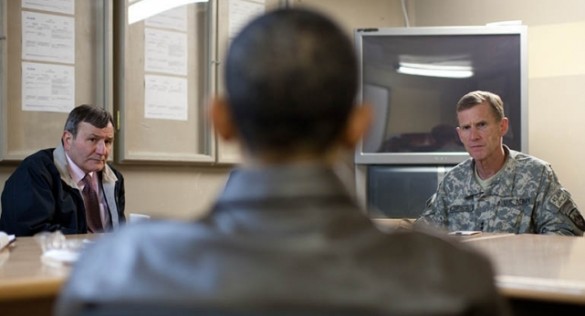
Gen Stanley McChrystal looks bemused at the sight of President Obama in a bomber jacket during a surprise visit to Afghanistan in March, 2010.

A Rolling Stone profile of Gen Stanley McChrystal due out on Friday “was a mistake reflecting poor judgment and it should have never happened,” the commander of US forces in Afghanistan now says.

It was a mistake to say what he and his staff said, or it was a mistake to make these remarks in the presence of a journalist?

The incident reveals the ambivalence Americans feel when it comes to the institutional power at the center of American democracy. Whatever keeps the wheels of Washington working smoothly, it isn’t candor.

Coming as I do from a country that has a real and ancient monarchy (for which I have little respect), during twenty-some years in the United States I’ve always viewed this country’s republican credentials with a certain measure of skepticism.

If at its conception America cast aside regal authority because of an unambiguous faith in the power of the people, why is it that so many Americans have such a gooey-eyed fascination with British royalty? Why the obsession with another form of royalty: celebrity? Why, in a supposedly egalitarian society, is such a high value attached to very visible displays of social status?

Americans seem to have had less interest in completely abandoning rule by a monarch than in modifying regal power and repackaging it in the quasi-regal institution of the presidency.

Having been crowned, a president always remains a president — even once out of office. He lives in a little palace, can never move around without being surrounded by a huge entourage of somewhat venal and sycophantic characters. And as in all forms of palace politics, those individuals who have wormed their way close to the center of power will do whatever they can to protect the status of the institution as they make frequent expressions of obeisance to the king-president.

But the concentration of power always involves the consolidation of power and so a president, just like any king, always needs to be on his guard, aware that one of his dukes or generals might pose a challenge.

Enter, Gen Stanley McChrystal.

McChrystal isn’t trying to stage a coup but he’s a repeat offender when it comes to upholding the most important principle in regal politics: never undermine the authority of the monarch or his highest officers.

National Security Adviser, Gen James Jones is a “clown.” Senior envoy Richard Holbrooke is a “wounded animal.” Joe Biden is “Bite me.” This is not language that can be uttered louder than a whisper in any palace.

As McChrystal heads to Washington for yet another dressing down, there’s one thing we can be sure of: President Obama won’t be wearing a bomber jacket when he lectures his top general. He’ll simply relying on the power of his throne — the Oval Office.

In his Rolling Stone profile of McChrystal, Michael Hastings writes:

The general prides himself on being sharper and ballsier than anyone else, but his brashness comes with a price: Although McChrystal has been in charge of the war for only a year, in that short time he has managed to piss off almost everyone with a stake in the conflict. Last fall, during the question-and-answer session following a speech he gave in London, McChrystal dismissed the counterterrorism strategy being advocated by Vice President Joe Biden as “shortsighted,” saying it would lead to a state of “Chaos-istan.” The remarks earned him a smackdown from the president himself, who summoned the general to a terse private meeting aboard Air Force One. The message to McChrystal seemed clear: Shut the fuck up, and keep a lower profile

Now, flipping through printout cards of his speech in Paris [in mid-April], McChrystal wonders aloud what Biden question he might get today, and how he should respond. “I never know what’s going to pop out until I’m up there, that’s the problem,” he says. Then, unable to help themselves, he and his staff imagine the general dismissing the vice president with a good one-liner.

“Are you asking about Vice President Biden?” McChrystal says with a laugh. “Who’s that?”

“Biden?” suggests a top adviser. “Did you say: Bite Me?”

When Barack Obama entered the Oval Office, he immediately set out to deliver on his most important campaign promise on foreign policy: to refocus the war in Afghanistan on what led us to invade in the first place. “I want the American people to understand,” he announced in March 2009. “We have a clear and focused goal: to disrupt, dismantle and defeat Al Qaeda in Pakistan and Afghanistan.” He ordered another 21,000 troops to Kabul, the largest increase since the war began in 2001. Taking the advice of both the Pentagon and the Joint Chiefs of Staff, he also fired Gen. David McKiernan – then the U.S. and NATO commander in Afghanistan – and replaced him with a man he didn’t know and had met only briefly: Gen. Stanley McChrystal. It was the first time a top general had been relieved from duty during wartime in more than 50 years, since Harry Truman fired Gen. Douglas MacArthur at the height of the Korean War.

Even though he had voted for Obama, McChrystal and his new commander in chief failed from the outset to connect. The general first encountered Obama a week after he took office, when the president met with a dozen senior military officials in a room at the Pentagon known as the Tank. According to sources familiar with the meeting, McChrystal thought Obama looked “uncomfortable and intimidated” by the roomful of military brass. Their first one-on-one meeting took place in the Oval Office four months later, after McChrystal got the Afghanistan job, and it didn’t go much better. “It was a 10-minute photo op,” says an adviser to McChrystal. “Obama clearly didn’t know anything about him, who he was. Here’s the guy who’s going to run his fucking war, but he didn’t seem very engaged. The Boss was pretty disappointed.”

Facebooktwittermail

US-Israeli relations improve — time to bulldoze Palestinian homes

Since US-Israeli relations are so famously cozy, maybe it’s time to extend the familial metaphor a bit further: Washington is a victim of domestic violence.

Every time the Obama administration reaches out to the Netanyahu government, it gets slapped in the face. Netanyahu has once again been invited to Washington — due to the poorly-time Mavi Marmara massacre he had to bail on a visit planned for early this month. He’s now due for his long-awaited kiss and make up session at the White House on July 6. But true to form, as soon as this was announced, word came from Jerusalem that 22 Palestinian homes are going to be bulldozed to clear space for a tourist center.

Another diplomatic snafu? On the contrary. These unfortunate “coincidences” have become so predictable that it’s hard to interpret them in any other way than as a calculated effort by Israeli officials to humiliate their American counterparts.

Just as some victims of serial abuse collude with their abuser by finding ways to excuse their partner’s violence, Washington’s tolerance of treatment that would be unthinkable coming from any other ally, is perpetually excused when the offending nation is Israel.

Haaretz now reports:

The Jerusalem municipal planning committee approved Monday a contentious plan to raze 22 Palestinian homes to make room for a tourist center that Palestinians fear would tighten Israel’s grip on the city’s contested eastern sector.

Jerusalem mayor Nir Barkat has asked the municipal planning committee earlier Monday to give preliminary approval to the plan which affects the neighborhood of Silwan in East Jerusalem, and risks more U.S.-Israeli friction.

Tensions have already been raised in Jerusalem, when conflict erupted during the meeting between committee members and the residents of Silwan. Silwan residents starkly objected to the plan and demanded the committee discuss their alternative plan, which does not include razing homes.

What will the White House say? That this is “unhelpful”? Hillary Clinton has already expressed her “dismay and disappointment.”

Just as the expansion of Jewish settlements on Palestinian land has been relentless, the Israeli assault on Washington perpetually expands the boundaries of impunity. The notion that Israel might go too far in testing the limits of American tolerance is repeatedly invalidated as Washington demonstrates that its diplomatic tool box is equipped with nothing more threatening than the occasional harsh word — and even those are in short supply and never particularly harsh.

Facebooktwittermail

Entering the Soviet era in America

As President Obama addressed the nation last night, he employed the impoverished language of a nation for which all things must supposedly be seen in terms of war. He spoke of “the battle we’re waging against an oil spill that is assaulting our shores and our citizens.”

“We will fight this spill with everything we’ve got for as long as it takes,” Obama said unconvincingly invoking a Churchillian spirit for tackling this sticky foe. He then laid out his “battle plan.”

It’s not that war is inherently a useless metaphor, but, to borrow one of Tom Engelhardt’s favorite expressions and the title of his new book, when it comes to the American way of war, war now has all the wrong connotations.

War spreads, is expensive, messy, difficult to end and difficult to justify. If the Obama administration claims it’s fighting a war against an oil spill, why exactly at this point in America’s history are we now supposed to have confidence in America’s war-fighting capabilities?

It seems that the path of war that America’s leaders persistently tread is a path they continue down (whether literally or metaphorically) not because they have confidence in reaching a desirable destination but because this has become the only path they know.

In this respect, as Tom Engelhardt points out, the United States is now following resolutely in the footsteps of the Soviet Union.

Mark it on your calendar. It seems we’ve finally entered the Soviet era in America.

You remember the Soviet Union, now almost 20 years in its grave. But who gives it a second thought today? Even in its glory years that “evil empire” was sometimes referred to as “the second superpower.” In 1991, after seven decades, it suddenly disintegrated and disappeared, leaving the United States — the “sole superpower,” even the “hyperpower,” on planet Earth — surprised but triumphant.

The USSR had been heading for the exits for quite a while, not that official Washington had a clue. At the moment it happened, Soviet “experts” like Secretary of Defense Robert Gates (then director of the CIA) still expected the Cold War to go on and on. In Washington, eyes were trained on the might of the Soviet military, which the Soviet leadership had never stopped feeding, even as its sclerotic bureaucracy was rotting, its economy (which had ceased to grow in the late 1970s) was tanking, budget deficits were soaring, indebtedness to other countries was growing, and social welfare payments were eating into what funds remained. Not even a vigorous, reformist leader like Mikhail Gorbachev could staunch the rot, especially when, in the late 1980s, the price of Russian oil fell drastically.

Looking back, the most distinctive feature of the last years of the Soviet Union may have been the way it continued to pour money into its military — and its military adventure in Afghanistan — when it was already going bankrupt and the society it had built was beginning to collapse around it. In the end, its aging leaders made a devastating miscalculation. They mistook military power for power on this planet.

Facebooktwittermail

Credibility, once shredded, is impossible to piece together again

“The man who ordered the attack on the aid flotilla to Gaza, set up the inquiry, chose its members and determined its mandate, has announced its outcome even before it has started,” wrote Chris Doyle, noting Benjamin Netanyahu’s visible satisfaction, confident that he has mounted an effective response to international pressure.

If the only audience the Israeli prime minister needed to satisfy was made up by the likes of Jeremy Ben-Ami and Barack Obama, Netanyahu could indeed take satisfaction as he proves how easy it is to win unprincipled support.

On the day of the Mavi Marmara massacre, J Street’s president Ben-Ami issued a statement which included this:

There will undoubtedly be calls in the coming days for a UN investigation into today’s events. A credible, independent commission appointed by the Israeli government should provide the world with a full and complete report into the causes and circumstances surrounding the day’s events and establish responsibility for the violence and bloodshed.

The world? And which world would that be?

There is nothing mysterious about the nature of credibility, but if the Israeli government and members of the pro-Israel lobby and the Obama administration assign themselves the exclusive role of being the arbiters of “credibility” then the term as applied has itself lost credibility.

The real arbiters of credibility have to include the Turkish government and the Turkish people. In its May 31 statement and a statement issued yesterday, J Street makes no reference to them.

Indeed, echoing those who see all Israeli violence as justifiable we hear J Street repeat the mantra, Israel has the right to self-defense.

Given that there has not been a single call for Israel to renounce its right to self-defense, this reiteration of Israel’s “defensive” posture implicitly endorses the claim that the attack on the Mavi Marmara in international waters was itself an act of self-defense.

The New York Times editorial board — not renowned for its political courage — managed to be bold enough to say that on this matter Israel cannot simply investigate itself. The paper has called for an inquiry overseen by The Quartet and says that Israeli and Turkish representation would have to be included: “That is in Israel’s clear interest. And it is in Turkey’s clear interest. The Obama administration should be pressing both its allies to embrace the idea.”

Anyone who now holds the position that this is Israel’s business and Israel can somehow impartially investigate itself, apparently regards the families of the dead as irrelevant.

But as an editorial in Haaretz makes clear, a move by Netanyahu that J Street, the Obama administration and other Israeli apologists have welcomed, does not meet the credibility test even inside Israel.

The government’s efforts to avoid a thorough and credible investigation of the flotilla affair seem more and more like a farce. The conclusions of an ostensible probe are intended to justify retroactively the decision to blockade Gaza, to forcibly stop the Turkish aid flotilla in international waters and to use deadly force on the deck of the Mavi Marmara.

To make the costume seem credible, the Prime Minister’s Bureau asked a retired Supreme Court justice, Yaakov Tirkel, to chair the committee. Alongside him will sit foreign observers in order to legitimize the conclusions in international public opinion. Prime Minister Benjamin Netanyahu even pledged to testify before the committee, together with Defense Minister Ehud Barak, other ministers and the chief of staff, so “the truth will come out.”

The truth that Netanyahu wishes to bring out involves the identity of the flotilla’s organizers, its sources of funding and the knives and rods that were brought aboard. He does not intend to probe the decision-making process that preceded the takeover of the ship and the shortcomings that were uncovered. As far as Netanyahu is concerned, it will be enough for television channels to broadcast footage of dark-suited jurists, and politicians addressing them, to present the semblance of an “examination.”

But Netanyahu’s panel will have no powers, not even those of a government probe, and its proposed chairman does not believe in such a panel. In an interview to Army Radio, Tirkel said there is no choice but to establish a state committee of inquiry. He opposed bringing in foreign observers and made clear that he is not a devotee of drawing conclusions about individuals and dismissing those responsible for failures. When a Haaretz reporter confronted Tirkel about these remarks, the former justice evaded the question saying, “I don’t remember what I said.”

The disagreements that erupted at the week’s end between Netanyahu and his deputy, Strategic Affairs Minister Moshe Ya’alon, over the question of whether Ya’alon was updated in time about the action underscored the suspicion of serious faults in the decision-making process with regard to the flotilla. Instead of being part of the whitewash, Tirkel, whose dodging of his earlier statements does him no honor, should return his mandate to the prime minister and demand that Netanyahu establish a government committee of inquiry with real powers. The public, as Netanyahu said, has a right to know the truth.

Facebooktwittermail

The latest threat to Afghanistan’s existence

Ask a foreigner what Afghans most need and he’s most likely to say: to escape from poverty. Ask an Afghan and he’s more likely to say: to escape from foreign interference.

The latest news from Afghanistan is no cause for celebration. The New York Times reports:

The United States has discovered nearly $1 trillion in untapped mineral deposits in Afghanistan, far beyond any previously known reserves and enough to fundamentally alter the Afghan economy and perhaps the Afghan war itself, according to senior American government officials.

The previously unknown deposits — including huge veins of iron, copper, cobalt, gold and critical industrial metals like lithium — are so big and include so many minerals that are essential to modern industry that Afghanistan could eventually be transformed into one of the most important mining centers in the world, the United States officials believe.

An internal Pentagon memo, for example, states that Afghanistan could become the “Saudi Arabia of lithium,” a key raw material in the manufacture of batteries for laptops and BlackBerrys.

The vast scale of Afghanistan’s mineral wealth was discovered by a small team of Pentagon officials and American geologists. The Afghan government and President Hamid Karzai were recently briefed, American officials said.

While it could take many years to develop a mining industry, the potential is so great that officials and executives in the industry believe it could attract heavy investment even before mines are profitable, providing the possibility of jobs that could distract from generations of war.

After all, who wants fight a holy war when you could instead be risking your life for Rio Tinto or Anglo-American?

Mining is the quintessential parasitic relationship that humans have with this planet. As an exercise in plundering the resources of the earth, it’s natural that the enterprises engaged in this activity have a habit of giving far more attention to what they are in the business of acquiring, than they do to the means by which they acquire it. They have as little respect for their workers as they do for the environment.

The US officials who told the New York Times that Afghanistan is the new Eldorado, probably thought they were sharing “good news” from a place where that particular commodity is in a desperately short supply.

Afghans themselves now have reason to wonder whether after having succeeded for centuries in holding back imperial forces they are now in danger of falling victim to the most destructive possible takeover — by global mining conglomerates.

Some existential threats are imaginary or abstract but Afghanistan now faces a material and cultural threat that could ultimately prove more destructive than decades of war.

Facebooktwittermail

Obama’s contempt for international standards

The National Security Strategy of the Obama administration says: “if nations challenge or undermine an international order that is based upon rights and responsibilities, they must find themselves isolated.”

Israel is currently resisting international pressure to accept an international investigation into the circumstances in which at least nine Turkish civilians were killed by Israeli soldiers on board the Mavi Marmara while the ship was in international waters moving away from Israel.

The UN Security Council, under pressure from the Obama administration, watered down a call for an international investigation into the massacre by saying that such an inquiry should merely meet “international standards.”

When team Obama came up with that phrase — as they surely did — did they first consult with George Bush’s former ambassador to the UN, John Bolton? It’s his kind of language. It cynically gives a passing nod to the idea that an inquiry needs international legitimacy, yet leaves it to Israel — a state that views the international community with contempt — to determine how that requirement might be met.

The answer, as far a Benjamin Netanyahu is concerned, is to toss in a couple of international figures who can observe the workings of the Israeli commission — a three-man body whose members have an average age of 85.

One of the two internationals is David Trimble, former First Minister of Northern Ireland. Are his the eyes that can ensure this commission conducts “a prompt, impartial, credible and transparent investigation”?

On the day of the Israeli assault, the Jerusalem Post reported on the launch of the “Friends of Israel Initiative,” a new project in defense of Israel’s right to exist, led by Spain’s former prime minister Jose Maria Aznar. This group of international leaders includes none other than, David Trimble.

The initiative is being launched now, its sponsors said in a statement, because of their outrage and concern about the “unprecedented delegitimation campaign against Israel, driven by the enemies of the Jewish state and perversely assumed by numerous international authorities.”

So will a commission in which there is an international observer with a declared suspicion of international organizations, meet “international standards”?

The White House calls this “an important step forward” and says:

We believe that Israel, like any other nation, should be allowed to undertake an investigation into events that involve its national security. Israel has a military justice system that meets international standards and is capable of conducting a serious and credible investigation, and the structure and terms of reference of Israel’s proposed independent public commission can meet the standard of a prompt, impartial, credible, and transparent investigation.

Credible perhaps to an American president who serves at the pleasure of the Israel lobby, but on this matter Obama doesn’t even have the support of the New York Times.

Facebooktwittermail

What happens when a country has no borders?

In the hours leading up to the Mavi Marmara massacre, Israel extended like a cloud whose shadow spread deep into the Mediterranean. The Turkish ship’s captain took evasive action but it’s hard to escape the reach of a nation whose borders are so elastic.

Anyone who reads the Israeli press will sooner or later notice one of the curious features about Israel’s geographic identity. Politicians talk about threats from the north and the south in such a way that Israel sounds like a legendary kingdom on whose periphery are regions of darkness. It doesn’t have borders as such but instead margins of indeterminate depth where it is dangerous to venture.

This might explain in part the mythopoetic imagination through which Israelis see themselves heroically standing up against the forces of evil. It also suggests why it is that a very modern state has a medieval view of the world.

Benjamin Netanyahu warned his cabinet this weekend: “Dark forces from the Middle Ages are raging against us. I have received calls from concerned officials in the Balkans and Eastern Europe who are very worried about these developments.”

The mission of the Mavi Marmara, Netanyahu seems to hint, signaled the beginning of an attempt to re-establish an Ottoman Caliphate that once again threatens to take control of the Holy Land. Nevertheless, at such a historic juncture, it’s perhaps surprising that the commander of Israel’s military forces was apparently asleep.

Was this an expression of the unshakable confidence IDF’s commander in chief has in his soldiers, or (more likely) the blasé attitude with which Israel operates in the international arena?

Israel Defense Forces chief of staff Gabi Ashkenazi was not present in the IDF’s Tel Aviv command center during the first part of the maritime takeover of the Gaza-bound Turkish ship Mavi Marmara on May 31, Haaretz learned Sunday.

Instead, the most senior officer supervising the raid was Major General Tal Russo, IDF Chief of Operations, with Ashkenazi arriving only after the takeover had taken a turn for the worse.

The absence of both Ashkenazi and his second in command, Major General Benny Ganz, will be one of the issues to be reviewed by the specialist panel named by the IDF chief to probe the raid, headed by retired major general Giora Eiland.

No wonder Israel has been dragging its feet in responding to calls for an international investigation. But now, thanks to the Obama administration, it looks like Israel may once again avoid being held accountable for its actions.

Israel last night flouted pressure for an independent international inquiry into the lethal assault two weeks ago on a flotilla of ships attempting to break the blockade on Gaza, announcing an internal investigation with two foreign observers.

The White House gave its approval for the Israeli formula, which will be confirmed by the Israeli cabinet today.

The inquiry into the raid, in which nine Turkish activists aboard the Mavi Marmara were killed, will be headed by a former Israeli supreme court judge, Yaakov Tirkel. The foreign observers are the former Northern Ireland first minister David Trimble and a Canadian judge, Ken Watkin. They will have no voting rights.

The inquiry falls short of a UN proposal for an international investigation, but was agreed after consultation with the US. The White House said last night that the Israeli inquiry meets the standard of “prompt, impartial, credible and transparent investigation”.

The US Ambassador to the UN, Susan Rice, told Fox News on Sunday:

“We think that an international component would strengthen the investigation and certainly buttress its credibility in the eyes of the international community, and we’ve had discussions with Israel as to how and whether they might go about doing that,” Rice said.

But she added it’s “obviously ultimately the Israelis’ choice” whether to participate in such a group evaluation.

“Our view is that Israel, as a democracy, as a country with a tradition of strong military justice, can conduct an investigation of this sort however it chooses to constitute it,” she said, adding, “We are not pressuring Israel to participate in anything that it chooses not to participate in.”

In effect, what the United States is saying is that unlike any other country on the planet, Israel has the right construct its own definition of the term “international.” Israel when operating outside even its own self-determined boundaries of sovereignty, when conducting an assault on a ship operating under a Turkish flag and killing Turkish citizens, nevertheless has the “right” to say, “this is our business” — and Washington agrees.

Sefi Rachlevsky describes what happens when a nation refuses to set its own limits.

Israel gave itself a nice present to celebrate the 43rd anniversary of losing its borders. The raid on the Gaza flotilla in international waters is like the first Lebanon War – as if in a nightmarish experiment, we seem to be examining the question: What happens when a country has no borders?

Israel’s maritime attack did not happen by chance. A border is one of the fundamental factors that defines a country. Decades without one have distorted Israel’s thinking.

It is self-evident that, just as a person cannot build in an area that he does not own, a country cannot build settlements outside of its borders. And yet Israel has settled hundreds of thousands of its citizens in areas that, according to its laws, are not part of the State of Israel.

It is self-evident that any couple can marry “without regard to religion, race or gender.” And yet in Israel a Jewish man and a non-Jewish woman cannot legally marry. It’s self-evident that there is no arbitrary discrimination, and yet it’s enough to use the magic words “I’m a religious woman” or “I’m an ultra-Orthodox man” and the obligation to serve in the military evaporates.

It’s self-evident that the education provided to children be based on democracy and equality. And yet in Israel, 52 percent of first-graders defined as Jews study in various religious school systems that teach students things like “You are considered a human being and the other nations of the world are not considered human beings.”

They are taught that a non-Jew is not a human being, and that anyone who kills a non-Jew is not supposed to be killed by human hands; that women are inferior, and it is an obligation that males and females be separated; and that secular people, or anyone with secular family members, cannot enter these schools.

It is self-evident that racist education cannot be funded by the government and is illegal. And yet most of the country’s first-graders receive such “compulsory education” from their government.

The results of this nightmarish experiment are self-evident. In the most recent elections, 35 percent of voters defined as Jews cast their ballots for avowedly racist parties – Yisrael Beitenu, Shas, National Union and their friends.

Critics in the Israeli media wake up only when mistakes are made. That is why – after initially cheering the declaration that “the flotilla will not pass” – they changed their tune following the imbroglio, turning into advocates of the twisted logic “be smart, not right.” But what justice is there in an attack on civilians by soldiers on the open seas?

Like the territories, international waters are not Israel; they are outside its borders. A Turkish ship on the open sea is, in effect, a floating Turkish island. An Israeli attack on such an island is not all that different from sending the Israel Defense Forces to take on demonstrators at the Luxembourg Gardens in Paris. There, too, unpleasant people who are not friends of Israel can sometimes be found.

Turkey, which is a member of NATO, was not in a state of war with Israel before the attack. Attacking its citizens on territory that is by definition Turkish is another expression of the Israeli lunacy that lacks any kind of boundaries.

An attack beyond the border must be reserved for extreme cases involving a military target that represents an entity fighting against the country and when citizens are in danger. But civilian ships, that are not carrying weapons, but are bringing civilian aid to a population that is denied chocolate, toys and notebooks, are not nuclear reactors in Iraq, Syria or Iran.

A person who grows up without external borders tends to create distorted internal borders. That is the reason for the attack on Arab MK Hanin Zuabi and her colleagues. While there were certain Arab public figures who went too far in their statements, joining a civilian aid flotilla is one of those legitimate acts which are supposed to be self-evident.

And yet, what was self-evident became betrayal. And citizenship, one of the unconditional foundations of existence, has turned into something that can be revoked – in this case on the basis of ethnicity, a tactic used in fascist regimes. The street has returned to the atmosphere that prevailed under “responsible” opposition leader Benjamin Netanyahu and led to the assassination of prime minister Yitzhak Rabin – and the next murder is in the air.

The Israeli deed at sea is liable to reach The Hague. The problem is that Israel has genuine enemies who want to destroy it. A country that does not do everything in its power to accumulate legitimacy, along with turning Iran into an entity that is losing legitimacy and can therefore become a target of activities to undermine it, is a country losing its basic survival instinct. Without borders, it turns out, you lose even that.

Young Israelis who have grown up without borders are now dancing and singing “In blood and fire we will expel Turkey” and “Mohammed is dead.” If this keeps up, Israel will not make it to The Hague. The entity gradually replacing the State of Israel is liable not to exist long enough to get there.

Facebooktwittermail

Turkey is the new Palestinian champion

Noting a historic shift in the regional balance of power, Alastair Crooke says:

The cause of the Palestinians is gradually passing out of the hands of Mubarak and King Abdullah bin Aziz Al Saud of Saudi Arabia. It is the leaders of Iran and Turkey, together with President Bashar al-Assad of Syria, who recognize the winds of change. Mubarak appears increasingly isolated and is cast as Israel’s most assiduous collaborator. Here in the region, it is often as not the Egyptian embassies that are the butt of popular demonstrations.

Mubarak’s motives for his dogged support for Israel are well known in the region: He is convinced that the gateway to obtaining Washington’s green light for his son Gamal to succeed him lies in Tel Aviv rather than Washington. Mubarak enjoys a bare modicum of support in the United States, and if Washington is to ignore its democratic principles in order to support a Gamal shoo-in, it will be because Israel says that this American “blind eye” is essential for its security.

To this end, Mubarak has worked to weaken and hollow out Hamas’s standing in Gaza, and to strengthen that of Palestinian Authority President Mahmoud Abbas. Indeed, he has pursued this policy at the expense of Palestinian unity – his regular “unity” initiatives notwithstanding. Egyptian one-sided peace “brokering” is viewed here as part of the problem rather than as part of any Palestinian solution. Paradoxically, it is precisely this posture that has opened the door to Turkey and Iran’s seizing of the sponsorship of the Palestinian cause.

Meanwhile, Associated Press reports:

The Arab world’s top diplomat declared support Sunday for the people of blockaded Gaza in his first visit to the Palestinian territory since Hamas violently seized control of it three years ago.

The visit was latest sign that Israel’s deadly raid on a flotilla trying to break the blockade of Gaza has eased the diplomatic isolation of the Islamic militant group.

Israel, meanwhile, appeared to grow more isolated in the fallout over the May 31 raid as Israeli Defense Minister Ehud Barak abruptly canceled plans Sunday to visit Paris.

Barak’s office said he canceled his trip while Israel forms a committee to investigate the raid. The statement denied that the decision was connected to attempts by pro-Palestinian groups to seek his arrest.

George Mitchell, having been President Obama’s so-called Middle East peace envoy for a year and a half and during that time having engaged in tireless and fruitless shuttle diplomacy, has yet to visit Gaza.

Facebooktwittermail