Category Archives: Entities

Islamism after the Arab Spring: Between the ISIS and the nation-state

Shadi Hamid, William McCants, and Rashid Dar write: Five years after the start of the Arab uprisings, mainstream Islamist groups — which generally seek to operate within the confines of institutional politics — find themselves brutally repressed (Egypt), fallen from power (Tunisia), internally fractured (Jordan), or eclipsed by armed groups (Syria and Libya). Muslim Brotherhood and Brotherhood-inspired movements had enjoyed considerable staying power, becoming entrenched actors in their respective societies, settling into strategies of gradualist democratic contestation, focused on electoral participation and working within existing state structures. Yet, the twin shocks of the Arab Spring — the Egyptian coup of 2013 and the rise of ISIS — have challenged mainstream Islamist models of political change.

The first section of the paper analyzes how recent developments in the region are forcing a discussion of the various fault lines within Islamist movements in Muslim-majority countries. The second brings out the challenges faced by Islamist parties, which, once admitted into the halls of power, have had to play politics in circumscribed contexts and make difficult compromises while not alienating their conservative constituencies.

The third section considers how Islamist groups have made sense of ISIS’s rise to prominence. The fourth takes a closer look at the state-centric approaches of Brotherhood-linked movements and how these are either coming under scrutiny or being challenged from various quarters, particularly by younger rank-and-file activists. The paper concludes by briefly considering to what extent Islamist movements will be able to “see beyond the state” in the years (and decades) to come.


Download the full report

Facebooktwittermail

As Trump takes power, scientists scramble to secure wildlife data

Jimmy Tobias writes: In recent weeks, archivists, academics, and other ardent information activists have frantically sought to preserve and protect federal climate science before Donald Trump takes power in Washington. Leading the way is the University of Pennsylvania’s DataRefuge project, which is conducting a nationwide campaign to save and copy massive government data sets that contain critical information about our changing climate. Leaders of this effort fear that such data could disappear from federal websites when the president-elect’s administration gains control of government agencies.

But climate science isn’t the only potential victim. DataRefuge organizers, along with allies like the Union of Concerned Scientists, are equally worried about other forms of federal environmental research.

“There is no reason to think its efforts would be restricted to climate data alone,” says Gretchen Goldman, the research director of the Union of Concerned Scientists’ Center for Science and Democracy.

Goldman stresses the vulnerability of wildlife science, particularly research by the United States Fish and Wildlife Service that pertains to endangered, threatened, or otherwise imperiled species. [Continue reading…]

Facebooktwittermail

Democrats should follow John Lewis’ lead


Michelle Goldberg writes: A new conventional wisdom is emerging among Very Serious People in Washington, D.C. It essentially holds that while Russia intervened on Donald Trump’s behalf in America’s election, questioning Trump’s legitimacy only plays into Russian hands. Marco Rubio articulated the new line in his questioning of Mike Pompeo, Trump’s choice for CIA chief, on Thursday. Rubio began with a series of false equivalences: “A president-elect who has questioned at times the judgment of our intelligence agencies. Opponents to our president-elect who continuously question the legitimacy of his election. The shameful leak in the media regarding unsubstantiated, unsourced information designed to smear the president-elect.” Given all that, he asked, “Is Vladimir Putin looking at all this and saying, ‘We’ve done a really good job of creating chaos?’ ” With this, Rubio conflated the behavior of Putin and Trump, which raises questions about Trump’s legitimacy, with the act of merely asking those questions. It’s a way to shut down attempts to reckon with the existential crisis Trump’s elevation poses to our faltering democracy while maintaining a centrist, Trump-skeptical pose.

Democrats should be pushing against this conventional wisdom, hard. So far only a few have stepped forward. In an interview to air on Meet the Press Sunday, U.S. Rep John Lewis, legend of the civil rights movement, told Chuck Todd that he does not consider Trump a legitimate president. “I think there was a conspiracy on the part of the Russians and others to help him get elected,” Lewis said. “That’s not right. That’s not fair.” For the first time in his 30 years in Congress, Lewis said he would not be attending the inauguration. “You cannot be at home with something that you feel that is wrong,” he said.

Lewis was speaking for many of us who are aghast at the way Trump benefited from Russian hacking and now appears to be returning the favor by taking a fawning stance toward Putin. He spoke for those of us who are shocked by the role of the FBI, which improperly publicized the reopening of its investigation into Hillary Clinton’s emails but refuses to say whether it is investigating Trump’s ties with Russia. Trump lost the popular vote; he is president-elect only because the country values fidelity to the democratic process over popular democracy itself. (The Constitution, it turns out, may in fact be a suicide pact.) If the process itself was crooked — if Trump’s campaign colluded in any way with Russia — his legitimacy disappears. If he scorns the Constitution by, say, violating the Emoluments Clause, it disappears as well. A president who lost the popular vote, who may have cheated to win the Electoral College, and who will be contravening the Constitution the second he’s sworn in is due neither respect nor deference. [Continue reading…]

Facebooktwittermail

The investigation of James Comey is exactly what the country needs

Michael R. Bromwich, who served as Justice Department inspector general from 1994 to 1999, writes: The announcement by the Justice Department’s inspector general that his office will look into FBI Director James B. Comey’s handling of Hillary Clinton’s emails reopens painful questions about the 2016 election, but it is also welcome news. The country needs this — an objective, independent and thorough investigation of issues that have roiled the country for months and continue to stir heated debate.

No one questions that the inspector general has the authority to conduct such an investigation, but some wonder whether it is wise to step into matters so completely suffused with politics. These fears are understandable but misguided. Inspectors general occupy a unique institutional position. They have dual reporting responsibilities: to the agency in which they are embedded and to Congress. Members of Congress sometimes inappropriately leverage the power conferred by those reporting responsibilities, and the unique relationships that exist between inspectors general and Congress, by requesting investigations or other reviews that have partisan political motives.

Here, that is not an issue. The announcement made clear that this investigation has bipartisan support — it was requested by the chairman and ranking members of multiple congressional oversight committees. In the face of those requests, the better question is whether the inspector general could afford not to do it.

Some members of the public may wonder how a political appointee in an outgoing administration can launch an investigation such as this one. That misunderstands the role of federal inspectors general, who do not leave with the change of administrations. Inspectors general are the only political appointees whom the law requires be selected “without regard to political affiliation and solely on the basis of integrity.” They serve for indefinite periods and may be removed only for cause and with advance notice to Congress. [Continue reading…]

Facebooktwittermail

Ignoring any ‘secrets,’ what we already know about Trump and Russia is bad enough

Anne Applebaum writes: Here, for the record, once again, are things we already know about Trump and Russia, and they aren’t remotely secret:

  • Trump’s real estate empire relies, though we don’t know how much, on Russian money. Trump says he never invested in Russia or got loans from Russia. But he did get investment from Russia. In 2008, his son said that Russian investment was “pouring in” to Trump properties. Even before that, Trump had a whole series of partners and investors linked to post-Soviet oligarchs and even Russian organized crime. Has Trump concealed his tax returns for this reason?
  • Paul Manafort, Trump’s former campaign manager, spent many years working on behalf of the thuggish Russian-backed Ukrainian president, Viktor Yanukovych, who eventually fled his own country. Manafort maintains links to pro-Russian groups in Ukraine. His name appeared on a list of people who took large chunks of cash from Yanukovych. He hasn’t gone away — in fact, he has lived in Trump Tower. There is no secret about his Russian connections. On the contrary, they define him.
  • Last summer, Trump operatives at the convention changed the Republican Party platform to soften the language on Ukraine. There was no explanation for this change, one of the few substantive changes made to the entire party platform. Was this a signal, from Manafort or Trump, that the candidate was on Vladi­mir Putin’s side?
  • Throughout the campaign, Trump repeated slogans and conspiracy theories — “Obama invented ISIS,” “Hillary will start World War III” — lifted from Sputnik, the Russian propaganda website. Was this just Trump campaign chief Stephen K. Bannon borrowing ideas, or Manafort using tactics he perfected in Ukraine? Or was there deliberate linkage?
  • Finally, and most important: Trump is willing to risk serious conflict with China, to destroy U.S. relations with Mexico, to dismiss America’s closest allies in Europe and to downgrade NATO, our most important military alliance. But he has repeated many times his admiration for Russia and its president. In 2013 he told MSNBC, “I do have a relationship” with Putin, who is “probably very interested in what you and I are saying today” and will “be seeing it in some form.” In 2014 he bragged that Putin had sent him a “beautiful present” and claimed — apparently untruthfully — to have spoken to him as well. Nothing that Putin has done since — invade Ukraine, murder journalists, jail opponents — has induced Trump to change his mind.

To that list, we can now add the fact that Russia hacked material from the Clinton campaign, fed it to WikiLeaks and passed it on through their bot and troll network, which transformed it into hysterical slogans. Eventually, our intelligence agencies may learn more about that process, but at this point it doesn’t matter.

Information doesn’t have to be secret to be shocking. Trump doesn’t have to be a Manchurian candidate who has been hypnotized or recruited by foreign intelligence. It’s enough that he has direct and indirect links to a profoundly corrupt and violent foreign dictator, whose policies he admires, whose advisers he shares and whose slogans he uses. That’s kompromat enough for me. [Continue reading…]

Facebooktwittermail

Human Rights Watch: Trump, European populists foster bigotry, discrimination

Human Rights Watch: The rise of populist leaders in the United States and Europe poses a dangerous threat to basic rights protections while encouraging abuse by autocrats around the world, Human Rights Watch said today in launching its World Report 2017. Donald Trump’s election as US president after a campaign fomenting hatred and intolerance, and the rising influence of political parties in Europe that reject universal rights, have put the postwar human rights system at risk.

Meanwhile, strongman leaders in Russia, Turkey, the Philippines, and China have substituted their own authority, rather than accountable government and the rule of law, as a guarantor of prosperity and security. These converging trends, bolstered by propaganda operations that denigrate legal standards and disdain factual analysis, directly challenge the laws and institutions that promote dignity, tolerance, and equality, Human Rights Watch said.

In the 687-page World Report, its 27th edition, Human Rights Watch reviews human rights practices in more than 90 countries. In his introductory essay, Executive Director Kenneth Roth writes that a new generation of authoritarian populists seeks to overturn the concept of human rights protections, treating rights not as an essential check on official power but as an impediment to the majority will.

“The rise of populism poses a profound threat to human rights,” Roth said. “Trump and various politicians in Europe seek power through appeals to racism, xenophobia, misogyny, and nativism. They all claim that the public accepts violations of human rights as supposedly necessary to secure jobs, avoid cultural change, or prevent terrorist attacks. In fact, disregard for human rights offers the likeliest route to tyranny.”

Roth cited Trump’s presidential campaign in the US as a vivid illustration of the politics of intolerance. He said that Trump responded to those discontented with their economic situation and an increasingly multicultural society with rhetoric that rejected basic principles of dignity and equality. His campaign floated proposals that would harm millions of people, including plans to engage in massive deportations of immigrants, to curtail women’s rights and media freedoms, and to use torture. Unless Trump repudiates these proposals, his administration risks committing massive rights violations in the US and shirking a longstanding, bipartisan belief, however imperfectly applied, in a rights-based foreign policy agenda. [Continue reading…]

Facebooktwittermail

Spy agencies around the world are digging into Trump’s Moscow ties

BuzzFeed reports: The dossier alleging that the Russian government has compromised President-elect Donald Trump has not only been circulating at the highest levels of the US government, but also among the intelligence agencies of other countries, two Israeli intelligence officers told BuzzFeed News. And while the dossier’s claims haven’t been verified, the officers said that intelligence services from other countries have been doing their own digging into Trump’s connections to Moscow.

“You can trust me that many intelligence agencies are trying to evaluate the extent to which Trump might have ties, or a weakness of some type, to Russia,” one of the intelligence officers said.

Part of Israel’s interest, he said, came from wanting to know how much of the intelligence it routinely shares with the Unites States might be fed to Russia.

The document published by BuzzFeed News “had been circulating for some months” among intelligence officers from various governments, one of the officers said. Both asked to speak on condition of anonymity, citing the sensitive nature of the claims in the dossier, a 35-page collection of memos commissioned by political opponents of Trump and written by a former British intelligence agent, identified in news reports as Christopher Steele.

Besides the Steele dossier, several unconfirmed reports of ties between Moscow and Trump are being circulated among Western intelligence agencies, said one of the Israeli officials familiar with the reports.

“There have been various reports about Trump’s ties to Russia,” the officer said in reference to other unpublished reports. “The dossier is one of them, but there are others, they make other allegations. Some are more specific, and some are less. You can trust me that many intelligence agencies are trying to evaluate the extent to which Trump might have ties, or a weakness of some type, to Russia.” [Continue reading…]

Facebooktwittermail

Assad linked to Syrian chemical attacks for first time

Reuters reports: International investigators have said for the first time that they suspect President Bashar al-Assad and his brother are responsible for the use of chemical weapons in the Syrian conflict, according to a document seen by Reuters.

A joint inquiry for the United Nations and global watchdog the Organisation for the Prohibition of Chemical Weapons (OPCW) had previously identified only military units and did not name any commanders or officials.

Now a list has been produced of individuals whom the investigators have linked to a series of chlorine bomb attacks in 2014-15 – including Assad, his younger brother Maher and other high-ranking figures – indicating the decision to use toxic weapons came from the very top, according to a source familiar with the inquiry. [Continue reading…]

Facebooktwittermail

First sign of enhanced U.S.-Russia relations under Trump: An invite to Syria talks

The Washington Post reports: Russia has invited the incoming Trump administration to Syrian peace talks it is sponsoring later this month with Turkey and Iran, part of a process from which the Obama administration pointedly has been excluded.

U.S. participation, especially if an agreement is reached, would be the first indication of the enhanced U.S.-Russia cooperation that President Vladi­mir Putin and President-elect Donald Trump have forecast under a Trump administration.

The invitation, extended to Trump’s designated national security adviser, Michael T. Flynn, came in a Dec. 28 phone call to Flynn by Sergey Kislyak, Russia’s ambassador in Washington, according to a transition official. [Continue reading…]

Facebooktwittermail

How Russian ‘kompromat’ destroys political opponents, no facts required

Sarah Oates writes: The 2016 presidential election and Donald Trump have given Russia a wonderful opportunity to showcase one of its best national products: a particularly effective type of media manipulation called “kompromat.”

Short for “compromising material” in Russian, kompromat is all about the intersection of news and blackmail. It’s the ability to sully the reputations of political opponents or pressure allies through hints, images, videos, promises of disclosures, perhaps even some high-quality faked documentation. Sex or pornography often figures prominently. The beauty of kompromat is that it has to create only a sense of doubt, not prove its case conclusively. This sounds a bit like “fake news,” but in a classic kompromat operation, real Russian state media organizations work in tandem with the Kremlin to find appealing and effective ways to discredit the target. Often, that means in the most visceral and personal ways possible.

Now kompromat may have come to the United States.

This past week, news broke that U.S. intelligence officials had briefed Trump on unsubstantiated allegations that Russian operatives had gathered scandalous information on him or had had contacts with his advisers. But kompromat was a constant undercurrent in the campaign, too: National security officials say hackers linked to Russian intelligence got into the Democratic National Committee’s servers and the Gmail account of Hillary Clinton’s campaign chairman in order to leak damaging information about her. And Trump’s love of conspiracy theories and baseless accusations isn’t so far from the Russian concept, either — which may be why the idea that he might have been a target of kompromat himself is resonating so clearly with his political opponents. [Continue reading…]

Facebooktwittermail

At Paris meeting, major powers to warn Trump over Middle East peace

Reuters reports: Major powers will send a message to U.S. President-elect Donald Trump on Sunday that a two-state solution between Israelis and Palestinians is the only way forward, and warn that his plan to move the U.S. Embassy to Jerusalem could derail peace efforts.

Some 70 countries, including key European and Arab states as well as the permanent members of the U.N. Security Council, are due in Paris for a meeting that Israeli Prime Minister Benjamin Netanyahu has rejected as “futile” and “rigged”. Neither the Israelis nor the Palestinians will be represented.

But, just five days before Trump is sworn in, the conference provides a platform for countries to send a strong signal to the future American leader. [Continue reading…]

Facebooktwittermail

Did the Trump transition team conspire with Russia to undermine U.S. sanctions?

As the primary beneficiary of Russian interference in the U.S. presidential election, it stands to reason that Donald Trump would not want to punish his benefactor, Vladimir Putin. For that reason, we might expect that when President Obama imposed the most recent round of sanctions on Russia in retaliation for the attack on American democracy, Trump would want to reassure his patron that sanctions relief is close at hand. Moreover, for this reassurance to have the greatest value it would need to be conveyed before Russia gave the standard tit-for-tat response to having dozens of diplomats expelled.

That’s probably why David Ignatius raised these questions on Thursday:

According to a senior U.S. government official, [Retired Lt. Gen. Michael T.] Flynn [Trump’s choice for national security adviser] phoned Russian Ambassador Sergey Kislyak several times on Dec. 29, the day the Obama administration announced the expulsion of 35 Russian officials as well as other measures in retaliation for the hacking. What did Flynn say, and did it undercut the U.S. sanctions? The Logan Act (though never enforced) bars U.S. citizens from correspondence intending to influence a foreign government about “disputes” with the United States. Was its spirit violated?

The Associated Press now reports: President-elect Donald Trump’s national security adviser and Russia’s ambassador to the U.S. have been in frequent contact in recent weeks, including on the day the Obama administration hit Moscow with sanctions in retaliation for election-related hacking, a senior U.S. official says.

After initially denying that Michael Flynn and Ambassador Sergey Kislyak spoke Dec. 29, a Trump official said late Friday that the transition team was aware of one call on the day President Barack Obama imposed sanctions.

It’s not unusual for incoming administrations to have discussions with foreign governments before taking office. But repeated contacts just as Obama imposed sanctions would raise questions about whether Trump’s team discussed — or even helped shape — Russia’s response.

Russian President Vladimir Putin unexpectedly did not retaliate against the U.S. for the move, a decision Trump quickly praised.

More broadly, Flynn’s contact with the Russian ambassador suggests the incoming administration has already begun to lay the groundwork for its promised closer relationship with Moscow. That effort appears to be moving ahead, even as many in Washington, including Republicans, have expressed outrage over intelligence officials’ assessment that Putin launched a hacking operation aimed at meddling in the U.S. election to benefit Trump.

In an interview published Friday evening by The Wall Street Journal, Trump said he might do away with Obama’s sanctions if Russia works with the U.S. on battling terrorists and achieving other goals.

“If Russia is really helping us, why would anybody have sanctions?” he asked. [Continue reading…]

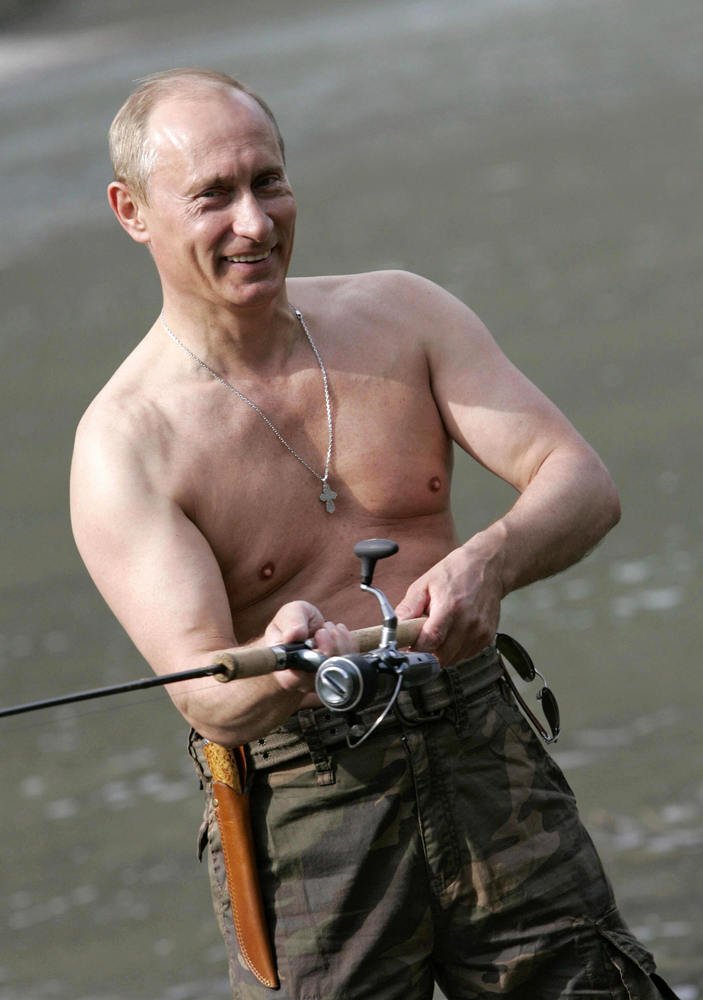
Putin helps Trump and Trump helps Putin — but no one should be in any doubt about who is the dominant partner in this bromance: it’s the one who’s rather proud of showing off his body; not the one who lives in fear of the day he might show up naked on the nightly news.

Facebooktwittermail

The Trump dossier and the FBI cover-up

The Independent reports: Christopher Steele, the former MI6 agent who investigated Donald Trump’s alleged Kremlin links, was so worried by what he was discovering that at the end he was working without pay, The Independent has learned.

Mr Steele also decided to pass on information to both British and American intelligence officials after concluding that such material should not just be in the hands of political opponents of Mr Trump, who had hired his services, but was a matter of national security for both countries.

However, say security sources, Mr Steele became increasingly frustrated that the FBI was failing to take action on the intelligence from others as well as him. He came to believe there was a cover-up, that a cabal within the Bureau blocked a thorough inquiry into Mr Trump, focusing instead on the investigation into Hillary Clinton’s emails. [Continue reading…]

The Guardian reports: Embattled FBI director James Comey has refused to clarify whether his organization is investigating Donald Trump’s ties to Russia in a closed briefing on Friday for members of Congress, angering legislators who recall his high-profile interjections about Hillary Clinton during the 2016 presidential campaign, the Guardian has learned.

Comey’s lack of candor in a classified setting, intended to brief members on the intelligence agencies’ assessment that Russia interfered in the election to benefit Trump, follows a public rebuff this week to senators seeking clarification.

In that earlier hearing, Comey said he would “never comment” on a potential FBI investigation “in an open forum like this”, raising expectations among some attendees of Friday’s briefing that Comey would put the issue to rest in a classified setting.

But according to sources attending the closed-door Friday morning meeting, that was not the case. As such, frustration with Comey was bipartisan and heated, adding to intense pressure on the director of the FBI, whose conduct in the 2016 election itself is now being investigated by an independent US justice department watchdog.

One source in the meeting said Comey would not answer “basic questions” about the FBI’s current investigative activities. The FBI chief was grilled “over and over again”, according to the source, about his standards for acknowledging FBI investigations, with legislators repeatedly bringing up Comey’s dramatic public confirmation that the bureau was revisiting classification issues with Hillary Clinton’s private email server days before the election, as well as his summer press conference announcing that he would not seek indictment. [Continue reading…]

Facebooktwittermail

Intelligence Committee will investigate possible Russia-Trump links

Politico reports: Senate Intelligence Chairman Richard Burr (R-N.C.) said late Friday that his committee will investigate possible contacts between Donald Trump’s campaign and Russia, reversing himself one day after telling reporters that the issue would be outside of his panel’s ongoing probe into Moscow’s election-disruption efforts.

Burr and the intelligence panel’s top Democrat, Virginia Sen. Mark Warner, said in a joint statement that the committee’s probe would touch on “intelligence regarding links between Russia and individuals associated with political campaigns” as well as Russian cyberattacks and other election meddling outlined in an intelligence report released last week.

The committee will use “subpoenas if necessary” to secure testimony from Obama administration officials as well as Trump’s team, Burr and Warner said.

The bipartisan Senate announcement came hours after several House Democrats aired their frustrations with FBI Director James Comey following a classified briefing on Russian election disruption. The Democrats were livid that Comey refused to confirm whether he is conducting an inquiry into potential Trump ties to Russia — a question that he publicly declined to answer earlier this week. [Continue reading…]

Facebooktwittermail

South China Sea: China media warn U.S. over ‘confrontation’

BBC News reports: Blocking China from islands it has built in contested waters would lead to “devastating confrontation”, Chinese state media have warned.

The angry response came after secretary of state nominee Rex Tillerson said the US should deny Beijing access to new islands in the South China Sea.

Two state-run papers carry editorials strongly criticising his comments.

The hawkish Global Times tabloid warned that any such action would lead to “a large-scale war”.

Beijing has been building artificial islands on reefs in waters also claimed by other nations. Images published late last year show military defences on some islands, a think-tank says.

Speaking at his confirmation hearing on Wednesday, Mr Tillerson likened China’s island-building to Russia’s annexation of Crimea from Ukraine.

“We’re going to have to send China a clear signal that first, the island-building stops and second, your access to those islands also is not going to be allowed.” [Continue reading…]

Facebooktwittermail

Trump’s Cabinet nominees keep contradicting him

The Washington Post reports: Donald Trump’s Cabinet nominees, in their first round of confirmation hearings on Capitol Hill, have one after another contradicted the president-elect on key issues, promising to trim back or disregard some of the signature promises on which he campaigned.

A fresh set of examples came Thursday, the third day of hearings.

Retired Marine Corps Gen. James Mattis, Trump’s nominee to be defense secretary, told the Senate Armed Services Committee that the United States must honor the “imperfect ­arms-control agreement” with Iran that Trump has vowed to dismantle because “when America gives her word, we have to live up to it and work with our allies.”

He also took a more adversarial stance than Trump has toward Russian President Vladi­mir Putin and cited Moscow as one of the nation’s top threats.

“I’ve never found a better guide for the way ahead than studying the histories. Since [the 1945 meeting of world powers at] Yalta, we have a long list of times we’ve tried to engage positively with Russia. We have a relatively short list of successes in that regard,” Mattis said. “I think right now, the most important thing is that we recognize the reality of what we deal with [in] Mr. Putin and we recognize that he is trying to break the North Atlantic alliance.”

At a witness table in another Senate hearing room, Rep. Mike Pompeo (R-Kan.), whom Trump picked to head the CIA, assured the Intelligence Committee that he would “absolutely not” use brutal interrogation tactics on terrorism suspects in contravention of the law, even if ordered to do so by a president who campaigned on a promise to reinstate the use of such measures.

Trump indicated in a tweet Friday morning that he is unconcerned about the contradictions. “All of my Cabinet nominee are looking good and doing a great job,” Trump wrote. “I want them to be themselves and express their own thoughts, not mine!”

The discordant notes that Cabinet nominees have struck as they have been questioned by senators suggest that a reality check may lie ahead for Trump.

It may be that the grandiosity and disregard for convention that got Trump elected were inevitably bound for a collision with the practical and legal limitations of governing. [Continue reading…]

Facebooktwittermail

U.S. intel sources warn Israel against sharing secrets with Trump administration

Ynet reports: Donald Trump’s upcoming inauguration as the next president of the United States is causing Israeli intelligence officials to lose sleep as well. Discussions held in closed forums recently raised fears of a leakage of Israeli intelligence top-classified information, clandestine modus oprandi and sources, which have been exposed to the American intelligence community over the past 15 years, to Russia – and from there to Iran.

The cause of concern are the suspicions of unreported ties between the president-elect or his associates and the Kremlin, whose agents are also associated with intelligence officials in Tehran.

These fears, which began upon Trump’s election, grew stronger following a meeting held recently between Israeli and American intelligence officials (the date of the meeting is not mentioned to protect the sources of the report). During the meeting, according to the Israelis who participated in it, their American colleagues voiced despair over Trump’s election, as he often lashes out at the American intelligence community. The American officials also told the Israelis that the National Security Agency (NSA) had “highly credible information” that Russia’s intelligence agencies, the FSB and GRU, were responsible for hacking the Democratic Party (DNC) servers during the elections and leaking sensitive information to WikiLeaks, which hurt Democratic presidential candidate Hillary Clinton.

The American officials further added that they believed Russia President Vladimir Putin had “leverages of pressure” over Trump – but did not elaborate. They were apparently referring to what was published Wednesday about embarrassing information collected by the Russian intelligence in a bid to blackmail the president-elect.

The Americans implied that their Israeli colleagues should “be careful” as of January 20, Trump’s inauguration date, when transferring intelligence information to the White House and to the National Security Council (NSC), which is subject to the president. According to the Israelis who were present in the meeting, the Americans recommended that until it is made clear that Trump is not inappropriately connected to Russia and is not being extorted – Israel should avoid revealing sensitive sources to administration officials for fear the information would reach the Iranians. [Continue reading…]

Facebooktwittermail

Obama hoped to transform the world. It transformed him

Adam Shatz writes: At his final news conference as president, Mr. Obama expressed anguish over the fall of Aleppo, but insisted that his Syria policy had been guided by his sense of “what’s the right thing to do for America.”

It may well have been; American lives were spared. But noninterference created a vacuum that autocrats like President Vladimir V. Putin of Russia and Recep Tayyip Erdogan of Turkey were happy to fill. What’s more, Mr. Obama’s understanding of American interests in Syria was more restrictively drawn than one might have expected from a man so worldly, someone who had always stressed the interdependence of the global community and the moral burdens of “what it means to share this world in the 21st century.” Who governs Syria may not be a core American interest, but the country’s apocalyptic splintering is another matter. The effect of Mr. Obama’s caution, as much as Moscow’s belligerent resolve, was to help prolong the war.

The consequences of Syria’s disintegration have spread far beyond its borders. Not only has the crisis placed dangerous strains on neighboring states, but it has emboldened the far right in Europe, which has played on fears about Islam and terrorism in its campaign against immigration and the European Union. Nor has the United States been unscathed by what Mr. Obama recently called the “tug of tribalism”: Donald J. Trump owes his election to it. Mr. Trump is an open admirer of tribal politicians like Mr. Putin, Mr. Erdogan and Prime Minister Benjamin Netanyahu of Israel, not least because they remind him of himself with their love of the mob, contempt for liberal elites and penchant for conspiracy theory.

In his 2009 speech in Cairo, Mr. Obama imagined Muslim and Western democrats working together in partnership, overcoming borders imposed by war, prejudice and mistrust for the sake of a common future. Instead, the very prospect of a common future, of global interdependence, has been jeopardized by the emergence of an illiberal world of tribes without flags. Despite the best of intentions, and for all his fine words, Mr. Obama became one of the midwives of this dangerous and angry new world, where his enlightened cosmopolitanism increasingly looks like an anachronism. [Continue reading…]

Facebooktwittermail