Category Archives: Congress

Capitol Hill’s representatives for Israel

Josh Ruebner writes:

Nearly 20 percent of the constituents of Rep. Jesse Jackson, Jr. (D-IL) live under the poverty line, and nearly 15 percent are unemployed. Jackson’s congressional district, covering parts of the south side of Chicago and its southern suburbs, has been hit harder than many others by the crises plaguing the economy. Many of his constituents are looking at even more cutbacks in social services, higher prices for food and fuel, and ever scarcer jobs.

During this August congressional recess, Rep. Jackson, Jr. should be at home, meeting with constituents and proposing to them how he will help them cope with their difficult circumstances. Instead, the politician is proudly gallivanting around Israel, in one of three separate congressional delegations heading there this month on all-expense-paid junkets organized by the American Israel Education Foundation (AIEF), a so-called charitable affiliate of the American Israel Public Affairs Committee (AIPAC), the most influential of the myriad pro-Israel lobbying outfits.

In total, 81 representatives, nearly one-fifth of the entire House, will participate in these jaunts, which, according to The Washington Post, include “a round-trip flight in business class for lawmakers and their spouses (that alone is worth about $8,000), fine hotels and meals, side trips, and transportation and guides.

Of course, these congressional delegations are not all fun and games. Members of Congress will be expected to sing for their lavish dinners by honoring President Bush’s 2007 pledge to provide the Israeli military with $30 billion of tax-payer-funded weapons between 2009 and 2018. So far, proposed increases in military aid to Israel have been spared from the budgetary chopping block by President Obama and a compliant Congress that treats Israeli militarism as more sacrosanct than medical care for seniors. This despite the fact that Israel misuses the funds, in violation of the Arms Export Control Act, to commit human rights abuses against Palestinians living under its illegal 44-year military occupation of the West Bank, East Jerusalem, and Gaza Strip.

Facebooktwittermail

The U.S. defense establishment is the world’s largest socialist economy

Fareed Zacharia writes:

The Pentagon’s budget has risen for 13 years, which is unprecedented. Between 2001 and 2009, overall spending on defense rose from $412 billion to $699 billion, a 70 percent increase, which is larger than in any comparable period since the Korean War. Including the supplementary spending on Iraq and Afghanistan, we spent $250 billion more than average U.S. defense expenditures during the Cold War — a time when the Soviet, Chinese and Eastern European militaries were arrayed against the United States and its allies. Over the past decade, when we had no serious national adversaries, U.S. defense spending has gone from about a third of total worldwide defense spending to 50 percent. In other words, we spend more on defense than the planet’s remaining countries put together.

It is not unprecedented for defense spending to fall substantially as we scale back or end military actions. After the Korean War, President Dwight Eisenhower cut defense spending 27 percent. Richard Nixon cut it 29 percent after Vietnam. As tensions declined in the 1980s, Ronald Reagan began scaling back his military spending, a process accelerated under Presidents George H.W. Bush and Bill Clinton. Given the enormous run-up in spending under George W. Bush, even if President Obama made comparable cuts to that of those presidents today, defense spending would remain substantially above the levels under all those presidents. The Bowles-Simpson commission’s plan proposed $750 billion in defense cuts over 10 years. Lawrence Korb, who worked at the Pentagon for Ronald Reagan, believes that a $1 trillion cut over 10 to 12 years is feasible without compromising national security.

Serious conservatives should examine the defense budget, which contains tons of evidence of liberalism run amok that they usually decry. Most talk of waste, fraud and abuse in government is vastly exaggerated; there simply isn’t enough money in discretionary spending. Most of the federal government’s spending is transfer payments and tax expenditures, which are — whatever their merits — highly efficient at funneling money to their beneficiaries. The exception is defense, a cradle-to-grave system of housing, subsidies, cost-plus procurement, early retirement and lifetime pension and health-care guarantees. There is so much overlap among the military services, so much duplication and so much waste that no one bothers to defend it anymore. Today, the U.S. defense establishment is the world’s largest socialist economy.

Facebooktwittermail

Why the US military is the greatest threat to US national security

Lawrence Korb writes:

In Congressional testimony over the past week, several high ranking military officers, led by Army General Martin Dempsey, the nominee to become the next Chairman of the Joint Chiefs of Staff, have warned about the dire national security consequences that could occur if the defense budget is cut by more than a token amount. Their comments have been reinforced by several Republican members of the House Armed Services Committee. But there are at least five reasons why the defense budget can and should be cut substantially without undo risk.

First, in real or inflation adjusted dollars, it is higher than at any time since World War II, including the Korean and Vietnam Wars and the height of the Reagan buildup. The Korean War peak was $485 billion in FY 1952, Vietnam $409 billion in FY 1968, and the Reagan buildup $546 billion in FY 1985. The baseline defense budget for FY2012 is $585 billion. If one adds in funding for the wars in Iraq and Afghanistan, the total defense budget for the upcoming fiscal year rises to about $700 billion.

Second, the baseline defense budget has risen in real terms for 13 consecutive years, which is unprecedented in American history. The Korean and Vietnam buildups lasted three years and the Reagan buildup but four. Since FY 1998, the baseline budget has risen from $360 billion to $585 billion or 63 percent. Moreover, the military snuck many items that had nothing to do with the wars in Afghanistan and Iraq into the $1.3 trillion war supplemental budgets, for example the F-22 and missile defense.

Third, despite the gusher of defense spending, the military in many ways is no better off than it was 13 years ago. In fact, it may be worse. Its equipment is older, and its forces are training less. This condition is the result of what Admiral Mullen, the current Chairman of the Joint Chiefs of Staff, called the failure to make hard choices. As a result, the Pentagon spent $46 billion on weapon systems it had to terminate and the cost overruns on systems it is currently buying went up by $400 billion. Finally, when pressed, the military leaders themselves have identified nearly $200 billion in savings that could be achieved in the FY 2012-2016 time frame if they operated more efficiently.

Fourth, the military budget must play a role in dealing with what Admiral Mullen calls the greatest threat to our national security, the burgeoning federal deficit which now totals $14.3 trillion. Defense spending now consumes more than half of the total discretionary budget, more than 20 percent of the total budget, up from 16 percent a decade ago, and is at the same level as Social Security and Medicare, which are funded by trust funds.

Fifth, the US is not dealing with an existential threat like we did in the Cold War.

Dempsey and his fellow officers say that cutting the baseline or non-war defense budget by $100 a year billion or by $1 trillion over the next decade will jeopardize our security. Hardly. A $100 billion cut will leave the Pentagon with a baseline defense budget of $480 billion. During the Cold War, the defense budget averaged $450 billion in today’s dollars. And even Secretary Gates admitted we do not need to go back to Cold War levels of defense spending.

Facebooktwittermail

Senator wants joint U.S.-Israeli special operations forces to attack flotilla

Military.com reports:

A U.S. senator wants U.S. special operations forces to help Israel halt a Gaza-bound international aid flotilla that includes a vessel carrying a number of American veterans, one of whom is a Sailor who served aboard the USS Liberty, the ship that Israel infamously attacked in 1967.

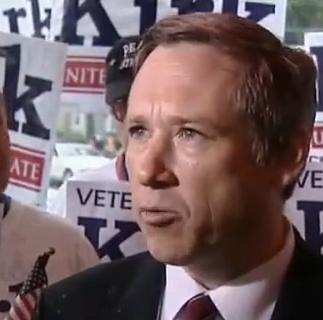
In a report drafted following a visit to Israel in early June, Sen. Mark Kirk, R-Ill., says the United States should “make available all necessary special operations and naval support to the Israeli Navy to effectively disable flotilla vessels before they can pose a threat to Israeli coastal security or put Israeli lives at risk.”

The U.S.-flagged ship, called “The Audacity of Hope” — the name of President Obama’s 2006 book — is currently docked in Greece and is supposed to set sail by the end of this week along with ships from Ireland, Spain, Italy, Greece and other countries. More than 30 Americans are booked for passage on the Audacity of Hope.

While Kirk is pushing for a direct U.S. military role in halting the flotilla, six Democratic congressmen want assurances from Secretary of State Hillary Clinton that she will work with Israel to ensure those aboard the American ship are not harmed.

The lawmakers, including ranking House Veterans Affairs Committee member Rob Filner, D-Calif., say they “wholeheartedly support” Israel’s duty to protect its citizens, but the “measures it uses to do so, as in the case with any other nation, must conform to international humanitarian and human rights law.”

An Open Letter to Illinois Senator Mark Kirk from three constituents responding to his call for U.S. Special Forces to attack a flotilla of ships that will sail to Gaza:

Senator Mark Kirk
524 Hart Senate Office Building
Washington DC, 20510

June 29th, 2011

Dear Senator Kirk,

We are Illinois residents writing to you from Athens, Greece. Just before leaving the United States, we wrote to inform your office about our intent to sail on “The Audacity of Hope,” as part of the U.S. Boat to Gaza project. In our letters, we explained why we were traveling to Gaza. We told you of our previous experiences living among Palestinians who lack access to basic necessities, such as clean water, because of the blockade. Referring to Gaza as the world’s largest open-air prison, we mentioned how hard it has been for people to rebuild after previous lethal assaults, especially the Operation Cast Lead attack which ended, after 23 days, on January 18, 2009. According to B’tselem, the foremost Israeli Human Rights Organization, Operation Cast Lead caused the deaths of 1,389 Palestinians in Gaza. Of those, 344 were children. Of the 13 Israelis who were killed, four were soldiers killed by friendly fire.

Knowing that you and your staff care deeply about the consequences of unemployment, poor education and dangerously limited health care delivery, we pointed out related statistics affecting people in Gaza where 45% of the population is unemployed and hospital administrators are sounding the alarm because they are running out of crucial medicines. Half of Gaza’s 1.6 million people are under age 18.

As you’ve recently noted, a flotilla of ships plans to arrive in Gaza. Our ship will carry 3,000 letters addressed to Gazan children and families. Other boats are carrying humanitarian assistance.

Greek authorities have been checking into various complaints which have stalled the flotilla’s progress. In our case, a complaint was lodged by the Israel Law Center, located in Tel Aviv, suggesting that our boat is not seaworthy. Two of the boats have been sabotaged while docked in the harbor, causing further delays.

Military.com reports that you said the United States should “make available all necessary special operations and naval support to the Israeli Navy to effectively disable flotilla vessels before they can pose a threat to Israeli coastal security or put Israeli lives at risk.”

You have an unusual opportunity to demonstrate thoughtful reconsideration of your earlier decision. Op-ed pieces have appeared in Israel’s Haaretz newspaper, encouraging the Israeli government to let the flotilla pass.

“There is nearly nothing which more effectively delegitimizes Israel — and makes Israel look more like an uncaring blockhead state — than does the siege of Gaza,” wrote Bradley Burston, Senior Editor of Haaretz and a former Israeli Defense Force medic. “The siege benefits Hamas in a thousand ways and Israel in none. But there is one thing that does the work of delegitimization even better: attacking civilians in order to protect the siege. Enter the 21st century. Before it’s too late. You’re not young commandos anymore… Do your nation a favor — act your age. The flotilla is not a terrorist fleet. It is not an arms shipment. The flotilla is, however, a statement about Israel, a judgment of its policies, and, in the end, the verdict will come directly from you.”

Senator Kirk, we are your constituents. It’s not too late for you to acknowledge that your earlier call for military action against us jeopardizes our safety and to reverse your claim which insinuates that we are dangerous people. We write with utmost respect for our collective responsibility to secure a better world, breaking the irrational cycle of military aggression and upholding basic human rights of all people.

Sincerely,

Kathy Kelly, Chicago IL
Max Suchan, Chicago IL
Robert Naiman, Champaign-Urbana

Facebooktwittermail

How the GOP and America’s Arab allies support slavery

Time magazine reports:

Three days before the congressional elections last fall, Hillary Rodham Clinton stood halfway around the world, pledging to young victims of human trafficking at Cambodia’s s Siem Reap Center that they would continue to enjoy the support of the U.S. State Department, which then provided some $336,000 to the shelter. The acclaimed center, situated near the magnificent temples of Angkor Wat, was an oasis of peace for some 50 survivors who, before they were rescued or escaped, had endured slavery in brothels, where they were forced to have sex with as many as 30 men a day. At the shelter, they received counseling, studied hairdressing, learned to sew, and otherwise worked to rebuild their lives and reclaim their humanity. In the evening, they did aerobics together.

On Monday afternoon, some eight months after that visit, as she unveiled the State Department’s 11th annual Trafficking in Persons (TIP) Report to a packed room in the department’s ornate Benjamin Franklin Room, Clinton only hinted that the result of the congressional elections had left the long-term value of her pledge to the survivors in doubt. “Even in these tight economic times, we need to find ways to do better,” Clinton told the overflow crowd.

Clinton’s confidence belied the fact that in April, Congress slashed the grant-making capacity of the State Department’s Office to Monitor and Combat Trafficking in Persons. When the Republicans won the House last November, the office’s $21.2 million annual budget to fight the war on slavery was already microscopic. At the time, it was barely equal to the U.S. government’s daily budget to fight the war on drugs. For fiscal year 2012, Congress sliced away nearly a quarter of those antislavery funds, as part of its broader $8 billion State Department budget cuts.

Brian Whitaker writes:

Efforts to combat human rights abuses are easily undermined by politics. Often – and with good reason – the US and other western countries are accused of highlighting abuses by their enemies while turning a blind eye to similar abuses by their friends.

One way of pushing political considerations into the background is to look at the problem comparatively, by considering where each country stands in relation to others. That is what the US state department has been doing for 11 years now, with its global reports on human trafficking.

The result, as seen in the latest report issued on Monday, is a robust critique, which places some of the staunchest US allies – Kuwait and Saudi Arabia – in the same rotten boat as long-time foes such as Cuba, North Korea and Iran.

“Trafficking in persons” covers various forms of exploitation including, in the words of the international Palermo protocol, “sexual exploitation, forced labour or services, slavery or practices similar to slavery, servitude or the removal of organs”.

Facebooktwittermail

House rebukes Obama on Libya, but won’t cut funds

The Los Angeles Times reports:

The House of Representatives refused to either endorse or curtail U.S. involvement in Libya, delivering a mixed message Friday that highlighted deep divisions surrounding the issue.

By an overwhelming margin, lawmakers refused to sanction U.S. participation in a NATO campaign of airstrikes in the North African country, a vote that amounted to a rare, bipartisan rebuke of a president’s foreign policy during an active military conflict.

Minutes later, however, a Republican-led effort to try to curb financial support for U.S. involvement also failed. A majority of Democrats and a group of Republicans rejected the bill to cut funding for combat activities — surprising GOP leaders, who tailored the bill at the last minute to suit the rank and file.

Both measures were largely symbolic. The first measure, which would have authorized U.S. involvement, was not expected to pass the Republican-led House, where fiscal conservatives and “tea party” freshmen have expressed increased skepticism about stretching the military thin.

The second bill, to cut off funding, had virtually no chance of passing the Senate, much less garnering a presidential signature.

GOP leaders framed the vote as an attempt to rein in the president, who decided not to seek authorization under the 1973 War Powers Act for U.S. participation in a NATO military effort.

Meanwhile, Patrick Cockburn reports:

Human rights organisations have cast doubt on claims of mass rape and other abuses perpetrated by forces loyal to Colonel Muammar Gaddafi, which have been widely used to justify Nato’s war in Libya.

Nato leaders, opposition groups and the media have produced a stream of stories since the start of the insurrection on 15 February, claiming the Gaddafi regime has ordered mass rapes, used foreign mercenaries and employed helicopters against civilian protesters.

An investigation by Amnesty International has failed to find evidence for these human rights violations and in many cases has discredited or cast doubt on them. It also found indications that on several occasions the rebels in Benghazi appeared to have knowingly made false claims or manufactured evidence.

The findings by the investigators appear to be at odds with the views of the prosecutor of the International Criminal Court, Luis Moreno-Ocampo, who two weeks ago told a press conference that “we have information that there was a policy to rape in Libya those who were against the government. Apparently he [Colonel Gaddafi] used it to punish people.”

Facebooktwittermail

U.S. Libya mission exposes divisions in Congress and within GOP

The New York Times reports:

It is a familiar pattern in a government of checks and balances: members of Congress almost instinctively criticize the foreign adventures of a president from the opposite party.

But the current imbroglio in Congress over the American involvement in Libya exposes a deep and unusual foreign policy schism within the Republican Party, driven in large part by a Tea Party-infused House whose members are more fiscally conservative, particularly constitutionalist, less internationalist and, in many cases, too young to have been politically influenced by the cold war that informed the more established members of the party.

The divisions came to the fore on Tuesday when Senator John McCain, an Arizona Republican, introduced a measure with Senator John Kerry, a Massachusetts Democrat, to offer President Obama official Congressional authorization for the Libyan operation.

The legislation is an effort to blunt a series of House measures expected to seek to cut off financing for the operations in Libya as early as Thursday.

In introducing it, Mr. McCain chastised House Republicans for seeking to end the Libya mission. “Is this the time for Americans to tell all of these different audiences that our heart is not in this,” Mr. McCain said, “that we have neither the will nor the capability to see this mission through, that we will abandon our closest friends and allies on a whim? These are questions every member of Congress needs to think about long and hard, especially my Republican colleagues.”

House members of both parties and various political stripes seemed undaunted. Representative Dennis J. Kucinich, a Democrat of Ohio, will offer an amendment to a Pentagon spending bill to deny money for operations in Libya, as will Representative Justin Amash of Michigan, a Republican freshman.

Meanwhile, AFP reports:

Italy on Wednesday called for an immediate halt to hostilities in Libya to allow humanitarian aid to reach the population in the strife-torn country, while NATO defended the credibility of its air war after a bomb misfired killing civilians.

On the diplomatic front, China said it recognises Libya’s opposition National Transitional Council (NTC) as an “important dialogue partner.”

Italian Foreign Minister Franco Frattini warned on Tuesday that NATO’s credibility was “at risk” following the civilian casualties, and urged it to ensure it was not providing ammunition to Kadhafi’s propaganda war.

Frattini followed up his comments in a speech on Wednesday to the lower house of parliament in Rome.

“With regard to NATO, it is fair to ask for increasingly detailed information on results as well as precise guidelines on the dramatic errors involving civilians,” he said.

The comments came after NATO admitted a bomb misfired in Tripoli at the weekend, killing nine people according to Moamer Kadhafi’s regime.

Facebooktwittermail

John McCain, John Kerry introduce Libya resolution

Politico reports:

Sens. John McCain and John Kerry introduced a resolution Tuesday that would give President Barack Obama the green light to continue limited military operations in Libya.

The language of the proposal has more teeth than the “sense of the Senate” resolution McCain and Kerry rolled out last month, which was merely a symbolic gesture backing the Libya effort. The latest plan would authorize U.S. operations in Libya but expires after one year and would make clear that the Senate agrees there is no need or desire to put boots on the ground in the North African nation.

“The Senate has been silent for too long on U.S. military operations in Libya,” McCain said on the chamber floor.

“It is time for the Senate to act. It is time to authorize the president’s use of force, whether he thinks he needs it or not. And it is time to send a message to our allies, to [Muammar Qadhafi] and to his opponents in Libya who are fighting for their freedom that there is strong bipartisan support in the Senate, and among the American people, for staying the course in Libya until we succeed.”

Facebooktwittermail

US mayors call for end to wars and nuclear weapons

Truthout reports:

Peace activists won a major victory on Monday, June 20, when the US Conference of Mayors voted to adopt two resolutions that call for a drawdown of troops in Iraq and Afghanistan and the abolition of nuclear weapons. Both resolutions also demand the reprioritization of defense spending, including the $126 billion spent each year in Iraq and Afghanistan, toward the needs of municipalities.

The group, which represents mayors of municipalities with 30,000 or more residents, has not passed such a resolution in 40 years.

Institute for Policy Studies (IPS) fellow Karen Dolan directs IPS’s Cities For Peace project, which organizes elected officials and activists to take action against war on a local level. In a statement to Truthout, Dolan said that the mayors, “are responsive to the needs of the people in a way in which Congress and the president have not been. Unless money is better spent at the state and local level, we will not see an economic recovery.” According to IPS, hundreds of municipalities around the United States have called for the end to the wars in the Middle East.

Facebooktwittermail

Obama overruled top lawyers in Libya war policy debate

The New York Times reports:

President Obama rejected the views of top lawyers at the Pentagon and the Justice Department when he decided that he had the legal authority to continue American military participation in the air war in Libya without Congressional authorization, according to officials familiar with internal administration deliberations.

Jeh C. Johnson, the Pentagon general counsel, and Caroline D. Krass, the acting head of the Justice Department’s Office of Legal Counsel, had told the White House that they believed that the United States military’s activities in the NATO-led air war amounted to “hostilities.” Under the War Powers Resolution, that would have required Mr. Obama to terminate or scale back the mission after May 20.

But Mr. Obama decided instead to adopt the legal analysis of several other senior members of his legal team — including the White House counsel, Robert Bauer, and the State Department legal adviser, Harold H. Koh — who argued that the United States military’s activities fell short of “hostilities.” Under that view, Mr. Obama needed no permission from Congress to continue the mission unchanged.

Presidents have the legal authority to override the legal conclusions of the Office of Legal Counsel and to act in a manner that is contrary to its advice, but it is extraordinarily rare for that to happen. Under normal circumstances, the office’s interpretation of the law is legally binding on the executive branch.

A White House spokesman, Eric Schultz, said there had been “a full airing of views within the administration and a robust process” that led Mr. Obama to his view that the Libya campaign was not covered by a provision of the War Powers Resolution that requires presidents to halt unauthorized hostilities after 60 days.

“It should come as no surprise that there would be some disagreements, even within an administration, regarding the application of a statute that is nearly 40 years old to a unique and evolving conflict,” Mr. Schultz said. “Those disagreements are ordinary and healthy.”

Still, the disclosure that key figures on the administration’s legal team disagreed with Mr. Obama’s legal view could fuel restiveness in Congress, where lawmakers from both parties this week strongly criticized the White House’s contention that the president could continue the Libya campaign without their authorization because the campaign was not “hostilities.”

Marc Lynch writes:

“There’s no outcry in the country to say ‘comply with the War Powers Act,’ outside of academia.” That’s what Senator John McCain told Foreign Policy in an interview a few weeks ago. How quickly things change. With House Speaker John Boehner presenting an ultimatum for administration compliance with the War Powers Act, and Congressional GOP leaders hinting at defunding the campaign, the demand that the Obama administration obtain Congressional authorization for the operation in Libya has suddenly become front page news. A full-scale battle over Presidential authority looms.

The administration should have secured authorization for the Libya campaign early on, to put it on solid legal and bipartisan political footing. Congressional oversight is as important for the Obama administration as it was during the Bush administration — a point which applies to Libya just as it does to drone strikes and global counter-terrorism operations. They probably didn’t do so because they (correctly) expected that a Congressional resolution authorizing the Libya campaign would come to the President’s desk with riders attached repealing health care reform, reinstating Don’t Ask Don’t Tell, and abolishing Medicare. But politics shouldn’t be allowed to outweigh the importance of effective Congressional oversight and respecting the rule of law.

Beyond the political jockeying, however, the sudden burst of attention to Libya should be an opportunity for the public to take a fresh look at what is actually happening in Libya. This is a good time to realize that the war in Libya was very much worth fighting and that it is moving in a positive direction. A massacre was averted, all the trends favor the rebels, the emerging National Transitional Council is an unusually impressive government in waiting, and a positive endgame is in sight. This is a war of which the administration should be proud, not one to be hidden away from public or Congressional view.

I supported the intervention in Libya reluctantly, in the face of strong evidence of in impending humanitarian catastrophe and an unprecedented, intense Arab public demand for Western action. I believe fully that the NATO intervention prevented a major massacre in Benghazi, which would have guaranteed the survival of the Qaddafi regime. The retaliation campaign which followed the regime’s survival would have been bloodier still. There would have been a chilling effect across the region, encouraging violent repression and demoralizing challengers. And the impact on America’s image in the region of failing to act and allowing the massacre would have been profound. Many of the same people (in the Arab world and in the U.S.) who now lambaste Obama for intervening would have been editorializing about his betrayal of his promises to the Muslims of the world and his indifference to Muslim lives.

Facebooktwittermail

Will Obama once again cover up Bush’s crimes?

The New York Times reports:

A former senior C.I.A. official says that officials in the Bush White House sought damaging personal information on a prominent American critic of the Iraq war in order to discredit him.

Glenn L. Carle, a former Central Intelligence Agency officer who was a top counterterrorism official during the administration of President George W. Bush, said the White House at least twice asked intelligence officials to gather sensitive information on Juan Cole, a University of Michigan professor who writes an influential blog that criticized the war.

In an interview, Mr. Carle said his supervisor at the National Intelligence Council told him in 2005 that White House officials wanted “to get” Professor Cole, and made clear that he wanted Mr. Carle to collect information about him, an effort Mr. Carle rebuffed. Months later, Mr. Carle said, he confronted a C.I.A. official after learning of another attempt to collect information about Professor Cole. Mr. Carle said he contended at the time that such actions would have been unlawful.

It is not clear whether the White House received any damaging material about Professor Cole or whether the C.I.A. or other intelligence agencies ever provided any information or spied on him. Mr. Carle said that a memorandum written by his supervisor included derogatory details about Professor Cole, but that it may have been deleted before reaching the White House. Mr. Carle also said he did not know the origins of that information or who at the White House had requested it.

Intelligence officials disputed Mr. Carle’s account, saying that White House officials did ask about Professor Cole in 2006, but only to find out why he had been invited to C.I.A.-sponsored conferences on the Middle East. The officials said that the White House did not ask for sensitive personal information, and that the agency did not provide it.

“We’ve thoroughly researched our records, and any allegation that the C.I.A. provided private or derogatory information on Professor Cole to anyone is simply wrong,” said George Little, an agency spokesman.

In 2005, after a long career in the C.I.A.’s clandestine service, Mr. Carle was working as a counterterrorism expert at the National Intelligence Council, a small organization that drafts assessments of critical issues drawn from reports by analysts throughout the intelligence community. The council was overseen by the newly created Office of the Director of National Intelligence.

Mr. Carle said that sometime that year, he was approached by his supervisor, David Low, about Professor Cole. Mr. Low and Mr. Carle have starkly different recollections of what happened. According to Mr. Carle, Mr. Low returned from a White House meeting one day and inquired who Juan Cole was, making clear that he wanted Mr. Carle to gather information on him. Mr. Carle recalled his boss saying, “The White House wants to get him.”

“ ‘What do you think we might know about him, or could find out that could discredit him?’ ” Mr. Low continued, according to Mr. Carle.

Mr. Carle said that he warned that it would be illegal to spy on Americans and refused to get involved, but that Mr. Low seemed to ignore him.

“But what might we know about him?” he said Mr. Low asked. “Does he drink? What are his views? Is he married?”

Mr. Carle said that he responded, “We don’t do those sorts of things,” but that Mr. Low appeared undeterred. “I was intensely disturbed by this,” Mr. Carle said.

He immediately went to see David Gordon, then the acting director of the council. Mr. Carle said that after he recounted his exchange with Mr. Low, Mr. Gordon responded that he would “never, never be involved in anything like that.”

Mr. Low was not at work the next morning, Mr. Carle said. But on his way to a meeting in the C.I.A.’ s front office, a secretary asked if he would drop off a folder to be delivered by courier to the White House. Mr. Carle said he opened it and stopped cold. Inside, he recalled, was a memo from Mr. Low about Juan Cole that included a paragraph with “inappropriate, derogatory remarks” about his lifestyle. Mr. Carle said he could not recall those details nor the name of the White House addressee.

He took the document to Mr. Gordon right away, he said. The acting director scanned the memo, crossed out the personal data about Professor Cole with a red pen, and said he would handle it, Mr. Carle said. He added that he never talked to Mr. Low or Mr. Gordon about the memo again.

In an interview, Mr. Low took issue with Mr. Carle’s account, saying he would never have taken part in an effort to discredit a White House critic. “I have no recollection of that, and I certainly would not have been a party to something like that,” Mr. Low said. “That would have simply been out of bounds.”

So there we have two non-denial denials from George Little, a CIA spokesman, and David B Low, a key suspect in this dirty tricks operation.

Little says the records have been searched and nothing was found. And are we supposed to have forgotten that the CIA has a history of destroying damaging records?

As for Low — not only a former intelligence officer but also an attorney — he employs the standard line, “I have no recollection,” fully aware that some day a prosecutor might present him with a piece of evidence that miraculously jogs his memory.

(While Low is a decorated intelligence officer, his career development outside the intelligence community was focused on business. “In the private sector, Mr. Low was president of the largest US apartment company, was responsible for US corporate acquisitions for a British industrial company, and was general counsel for the investment advisors to the Imperial Government of Iran under the Shah. Mr. Low practiced corporate law on Wall Street at White & Case.”)

So what now? Juan Cole says: “I hope that the Senate and House Intelligence Committees will immediately launch an investigation of this clear violation of the law by the Bush White House and by the CIA officials concerned.”

But this isn’t just a matter for Congress; it should also involve the Justice Department.

And what are the chances of that happening? Not very good with an administration that is dedicated to “looking forward” rather being willing to expose the crimes of its predecessor.

Facebooktwittermail

The fall of the house of Assad

Robin Yassin-Kassab writes:

Selmiyyeh, selmiyyeh” — “peaceful, peaceful” — was one of the Tunisian revolution’s most contagious slogans. It was chanted in Egypt, where in some remarkable cases protesters defused state violence simply by telling policemen to calm down and not be scared. In both countries, largely nonviolent demonstrations and strikes succeeded in splitting the military high command from the ruling family and its cronies, and civil war was avoided. In both countries, state institutions proved themselves stronger than the regimes that had hijacked them. Although protesters unashamedly fought back (with rocks, not guns) when attacked, the success of their largely peaceful mass movements seemed an Arab vindication of Gandhian nonviolent resistance strategies. But then came the much more difficult uprisings in Bahrain, Libya, and Syria.

Even after at least 1,300 deaths and more than 10,000 detentions, according to human rights groups, “selmiyyeh” still resounds on Syrian streets. It’s obvious why protest organizers want to keep it that way. Controlling the big guns and fielding the best-trained fighters, the regime would emerge victorious from any pitched battle. Oppositional violence, moreover, would alienate those constituencies the uprising is working so hard to win over: the upper-middle class, religious minorities, the stability-firsters. It would push the uprising off the moral high ground and thereby relieve international pressure against the regime. It would also serve regime propaganda, which against all evidence portrays the unarmed protesters as highly organized groups of armed infiltrators and Salafi terrorists.

The regime is exaggerating the numbers, but soldiers are undoubtedly being killed. Firm evidence is lost in the fog, but there are reliable and consistent reports, backed by YouTube videos, of mutinous soldiers being shot by security forces. Defecting soldiers have reported mukhabarat lined up behind them as they fire on civilians, watching for any soldier’s disobedience. A tank battle and aerial bombardment were reported after a small-scale mutiny in the Homs region. Tensions within the military are expanding.

And a small minority of protesters does now seem to be taking up arms. Syrians — regime supporters and the apolitical as much as anyone else — have been furiously buying smuggled weapons since the crisis began. Last week for the first time, anti-regime activists reported that people in Rastan and Talbiseh were meeting tanks with rocket-propelled grenades. Some of the conflicting reports from Jisr al-Shaghour, the besieged town near the northwestern border with Turkey, describe a gun battle between townsmen and the army. And a mukhabarat man was lynched by a grieving crowd in Hama.

The turn toward violence is inadvisable but perhaps inevitable. When residential areas are subjected to military attack, when children are tortured to death, when young men are randomly rounded up and beaten, electrocuted, and humiliated, some Syrians will seek to defend themselves. Violence has its own momentum, and Syria appears to be slipping toward war.

Meanwhile, CBS News reports:

Sen. Lindsey Graham, R-S.C., on Sunday called for increased U.S. action in Syria, and said “now is the time to let [Syrian president Bashar] Assad know that all options are the table” – including the possible use of military force.

Graham, in an interview on CBS’ “Face the Nation,” decried what he described as the Assad regime’s “wholesale slaughter” against the Syrian people, and urged the U.S. to take a similar approach in that nation as it has in Libya in seeking the ouster of Muammar Qaddafi.

It’s time, Graham contended, to “get the regional partners to tell the Assad he has to go. And put everything on the table – including military force.”

“If we don’t turn this dynamic around, the Red Cross can’t go into Syria,” he continued. “It’s wholesale slaughter. We’re about to get Qaddafi going. We need to turn our attention strongly to Syria with the regional cooperation like we have in Libya.”

Regional cooperation for a US intervention in Syria? He must be joking! There would be opposition from Turkey, Iraq, Iran and even Israel. Maybe Graham thinks his proposal would get Kurdish support.

Facebooktwittermail

What have Obama and Netanyahu wrought?

Henry Siegman writes:

What conclusions are to be drawn about the state of Middle East peacemaking from the extraordinary spectacle of the adversarial encounter between President Barack Obama and Israeli Prime Minister Benjamin Netanyahu and their several major adversarial addresses in the second half of May?

The spectacle did not bring an Israeli-Palestinian peace agreement any closer. Indeed, Netanyahu’s address to the U.S. Congress, no less than Congress’s reaction to that speech, effectively buried the Middle East peace process for good. For what America’s solons were jumping up and down to applaud so wildly as they pandered pathetically to the Israel lobby was Netanyahu’s rejection of a two-state solution to the Israel-Palestine conflict, thus endorsing his determination to maintain permanently Israel’s colonial project in the West Bank.

If Netanyahu succeeds in his objective, these members of Congress will be able to take credit for an Israeli apartheid regime that former Prime Ministers Ehud Barak, Ariel Sharon, and Ehud Olmert predicted would be the inescapable consequence of policies the congressmen cheered and promised to continue to support as generously as they have in the past.

Unfortunately, it is an outcome made more likely by Obama’s insistence that a United Nations resolution could never bring about Palestinian statehood. He was wrong about that. That the United Nations can create a state was affirmed and celebrated not by enemies of Israel but in Israel’s own Declaration of Independence of 1948. It is the U.N. Partition Resolution of 1947, not negotiations between the Jews and Arabs of Palestine, that is cited in that declaration as having brought about the state of Israel and the source of its legitimacy.

It is the United Nations, not Netanyahu nor even the United States, that can and should bring the state of Palestine into being — and would do so if the United States were not to prevent it. The bilateral talks with Netanyahu that Obama is insisting Palestinians return to will only continue to serve, as they have in the past, as cover for the expansion of Israeli settlements whose purpose it is to annex (i.e., steal) enough Palestinian territory to preclude the possibility of Palestinian statehood.

Facebooktwittermail

AIPAC’s unrivaled influence

MJ Rosenberg writes:

Not surprisingly, my recent column on an ugly 1988 experience with AIPAC, the Israeli government, and late New York Times columnist William Safire elicited some controversy. I knew it would.

There aren’t that many first-person accounts of encounters with the lobby (for obvious reasons) so my recollections of how it went down on Capitol Hill fill a vacuum. Hopefully, there will be more such accounts as those of us who dealt with the lobby in the 1980s move into a position (career-wise or financially) where we feel free to talk and write about it without any fear of retribution.

If I were 35, there is no way that I would challenge an institution which has a long history of preventing its critics from advancing professionally. I am not that brave — although the terrain is finally changing for the better thanks to the internet.

Facebooktwittermail

Criminalizing free speech

Glenn Greenwald writes:

Alex Seitz-Wald of Think Progress rightly takes Sen. Rand Paul to task for going on Sean Hannity’s radio program — one week after commendably leading opposition to the Patriot Act on civil liberties grounds — and advocating the arrest of people who “attend radical political speeches.”  After claiming to be against racial and religious profiling, Paul said:  ”But if someone is attending speeches from someone who is promoting the violent overthrow of our government, that’s really an offense that we should be going after — they should be deported or put in prison.”  Seitz-Wald correctly notes the obvious:  ”Paul’s suggestion that people be imprisoned or deported for merely attending a political speech would be a fairly egregious violation on the First Amendment, not to mention due process.” 

Indeed, the First Amendment not only protects the mere “attending” of a speech “promoting the violent overthrow of our government,” but also the giving of such a speech.  The government is absolutely barred by the Free Speech clause from punishing people even for advocating violence.  That has been true since the Supreme Court’s unanimous 1969 decision in Brandenburg v. Ohio, which overturned the criminal conviction of a Ku Klux Klan leader who had threatened violence against political officials in a speech.

The KKK leader in Brandenburg was convicted under an Ohio statute that made it a crime to ”advocate . . . the duty, necessity, or propriety of crime, sabotage, violence, or unlawful methods of terrorism as a means of accomplishing industrial or political reform” and/or to “voluntarily assemble with any society, group, or assemblage of persons formed to teach or advocate the doctrines of criminal syndicalism.”  The Court struck down the statute on the ground that it “purports to punish mere advocacy” and thus “sweeps within its condemnation speech which our Constitution has immunized from governmental control.”  The Court ruled that “except where such advocacy is directed to inciting or producing imminent lawless action” — meaning conduct such as standing outside someone’s house with an angry mob and urging them to burn the house down that moment — “the constitutional guarantees of free speech and free press do not permit a State to forbid or proscribe advocacy of the use of force“ (emphasis added).

Facebooktwittermail

How the Israel lobby chills Middle East debate

The Israel lobby is like the Mafia. It’s commonly understood how it works, who its leaders are, how they wield their power through intimidation, and to what effect. But there’s a big difference between knowing the identity of a Mafia boss and being able to throw him in jail. Usually an informant needs to be wired so that incriminating words can get caught on tape.

The following story recounted by MJ Rosenberg, who was himself once an AIPAC official, goes beyond the broad brushstrokes that are usually employed to describe the impact of the lobby on American politics. It is more akin to evidence from a wire — evidence that those who get on the wrong side of the lobby risk having their lives destroyed.

This week, following that tumultuous reception for Prime Minister Netanyahu at the congressional joint meeting, I want to share a personal recollection of how the Middle East status quo is preserved on Capitol Hill.

It was in 1988 and I was a foreign policy aide to Sen. Carl Levin (D-MI). One February day, Levin called me into his office to say that he was disturbed at a quote he saw in that day’s New York Times. An article quoted Israeli Prime Minister Yitzhak Shamir saying that he rejected the idea of withdrawing from any of the land Israel captured in the 1967 war:

Mr. Shamir said in a radio interview, ”It is clear that this expression of territory for peace is not accepted by me.”

Levin instantly understood what Shamir was saying. He was repudiating U.N. Security Council Resolutions 242 and 338 (which Israel had helped draft) which provided for “withdrawal of Israeli armed forces from territories occupied in the recent [1967] conflict” in exchange for peace and security. Those resolutions represented official U.S. and international policy then, and they still do.

But, in 1988, Shamir tried to declare them null and void.

Levin asked me to draft a letter to Secretary of State George Shultz stating that it was the view of the Senate that the U.N. Resolutions remained the policy of the U.S. whether Shamir liked it or not. Of course, the letter wasn’t written in that kind of language. It was more than polite. Additionally, Levin wanted it addressed to Shultz, not to Shamir, to avoid ruffling too many feathers in Israel.

I wrote the draft. Levin edited and re-edited it. Then he called in the head of AIPAC, Thomas A. Dine, to run the language past him. Tom said it was “great.” Levin told Dine that he would not embarass him by revealing that he had approved the letter.

Levin then asked me to deliver it to the Secretary of State but said that first he would try to round up a few other senators to join him in signing it. In an hour he had 30. He probably could have gotten three times as many but it was Friday afternoon and most of the senators had decamped.

I delivered the letter. Because Levin wanted to avoid a brouhaha, the Levin office did no press about it. It was essentially a secret initiative.

But then one of the senators who had the letter gave it to the New York Times. And within minutes the phones started ringing off the hook. Reporters and AIPAC donors (who had no idea Dine had signed off on the letter) were going crazy. Levin was asked to appear on all three Sunday morning talk shows. He declined. In fact, he took off for Moscow, on a long-planned trip. [Continue reading…]

Facebooktwittermail

Netanyahu’s Congress

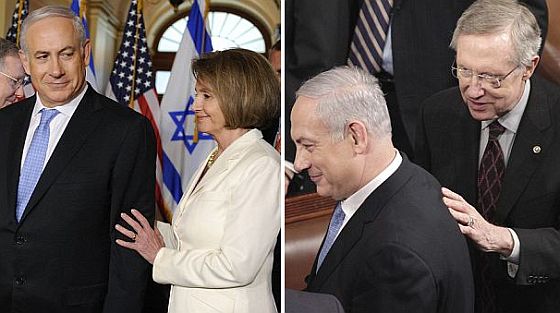
Benjamin Netanyahu being caressed in Congress this morning by Nancy Pelosi and Harry Reid

Josh Ruebner writes:

Gliding down the aisle of the House of Representatives like a popular president about to deliver the State of the Union address, escorted by a phalanx of dozens of ebullient Members of Congress, Israeli Prime Minister Benjamin Netanyahu entered a joint meeting of Congress today to a round of hearty handshakes and a thunderous standing ovation.

In a post-speech press conference, Senate Majority Leader Harry Reid gushed that Netanyahu delivered an “all-star” address, and Netanyahu proclaimed it a “great day” for Israel. And, in the self-contained world that is Capitol Hill, who could blame them for believing it to be so?

For in a world in which Israel finds itself as isolated as ever by a growing and successful Palestinian civil society-led international movement of boycott, divestment, and sanctions (BDS) against its apartheid policies; in which Palestinians are taking matters into their own hands diplomatically and pushing to have the United Nations admit the State of Palestine as a full member of the organization this fall; and in which even the President of the United States appears disgruntled by Israel’s intransigent ongoing colonization of Palestinian land, at least on Capitol Hill, Netanyahu can still play the ace up his sleeve to aplomb and then chum around like the king of the castle.

There on Capitol Hill, Netanyahu still has friends like Senator Chuck Schumer, who told a Jewish radio program that “One of my roles, very important in the United States Senate, is to be a shomer [guard]—to be a or the shomer Yisrael [guard of Israel]. And I will continue to be that with every bone in my body.” With friends like these wrapped around his little finger, no wonder Netanyahu’s forcible denunciations of international law were met with such rapturous approbation by Members of Congress who applauded his rejectionism dozens of times.

Justin Elliot lists the lines of Netanyahu’s speech that won 29 standing ovations.

Facebooktwittermail

The Zionist US Congress


(H/t Glenn Greenwald)

If anyone was in any doubt that Capitol Hill is Israeli occupied territory, the adulation Benjamin Netanyahu received from Republicans and Democrats in Congress today makes it obvious where the loyalties of most of our so-called representatives lie.

“In Judea and Samaria [the West Bank], the Jewish people are not foreign occupiers,” Netanyahu declared as members of Congress stood, clapped and cheered.

Well, if that’s what Washington really believes then it’s time to toss the two-state solution out of the window.

ABC News reports:

Prime Minister Benjamin Netanyahu’s speech before a joint meeting of Congress today had all trappings of a state of the union address by a U.S. president with sky-high approval ratings.

Speaking to a packed House chamber with Speaker of the House John Boehner and Vice President Joe Biden over his shoulders, Netanyahu was interrupted at least 53 times by applause, including at least 29 standing ovations.

To put those numbers in perspective, 29 standing ovations eclipse the total that President Obama received at the State of the Union this year. Obama, in a speech that lasted much longer than Netanyahu’s, garnered 79 applause interruptions, but his remarks were met by only 25 standing ovations.

One of Netanyahu’s biggest applause lines was aimed directly at President Obama.

“Israel will not return to the indefensible boundaries of 1967,” Netanyahu said, prompting a big standing ovation.

Later the prime minister added: “Israel under 1967 lines would be only nine miles wide. So much for strategic depth. So it’s therefore vital — absolutely vital — that a Palestinian state be fully demilitarized, and it’s vital — absolutely vital — that Israel maintain a long-term military presence along the Jordan River.”

As Netanyahu himself pointed out, the President has not called on Israel to return to the exact 1967 borders. The President has said that a peace agreement should be “based on 1967 lines with mutually agreed swaps.”

Nevertheless, Netanyahu speech – and the thunderous bi-partisan response – was a clear challenge to the idea of using the 1967 boundaries – with or without “swaps” — as a basis for a peace deal.

Netanyahu also got big ovations with hard-line statements on two other perennial sticking points to Israeli-Palestinian peace agreements: No right of return for Palestinian refugees, and “Jerusalem will never again be divided. Israel must remain the united Capital of Israel.”

Netanyahu arguably got a warmer reception than President Obama received during his last state of the union and certainly a warmer reception than he’d receive at the Knesset. When the speech was over, he lingered for a while at the podium as it seemed he didn’t want to leave.

Facebooktwittermail