A pro Israeli advocate knocked a camera out of the hands of Alison Weir, President of the Council for the National Interest Foundation. The group just finished their press conference on what they call unjustifiable US Aid to Israel.
The two sides met when the Press Club scheduled a pro Israeli news conference to follow held in the same room. The altercation illustrates heightened tensions on differing views regarding America’s relationship with Israel.
The Council for the National Interest Foundation wants Americans to know how much of their tax dollars are going to Israel.
The Congress of the United States consists of 100 senators and 435 members of the House of Representatives; in effect, just 535 Americans are blocking efforts to bring peace to the Middle East. Why? Forget the pious guff about Israel being the region’s “only democracy” and a “valued friend and ally” of Washington. In the corrupt and dysfunctional US political system, where legislators are outnumbered by special interests, from the gun lobby to Big Pharma, the Israel lobby – specifically, the American Israel Public Affairs Committee (Aipac) that brags on its website about being “the most important organisation affecting America’s relationship with Israel” – has a financial stranglehold on both main parties. According to William Quandt, a former adviser on the Middle East to the Nixon and Carter administrations, “70 per cent to 80 per cent of all members of Congress will go along with whatever they think Aipac wants”.
It is Aipac that polices congressional votes on Israel, demands unconditional US support for the occupation of the West Bank and insists that Israel remain the largest single annual recipient of US foreign aid ($250 a year per Israeli, compared to $1 a year per African). Consider this: the upper and lower houses of Congress are more divided, polarised and partisan than in any other period in recent history. Democrats and Republicans agree on nothing. Except Israel.
Presidents who have tried to pressurise the Israelis – from Reagan to Obama – have found themselves attacked not just in the Knesset but in Congress. In the words of Paul Findley, a Republican from Illinois who served in the House of Representatives for 22 years before being
defeated by an Aipac-funded candidate in 1982: “Congress behaves as if it were a subcommittee of the Israeli parliament.” The irony is that there is far more heated debate about Israel’s actions on the floor of the Knesset than on Capitol Hill. “For 35 years, not a word has been expressed . . . in either chamber of Congress that deserves to be called debate on Middle East policy,” Findley wrote in 2002.
On 2 May 2002, after Ariel Sharon’s invasion of the West Bank and the destruction of the Jenin refugee camp, both houses of Congress overwhelmingly approved resolutions expressing “solidarity with Israel” – 352 to 21 in the House, 94 to two in the Senate.
On 20 July 2006, eight days after the start of Israel’s war against Lebanon, Congress passed a resolution endorsing Israeli military action by a vote of 410 to eight. On 9 January 2009, as the Palestinian death toll from the Israeli air assault on Gaza topped 700, the House of Representatives passed a resolution “reaffirming the United States’ strong support for Israel in its battle with Hamas”. The margin was 390 votes to five.
These comically one-sided resolutions illustrate the power and influence of the Israel lobby on Capitol Hill – and the way in which craven legislators in both main parties blindly throw their support behind any and every act of belligerence. As Uri Avnery, the Israeli author and peace activist, once remarked: if Aipac “were to table a resolution abolishing the Ten Commandments, 80 senators and 300 congressmen would sign it at once”.
I received an email from a Capitol Hill aide who thinks my criticism of AIPAC, the powerful pro-Israel lobby, is overly simplistic. He doesn’t dispute the fact that AIPAC has a disproportionate influence on our Middle East foreign policy. He argues, however, that AIPAC is no different than other powerful special interest lobbies.
I think his whole email is worth a read:
I work on Capitol Hill and I disagree with you about AIPAC. You make it seem as if AIPAC is the only lobby that gets what it wants through threats of cutting off campaign contributions, as if only AIPAC dictates legislation through intimidation.
WRONG! My colleague who handles the Israel issue confirms your analysis. But it’s no different on the domestic issues I cover. The issues of jobs, health, taxes, the environment, regulation to protect kids’ health, oil drilling, workers’ safety, education, guns…they are all dictated by lobbies just as overbearing as AIPAC. All we do up here is cater to rich, selfish people and their special interests. And their interest is cutting all social programs so we can keep cutting taxes to make them even richer.
True, most of them don’t brag as much as AIPAC but that doesn’t make them any better or worse, just smarter (AIPAC gets more negative attention because of its swagger). Big deal. The public is getting screwed eight ways to Sunday by special interests and AIPAC is just one of them. Don’t mislead your readers into thinking it is unique. Not only is it not unique, it’s insignificant in the sense that it’s not the guys robbing the poor to put money in their own pockets. They own US Middle East policy. But the real fat cats own everything else.
I agree with everything my correspondent writes. The American democracy we learned about in school no longer exists. It’s been sold to the highest bidders. And the highest bidder is not, as the Tea Partiers like to say, “We The People.”
As the military operation continued over Libya on Monday, there was some confusion about which country or organization is actually leading it, and for how long. France, Britain and the United States are in charge of their own operations, which each have different code names.
The participants are being “coordinated” by the United States, but not commanded by it, according to the French Defense Ministry. The Americans, with the most assets, seem to be the lead coordinator, but Washington has said it wants to step back after the initial phase and have NATO take charge of maintaining a no-fly zone and arms embargo.
Britain wants NATO to take over but France does not, and Italy is threatening to rethink its participation unless NATO takes command.
George Bush assembled coalitions of the willing, a euphemism for his failure to get the UN to back his invasion of Iraq in 2003. Barack Obama has UN cover for a no-fly zone in Libya, but he has paradoxically produced a coalition of the unwilling to enforce it. US commanders expected that Nato would announce yesterday that it was taking over. That was blocked by Turkey, whose prime minister Recep Tayyip Erdogan called for immediate talks. Neither Germany nor eastern European members are keen on Nato heading an operation that has nothing to do with the defence of Europe. That might leave Britain or France carrying the can, “using Nato machinery”.
An operation no one wants to lead reflects deeper unease about the scale of the air strikes and confusion about their strategic purpose. The Arab League is meeting in an emergency session today after its outgoing secretary general, Amr Moussa, called for an immediate halt to the military action and for talks. He clearly believes that the attacks have gone far beyond their stated purpose in protecting civilian lives. Mr Moussa’s position is important for two reasons. Not only have Qatari planes yet to become involved, but Mr Moussa himself is a participant in the democratic revolution in his native Egypt. As a possible presidential candidate of a country that will one day resume leadership of the Arab world, he has a personal interest in what he puts his name to.
In Britain, the government appeared increasingly at odds with its defence chiefs over whether Muammar Gaddafi was a legitimate military target. General Sir David Richards said the Libyan leader was “absolutely not” a target, while Downing Street appeared to side with the view of the defence secretary, Liam Fox, that the Libyan leader was a legitimate target if his forces continued to threaten civilian lives. Three days into this mission, these are not insignificant questions. While much was made of the fact that China and Russia abstained in the security council vote, the fact remains that a large part of the world – including India, Brazil and much of Africa – is against this operation. The Arab League, whose support was so essential to the argument that military action had regional backing, is plainly wavering. Mr Cameron may say until he is blue in the face that it will be up to the Libyans to choose their leader once this is all over, but history in this part of the world is against him.
The longer the bombing campaign goes on, the sooner the real issue will have to be confronted: where is it leading? The answer matters on a day-to-day basis. Yesterday, as our correspondent’s account made clear, an ad hoc motorised cavalry of scores of youth fighters on pick-up trucks charged at Ajdabiya, only to retreat in disarray when Gaddafi’s tanks, which were dug in around the town, fired back. The fighters thought that air strikes had knocked out the enemy’s tanks and rockets. And they were surely entitled to think that what was good for Benghazi was also good for Ajdabiya, or Tripoli for that matter. Some had families trapped behind Gaddafi’s tanks, and in other loyalist-held towns there were reports of civilians being used as human shields. If the rebels lack the military means to take these towns back, are coalition warplanes going to fight their battles for them? And if not, would the revolutionary council in Benghazi accept partition? As things stand, the answer to both questions is no. So even if Gaddafi’s forces accepted the ceasefire, the rebels would keep on fighting.
Members of the council have already said they fear the result of a limited air campaign will be a military stalemate and have called for an escalation of air strikes to wipe out Gaddafi’s army. This is the logic of intervention, but it is not in the remit of the UN resolution. Three days ago, air strikes launched to save innocent lives looked simple enough. Very quickly, they have become part of the war.
President Barack Obama Monday formally notified Congress the U.S. had begun military attacks on Libya, prompting complaints from lawmakers that the president waged war without congressional consent, appearing to contradict his own previous position.
In a letter to congressional leaders, the president said the U.S. had “commenced operations to assist an international effort authorized by the United Nations (U.N.) Security Council” and “to prevent a humanitarian catastrophe and address the threat posed to international peace and security by the crisis in Libya.”
Presidents over the decades have conducted military operations without prior congressional approval, including Harry Truman in Korea, George H.W. Bush in Iraq and and President Bill Clinton in Serbia. Congress in 1991 approved the Iraq military action, five months after Mr. Bush deployed forces to the region in response to Iraq’s invasion of Kuwait. The military action in Libya, which Congress wasn’t asked to approve, irked lawmakers.
More than 8,000 Libyan rebels have been killed in the revolt against Muammar Gaddafi’s rule, it has been claimed.
“Our dead and martyrs number more than 8,000 killed,” said Abdel Hafiz Ghoga, spokesman for the National Transitional Council rebel group.
He criticised Arab League Secretary General Amr Moussa over comments that appeared to be critical of military action by the United States and its allies against Libya.
The Arab League had called for the imposition of a no-fly zone over Libya to protect civilians from Gaddafi’s forces but Moussa on Sunday condemned “the bombardment of civilians”.
“What is happening in Libya differs from the aim of imposing a no-fly zone, and what we want is the protection of civilians and not the bombardment of more civilians,” Egypt’s state news agency quoted Moussa as saying.
Ghoga said: “Today, when the secretary general spoke, I was surprised.
“What is the mechanism that stops the extermination of the people in Libya, what is the mechanism, Mr Secretary General?
“If the protection of civilians is not a humanitarian obligation, what is the mechanism that you propose to us?”
After Turkish diplomats were able to secure the release of Stephen Farrell, Tyler Hicks, Lynsey Addario and Anthony Shadid, four New York Times journalists who had been captured by Gaddafi forces six days ago, they have now provided an account of their capture and captivity.
The four had been covering fighting near Ajdabiya when they decided that the battle had grown too dangerous for them to continue covering it safely. Their driver, however, inadvertently drove into a checkpoint manned by forces loyal to Colonel Qaddafi. By the time they knew they were in trouble, it was too late.
“I was yelling to the driver, ‘Keep driving! Don’t stop! Don’t stop!’ ” Mr. Hicks recalled in a telephone interview from the hotel where he and the three others were recuperating. “I knew that the consequences of being stopped would be very bad.”
The driver, Mohamed Shaglouf, is still missing. If he had tried to drive straight through, Mr. Hicks said, the vehicle certainly would have been fired on. In any event, the soldiers flung the doors to their gold four-door sedan wide open so quickly that they had little chance to get away.
As they were being pulled from the car, rebels fired on the checkpoint, sending the four running for their lives.
“You could see the bullets hitting the dirt,” Mr. Shadid said.
All four made it safely behind a small, one-room building, where they tried to take cover. But the soldiers had other plans. They told all four to empty their pockets and ordered them on the ground. And that is when they thought they were seconds from death.
“I heard in Arabic, ‘Shoot them,’ ” Mr. Shadid said. “And we all thought it was over.”
Then another soldier spoke up. “One of the others said: ‘No, they’re American. We can’t shoot them,’ ” Mr. Hicks said.
The intervention is a high-stakes gamble. If it succeeds quickly, and Qaddafi’s regime crumbles as key figures jump ship in the face of its certain demise, then it could reverse the flagging fortunes of the Arab uprisings. Like the first Security Council resolution on Libya, it could send a powerful message that the use of brutal repression makes regime survival less rather than more likely. It would put real meat on the bones of the “Responsibility to Protect” and help create a new international norm. And it could align the U.S. and the international community with al-Jazeera and the aspirations of the Arab protest movement. I have heard from many protest leaders from other Arab countries that success in Libya would galvanize their efforts, and failure might crush their hopes.
But if it does not succeed quickly, and the intervention degenerates into a long quagmire of air strikes, grinding street battles, and growing pressure for the introduction of outside ground forces, then the impact could be quite different. Despite the bracing scenes of Benghazi erupting into cheers at the news of the Resolution, Arab support for the intervention is not nearly as deep as it seems and will not likely survive an extended war. If Libyan civilians are killed in airstrikes, and especially if foreign troops enter Libyan territory, and images of Arabs killed by U.S. forces replace images of brave protestors battered by Qaddafi’s forces on al-Jazeera, the narrative could change quickly into an Iraq-like rage against Western imperialism. What began as an indigenous peaceful Arab uprising against authoritarian rule could collapse into a spectacle of war and intervention.
Michael Moore, speaking yesterday in Madison, Wisconsin:
Contrary to what those in power would like you to believe so that you’ll give up your pension, cut your wages, and settle for the life your great-grandparents had, America is not broke. Not by a long shot. The country is awash in wealth and cash. It’s just that it’s not in your hands. It has been transferred, in the greatest heist in history, from the workers and consumers to the banks and the portfolios of the uber-rich.
Right now, this afternoon, just 400 Americans have more wealth than half of all Americans combined.
Let me say that again — and please, someone in the mainstream media, just repeat this fact once. We’re not greedy. We’ll be happy to just hear it once: 400 obscenely wealthy individuals — 400 little Mubaraks — most of whom benefited in some way from the multi-trillion dollar taxpayer “bailout” of 2008, now have more cash, stock and property than the assets of 155 million Americans combined.
[Crowd chants: Shame! Shame! Shame!]
If you can’t bring yourself to call that a financial coup d’état, then you are simply not being honest about what you know in your heart to be true.
And I can see why. For us to admit that we have let a small group of men abscond with and hoard the bulk of the wealth that runs our economy, would mean that we’d have to accept the humiliating acknowledgment that we have indeed surrendered our precious Democracy to the moneyed elite. Wall Street, the banks and the Fortune 500 now run this Republic — and, until this past month here in Madison Wisconsin, the rest of us have felt completely helpless, unable to find a way to do anything about it.
Senior members of the U.S. Congress are debating whether to halt foreign aid to Egypt as a way to hasten President Hosni Mubarak’s exit from power amid continuing protests against his three-decade rule.
Senator Patrick Leahy, the chairman of the panel that controls foreign aid, said he’s prepared to stop all U.S. financial assistance to Egypt — which topped $1.5 billion last year — unless Mubarak steps aside immediately and allows a transitional government to take over.
“If he doesn’t leave, there will not be foreign aid; I mean, it’s as simple as that,” Leahy, a Vermont Democrat, told Bloomberg Television in an interview yesterday. U.S. money “will not go to the Mubarak administration,” Leahy said, adding, “that’s a pipeline that can easily be turned off.”
Today, the Senate passed a resolution calling on Mubarak to begin the transfer of power to an “inclusive, interim caretaker government.”
The Obama administration is discussing with Egyptian officials a proposal for President Hosni Mubarak to resign immediately, turning over power to a transitional government headed by Vice President Omar Suleiman with the support of the Egyptian military, administration officials and Arab diplomats said Thursday.
Even though Mr. Mubarak has balked, so far, at leaving now, officials from both governments are continuing talks about a plan in which, Mr. Suleiman, backed by Sami Enan, chief of the Egyptian armed forces, and Field Marshal Mohamed Tantawi, the Defense Minister, would immediately begin a process of constitutional reform.
The proposal also calls for the transitional government to invite members from a broad range of opposition groups, including the banned Muslim Brotherhood, to begin work to open up the country’s electoral system in an effort to bring about free and fair elections in September, the officials said.
Senior administration officials said that the proposal is one of several options under discussion with high-level Egyptian officials around Mr. Mubarak, though not him directly, in an effort to convince him to step down now.
The officials cautioned that the outcome depended on several factors, not least of all the mood of the protesters on the streets of Cairo and other Egyptian cities and the dynamics within the Egyptian government. Some officials said there was not yet any indication that either Mr. Suleiman or the military were willing to abandon Mr. Mubarak.
Congress voted Wednesday to impose strict new limits on transferring detainees out of the Guantánamo Bay prison, dealing a major blow to President Obama’s vows to shut down the center and give federal court trials to many of the prisoners.
The Guantánamo provisions were contained in a major defense authorization bill, which both chambers passed on the last day of Congress’s lame-duck session. It is considered highly unlikely that Mr. Obama will veto the bill because it also authorizes billions in spending for the wars in Afghanistan and Iraq.
Robert M. Chesney, a University of Texas law professor who specializes in national security matters, said the legislation would make it even harder to close the prison, at the American military base in Cuba. He said the next Congress, in which Republicans will have more power, was likely to keep or even intensify the restrictions.
“A Democratic Congress has done its level best to prevent prosecutions in civilian court,” Professor Chesney said.
“It strengthens the relative position of military commissions, and it separately strengthens the likelihood of continuing to rely on military detention” without trial, he said.
The Islamophobia gripping the U.S. grows more entrenched by the day. Once confined to the far right, more and more pundits, power-brokers, and politicians are bringing it into mainstream. Apparently unsatisfied with dragging Muslims through the mud, Rep. Pete King (R-NY) is now committed to dragging them before Congress. Elected Chairman of the House Homeland Security Committee earlier this month, King penned an Newsday op-ed yesterday listing the investigation of “radicalization of the American Muslim community and homegrown terrorism” as a top priority. ” “I will do all I can to break down the wall of political correctness and drive the public debate on Islamic radicalization,” he said.
Civil rights, Constitutional, and sanity advocates have criticized King for repeatedly vilifying the entire Muslim community as obstacles to security. “We are disturbed that this representative who is in a leadership position does not have the understanding and knowledge of what the realities are on the ground,” the American-Arab Anti-Discrimination Committee’s legal director Abed Ayoub said, adding that Mr. King’s proposal “has bigoted intentions.” But rather than consider, address, or even refute the charge, King embraced it yesterday. Lambasting the Muslim community for its supposed refusal to help expose homegrown terrorism, King told Fox News’ Jaime Colby that if targeting all Muslims makes him a bigot, then “I’m willing to take that hit if I have to.”
The Republican who will head the House committee that oversees domestic security is planning to open a Congressional inquiry into what he calls “the radicalization” of the Muslim community when his party takes over the House next year.
Representative Peter T. King of New York, who will become the chairman of the House Homeland Security Committee, said he was responding to what he has described as frequent concerns raised by law enforcement officials that Muslim leaders have been uncooperative in terror investigations.
He cited the case of Najibullah Zazi, an Afghan man and a legal resident of the United States, who was arrested last year for plotting to bomb the New York subway system. Mr. King said that Ahmad Wais Afzali, an imam in Queens who had been a police informant, had warned Mr. Zazi before his arrest that he was the target of a terror investigation.
“When I meet with law enforcement, they are constantly telling me how little cooperation they get from Muslim leaders,” Mr. King said.
The move by Mr. King, who said he was planning to open a hearing on the matter beginning early next year, is the latest example of the new direction that the House will take under the incoming Republican majority.
The deal the President struck with Republican leaders is an abomination.
It will cost $900 billion over the next two years — larger than the bailout of Wall Street, GM, and Chrysler put together, larger than the stimulus package, larger than anything that’s come out of Washington in years.
It makes a mockery of deficit reduction. Worse, the lion’s share of that $900 billion will go to the very rich. Families with incomes of over $1 million will reap an average of about $70,000, while middle-class families earning $50,000 a year will get an average of around $1,500. In addition, the deal just about eviscerates the estate tax — yanking the exemption up to $5 million per person and a maximum rate of 35 percent.
And for what?
Wealthy families won’t spend nearly as large a share of what they get out of this deal as will middle-class and working-class families, so it doesn’t do much to stimulate the economy.
The deal further concentrates income and wealth in America — when it’s already more concentrated than at any time in the last 80 years.
This is not a conspiracy theory. To say that terrorism is a fabrication of a national security state is to say that when the label “terrorist” starts being indiscriminately applied to anyone who threatens the government we have taken another step towards totalitarianism.
Rep. Peter King, R-N.Y., the incoming chairman of the House Committee on Homeland Security, is calling for WikiLeaks to be designated a terrorist organization.
As Republicans come into power, they’re going to explore what can be done. They can’t do much. But let’s be honest. The quest to find some way to define Assange’s group as terrorists is not about fighting terrorism. It’s about indulging the fantasy, well put by Cornell law professor William Jacobson, of Assange being hunted down like a Robert Ludlum villain and possibly “killed while resisting arrest.”
And all of this assumes there’s something talismanic about declaring someone a “terrorist.” In reality, American agents could capture any boogeyman they wanted and prosecute him in the United States. The 1992 decision in U.S. v. Alvarez-Machain affirmed that the government was within its rights when a Mexican citizen was abducted and brought to the U.S. to be tried for the murder of a Drug Enforcement Administration agent. “We have kidnapped people to bring them to justice,” explains David Cole, a law professor at Georgetown. “Whether it applies in this case, I don’t know.”
It probably doesn’t. What’s being lost in the James Bond scenarios about taking down WikiLeaks is that its current, highly embarrassing leaks don’t actually threaten American intelligence assets. They create problems for diplomats, and by extension they embarrass the United States. They cause the State Department to lose face. That’s not terrorism as we define it.
So how does King or anyone else turn Julian Assange into a terrorist? They either have to define terrorism in some real way that would eventually open up media organizations to terror charges of their own, or WikiLeaks actually has to do something materially to benefit terrorists. Neither scenario seems likely. What is likely: None of this gets past the shouting stage.
Weigel’s analysis may be sound in the short term but the broader question is not legal. It is whether in American popular discourse the term “terrorist” continues to acquire legitimacy in broader and broader applications or whether those who criticize the term’s flagrant abuse are able to shout louder and get more widely heard. So far the terrorists are winning.
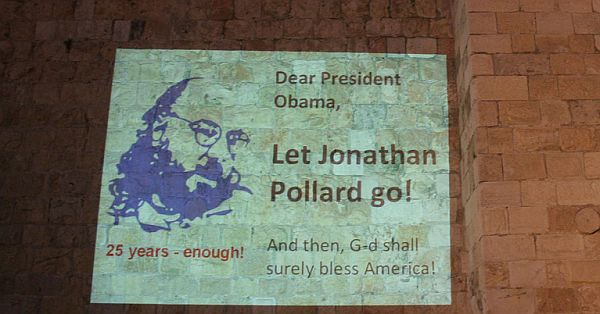
A “relentless” campaign by David Nyer, a Jewish Orthodox activist from Monsey, New York, has succeeded in winning significant support from House Democrats who are now calling on President Obama to release Jonathan Pollard.
Pollard is a former civilian intelligence analyst who was convicted of spying for Israel and through a plea bargain received a life sentence in 1987. He is believed to have caused incalculable damage to US national security.
Nyer’s campaign “struck gold” when he succeeded in winning the support of Rep. Barney Frank. The JTA reported:
Getting Frank was a coup, one congressional insider said, not only because he has a leadership position, but because his pronounced liberalism in other arenas adds credibility to an effort that has been identified in recent years with the Israeli and pro-Israel right.
Frank took up the cause because he long has believed that Pollard’s life sentence was disproportionate to the crime, his spokesman said.
“It is something he feels strongly about,” Harry Gural told JTA.
Launching the initiative at a Capitol Hill news conference Nov. 18, Frank listed two factors that made the matter timely: Pollard’s 25 years in prison as of Sundayand the parlous state of the Israeli-Palestinian peace process.
“The justification of this is the humanitarian one and the notion that the American justice system should be a fair one,” Frank said. “We believe that clemency after 25 years for the offenses of Jonathan Pollard would do that.
“My own hope is that if the president would do this, it would contribute to the political climate within the democracy of Israel and would enhance the peace process.”
Frank alluded to Obama’s low popularity in Israel where, fairly or not, the president has been saddled with a reputation as cool to Israeli interests.
The Jerusalem Post reports that Benjamin Netanyahu has asked the US to add Pollard’s release to the many other generous incentives the Obama administration have offered Israel in the hope of a 90 day, once only, extension to the settlement slowdown.
In “Why Pollard Should Never Be Released (The Traitor),” published in the New Yorker in January 1999, Seymour Hersh wrote:
A full accounting of the materials provided by Pollard to the Israelis has been impossible to obtain: Pollard himself has estimated that the documents would create a stack six feet wide, six feet long, and ten feet high. Rafi Eitan, the Israeli who controlled the operation, and two colleagues of his attached to the Israeli diplomatic delegation — Irit Erb and Joseph Yagur — were named as unindicted co-conspirators by the Justice Department. In the summer of 1984, Eitan brought in Colonel Aviem Sella, an Air Force hero, who led Israel’s dramatic and successful 1981 bombing raid on the Iraqi nuclear reactor at Osirak. (Sella was eventually indicted, in absentia, on three counts of espionage.) Eitan’s decision to order Sella into the case is considered by many Americans to have been a brilliant stroke: the Israeli war hero was met with starry eyes by Pollard, a chronic wannabe.
Yagur, Erb, and Sella were in Washington when Pollard was first seized by the F.B.I., in November, 1985, but they quickly left the country, never to return. During one period, Pollard had been handing over documents to them almost weekly, and they had been forced to rent an apartment in northwest Washington, where they installed a high-speed photocopying machine. “Safe houses and special Xeroxes?” an American career intelligence officer said, despairingly, concerning the Pollard operation. “This was not the first guy they’d recruited.” In the years following Pollard’s arrest and confession, the Israeli government chose not to cooperate fully with the F.B.I. and Justice Department investigation, and only a token number of the Pollard documents have been returned. It was not until last May [1998] that the Israeli government even acknowledged that Pollard had been its operative.
In fact, it is widely believed that Pollard was not the only one in the American government spying for Israel. During his year and a half of spying, his Israeli handlers requested specific documents, which were identified only by top-secret control numbers. After much internal assessment, the government’s intelligence experts concluded that it was “highly unlikely,” in the words of a Justice Department official, that any of the other American spies of the era would have had access to the specific control numbers. “There is only one conclusion,” the expert told me. The Israelis “got the numbers from somebody else in the U.S. government.”
Richard Perle? He was Assistant Secretary of Defense in the Reagan administration at that time and early in his career had been caught by the FBI passing classified information to the Israeli embassy in Washington.
Pollard’s American interrogators eventually concluded that in his year and a half of spying he had provided the Israelis with more than a year’s worth of the daily FOSIF reports from Rota [in Spain, the location of the Navy’s Sixth Fleet Ocean Surveillance Information Facility (FOSIF)]. Pollard himself told the Americans that at one point in 1985 the Israelis had nagged him when he missed several days of work because of illness and had failed to deliver the FOSIF reports for those days. One of his handlers, Joseph Yagur, had complained twice about the missed messages and had asked him to find a way to retrieve them. Pollard told his American interrogators that he had never missed again.
The career intelligence officer who helped to assess the Pollard damage has come to view Pollard as a serial spy, the Ted Bundy of the intelligence world. “Pollard gave them every message for a whole year,” the officer told me recently, referring to the Israelis. “They could analyze it” — the intelligence — “message by message, and correlate it. They could not only piece together our sources and methods but also learn how we think, and how we approach a problem. All of a sudden, there is no mystery. These are the things we can’t change. You got this, and you got us by the balls.” In other words, the Rota reports, when carefully studied, gave the Israelis “a road map on how to circumvent” the various American collection methods and shield an ongoing military operation. The reports provide guidance on “how to keep us asleep, thinking all is working well,” he added. “They tell the Israelis how to raid Tunisia without tipping off American intelligence in advance. That is damage that is persistent and severe.”
Senator John McCain, the top Republican on the Senate Armed Services Committee, said billions of dollars could be saved from the defense budget by cutting lawmakers’ pet projects, known as earmarks, and fixing troubled arms programs.
McCain told a foreign policy forum on Monday that he is confident Defense Secretary Robert Gates will be able to cut $100 billion from the defense budget over the next five years to fund personnel costs and keep weapons programs on track.
He cited several big arms programs that were over budget and behind schedule, saying they presented further opportunities to save money.
He said the Lockheed Martin Corp F-35 fighter program, now projected to cost $382 billion, was one example, saying it was “unacceptable” that the cost of each fighter jet was now double what was initially planned.
Axe the most expensive defense program ever — sounds like a good idea. But the Israelis will be disappointed. Maybe this says something about why the Obama administration is offering F-35 squadrons as though it was handing out candy.
Those of us who keep an eye on the parties of God are avid students of the weekly Sabbath sermons of Rabbi Ovadia Yosef. In these and other venues, usually broadcast, this elderly Sephardic ayatollah provides an action-packed diet that seldom disappoints. A few months ago, he favored his devout audience with a classic rant in which he called down curses on the Palestinian Arabs and their leaders, wishing that a plague would come and sweep them all away. Last month, he announced that the sole reason for the existence of gentiles was to perform menial services for Jews: After that, he opined, their usefulness was at an end. A huge hubbub led to his withdrawal of the first of these diatribes. (I would be interested to know if this was on partly theological grounds. After all, the local Palestinians may still have some labor to perform before the divine plan is through with them.) The second sermon, so far as I know, still stands without apology. Why on earth should anybody care about the ravings of this scrofulous medieval figure, who peppers his talk of non-Jews in Palestine with comparisons to snakes, monkeys, and other lesser creations, rather as Hamas and Hezbollah refer to the Jews? Well, one reason is that he is the spiritual leader of the Shas Party, an important member of Prime Minister Benjamin Netanyahu’s coalition. Indeed, two key portfolios, of the Interior and of Construction and Housing, are held by Shas members named Eli Yishai and Ariel Atias.
Yishai recently delighted the Diaspora by saying that only those Jews who converted via the Orthodox route could carry “the Jewish gene.” Atias has expressed alarm about the tendency of Israeli Arab citizens to try to live where they please—or “spread,” as he phrases it—and has advocated a policy of segregation in housing within Israel proper. He also advocates the segregation by neighborhood of secular from Orthodox Jews, adding that he does not wish his own children to mix with their nonreligious peers. It is Yishai’s ministry that is famous for making announcements about new “housing” developments outside Israel itself and in legally disputed territory. Very often, Netanyahu himself has claimed to be taken by surprise at these announcements, which usually involve tense areas of Jerusalem. Thus the huge embarrassment inflicted on Vice President Joe Biden earlier this year, when fresh settlement construction was proclaimed in the middle of his high-level visit. And thus the undisguised irritation of President Obama and Secretary of State Hillary Clinton last week, when yet another round of such housing was scheduled while Obama was in Asia and Netanyahu was in the United States. Apparently, the latest high-level round of the peace process has included the modest and tentative suggestion to Israel that such disclosures be timed with greater tact and coordination in the future.
[Soon-to-be House Majority Leader Eric Cantor] has been an AIPAC cutout since he first was elected to office. He’s been to more AIPAC meetings than he can probably count. And he should have figured out by now that the lobby is extremely careful, obsessively careful, to always emphasize loyalty to the United States while simultaneously endorsing Israeli policies that undermine our foreign policy objectives.
AIPAC officials never, ever, say that when push comes to shove their loyalty is with Israel not the United States. In fact, the accusation that this is the case is the charge AIPAC hates most.
But the soon-to-be Majority Leader came right out and said it: Israel, right or wrong.
It took a few days for Cantor to understand how utterly offensive his statement was. (He might have heard from a few Tea Party types who, say what you will about them, tend to take their patriotism seriously.)
So today Cantor explained he was misunderstood. His inconvenient truth, his gaffe, was replaced by a laughable untruth.
This is how the Washington Post‘s Dana Milbank reports it:
Brad Dayspring, Cantor’s press guy, tells me Cantor’s promise that the Republican majority would “serve as a check on the administration” was “not in relation to U.S./Israel relations.”
Mmmm. So Cantor’s pledge to stand with Netanyahu against Obama was “not in relation to US/Israel relations” despite the context of Cantor’s statement — just before Netanyahu’s meeting with Clinton — and the fact that the person he was talking to was the Prime Minister of Israel.
So, what was Cantor’s pledge “in relation to”?
Was it in relation to either repealing “Don’t Ask, Don’t Tell” or the Bush tax cuts for millionaires? Maybe it was about farm subsidies.
After winning the US midterm elections, Israel’s prime minister Benjamin Netanyahu hardly needs to worry about holding his own coalition government together. The fact that he so transparently now has Washington in his pocket should duly impress anyone who might have doubted America’s willingness to tolerate its increasingly servile relationship with Israel.
Even so, after the announcement that 1,345 new housing units will be built for Jewish occupants in Israeli-occupied East Jerusalem, President Obama’s reaction — to suggest that this move is “unhelpful” during peace negotiations — set off alarm bells. The White House was swift to assure those concerned, that the administration is not stepping out of line.
On a conference call with American Jewish leaders today, a White House official said the administration hadn’t sought a confrontation with the Israelis over a new construction announcement.
President Barack Obama answered a question at a press conference on the subject straightforwardly but hadn’t specifically planned to make a statement criticizing new Israeli building, National Security Council official Dan Shapiro said on the call, according to a participant.
Perhaps the press can avoid causing Obama any further embarrassment by henceforth not asking questions on such sensitive topics.
Still, this administration remains an object of mistrust and so when Netanyahu met his leading representative in Washington a few days ago, Eric Cantor, the congressman and likely GOP majority leader assured his prime minister that the Republican party will now be able impose the required discipline.
Eric stressed that the new Republican majority will serve as a check on the Administration and what has been, up until this point, one party rule in Washington. He made clear that the Republican majority understands the special relationship between Israel and the United States, and that the security of each nation is reliant upon the other.
Mutual dependence and the security of these two nations being synonymous are not quite the same thing.
It’s easy to see that Israel is capable of having such a disruptive impact on the Middle East that this will damage US interests and in that sense that the US depends on Israel not to undermine its national security even more than it already does.
But to say that Israel’s security is synonymous with America’s security suggests another possibility. If our interests do indeed so perfectly overlap, then we really don’t need to think about Israel’s security. If America focuses on its own interests, Israel’s — in as much as their interests are identical — will be taken care of. In as much as our interests differ — well that’s Israel’s problem, not ours.
The sharpest signal of what last week’s elections meant for Jews came not from Washington but from New Orleans, Nova Scotia and Australia.
In New Orleans, Israeli Prime Minister Benjamin Netanyahu delivered a speech Monday calling for moving beyond sanctions to mounting a “credible military threat” against Iran as a means of avoiding war.
“Containment will not work,” Netanyahu said in his address to the General Assembly of the Jewish Federations of North America.
The prime minister’s remarks echoed the precise terminology used by Sen. Lindsey Graham (R-S.C.) in Nova Scotia two days earlier, when he told the Halifax International Security Forum that “containment is off the table.” The likely new majority leader in the U.S. House of Representatives, Rep. Eric Cantor (R-Va.), referred to a “credible military threat” in the days before the election.
It was a clear sign that Netanyahu feels empowered by the Republican sweep last week of the House of Representatives to trump the Obama administration’s emphasis on peacemaking with the Palestinians with his own priority: confronting Iran.
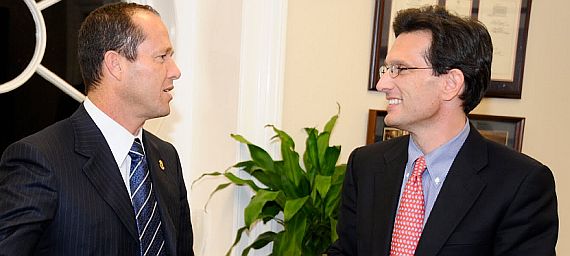
Jerusalem Mayor Nir Barkat meeting Rep. Eric Cantor, the presumptive Republican leader following the midterm elections. They are shown meeting in Washington DC last year.
Whatever the outcome of yesterday’s election had been, the Israel lobby had good reason to claim victory. Josh Rogin writes:
One prominent pro-Israel lobbying group in Washington is already praising the GOP takeover of the House of Representatives as a net benefit for Israel.
“While Democrats are likely to keep control of the U.S. Senate, Republicans will take over the U.S. House of Representatives following Tuesday’s elections. This is likely to have implications for Israel-related issues such as Israel’s relationship with the United States and the push for sanctions against Iran,” said an e-mail blasted out by The Israel Project only minutes after news stations called the turnover of House control a certainty.
“The takeover of the House by Republicans is great news for Israel and her supporters,” the email quotes Ari Fleischer, White House spokesman under President George W. Bush, as saying. “The House leadership and almost every single GOP member is rock-solid behind Israel. At times like this, Israel needs friends everywhere.”
But the Israel Project’s e-mail then quickly turns on its head and praises Congressional Democrats in the House and Senate for their staunch support of Israel.
“The House Democratic leadership has been powerfully supportive of Israel, and Speaker Pelosi has been nothing short of passionate in her successful pursuit of biting sanctions against Iran – a key interest of the pro-Israel community,” The Israel Project quotes David Harris, president and CEO of the National Jewish Democratic Council, as saying.
So which is it? Is The Israel Project saying that Republicans or Democrats are better for Israel?
“American voters on both sides of the aisle support Israel,” Jennifer Laszlo Mizrahi, founder and president of The Israel Project, says in the e-mail.







 After
After