



Visit msnbc.com for breaking news, world news, and news about the economy
MSNBC reports: A well-known Washington lobbying firm with links to the financial industry has proposed an $850,000 plan to take on Occupy Wall Street and politicians who might express sympathy for the protests, according to a memo obtained by the MSNBC program “Up w/ Chris Hayes.”
The proposal was written on the letterhead of the lobbying firm Clark Lytle Geduldig & Cranford and addressed to one of CLGC’s clients, the American Bankers Association.
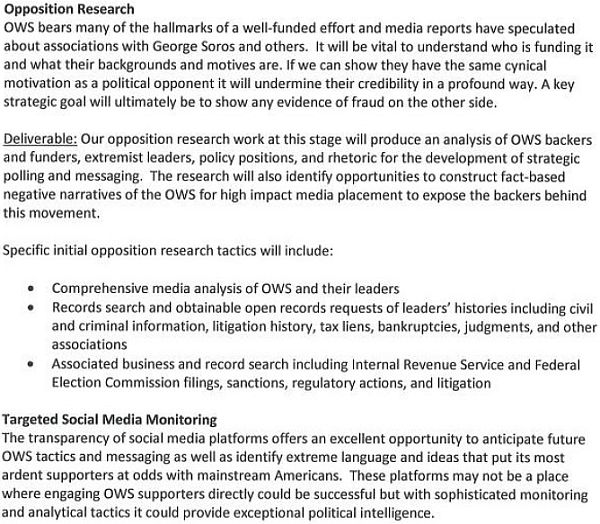
CLGC’s memo [PDF] proposes that the ABA pay CLGC $850,000 to conduct “opposition research” on Occupy Wall Street in order to construct “negative narratives” about the protests and allied politicians. The memo also asserts that Democratic victories in 2012 would be detrimental for Wall Street and targets specific races in which it says Wall Street would benefit by electing Republicans instead.
According to the memo, if Democrats embrace OWS, “This would mean more than just short-term political discomfort for Wall Street. … It has the potential to have very long-lasting political, policy and financial impacts on the companies in the center of the bullseye.”
Here’s an extract from the memo:

The New York Times reports: The warning has ricocheted around the financial world in recent weeks, in conversations at Midtown restaurants and Washington fund-raisers, carrying urgent appeals for money from financial executives around the Northeast: The battle to re-elect Senator Scott P. Brown, the Republican from Massachusetts, just got a little more interesting.
“Senator Brown is a free-market advocate who believes that our strength as a nation comes from the ingenuity and hard work of its people,” read an invitation to a fund-raiser at a New Canaan, Conn., country club last week, that circulated among hedge fund and private equity executives. His Democratic opponent, the invitation noted, was all but certain to be the financial industry’s most prominent foe: “big government liberal Elizabeth Warren.”
Mr. Brown, a freshman who harnessed populist Tea Party anger to win the seat once held by Edward M. Kennedy, has taken more money from the financial industry than almost any other senator: all told, more than $1 million during the last two years, according to data from the Center for Responsive Politics.
Of the 20 companies that accounted for the most campaign donations to Mr. Brown, about half were prominent investment or securities firms like Morgan Stanley, Fidelity Investments and Bain Capital. His donors include such blue-chip names as Gary Cohn, the president of Goldman Sachs, and the hedge fund kings John Paulson and Kenneth Griffin.
Mr. Brown, in turn, has been an important ally at critical moments, using his swing vote in the Senate to wring significant concessions out of Democrats on last year’s financial regulation bill, including helping strip out a proposed $19 billion bank tax and weakening a proposal to stop commercial banks from holding large interests in hedge funds and private equity funds.
But the intensity of his relationship with Wall Street was altered in September, when Mr. Brown got a new opponent: Ms. Warren, a law professor and consumer advocate who has described herself as an intellectual godmother of the Occupy Wall Street movement.
Ms. Warren’s relentless manner and withering attacks on predatory lenders have won her enemies from Wall Street to Washington, where as a member of an oversight panel she helped usher in the largest expansion in decades of federal oversight of the financial industry. Now Mr. Brown’s support for the industry — and Ms. Warren’s battles with it — are becoming a defining issue in one of the most hotly contested Senate races and a magnet for special interest money.
Zaid Jilani reports: In one of the greatest signs yet that the 99 Percenters are having an impact, Rep. Ted Deutch (D-FL), a member of the House Judiciary Committee, today introduced an amendment that would ban corporate money in politics and end corporate personhood once and for all.
Deutch’s amendment, called the Outlawing Corporate Cash Undermining the Public Interest in our Elections and Democracy (OCCUPIED) [PDF] Amendment, would overturn the Citizens United decision, re-establishing the right of Congress and the states to regulate campaign finance laws, and to effectively outlaw the ability of for-profit corporations to contribute to campaign spending.
“No matter how long protesters camp out across America, big banks will continue to pour money into shadow groups promoting candidates more likely to slash Medicaid for poor children than help families facing foreclosure,” said Deutch in a statement provided to ThinkProgress. “No matter how strongly Ohio families fight for basic fairness for workers, the Koch Brothers will continue to pour millions into campaigns aimed at protecting the wealthiest 1%. No matter how fed up seniors in South Florida are with an agenda that puts oil subsidies ahead of Social Security and Medicare, corporations will continue to fund massive publicity campaigns and malicious attack ads against the public interest. Americans of all stripes agree that for far too long, corporations have occupied Washington and drowned out the voices of the people. I introduced the OCCUPIED Amendment because the days of corporate control of our democracy. It is time to return the nation’s capital and our democracy to the people.”
MJ Rosenberg writes: The Republican candidates for president are not the only politicians who use Iran and its nuclear program as a magnet for campaign dollars. The same dynamic is at play in Los Angeles, where two Democratic House members, Howard Berman and Brad Sherman, are trying to out-hawk each other on Iran in preparation for a June 2012 primary. (Their districts are being merged.)
To be fair, both Sherman and Berman, who is a former chair of the House Foreign Affairs Committee and now its ranking Democrat, are AIPAC stalwarts and were hardliners on Iran long before being pitted against each other in a primary.
They have both promoted “crippling” sanctions bills, which supporters argue are specifically targeted at Iranians involved in the country’s nuclear program and not at Iranians in general.
But that claim cannot be made for Brad Sherman’s latest AIPAC-inspired legislation, which would prevent the president from permitting the inspection and repair of U.S.-manufactured engines on Iranian civilian aircraft.
The planes in question were sold to the Iranians back in the 1970s (when the Shah was in power) and are now dangerously out of date. Current sanctions laws ban the sale of new planes and parts to Iran, but a humanitarian exception in the law permits repairs and the replacement of parts necessary to prevent civilian air crashes. It is that exception that Sherman is hell-bent on removing.
On March 16, President Obama informed Congress that he would use his authority under the law to allow Iran to repair fifteen General Motors engines used in civilian planes that were recently deemed a safety risk by the Federal Aviation Administration.
Sherman went ballistic, immediately firing off a letter to the president demanding that he not permit the planes to be repaired. He wrote:
There is no reason we should be helping the Iranians keep these planes in the air. … Fixing these aircraft is in 180 degree opposition to our sanctions policy, which if properly implemented, would provide for Iran’s increased economic and political isolation.
Sherman either overlooks or doesn’t care about the one reason the United States should permit the repair of those planes: saving lives.
An editorial in The Observer says: Iran’s acquisition of nuclear weapons is seen as a threat for reasons partly of Israel’s own making – foremost its absolute reliance on a policy of military supremacy and deterrence to underpin security. A nuclear-armed Iran would hole that policy below the waterline, making it far more difficult, for instance, to launch the kind of war it waged against Hezbollah in Lebanon in 2006.
Israel’s recent posturing ahead of the IAEA meeting, which included testing a new long-range missile and launching a long-range air strike exercise, is a doubly dangerous game. For while some senior Israeli air force officers are understood to support Netanyahu’s desire to strike Iran sooner rather than later, other independent analysis is far more sceptical of Israel’s ability to cause lasting damage on Iran’s nuclear programme, suggesting that it might require up to a fifth of the country’s operational aircraft to inflict serious harm, which could still fall short of Israel’s desired outcome. Some experts have estimated that even a successful raid on Iran would buy Israel only four years at best while encouraging Iran to redouble its efforts to acquire nuclear weapons.
If that is the short-term analysis, then in the medium term the risks for Israel perhaps would be greater still. With its regional alliances with friendly states quickly unravelling in the fall-out from the Arab Spring, from Israel’s botched attack on the Turkish-flagged MV Mavi Marmara and from its war against Gaza, an attack on the scale required to halt Iran’s nuclear programme is unlikely to improve either its relations with its neighbours or Israel’s security environment.
All of which leads to the question – if the consequences carry such risk for so little benefit, why are Netanyahu and his defence minister, Ehud Barak, pushing the plan?
One possibility is that Netanyahu is determined to impose the terms of the debate about the issues raised by the IAEA report at a time when it is clear that both Russia and China are lukewarm on the prospect of further sanctions against Tehran. If that is Netanyahu’s aim – to use the threat of war to leverage diplomatic effect – it is the behaviour of a tinpot state, not the mature democracy Israel claims to be.
Far more worrying is the notion that Netanyahu, who has long chafed against President Obama’s strictures on settlement building and the peace process, and is said to be obsessed with the issue of Iran, is contemplating an attack having calculated he has sufficient friends in Congress to defy the White House.
Whatever Netanyahu is thinking, he is playing a high-risk game for even higher stakes, betting Israel’s security and international prestige against an uncertain outcome, even by allowing it to be suggested that Israel might strike. After Israel’s failure to defeat Hezbollah in Lebanon in 2006, its failure to break Hamas in Gaza in 2009 – and with the international opprobrium that followed that operation – Israel risks talking itself into a corner where it appears weak if it doesn’t act and perhaps weaker if it does, a country increasingly bereft of any notion of how to manage relations with its neighbours except through the threat of aggression.
The Cable reports: Following the State Department’s announcement that it had cut off U.S. funding from UNESCO in response to its overwhelming vote in favor of accepting the Palestinian bid for full membership, senators from both parties predicted the United States would cut funding or even withdraw from several other international organizations the Palestinians seek to join.
As The Cable reported last month, the Obama administration is required by existing U.S. law to cut off funding for any international organization that grants the Palestinians full membership. . Membership in UNESCO also grants the Palestinians membership in the World Intellectual Property Organization (WIPO) and the United Nations Industrial Development Organization (UNIDO). The United States is not a member of UNIDO, but will be forced to stop contributing to WIPO.
But that’s only the tip of the iceberg. The Palestinians could seek membership in more prominent international organizations, which could result in the United States defunding or even withdrawing from institutions such as the World Health Organization and the International Atomic Energy Agency. The AP reported today that the Palestinian Authority was examining seeking membership in 16 more U.N. organizations.
While leading senators in both parties acknowledge that such an outcome would be negative for U.S. interests and influence, they have no intention of intervening to change the law. To the contrary, several top senators in both parties told The Cable they support the policy and will work to enforce it, despite the consequences.
Ian Williams writes: By reflexively withdrawing from Unesco in response to Palestine’s admission, the Obama-Clinton state department has taken the lunatic fringe and put them centre stage. Representative Ileana Ros-Lehtinen, a Florida Republican who chairs the House foreign affairs committee, combines a Likudnik support of Israel with a recidivist hatred of the UN and has been trying to de-fund the UN and its agencies.
In contrast, Hillary Clinton, who visited Unesco’s Paris HQ earlier this year, had announced: “I am proud to be the first secretary of state from the United States ever to come to Unesco, and I come because I believe strongly in your mission.” Indeed. So strongly does she believe in it that she is prepared to pull out of the organisation for recognising the Palestinian statehood that Obama had himself called for at the UN general assembly in September 2010.
The voting lineup on Monday was indicative. France, much more diplomatically adroit than the US, and mindful of its global standing, supported Palestinian membership. Even subservient Britain could not bring itself to vote with the US and pusillanimously abstained. The voting suggests that when the security council resolution on Palestinian UN membership comes up next week, it will get the nine affirmative votes needed – which means the US will have to use its veto and risk consequences, such as those threatened by the Saudis.
If the US had put nearly as much pressure on Israel as it had on others to avoid using its threatened veto, it would be a much more credible and creditable world power. As it is, its desperate attempts to avoid a veto by getting others to do its dirty work for it have made the Obama administration look like a toddler who hides his head behind the curtains and cannot understand why everyone can still see him.
The security council vote apart, the Unesco vote presages Palestinian admission to other agencies. One looks forward to US withdrawal from the International Atomic Energy Agency, relieving the pressure in Iran, or from the World Health Organisation, as soon as Palestine is allowed to join.
Compounding the irony, Israel itself has so far not indicated it is pulling out of Unesco, nor indeed any other UN agency. On the contrary, WikiLeaks recently revealed that Israel was angling for a major position in Unesco.
The nature of the US approach is clear. There is a general lack of principle. For example, the route being followed by Palestine in its effort to join multilateral institutions replicates that of the Vatican, whose far more dubious claim to statehood derives from its original membership of the Universal Postal Union, since the postage stamp-sized enclave did indeed issue its own stamps.
The actual legislation the state department invokes is a 1990 prohibition on funding “the United Nations or any specialised agency thereof which accords the Palestine Liberation Organisation the same standing as a member state”, and another in 1994 banning payments to “any affiliated organisation of the United Nations which grants full membership as a state to any organisation or group that does not have the internationally recognised attributes of statehood”.
Any president, as we have seen, has ways to get around congressional mandates like this. For example, there are questions about which manifestation of Palestine is applying: the PLO or the Palestinian Authority. The congressional legislation was passed before the Oslo accords – and before the US began funding the Palestinians directly, so an executive decision could have declared that events had overtaken the intent of the law, and, what is more, that it was not the PLO but the Palestinian state that had been admitted.
Ari Berman writes: In September the Committee for a Responsible Federal Budget (CRFB), a bipartisan deficit-hawk group based at the New America Foundation, held a high-profile symposium urging the Congressional “supercommittee” to “go big” and approve a $4 trillion deficit reduction plan over the next decade, which is well beyond its $1.2 trillion mandate. The hearing began with an alarming video of top policy-makers describing the national debt as “the most serious threat that this country has ever had” (Alan Simpson) and “a threat to the whole idea of self-government” (Mitch Daniels). If the debt continues to rise, predicted former New Mexico Senator Pete Domenici, there would be “strikes, riots, who knows what?” A looming fiscal crisis was portrayed as being just around the corner.
The event spotlighted a central paradox in American politics over the past two years: how, in the midst of a massive unemployment crisis—when it’s painfully obvious that not enough jobs are being created and the public overwhelmingly wants policy-makers to focus on creating them—did the deficit emerge as the most pressing issue in the country? And why, when the global evidence clearly indicates that austerity measures will raise unemployment and hinder, not accelerate, growth, do advocates of austerity retain such distinction today?
An explanation can be found in the prominence of an influential and aggressive austerity class—an allegedly centrist coalition of politicians, wonks and pundits who are considered indisputably wise custodians of US economic policy. These “very serious people,” as New York Times columnist Paul Krugman wryly dubs them, have achieved what University of California, Berkeley, economist Brad DeLong calls “intellectual hegemony over the course of the debate in Washington, from 2009 until today.”
Its members include Wall Street titans like Pete Peterson and Robert Rubin; deficit-hawk groups like the CRFB, the Concord Coalition, the Hamilton Project, the Committee for Economic Development, Third Way and the Bipartisan Policy Center; budget wonks like Peter Orszag, Alice Rivlin, David Walker and Douglas Holtz-Eakin; red state Democrats in Congress like Mark Warner and Kent Conrad, the bipartisan “Gang of Six” and what’s left of the Blue Dog Coalition; influential pundits like Tom Friedman and David Brooks of the New York Times, Niall Ferguson and the Washington Post editorial page; and a parade of blue ribbon commissions, most notably Bowles-Simpson, whose members formed the all-star team of the austerity class.
The austerity class testifies frequently before Congress, is quoted constantly in the media by sympathetic journalists and influences policy-makers and elites at the highest levels of power. They manufacture a center-right consensus by determining the parameters of acceptable debate and policy priorities, deciding who is and is not considered a respectable voice on fiscal matters. The “balanced” solutions they advocate are often wildly out of step with public opinion and reputable economic policy, yet their influence endures, thanks to an abundance of money, the ear of the media, the anti-Keynesian bias of supply-side economics and a political system consistently skewed to favor Wall Street over Main Street.
Walter Pincus, in a column for the Washington Post, writes: As the country reviews its spending on defense and foreign assistance, it is time to examine the funding the United States provides to Israel.
Let me put it another way: Nine days ago, the Israeli cabinet reacted to months of demonstrations against the high cost of living there and agreed to raise taxes on corporations and people with high incomes ($130,000 a year). It also approved cutting more than $850 million, or about 5 percent, from its roughly $16 billion defense budget in each of the next two years.
If Israel can reduce its defense spending because of its domestic economic problems, shouldn’t the United States — which must cut military costs because of its major budget deficit — consider reducing its aid to Israel?
First, a review of what the American taxpayer provides to Israel.
In late March 2003, just days after the invasion of Iraq, President George W. Bush requested the approval of $4.7 billion in military assistance for more than 20 countries that had contributed to the conflict or the broader fight against terrorism. Israel, Jordan, Egypt, Afghanistan, Pakistan and Turkey were on that list.
A major share of the money, $1 billion, went to Israel, “on top of the $2.7 billion regular fiscal year 2003 assistance and $9 billion in economic loans guaranteed by the U.S. government over the next three years,” according to a 2003 study by the Congressional Research Service (CRS).
Then in 2007, the Bush administration worked out an agreement to raise the annual military aid grant, which had grown to $2.5 billion, incrementally over the next 10 years. This year, it has reached just over $3 billion. That is almost half of all such military assistance that Washington gives out each year and represents about 18 percent of the Israeli defense budget.
In addition, the military funding for Israel is handled differently than it is for other countries. Israel’s $3 billion is put almost immediately into an interest-bearing account with the Federal Reserve Bank. The interest, collected by Israel on its military aid balance, is used to pay down debt from earlier Israeli non-guaranteed loans from the United States.
Another unique aspect of the assistance package is that about 25 percent of it can be used to buy arms from Israeli companies. No other country has that privilege, according to a September 2010 CRS report.
The U.S. purchases subsidize the Israeli arms business, but Washington maintains a veto over sales of Israeli weapons that may contain U.S. technology.
Look for a minute at the bizarre formula that has become an element of U.S.-Israel military aid, the so-called qualitative military edge (QME). Enshrined in congressional legislation, it requires certification that any proposed arms sale to any other country in the Middle East “will not adversely affect Israel’s qualitative military edge over military threats to Israel.”
In 2009 meetings with defense officials in Israel, Undersecretary of State Ellen Tauscher “reiterated the United States’ strong commitment” to the formula and “expressed appreciation” for Israel’s willingness to work with newly created “QME working groups,” according to a cable of her meetings that was released by WikiLeaks.
The formula has an obvious problem. Because some neighboring countries, such as Saudi Arabia and Egypt, are U.S. allies but also considered threats by Israel, arms provided to them automatically mean that better weapons must go to Israel. The result is a U.S.-generated arms race.
MJ Rosenberg writes: Aid to Israel is virtually the only program, domestic or foreign, that is exempt from every budget cutting proposal pending in Congress. No matter that our own military is facing major cuts along with Medicare, cancer research and hundreds of other programs, Israel’s friends in Congress in both parties make sure that aid to Israel is protected at current levels.
Back when I was a Congressional staffer, I was part of the process by which aid to Israel was secured. Every member of the Congressional Appropriations Committees sent a “wish list” to the chairman of the committee telling him or her which programs he wanted funded and by what amounts. Each letter reflected the particular interest of a particular Representative or Senator and of his own district or state.
There was always one exception: aid to Israel, which apparently is a local issue for every legislator. The American Israel Public Affairs Committee (AIPAC) would provide the list of Israel’s aid requirements for the coming year and, with few if any exceptions, every letter would include the AIPAC language. Not a punctuation mark would be changed.
At the end of the process, the AIPAC wish list would become law of the land. (Woe to any Member of Congress who dared to resist the AIPAC juggernaut).
That is how it has been for decades and not even the current economic crisis is likely to change it. On this issue, Congress is hopeless and will remain so as long as its members rely so heavily on campaign contributions (PAC or individual) delivered by AIPAC.
JTA reports: Mitt Romney said he would increase defense assistance to Israel, raise the U.S. military profile near Iran and recognize Israel as a Jewish state.
Lara Friedman from Americans for Peace Now writes:
This past weekend there were press reports (original story in the Independent, with further reporting in the Israeli press) that Congress was blocking $200 million in aid to the Palestinian Authority (PA). As is often the case when it comes to the rather arcane world of Congress and appropriations, the press reports were partly correct and partly incorrect, and also missed some rather important points.
The Facts
- U.S. direct assistance to the PA for FY2011, which amounted to $200 million, is already out the door. Congress can’t do anything to block funding that has already been spent, although some members of Congress are threatening to cut off this funding in 2012 to punish the Palestinian Authority for going to the UN.
- Congress is blocking $192 million in funds for U.S. humanitarian programs for Palestinian residents of the West Bank and Gaza. This funding is being blocked by Republicans on two House committees: the House Foreign Affairs Committee and the House Appropriations Committee’s Foreign Operations Subcommittee. These funds are for programs funded through USAID and carried out by non-governmental organizations. It should be emphasized that the West Bank/Gaza assistance program is completely distinct from U.S. aid to the PA. U.S. humanitarian assistance to the Palestinian people has long been kept hermetically sealed off from PA aid – specifically to enable it to continue, even, for example, when concerns over corruption led Congress to prohibit all aid to the PA (a prohibition that still is law today, but a law that the President has the authority to waive, with conditions), and even after Hamas won the 2006 Palestinian legislative elections. The U.S. program for the West Bank and Gaza, it should be emphasized, is probably the most congressionally restricted, conditioned, vetted and overseen U.S. assistance program in the world – all to ensure that not a dollar benefits the PA and that not a dollar serves any purpose but to address humanitarian concerns and promote U.S. policy objectives.
- Congress is also blocking $150 million in funding for security assistance to the PA (aid that comes under the title of “international narcotics control and law enforcement programs – INCLE”). This block – which so far has not been reported in the media – does target the PA and will be very problematic for the PA. These funds are being blocked by Republicans on the Senate Foreign Relations Committee and possibly also by the House Foreign Affairs Committee (this could not be confirmed as of this writing). Some members of Congress have also threatened to cut these funds in 2012 to punish the Palestinian Authority for going to the UN.
The press has not been clear on how Congress is blocking funds that have been previously approved, so to clarify: Congress keeps a very tight hold on the purse strings when it comes to foreign aid in general, and assistance for the Palestinians and the PA in particular. One way it does this is by (as part of the law providing the funds) requiring the Administration to notify/consult with relevant committees (House and Senate) before actually spending money. The relevant committees are the committees with jurisdiction over foreign assistance – the House Foreign Affairs Committee and Senate Foreign Relations Committee and the Foreign Operations Subcommittees of the House and Senate Appropriations Committees. As part of this notification process, a committee member or members can place a hold on a given expenditure – in theory in order to get more information/justification from the Administration.
That is what is happening here with the holds on the $192 million for USAID funding for the Palestinians, and the hold on the $150 million for security assistance – although of course while some members might legitimately want more information (including information about how USAID might be adapting to new circumstances that could be relevant to a these aid programs), for others this could easily be a handy pretext for just blocking the funding for political reasons. [Continue reading…]
The Independent reports:
The Palestinian leadership yesterday accused the US Congress of inflicting “collective punishment” upon its people by holding up almost $200m in aid earmarked for the West Bank and Gaza by the Obama administration.
The freeze on funds earlier allocated for the financial year which ends today is the first concrete Congressional reprisal against Palestinian President Mahmoud Abbas to come to light since he angered US legislators by pursuing his application for full UN membership last week.
The unpublicised block has been in force since August and was imposed in response to the then planned UN recognition bid and to earlier – so far fruitless – efforts to effect reconciliation between Mr Abbas’s own Fatah faction and Hamas.
USAID has been unable to allocate the funds, designated for a wide range of humanitarian, educational and state capacity building projects, pending negotiations between the US government and Congressional leaders aimed at lifting the freeze. Ghassan Khatib, chief spokesman for the Palestinian Authority, said yesterday: “This is not constructive at all. Such moves are unjustified. These are mainly humanitarian and development projects-it is another kind of collective punishment which is going to harm the needs of the public without making any positive contribution.”
Max Blumenthal writes:
Bob Turner, the Republican candidate campaigning to replace disgraced Democratic Rep. Anthony Weiner, picked up a crucial endorsement last week when Democratic Assemblyman Dov Hikind threw his support to him. Hikind is the former leader of the the Jewish Defense League (JDL), which the FBI lists as a terror organization. He was also a confidant of the fanatical Israeli settler leader Meir Kahane, who called for the “slaughter” of Palestinians. Under Kahane’s direction, Hikind operated a front group with the JDL cadre Victor Vancier (aka Chaim Ben Pesach), who served 10 years in prison for carrying out numerous firebomb attacks on innocent people, and openly contemplated killing the renowned Palestinian professor Edward Said. According to journalists Michael Karpin and Ina Friedman, “Hikind had been suspected [by the FBI] of similar activities” including a string of six bombings against Arab-American targets across the United States.
Hikind once told the journalist Robert I. Friedman that he supported a Jewish terrorist underground that assassinates Nazis. “If it is a group that is made up of people who are intelligent professionals and their goal is to execute those clearly responsible for killing tens of thousands, then I would have no trouble with that,” Hikind said. Hikind added that he also favored the assassination of Arab-American supporters of the PLO. The JDL was widely suspected of killing Arab-American Anti-Discrimination committee western regional director Alex Odeh in 1985, though the FBI was never able to apprehend the likely perpetrators. In 2001, JDL leaders Irv Rubin and Earl Krugel were arrested for conspiring to blow up a Los Angeles-area mosque and assassinate Republican Rep. Darrell Issa, who is of Lebanese descent.
Hikind’s terrorist links were never raised by Bob Turner’s Democratic opponent, David Weprin. Instead, Weprin joined Turner in the pro-Israel competition that has become a hallmark of American political campaigns, attacking President Barack Obama’s policy towards Israel as “outrageous.”

Tony Karon writes:
Israel’s fallout with long-time ally Turkey is no isolated spat that will be repaired any time soon; it’s a dramatic illustration that no amount of U.S. backing can prevent the growing international isolation resulting from Israel’s handling of the Palestinian issue. Indeed, the unconditional nature of Washington’s backing may, in fact, have become dysfunctional to Israel’s diplomatic standing: A U.S. domestic political climate in which challenging Israel on anything is about as wise as threatening to cut medicare payments leaves Washington unable to restrain the most right-wing government in Israeli history from its most self-destructive urges, while economic changes and the radical policies adopted by the United States in the decade since 9/11 have left Washington’s influence in the Middle East at its weakest since World War II.
The trigger for Turkey expelling Israel’s ambassador, cutting defense ties and vowing to wage a diplomatic campaign against the blockade of Gaza and in support of the Palestinian move for recognition of statehood at the United Nations was the Netanyahu government’s refusal to apologize for the killing of nine Turkish citizens and a Turkish American in last year’s raid on the Gaza flotilla. The Obama Administration had tried to broker a rapprochement involving some form of Israeli apology, which Prime Minister Benjamin Netanyahu had reportedly been inclined to accept but his ultranationalist foreign minister and key coalition partner (as well as rival) Avidgor Lieberman refused to countenance it.
The breakdown, however, is about a lot more than an apology: The flotilla itself, after all, had sailed in direct challenge to the Gaza blockade, with the support of the Turkish government — an expression of the fact that Ankara was no longer willing to follow its NATO allies, under U.S. leadership, in turning a blind eye to the plight of the beleaguered Palestinians. Israeli leaders and their most enthusiastic boosters in Washington like to paint this as a sign that Turkey had “gone over” to the region’s Iranian-led “resistance” camp, but despite the ruling AK Party’s roots in moderate political Islam and its insistence on a political solution to the nuclear standoff with Iran, Turkey is in fact a regional rival for influence with Tehran. Ankara’s stance on the Palestinians, like its refusal to support or enable the Bush Administration’s invasion of Iraq and its stance on the Iran nuclear issue or its break with the Syrian regime of President Bashar al-Assad, is based on its own reading of what’s good for the region — which is quite different from Washington’s — and on Turkish public opinion. And, as if to underscore the fact that its break with Israel doesn’t threaten its commitment to NATO, Turkey announced last week that it had agreed to host radar installations for a NATO missile defense system targeting Iran.
Turkey’s actions also reflect a growing international impatience with and loss of faith in Washington’s handling of the Israeli-Palestinian conflict. Israel is worried, with good reason, that Egypt — whose foreign policy has been made more responsive to public opinion by the overthrow of the Israel-friendly U.S.-backed President Hosni Mubarak last February — may follow the Turkish example.
Meanwhile, the Associated Press reports:
Rising tensions with some of its closest and most important allies have left Israel increasingly isolated ahead of a momentous vote on Palestinian independence at the United Nations.
Troubles with Turkey, Egypt and even the U.S. are adding to Israel’s headaches ahead of the vote, which is shaping up to be a global expression of discontent against the government of Prime Minister Benjamin Netanyahu.
The Palestinians plan to ask the United Nations this month to recognize their independence in the West Bank, Gaza Strip and east Jerusalem – areas captured by Israel in the 1967 Mideast war – probably by embracing them as a “nonmember observer state.” The measure is expected to pass overwhelmingly in the U.N. General Assembly.
The assembly’s decisions are not legally binding, so the vote will be largely symbolic. But the Palestinians hope the measure will increase the already considerable pressure on Israel to withdraw from occupied territories, and add leverage should peace talks resume. The Palestinians refuse to negotiate while Israel continues to expand Jewish settlements in the West Bank and east Jerusalem.
Ghassan Khatib, a spokesman for the Palestinian government in the West Bank, said Israeli isolation is playing right into Palestinian hands. “We are seeing that result in increased support for us in the United Nations,” he said.
On Wednesday, China announced it would support the Palestinian bid. And a French Mideast envoy, Valerie Hoffenberg, said she had been fired after publicly arguing against the Palestinian initiative. France has not publicly said how it will vote, but her comments signaled that the government favors the Palestinians.
(Update below)
Jamal Elshayyal visited Libya’s intelligence headquarters in Tripoli, much of which were destroyed in NATO airstrikes.
I managed to smuggle away some documents, among them some that indicate the Gaddafi regime, despite its constant anti-American rhetoric – maintained direct communications with influential figures in the US.
I found what appeared to be the minutes of a meeting between senior Libyan officials – Abubakr Alzleitny and Mohammed Ahmed Ismail – and David Welch, the former assistant secretary of state who served under George W Bush and the man who brokered the deal which restored diplomatic relations between the US and Libya in 2008.
Welch now works for Bechtel, a multinational American company with billion dollar construction deals across the Middle East. The documents record that, on August 2, 2011, David Welch met with Gaddafi’s officials at the Four Seasons Hotel in Cairo, just a few blocks from the US embassy there.
During that meeting Welch advised Gaddafi’s team on how to win the propaganda war – suggesting several “confidence building measures”, the documents said. The documents appear to indicate that an influential US political personality was advising Gaddafi on how to beat the US and NATO.
Minutes of this meeting note his advice on how to undermine Libya’s rebel movement, with the potential assistance of foreign intelligence agencies, including Israel. “Any information related to al-Qaeda or other terrorist extremist organisations should be found and given to the American administration but only via the intelligence agencies of either Israel, Egypt, Morroco, or Jordan… America will listen to them… It’s better to receive this information as if it originated from those countries…”
The papers also document that Welch advised Gaddafi’s regime to take advantage of the current unrest in Syria, pointing out: “The importance of taking advantage of the Syrian situation particularly regarding the double-standard policy adopted by Washington… the Syrians were never your friends and you would loose nothing from exploiting the situation there in order to embarrass the West.”
Despite this apparent encouragement to Gaddafi of going on a propaganda campaign at the expense of Syria, the documents claim Welch attacked Qatar, describing Doha’s actions as “cynical” and an attempt to divert attention from the unrest in Bahrain.
The documents claims that Welch went on to propose the following solution to the crisis which he said many would support in the US administration; Gaddafi “should step aside” but “not necessarily relinquish all his powers”. This advice is a clear contradiction to public demands from the White House that Gaddafi must be removed.
According to the document, as the meeting closed, Welch promised: “To convey everything to the American administration, the congress and other influential figures.” But it appears that David Welch was not the only prominent American giving help to Gaddafi as NATO and the rebel army were locked in battle with his regime.
On the floor of the intelligence chief’s office lay an envelope addressed to Gaddafi’s son Saif Al-Islam. Inside, I found what appears to be a summary of a conversation between US congressman Denis Kucinich, who publicly opposed US policy on Libya, and an intermediary for the Libyan leader’s son.
It details a request by the congressman for information he needed to lobby American lawmakers to suspend their support for the Libyan National Transitional Council (NTC) and to put an end to NATO airstrikes. According to the document, Kucinich wanted evidence of corruption within the NTC and, like his fellow countryman Welch, any possible links within rebel ranks to al-Qaeda.
The document also lists specific information needed to defend Saif Al-Islam, who is currently on the International Criminal Court’s most wanted list.
Update: Al Jazeera:
A spokesperson for the US state department said that David Welch is “a private citizen” who was on a “private trip” and that he did not carry “any messages from the US government”. Welch has not responded to Al Jazeera‘s requests for comment.
Dennis Kucinich issued a statement to the Atlantic Wire stating: “Al Jazeera found a document written by a Libyan bureaucrat to other Libyan bureaucrats. All it proves is that the Libyans were reading the Washington Post… I can’t help what the Libyans put in their files… Any implication I was doing anything other than trying to bring an end to an unauthorised war is fiction.”
The document connected to Welch can be read here.
The document connected to Kucinich can be read here.
Josh Ruebner writes:
Apologists for Israeli occupation and apartheid claim that advocates for holding Israel accountable for its human rights abuses of Palestinians are “singling Israel out for extra scrutiny” or “holding Israel to a higher standard than other countries.”
Yet, ironically, Israel’s supporters also claim that U.S. military aid to Israel is sacrosanct and, unlike every other governmental program on the chopping block these days, cannot be questioned due to the “special U.S.-Israeli relationship.” Dan Carle, a spokesperson for Sen. Patrick Leahy (D-Vt.), has noted correctly that you cannot have your cake and eat it too.
In response to an article in the Israeli newspaper Ha’aretz suggesting that the Vermont Senator will attempt to apply sanctions to certain units of the Israeli military for human rights violations, Carle explained that “the [Leahy] law applies to U.S. aid to foreign security forces around the globe and is intended to be applied consistently across the spectrum of U.S. military aid abroad. Under the law the State Department is responsible for evaluations and enforcement decisions and over the years Senator Leahy has pressed for faithful and consistent application of the law.”
The possibility of Senator Leahy consistently applying this eponymous legislation and holding Israel to the exact same standard as every other country has Israeli Defense Minister Ehud Barak, whose office may have leaked the story in an effort to kill the initiative, in a tizzy.
The “Leahy Law,” as it is commonly known, prohibits the United States from providing any weapons or training to “any unit of the security forces of a foreign country if the Secretary of State has credible evidence that such unit has committed gross violations of human rights.” In the past, this law has been invoked to curtail military aid to countries as diverse as Indonesia, Colombia, Pakistan, and the Philippines. Along with other provisions in the Foreign Assistance Act, of which it is a part, and the Arms Export Control Act, it forms the basis of an across-the-board policy that is supposed to ensure that U.S. assistance does not contribute to human rights abuses.
Ha’aretz reports that the Senator is looking to invoke this prohibition regarding “Israel Navy’s Shayetet 13 unit, the undercover Duvdevan unit and the Israel Air Force’s Shaldag unit.” The inclusion of specific units in the story may indicate that Leahy already has findings from the Secretary of State that these Israeli military units have committed human rights abuses.
If so, then this could be a much-overdue watershed in holding accountable Israel, the largest recipient of U.S. military aid, for its gross misuse of U.S. weapons to commit systematic human rights abuses of Palestinians living under Israel’s illegal 44-year military occupation of the West Bank, East Jerusalem, and Gaza Strip.

Haaretz reports:
U.S. Senator Patrick Leahy is promoting a bill to suspend U.S. assistance to three elite Israel Defense Forces units, alleging they are involved in human rights violations in the West Bank and Gaza Strip.
Leahy, a Democrat and senior member of the U.S. Senate, wants assistance withheld from the Israel Navy’s Shayetet 13 unit, the undercover Duvdevan unit and the Israel Air Force’s Shaldag unit.
Defense Minister Ehud Barak, a long-time friend of Leahy’s, met with him in Washington two weeks ago to try to persuade him to withdraw the initiative.
According to a senior Israeli official in Jerusalem, Leahy began promoting the legislation in recent months after he was approached by voters in his home state of Vermont.
A few months ago, a group of pro-Palestinian protesters staged a rally across from Leahy’s office, demanding that he denounce the killing by Shayetet 13 commandos of nine Turkish activists who were part of the flotilla to Gaza last May.
Leahy, who heads the Senate Appropriations Committee’s sub-committee on foreign operations, was the principle sponsor of a 1997 bill prohibiting the United States from providing military assistance or funding to foreign military units suspected of human rights abuses or war crimes. The law also stipulates that the U.S. Defense Department screen foreign officers and soldiers who come to the United States for training for this purpose.
Leahy wants the new clause to become a part of the U.S. foreign assistance legislation for 2012, placing restrictions on military assistance to Israel, particularly to those three units.

From Britain, Larry Elliott writes:
For the past two centuries and more, life in Britain has been governed by a simple concept: tomorrow will be better than today. Black August has given us a glimpse of a dystopia, one in which the financial markets buckle and the cities burn. Like Scrooge, we have been shown what might be to come unless we change our ways.
There were glimmers of hope amid last week’s despair. Neighbourhoods rallied round in the face of the looting. The Muslim community in Birmingham showed incredible dignity after three young men were mown down by a car and killed during the riots. It was chastening to see consumerism laid bare. We have seen the future and we know it sucks. All of which is cause for cautious optimism – provided the right lessons are drawn.
Lesson number one is that the financial and social causes are linked. Lesson number two is that what links the City banker and the looter is the lack of restraint, the absence of boundaries to bad behaviour. Lesson number three is that we ignore this at our peril.
From Washington, Steven Pearlstein writes:
Another great week for Corporate America!
The economy is flatlining. Global financial markets are in turmoil. Your stock price is down about 15 percent in three weeks. Your customers have lost all confidence in the economy. Your employees, at least the American ones, are cynical and demoralized. Your government is paralyzed.
Want to know who is to blame, Mr. Big Shot Chief Executive? Just look in the mirror because the culprit is staring you in the face.
J’accuse, dude. J’accuse.
You helped create the monsters that are rampaging through the political and economic countryside, wreaking havoc and sucking the lifeblood out of the global economy.
Did you see this week’s cartoon cover of the New Yorker? That’s you in top hat and tails sipping champagne in the lifeboat as the Titanic is sinking. Problem is, nobody thinks it’s a joke anymore.
Did you presume we wouldn’t notice that you’ve been missing in action? I can’t say I was surprised. If you’d insisted on trotting out those old canards again, blaming everything on high taxes, unions, regulatory uncertainty and the lack of free-trade treaties, you would have lost whatever shred of credibility you have left.
My own bill of particulars begins right here in Washington, where over the past decade you financed and supported the growth of a radical right-wing cabal that has now taken over the Republican Party and repeatedly made a hostage of the U.S. government.
When it started out all you really wanted was to push back against a few meddlesome regulators or shave a point or two off your tax rate, but you were concerned it would look like special-interest rent-seeking. So when the Washington lobbyists came up with the clever idea of launching a campaign against over-regulation and over-taxation, you threw in some money, backed some candidates and financed a few lawsuits.
The more successful it was, however, the more you put in — hundreds of millions of the shareholders’ dollars, laundered through once-respected organizations such as the Chamber of Commerce and the National Association of Manufacturers, phoney front organizations with innocent-sounding names such as Americans for a Sound Economy, and a burgeoning network of Republican PACs and financing vehicles. And thanks to your clever lawyers and a Supreme Court majority that is intent on removing all checks to corporate power, it’s perfectly legal.
And from Omaha, Nebraska, Warren Buffett writes:
Our leaders have asked for “shared sacrifice.” But when they did the asking, they spared me. I checked with my mega-rich friends to learn what pain they were expecting. They, too, were left untouched.
While the poor and middle class fight for us in Afghanistan, and while most Americans struggle to make ends meet, we mega-rich continue to get our extraordinary tax breaks. Some of us are investment managers who earn billions from our daily labors but are allowed to classify our income as “carried interest,” thereby getting a bargain 15 percent tax rate. Others own stock index futures for 10 minutes and have 60 percent of their gain taxed at 15 percent, as if they’d been long-term investors.
These and other blessings are showered upon us by legislators in Washington who feel compelled to protect us, much as if we were spotted owls or some other endangered species. It’s nice to have friends in high places.
Last year my federal tax bill — the income tax I paid, as well as payroll taxes paid by me and on my behalf — was $6,938,744. That sounds like a lot of money. But what I paid was only 17.4 percent of my taxable income — and that’s actually a lower percentage than was paid by any of the other 20 people in our office. Their tax burdens ranged from 33 percent to 41 percent and averaged 36 percent.
If you make money with money, as some of my super-rich friends do, your percentage may be a bit lower than mine. But if you earn money from a job, your percentage will surely exceed mine — most likely by a lot.
To understand why, you need to examine the sources of government revenue. Last year about 80 percent of these revenues came from personal income taxes and payroll taxes. The mega-rich pay income taxes at a rate of 15 percent on most of their earnings but pay practically nothing in payroll taxes. It’s a different story for the middle class: typically, they fall into the 15 percent and 25 percent income tax brackets, and then are hit with heavy payroll taxes to boot.
Back in the 1980s and 1990s, tax rates for the rich were far higher, and my percentage rate was in the middle of the pack. According to a theory I sometimes hear, I should have thrown a fit and refused to invest because of the elevated tax rates on capital gains and dividends.
I didn’t refuse, nor did others. I have worked with investors for 60 years and I have yet to see anyone — not even when capital gains rates were 39.9 percent in 1976-77 — shy away from a sensible investment because of the tax rate on the potential gain. People invest to make money, and potential taxes have never scared them off. And to those who argue that higher rates hurt job creation, I would note that a net of nearly 40 million jobs were added between 1980 and 2000. You know what’s happened since then: lower tax rates and far lower job creation.
