Wired reports: The Supreme Court today rejected a challenge to the National Security Agency’s once-secret telephone metadata spying program.
The justices, without comment, declined to entertain a challenge from the Electronic Privacy Information Center seeking to halt the program that was disclosed in June by NSA leaker Edward Snowden.
The court’s inaction means that the there isn’t likely to be any court resolution to constitutional challenges to the metadata program for years. Legislation, however, is pending to gut the program.
What’s more, several cases challenging the snooping are pending in federal courts across the country. EPIC’s petition was unusual in that it went directly to the Supreme Court without first being litigated in the lower courts.
The Washington, D.C. based non-profit privacy group went straight to the justices after Snowden’s leak because of the gravity of the phone spying, which includes telephone companies having to provide the NSA the phone numbers of both parties involved in all calls, the International Mobile Subscriber Identity (IMSI) number for mobile callers, calling card numbers used in the call, and the time and duration of the calls. [Continue reading…]
Category Archives: US government
The high cost of the Pentagon’s bad bookkeeping
Part One — How the Pentagon’s payroll quagmire traps America’s soldiers:
As Christmas 2011 approached, U.S. Army medic Shawn Aiken was once again locked in desperate battle with a formidable foe. Not insurgents in Iraq, or Taliban fighters in Afghanistan – enemies he had already encountered with distinguished bravery.This time, he was up against the U.S. Defense Department.
Aiken, then 30 years old, was in his second month of physical and psychological reconstruction at Fort Bliss in El Paso, Texas, after two tours of combat duty had left him shattered. His war-related afflictions included traumatic brain injury, severe post-traumatic stress disorder (PTSD), abnormal eye movements due to nerve damage, chronic pain, and a hip injury.
But the problem that loomed largest that holiday season was different. Aiken had no money. The Defense Department was withholding big chunks of his pay. It had started that October, when he received $2,337.56, instead of his normal monthly take-home pay of about $3,300. He quickly raised the issue with staff. It only got worse. For all of December, his pay came to $117.99.
All Aiken knew was that the Defense Department was taking back money it claimed he owed. Beyond that, “they couldn’t even tell me what the debts were from,” he says.
At the time, Aiken was living off base with his fiancee, Monica, and her toddler daughter, while sharing custody of his two children with his ex-wife. As their money dwindled, the couple began hitting church-run food pantries. Aiken took out an Army Emergency Relief Loan to cover expenses of their December move into a new apartment. At Christmas, Operation Santa Claus provided the family with presents – one for each child, per the charity’s rules.
Eventually, they began pawning their possessions – jewelry, games, an iPhone, and even the medic bag Aiken used when saving lives in Afghanistan. The couple was desperate from “just not knowing where food’s going to come from,” he says. “They just hit one button and they take your whole paycheck away. And then you have to fight to get the money back.”
Aiken’s injuries made that fight more difficult. He limped from office to office to press his case to an unyielding bureaucracy. With short-term and long-term memory loss, he struggled to keep appointments and remember key dates and events. His PTSD symptoms alienated some staff. “He would have an outburst … (and) they would treat him as if he was like a bad soldier,” says Monica. “They weren’t compassionate.”
They were also wrong. The money the military took back from Aiken resulted from accounting and other errors, and it should have been his to keep. Further, even after Aiken complained, the Defense Department didn’t return the bulk of the money to Aiken until after Reuters inquired about his case. [Continue reading…]
Part Two — Behind the Pentagon’s doctored ledgers, a running tally of epic waste:
Linda Woodford spent the last 15 years of her career inserting phony numbers in the U.S. Department of Defense’s accounts.Every month until she retired in 2011, she says, the day came when the Navy would start dumping numbers on the Cleveland, Ohio, office of the Defense Finance and Accounting Service, the Pentagon’s main accounting agency. Using the data they received, Woodford and her fellow DFAS accountants there set about preparing monthly reports to square the Navy’s books with the U.S. Treasury’s – a balancing-the-checkbook maneuver required of all the military services and other Pentagon agencies.
And every month, they encountered the same problem. Numbers were missing. Numbers were clearly wrong. Numbers came with no explanation of how the money had been spent or which congressional appropriation it came from. “A lot of times there were issues of numbers being inaccurate,” Woodford says. “We didn’t have the detail … for a lot of it.”
The data flooded in just two days before deadline. As the clock ticked down, Woodford says, staff were able to resolve a lot of the false entries through hurried calls and emails to Navy personnel, but many mystery numbers remained. For those, Woodford and her colleagues were told by superiors to take “unsubstantiated change actions” – in other words, enter false numbers, commonly called “plugs,” to make the Navy’s totals match the Treasury’s.
Jeff Yokel, who spent 17 years in senior positions in DFAS’s Cleveland office before retiring in 2009, says supervisors were required to approve every “plug” – thousands a month. “If the amounts didn’t balance, Treasury would hit it back to you,” he says.
After the monthly reports were sent to Treasury, the accountants continued to seek accurate information to correct the entries. In some instances, they succeeded. In others, they didn’t, and the unresolved numbers stood on the books.
At the DFAS offices that handle accounting for the Army, Navy, Air Force and other defense agencies, fudging the accounts with false entries is standard operating procedure, Reuters has found. And plugging isn’t confined to DFAS (pronounced DEE-fass). Former military service officials say record-keeping at the operational level throughout the services is rife with made-up numbers to cover lost or missing information. [Continue reading…]
The Democrats marching to war with Iran
James Traub writes: If you squeeze a bully’s b — sorry, fingers — really hard, and he buckles, then you keep squeezing until you bring him to his knees, right? That, in any case, is the logic which lies behind the bipartisan revolt against President Barack Obama’s diplomacy with Iran. In an op-ed in USA Today, Democratic Senator Robert Menendez, the chairman of the Senate Foreign Relations Committee, explained why he had defied the administration’s urgent request that Congress hang fire on further sanctions: “Iran is on the ropes because of its intransigent policies and our collective will…. Tougher sanctions will serve as an incentive for Iran to verifiably dismantle its nuclear weapons program.”
It’s hardly an absurd proposition. Menendez, one of the leading Democratic Iran hawks, also recently told an AIPAC meeting that when he began his drive to impose sanctions — a drive for which the White House might want to claim a little bit of credit as well — he was told that force would never bring the Iranians to the table. I’m not sure who, besides Flynt Leverett, argued against coercion, but it’s an unarguable fact that sanctions on Iran’s oil sales and financial system, imposed by the European Union as well as Congress, have forced the Iranians to take the nuclear negotiations more seriously than they have in the past, and may even have helped elect the moderate president Hassan Rouhani.
So why is the White House insisting that Menendez and his colleagues on the left and right are provoking “a march to war”? The obvious answer, furnished by Secretary of State John Kerry, among others, is that Iran would view additional sanctions imposed in the middle of the most delicate negotiations as a sign of bad faith. More to the point, a punitive response by the West would undermine the moderates on Rouhani’s team, and prove to Iranian hard-liners — including the supreme leader, Ayatollah Khamenei — that the United States and its allies are an intransigent adversary intent on humiliating Iran and ultimately overthrowing its Islamic regime.
Obama’s critics have a riposte to this claim: new sanctions won’t kick in for another three to six months, and thus will function as an effective Sword of Damocles while talks continue. That’s a pretty risky gamble, especially because anything that prolongs the negotiations gives Iran more time to enrich uranium and reach a point of no return at which it could produce enough fuel to fill a bomb.
But that’s not the biggest problem with the squeeze-’em-till-they-drop crowd. The reason why Menendez and others really are marching on a path to war is that they are demanding an outcome which Iran manifestly will not accept: zero enrichment. As Daryl Kimball, director of the Arms Control Association, puts it, “This is a strategy based upon hope that is not supported by the evidence of Iranian actions over the past decade, its past statements, or common sense.” [Continue reading…]
Jeremy Hammond: FBI directed my attacks on foreign government sites
The Guardian reports: The Anonymous hacktivist sentenced on Friday to 10 years in federal prison for his role in releasing thousands of emails from the private intelligence firm Stratfor has told a Manhattan court that he was directed by an FBI informant to break into the official websites of several governments around the world.
Jeremy Hammond, 28, told a federal court for the southern district of New York that a fellow hacker who went under the internet pseudonym “Sabu” had supplied him with lists of websites that were vulnerable to attack, including those of many foreign countries. The defendant mentioned specifically Brazil, Iran and Turkey before being stopped by judge Loretta Preska, who had ruled previously that the names of all the countries involved should be redacted to retain their secrecy.
Within a couple of hours of the hearing, the three countries had been identified publicly by Forbes, the Huffington Post and Twitter feeds serving more than a million followers. “I broke into numerous sites and handed over passwords and backdoors that enabled Sabu – and by extension his FBI handlers – to control these targets,” Hammond told the court.
The 28-year-old hacker has floated the theory in the past that he was used as part of an effective private army by the FBI to target vulnerable foreign government websites, using the informant Sabu – real name Hector Xavier Monsegur – as a go-between. Sabu, who was a leading figure in the Anonymous-affiliated hacking group LulzSec, was turned by the FBI into one of its primary informants on the hacker world after he was arrested in 2011, about six months before the Stratfor website was breached. [Continue reading…]
Chris Hedges: Jeremy Hammond exposed state’s plan to criminalize democratic dissent
Feinstein promotes bill to strengthen NSA’s hand on warrantless searches
The Guardian reports: A Senate bill promoted as a surveillance reform would codify the ability of the National Security Agency to search its troves of foreign phone and email communications for Americans’ information, and permit law enforcement agencies to search the vast databases as well.
The Fisa Improvements Act, promoted by Dianne Feinstein, the California Democrat who chairs the Senate intelligence committee, would both make permanent a loophole permitting the NSA to search for Americans’ identifying information without a warrant – and, civil libertarians fear, contains an ambiguity that might allow the FBI, the DEA and other law enforcement agencies to do the same thing.
“For the first time, the statute would explicitly allow the government to proactively search through the NSA data troves of information without a warrant,” said Michelle Richardson, the surveillance lobbyist for the ACLU.
“It may also expand current practices by allowing law enforcement to directly access US person information that was nominally collected for foreign intelligence purposes. This fourth amendment back door needs to be closed, not written into stone.” [Continue reading…]
Eric Holder doesn’t see any basis to prosecute Glenn Greenwald… for now
Mike Masnick writes: It’s not a complete promise, but in an interview with the Washington Post, Attorney General Eric Holder suggested that, while he disagrees with some of what Glenn Greenwald is doing, he still thinks it’s legitimate journalism and he’s not looking to prosecute him for anything related to the Ed Snowden NSA leaks:
Holder indicated that the Justice Department is not planning to prosecute former Guardian reporter Glenn Greenwald, one of the journalists who received documents from Snowden and has written a series of stories based on the leaked material. Greenwald, an American citizen who lives in Brazil, has said he is reluctant to come to the U.S. because he fears detention and possible prosecution.
“Unless information that has not come to my attention is presented to me, what I have indicated in my testimony before Congress is that any journalist who’s engaged in true journalistic activities is not going to be prosecuted by this Justice Department,” Holder said.
“I certainly don’t agree with what Greenwald has done,” Holder said. “In some ways, he blurs the line between advocate and journalist. But on the basis of what I know now, I’m not sure there is a basis for prosecution of Greenwald.”
That’s not exactly a ringing endorsement of freedom of the press, nor is it probably enough to make Greenwald feel comfortable. [Continue reading…]
National Security State: FBI and DHS warn Congress about the domestic threat
The Washington Post reports: FBI Director James B. Comey testified Thursday that the risk of cyberattacks is likely to exceed the danger posed by al-Qaeda and other terrorist networks as the top national security threat to the United States and will become the dominant focus of law enforcement and intelligence services.
Appearing before the Senate Homeland Security Committee, Comey said he expected Internet-related attacks, espionage and theft to emerge as the most consuming security issue for the United States by the end of his 10-year FBI term.
“We have connected all of our lives — personal, professional and national — to the Internet,” Comey said. “That’s where the bad guys will go because that’s where our lives are, our money, our secrets.”
The warning underscored the growing sense of alarm among officials in Washington over the nation’s vulnerability to online attacks as well as the diminished ability of al-Qaeda to mount plots against the United States after more than a decade of CIA drone strikes and other counterterrorism operations.
Rand Beers, the acting homeland security secretary, said his agency is working with European allies to identify and track militants from Western nations who may travel to Syria and then seek to return.
Despite that potential danger, officials said that the main terrorist threat inside the United States is that U.S. citizens or residents could adopt militant ideologies and develop plans for domestic attacks without communicating with terrorist networks or traveling overseas.
Tamerlan and Dzhokhar Tsarnaev, ethnic Chechen brothers accused of carrying out the bombings at the Boston Marathon this year, had “no formal or direct ties to al-Qaeda” but had embraced aspects of the terrorist group’s ideology, Olsen said. He added that cooperation with Russian intelligence services has improved since the Boston attacks.
The officials said counterterrorism efforts had been damaged by leaks of U.S. intelligence operations by former National Security Agency contractor Edward Snowden, and they warned of the impact of the budget cuts known as sequestration. Comey said the FBI is in the process of eliminating 3,500 positions because of budget pressures.
Despite concern about “homegrown extremists,” Comey said that he had concluded after just two months on the job that cyberthreats are likely to be more worrisome in the long term.
“That is why we anticipate that in the future, resources devoted to cyber-based threats will equal or even eclipse the resources devoted to non-cyber-based terrorist threats,” Comey said.
CIA collecting data on international money transfers, officials say
The New York Times reports: The Central Intelligence Agency is secretly collecting bulk records of international money transfers handled by companies like Western Union — including transactions into and out of the United States — under the same law that the National Security Agency uses for its huge database of Americans’ phone records, according to current and former government officials.
The C.I.A. financial records program, which the officials said was authorized by provisions in the Patriot Act and overseen by the Foreign Intelligence Surveillance Court, offers evidence that the extent of government data collection programs is not fully known and that the national debate over privacy and security may be incomplete.
Some details of the C.I.A. program were not clear. But it was confirmed by several current and former officials, who spoke on the condition of anonymity because the matter is classified.
The data does not include purely domestic transfers or bank-to-bank transactions, several officials said. Another, while not acknowledging the program, suggested that the surveillance court had imposed rules withholding the identities of any Americans from the data the C.I.A. sees, requiring a tie to a terrorist organization before a search may be run, and mandating that the data be discarded after a certain number of years. The court has imposed several similar rules on the N.S.A. call logs program.
Several officials also said more than one other bulk collection program has yet to come to light.
“The intelligence community collects bulk data in a number of different ways under multiple authorities,” one intelligence official said. [Continue reading…]
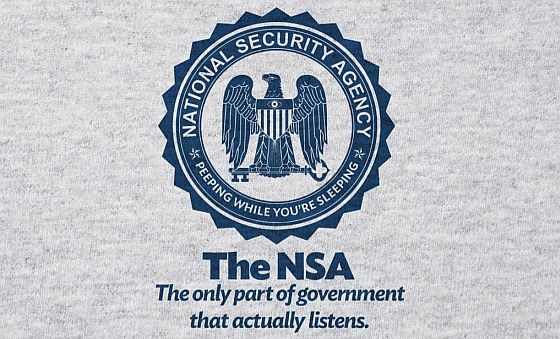
NSA and DHS try to suppress free speech

VOA reports: The U.S. National Security Agency and the Department of Homeland Security have threatened legal action to block the sale of T-shirts that ridicule these two powerful government agencies. But the T-shirt designer says NSA and DHS are the ones breaking the law by assaulting free speech, a pillar of democratic society.
A judge may decide who is right.
One T-shirt calls the NSA the “only part of the government that actually listens,” a joke that plays on the NSA’s controversial, and critics say overzealous, monitoring of communications worldwide. Americans tend to laugh out loud when they see the message.
Another shirt parodies the DHS logo, rewritten as the “Department of Homeland Stupidity.”
Agency officials have sent stern letters to the printer who makes and distributes these designs, demanding an immediate halt, according to T-shirt designer Dan McCall. He says the letters cite federal laws banning unauthorized use or defacement of official logos. [Continue reading…]
Obama vs. the generals
Rosa Brooks writes: After a spate of news stories this summer citing tensions between President Barack Obama and his top military commanders over the possibility of U.S. intervention in Syria, White House chief of staff Denis McDonough hastened to assure the Washington Post that everything was, in fact, copacetic: The president “appreciates” candid military advice “above all else,” McDonough insisted, and has “close, and in some instances warm, relationships with his military chiefs,” as the Post put it. During my own time at the Pentagon, where I worked as an Obama appointee from the spring of 2009 until mid-2011, few seemed to hold this view. I recall asking one general, recently back from Afghanistan, if he’d shared his experiences and insights with the president. Rolling his eyes, he told me grimly that the White House preferred the military to be seen but not heard.
Curious about whether things had changed since then, I asked a dozen serving and recently retired senior military officers with high-level White House access, many of whom were not comfortable speaking on the record, if they knew of any military leaders with whom the president had a close and warm personal relationship. In every case, the initial response was a long silence. “That’s a great question,” said one retired senior officer, after a lengthy pause. “Good question. I don’t know,” said a second. “I don’t think he’s close to anyone,” commented a third. He just doesn’t seem to have any interest in “getting to know” the military, a retired general concluded.
Of course, there’s no law that requires the president to invite his top generals for pajama parties or rounds of golf, and being “close” to military leaders is no guarantee of sound decision-making. But all of this raises an increasingly relevant question: How has the president—the man who promised to “finish the job” in Afghanistan, close the door on the unpopular Iraq War and “end the mind-set that got us into the war in the first place”—managed a military he often seems to regard with mistrust and unease? [Continue reading…]
The friendly ties between Egyptian intelligence and the CIA
David Ignatius writes: The U.S.-Egyptian relationship has been through some rocky months since the June 30 military coup that toppled President Mohamed Morsi and the Muslim Brotherhood. But the strain doesn’t seem to have diminished cooperation between the two countries’ intelligence services.
Gen. Mohammed Farid el-Tohamy, the director of Egypt’s General Intelligence Service, said had been “no change” in his organization’s relationship with U.S. spy agencies, despite delay of some U.S. weapons deliveries to the Egyptian military and talk of new Egyptian military contacts with Russia.
“Cooperation between friendly services is in a completely different channel than the political channel,” Tohamy said. “I’m in constant contact with [Director] John Brennan at the CIA and the local station chief, more than with any other service worldwide.” [Continue reading…]
The fight against the FBI’s effort to undermine the Freedom of Information Act
Will Potter writes: Ryan Shapiro has just wrapped up a talk at Boston’s Suffolk University Law School, and as usual he’s surrounded by a gaggle of admirers. The crowd, consisting of law students, academics, and activist types, is here for a panel discussion on the Animal Enterprise Terrorism Act, a 2006 law targeting activists whose protest actions lead to a “loss of profits” for industry. Shapiro, a 37-year-old Ph.D. student at the Massachusetts Institute of Technology, contributed a slideshow of newspaper headlines, posters, and government documents from as far back as the 1800s depicting animal advocates as a threat to national security. Now audience members want to know more about his dissertation and the archives he’s using. But many have a personal request: Would Shapiro help them discover what’s in their FBI files?
He is happy to oblige. According to the Justice Department, this tattooed activist-turned-academic is the FBI’s “most prolific” Freedom of Information Act requester — filing, during one period in 2011, upward of two documents requests a day. In the course of his doctoral work, which examines how the FBI monitors and investigates protesters, Shapiro has developed a novel, legal, and highly effective approach to mining the agency’s records. Which is why the government is petitioning the United States District Court in Washington, DC, to prevent the release of 350,000 pages of documents he’s after.
Invoking a legal strategy that had its heyday during the Bush administration, the FBI claims that Shapiro’s multitudinous requests, taken together, constitute a “mosaic” of information whose release could “significantly and irreparably damage national security” and would have “significant deleterious effects” on the bureau’s “ongoing efforts to investigate and combat domestic terrorism.”
So-called mosaic theory has been used in the past to stop the release of specific documents, but it has never been applied so broadly. “It’s designed to be retrospective,” explains Kel McClanahan, a DC-based lawyer who specializes in national security and FOIA law. “You can’t say, ‘What information, if combined with future information, could paint a mosaic?’ because that would include all information!”
Fearing that a ruling in the FBI’s favor could make it harder for journalists and academics to keep tabs on government agencies, open-government groups including the Center for Constitutional Rights, the National Security Archive, and the National Lawyers Guild (as well as the nonprofit news outlet Truthout and the crusading DC attorney Mark Zaid) have filed friend-of-the-court briefs on Shapiro’s behalf. “Under the FBI’s theory, the greater the public demand for documents, the greater need for secrecy and delay,” says Baher Azmy, CCR’s legal director. [Continue reading…]
White House works to delay Iran sanctions that could affect nuclear talks
The Washington Post reports: The Obama administration struggled Wednesday to head off new congressional sanctions that it fears could kill a proposed nuclear deal with Iran before it can be finalized.
During a visit to Capitol Hill, Secretary of State John F. Kerry and Vice President Biden faced strong skepticism, including from leading Democrats, who suggested the White House is being snookered by the Iranian leadership.
Kerry warned that although tough economic sanctions have worked as intended to push Iran to the bargaining table, piling on now could drive the country away.
“The risk is that if Congress were to unilaterally move to raise sanctions, it could break faith in those negotiations, and actually stop them and break them apart,” Kerry said before a closed session of the Senate Banking Committee. “What we’re asking everyone to do is calm down, look hard at what can be achieved and what the realities are.”
Afterward, Senate Republicans scoffed at the administration presentation. [Continue reading…]
Meanwhile, AFP reports: President Barack Obama’s top national security aide said Wednesday that France was “fully on board” with a proposed interim deal on freezing Iran’s nuclear program, ahead of a new round of talks in Geneva.
National Security Advisor Susan Rice made the comment after Obama spoke to French President Francois Hollande by phone and both men urged Iran to accept a deal presented by world powers.
“The French are fully on board,” Rice said at the Washington Ideas Forum sponsored by the Atlantic magazine and the Aspen Institute.
Polio strain in Syria originated in Pakistan, WHO confirms
Reuters reports: Polio that has crippled at least 13 children in Syria has been confirmed as being caused by a strain of the virus that originated in Pakistan and is spreading across the Middle East, the World Health Organization said.
Genetic sequencing shows the strain found in Syrian children in Deir al-Zor, where an outbreak was detected last month, is linked to the strain of Pakistani origin found in sewage in Egypt, Israel and Palestinian territories in the past year.
“Genetic sequencing indicates that the isolated viruses are most closely linked to virus detected in environmental samples in Egypt in December 2012 (which in turn had been linked to wild poliovirus circulating in Pakistan),” the United Nations agency said in a statement on Monday.
Closely related strains of the wild poliovirus of Pakistani origin have also been detected in sewage samples in Israel, the West Bank and Gaza Strip since February 2013, it said.
Polio virus has been confirmed in 13 of 22 children who became paralyzed in the northern Syrian province of Deir al-Zor. Investigations continue into the other nine cases. It is Syria’s first polio outbreak since 1999.
No children in Egypt, Israel or the Palestinian territories have been hit by polio thanks to high immunization rates and a strong response to the alert, WHO spokeswoman Sona Bari said.
Polio virus is endemic in Pakistan, Afghanistan and Nigeria despite a 25-year-old campaign to eradicate the disease, which can paralyze a child in hours.
Islamist fighters from countries including Pakistan are among groups battling to oust President Bashar al-Assad, leading to speculation that they brought the virus into the country. [Continue reading…]
See also, How the CIA and the Taliban undermined the global campaign to eradicate polio.
Leader’s death plunges Pakistan Taliban into dangerous disarray
Reuters reports: The killing of one of Pakistan’s most wanted Islamic militants in a U.S. drone strike has exposed centuries-old rivalries within the group he led, the Pakistani Taliban, making the insurgency ever more unpredictable and probably more violent.
Hakimullah Mehsud’s death this month has set off a power struggle within the outfit’s ranks, which could further unnerve a region already on tenterhooks with most U.S.-led troops pulling out of neighboring Afghanistan in 2014.
When a tribal council declared Mullah Fazlullah as the new leader of the Pakistani Taliban last week, several furious commanders from a rival clan stood up and left.
“When Fazlullah’s name was announced, they … walked out saying, ‘The Taliban’s command is doomed’,” said one commander who attended the November 7 ‘shura’ meeting in South Waziristan, a lawless Pakistani tribal region on the Afghan border.
Others at the shura declared loyalty to the hardline new leader and stayed on to map out a plan to avenge Hakimullah’s death through a new campaign of bombings and shootings.
“This is the start of our fight with the Pakistan government, an American puppet,” the Taliban official said.
“Those who forced the Soviet Union out of Afghanistan are capable of breaking up Pakistan,” he added, alluding to senior commanders whose rite of passage into war started with the rebellion against Soviet troops in Afghanistan in the 1980s. [Continue reading…]
America’s confused, half-hearted policy toward Egypt
Shadi Hamid writes: John Kerry felt more threatened by his own administration’s partial aid “cut” to Egypt than Egypt’s generals did. Or so it seemed. In a visit to Cairo on November 3, America’s top diplomat insisted that the “aid issue is a very small issue,” as if to tell Egyptians not to worry—that it was something the U.S. had to do against its will, and that this slap on the wrist, like all the previous ones, too, would pass.
What was more concerning, however, was that Kerry felt the need to heap an inordinate amount of praise on Egypt’s military rulers, suggesting either a great deal of cynicism or the possibility that he hadn’t been briefed on Egyptian politics for weeks on end. “The roadmap is being carried out to the best of our perception,” Kerry said, referring to the military’s timetable for drafting a constitution and holding elections. “The roadmap [is moving] in the direction that everybody has been hoping for,” he added. In reality, Egypt, on almost any conceivable political indicator, is more repressive today than it was under the Mubarak regime. The sheer ferocity of the post-coup crackdown continues, with a slate of repressive laws recently announced in the guise of Egypt’s “war on terrorism.”
Presumably, this is why U.S. officials — recognizing the dangerous path Egypt was traveling down — felt compelled to announce some sort of change in the aid relationship. But, even then, the aid “cut”—which is itself a misnomer since the aid was always likely to resume — was largely symbolic, with little meaningful impact on the military. An aid cut, to be effective, needs to change the calculus of Egypt’s generals. But, in this case, there was little at stake: all essential aid would continue to flow (and one of the army’s biggest perks—”cashflow financing” — would be unaffected).
In case there was any doubt, senior U.S. officials went out of their way to belittle the aid cut during the policy rollout, admitting it would have little impact, and perhaps wasn’t even designed to have an impact in the first place. [Continue reading…]
AIPAC ready to mount an aggressive campaign to sabotage negotiations with Iran
The New York Times reports: Diplomats from the United States and five other countries are pursuing an accord that would cause Iran to freeze its nuclear program in exchange for the loosening of some of the sanctions that have crippled the Iranian economy. Talks broke off this weekend but are scheduled to resume on Nov. 20.
But they are facing bipartisan doubt about their course. “I understand what they’re saying about destroying a chance for a peaceful outcome here with new sanctions, but I really do believe if the new sanctions were crafted in the right way, they would be more helpful than harmful,” said Senator Lindsey Graham, Republican of South Carolina.
Senator Charles E. Schumer of New York, the third-ranking Democrat, was briefed Monday on the negotiations by Mr. Biden and has met with the White House chief of staff, Denis R. McDonough, as well as with cabinet officials. Yet he still proclaimed himself “dubious” of the possible agreement because of concerns that the administration might be willing to give too much away while getting too little in return.
In a letter to the editor in The New York Times last week and an opinion article in USA Today, Senator Robert Menendez of New Jersey, the Democratic chairman of the Foreign Relations Committee, indicated he would press forward against the administration’s wishes on the sanctions legislation.
“Iran is on the ropes because of its intransigent policies and our collective will, and it would be imprudent to want an agreement more than the Iranians do,” he wrote in USA Today on Monday. “Tougher sanctions will serve as an incentive for Iran to verifiably dismantle its nuclear weapons program.”
A powerful lobbying group, the American Israel Public Affairs Committee, issued its own broadside. “Aipac continues to support congressional action to adopt legislation to further strengthen sanctions, and there will absolutely be no pause, delay or moratorium in our efforts,” the group’s president, Michael Kassen, said in a statement this month.
But the group’s officials are taking a wait-and-see stance for now. If the talks collapse on their own, the group can avoid wading into a political donnybrook, but if a diplomatic breakthrough is achieved, Aipac is ready to mount an aggressive campaign to stop it, according to one person familiar with its thinking. [Continue reading…]