In an assessment of the winners and losers emerging from the Arab democratic revolution, Fawaz A Gerges writes:
Regionally, Israel is the biggest loser. It has put all its eggs into the basket of Arab dictators and autocrats, like Egypt’s deposed Hosni Mubarak. Israel fought tooth and nail to support Mr Mubarak, who played a key role in tightening the siege of Gaza and the noose around Hamas’s neck.
Time and again, the Israeli political class has proven to be its own worst enemy. Israel lost Iran 40 years ago because it put all its eggs in the Shah’s basket. It has just lost Turkey over the killing of nine activists on board a Gaza-bound Turkish aid ship.
And now Israel is likely to lose Egypt, a critical and pivotal neighbour whose Camp David peace agreement in the late 1970s consolidated Israel’s superiority in the region and undermined the official Arab state system.
Regardless of what governments emerge out of the rubble of political authoritarianism in the Arab world, they will have assertive foreign policies that challenge Israel’s hegemony and further colonisation of Palestinian lands.
Meanwhile, the leadership of the Palestinian Authority President Mahmoud Abbas, has lost all credibility in the eyes of the people there. The leaked negotiation documents obtained by al-Jazeera – offering wide-ranging concessions to the Israeli side – were the final nail in the PA’s coffin.
Resistance-based movements like Hamas and Hezbollah have gained more popularity at the expense of Abbas’s Palestinian Authority; they will emerge as major winners of the social turmoil unless Israel takes concrete steps to sign a peace settlement and withdraw from occupied Arab territories.
President Obama has reportedly told White House aides that he wants a “new Middle East policy” — one that urges beleaguered allies threatened by popular rebellions to “enact reforms that would satisfy the popular craving for change while preserving valuable partnerships on crucial U.S. interests, from soil security to counter-terrorism and containing Iran.”
But there’s not much “new” there, to be frank: The Obama Administration, like the Bush Administration before it, has consistently urged Arab allies to make reforms, while prioritizing U.S. regional concerns such as oil, counterterrorism, confronting Iran and protecting Israel. What is new, of course, is the fear that Washington’s influence in the Middle East, which had already been waning steadily in recent years, is tied almost exclusively to regimes that are looking a lot more like relics of the past than stewards of the future.
And there may be no easy way for the U.S. to switch horses carrying its baggage of priorities, or even to shape any emerging democratic order to meet its own strategic requirements. Indeed, the reason Washington is so wedded to autocratic regimes of dwindling legitimacy and authority in the Arab world is the fact that not all U.S. priorities are shared by the Arab public.
No country pumping oil is going to resist the urge to sell it on world markets, so a regime change won’t likely endanger energy supplies. And countries that face a problem of extremist terrorism directed at their own populations will likely cooperate on that front – while the logic of deterrence and consequences can persuade others to prevent their territory being used to stage terror attacks on third countries.
But the idea that the newly empowered Arab public is going to produce governments that will march in lockstep with the U.S. on issues such as Iran and Israel is simply fanciful.
It was undoubtedly a mischievous rumour, but William Hague accepted it without demur: Hugo Chávez had offered asylum to Colonel Gaddafi. It was vigorously denied by the Venezuelan government, and as yet it seems to be founded on nothing but a rightwing sleight of hand that elides Chávez and Gaddafi into a single, caricatured military dictator. But Chávez was elected, and re-elected, to the presidency of his country, unlike Gaddafi, and he has not tortured and murdered thousands of his political opponents as Gaddafi has – on the contrary his detractors continue to vilify him daily in the media with impunity.
Yet the response to the Libyan events from Latin America’s radicals has been perplexing and disturbing. Chávez himself has praised Gaddafi and echoed directly the views on the Libyan revolution offered by Fidel Castro. Castro has counselled caution and patience, warning that since the US media are consistently reporting the insurrection and denouncing Gaddafi’s brutal repression it must clearly be suspect. Daniel Ortega, the president of Nicaragua, rushed to present himself to the press as a fervent supporter of the Libyan leader in his sterling defence of his nation.
It is worth remembering that the Sandinista National Liberation Front, of which Ortega was and remains a leader, took power on the basis of a mass rising of the Nicaraguan people against a dictatorship at least as vicious as Gaddafi’s. In the final month of the Sandinista Revolution, from June to July 1979, the Somoza dictatorship (a dynasty actively sustained by Washington for more than 40 years) used napalm against the country’s impoverished population. Chávez freely acknowledges that the Bolivarian movement, which gave its name to the new Venezuelan Republic, was born in the great urban insurrection of February 1989, the “Caracazo” in which the poor barrios of the cities, and principally of Caracas, emptied into the city centres in three Days of Rage after President Carlos Andres Perez broke his promise not to implement neo-liberal economic measures. There were several thousand victims of the repression of the movement. The same people mobilised to defeat an attempted coup against Chávez in 2002 and saved the Bolivarian revolution.
These two very different leaders cannot support an oppressive regime that now faces a mass democratic movement from below. For despite attempts to deny and silence the movement, tyrants have been toppled across the Middle East – not by the mass use of Twitter alone, of course, but through strikes, mass protests, and face-to-face battles with a repressive machinery in which people have been willing to put their lives on the line in the struggle for freedom. There is still much ground to be covered before that is achieved, but there have been glimpses of a very different world in the course of these struggles.
We are witnessing, along with the rest of the Saudi population, the receding of Saudi Arabia’s prominent regional role; the deterioration of the government apparatus and administrative competence; the prevalence of corruption and nepotism; the exacerbation of factionalism; and the widening gap between state and society, particularly among the new generation of youth in the country. This threatens to lead to catastrophic results for the country and the people, which we will never accept for our nation and its children.
Resolving these conditions requires a serious review and an immediate announcement that both government and society will together adopt a comprehensive reform project that focuses on structural shortcomings in our political system, and that leads our country towards a constitutional monarchy.
The people’s consent is the basis for the legitimacy of authority, and the only guarantee for unity, stability, and the efficiency of public administration, as well as the protection of the country from foreign intervention. This requires a reformulation of the state-society relationship, whereby the people will be a source of authority, and a full partner in deciding public policies through their elected representatives in the Shura (Consultative) Council, and whereby the purpose of the state is to serve society, secure its interests, improve its standard of living, and ensure the dignity of its members, their pride, and the future of their children.
We therefore look forward to a royal declaration that clearly demonstrates the state’s commitment to becoming a “Constitutional Monarchy,” and that puts in place a timeline that delineates the beginning, implementation, and finalizing of the desires reforms. The royal declaration should also confirm the adoption of the major reform goals, namely: the rule of law, full equality between members of the population, the legal guarantee of individual and civil freedoms, popular participation in decision-making, even development, the eradication of poverty, and the optimal use of public resources.
[D]emocracy – the real, unfettered, flawed but brilliant version which we in the West have so far lovingly (and rightly) cultivated for ourselves – is not going, in the Arab world, to rest happy with Israel’s pernicious treatment of Palestinians and its land theft in the West Bank. Now no longer the “only democracy in the Middle East”, Israel argued desperately – in company with Saudi Arabia, for heaven’s sake – that it was necessary to maintain Mubarak’s tyranny. It pressed the Muslim Brotherhood button in Washington and built up the usual Israeli lobby fear quotient to push Obama and La Clinton off the rails yet again. Faced with pro-democracy protesters in the lands of oppression, they duly went on backing the oppressors until it was too late. I love “orderly transition”. The “order” bit says it all. Only Israeli journalist Gideon Levy got it right. “We should be saying ‘Mabrouk Misr!’,” he said. Congratulations, Egypt!
Yet in Bahrain, I had a depressing experience. King Hamad and Crown Prince Salman have been bowing to their 70 per cent (80 per cent?) Shia population, opening prison doors, promising constitutional reforms. So I asked a government official in Manama if this was really possible. Why not have an elected prime minister instead of a member of the Khalifa royal family? He clucked his tongue. “Impossible,” he said. “The GCC would never permit this.” For GCC – the Gulf Co-operation Council – read Saudi Arabia. And here, I am afraid, our tale grows darker.
We pay too little attention to this autocratic band of robber princes; we think they are archaic, illiterate in modern politics, wealthy (yes, “beyond the dreams of Croesus”, etc), and we laughed when King Abdullah offered to make up any fall in bailouts from Washington to the Mubarak regime, and we laugh now when the old king promises $36bn to his citizens to keep their mouths shut. But this is no laughing matter. The Arab revolt which finally threw the Ottomans out of the Arab world started in the deserts of Arabia, its tribesmen trusting Lawrence and McMahon and the rest of our gang. And from Arabia came Wahabism, the deep and inebriating potion – white foam on the top of the black stuff – whose ghastly simplicity appealed to every would-be Islamist and suicide bomber in the Sunni Muslim world. The Saudis fostered Osama bin Laden and al-Qa’ida and the Taliban. Let us not even mention that they provided most of the 9/11 bombers. And the Saudis will now believe they are the only Muslims still in arms against the brightening world. I have an unhappy suspicion that the destiny of this pageant of Middle East history unfolding before us will be decided in the kingdom of oil, holy places and corruption. Watch out.
In ‘Free Libya’: Hey, who, exactly, is in charge here?
It’s easy to find the headquarters of the Libyan opposition in Benghazi, the country’s second city and the hotbed of the uprising against the regime of Muammar Gaddafi. Just head down to the Corniche, the city’s Mediterranean waterfront, and follow the cheering crowds hanging Gaddafi in effigy to the city’s district courthouse, where the revolution began on Feb. 17 as a protest by the city’s lawyers and judges. But once inside the now battle-scarred and graffitied building, it’s hard to figure out who, exactly, is in charge.
Scores of newly minted revolutionary officials — middle-aged volunteers from the city’s professional and business classes — have many meetings but appear to make few decisions. They hold press conferences in what used to be a courtroom, while about a dozen opposition spokesmen roam the halls trying to be helpful but often offering conflicting information. Trucks full of eggs and baby formula arrive at the courthouse doors without an apparent system for delivering them to the needy and without clear reports of shortages. And though spirits are high, especially among the young volunteers sporting Che Guevara–style berets, the institutional vibe is more like that of a steering committee of a future liberal-arts college than of a guerrilla movement gearing up for a long fight. “The problem is that we don’t have anyone with any political experience whatsoever,” says Iman Bugahaighis, a professor of dentistry now acting as an unofficial spokesperson. “We didn’t have any institutions other than regime. That was part of Gaddafi’s plan: to make everyone loyal only to him.” (Time)
Rebels claim to have shot down jet
Rebels claimed to have downed a military aircraft as they fought a government bids to take back Libya’s third city, Misrata, and the strategic oil refinery town of Zawieh.
Libyan forces have been launched fresh offensives again Zawieh, 30 miles from Tripoli, and Misrata, 125 miles to the east. Rebels said some 2,000 troops loyal to the regime had surrounded Zawieh, but that they had succeeded in holding on to the town centres.
“An aircraft was shot down this morning while it was firing on the local radio station,” a witness, who was identified only as Mohamed, said by telephone from Misrata. (Telegraph)
Libya’s terra incognita
For four decades, Libya has been largely terra incognita, a place where the outsized personality of its quixotic leader and a byzantine bureaucracy obscured an informal network of constantly shifting power brokers. Even before the current unrest, working with these figures was uncertain at best — “like throwing darts at balloons in a dark room,” as one senior Western diplomat put it to me in 2009.
In the near future, even with Qaddafi gone, the country may face a continued contest between the forces of a free Libya and the regime’s die-hard elements. In particular, Qaddafi’s sons — Saif al-Islam, Khamis, Al-Saadi, and Mutassim — and their affiliated militias may not go quietly into the night; the struggle to root them out may be violent and protracted (think, for example, of Saddam Hussein’s sons, Uday and Qusay). Saif al-Islam, who was known for years in the West as Libya’s supposed champion of reform, revealed his true character as a reactionary much like his father by promising a “bloodbath” in a televised speech last week. On the ground, many of the attacks against demonstrators and their suspected sympathizers are being ordered by Captain Khamis al-Qaddafi, who heads the 32nd Brigade, the regime’s best-trained and best-equipped force. As the current unrest unfolded, Al-Saadi’s star was on the rise: as a brigadier in the special forces, he was dispatched to placate and then suppress the brewing revolt in Benghazi on February 16. Lastly, Mutassim, Libya’s National Security Council adviser, reportedly sought in 2008 to establish his own militia to keep up with his brothers and has strong ties to a number of hard-liners. (Foreign Affairs)
International pressure on Qaddafi intensifies
An international campaign to force Col. Muammar el-Qaddafi out of office gathered pace on Monday as the European Union adopted an arms embargo and other sanctions, the opposition showed increasing signs of organization in the east, and Secretary of State Hillary Rodham Clinton bluntly told the Libyan leader to surrender power “now, without further violence or delay.”
With the rebel and loyalist forces locked in an increasingly tense stand-off on the ground, the prime ministers of France and Britain echoed Mrs. Clinton’s call for Colonel Qaddafi to go, Germany proposed a 60-day ban on financial transactions, and a spokeswoman for Catherine Ashton, the European Union’s foreign policy chief, said that contacts were being established with the opposition.
Italy’s foreign minister on Sunday suspended a nonaggression treaty with Libya on the grounds that the Libyan state “no longer exists,” while Mrs. Clinton said the United States was reaching out to the rebels to “offer any kind of assistance.” (New York Times)
Exile an option for Gaddafi, White House says
Going into exile would be one option for Libyan leader Muammar Gaddafi in meeting international demands that he leave power, White House spokesman Jay Carney said on Monday.
Carney, asked by reporters whether the United States would help facilitate exile for Gaddafi, said this was a bit of speculation that he would not discuss. (Reuters)
U.S. and allies weigh Libya no-fly zone
Obama administration officials held talks on Sunday with European and other allied governments as they readied plans for the possible imposition of a no-fly zone over Libya to prevent further killings of civilians by forces loyal to Col. Muammar el-Qaddafi.
Further increasing international pressure on Colonel Qaddafi, the Libyan leader, Italy suspended a 2008 treaty with Libya that includes a nonaggression clause, a move that could allow it to take part in future peacekeeping operations in Libya or enable the use of its military bases in any possible intervention. (New York Times)
France begins ‘massive’ aid effort for Libyan opposition
France says it is flying medical aid to the eastern Libyan city of Benghazi in what it calls the start of a “massive” operation to support opposition forces trying to topple Libyan leader Moammar Gadhafi.
French Prime Minister Francois Fillon said two planes were due to leave for Benghazi Monday, carrying doctors, nurses, medicine and medical equipment for the Libyan people in what he described as “liberated” areas. (VOA)
In this city 30 miles west of Tripoli, hundreds of people rejoiced in a central square on Sunday, waving the red, black and green flag that has come to signify a free Libya and shouting the chants that foretold the downfall of governments in Tunisia and Egypt: “The people want to bring down the regime.”
Rebels, in control of the city, had reinforced its boundaries with informal barricades, and military units that had defected stood guard with rifles, six tanks and anti-aircraft guns mounted on the backs of trucks. In the central square here, a mosque was riddled with enormous holes, evidence of the government’s failed attempt to take back this city on Thursday. Nearby lay seven freshly dug graves belonging to protesters who had fallen in that siege, witnesses said.
“We are really suffering for 42 years, and people are asking here for the same things as other people of the world — they want the real democracy,” said Ahmed El-Hadi Remeh, an engineer standing in the square. He and other residents told how they had used stones to repel the government’s forces.
Proving how close opposition control has come to the capital, where Col. Muammar el-Qaddafi maintains tight control, the confidence of the demonstrators in Zawiya was remarkable, all the more so because it was witnessed as part of the official tour for international journalists that Colonel Qaddafi’s government organized. The public relations effort, apparently intended to show a stable Libya to the outside world, appeared to backfire, as a tour of Tripoli had on Saturday.
Instead, the tour, whose minders were forced to wait at the city’s outskirts, showed a nation where the uprising had reached the capital’s doorstep, underscoring a growing impression that the ring of rebel control around Tripoli was tightening. But in a sign that the fight was far from over, armed government forces were seen massing around the city.
Two prominent U.S. Senators said Washington should recognize and arm a provisional government in rebel-held areas of eastern Libya and impose a no-fly zone over the area — enforced by U.S. warplanes — to stop attacks by the regime. U.S. Secretary of State Hillary Rodham Clinton echoed President Barack Obama’s demand for Gadhafi to relinquish power.
“We want him to leave,” she told reporters traveling with her Sunday to a U.N. meeting on Libya planned for Monday. “We want him to end his regime and call off the mercenaries and forces loyal to him. How he manages that is up to him.”
Gadhafi’s son, Seif al-Islam, claimed again that the country was calm and denied the regime used force or airstrikes against its own people. But human rights groups and European officials have put the death toll since unrest began in Libya nearly two weeks ago at hundreds, or perhaps thousands, though it has been virtually impossible to verify the numbers.
The U.N. Security Council moved as a powerful bloc Saturday to try to halt Libyan leader Moammar Gadhafi’s deadly crackdown on protesters, slapping sanctions on him, his children and top associates.
Voting 15-0 after daylong discussions interrupted with breaks to consult with capitals back home, the council imposed an arms embargo and urged U.N. member countries to freeze the assets of Gadhafi, four of his sons and a daughter. The council also backed a travel ban on the Gadhafi family and close associates, including leaders of the revolutionary committees accused of much of the violence against opponents.
Council members additionally agreed to refer the Gadhafi regime’s deadly crackdown on people protesting his rule to a permanent war crimes tribunal for an investigation of possible crimes against humanity.
Carne Ross, a former British diplomat at the UN, comments:
[T]here are some strking things about this resolution:
Clear and early referral to the ICC (paras 4-8), including a demand that the ICC prosecutor brief the Council in two months’ time: this is remarkable. This is I think (and Barbara Plett thinks too) the first time the Council has voted unanimously for ICC referral. This resolution has also taken place very early in a conflict, only days after it began. In other words, the Council is moving in welcome fashion towards the preventive signalling required under the Responsibility to Protect doctrine (see my blog comment below). It is reacting almost as fast as news breaks of killing.
The second remarkable thing is that the Libya situation is clearly internal. The Council may have denoted it as a “threat to international peace and security” in the preambular paragraphs (though I think this reference has been watered down in negotiation) and by putting the res under Chapter VII of the Charter, but to any outside observer it’s pretty clear that the conflict is confined within Libya’s borders, so far. There is a clear and unambiguous reference to Responsibility to Protect in the preambular paras. This is in my memory the first time that the Council has acted so quickly and so decisively on an internal situation. I am very surprised that the Chinese, Indians etc went along with such clear language. International public opinion seems to be moving them. This is an important precedent too.
Thirdly, on a more political note, this resolution is putting the Libyan regime in the freezer – big time. The assets freeze, travel ban etc apply to named members of the regime. These measures will be legally obligatory for all member states to impose – the resolution is under Chapter VII of the charter. And the measures will be in place indefinitely. These sanctions are not time-limited and will require a further positive vote of the Council to be lifted. In other words, all P5 will have to agree, plus 9 non-permanents. Moreover, the criteria for sanctions lift are left very unclear. What this means in practice is the total international isolation of members of the Gadhaffi regime indefinitely.
Britain said on Sunday it had revoked Muammar Gaddafi’s diplomatic immunity, putting pressure on the Libyan leader to step down after his government’s bloody crackdown on a revolt against his rule.
Officials said the move, which backs up U.N. Security Council sanctions agreed on Saturday, was an unprecedented step by Britain against a serving head of state.
“It is time for Colonel Gaddafi to go,” Foreign Secretary William Hague told the BBC, in the strongest language Britain’s nine-month-old coalition has used so far about the crisis.
The diplomatic immunity of Gaddafi’s sons, family and household had also been revoked, Hague said.
Hague said Gaddafi appeared to have stocks of mustard gas, a potentially deadly chemical weapon, that had not been destroyed under a 2003 agreement to dismantle weapons of mass destruction (WMD).
“Some of those stocks do appear to exist although we are not sure what condition they are in,” Hague said.
Separately, Peter Mandelson, a close confidant of former British Prime Minister Tony Blair, said that Blair had been in contact with Gaddafi in the last few days.
According to Whitehall sources, Mr Blair made an initial call to the Libyan President, who has ordered helicopter gunships to fire on protesters he described as “rats” and “cockroaches”. The Middle East envoy urged him to cease the attacks. The sources suggested that, after consultations with the British Foreign Office, Mr Blair was told that the UK Government would prefer the Libyan President to step down, and so he agreed to phone him again and transmit that message. There was no comment from Mr Blair’s office yesterday. Government sources could not say last night whether ministers knew in advance about the initial phone call.
The first oblique hint that Mr Blair might be in active contact with the Libyan regime came in a routine briefing on Friday in which US State Department spokesman P J Crowley said the former PM was among the international figures that Secretary of State Hillary Clinton had spoken to during the day. Asked why Mrs Clinton called Mr Blair and if it was because of “his dealings with Gaddafi over the Lockerbie bomber”, the spokesman said of Mr Blair: “He has very important and valuable contacts inside of Libya.”
Mercenaries captured in Libya are facing an uncertain future, writes Nick Meo in Al-Bayda.
Crowded into an empty classroom which was stinking of unwashed bodies and reeking of fear, Colonel Muammar Gaddafi’s defeated mercenary killers awaited their fate.
A week earlier the men – Libyan loyalists of the dictator and black African recruits – had been landed at airports throughout eastern Libya and sent out into the streets to shoot protesters in a murderous rampage. They killed dozens before they were overwhelmed by anti-Gaddafi militias.
The survivors were exhausted, filthy, far from home, and fearful of execution, even though they had been assured of good treatment. Fifty of them lay on mattresses on the floor in one classroom alone, with nearly 100 more in the same school building which was being used as a temporary prison. Most looked dazed. Some were virtually children.
“A man at the bus station in Sabha offered me a job and said I would get a free flight to Tripoli,” said Mohammed, a boy of about 16 who said he had arrived looking for work in the southern Libyan town only two weeks ago from Chad, where he had earned a living as a shepherd.
I’m not sure how long the general Egyptian public can maintain the bizarre idea that the army is so great. This is the army that took power in a coup in 1952 and ended political pluralism, lost tons of wars after that and continued to justify its predation on the national budget despite not having had to fight anyone since 1973 (if you exclude the Libyans very briefly in the late 1970s and those field hospitals sent to Iraq and Kosovo in the 1990s), that has absolutely no experience policing and yet is getting military police and military intelligence to carry out that function (when their primary job has been keeping an eye on rank and file). It is the army that put Mubarak in place in six days after the assassination of Sadat, and now runs things through a Supreme Council of the Armed Forces that is headed by Mubarak loyalist Mohammed Hussein Tantawi (in place since 1992) and a government headed by former chief of the Air Force Ahmed Chafiq (who considers Mubarak his “spiritual father.”) Not to mention, of course, the army that owned the land in Tagammu al-Khamiss outside of Cairo that was sold for the spectacular profits by several real estate developers, or the army that continues to employ conscripts as free labor in various places.
In answer to the question that started the preceding paragraph, I think actually the army can maintain that illusion for a long time. Eleven years in Egypt have taught me to never underestimate the power of the ERDF — the Egyptian Reality Distortion Field. It is a surprisingly flexible and adaptable weapon, even in the face of the most stubborn facts. Part of this is information manipulation, of course — it helps that the military has just appointed one of its own to run the Egyptian Radio and Television Union — but also a certain amount of political caution. Hossam el-Hamalawy, never one to hold on to illusions about power, wrote after the clash with the army:
Everyone is rightly upset about what the army did in Tahrir Square last night. Let’s remember, however, the military already moved against peaceful protesters in Suez, and is accused of involvement of torture and arrest of hundreds during the uprising. And almost everyday there is a statement from the army warning strikers and protesters, coupled with an orchestrated media campaign in both state and private TV channels discrediting labor strikes and renewed protests in Tahrir. What happened last night should not come as a shock.
If Mubarak’s regime was corrupt (and it was), then why do we treat the military institution, which provided the backbone of his dictatorship, as “neutral” or “pure”? The leadership of this institution, namely the generals of the Supreme Council of the Armed Forces are part of Mubarak’s regime. And any real change would affect their privileges and control.
We cannot and will not carry up arms against the army. I salute and support all the efforts for resuming the protests in Tahrir, including the one planned for today at 2pm. But still, the most effective weapon is the mass strikes.
Mass strikes is precisely what the army fears the most, along with the Egyptian elite for which it represents both economic disaster and the rise of mob rule.
A bold effort by Col. Muammar el-Qaddafi to prove that he was firmly in control of Libya appeared to backfire Saturday as foreign journalists he invited to the capital discovered blocks of the city in open revolt.
Witnesses described snipers and antiaircraft guns firing at unarmed civilians, and security forces were removing the dead and wounded from streets and hospitals, apparently in an effort to hide the mounting toll.
When government-picked drivers escorted journalists on tours of the city on Saturday morning, the evidence of the extent of the unrest was unmistakable. Workers were still hastily painting over graffiti calling Colonel Qaddafi a “bloodsucker” or demanding his ouster. Just off the tour route were long bread lines where residents said they were afraid to be seen talking to journalists.
And though heavily armed checkpoints dominated some precincts of the city, in other neighborhoods the streets were blocked by makeshift barricades of broken televisions, charred tree trunks and cinder blocks left over from protests and street fights the night before.
“I have seen more than 68 people killed,” said a doctor who gave his name only as Hussein. “But the people who have died, they don’t leave them in the same place. We have seen them taking them in the Qaddafi cars, and nobody knows who there are taking the people who have died.” He added, “Even the ones with just a broken hand or something they are taking away.”
In some ways, the mixed results of Colonel Qaddafi’s publicity stunt — opening the curtains to the world with great fanfare, even though the stage is in near-chaotic disarray — is an apt metaphor for the increasingly untenable situation in the country.
On Friday, before the journalists arrived, his forces put down a demonstration in the capital only after firing on the protesters. There were reports that an armed rebel force was approaching the city on Saturday, but Colonel Qaddafi’s forces are believed to have blocked the way at the city of Surt, a stronghold of his tribe.
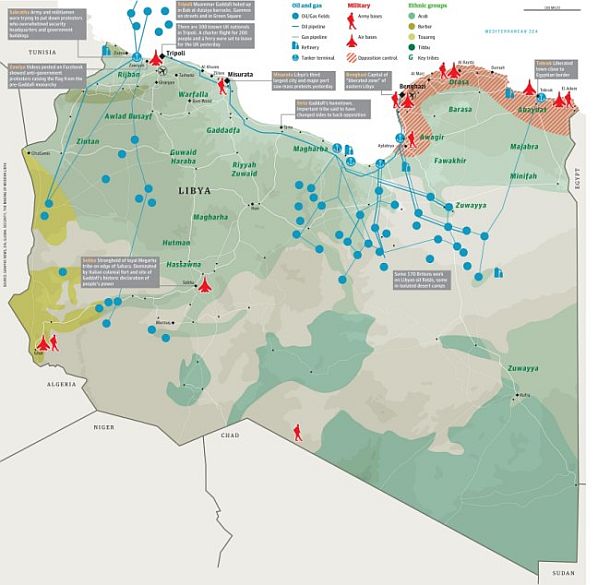
He is no longer in full control of the countryside either. Rebels now control about half the populous Mediterranean coast, including the strategic towns of Zawiyah and Misurata, not far from the capital and near important oil facilities.
Misurata (225km east of Tripoli) – Rally in front of the People’s Hall after city is liberated:
The youngest son of the embattled ruler Muammar Gaddafi has joined the pro-democracy protesters in Libya amid an unabated outpouring of rage against Gaddafi, reports say.
According to the reports, Saif al-Arab, Gaddafi’s youngest son, who was sent by his father to cooperate with Libyan security forces in the massive crackdown on pro-democracy protesters joined forces with the demonstrators in the eastern city of Benghazi on Thursday.
Saif al-Arab, who is widely regarded as the most low-profile of Gaddafi’s sons have also hinted that his father would commit suicide or flee to Latin America in the face of rising public outcry over his tyrannical rule.
Saif al-Arab is said to have had the backing of combat troops and had military equipment that was dispatched to the eastern parts of turmoil-hit Libya.
Libyan leader Muammar Qaddafi spent most of his 41 year-regime trying to sideline the country’s tribes. That may be something he’s now regretting as his power unravels.
Akram al-Qarfalli, a senior member of the Warfalla tribe, on Feb. 20 announced it was withdrawing support from Qaddafi, saying “he is no longer a brother.” The Al-Zawiya tribe threatened to halt the flow of oil if Qaddafi doesn’t stop killing protesters. By Feb. 23 most tribes were united in their opposition, says former interior minister, Abdul Fattah Younis.
“The tribes are powerful, especially outside urban centers,” said Charles Gurdon, a Libya analyst and managing director of the London-based Menas Associates political risk consulting firm, in a phone interview. “The fact the majority of them are now opposed to Qaddafi is probably the last nail in the coffin.”
Tribal loyalties form the bedrock of Libyan society. While Qaddafi says the patchwork of more than 100 tribes makes a slide into civil war inevitable if he’s ousted, academics and opposition members say they have been key in uniting Libyans against the regime and will help shape the country’s political future.
Citing human rights abuses against peaceful demonstrators in Libya, President Barack Obama late Friday ordered that all the assets of dictator Moammar Gadhafi, his children and their wives be frozen in the United States, or in branches of U.S. banks.
The order comes as Gadhafi is losing his grip on power against massive opposition in his oil-rich nation, which began on Feb. 15. Eyewitnesses reported murders and abductions by Gadhafi’s security forces and by hired mercenaries from other African nations.
“I . . . find that there is a serious risk that Libyan state assets will be misappropriated by Gadhafi, members of his government, members of his family, or his close associates if those assets are not protected, ” Obama said in the order.
And in a statement, Obama said: “By any measure, Muammar el-Qaddafi’s government has violated international norms and common decency and must be held accountable. These sanctions therefore target the Qaddafi government, while protecting the assets that belong to the people of Libya.”
One day after the United States closed its embassy in Tripoli and imposed unilateral sanctions against Libya, the United Nations Security Council prepared to meet in New York on Saturday to consider imposing international sanctions, including an arms embargo and an asset freeze and travel ban against Col. Muammar el-Qaddafi, his relatives and key members of his government.
Ahead of the meeting, diplomats from the United States, France, Germany and Britain circulated a draft resolution that also called for the referral of the violent crackdown in Libya to the International Criminal Court to investigate possible crimes against humanity.
But Turkey Prime Minister Recep Tayyip Erdogan on Saturday warned that sanctions would do more harm to Libya’s people than to Colonel Qaddafi, the Associated Press reported. He added: “We call on the international community to act with conscience, justice, laws and universal humane values — not out of oil concerns.”
The international community was being spurred to action by Ban Ki-Moon, the United Nations secretary general, who gave a dire description of the continuing violence against protesters in Libya on Friday, as well as an emotional plea from the Libyan ambassador to help his countrymen.
“Please United Nations, save Libya,” Ambassador Mohammed Shalgham told fellow diplomats in New York on Friday, as he publicly broke with the Qaddafi government. “I tell my brother Qaddafi, leave the Libyans alone.”
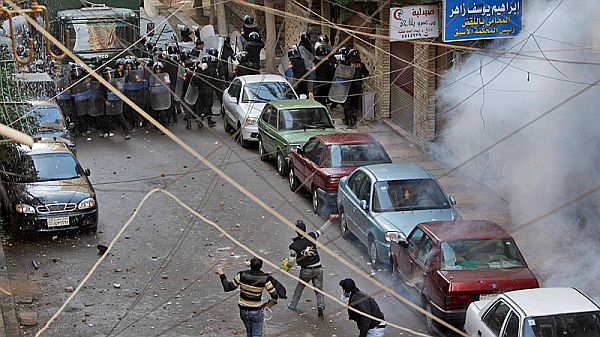
Following overnight clash between protesters and the Egyptian army outside the cabinet office near Tahrir Square, Cairo, Jack Shenker reports:
The international press is reporting that the army has issued an apology for its brutality, which included demonstrators being beaten and tasered, but that’s not quite true. In fact it has posted a series of statements on its new Facebook page, one of which is entitled ‘apology’ but which actually says only that the overnight fracas was ‘unintentional’ – prompting scorn and anger from many activists on the ground.
The army is a highly-respected national institution in Egypt, but suspicions are now mounting about its willingness to tolerate – and even prop up – lasting remnants of the Mubarak regime, and its intolerance of any public dissent. Combined with fierce fighting last night in the Nile Delta town of Mansoura, where protesters did battle with central security forces (who hadn’t been deployed in large numbers since Mubarak’s downfall), the incidents outside parliament are amplifying the voices of those who believe the army cannot be trusted, either to build a meaningful and durable set of civilian-led democratic political institutions, or to see through the kind of root and branch economic reform which is needed to answer the legitimate aspirations of millions of poor Egyptians. (For more details on how Egypt’s poor have done so badly from the country’s neoliberal reform programme in recent years see this analysis piece by Walter Armbrust.)
Security forces in the Tunisian capital have fired tear gas to try to disperse hundreds of demonstrators outside the interior ministry.
Police and masked men in civilian clothes, armed with sticks, moved through streets looking for protesters.
The renewed protest comes a day after police cleared huge crowds from the streets demanding the resignation of the interim prime minister.
That was the biggest rally since the president fled after weeks of unrest.
On Friday police fired tear gas and warning shots to disperse demonstrators.
The BBC’s Paul Moss in Tunis says the stench of tear gas is again filling the main shopping street in Tunis.
The trouble flared very suddenly – people out shopping found themselves caught up in the confrontation, women carrying heavy bags running for cover with handkerchiefs clutched to their mouths, our correspondent says.
In the summer of 2007, the senior leadership of al-Qaida decided on a major effort in Egypt, Algeria and Libya. Their campaign elsewhere in the Middle East, after an apparently promising start, had not been going very well. Public sentiment in key countries had turned against the extremists the moment bombs started going off locally. Supporting far-off violence was one thing. Blasts in hotels or on the streets of your home town was something different, it seemed. In Iraq, Jordan, Saudi Arabia and elsewhere, popular support for the extremists was plummeting.
Ayman al-Zawahiri, the Cairo suburb-born former medical doctor who leads al-Qaida with Osama bin Laden, tasked Mohammed Hakaima, an Egyptian veteran militant, with creating a regional franchise for the group in his native land. “O heroes, strike … all the Zionist-Crusader targets in the land of Egypt without shedding the blood of Muslims,” Hakaima told his countrymen. Few did. Based in Pakistan, all Hakaima could do was to make approaches to potential collaborators online. He was killed in a drone strike in mid 2008. The project for an “al-Qaida in the land of Egypt” died with him.
Hosni Mubarak, even in the death throes of his regime, did not have the temerity to blame al-Qaida for his downfall. Not so Colonel Gaddafi, who says Bin Laden has been duping Libyan youth with drugs to foment violence. Both the accusation of involvement in narcotics and domestic unrest have long pedigrees. Many, including the British government, have claimed that Bin Laden is involved in the heroin trade though no evidence for such a link exists, for example. And dozens of unsavoury and repressive regimes (mainly allies of the west) have invoked the name of the al-Qaida leader to get diplomatic, military, financial or commercial benefits or explain away internal discontent and dissent.
As in Egypt, Islamic militancy in Libya goes back decades, even to colonial days. The Libyan Islamic Fighting Group were active in the 1990s as, in Egypt, was Zawahiri’s Islamic Jihad. Between 2004 and 2006, captured records show Libya provided a disproportionate number of foreign “mujahideen” in Iraq. When “al-Qaida in the Maghreb” was formed in 2006, Zawahiri hoped that fusing existing Algerian and Libyan groups, would gain the al-Qaida hardcore new capabilities and a springboard into Europe. But the merger merely revealed the weakness and parochialism of all involved and has since collapsed.
Ben Plesser spoke to the CBS’s Early Show about the situation at Tripoli’s airport:
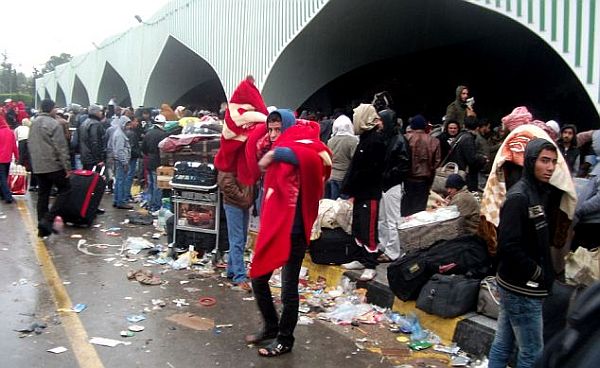
“There are thousands, maybe tens of thousands, of people packed into the terminal, mostly foreign workers. They’re Egyptians, they’re Turks, they’re from Southeast Asia. Every once in a while you see a western face.
“They are living on the floor, wrapped in dirty blankets, they’ve been there for days. And they’re the lucky ones, because they have a roof over their heads,” he said.
Plesser said airport workers were wearing face masks due to concerns about infectious diseases, because no one has had access to facilities or showers, and are living off of whatever scraps or trash they can find. “And these people are basically the lucky ones,” Plesser said.
“Outside the terminal, there are thousands more people trying to inch their way into the terminal. There are policemen with sticks and whips keeping them in line, keeping them away from the terminal doors. There are fights breaking out. They’re living in the trash from days of sitting outside the terminal, just waiting for an opportunity to get out of the country.”
Plesser notes the few “Western” faces in the airport — which, to be blunt, means white people. What else are we to suppose defines a Western face in a crowd of brown faces other than a pale complexion?
There are about 6,000 Americans in Libya, but most hold dual Libyan citizenship, so, according to State Department spokesman PJ Crowley, it’s up to the Gaddafi government whether they will be allowed to leave. Had any managed to reach the airport, Plesser’s snap survey would have overlooked those invisible Westerners.
The scramble by foreigners to leave the country began several days ago, but the number of commercial flights could not keep up with demand. Many countries have been mobilizing military and chartered ships and planes.
After landing in Malta on a flight chartered by the British government, Sam Dewhirst from Leeds who had been teaching English in Libya, described the situation in the Tripoli airport as “hellish.”
While he and other Britons had been able to “jump the queue,” he said, scores of North Africans were still waiting to leave or had abandoned their suitcases on the tarmac in a mad scramble to get on flights. “It was heartbreaking,” he said.
No explanation on how these Britons were able to jump the queue.
And then there’s the inexplicable, inexcusable case of a Canadian flight that landed in Tripoli, found no Canadian’s waiting to get out and so returned to Jordan without a single passenger!
“There were no other citizens from like-minded countries who needed the flight,” said a Canadian government official.
The airport is full of like-minded people — everyone wants to get the hell out of Libya and probably wouldn’t be too choosy about their destination. What is this club of like-minded countries to which Canada belongs? The white club?
As soon as news emerged that the Libyan protestors were also planning to take to the streets, I was horror-struck. This wasn’t going to be Egypt or Tunisia, or even frightened emirs, sultans, and monarchs. Libya has neither Egypt’s vibrant civil society nor developed institutions, nor a military that can easily challenge Qadhafi’s rule. Colonel Mu’ammar al-Qadhafi – variously, Guide of the First of September Great Revolution of the Socialist People’s Arab Republic, great leader of the al-Jumhuriyya al-‘Arabiyya al-Libiyya, the General Commander of Libya’s Armed Forces, the Head of [every] Council of State and of the Arab Socialist Union, the learned author of the al-kitab al-akhdar (Green Book), the Brotherly leader and Guide of the Revolution, Africa’s King of Kings, Supreme Leader regally surveying his kingdom or majestically visiting abroad accompanied by an elite, armed female bodyguard corps, ubiquitously, honorifically titled leader without official state title – was not about to take rejection lightly. Nor is this eccentric megalomaniac, a caricature of himself, about to let go of power after four decades, his son essentially in the same breath raising the spectre of social disintegration without the Leader and unleashing the full, bloody fury of the state.
True, permanent rulers everywhere don’t easily let go of one of life’s foremost aphrodisiacs, power, and can’t conceive that anyone else can rule their subjects like them, with their benevolent patriarchy. They all crave the attention and revel in the whimsical arbitrariness that accompany being number one, including hobnobbing with world leaders. Qadhafi’s flamboyance, including his romanticized ‘tent’ outings and a costume for every occasion and genre, was once curious, with an air of populism about it. But his African-style personal rule has not been a laughing matter for decades, and his endless speeches on TV and lectures to foreign audiences, including western women on converting to Islam, have nauseated his people. This ageing, narcissistic, deluded man, ruling over merely 5-6 million people in a petroleum-rich country the size of Alaska, cannot possibly accept the reality of letting go of all this, or that his people don’t want him, hence his rage and violence against them.
Qadhafi, like his now absent Egyptian counterpart, is symptomatic of Arab rulers’ stunning, unenlightened failure to pay any regard to placing their people’s future and well-being, much less encourage institutional inter-Arab cooperation for the sake of social and economic development, over their own immediate self-interest. (Whatever criticism one reserves for Egypt’s Jamal ‘abd al-Nasir, his attempt to live by principle, humbly refusing to enrich himself or his family, is admirable by today’s kleptocratic standards.) The Libyan dictator is what old Arab nationalism-turned-authoritarianism – including its ‘radical’ versions found in the regimes of Algeria, Syria, Iraq and the now hapless PLO, or ‘socialist republics’ such as Tunisia or Egypt – has wrought. This amounts to bureaucratic or tyrannical one party or no party states, violently crushing civil society, suffocating public space, privately owning and enriching themselves on state resources.
That insistent, ancient character of élite Arab political culture – the reliance on narrow social groups and classes, those with wealth and economic power to sustain an unwritten contract maintaining the dictator’s rule and circulating power within the state – has not yet disappeared. If anything, it has been supplemented in the last fifty years by secretive, shadowy, Qadhafi- and Saddam-like personality cults and intelligence services. All Arab regimes, regardless of regime type, have essentially behaved like dynasties.
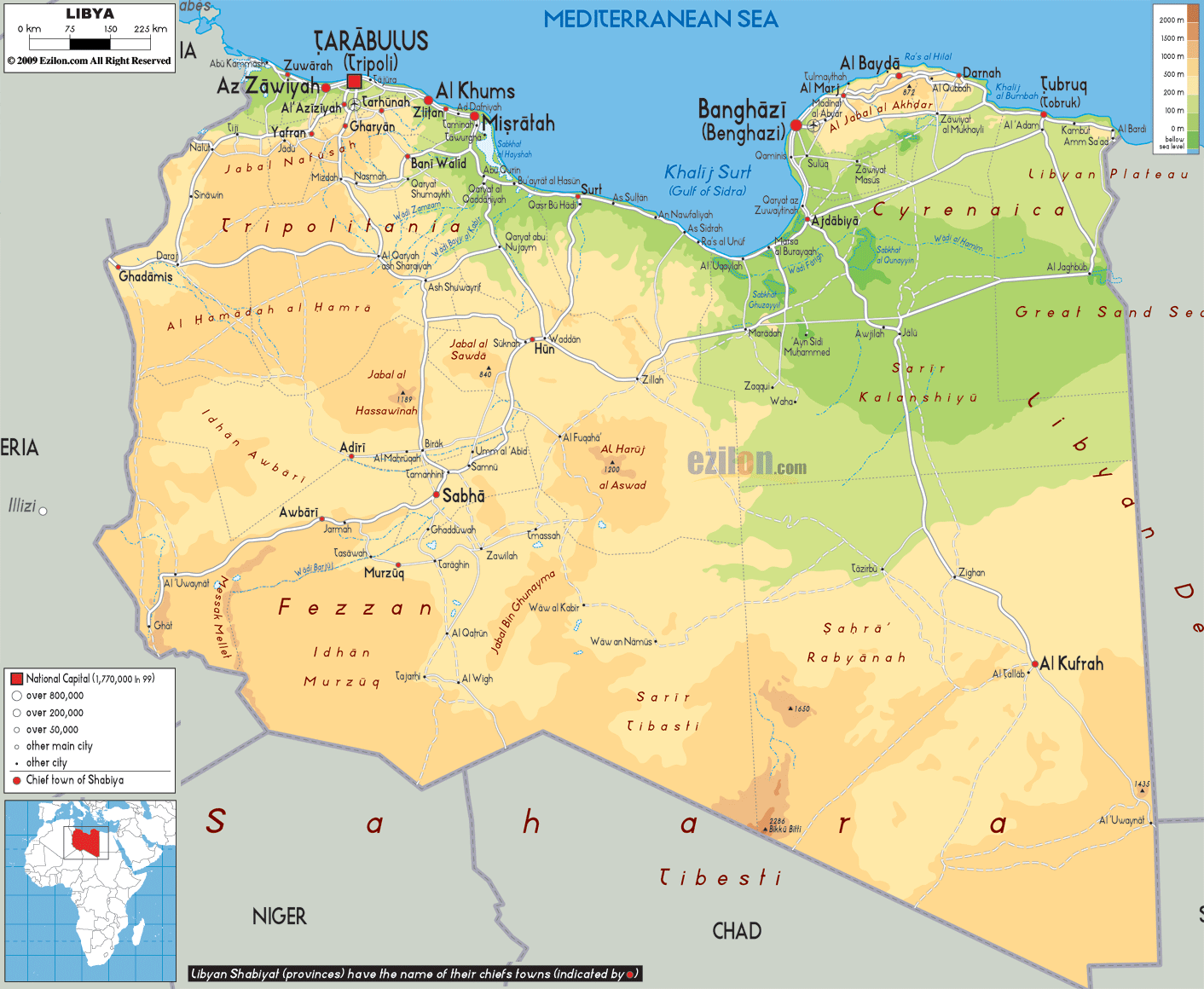
Libya is essentially a desert, with the only areas that can support intensive residence located in the Jefara Plain, around Tripoli in Tripolitania, and the Jabal al-Akhdar behind Benghazi in Cyrenaica.
The result has been that Libya’s six million-strong population, as a result of oil-fired economic development in the rentier state that emerged at the end of the 1960s, is now highly urbanised and largely concentrated in these two cities and the satellite towns around them.
This means that any regime which loses control of them has lost control of the country, even if it controls all outlying areas, such as the oil fields in the Gulf of Sirt between them, which is also the home base of the Qadhadhfa, or the Fezzan that still seems to be loyal to the Gaddafi regime.
It is this that explains how, once the army in Benghazi changed sides, the regime lost control of Eastern Libya and why its hold on Tripoli, the capital, has been so rapidly contested.
Nor should the nature of the regime or the Gaddafi family be ignored as a factor for the collapse. The regime has, in recent years, benefited from growing foreign investment in Libya, alongside its massive oil revenues, after sanctions in connection with the Lockerbie affairs were removed in 1999.
As foreign economic interest grew, so did corruption and, although Colonel Gaddafi himself may not have been corrupt, his seven sons and one daughter certainly were, drawing their fortunes from commissions and income streams siphoned off from the oil-and-gas sector.
Libyans themselves have been excluded from the benefits of oil wealth for decades, so the blatant corruption inflamed their resentment in recent years.
In addition, the Libyan leader, who had no formal role inside the jamahiriyah but made sure that the Revolutionary Committee Movement answered only to him, has played on the aspirations of his sons to succeed him, pitting one against the other to ensure that none of them could amass sufficient power to threaten his position.
In such an atmosphere of eternal mistrust and suspicion, it is hardly surprising that the ultimate bastion of the regime has been the “foreign mercenaries” that have terrified Libyans with their indiscriminate violence during the country’s latest revolution.
Yet, they too form part of the leader’s conception of the state. In the 1980s, Libya opened its borders to all who were Muslim, as part of its vision of Arab nationalism and Islamic radicalism.
The regime also recruited an “Islamic Legion” to aid it in its foreign adventures, particularly in Africa, as Chad, Uganda and Tanzania were to discover.
In 1997, Libya also renounced its self-image as an Arab state, prioritising its African destiny instead, opening its borders to sub-Saharan Africa, despite the intense domestic tensions that the inflow of migrants generated, which resulted in riots and deaths in September 2000.
Now, apart from using African migrants as a tool to coerce European states such as Italy with the threat of uncontrolled migration, it has also recruited them into its elite forces around the “Deterrent Battalion” (the 32nd Brigade) which are used solely for internal repression.
They have no loyalty to Libyans who hate them and they are the forces on which Colonel Gaddafi relies to ensure that his regime ends in a bloodbath to punish Libyans for their disloyalty to his political vision.
Whatever the Colonel thinks – and it is what he thinks that determines the struggle inside Libya today – there are objective factors that will determine the outcome.
Unrest in Western Libya has already led to towns in the Jefara Plain falling to the widening anti-regime movement. Zuwara is said to have been taken over by them and major struggles are taking place between armed forces loyal to the Gaddafi regime and the inchoate movement opposed to it in Misurata and Zawiya, where helicopter gunships seem to have been used.
Even if Tripoli is still under regime control, the towns surrounding it seem to be slipping away. Eventually, the leader will control only the capital and nothing else.
On Wednesday in Alexandria, a huge Egyptian flag was flown connecting the Coptic al-Qiddissin (Saints) Church to the adjacent mosque in a powerful display of religious and national unity.
On New Year’s Day, the church was the target of a bombing that killed 23 people. The attack was internationally condemned. The Interior Ministry blamed “foreign elements,” and the Alexandria governor accused al Qaida of being responsible, yet in a foretaste of the nationwide protests that were to erupt three weeks later Christians unleashed their rage at the authorities.
Former Interior Minister Habib el-Adly is now facing trial for his alleged role in organizing the bombing.
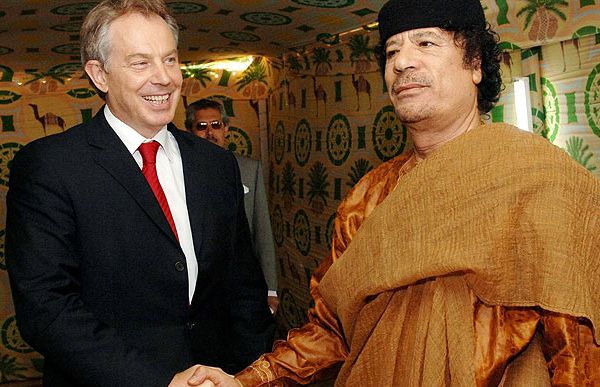
When Moammar Gadhafi told the world he was a changed man, some leaders were skeptical. Others, like Britain’s Tony Blair, were quicker to see the benefits of rapprochement with the oil-rich nation.
Now, as Gadhafi’s regime crumbles, questions are being raised about whether Britain, the United States, and others were too quick to embrace a volatile despot linked to terrorism and oppression as they sought lucrative business deals.
Those deals worth billions are now in jeopardy as Libya hurtles toward civil war. The strategic decision to build ties with the likes of Gadhafi, Egypt’s Hosni Mubarak, and Tunisia’s Ben Ali also threatens to further inflame anti-Western anger in the Arab world.
Blair’s role was particularly vital in Gadhafi’s international rehabilitation.
The former British prime minister flew to Libya in 2004, holding talks with Gadhafi inside a Bedouin tent. He praised the leader for ending Libya’s nuclear and chemical weapons program and stressed the need for new security alliances in the wake of the Sept. 11 terror attacks. British commercial deals soon followed.
Britain sold Libya about 40 million pounds ($55 million) worth of military and paramilitary equipment in the year ending Sept. 30, 2010, according to Foreign Office statistics. Among the items: sniper rifles, bulletproof vehicles, crowd control ammunition, and tear gas.
“What did the Foreign Office think Colonel Gadhafi meant to do with sniper rifles and tear gas grenades — go mole hunting?” asked Britain’s Guardian newspaper.
Although Britain’s current government led by David Cameron has revoked dozens of export licenses to Libya in the wake of the Libyan violence, many say the very weapons and equipment Britain has sold to Libya are being used against the country’s people.
Britain’s elite Special Air Service, or SAS, also participated in recent training for Libyan soldiers in counterterrorism and surveillance. Robin Horsfall, a former SAS soldier, said at the time that the training was a mistake: “People will die as a result of this decision,” he warned.
Members of Britain’s elite regiment are angry at having to help train soldiers from a country that for years armed terrorists they fought against.
An SAS source said: “A small SAS training team have been doing it for the last six months as part of this cosy deal with the Libyans.
“From our perspective we cannot see it as part of anything else other than the Megrahi deal.” Another SAS soldier said: “The IRA was our greatest adversary now we are training their backers. There was a weary rolling of the eyes when we were told about this.”
The Ministry of Defence refuses to comment on special forces activities, but sources have admitted that SAS reserves have bolstered the team that has been training “Libyan infantry in basic skills”.
A senior defence source admitted: “This is a huge political embarrassment.’’
The first moves towards setting up the training agreement are believed to have begun after Tony Blair visited
Libya as Prime Minister in 2004. However, the deal was only finalised and “signed off” by Mr Brown earlier this year.
Robin Horsfall, a former SAS soldier who took part in the Iranian Embassy siege in 1980 and fought the IRA in Northern Ireland, said:
“There is a long list of British soldiers who have died because of Gaddafi funding terrorists.
“The SAS is being ordered to do something it knows is morally wrong.”
Iraqi police allowed dozens of assailants to beat and stab peaceful protesters in Baghdad on February 21, 2011, Human Rights Watch said today. Security forces have an obligation to protect the right to assemble peacefully and to use only the minimum necessary force to protect lives if violence erupts, Human Rights Watch said.
In the early hours of February 21 dozens of men, some wielding knives and clubs, attacked about 50 protesters who had set up two tents in Baghdad’s Tahrir Square. The assailants stabbed and beat at least 20 of the protesters who were intending to camp in the square until February 25, when groups have called for national protests similar to the “Day of Anger” in Egypt. The attack came directly after the police had withdrawn from the square, and witnesses suggested the assailants were in discussion with the police before they attacked.
“Promises by Prime Minister Nuri al-Maliki to allow protests are meaningless when we see vicious attacks like the one on February 21,” said Joe Stork, deputy Middle East director at Human Rights Watch. “Iraqi authorities should hold police who allowed this attack to happen accountable.”
Teenagers high on drugs, incited by Osama bin Laden — this is Muammar Gaddafi’s explanation gives for the current challenge to his rule.
What is happening now in Libya is not people’s power, it’s international terrorism led by al-Qaeda … All they want is to kill your kids, that’s what Bin Laden wants, he should be happy now, that’s what he wants.
Rebels are increasing their hold on Muammar Gaddafi’s ailing regime, by shutting down oil exports and mobilising rebel groups in the west of the country as the revolution rapidly spreads. Gaddafi’s hold on power appears confined to parts of Tripoli and perhaps several regions in the centre of the country. Towns to the west of the capital have fallen or are being fought over. Gun battles are taking place between forces loyal to Gaddafi and his opponents in the town of Az-Zawiyah, 30 miles west of Tripoli, according to witnesses. Order is returning to the sacked second city of Benghazi after days of fierce fighting that saw the military defect en masse and virtually all government buildings razed and looted. Gaddafi was expected to make a statement at some point soon…
Nato says it will not intervene in Libya. Its secretary-general, Anders Fogh Rasmussen, says the alliance has received no such requests and that in any case any intervention must be based on a UN mandate. Rasmussen says the turmoil in Libya does not threaten any Nato members, but the conflict could spark a mass refugee crisis.
The claim comes in an interview with former justice minister Mustafa Mohamed Abud Al Jeleil in the Swedish newspaper Expressen:
“Gaddafi’s days are numbered. He will do what Hitler did – he will take his own life.”
Al Jeleil earlier claimed that Gaddafi had ordered the Lockerbie bombing.
When Gaddafi said bin Laden must be happy now, he spoke with an air of resignation — much of his tone of defiance from yesterday having dissipated.
Denial, bargaining, anger, depression — most of the stages of dying are already evident. Al Jeleil may well be right and what we are witnessing now is a tyrant in dialogue with his own death. Acceptance comes as he pulls the trigger.
This website or its third-party tools use cookies, which are necessary to its functioning. By closing this banner, you agree to the use of cookies.