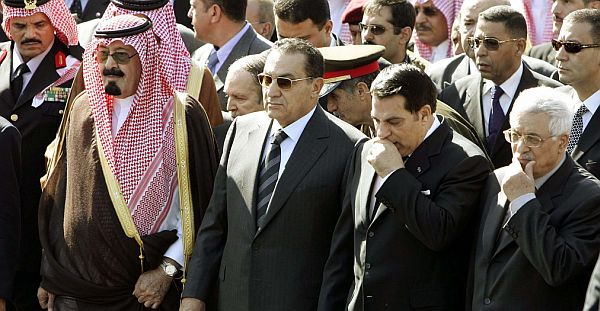
“Sultan Qaboos, Oman’s absolute ruler, is a man of culture,” writes Brian Whitaker.
“I have never encountered a place in the Arab world so well-governed as Oman, and in such a quiet and understated way,” Robert Kaplan wrote the other day in an article for Foreign Policy headed “Oman’s renaissance man”.
Last weekend, though, overshadowed by events in Libya, there were disturbances in Sohar (Oman’s second city) along with more peaceful demonstrations elsewhere in the country. Protesters’ complaints were the familiar ones heard these days in most of the Arab countries: government corruption, cronyism and youth unemployment.
Oman has an exceptionally young population – 43% are under the age of 15 – and even those who buy the line that Oman is well governed recognise that the authorities face an uphill struggle in providing jobs. “The problem is evolving faster than they can provide solutions,” one person who is familiar with the country (and asked not to be identified) told me this week.
But there’s another problem too. Even if Qaboos is a Britain-friendly, music-loving ruler with benevolent intentions he is none the less a despot. He doesn’t tolerate criticism and his citizens have very few rights. They can’t, for instance, hold a public meeting without the government’s approval. Anyone who wants to set up a non-governmental organisation of any kind needs a licence. To get it, they have to demonstrate that the organisation is “for legitimate objectives” and not “inimical to the social order”. On average, that takes two years – assuming permission is granted at all.
Egypt’s uprising, contrary to most predictions, was initiated and driven by coalitions – including political parties, associations and internet networks – which were dominated by secular and democratic forces. Islamic organisations or their individual members took part on an equal footing with groups of marginal importance before the uprising, and with groups closer to eastern European dissidents of 1989 than to the usual mass parties or revolutionary elites of social revolutions.
The discretion of Tunisia’s Islamist movement can be explained to a large extent by the harshness of its suppression under Ben Ali, impeding the ability of the Islamic Nahda party to act. However, the Muslim Brotherhood in Egypt was also discreet, but for the opposite reason: because it was a party tolerated by the military regime (although not legalised).
Anwar Sadat, when he came to power after Gamal Abdel Nasser’s death in 1970, favoured the Brotherhood’s return to the public stage and its enhanced position as a counterbalance to the Nasserist or radical left. The Brothers fully subscribed to the economic liberalisation (infitah) of Sadat when he embarked on dismantling Nasser’s legacy. This led to increased influence of members of the new Egyptian bourgeoisie within the Brotherhood. Even so, it continued to assert its piety against rampant corruption; this was a key argument for the petit bourgeois, the Brothers’ favourite constituency.
The Brotherhood built itself as a reactionary religious political movement, whose main concern was – and still is – the Islamisation of Egypt’s political and cultural institutions and the promotion of sharia as the basis for legislation. This programme is summed up by its main slogan: “Islam is the solution”. At the same time, the Brotherhood has served as a political antidote to extreme and violent fundamentalist groups.
Carried on the shoulders of protesters who claimed him as their own, Egypt’s new prime minister waded into a crowd of tens of thousands in Tahrir Square on Friday, delivering a speech bereft of regal bombast that illustrated the reach of Egypt’s nascent revolution and the breadth of demonstrators’ demands that remain unanswered.
“I am here to draw my legitimacy from you,” Prime Minister Essam Sharaf told the raucous, flag-waving assembly. “You are the ones to whom legitimacy belongs.”
Some protesters dismissed the speech as the savvy move of an ambitious politician in a time fraught with anxiety. Yet it was perhaps the symbolism itself that said the most about Friday’s moment when, just a day after his appointment, an Egyptian leader chose to make his first stop the square that helped topple his predecessor.
In Benghazi, the opposition National Libyan Council said there was no room for talks, following reports that Col Gaddafi had ordered an intelligence chief to negotiate with the rebels.
The council is led by former Libyan Interior Minister Mustafa Abdel-Jalil, who defected last month.
“If there is any negotiation it will be on one single thing – how Gaddafi is going to leave the country or step down so we can save lives. There is nothing else to negotiate,” Ahmed Jabreel, a spokesman for Mr Abdel-Jalil, told Reuters news agency.
The BBC’s Kevin Connolly in Benghazi says it appears that neither side has the capacity to move large amounts of manpower or firepower over vast expanses of desert.
He says that raises the grim prospect of a military stalemate and a political vacuum after the revolt that began in the east of the country in mid-February.
Muammar Gaddafi has accepted an offer from Venezuela to mediate in Libya’s political crisis after talks with Hugo Chavez, the Venezuelan president, Al Jazeera has learnt.
Sources told our correspondent in Caracas that Nicolas Maduro, Venezuelan’s foreign minister, had discussed the offer with Amr Moussa, the head of the Arab League, and that details of the plan could be announced by the Arab League in Cairo on Thursday.
Mustafa Abdel Jalil, the head of the opposition National Libyan Council, told Al Jazeera he totally rejected the concept of talks with Gaddafi, and said that no one been in contact with him regarding the Venezuelan initiative.
The plan would involve a commission from Latin America, Europe and the Middle East trying to reach a negotiated outcome between the Libyan leader and opposition forces which have seized control of large areas of the North African oil-producing country.
After decades of financing and training rebels and liberation movements, Libya’s Moamer Gathafi is accused of using his influence to amass an army of mercenaries from across sub-Saharan Africa.
Liberia, Sierra Leone, Uganda, Chad, Mali and Zimbabwe: One only has to name a conflict, rebel group or despot in Africa to find someone the Libyan leader has offered finance, training or backing to during his 41-year reign.
He has also aided peacekeeping operations, given aid and built infrastructure.
And now, waving oil money to the south, Gathafi is said to have lured some 25,000 mercenaries to quash a popular revolt against his regime.
Gaddafi can no more quickly attack Benghazi with his armour than the rebels can advance on Tripoli in sufficient numbers to force the issue decisively. For either side to move the hundreds of kilometres to come into contact would require a huge logistical operation using tank and armour carriers which could not drive the long distances and still be ready to fight.
Why this matters is simple. Foreign policy – including the increasing threat of military intervention – is being driven by what the media is reporting from Libya, and that is being driven largely by reports from the opposition, some of which are true, some of them dubious. The Libyan government says that. But for once, in the midst of all the regime’s evasions, lies and fantastical notions, it may just have a point.
We are being drawn into a crisis where credible information about so much of what is happening is not simply at a premium, it is often impossible to mine from among all the exaggerations and misinformation.
To the rebels of eastern Libya, it was always a matter of when. On Wednesday morning, sooner than many had expected, Gaddafi’s men came for them.
A thundering burst of machine-gun fire just before 6.30am heralded the attack on the outskirts of Brega, a sand-strewn service town about 150 miles south of Benghazi. The loyalist forces had crept in during the night, patiently set up in an industrial area on the city limits, and dug in.
“They arrived in 60-70 Toyota trucks,” said Wais Werfali, 40, who works in a nearby ammonia production plant. “They have set up a perimeter and are using families from the area as human shields.”
By sunset, the battle had been joined by rebels streaming down from the city of Ajdabiya. A decisive phase in this war for control of eastern Libya had begun.
Peter Beaumont reports from the Tripoli suburb of Tajura, the target of a crackdown on rebels where ‘disappearances’ are increasing.
Tajura, with its population of about 100,000, is made up mainly of poor and middle-class Libyans who live in three-storey apartment blocks and houses built around little squares and alleys.
It is here that residents say gunmen in pickup trucks fired wildly into the crowd last week. It now feels like a ghost town, with shops shuttered and few people on the streets, which still bear the scars of the clashes.
We had been met on a dark corner by a group of youths keeping watch on the street. They were suspicious of the driver, who was sent away after being questioned briefly. There was evidence on the roadside of felled palm trees that had been used as barricades and anti-government graffiti, painted over with red paint.
“Fifteen of them came and kicked in the door,” Bilhaj says inside the house. “They turned the house upside down. In this neighbourhood, 20 have disappeared. We don’t know where they have gone.
“The people in this area feel threatened. They are scared. The government says if there are any protests in the streets here they will burn them.”
We ask what his brothers did to be arrested. “They spoke out. They were targeted because they were ones who oppose the government. Tonight they will come and take more people. Our street is almost empty. The men have been taken and the families fled elsewhere.”
Thousands of people continue to flee the violence in Libya, with most refugees attempting to enter neighbouring Tunisia or Egypt, though there are pressing concerns regarding African migrants who remain trapped in the country, unable to leave for fear of being attacked by both the government and the opposition.
Officials say that tens of thousands of people remain just inside Libya’s borders, awaiting evacuation, safe passage or the granting of asylum, while thousands more have so far not attempted to leave their homes for fear of their own safety.
International Organisation for Migration officials say that almost 200,000 people have fled Libya since violence began several weeks ago, headed towards neighbouring Egypt, Tunisia and Niger.
President Obama demanded Thursday that the embattled Libyan leader, Col. Muammar el-Qaddafi, “step down and leave” immediately, and said he would consider a full range of options to stem the bloodshed there, though he did not commit the United States to any direct military action.
In his most forceful response to the near-civil war in Libya, Mr. Obama said the United States would consider imposing a “no-fly zone” over the country — a step his defense secretary, Robert M. Gates, warned a day earlier would carry major risks, requiring the United States to destroy Libya’s air defenses.
Mr. Obama said the United States and the world were outraged by Colonel Qaddafi’s “appalling violence against the Libyan people.” Speaking after he met with President Felipe Calderón of Mexico at the White House, he declared, “Muammar Qaddafi has lost the legitimacy to lead, and must leave.”
The president’s statement, while robust, left important questions unanswered: Where would Colonel Qaddafi go, given the lack of countries that have offered him sanctuary? And what kind of intervention, beyond airlifting refugees on military planes, would the United States be willing to undertake?
The situation in Libya [has become] a test of how seriously the international community takes the idea of a responsibility to protect people from their rulers. The idea is an old one, but its modern form is rooted in the tragic failure to intervene in the Rwandan genocide in 1994. A subsequent UN inquiry concluded that as few as 2,500 properly trained military personnel could have prevented the massacre of 800,000 Tutsis.
Former US President Bill Clinton has said that the mistake he most regrets making during his presidency was his failure to push for intervention in Rwanda. Kofi Annan, who was then UN Under-Secretary-General for Peace-Keeping Operations, described the situation at the UN at the time as a “terrible and humiliating” paralysis.
When Annan became Secretary-General, he urged the development of principles that would indicate when it is justifiable for the international community to intervene to prevent gross violations of human rights. In response, Canada’s government established an International Commission on Intervention and State Sovereignty, which recommended that military intervention could be justified, as an extraordinary measure, where large-scale loss of life is occurring or imminent, owing to deliberate state action or the state’s refusal or failure to act. These principles were endorsed by the UN General Assembly at its special World Summit in 2005 and discussed again in 2009, with an overwhelming majority of states supporting them.
The principle fits the situation in Libya today. Yet the Security Council resolution contains no mention of the possibility of military intervention – not even the imposition of a no-fly zone over Libya to prevent Gaddafi from using planes to attack protesters.
One body with a special concern to transform the idea of the responsibility to protect into a cause for action is the Global Center for the Responsibility to Protect, at the City University of New York. It has called on UN members to uphold their 2005 commitments and put the responsibility to protect into action in Libya. It urges consideration of a range of measures, several of which were covered by the Security Council resolution, but also including a no-fly zone.
In addition to arguing that the responsibility to protect can justify military intervention, the International Commission on Intervention and State Sovereignty recommended a set of precautionary principles. For example, military intervention should be a last resort, and the consequences of action should not be likely to be worse than the consequences of inaction.
Whether these precautionary principles are satisfied in Libya requires expert judgment of the specifics of the situation. No one wants another drawn-out war like those in Iraq and Afghanistan. But Libya is not Iraq or Afghanistan – its population is only about one-fifth of either country’s, and there is a strong popular movement for a democratic form of government. Assuming that foreign military forces rapidly overwhelmed Gaddafi’s troops, they would soon be able to withdraw and leave the Libyan people to decide their own future.
Those calling for western military action in Libya seem brazenly untroubled by the fact that throughout the Arab world, foreign intervention, occupation and support for dictatorship is regarded as central to the problems of the region. Inextricably tied up with the demand for democratic freedoms is a profound desire for independence and self-determination.
That is clear in reaction on the ground in Libya to the threat of outside intervention. As one of the rebel military leaders in Benghazi, General Ahmad Gatroni, said this week, the US should “take care of its own people, we can look after ourselves”.
No-fly zones, backed by some other opposition figures, would involve a military attack on Libya’s air defences and, judging from the Iraqi experience, be highly unlikely to halt regime helicopter or ground operations. They would risk expanding military conflict and strengthening Gaddafi’s hand by allowing the regime to burnish its anti-imperialist credentials. Military intervention wouldn’t just be a threat to Libya and its people, but to the ownership of what has been until now an entirely organic, homegrown democratic movement across the region.
A decade ago an independent international commission that elaborated on the idea of “responsibility to protect” spelled out six criteria for deciding whether military action is justified. Essentially a modernised version of centuries-old Catholic standards for “just war”, these criteria are: right authority, just cause, right intention, last resort, proportional means, and reasonable prospects. Bitter experience, from Kosovo to Afghanistan, has taught us that “reasonable prospects” (ie of success) may be the most difficult to judge and achieve.
Applying these criteria, I remain unconvinced that a no-fly zone over Libya is justified – at the time of writing. If it turns out that Gaddafi does still have a secret stock of chemical weapons, and can drop them from the sky, this judgment could change overnight. We should prepare contingency plans. But we have not yet exhausted all other avenues, including trying to pry Gaddafi’s cronies away from him by fair means and foul. A no-fly zone would be very difficult to enforce, and might not have anything more than a marginal impact on the ground.
Above all, any form of armed intervention by the west – and the US military says a no-fly zone would require initial bombing of Libyan radar and anti-aircraft facilities – would spoil the greatest pristine glory of these events, which is that they are all about brave men and women liberating themselves.
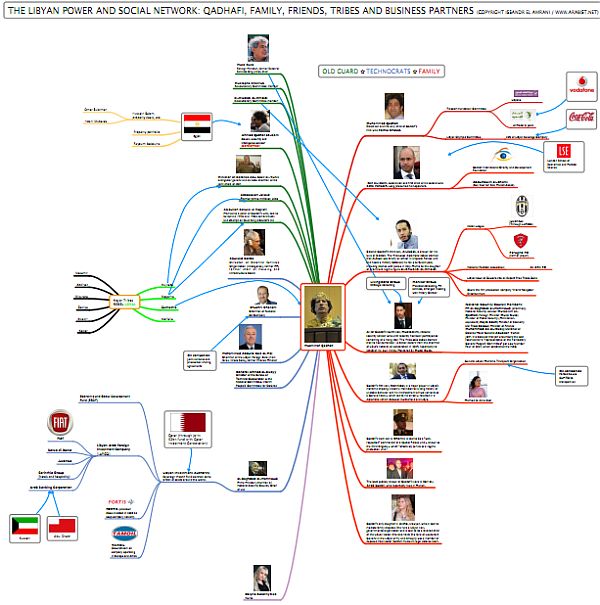
Issandr El Amrani has mapped the social and power networks around Muammar Gaddafi using existing reporting, Wikileaks cables from Tripoli, and a few academic sources.
Click on the image below to see the detailed graphic (PDF).
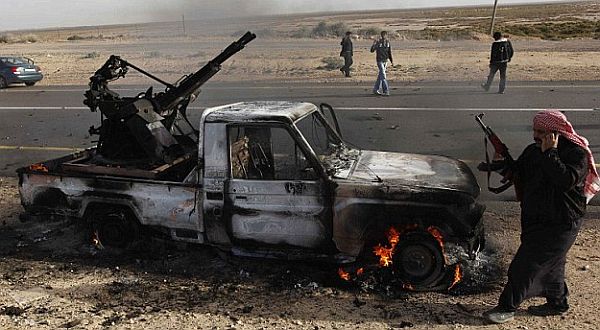
The defense of Brega
From the feeble cover of sand dunes, under assault from a warplane overhead and heavy artillery from a hill, rebels in this strategic oil city repelled an attack by hundreds of Col. Muammar el-Qaddafi’s fighters on Wednesday. The daylong battle was the first major incursion by the colonel’s forces in the rebel-held east of the country since the Libyan uprising began.
The battle began at daybreak, when government fighters stormed the airport and the area around the city’s oil refinery. By the early afternoon, hundreds of men from this city, wielding Kalashnikov rifles and knives — joined by confederates from neighboring cities with heavier artillery — fought Colonel Qaddafi’s men, who were backed by air power and mortars.
But as night fell, the government fighters were on the run and the rebels were celebrating in Brega and all along the road north to Benghazi, the seat of rebel power, where fireworks lighted up the sky.
The attack seemed to spearhead a broader effort by the government of Colonel Qaddafi to reassert control over strategic oil assets in the eastern part of the country, which have been seized by rebel forces. And what appeared to be a victory by the rebels continued a string of recent successes in beating back those attacks, as they did in the western city of Zawiyah earlier this week. But the rebels have not been able to shake the colonel’s hold on power.
That quandary was apparent as the fighters celebrated their victory in a Brega square: the warplane reappeared and attacked the gathering.
“Yes, they won,” said Iman Bugaighis, a spokeswoman for the rebel governing authority, which asked Western nations to conduct airstrikes against Colonel Qaddafi’s strongholds on Wednesday. “We don’t know how long it will last. He’s getting stronger.” (New York Times)
The interim council had indicated it won’t negotiate with Qaddafi, the Benghazi-based newspaper said on its website. Benghazi, the biggest city in eastern Libya, has fallen under the rule of Qaddafi’s foes who are pushing to end his four- decade rule.
Qaddafi also fired Abdallah Senoussi, his close aide and head of Libya’s domestic intelligence services, Quryna reported yesterday, citing people it didn’t name. (Bloomberg)
Fierce battles rage in Libya
Forces loyal to Muammar Gaddafi, the Libyan leader, are reported to have regained control of two strategic towns in the country’s northwest, even as opposition fighters in the east prepare to march on the capital, Tripoli.
The claims about the fall of Gharyan and Sabratha on Wednesday came as fighting raged between pro- and anti-government forces over the control of the eastern town of Brega, the headquarters of several oil companies, and Gaddafi appeared on state television once again.
“They tried to take Brega this morning, but they failed,” Mustafa Gheriani, a spokesman for the February 17th Coalition, an anti-government group, told the Reuters news agency.
“It is back in the hands of the revolutionaries. He is trying to create all kinds of psychological warfare to keep these cities on edge.” (Al Jazeera)
Gaddafi: Libya dignity under attack
Libyan leader Muammar Gaddafi has said that he is not a president and so cannot resign his position, and that power is in the hands of the people, during a televised public rally in the capital, Tripoli.
“Muammar Gaddafi is not a president to resign, he does not even have a parliament to dissolve,” Gaddafi said on Wednesday, his third pu8blic appearance since the uprising, surrounded by dozens of supporters in a large ballroom for a ceremony to mark 34 years of “people power”.
“Attacks on me are seen by Libyan people as attacks on their symbol and dignity.
“The foreigners want Gaddafi to step down, to step down from what? Gaddafi is just a symbol for the Libyan people… This is how the Libyan people understood it.”
He said that the world did not understand the Libyan system that puts power in the hands of the people. (Al Jazeera)
Libya’s toxic tribal divisions are greater than Qaddafi
Col Qaddafi’s main support comes from three major sources: the Warfalla, based 180km southwest of Tripoli, the largest tribe in the country with large communities within Tripoli. The Warfalla also comprise a majority of well-educated Libyans. Gaddafi’s own tribe, centred in Sirte, 500km east of Tripoli, is another pillar of his support. The allegiance between Gaddafi’s tribe, Gaddafa, and the Warfalla has been described as a “blood link”. Their ties predate Col Qaddafi’s rise to power and will be slow to change now. Prejudice against other tribes in Libya, particularly against the Misrata, make many Warfalla more hardline than Col Qaddafi himself.
Sizeable support for Col Qaddafi still exists within these two tribes, which form a triangle with the Mediterranean as its base, that points deep into Libya’s south, where Col Qaddafi also draws sizable support. Sebha, for instance, the capital of Libya’s southern region, has not seen any demonstrations so far.
This tribal landscape must be understood along with Libya’s recent history: the country has not had political parties for more than four decades. Civil society does not exist, nor does the idea of loyalty to the “state”. There is not a constitution, no nationally-accepted rule of law and no practical mechanisms to guide the country in the event of a power vacuum at the top. Col Qaddafi himself emphasises the fact that he has neither “official role” nor “legally binding responsibility”.
This structure makes it hard to see how a power vacuum could be filled and by whom. While the eastern part of Libya is beyond government control it still lacks effective leadership, let alone a clear political vision for a united Libya. The only strong message and symbol coming from eastern Libya is the flag of the country from the 1950s that is being waved by protesters. The two most viable scenarios for Libya in the long-term, however, are a country vulnerable to further division or all-out tribal war. (Mustafa Fetouri)
UN warcrimes court to name Libyan suspects
The chief prosecutor of the International Criminal Court on Thursday will name individuals to be targeted in a full-scale probe of alleged crimes committed in Libya, his office announced.
Luis Moreno-Ocampo will announce “the opening of an investigation in Libya” at a press conference in The Hague on Thursday and present “preliminary information as to the entities and persons who could be prosecuted”, it added.
The prosecutor will “put them on notice to avoid future crimes” and would also present an overview of the alleged crimes committed in Libya since an anti-government rebellion started on February 15, the statement noted.
Hundreds of people have been killed in a violent crackdown on the uprising and tens of thousands are fleeing the country, causing a humanitarian emergency. (AFP)
Europe to help Libya stranded
The governments of France, Spain and Britain have said they would evacuate thousands of workers stranded on the Tunisian border after fleeing the violence in Libya.
Emergency airlifts along Libya’s borders were launched on Wednesday, as more than 140,000 refugees pour into Tunisia and Egypt from Libya and thousands more are arriving by the day.
UN experts warned that fast action was needed to protect and feed them before the exodus turned into a full-blown humanitarian crisis.
Many of the foreigners are from countries that could not afford evacuations, or sub-Saharan African workers whose lives are in danger because they are being mistaken for mercenaries hired by Libyan leader Muammar Gaddafi. (Al Jazeera)
The upheaval engulfing the Arab world presents the United States with two choices. Washington can either embrace change, stand on the sidelines, and accept whatever results. Or it can intervene, insert itself in the process, and try to shape the outcome. Advocating the latter would be to assume reserves of power, not to mention wisdom, at Washington’s disposal. At the moment, however, the U.S. possesses neither.
But history, too, argues for restraint. Consider what several decades of outside meddling in the Islamic world has accomplished. Out of the ruins of the Ottoman Empire after World War I came a new map of the vast region, designed not to promote the well-being of its inhabitants, but to satisfy European (chiefly British) interests. The Allies drew boundaries, created nation-states, and installed monarchs to ensure Western access to oil and control of the Suez Canal.
British success proved fleeting, however. The many tasks proved expensive, and in the wake of World War II, cash-strapped Britain devolved its responsibilities onto the U.S., which had grown hungry for global leadership. Although American aims differed little from Great Britain’s, the Cold War enabled Washington to camouflage its purposes. It portrayed Iran’s Mohammad Mossadegh as a communist dupe to justify his overthrow, depicted Egypt’s Gamal Abdel Nasser as a puppet of the Kremlin rather than as an Arab nationalist, and endorsed Israel’s image of itself as a lonely bastion of democracy in a sea of Soviet-armed authoritarians.
By the end of the 20th century, Washington’s ambitions had ballooned rapidly. Yet the unintended consequences of America’s informal empire, which began as a trickle, rushed on as an unwelcome flood. Chief among them: the emergence in Iran of an Islamic Republic deeply hostile to the United States; Israeli insecurities finding expression in a penchant for an excessive reliance on force, recklessly and aggressively employed; the rise of widespread anti-Americanism throughout much of the Islamic world; and the incubation of radical Islamist organizations committed to expelling the U.S., purging the region of its corrupt local rulers, and unifying the umma.
Even in a moment of joy and triumph for millions of Arabs, Fouad Ajami cannot wholly renounce one of his favourite themes – that the political behaviour of Arabs has been driven by inherited pathologies which set them apart from the rest of mankind. Even when he revels with Tunisians, Egyptians and Libyans at their liberation from old tyrannies, he cannot resist the temptation to hold them responsible for their own long oppression. Their liberation, he writes in the New York Times, came when they finally saw the light – his own very idiosyncratic light, abandoning Arab nationalism and the cause of Palestine:
These rulers hadn’t descended from the sky. They had emerged out of the Arab world’s sins of omission and commission. Today’s rebellions are animated, above all, by a desire to be cleansed of the stain and the guilt of having given in to the despots for so long.
There is no marker, no dividing line, that establishes with precision when and why the Arab people grew weary of the dictators. To the extent that such tremendous ruptures can be pinned down, this rebellion was an inevitable response to the stagnation of the Arab economies…Then, too, the legends of Arab nationalism that had sustained two generations had expired. Younger men and women had wearied of the old obsession with Palestine.
I disagree, not on some technicality, but profoundly and thoroughly. Individuals may sin, but to project those sins on to the whole Arab world – millions of people across several generations and more than 20 countries – is more than they deserve. Such a theory of collective guilt makes for powerful rhetoric, well-tuned to the preconceptions of Ajami’s audience, preconceptions that he has made a good living out of humouring. But it’s a little too close for comfort to some discredited 20th-century ideas that led to the deaths of millions. What sins did the young Egyptians who came out on the streets on January 25 have to expiate? Their failure to overthrow Hosni Mubarak when they were in their teens? Even the older generations, the ones who applauded the initiative and determination of their descendants, did not feel guilt, only regret that they had lived under tyranny so long. Most of them never connived in their own oppression. On the contrary, the main forces that conspired to oppress them were the very ones that Ajami serves and that he does not mention – the United States, the oil companies, the arms dealers, and all those who believed that ordinary Arabs should pay any price necessary for the sake of cheap oil and Israel’s immunity from accountability.
As the Mideast protests and government crackdowns continue, one country to watch closely is Iraq, with whom the U.S. has a long-term partnership and where clashes between protesters and government forces recently turned violent. Even as Iraqi security forces detained and abused hundreds of intellectuals and journalists, the U.S. government—in keeping with a pattern of silence on Iraq’s abuses—has withheld criticism of its strategic ally. (Salon noticed this too.)
Asked generally about the violence against Iraqi demonstrators on Friday, White House Press Secretary Jay Carney said only “the approach we’ve taken with regard to Iraq is the same that we’ve taken with regard to the region,” which he said was to call on governments to respond to the protests peacefully. Neither the White House nor the State Department seem to have mentioned the matter since. Yesterday’s State Department briefing discussed Libya, Egypt, Iran, Oman, Saudi Arabia, South Korea, China, Pakistan, Argentina, South Africa and Haiti—Iraq was never discussed.
For years, they have been one of the most formidable lobbying forces in town: the elite band of former members of Congress, former diplomats and power brokers who have helped Middle Eastern nations navigate diplomatic waters here on delicate issues like arms deals, terrorism, oil and trade restrictions.
Just last year, three of the biggest names in the lobbying club — Tony Podesta, Robert L. Livingston and Toby Moffett — pulled off a coup for one of their clients, Egypt. They met with dozens of lawmakers and helped stall a Senate bill that called on Egypt to curtail human rights abuses. Ultimately, those abuses helped bring the government down.
Mr. Moffett, a former congressman from Connecticut, told his old colleagues that the bill “would be viewed as an insult” by an important ally. “We were just saying to them, ‘Don’t do this now to our friends in Egypt,’ ” he recounted.
Now the Washington lobbyists for Arab nations find themselves in a precarious spot, as they try to stay a step ahead of the fast-changing events without being seen as aiding despots and dictators. In Libya, Saudi Arabia, Bahrain, Yemen, Egypt and other countries in the region, leaders have relied increasingly on Washington’s top lobbyists and lawyers, paying them tens of millions of dollars. Some consultants are tacking toward a more progressive stance in light of pro-democracy protests, while others are dropping their clients altogether because of the tumult.
In Tunisia, where the earliest revolts energized the regional upheaval in January, the Washington Media Group, a public relations and communications firm, ended its $420,000 image-building contract with Tunis on Jan. 6, soon after reports emerged of violent government crackdowns on demonstrators.
“We basically decided on principle that we couldn’t work for a country that was using snipers on rooftops to pick off its citizens,” said Gregory L. Vistica, the firm’s president, who first announced the decision on Facebook.
In the 1990s, one could only whisper Hosni Mubarak’s name. Political talk or jokes were avoided in phone calls. This year, millions of Egyptians fought for 18 days against their ageing tyrant, braving the police troops firing teargas, rubber bullets and live ammunition. People in Egypt have lost their fear, but it did not happen overnight. The Egyptian revolution, rather than coming out of the blue on 25 January 2011, is a result of a process that has been brewing over the previous decade – a chain reaction to the autumn 2000 protests in solidarity with the Palestinian intifada.
Mubarak’s iron-fist rule and the outbreak of the dirty war between the regime and Islamist militants in the 1990s meant the death of street dissent. Public gatherings and street protests were banned and if they did take place, confronted by force. Live ammunition was used on strikers. Trade unions were put under government control.
Only after the Palestinian intifada broke out in September 2000 did tens of thousands of Egyptians take to the streets in protest – probably for the first time since 1977. Although those demonstrations were in solidarity with the Palestinians, they soon gained an anti-regime dimension, and police showed up to quell the peaceful protests. The president, however, remained a taboo subject, and I rarely heard anti-Mubarak chants.
I recall the first time I heard protesters en masse chanting against the president in April 2002, during the pro-Palestinian riots around Cairo University. Battling the notorious central security forces, protesters were chanting in Arabic: “Hosni Mubarak is just like [Ariel] Sharon.” [Continue reading…]
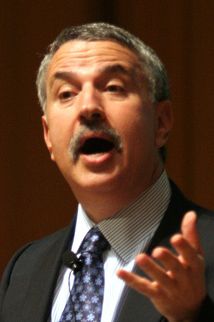
Future historians will long puzzle over how I was given an international platform to freely pontificate on the Arab people and be remunerated handsomely for it. It is true that I am not the only person in the world who formulates dubious theories based on scant or no evidence which I then harangue people with. Other people do it. They are called taxi drivers. But they are not as rich as me and haven’t been awarded three Pulitizer Prizes.
Since I’ve been here in Egypt I’ve been putting together a list of “the-absolutely-irrelevant forces” that have captured the captive Arab mind and ignited the simmering coals of the instant garden BBQ that is the Middle East. You might ask why, since I am in Egypt, I don’t ask an Egyptian – possibly two Egyptians – about what inspired them to completely ignore my theories on the Arab peoples and take to the streets. The answer is this: I am Thomas Friedman and I write a column in the New York Times.
I started my last extremely important column with an introduction in which I listed tyranny, rising food prices, youth unemployment and social media as the “big causes”. Rather than just stop there, I did a Google “surprise me” search and chose five of the random results for my special “mix of forces” which inspired the Arab mass revolts. These included Barack Obama, Google Earth and the Beijing Olympics.
But there are other critical factors integral to an understanding of my bollocks theory on the Middle East. Here they are:
MY MOUSTACHE – Americans have never really appreciated what a radical thing I did in growing a moustache, long the symbol of Arab male virility. I’m convinced that when Arab men catch a glimpse of my moustache as they bring me my breakfast in my hotel they are inspired and say to themselves: “Hmmm. Let’s see. He’s middle-aged. I’m middle-aged. He’s slightly tanned. I’m roughly the same colour. His name is Thomas. My name is Hussein. He is a prick. I sometimes act like a prick. He is not president of the United States. I am not president of the United States. Lincoln is the capital of Nebraska. Water boils at 100 degrees centigrade. He has a moustache. I have a moustache. Both our moustaches have no voice in my future”. I’d put that in my special mix of hallucinogenic drugs and ingest it. [Continue reading…]
UN urges mass Libyan evacuation
The UN has called for a mass humanitarian evacuation of people fleeing Libya for Tunisia, saying the border situation is at “crisis point”.
General Secretary Ban Ki-moon said thousands of lives were at stake. Some 75,000 people have fled to Tunisia since the unrest began and 40,000 more are waiting to cross, the UN says. (BBC)
Panic on borders as chaos engulfs Libya
The Libyans watched from an open window of the immigration post, leaning out to see the 20,000 fleeing Egyptian, Bangladeshi, Chinese and Iranian workers heaped up against the border wall. They seemed quite unconcerned, shirt-sleeves rolled up, moving to a window closer to this crowd. Already up to 75,000 have struggled into Tunisia, but yesterday the crossing system collapsed as thousands of men, almost all Arabs desperate to escape Muammar Gaddafi’s state, fought with local Tunisians who – under the eyes of the army – attacked them with stakes and iron bars.
Many of the soldiers hurled plastic water bottles and biscuits into the masses of refugees who began to jump the border wall in their desperation, heaving family members and baggage through breaks in the cement. Clichés run out when faced with such chaos and unnecessary suffering. “Insupportable” was the word that came to mind yesterday. Most of these 20,000 had gone without food, water or sleep for four days. How is it possible that people should suffer so greatly at a mere border post? (Robert Fisk)
Libyan rebels, invoking U.N., may ask West for airstrikes
In a sign of mounting frustration among rebel leaders at Colonel Muammar el-Qaddafi’s diminished but unyielding grip on power, the revolutionary council here is debating whether to ask for Western airstrikes on some of the regime’s most important military assets under a United Nations banner, according to four people with knowledge of the council’s deliberations.
By invoking the United Nations, the council, made up lawyers, academics, judges and other prominent figures, is seeking to draw a distinction between the airstrikes and foreign intervention, which the rebels say they emphatically oppose.
“He destroyed the army. We have two or three planes,” said Abdel-Hafidh Ghoga, the council’s spokesman, speaking of the rebels’ military disadvantage. He refused to comment on the council’s deliberations or any imminent announcement, but said: “If it is with the United Nations, it is not a foreign intervention.”
But that distinction is lost on many people, and any call for foreign military help carries great risks. The anti-government protesters in Libya, like their counterparts in Tunisia and Egypt, have drawn broad popular support — and great pride — from their status as homegrown movements that toppled autocrats without outside help. An intervention, even one with the imprimatur of the United Nations, could play into the hands of Colonel Qaddafi, who has called the uprising a foreign plot by Western powers seeking to occupy Libya.
“If he falls with no intervention, I’d be happy,” said one senior council official. “But if he’s going to commit a massacre, my priority is to save my people.”
There was no indication that the United Nations Security Council members would approve such a request, or that Libyans seeking to topple Colonel Qaddafi would welcome it. Russia has dismissed talk of a no-fly zone to curb Colonel Qaddafi’s still-active air force, and China has traditionally voted against foreign intervention. (New York Times)
Musa Kusa, Libya’s ‘envoy of death,’ escapes UN sanctions list
Musa Kusa, the Libyan foreign minister who became known as “the envoy of death,” is not on the United Nations sanctions list, a notable omission that has lit up the exile tweetersphere.
Kusa earned the grisly moniker years ago for his role in assassinating and kidnapping opposition figures abroad. After the Sept. 11, 2001 terrorist attacks Kusa, Gadaffi’s intelligence chief at the time, was directed to cooperate with the CIA on terrorism. The U.S.-educated Kusa reprised the role when the strongman decided to dismantle his weapons of mass destruction programs in exchange for lifting sanctions against the country for its role in the 1989 downing of PanAm Flight 103.
Western diplomats and White House officials described the Libyan sanction list as “dynamic,” meaning Kusa could be included on it at a later date. (Jeff Stein)
Clinton: Libya no-fly zone under active consideration
Secretary of State Hillary Clinton said on Tuesday that the administration is actively considering implementing a no-fly zone over Libya and gave a full-throated defense of robust State Department funding.
Clinton testified on Tuesday morning before the House Foreign Affairs Committee led by Chairwoman Ileana Ros-Lehtinen (R-FL), who has been critical of the administration’s response to the unfolding events in the Arab world and has pledged to slash the State Department and foreign aid budgets this year. (Foreign Policy)
Cameron backtracks on Libya no-fly zone plan as US distances itself
Britain has backtracked from its belligerent military stance over Libya after the Obama administration publicly distanced itself from David Cameron’s suggestion that Nato should establish a no-fly zone over the country and that rebel forces should be armed.
As senior British military sources expressed concern that Downing Street appeared to be overlooking the dangers of being sucked into a long and potentially dangerous operation, the prime minister said Britain would go no further than contacting the rebel forces at this stage.
The marked change of tone by the prime minister, who told MPs on Monday that Britain did not “in any way rule out the use of military assets”, came as the British-educated son of Muammar Gaddafi mocked Cameron for trying to act as a hero. Saif al-Islam told Sky News: “Everybody wants to be a hero, to be important in history.” (The Guardian)
Ali Abunimah tweets: With the parlous state of the RAF I doubt the UK could impose a no-fly zone over the UK, let alone Libya.
In the age of Arab revolutions, will Saudis dare to honor Facebook calls for anti-government demonstrations on March 11? Will they protest at one of Jeddah’s main roundabouts? Or will they start in Qatif, the eastern region where a substantial Shiite majority has had more experience in real protest? Will Riyadh remain cocooned in its cloak of pomp and power, hidden from public gaze in its mighty sand castles?
Saudi Arabia is ripe for change. Despite its image as a fabulously wealthy realm with a quiescent, apolitical population, it has similar economic, demographic, social, and political conditions as those prevailing in its neighboring Arab countries. There is no reason to believe Saudis are immune to the protest fever sweeping the region.
Saudi Arabia is indeed wealthy, but most of its young population cannot find jobs in either the public or private sector. The expansion of its $430 billion economy has benefited a substantial section of the entrepreneurial elite — particularly those well connected with the ruling family — but has failed to produce jobs for thousands of college graduates every year. This same elite has resisted employing expensive Saudis and contributed to the rise in local unemployment by hiring foreign labor. Rising oil prices since 2003 and the expansion of state investment in education, infrastructure, and welfare, meanwhile, have produced an explosive economy of desires.
Like their neighbors, Saudis want jobs, houses, and education, but they also desire something else. Since the overthrow of Saddam Hussein’s regime in Iraq in 2003, they have expressed their political demands in their own way, through petitions that circulated and were signed by hundreds of activists and professionals, men and women, Sunnis, Shiites, and Ismailis. Reformers petitioned King Abdullah to establish an elected consultative assembly to replace the 120-member appointed Consultative Council Saudis inherited from King Fahd. Political organizers were jailed and some banned from travel to this day. The “Riyadh spring” that many reformers anticipated upon King Abdullah’s accession in 2005 was put on hold while torrential rain swept away decaying infrastructure and people in major cities. Rising unemployment pushed the youth toward antisocial behavior, marriages collapsed, the number of bachelors soared, and the number of people under the poverty line increased in one of the wealthiest states of the Arab world. Today, nearly 40 percent of Saudis ages 20 to 24 are unemployed.
Meanwhile, scandal after scandal exposed the level of corruption and nepotism in state institutions. Princes promised to establish investigative committees, yet culprits were left unpunished. Criticism of the king and top ruling princes remained taboo, and few crossed the red line surrounding the substantial sacrosanct clique that monopolizes government posts from defense to sports. The number of political prisoners and prisoners of conscience swelled Saudi prisons. Under the pretext of the war on terror, the Saudi regime enjoyed a free hand. The interior minister, Prince Nayef, and his son and deputy, Prince Mohammed, rounded up peaceful activists, bloggers, lawyers, and academics and jailed them for extended periods. Saudis watched in silence while the outside world either remained oblivious to abuses of human rights or turned a blind eye in the interests of oil, arms, and investment.
The only way to get to Baghdad’s Tahrir Square — yes, it has one too — on Feb. 25 was to walk. It was a treat to stride down roads usually solid with traffic, but the silent city also felt ominous. Prime Minister Nouri al-Maliki had warned that the long-planned “Day of Rage” protests would be infiltrated by al Qaeda and remnants of Saddam Hussein’s Baathist regime, and imposed a ban on all vehicles within city limits to reduce the risk of car bombs. Religious leaders warned people to stay away, while security officials made doom-laden predictions of violence. Most people were too scared to venture outside.
The hush throughout Baghdad made the clamor in Tahrir Square seem all the louder. Thousands of demonstrators had walked for miles to gather there, not even bothering to go to Friday prayers first. They were mostly men — some university graduates, others day laborers, but all with the same grievances. We have no electricity and no water, scant job opportunities, and our politicians are liars and thieves, they said. They flung themselves against the blast walls blocking the entrance to the Green Zone, a symbol of the distant and unaccountable elite that they were raging against.
The protesters’ banners were homemade and simple in their demands. “The government in the Green Zone is afraid of the people,” said one. “Yes to democracy and public services,” another proclaimed.
Settar al-Sammarai, a soldier with six children who had been retired on a pension of $200 a month when Saddam Hussein’s army was disbanded, said, “I would like my voice to be heard by the government — I would like to be heard condemning the robbery of public funds.”
The Baghdad protests highlight the same frustrations that led Tunisians and Egyptians to topple their autocrats. A generation of Iraqis has grown up with even less control over their lives than youth elsewhere in the Arab world. They went from brutality and scarcity under Saddam Hussein to a U.S.-led liberation they never asked for. Foreign troops patrolled their streets, searched their houses at night, yelled at them in a language they didn’t understand, and, as the WikiLeaked war logs show, killed without good reason. The ensuing chaos placed them at the mercy of Iraq’s fearsome militias. And now, they’re living under a prime minister who is undermining some of the crucial checks and balances that are meant to make the Iraqi government accountable to its people.






 Future historians will long puzzle over how I was given an international platform to freely pontificate on the Arab people and be remunerated handsomely for it. It is true that I am not the only person in the world who formulates dubious theories based on scant or no evidence which I then harangue people with. Other people do it. They are called taxi drivers. But they are not as rich as me and haven’t been awarded three Pulitizer Prizes.