Category Archives: democracy

NEWS, ANALYSIS & EDITOR’S COMMENT: The long and winding path to democracy

Washington envisions a Pakistan beyond Musharraf

President Bush continues to praise Pakistan’s President Pervez Musharraf as a valued ally in the war on terror. At the same time, US officials are pressuring the military leader over his declaration of emergency law – though some Pakistanis call it pressure with kid gloves – as if he were the only acceptable game in Islamabad.

Yet even as Secretary of State Condoleezza Rice argues for patience toward General Musharraf, some US officials and South Asia experts are doing what they say the US has failed to do: envision and prepare for a post-Musharraf Pakistan.

“Washington’s approach to Pakistan has always been that the devil we know is better than the devil we don’t know. But there is every reason to believe that with Musharraf and Pakistan, that is not the case,” says Selig Harrison, director of the Asia Program at the Center for International Policy in Washington. “Musharraf has blinded Washington over and over again with a mastery of blackmail, but in the two areas we worry most about – nuclear proliferation and Islamist extremism – there are alternatives that are just as good, if not better.” [complete article]

Musharraf’s survival may hinge on elections

The Bush administration is betting that President Pervez Musharraf can survive the crisis in Pakistan if he moves decisively to lift emergency rule and hold elections over the next two months, despite new U.S. intelligence concerns about the dangers of long-term instability or, worse, a political vacuum, U.S. officials say. Timing is the key, they add.

Secretary of State Condoleezza Rice yesterday called on Musharraf to restore constitutional rule “as soon as possible.” The administration is considering sending a senior official to Islamabad this week to tell the Pakistani leader that he must urgently rescind restrictions on the media, civil society and opposition politicians, which could discredit any January elections — and endanger both Pakistan’s stability and his political future, the sources said. [complete article]

See also, Some doubt Musharraf can be ousted (LAT) and Pakistan to detain Bhutto in bid to stop protest march (NYT).

Editor’s Comment — Funny how an administration that is “dedicated to helping the Pakistani people come to a more democratic path” places all its attention on the theater of (riggable) elections yet says nothing about reinstituting the judiciary. The path to democracy is clearly much more appealing than the destination.

And how representative of Washington thinking is this? One former State official envisages one post-Musharraf scenario this way:

A less favorable alternative for the US, Markey, says, would be the rise of the Pakistan Muslim League (N), led by exiled former Prime Minister Nawaz Sharif.

“That wouldn’t mean an extremist Pakistan, but they just aren’t as keen on working that closely with the US, and they don’t see the world through Washington’s lenses,” says Markey.

Neocolonialism is alive and well. Can you imagine anyone in Pakistan saying, “We fear the next US president might be one who doesn’t see the world through Islamabad’s lenses”?


Facebooktwittermail

ANALYSIS & EDITOR’S COMMENT: The nuclear threat to democracy

So, what about those nukes?

The administration says it hopes to put Pakistan on a path to democracy. But Washington’s actions show it does not want to go so fast that nuclear control becomes a casualty. So President Bush was on the phone to General Musharraf on Wednesday to press for the patina of a return to democracy: He said General Musharraf must shed his title as army chief, hold parliamentary elections early next year, and find a way to work with Benazir Bhutto, the opposition leader with whom the United States has urged him to share power. The general promised to hold elections by February, but the crisis was far from over.

“The nightmare scenario, of course, is what happens if an extremist Islamic government emerges — with an instant nuclear arsenal,” said Robert Joseph, a counterproliferation expert who left the administration this year. John R. Bolton, the former United Nations representative who has accused Mr. Bush of going soft on proliferation, said more bluntly that General Musharraf’s survival was critical. “While Pervez Musharraf might not be a Jeffersonian democrat,” Mr. Bolton said, “he is the best bet to secure the nuclear arsenal.”

Americans might feel better about the arsenal if they knew how big it was — or even where the weapons were stored. Pakistan has done its best to keep that information secret.

There are also more than a dozen nuclear facilities, from fuel fabrication plants to laboratories that enrich uranium and produce next-generation weapons designs, that Al Qaeda and other terror groups have eyed for years. How safe are they? [complete article]

See also, Pakistan nuclear security questioned (WP) and Suitcase nukes said unlikely to exist (AP).

Editor’s Comment — How safe are they? This is currently Washington’s most vexing question. Indeed, as the New York Times presents it, the issue of nuclear peril is now being spun in such a way that we are meant to fear that Pakistan is such a dangerous place that it’s not safe enough for democracy.

So, when we pose the question, how safe are they?, we don’t pause to consider what should already be obvious: Pakistan’s nuclear weapons are already in the wrong hands. General Musharraf isn’t “indispensable” because, as John Bolton claims, “he is the best bet to secure the nuclear arsenal.” He’s immovable because he has no intention of letting go of the keys to his power. As Adrian Levy and Catherine Scott-Clark note, the Bhutto deal that Musharraf backed out of amounted to little more than the appearance of a transfer of power. In the secret negotiations prior to her return, Bhutto:

…agreed to an unprecedented compromise, ceding, should she win [upcoming elections], the foreign, military, internal and external security as well as Pakistan’s WMD portfolios to Musharraf. That left her with only a handful of power-light cards to play, while still giving the military a veneer of legitimacy.

But in Pakistan, nothing is agreed until it actually happens. And Musharraf backtracked as soon as Bhutto returned to the country Oct. 18.

Fueled by a potent mixture of patronage, tribalism, backstabbing, side dealing, blackmail and straightforward medieval feudalism, politics Pakistan-style makes Washington and London look like a pajama party. And Bhutto’s return to Pakistan was spectacular as well as murderous. It began with two ear-splitting bangs, the first when two explosions blew up her motorcade in Karachi, killing 145 and injuring hundreds more, and the second when Bhutto aides accused agents allied to the country’s pervasive intelligence establishment of arming the suicide bombers.

Bhutto swiftly picked herself up and dramatically began to galvanize support, with Pakistanis previously indifferent or critical of her embracing her high-profile return – a breath of fresh air after the vacuum of almost a decade of military repression.

Realizing this momentum could help her overwrite the power-ceding deal that had brought her home, Bhutto upped her campaign, bringing Pakistani politics to the boil. She condemned the country’s extremist groups and religious parties. She accused the government of manipulating them. An editorial in Pakistan’s Daily Times noted: “Ms. Bhutto arrived, not carrying flowers but a bunch of accusations.”

This was what Musharraf most feared.

Fears about the future of Pakistan’s nuclear weapons are legitimate, but the presumption that they are currently in safe hands is fanciful.

Facebooktwittermail

OPINION & EDITOR’S COMMENT: The species of oppression by which we are menaced

The coup at home

…there’s another moral to draw from the Musharraf story, and it has to do with domestic policy, not foreign. The Pakistan mess, as The New York Times editorial page aptly named it, is not just another blot on our image abroad and another instance of our mismanagement of the war on Al Qaeda and the Taliban. It also casts a harsh light on the mess we have at home in America, a stain that will not be so easily eradicated.

In the six years of compromising our principles since 9/11, our democracy has so steadily been defined down that it now can resemble the supposedly aspiring democracies we’ve propped up in places like Islamabad. Time has taken its toll. We’ve become inured to democracy-lite. That’s why a Mukasey can be elevated to power with bipartisan support and we barely shrug.

This is a signal difference from the Vietnam era, and not necessarily for the better. During that unpopular war, disaffected Americans took to the streets and sometimes broke laws in an angry assault on American governmental institutions. The Bush years have brought an even more effective assault on those institutions from within. While the public has not erupted in riots, the executive branch has subverted the rule of law in often secretive increments. The results amount to a quiet coup, ultimately more insidious than a blatant putsch like General Musharraf’s. [complete article]

See also, Abdicate and capitulate (NYT editorial).

Editor’s Comment — Whereas Frank Rich sees in America, “a people in clinical depression,” I’m inclined to think his diagnosis a little too forgiving. What he sees as a “permanent erosion inflicted over the past six years,” has, I believe, much more distant roots. Signs of their growth were anticipated over 150 years ago and described quite clearly in Democracy in America.

If an American rebellion is not around the corner, it appears to have much less to do with a form of political depression than with a pervasive indifference. Bush and Cheney have exploited that indifference but they didn’t create it.

This is how Tocqueville anticipated the trend through which we would end up too comfortable to care:

…the species of oppression by which democratic nations are menaced is unlike anything that ever before existed in the world; our contemporaries will find no prototype of it in their memories. I seek in vain for an expression that will accurately convey the whole of the idea I have formed of it; the old words despotism and tyranny are inappropriate: the thing itself is new, and since I cannot name, I must attempt to define it.

I seek to trace the novel features under which despotism may appear in the world. The first thing that strikes the observation is an innumerable multitude of men, all equal and alike, incessantly endeavoring to procure the petty and paltry pleasures with which they glut their lives. Each of them, living apart, is as a stranger to the fate of all the rest; his children and his private friends constitute to him the whole of mankind. As for the rest of his fellow citizens, he is close to them, but he does not see them; he touches them, but he does not feel them; he exists only in himself and for himself alone; and if his kindred still remain to him, he may be said at any rate to have lost his country.

Above this race of men stands an immense and tutelary power, which takes upon itself alone to secure their gratifications and to watch over their fate. That power is absolute, minute, regular, provident, and mild. It would be like the authority of a parent if, like that authority, its object was to prepare men for manhood; but it seeks, on the contrary, to keep them in perpetual childhood: it is well content that the people should rejoice, provided they think of nothing but rejoicing. For their happiness such a government willingly labors, but it chooses to be the sole agent and the only arbiter of that happiness; it provides for their security, foresees and supplies their necessities, facilitates their pleasures, manages their principal concerns, directs their industry, regulates the descent of property, and subdivides their inheritances: what remains, but to spare them all the care of thinking and all the trouble of living?

Thus it every day renders the exercise of the free agency of man less useful and less frequent; it circumscribes the will within a narrower range and gradually robs a man of all the uses of himself. The principle of equality has prepared men for these things;it has predisposed men to endure them and often to look on them as benefits.

After having thus successively taken each member of the community in its powerful grasp and fashioned him at will, the supreme power then extends its arm over the whole community. It covers the surface of society with a network of small complicated rules, minute and uniform, through which the most original minds and the most energetic characters cannot penetrate, to rise above the crowd. The will of man is not shattered, but softened, bent, and guided; men are seldom forced by it to act, but they are constantly restrained from acting. Such a power does not destroy, but it prevents existence; it does not tyrannize, but it compresses, enervates, extinguishes, and stupefies a people, till each nation is reduced to nothing better than a flock of timid and industrious animals, of which the government is the shepherd.
What sort of despotism democratic nations have to fear, Chapter VI, Section IV, Volume III, Democracy in America, by Alexis de Tocqueville.

Facebooktwittermail

NEWS: Jordan prepares for undemocratic elections

Jordan, fearing Islamists, tightens grip on elections

This month’s legislative elections were supposed to be a watershed in this pro-American kingdom’s slow but committed march to democratic change.

But Hamas’s rise to power in the Palestinian Authority and its violent takeover of Gaza in June have cast a heavy shadow over politics in Jordan, where a Hashemite monarch maintains a tight, authoritarian grip on a restive Palestinian majority and an activist Islamic opposition.

As a result, the government has dropped plans to change its byzantine electoral law, prohibited some critics from seeking office and threatened to bar independent observers from the polls. And, with less than two weeks before the Nov. 20 vote, opposition candidates are accusing the government of rampant voter fraud. [complete article]

Facebooktwittermail

NEWS: Pakistan’s legal revolution

Lawyers: Pakistan political conscience

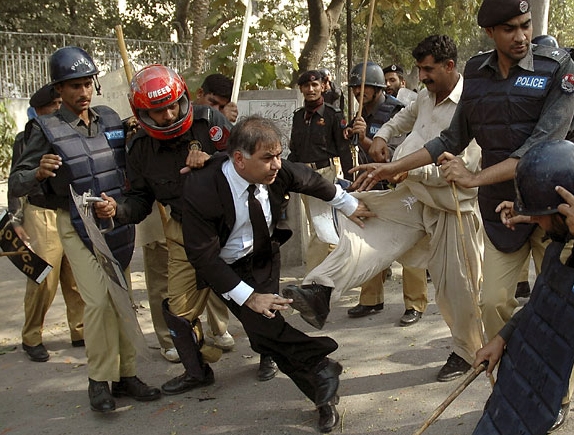
Thousands of black-suited lawyers facing police batons and tear gas to protest the declaration of emergency rule have become Pakistan’s political conscience.

Enraged by President Pervez Musharraf’s assault on independent judges, the legal community has eclipsed discredited opposition parties as the torchbearers for democracy.

The general’s botched attempt to oust Pakistan’s top judge this spring sparked a mass movement against military rule, with lawyers in the vanguard. That put wind in the sails of a defiant Supreme Court, which challenged Musharraf’s dominance and the secret workings of Pakistan’s spy agencies.

Fearing the court would declare his recent presidential election victory illegal, Musharraf finally pulled the plug on its activism on Saturday by suspending the constitution and purging its ranks. Deposed Chief Justice Iftikhar Mohammed Chaudhry, now under house arrest, has urged lawyers to revolt. [complete article]

Facebooktwittermail

OPINION & EDITOR’S COMMENT: A tyranical fear of terrorism

Pakistan’s general anarchy

For those who have never had to live under [Musharraf’s] regime, the general/president can come across as a rakish, daredevil figure. His résumé is impressive: here’s a man who can manage the frontline of the Western world’s war on terrorism, get rid of prime ministers at will, force his political opponents into exile and still find the time to write an autobiography. But ask the lawyers, judges, arts teachers and students behind bars about him, and one will find out he is your garden-variety dictator who, after having spent eight years in power, is asking why can’t he continue for another eight.

General Musharraf’s bond with his troops is not just ideological. Under his command Pakistan’s armed forces have become a hugely profitable empire. It’s the nation’s pre-eminent real estate dealer, it dominates the breakfast-cereal market, it runs banks and bakeries. Only last month Pakistan’s Navy, in an audacious move, set up a barbecue business on the banks of the Indus River about 400 miles away from the Arabian Sea it’s supposed to protect.

It’s a happy marriage between God and greed.

For now, the general’s weekend gamble seems to have paid off. From Washington and the European Union he heard regrets but no condemnation with teeth — exactly what he counted on.

General Musharraf has always tried to cultivate an impression in the West that he is the only one holding the country together, that after him we can only expect anarchy. But in a country where arts teachers and lawyers are behind bars and suicide bombers are allowed to go free, we definitely need to redefine anarchy. [complete article]

Editor’s Comment — What Musharraf has done is to expose the lie embedded in the war on terrorism. The terror threat is so large, so ubiquitous, and so diabolical that it is supposedly worse than tyranny. In the 21st century, oppression has become a tolerable part of the landscape. Curious indeed it is that those among Musharraf’s allies who so frequently declare that terrorism is the greatest threat to our freedom, appear so blithely indifferent when they witness freedom being taken away. If they show some discomfort it is because they know that their own hypocrisy is now on full display.

In the heart of Pakistan, a deep sense of anxiety

Three days after President Pervez Musharraf declared emergency rule, a deep sense of anxiety prevails among Pakistan’s students, rights activists and intellectuals, who say the mass arrests being carried out by the government mark an unprecedented assault on civil society.

When Musharraf suspended the constitution Saturday, he said he had been forced to act by rising extremism and judicial interference in his efforts to protect the country. But in Lahore, an ancient city that has long served as the cultural and intellectual heart of Pakistan, many government critics see a smoke screen being used to quash opposition.

Over the weekend, they note, an estimated 70 community leaders were arrested here during a cookies-and-tea meeting of the Human Rights Commission of Pakistan. Those detained included a college dean, a well-known poet, an economics professor and a board member of the International Crisis Group. [complete article]

See also In Pakistan, echoes of Iran (David Ignatius).

Facebooktwittermail

NEWS, ANALYSIS, OPINION & EDITOR’S COMMENT: Musharraf’s detour on the path to democracy

Pakistan shakes off U.S. shackles

…it turns out that the former prime minister Bhutto’s abrupt departure for Dubai in the United Arab Emirates last Thursday against the advice rendered by most of her party leaders happened just in time when it dawned on the US and Britain that despite their strong urgings, the generals were hell-bent on the imposition of emergency rule. The US and Britain counseled her to get out of harm’s way and quickly leave the country.

The initial statements of “regret” by the Western capitals, especially Washington, need to be taken with a pinch of salt. To be sure, the US policy toward Pakistan finds itself in a cul-de-sac. Musharraf’s move coincides almost to the hour with the thundering speech by President George W Bush at the Heritage Foundation, a Washington-based think-tank, on Thursday in which he blasted the US Congress for failing to take his “war on terror” not seriously enough, and he went on to compare Osama bin Laden to Adolf Hitler and Vladimir Lenin.

Addressing his neo-conservative acolytes, Bush came back to his favorite theme that via his “war on terror”, he was actually waging a global war for democracy and freedom. He compared Islamist “plans to build a totalitarian Islamist empire … stretching from Europe to North Africa, the Middle East and South East Asia” to the Third Reich. He claimed that US-led campaigns have “liberated 50 million people from the clutches of tyranny” in Iraq and Afghanistan. Bush said the people in the Middle East are “looking to the United States to stand up for them”.

Alas, we knew only a day later that just as Bush was speaking, one of his staunchest allies in his pet global war was squashing democracy and freedom. The US doublespeak becomes all too apparent in the mildly reproachful comment over Musharraf’s move, bordering on resignation, by the US spokesmen. It indicates that Washington’s dealings with the Musharraf regime will continue and normal business will resume once the dust has settled down. [complete article]

lawyersdefendingdemocracy.jpg

Editor’s Comment — These images of protesting lawyers in Pakistan deserve to become one of the lasting icons of the so-called war on terrorism. The Bush administration — however much handwringing it might engage in — once again has put itself on the wrong side of the law. Tariq Azim Khan, Pakistan’s minister of information, in what the New York Times describes as “unusually candid terms,” says that the United States would rather have a “stable” Pakistan than risk see democracy “fall into the hands of extremists.” In the same cynical spirit as talk-circuit motivational speakers, administration officials have now adopted a the journey is the goal philosophy as they express their hope that General Musharraf can keep Pakistan on the “path to democracy.”

(And here’s a note to America’s legal profession: How about demonstrating outside the White House in solidarity with your Pakistani counterparts? Their willingness to stand up to batton-wielding police is the kind of pro bono work that democracy defenders the world over, should be applauding.)

A second coup in Pakistan

The key question Musharraf faces is how long the army will continue to back him. Rank-and-file soldiers are keenly aware of the widening gulf between them and the public they are supposed to protect. The army, already demoralized, is unwilling to fight a never-ending war against its own people.

For now, the judges are gone, the media has been censored, the opposition and lawyers jailed and curtailed. But Musharraf’s emergency is not sustainable. Ruling by force without any political support will prove impossible. [complete article]

U.S. military aid to Pakistan misses its Al Qaeda target

Despite billions of dollars in U.S. military payments to Pakistan over the last six years, the paramilitary force leading the pursuit of Al Qaeda militants remains underfunded, poorly trained and overwhelmingly outgunned, U.S. military and intelligence officials said.

Pakistani President Pervez Musharraf cited the rising militant threat in declaring a state of emergency on Saturday and suspending the constitution.

But rather than use the more than $7 billion in U.S. military aid to bolster its counter-terrorism capabilities, Pakistan has spent the bulk of it on heavy arms, aircraft and equipment that U.S. officials say are far more suited for conventional warfare with India, its regional rival. [complete article]

Editor’s Comment — Hmmm… So we’re supposed to believe the administration isn’t happy to see military aid being spent on F-16s? On the contrary, it just sounds like that well-oiled revolving door that circulates American tax dollars, allocated as “foreign aid,” back into the pockets of American defense contractors. That’s how the military-industrial complex is designed to run isn’t it?

Fear and brutality inside the fiefdom of Islamist shock jock

The tourist brochures call it the Switzerland of south Asia – a mountain idyll of rushing turquoise rivers, snow-dusted peaks and Pakistan’s sole ski piste.

But now the Swat valley in northern Pakistan has a dark new reputation, as the frontline in the country’s faltering war on Islamist extremism.

On Saturday General Pervez Musharraf cited surging violence in Swat – including suicide bombings, beheadings and kidnappings – as a justification for the imposition of emergency rule. His security forces are battling an Islamist militia led by Maulana Fazlullah, a radical cleric with a flair for theatrics who wants to turn Swat into a mini Islamic fiefdom. The fight has been short but brutal, leaving hundreds dead. [complete article]

Facebooktwittermail

ANALYSIS: The shadow of Mubarak’s ghost

An Unanswered Question: Who Follows Mubarak?

An old joke here goes something like this: President Hosni Mubarak is on his deathbed when an aide comes to his side and says, “Mr. President, aren’t you going to give a farewell speech to the people?” The president opens his eyes and replies: “Really? Why? Where are the people going?”

At three decades, Mr. Mubarak’s tenure is the longest of any president since the ouster of the king in the 1950s. He has served longer than Gamal Abdel Nasser, a pioneer of Arab nationalism, and longer than Anwar el-Sadat, the man who made peace with Israel. He is routinely referred to as Egypt’s modern pharaoh, though usually in a cautious whisper.

Beginning on Friday, Mr. Mubarak’s ruling party, the National Democratic Party, will hold a general assembly. Six thousand, five hundred delegates from Egypt, along with guests from around the world, will gather to talk and listen. They will discuss economic, political and terrorism-related issues. What they will not discuss, party officials said, is succession — arguably, and in many minds, one of the most important issues regarding Egypt’s long-term stability.

Who will come after Mr. Mubarak?

It is a question many people here ask, but as a party official said after a briefing on the assembly, “You will never get the answer you want.” [complete article]

Facebooktwittermail

NEWS: Discontent among Egypt’s workers

Discontent among Egypt’s workers

President Hosni Mubarak faces discontent from many quarters, but perhaps the most intense criticism resonates from the banners and shaking fists of militant workers who have broken away from government-controlled unions and staged sporadic strikes across the nation.

The Egyptian government frequently muffles free speech and political dissent, but these ragged and often disorganized picket lines present a widening crisis for a president viewed as detached from the working class and unable to lift wages and stem double-digit inflation.

“Mubarak doesn’t care about workers at all anymore,” said Mohammed Shorbagy, who held a Koran in a plastic bag and stood amid litter and lean-tos during a strike last month at the Misr Spinning and Weaving Factory in this Nile Delta city. “Why is the president asleep? We’ve been here for four days and he’s done nothing.” [complete article]

See also, The Militancy of Mahalla al-Kubra (MERIP).

Facebooktwittermail

OPINION: Why the U.S. government is losing its war on Islam

Anti-terrorism on trial

The government’s failure in the Holy Land case suggests that the administrative processes for designating groups as terrorist organizations are flawed. The president has asserted the power to designate any organization or individual he chooses, here or abroad, without formal charges, a trial or hearing of any kind; without a statement of reasons; and on the basis of secret evidence. While full-scale criminal protections are not necessary, surely groups should be afforded a meaningful opportunity to defend themselves before they are shut down.

We’ve seen this kind of regime before. In the McCarthy era, the government, working behind closed doors, created lists of “subversive organizations” and then held individuals responsible for any association with such groups, often using secret evidence to support its charges. Such actions invited abuse, harmed innocents and infringed on the very rights the government claimed to be protecting. As the Supreme Court said in a 1967 decision belatedly declaring unconstitutional the “guilt by association” tactics of the McCarthy period: “It would indeed be ironic if, in the name of national defense, we would sanction the subversion of one of those liberties — the freedom of association — which makes the defense of the Nation worthwhile.” The administration seems to have forgotten that lesson; American juries, thankfully, still remember. [complete article]

Facebooktwittermail

NEWS & EDITOR’S COMMENT: Another defeat in the war on Islam

U.S. prosecution of Muslim group ends in mistrial

A federal judge declared a mistrial on Monday in what was widely seen as the government’s flagship terrorism-financing case after prosecutors failed to persuade a jury to convict five leaders of a Muslim charity on any charges, or even to reach a verdict on many of the 197 counts.

The case, involving the Holy Land Foundation for Relief and Development and five of its backers, is the government’s largest and most complex legal effort to shut down what it contends is American financing for terrorist organizations in the Middle East.

President Bush announced he was freezing the charity’s assets in December 2001, saying that the radical Islamic group Hamas had “obtained much of the money it pays for murder abroad right here in the United States.”

But at the trial, the government did not accuse the foundation, which was based in a Dallas suburb, of paying directly for suicide bombings. Instead, the prosecution said, the foundation supported terrorism by sending more than $12 million to charitable groups, known as zakat committees, which build hospitals and feed the poor. [complete article]

Editor’s Comment — This is a vindication for the principle that democracy depends on the separation of powers. Those in the executive branch of government who obviously feel more comfortable with a totalitarian concentration of power will however be disappointed that most of the jury reached the “wrong” verdict and that in doing so they may have been influenced by a former American consul general in Jerusalem. That the defendents would regard this as having been “an Israeli trial tried on American soil,” is not surprising, yet when a jury member says of the trial, “it seems political to me,” noting that the prosecution’s key witness was paid by the Israeli government to testify, it seems reasonable to ask, who is our government working for? And when what had been the largest Muslim charity in the United States gets put on trial there seems little reason to wonder why so many Muslims, and others, see the war on terrorism as a war on Islam.

Facebooktwittermail

FEATURE: Hamas: Islamic democracy and national liberation

Hamas: Islamic democracy and national liberation

The Hamas election victory in January 2006 has led to an increased interest in the Islamic Resistance Movement. Hitherto little had been understood of Hamas’ history, political and social strategy and tactics. Rather rumors and cheap prejudice against Hamas have been rampant across the political spectrum in the West. Regrettably, progressives in the West have largely dodged the challenges of internationalism and anti-racism in the context of neocolonialism’s racist campaign focused on Muslims and Islam, of which the maligning and criminalisation of Hamas is a component. Democrat-minded and progressive people who challenge the criminalisation of Hamas by the West, in so doing confront the Eurocentric idea that legitimacy is only bestowed upon those that the West consider democratic rather then what the people in the given country have chosen. This article seeks to demonstrate that Hamas’ ideology has as much claim to the values and practices of democracy and human rights as those political movements in the West. The difference is that these values are inspired and rooted in their own religious, cultural and social contexts. [complete article]

Facebooktwittermail

ANALYSIS: Democracy’s only good when it’s good for America

On human rights, U.S. seems to give Egypt a pass

Last month, Hisham Kassem, an Egyptian human rights advocate, met with President Bush in Washington when he was flown there for an award granted by the National Endowment for Democracy. Mr. Kassem, the only winner from Egypt, said that Mr. Bush had spoken effusively about promoting democracy to the other recipients, but he did not address the topic when it came to Egypt.

“In comparison with my colleagues from other countries, this was the least of his interests,” Mr. Kassem said.

He and other democracy campaigners in Egypt say that when Secretary of State Condoleezza Rice meets with Egyptian officials in Sharm el Sheik on Tuesday as part of her preparation for a Middle East peace summit meeting, they expect from her a similar approach to Egyptian human rights and democracy. Even if she does raise the issues, analysts here say, it will have little impact.

That is in sharp contrast to the administration’s aggressive campaign for democracy in 2005 and 2006, which did have an effect and shows shifting American priorities, advocates and analysts say. [complete article]

Facebooktwittermail

ANALYSIS: The strategic importance of Myanmar

The geopolitical stakes of ‘Saffron Revolution’

…the US State Department has recruited and trained key opposition leaders from numerous anti-government organizations in Myanmar. It has poured the relatively huge sum (for Myanmar) of more than $2.5 million annually into NED [National Endowment for Democracy] activities in promoting regime change in Myanmar since at least 2003. The US regime change effort, its Saffron Revolution, is being largely run, according to informed reports, out of the US Consulate General in bordering Chaing Mai, Thailand. There activists are recruited and trained, in some cases directly in the US, before being sent back to organize inside Myanmar. The US’s NED admits to funding key opposition media including the New Era Journal, Irrawaddy and the Democratic Voice of Burma radio.

The concert-master of the tactics of Saffron monk-led non-violence regime change is Gene Sharp, founder of the deceptively-named Albert Einstein Institution in Cambridge, Massachusetts, a group funded by an arm of the NED to foster US-friendly regime change in key spots around the world. Sharp’s institute has been active in Myanmar since 1989, just after the regime massacred some 3,000 protestors to silence the opposition. CIA special operative and former US military attache in Rangoon, Col Robert Helvey, an expert in clandestine operations, introduced Sharp to Myanmar in 1989 to train the opposition there in non-violent strategy. Interestingly, Sharp was also in China two weeks before the dramatic events at Tiananmen Square.

A relevant question is why the US government has such a keen interest in fostering regime change in Myanmar at this juncture. We can dismiss rather quickly the idea that it has genuine concern for democracy, justice, human rights for the oppressed population there. Iraq and Afghanistan are sufficient testimony to the fact Washington’s paean to democacy is propaganda cover for another agenda.

The question is, what would lead to such engagement in such a remote place as Myanmar?

Geopolitical control seems to be the answer – control ultimately of the strategic sea lanes from the Persian Gulf to the South China Sea. The coastline of Myanmar provides naval access in the proximity of one of the world’s most strategic water passages, the Strait of Malacca, the narrow ship passage between Malaysia and Indonesia.

The Pentagon has been trying to militarize the region since September 11, 2001 on the argument of defending against possible terrorist attack. The US has managed to gain an airbase on Banda Aceh, the Sultan Iskandar Muda Air Force Base, on the northernmost tip of Indonesia. The governments of the region, including Myanmar, however, have adamantly refused US efforts to militarize the region. [complete article]

Facebooktwittermail

PREVIEW: The Cheney coup

Cheney’s law

For three decades Vice President Dick Cheney conducted a secretive, behind-closed-doors campaign to give the president virtually unlimited wartime power. Finally, in the aftermath of 9/11, the Justice Department and the White House made a number of controversial legal decisions. Orchestrated by Cheney and his lawyer David Addington, the department interpreted executive power in an expansive and extraordinary way, granting President George W. Bush the power to detain, interrogate, torture, wiretap and spy — without congressional approval or judicial review.

Now, as the White House appears ready to ignore subpoenas in the wiretapping and U.S. attorneys’ cases, FRONTLINE’s season premiere, Cheney’s Law, airing Oct. 16, 2007, at 9 P.M. ET on PBS (check local listings), examines the battle over the power of the presidency and Cheney’s way of looking at the Constitution. [complete article]

Facebooktwittermail

NEWS: Democracy cannot be imported

Cut Iran democracy funding, groups tell U.S.

More than two dozen Iranian American and human rights groups have launched an appeal to Congress to reduce or eliminate new financial support of up to $75 million aimed at promoting democracy inside Iran.

The U.S. program, launched in 2006, backfired in its first year, undermining democracy efforts in Iran and leading to wider repression against activists as foreign agents or traitors, the groups said. Among those detained were four Iranian Americans, all charged with “crimes against national security” linked to the U.S. program. A second year of funding will further endanger democracy efforts, the groups added.

“Iranian reformers believe democracy cannot be imported and must be based on indigenous institutions and values. Intended beneficiaries of the funding — human rights advocates, civil society activists and others — uniformly denounce the program,” according to an open letter organized by the National Iranian American Council, the American Conservative Defense Alliance and the Center for Arms Control and Non-Proliferation. The letter was signed by 23 other liberal and conservative pro-democracy groups. [complete article]

Facebooktwittermail

NEWS: “Jimmy” Mubarak ready to become next pharaoh

In Egypt, a son is readied for succession

In Egypt, “we didn’t choose Sadat, we didn’t choose Mubarak, and we’re not choosing the next one,” Zakaria Nahla, a 52-year-old salesman of cheap furniture, said in a Cairo market crowded with beeping scooters and veiled women picking through racks of clothes.

Asked if they expected to have any say about Mubarak’s succession, a group of men with their arms full of round loaves of bread answered in unison, “No, no, no.” One underscored the point by wagging a finger and shaking his head.

“We take it as a given” that it will be Gamal Mubarak, said Sayida Amin, 46, a nanny who works for a family in one of Cairo’s wealthier districts. “People don’t know who he is. We only know he’s the president’s son, and he’s imposed on us.” [complete article]

Facebooktwittermail

OPINION: Torture, secrecy, and the Bush administration

Editor’s Comment — If the immortal line from the Clinton presidency was, “I did not have sexual relations with that woman,” George Bush may be most remembered for his emphatic lie, “This government does not torture people.” But rather than this result in the Congressional pageantry of impeachment proceedings, it seems to me far preferable that Bush, Cheney, and the other principals in the creation of the torture presidency, face judgment in a court of law — one which provides them with the legal rights they have deprived from others, and one which if they are convicted shows no leniency and forces accountability on those who have always operated as though they have absolute impunity.

With that in mind, it’s now worth revisiting an excellent essay by Scott Horton, tracing the history of torture and secrecy, in which he wrote:

The practice of secret courts. The use of torture to secure confessions. The receipt of secret evidence. The exclusion of the public from proceedings. The offering of evidence in the form of summaries delivered to the judges, without the defendant being able to confront the evidence or conduct a cross-examination. These practices were the definition of tyrannical injustice to the Puritan fathers and the Founding Fathers. We thought them long-banished a hundred years and more before our own revolution. And now suddenly here they are again.

Secrecy has reemerged just as torture has made its comeback, being justified on the public stage, by government officials for the first time since the famous gathering at the Inns of Court in 1629 at which the judges declared “upon their and their nation’s honor” that torture was not permitted by the common law.

The two fit together, hand in glove: torture and secrecy. Torture and secrecy. Where one is used, the other is indispensable.

Torture is no longer a tool of statecraft. Today it is a tool of criminals, though sometimes of criminals purporting to conduct the affairs of state. Having resorted to these “dark arts,” to quote Dick Cheney, the torturers now have the dilemma faced so frequently by criminals. They seek to cover it up. And so the path flows from torture to secrecy, the twin dark stars of the tyrannical state.

Torture, secrecy, and the Bush administration

Facebooktwittermail