Category Archives: internet

Sopa and Pipa: they’ll be back

Bill McGeveran writes: At the end of a Hollywood blockbuster, when the vanquished villain declares that he should have won and that we haven’t seen the last of him, we all know what it means: the sequel is coming.

So, Hollywood’s top lobbyist, former Senator Chris Dodd, followed a familiar script last week after sweeping online protests derailed the Stop Online Piracy Act (Sopa) and Protect IP Act (Pipa), a pair of legislative proposals backed by movie and music distributors. Dodd snarled that his opponents had misled the public and vowed to continue pressing for new laws to combat unauthorized copying of intellectual property. Coming soon to a congressional hearing room near you, it’s Sopa II: Revenge of the Content Industries.

While the US Senate and House of Representatives deferred immediate action on the bills, few doubt that Congress will debate some form of legislation aimed at overseas web sites engaged in intellectual property (IP) infringement, probably later this year. Even Dodd’s enemies acknowledge that these sites pose a problem, though many question industry estimates about its scope.

Those of us who opposed the excesses of Sopa and Pipa need to prepare for the next round. Sponsors have already abandoned the bills’ most objectionable feature, which interfered with the domain name addressing system in an attempt to cut off access to “pirate” sites – a measure critics charged would “break the internet”. At a minimum, Congress must address three other problems as well.

Facebooktwittermail

The struggle against Sopa and Pipa is not over

Dan Gillmor writes: Has Sopa, the draconian copyright legislation under consideration by the American Congress, been firmly put to rest? You might imagine that, while the dust settles from a series of mini-explosions this week in the copyright arena, as a bill that once seemed certain to be enacted has stalled.

But you would be mistaken to think it’s dead. The powerful interests backing Sopa (Stop Online Piracy Act), which proponents say is aimed to stop the worst of the worst infringers, are unhappy with this week’s events, but they have not remotely given up. And they still have time and money on their side.

For the moment, however, it’s plain that the internet community made a huge impact on Congress with a mass online protest that led to a flooding of lawmakers’ email accounts and phone/fax lines. Dozens of lawmakers either backed away from earlier support or announced that they’d gone from neutral to against.

Facebooktwittermail

PIPA support collapses, with 18 new Senators opposed

Ars Technica reports: Members of the Senate are rushing for the exits in the wake of the Internet’s unprecedented protest of the Protect IP Act (PIPA). At least 13 members of the upper chamber announced their opposition on Wednesday. In a particularly severe blow for Hollywood, at least five of the newly-opposed Senators were previously co-sponsors of the Protect IP Act. (Update: since we ran this story, the tally is up to 18 Senators, of which seven are former co-sponsors. See below.)

The newly-opposed Senators are skewed strongly to the Republican side of the aisle. An Ars Technica survey of Senators’ positions on PIPA turned up only two Democrats, Ben Cardin (D-MD) and Jeff Merkley (D-OR), who announced their opposition on Wednesday. The other 11 Senators who announced their opposition on Wednesday were all Republicans. These 13 join a handful of others, including Jerry Moran (R-KS), Rand Paul (R-KY), Mark Warner (D-VA), and Ron Wyden (D-OR), who have already announced their opposition.
[…]
The partisan slant of the defections is surprising because copyright has not traditionally been considered a partisan issue. Before Wednesday’s protests, PIPA had 16 Republican co-sponsors and 23 Democratic ones. The bill lost a quarter of its Republican co-sponsors on Wednesday, while we know of only one Democrat, Ben Cardin (D-MD), who dropped his support.

Those who dropped their support were most likely bolstered by strong opposition from conservative think tanks and blogs. On Tuesday, the influential Heritage Foundation announced that it would include SOPA and PIPA as a key issue on its voter scorecard. And the popular conservative blog redstate.com, whose founder threatened to mount primary challengers to SOPA supporters last month, has been hailing Senators who come out in opposition.

Neither side is close to having a majority. A whip count by OpenCongress found 35 supporters (including 34 co-sponsors), 18 opponents, and 12 more Senators leaning toward opposition. About 35 Senators have not committed to a position, perhaps reluctant to do so for fear of angering either deep-pocketed Hollywood campaign contributors or their constituents back home.

The Los Angeles Times reports: When Google speaks, the world listens.

And today, when Google asked its users to sign a petition protesting two anti-piracy laws circulating in Congress, millions responded.

A spokeswoman for Google confirmed that 4.5 million people added their names to the company’s anti-SOPA petition today.

When he was about to leave the Senate, Chris Dodd predicted he would not pass through Washington’s revolving door and become a lobbyist. Earlier, in an interview with Glenn Greenwald in 2007, he had scoffed at the idea that anyone would want to become president of a trade association. He’s now “Hollywood’s chief lobbyist“.

Apparently, the person Chris Dodd scorned back then as someone “who wants to be president of a trade association” was . . . Chris Dodd, who is now President of Hollywood’s trade association. Back then, Dodd was running around inducing large numbers of people (including me) to cheer on his presidential campaign by venerating Constitutional freedoms as the supreme value. Now, a mere three years later, he is peddling his influence in Washington — assembled during his 35 years in Congress — on behalf of a bill that, as several law professors in The Stanford Law Review recently wrote, “not only violates basic principles of due process by depriving persons of property without a fair hearing and a reasonable opportunity to be heard, it also constitutes an unconstitutional abridgment of the freedom of speech protected by the First Amendment” (Constitutional law professor Laurence Tribe has argued the same).

Furthermore, one of the bill’s chief Senate sponsors is a liberal Democrat from Vermont, Pat Leahy, who during the Bush years flamboyantly depicted himself as a stalwart defender of Constitutional liberties — and whosetop 3 campaign contribution sources [are] lawyers, entertainment industry, lobbyists.” Those industries are, of course, also major donors to Leahy’s House GOP counterpart. It’s all redolent of how Howard Dean quickly converted himself from a righteous presidential candidate who inspired large numbers of young Americans into little more than a paid shill who exploits his political celebrity by reciting the script of whichever political interests are paying him the most.

In the face of pervasive, sleazy conduct like this, it’s not only tempting to be jaded about partisan activism: it’s rational. Watching Chris Dodd and Pat Leahy join equally compromised Republicans in crusading for an Internet censorship bill — not even out of sincerely held authoritarian impulses but just base, corrupted subservience to industry — reveals most of what one needs to know about how the political class functions and who owns and controls it.

Facebooktwittermail

Study reveals the Web isn’t as polarized as we thought

Farhad Manjoo writes: Today, Facebook is publishing a study that disproves some hoary conventional wisdom about the Web. According to this new research, the online echo chamber doesn’t exist.

This is of particular interest to me. In 2008, I wrote True Enough, a book that argued that digital technology is splitting society into discrete, ideologically like-minded tribes that read, watch, or listen only to news that confirms their own beliefs. I’m not the only one who’s worried about this. Eli Pariser, the former executive director of MoveOn.org, argued in his recent book The Filter Bubble that Web personalization algorithms like Facebook’s News Feed force us to consume a dangerously narrow range of news. The echo chamber was also central to Cass Sunstein’s thesis, in his book Republic.com, that the Web may be incompatible with democracy itself. If we’re all just echoing our friends’ ideas about the world, is society doomed to become ever more polarized and solipsistic?

It turns out we’re not doomed. The new Facebook study is one of the largest and most rigorous investigations into how people receive and react to news. It was led by Eytan Bakshy, who began the work in 2010 when he was finishing his Ph.D. in information studies at the University of Michigan. He is now a researcher on Facebook’s data team, which conducts academic-type studies into how users behave on the teeming network.

Bakshy’s study involves a simple experiment. Normally, when one of your friends shares a link on Facebook, the site uses an algorithm known as EdgeRank to determine whether or not the link is displayed in your feed. In Bakshy’s experiment, conducted over seven weeks in the late summer of 2010, a small fraction of such shared links were randomly censored—that is, if a friend shared a link that EdgeRank determined you should see, it was sometimes not displayed in your feed. Randomly blocking links allowed Bakshy to create two different populations on Facebook. In one group, someone would see a link posted by a friend and decide to either share or ignore it. People in the second group would not receive the link—but if they’d seen it somewhere else beyond Facebook, these people might decide to share that same link of their own accord.

By comparing the two groups, Bakshy could answer some important questions about how we navigate news online. Are people more likely to share information because their friends pass it along? And if we are more likely to share stories we see others post, what kinds of friends get us to reshare more often—close friends, or people we don’t interact with very often? Finally, the experiment allowed Bakshy to see how “novel information”—that is, information that you wouldn’t have shared if you hadn’t seen it on Facebook—travels through the network. This is important to our understanding of echo chambers. If an algorithm like EdgeRank favors information that you’d have seen anyway, it would make Facebook an echo chamber of your own beliefs. But if EdgeRank pushes novel information through the network, Facebook becomes a beneficial source of news rather than just a reflection of your own small world.

That’s exactly what Bakshy found. His paper is heavy on math and network theory, but here’s a short summary of his results. First, he found that the closer you are with a friend on Facebook—the more times you comment on one another’s posts, the more times you appear in photos together, etc.—the greater your likelihood of sharing that person’s links. At first blush, that sounds like a confirmation of the echo chamber: We’re more likely to echo our closest friends.

But here’s Bakshy’s most crucial finding: Although we’re more likely to share information from our close friends, we still share stuff from our weak ties—and the links from those weak ties are the most novel links on the network. Those links from our weak ties, that is, are most likely to point to information that you would not have shared if you hadn’t seen it on Facebook. The links from your close ties, meanwhile, more likely contain information you would have seen elsewhere if a friend hadn’t posted it. These weak ties “are indispensible” to your network, Bakshy says. “They have access to different websites that you’re not necessarily visiting.” [Continue reading…]

Facebooktwittermail

Web protests piracy bills, and senators change course

The New York Times reports: Online protests on Wednesday quickly cut into Congressional support for online antipiracy measures as lawmakers abandoned and rethought their backing for legislation that pitted new media interests against some of the most powerful old-line commercial interests in Washington.

A freshman senator, Marco Rubio of Florida, a rising Republican star, was first out of the starting gate Wednesday morning with his announcement that he would no longer back antipiracy legislation he had co-sponsored. Senator John Cornyn, the Texas Republican who heads the campaign operation for his party, quickly followed suit and urged Congress take more time to study the measure, which had been set for a test vote next week.

By Wednesday afternoon, Senator Orrin Hatch, Republican of Utah and one of the Senate bill’s original co-sponsors, called it “simply not ready for prime time” and withdrew his support.

Their decisions came after some Web pages were shut down Wednesday to protest two separate bills, the Stop Online Piracy Act in the House, written by Representative Lamar Smith, the Texas Republican who is chairman of the House Judiciary Committee, and the Protect Intellectual Property Act, drafted by Senator Patrick Leahy, the Vermont Democrat who is chairman of the Senate Judiciary Committee.

Protests organized in the real world drew far less attention. A rally convened in Midtown Manhattan outside the offices of Senators Charles E. Schumer and Kirsten E. Gillibrand, who co-sponsored some of the proposed legislation, drew a few hundred protesters.

Members of Congress, many of whom are grappling with the issues posed by the explosion in new media and social Web sites, appeared caught off guard by the enmity toward what had been a relatively obscure piece of legislation to many of them. The Internet sensibility of the Senate was represented a few years ago in remarks by the late Senator Ted Stevens, Republican of Alaska, who called the Internet “not a big truck” but a “series of tubes” — an observation enshrined in the Net Hall of Shame.

In reaction to the pending legislation, the online encyclopedia Wikipedia went dark. Google’s home page had a black banner across its home page that led to pointed information blasting the bills.

Such new-media lobbying was having an impact.

“As a senator from Florida, a state with a large presence of artists, creators and businesses connected to the creation of intellectual property, I have a strong interest in stopping online piracy that costs Florida jobs,” Mr. Rubio wrote on his Facebook page. “However, we must do this while simultaneously promoting an open, dynamic Internet environment that is ripe for innovation and promotes new technologies.”

James Allworth and Maxwell Wessel write: SOPA and PIPA are prime examples of big companies trying to do everything they can to stop new competitors from innovating. They’re also examples of how lobbying in the United States has become one of the most effective ways of limiting this sort of competition.

The argument over this legislation has essentially been characterized in the press as having two sides. The first side, which is generally represented by big content, is that piracy (and any new technology that facilitates it) is an existential threat to any business based on intellectual property. That’s actually a line that has been used a few times before — most famously by Jack Valenti, head of the MPAA, when he testified in front of congress that the VCR was to the movie industry what the Boston Strangler was to women.

And on the other side of the argument? Well, they have been mostly characterized as the “technology industries.” They’ve been making the case that SOPA and PIPA will chill innovation and threaten free speech.

But “content” vs “technology” doesn’t do justice to describing the two sides. Tim O’Reilly, the CEO of O’Reilly Media — a very well-known publishing and media company that derives a large portion of its revenue from the sale of books — has been one of the most ardent critics of SOPA and PIPA. On the other hand, GoDaddy.com, the largest of the web’s domain name registrars, was very much in favor of SOPA — at least until a boycott caused them to back down. Similarly, there are plenty of other technology firms that have supported SOPA.

So if “content” vs “technology” doesn’t capture what’s going on in this fight, what does? Well, SOPA makes much more sense if you look at the debate as big companies unwilling to accept change versus the innovative companies and startups that embrace change. And if we accept that startups are created to find new ways to create value for consumers, the debate is actually between the financial interests of “big content” shareholders versus consumer interests at large.

Facebooktwittermail

Striking to protest SOPA and PIPA

War in Context will be going dark on January 18 (8AM till 8PM US Eastern Standard Time) to protest the SOPA and PIPA, two bills promoted by the American entertainment and publishing industries currently making their way through Congress.

The Electronic Frontier Foundation provides more information on how PIPA and SOPA violate White House principles supporting free speech and innovation:

Over the weekend, the Obama administration issued a potentially game-changing statement on the blacklist bills, saying it would oppose PIPA and SOPA as written, and drew an important line in the sand by emphasizing that it “will not support” any bill “that reduces freedom of expression, increases cybersecurity risk, or undermines the dynamic, innovative global Internet.”

Yet, the fight is still far from over. Even though the New York Times reported that the White House statement “all but kill[s] current versions of the legislation,” the Senate is still poised to bring PIPA to the floor next week, and we can expect SOPA proponents in the House to try to revive the legislation—unless they get the message that these initiatives must stop, now. So let’s take a look at the dangerous provisions in the blacklist bills that would violate the White House’s own principles by damaging free speech, Internet security, and online innovation:

The Anti-Circumvention Provision

In addition to going after websites allegedly directly involved in copyright infringement, a proposal in SOPA will allow the government to target sites that simply provide information that could help users get around the bills’ censorship mechanisms. Such a provision would not only amount to an unconstitutional prior restraint against protected speech, but would severely damage online innovation. And contrary to claims by SOPA’s supporters, this provision—at least what’s been proposed so far—applies to all websites, even those in the U.S.

As First Amendment expert Marvin Ammori points out, “The language is pretty vague, but it appears all these companies must monitor their sites for anti-circumvention so they are not subject to court actions ‘enjoining’ them from continuing to provide ‘such product or service.’” That means social media sites like Facebook or YouTube—bascailly any site with user generated content—would have to police their own sites, forcing huge liability costs onto countless Internet companies. This is exactly why venture capitalists have said en masse they won’t invest in online startups if PIPA and SOPA pass. Websites would be forced to block anything from a user post about browser add-ons like DeSopa, to a simple list of IP addresses of already-blocked sites.

Perhaps worse, EFF has detailed how this provision would also decimate the open source software community. Anyone who writes or distributes Virtual Private Network, proxy, privacy or anonymization software would be negatively affected. This includes organizations that are funded by the State Department to create circumvention software to help democratic activists get around authoritarian regimes’ online censorship mechanisms. Ironically, SOPA would not only institute the same practices as these regimes, but would essentially outlaw the tools used by activists to circumvent censorship in countries like Iran and China as well.

The “Vigilante” Provision

Another dangerous provision in PIPA and SOPA that hasn’t received a lot of attention is the “vigilante” provision, which would grant broad immunity to all service providers if they overblock innocent users or block sites voluntarily with no judicial oversight at all. The standard for immunity is incredibly low and the potential for abuse is off the charts. Intermediaries only need to act “in good faith” and base their decision “on credible evidence” to receive immunity.

As we noted months ago, this provision would allow the MPAA and RIAA to create literal blacklists of sites they want censored. Intermediaries will find themselves under pressure to act to avoid court orders, creating a vehicle for corporations to censor sites—even those in the U.S.—without any legal oversight. And as Public Knowledge has pointed out, not only can this provision be used for bogus copyright claims that are protected by fair use, but large corporations can take advantage of it to stamp out emerging competitors and skirt anti-trust laws:

For instance, an Internet service provider could block DNS requests for a website offering online video that competed with its cable television offerings, based upon “credible evidence” that the site was, in its own estimation, promoting its use for infringement….While the amendment requires that the action be taken in good faith, the blocked site now bears the burden of proving either its innocence or the bad faith of its accuser in order to be unblocked.

Corporate Right of Action

PIPA and SOPA also still allow copyright holders to get an unopposed court order to cut off foreign websites from payment processors and advertisers. As we have continually highlighted, copyright holders already can remove infringing material from the web under the DMCA notice-and-takedown procedure. Unfortunately, we’ve seen that power abused time and again. Yet the proponents of PIPA and SOPA want to give rightsholders even more power, allowing them to essentially shut down full sites instead of removing the specific infringing content.

While this provision only affects foreign sites, it still affects Americans’ free speech rights. As Marvin Ammori explained, “The seminal case of Lamont v. Postmaster makes it clear that Americans have the First Amendment right to read and listen to foreign speech, even if the foreigners lack a First Amendment speech right.” If history is any guide—and we’re afraid it is—we will see specious claims to wholesale take downs of legitimate and protected speech.

Expanded Attorney General Powers

PIPA and SOPA would also give the Attorney General new authority to block domain name services, a provision that has been universally criticized by both Internet security experts and First Amendment scholars. Even the blacklist bills’ authors are now publicly second-guessing that scary provision. But even without it, this section would still force many intermediaries to become the Internet police by putting the responsibility of censorship enforcement on those intermediaries, who are usually innocent third parties.

The Attorney General would also be empowered to de-list websites from search engines, which, as Google Chairman Eric Schmidt noted, would still “criminalize linking and the fundamental structure of the Internet itself.” The same applies to payment processors and advertisers.

These are just some of the egregious provisions in PIPA and SOPA that would drastically change the way we use the Internet (for the worse), and punish millions of innocent users who have never even thought about copyright infringement. As Reddit co-founder Alexis Ohanian explained, PIPA and SOPA are “the equivalent of being angry and trying to take action against Ford just because a Mustang was used in a bank robbery.” These bills must be stopped if we want to protect free speech and innovation on the web.

Please take action now and tell your Congressional representatives you oppose the blacklist bills.

Facebooktwittermail

Attention to the unseen

Regular readers of War in Context might be perplexed about some of the items that have been popping up here lately — particularly those that appear under my generic and cryptic byline: Attention to the Unseen.

Here’s another one — but this isn’t just another seemingly “off-topic” post. It also illustrates one of the reasons I am picking out such items.

In Intelligent Life, Ian Leslie writes: One day in 1945, a man named Percy Spencer was touring one of the laboratories he managed at Raytheon in Waltham, Massachusetts, a supplier of radar technology to the Allied forces. He was standing by a magnetron, a vacuum tube which generates microwaves, to boost the sensitivity of radar, when he felt a strange sensation. Checking his pocket, he found his candy bar had melted. Surprised and intrigued, he sent for a bag of popcorn, and held it up to the magnetron. The popcorn popped. Within a year, Raytheon made a patent application for a microwave oven.

The history of scientific discovery is peppered with breakthroughs that came about by accident. The most momentous was Alexander Fleming’s discovery of penicillin in 1928, prompted when he noticed how a mould that floated into his Petri dish killed off the surrounding bacteria. Spencer and Fleming didn’t just get lucky. Spencer had the nous and the knowledge to turn his observation into innovation; only an expert on bacteria would have been ready to see the significance of Fleming’s stray spore. As Louis Pasteur wrote, “In the field of observation, chance favours only the prepared mind.”

The word that best describes this subtle blend of chance and agency is “serendipity”. It was coined by Horace Walpole, man of letters and aristocratic dilettante. Writing to a friend in 1754, Walpole explained an unexpected discovery he had just made by reference to a Persian fairy tale, “The Three Princes of Serendip”. The princes, he told his correspondent, were “always making discoveries, by accidents and sagacity, of things which they were not in quest of…now do you understand Serendipity?” These days, we tend to associate serendipity with luck, and we neglect the sagacity. But some conditions are more conducive to accidental discovery than others.

Today’s world wide web has developed to organise, and make sense of, the exponential increase in information made available to everyone by the digital revolution, and it is amazingly good at doing so. If you are searching for something, you can find it online, and quickly. But a side-effect of this awesome efficiency may be a shrinking, rather than an expansion, of our horizons, because we are less likely to come across things we are not in quest of.

To some extent, War in Context reflects this web-wide narrowing of attention in its focus on Middle East politics. But now, in my own attempt to buck this wider trend and also reflect the fact that my own interests are not limited to the enduring political reverberations of 9/11, I am using “attention to the unseen” as an amorphous theme where I will call attention to gleanings from the web covering topics as diverse as endangered cultures and neuroscience, or the social organization of bees and avant-garde accordion music.

Facebooktwittermail

U.S. government threatens free speech with calls for Twitter censorship

What so often gets forgotten about the nature of free speech is that its sole value lies in protecting the right of public communication for those organizations and individuals that governments would rather silence. Speech that is utterly inoffensive is never in need of protection.

At the Electronic Frontier Foundation, Jillian C. York and Trevor Timm write about the growing number of calls for Twitter to ban the accounts of America’s designated enemies.

In a December 14th article in the New York Times, anonymous U.S. officials claimed they “may have the legal authority to demand that Twitter close” a Twitter account associated with the militant Somali group Al-Shabaab. A week later, the Telegraph reported that Sen. Joe Lieberman contacted Twitter to remove two “propaganda” accounts allegedly run by the Taliban. More recently, an Israeli law firm threatened to sue Twitter if they did not remove accounts run by Hezbollah.

Twitter is right to resist. If the U.S. were to pressure Twitter to censor tweets by organizations it opposes, even those on the terrorist lists, it would join the ranks of countries like India, Azerbaijan, Bahrain, Syria, Uzbekistan, all of which have censored online speech in the name of “national security.” And it would be even worse if Twitter were to undertake its own censorship regime, which would have to be based upon its own investigations or relying on the investigations of others that certain account holders were, in fact, terrorists.

Let’s review the various calls for Twitter to censor their site and the possible causes of action: [Continue reading…]

Facebooktwittermail

Israeli students to get $2,000 to spread state propaganda on Facebook

Ali Abunimah writes: The National Union of Israeli Students (NUIS) has become a full-time partner in the Israeli government’s efforts to spread its propaganda online and on college campuses around the world.

NUIS has launched a program to pay Israeli university students $2,000 to spread pro-Israel propaganda online for 5 hours per week from the “comfort of home.”

The union is also partnering with Israel’s Jewish Agency to send Israeli students as missionaries to spread propaganda in other countries, for which they will also receive a stipend.

This active recruitment of Israeli students is part of Israel’s orchestrated effort to suppress the Palestinian solidarity movement under the guise of combating “delegitimization” of Israel and anti-Semitism.

The involvement of the official Israeli student union as well as Haifa University, Tel Aviv University, Ben-Gurion University and Sapir College in these state propaganda programs will likely bolster Palestinian calls for the international boycott of Israeli academic institutions. [Continue reading…]

Facebooktwittermail

Internet finds voice as citizens cry freedom

Stratis G. Camatsos writes: July 1956: Writers, journalists, and students started a series of intellectual forums, called the Petőfi Circles, examining the problems facing Hungary. Later, in October 1956, university students in Szeged snubbed the official communist student union, which led to students of the Technical University to compile a list of 16-points containing several national policy demands. Days after, approximately 20,000 protesters convened organised by the writer’s union, which grew to 200,000 in front of the Parliament, all chanting the censored patriotic poem, the “National Song”.

December 1964: The Free Speech Movement (FSM) at the University of California at Berkeley was started by students who had participated in Mississippi’s ‘Freedom Summer’, and it provided an example of how students could bring about change through organisation. Later, in February 1965, the United States begins bombing North Vietnam. Students for a Democratic Society (SDS) organised marches on the Oakland Army Terminal, the departure point for many troops bound for Southeast Asia. In April 1965, between 15,000 and 25,000 people gathered at the capital, a turnout that surprised even the organisers.

December 2010: Mohamed Bouazizi proclaimed that there was police corruption and ill treatment in Tunisia. This sparked revolutions well into 2011 in Tunisia and Egypt, a civil war in Libya resulting in the fall of its government; civil uprisings in Bahrain, Syria, and Yemen, major protests in Algeria, Iraq, Jordan, Kuwait, Morocco, and Oman, and less in Lebanon, Saudi Arabia, and Sudan.

The parallels between all three of these iconic uprisings are that the protests have shared techniques of civil response in sustained campaigns involving strikes, demonstrations, marches and rallies. All of them were based on a common ideal or symbol that led the way for organisation. All were themselves the epitome of the principle of freedom of expression.

The differences between the three rest with the tools used to mobilise and organise. As the former two were based on word of mouth and media such as newspapers and TV, the latter one saw the largest uprising to have used the social media to communicate and raise awareness in the face of state attempts at repression and Internet censorship. It was truly a behemothic moment for the internet, as its potential was finally reached. [Continue reading…]

Facebooktwittermail

SOPA opponents may go nuclear

CNET reports: The Internet’s most popular destinations, including eBay, Google, Facebook, and Twitter seem to view Hollywood-backed copyright legislation as an existential threat.

It was Google co-founder Sergey Brin who warned that the Stop Online Piracy Act and the Protect IP Act “would put us on a par with the most oppressive nations in the world.” Craigslist founder Craig Newmark, Twitter co-founders Jack Dorsey and Biz Stone, and LinkedIn co-founder Reid Hoffman argue that the bills give the Feds unacceptable “power to censor the Web.”

But these companies have yet to roll out the heavy artillery.

When the home pages of Google.com, Amazon.com, Facebook.com, and their Internet allies simultaneously turn black with anti-censorship warnings that ask users to contact politicians about a vote in the U.S. Congress the next day on SOPA, you’ll know they’re finally serious.

True, it would be the political equivalent of a nuclear option–possibly drawing retributions from the the influential politicos backing SOPA and Protect IP–but one that could nevertheless be launched in 2012.

“There have been some serious discussions about that,” says Markham Erickson, who heads the NetCoalition trade association that counts Google, Amazon.com, eBay, and Yahoo as members. “It has never happened before.”

Facebooktwittermail

The Internet hasn’t changed our concept of truth as much as some theorists claim

Evgeny Morozov reviews Too Big to Know by David Weinberger: Weinberger argues that on the Internet facts are born “linked,” pointing to other facts and opinions. With time, other entities start linking to them, creating digital traces that can be used to scrutinize and even revise original facts.

On paper, facts look firm and reliable; online, they are always in flux. Furthermore, the Internet, unlike your local library, is infinite. Librarians choose which books to acquire; books that don’t make the cut become invisible. Not so with search engines. What they filter out doesn’t disappear — it stays in the background. New filters, Weinberger claims, don’t “filter out” but “filter forward.”

This triumph of the “networked” and the “hyperlinked” unsettles everything: facts (those who think that Barack Obama was born in Kenya also have facts), books (they are unable to contain “linked” and infinite knowledge) and even knowledge itself (it’s too obsessed with theories and consensus-seeking). Thus, “knowledge has become a network with the characteristics — for better and for worse — of the Net.”

This is an ambitious thesis. It’s also not original. “The Postmodern Condition: A Report on Knowledge,” a famous 1979 book by the French philosopher Jean-François Lyotard, makes a similar claim about computerization. “Along with the hegemony of computers comes a certain logic, and therefore a certain set of prescriptions determining which statements are accepted as ‘knowledge statements,’” wrote Lyotard. Weinberger doesn’t mention Lyotard by name but claims that “the Internet showed us that the postmodernists were right.”

Too bad, then, that his argument is ridden with familiar postmodernist fallacies, the chief of which is his lack of discipline in using loaded terms like “knowledge.” This term means different things in philosophy and information science; the truth of a proposition matters in the former but not necessarily in the latter. Likewise, sociologists of knowledge trace the social life of facts, often by studying how and why people come to regard certain claims as “knowledge.” The truth of such claims is often irrelevant.

For epistemologists, however, to say that “S knows that p” three conditions must be met. P must be true; S must believe that p; S must be justified in believing that p. One can’t “know” that “Barack Obama was born in Kenya” because it’s untrue. On the other hand, to “know” that “Barack Obama was born in Hawaii,” one needs to have justification. A copy of his birth certificate would do. The hyperlink nirvana has not rid us of the justification requirement. The Internet may have altered the context in which justification is obtained — one can now link to Obama’s birth certificate — but it hasn’t changed what counts as “knowledge.”

Facebooktwittermail

Internet freedom in the wake of the Arab Spring

Jillian C. York writes: For several years, discussions about global Internet freedom have focused primarily on what are widely considered the world’s two most restrictive countries: China and Iran. But while China’s ‘Great Firewall’ is indeed the most sophisticated system of censorship and Iran’s persecution of bloggers unprecedented, the Arab world — the 22 Arabic-speaking states and territories stretching from Morocco to Saudi Arabia — is the most Internet-restrictive region on earth.

In 2010, four Arab countries (Syria, Tunisia, Egypt, and Saudi Arabia) were named to Reporters Without Borders’ Enemies of the Internet [PDF] list, while two more (the UAE and Bahrain) were designated as ‘under surveillance.’ Freedom House’s Freedom on the Net 2011 [PDF] report (released early in the year) saw two of the region’s countries (Tunisia and Egypt) slide backwards, and The OpenNet Initiative claimed in their most recent regional report that “Internet censorship in the Middle East and North Africa is on the rise, and the scope and depth of filtering are increasing.” Meanwhile, a glance at the Threatened Voices project’s map shows China and Iran immediately followed by Egypt and Tunisia when it comes to repression of bloggers.

Therefore, when Egyptians and Tunisians kicked off 2011 with a bang, ousting entrenched leaders Hosni Mubarak and Zine El Abidine Ben Ali, observers were hopeful that the two countries–both of whose pro-democracy movements had strong contingencies of free expression advocates–would move in the right direction toward Internet freedom.

Facebooktwittermail

#Riot: Self-organized, hyper-networked revolts — coming to a city near you

Bill Wasik writes: Let’s start with the fundamental paradox: Our personal technology in the 21st century—our laptops and smartphones, our browsers and apps—does everything it can to keep us out of crowds.

Why pack into Target when Amazon can speed the essentials of life to your door? Why approach strangers at parties or bars when dating sites like OkCupid (to say nothing of hookup apps like Grindr) can more efficiently shuttle potential mates into your bed? Why sit in a cinema when you can stream? Why cram into arena seats when you can pay per view? We declare the obsolescence of “bricks and mortar,” but let’s be honest: What we usually want to avoid is the flesh and blood, the unpleasant waits and stares and sweat entailed in vying against other bodies in the same place, at the same time, in pursuit of the same resources.

And yet: On those rare occasions when we want to form a crowd, our tech can work a strange, dark magic. Consider this anonymous note, passed around among young residents of greater London on a Sunday in early August:

Everyone in edmonton enfield woodgreen everywhere in north link up at enfield town station 4 o clock sharp!!!!

Bring some bags, the note went on; bring cars and vans, and also hammers. Make sure no snitch boys get dis, it implored. Link up and cause havic, just rob everything. Police can’t stop it. This note, and variants on it, circulated on August 7, the day after a riot had broken out in the London district of Tottenham, protesting the police killing of a 29-year-old man in a botched arrest. So the recipients of this missive, many of them at least, were already primed for violence.

It helped, too, that the medium was BlackBerry Messenger, a private system in which “broadcasting” messages—sending them to one’s entire address book—can be done for free, with a single command. Unlike in the US, where BlackBerrys are seen as strictly a white-collar accessory, teens and twentysomethings in the UK have embraced the platform wholeheartedly, with 37 percent of 16- to 24-year-olds using the devices nationwide; the percentage is probably much higher in urban areas like London. From early on in the rioting, BBM messages were pinging around among the participants and their friends, who were using the service for everything from sharing photos to coordinating locations. Contemplating the corporate-grade security and mass communication of the platform, Mike Butcher, a prominent British blogger who serves as a digital adviser to the London mayor, wryly remarked that BBM had become the “thug’s Gutenberg press.”

Facebooktwittermail

Pity the elf slaves of online shipping

Mac McClelland writes: Since June, I’ve been ruining my friends’ online-shopping lives. Back then, I reported on a vast warehouse in Ohio where goods bought from online retailers are sorted, boxed, and shipped to consumers. Unsurprisingly, this job does not pay well. A little more surprisingly, this job seems designed to crush employees’ spirits. During my visit, two people got fired within 10 minutes, one for talking to someone while he was working—"Where are you from?" was the offending comment—and one for going to the bathroom too much. So occasionally, and now more that it’s the holidays, my friends and family will call to complain that "Bleh, I want to order something from Amazon/Walmart/Staples/whatever, but I feel guilty about helping oppress workers."

Why would online retailers be so mean? Well, in the case of many, they have helpfully outsourced interaction with workers. When Walmart started selling its merchandise on the internet, it turned to third-party logistics contractors, or 3PLs, experts who could handle the, uh, logistics, like warehousing and transportation, of online sales. Take Exel, for example, the largest 3PL in the country, and a subsidiary of Deutsche Post DHL, one of the largest companies in the world. Exel alone has 86 million square feet of warehouse all over North America and processes literally millions of goods every single day. Other retailers directly perpetrate the oppression. Amazon.com made headlines earlier this year when 20 current and former employees of its Breinigville, Pennsylvania, warehouse told the local Morning Call that workers were fainting in stifling heat and getting yelled at for not meeting ridiculously high productivity goals and generally being "treated like a piece of crap." Employees who were sent home with heat exhaustion were disciplined; a local ER doc eventually called OSHA and reported "an unsafe environment."

Either way, many of the people actually loading and unloading trucks, packing boxes, and pasting labels work not for retailers, or for 3PLs, but for yet another company: temporary staffing agencies. When an online retailer (especially one that doesn’t actually make anything) wants to wring out the most profit possible, it helps to have a labor pool that is on demand, so it can order the exact number of humans it needs to fill that day’s number of orders if the humans are working at top capacity. That way, workers can’t unionize or be legally entitled to decent benefits. That way, the online retailer can give them outlandish productivity goals, like hundreds of orders and thousands of items per day apiece—and when workers burn out, just replace them with the next temp, who can join the rest of the ranks living in fear that they won’t make their numbers and might be incessantly berated for it, or simply fired. Even if you meet the outlandish goals, don’t necessarily expect to be rewarded by say, a real job. As with so many in the industry, the warehouse in Ohio are mostly "temps"—even though some of them have been working in the same place for more than a year.

Facebooktwittermail

Obama administration considers censoring Twitter

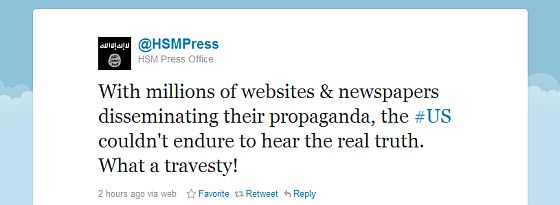
With millions of websites & newspapers disseminating their propaganda, the #US couldn't endure to hear the real truth. What a travesty!

Tweet from Harakat Al-Shabaab Al Mujahideen, Somalia's Islamist insurgent movement.

How dangerous can 140 characters be?

Apparently if those 140 characters are being fired onto the web through the Twitter account of al Shabib, Somalia’s militant jihadist movement, then the national security of the United States could be in jeopardy.

The New York Times reports:

American officials say they may have the legal authority to demand that Twitter close the Shabab’s account, @HSMPress, which had more than 4,600 followers as of Monday night.

The most immediate effect of the Obama administration’s threat appears to have been that @HSMPress (which has so far only made 114 tweets) has subsequently gained hundreds of new followers.

Is Twitter itself about to take a stand in defense of freedom of speech?

A company spokesman, Matt Graves, said [to a Times reporter] on Monday, “I appreciate your offer for Twitter to provide perspective for the story, but we are declining comment on this one.”

Last Wednesday, the New York Times reported from Nairobi in Kenya:

Somalia’s powerful Islamist insurgents, the Shabab, best known for chopping off hands and starving their own people, just opened a Twitter account, and in the past week they have been writing up a storm, bragging about recent attacks and taunting their enemies.

“Your inexperienced boys flee from confrontation & flinch in the face of death,” the Shabab wrote in a post to the Kenyan Army.

It is an odd, almost downright hypocritical move from brutal militants in one of world’s most broken-down countries, where millions of people do not have enough food to eat, let alone a laptop. The Shabab have vehemently rejected Western practices — banning Western music, movies, haircuts and bras, and even blocking Western aid for famine victims, all in the name of their brand of puritanical Islam — only to embrace Twitter, one of the icons of a modern, networked society.

On top of that, the Shabab clearly have their hands full right now, facing thousands of African Union peacekeepers, the Kenyan military, the Ethiopian military and the occasional American drone strike all at the same time.

But terrorism experts say that Twitter terrorism is part of an emerging trend and that several other Qaeda franchises — a few years ago the Shabab pledged allegiance to Al Qaeda — are increasingly using social media like Facebook, MySpace, YouTube and Twitter. The Qaeda branch in Yemen has proved especially adept at disseminating teachings and commentary through several different social media networks.

“Social media has helped terrorist groups recruit individuals, fund-raise and distribute propaganda more efficiently than they have in the past,” said Seth G. Jones, a political scientist at the RAND Corporation.

The Times reporter, Jeffrey Gettleman, sounds quite indignant that al Shabib should have the audacity to be using Twitter, so he can hardly have been surprised that his article prompted this exchange between @HSMPress and one of their followers:
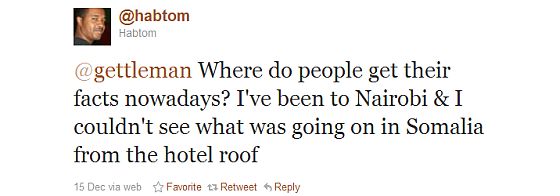
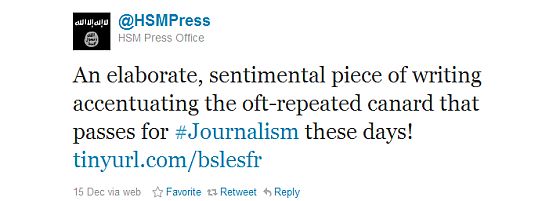
@gettleman Where do people get their facts nowadays? I've been to Nairobi & I couldn't see what was going on in Somalia from the hotel roof
An elaborate, sentimental piece of writing accentuating the oft-repeated canard that passes for #Journalism these days!
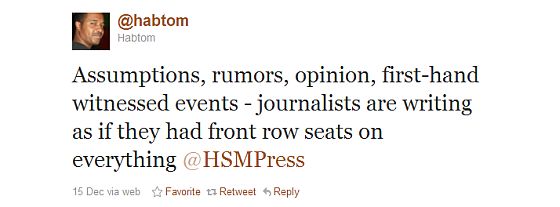
Assumptions, rumors, opinion, first-hand witnessed events - journalists are writing as if they had front row seats on everything @HSMPress
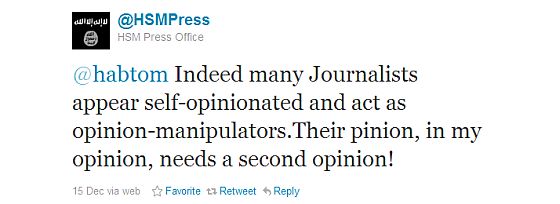
@habtom Indeed many Journalists appear self-opinionated and act as opinion-manipulators.Their pinion, in my opinion, needs a second opinion!
Somalia is not the only front in the new war on Twitter.

The Washington Post reports on Twitter battles in Afghanistan:

U.S. military officials assigned to the International Security Assistance Force, or ISAF, as the coalition is known, took the first shot in what has become a near-daily battle waged with broadsides that must be kept to 140 characters.

“How much longer will terrorists put innocent Afghans in harm’s way,” @isafmedia demanded of the Taliban spokesman on the second day of the embassy attack, in which militants lobbed rockets and sprayed gunfire from a building under construction.

“I dnt knw. U hve bn pttng thm n ‘harm’s way’ fr da pst 10 yrs. Razd whole vilgs n mrkts. n stil hv da nrve to tlk bout ‘harm’s way,’ ” responded Abdulqahar Balkhi, one of the Taliban’s Twitter warriors, who uses the handle ­@ABalkhi….

U.S. military officials say the dramatic assault on the diplomatic compound convinced them that they needed to seize the propaganda initiative — and that in Twitter, they had a tool at hand that could shape the narrative much more quickly than news releases or responses to individual queries.

“That was the day ISAF turned the page from being passive,” said Navy Lt. Cmdr. Brian Badura, a military spokesman, explaining how @isafmedia evolved after the attack. “It used to be a tool to regurgitate the company line. We’ve turned it into what it can be.”

So how’s @isafmedia exploiting the power of Twitter? With tweets like this?
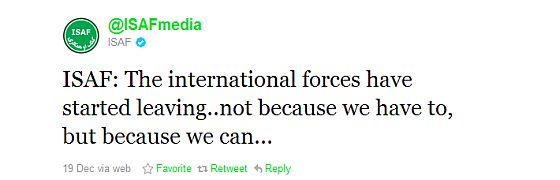
A we’re-winning-the-war tweet like this might sound good inside ISAF’s Twitter Command Center, but I don’t think it’s going to impress anyone else.

The problem the Obama administration is up against is not the threat posed by its adversaries on Twitter; it is that its own ventures into social media are predictably inept. Official tweets lack wit and tend to sound like the clumsy propaganda. But when losing an argument, the solution is not to look for ways to gag your opponent — that’s how dictators operate.

The Pentagon prides itself on its smart bombs. Can’t it come up with a few smart tweets?

Facebooktwittermail