Category Archives: Issues

Donald Trump’s network of unsavory Russian connections

James S Henry writes: A few of Donald Trump’s connections to oligarchs and assorted thugs have already received sporadic press attention — for example, former Trump campaign manager Paul Manafort’s reported relationship with exiled Ukrainian oligarch Dmytro Firtash. But no one has pulled the connections together, used them to identify still more relationships, and developed an image of the overall patterns.

Nor has anyone related these cases to one of the most central facts about modern Russia: its emergence since the 1990s as a world-class kleptocracy, second only to China as a source of illicit capital and criminal loot, with more than $1.3 trillion of net offshore “flight wealth” as of 2016.

This tidal wave of illicit capital is hardly just Putin’s doing. It is in fact a symptom of one of the most epic failures in modern political economy — one for which the West bears a great deal of responsibility. This is the failure, in the wake of the Soviet Union’s collapse in the late 1980s, to ensure that Russia acquires the kind of strong, middle-class-centric economic and political base that is required for democratic capitalism, the rule of law, and stable, peaceful relationships with its neighbors.

Instead, from 1992 to the Russian debt crisis of August 1998, the West in general — and the U.S. Treasury, USAID, the State Department, the IMF/World Bank, the ERDB, and many leading economists in particular — actively promoted and, indeed, helped to finance one of the most massive transfers of public wealth into private hands that the world has ever seen. [Continue reading…]

Stay informed. Click below to sign up for daily email updates from War in Context:

sign up now

Facebooktwittermail

In Donald Trump, Alexander Dugin trusts

Matthew d’Ancona writes: Russian hacking, White House warnings, angry denials by Vladimir Putin’s officials: we are edging towards a digital Cuban crisis. So it is as well to ask what is truly at stake in this e-conflict, and what underpins it.

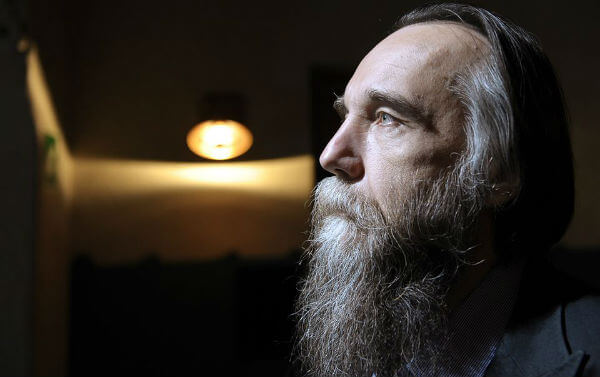
To which end, meet the most important intellectual you have (probably) never heard of. Alexander Dugin, the Russian political scientist and polemicist, may resemble Santa’s evil younger brother and talk like a villain from an Austin Powers movie. But it is no accident that he has earned the nickname Putin’s Rasputin. His books and posts – often, it must be said impenetrable or plain madcap – are required reading for those who seek to understand the new landscape of Brexit, Donald Trump’s victory and the global surge of the far right.

Born in Moscow in 1962, Dugin is a ferocious champion of Russian imperialism, or what he calls Eurasianism. He supports tradition against liberalism, autocracy against democratic institutions, stern uniformity against Enlightenment pluralism. In The Fourth Political Theory (2009), he claims all this adds up to a new and coherent ideology, supplanting liberal democracy, Marxism and fascism – though he still seems pretty fond of fascism.

The extent of Dugin’s personal access to the Kremlin remains opaque: it has certainly waxed and waned over the decades. What is beyond dispute, however, is the influence his geopolitical vision has enjoyed in the general staff academy and the Russian ministry of defence. Putin’s intervention in Georgia in 2008, his invasion of Ukraine in 2014, and his tightening grip on Syria are all entirely consistent with Dugin’s strategy for Mother Russia.

All of which is alarming enough. But what makes Dugin so suddenly significant is his growing influence in the west. It has long been alleged that he acts as a covert intermediary between Moscow and far-right groups in Europe, many of which are believed to receive funding from the Kremlin.

The purpose of operations like the hacking of the US election has been to destabilise the Atlantic order generally, and America specifically. And on this great struggle, Dugin is positively millenarian: “We must create strategic alliances to overthrow the present order of things, of which the core could be described as human rights, anti-hierarchy, and political correctness – everything that is the face of the Beast, the anti-Christ.” [Continue reading…]

Stay informed. Click below to sign up for daily email updates from War in Context:

sign up now

Facebooktwittermail

Iraqi Kurdistan slides toward autocracy

Akbar Shahid Ahmed reports: Most mornings this August, Wedad Hussein Ali, a 28-year-old Kurdish journalist with a trim beard and a penchant for spiking his hair, would get up early to drive his big brother, Sardar, to work. The trip from Kora, their leafy, ancient village in Iraqi Kurdistan’s mountains, to Dohuk, the nearest big town, took 30 minutes.

On Aug. 13, they reached Sardar’s construction site at 9:15 a.m. He got out of the car as usual. Ali drove on.

Minutes later, two unmarked cars cut off Ali. Three men got out. One pointed a gun to the journalist’s head. The others tied his wrists and placed a hood over his head. As witnesses watched, the men loudly announced that they had official business with Ali. They placed him in one of their cars and drove away.

A few hours later, a police officer called Ali’s family to say his body was at a local morgue. It had been transferred there after police in a neighboring village found it dumped by the side of a road, the police contact said. Ali had been cut, beaten and bruised, showing signs, one doctor said, of having been hit by a long object like a bat or a baton. To the family, it looked like he had suffered third-degree burns and beatings with electric cables. His eyes appeared to have been torn out with knives.

There were plenty of groups that could have killed Ali. The vicious Islamic State group maintains sleeper cells across Iraq, including in Kurdistan; Dohuk is just an hour’s drive from Mosul, the chief ISIS hub in the country. Iran-backed Shiite militias have tortured and terrorized thousands of their fellow Iraqis over the past decade, focusing their attention on people who follow the rival Sunni branch of Islam — which most Kurds do. And Iraqi Kurdistan has long hosted an internationally condemned Kurdish movement called the Kurdistan Workers’ Party (PKK), which has issued harsh punishments, including executions, to Kurds who refuse to collaborate with it.

But Ali’s family doesn’t blame ISIS, Shiite militias or the PKK for his murder. They believe Iraqi Kurdistan’s U.S.-friendly leaders were responsible for his death.

Nine weeks after Ali’s murder, Massoud Barzani, the president of Iraqi Kurdistan, held a triumphant press conference. The day before, 4,000 Iraqi Kurdish fighters had begun moving toward Mosul. Scores of American advisers boosted their ranks, and American B-1 and F-15 jets provided air support.

The Kurds’ advance was sold as a key sign that the U.S. had rallied its partners in Iraq and prepared them to push ISIS out of the country for good. Brett McGurk, the top American managing the U.S.-led coalition against the Islamic State, wished the Kurds and others “Godspeed” on Twitter. “We are proud to stand with you,” he added.

Since the U.S. and Kurdistan first began major cooperation against ISIS in August 2014, Barzani, an iconic former militia man who has been close to winning Time’s Person of the Year award, has pushed the region ever closer to autocracy.

But the Obama administration and President-elect Donald Trump have largely ignored warning signs — including Ali’s death — that point to a dark future for Kurdistan.

Parliament has not functioned since last October, because Barzani banned its speaker, an opposition politician, from entering the capital. Thousands of refugees who have sought sanctuary in the region have seen their freedoms restricted. Kurdish authorities have meted out particularly harsh treatment to Sunni Arabs, mimicking the Iraqi policies that provoked Sunni dissatisfaction and enabled the initial rise of ISIS. U.S.-backed Kurdish forces have demolished the homes of Sunni Arabs in areas recaptured from ISIS. Kurdistan has subjected many of the Yazidis, the minority group whose genocide prompted U.S. action against ISIS, to painful shortages of food, water, fuel and medicine because of their affinity for the anti-Barzani PKK ― only strengthening the militant Kurdish group’s appeal. [Continue reading…]


Facebooktwittermail

The sixth anniversary of the start of the Arab uprisings

Gilbert Achcar writes: Six years ago, on 17 December 2010, Mohamed Bouazizi immolated himself in the Tunisian city of Sidi Bouzid. Bouazizi did not know that by this extreme form of protest, he was setting not only himself or his town on fire, nor his province or even his Tunisian homeland alone, but the whole Arab region. Indeed, his protest inspired millions of others — “from the Ocean to the Gulf” as the saying went in the heyday of Arab nationalism — to protest their regimes and the status quo.

The tragedy is that this wave of protests did not bring the renewal that was promised by the branding phrase “Arab Spring,” but rather what followed were more of the old calamities, aggravated to a frightening degree in some cases. It is necessary therefore to emphasize two crucial issues regarding the sad condition under which we commemorate the sixth anniversary of the Arab uprisings.

The first issue concerns a view that has spread quite understandably in the Arab region, according to which the lesson of the past six years is that the old order, despite its huge problems, was better than the revolt against it since the latter only managed to create a bigger disaster. The truth is that if we were to apply the same logic to any of the great revolutions in history, assessing them only a few years after their beginning, we would condemn them all. Thus, if we envisaged the French Revolution from the angle of where it stood six years after its start in 1789, we would find an appalling situation in France with an ongoing civil war that killed hundreds of thousands and a revolutionary regime that executed tens of thousands in a reign of terror. France was, later, to go through an imperial stage followed by the restoration of the monarchy that the revolution had overthrown. Only close to a century after the revolution’s start did the republican regime stabilize. And yet, the anniversary of the French Revolution on 14 July is the greatest yearly celebration in contemporary France, and the French recall their revolution as a glorious historical event, which most of their historians rally to defend against anyone who denigrates it by trying to portray it as a catastrophe. [Continue reading…]

Facebooktwittermail

Climate change forced over 1 million Africans from their homes in 2015

ThinkProgress reports: At least 12 million people lived in ongoing displacement caused by conflict, violence, and other disasters across the African continent in 2015. And in the future, climate change may be the lead driver of even greater displacement.

In the Africa Report on Internal Displacement  — a new report by the Internal Displacement Monitoring Centre that focused on internal displacement across the entire African continent  — researchers found that “disasters triggered by rapid-onset natural hazards” forced 1.1 million people from their homes across 33 African countries last year. What’s more, disaster-induced displacement makes people more vulnerable from one year to the next and more susceptible to food insecurity since planting and harvesting become disrupted when farmers are absent.

“The figure of 12.4 million internally displaced people (IDPs) is more than double Africa’s 5.4 million refugee population across the continent, and is a reminder of the protracted nature of many conflicts in Africa,” Alexandra Bilak, the director of the Internal Displacement Monitoring Centre (IDMC), said in a statement. “But it still underestimates the full scale of Africa’s internal displacement crisis because data over time is not available for the millions more who become trapped in displacement as a result of disasters and development projects.” [Continue reading…]

Facebooktwittermail

Leak reveals Rex Tillerson is director of Bahamas-based U.S.-Russian oil company

The Guardian reports: Rex Tillerson, the businessman nominated by Donald Trump to be the next US secretary of state, is the long-time director of a US-Russian oil firm based in the tax haven of the Bahamas, leaked documents show.

Tillerson – the chief executive of ExxonMobil – has been a director of the oil company’s Russian subsidiary, Exxon Neftegas, since 1998. His name – RW Tillerson – appears next to other officers who are based at Houston, Texas; Moscow; and Sakhalin, in Russia’s far east.

The leaked 2001 document comes from the corporate registry in the Bahamas. It was one of 1.3m files given to the Germany newspaper Süddeutsche Zeitung by an anonymous source. The registry is public but details of individual directors are typically incomplete or missing entirely.

Though there is nothing untoward about this directorship, it has not been reported before and is likely to raise fresh questions over Tillerson’s relationship with Russia ahead of a potentially stormy confirmation hearing by the US senate foreign relations committee.

ExxonMobil’s use of offshore regimes – while legal – may also jar with Trump’s avowal to put “America first”.

Tillerson’s critics say he is too close to the Russian president, Vladimir Putin, and that his appointment could raise potential conflicts of interest. [Continue reading…]

Facebooktwittermail

I’m a scientist who has gotten death threats. I fear what may happen under Trump

Michael E. Mann writes: My Penn State colleagues looked with horror at the police tape across my office door.

I had been opening mail at my desk that afternoon in August 2010 when a dusting of white powder fell from the folds of a letter. I dropped the letter, held my breath and slipped out the door as swiftly as I could, shutting it behind me. First I went to the bathroom to scrub my hands. Then I called the police.

It turned out to be cornstarch, not anthrax. And it was just one in a long series of threats I’ve received since the late 1990s, when my research illustrated the unprecedented nature of global warming, producing an upward-trending temperature curve whose shape has been likened to a hockey stick.

I’ve faced hostile investigations by politicians, demands for me to be fired from my job, threats against my life and even threats against my family. Those threats have diminished in recent years, as man-made climate change has become recognized as the overwhelming scientific consensus and as climate science has received the support of the federal government. But with the coming Trump administration, my colleagues and I are steeling ourselves for a renewed onslaught of intimidation, from inside and outside government. It would be bad for our work and bad for our planet. [Continue reading…]

Facebooktwittermail

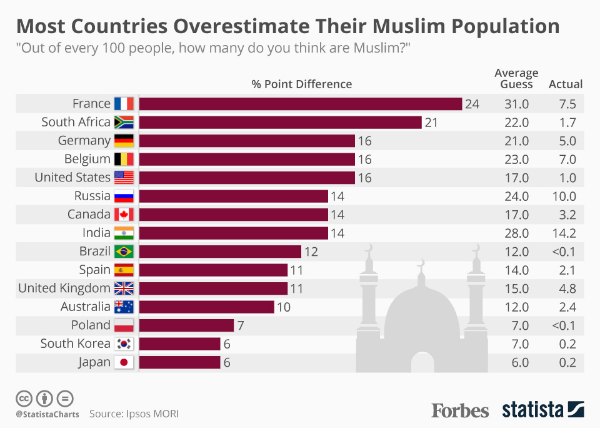
Americans believe there are 54 million Muslims in America. In fact, there are only 3 million

Huffington Post reports: Americans and Europeans drastically overestimate their Muslim populations, a new international survey shows, a misperception many say is driven by Islamophobia and growing anti-Muslim sentiment.

Americans think 17 out of every 100 people in the U.S. are Muslim, according to the survey from Ipsos Mori, a U.K. research company. But, according to the nonpartisan Pew Research Center, Muslims account for only 1 out of every 100 people in the U.S.

That works out to Americans thinking there are about 54 million Muslims in the U.S., when in fact the Muslim population is about 3 million.

This wide disparity between public perception and reality is even more pronounced in Europe. The French, for example, think Muslims make up 31 percent of the French population, when only 7.5 percent of that country is Muslim. [Continue reading…]

Facebooktwittermail

How a Putin fan overseas pushed pro-Trump propaganda to Americans

The New York Times reports: The Patriot News Agency website popped up in July, soon after it became clear that Donald J. Trump would win the Republican presidential nomination, bearing a logo of a red, white and blue eagle and the motto “Built by patriots, for patriots.”

Tucked away on a corner of the site, next to links for Twitter and YouTube, is a link to another social media platform that most Americans have never heard of: VKontakte, the Russian equivalent of Facebook. It is a clue that Patriot News, like many sites that appeared out of nowhere and pumped out pro-Trump hoaxes tying his opponent Hillary Clinton to Satanism, pedophilia and other conspiracies, is actually run by foreigners based overseas.

But while most of those others seem be the work of young, apolitical opportunists cashing in on a conservative appetite for viral nonsense, operators of Patriot News had an explicitly partisan motivation: getting Mr. Trump elected. [Continue reading…]

Facebooktwittermail

Donald Trump’s pick for ambassador to Israel opens a world of unknowns

Karl Vick writes: Don’t even try thinking of Donald Trump’s choice for ambassador to Israel as a diplomat. David M. Friedman is far from that. But he serves very well as a reply in kind, an answer in human form.

It’s like this: For the last three years Prime Minister Benjamin Netanyahu, the man who leads Israel, has sent signal after signal that he’s done with peace talks, or ever pulling Israeli troops out of the West Bank. Sometimes these signals were verbal — in the 2015 election campaign, Netanyahu declared flat out that there would be no Palestinian state. More recently the signals arrived in the form of diplomats — men who, like Friedman, had no prior experience in the subtle arts of statecraft, but whose biographies and attitudes said a great deal. In August, Dani Dayan became Israel’s Consul General in New York. To get his stuff, the moving van had to leave Israel and drive across the Green Line into Palestinian territory, where Dayan lived. He is a settler, a Jewish Israeli who moved to the West Bank in order to stake a claim to rocky hills that are also home to some two million Palestinians. In fact, for six years, Dayan headed the settlers’ primary organization, the Yesha Council. Earlier in the year, Brazil rejected his appointment as Israel’s ambassador to Brasilia, citing his settler background.

In New York, Dayan joined a man with a similar name — Danny Danon, the new Israeli ambassador to the United Nations. Danon was Netanyahu’s remarkable choice for the international body where the topic of Israel’s 50-year occupation of Palestinian territory is a chronic one. The new ambassador had written wrote a book suggesting that Israel simply annex the West Bank, perhaps leaving the Palestinians some urban areas. His rhetoric is famously scalding; after Israeli Defense Forces commandos killed nine Turks on a relief boat headed to the Gaza Strip, Danon wrote to Turkey’s prime minister saying “We are sorry that due to the IDF’s over-cautious behavior, only nine terrorists were killed…” Danon’s appointment to Israel’s premiere diplomatic post — like Dayan’s as envoy to the largest concentration of American Jews — was as far as you can get from business as usual in Israeli diplomacy. For more than a generation, it at least nodded to the idea of a Palestinian state. That’s no longer the case. Not even from the next U.S. ambassador — a bankruptcy lawyer who has represented Trump’s casinos.

“There has never been a two-state solution,” Friedman wrote in August, “only a two-state narrative.” And if it was that was a narrative in which moderate Palestinians invested pretty much everything, a story in which almost the entire world continues to believe, the crystalline signal from both Trump Tower and Jerusalem is that it’s all over now. [Continue reading…]

Facebooktwittermail

To combat Trump, Democrats ready a GOP tactic: lawsuits

The New York Times reports: One attorney general, Eric T. Schneiderman, is already investigating Donald J. Trump over possible violations of New York State law at his charity foundation.

Another, Maura Healey of Massachusetts, has joined Mr. Schneiderman in an investigation into whether Exxon Mobil — whose chief executive, Rex W. Tillerson, is Mr. Trump’s choice for secretary of state — lied to investors and the public about the threat of climate change.

Ms. Healey also has a new fund-raising pitch: “I won’t hesitate to take Donald Trump to court if he carries out his unconstitutional campaign promises,” she recently wrote to supporters.

A third, Representative Xavier Becerra, who was chosen this month to become California’s attorney general, has dared the Trump administration to “come at us” over issues including immigration, climate change and health care.

As Democrats steel themselves for the day next month when the White House door will slam on their backs, some of the country’s more liberal state attorneys general have vowed to use their power to check and balance Mr. Trump’s Washington. [Continue reading…]

Facebooktwittermail

Nine ways to oppose Donald Trump

John Cassidy writes: er the past few weeks, a number of anguished friends and acquaintances, and even some strangers, have got in touch with me to ask what they might do to oppose Donald Trump. Being a fellow sufferer from OATS — Obsessing About Trump Syndrome — my first instinct has been to tell people to get off social media and take a long walk. It won’t do anybody much good, except possibly Trump, if large numbers of people who voted against him send themselves mad by constantly reading about him, cursing him, and recirculating his latest outrages.

But, of course, taking a mental-health break is only a first step toward preserving the Republic. As a daily columnist, I see my role as trying to analyze and critique the Trump program, while also trying to understand some of the phenomena that allowed him to blag his way to the verge of the White House. But for those who want to take a more direct approach, here are some suggestions, starting with something you can do immediately:

1. Go to change.org and join the 4.9 million people who have signed a petition calling on members of the Electoral College to reject Trump. Then contact the electors for your state directly and tell them your concerns. On Monday, the five hundred and thirty eight electors will choose a new President. According to the Harvard law professor Lawrence Lessig, between twenty and thirty Republican electors are ready to vote against Trump. To deny him a majority, the number would need to reach thirty-seven. Most observers think that won’t happen, and, even if it did, the task of electing a President would pass to the Republican-dominated House of Representatives, which would almost certainly vote for Trump. But a big protest vote in the Electoral College could still have great deal of symbolic importance. [Continue reading…]

Facebooktwittermail

Russia’s fear of Hillary Clinton eclipsed any affection for Donald Trump

Max Fisher writes: Russia’s unprecedented intervention in the United States election came amid more than United States-Russia tension and Donald J. Trump’s praise of Vladimir V. Putin, the Russian president. It also coincided with a growing belief, in Moscow, that Russia faced an imminent threat in Hillary Clinton’s candidacy.

Mrs. Clinton is viewed in Moscow as innately hostile to Russia. Widely held conspiracy theories portray her as seeking to foment unrest that will return Russia to the chaos and depression of the 1990s. Even many government technocrats view her with suspicion that at times verges on paranoia.

She referred to these views at an event on Thursday, telling donors that Mr. Putin’s “personal beef” with her had driven Russia’s intervention in the American election.

Mark Galeotti, a Russia expert at the Institute of International Relations, based in Prague, said the Kremlin was consumed by something more urgent than petty revenge: self-preservation.

“It’s not just they didn’t like Clinton, but they actually thought that she represented a threat,” he said, describing Russia’s actions as a matter of “policy, not pique.”

No one factor can fully explain Russia’s decision to hack and pass on Democratic emails, analysts say, and intelligence agencies appear divided on assessing Russian motives. But, in Moscow, fear of Mrs. Clinton has loomed as large or larger than any warmth for Mr. Trump. [Continue reading…]

Facebooktwittermail

FBI backs CIA view that Russia intervened to help Trump win election

The Washington Post reports: FBI Director James B. Comey and Director of National Intelligence James R. Clapper Jr. are in agreement with a CIA assessment that Russia intervened in the 2016 election in part to help Donald Trump win the presidency, according to U.S. officials.

Comey’s support for the CIA’s conclusion reflects the fact that the leaders of the three agencies have always been in agreement on Russian intentions, officals said, contrary to suggestions by some lawmakers that the FBI disagreed with the CIA.

“Earlier this week, I met separately with (Director) FBI James Comey and DNI Jim Clapper, and there is strong consensus among us on the scope, nature, and intent of Russian interference in our presidential election,” CIA Director John Brennan said in a message to the agency’s workforce, according to U.S. officials who have seen the message.

“The three of us also agree that our organizations, along with others, need to focus on completing the thorough review of this issue that has been directed by President Obama and which is being led by the DNI,” Brennan’s message read. [Continue reading…]

Facebooktwittermail

Is Donald Trump a threat to democracy?

Steven Levitsky and Daniel Ziblatt write: Donald J. Trump’s election has raised a question that few Americans ever imagined asking: Is our democracy in danger? With the possible exception of the Civil War, American democracy has never collapsed; indeed, no democracy as rich or as established as America’s ever has. Yet past stability is no guarantee of democracy’s future survival.

We have spent two decades studying the emergence and breakdown of democracy in Europe and Latin America. Our research points to several warning signs.

The clearest warning sign is the ascent of anti-democratic politicians into mainstream politics. Drawing on a close study of democracy’s demise in 1930s Europe, the eminent political scientist Juan J. Linz designed a “litmus test” to identify anti-democratic politicians. His indicators include a failure to reject violence unambiguously, a readiness to curtail rivals’ civil liberties, and the denial of the legitimacy of elected governments.

Mr. Trump tests positive. In the campaign, he encouraged violence among supporters; pledged to prosecute Hillary Clinton; threatened legal action against unfriendly media; and suggested that he might not accept the election results.

This anti-democratic behavior has continued since the election. With the false claim that he lost the popular vote because of “millions of people who voted illegally,” Mr. Trump openly challenged the legitimacy of the electoral process. At the same time, he has been remarkably dismissive of United States intelligence agencies’ reports of Russian hacking to tilt the election in his favor. [Continue reading…]

Facebooktwittermail

Donald Trump’s war on science

Lawrence M. Krauss writes: Last week, the Space, Science, and Technology subcommittee of the House of Representatives tweeted a misleading story from Breitbart News: “Global Temperatures Plunge. Icy Silence from Climate Alarmists.” (There is always some drop in temperature when El Niño transitions into La Niña — but there has been no anomalous plunge.) Under normal circumstances, this tweet wouldn’t be so surprising: Lamar Smith, the chair of the committee since 2013, is a well-known climate-change denier. But these are not normal times. The tweet is best interpreted as something new: a warning shot. It’s a sign of things to come — a declaration of the Trump Administration’s intent to sideline science.

In a 1946 essay, George Orwell wrote that “to see what is in front of one’s nose needs a constant struggle.” It’s not just that we’re easily misled. It’s that, by “impudently twisting the facts,” we can convince ourselves of “things which we know to be untrue.” A whole society, he wrote, can deceive itself “for an indefinite time,” and the only check on that mass delusion is that “sooner or later a false belief bumps up against solid reality.” Science is one source of that solid reality. The Trump Administration seems determined to keep it at bay, and the consequences for society and the environment will be profound.

The first sign of Trump’s intention to spread lies about empirical reality, “1984”-style, was, of course, the appointment of Steve Bannon, the former executive chairman of the Breitbart News Network, as Trump’s “senior counselor and strategist.” This year, Breitbart hosted stories with titles such as “1001 Reasons Why Global Warming Is So Totally Over in 2016,” despite the fact that 2016 is now overwhelmingly on track to be the hottest year on record, beating 2015, which beat 2014, which beat 2013. Such stories do more than spread disinformation. Their purpose is the creation of an alternative reality — one in which scientific evidence is a sham — so that hyperbole and fearmongering can divide and conquer the public. [Continue reading…]

Facebooktwittermail

Donald Trump’s rigged election

The New York Times reports: President Obama said on Thursday that the United States would retaliate for Russia’s efforts to influence the presidential election, asserting that “we need to take action,” and “we will.”

The comments, in an interview with NPR, indicate that Mr. Obama, in his remaining weeks in office, will pursue either economic sanctions against Russia or perhaps some kind of response in cyberspace.

Mr. Obama spoke as President-elect Donald J. Trump on Thursday again refused to accept Moscow’s culpability, asking on Twitter why the administration had waited “so long to act” if Russia “or some other entity” had carried out cyberattacks.

The president discussed the potential for American retaliation with Steve Inskeep of NPR for an interview to air on Friday morning. “I think there is no doubt that when any foreign government tries to impact the integrity of our election,” Mr. Obama said, “we need to take action. And we will — at the time and place of our choosing.”

The White House strongly suggested before the election that Mr. Obama would make use of sanctions authority for cyberattacks that he had given to himself by executive order. But he did not, in part out of concern that action before the election could lead to an escalated conflict.

If Mr. Obama invokes sanctions on Russian individuals or organizations, Mr. Trump could reverse them. But that would be politically difficult, as his critics argue that he is blind to Russian behavior. [Continue reading…]

NBC News reports: [In this tweet] Trump was no longer disputing, as he has for months, that Russia was involved. And his top transition aide, Anthony Scaramucci, went even further Wednesday night in an interview with MSNBC’s Brian Williams.

“I don’t think anybody thinks that you’re wrong,” he said of the NBC News report. “Our position right now is that we’re waiting for more information. We reject the notion that people would cyber attack our institutions. We are very upset about it.”

Scaramucci went on to suggest that Trump needed time to digest the intelligence.

“I wonder whether the tweet the president-elect sent out today is the beginning of his pivot, the beginning of his acknowledgement of the intelligence that Russia has been hacking our institutions,” said Rep. Adam Schiff, the ranking Democrat on the House Intelligence Committee.

In an exclusive report Wednesday, U.S. intelligence officials told NBC News they now believe with “a high level of confidence” that Putin became personally involved in the covert Russian campaign in October.

Two senior officials with direct access to the information say new intelligence shows that Putin personally directed how hacked material from Democrats was leaked and otherwise used. The intelligence came from diplomatic sources and spies working for U.S. allies, the officials said. [Continue reading…]

The New York Times reports: It remains to be seen whether Mr. Trump’s stated doubts about Russia’s involvement will subside after Monday’s Electoral College vote. He and his allies have been concerned that the reports of Russian hacking have been intended to peel away votes from him, although even Democrats have not gone so far as to say the election was illegitimate.

“Right now, certain elements of the media, certain elements of the intelligence community and certain politicians are really doing the work of the Russians — they’re creating this uncertainty over the election,” Representative Peter T. King, Republican of New York, told reporters on Thursday after meeting with Mr. Trump.

But many other Republicans, including Senator Mitch McConnell of Kentucky, the majority leader, and Senator John McCain of Arizona, have publicly argued that the evidence leads straight to Russia. They have called for a full investigation, and Senator Dianne Feinstein, Democrat of California, who sits on the Senate Intelligence Committee, urged Mr. Obama on Thursday to complete an administration review quickly.

Mr. Trump’s Twitter post was his latest move to accuse the intelligence agencies he will soon control of acting with a political agenda and to dispute the well-documented conclusion that Moscow carried out a meticulously planned series of attacks and releases of information to interfere in the presidential race.

But as he repeated his doubts, Mr. Trump seized on emerging questions about the Obama administration’s response: Why did it take months after the breaches had been discovered for the administration to name Moscow publicly as the culprit? And why did Mr. Obama initially opt not to openly retaliate, through sanctions or other measures?

White House officials have said that the warning to Mr. Putin at the September summit meeting in China constituted the primary American response so far. When the administration decided to go public with its conclusion a month later, it did so in a statement from the director of national intelligence and the Homeland Security secretary, not in a prominent presidential appearance.

Officials said they were worried that any larger public response would have raised doubts about the election’s integrity, something Mr. Trump was already seeking to do during the campaign when he insisted the election was “rigged.” [Continue reading…]


Facebooktwittermail

Trump picks hardline pro-settler bankruptcy lawyer to become U.S. ambassador to Israel

The Guardian reports: Donald Trump has named as his ambassador to Israel a pro-settler lawyer who has described some US Jews as worse than concentration camp prisoner-guards.

David Friedman, a bankruptcy lawyer who represented the president-elect over his failing hotels in Atlantic City, served Trump’s advisory team on the Middle East. He has set out a number of hardline positions on Israeli-Palestinian relations, including fervent opposition to the two-state solution and strong support for an undivided Jerusalem as Israel’s capital.

He has called President Barack Obama an antisemite and suggested that US Jews who oppose the Israeli occupation of the West Bank are worse than kapos, Nazi-era prisoners who served as concentration camp guards.

Liberal Jewish groups in the US denounced the appointment as “reckless” and described Friedman – a man with no experience of foreign service – as the “least experienced pick” ever for a US ambassador to Israel.

Yossi Dagan, a prominent Israeli settler leader and friend of Friedman, welcomed the news, describing him as “a true friend and partner of the state of Israel and the settlements”. Morton Klein, the president of the Zionist Organization of America, said Friedman had “the potential to be the greatest US ambassador to Israel ever”. [Continue reading…]

Facebooktwittermail