Category Archives: Issues

Nearly half the adults in Britain and elsewhere in Europe hold extremist views

BuzzFeed reports: Almost half of the adults in 12 European countries now hold anti-immigrant, nationalist views, according to major new research that reveals the spread of fringe political views into the mainstream.

BuzzFeed News has been given exclusive access to new data from YouGov, which polled more than 12,000 people across the continent to measure the extent of what it termed “authoritarian populist” opinions – a combination of anti-immigration sentiments, strong foreign policy views, and opposition to human rights laws, EU institutions, and European integration policies.

The YouGov findings are the first to capture the political attitudes that are both fuelling, and being fuelled by, upheaval across Europe and beyond – from the continent’s refugee crisis and the Brexit vote in Britain, to the burkini ban in France, to the rise of Donald Trump and the radical “alternative right” in the US.

In Britain, the poll found authoritarian populist attitudes were shared by 48% of adults, despite less than 20% of the population identifying itself as right-wing. Three months on from the EU referendum, prime minister Theresa May has responded this week by appealing directly to disaffected working-class voters with a promise to crackdown on immigration and reassert British sovereignty. [Continue reading…]

Facebooktwittermail

The United States and Russia are prepping for doomsday

Jeffrey Lewis writes: The other day, a little present arrived in the mail. It was book, or rather a pair of doorstops. Titled Doomed to Cooperate, the massive two-volume set is about 1,000 pages of essays, interviews, and vignettes from more than 100 participants in the remarkable period of cooperation between the nuclear weapons complexes of the United States and Russia in the immediate post-Cold War period. Siegfried Hecker, who edited the volumes, titled them after the remark of a Soviet scientist, who said of the shared danger that nuclear weapons pose, “Therefore, you know, we were doomed to work together, to cooperate.” Not everyone got the message, certainly not Vladimir Putin. Set against relations between Washington and Moscow today, the incredible stories in Hecker’s two volumes seem to be from another era entirely. On Monday, Putin issued a decree suspending a plutonium disposition agreement with the United States due to its “unfriendly actions.” (An unofficial translation is available from the Center for Energy and Security Studies in Moscow, as is a draft law submitted by the Kremlin.) Putin’s decree ends one of the last remaining forms of cooperation from that remarkable era.

“Plutonium disposition” is a fancy sort of phrase, the kind of term of art that, when I drop it at a cocktail party, sends people off to refill their drinks. But plutonium is the stuff of which bombs are made. After the Cold War, the United States and Russia agreed to dispose of tons of plutonium to make sure it could never be put back into bombs. So believe you me, when the Russians decide that maybe they should just hang on to that material for a while longer, it’s not so boring.

And we’re talking about a lot of plutonium here. If you recall the dark days of the Cold War, or maybe just read about them in a book, the United States and Soviet Union each had tens of thousands of nuclear weapons. That’s sort of insane if you think about what just one nuclear bomb did to Hiroshima and another to Nagasaki. But the United States and the Soviet Union each built stockpiles in excess of 30,000 nuclear weapons at their peak, massive arsenals of nuclear weapons that vast exceeded any conceivable purpose. And at the beating heart of the vast majority of those bombs were tiny little pits of plutonium.

Washington and Moscow have made great strides in reducing their vast nuclear arsenals, although we still have more than enough nuclear weapons to kill each other and then make the rubble bounce. The United States, for example, has reduced its stockpile from a peak of 31,255 nuclear weapons in 1967 to 4,571 in 2015. Let’s just say Russia’s stockpile is comparable, though perhaps not quite as modest.

Of course, retiring a nuclear weapon requires it to be dismantled. In the United States, a backlog of thousands of weapons awaits dismantlement. That queue stretches to 2022, and few experts think the United States will meet that target. And even once a weapon is dismantled, that still leaves the plutonium. As long as the plutonium exists, it can be turned back into a nuclear bomb.

The United States and Russia have lots and lots of plutonium left over from the Cold War. Neither country makes new plutonium anymore, or at least no weapons-grade plutonium, but don’t worry — there’s still more than enough to keep you up at night. The International Panel on Fissile Materials, at Princeton University, estimates the stockpiles of weapons-grade plutonium at 88 metric tons for the United States and 128 metric tons for Russia. To give you a sense of how much plutonium that is, it is an unclassified fact that a nuclear weapon can be made with as little as 4 kilograms of plutonium. It’s a slightly touchier subject that this is the average in the U.S. stockpile — one can make do with less. But let’s do the math: Even at 4 kilograms per nuclear weapon, 88 metric tons represents enough material for 22,000 nuclear weapons. [Continue reading…]

Facebooktwittermail

A caller had a lewd tape of Donald Trump. Then the race to break the story was on

The Washington Post reports: Reporter David Fahrenthold got a phone call around 11 a.m. Friday from a source with a tip about Donald Trump. The source asked: Would Fahrenthold be interested in seeing some previously unaired video of Trump?

Fahrenthold didn’t hesitate. Within a few moments of watching an outtake of footage from a 2005 segment on “Access Hollywood,” the Washington Post reporter was on the phone, calling Trump’s campaign, “Access Hollywood” and NBC for reaction.

By 4 p.m., his story was causing shock waves. [Continue reading…]

Facebooktwittermail

Testing Obama’s transparency pledge, groups send list of drone strikes to investigate

The Intercept reports: A coalition of human rights groups is calling on the Obama administration to make good on an executive order issued this summer that requires the United States to investigate when civilians are harmed in lethal operations abroad, including drone strikes.

In a letter sent to the White House on Thursday, the groups press for investigations into several specific attacks that occurred on the president’s watch. The letter calls for public acknowledgement as well as “prompt, thorough, effective, independent, impartial and transparent investigations” into 10 incidents over the last seven years. A dozen groups signed on, including the ACLU, Human Rights Watch, Amnesty International, and the Center for Civilians in Conflict.

The letter also calls for the methodology of those investigations to be made public, to include “only those redactions necessary to protect information that is properly classified” and to offer clear explanations for any discrepancies that might arise between the government’s conclusions and those reached by outside parties, including NGOs and journalists.

The executive order that Obama signed requires the government to investigate allegations of civilian casualties caused by U.S. operations, then take responsibility when they occur, and provide compensation to the family members of victims. [Continue reading…]

Facebooktwittermail

Lobbyist advised Trump campaign while promoting Russian pipeline

Politico reports: A Republican lobbyist was earning hundreds of thousands of dollars to promote one of Vladimir Putin’s top geopolitical priorities at the same time he was helping to shape Donald Trump’s first major foreign policy speech.

In the first two quarters of 2016, the firm of former Reagan administration official Richard Burt received $365,000 for work he and a colleague did to lobby for a proposed natural-gas pipeline owned by a firm controlled by the Russian government, according to congressional lobbying disclosures reviewed by POLITICO. The pipeline, opposed by the Polish government and the Obama administration, would allow Russian gas to reach central and western European markets while bypassing Ukraine and Belarus, extending Putin’s leverage over Europe.

Burt’s lobbying work for New European Pipeline AG, the company behind the pipeline known as Nord Stream II, began in February. At the time, the Russian state-owned oil giant Gazprom owned a 50 percent stake in New European Pipeline AG. In August, five European partners pulled out and Gazprom now owns 100 percent. [Continue reading…]

Facebooktwittermail

Xenophobia inside British government: Foreign experts are now barred from offering advice on Brexit

The Guardian reports: Leading foreign academics acting as expert advisers to the UK government have been told they will not be asked to contribute to any government analysis and reports on Brexit because they are not British nationals.

“It is utterly baffling that the government is turning down expert, independent advice on Brexit simply because someone is from another country,” said Nick Clegg, the Liberal Democrats’ EU spokesman.

“This is yet more evidence of the Conservatives’ alarming embrace of petty chauvinism over rational policymaking.”

Sara Hagemann, an assistant professor at the London School of Economics who specialises in EU policymaking processes, EU treaty matters, the role of national parliaments and the consequences of EU enlargements, said she had been told her services would not be required. [Continue reading…]

Facebooktwittermail

Xenophobia finds a foothold among those who feel left behind

Stefan Berg writes: I recently ran into a man in Brandenburg who, for no obvious reason, began to rail against German President Joachim Gauck before spitting on the ground and storming away. Another time, I overheard a loud discussion about refugees in a bus, one that escalated into an exchange of ideas for how best to neglect or even abuse migrants: by giving them only bread and water, for instance, or keeping them in cages. In the nearby butcher shop, you can find people who don’t care much about freedom — people who demand a “clear position,” a “bit more Putin” and less “palaver in the talk-shop,” by which they mean the German parliament in Berlin. Outside the butcher’s, there’s a parked car with the bumper sticker: “death penalty for child abusers.”

In its report on the state of German unity, which was celebrated on Monday, the government warned that Eastern Germany’s xenophobia represents a danger to social harmony. No matter where it takes place, xenophobia can be dangerous for its victims, whether in East or West. But the government in Berlin has identified a greater danger in Eastern Germany — one that threatens society as a whole.

Every time a snarling horde marches against a refugee home in Saxony, every time the chancellor is confronted with hateful tirades during a public appearance, I wonder if this behavior is typical for Eastern Germany. At first glance, my answer is: No. The majority of Eastern Germans clearly adhere to the rules of decency and democracy. Nevertheless, something “typically Eastern German” can still be identified in these excesses. [Continue reading…]

Facebooktwittermail

Israel brushes off criticism of settlement policy as U.S. assumes increasingly tough posture

The Washington Post reports: The Israeli government pushed back Thursday against the latest U.S. condemnation of its settlement enterprise as commentators called it another sign of fraying relations between the Jewish state and its most steadfast ally.

The Foreign Ministry issued a statement reacting to the unusually sharp language in the State Department’s “strong condemnation” of Israeli plans to build new settler housing “deep in the West Bank,” closer to Jordan than Israel. The Foreign Ministry said the 98 housing units approved for the Shilo area do not constitute “a new settlement.”

Ayelet Shaked, Israeli’s justice minister and a member of the pro-settler Jewish Home party, said Washington should train its condemnation on Syria “rather than criticizing where Israel builds houses.”

Education Minister Naftali Bennett said Thursday that “we must give our lives” for the cause of annexing the West Bank to Israel.

The Israeli government’s ire was piqued by statements Wed­nesday from the White House and State Department that further ratcheted up the Obama administration’s criticism of Israel’s settlement policy.

The tone began changing late last year, when Secretary of State John F. Kerry told a gathering at the Brookings Institution’s Saban Forum that Israel’s settlement expansion was closing off possibilities for a two-state solution. He said Israel would not be able to maintain itself as a Jewish and democratic state if the trend continued.

Since then, in what seems a deliberate calibration, the State Department has spoken out strongly almost every time Israel has announced new housing, not only in the West Bank but also in East Jerusalem, where Palestinians hope to have the capital of an independent state. In July, the State Department called Israeli construction over the Green Line, Israel’s pre-1967 border, “provocative and counterproductive.” In August, the White House said “significant settlement expansion” poses “a serious and growing threat to the viability of a two state solution.”

Prime Minister Benjamin Netanyahu and his coalition fear that between the presidential election in November and Inauguration Day, President Obama could seek a way to try to enshrine U.S. parameters for a future peace deal between Israel and the Palestinians.

Far worse in Netanyahu’s mind would be U.S. support for a resolution along those lines in the United Nations.

“There is no doubt in Israel that Obama wants to leave a legacy,” said former Israel diplomat Jacob Dayan, who was chief of staff to two foreign ministers. “A legacy is created in two ways — a comprehensive speech on the issue, which I am sure Israel will accept because speeches are nice and memorable, but not more than that, or an American U.N. Security Council Resolution on the issue. . . . That is Israel’s biggest fear.” [Continue reading…]

Facebooktwittermail

António Guterres: Refugees have the right to be protected


BBC News reports: The nomination of Antonio Guterres as next UN secretary general came despite efforts by some politicians for the role to go to a woman, or to someone from eastern Europe.

He is widely expected to select a woman as deputy secretary-general, having said that “gender parity” is crucial at the United Nations.

Speaking earlier this year, Richard Gowan, a UN expert at the European Council on Foreign Relations, said insiders believed Mr Guterres, from Portugal, “could give the UN the kind of kick up the backside it needs”.

Mr Guterres was born in Lisbon in 1949. He studied engineering and physics at the Instituto Superior Tecnico, before going into academia after graduating in 1971.

But academia only held the fervent Catholic’s interest for a couple of years. He joined the Socialist party in 1974 – the same year five decades of dictatorship came to an end in Portugal – and soon became a full-time politician.

In 1995, three years after being elected the Socialist party’s secretary general, he was voted in as prime minister, a position he held until 2002.

Then Mr Guterres, fluent in Portuguese, English, Spanish and French, turned his attention to the world of international diplomacy, becoming the UN’s high commissioner for refugees in 2005. [Continue reading…]

Facebooktwittermail

Aleppo’s White Helmets reject foreign influence claims

Al Jazeera reports: Members of the Syrian Civil Defence units – or White Helmets – have dismissed claims that they are biased actors in the conflict following a controversial report linking the organisation to alleged US government attempts to overthrow the Syrian government.

In an article published by US-based progressive website AlterNet on Monday, journalist Max Blumenthal accused the group of undermining United Nations aid work in Syria.

The two-part report, which was shared thousands of times on Twitter, was widely condemned by journalists and anti-Assad activists. [Continue reading…]

Facebooktwittermail

Whoever saves a life

In June 2014, Matthieu Aikins visited Aleppo and rode with Civil Defense volunteers (the “White Helmets”) in their donated truck in the neighborhood of Hanano. He wrote: The members of Civil Defense were attendants to the city’s trauma, one of the few first responders left to care for the civilians caught on the front lines in a war between Syrian President Bashar al Assad and rebel fighters. The team evacuated the injured, cleaned up the bodies, and fought fires. But what they were best known for  — what they had become famous for in Syria and abroad  — were the dramatic rescues, the lives they pulled from under the rubble.

When they spotted a blast, they’d cram into the cabin, ten or more on its two bench seats, and set off in search of the impact site. The truck had a loose, shaky suspension and the cab would smash up and down off the craters and potholes, jangling the men like change inside of a tin cup. The siren atop was an old-school wailer, deafening and sonorous. Sometimes they’d catch sight of an ambulance and give chase; often they’d be the first to the scene. As they rushed along, they’d lean out and ask pedestrians where the bomb had fallen. They could tell by the reaction if they were getting closer. At first it was just a pointed arm or a shrug, but as they neared, the onlookers would get increasingly agitated, until they saw in their eyes the wildness of a close brush with death or the panic for a trapped neighbor. The missions were all the more dangerous because of the regime’s tactic of “double-tap” strikes, where they would return to bomb the same site and hit the rescuers and whatever crowd had gathered. In March, three members of the Hanano team had been killed that way, along with an Egyptian-Canadian photographer who had come to document their work.

Khaled flicked the cigarette into the parking lot. Thirty years old, he looked more like a graduate student than someone who had spent the last year immersed in blood and rubble: shaggy hair, a straight, full-bridged nose and a pointed jaw softened by full lips and cheeks. In a city dominated increasingly by anti-Western Islamist groups, he had until recently worn a pony tail. He was growing a slight paunch from all the nights spent sitting up snacking on fruit and nuts, listening to the sound of the city’s bombardment and waiting for a call. When he smiled, a net of crow’s feet crinkled into the corners of his eyes, but mostly his face maintained an unshakable placidity, even in the presence of death. It was this stillness, more than anything else, that accounted for his unruly team’s respect and obedience. “It’s the quiet ones you should fear,” was how Surkhai, the group’s joker, had put it.

After washing his face in the rickety outbuilding that served as their bathroom, Khaled returned to his office, which was furnished with a scuffed desk, a shelf that held the station’s paperwork, and a couple of love seats. On the wall hung a certificate of appreciation from the city council. Two bare bulbs dangled from the ceiling.

Khaled could hear the rest of the team stirring. Present that day were some of his most reliable veterans  —  though of course they were really still boys. At 28, the twins, Surkhai and Shahoud, heavyset with thick hair covering everywhere but the top of their heads, were among the eldest. The rest were mostly 20 or 21. Scrawny Ali, with his mullet, was only 19. Only Ahmed, a lanky, goateed kid who had been a firefighter like his father, had any experience as a first responder before the war. In all, there were 30 of them, but they worked in shifts, so that only a dozen or so were typically in the station at any one time. Except for the leader, Khaled. He had not taken a single day off. He loved the team  —  loved the physical closeness, the emotional bond. These guys had become his life. His old self, the former law student who taught at a trade school, seemed as remote to him as his family’s home, now behind regime lines. [Continue reading…]

Facebooktwittermail

Selective outrage: Why the silence? What’s outrageous in Gaza is no less so in Aleppo

Fintan O’Toole writes: The United States and Israel are bombing an ancient city, targeting hospitals and slaughtering children, women and other non-combatants. All across Europe, ordinary people are appalled. Protest marches to the US and Israeli embassies attract hundreds of thousands of people, denouncing these crimes against humanity. But what if the perpetrators are Russia and the Assad regime in Syria? Protests against the bombing of Aleppo, such as that in Dublin last weekend, have been small and muted. Why are Russian war crimes so much less obnoxious than American atrocities?

On Vimeo, there’s a short film of a demonstration against the Aleppo bombing at the Russian embassy in Dublin on August 27th, led by the veteran peace campaigner Brendan Butler. It is a very fine gesture by compassionate and concerned people. But I counted the crowd stretching a banner across the entrance to the embassy. It didn’t take long – there are 14 people. One of them is a young boy with a poster that says “This isn’t happening in a galaxy far, far away”. But it might as well be. [Continue reading…]

Facebooktwittermail

The murder that killed free media in Russia

Shaun Walker writes: No other reporter has been assigned Anna Politkovskaya’s desk in Novaya Gazeta’s newsroom. It remains as a memorial, alongside her photograph and those of other murdered journalists at the newspaper, and as a reminder of the danger of the work.

Ten years after Politkovskaya was shot in the lobby of her apartment block in Moscow, Novaya Gazeta continues to be one of the few outlets for hard-hitting independent journalism in Russia. Its reporters still work from the North Caucasus, one the most dangerous part of the region.

In September, Elena Kostyuchenko, a reporter with Novaya, travelled to Beslan in North Ossetia to cover the 12th anniversary of the siege in which 334 people died, including 186 children.

Politkovskaya had attempted to make the same journey back in 2004, but fainted on the plane on her way there. Doctors believe she was poisoned to prevent her from reporting.

Nevertheless, Novaya worked tirelessly to investigate what happened at Beslan, and published a number of reports suggesting explosives planted by Russian special forces to try to end the siege had been responsible for many of the deaths. [Continue reading…]

Facebooktwittermail

How is it possible that Donald Trump could become president?

Roger Cohen writes: It is possible because spectacle and politics have merged and people no longer know fact from fiction or care about the distinction. It is possible because fear has entered people’s lives and that fear is easily manipulated. It is possible because technology has created anxiety-multipliers such as have never been known before. It is possible because America is a country living with the dim dissatisfaction of two wars without victory and the untold trillions spent on them. It is possible because a very large number of people want to give the finger to the elites who brought the crash of 2008 and rigged the global system and granted themselves impunity. It is possible because of growing inequality and existential dread, especially among the white losers from globalization who know minorities will be the majority in the United States by midcentury. It is possible because both major parties have abandoned the working class. It is possible because a lot of Americans feel the incumbent in the White House has undersold the United States, diminished its distinctive and exceptional nature, talked down its power, and so diluted its greatness and abdicated its responsibility for the well-being of the free world. It is possible because the identity politics embraced by urban, cosmopolitan liberals have provoked an inevitable backlash among those who think white lives matter, too. It is possible because Trump speaks to the basest but also some of the most ineradicable traits of human beings — their capacity for mob anger, their racist resentments, their cruelty, their lust, their search for scapegoats, their insecurities — and promises a miraculous makeover. It is possible because the Clinton family has been in the White House and cozy with the rich and close to the summit of a discredited political establishment for a quarter-century now and, to people who want change or bridle at dynastic privilege, that makes Hillary Clinton an unattractive candidate. It is possible because history demonstrates there is no limit to human folly or the dimensions of the disasters humanity can bring on itself. [Continue reading…]

Facebooktwittermail

Baghdad bridles at Turkey’s military presence, warns of ‘regional war’

Reuters reports: Iraqi Prime Minister Haider al-Abadi has warned Turkey that it risks triggering a regional war by keeping troops in Iraq, as each summoned the other’s ambassador in a growing row.

Relations between the two regional powers are already broadly strained by the Syrian civil war and the rise of the Islamic State militant group.

Turkey’s parliament voted last week to extend its military presence in Iraq for a further year to take on what it called “terrorist organizations” – a likely reference to Kurdish rebels as well as Islamic State.

Iraq’s parliament responded on Tuesday night by condemning the vote and calling for Turkey to pull its estimated 2,000 troops out of areas across northern Iraq.

“We have asked the Turkish side more than once not to intervene in Iraqi matters and I fear the Turkish adventure could turn into a regional war,” Abadi warned in comments broadcast on state TV on Wednesday. [Continue reading…]

Facebooktwittermail

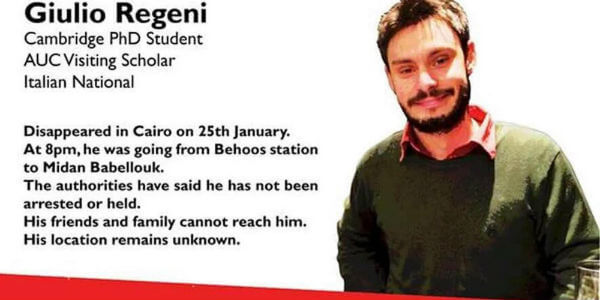
Who murdered Giulio Regeni?

GIULIO-REGENI

Alexander Stille writes: When six senior Italian detectives arrived in Cairo in early February, following the discovery of the brutally battered body of 28-year-old Italian PhD student Giulio Regeni, they faced long odds of solving the mystery of his disappearance and death. Egyptian officials had told reporters that Regeni had probably been hit by a car, but clear signs of torture on his body had raised an alarm in Rome.

The Egyptian authorities guaranteed “full cooperation”, but this was quickly revealed to be a hollow promise. The Italians were allowed to question witnesses – but only for a few minutes, after the Egyptian police had finished their own much longer interrogations, and with the Egyptian police still in the room. The Italians requested the video footage from the metro station where Regeni last used his mobile phone, but the Egyptians allowed several days to elapse, by which time the footage from the day of his disappearance had been taped over. They also refused to share the mobile phone records from the area around Regeni’s home, where he disappeared on 25 January, and the site where his body was found nine days later.

One of the Egyptian chief investigators in charge of the Regeni case, Major General Khaled Shalaby, who told the press that there were no signs of foul play, is a controversial figure. Convicted of kidnapping and torture over a decade ago, he escaped with a suspended sentence.

The Egyptians may well have hoped that the outside world, with no independent information, would have little choice but to accept their unsatisfying explanation for Regeni’s death. But in the digital age, getting away with murder has become more difficult. [Continue reading…]

Facebooktwittermail

Yahoo secretly scanned customer emails for U.S. intelligence

Reuters reports: Yahoo Inc last year secretly built a custom software program to search all of its customers’ incoming emails for specific information provided by U.S. intelligence officials, according to people familiar with the matter.

The company complied with a classified U.S. government demand, scanning hundreds of millions of Yahoo Mail accounts at the behest of the National Security Agency or FBI, said three former employees and a fourth person apprised of the events.

Some surveillance experts said this represents the first case to surface of a U.S. Internet company agreeing to an intelligence agency’s request by searching all arriving messages, as opposed to examining stored messages or scanning a small number of accounts in real time.

It is not known what information intelligence officials were looking for, only that they wanted Yahoo to search for a set of characters. That could mean a phrase in an email or an attachment, said the sources, who did not want to be identified.

Reuters was unable to determine what data Yahoo may have handed over, if any, and if intelligence officials had approached other email providers besides Yahoo with this kind of request.

According to two of the former employees, Yahoo Chief Executive Marissa Mayer’s decision to obey the directive roiled some senior executives and led to the June 2015 departure of Chief Information Security Officer Alex Stamos, who now holds the top security job at Facebook Inc. [Continue reading…]

The Wall Street Journal reports: Big technology companies, including Google, Microsoft Corp., Twitter Inc. and Facebook Inc. denied scanning incoming user emails on behalf of the U.S. government, following a report that Yahoo Inc. had built such a system. [Continue reading…]

Facebooktwittermail

Why Egypt’s migrants risk their lives

Bel Trew writes: The smugglers forced the last 100 frightened migrants to board a listing ship at knifepoint. They were 12 kilometers (8 miles) off the Egyptian coast and the battered fishing boat was already packed. The smugglers snarled death threats at the appointed “captain” who refused to set sail for Italy because, with over 450 people on board, the vessel was dangerously overloaded.

One we’ll call Mohamed, because he is only 17, is an impoverished Egyptian tuk-tuk driver who waited on the bow of the crammed ship with a dozen of this friends as the fight erupted. It was 4:00 a.m. and nearly light but the new influx of passengers had sparked panic on deck.

The battered ribs of the ship began to groan as the shifting weight rocked the vessel violently to the side. Locked inside a fish refrigerator in the hold, dozens of people clawed at the walls to get out.

Mohamed and his 15-year-old friend, whom we’ll call Osman, were the first to jump into the churning water after failing to coax their best friend Karim, also 15, to join them. Karim, like many others on board the boat, could not swim.

“From the water I saw something snap on top and the boat suddenly flipped on its side. It was as if it was sucked under the waves,” Mohamed said days later from his impoverished hometown of Green Island, east of Alexandria.

“We watched people drowning each other to get air. The living were floating on the dead,” he added, his voice cracking.

Osman spotted Karim, 15, clutching onto a water bottle. “He was slipping. We tried to reach him. But I looked back and he was gone.”

The two boys, who swam for seven hours looking for land, were among the 163 people dragged out of the water by fishermen, who came to their rescue when the Egyptian coastguard failed to show up.

An estimated 300 people from Egypt, Sudan, Eritrea, Syria, and Somalia drowned that morning of Sept. 21, although only 202 bodies have so far been recovered. On Tuesday, 33 corpses, some unrecognizable after a week on the sea floor, were pulled out of the hull of the ship, which was finally brought to the surface and towed to shore.

Dozens of Egyptian children like Mohamed were onboard, part of an increasing number of minors leaving alone for Italy, because they cannot be repatriated under Italian law and so can stay to make money to send home.

Over 16,863 unaccompanied children have made the perilous Mediterranean crossing from North Africa to Italy so far this year, nearly double the 8,354 who traveled last year, according to an email sent to me by Save The Children. Over 2,666 of those unaccompanied minors were Egyptian, more than triple the 854 who traveled in the same period last year.

Desperation is driving families to urge their young sons to take the deadly 10-day sea trip. A crumbling economy in Egypt, fueled by five years of unrest and political oppression, means few have opportunities if they stay. [Continue reading…]

Facebooktwittermail