Category Archives: Issues

Martin Bosma — Geert Wilders’ brain

Politico reports: Look at photographs of Geert Wilders in the Dutch parliament, and the camera often shows a figure seated behind him: Martin Bosma, the polemicist of the Freedom Party (PVV).

A former journalist, whose side-swept brown hair keeps him a youthful 52, Bosma is often described in Dutch media as the PVV’s ideologist. “He’s the brain. He invented the PVV,” said Geert Tomlow, a former parliamentary elections candidate from the party.

Bosma’s ideas are bearing fruit at just the right time, with the PVV leading in the polls five months from a general election that could see the party double in size in the parliament. He and Wilders have helped push the center-ground of Dutch politics to the Right and mainstreamed positions once confined to the fringe.

Since entering parliament a decade ago, Bosma has published two books, each released to a flurry of television interviews and controversy.

The autobiographical “The Fake Elite of the Counterfeiters” takes aim at a left-wing clique he accuses of taking over cultural institutions and allowing immigration in an underhand coup to achieve radical aims by stealth.

“Minority in One’s Own Land” turns to South African history. Bosma argues that the predominantly Dutch-descended settlers, the Afrikaners, became outnumbered by black South Africans and subjected to “cultural genocide” and “Apartheid 2.0” in events he warns could foreshadow the fate of the Netherlands. [Continue reading…]

Facebooktwittermail

How Donald Trump is promoting Russian disinformation to American voters

Kurt Eichenwald writes: I am Sidney Blumenthal. At least, that is what Vladimir Putin — and, somehow, Donald Trump — seem to believe. And that should raise concerns about not only Moscow’s attempts to manipulate this election but also how Trump came to push Russian disinformation to American voters.

An email from Blumenthal — a confidant of Hillary Clinton and a man, second only to George Soros, at the center of conservative conspiracy theories — turned up in the recent document dump by WikiLeaks. At a time when American intelligence believes Russian hackers are trying to interfere with the presidential election, records have been fed recently to WikiLeaks out of multiple organizations of the Democratic Party, raising concerns that the self-proclaimed whistleblower group has become a tool of Putin’s government. But now that I have been brought into the whole mess — and transformed into Blumenthal — there is even more proof that the Russians are not only orchestrating this act of cyberwar but also really, really dumb.

The evidence emerged thanks to the incompetence of Sputnik, the Russian online news and radio service established by the government-controlled news agency, Rossiya Segodnya.

The documents that WikiLeaks has unloaded recently have been emails out of the account of John Podesta, the chairman of Clinton’s election campaign. Almost as soon as the pilfered documents emerged, Sputnik was all over them and rapidly found (or probably already knew about before the WikiLeaks dump) a purportedly incriminating email from Blumenthal.

The email was amazing — it linked Boogie Man Blumenthal, Podesta and the topic of conservative political fever dreams, Benghazi. This, it seemed, was the smoking gun finally proving Clinton bore total responsibility for the attack on the American outpost in Libya in 2012. Sputnik even declared that the email might be the “October surprise” that could undermine Clinton’s campaign. [Continue reading…]

Facebooktwittermail

Trump: ‘It is so nice that the shackles have been taken off me’

Politico reports: Donald Trump celebrated his freedom from the Republican establishment Tuesday, boasting that it’s “so nice” to be unchained.

Trump’s tweet was a tacit attack on House Speaker Paul Ryan, whom the Republican nominee has continued to lash out at since the top elected Republican on Monday told his conference he would no longer defend Trump.

“It is so nice that the shackles have been taken off me and I can now fight for America the way I want to,” Trump tweeted.

The real estate mogul also highlighted the chasm in the Republican Party, conceding that Democrats are “far more loyal” than the GOP. More than two dozen Republicans have either said they will no longer support their nominee or called on him to step aside from the top of the ticket since a tape emerged Friday showing Trump speaking in incredibly lewd terms about sexually assaulting women. [Continue reading…]

While Trump is angered by the lack of support he is receiving from much of the Republican establishment, his campaign seems to be signalling that it has no problem with his supporters not bothering to vote for other Republican candidates.

Katrina Pierson, Trump’s national campaign spokeswoman, tweeted yesterday:

Facebooktwittermail

UN chief condemns airstrike on Yemeni funeral and dismisses Saudi denials

The New York Times reports: The United Nations secretary general, Ban Ki-moon, on Monday condemned a weekend airstrike on a funeral ceremony in the Yemeni capital, Sana, as well as the Saudi-led bombing campaign believed to be responsible for it.

Mr. Ban said he supported demands for an international inquiry into whether the attack, which killed at least 140 people, was a war crime.

“Despite mounting crimes by all parties to the conflict, we have yet to see the results of any credible investigations,” he said. “This latest horrific incident demands a full inquiry.”

Brushing aside Saudi Arabia’s initial denials of responsibility, he said reports from the site of the attack indicated that it was carried out by the Saudi-led coalition.

According to witness accounts cited by United Nations human rights investigators, two airstrikes struck the Al Kubra community hall in Sana, seven to eight minutes apart. It was packed with families attending the funeral of a leader of the Houthi rebel movement, which is battling the Saudi-backed government of President Abdu Rabbu Mansour Hadi for control of the country. Many prominent military and political leaders associated with the Houthis were in the hall and were killed in the assault, the United Nations said. [Continue reading…]

The Intercept reports: Fragments of what appear to be U.S.-made bombs have been found at the scene of one of the most horrific civilian massacres of Saudi Arabia’s 18-month air campaign in Yemen.

Aircraft from the Saudi-led coalition on Saturday bombed a community hall in Sana’a, Yemen’s capital city, where thousands of people had gathered for a funeral for Sheikh Ali al-Rawishan, the father of the rebel-appointed interior minister. The aircraft struck the hall four times, killing more than 140 people and wounding 525. One local health official described the aftermath as “a lake of blood.”

Multiple bomb fragments at the scene appear to confirm the use of American-produced MK-82 guided bombs. One fragment, posted in a picture on the Facebook page of a prominent Yemeni lawyer, says “FOR USE ON MK-82 FIN, GUIDED BOMB.” [Continue reading…]

Facebooktwittermail

Lies, damned lies, and politics

Ned O’Gorman writes: Early into last night’s debate, Donald Trump found himself in an awkward position. No, I am not talking about the question first asked about the Access Hollywood tape on which he boasts of sexual assault. I am talking about a more subtle moment: early on Donald Trump found himself calling himself a “politician,” incredulously admitting, “I can’t believe I am saying that about myself.”

Almost one hundred years ago, the German social theorist Max Weber gave a lecture in Munich called “Politics as Vocation” in which he argued that there was a big difference between the “occasional” politician and the “professional” politician. We are all, he claimed, occasional politicians, in as much as we all may vote, circulate a pamphlet or petition, or give a stump speech. But professional politicians are a different breed: For them politics is a vocation, a calling, and with the vocation comes certain burdens and responsibilities.

The biggest problem with Donald Trump in this election cycle is that he is, in fact, no politician, at least not in a vocational sense. And contrary to popular belief, that is a very bad thing for a person running for president. [Continue reading…]

Facebooktwittermail

Everything Donald Trump says about Syria is crazy, wrong, or both

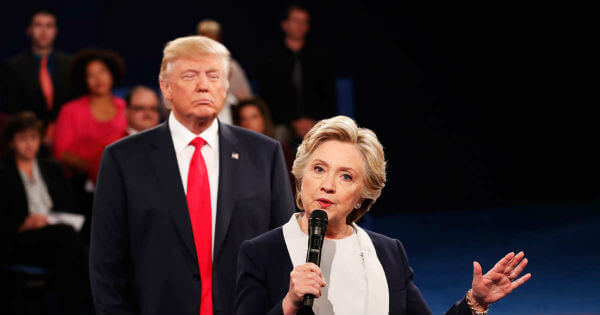
hovering-trump

Michael Weiss writes: Well, now I prefer the guy who didn’t know what Aleppo is.

In the second presidential debate, during which Hillary Clinton looked as if she could profit from her own no-fly zone against her menacingly hovering opponent, Donald Trump made a series of assertions about the five-year-old humanitarian catastrophe in Syria that no one with access to Google, much less classified intelligence, ever ought to make. That he managed to do this while both deferring to a theocratic—excuse me, Islamic terrorist—regime he claims to reprehend and also humiliating his own running-mate in the process was a masterstroke of Trumpist illogic and megalomania.

By way of reaffirming his faith in a better working relationship with the Kremlin (whose hacking of the Democratic National Committee he again doubted), Trump stated that “Assad is killing ISIS. Russia is killing ISIS. And Iran is killing ISIS.” He sees this as proof of absent American leadership, and is quite comfortable being on their side in a civilizational struggle, even though he hates the fact that Iran is richer and only able to war against the Sunni extremists thanks to Obama’s nuclear deal.

In point of fact, none of the parties Trump rattled off has demonstrated much of a keenness or willingness to fight ISIS in Syria, as a bevy of U.S. officials and independent monitors have repeatedly pointed out. [Continue reading…]

Facebooktwittermail

A short list of Trump’s debate lies

David Leonhardt writes: He lied about a sex tape.

He lied about his lies about ‘birtherism.’

He lied about the growth rate of the American economy.

He lied about the state of the job market.

He lied about the trade deficit.

He lied about tax rates.

He lied about his own position on the Iraq War, again.

He lied about ISIS.

He lied about the Benghazi attack.

He lied about the war in Syria.

He lied about Syrian refugees.

He lied about Russia’s hacking.

He lied about the San Bernardino terrorist attack.

He lied about Hillary Clinton’s tax plan.He lied about her health care plan.

He lied about her immigration plan.

He lied about her email deletion.

He lied about Obamacare, more than once.

He lied about the rape of a 12-year-old girl.

He lied about his history of groping women without their consent.

Finally, he broke with basic democratic norms and called on his political opponent to be jailed — because, in large part, of what he described as her dishonesty. [Continue reading…]

Facebooktwittermail

Trump stalking Clinton

NBC News reports: Donald Trump was accused by his rival’s campaign of “menacingly stalking” Hillary Clinton on stage at Sunday night’s debate, with even a prominent supporter likening the billionaire to a gorilla.

The Republican nominee took full advantage of the town hall debate format by moving around in front of the cameras rather than sitting on his chair.

However, his tactic drew widespread criticism in post-debate commentary and on social media.

“Take a seat, loser!” was the front page headline in the New York Daily News, next to a picture of Trump clutching the back of his seat.

Camera angles gave Trump a looming presence as he moved around in the background behind Clinton.

“If a man did that to me on the street … I’d call 911,” political commentator and former Republican strategist Nicolle Wallace said. [Continue reading…]

Facebooktwittermail

U.S. ‘could be implicated in war crimes’ in Yemen

Reuters reports: The Obama administration went ahead with a $1.3 billion arms sale to Saudi Arabia last year despite warnings from some officials that the United States could be implicated in war crimes for supporting a Saudi-led air campaign in Yemen that has killed thousands of civilians, according to government documents and the accounts of current and former officials.

State Department officials also were privately skeptical of the Saudi military’s ability to target Houthi militants without killing civilians and destroying “critical infrastructure” needed for Yemen to recover, according to the emails and other records obtained by Reuters and interviews with nearly a dozen officials with knowledge of those discussions.

U.S. government lawyers ultimately did not reach a conclusion on whether U.S. support for the campaign would make the United States a “co-belligerent” in the war under international law, four current and former officials said. That finding would have obligated Washington to investigate allegations of war crimes in Yemen and would have raised a legal risk that U.S. military personnel could be subject to prosecution, at least in theory.

For instance, one of the emails made a specific reference to a 2013 ruling from the war crimes trial of former Liberian president Charles Taylor that significantly widened the international legal definition of aiding and abetting such crimes.

The ruling found that “practical assistance, encouragement or moral support” is sufficient to determine liability for war crimes. Prosecutors do not have to prove a defendant participated in a specific crime, the U.N.-backed court found.

Ironically, the U.S. government already had submitted the Taylor ruling to a military commission at Guantanamo Bay, Cuba, to bolster its case that Khalid Sheikh Mohammed and other al Qaeda detainees were complicit in the Sept 11, 2001 attacks. [Continue reading…]

Facebooktwittermail

Even the U.S. military is looking at blockchain technology — to secure nuclear weapons

Quartz reports: Blockchain technology has been slow to gain adoption in non-financial contexts, but it could turn out to have invaluable military applications. DARPA, the storied research unit of the US Department of Defense, is currently funding efforts to find out if blockchains could help secure highly sensitive data, with potential applications for everything from nuclear weapons to military satellites.

The case for using a blockchain boils down to a concept in computer security known as “information integrity.” That’s basically being able to track when a system or piece of data has been viewed or modified. DARPA’s program manager behind the blockchain effort, Timothy Booher, offers this analogy: Instead of trying to make the walls of a castle as tall as possible to prevent an intruder from getting in, it’s more important to know if anyone has been inside the castle, and what they’re doing there.

A blockchain is a decentralized, immutable ledger. Blockchains can permanently log modifications to a network or database, preventing intruders from covering their tracks. In DARPA’s case, blockchain tech could offer crucial intelligence on whether a hacker has modified something in a database, or whether they’re surveilling a particular military system. [Continue reading…]

Facebooktwittermail

A plan to defend against the war on science

Shawn Otto writes: Four years ago in Scientific American, I warned readers of a growing problem in American democracy. The article, entitled “Antiscience Beliefs Jeopardize U.S. Democracy,” charted how it had not only become acceptable, but often required, for politicians to embrace antiscience positions, and how those positions flew in the face of the core principles that the U.S. was founded on: That if anyone could discover the truth of something for him or herself using the tools of science, then no king, no pope and no wealthy lord was more entitled to govern the people than they were themselves. It was self-evident.

In the years since, the situation has gotten worse. We’ve seen the emergence of a “post-fact” politics, which has normalized the denial of scientific evidence that conflicts with the political, religious or economic agendas of authority. Much of this denial centers, now somewhat predictably, around climate change — but not all. If there is a single factor to consider as a barometer that evokes all others in this election, it is the candidates’ attitudes toward science.

Consider, for example, what has been occurring in Congress. Rep. Lamar Smith, the Texas Republican who chairs the House Committee on Science, Space and Technology, is a climate change denier. Smith has used his post to initiate a series of McCarthy-style witch-hunts, issuing subpoenas and demanding private correspondence and testimony from scientists, civil servants, government science agencies, attorneys general and nonprofit organizations whose work shows that global warming is happening, humans are causing it and that — surprise — energy companies sought to sow doubt about this fact.

Smith, who is a Christian Scientist and seems to revel in his role as the science community’s bête noire, is by no means alone. Climate denial has become a virtual Republican Party plank (and rejecting the Paris climate accord a literal one) with a wide majority of Congressional Republicans espousing it. Sen. Ted Cruz (R–Texas), chairman of the Senate’s Subcommittee on Space, Science and Competitiveness, took time off from his presidential campaign last December to hold hearings during the Paris climate summit showcasing well-known climate deniers repeating scientifically discredited talking points.

The situation around science has grown so partisan that Hillary Clinton turned the phrase “I believe in science” into the largest applause line of her convention speech accepting the Democratic Party nomination. Donald Trump, by contrast, is the first major party presidential nominee who is an outright climate denier, having called climate science a “hoax” numerous times. In his responses to the organization I helped found, ScienceDebate.org, which gets presidential candidates on the record on science, he told us that “there is still much that needs to be investigated in the field of ‘climate change,’” putting the term in scare quotes to cast doubt on its reality. When challenged on his hoax comments, campaign manager Kellyanne Conway affirmed that Trump doesn’t believe climate change is man-made. [Continue reading…]

Facebooktwittermail

Seagrass is a marine powerhouse, so why isn’t it on the world’s conservation agenda?

By Richard K.F. Unsworth, Swansea University; Jessie Jarvis, University of North Carolina Wilmington; Len McKenzie, James Cook University, and Mike van Keulen, Murdoch University

Seagrass has been around since dinosaurs roamed the earth, it is responsible for keeping the world’s coastlines clean and healthy, and supports many different species of animal, including humans. And yet, it is often overlooked, regarded as merely an innocuous feature of the ocean.

But the fact is that this plant is vital – and it is for that reason that the World Seagrass Association has issued a consensus statement, signed by 115 scientists from 25 countries, stating that these important ecosystems can no longer be ignored on the conservation agenda. Seagrass is part of a marginalised ecosystem that must be increasingly managed, protected and monitored – and needs urgent attention now.

Seagrass meadows are of fundamental importance to human life. They exist on the coastal fringes of almost every continent on earth, where seagrass and its associated biodiversity supports fisheries’ productivity. These flowering plants are the powerhouses of the sea, creating life in otherwise unproductive muddy environments. The meadows they form stabilise sediments, filter vast quantities of nutrients and provide one of the planet’s most efficient oceanic stores of carbon.

But the habitat seagrasses create is suffering due to the impact of humans: poor water quality, coastal development, boating and destructive fishing are all resulting in seagrass loss and degradation. This leads in turn to the loss of most of the fish and invertebrate populations that the meadows support. The green turtle, dugong and species of seahorse, for example, all rely on seagrass for food and shelter, and loss endangers their viability. The plants are important fish nurseries and key fishing grounds. Losing them puts the livelihoods of hundreds of millions of people at risk too, and exposes them to increasing levels of poverty.

Continue reading

Facebooktwittermail

The alt-right’s fight against ‘the systematic browbeating of the white male’

Sanjiv Bhattacharya reports: It’s not every day that a brown journalist gets to sit in on a white-nationalist strategy meeting. But these are strange times. Racism is trending. Like Brexit, Trump has normalised views that were once beyond the pale, and groups like the AFP have grown bold. Their man’s stubby orange fingers are within reach of actual power, so maybe it’s time to emerge from the shadows at last.

I first met [William] Johnson [the chairman of the white nationalist American Freedom Party (AFP)] in May after he signed up as a Trump delegate before being swiftly struck off by the campaign when the press found out. He’s a surprising figure. An avid environmentalist, fluent in Japanese and, in person, not the bitter old racist I’d expected but rather a jolly Mormon grandfather, bright eyed and chuckling, a Wind in the Willows character. Eric is even more unexpected. Tall and impassioned, he came to racism via hypnotherapy, of all things. He sells solar panels for a living and practises yoga. Together with his friends Matt and Nathan, who are also here at lunch, he runs an alt-right fraternity in Manhattan Beach – “a beer and barbecues thing”. They’re called the Beach Goys. “We’re starting a parody band,” he beams. “We’ve found a drummer!”

Between them they represent two poles of a racist spectrum, young and old. And judging from this lunch, it’s the millennials who are the more extreme. Johnson wants white nationalists to appear less mean and he finds the “JQ”, the Jewish Question, archaic. But Eric loves the meanness of the alt right. “We’re the troll army!” he says. “We’re here to win. We’re savage!” And antisemitism is non-negotiable. In fact, he’d like to clear up a misnomer about the alt right, propagated by the Breitbart columnist Milo Yiannopoulos, who is often described, mistakenly, as the movement’s leader. Milo casts the alt right as principally a trolling enterprise, dedicated to attacking liberal shibboleths for the “lulz”– there’s precious little actual bigotry. But Eric insists otherwise. Yes, they like to joke, they have memes, they’re just as funny as liberals – have I heard of their satirical news podcasts, the Daily Shoah and Fash the Nation? But make no mistake, the racism is real. Eric especially enjoys The Daily Stormer, a leading alt-right news site, which is unashamedly pro-Hitler. [Continue reading…]

Facebooktwittermail

How U.S. torture left legacy of damaged minds

The New York Times reports: Before the United States permitted a terrifying way of interrogating prisoners, government lawyers and intelligence officials assured themselves of one crucial outcome. They knew that the methods inflicted on terrorism suspects would be painful, shocking and far beyond what the country had ever accepted. But none of it, they concluded, would cause long lasting psychological harm.

Fifteen years later, it is clear they were wrong.

Today in Slovakia, Hussein al-Marfadi describes permanent headaches and disturbed sleep, plagued by memories of dogs inside a blackened jail. In Kazakhstan, Lutfi bin Ali is haunted by nightmares of suffocating at the bottom of a well. In Libya, the radio from a passing car spurs rage in Majid Mokhtar Sasy al-Maghrebi, reminding him of the C.I.A. prison where earsplitting music was just one assault to his senses.

And then there is the despair of men who say they are no longer themselves. “I am living this kind of depression,” said Younous Chekkouri, a Moroccan, who fears going outside because he sees faces in crowds as Guantánamo Bay guards. “I’m not normal anymore.”

After enduring agonizing treatment in secret C.I.A. prisons around the world or coercive practices at the military detention camp at Guantánamo Bay, Cuba, dozens of detainees developed persistent mental health problems, according to previously undisclosed medical records, government documents and interviews with former prisoners and military and civilian doctors. Some emerged with the same symptoms as American prisoners of war who were brutalized decades earlier by some of the world’s cruelest regimes. [Continue reading…]

Facebooktwittermail

Polish workers, Indian students and Italian politicians voice fears over Brexit effect on British culture

The Observer reports: Two young Polish women on the train from Gatwick into London are chattering away, bags at their feet. Off the flight from Kraków after five days at home with family, they followed the news, and the speeches, from Britain all week. “You have to – so as to get an idea of how long before we will be driven out of England. I’m sure it will happen,” said Angela, who is the manager of a gastropub near Oxford.

“It’s sad this is the way things are going because I was pleased to have a woman prime minister, but my boss said to me it will be bad. He’s angry because he wants to choose staff for how good they are, not their nationality. He says it will be hard to replace me, which is nice to hear,” she said.

Angela and her friend, Martina, are among the 600,000 people who will not have been in the UK for five years – giving, under present rules, permanent residency rights – by the time the UK leaves the EU in 2019. Now she and her friend are alarmed by the tone of the rhetoric that emerged from last week’s Tory conference. They are among thousands across Europe and beyond who fear that life for people hoping to settle in Britain may be about to become more difficult.

Of the 2.1 million EU nationals employed in the UK, Poles are the biggest group. Of EU nationals in the UK, Poles number 916,000, Irish 332,000, Romanians 233,000 and Portuguese 219,000, according to latest figures from the Office of National Statistics.

“My cousin is a priest here, he would rather be in Poland, close to his old mother, but he came where there is a shortage [of priests] and to be where he is needed. Britain does need workers,” Angela said. “In Poland people are worried, shocked. They say Britain is now dangerous and tell stories in the newspaper of race attacks and murders. People are scared if their children are living here,” she added. [Continue reading…]

Facebooktwittermail

How aphasic patients understood the presidential debate

Susie Neilson writes: In The President’s Speech, a 1985 essay by the late neurologist and writer Oliver Sacks, he observes a group of people with aphasia, a language disorder, as they laugh uproariously at the television. The cause of their amusement is an unnamed actor-turned United States president, presumably Ronald Reagan, addressing his audience: “There he was, the old Charmer, the Actor, with his practised rhetoric, his histrionisms, his emotional appeal…The President was, as always, moving—but he was moving them, apparently, mainly to laughter. What could they be thinking? Were they failing to understand him? Or did they, perhaps, understand him all too well?

Aphasic patients have a heightened ability to interpret body language, tonal quality, and other non-verbal aspects of communication due to a disruption of their speech, writing, reading, or listening abilities. Each aphasic person may have disruptions in any or all of these areas. Usually, the damage comes from a stroke or other head trauma — many people become aphasic in the wake of combat, for example, or after car accidents. “The key,” says Darlene Williamson, a speech pathologist specializing in aphasia and president of the National Aphasia Association, “is intelligence remains intact.”

In this sense, Williamson says, having aphasia is akin to visiting a foreign country, where everyone is communicating in a language you are conversational in at best. “The more impaired your language is,” she says, “the harder you’re working to be sure that you’re comprehending what’s going on.” How do we do this? By paying more careful attention to the cues we can understand, Williamson says. [Continue reading…]

Facebooktwittermail

Panama: The hidden trillions

Alan Rusbridger writes: In a seminar room in Oxford, one of the reporters who worked on the Panama Papers is describing the main conclusion he drew from his months of delving into millions of leaked documents about tax evasion. “Basically, we’re the dupes in this story,” he says. “Previously, we thought that the offshore world was a shadowy, but minor, part of our economic system. What we learned from the Panama Papers is that it is the economic system.”

Luke Harding, a former Moscow correspondent for The Guardian, was in Oxford to talk about his work as one of four hundred–odd journalists around the world who had access to the 2.6 terabytes of information about tax havens — the so-called Panama Papers — that were revealed to the world in simultaneous publication in eighty countries this spring. “The economic system is, basically, that the rich and the powerful exited long ago from the messy business of paying tax,” Harding told an audience of academics and research students. “They don’t pay tax anymore, and they haven’t paid tax for quite a long time. We pay tax, but they don’t pay tax. The burden of taxation has moved inexorably away from multinational companies and rich people to ordinary people.”

The extraordinary material in the documents drew the curtain back on a world of secretive tax planning, just as WikiLeaks had revealed the backroom chatter of diplomats and Edward Snowden had shown how intelligence agencies could routinely scoop up vast server farms of data on entire populations. The Panama Papers — a name chosen for its echoes of Daniel Ellsberg’s 1971 leak of the Pentagon Papers — unveiled how a great many rich individuals used one Panamanian law firm, Mossack Fonseca (“Mossfon” for short), to shield their money from prying eyes, whether it was tax authorities, law enforcement agencies, or vengeful former spouses. [Continue reading…]

Facebooktwittermail

Donald Trump and the comeuppance of New York’s capital class

Benjamin Wallace-Wells writes: The political drama of the week [before the weekend] — the revelation that, in 1995, Donald Trump claimed nine hundred and sixteen million dollars in losses and as a result might not have had to pay any federal income taxes for two decades — was a New York story in every particular. Its theme was the comeuppance of the capital class by the hand of brainier, laboring professionals. It had a midtown office-tower setting and an earnest protagonist, the Times metro reporter Susanne Craig, who found Trump’s tax returns because she is a compulsive checker of her newsroom mailbox. It had a vengeful ghost: whichever shrewd, jilted ex-wife or shrewd, jilted ex-C.P.A. photocopied the returns and sent them to the press in the first place. And, at the center of it all, there was an eighty-year-old real-estate accountant named Jack Mitnick.

Mitnick functioned both as the story’s narrative pivot and its moral anchor. His signature was on one of the tax forms sent to the Times, and the paper’s reporters tracked him down in Florida, where Mitnick now lives in semiretirement, to try to confirm that the documents were authentic. Mitnick was wary, but eventually he agreed to meet a reporter in a bagel shop. The Times describes the scene: “ ‘This is legit,’ he said, stabbing his finger into the documents.” That “stabbing” is a nice flourish. It describes, after all, the story’s essential plot. [Continue reading…]

Facebooktwittermail