Category Archives: Issues

How Saudi Arabia captured Washington

yemen-bombing

Max Fisher reports: There was a moment almost exactly one year ago, in March 2015, that revealed some uncomfortable truths about America’s relationship with Saudi Arabia.

That month, as Saudi Arabia prepared to launch what would become its disastrous war against Shia rebels in neighboring Yemen, the Saudi ambassador in Washington, Adel al-Jubeir, brought a list of “high-value targets” to CIA Director John Brennan. The Saudis were asking for American support in the war; the list was meant as a show of cooperation.

But when US intelligence agencies checked the list against their own information, they found that many of the targets had little or no military value, according to a report at the time by the Wall Street Journal’s Maria Abi-Habib and Adam Entous. Many were civilian structures in or near population centers.

The US warned Saudi Arabia off the targets, and Saudi officials said they complied. But when the air war began, Saudi bombs fell heavily on “hospitals, schools, a refugee camp, and neighborhoods,” according to the Journal.

The US initially held back from the war. But soon, in an apparent effort to purchase Saudi acquiescence to the nuclear deal with Iran, the US substantially increased support for the Saudi-led campaign, providing midair refueling, weapons and supplies, targeting information, and 45 dedicated intelligence analysts.

A year after the war began, it is now a disaster, as detailed in a New York Times account. Half of the 6,000 casualties are thought to be civilians; al-Qaeda’s hold in Yemen has strengthened; Saudi Arabia has failed in its objective to force the war’s end, instead only exacerbating the ongoing violence. The US has helped Saudi Arabia to accelerate the implosion of another Mideast state, with unknown but surely far-reaching implications.

You would think that Washington’s foreign policy community — a close-knit network of think tanks, academic outfits, and other institutions that heavily influence the media and whose members frequently rotate into and out of government positions — would be outraged. That community is overwhelmingly focused on the Middle East, prides itself on high-minded humanitarian ideals and far-thinking strategy, and is often critical of President Obama’s foreign policy.

But aside from a few dissident voices, the Washington foreign policy community has been relatively quiet on America’s involvement backing Saudi Arabia’s war in Yemen. Instead, this week, much of that community expressed outrage over a very different story about the US relationship with Saudi Arabia: Obama, in an interview, had seemed to deride the Saudi leadership and its influence in Washington. [Continue reading…]


Facebooktwittermail

The Syrian refugees of Gaza

Creede Newton reports: On a bustling Gaza street lined with restaurants, juice vendors and shawarma stands, one facade immediately catches the eye: A large, modernist black cube sits atop the entrance to Syriana – Arabic for ‘our Syria’.

“The rest should be here soon,” says Wareef Kaseem Hamdeo, the visibly tired chef and proprietor of the restaurant, as he sits down for his first break of the day. It is early afternoon and he has been here since early morning.

The 35-year-old Syrian left Aleppo in 2012 when the bombs of President Bashar al-Assad’s forces began falling onto the city in an attempt to stamp out the then-nascent armed resistance to his rule.

He travelled to Turkey and then to Egypt, enduring a 44-hour voyage across the Mediterranean Sea. As a seasoned chef with his own restaurant in Aleppo and a degree in mechanical engineering, Hamdeo felt confident that he would find work in Egypt.

He did. It was mostly informal employment – cooking and decorating hotels. But after two months, a Syrian who had eaten in his restaurant back in Aleppo offered him work as a chef in Cairo. A second opportunity came along to open a restaurant in Poland. Both options were tempting, but as he pondered over each one, a third emerged: a job in Gaza.

He immediately and resolutely refused. But when a Palestinian acquaintance urged him to visit, he tentatively obliged. Hamdeo fell in love with the seaside enclave. “It reminded me of Syria,” he says.

Now, three years after he first travelled through the dark, damp tunnels connecting Egypt and Gaza, which are constantly at risk of collapse or flooding by the Egyptian military, his life has changed considerably: He has survived Israel’s 2014 attack on the Gaza Strip, found love with a Palestinian journalist who had interviewed him shortly after his arrival, and successfully opened his own restaurant.

In spite of this, Hamdeo feels he has to leave, and it is now or never. He reads the news and hears that relations between Hamas, which governs the Gaza Strip, and Egypt are deteriorating; he sees growing tensions with Israel and believes further trouble is looming. He is, simply, tired of war. [Continue reading…]

Facebooktwittermail

Is the Kurdish plan foolhardy or first-rate?

Hassan Hassan writes: The Syrian Kurdish Democratic Union Party, or PYD, made history last week when it announced a federal system in northern Syria. The declaration is both symbolic and catalytic, and there are reasons to believe it is not as foolhardy as many think. Although Syrian and Iraqi Kurds differ on many issues, the move has linked the adjoining territories controlled by Kurds, who prevail over a combined territory the size of Sri Lanka.

In Syria, the PYD controls approximately 10,000 square miles, roughly two-thirds of the territory ruled by Iraqi Kurds. In October, the party seized more territory after gains against ISIL in northern Syria. Since then, the group’s military wing, the YPG, drove out ISIL from southern Hasaka. This has galvanised Kurdish activists who dream of statehood for “the world’s largest stateless nation”.

On the other hand, the news agitated almost everyone else involved in the conflict in Syria, including putative Kurdish allies such as Haitham Mannaa, a Syrian opposition figure who has distanced himself from mainstream rebels. The US too stated it would not recognise the federacy. Turkey, unsurprisingly, rejected it.

Local populations in northeastern Syria also fear the YPG’s nationalist project, particularly after incidents, documented by Amnesty International, of home demolition and forced displacement by the Kurdish militia against Arab families.

From the outside, the project appears to be a fool’s errand. In Iraq, Kurds carved out a semi-autonomous region after the US-led coalition forces declared a safe haven inside Iraq in 1991. In Syria, the Kurds are outnumbered and surrounded by hostile Arab demographics and armed groups, not to mention Turkey. Kurdish-majority areas are also scattered throughout northern Syria. [Continue reading…]

Shiar Neyo writes: I do support the right of Kurds and other minorities in Syria to self-determination, and I do believe that federalism is better than a centralist state. However, federalism by definition requires all concerned units or parts to agree to this system of governance because they believe it is better for all of them.

Not only were other parts of Syria and other Syrian political and military forces not consulted and not involved, even people and political parties within the so-called self-administration areas were not involved in the process.

There should have been a long process of consultation and negotiation followed by a general referendum, which are clearly not possible at the moment, rather than a hasty two-day conference clearly dominated by the PYD to ‘discuss’ and agree an equally badly written and quite confused founding document deciding important issues that affect all Syrians. It was clearly a politically motivated move.

The declaration came soon after the PYD forces attacked Syrian opposition factions and took over some areas in north Syria with the support of Russian air strikes and Iranian-led ground assaults. It is indeed telling that the founding document dedicates a whole section to the “historical development of the societal problems in the Middle East and Syria and the current situation,” tracing them back to Mesopotamia. (!) Yet it does not even mention the ongoing Syrian revolution. It only talks about war and Islamist forces backed by regional powers. [Continue reading…]

Facebooktwittermail

Following Brussels attacks, Ted Cruz says the U.S. should ‘patrol and secure’ its Muslim neighborhoods

Quartz reports: Apparently trying to one-up Donald Trump in aggressive rhetoric after attacks in Brussels today, March 22, that left at least 31 dead, Ted Cruz issued a statement calling for the US to “patrol and secure its Muslim neighborhoods.”

“For years, the West has tried to deny this enemy exists, out of a combination of political correctness and fear. We can no longer afford either. Our European allies are now seeing what comes of a toxic mix of migrants who have been infiltrated by terrorists and isolated, radical Muslim neighborhoods,” said the would-be Republican presidential nominee.

Cruz’s statement came after another one this morning, in which he simply vowed to fight “radical Islamic terrorism.” It also comes after his main rival Donald Trump went on a media blitz calling for the US to close its borders to Muslim immigration, describing Brussels as a “disaster city” and Belgium a “horror show.” “This all happened because frankly there’s no assimilation. They are not assimilating for whatever reason. They don’t want laws that we have, they want Sharia law, and you say to yourself, at what point, how much of this do you take?” Trump said. [Continue reading…]

Facebooktwittermail

Brussels attacks: A throwback to pre-9/11 terrorism

By Steve Hewitt, University of Birmingham

The terrible scenes in Brussels following a terrorist attack now claimed by Islamic State are a reminder of just how vulnerable airports can be.

In the years since the September 11 attacks in the US in 2001, a clear priority of western security agencies has been to protect airlines from bombings and hijackings. And, of course, this threat is real and has been persistent.

This attack in Belgium is something of a throwback to the pre-9/11 era. The fact that it occurred in the unsecured section of a major airport is significant and will raise difficult questions for the authorities.

Continue reading

Facebooktwittermail

Ted Cruz, not Donald Trump, is the scariest candidate standing

By Randall Stephens, Northumbria University, Newcastle

The 2016 Republican primary is now essentially a two-man race. Donald Trump has tallied an astonishing 678 delegates, while Ted Cruz, the dogmatic, far-right Texas Republican, who apparently gets along with no one in his own party, has garnered 423. Even though John Kasich, former governor and the last great hope for moderates, won his home state of Ohio, his candidacy is mathematically dead in the water; his only hope is to pull some remarkable trick at a contested convention.

For Cruz as well, it’s still an uphill battle. But depending on the outcomes of subsequent primaries, other Republican leaders may yet rally to his side. As CBS News put it: “Cruz may be the only candidate who can beat Trump in the delegate count before the convention.”

This is the mainstream party’s worst nightmare. Comedy Central’s Daily Show compared the choice between Trump and Cruz to picking between getting a blood clot or bone cancer, and to listen to the party’s establishment, the clot has so far been getting the most attention. As a Los Angeles Times headline put it, “Cruz is Scary, Trump Is Dangerous”. Jeb Bush memorably called Trump the “chaos candidate”. George W. Bush’s former press secretary, Ari Fleischer, describes Trump as a “wrecking ball”.

South Carolina senator and former GOP candidate Lindsey Graham has decided to back Cruz in a desperate effort to stop the chaos candidate, but even he once compared the decision to choosing between being poisoned or shot by a firing squad. The cyanide capsule seems to have cracked between Graham’s teeth.

Continue reading

Facebooktwittermail

Progressive only on Palestine?

Yesterday, I saw someone on Facebook express his disgust for Hillary Clinton’s speech at AIPAC by concluding that the most dangerous presidential candidates are first Clinton, second Cruz, and third Trump.

Underneath this outrage there clearly lurked a tenuous hope that Clinton’s message might have been different — that along with the predictable pandering there might have been a modicum of truth telling.

Still, it makes more sense to be disappointed that any politician chooses to speak at an AIPAC conference rather than disappointed by what they end up saying after having crossed that threshold. Everyone knows in advance that these are servile and self-serving exercises.

If we need to score such performances in some way, the criteria on which they should be assessed are their measures of cynicism, shamelessness, gall, hyperbole, and obsequiousness. By those measures, everyone tends to compete very closely.

For that reason, it’s debatable how much value there is in analyzing the specific content of any AIPAC speech when there is arguably no other venue in which such little weight can be attached to what anyone says.

Nevertheless, there is a risk that a small constituency of American voters, on the basis of her AIPAC speech (and her political history), are now leaning in the direction of believing that it would be worse to see Hillary Clinton enter the White House than it would be for Donald Trump to be elected.

Phil Weiss writes:

If there was any doubt that Hillary Clinton is running to the right of Donald Trump on Israel, she removed it this morning with a fist-pumping hard-right speech to the Israel lobby group AIPAC that mentioned Israeli settlements just once, in passing, and continually derided the idea of American “neutrality” in the conflict, which Trump has embraced.

Often projecting an adamant posture in the speech, Clinton said she was willing to use force against Iran if it violates the Iran deal, praised Israeli PM Benjamin Netanyahu, and promised to invite the PM to the White House in one of her first acts in office. She concluded the speech by thrusting her fist in the air as she vowed to take the relationship to the “next level” so that Israel and the U.S. could face the future together.

When Trump addressed the AIPAC conference yesterday afternoon, he offered a clue of how the “neutrality” of a Trump administration would work:

When I’m president, believe me, I will veto any attempt by the U.N. to impose its will on the Jewish state. It will be vetoed 100 percent.

He also said:

The United States can be useful as a facilitator of negotiations, but no one should be telling Israel that it must be and really that it must abide by some agreement made by others thousands of miles away that don’t even really know what’s happening to Israel, to anything in the area. It’s so preposterous, we’re not going to let that happen.

And in the most loyal expression of fealty to the Zionist lobby, Trump promised:

We will move the American embassy to the eternal capital of the Jewish people, Jerusalem.

Let’s assume that Trump is no less cynical than any other politician in serving up the sentiments that AIPAC wants to hear. Would it be worth voting for him on the basis of some tentative hope that he might turn out to be a great Middle East deal maker? Or, simply because you imagine that in relation to Israel, Clinton could be worse.

Hell no!

The fact that for some people, Palestine is the only issue, doesn’t actually make it the only issue. It just means they have chosen to reduce politics to the singular focus of their own passion.

Ironically, for some Palestine watchers, as humanitarian as their sensibilities might be, in recent years their focus has become so tightly constrained, they have largely averted their gaze from the worst humanitarian crisis of the twenty-first century — even as it unfolds right next door in Syria.

To be open-minded about a Trump presidency solely on the basis that on a few occasions he has broken ranks with the pro-Israel political establishment, is to overlook the fact that whatever his actions on this issue might turn out to be, he would certainly be more active in many other arenas — active in ways that pose all kinds of adverse consequences.

Even if one adopts a thoroughly agnostic position and decides that it’s impossible to predict what a President Trump might do, the question is: Do you want to take the risk of finding out?

This much we already know: Trump is a demagogue. He is vain, ignorant, extraordinarily arrogant, and deceitful. He promotes xenophobia and mob violence. He is a misogynist and a bully.

However dark your view of the U.S. presidency might be, Donald Trump isn’t fit for office.

As sickened as many Americans feel about the corrupt nature of this country’s political culture, sending Trump to Washington makes no more sense than employing an arsonist to put out a fire.

Facebooktwittermail

In speech to AIPAC, Donald Trump affirms support for Israel

The Wall Street Journal reports: Despite threats of protests, the crowd appeared largely receptive to Mr. Trump, save for a few moments. He received several rounds of cheers, with some standing to applaud him, when he said Israel would no longer be treated like a “second-class citizen” and when he criticized the Iran deal.

But he drew some titters when he said that no one had studied the Iran deal more than him — “believe me.”

Having drawn fire last year for giving an ambiguous response on a key litmus-test issue, Mr. Trump also told the audience: “We will move the American Embassy to the eternal capital of the Jewish people, Jerusalem.”

Mr. Trump’s prior insults to women and minorities had prompted protests from rabbis and other critics who threatened to walk out or boycott the address. Some attendees, wearing stickers that read “Come together against hate” — a play-off of Aipac’s theme, “Come Together” — planned to walk out before he began speaking, while protesters gathered outside.

Daniel Burg, a rabbi from Baltimore who was attending Aipac this week for the ninth year in a row, was among the attendees who walked out. “People are exercising their rights to not simply abide the presence of Mr. Trump and pretend that this election cycle is business as usual,” he said. He called the real-estate billionaire’s rhetoric “so hateful, so misogynistic, so racist” and said it had “undermined the democracy that we believe in.”

Rick Jacobs, a rabbi from New York City and president of the Union for Reform Judaism, helped author a letter to Mr. Trump requesting a meeting to discuss the community’s concerns with the front-runner, citing his comments about Mexican immigrants, women, Muslims, and other groups.

Mr. Jacobs said the campaign has said it is considering setting up a meeting later this week. “It’s not that we won’t engage with this candidate,” he said. “We want to have a chance not just to listen—we want to have a chance to speak.”

Mr. Jacobs walked out ahead of Mr. Trump’s speech and gathered with about 70 others outside the auditorium while Mr. Trump speaking. He said he saw hundreds leaving the stadium before Mr. Trump took the stage. [Continue reading…]

Politico reports: The leaders of the largest American pro-Israel lobby distanced themselves on Tuesday morning from Donald Trump’s attacks on President Barack Obama at their policy conference.

Trump addressed the annual Washington gathering of the American Israel Public Affairs Committee on Monday night, and some of his biggest applause lines were his characteristically blunt critiques of Obama, who he said “may be the worst thing to ever happen to Israel, believe me, believe me.”

AIPAC president Lillian Pinkus read a statement from the stage on Tuesday to disavow Trump’s remarks.

“We say unequivocally that we do not countenance ad hominem attacks, and we take great offense to those that are levied against the United States of America from our stage,” Pinkus said. “While we may have policy differences, we deeply respect the office of the president of the United States and our president, Barack Obama.”

She also castigated attendees who responded positively to Trump’s comments. [Continue reading…]

Facebooktwittermail

Donald Trump’s new foreign policy advisers are as rotten as his steaks

Shane Harris writes: A Christian academic accused of inciting violence against Muslims. A former Pentagon official who blocked investigations into Bush administration bigwigs. And an assortment of self-professed experts probably few in established foreign policy circles have ever heard of. These are the minds advising Republican presidential candidate Donald Trump on foreign policy and national security.

Trump, who has been pressed for months to name his council of advisers, revealed five in a meeting with The Washington Post editorial board on Tuesday: Keith Kellogg, Carter Page, George Papadopoulos, Walid Phares, and Joseph E. Schmitz.

Few of these names will register with most voters, or many experts in Washington. None of them are especially sought after for foreign policy views and national security expertise in the nation’s capital — which may be why they’re attractive to Trump.

Trump revealed little about what specific advice they’d given so far, or how any of them may have shaped Trump’s surprising new position that the U.S. should rethink whether it needs to remain in the seven-decades-old NATO alliance with Europe.

Sounding more like a CFO than a commander-in-chief, Trump said of the alliance, “We certainly can’t afford to do this anymore,” adding, “NATO is costing us a fortune and yes, we’re protecting Europe with NATO, but we’re spending a lot of money.” [Continue reading…]

Facebooktwittermail

What Americans don’t get about Nordic countries

Anu Partanen writes: Bernie Sanders is hanging on, still pushing his vision of a Nordic-like socialist utopia for America, and his supporters love him for it. Hillary Clinton, meanwhile, is chalking up victories by sounding more sensible. “We are not Denmark,” she said in the first Democratic debate, pointing instead to America’s strengths as a land of freedom for entrepreneurs and businesses. Commentators repeat endlessly the mantra that Sanders’s Nordic-style policies might sound nice, but they’d never work in the U.S. The upshot is that Sanders, and his supporters, are being treated a bit like children — good-hearted, but hopelessly naive. That’s probably how Nordic people seem to many Americans, too.

A Nordic person myself, I left my native Finland seven years ago and moved to the U.S. Although I’m now a U.S. citizen, I hear these kinds of comments from Americans all the time — at cocktail parties and at panel discussions, in town hall meetings and on the opinion pages. Nordic countries are the way they are, I’m told, because they are small, homogeneous “nanny states” where everyone looks alike, thinks alike, and belongs to a big extended family. This, in turn, makes Nordic citizens willing to sacrifice their own interests to help their neighbors. Americans don’t feel a similar kinship with other Americans, I’m told, and thus will never sacrifice their own interests for the common good. What this is mostly taken to mean is that Americans will never, ever agree to pay higher taxes to provide universal social services, as the Nordics do. Thus Bernie Sanders, and anyone else in the U.S. who brings up Nordic countries as an example for America, is living in la-la land.

But this vision of homogenous, altruistic Nordic lands is mostly a fantasy. The choices Nordic countries have made have little to do with altruism or kinship. Rather, Nordic people have made their decisions out of self-interest. Nordic nations offer their citizens — all of their citizens, but especially the middle class—high-quality services that save people a lot of money, time, and trouble. This is what Americans fail to understand: My taxes in Finland were used to pay for top-notch services for me. [Continue reading…]

Facebooktwittermail

Does Roland Barthes shed light on Donald Trump?

Judd Legum writes: Barthes is best known for his work in semiotics, the study of signs and symbols. But he wasn’t limited to lengthy, esoteric treatises. Rather, Barthes published much of his work in short, accessible pieces breaking down elements of popular culture. The New York Times described Barthes as the godfather of the TV recap.

His most famous essay, published in his 1957 book Mythologies, focuses on professional wrestling. Could an essay about professional wrestling hold the key to understanding Trump’s appeal? It’s worth noting that, before he was a presidential candidate, Trump was an active participant in the WWE. In 2013, Trump was inducted into the WWE Hall of Fame.

In his essay, Barthes contrasts pro wrestling to boxing.

This public knows very well the distinction between wrestling and boxing; it knows that boxing is a Jansenist sport, based on a demonstration of excellence. One can bet on the outcome of a boxing-match: with wrestling, it would make no sense. A boxing- match is a story which is constructed before the eyes of the spectator; in wrestling, on the contrary, it is each moment which is intelligible, not the passage of time… The logical conclusion of the contest does not interest the wrestling-fan, while on the contrary a boxing-match always implies a science of the future. In other words, wrestling is a sum of spectacles, of which no single one is a function: each moment imposes the total knowledge of a passion which rises erect and alone, without ever extending to the crowning moment of a result.

In the current campaign, Trump is behaving like a professional wrestler while Trump’s opponents are conducting the race like a boxing match. As the rest of the field measures up their next jab, Trump decks them over the head with a metal chair. [Continue reading…]

Facebooktwittermail

The CIA just declassified the document that supposedly justified the Iraq invasion

Jason Leopold reports: Thirteen years ago, the intelligence community concluded in a 93-page classified document used to justify the invasion of Iraq that it lacked “specific information” on “many key aspects” of Iraqi President Saddam Hussein’s weapons of mass destruction (WMD) programs.

But that’s not what top Bush administration officials said during their campaign to sell the war to the American public. Those officials, citing the same classified document, asserted with no uncertainty that Iraq was actively pursuing nuclear weapons, concealing a vast chemical and biological weapons arsenal, and posing an immediate and grave threat to US national security.

Congress eventually concluded that the Bush administration had “overstated” its dire warnings about the Iraqi threat, and that the administration’s claims about Iraq’s WMD program were “not supported by the underlying intelligence reporting.” But that underlying intelligence reporting — contained in the so-called National Intelligence Estimate (NIE) that was used to justify the invasion — has remained shrouded in mystery until now. [Continue reading…]

Facebooktwittermail

Are we to be a nation of such barbarous temper?

The Guardian reports: The last surviving play script handwritten by William Shakespeare, in which he imagines Sir Thomas More making an impassioned plea for the humane treatment of refugees, is to be made available online by the British Library.

The manuscript is one of 300 newly digitised treasures shining a light on the wider society and culture that helped shape Shakespeare’s imagination. All will be available to view on a new website before an extensive exhibition on the playwright at the library next month.

The Book of Sir Thomas More script is particularly poignant given the current European migration crisis.

The powerful scene, featuring More challenging anti-immigration rioters in London, was written at a time when there were heightened tensions over the number of French Protestants (Huguenots) seeking asylum in the capital.

“It is a really stirring piece of rhetoric,” said the library’s curator, Zoe Wilcox. “At its heart it is really about empathy. More is calling on the crowds to empathise with the immigrants or strangers as they are called in the text. He is asking them to imagine what it would be like if they went to Europe, if they went to Spain or Portugal, they would then be strangers. He is pleading with them against what he calls their ‘mountainous inhumanity’.

“It is striking and sad just how relevant it seems to us now considering what is happening in Europe.” [Continue reading…]

You’ll put down strangers,
Kill them, cut their throats, possess their houses,
And lead the majesty of law in line,
To slip him like a hound. Say now the king
(As he is clement, if th’ offender mourn)
Should so much come to short of your great trespass
As but to banish you, whether would you go?
What country, by the nature of your error,
Should give you harbor? Go you to France or Flanders,
To any German province, to Spain or Portugal,
Nay, any where that not adheres to England,—
Why, you must needs be strangers. Would you be pleased
To find a nation of such barbarous temper,
That, breaking out in hideous violence,
Would not afford you an abode on earth,
Whet their detested knives against your throats,
Spurn you like dogs, and like as if that God
Owed not nor made not you, nor that the claimants
Were not all appropriate to your comforts,
But chartered unto them, what would you think
To be thus used? This is the strangers’ case;
And this your mountanish inhumanity. [Source]

Facebooktwittermail

The Trump phenomenon is what the founders feared and Lincoln warned against

trump-bw

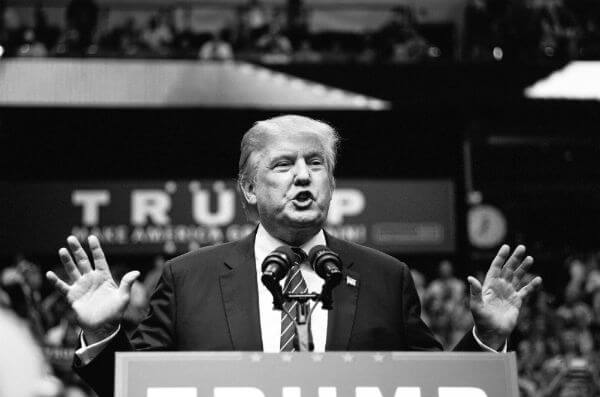
Peter Wehner writes: “I think you’d have riots.” So said Donald J. Trump last week, when he was asked by CNN what he thought would happen if he arrived at the Republican Convention this summer a few delegates short of the 1,237 needed to win outright and didn’t set forth from Cleveland as the party’s nominee.

It is stunning to contemplate, particularly for those of us who are lifelong Republicans, but we now live in a time when the organizing principle that runs through the campaign of the Republican Party’s likely nominee isn’t adherence to a political philosophy — Mr. Trump has no discernible political philosophy — but an encouragement to political violence.

Mr. Trump’s supporters will dismiss this as hyperbole, but it is the only reasonable conclusion that his vivid, undisguised words allow for. As the examples pile up, we should not become inured to them. “I’d like to punch him in the face,” Mr. Trump said about a protester in Nevada. (“In the old days,” Mr. Trump fondly recalled, protesters would be “carried out in a stretcher.”)

Of another protester, Mr. Trump said, “Maybe he should have been roughed up.” In St. Louis, Mr. Trump sounded almost wistful: “Nobody wants to hurt each other anymore.” About protesters in general, he said: “There used to be consequences. There are none anymore. These people are so bad for our country. You have no idea folks, you have no idea.”

Talk like this eventually finds its way into action. And so on March 10, a Trump supporter named John McGraw, was charged with assault, battery and disorderly conduct, after a protester was sucker-punched as he was being hauled by security guards out of a Trump rally in North Carolina the day before. When interviewed afterward Mr. McGraw said, “The next time we see him, we might have to kill him.”

And Donald Trump’s reaction? He said he was considering paying Mr. McGraw’s legal fees. “He obviously loves his country,” Mr. Trump added, “and maybe he doesn’t like seeing what’s happening to the country.”

Welcome to Donald Trump’s America.

Mr. Trump’s comments, startling in a leading presidential candidate, have raised widespread concern about the path we find ourselves on. But concern about political violence, mob rule and unchecked passion is hardly new in American history. [Continue reading…]

Facebooktwittermail

‘Trump’s relationship with Israel and the Jews is beyond fabulous,’ says former chairman of Palm Beach County Republican Party

The New York Times reports: Sheldon Adelson, the casino magnate and a major donor to Republican and Israeli causes, said recently that he would back Mr. Trump if he were the nominee, and a newspaper that he owns, Israel Hayom, has written favorably about Mr. Trump.

But there is still concern about Mr. Trump’s behavior, which if not anti-Semitic is at least seen by many Jews as overly accommodating of bigotry. “The way he dillydallied with David Duke basically sent a message that was perceived by many in the Jewish community as he’s looking for any votes he can get from the hard right,” said Alan M. Dershowitz, the defense lawyer.

To Mr. Dershowitz, the problem is not simply Mr. Trump; it is the white supremacists who have rallied around his candidacy. “It’s quite frightening to see who supports him,” he said.

Ms. Hicks, the campaign spokeswoman, said Mr. Trump had “disavowed David Duke and continues to strongly condemn any groups that share those hateful views.”

And for all of his critics in the Jewish world, Mr. Trump also has his supporters, including Sid Dinerstein, the former chairman of the Palm Beach County Republican Party in Florida.

“Donald Trump’s relationship with Israel and the Jews is beyond fabulous,” Mr. Dinerstein said, noting that his wife displayed a Trump bumper sticker on the dashboard of her Mercedes-Benz.

Mr. Dinerstein said he trusted Mr. Trump to negotiate good deals for Israel — “he only negotiates from strength, he doesn’t know anything else” — and to make sure that America “doesn’t get pushed around.”

He and his wife are hardly the lone Trump supporters in their predominantly Jewish community, he said, though not everyone is outspoken about it.

“Sometimes people come over to me and quietly say, ‘Sid, I never thought I would say this, but I’m voting for Trump,’” Mr. Dinerstein said. “And I say, ‘Everybody says that.’ ” [Continue reading…]

Facebooktwittermail

The mutual dependence of Donald Trump and the news media

Jim Rutenberg writes: Did you catch the Trump-Kelly bout Friday night? What a show.

It had Donald J. Trump, The Likely Republican Presidential Nominee, throwing the first punch (of that day) at the star Fox News anchor Megyn Kelly by composing a Twitter post describing her as “overrated” and calling for a boycott of her show.

Then Fox News Channel counterpunched, accusing the candidate of having a sexist and “sick obsession” with its popular journalist. Boom. Another Trump News avalanche!

The Trump-Kelly feud once again became a focal point of the presidential campaign coverage, cascading across Twitter, cable news and digital news outlets, including this one.

As in any good prizefight, everybody came out the richer Friday, putting aside the potentially severe internal injuries.

Mr. Trump riled up his fans against a recurring villain in his running campaign narrative and ensured the news was once again all about him. Fox News, the cable news ratings leader that is so often impugned as an arm of the Republican Party, got to ring a bell for journalistic independence. Ms. Kelly got the sort of support from the network that she has described as lacking from her colleague Bill O’Reilly; guaranteed big ratings to come; and got more fodder for the book she sold for many millions of dollars after the Trump feud began.

Newspapers and online news organizations got a click-worthy story line tailor-made for a fast read on the iPhone. And, finally, there were the viewers and the readers, who are benefiting from a transitioning media industry’s desire to give them what they want, where they want it, as fast as possible. As the people have made clear, they want Trump.

It was the perfect boil-down of the disturbing symbiosis between Mr. Trump and the news media. There is always a mutually beneficial relationship between candidates and news organizations during presidential years. But in my lifetime it’s never seemed so singularly focused on a single candidacy. And the financial stakes have never been so intertwined with the journalistic and political stakes. [Continue reading…]

Facebooktwittermail

The Baltic elves taking on pro-Russian trolls

Michael Weiss writes from Vilnius, Lithuania: My elf was on time and surprisingly tall.

Mindaugas is an unassuming, thirtysomething advertising agency director by day, and a ferocious cyber-warrior by night. He started a phenomenon, here in Lithuania, of countering Kremlin propaganda and disinformation on the Internet. “We needed to call our group something. What to name it? Well, we were fighting trolls. So I said, ‘Let’s be elves.’”

There were 20 or 30 at first, when the trolls began a targeted campaign of leaving nasty comments about the Lithuanian government and society, usually pegged to a hatred of NATO, the European Union and, of course, the United States. Since then, elves have proliferated into the hundreds. They’re now scattered about neighboring Latvia and Estonia and have even been spotted as far north as Finland. The elves pride themselves on clandestinity and reclusiveness, and so I was quite lucky to catch this Lithuanian Legolas on my last night in Vilnius.

“Most of us were already participating in some online groups,” said this man, who suggests we call him Mindaugas in person. “Fighting the trolls on Facebook and vKontakte, giving examples of Russian lies. That’s how we met.”

Facebook is where the light skirmishes take place; the mortal combat is reserved for the comment sections of Lithuanian news articles, where the trolls loose a constant drizzle of falsehoods and complaints, each comment helping to construct an alternate reality version of life in this Baltic country of 3 million. Rather than a thriving and patriotic post-Soviet success story, which it is, the image the trolls cultivate is that of a demoralized and angry society whose people are ready for regime change, be it through internal democratic mechanisms or through “liberation” by a friendly neighboring army. [Continue reading…]

Facebooktwittermail