North Korea claims to have successfully tested a miniaturized hydrogen nuclear device which, if this indeed happened, would mark a major advance in its weapons program. The announcement is being viewed with some skepticism.
Reuters reports: South Korean intelligence officials and several analysts, however, questioned whether Wednesday’s explosion was indeed a full-fledged test of a hydrogen device.
The device had a yield of about 6 kilotons, according to the office of a South Korean lawmaker on the parliamentary intelligence committee – roughly the same size as the North’s last test, which was equivalent to 6-7 kilotons of TNT.
“Given the scale, it is hard to believe this is a real hydrogen bomb,” said Yang Uk, a senior research fellow at the Korea Defence and Security Forum.
“They could have tested some middle stage kind (of device) between an A-bomb and H-bomb, but unless they come up with any clear evidence, it is difficult to trust their claim.”
Joe Cirincione, a nuclear expert who is president of Ploughshares Fund, a global security organization, said North Korea may have mixed a hydrogen isotope in a normal atomic fission bomb.
“Because it is, in fact, hydrogen, they could claim it is a hydrogen bomb,” he said. “But it is not a true fusion bomb capable of the massive multi-megaton yields these bombs produce”.
The United States Geological Survey reported a 5.1 magnitude quake that South Korea said was 49 km (30 miles) from the Punggye-ri site where the North has conducted nuclear tests in the past.
North Korea’s last test of an atomic device, in 2013, also registered at 5.1 on the USGS scale.
The test nevertheless may mark an advance of North Korea’s nuclear technology. The claim of miniaturizing, which would allow the device to be adapted as a weapon and placed on a missile, would also pose a new threat to the United States and its regional allies, Japan and South Korea. [Continue reading…]
Comparison: 2016 North Korean nuclear test and 2005 M5.0 earthquake, both at similar distances from seismometer. pic.twitter.com/1ZuMYBJbZN
Jeffrey Lewis, who teaches a class on the evolution of China’s nuclear weapons program at the Middlebury Institute of International Studies, points out that current assessments of North Korea’s technical capabilities should not lead to false assumptions about their aspirations. He writes:
One of the major themes of the early part of China’s nuclear program is how committed China was to matching the other nuclear powers in the possession of intercontinental-range ballistic missiles armed with multi-megaton thermonuclear weapons. A lot of Americans had trouble accepting this idea. We thought of China as being too backward to have such aspirations. That was, I argue, precisely why China wanted such weapons: because China’s communist leaders had a different vision of China’s place in the world and the development of thermonuclear weapons was a way of achieving that vision.
I think something similar is happening with North Korea. We think of the country as impoverished, both in terms of economy and leadership. Well, that’s not how the government in North Korea sees itself—and anyone who does, keeps such thoughts to himself. Pyongyang’s propaganda apparatus argues—and this is what Kim was saying—that North Korea is a technological powerhouse. The North Korean propaganda line argues that this power is demonstrated by a series of achievements culminating in space launches, nuclear weapons and, yes, even thermonuclear weapons.
So, while a staged thermonuclear weapon is likely more than North Korea can, at the moment, achieve technically, it is a mistake to rule out the aspiration by Pyongyang. An H-bomb might not conveniently fit our perception of North Korea, but perhaps that is Kim’s point.
This is today’s announcement being made on North Korean state television:
Bloomberg reported on December 30: China, the world’s biggest clean energy investor, plans to increase wind and solar power capacity by more than 21 percent next year as it works to reduce greenhouse gas emissions by cutting its reliance on coal.
The nation is targeting at least 20 gigawatts of new wind power installations and 15 gigawatts of additional photovoltaic capacity next year, the National Energy Administration said in a statement on Tuesday.
China has pledged to peak carbon emissions around 2030, by which time it aims to derive 20 percent of the energy it uses from clean sources. China will also stop approving new coal mines in the next three years, the Xinhua News Agency reported Tuesday, citing National Energy Administration head Nur Bekri.
The world’s biggest producer of carbon emissions is expected at the end of this year to have a total of 120 gigawatts of wind power, 43 gigawatts of solar, and 320 gigawatts of hydro power, the NEA said. To accommodate the clean energy additions, China will promote the construction of electricity networks, the agency said.[Continue reading…]
The Los Angeles Times reports: A few weeks before seminal climate change talks in Kyoto back in 1997, Mobil Oil took out a bluntly worded advertisement in the New York Times and Washington Post.
“Let’s face it: The science of climate change is too uncertain to mandate a plan of action that could plunge economies into turmoil,” the ad said. “Scientists cannot predict with certainty if temperatures will increase, by how much and where changes will occur.”
One year earlier, though, engineers at Mobil Oil were concerned enough about climate change to design and build a collection of exploration and production facilities along the Nova Scotia coast that made structural allowances for rising temperatures and sea levels.
“An estimated rise in water level, due to global warming, of 0.5 meters may be assumed” for the 25-year life of the Sable gas field project, Mobil engineers wrote in their design specifications. The project, owned jointly by Mobil, Shell and Imperial Oil (a Canadian subsidiary of Exxon), went online in 1999; it is expected to close in 2017.
The United States has never ratified the 1997 Kyoto Protocol to reduce greenhouse emissions.
A joint investigation by the Columbia University Graduate School of Journalism’s Energy and Environmental Reporting Project and the Los Angeles Times earlier detailed how one company, Exxon, made a strategic decision in the late 1980s to publicly emphasize doubt and uncertainty regarding climate change science even as its internal research embraced the growing scientific consensus.
An examination of oil industry records and interviews with current and former executives shows that Exxon’s two-pronged strategy was widespread within the industry during the 1990s and early 2000s.
As many of the world’s major oil companies — including Exxon, Mobil and Shell — joined a multimillion-dollar industry effort to stave off new regulations to address climate change, they were quietly safeguarding billion-dollar infrastructure projects from rising sea levels, warming temperatures and increasing storm severity. [Continue reading…]
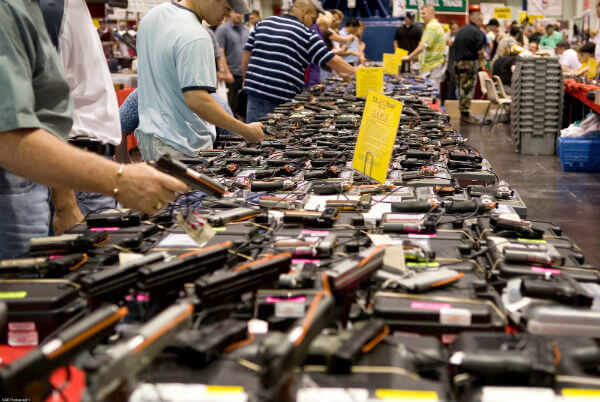
Quartz reports: Another gun control measure, another rally for gun stocks.
As US president Barack Obama spoke about his proposal to further regulate firearms, shares of Smith & Wesson climbed more than 10% in midday trading today (Jan. 5), while Sturm, Ruger & Co. moved up 7%.
Although most Americans don’t own guns and want more gun control, a minority who do own guns end up buying more of them when they feel that stricter regulation — or even just the threat of it — is coming down the pike. And that’s what is set to happen now that Obama, after being repeatedly frustrated by Congress, has chosen to pursue the issue unilaterally with executive action that would: [Continue reading…]
10. The Death of Zahran Alloush.
9. The Failure of the Southern Storm Offensive.
8. Operation Decisive Quagmire.
7. Europe’s Syria Fatigue vs. Assad’s Viability
6. The Vienna Meeting, the ISSG, and Geneva III.
5. The Donald.
4. The Iran Deal.
3. The Continuing Structural Decay of the Syrian Government.
2. The American-Kurdish Alliance.
1. The Russian Intervention. [Continue reading…]
Michele Dunne and Nik Nevin write: Egypt of December 2015 is looking a lot like Egypt of late 2010 and the final months of Hosni Mubarak‘s three-decade rule. The country’s longtime military president had little political sophistication; then as now, there were struggles between the military and businessmen for economic and political power, human rights abuses, economic woes, and jihadi groups in the Sinai. But today, these things appear more pronounced.
The membership and mission of the recently elected 598-seat House of Representatives bear similarities to the parliament chosen a few months before the January 2011 uprising, but each is more exaggerated. Other developments in Egypt echo the dysfunction of 2010, raising questions about whether another upheaval might be brewing. [Continue reading…]
David Victor writes: Why did Paris work when almost everything before it failed? The central answer lies in a new style of international cooperation, one that has enabled 195 countries to formally adopt an agreement that is likely to have a real impact on the emissions that cause climate change, as well as on how societies adapt to the big shifts in climate that are coming.
The contrast of Paris with the past could not be starker. The 1992 Rio framework to get serious climate diplomacy going was the right approach, but diplomats and climate activists steered that framework off the rails, and for 23 years — until now — they achieved very little. The 1997 Kyoto Protocol was so riddled with flaws that it had essentially no impact on emissions. The 2009 climate negotiations in Copenhagen ended in acrimony and recriminations.
Now, instead of setting commitments through centralized bargaining, the Paris approach sets countries free to make their own commitments. These “nationally determined contributions” are a starting point for deeper cooperation that will unfold over time. Once the Paris agreement enters into force and is fully in motion, around the year 2020, each nation will be expected to adopt a new pledge every five years in tandem with periodic overall efforts to take stock of how the group of nations is doing. [Continue reading…]
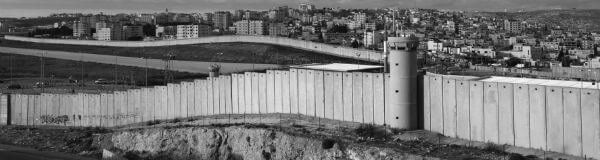
Following Trump’s logic and his imperative of vigilance, it sounds as though the world — just to be safe — can’t have too many walls.
In Europe the principle of open borders functioning in the Schengen Area is currently in peril.
If, as seems increasingly likely, the presidential election in the U.S. ends up being a contest between Trump and Clinton, it’s possible that Trump just defined the battle line in a useful way.
He obviously wants to use Israel’s wall to justify his own wall plans and he’s assuming that Clinton’s ties to Israel mean she wouldn’t dare question their security measures.
Nevertheless, Israel’s wall has symbolic significance that stretches far beyond the Israeli-Palestinian conflict.
Ever since the end of the Cold War, there has been a broad consensus that the breakdown of divisions around the world has inherent value and the creation of divisions causes trouble.
While the value of this principle has most often been measured in economic terms and the rewards concentrated in the hands of powerful corporations, the human desire for people to be able to connect seems far greater than the need to stand apart.
Those who want to wall themselves in so they can keep others out are in a minority that perceives itself as embattled.
The walls supposedly designed to make people feel safe also solidify their fears.
The wall is both a metaphor and a literal expression of the conflict between inclusion and exclusion.
Have we reached a point in history where we must now reverse tracks and head back into the past — into a world defined by its rigid divisions? Would not such a world be anything less than a retreat from humanity?
No doubt, in a debate, Clinton would skirt around Israel’s wall — perhaps just by reiterating the official line that it is a temporary measure — but she could not pick a better theme around which to shape her campaign than by presenting herself as someone dedicated to breaking down divisions versus an opponent who is actively divisive.
Am I indulging in an internationalist liberal fantasy?
Perhaps. But however deeply entrenched divisiveness has become, unless we quickly learn how to shake it off, our common fate will be ruin.
Alexander Hurst writes: In 2012, a team of academics from Europe and the U.S. — Yoel Inbar, David Pizarro, Ravi Iyer, and Jonathan Haidt — published a paper titled “Disgust Sensitivity, Political Conservatism, and Voting,” looking at the role disgust plays in political orientation. The researchers posited three different types of disgust: interpersonal disgust (i.e., the feeling produced by drinking from the same cup as someone else); core disgust (the response to maggots, vomit, dirty toilets, etc.); and animal-reminder disgust (how we react to corpses, blood, anything that evokes our animal nature).
Disgust, they write, “serves to discourage us from ingesting noxious or dangerous substances,” but also plays a role in moral and social judgments. Those who feel more disgusted by unpleasant images, smells, or tastes judge more harshly that which violates their subjective moral code.
The team had respondents position themselves on a political scale from conservative to liberal. The respondents then stated how strongly they agreed or disagreed with statements like “I never let any part of my body touch the toilet seat in a public washroom,” and rated other hypotheticals according to the level of disgust they generated. Even when controlling for age, education, geography, and religious belief, individuals with higher “disgust sensitivity” were found to be more likely to tolerate wealth inequality, view homosexuality negatively, and place more belief in authoritarian leaders and systems.
Most strikingly, interpersonal disgust was an important predictor of anti-immigrant attitudes.
Trump, of course, is a well-known, admitted germaphobe. “One of the curses of American society is the simple act of shaking hands,” he wrote in The Art of the Deal. “I happen to be a clean hands freak. I feel much better after I thoroughly wash my hands, which I do as much as possible.”
Trump even described shaking hands as “barbaric” in an interview with Dateline in 1999, saying, “They have medical reports all the time. Shaking hands, you catch colds, you catch the flu, you catch it, you catch all sorts of things. Who knows what you don’t catch?”
Beyond the aversion to hand-shaking, Trump used to pre-test his dates for AIDS, and reportedly avoids pushing elevator buttons.
The connection between modern xenophobia, disgust sensitivity, and the strength of Trump’s campaign is fairly easy to make. As Inbar, Pizarro, Iyer, and Haidt point out, “Disgust evolved not just to protect individuals form oral contamination by potential foods, but also from the possibility of contamination by contact with unfamiliar individuals or groups.” And after all, Trump’s success has come not from presenting voters with detailed policy proposals, but from connecting with them on a gut level. [Continue reading…]
Pankaj Mishra writes: Racism, a beast cornered if not tamed after much struggle, has lumbered back to civil society in the solemn guise of “reforming” Islam. Tony Blair summons us to worldwide battle on behalf of western values while embodying, with his central Asian clients, their comprehensive negation. The handful of media institutions and individuals that are not obliged to flesh out Rupert Murdoch’s tweets on Muslims seem to be struggling to remain viable in an increasingly retrogressive political culture. Even the BBC seems determined not to stray far from the Daily Mail’s editorial line.
Unsurprisingly, we witness, as Judt pointed out, “no external inputs, no new kinds of people, only the political class breeding itself”. “The old ways of mass movements, communities organised around an ideology, even religious or political ideas, trade unions and political parties to leverage public opinion into political influence” have disappeared. Indeed, the slightest reminder of this democratic past incites the technocrats of politics, business and the media into paroxysms of scorn.
Having acted recklessly to create their own reality, they have managed to trap all of us in a tawdry nightmare – a male buddy film of singular fatuousness. At the same time, reality-making has ceased to be the prerogative of the American imperium or of the French and British chumocrats, who lost their empires long ago and are still trying to find a role for themselves.
Some random fanatic, it turns out, can make their reality far more quickly, coercing the world’s oldest democracies into endless war, racial-religious hatred and paranoia. Such is the great power surrendered by the crappy generation and its epigones. The generations to come will scarcely believe it. [Continue reading…]
The New York Times reports: Two days after Sheldon Adelson’s lawyers lost in their attempts to have a judge removed from a contentious lawsuit that threatens his gambling empire, a call went out to the publisher of this city’s most prominent newspaper.
Almost immediately, journalists were summoned to a meeting with the publisher and the general counsel and told they must monitor the courtroom actions of the judge and two others in the city. When the journalists protested, they were told that it was an instruction from above and that there was no choice in the matter.
It is unclear whether Mr. Adelson, who was then in talks to buy the newspaper, The Las Vegas Review-Journal, or his associates were behind the directive or even knew about it. But it was an ominous coincidence for many in the city who worry what will become of the paper now that it is owned by Mr. Adelson, a billionaire casino magnate and prominent Republican donor with a history of aggressively pursuing his interests.
Suspicions about his motives for paying a lavish $140 million for the newspaper last month are based on his reputation in Las Vegas as a figure comfortable with using his money in support of his numerous business and political concerns, said more than a dozen of the current and former Review-Journal staffers and local civic figures who have worked closely with him. [Continue reading…]
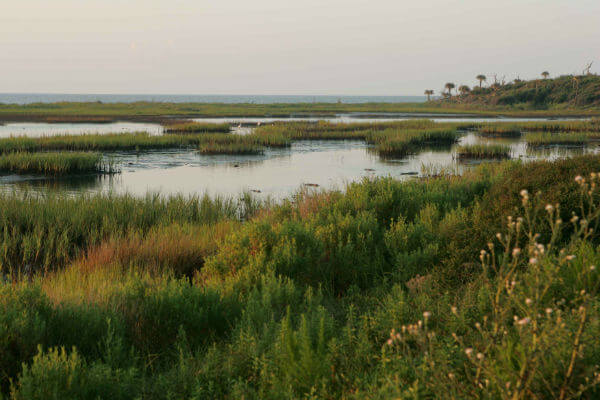
Climate Central reports: In the race to keep their verdure heads above rising seas, marshes that protect coastal regions from floods, storms and erosion harbor the botanical equivalents of nitro boosters: rapid growth fueled by climate-changing pollution.
The same greenhouse gas that’s doing most to warm the planet and uplift its seas can also work as a fertilizer. New research suggests that rising levels of heat-trapping carbon dioxide in the atmosphere could help communities of marsh plants grow quickly enough to keep up with changes that would otherwise inundate them.
“The fertilization effect from increased carbon dioxide in the atmosphere definitely enhances marsh-plant biomass functioning,” said Katherine Ratliff, a PhD candidate at Duke University who led modeling-based research published last month in Proceedings of the National Academy of Sciences.
The findings suggest that mud shortages — not growth rates — could be the greatest challenges for marshes as they strive to grow quickly enough to keep up with rising seas. Sea levels have risen 8 inches since the late 1800s, with several more feet expected this century. The fostering of coastal ecosystems is considered a key defense strategy against future flooding. [Continue reading…]
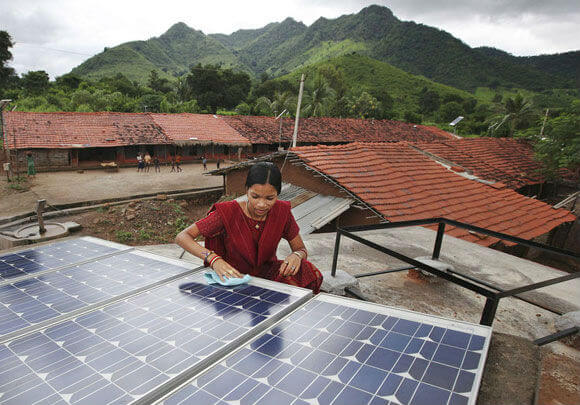
The New York Times reports: A few years ago, the hundred or so residents of Paradeshappanamatha, a secluded hamlet in the southern Indian state of Karnataka, gathered along the central pathway between their 22 densely clustered homes, and watched as government workers hoisted a solar-powered streetlamp. As the first display of electricity in the town, it was an object of mild interest, but, being outside, the light didn’t help anyone cook or study, and only attracted moths.
Still, when B. Prasad arrived two years later to encourage people here to abandon kerosene lighting for solar-powered home systems, people had some idea what he was talking about. What sounded preposterous to the village residents was the price. Mr. Prasad, an agent for Solar Electric Light Company, or Selco, was selling a panel and battery that would power three lights and an attached socket for phone charging for approximately 12,800 rupees, or $192.
“There was no way we could afford that,” P. C. Kalayya remembers thinking. He and his neighbors rise early in the morning to walk miles along a nearly impassable dirt road to work on coffee, pepper and betel nut plantations. Mr. Kalayya earns $3 a day — he’d been earning $2.25 until a raise came through this year — and half his wage is withheld by his employer as repayment for various loans.
And yet, despite what seemed on its face an impossibly high cost, Selco agents succeeded in persuading Mr. Kalayya and 10 other village households to make the switch. Now, his wife can better see how much spice she is putting in as she cooks, and Pratima, their 18-year-old daughter, can study long after dark.
The idea behind Selco, and other companies like it, is to create a business model that will help some of the 1.2 billion people in the world who don’t have electricity to leapfrog the coal-dependent grid straight to renewable energy sources.
About a quarter of the world’s off-the-grid people, or 300 million or so, live in India, mostly in remote, rural communities like Paradeshappanamatha, or in informal urban settlements. Hundreds of millions more get electricity for only a few hours a day. Prime Minister Narendra Modi has pledged to achieve universal electrification in India by the end of 2022. His main effort is adding hundreds of new coal plants, which have contributed to near-apocalyptic pollution levels across large swaths of the country. [Continue reading…]
Rami G Khouri writes: It is useful to spot meaningful patterns that help us make sense of our bewildering world, and to acknowledge positive developments to be continued alongside negative ones to be avoided.
Applying this principle to the last year in the Middle East reveals several troubling trends that have made life difficult for hundreds of millions of people. One in particular stands out, and strikes me as a root cause of many other negative trends that plague our region. This is the tendency of governments to use increasingly harsh measures to restrict the freedoms of their citizens to express themselves and meaningfully to participate politically and hold power accountable.
Several aspects of this behavior make it especially onerous. It is practiced by all states in the region—Arab, Israeli, Iranian, and Turkish—leaving few people in this part of the world who can live as fully free and dignified human beings. It is justified on the basis of existing constitutional powers, so governments can jail tens of thousands of their citizens, rescind their nationality, or torture and kill them in the worst cases, simply because of the views they express, without any recourse to legal or political challenge. It shows no signs of abating, and indeed may be worsening in lands like Egypt, Turkey, and others. And, it is most often practiced as part of a “war on terror” that seeks to quell criminal terror attacks, but in practice achieves the opposite; the curtailment of citizen rights and freedoms exacerbates the indignities and humiliations that citizens feel against their government, which usually amplifies, rather than reduces, the threat of political violence. [Continue reading…]
The New York Times reports: One Syrian woman who joined the stream of migrants to Germany was forced to pay down her husband’s debt to smugglers by making herself available for sex along the way. Another was beaten unconscious by a Hungarian prison guard after refusing his advances.
A third, a former makeup artist, dressed as a boy and stopped washing to ward off the men in her group of refugees. Now in an emergency shelter in Berlin, she still sleeps in her clothes and, like several women here, pushes a cupboard in front of her door at night.
“There is no lock or key or anything,” said Esraa al-Horani, the makeup artist and one of the few women here not afraid to give her name. She has been lucky, Ms. Horani said: “I’ve only been beaten and robbed.”
War and violence at home, exploitative smugglers and perilous seas along the way, an uncertain welcome and future on a foreign continent — these are some of the risks faced by tens of thousands of migrants who continue to make their way to Europe from the Middle East and beyond. But at each step of the way, the dangers are amplified for women.
Interviews with dozens of migrants, social workers and psychologists caring for traumatized new arrivals across Germany suggest that the current mass migration has been accompanied by a surge of violence against women. From forced marriages and sex trafficking to domestic abuse, women report violence from fellow refugees, smugglers, male family members and even European police officers. There are no reliable statistics for sexual and other abuse of female refugees. [Continue reading…]
Shadi Hamid and Will McCants write: Refusing to utter the Islamic State’s name … needlessly complicates the religious fight to discredit the organization. Muslims understandably feel that their religion is being hijacked. But there’s something odd about an American president or Secretary of State opining on what is and isn’t legitimately Islamic. Shouldn’t it go without saying that a murderous extremist group isn’t what Muslims are all about?
There is a place for Muslim apologetics — from Muslims. This is precisely what a group of prominent British figures did when they attempted to rebrand the Islamic State as “the Un-Islamic State.”
But when non-Muslim officials insert themselves into this debate, it sets a negative precedent. It lends itself easily to broader pronouncements on who the good, “moderate” Muslims are, in contrast to the “bad guys,” a category which presumably could include anyone who falls on the Islamist side of the spectrum, regardless of whether they’re actually “extreme.”
And when the West co-opts Muslim talking points about the “true” Islam, it makes it harder for Muslims in the Arab world to make the same claim. Western governments are widely loathed and lack credibility in the region, even when they take care to explain their policies. A 2006 study suggested Arab students’ views of American policy “worsened slightly” the longer they listened to U.S.-sponsored Radio Sawa and al-Hurra TV. When Western officials repeat religious criticisms of the Islamic State, they make it easier for the group’s sympathizers to dismiss the criticisms as mere imperial dictation. [Continue reading…]
Some regular readers here may have noticed that in headlines (the one above being an exception), I have stuck with ISIS, in spite of its official name change and the ongoing debate among outsiders over which is the most appropriate label. My choice has nothing to do with that debate. It’s based instead on the matter of usage.
Whichever happens to be the most commonly used label is “correct” by that virtue alone. That’s why even though ISIS is actually an ambiguous term, you will rarely find yourself in a conversation during which you’ll be asked to clarify whether you’re talking about the terrorist organization, ISIS, or the Egyptian goddess, Isis.
When it comes to determining who’s saying what, where, Google Trends is an indispensable tool.
After a 52-minute video made by al-Kataib, the media outlet of Somalia’s al-Qaeda-affiliate, al-Shabaab, was posted on YouTube yesterday, it was swiftly removed. YouTube has a long-standing policy of banning videos that incite violence.
As the ABC News report above shows, the element in the video which has grabbed the media’s attention is its use of Donald Trump’s recent call for Muslims to be prohibited from entering the United States.
Here’s the part of the video which features Trump — although, by the time you read this post, YouTube will have removed this clip, which is why I’m also posting a transcript:
First we see the American imam, Anwar al-Awlaki, making a prediction about the fate of Muslims who continue living in the U.S. — Awlaki was killed by a U.S. drone strike in Yemen in 2011. Then comes a clip of Trump and then Awalaki again.
Awlaki, date unknown: Muslims of the West, take heed and learn from the lessons of history. There are ominous clouds gathering in your horizon.
Yesterday, America was a land of slavery, segregation, lynching, and Ku Klux Klan. And tomorrow it will be a land of religious discrimination and concentration camps.
Trump speaking at a campaign rally on December 7: Guys remember this and listen: Donald J Trump is calling for a total and complete shutdown of Muslims entering the United States [cheers] until our country’s representatives can figure out what [expletive bleeped] is going on [cheers and applause].
Awlaki: The West will eventually turn against its Muslim citizens. Hence, my advice to you is this: You have two choices, either hijra or jihad. You either leave or you fight. You leave and live among Muslims, or you stay behind and follow the example of Nidal Hassan [perpetrator of the Fort Hood mass shooting] and others who fulfilled their duty of fighting for Allah’s cause.
In response to pressure from Western governments, YouTube and other social media channels are becoming increasingly aggressive in blocking the distribution of terrorist propaganda. There is understandable frustration at the fact that the internet is being used to threaten the very societies within which this global communications system was created.
Censorship can easily backfire, however, and this is happening with the removal of clips of the new al-Shabaab video.
After the full-length version had been removed, snippets which just showed the al-Awalaki statement and Trump, have also been removed (as I noted above).
It is clear that these videos are being posted by Trump critics rather than al-Shabaab supporters and their removal is breathing life into a conspiracy theory being propagated by some Trump supporters: that the al-Shabaab video itself is a fabrication created by the Clinton campaign!
It seems likely that there are some Trump supporters who — following the lead of Bashar al-Assad supporters — are using YouTube’s community guidelines in order to silence criticism.
Although in the short clips of the al-Shabaab, Awlaki is indeed inciting violence, the clips themselves are clearly not being posted in order to incite violence — they have been posted to show how Trump’s rhetoric serves as a propaganda gift for jihadists.
By removing these clips, YouTube is playing straight into the hands of conspiracy theorists.
At the same time, censorship also buttresses the perception among ISIS and al Qaeda supporters, that the West feels threatened by “the truth.”
It’s worth remembering the trajectory Awlaki followed which eventually led to him promoting terrorism from Yemen.
In 2000, he supported George Bush’s campaign to become president and after 9/11 believed his own emerging role must be to serve as bridge between America and all Muslims.
At midnight on Sept. 14, 2001, Awlaki, then a young Yemeni-American imam at the prominent Dar al-Hijrah mosque in Falls Church, Va., finished a long day by answering an email from his younger brother about the terrorist attacks of a few days before. ‘‘I personally think it was horrible,’’ he wrote to Ammar, a college student in New Mexico at the time. ‘‘I am very upset about it.’’ He added, ‘‘The media are all over us.’’ Anwar was disconcerted, but perhaps also pleased that an onslaught of reporters had turned his Friday prayers, or jummah, into a circus. ‘‘At jummah today we had ABC, NBC, CBS and The Washington Post.’’ He closed on a positive note, hinting at a noble purpose, to be sure, but also displaying a trace of personal ambition: ‘‘I hope we can use this for the good of all of us.’’
Though the country was in mourning, a sense of defiant unity emerged. A non-Muslim neighbor of Dar al-Hijrah organized a candlelight vigil around the building to show solidarity with the mosque. Roughly 80 residents of a nearby apartment building sent over a note saying, ‘‘We want your congregation to know that we welcome you in this community.’’ Journalists, hunting for an authoritative voice from the Muslim community, began to pass regularly under the mosque’s grand marble arches or to gather in Awlaki’s modest family home. He denounced the 9/11 attacks but in the same breath would criticize America’s record in the Middle East. Reporters were impressed. The New York Times wrote that Awlaki, just 30, was being ‘‘held up as a new generation of Muslim leader capable of merging East and West.’’ He relished the spotlight. He seemed to be quite self-consciously auditioning for a dual role: explainer of Islam to America and of America to Muslims. ‘‘We came here to build, not to destroy,’’ he declared from his pulpit. ‘‘We are the bridge between America and one billion Muslims worldwide.’’
The challenge presented by ISIS, al Qaeda and other jihadist groups is more than one of security and communications. At its core, this is a moral challenge.
The jihadists present themselves as offering the solution to a moral problem: a way for Muslims to confront the immorality, corruption, and hypocrisy they see in the contemporary Western-dominated world.
An effective counter-jihadist strategy cannot simply brush off this critique of the West. It has to present an alternative solution.
Currently, who has the more credible voice? Donald Trump, Hillary Clinton, or Anwar al-Awlaki?
Unfortunately, it’s Awlaki.
As Shane observed:
Awlaki’s pronouncements seem to carry greater authority today than when he was living, because America killed him.
Right now, it’s easy to castigate Trump for providing terrorists with fodder for propaganda, but we mustn’t forget the extent to which the U.S. led by Bush and then Obama, has helped reinforce the jihadists’ narrative — by opening Guantanamo; through the use of torture, rendition and secret prisons; through the disastrous war in Iraq; through drone strikes in Afghanistan, Yemen, and Somalia; through continuing to prop up authoritarian regimes across the Middle East; through allowing the Assad regime to destroy Syria, and through failing to broker an end to the Israeli-Palestinian conflict.
The real challenge for Western political leaders and whoever becomes the next U.S. president is not whether they can destroy ISIS and effectively tackle global terrorism.
It is this: How can they regain sufficient moral authority that their words carry weight? How can they restore some much-needed respect for democracy?
In a global failure of governance, the Middle East can be viewed as the emergency room, while in the West, governance suffers from chronic illness for which symptom-relief is the only treatment on offer.
It’s time we face up to the fact that terrorism is just a symptom what ails the world. Indeed, much of the time a global obsession with terrorism is having the effect of turning our attention away from broader issues that undermine the health of societies and our ability to survive on this planet.
This isn’t a question of striving for some kind of unattainable and contestable moral purity. No one wants to live under the control of zealots. It’s about trying to create societies in which government is no longer a dirty word, where ordinary citizens receive the respect they deserve, and in which individuals are no longer cynical about the possibilities for securing collective interests.
In a word, it’s about the restoration of honesty in public life.
As we approach the fifth anniversary of the Arab Uprisings, it’s hard to remember the days of popular protests, of democratic revolutions and of dreams of a better future that rocked the Middle East in 2011. Nearly five years on, tensions between rulers and the ruled have exploded across the region – and the ensuing struggles for survival have continued to take all manner of ugly forms.
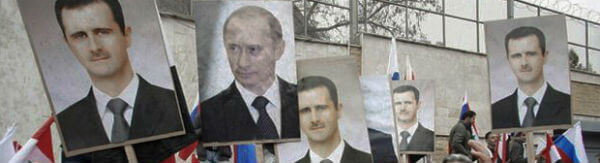
At the centre of things, the Syrian conflict has deepened – and while the brutality of Islamic State (IS) has been responsible for much of the recent chaos and tragedy across Syria, the regime of Bashar al-Assad has been responsible for seven times as many Syrian deaths as IS. Assad’s position was strengthened by continued support from Russia, Iran and Lebanon’s Hezbollah, antagonising powerful states in the West and the Gulf – particularly Saudi Arabia. The Gulf states also faced domestic threats from IS, with the group carrying out a number of attacks on Shia sites and communities across the region.
The Syrian conflict became ever more internationalised in 2015. The number of foreign fighters on the ground – on all sides – continued to grow, while on the diplomatic level, the Vienna talks tried to resolve the seemingly intractable conflict – though they have yet to yield any decisive action.