Forbes reports: Dressed in a blue suit and red tie, Donald Trump’s 79-year-old pick for Secretary of Commerce sat before a panel of senators for nearly four hours in January, deflecting dozens of questions with relative ease. When one legislator at the confirmation hearing asked Wilbur Ross how he would ensure that his official actions did not create conflicts of interest, given his vast personal holdings, Ross left little room for criticism. “I intend to be quite scrupulous about recusal and any topic where there is the slightest scintilla of doubt,” he said.
What he left unsaid, however, was that between the November election and January inauguration, he had quietly moved a chunk of assets into trusts for his family members, leaving more than $2 billion off of his financial disclosure report—and therefore out of the public eye. Ross revealed the existence of those assets, and the timing of the transfer, when Forbes asked why his financial disclosure form listed fewer assets than he had previously told the magazine he owned.
The hidden assets raise questions about whether the Secretary of Commerce violated federal rules and whether his family owns billions in holdings that could create the appearance of conflicts of interest.
Federal law requires incoming cabinet members to disclose assets they currently own, as well as any that produced income during the current and previous calendar years, even if they no longer own the assets. Ross says he followed all rules. But how someone could apparently hold $2 billion in assets, without producing big income that would show up on a financial disclosure report, raises more questions than answers.
Three months before the 2016 election, Ross’ assistant described his portfolio to Forbes as a mix that would theoretically throw off plenty of cash: $1.3 billion of municipal bonds, $1.3 billion worth of interests in general and limited partnerships, $550 million of equities, $225 million of art, $180 million in cash and $120 million worth of real estate.
That adds up to $3.7 billion. Last year, Forbes asked for documentation to prove the existence of those assets, received nothing in return, and ultimately estimated Ross’ fortune at a more conservative $2.9 billion for its annual Forbes 400 list of the richest Americans, published in October. This year, the Secretary of Commerce said he would dig up a breakdown of the assets he transferred into trusts, but he never sent anything. It is unclear whether he cited accurate figures either year. [Continue reading…]
Category Archives: Issues
Interview with a former troll at Russia’s Internet Research Agency
Meduza reports: One of the many remarkable things about 2017 is that American journalists no longer have the Irish Republican Army in mind when writing “IRA,” which is now used most often to mean Russia’s Internet Research Agency — the “troll factory” responsible for buying ads on social media and polluting American online news discussion in an apparent effort to destabilize U.S. democracy. On October 15, the Russian independent news network Dozhd published the latest development in this ongoing story: an interview with a man who allegedly worked for the IRA from 2014-2015. Meduza summarizes that interview here.
*
Dozhd calls him “Maxim,” but that’s not his real name. The TV network says Max’s employment records confirm that he spent 18 months at 55 Savushkina in St. Petersburg, working for the Internet Research Agency (IRA), Russia’s infamous “troll factory.” He quit in early 2015, before Donald Trump even announced his presidential candidacy, but not too soon to get a taste of the “factory’s” war on Hillary Clinton.
According to Max, the IRA’s “foreign desk” had open orders to “influence opinions” and change the direction of online discussions. He says this department within the agency considered itself above the “Russian desk,” which he claims is generally “bots and trolls.” The foreign desk was supposedly more sophisticated. “It’s not just writing ‘Obama is a monkey’ and ‘Putin is great.’ They’ll even fine you for that kind of [primitive] stuff,” Max told Dozhd. People in his department, he says, were even trained and educated to know the nuances of American social polemics on tax issues, LGBT rights, the gun debate, and more.
Max says that IRA staff were tasked with monitoring tens of thousands of comments on major U.S. media outlets, in order to grasp the general trends of American Internet users. Once employees got a sense of what Americans naturally discussed in comment forums and on social media, their job was to incite them further and try to “rock the boat.”
According to Max, the Internet Research Agency’s foreign desk was prohibited from promoting anything about Russia or Putin. One thing the staff learned quickly was that Americans don’t normally talk about Russia: “They don’t really care about it,” Max told Dozhd. “Our goal wasn’t to turn the Americans toward Russia,” he claims. “Our task was to set Americans against their own government: to provoke unrest and discontent, and to lower Obama’s support ratings.”
The trolls at the IRA were also careful about covering their tracks. Max says anyone working in the foreign desk was required to post comments using a VPN, to disguise their Russian origins. He says an employee once shared a photograph taken at the IRA’s office, which was especially forbidden, because photos can contain revealing metadata. This incident also revealed that the IRA employed staff to spy on its own trolls, Max says.
Even two years before Americans actually voted on their next president, St. Petersburg trolls were told to attack Hillary Clinton, reminding Internet users about her wealth, her husband’s legacy, and her various corruption scandals. The IRA even encouraged employees to watch Netflix’s “House of Cards,” supposedly as an education in U.S. politics. Staff would also monitor each other’s use of English, nitpicking over grammar and punctuation, in order to weed out ESL formulations. [Continue reading…]
Malta car bomb kills Panama Papers journalist
The Guardian reports: The journalist who led the Panama Papers investigation into corruption in Malta was killed on Monday in a car bomb near her home.
Daphne Caruana Galizia died on Monday afternoon when her car, a Peugeot 108, was destroyed by a powerful explosive device which blew the vehicle into several pieces and threw the debris into a nearby field.
A blogger whose posts often attracted more readers than the combined circulation of the country’s newspapers, Caruana Galizia was recently described by the Politico website as a “one-woman WikiLeaks”. Her blogs were a thorn in the side of both the establishment and underworld figures that hold sway in Europe’s smallest member state. [Continue reading…]
How Stalin — and the foreign press corps — hid Ukraine’s famine from the world
Anne Applebaum writes: In the years 1932 and 1933, a catastrophic famine swept across the Soviet Union. It began in the chaos of collectivization, when millions of peasants were forced off their land and made to join state farms. It was then exacerbated, in the autumn of 1932, when the Soviet Politburo, the elite leadership of the Soviet Communist Party, took a series of decisions that deepened the famine in the Ukrainian countryside. Despite the shortages, the state demanded not just grain, but all available food. At the height of the crisis, organized teams of policemen and local Party activists, motivated by hunger, fear, and a decade of hateful propaganda, entered peasant households and took everything edible: potatoes, beets, squash, beans, peas, and farm animals. At the same time, a cordon was drawn around the Ukrainian republic to prevent escape. The result was a catastrophe: At least 5 million people perished of hunger all across the Soviet Union. Among them were nearly 4 million Ukrainians who died not because of neglect or crop failure, but because they had been deliberately deprived of food.
Neither the Ukrainian famine nor the broader Soviet famine were ever officially recognized by the USSR. Inside the country the famine was never mentioned. All discussion was actively repressed; statistics were altered to hide it. The terror was so overwhelming that the silence was complete. Outside the country, however, the cover-up required different, subtler tactics. These are beautifully illustrated by the parallel stories of Walter Duranty and Gareth Jones.
In the 1930s, all of the members of the Moscow press corps led a precarious existence. At the time, they needed the state’s permission to live in the USSR, and even to work. Without a signature and the official stamp of the press department, the central telegraph office would not send their dispatches abroad. To win that permission, journalists regularly bargained with foreign ministry censors over which words they could use, and they kept on good terms with Konstantin Umansky, the Soviet official responsible for the foreign press corps. William Henry Chamberlin, then the Moscow correspondent for the Christian Science Monitor, wrote that the foreign reporter “works under a Sword of Damocles—the threat of expulsion from the country or of the refusal of permission to re-enter it, which of course amounts to the same thing.”
Extra rewards were available to those, like Walter Duranty, who played the game particularly well. Duranty was The New York Times correspondent in Moscow from 1922 until 1936, a role that, for a time, made him relatively rich and famous. British by birth, Duranty had no ties to the ideological left, adopting rather the position of a hard-headed and skeptical “realist,” trying to listen to both sides of the story. “It may be objected that the vivisection of living animals is a sad and dreadful thing, and it is true that the lot of kulaks and others who have opposed the Soviet experiment is not a happy one,” he wrote in 1935—the kulaks being the so-called wealthy peasants whom Stalin accused of causing the famine. But “in both cases, the suffering inflicted is done with a noble purpose.”
This position made Duranty enormously useful to the regime, which went out of its way to ensure that Duranty lived well in Moscow. He had a large flat, kept a car and a mistress, had the best access of any correspondent, and twice received coveted interviews with Stalin. But the attention he won from his reporting back in the U.S. seems to have been his primary motivation. His missives from Moscow made him one of the most influential journalists of his time. In 1932, his series of articles on the successes of collectivization and the Five Year Plan won him the Pulitzer Prize. Soon afterward, Franklin Roosevelt, then the governor of New York, invited Duranty to the governor’s mansion in Albany, where the Democratic presidential candidate peppered him with queries. “I asked all the questions this time. It was fascinating,” Roosevelt told another reporter.
As the famine worsened, Duranty, like his colleagues, would have been in no doubt about the regime’s desire to repress it. In 1933, the Foreign Ministry began requiring correspondents to submit a proposed itinerary before any journey into the provinces; all requests to visit Ukraine were refused. The censors also began to monitor dispatches. Some phrases were allowed: “acute food shortage,” “food stringency,” “food deficit,” “diseases due to malnutrition,” but nothing else. In late 1932, Soviet officials even visited Duranty at home, making him nervous.
In that atmosphere, few of them were inclined to write about the famine, although all of them knew about it. “Officially, there was no famine,” wrote Chamberlin. But “to anyone who lived in Russia in 1933 and who kept his eyes and ears open, the historicity of the famine is simply not in question.” Duranty himself discussed the famine with William Strang, a diplomat at the British embassy, in late 1932. Strang reported back drily that the New York Times correspondent had been “waking to the truth for some time,” although he had not “let the great American public into the secret.” Duranty also told Strang that he reckoned “it quite possible that as many as 10 million people may have died directly or indirectly from lack of food,” though that number never appeared in any of his reporting. Duranty’s reluctance to write about famine may have been particularly acute: The story cast doubt on his previous, positive (and prize-winning) reporting. [Continue reading…]

Iraqi forces launch operation for Kurdish-held oil fields, military base
The Washington Post reports: Clashes broke out early Monday in northern Iraq as Iraqi forces moved to recapture Kurdish-held oil fields and a military base near the city of Kirkuk, setting the stage for a battle between two U.S. allies.
After a three-day standoff, Iraqi forces advanced into the contested province with the goal of returning to positions they held before 2014, when they fled in the face of an Islamic State push. The positions have since been taken over by Kurdish troops.
The conflict between Kurdistan and the Iraqi government over land and oil is decades old, but a Kurdish referendum for independence last month inflamed the tensions. The Iraqi government, as well as the United States, Turkey and Iran all opposed the vote.
The flare-up presents an awkward dilemma for the United States, which has trained and equipped the advancing Iraqi troops, which include elite counterterrorism forces, and the Kurdish peshmerga on the other side.
But the Iraqi side is also backed up by Shiite militia forces close to Iran, at a time when the Trump administration has been vocal about curbing Iranian influence in the region, having sanctioned Iran’s Islamic Revolutionary Guard Corps last week. [Continue reading…]
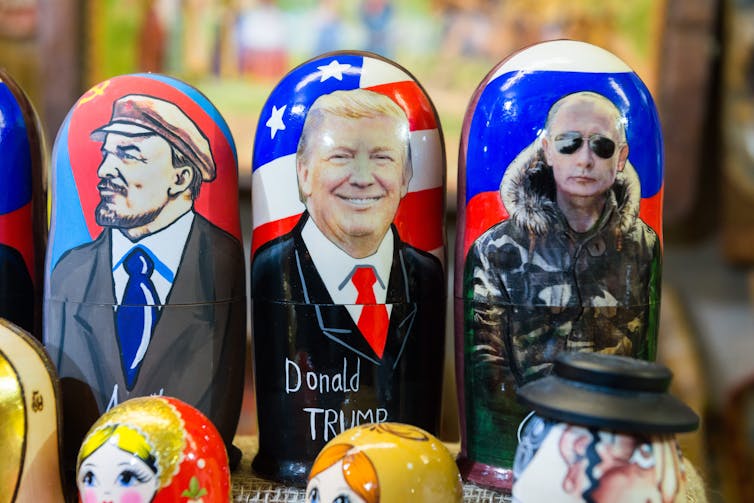
Russia is showing increasing contempt for Trump

Maxim Apryatin
By Cynthia Hooper, College of the Holy Cross
Four major Russia investigations are underway in Washington, along with at least six related federal inquiries.
Anxiety currently swirls around the Kremlin’s manipulation of popular social media platforms Facebook, YouTube and Instagram. Cybersecurity sleuths claim Russia used Pokemon Go to inflame racial tensions and accuse Twitter of deleting crucial data detailing Russian efforts to sow discord during the 2016 presidential election.
“Russia, Russia Everywhere,” read The New York Times Oct. 13 “Week in Technology” review.
But as a cultural historian, I’m interested in how Russia’s media outlets – many of which are state-controlled – are covering these same stories.
It’s no secret that for years the Kremlin has claimed Washington possesses a knee-jerk, anti-Russian bias. Moscow officials have cast recent U.S. charges that Russia has been acting to “undermine the U.S.-led liberal democratic order” as simply part of this same phenomenon, albeit one that has blossomed, of late, into full-fledged hysteria.
Russia’s most popular media outlets compare the investigations to those of the McCarthy era, calling them “witch hunts” focused on a “phantom menace.”
However, I’ve noticed something surprising. Amid all the emphasis of “Russophobia run wild,” Russian media coverage seems to have become more positive in regard to one issue: the Justice Department’s investigation led by Special Prosecutor Robert Mueller.
Russian trolls were schooled on ‘House of Cards’
Michael Isikoff reports: The Russians who worked for a notorious St. Petersburg “troll factory” that was part of Vladimir Putin’s campaign to influence the 2016 presidential election were required to watch the “House of Cards” television series to help them craft messages to “set up the Americans against their own government,” according to an interview broadcast Sunday (in Russian) with a former member of the troll factory’s elite English language department.
The interview, broadcast by the independent Russian TV station Rain, provides new insight into how the troll factory formerly known as the Internet Research Agency targeted U.S. audiences in part by posting provocative “comments” pretending to be from Americans on newspaper articles that appeared on the websites of the New York Times and Washington Post.
A central theme of this messaging was demonizing Hillary Clinton by playing up the past scandals of her husband’s administration, her wealth and her use of a private email server, according to the interview with the agency worker, identified only as “Maksim,” with his face concealed. [Continue reading…]
Put women in charge
Michelle Goldberg writes: Most women I know — and probably most women you know — have stories about sexual harassment. Mine happened in college, with a professor who was older than my father and who made me think he was genuinely interested in my writing. One day in his office, he told me he wanted to “kiss and molest” me. I muttered something about having a boyfriend and fled.
As stories like this go, I got off easy. I remember thinking at the time, “Huh, so this is sexual harassment.” I wasn’t particularly traumatized, but it was a blow to my faith in my own talents. I felt ridiculous for having believed that this man, whom I very much admired, saw me as a person with promise instead of an easy mark.
Cumulatively, incidents like this erode women’s self-confidence and make it hard for them to find mentors as their male peers do. But in my case, there was no accumulation; I never again experienced anything like it. There’s plenty of harassment in the media; in the wake of the Harvey Weinstein scandal, some women passed around an anonymous, crowd-sourced Google Doc listing men in my industry accused of sexual transgressions. I’d heard some of these stories but have somehow been immune since that office visit so many years ago. Why?
I’m sure the friendly people on the internet will say it’s because I’m undesirable, but despite the Weinstein affair, it’s not just dewy bombshells who experience harassment. Maybe I’ve simply been lucky. But I credit the fact that I worked at a succession of publications — Salon, Newsweek and The Daily Beast, The Nation, Slate — headed, for most of the time I was there, by women. (This was unusual; as of 2016, according to the American Society of News Editors, women still made up only 37.11 percent of “newsroom leaders.”) The books I’ve published have been acquired and edited by women. For most of my 20s and 30s, I never had to worry that getting ahead in my career meant staying in the good graces of a straight man.
More women should have the same privilege. [Continue reading…]
Donald Trump and the dawn of the evangelical-nationalist alliance
Tim Alberta writes: Donald Trump’s supporters always had diverging interpretations of his campaign mantra, “Make America Great Again,” yet they all centered on returning the country to a better and more comfortable time.
To economic nationalists, it meant going back to an era of high tariffs and buying American. To defense hawks, it meant returning to a time of unquestioned military supremacy. To immigration hard-liners, it meant fewer jobs for foreign-born workers—and, for some of those voters, fewer dark faces in the country, period.
But for many evangelicals and conservative Catholics, “Make America Great Again” meant above all else returning to a time when the culture reflected and revolved around their Judeo-Christian values. When there was prayer in public schools. When marriage was limited to one man and one woman. When abortion was not prevalent and socially acceptable. When the government didn’t ask them to violate their consciences. And, yes, when people said “Merry Christmas” instead of “Happy Holidays.”
This explains one of the more striking lines in Trump’s speech Friday to the Values Voter Summit, which in just 10 years has become one of the premier annual gatherings of social conservatives in Washington. Touting the “customs, beliefs and traditions that defined who we are as a nation and as a people,” the president recalled the Founders’ repeated reference to a “Creator” in the Declaration of Independence. “How times have changed,” Trump said. “But you know what? Now they’re changing back again. Just remember that.”
The audience roared with a 20-second standing ovation.
Of course, much of the cultural drift the “values voters” fear seems irreversible as America’s demographic transformation yields an electorate that is younger, more ethnically diverse, more urban, more educated and less religious. Same-sex marriage is settled law with ever-broadening public support; abortion rights are probably impossible to fully retract. And the country’s steady secularization, decried for decades from church pulpits, appears to have accelerated in recent years: According to a comprehensive Pew Research Center poll of more than 35,000 Americans, the share of self-identified Christians decreased nearly 7 percent between 2007 and 2014, while the share of religiously unaffiliated citizens increased nearly 7 percent in that time.
What, then, can a thrice-married Manhattan billionaire—or any politician, for that matter—realistically offer Christian voters who hope for a cultural and spiritual revival in America? [Continue reading…]
Sebastian Kurz’s audacious gamble to lead Austria pays off
The Guardian reports: By handing a convincing victory to the centre-right party of 31-year-old Sebastian Kurz on Sunday, Austria rewarded one of the most audacious political gambles in its recent history.
Until Kurz was announced as a candidate for chancellor in June, his Austrian People’s party (ÖVP) had been trailing by some distance in polls behind its senior partner in the governing coalition, the centre-left SPÖ, and behind the far-right Freedom party (FPÖ).
But on Sunday evening the man Austrian tabloids have affectionately dubbed wunderwuzzi or “wonderkid” could hardly make himself heard over deafening cheers as walked on to the stage at Vienna’s Kursalon, draped in the turquoise colours of his “movement”.
With the ÖVP winning more than 30% of the vote, Kurz is in a position to choose whether he wants to continue the “grand coalition” of the past decade under his leadership or enter an alliance with the nationalist FPÖ. [Continue reading…]
How dirty campaigning and fake Facebook sites came to dominate the Austrian election
The Washington Post reports: The two Facebook pages told sharply different tales, but neither looked especially favorable for Sebastian Kurz, the 31-year-old Austrian foreign minister who is expected to become the country’s youngest-ever chancellor following elections Sunday.
One cast itself as a fanboy site for the telegenic Kurz, but included dodgy accusations that nongovernmental organizations were smuggling in thousands of migrants. It also included a poll suggesting that the center-right leader might seal the country’s border with Italy to block the path of asylum seekers.
The other appeared to be a far-right attack site against Kurz, and was laced with anti-Semitic conspiracy theories.
In the end, neither site was what it appeared. But both, according to the Austrian media, had the same unlikely creator: a former consultant for the reelection campaign of Kurz’s rival, center-left Chancellor Christian Kern.
The disclosure of the deception has rocked the normally sedate world of Austrian politics in the election’s final weeks, crowding out debate over the issues and clogging Austrian newspapers and news shows with endless discussion of who knew what, and when. [Continue reading…]
World’s first ‘negative emissions’ plant has begun operation — turning carbon dioxide into stone
Akshat Rathi writes: There’s a colorless, odorless, and largely benign gas that humanity just can’t get enough of. We produce 40 trillion kg of carbon dioxide each year, and we’re on track to cross a crucial emissions threshold that will cause global temperature rise to pass the dangerous 2°C limit set by the Paris climate agreement.
But, in hushed tones, climate scientists are already talking about a technology that could pull us back from the brink. It’s called direct-air capture, and it consists of machines that work like a tree does, sucking carbon dioxide (CO2) out from the air, but on steroids—capturing thousands of times more carbon in the same amount of time, and, hopefully, ensuring we don’t suffer climate catastrophe.
There are at least two reasons that, to date, conversations about direct air capture have been muted. First, climate scientists have hoped global carbon emissions would come under control, and we wouldn’t need direct air capture. But most experts believe that ship has sailed. That brings up the second issue: to date, all estimates suggest direct air capture would be exorbitantly expensive to deploy.
For the past decade, a group of entrepreneurs—partly funded by billionaires like Bill Gates of Microsoft, Edgar Bronfman Jr. of Warner Music, and the late Gary Comer of Land’s End—have been working to prove those estimates wrong. Three companies—Switzerland’s Climeworks, Canada’s Carbon Engineering, and the US’s Global Thermostat—are building machines that, at reasonable costs, can capture CO2 directly from the air. (A fourth company, Kilimanjaro Energy, closed shop due to a lack of funding.) [Continue reading…]
As Austria heads to the polls, the far right eyes what may be this year’s biggest European success
The Washington Post reports: Austria could be set for a turn to the right, as voters there head to the polls on Sunday in an election that’s being closely watched across Europe.
One of the most likely results, according to polls, is a coalition between the right-wing populist Freedom party and the center-right ÖVP party. The Freedom party is expected to make significant gains, possibly paving the way for its best election result in over a decade.
What’s at stake?
When neighboring Germany held its election less than a month ago, the far-right Alternative for Germany made significant gains. The political center still held, however, putting Chancellor Angela Merkel on track for a fourth term. Her party’s losses were widely linked to her decision to allow more than one million refugees into the country within four years.
In Austria, the backlash against liberal policies has been much more pronounced. As a member of the European Union, Austria could resist efforts by Germany and France to reform the E.U. and to expand cooperation on issues such as immigration.
The center-right candidate considered most likely to win the chancellorship, Foreign Minister Sebastian Kurz, has already rejected E.U. reform proposals by French President Emmanuel Macron. As foreign minister, Kurz also pursued policies designed to stop the influx of immigrants, even if some of those measures contradicted E.U. rules. Sunday’s elections could turn some of those measures into longer-term solutions embraced by the country’s political mainstream. [Continue reading…]
‘Allah’ is found on Viking funeral clothes
The New York Times reports: The discovery of Arabic characters that spell “Allah” and “Ali” on Viking funeral costumes in boat graves in Sweden has raised questions about the influence of Islam in Scandinavia.
The grave where the costumes were found belonged to a woman dressed in silk burial clothes and was excavated from a field in Gamla Uppsala, north of Stockholm, in the 1970s, but its contents were not cataloged until a few years ago, Annika Larsson, a textile archaeologist at Uppsala University, said on Friday.
Among the contents unearthed: a necklace with a figurine; two coins from Baghdad; and the bones of a rooster and a large dog.
Dr. Larsson discovered the Arabic characters in February, as she was preparing some of the items for an exhibition on Viking couture in Enkoping, Sweden. She had been trying to recreate textile patterns for the exhibits — by comparing motifs on the burial dress with a silk band found around the head of a skeleton in a Viking grave at Birka, Sweden — when she discovered Kufic characters of Arabic. [Continue reading…]
Although Europe is referred to as a continent, we should always remember that as a topographical entity it is actually — as described by the Oxford archeologist, Barry Cunliffe — “the westerly excrescence of the continent of Asia.”
In other words, the separation between Europe and the lands and cultures surrounding it is a construct that resides solely inside people’s minds. Inside this cognitive space, it has periodically taken on a rigidity that obscures both geography and history.
While evidence of the influence of Islam across Europe might alarm some contemporary nativist Europeans whose cultural identity is only skin-deep, the location of the artifacts in question hardly seems surprising. What they reveal is open to question — their arrival might simply be the result of trade in goods. Yet intermixing is and always has been an engine that enriches cultural development.
A hero turned villain: Aung San Suu Kyi and the annihilation of Myanmar’s Rohingya
Neve Gordon writes: I recently met Penny Green to discuss the situation in Myanmar and Aung San Suu Kyi’s role in the perpetration of the horrific crimes carried out against the Rohingya.
A professor of law and globalization and the founding director of the International State Crime Initiative (ISCI) at Queen Mary University of London, Green has been closely monitoring the treatment of the Rohingya in Myanmar for the past five years. In a 2015 report based on 12 months of field work and over 200 interviews, ISCI found ample evidence that the Rohingya have been subjected to systematic and widespread human-rights violations, including killings, torture, and rape; denial of citizenship; destruction of villages; land confiscation; and forced labor. Citing Daniel Feierstein’s Genocide as Social Practice, which outlines six stages leading to genocide, ISCI claimed that the Myanmar regime had already perpetrated four: (1) stigmatization and dehumanization; (2) harassment, violence, and terror; (3) isolation and segregation; and (4) the systematic weakening of the target group. Now the Rohingya potentially face the final two stages of genocide—mass annihilation and erasure of the group from Myanmar’s history.
Neve Gordon: Can you provide some background about the Rohingya’s plight and the processes that have brought us to where we are today?
Penny Green: Burma, known today as Myanmar, received independence in 1948. The country had been part of a vast British colony, and not unlike India, Pakistan, and Bangladesh, Burma’s borders were determined partly according to religious lines, with the Bengal state being mostly Hindu, Bangladesh mostly Muslim and Burma mostly Buddhist. The Rohingya, who are Muslim, had been living for centuries mostly in what became Rakhine State in the newly established Burma. In 1950, they were issued citizenship identification cards and granted the right to vote under the first post-independence Prime Minister, U Nu. Until the late 1970s, the Rohingya held important government positions as civil servants, the official Burma Broadcasting Service relayed a Rohingya-language radio program three times a week, and the term “Rohingya” was used in school textbooks and official documents.
In the early 1980s, we start to witness the beginning of the process that ultimately aims at erasing the Rohingya from Myanmar’s history and geography. In 1982, the Rohingya were removed from the list of Myanmar’s 135 officially recognized ethnic minorities and stripped of citizenship. A little more than a decade later, the government suddenly refused to issue birth certificates to Rohingya babies. It then began to completely erase the term “Rohingya” from the official texts and even to condemn anyone who uttered the word. After the 2012 government-sanctioned Rakhine violence, the Rohingya were restricted to secure zones, detention camps, ghettos, and prison villages, and were excluded from higher education, all professions, the military and the public service.
Finally, in 2014, the Rohingya were excluded from the census. This is crucial in my mind, even more so than the prohibition to participate in the November 2015 elections, since, as history teaches us, when the state stops counting people it means that the state no longer considers them subjects of management and control, and when people are no longer monitored and managed, it means that they are considered superfluous. [Continue reading…]
Manafort had $60 million relationship with a Russian oligarch
NBC News reports: Paul Manafort, a former campaign manager for President Donald Trump, has much stronger financial ties to a Russian oligarch than have been previously reported.
An NBC News investigation reveals that $26 million changed hands in the form of a loan between a company linked to Manafort and the oligarch, Oleg Deripaska, a billionaire with close ties to the Kremlin.
The loan brings the total of their known business dealings to around $60 million over the past decade, according to financial documents filed in Cyprus and the Cayman Islands. [Continue reading…]
Scientists think that global warming may already be influencing fire seasons
ClimateWire reports: As deadly wildfires rage across California’s wine country, leaving at least 29 dead and a trail of destruction in their wake, the influence of climate change is again being questioned.
Just Monday, Hillary Clinton delivered a speech at the University of California, Davis, in which she noted that “it’s been a tough couple of weeks with hurricanes and earthquakes and now these terrible fires” (Climatewire, Oct. 12).
“So in addition to expressing our sympathy, we need to really come together to try to work to prevent and mitigate, and that starts with acknowledging climate change and the role that it plays in exacerbating such events,” she added.
While there’s growing interest in investigating the fingerprints of climate change on extreme weather events, it’s often challenging for scientists to parse out its influence versus other natural and human factors—and, as experts have warned time and again, no single weather event can be attributed solely to the effects of climate change. This may be particularly true for wildfires, which are heavily influenced by human land-use and management practices in addition to the weather.
Still, scientists are increasingly suggesting that climate change has already had a hand in shaping fire seasons, not just in California but elsewhere around the world, and will likely continue to play a major role. These are a few of the major climate-related factors that may be at play. [Continue reading…]
Iraq conflict: Kurdish Peshmerga ‘given deadline’ in Kirkuk
BBC News reports: Kurdish Peshmerga fighters say Iraq’s central government has ordered them to surrender key military positions in the disputed city of Kirkuk within hours.
They were given a deadline of 02:00 on Sunday (23:00 GMT on Saturday) to quit military facilities and oil fields.
Brief clashes also erupted between Kurdish forces and Shia militia backing the Iraqi government.
Tensions have been on the rise since Kurds held a referendum on independence last month, which Iraq called illegal.
The oil-rich province of Kirkuk is claimed by both the Kurds and Baghdad, though the two sides were recently united in the fight against the Islamic State (IS) jihadist group. [Continue reading…]