Category Archives: Issues

Is BDS the only pro-Israel option left?

Mark LeVine writes: Just a year ago, the boycott, divestment and sanctions (BDS) movement was no more than a minor irritant in the eyes of the majority of Israeli and Diaspora Jewish leaders. The boycott of settlement products — with a value of $30 million per year in a GDP of $36 billion — while politically worrisome, was limited. The Knesset and the country’s National Science Foundation both released studies declaring the academic boycott’s impact marginal, and the number of artists refusing to play Israel remained manageably small.

What a difference a year makes. Today BDS is described as an existential threat to Israel; its potential cost is estimated at upward of $5 billion per year. Entire ministries are being tasked with combating it. The self-described “richest Jew in the world,” casino magnate Sheldon Adelson, has convinced other wealthy pro-Israel Jews to commit upward of $50 million to setting up programs on college campuses to aggressively fight it.

There are four reasons the “noise” — as Fitch Ratings financial analyst Paul Gamble described it for The Jewish Week — of BDS became a roar. First, the occupation of the West Bank has become so concentrated that it can no longer be dissolved into a larger narrative of a modern, Western Israel. Israel’s matrix of control is so dense that it is simply impossible to hide from the occupation or pretend it doesn’t exist. [Continue reading…]

Facebooktwittermail

Another futile report on Israel’s wild adventure in Gaza

Gideon Levy writes: The United Nations Human Rights Council’s report did not tell us anything new. We did not need to wait a year to know that Israel (and Hamas) committed war crimes; there was no need to impanel a committee to know that Israel went wild in Gaza; there was no need to bother judge Mary McGowan Davis in order for her to tell us that it is unacceptable to drop a one-ton bomb in the middle of a neighborhood. We have known that for a long time.

The UN report also did not tell us anything new about Israel’s response. There was no need to publish it to know the scope of unreceptiveness and denial within Israeli society, the low level to which the Israeli media stooped in finally allowing itself to become an agent of propaganda, and the lack of interest that all this killing and destruction in Gaza arouse in Israel. We have known all that for a long time.

The world knows the fundamental truths, and every commission repeats them like a parrot, and nothing changes: Israel ignores international law. It is convinced that it applies to all countries, except for itself. According to its combat theory, when the life of one Israeli soldier is at stake it is alright to wreak havoc with everything, and when Israel says everything it means everything. There is no chance Israel will change its doctrine of death and destruction, unless it is punished severely. Therefore this report, like all its predecessors, has no value at all.

If the Goldstone Report, which described in harsher colors a less brutal attack, did not prevent Operation Protective Edge, then why do we need all these reports? If the international community, which knew in real time what the Israel Defense Forces was doing in Gaza, did not respond immediately with actions that would stop it, then there is no reason for these commissions of inquiry after the fact.

If in the wake of this commission, too, the international community does not take practical steps against war criminals, then there is no further reason for commissions. [Continue reading…]

Facebooktwittermail

Inside the hack of the century

Peter Elkind writes: On Monday, Nov. 3, 2014, a four-man team from Norse Corp., a small “threat-intelligence” firm based in Silicon Valley, arrived early for an 11:30 a.m. meeting on the studio lot of Sony Pictures Entertainment, in the Los Angeles suburb of Culver City. They were scheduled to see Sony’s top cybersecurity managers to pitch Norse’s services in defending the studio against hackers, who had been plaguing Sony for years.

After a quick security check at the front gate and then proceeding to the George Burns Building on the east side of the Sony lot, the Norse group walked straight into the unlocked first-floor offices of the information security department, marked with a small sign reading info sec. There was no receptionist or security guard to check who they were; in fact, there was no one in sight at all. The room contained cubicles with unattended computers providing access to Sony’s international data network.

The visitors found their way to a small sitting area outside the office of Jason Spaltro, Sony’s senior vice president for information security, settled in, and waited. Alone. For about 15 minutes.

“I got a little shocked,” says Tommy Stiansen, Norse’s co-founder and chief technology officer. “Their Info Sec was empty, and all their screens were logged in. Basically the janitor can walk straight into their Info Sec department.” Adds Mickey Shapiro, a veteran entertainment attorney who helped set up the meeting and was present that day: “If we were bad guys, we could have done something horrible.”

Finally Spaltro, who’s worked at Sony since 1998, showed up and led them to a nearby conference room, where another studio information security executive was waiting. The meeting began, and as Stiansen described how Norse scopes out potential threats, Spaltro interrupted: “Boy, that could really help us with that North Korean film!” According to the four Norse representatives, Spaltro explained that he was worried about a Seth Rogen comedy called The Interview that the studio was preparing to release on Christmas Day. It featured a plot to assassinate Kim Jong-un, the country’s actual leader. Recalls Stiansen: “They said North Korea is threatening them.” (Sony denies any mention of a North Korean cyberthreat.)

After about an hour the Sony team declared the session “very productive,” according to the Norse team, and promised to be in touch. They departed, leaving the visitors to find their own way out.

Three weeks later — starting at about 7 a.m. Pacific time on Monday, Nov. 24 — a crushing cyberattack was launched on Sony Pictures. Employees logging on to its network were met with the sound of gunfire, scrolling threats, and the menacing image of a fiery skeleton looming over the tiny zombified heads of the studio’s top two executives.

Before Sony’s IT staff could pull the plug, the hackers’ malware had leaped from machine to machine throughout the lot and across continents, wiping out half of Sony’s global network. It erased everything stored on 3,262 of the company’s 6,797 personal computers and 837 of its 1,555 servers. To make sure nothing could be recovered, the attackers had even added a little extra poison: a special deleting algorithm that overwrote the data seven different ways. When that was done, the code zapped each computer’s startup software, rendering the machines brain-dead.

From the moment the malware was launched — months after the hackers first broke in — it took just one hour to throw Sony Pictures back into the era of the Betamax. The studio was reduced to using fax machines, communicating through posted messages, and paying its 7,000 employees with paper checks.

That was only the beginning of Sony’s horror story. [Continue reading…]

Facebooktwittermail

Rainbow White House

Quartz: The White House was quick to celebrate today’s historic decision by the US Supreme Court that legalized gay marriage in all 50 states of the nation.

Soon after the Supreme Court announced its decision, the White House Facebook page changed its profile photo to a picture of the iconic building’s walls in the colors of the rainbow, the universal symbol of the gay rights movement.

At 11am, the President addressed a crowd in the Rose Garden behind the White House—whose walls, alas, remain white despite the Facebook change—heralding the Supreme Court’s decision as “justice that arrives like a thunderbolt.”

“This ruling is a victory for America,” Obama said. “This decision affirms what millions of Americans already believe in their hearts: When all Americans are treated as equal, we are all more free.”

Facebooktwittermail

Caring for the Earth is caring for the common good

“We need to strengthen the conviction that we are one single human family. There are no frontiers or barriers, political or social, behind which we can hide, still less is there room for the globalization of indifference.” – Pope Francis

Sergio Mello e Souza and Brother Jaazeal Jakosalem write: Although we hail from two different continents, speak many different languages, and represent two different hemispheres of this Earth, this past week was momentous for both of us. That’s because before we became Climate Reality Leaders, we were Catholics, each guided by our faith to love God’s Earth and be good stewards of creation – all living creatures and the planet.

This past week, Pope Francis delivered a historic encyclical – a letter from the pope to Catholic communities around the world – about the interrelatedness of the economy, the environment, and equity entitled Laudato Si’: On Care For Our Common Home.

Pope Francis is not just writing to Catholics in his encyclical. He also hopes it will help people around the world – no matter their faith or creed – understand how the destruction and degradation of our environment is not only harming the home we all share, but also having especially devastating consequences for the poorest among us. It’s a reminder that if we want to solve climate change and poverty, we need to address both at the same time, and that by caring for our world and pursuing a more sustainable way of life, we can lift up the neediest out of poverty and ensure a peaceful, prosperous, and healthy world for future generations. [Continue reading…]

Facebooktwittermail

The world’s power mix is about to change

Scientific American reports: Big changes are afoot for the energy sector in the next 25 years. Coal and gas are headed out and solar and wind are rushing to take their place on a multi-trillion dollar investment bonanza, according to a new report from Bloomberg New Energy Finance that scopes out the power generating landscape through 2040.

The main reason for the big shift in power generation isn’t likely to be because of a grand climate agreement, national polices or carbon pricing scheme, though. Instead, it comes down to cold, hard cash with renewables offering more power-generating bang for the buck than fossil fuels. Here are the three big numbers. [Continue reading…]

Facebooktwittermail

Why cyber war is dangerous for democracies

Moisés Naím writes: This month, two years after his massive leak of NSA documents detailing U.S. surveillance programs, Edward Snowden published an op-ed in The New York Times celebrating his accomplishments. The “power of an informed public,” he wrote, had forced the U.S. government to scrap its bulk collection of phone records. Moreover, he noted, “Since 2013, institutions across Europe have ruled similar laws and operations illegal and imposed new restrictions on future activities.” He concluded by asserting that “We are witnessing the emergence of a post-terror generation, one that rejects a worldview defined by a singular tragedy. For the first time since the attacks of Sept. 11, 2001, we see the outline of a politics that turns away from reaction and fear in favor of resilience and reason.”

Maybe so. I am glad that my privacy is now more protected from meddling by U.S. and European democracies. But frankly, I am far more concerned about the cyber threats to my privacy posed by Russia, China, and other authoritarian regimes than the surveillance threats from Washington. You should be too. [Continue reading…]

Facebooktwittermail

The day after a nuclear deal with Iran

Hooman Majd writes: Iranian president Hassan Rouhani may soon discover that negotiating a nuclear deal was the easy part of his job. He is likely to have a much more difficult time in office — with pressure from his opponents and his supporters — once the initial euphoria of a deal passes. Not only will he have to show that the nuclear deal does indeed better the lives of ordinary Iranians by drastically improving the economy, he will no longer have the excuse of the nuclear deal in delaying his other campaign promises. And he will still have his hardline opponents, even less willing to grant him another popular achievement, nipping at his heels on every issue, particularly any issue that relates to a loosening of social restrictions and building a new relationship with the U.S. in the aftermath of a deal.

With only days to go until the deadline to ink such a comprehensive nuclear deal with Iran — and this is a deadline that, unlike the others in the eighteen month long negotiations saga, will need to be adhered to, at least to within a few days — it’s safe to assume that a deal will be struck. My confidence is based on the political capital spent in both Washington and Tehran, the political will in both capitals to move past a crisis that has benefited neither party and the presumption in both capitals that the time for a nuclear deal is now or never.

On the brink of this historic agreement, it’s useful to ask “what next?” for Iran and more importantly, for Iranians. The future of this nation of some 80 million, sitting at the crossroads of the East and West, on top of bountiful energy supplies, and in the center of — if not a factor in — multiple regional crises with knock-on effects, is tied to the future of the entire world, whether we like it or not. [Continue reading…]

Facebooktwittermail

Iran nuclear talks: Clearing the final hurdles

Reza Marashi writes: As officials from Iran and the permanent members of the United Nations Security Council plus Germany (P5+1) negotiate around the clock in Vienna, the self-imposed June 30 deadline steadily approaches to seal a comprehensive nuclear deal. The Obama and Rouhani administrations should be commended: The amount of progress made in the past eighteen months is greater than the preceding decade combined. The two sides are now on the cusp of a historic deal that will be one of the greatest foreign policy achievements in recent memory.

Standing in the way of victory are two key issues, both of which are resolvable: Sanctions relief, and inspections and verification.

Finding the right formula for sanctions relief will likely be the most challenging issue in Vienna. If Washington offers sanctions relief that does not provide practical value for Tehran, it will correspondingly diminish the practical value for Iranian decision-makers to uphold their end of the bargain. Iran gave more than it received in the interim nuclear deal, and is looking to collect on that investment. The P5+1 believes it must maintain the architecture of sanctions to ensure Iranian compliance. Splitting the difference will require compromise on two fronts: Multilateral sanctions and unilateral sanctions. [Continue reading…]

Facebooktwittermail

Climate change judgement in the Hague could inspire a global civil movement

The Guardian reports: “You have been negotiating all my life”, cried out 21-year-old Anjali Appadurai from the lectern of a UN climate change conference four years ago. The activist, speaking on behalf of her nation’s youth, could have speaking for anyone who has taken a mild interest in more than two decades of international negotiations on climate change and stood aghast as world leaders have failed to protect the most basic of human rights – to exist.

But today, thanks to 886 Dutch citizens who decided to sue their government, all of that may change. We may not have to wait for the politicians to save us – the lawyers may step in instead. In the first successful case of its kind, a judge in the Hague has ruled that the Dutch government’s stance on climate change is illegal and has ordered them to take action to cut greenhouse gas emissions by a hefty 25% within five years.

Lawyers say the precedent it sets could trigger similar cases all around the world. Already, in Belgium, 8, 000 citizens are preparing for a similar court case, with others pointing to another possible lawsuit in Norway. Although the case is only binding within the Netherlands, lawyers say that it will inspire lawyers and judges considering similar cases in many other countries. [Continue reading…]

Facebooktwittermail

America’s embattled Christian majority?

In America, 72% of the adult population identify themselves as Christian.

That, to my mind, makes this demographically (though of course not constitutionally) a Christian country.

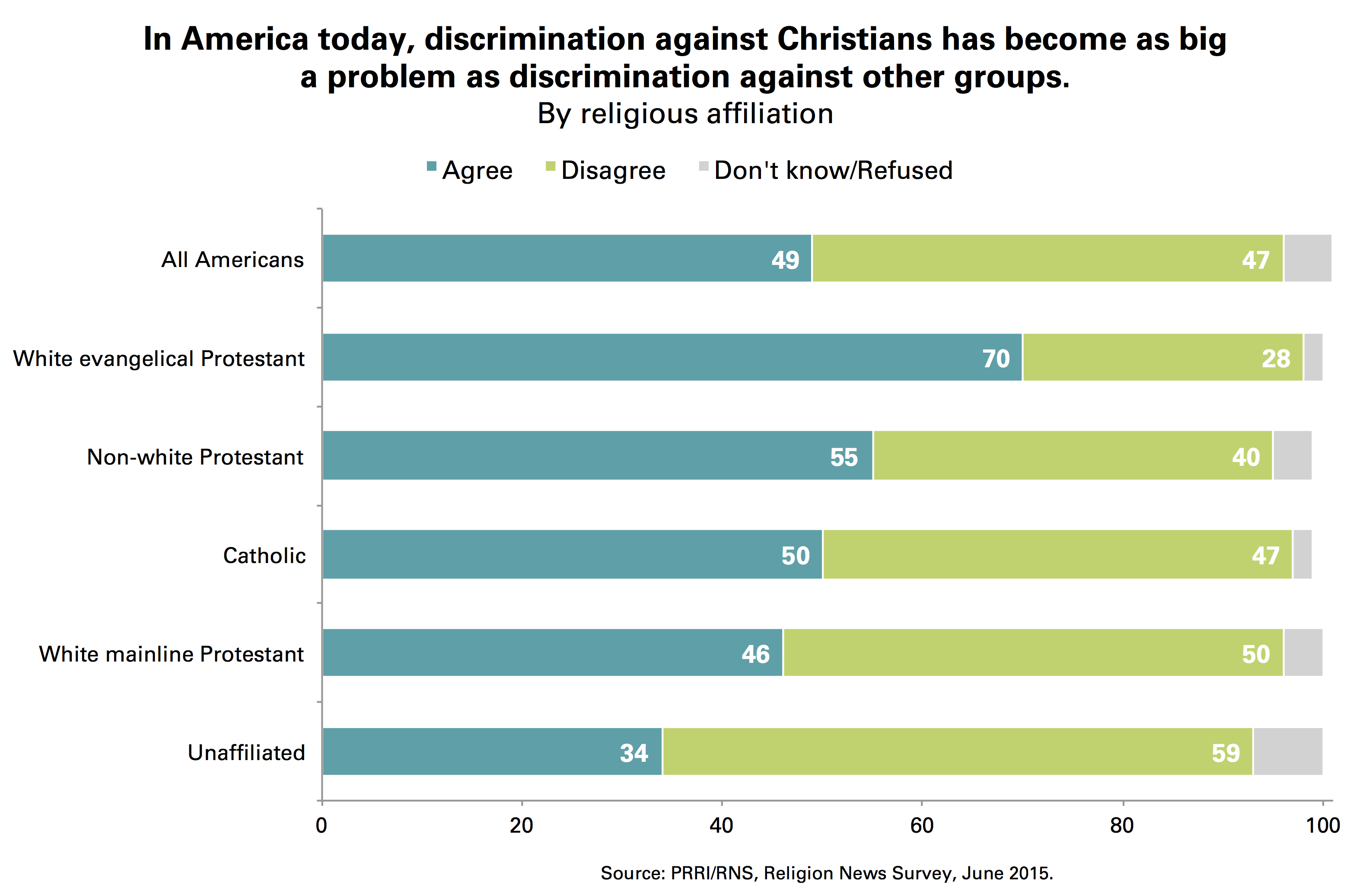
And yet, among white evangelical Protestants, 70% believe that discrimination against Christians has become as big of a problem as discrimination against other groups!

The persecuted majority?

Do Christians get harassed by the police? Get discriminated against by landlords or employers? Get harsher jail sentences? Suffer any of the other forms of discrimination experienced by many minorities in this country?

Or, do some Christians simply resent living under a democratic constitution that separates Church and State?

Facebooktwittermail

Nomi Prins: Jeb! The money! Dynasty!

Money, they say, makes the world go round. So how’s $10 billion for you? That’s a top-end estimate for the record-breaking spending in this 1% presidential election campaign season. But is “season” even the right word, now that such campaigns are essentially four-year events that seem always to be underway? In a political world stuffed with money, it’s little wonder that the campaign season floats on a sea of donations. In the case of Jeb Bush, he and his advisers have so far had a laser-focus on the electorate they felt mattered most: big donors. They held off the announcement of his candidacy until last week (though he clearly long knew he was running) so that they could blast out of the gates, dollars-wise, leaving the competition in their financial dust, before the exceedingly modest limits to non-super PAC campaign fundraising kicked in.

And give Jeb credit — or rather consider him a credit to his father (the 41st president) and his brother (the 43rd), who had Iraq eternally on their minds. It wasn’t just that Jeb flubbed the Iraq Question when a reporter asked him recently (yes, he would do it all over again; no, he wouldn’t… well, hmmm…), but that Iraq is deeply embedded in the minds of his campaign team, too. His advisers dubbed the pre-announcement campaign they were going to launch to pull in the dollars a “shock-and-awe” operation in the spirit of the invasion of Iraq. Now, having sent in the ground troops, they clearly consider themselves at war. As the New York Times reported recently, the group’s top strategist told donors that his super PAC “hopes to ‘weaponize’ its fund-raising total for the first six months of the year.”

The money being talked about$80-$100 million raised in the first quarter of 2015 and $500 million by June. If reached, these figures would indeed represent shock-and-awe fundraising in the Republican presidential race. As of now, there’s no way of knowing whether they’re fantasy figures or not, but here’s a clue to Jeb’s money-raising powers: according to the Washington Post, his advisers have been asking donors not to give more than a million dollars now; they are, that is, trying to cap donations for the moment. (As the Post’s Chris Cillizza wrote,“The move reflects concerns among Bush advisers that accepting massive sums from a handful of uber-rich supporters could fuel a perception that the former governor is in their debt.”) And having spent just about every pre-announcement day for months doing fundraisers and scouring the country for money, while preserving the fiction that he might not be interested in the presidency, Jeb, according to the New York Times, bragged to a group of donors that “he believed his political action committee had raised more money in 100 days than any other modern Republican political operation.”

Let’s not forget, of course, that we’re not talking about anyone; we’re talking about a Bush. We’re talking about the possibility of becoming number three (or rather Bush 45) in the Oval Office. We’re talking about what is, by now, a fabled money-shaking, money-making, money-raising machine of a family. We’re talking dynasty and when it comes to money and the Bushes (as with money and that other potential dynasty of our moment), no one knows more on the subject than Nomi Prins, former Wall Street exec and author of All the Presidents’ Bankers: The Hidden Alliances That Drive American Power. In her now ongoing TomDispatch series on the political dynasties of our moment, fundraising, and the Big Banks, think of her latest post as an essential backgrounder on the election you have less and less to do with, in which Wall Street, the Koch brothers, Sheldon Adelson, and the rest of the crew do most of the essential voting with their wallets. Tom Engelhardt

All in
The Bush family goes for number three (with the help of its bankers)
By Nomi Prins

[This piece has been adapted and updated by Nomi Prins from her book All the Presidents’ Bankers: The Hidden Alliances That Drive American Powerrecently out in paperback (Nation Books).] 

It’s happening. As expected, dynastic politics is prevailing in campaign 2016. After a tease about as long as Hillary’s, Jeb Bush (aka Jeb!) officially announced his presidential bid last week. Ultimately, the two of them will fight it out for the White House, while the nation’s wealthiest influencers will back their ludicrously expensive gambit.

And here’s a hint: don’t bet on Jeb not to make it through the Republican gauntlet of 12 candidates (so far). After all, the really big money’s behind him. Last December, even though out of public office since 2007, he had captured the support of 73% of the Wall Street Journal’s “richest CEOs.” Though some have as yet sidestepped declarations of fealty, count on one thing: the big guns will fall into line. They know that, given his family connections, Jeb is their best path to the White House and they’re not going to blow that by propping up some Republican lightweight whose father and brother weren’t president, not when Hillary, with all her connections and dynastic power, will be the opponent. That said, in the Bush-Clinton battle to come, no matter who wins, the bankers and billionaires will emerge victorious.

Continue reading

Facebooktwittermail

Obama administration restates its commitment to shelter war criminals

UPI reports: The Obama administration opposes bringing a United Nations report on the 2014 war between Israel and Hamas in the Gaza Strip to the Security Council for a vote, the State Department said.

State Department spokesman John Kirby said Tuesday the United States continues to review the U.N. report that found evidence of war crimes on the part of both the Israeli and Hamas-led Palestinian forces. Kirby said the United States calls into question the U.N. Human Rights Council’s process of appointing the investigative committee because of a “very clear bias against Israel.”

“We challenge the very mechanism which created it. And so we’re not going to have a readout of this. We’re not going to have a rebuttal to it. We’re certainly going to read it, as we read all U.N. reports,” Kirby said. “But we challenge the very foundation upon which this report was written, and we don’t believe that there’s a call or a need for any further Security Council work on this.”

The 200-page report found, among other things, 1,462 Palestinian civilians were killed by Israeli fire, noting over one-third were children. It added a large number of families lost three or more members in airstrikes against residences. Six Israeli civilians died during the conflict. [Continue reading…]

Facebooktwittermail

Palestinians giving up on statehood, Israeli ex-security chief says

The Times of Israel reports: The death of the two-state solution among the Palestinians is no secret to the Israelis, nor is it mourned by government officials. To the political echelon, the threat of a binational state is not sufficiently tangible, and the possibility that radical Islam will take over the West Bank if there should be a peace agreement seems more real.

But things sound different in the defense establishment, and particularly among those who have left it. Quite a few former generals, Shin Bet directors and Mossad chiefs have warned any number of times that maintaining the status quo in the territories, which has become a kind of strategy in Netanyahu’s era, could change the face of the State of Israel.

“I’m hearing from various Palestinian officials with whom I am in contact that they have given up on the two-state solution as an option for resolving the conflict,” says former Shin Bet chief Yuval Diskin, 59, who now owns a hi-tech firm in Herzliya. [Continue reading…]

Facebooktwittermail

Former U.S. military personnel urge drone pilots to walk away from controls

The Guardian reports: Forty-five former US military personnel, including a retired army colonel, have issued a joint appeal to the pilots of aerial drones operating in Afghanistan, Iraq, Pakistan, Syria and elsewhere, calling on them to refuse to carry out the deadly missions.

In a joint letter, the retired and former military members call on air force pilots based at Creech air force base in Nevada and Beale air force base in California to refuse to carry out their duties. They say the missions, which have become an increasingly dominant feature of US military strategy in recent years, “profoundly violate domestic and international laws”.

“At least 6,000 lives have been unjustly taken by US drone attacks in Afghanistan, Pakistan, Yemen, Somalia, Iraq, the Philippines, Libya and Syria. These attacks are also undermining principles of international law and human rights,” the authors write. [Continue reading…]

Facebooktwittermail

What climate deniers learned from Big Tobacco

The New York Times reports: Dr. [Naomi] Oreskes is fast becoming one of the biggest names in climate science — not as a climatologist, but as a defender who uses the tools of historical scholarship to counter what she sees as ideologically motivated attacks on the field.

Formally, she is a historian of science. Informally, this diminutive woman has become a boxer, throwing herself into a messy public arena that many career-minded climate scientists try to avoid.

She helps raise money to defend researchers targeted for criticism by climate change denialists. She has become a heroine to activist college students, supporting their demand that universities and other institutions divest from fossil fuels. Climatologists, though often reluctant themselves to get into fights, have showered her with praise for being willing to do it.

“Her courage and persistence in communicating climate science to the wider public have made her a living legend among her colleagues,” two climate researchers, Benjamin D. Santer and John Abraham, wrote in a prize-nomination letter in 2011.

Dr. Oreskes’s approach has been to dig deeply into the history of climate change denial, documenting its links to other episodes in which critics challenged a developing scientific consensus.

Her core discovery, made with a co-author, Erik M. Conway, was twofold. They reported that dubious tactics had been used over decades to cast doubt on scientific findings relating to subjects like acid rain, the ozone shield, tobacco smoke and climate change. And most surprisingly, in each case, the tactics were employed by the same group of people.

The central players were serious scientists who had major career triumphs during the Cold War, but in subsequent years apparently came to equate environmentalism with socialism, and government regulation with tyranny.

In a 2010 book, Dr. Oreskes and Dr. Conway called these men “Merchants of Doubt,” and this spring the book became a documentary film, by Robert Kenner. At the heart of both works is a description of methods that were honed by the tobacco industry in the 1960s and have since been employed to cast doubt on just about any science being cited to support new government regulations. [Continue reading…]

Facebooktwittermail

Inaction on climate change would cost billions, major EPA study finds

The Washington Post reports: A global agreement to curb greenhouse gas emissions would prevent nearly 70,000 premature American deaths annually by the end of the century while sparing the country hundreds of billions of dollars’ worth of economic losses, according to a major government study on the cost of climate change.

Slowing the carbon build-up in the atmosphere would also prevent severe damage to a wide range of critical ecosystems, from Hawaiian coral reefs that support tourism to shellfish beds off the East Coast, said the report released by the White House on Monday.

The report, a five-year, peer-reviewed analysis that assesses the benefits of alternative strategies for dealing with climate change, concludes that every region of the country could be spared severe economic disruptions that would result if greenhouse gas concentrations continue to soar. [Continue reading…]

Facebooktwittermail

Taliban has a major northern Afghan city within its grasp for the first time since 2001

The Washington Post reports: Taliban forces were less than four miles from this strategic northern city Monday after seizing control of two key districts over the weekend, triggering fears that they could capture their first Afghan city since U.S.-backed forces toppled the hard-line Islamist regime in late 2001.

The government in Kabul has dispatched reinforcements, including Afghan special forces and their U.S. advisers and trainers, to try to repel the insurgents and rescue about 75 soldiers and police officers trapped inside their district base. But as of Monday evening, the Taliban remained in control of the districts, including one separated from Kunduz city only by a wide, brown river.

“It is a critical situation,” said Mohammad Omer Safi, the governor of Kunduz province.

Not since the Taliban’s collapse has the population of an Afghan metropolis faced such intimidation from the insurgency. Starting this spring, the Taliban has focused its efforts on gaining territory in Kunduz and other northern provinces, straying from its traditional battlefields in the south and east. Whoever controls Kunduz, a vast, rich agricultural region that was a former Taliban bastion, controls the roads to northeastern Afghanistan as well as smuggling and trade routes into neighboring Tajikistan and the rest of Central Asia. [Continue reading…]

Facebooktwittermail