More ABC News Videos | ABC World News




Trevor Timm writes: After a pre-Christmas week full of massive backlash for caving to a vague and unsubstantiated threat by hackers supposedly from North Korea, Sony has reversed course and decided it will allow The Interview to be shown after all – thus all but ending what Senator John McCain absurdly called “the greatest blow to free speech that I’ve seen in my lifetime probably”.
Don’t get me wrong: it’s unequivocally good news that North Korea (or whoever hacked Sony) won’t succeed in invoking a ludicrous heckler’s veto over a satirical movie starring Seth Rogen, but there are far greater threats to our freedom of speech here in the United States. For example, Sony itself.
Lost in the will-they-or-won’t-they controversy over Sony’s potential release of The Interview has been the outright viciousness that Sony has unleashed on some of the biggest social-media sites and news outlets in the world. For the past two weeks, the studio has been trying to bully these publishing platforms into stopping the release of newsworthy stories or outright censoring already-public information contained in the hacked emails, despite a clear First Amendment right to the contrary.
On top of Sony’s worrying and legally dubious threats, the most explosive and under-read story inside the hacked trove involves Sony and its close allies at the Motion Picture Association of America (MPAA) attempting to censor the internet on a much larger scale, by reviving a re-tooled version of a highly controversial bill known as Sopa that was scuttled back in 2011 because of widespread fears that it would destroy online free speech as we know it. [Continue reading…]
Robert Foyle Hunwick writes: There’s a joke going around: “Santa Claus was descending into China from the sky. Due to the heavy smog, he fell to the ground, but no one dared help him up. While he was still lying in the snow, his bag was ransacked for presents, and his reindeer and sleigh taken away by the chengguan. Therefore, no Christmas this year.”
While some of the humor needs context—there are digs at China’s notorious bystander effect and much-despised urban-management officials, chengguan — the larger meaning is clear. Ironic jokes about Santa’s routine being disrupted with uniquely Chinese characteristics are a sure sign that, yes, they do know it’s Christmas time in communist China.
Retailers lead the way here: An annual spending season that once focused on Chinese New Year in the winter is now bloated and elongated, stretching from the invented Singles’ Day on November 11 through February, with Christmas as a kind of hump day. Even before December, shops, streets, and hotels begin filling with slightly off-kilter Yuletide scenes: performers in elf suits play traditional cymbals while a grinning plastic Santa Claus toots a saxophone outside his gingerbread cabin. Why the sax? Theorists point to everything from the instrument’s romantic associations with the avuncular Bill Clinton jamming on one in the 1990s, to the smooth alto-sax muzak that’s the preferred soundtrack of Santa’s typical dwelling, the shopping mall.
There’s no sign of Jesus, but in many big cities, you’re still more likely to see Father Christmas’s face than that of “Uncle” Xi Jinping, as state media has characterized the country’s president, presenting a homely, familial image that’s quite at odds with the repressive manner in which he’s coldly eliminated opponents. But Xi is not above the fray himself, visiting Santa’s official cabin in Rovaniemi, Finland in 2010.
The Western religious festival is so trendy, in fact, that it may be the second-most-celebrated festival in China after the Spring Festival among young Chinese, according to research conducted by the China Social Survey Institute (CSSI), which found that 15- to 45-year-olds are the most likely to observe it. [Continue reading…]
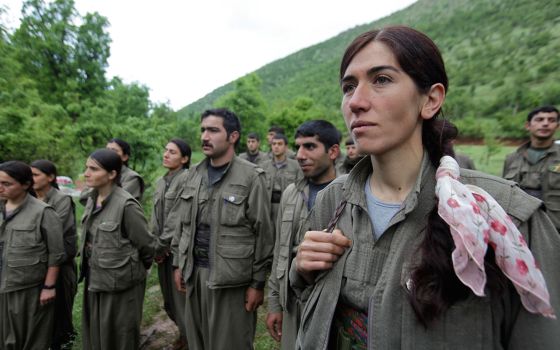
Zîlan Diyar, a Kurdish guerrilla fighter, writes: The whole world is talking about us, Kurdish women. It has become a common phenomenon to come across news about women fighters in magazines, papers, and news outlets. Televisions, news sites, and social media are filled with words of praise. They take photos of these women’s determined, hopeful, and radiant glances. To them, our rooted tradition is a reality that they only recently started to know. They are impressed with everything. The women’s laughter, naturalness, long braids, and the details of their young lives feel like hands extending to those struggling in the waters of despair. There are even some, who are so inspired by the clothes that the women are wearing, that they want to start a new fashion trend! They are amazed by these women, who fight against the men that want to paint the colors of the Middle East black, and wonder where they get their courage from, how they can laugh so sincerely. And I wonder about them. I am surprised at how they noticed us so late, at how they never knew about us. I wonder how they were so late to hear the voices of the many valiant women who expanded the borders of courage, belief, patience, hope, and beauty. I do not want to complain too much. Perhaps our eras just did not match. I just have a few words to say to those who only now begin to notice us, that’s all.
Now one half of us is missing. If there is no past or future in your environment, one feels like a sound, an upsurge that gets lost in the black holes of the universe. The excitement and beauty of today can only be measured by those who were able to carry it to this day and their ability to carry it further to the future. In the cry of Zîlan (Zeynep Kinaci), who detonated herself in 1996 is the breath of Besê, who threw herself off the cliffs in the Dersîm uprising in the 1930s, saying “You cannot catch me alive” and that of Berîtan, who surrendered neither her body, nor her weapon to the enemy, when she threw herself off the mountain cliffs in 1992. It is the reason why YPJ fighter Arîn Mirkan made a mountain wind blow through a desert town, when she detonated herself rather than surrendering to ISIS, in order to cover her retreating comrades in Kobanê this October. In the hearts of the Yezidi women, who take up arms against the men with the black flag is the homesickness of Binevs Agal, a Yezidi woman, who joined the guerilla from Germany in the 1980s and crossed continents to return to her country. In the words of Ayse Efendi, the co-president of the Kobanê people’s assembly, “I will die in my homeland,” is hidden the odin of the rebellious Zarife, who fought in the Dersim uprising. In the smile of the YPJ fighter, who poses with her child while carrying a rifle, is the hope of Meryem Colak, a psychologist, who chose to fight in the mountains and who often shared with us her longing for the daughter she left behind. Deniz Firat, a Firat News journalist, who was killed by ISIS in Makhmur in August, learned to search for truth from Gurbetelli Ersöz, a journalist and guerrilla fighter who died in clashes in 1997. Sema Yüce (Serhildan), who set herself on fire in protest in a Turkish prison in 1992, whispered the secrets of the fire to Leyla Wali Hussein (Viyan Soran), who self-immolated in 2006 to draw attention to the situation of Abdullah Öcalan. Those who today wonder about why the “Girl with the Red Scarf”, a Turkish girl, who was disillusioned from the state after the Gezi-Park protests, would join the mountains, would have known the answer if they had known Ekin Ceren Dogruak (Amara), a Turkish revolutionary woman in the PKK whose grave stone says “The girl of the sea who fell in love with the mountains” and Hüsne Akgül (Mizgin), a Turkish guerrilla fighter of the PKK, who died in 1995. Those surprised at the US Americans, Canadians joining the YPG are those who do not know Andrea Wolf, a German internationalist in the PKK, who was murdered in 1998 and whose bones were thrown into a mass grave, and whose memorial could not be tolerated by the state. [Continue reading…]

No one would call TomDispatch a traditional website. Still, we do have our traditions. Among them, none is more “traditional” — a full decade old at a website that just turned 13 this November — than having Rebecca Solnit end our year. Sometimes as the year winds down, she’s dreaming of the future, sometimes thinking about the past, sometimes focused on the last few seconds, but always, as was true from her very first moment at this website, she offers some version of hope in the face of a reality that others find almost too grim and obdurate to consider.
As this year ends, Solnit, the author of the 2014 hit book Men Explain Things to Me and an even more recent collection of essays, The Encyclopedia of Trouble and Spaciousness, considers humanity’s latest breakthrough into the apocalyptic. She takes on climate change in a clear-eyed way without losing her sense of hope and purpose. As ever, it’s an impressive performance and a reminder to all of us that the future remains ours, if only we care to focus on what truly endangers us. Someday, those who sent the most recent rounds of greenhouse gases into the atmosphere utterly wittingly, with profits on the brain — and I’m talking, of course, about the CEOs of Big Energy (and the various figures who run the energy operations we’ve given names like Saudi Arabia, Russia, and “Saudi America”) — will be remembered as the greatest criminals in history, the true terrorists (or as I’ve called them, “terrarists”) of our age. It’s one of the jokes of our time that we Americans have literally plowed trillions of dollars into what’s called “national security” in the post-9/11 years without seriously facing climate change, a phenomenon that, if not brought under control, guarantees us a kind of insecurity we’ve never known. Call it irony or call it idiocy, but call it something.
And let me end 2014, the year that revealed to all of us so much more about the hidden world of surveillance that is ours, with my own New Year’s wish: if I could be granted one relatively modest thing to end 2014, it would be the release from prison of former Army private Chelsea Manning and former CIA Agent John Kiriakou, and the release from exile of NSA whistleblower Edward Snowden. For their genuine service, for letting us know what no one else would about the nature of the American world we inhabit, they deserve so unbearably much better from this country than they’ve gotten. Someday, when those who jailed or exiled them are forgotten or scorned, they will, I’m convinced, be remembered as heroes of our moment. In the meantime, a guy can hope, can’t he? I take my hat off to all three of them as 2014 ends. Tom Engelhardt
Everything’s coming together while everything falls apart
The climate for 2015
By Rebecca SolnitIt was the most thrilling bureaucratic document I’ve ever seen for just one reason: it was dated the 21st day of the month of Thermidor in the Year Six. Written in sepia ink on heavy paper, it recorded an ordinary land auction in France in what we would call the late summer of 1798. But the extraordinary date signaled that it was created when the French Revolution was still the overarching reality of everyday life and such fundamentals as the distribution of power and the nature of government had been reborn in astonishing ways. The new calendar that renamed 1792 as Year One had, after all, been created to start society all over again.
In that little junk shop on a quiet street in San Francisco, I held a relic from one of the great upheavals of the last millennium. It made me think of a remarkable statement the great feminist fantasy writer Ursula K. Le Guin had made only a few weeks earlier. In the course of a speech she gave while accepting a book award she noted, “We live in capitalism. Its power seems inescapable. So did the divine right of kings. Any human power can be resisted and changed by human beings.”

If a tree falls in a forest and no one is around to hear it, does it make a sound?
When four networks go down in a country where hardly anyone has internet access, does it make any sense to say that North Korea had an internet outage?
Every single day there are outages on a much larger scale all over the world and apart from for the technicians whose task it is to fix them, they largely go unnoticed.
Two weeks ago there was an outage of 148 networks in the U.S. It didn’t merit media coverage — just a tweet.
A 9 hour 31 minute outage that prompted headlines suggesting the U.S. government might have launched a cyberattack in response to the Sony hack, drew this more measured observation from Mashable:
While nobody knows who blocked access for the four networks and 1,024 IP addresses in the country, the consensus is clear: it wouldn’t have taken much. The attack appears to have been a relatively simple distributed denial of service, or DDoS — the kind of thing just about any experienced hacker could launch.
Meanwhile, North Korea, never known to exercise restraint when it comes to launching fusillades of wild rhetoric, on Sunday threatened to destroy America, which is to say, they are ready to “blow up” every city in this country. The Policy Department of the National Defence Commission of the DPRK said:
The army and people of the DPRK who aspire after justice and truth and value conscience have hundreds of millions of supporters and sympathizers, known or unknown, who have turned out in the sacred war against terrorism and the U.S. imperialists, the chieftain of aggression, to accomplish the just cause.
Obama personally declared in public the “symmetric counteraction”, a disgraceful behavior.
There is no need to guess what kind of thing the “symmetric counteraction” is like but the army and people of the DPRK will never be browbeaten by such a thing.
The DPRK has already launched the toughest counteraction. Nothing is more serious miscalculation than guessing that just a single movie production company is the target of this counteraction. Our target is all the citadels of the U.S. imperialists who earned the bitterest grudge of all Koreans.
The army and people of the DPRK are fully ready to stand in confrontation with the U.S. in all war spaces including cyber warfare space to blow up those citadels.
Funny how a nuclear-armed government can threaten to destroy this country and no one takes it seriously and yet when unknown hackers ominously evoke memories of 9/11, Sony executives panic.
AFP reports: Turkish President Recep Tayyip Erdogan described efforts to promote birth control as “treason”, saying contraception risked causing a whole generation to “dry up”, reports said Monday.
Erdogan made the comments on Sunday, directly addressing the bride and groom at the Istanbul wedding ceremony of the son of businessman Mustafa Kefeli, who is one of his close allies.
He told the newly-weds that using birth control was a betrayal of Turkey’s ambition to make itself a flourishing nation with an expanding young population.
“One or two (children) is not enough. To make our nation stronger, we need a more dynamic and younger population. We need this to take Turkey above the level of modern civilisations,” Erdogan said.
“In this country, they (opponents) have been engaged in the treason of birth control for years and sought to dry up our generation,” Erdogan said. [Continue reading…]
Jamestown Terrorism Monitor: The Kurds in both Iraq and Syria have managed to attain significant degrees of autonomy in the last two decades. With the advances of the Islamic State organization, the Kurds have also become one of the West’s most prominent allies against the militant Salafist group. This has made them a target of the Islamic State, whose attacks on the Kurds have led to increased pan-Kurdish cooperation and more Western support for the Kurds despite opposition from Turkey.
There are many ideological differences between Kurdish nationalist groups and the Islamic State organization, however, the Islamic State have said that they are not against Kurdish Muslims per se. As Abu Muhammad al-Adnani, the Islamic State’s spokesman, explained in September: “We do not fight Kurds because they are Kurds. Rather we fight the disbelievers amongst them, the allies of the crusaders and Jews in their war against the Muslims” (Reuters, September 22). The Islamic State organization, like other jihadist groups, has also recruited some Kurds, largely from Iraq, to fight against the Iraqi Kurdish peshmerga and the Syrian Kurdish Yekiniyen Parastina Gel (YPG – People’s Protections Units), a Syrian branch of the Kurdistan Workers Party (PKK).
In Islamic State operations in both Iraq and Syria, Kurdish jihadists have been used as suicide bombers and foot soldiers and have led operations in Kurdish territories. Reportedly, Abu Khattab al-Kurdi (i.e. the Kurd) was the top commander of the Islamic State’s attack on Kobane. An Islamic State Kurdish bomber, Abd al-Rahman al-Kurdi, also blew himself up in Erbil, the capital of Iraqi Kurdistan, on November 19 (AP, November 5). Most of these Kurds have been recruited in the Kurdish Islamist stronghold of Halabja in Iraq, where Kurdish and American forces uprooted Islamist militants in 2003. Recent regional instability has resulted in Kurdish Islamists again posing a threat to the KRG and YPG, now by joining the Islamic State. [Continue reading…]
Der Spiegel reports: Felix Menzel is sitting in his study in an elegant villa in Dresden’s Striesen neighborhood on a dark afternoon in early December. He’s thinking about Europe. A portrait of Ernst Jünger, a favorite author of many German archconservatives is hung on the wall.
Menzel, 29, is a polite, unimposing man wearing corduroys and rimless glasses. He takes pains to come across as intellectual, and avoids virulent rhetoric like “Foreigners out!” He prefers to talk about “Europe’s Western soul,” which, as he believes, includes Christianity and the legacy of antiquity, but not Islam. “I see serious threats coming our way from outside Europe. I feel especially pessimistic about the overpopulation of Africa and Asia,” says Menzel, looking serious. “And I believe that what is unfolding in Iraq and Syria at the moment is a clear harbinger of the first global civil war.”
Menzel, a media scholar, has been running the Blaue Narzisse (Blue Narcissus), a conservative right-wing magazine for high school and university students, for the last 10 years. His small magazine had attracted little interest until now. But that is about to change, at least if Menzel has his way. “The uprising of the masses that we have long yearned for is slowly getting underway,” he writes on his magazine’s website. “And this movement is moving toward the right.”
In Dresden, at least, the sentiments expressed in the Blaue Narzisse have become more palpable in recent weeks. Protests staged each week on Mondays initially attracted only a few dozen to a few hundred people, but more recently the number of citizens taking to the streets has reached 10,000. The group, which calls itself Patriotic Europeans Against the Islamization of the West (and goes by the German acronym PEGIDA), demonstrates against economic migrants and a supposed “cultural foreign domination of our country” — whatever is meant by that.
What is going on in Germany, the world’s second most popular destination for immigrants? Has the open-mindedness for which Germans had long been praised now ended? Are we seeing a return of the vague fear of being overwhelmed by immigrants that Germany experienced in the 1990s, when a hostel for asylum seekers was burned down? How large is the new right-wing movement, and will it remain limited to Dresden, or is it spreading nationwide?
So far, protests held under the PEGIDA label in under cities — like Kassel and Würzburg — have attracted only a few hundred people at a time. In fact, some of the protests attracted significantly larger numbers of counter-demonstrators. And while thousands of “patriotic Europeans” aim to take to the streets in Dresden again in the coming days, their counterparts in Germany’s western states are taking a Christmas break. PEGIDA supporters are waiting until after the holidays to return to the streets in cities like Cologne, Düsseldorf and Unna.
Still, many Germans share the protestors’ views, according to a current SPIEGEL poll. Some 34 percent of citizens agreed with the PEGIDA protestors that Germany is becoming increasingly Islamicized. [Continue reading…]
Barbara Slavin reports: US Assistant Secretary of State for Population, Refugees, and Migration Anne Richard says the United States will dramatically increase the number of Syrian refugees allowed to resettle permanently in the United States from about 350 this year to close to 10,000 annually as the crisis grinds on into its fifth year.
While the number is minuscule given a total Syrian refugee population of 3.3 million, it reflects US recognition that the civil war in Syria is not about to end anytime soon and that, even when it does, Syria will need years for reconstruction and reconciliation.
In an interview with Al-Monitor Dec. 22, Richard said, “People are surprised we haven’t taken more.” She said the initial low numbers reflect the reality that “resettling refugees is never the first thing you do when people are fleeing an emerging crisis” and that other countries — in particular Germany and Sweden — have “stepped forward and offered to take a lot” of Syrian refugees. [Continue reading…]
Jamestown Terrorism Monitor: Since the outbreak of the Libyan revolution in 2011 and the collapse of Mu’ammar Qaddafi’s Jamahiriya (Republic of the Masses), Libya has fallen into a process of constant and ever deeper chaos, which has lately reached a new climax. This conflict, however, has its roots in some specific features characterizing Libya as a “nation-state”: while Libya may be a nation-state on paper, it has yet to become a proper and unified national society. Indeed, the very roots of the revolution in Libya lie in the significant structural, regional and territorial imbalances that have characterized Libya since its establishment and the dominance of parochial and narrow interests.
Indeed, regional and political imbalances – the neglected east and south against the stronger and richer west – were key in setting the landscape in which the Libyan revolution took place. Revolts started in Benghazi and moved east to west, with a long military stalemate occurring in Ras Lanuf, historically a sort of informal cultural border dividing Tripolitania and Cyrenaica. Geographically, this was similar to what happened with the 1969 revolution. That revolution was a reaction against the dominance of the east, Benghazi and the royal circle. Among the 12 members of the Revolutionary Command Council, which led the revolution and then acted as the supreme authority in Libya between 1969 and 1975, only four were from the east.
Moreover, another factor explaining the complete collapse of order in post-Qaddafi Libya is the complete lack of any reliable state institution. Despite being the “Republic of the Masses”, Qaddafi’s Jamahiriya was essentially based on his sole, complete personal rule: 42 years under this system left Libya as a sort of institutional desert following the collapse of the regime. The regime overlapped the state and as a result the boundaries, both conceptual and organizational, between the two became soon nonexistent. That explains why, in Libya, the fall of the regime caused the fall of the state, unlike in Tunisia and Egypt where the regimes, not the state, collapsed. However, this lack of institutional capacity must be seen in a longer-term perspective: that was a structural feature of Libya as a nation-state since its foundation. Libya at independence did not have a stable state apparatus and oil and external revenue allowed the rulers to avoid building a bureaucratic state, moving from the rentier patronage of King Idris and the Senussi monarchy to the distributive republic led by Qaddafi. [Continue reading…]
Sebastian Rotella, James Glanz and David E. Sanger report: In the fall of 2008, a 30-year-old computer expert named Zarrar Shah roamed from outposts in the northern mountains of Pakistan to safe houses near the Arabian Sea, plotting mayhem in Mumbai, India’s commercial gem.
Mr. Shah, the technology chief of Lashkar-e-Taiba, the Pakistani terror group, and fellow conspirators used Google Earth to show militants the routes to their targets in the city. He set up an Internet phone system to disguise his location by routing his calls through New Jersey. Shortly before an assault that would kill 166 people, including six Americans, Mr. Shah searched online for a Jewish hostel and two luxury hotels, all sites of the eventual carnage.
But he did not know that by September, the British were spying on many of his online activities, tracking his Internet searches and messages, according to former American and Indian officials and classified documents disclosed by Edward J. Snowden, the former National Security Agency contractor.
They were not the only spies watching. Mr. Shah drew similar scrutiny from an Indian intelligence agency, according to a former official who was briefed on the operation. The United States was unaware of the two agencies’ efforts, American officials say, but had picked up signs of a plot through other electronic and human sources, and warned Indian security officials several times in the months before the attack.
What happened next may rank among the most devastating near-misses in the history of spycraft. The intelligence agencies of the three nations did not pull together all the strands gathered by their high-tech surveillance and other tools, which might have allowed them to disrupt a terror strike so scarring that it is often called India’s 9/11.
“No one put together the whole picture,” said Shivshankar Menon, who was India’s foreign secretary at the time of the attacks and later became the national security adviser. “Not the Americans, not the Brits, not the Indians.” [Continue reading…]
So many years and wars later, it’s easy to forget what a total television hit the first Gulf War of 1991 was. Just in case you no longer remember — and why should you? — that was the war that was to bury America’s defeat in Vietnam forever and signal the arrival of the greatest Great Power the planet had ever known, the soon-to-be-Soviet-Union-less United States. That first partial invasion of Iraq, with its million or more uniformed extras, its vast sets, and its six-month preproduction schedule filled with logistical miracles, was something to behold. All through the winter of 1990, the production had its built-in “coming attractions,” the many variations on “showdown in the Gulf” with Saddam Hussein, the glowering guy with the black mustache who had, until more or less the previous night, been Washington’s man in Baghdad.
Those previews of the war-to-come teased American viewers with a possible January opening in domestic multiplexes nationwide. And when it arrived, the production didn’t disappoint. It had its dazzling Star Wars-style graphics, its own theme music and logos, and its stunningly prime-timed first moments (Disneyesque fireworks over Baghdad). As a show, it was calibrated for controlled thrills, anxiety, and relief from its opening laser-guided, son et lumière spectacular to its final triumphant helicopter descent on the U.S. embassy in Kuwait (which was meant to replay in reverse indelible final images of helicopters fleeing Saigon).
And what a show that war was, a kind of program-length commercial similar to those pioneered by toy companies in the previous decade that had turned TV cartoons into animated toy catalogs. It was as if the whole post-Vietnam era had been building toward nothing but that 43-day-long ad, intent on selling domestic and foreign markets on the renewal of American power as well as on the specific weapons systems that were renewing that power. In this way, the Gulf War of 1991 hawked the leading-edge aspects of the country’s two foremost exports: arms and entertainment.
Almost a quarter of a century later, amid the rubble of a chaotic Greater Middle East, America’s third Iraq war drags on, as Washington officials insist that it has years still to go. Meanwhile, Iraq itself, having experienced two American invasions, a prolonged occupation, and an era of “reconstruction” (which proved to be largely an era of deconstruction), as well as the birth of a jihadist oil-mini-state in its midst, now threatens to split into Shiite, Sunni, and Kurdish cantonments. Given what’s happened in the 24 years since, who now remembers any of the triumphalist glories of that first conflict in the Gulf? And here’s a guarantee: no matter how few still remember the highlight reels from that moment, even fewer remember the American war that, in a sense, began it all, the one that TomDispatch regular Greg Grandin, author of The Empire of Necessity: Slavery, Freedom, and Deception in the New World, recalls today: the invasion of Panama. Tom Engelhardt
The war to start all wars
The 25th anniversary of the forgotten invasion of Panama
By Greg GrandinAs we end another year of endless war in Washington, it might be the perfect time to reflect on the War That Started All Wars — or at least the war that started all of Washington’s post-Cold War wars: the invasion of Panama.
Twenty-five years ago this month, early on the morning of December 20, 1989, President George H.W. Bush launched Operation Just Cause, sending tens of thousands of troops and hundreds of aircraft into Panama to execute a warrant of arrest against its leader, Manuel Noriega, on charges of drug trafficking. Those troops quickly secured all important strategic installations, including the main airport in Panama City, various military bases, and ports. Noriega went into hiding before surrendering on January 3rd and was then officially extradited to the United States to stand trial. Soon after, most of the U.S. invaders withdrew from the country.
In and out. Fast and simple. An entrance plan and an exit strategy all wrapped in one. And it worked, making Operation Just Cause one of the most successful military actions in U.S. history. At least in tactical terms.

Roger Cohen writes: Uneasiness inhabits Israel, a shadow beneath the polished surface. In a violent Middle Eastern neighborhood of fracturing states, that is perhaps inevitable, but Israelis are questioning their nation and its future with a particular insistence. As the campaign for March elections begins, this disquiet looks like the precursor of political change. The status quo, with its bloody and inconclusive interludes, has become less bearable. More of the same has a name: Benjamin Netanyahu, now in his third term as prime minister. The alternative, although less clear, is no longer unthinkable.
“There is a growing uneasiness, social, political, economic,” Amos Oz, the novelist, told me in an interview. “There is a growing sense that Israel is becoming an isolated ghetto, which is exactly what the founding fathers and mothers hoped to leave behind them forever when they created the state of Israel.” The author, widely viewed as the conscience of a liberal and anti-Messianic Israel, continued, “Unless there are two states — Israel next door to Palestine — and soon, there will be one state. If there will be one state, it will be an Arab state. The other option is an Israeli dictatorship, probably a religious nationalist dictatorship, suppressing the Palestinians and suppressing its Jewish opponents.”
If that sounds stark, it is because choices are narrowing. Every day, it seems, another European government or parliament expresses support for recognition of a Palestinian state. A Palestinian-backed initiative at the United Nations, opposed in its current form by the United States, is aimed at pushing Israel to withdraw from the West Bank by 2017. The last Gaza eruption, with its heavy toll and messy outcome, changed nothing. Hamas, its annihilationist hatred newly stoked, is still there parading its weapons. Tension is high in Jerusalem after a spate of violent incidents. Life is expensive. Netanyahu’s credibility on both the domestic and international fronts has dwindled. [Continue reading…]
Adrian Chen reports: We’ve come up with the menacing term “troll” for someone who spreads hate and does other horrible things anonymously on the Internet. Internet trolls are unsettling not just because of the things they say but for the mystery they represent: what kind of person could be so vile? One afternoon this fall, the Swedish journalist Robert Aschberg sat on a patio outside a drab apartment building in a suburb of Stockholm, face to face with an Internet troll, trying to answer this question. The troll turned out to be a quiet, skinny man in his 30s, wearing a hoodie and a dirty baseball cap — a sorry foil to Aschberg’s smart suit jacket, gleaming bald head, and TV-trained baritone. Aschberg’s research team had linked the man to a months-long campaign of harassment against a teenage girl born with a shrunken hand. After meeting her online, the troll tormented her obsessively, leaving insulting comments about her hand on her Instagram page, barraging her with Facebook messages, even sending her taunts through the mail.
Aschberg had come to the man’s home with a television crew to confront him, but now he denied everything. “Have you regretted what you’ve done?” Aschberg asked, handing the man a page of Facebook messages the victim had received from an account linked to him. The man shook his head. “I haven’t written anything,” he said. “I didn’t have a profile then. It was hacked.”
This was the first time Aschberg had encountered an outright denial since he had started exposing Internet trolls on his television show Trolljägarna (Troll Hunter). Usually he just shoots them his signature glare — honed over decades as a muckraking TV journalist and famous for its ability to bore right through sex creeps, stalkers, and corrupt politicians—and they spill their guts. But the glare had met its match. After 10 minutes of fruitless back and forth on the patio, Aschberg ended the interview. “Some advice from someone who’s been around for a while,” he said wearily. “Lay low on the Internet with this sort of stuff.” The man still shook his head: “But I haven’t done any of that.”
“He’s a pathological liar,” Aschberg grumbled in the car afterward. But he wasn’t particularly concerned. The goal of Troll Hunter is not to rid the Internet of every troll. “The agenda is to raise hell about all the hate on the Net,” he says. “To start a discussion.” Back at the Troll Hunter office, a whiteboard organized Aschberg’s agenda. Dossiers on other trolls were tacked up in two rows: a pair of teens who anonymously slander their high school classmates on Instagram, a politician who runs a racist website, a male law student who stole the identity of a young woman to entice another man into an online relationship. In a sign of the issue’s resonance in Sweden, a pithy neologism has been coined to encompass all these forms of online nastiness: näthat (“Net hate”). Troll Hunter, which has become a minor hit for its brash tackling of näthat, is currently filming its second season.
It is generally no longer acceptable in public life to hurl slurs at women or minorities, to rally around the idea that some humans are inherently worth less than others, or to terrorize vulnerable people. But old-school hate is having a sort of renaissance online, and in the countries thought to be furthest beyond it. The anonymity provided by the Internet fosters communities where people can feed on each other’s hate without consequence. They can easily form into mobs and terrify victims. Individual trolls can hide behind dozens of screen names to multiply their effect. And attempts to curb online hate must always contend with the long-standing ideals that imagine the Internet’s main purpose as offering unfettered space for free speech and marginalized ideas. The struggle against hate online is so urgent and difficult that the law professor Danielle Citron, in her new book Hate Crimes in Cyberspace, calls the Internet “the next battleground for civil rights.” [Continue reading…]
Reuters reports: Iraqi Kurdish fighters flashed victory signs as they swept across the northern side of Sinjar mountain on Saturday, two days after breaking through to free hundreds of Yazidis trapped there for months by Islamic State fighters.
A Reuters correspondent, who arrived on the mountain late Saturday, witnessed Kurdish and Yazidi fighters celebrating their gains after launching their offensive on Wednesday with heavy U.S. air support.
The Iraqi Kurdish flag fluttered, with its yellow sun, and celebratory gunfire rang out. Little children cheered “Barzani’s party”, in reference to the Kurdish region’s president, Massoud Barzani.
“We have been surrounded the last three months. We were living off of raw wheat and barley,” said Yazidi fighter Haso Mishko Haso. [Continue reading…]