



The New York Times reports: Nations have dragged their feet in battling climate change so much that the situation has grown critical and the risk of severe economic disruption is rising, according to a UN draft report. Another 15 years of failure to limit carbon emissions could make the problem virtually impossible to solve with current technologies, the experts found.
Delay would probably force future generations to develop the capability to suck greenhouse gases out of the atmosphere and store them underground to preserve the livability of the planet, the report found. But it is not clear whether such technologies will ever exist at the necessary scale, and even if they do, the approach would probably be wildly expensive compared with taking steps now to slow emissions.
The report said that governments of the world were still spending far more money to subsidize fossil fuels than to accelerate the shift to cleaner energy, thus encouraging continued investment in projects like coal-burning power plants that pose a long-term climate risk.
While the spread of technologies like solar power and wind farms might give the impression of progress, the report said, such developments are being overtaken by rising emissions from fossil fuels over the past decade, especially in fast-growing countries like China. And one of the most important sources of low-carbon energy, nuclear power, is actually declining over time as a percentage of the global energy mix, the report said.
“The fundamental drivers of emissions growth are expected to persist despite major improvements in energy supply” and in the efficiency with which energy is used, the report declared.
The new warnings come in a draft report from the Intergovernmental Panel on Climate Change, a panel of climate experts that won the Nobel Peace Prize in 2007 for its efforts to analyze and communicate the risks of climate change. The report is not final, but a draft dated Dec. 17 leaked this week and was first reported by Reuters. The New York Times obtained a copy independently. [Continue reading…]
Sarah Carr writes: A referendum on the constitution is rarely about the document itself, but more than any previous plebiscite this vote is about sticking two fingers up at the Brotherhood and expressing varying levels of confidence/adoration in the army and more specifically the person of Commander-in-Chief Abdel Fatah el Sisi.
Voters repeatedly linked a “yes” to the constitution with a “yes to Sisi” yesterday. His picture was everywhere, and in some quarters he is regarded as the second coming. One man actually said this, that Sisi was “sent” to protect Egypt. I remembered 2011, and the Islamists and their rhetoric, a “yes” vote is a vote for Islam. It’s still all about interchangeable deities in the end.
One interesting aspect of all this is that Mubarak was noticeably absent from the military effigies (Nasser, Sadat, Sisi) plastered everywhere, but his spirit permeated everything. He bequeathed the current situation to Egypt, after all, the us vs. them mindset, the suspicion of political or cultural otherness, that idea that Egypt, and Egyptian identity, must be a fortress against interlopers and the ease with which the threat of such interlopers, real or imagined, can steer the country’s course.
This referendum is part of that legacy. It is another brick in the wall of the security state and its relentless homogeneity. In January 2011, there was a small crack put in that wall and we were given a glimpse of a new possibility, of new faces, and new political forces. But through a tragic and increasingly inevitable combination of their own inexperience, blind trust and the public’s unwillingness to back an unknown entity, they were eventually shut out of the public space and we were reduced to the same old tired binary of Islamists and the old state — just like Mubarak promised us.
Now the old state has won, to great applause, and there is absolutely no room for difference, all in the name of stability and progress. [Continue reading…]
Mada Masr: The public prosecution has accused three journalists working for the Qatar-based satellite channel Al Jazeera English of producing fabricated news with the intent of harming Egypt’s image abroad, reported on Thursday the state-owned Middle East News Agency (MENA).
The journalists were arrested last month after the National Security Apparatus accused them of using two hotel rooms to hold meetings with Muslim Brotherhood members and “broadcast news that harms national security as well as spread false information for Al Jazeera without the approval of relevant authorities,” according to a statement issued by the Ministry of Interior in late December.
The defendants include Mohamed Fahmy, Al Jazeera’s English-language bureau chief, correspondent Peter Greste and producer Baher Mohamed. Fahmy is of Egyptian origin but holds a Canadian passport, while Greste is Australian. Mohamed is an Egyptian.
The prosecution accused the defendants of fabricating news stories that Egypt was going through a civil war to serve the interests of the Muslim Brotherhood group, which was recently designated a banned, terrorist organization in Egypt; as well as inciting the international community against the nation.
The journalists have been charged with possession of wireless communication devices and broadcasting equipment without the required authorization, spreading false news to threaten public security and possession of fake footage they intended to use to harm Egypt’s image and reputation, according to the statement.
The prosecution dismissed allegations that the journalists’ arrest was a violation of freedom of the press, and asserted that the laws regulating media were carefully taken into consideration in the case.
The “prosecution is not concerned with conflicts among different political fractions,” the statement added. [Continue reading…]
Al Jazeera has denied that its journalists detained in Egypt since December 29, 2013, have confessed to the charges levelled against them.
Egypt’s prosecutor’s office said on Thursday that some of the journalists – producers Mohamed Fahmy, Baher Mohamed, and correspondent Peter Greste – confessed to being members of the Muslim Brotherhood, without specifying who.
Muslim Brotherhood was designated as a terrorist organisation by Egypt’s military-led interim government after its leader Mohamed Morsi was deposed on July 3 in a coup.
The Guardian reports: The National Security Agency has collected almost 200 million text messages a day from across the globe, using them to extract data including location, contact networks and credit card details, according to top-secret documents.
The untargeted collection and storage of SMS messages – including their contacts – is revealed in a joint investigation between the Guardian and the UK’s Channel 4 News based on material provided by NSA whistleblower Edward Snowden.
The documents also reveal the UK spy agency GCHQ has made use of the NSA database to search the metadata of “untargeted and unwarranted” communications belonging to people in the UK.
The NSA program, codenamed Dishfire, collects “pretty much everything it can”, according to GCHQ documents, rather than merely storing the communications of existing surveillance targets.
The NSA has made extensive use of its vast text message database to extract information on people’s travel plans, contact books, financial transactions and more – including of individuals under no suspicion of illegal activity. [Continue reading…]
Julian Borger reports: Deep beneath desert sands, an embattled Middle Eastern state has built a covert nuclear bomb, using technology and materials provided by friendly powers or stolen by a clandestine network of agents. It is the stuff of pulp thrillers and the sort of narrative often used to characterise the worst fears about the Iranian nuclear programme. In reality, though, neither US nor British intelligence believe Tehran has decided to build a bomb, and Iran’s atomic projects are under constant international monitoring.
The exotic tale of the bomb hidden in the desert is a true story, though. It’s just one that applies to another country. In an extraordinary feat of subterfuge, Israel managed to assemble an entire underground nuclear arsenal – now estimated at 80 warheads, on a par with India and Pakistan – and even tested a bomb nearly half a century ago, with a minimum of international outcry or even much public awareness of what it was doing.
Despite the fact that the Israel’s nuclear programme has been an open secret since a disgruntled technician, Mordechai Vanunu, blew the whistle on it in 1986, the official Israeli position is still never to confirm or deny its existence.
When the former speaker of the Knesset, Avraham Burg, broke the taboo last month, declaring Israeli possession of both nuclear and chemical weapons and describing the official non-disclosure policy as “outdated and childish” a rightwing group formally called for a police investigation for treason.
Meanwhile, western governments have played along with the policy of “opacity” by avoiding all mention of the issue. In 2009, when a veteran Washington reporter, Helen Thomas, asked Barack Obama in the first month of his presidency if he knew of any country in the Middle East with nuclear weapons, he dodged the trapdoor by saying only that he did not wish to “speculate”. [Continue reading…]
At the beginning of 2004, Graham Allison wrote:
The Bush administration has yet to develop a coherent strategy for combating the threat of nuclear terror. Although it has made progress on some fronts, Washington has failed to take scores of specific actions that would measurably reduce the risk to the country. Unless it changes course — and fast — a nuclear terrorist attack on the United States will be more likely than not in the decade ahead.
A decade later hardly anyone seems to be pushing that particular panic button and yet the world still bristles with an estimated 17,300 nuclear weapons.
Apart from the fewer than 10 weapons North Korea is estimated to possess, the rest of the world’s nuclear arsenal is supposedly protected by ‘safe hands.’ How safe those might be in Pakistan is highly debatable and likewise there is little reason to have complete confidence in nuclear security in India, Russia, or Israel. But most Americans are probably confident that the nuclear arsenal in this country is the most carefully protected in the world, and maybe it is — on paper.
But it turns out — and this should come as no surprise — that the real nuclear peril here and everywhere else derives not from the designs of madmen, but rather from human frailty. Or to put it in words every American understands: because shit happens.
We already know that in 1961 two hydrogen bombs with a combined power of more than 500 Hiroshimas were accidentally dropped over North Carolina. Subsequently, a “secret investigation concluded that in the case of one of the devices only a single low-voltage switch stood between the US and catastrophe.”
The New York Times now reports that 34 of the U.S. Air Force officers who are directly in control of launching nuclear weapons have been suspended because they were found to be cheating on “proficiency tests that assess their knowledge of how to operate the warheads.”
This comes just weeks after an Air Force general was fired because of his drunken antics.
The officer, Maj. Gen. Michael J. Carey, was removed as commander of the 20th Air Force, which maintains and operates intercontinental ballistic missiles, after being accused of drinking heavily, insulting his guests, consorting with someone identified as the “cigar shop lady,” and slurring his speech while weaving in Red Square, “pouting and stumbling.”
Last May the Air Force disclosed that it removed 17 officers assigned to stand watch over nuclear-tipped Minuteman missiles after finding safety violations, potential violations in protecting codes and attitude problems.
And last November, The Associated Press reported that Air Force officers with nuclear launch authority had twice been caught napping with the blast door open. That is a violation of security regulations meant to prevent a terrorist or intruder from entering the underground command post and compromising secret launch codes.
When these are the vulnerabilities of the U.S. nuclear arsenal, there’s little reason to assume that these weapons are being guarded any more carefully elsewhere.
Posit a threat as external and no effort or expense will be spared to erect every imaginable barrier whose claimed effect will be to enhance everyone’s safety.
But when a much larger threat comes from within and comes from the simple fact that people make mistakes — that no system is absolutely unbreakable — and the only rational solution is one that hardly any politician has the guts to advocate: global nuclear disarmament.
It isn’t a question of whether this can be accomplished; it’s simply a question of whether this will happen before or after a catastrophic nuclear accident.
Jeffrey Goldberg is arguably the most influential liberal Zionist in America, so it’s worth taking note when he speaks out against the efforts of the Israel lobby and its lackeys inside the U.S. Senate.
For years, Iran hawks have argued that only punishing sanctions, combined with the threat of military force, would bring Tehran to the nuclear negotiating table. Finally, Iran is at the table. And for reasons that are alternately inexplicable, presumptuous and bellicose, Iran hawks have decided that now is the moment to slap additional sanctions on the Iranian regime.
The bill before the U.S. Senate, which has 59 co-sponsors at last count, will not achieve the denuclearization of Iran. It will not lead to the defunding of Hezbollah by Iran or to the withdrawal of Iranian support for Syrian president Bashar al-Assad. What it could do is move the U.S. closer to war with Iran and, crucially, make Iran appear — even to many of the U.S.’s allies — to be the victim of American intransigence, even aggression. It would be quite an achievement to allow Iran, the world’s foremost state sponsor of terrorism, to play the role of injured party in this drama. But the Senate is poised to do just that.
M.E. Bowman writes: Jonathan Jay Pollard liked to imagine his life was greater than it was. He told fanciful tales to peers while at Stanford in the 1970s, including that he was a Mossad officer and that he had once been captured and tortured by Arabs.
After graduation, he lied to superiors and friends about his exploits and his qualifications. By the mid-1980s, he had used his position as a civilian naval intelligence analyst to become an enthusiastic and willing spy for profit by passing state secrets to Israel.
The Department of Justice was prepared to file a variety of charges against him, but in a plea agreement all except the most serious were dropped. Mr. Pollard pleaded guilty to espionage in 1987.
At the time of his arrest and trial, I was the liaison officer for the Department of Defense to the Department of Justice, and the coordinator of an investigation into the damage Mr. Pollard’s treachery had done to the American intelligence community.
Every few years, there is an orchestrated attempt to forge popular support for Mr. Pollard’s release. It is now happening again. In addition to calls for clemency coming from across the Israeli political spectrum, Lawrence J. Korb, the assistant secretary of defense at the Pentagon at the time of Mr. Polland’s arrest, has said that his punishment was disproportionate to his offense. R. James Woolsey, a former director of central intelligence echoed that sentiment at a security conference in November. Last month, when Secretary of State John Kerry traveled to Israel, there was a rash of hopeful reports in the Israeli press that he was considering releasing Mr. Pollard in exchange for Israeli concessions.
Mr. Pollard’s apologists portray him as a sort of dual patriot: loyal to the United States, but also motivated to help Israel. In fact, he was primarily a venal and selfish person who sought to get rich. [Continue reading…]
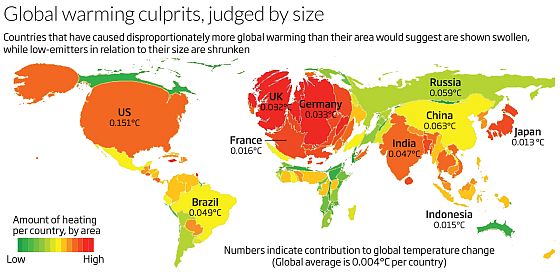
New Scientist reports: It’s a chart that no one wants to top, but global warming’s worst offenders, in absolute terms, are the US, China, Russia, Brazil, India, Germany and the UK. New calculations suggest that these nations are responsible for more than 60 per cent of the global warming between 1906 and 2005.
Damon Matthews of Concordia University in Montreal, Canada, and his colleagues calculated national contributions to warming by weighting each type of emission according to the atmospheric lifetime of the temperature change it causes. Using historical data, they included carbon dioxide from burning fossil fuels and changes in land use – such as deforestation. They also accounted for methane, nitrous oxide and sulphate aerosols. These together account for 0.7 °C of the world’s 0.74 °C warming between 1906 and 2005.
The US is the clear leader, responsible for 0.15 °C, or 22 per cent of the 0.7 °C warming. China accounts for 9 per cent, Russia for 8 per cent, Brazil and India 7 per cent each, and Germany and the UK for 5 per cent each. [Continue reading…]

The New York Times reports: The Obama administration is retreating from previous demands of strong international environmental protections in order to reach agreement on a sweeping Pacific trade deal that is a pillar of President Obama’s strategic shift to Asia, according to documents obtained by WikiLeaks, environmentalists and people close to the contentious trade talks.
The negotiations over the Trans-Pacific Partnership, which would be one of the world’s biggest trade agreements, have exposed deep rifts over environmental policy between the United States and 11 other Pacific Rim nations. As it stands now, the documents, viewed by The New York Times, show that the disputes could undo key global environmental protections.
The environmental chapter of the trade deal has been among the most highly disputed elements of negotiations in the pact. Participants in the talks, which have dragged on for three years, had hoped to complete the deal by the end of 2013.
Environmentalists said that the draft appears to signal that the United States will retreat on a variety of environmental protections — including legally binding pollution control requirements and logging regulations and a ban on harvesting sharks’ fins — to advance a trade deal that is a top priority for Mr. Obama. [Continue reading…]
“The only way for interaction with Iran is dialogue on an equal footing, confidence-building and mutual respect as well as reducing antagonism and aggression,” Iranian President Hassan Rouhani said in a speech after taking the oath of office last August.
“If you want the right response, don’t speak with Iran in the language of sanctions, speak in the language of respect.”
In the following article, Nicholas Wright and Karim Sadjadpour describe how an understanding of neuroscience — or lack of it — may determine the outcome of negotiations with Iran.
The whole piece is worth reading, but keep this in mind: every single insight that gets attributed to neuroscience has been clearly established without the need to conduct a single brain scan. Indeed, everything that is here being attributed to the “exquisite neural machinery” of the brain can be understood by studying the workings of the human mind and how thought shapes behavior.
It is important to draw a sharp distinction between the examination of the mind and observing the workings of the brain because the latter is totally dependent on the output of intermediary electronic scanning devices, whereas minds can study themselves and each other directly and through shared language.
One of the insidious effects of neuroscience is that it promotes a view that understanding the ways brains work has greater intrinsic value than understanding how minds work. What the negotiations with Iran demonstrate, however, is that the exact opposite is true.
To the extent that through the development of trust, negotiations are able to advance, this will have nothing to do with anyone’s confidence about what is happening inside anyone’s brain. On the contrary, it will depend on a meeting of minds and mutual understanding. No one will need to understand what is happening in their own or anyone else’s insula cortex, but what will most likely make or break the talks will be whether the Iranians believe they are being treated fairly. The determination of fairness does not depend on the presence or absence of a particular configuration of neural activity but rather on an assessment of reality.
Treat us as equals, Iran’s president said — and that was almost 15 years ago!
Nicholas Wright and Karim Sadjadpour write: “Imagine being told that you cannot do what everyone else is doing,” appealed Iranian Foreign Minister Javad Zarif in a somber YouTube message defending the country’s nuclear program in November. “Would you back down? Would you relent? Or would you stand your ground?”
While only 14 nations, including Iran, enrich uranium (e.g. “what everyone else is doing”), Zarif’s message raises a question at the heart of ongoing talks to implement a final nuclear settlement with Tehran: Why has the Iranian government subjected its population to the most onerous sanctions regime in contemporary history in order to do this? Indeed, it’s estimated that Iran’s antiquated nuclear program needs one year to enrich as much uranium as Europe’s top facility produces in five hours.
To many, the answer is obvious: Iran is seeking a nuclear weapons capability (which it has arguably already attained), if not nuclear weapons. Yet the numerous frameworks used to explain Iranian motivations—including geopolitics, ideology, nationalism, domestic politics, and threat perception—lead analysts to different conclusions. Does Iran want nuclear weapons to dominate the Middle East, or does it simply want the option to defend itself from hostile opponents both near and far? While there’s no single explanation for Tehran’s actions, if there is a common thread that connects these frameworks and may help illuminate Iranian thinking, it is the brain.
Although neuroscience can’t be divorced from culture, history, and geography, there is no Orientalism of the brain: The fundamental biology of social motivations is the same in Tokyo, Tehran, and Tennessee. It anticipates, for instance, how the mind’s natural instinct to reject perceived unfairness can impede similarly innate desires for accommodation, and how fairness can lead to tragedy. It tells us that genuinely conciliatory gestures are more likely and natural than many believe, and how to make our own conciliatory gestures more effective.
Distilled to their essence, nations are led by and comprised of humans, and the success of social animals like humans rests on our ability to control the balance between cooperation and self-interest. The following four lessons from neuroscience may help us understand the obstacles that were surmounted to reach an interim nuclear deal with Iran, and the enormous challenges that still must be overcome in order to reach a comprehensive agreement. [Continue reading…]
Michael Ratner, the U.S. attorney for Julian Assange, writes: Last week, both the New York Times and the Guardian released editorials supporting clemency for NSA leaker Edward Snowden. Considering the important nature of Snowden’s revelations, clemency is definitely in order – and it’s about time that majorww outlets recognize that.
However, the focus on Snowden’s singular case seriously deflects from the fact that the Obama administration has been a nightmare for whistleblowers and truth tellers, and that several others currently in prison or in exile deserve the same clemency or clear assurances they will not be prosecuted.
So why is the media now calling for mercy for Edward Snowden, while other truth tellers including Chelsea Manning and Julian Assange, continue to face persecution (and prosecution)?
If you apply the criteria established by both the New York Times and the Guardian to Manning and Assange – as well as other truth tellers including Jeremy Hammond, currently in prison serving a 10-year sentence after exposing corporate spy networks – a clear double standard emerges. [Continue reading…]
The New York Times reports: The National Security Agency has implanted software in nearly 100,000 computers around the world that allows the United States to conduct surveillance on those machines and can also create a digital highway for launching cyberattacks.
While most of the software is inserted by gaining access to computer networks, the N.S.A. has increasingly made use of a secret technology that enables it to enter and alter data in computers even if they are not connected to the Internet, according to N.S.A. documents, computer experts and American officials.
The technology, which the agency has used since at least 2008, relies on a covert channel of radio waves that can be transmitted from tiny circuit boards and USB cards inserted surreptitiously into the computers. In some cases, they are sent to a briefcase-size relay station that intelligence agencies can set up miles away from the target.
The radio frequency technology has helped solve one of the biggest problems facing American intelligence agencies for years: getting into computers that adversaries, and some American partners, have tried to make impervious to spying or cyberattack. In most cases, the radio frequency hardware must be physically inserted by a spy, a manufacturer or an unwitting user.
The N.S.A. calls its efforts more an act of “active defense” against foreign cyberattacks than a tool to go on the offensive. But when Chinese attackers place similar software on the computer systems of American companies or government agencies, American officials have protested, often at the presidential level. [Continue reading…]
Marvin Ammori writes: The D.C. Circuit Court of Appeals just issued its long-awaited decision striking down the FCC’s network neutrality rule. This is the second time in four years that this court struck down the FCC’s attempt to adopt a network neutrality rule. It is now legal for AT&T or Verizon to block Slate, your blog, or any other site.
Even though the Internet touches every part of our lives, one person is to blame for potentially destroying its potential for innovation and freedom of expression: former FCC Chairman Julius Genachowski.
The court loss was even more emphatic and disastrous than anyone expected. But this defeat comes with a silver lining: It may force the new FCC chairman to act.
“Network neutrality” is sometimes called “Internet freedom” or “Internet openness” and is a legal principle that would forbid cable and phone companies like AT&T, Verizon, and Comcast from blocking some websites or providing special priority to others. It would forbid Comcast from blocking Facebook or Bing. It would forbid Verizon from, say, charging the Huffington Post for special service to load more quickly than Slate.
Without network neutrality, cable and phone companies could stifle innovation. Imagine if, years ago, MySpace or AltaVista had cut deals with cable companies to block Facebook and Google. Without network neutrality, telecom and cable companies could also stifle free expression. They’d have the legal right to block articles like this one. [Continue reading…]
The Daily Beast reports: Congress is preparing to allow the Obama administration to give more than $1 billion dollars to the Egyptian government and military, despite the fact the generals perpetrated a coup last summer and are suppressing opposition ahead of a nation-wide constitutional referendum.
The House and Senate are set to unveil a year-long spending bill that will loosen restrictions on U.S. aid to Egypt and negate the law that prevents the U.S. from funding a foreign military that has conducted a coup against a democratically elected government. The Obama administration has been lobbying Congress for permission to give the aid to the Egyptian government. Several senior senators had been working to make sure that aid was conditioned on the Egyptian government pursing a path toward democracy and respect for the rule of law.
But now, with the Egyptians speeding toward a Constitutional referendum that will cement the rule of the military-led regime and with the Egyptian government’s crackdown on the opposition ongoing, most of those conditions could be lifted by Congress or waived by the Obama administration.
For experts and congressional officials who have followed the Obama administration’s clumsy and often incoherent policy on Egypt, the potential easing of restrictions on aid represents only the latest unfortunate twist in a failed effort to preserve U.S. influence in the Arab world’s most populous country.
“When the omnibus bill is passed, there’s going to be legislation in it that in effect is going to give the administration a waiver from the coup provisions and allow them to restore aid to Egypt,” said Michele Dunne, senior associate at the Carnegie Endowment for International Peace.
Ever since the Egyptian military ousted and jailed ex-president Mohamed Morsi last July and began its campaign of arresting opposition leaders and protesters, the Obama administration and Congress have been withholding most of the $1.5 billion in annual aid the U.S. gives Egypt, most of which goes directly to the country’s army.
“I think there’s a sense of giving up on Egypt [inside of the Obama administration], on the Hill as well,” said Dunne. “There’s a sense that ‘Oh well they tried a democratic transition, it didn’t work, but we don’t want to cut ourselves off from Egypt as a security ally, so let’s just forget about the whole democracy and human rights thing except for giving it some lip service from time to time.’” [Continue reading…]
Quartz: Moscow privately denies a report that it is conducting barter negotiations that would increase Iranian crude oil exports by up to 50%, a source privy to US State Department communications has told Quartz. But if Russian president Vladimir Putin has in fact sanctioned such discussions, it is because of the attractions of a sweet deal and a chance yet again to flaunt his foreign policy independence.
The report — a Jan. 10 exclusive by Reuters — is taken seriously enough in Washington that US secretary of state John Kerry raised it with Russian foreign minister Sergei Lavrov. The idea is that Iran would ship as many as 500,000 barrels of oil a day to Russia, which would pay in the form of goods. The volume is eye-popping since Iran currently exports just 1 million barrels a day, one-third of its 2011 shipments, because of sanctions.
The Russian side denied the Reuters report to US officials, the source told Quartz. But the reason Kerry reacted so sharply was that it coincided almost precisely with a Jan. 12 final agreement by Iran and US-led negotiators to scale back Tehran’s nuclear enrichment program in exchange for some sanctions relief. The two sides agreed to activate that deal Jan. 20. If Iran could hike its oil shipments significantly, with Russia’s help, it would weaken other countries’ leverage for getting it to agree to a planned final and much more stringent agreement in six months. [Continue reading…]
Stephen Kinzer writes: The diplomatic bargain struck by the United States and Iran this week is the Obama administration’s greatest diplomatic triumph. Efforts by the US Congress to derail it would, if successful, constitute a self-inflicted strategic wound even more myopic than its vote to endorse the 2003 invasion of Iraq. That vote, after all, was only endorsing a mistaken policy set in the White House. This one would be a rebellion against a White House decision that promises great benefits to the United States.
Congress, it turns out, is filled with Republicans and Democrats eager to act as enablers for the most repressive forces in Iran. It is an astonishing spectacle: an alliance between brutal Iranian institutions, principally the Revolutionary Guard, and elected representatives of the American people. Both are deeply invested in the paradigm of hostility, and both are in a state of near-panic at the prospect of reconciliation between Tehran and Washington.
Hostility toward Iran may not be the silliest of all American foreign policies –that would probably be the continuing trade embargo of Cuba – but it is undoubtedly the most self-defeating. No step the United States could take anywhere in the world would bring strategic benefits as great as détente with Iran. It has tantalizing potential. Iran’s interest in stabilizing the violence-torn countries on its eastern and western borders, Iraq and Afghanistan, closely parallels that of the United States. [Continue reading…]