Category Archives: Issues

Sharon: The man who made peace impossible

Ali Jarbawi writes: Since Ariel Sharon’s death, the Israeli media have been grumbling about the lack of an official Palestinian response — and in particular from the Palestinian president, Mahmoud Abbas.

But what can Israelis possibly expect a Palestinian president — or any Palestinian for that matter — to feel toward Mr. Sharon? Are they supposed to celebrate his sponsorship of violence and bloodshed against them throughout his long military career? Or laud his expansionist colonialist policies against them during his long political career?

Only out of respect for the stature of death itself was the official Palestinian response of silence appropriate. Many believe that a full accounting for Mr. Sharon’s violent and bloody history was warranted — nothing less than what Human Rights Watch did when it issued a statement expressing regret that he had died without facing justice for his crimes against Palestinians. [Continue reading…]

Facebooktwittermail

Evidence of ‘industrial-scale killing’ by Syria spurs call for war crimes charges

The Guardian reports: Syrian government officials could face war crimes charges in the light of a huge cache of evidence smuggled out of the country showing the “systematic killing” of about 11,000 detainees, according to three eminent international lawyers.

The three, former prosecutors at the criminal tribunals for the former Yugoslavia and Sierra Leone, examined thousands of Syrian government photographs and files recording deaths in the custody of regime security forces from March 2011 to last August.

Most of the victims were young men and many corpses were emaciated, bloodstained and bore signs of torture. Some had no eyes; others showed signs of strangulation or electrocution.

The UN and independent human rights groups have documented abuses by both Bashar al-Assad’s government and rebels, but experts say this evidence is more detailed and on a far larger scale than anything else that has yet emerged from the 34-month crisis.

The three lawyers interviewed the source, a military policeman who worked secretly with a Syrian opposition group and later defected and fled the country. In three sessions in the last 10 days they found him credible and truthful and his account “most compelling”.

They put all evidence under rigorous scrutiny, says their report, which has been obtained by the Guardian and CNN.

The authors are Sir Desmond de Silva QC, former chief prosecutor of the special court for Sierra Leone, Sir Geoffrey Nice QC, the former lead prosecutor of former Yugoslavian president Slobodan Milosevic, and Professor David Crane, who indicted President Charles Taylor of Liberia at the Sierra Leone court.

The defector, who for security reasons is identified only as Caesar, was a photographer with the Syrian military police. He smuggled the images out of the country on memory sticks to a contact in the Syrian National Movement, which is supported by the Gulf state of Qatar. Qatar, which has financed and armed rebel groups, has called for the overthrow of Assad and demanded his prosecution.

The 31-page report, which was commissioned by a leading firm of London solicitors acting for Qatar, is being made available to the UN, governments and human rights groups. Its publication appears deliberately timed to coincide with this week’s UN-organised Geneva II peace conference, which is designed to negotiate a way out of the Syrian crisis by creating a transitional government. [Continue reading…]

Facebooktwittermail

Syria’s polio epidemic: the suppressed truth

Annie Sparrow reports: One way to measure the horrific suffering of Syria’s increasingly violent war is through the experience of Syrian children. More than one million children are now refugees. At least 11,500 have been killed because of the armed conflict,1 well over half of these because of the direct bombing of schools, homes, and health centers, and roughly 1,500 have been executed, shot by snipers or tortured to death. At least 128 were killed in the chemical massacre in August.

In the midst of all this violence, it is easy to miss the health catastrophe that has also struck Syrian children, who must cope with war trauma, malnutrition, and stunted growth alongside collapsing sanitation and living conditions. Syria has become a cauldron of once-rare infectious diseases, with hundreds of cases of measles each month and outbreaks of typhoid, hepatitis, and dysentery. Tuberculosis, diphtheria, and whooping cough are all on the rise. Upward of 100,000 children are stigmatized by leishmaniasis, a hideous parasitic skin disease that flourishes in war. Many of these diseases have already traveled beyond Syria’s borders, carried by millions of refugees. Five million more children have been forced out of their homes but are still living within Syria, increasingly vulnerable to early marriage, trafficking, and recruitment as child soldiers.

And now polio is back. Since May, Syrian doctors and international public health agencies have documented more than ninety cases of polio in seven of Syria’s fourteen administrative districts, or governorates: Deir Ezzor, Aleppo, Idlib, Hamas, Damascus, al-Hasakeh, and Ar-Raqqa. At an average age of just under two, most victims are—or used to be—literally toddlers. Few were fully vaccinated. None has had treatment to prevent paralysis from becoming permanent. All are from areas long opposed to the Assad regime, which reflects the political dimension of the outbreak. Not a single case has occurred in territory controlled by the government.

Once the most feared disease of the twentieth century, polio in most countries had long ago passed into the history books. Syria was no exception. Polio was eliminated there in 1995 following mandatory (and free) immunization introduced in 1964 after the Baath party took power.2 Yet wildtype 1 polio—the most vicious form of the disease—has been confirmed across much of Syria.

Ninety or so afflicted children may sound like a small number, but they are only a tiny manifestation of an enormous problem, since for each crippled child up to one thousand more are silently infected. Polio is so contagious that a single case is considered a public health emergency. Ninety cases could mean some 90,000 people infected, each a carrier invisibly spreading the disease to others for weeks on end. [Continue reading…]

Facebooktwittermail

The threat of institutional anti-extremism

James Harkin writes: Moderation, just like extremism, is sometimes in the eye of the beholder. Last month the British and US governments suspended deliveries of “non-lethal aid” – vehicles, communication devices, intelligence assistance – to its preferred group of moderate Syrian rebels, the Free Syrian Army. That was because the FSA was as dead as a dodo and our aid had been confiscated by a newer coalition of rebel groups called the Islamist Front.

This month the same Islamist Front, together with Syria’s home-grown al-Qaida affiliate Jabhat al-Nusra – and with the presumed acquiescence or encouragement of Turkey and other Nato countries – helpfully led attacks on the most ruthless al-Qaida group in northern Syria, the Islamic State of Iraq and al-Sham (Isis). At least 50 Isis members, according to the Syrian Observatory for Human Rights, were summarily executed; some of their families have been kidnapped and brutalised. Meet the new moderates.

Our confused approach to Syria is simply the internationalisation of a familiar problem – our definition of extremism and how to beat it. One result of the London terror attacks in 2005 was a mushrooming of well-meaning, generously endowed initiatives designed to combat extremism. Most went beyond traditional anti-terror techniques to focus on the alleged causes of terrorism, and how to rescue young men on the pathway to radicalisation. More Malcolm Gladwell than Andy McNab; the point was to tip, nudge and channel young men at risk of indoctrination towards more benign alternatives. Then there were all those attempts to “turn” Islamist militants or English Defence League activists. Occasionally came news of a coup – after delicate negotiations a firebrand had jumped ship, leading to a new career in anti-extremism and a round of media congratulation. Like a former drug addict playing the awareness circuit, Stephen Yaxley-Lennon (aka Tommy Robinson), with the help of his new friends at the “deradicalisation” thinktank the Quilliam Foundation, is now said to be carving out a new role teaching tolerance to children.

This is nice work if you can get it. But just how helpful is it to label the average EDL supporter or conservative Muslim as a dangerous extremist? To put it another way: do we have a problem with specific acts of violence or intimidation, or with radicalisation per se? If our problem is radicalisation itself, we’re in serious trouble. No liberal, democratic state should be in the business of steering people away from radical or fundamentalist beliefs – as long as their plans don’t congeal into plans to perpetrate terrorism.

Then there’s the question of strategy. Attempts to counter Islamist extremism often take the form of puffing up the importance of allegedly moderate counterweights whose leaders may be corrupt or not representative of anyone but themselves. The UK government’s much-criticised preventing violent extremism strategy spent large sums of public money footing the bill for tours by peaceable-sounding Islamic scholars. This was grossly patronising to believers: it is not up to us to tell Muslims how to be Muslim. Neither was it clear what the money was supposed to achieve. A friend of mine who teaches in an inner-city London school scored £5,000 from the Prevent programme because it was there for the taking: with no idea how to spend it she made a comic documentary about jihad and took the whole class to see the Chris Morris satire Four Lions.

If this kind of woolly subsidy existed anywhere else in the public sector it would have been hammered with endless demands for evidence-based assessment of its output – because there is little or no evidence it works. No matter: institutional anti-extremism is better dug in than ever, an enormous intellectual gravy train of research centres and thinktanks for the feeble minded. [Continue reading…]

Facebooktwittermail

In honor of radicals

Andy Fitzgerald writes: America has a propensity for dismissing people and ideas with labels. Terms like “socialist” and “communist” are frequently hurled at those who dare to promote substantial programs that address poverty, or suggest that government provide what many other “developed nations” deem fundamental services – like universal healthcare. Anyone who openly identifies with such positions is assumed to have nothing legitimate to contribute to public debate, irrespective of the plausibility, merit, and true ideology informing their arguments.

It’s a similar scenario with “radical” – a word often used to evoke associations with extremism, instability and an absolutist approach to politics. But the popular usage belies the important role many radicals have played in promoting democracy and justice throughout history, not to mention the continued role radical ideas and activism have to play in unfinished projects.

A recent op-ed in the Chicago Tribune illustrates the common abuse of the term in the media. The columnist, Dennis Byrne, rightly criticizes a tendency in America to privilege individual liberty over community solidarity, but he then attempts a “balanced” perspective by presenting examples of “radicalism” on both sides of the aisle. On abortion, Byrne writes: “Radical individuals on the right and the left demand the supremacy of a woman’s body. … For [those who are pro-choice], a woman’s rights are nearly absolute.”

Squaring the false equivalence circle he adds: “Similar absolutist views are held on the right by those who interpret the Constitution’s Second Amendment to mean that government regulation of firearms should be extraordinarily limited, if not nonexistent.”

But the mischaracterization of radicals extends beyond mainstream media and politics. While discussing feminist activism with several friends, one retorted, “there are radicals in every group”. I challenged the presumption that radicals were inherently a liability to social movements, given the positive history of radicalism in America.

Indeed, it was “radicals” who were responsible for sowing the seeds of two of America’s most important social movements: worker rights and racial justice. The labor movement, in its nascent days, was a radical movement. A confrontational approach to management was necessary to win many of the concessions now sorely taken for granted: the minimum wage, the eight-hour day, even the very possibility of forming a union.[Continue reading…]

Facebooktwittermail

The White House and the aristocratic institution of unpaid internships

Michael Lind writes: What do you call an employer that refuses to pay its workers any salary at all? Answer: The White House.

President Barack Obama has called for an increase in the U.S. minimum wage. And yet his administration expects hundreds of young people each year to work at the White House for an hourly wage of zero.

According to a White House website, White House interns are expected to work “at least Monday-Friday, 9 am-6pm.” Nice touch — “at least.”

In return for a full week’s worth of work and possible overtime, the White House provides its interns with no pay and no housing help. The latter is significant, because the Washington, D.C., metro area has among the highest costs in the U.S.

The problem with the unpaid internship program, which Obama inherited from previous Oval Officers and which has continued, is not sweatshop exploitation — it’s blatant class discrimination. [Continue reading…]

Facebooktwittermail

Israeli mainstream media recognizes the significance of the boycott

Larry Derfner writes: On Saturday night the boycott of Israel gained an impressive new level of mainstream recognition in this country. Channel 2 News, easily the most watched, most influential news show here, ran a heavily-promoted, 16-minute piece on the boycott in its 8 p.m. prime-time program. The piece was remarkable not only for its length and prominence, but even more so because it did not demonize the boycott movement, it didn’t blame the boycott on anti-Semitism or Israel-bashing. Instead, top-drawer reporter Dana Weiss treated the boycott as an established, rapidly growing presence that sprang up because of Israel’s settlement policy and whose only remedy is that policy’s reversal.

In her narration, Weiss ridicules the settlers and the government’s head-in-the-sand reaction to the rising tide. The segment from the West Bank’s Barkan Industrial Park opens against a background of twangy guitar music like from a Western. “To the world it’s a black mark, a symbol of the occupation,” she reads. “But here they insist it’s actually a point of light in the area, an island of coexistence that continues to flourish despite efforts to erase it from the map.” A factory owner who moved his business to Barkan from the other side of the Green Line makes a fool of himself by saying, “If the state would only assist us by boycotting the Europeans and other countries causing us trouble …” The Barkan segment ends with the manager of Shamir Salads saying that between the European and Palestinian boycott, he’s losing about $115,000 to $143,000 a month in sales. “In my view,” he says, “it will spread from [the West Bank] to other places in Israel that have no connection to the territories.”

Weiss likewise ridicules Deputy Foreign Minister Ze’ev Elkin, who runs the government’s “hasbara war,” as he puts it. Weiss: “Yes, in the Foreign Ministry they are for the time being sticking to the old conception: it’s all a question of hasbara. This week the campaign’s new weapon, developed with the contributions of world Jewry: (Pause) Another hasbara agency, this time with the original name ‘Face To Israel.’” She quotes the co-owner of Psagot Winery saying the boycott is “nothing to get excited about,” that people have been boycotting Jews for 2,000 years, and concluding, “If you ask me, in the last 2,000 years, our situation today is the best it’s ever been.” That final phrase, along with what Weiss describes as Elkin’s “conceptzia,” are the same infamous words that Israelis associate with the fatal complacency that preceded the surprise Yom Kippur War. [Continue reading…]

Facebooktwittermail

Egyptians care more about the survival of society than who governs

Rami G Khouri writes: In the past three years since the overthrow of the Hosni Mubarak’s government, on my regular visits to Cairo I have watched with fascination, pride and hope the birth of Arab citizens and the sudden emergence of a public political sphere – an open, pluralistic space where people from different ideological and cultural perspectives could freely compete for political power and legitimate, democratic control of the government. I have witnessed very different things in Cairo this week, during and after the referendum on the new Egyptian constitution that was drawn up in recent months by the interim government that was installed by armed forces commander Gen. Abdel-Fattah al-Sisi, and that also has led a tough campaign to outlaw the Muslim Brotherhood.

The constitution was approved by an astounding, and totally expected, 98 percent of voters, for most of those who opposed it boycotted the process altogether, either from conviction or intimidation. The vast majority of international and local observers found almost nothing seriously wrong with the mechanics of the voting, so the 98 percent approval accurately reflects the sentiments of those who voted. Yet many observers criticized the wider political environment that did not permit a serious debate about the merits or the constitution or the unilateral political process that created it.

The frenzied mass support for Gen. Sisi and against the Muslim Brotherhood is genuine, and reflects a peculiar combination of Arab events and sentiments that are only found today in Egypt. This is why I suspect that what we witness these days in Egypt cannot be analyzed by using political criteria, but rather requires the tools of the anthropologist. There is no real political or ideology involved here. There is mainly biology driving events these days, primarily the anthropological need of tens of millions of Egyptians to get on with their lives and – as they see it – prevent the collapse of this society that has functioned without interruption for over 5,000 years. The citizen and public political sphere that were being born in the past three years have momentarily receded from modern history, for they have been overshadowed by the herd and its need for self-preservation, the biological cell’s need for water and protein, and Egyptian society’s need for order. [Continue reading…]

Facebooktwittermail

Where is First Look heading?

Earlier this month, Pierre Omidyar announced the addition of Bill Gannon to First Look Media’s editorial leadership team. Gannon comes from from Time Inc.’s EntertainmentWeekly.com.

Drawing on his extensive experience in digital media as well as his diverse background in developing new editorial strategies and creating great user experiences, Bill will leverage all of his talents to help us build a next-generation media platform for a broad audience.

Gannon’s job title hasn’t been specified but his is presumably the lead editorial position. “Bill will assemble a specialized team to create a unique, digital approach to breaking news – from politics and business to sports and entertainment.”

Ray Rosen, from NYU, who is acting as an adviser to FLM and who is an opponent of what he calls The View From Nowhere (the pseudo impartiality that prevails in the mainstream media) was asked the following question in an interview with The Atlantic in December:

You’ve written that The View From Nowhere is, in part, a defense mechanism against charges of bias originating in partisan politics. If you won’t be invoking it, what will your defense be when those charges happen?

There are two answers to that. 1) We told you where we’re coming from. 2) High standards of verification. You need both.

Is “we told you where we’re coming from” referring to the organization itself, or the journalists it publishes, or both?

Both. Like I said: NewCo [renamed First Look] will not present itself as the Voice of God. Neither will its contributors. NewCo will not always be in harmony with itself, either. It will be messier than that.

Rosen did a short interview earlier this month with Gannon and given that Gannon is unknown to most people who are interested in FLM, it would have been great if Rosen had asked where Gannon is coming from. He didn’t and based on what Gannon says, the glibbest answer to that question is probably the most accurate: Entertainment Weekly.

The closest answer Gannon provided to the question of where he’s coming from was his explanation on his reasons for joining this venture:

I was initially attracted to the idea because it seemed to be a unique opportunity where my background in creating new editorial strategies and new user experiences could add value. I’ll be focusing on continuous news coverage and aggregation across a wide range of sections: world news, politics, business, entertainment, sports and more.

That’s marketing boilerplate — and a rehash of Omidyar’s press release. It’s the kind of statement I’d expect from someone entering a similar position in any new media outlet from Huffington Post to Buzzfeed. I get no sense of where Gannon is coming from other than that he believes he can devise ways of boosting the site’s popularity — on the unquestioned supposition that popularity is the best measure of success.

After the interview, Rosen adds an observation about the importance of establishing the right balance of “flow” and “stock” — terms defined by Robin Sloan:

Flow is the feed. It’s the posts and the tweets. It’s the stream of daily and sub-daily updates that remind people that you exist.

Stock is the durable stuff. It’s the content you produce that’s as interesting in two months (or two years) as it is today. It’s what people discover via search. It’s what spreads slowly but surely, building fans over time.

From the little that Gannon reveals, it sounds like he’ll be the kind of editor who focuses more on flow than stock — he’s no Lewis Lapham, that’s for sure.

If that’s the case, I remain skeptical about where FLM is heading since I firmly believe that any new media venture in America, for which investigative journalism is central, will for that very reason have limited popularity.

In attempting to legitimize the pursuit of a mass general interest audience, Gannon says: “The audience becomes aware of our our investigative journalism en route to their other news needs.”

On their way to catch up on Justin Bieber’s latest egg-throwing antics, users (who should not be narrowly defined as readers) will be enticed by the irresistible draw of reporting on fracking, climate change, or net neutrality.

From what I can tell, Huffington Post has already cracked this nut and established it goes the other way around: the serious bleeds to the trivial.

Facebooktwittermail

How the U.S. turned the world into a war zone

Gregory D Johnsen writes: Sunrise was still nearly an hour off when Nazih al-Ruqai climbed into his black Hyundai SUV outside a mosque in northern Tripoli and turned the key. The lanky 49-year-old had left the house barely 30 minutes earlier for a quick trip to the mosque on a Saturday. It was Oct. 5, 2013, and after more than two decades in exile, he had settled into a predictable existence of prayer and worship.

The homecoming hadn’t always been so smooth. Ruqai, who is better known in the jihadi world as Abu Anas al-Libi, was still feeling the effects of the hepatitis C he had contracted years earlier during a stint in an underground prison in Iran. Following overtures from Muammar al-Qaddafi’s government, his wife and children had returned to Libya in 2010. But Libi stayed away, wary of the man he had once plotted to kill. Only when the Libyan uprisings started in early 2011 did he follow his family back to Libya. But by then it was already too late. His oldest son, Abd al-Rahman, the only one of his five children who had been born in Libya, was dead, shot while fighting for the capital.

After that, things moved in fits and starts. Qaddafi was killed weeks later in October 2011, and Libi eventually settled in Nufalayn, a leafy middle-class neighborhood in northeast Tripoli, alongside several members of his extended family. Life after Qaddafi was chaotic and messy — nothing really worked as the new government struggled to reboot after 42 years of dictatorship, often finding itself at the mercy of the heavily armed militias and tribes that had contributed to Qaddafi’s downfall.

Libi knew he was a wanted man. He had been on the FBI’s most wanted list for more than a decade, following an indictment in 2000 for his alleged role in al-Qaeda’s attacks on U.S. embassies in Kenya and Tanzania two years earlier. Along with Libi the indictment named 20 other individuals, including Osama bin Laden and Ayman al-Zawahiri, as defendants.

“He suspected that at any moment he would be killed,” his son later told The New York Times. Still, on that Saturday morning in early October, much of the danger seemed to have passed. Libi had been living in the open for nearly a year, attending prayers and settling local disputes, where his history as a fighter and knowledge of the Qur’an made him a respected arbiter. Neighbors called him simply “the shaykh,” a sign of respect in the conservative circles in which Libi still moved.

He had also taken steps to address his past. Three weeks earlier, on Sept. 15, Libi had sat down with Libya’s attorney general to discuss his indictment, according to one report. (The Libyan Embassy in Washington did not respond to repeated requests to confirm Libi’s meeting.) But mostly he just wanted to move on with his life. He had applied for his old job at the Ministry of Oil and Gas and he couldn’t stop talking about how much he was looking forward to becoming a grandfather for the first time.

A trio of cars around 6 a.m. ended all of that.

Inside the family’s apartment, Libi’s wife heard the commotion. From a window she looked out over the beige wall that surrounded their building and into the street where several men had surrounded her husband, who was still in the driver’s seat of his black Hyundai.

“Get out,” the men shouted in Arabic. “Get out.” Then they smashed the window. Most of the men were masked, but she could see a few faces, she said later in Arabic interviews. They looked Libyan; they sounded Libyan. Some of them had guns; some didn’t, but they all moved quickly.

By the time the rest of the family made it to the street, all that was left was a single sandal and a few drops of blood.

Early that same morning, nearly 3,000 miles away in the seaside city of Baraawe on Somalia’s eastern coast, U.S. Navy SEALs crept through the darkness toward their target, which a local resident later described to me as a walled compound more than 100 yards inland. The Americans had been here before. Four years earlier, in September 2009, a contingent of Navy SEALs had ambushed a two-car convoy just outside of town. Flying low in helicopter gunships, the SEALs quickly disabled the cars and then touched down to collect the bodies.

This time the target — Abd al-Qadir Muhammad Abd al-Qadir, a young Kenyan of Somali descent better known as Ikrima — was stationary. The SEALs would have to go in and get him. Pre-raid intelligence suggested that the compound housed mostly fighters with few or no civilians present. Only 130 miles south of Mogadishu and what passed for the Somali government, Baraawe had been under the control of al-Shabaab, a fragmentary militant group, since 2009. Fighters came and went freely, as al-Shabaab implemented its own narrow version of Islamic law in the city.

Moving up the beach and into enemy territory, the SEALs needed the element of surprise. Through the trees and scrub brush ahead of them, most of the city was dark. Baraawe had only a few hours of electricity each day, usually from evening prayers until midnight. But al-Shabaab’s members lived separately and, along with some of the city’s wealthier residents, got around the shortages by running private generators. The plan that night took this into account, calling for the SEALs to jam internet signals, apparently in an attempt to cut off communication once the raid began. That would prove to be a mistake.

Inside the compound, some of the al-Shabaab fighters were up late and online. And, according to a report in the Toronto Star, when the internet suddenly went out in the middle of the night, they went to look for the source of the problem. At least one fighter stepped outside, and as he moved around in the darkness he spotted some of the SEALs.

The plan to knock the internet offline and isolate the fighters in the villa had backfired, effectively giving al-Shabaab an early warning that the SEALs were on their way. (In the days after the raid, al-Shabaab would arrest a handful of local men who were known to visit Western websites, accusing them of spying and aiding U.S. efforts.)

The firefight lasted several minutes, although residents reported hearing gunfire throughout the night as members of al-Shabaab discharged their weapons into the dark for hours after the Americans had withdrawn, empty-handed.

In the span of a few hours, the U.S. had launched a pair of raids — one successful and one not — 3,000 miles apart, in countries with which the nation was not at war. Hardly anyone noticed.

More than a dozen years after the Sept. 11 attacks, this is what America’s war looks like, silent strikes and shadowy raids. The Congressional Research Service, an analytical branch of the Library of Congress, recently said that it had located at least 30 similar occurrences, although the number of covert actions is likely many times higher with drones strikes and other secret operations. The remarkable has become regular.

The White House said that the operations in both Libya and Somalia drew their authority from the Authorization for the Use of Military Force, a 12-year-old piece of legislation that was drafted in the hours after the Sept. 11 attacks. At the heart of the AUMF is a single 60-word sentence, which has formed the legal foundation for nearly every counterterrorism operation the U.S. has conducted since Sept. 11, from Guantanamo Bay and drone strikes to secret renditions and SEAL raids. Everything rests on those 60 words. [Continue reading…]

Facebooktwittermail

The Sunni-Shiite divide in the Greater Levant

Giandomenico Picco writes: The entire region from Pakistan to Lebanon — what I refer to as the Greater Levant — has been affected by profound, seismic changes during the course of the last three decades. These began in the late 1970s, in the Pakistan-Afghanistan-Iran triangle.

Pakistan received the political support of Saudi Arabia, both in its tense standoff with nuclear India and in its increasingly intense relationship with the Soviet Union, which had invaded neighboring Afghanistan in December 1979. The Khomeini revolution (February 1979) in Shiite Iran convinced the Sunni “world” of an epochal change in the making. This little-noticed affair was at the very root of a more open confrontation along sectarian lines. In the mess of the first Afghan War of the 1980s, which I witnessed up close and personal, the underlying Sunni and Shiite conflict was barely noticed by the rest of the world, though it was better perceived in the war between Iran and Iraq in the same decade.

In the 1990s, however, events in Afghanistan revealed the true face of the underlying confrontation between Sunni and Shiite throughout the region. By the mid 1990s, the Taliban, with Pakistani support, began to make their run for total victory in Kabul. Soon the Sunni Afghan tribes (i.e., the Pasthun) and the Shiite Afghan tribes (i.e. the Tajiks and Hazaras), were engaged in open sectarian civil war. The Shiite tribes were supported by Russia and Iran, while the Taliban received support from Pakistan, somewhat from Saudi Arabia and, for a while, from the West, though in a very undecided way.

The tragic events of September 11, which had been masterminded by Sunni men who had trained in Afghanistan, resulted in a new understanding between Iran and the United States. The interests of both countries had coalesced. The 2001 Bonn Agreements between Washington and Tehran revealed that both nations had a common enemy in the Sunni extremists. At the same time, Hamid Karzai, a Pashtun Sunni, became president of Afghanistan and the opposing Tajiiks came back to Kabul and entered into a coalition of sorts with Karzai. While this did not end the sectarian conflict, which continued during and after the U.S. military intervention, post-2001 Afghanistan is an example of a country rife with sectarian conflict, yet one in which compromise of a sort can be sought and even found.

But then came Iraq. Iran welcomed the U.S. war against Saddam Hussein in 2003, seeing it as payback for 1534, an important, sad date in the Shiite narrative. In that year, Suleiman the First (the Ottoman Sultan) conquered Mesopotamia (modern day Iraq) and “the land of the two rivers” came under the control of the Sunni minority. Iran felt that the West had inadvertently given them a chance to reclaim Baghdad for the Shiites. Again, the ancient Sunni-Shiite conflict structured events but was little noticed by the West.

Despite vigorous efforts, there has been little progress on the Israeli-Palestinian question. Indeed, there has been no progress at all since Prime Minister Rabin was assassinated by one of his own fellow citizens in mid 1995. The longest running conflict in the modern Middle East now seems to have little effect on the day-to-day events of the region. Indeed I would submit that the conflict is no longer pivotal in the region.

There are several reasons for this shift in the prominence and perception of the issue: for one thing, the Cold War came to an end and power struggles in the region were no longer proxy conflicts between the superpowers. Globalization, moreover, has weakened national and nationalistic boundaries and created unprecedented economic interdependence. Technology has made the individual more powerful than he or she has ever been before and the very concept of the nation-state is changing. The simple, two-dimensional worldview of decades past has yielded to recognition of a multiplicity of variables in the Greater Levant. Still, the principal, underlying and organizational dynamic of the entire region is no longer the Palestinian-Israeli conflict but the Sunni-Shiite conflict and its cold and hot wars in every country from the Hindu Kush to the Litani River.

The lead actors in this ongoing drama remain Shiite Iran and Sunni Saudi Arabia. If a new architecture for the entire region is going to be found, then these two countries must take on the responsibility. Yet the chess game between Riyadh and Tehran continues: in Iraq, the Shiites have won a victory of sorts in the West’s defeat of Saddam. Yet Saddam’s Sunni backers in the region do not accept this as the last word. This remains the core line of demarcation for both sides. [Continue reading…]

Facebooktwittermail

America’s forgotten lobotomized soldiers

The Wall Street Journal reports: Roman Tritz’s memories of the past six decades are blurred by age and delusion. But one thing he remembers clearly is the fight he put up the day the orderlies came for him.

“They got the notion they were going to come to give me a lobotomy,” says Mr. Tritz, a World War II bomber pilot. “To hell with them.”

The orderlies at the veterans hospital pinned Mr. Tritz to the floor, he recalls. He fought so hard that eventually they gave up. But the orderlies came for him again on Wednesday, July 1, 1953, a few weeks before his 30th birthday.

This time, the doctors got their way.

The U.S. government lobotomized roughly 2,000 mentally ill veterans—and likely hundreds more—during and after World War II, according to a cache of forgotten memos, letters and government reports unearthed by The Wall Street Journal. Besieged by psychologically damaged troops returning from the battlefields of North Africa, Europe and the Pacific, the Veterans Administration performed the brain-altering operation on former servicemen it diagnosed as depressives, psychotics and schizophrenics, and occasionally on people identified as homosexuals.

The VA doctors considered themselves conservative in using lobotomy. Nevertheless, desperate for effective psychiatric treatments, they carried out the surgery at VA hospitals spanning the country, from Oregon to Massachusetts, Alabama to South Dakota.
Roman Tritz talks about the scars from his lobotomy.

The VA’s practice, described in depth here for the first time, sometimes brought veterans relief from their inner demons. Often, however, the surgery left them little more than overgrown children, unable to care for themselves. Many suffered seizures, amnesia and loss of motor skills. Some died from the operation itself.

Mr. Tritz, 90 years old, is one of the few still alive to describe the experience. “It isn’t so good up here,” he says, rubbing the two shallow divots on the sides of his forehead, bracketing wisps of white hair.

The VA’s use of lobotomy, in which doctors severed connections between parts of the brain then thought to control emotions, was known in medical circles in the late 1940s and early 1950s, and is occasionally cited in medical texts. But the VA’s practice, never widely publicized, long ago slipped from public view. Even the U.S. Department of Veterans Affairs says it possesses no records detailing the creation and breadth of its lobotomy program.

When told about the program recently, the VA issued a written response: “In the late 1940s and into the 1950s, VA and other physicians throughout the United States and the world debated the utility of lobotomies. The procedure became available to severely ill patients who had not improved with other treatments. Within a few years, the procedure disappeared within VA, and across the United States, as safer and more effective treatments were developed.”

Musty files warehoused in the National Archives show VA doctors resorting to brain surgery as they struggled with a vexing question that absorbs America to this day: How best to treat the psychological crises that afflict soldiers returning from combat.

Between April 1, 1947, and Sept. 30, 1950, VA doctors lobotomized 1,464 veterans at 50 hospitals authorized to perform the surgery, according to agency documents rediscovered by the Journal. Scores of records from 22 of those hospitals list another 466 lobotomies performed outside that time period, bringing the total documented operations to 1,930. Gaps in the records suggest that hundreds of additional operations likely took place at other VA facilities. The vast majority of the patients were men, although some female veterans underwent VA lobotomies, as well.

Lobotomies faded from use after the first major antipsychotic drug, Thorazine, hit the market in the mid-1950s, revolutionizing mental-health care.

The forgotten lobotomy files, military records and interviews with veterans’ relatives reveal the details of lives gone terribly wrong. There was Joe Brzoza, who was lobotomized four years after surviving artillery barrages on the beaches at Anzio, Italy, and spent his remaining days chain-smoking in VA psychiatric wards. Eugene Kainulainen, whose breakdown during the North African campaign the military attributed partly to a childhood tendency toward “temper tantrums and [being] fussy about food.” Melbert Peters, a bomber crewman given two lobotomies—one most likely performed with a pick-like instrument inserted through his eye sockets.

And Mr. Tritz, the son of a Wisconsin dairy farmer who flew a B-17 Flying Fortress on 34 combat missions over Germany and Nazi-occupied Europe.

“They just wanted to ruin my head, it seemed to me,” says Mr. Tritz. “Somebody wanted to.”

The VA documents subvert an article of faith of postwar American mythology: That returning soldiers put down their guns, shed their uniforms and stoically forged ahead into the optimistic 1950s. Mr. Tritz and the mentally ill veterans who shared his fate lived a struggle all but unknown except to the families who still bear lobotomy’s scars. [Continue reading…]

Facebooktwittermail

Collective punishment: easier to condemn in Gaza than Yarmouk

The Palestinian refugee camp of Yarmouk in Damascus has been under siege by forces of the Assad regime since last July and 28 of the residents have already starved to death. Yet the pro-Palestinian movement which never fails to raise its voice in outrage about the effects of an Israeli siege on Gaza, is reluctant to takes sides when it comes to Syria.

Talal Alyan writes: While you were insisting on neutrality about Yarmouk, the Syrian regime dropped barrel bombs on it. Mohammad Al Far. Husam Abo Ahmad. Mohammad Tafori. Mohammad Suhaib Al Qides. Ala’a Fri’j. These men are all dead. Mohammad Taha would later die too when he, along with a larger demonstration, approached a regime checkpoint in frustration after the carnage rained on them from above.

The Pro-Palestinian movement was delayed in picking up on the tragic unraveling of Yarmouk. It took the work of a great deal of dedicated activists to force it into the forefront of the solidarity movement’s agenda. What couldn’t be predicted, however, was that, in the place of silence, an ugly neutrality would hover over the new-founded concern. And that said the neutrality was often an unconvincing veil for something much more vile. Perhaps, in our naivety, we believe that when Yarmouk became visible, it would be nearly impossible to omit the clear fact that the siege was being imposed by the Syrian regime. Instead, it was the oppositional fighters in the camp who fell under the spotlight. A chorus emerged, one familiar enough to evoke a surreal sense of Déjà vu.

Yarmouk had transformed into Gaza. But this time, it was our side that was rationalizing the blockage, entertaining and validating the motives offered for collective punishment, instead of flatly rejecting it as a cruel practice. [Continue reading…]

Facebooktwittermail

In keeping grip on data pipeline, Obama does little to reassure industry

The New York Times reports: Google, which briefly considered moving all of its computer servers out of the United States last year after learning how they had been penetrated by the National Security Agency, was looking for a public assurance from President Obama that the government would no longer secretly suck data from the company’s corner of the Internet cloud.

Microsoft was listening to see if Mr. Obama would adopt a recommendation from his advisers that the government stop routinely stockpiling flaws in its Windows operating system, then using them to penetrate some foreign computer systems and, in rare cases, launch cyberattacks.

Intel and computer security companies were eager to hear Mr. Obama embrace a commitment that the United States would never knowingly move to weaken encryption systems.

They got none of that. [Continue reading…]

Facebooktwittermail

Tepid global reaction to Obama’s NSA vow

The Washington Post reports: After months of revelations that strained U.S. relations with allies and cast a harsh light on the National Security Agency’s global surveillance reach, President Obama’s speech Friday was aimed at least in part at reassuring the world of American intentions.

But the initial reaction overseas suggested he still has a significant way to go to heal the rifts, with many wondering why he didn’t offer more specific protections.

In Germany, where revelations that the NSA had been eavesdropping on the calls of Chancellor Angela Merkel stirred deep anger and unusually tough criticism of Washington, Obama’s promises to rein in the excesses of U.S. spying were met with a tepid welcome from the German government — and scorn from some analysts.

Government spokesman Steffen Seibert tweeted that the government would appreciate better safeguards of the rights of non-U.S. citizens but would need more time to review Obama’s words in detail. [Continue reading…]

Facebooktwittermail

Obama’s restrictions on NSA surveillance rely on narrow definition of ‘spying’

Barton Gellman reports: President Obama said Friday, in his first major speech on electronic surveillance, that “the United States is not spying on ordinary people who don’t threaten our national security.”

Obama placed restrictions on access to domestic phone records collected by the National Security Agency, but the changes he announced will allow it to continue — or expand — the collection of personal data from billions of people around the world, Americans and foreign citizens alike.

Obama squares that circle with an unusually narrow definition of “spying.” It does not include the ingestion of tens of trillions of records about the telephone calls, e-mails, locations and relationships of people for whom there is no suspicion of relevance to any threat.

In his speech, and an accompanying policy directive, Obama described principles for “restricting the use of this information” — but not for gathering less of it.

Alongside the invocation of privacy and restraint, Obama gave his plainest endorsement yet of “bulk collection,” a term he used more than once and authorized explicitly in Presidential Policy Directive 28. In a footnote, the directive defined the term to mean high-volume collection “without the use of discriminants.” [Continue reading…]

Facebooktwittermail

Obama’s (still) unanswered question on phone spying

National Journal reports: Ending bulk data collection, which the NSA claims is authorized under Section 215 of the Patriot Act, has been the top priority for civil liberties groups.

Obama announced on Friday that he will end the program “as it currently exists.”

Starting immediately, NSA analysts will need approval from the Foreign Intelligence Surveillance Court every time they want to access the phone database. Obama also said he plans to eventually move the database out of the government’s hands. The president directed Attorney General Eric Holder and top intelligence officials to come up with a plan by March 28 for turning over control of the database.

But no matter who stores the data, the NSA will want to ensure that its analysts can still access it when they want to map the connections of a potential terrorist group. That could mean the administration will ask Congress to enact a mandate requiring phone companies to store their customers’ data on behalf of the NSA.

Privacy advocates warn that a data retention mandate would turn phone companies into agents of the NSA.

“To the contrary, companies should be working on ways to store less user data for less time—decreasing the risks from data breaches and intrusions like the one that just happened to Target,” wrote Cindy Cohn and Rainey Reitman of the Electronic Frontier Foundation. “Data retention heads in the wrong direction for our security regardless of whether the government or private parties store the information.”

Kevin Bankston, a policy director for the New American Foundation, said that if the alternative to government storage is mandatory data retention or a requirement for phone companies to turn the data over to some other third party, “the President should be prepared for a major legislative battle with key members of Congress, the technology industry and the privacy community arrayed against him.” [Continue reading…]

Facebooktwittermail

What happened to AIPAC’s seventy senators?

AIPAC-senators

In 2005, AIPAC’s Steven Rosen when prompted by Jeffrey Goldberg to assess the level of the lobby’s influence famously said: “In twenty-four hours, we could have the signatures of seventy senators on this napkin.”

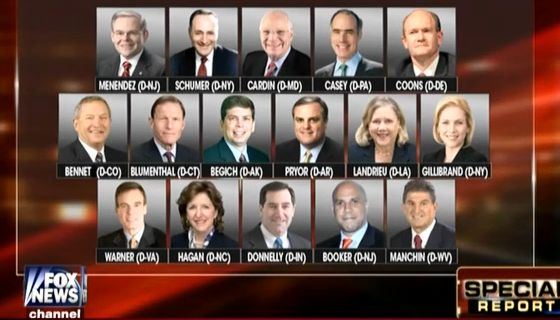
The “Nuclear Weapon Free Iran Act of 2013” sponsored by Democratic Senator Robert Menedez has the support of fifty-nine senators. That’s a dangerously large majority but just short of a veto-proof sixty-seven votes and well short of Rosen’s seventy.

Does that mean that AIPAC is refraining from pulling its weight or is it just not as powerful as Rosen declared?

I called my Democratic Senator Kay Hagan, one of the co-sponsors of the bill, to tell her that if she follows through and casts a vote in favor, she won’t have my vote in November. Interestingly, her staffer was at pains to underline the fact that this is still in process and hasn’t gone to a vote. I got a strong sense that Hagan, perhaps like many other senators both Democratic and Republican, would be content demonstrating her loyalty to AIPAC without actually casting a vote.

In the report below, Republican Senator Roy Blunt essentially says that every senator’s hands have been tied by Senate leader Harry Reid and far from striking a defiant tone, Blunt seems content to be rendered powerless.

If the bill got just one more supporter, would Reid bow to pressure and let it go to a vote? And can’t AIPAC with all its influence turn just one more senator in its favor?

I get the sense that for everyone involved — including AIPAC — this is all political theater. They want to act tough, but at the end of the day, they probably don’t want to be held responsible for sabotaging the most significant diplomatic opening in a decade.

National Journal reports: Senate Iran hawks have lots of votes to back their sanctions legislation. What they lack is a plan to get the bill to the floor.

Fifty-nine senators — including 16 Democrats — have signed onto sanctions legislation from Democratic Sen. Robert Menendez and Republican Sen. Mark Kirk. The measure would punish Iran with sanctions if it reneges on an interim nuclear agreement or if that agreement does not ultimately abolish any nuclear-weapons capabilities for Iran.

That count has climbed rapidly since the bipartisan pair introduced their legislation in late December. But now it’s unclear whether that support will be enough to clear the bill’s next major hurdle: Senate Majority Leader Harry Reid.

Reid is siding with the White House, which has put intense pressure on lawmakers not to act on sanctions, arguing it could result in both a nuclear-armed and hostile Iranian state. And without Reid’s backing, supporters of the Menendez-Kirk bill are unsure how to move the measure to the floor.

“I assume that if the Democrat senators put enough pressure on Senator Reid he might bring it to the floor,” said Missouri Republican Sen. Roy Blunt. “But, you know, we are at a moment in the Senate where nothing happens that Senator Reid doesn’t want to happen; and this is something at this moment that Senator Reid doesn’t want to happen.”

And for now, sanctions supporters are still mulling their strategy.

“We are talking amongst ourselves. There is a very active debate and discussion ongoing about how best to move forward,” said Democratic Sen. Richard Blumenthal of Connecticut, a cosponsor of the bill. “There are a number of alternative strategies, but we’re deliberating them.”

While Reid has, at least for now, foiled their policy plans, sanctions supporters are still scoring the desired political points on the issue. They can report their efforts to their constituents while blaming Reid for the inaction.

Jon Stewart, comparing these senators to egg-throwing Justin Bieber, is perfectly clear about which “constituents” they are trying to represent: AIPAC and Israel. (It’s a shame that Daily Show writers, having crafted a strong piece then felt compelled to add some “balance” by treating Rouhani’s tweet with scorn: “World powers surrendered to Iran’s national will.” If he can placate his hawkish critics just with a tweet, I’m sure Obama is envious.)

Facebooktwittermail