The Los Angeles Times reports: A deal to limit Iran’s nuclear program appeared close to completion Friday as negotiators from six world powers and Tehran smoothed remaining conflicts and top diplomats began arriving to join the talks.
After a rocky day Thursday, negotiators appeared for now to have overcome their differences on Iran’s entitlement to enrich uranium and on how to curb progress on a partially built nuclear research reactor that Western powers view as a particular threat.
U.S. Secretary of State John F. Kerry left late Friday for Geneva to help “narrow the differences and move closer to an agreement,” the State Department said. Sergei Lavrov, Russia’s foreign minister, arrived from Moscow early Friday evening, making him the first of the six nations’ ministers to show up for a possible signing ceremony that would end a decade of usually stalemated negotiations.
“Negotiations are moving on a positive track,” Iranian Deputy Foreign Minister Takht Ravanchi said.
A deal would be a first-stage agreement that would give Iran temporary relief from the crushing Western sanctions on its economy in exchange for temporary limits on its nuclear program. Many nations fear that Iran, despite its insistence that its program is for peaceful purposes only, is seeking weapons capability with its huge nuclear infrastructure.
This deal would open the way for tough bargaining on a final, comprehensive agreement that would take six months or longer to be reached.
A preliminary agreement would be a major step and could reduce the threat of another war in the Middle East. But as soon as it is signed it is likely to come under attack by Republican and Democratic lawmakers and U.S. allies such as Israel and Saudi Arabia, who fear that it will be too lenient. [Continue reading…]
Category Archives: Issues
White House: Israel’s all-or-nothing proposal on Iran would lead to war
JTA reports: Israel’s proposal that Iran totally dismantle its nuclear capacity in exchange for sanctions relief would likely lead to war, a top White House official said.
The official, in a conference call on Wednesday with think tanks and advocacy groups sympathetic to the Obama administration’s Iran strategy, outlined the proposal that the major powers will put forward at a third round of negotiations in Geneva beginning Thursday.
JTA obtained a recording of the call on condition that it not name the participants or fully quote them.
A think tank participant on the call said Israel’s posture — demanding a total halt to enrichment and the dismantling of all of Iran’s centrifuges — was a path to war. [Continue reading…]
Israeli military signals positive view of nuclear deal with Iran
Christian Science Monitor reports: Even as Prime Minister Benjamin Netanyahu continues his diplomatic offensive against what he calls a “dangerous” compromise on Iran’s nuclear program, Israel’s military intelligence seems open to a deal, even one that relaxes the Western sanctions on Iran that Mr. Netanyahu has vocally supported.
According to an unclassified assessment shared by a senior Israeli officer, military intelligence is focused on the implications of a potential compromise between Iran and the P5+1 (the US, Britain, France, Russia, China, and Germany).
A deal would boost President Hassan Rouhani, whose surprise victory in June appeared to herald a political shift in Iran – although he is up against hardliners who oppose a deal.
In the background briefing with foreign journalists, which covered a wide range of Middle East hotspots, the intelligence officer said Iran was one of several countries that could buck the general turmoil across the region.
“We see a bit of a possibility, although it’s quite problematic, of more … stability,” said the officer, who spoke on the basis of anonymity. But that is dependent on the success of negotiations “over the nuclear project, but more than that, over the relief of the sanctions on the Iranian economy,” he said. [Continue reading…]
Gaps narrowing as Iran nuclear talks continue
Laura Rozen reports: A second day of high level of nuclear talks broke for the night here Thursday with Iranian and western negotiators saying progress was being being made in narrowing gaps, but four or five issues still remain to be resolved and need more time. Talks are set to continue here Friday and are very likely to extend into the weekend.
A day “of intense, substantial and detailed negotiations on Iran nuclear programme, conducted in good atmosphere,” Michael Mann, spokesperson for European Union foreign policy chief Catherine Ashton, said Thursday. “Talks continue tomorrow.”
There are fewer and fewer gaps between the two sides, “the process is efficient, we have a very deep treatment” of the issues, a senior European diplomat, speaking not for attribution, said Thursday of the days’ discussions.
“Some big obstacles [to an accord] have been removed, but not all of them,” the European diplomat said. There are still about four to five elements on the table for negotiation, he said, most of them pertaining to the first phase of the agreement, which is intended to halt the expansion of Iran’s nuclear program over the course of six months while a comprehensive agreement is negotiated.
There is “no rupture with the Iranians, but it doesn’t mean agreement tomorrow,” the European diplomat said. “There is a feeling something could happen tomorrow, or after tomorrow,” but there’s no guarantee, he said. If an accord is reached over the next day, P5+1 foreign ministers could possibly come on Saturday. [Continue reading…]
This morning, Reuters reports that Russian Foreign Minister Sergei Lavrov is already on his way to Geneva.
Sen. Mark Kirk’s unshakable loyalty to Israel
Eli Clifton and Ali Gharib report: During an invitation-only phone briefing for supporters, one of the Senate’s top Iran hawks relished his battle with the Obama administration over the imposition of more sanctions against Iran amid the latest round of diplomatic negotiations underway in Geneva. During the call, Sen. Mark Kirk, R-Ill., reserved special attacks for Secretary of State John Kerry and lead U.S. negotiator Under Secretary of State Wendy Sherman.
“It’s the reason why I ran for the Senate, [it] is all wrapped up in this battle. I am totally dedicated to the survival of the state of Israel in the 21st century,” said Kirk, whose office framed the call as an update on Iran’s nuclear program and Kirk’s efforts to pass additional sanctions. “This has been very much a one-senator show, unfortunately,” he said of his confrontational, public approach.
Kirk is leading the Republican effort to introduce new sanctions in the Senate. Along with six co-sponsors, Kirk on Tuesday announced his intention to introduce amendments to the National Defense Authorization Act, the annual bill that budgets for the military, that would increase sanctions on Iran and impose restrictions on any possible interim nuclear deal with Iran. The effort is currently being held up by the upper chamber’s Democratic leadership.
The 28-minute phone call with Kirk, which occurred on Monday afternoon, was by invitation only, but Salon reporters obtained an invitation and RSVPed by name to Kirk for Senate finance director Barret Kedzior. [Continue reading…]
Working around Keystone XL, Suncor Energy steps up oil production in Canada
The New York Times reports: Suncor Energy, Canada’s top petroleum producer, announced on Thursday that it would expand its oil production in 2014 by 10 percent in another sign that the Obama administration’s delay in approving the Keystone XL pipeline extension is not holding back growth in the western Canadian oil sands fields.
“We’re set for a strong year of continued production,” Suncor’s chief executive, Steven W. Williams, said. The company announced a capital spending program of $7.45 billion for 2014, $477 million more than it had forecast earlier this year.
Suncor, which is based in Calgary, produces oil and gas around Canada, and has operations in North Africa and the North Sea. But its oil sands operations are the main driver for the company. In the most recent quarter, its oil sands output rose 16 percent from the year before for a record of 396,000 barrels a day, nearly 20 percent of the country’s total oil sands production.
The company said it expected its oil sands production to increase again next year to 430,000 barrels a day.
Reports of increased production are coming even as Canadian oil executives are privately questioning whether the Obama administration will ever approve the Keystone XL pipeline, which it has been considering for more than two years.
The extension is intended to transport more than 800,000 barrels a day of oil sands output to refineries on the Gulf of Mexico coast, but environmentalists have made stopping the pipeline their top priority since emissions from oil sands production are higher than for most crude oils consumed in the United States.
But over the last several months, oil companies have sought to go around the dispute by announcing plans for three large rail loading terminals with the combined capacity of transporting 350,000 barrels a day.
The companies are poised to quadruple rail-loading capacity over the next few years to as many as 900,000 barrels a day, whether or not the Keystone pipeline is built. [Continue reading…]
It’s long been reported that rail transportation of oil was already making the construction of Keystone XL an issue of questionable relevance in relation to the environmental consequences of oil sands production, which makes me wonder why so much activist energy was focused on the pipeline. Was it simply because “stop the pipeline” is such an easy rallying-cry?
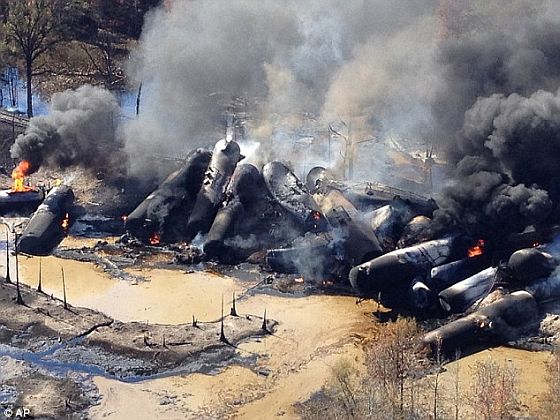
Ironically, the dangers posed by rail delivery of oil are probably far greater than those posed by Keystone XL as an accident in Alabama earlier this month made all too clear:

Meet the spies doing the NSA’s dirty work
Shane Harris writes: With every fresh leak, the world learns more about the U.S. National Security Agency’s massive and controversial surveillance apparatus. Lost in the commotion has been the story of the NSA’s indispensable partner in its global spying operations: an obscure, clandestine unit of the Federal Bureau of Investigation that, even for a surveillance agency, keeps a low profile.
When the media and members of Congress say the NSA spies on Americans, what they really mean is that the FBI helps the NSA do it, providing a technical and legal infrastructure that permits the NSA, which by law collects foreign intelligence, to operate on U.S. soil. It’s the FBI, a domestic U.S. law enforcement agency, that collects digital information from at least nine American technology companies as part of the NSA’s Prism system. It was the FBI that petitioned the Foreign Intelligence Surveillance Court to order Verizon Business Network Services, one of the United States’ biggest telecom carriers for corporations, to hand over the call records of millions of its customers to the NSA.
But the FBI is no mere errand boy for the United States’ biggest intelligence agency. It carries out its own signals intelligence operations and is trying to collect huge amounts of email and Internet data from U.S. companies — an operation that the NSA once conducted, was reprimanded for, and says it abandoned.
The heart of the FBI’s signals intelligence activities is an obscure organization called the Data Intercept Technology Unit, or DITU (pronounced DEE-too). The handful of news articles that mentioned it prior to revelations of NSA surveillance this summer did so mostly in passing. It has barely been discussed in congressional testimony. An NSA PowerPoint presentation given to journalists by former NSA contractor Edward Snowden hints at DITU’s pivotal role in the NSA’s Prism system — it appears as a nondescript box on a flowchart showing how the NSA “task[s]” information to be collected, which is then gathered and delivered by the DITU. [Continue reading…]
The quest to build an NSA-proof European cloud
The Atlantic reports: If Germany’s special parliamentary session on U.S. surveillance this week was any indication, European politicians are still worked up about former NSA contractor Edward Snowden’s leaks. Chancellor Angela Merkel declared that the revelations had “tested” U.S.-German relations. Green Party politician Hans-Christian Strobele urged the German leader to thank Snowden and offer him asylum for discovering that her cell phone “was probably bugged.” Merkel even got called a “scaredy-cat” for not standing up to Washington.
The criticism comes as politicians in the region — from Estonia to Germany — are calling for the European Union to create a cloud-computing infrastructure of its own to compete with American providers like Amazon, Google, and Verizon.
The idea is that if the EU has its own cloud — and what form it would take, who would build it, and where it would be based remain unclear — then member states could compel providers to abide by the EU’s (comparatively) stricter data-protection rules. It’s part of a backlash against the long arm of the U.S. intelligence community that has echoes everywhere from Brazil to the United Nations. [Continue reading…]
Turkey, Iraqi Kurdistan clinch major energy pipeline deals
Reuters reports: Iraqi Kurdistan has finalized a comprehensive package of deals with Turkey to build multi-billion dollar oil and gas pipelines to ship the autonomous region’s rich hydrocarbon reserves to world markets, sources involved in talks said on November 6.
The deals, which could have important geo-political consequences for the Middle East, could see Kurdistan export some 2 million barrels per day (bpd) of oil to world markets and at least 10 billion cubic meters per year of gas to Turkey.
Such a relationship would have been unthinkable just a few years ago, when Ankara enjoyed strong ties with Iraq’s central Baghdad government and was deep in a decades-long fight with Kurdish militants on its own soil.
But Turkey imports almost all of its energy needs and growing demand means it faces a ballooning deficit, making the resources over its southeastern border hard to ignore.
Inequality is (literally) killing America
Zoë Carpenter writes: Only a few miles separate the Baltimore neighborhoods of Roland Park and Upton Druid Heights. But residents of the two areas can measure the distance between them in years — twenty years, to be exact. That’s the difference in life expectancy between Roland Park, where people live to be 83 on average, and Upton Druid Heights, where they can expect to die at 63.
Underlying these gaps in life expectancy are vast economic disparities. Roland Park is an affluent neighborhood with an unemployment rate of 3.4 percent, and a median household income above $90,000. More than 17 percent of people in Upton Druid Heights are unemployed, and the median household income is just $13,388.
It’s no secret that this sort of economic inequality is increasing nationwide; the disparity between America’s richest and poorest is the widest it’s been since the Roaring Twenties. Less discussed are the gaps in life expectancy that have widened over the past twenty-five years between America’s counties, cities and neighborhoods. While the country as a whole has gotten richer and healthier, the poor have gotten poorer, the middle class has shrunk and Americans without high school diplomas have seen their life expectancy slide back to what it was in the 1950s. Economic inequalities manifest not in numbers, but in sick and dying bodies. [Continue reading…]
Friedman on the Israel lobby’s effort to block a deal with Iran
Thomas Friedman writes: Never have I seen Israel and America’s core Arab allies working more in concert to stymie a major foreign policy initiative of a sitting U.S. president, and never have I seen more lawmakers — Democrats and Republicans — more willing to take Israel’s side against their own president’s. I’m certain this comes less from any careful consideration of the facts and more from a growing tendency by many American lawmakers to do whatever the Israel lobby asks them to do in order to garner Jewish votes and campaign donations.
That said, I don’t mind Prime Minister Bibi Netanyahu of Israel and King Abdullah of Saudi Arabia going ballistic — in stereo — over this proposed deal. It gives Kerry more leverage. Kerry can tell the Iranians: “Look, our friends are craaaaaazzzy. And one of them has a big air force. You better sign quick.”
No, I don’t begrudge Israel and the Arabs their skepticism, but we still should not let them stop a deal. If you’re not skeptical about Iran, you’re not paying attention. Iran has lied and cheated its way to the precipice of building a bomb, and without tough economic sanctions — sanctions that President Obama engineered but which Netanyahu and the Arab states played a key role in driving — Iran would not be at the negotiating table.
It’s good to see Friedman again acknowledging the influence of the Israel lobby and not surprising that like so many others he repeats the trope that sanctions forced Iran to negotiate, but as Hossein Mousavian points out, the actual effect of sanctions has been the opposite of their intended effect:
Contrary to the claims of some US lawmakers and Israeli officials, sanctions only caused a dramatic rise in nuclear capability, as Tehran sought to show it would not respond to pressure. Before, Iran was enriching uranium to below 5 per cent at one site with 3,000 centrifuges and possessed a minute stockpile of enriched uranium. Today, it is enriching to 20 per cent at two sites with 19,000 centrifuges. It has a stockpile of 8,000kg of enriched uranium and more sophisticated centrifuges.
The Western European roots of Native Americans
The New York Times reports: The genome of a young boy buried at Mal’ta near Lake Baikal in eastern Siberia some 24,000 years ago has turned out to hold two surprises for anthropologists.
The first is that the boy’s DNA matches that of Western Europeans, showing that during the last Ice Age people from Europe had reached farther east across Eurasia than previously supposed. Though none of the Mal’ta boy’s skin or hair survives, his genes suggest he would have had brown hair, brown eyes and freckled skin.
The second surprise is that his DNA also matches a large proportion — about 25 percent — of the DNA of living Native Americans. The first people to arrive in the Americas have long been assumed to have descended from Siberian populations related to East Asians. It now seems that they may be a mixture between the Western Europeans who had reached Siberia and an East Asian population.
The Mal’ta boy was 3 to 4 years old and was buried under a stone slab wearing an ivory diadem, a bead necklace and a bird-shaped pendant. Elsewhere at the same site about 30 Venus figurines were found of the kind produced by the Upper Paleolithic cultures of Europe. The remains were excavated by Russian archaeologists over a 20-year period ending in 1958 and stored in museums in St. Petersburg.
There they lay for some 50 years until they were examined by a team led by Eske Willerslev of the University of Copenhagen. Dr. Willerslev, an expert in analyzing ancient DNA, was seeking to understand the peopling of the Americas by searching for possible source populations in Siberia. He extracted DNA from bone taken from the child’s upper arm, hoping to find ancestry in the East Asian peoples from whom Native Americans are known to be descended.
But the first results were disappointing. The boy’s mitochondrial DNA belonged to the lineage known as U, which is commonly found among the modern humans who first entered Europe about 44,000 years ago. The lineages found among Native Americans are those designated A, B, C, D and X, so the U lineage pointed to contamination of the bone by the archaeologists or museum curators who had handled it, a common problem with ancient DNA projects. “The study was put on low speed for about a year because I thought it was all contamination,” Dr. Willerslev said.
His team proceeded anyway to analyze the nuclear genome, which contains the major part of human inheritance. They were amazed when the nuclear genome also turned out to have partly European ancestry. Examining the genome from a second Siberian grave site, that of an adult who died 17,000 years ago, they found the same markers of European origin. Together, the two genomes indicate that descendants of the modern humans who entered Europe had spread much farther east across Eurasia than had previously been assumed and occupied Siberia during an extremely cold period starting 20,000 years ago that is known as the Last Glacial Maximum.
The other surprise from the Mal’ta boy’s genome was that it matched to both Europeans and Native Americans but not to East Asians. Dr. Willerslev’s interpretation was that the ancestors of Native Americans had already separated from the East Asian population when they interbred with the people of the Mal’ta culture, and that this admixed population then crossed over the Beringian land bridge that then lay between Siberia and Alaska to become a founding population of Native Americans. [Continue reading…]
Go south young Jew to a land you’ve never seen
Nefesh B’Nefesh’s appeal to young American Jews to “go south” involves a cultural mashup, mixing the promise of an open frontier ready to be settled by adventuresome pioneers, along with the idea that the Negev desert is part of their ancestral homeland.
A would-be recruit says that as a Jew in America he’s “living in exile.”
What apparently hasn’t dawned on him or any others who swallow Nefesh B’Nefesh’s bait, is that this sense of exile might have more to do with being American than being Jewish.
The American fascination with roots springs precisely from the fact that nearly everyone comes from elsewhere, yet from exactly where is for so many very hard to trace. What distinguishes the Zionist hucksters is that they can easily trade with a ready-made answer to this question: where do I come from?
Alex Kane writes: On the 17th floor of a Manhattan conference building, young Jews from the New York area listened intently to two Israeli-Americans speak of the wonders of the Jewish state. They were going through the finer points of emigrating to Israel, talking up the varied benefits those who become citizens receive. Outside, it was a dreary and overcast Sunday. But the atmosphere inside was sunny: the banter light-hearted, the jokes from the speakers free-flowing, and all happy to be at the “Think Israel” conference (held on November 17th).
There was a serious task at hand, though: deciding how to choose a community in Israel where they would feel at home, which is part of Nefesh B’Nefesh’s core mission of encouraging aliyah to the Jewish state.
Ravit Greenberg, an Israeli citizen from upstate New York now working for Nefesh B’Nefesh, had just the right answer for them. They should move to the Negev in the south of Israel. It’s an area the government is encouraging Jews to move to with a variety of incentives. Greenberg was asked why the Negev was attractive by a boisterous and overeager pony-tailed man named Aaron.
“They want to encourage development,” Greenberg told him, talking about the Israeli government. And to help the Israeli government, Nefesh B’Nefesh seeks to enlist young North American Jews in the a key state project: populating the Negev with more Israeli Jews. [Continue reading…]
Likud drifts into an apartheid mood
Aaron Magid writes: The recent Likud primaries in Israel highlighted the rightward shift in the ruling party. Three prominent Knesset members representing the more liberal wing of the party were pushed off the Knesset list in 2013. This was a consequence of their respect for Supreme Court decisions and democratic norms.
“Human rights and democracy is not part of their thinking. It is like South Africa. It is not Likud.” Comparing Likud hard-liners to South African apartheid supporters is common among leftist critics of Israel, but the man who said this to me is no anti-Zionist. He is Dan Meridor, who was a senior Likud minister in Prime Minister Benjamin Netanyahu’s government less than a year ago.
Meridor’s bluntness may be surprising. But his political downfall at the hands of right-wing voters in the Likud primary exemplified the trend within the party, which goes beyond domestic politics. With Netanyahu engaged in negotiations with the Palestinians, his party’s move to the right threatens the viability of any potential deal.
Meridor served in the Knesset for 23 years, including as deputy prime minister and intelligence minister. Until this year, he sat in the Security Cabinet and participated in Israel’s most sensitive discussions. Meridor spoke about the Knesset bills designed to curtail democratic norms, such as requiring Arab citizens to take a loyalty oath to Israel. He and his two like-minded peers, Michael Eitan and Benny Begin, fought to prevent these Likud-led bills from passing. Meridor warned that the law passed to detain African migrants to Israel for up to three years without a trial was illegal, but his party, including Netanyahu, ignored the recommendation.
Meridor explained: “Democracy became a leftist word. This is so strange and dangerous.” His support for democracy and a Palestinian state led to his departure from Likud. [Continue reading…]
Poll: Most Americans say Snowden leaks harmed national security
The Washington Post reports: Americans increasingly believe that former federal contractor Edward Snowden’s exposure of U.S. surveillance programs damaged national security, even as the programs have sparked widespread privacy concerns, a new Washington Post-ABC News poll has found.
Six in 10 Americans — 60 percent — say Snowden’s actions harmed U.S. security, increasing 11 percentage points from July after a cascade of news reports based on his disclosures detailed the National Security Agency’s expansive web of telephone and Internet surveillance efforts. Clear majorities of Democrats, Republicans and independents believe disclosures have harmed national security.
How is Hamid Karzai still standing?
William Dalrymple writes: The Karzai family graveyard lies a few miles outside Kandahar, on the edge of the village of Karz. On the day I drove there, burned-out cars stood rusting by the sides of the road, children splashed through open drains and bullet holes riddled the mud walls opposite checkpoints. Amid all this, the graveyard stood out — gleaming, immaculate. Straggling bougainvillea and mulberry trees blossomed over the calligraphic tiles topping the cream-colored walls. Through the double gates were lines of cypresses. In the middle stood a domed enclosure containing the graves of the clan elders.
Hamid Karzai was entering the final lap of his presidency, and I had traveled to Karz with Mahmood, one of the president’s elder brothers, accompanied by a phalanx of his bodyguards. Afghanistan’s presidential election is set for April, and as the deadline for registering candidates approached, the country’s future seemed to hang in part on the fraught internal family politics of the Karzais. Hamid is ineligible to run for a third term, and it had been long rumored in Kabul that he would anoint his brother Qayum as his successor. Mahmood had made it clear that he wanted the presidency to stay in the family; he had even begun to raise campaign funds for Qayum, just as he once had for Hamid.
So far, however, the president had been publicly silent on the subject, and Qayum had yet to tip his hand. Mahmood’s business dealings — banking scandals and supposedly dodgy real estate deals — had long been perceived as Hamid’s Achilles’ heel, and it remained unclear whether family loyalty would trump the president’s growing preoccupation with his own legacy. All this, along with Karzai’s angry rhetoric against the alleged misdeeds of his American backers, had caused some tensions around the family table. “I don’t feel comfortable talking to Hamid these days,” Mahmood said as we rode in his armored Land Cruiser, sandwiched between pickup trucks full of troops. “These ridiculous conspiracy theories. And his cynical view of the West. These ideas aren’t helping Afghanistan. I don’t think he understands the importance of a good economic policy.”
On arrival, however, the sight of the massed Karzai dead quickly brought back Mahmood’s sense of dynastic solidarity. “See over there — the grave with the old carved headstone?” he said. “That was my grandfather, the real leader of the family. He migrated to Karz from the west of the province and bought this land.”
He then pointed to a poster of a mustached man on the guardhouse: “That’s my uncle, Khalil.” Khalil was killed in the 1980s. Some say he was murdered in a family dispute, but Mahmood told me he was assassinated during the war with the Soviets. “And over there,” he continued, “another uncle. Also assassinated.”
We walked into the domed mausoleum where two recumbent gravestones were covered with pink plastic flowers: “My father’s grave,” he said, lowering his voice to a whisper. “He was shot dead leaving a mosque. And that, by his side, is Ahmed Wali, my half brother.”
He didn’t bother saying what we both knew, that Ahmed Wali Karzai, the head of Kandahar’s provincial council, effectively governor of Kandahar and the man suspected by the West of controlling part of the Afghan heroin trade, but who also helped the C.I.A. operate an anti-Taliban paramilitary group, was himself killed by a trusted member of his inner circle. The shooting took place not far from where we were standing, two years earlier, almost to the day. I asked if anyone else in the family died violently. “Many!” Mahmood replied. He pointed to the different grave plots: “One, two, three . . . altogether about eight. Maybe more.”
From the graveyard, we headed on into Karz, where the brothers spent their childhood. Low mud-brick houses flanked the road. “Imagine having to live in these conditions!” Mahmood said. “If I had my way, I’d demolish the entire village, rehouse everyone in apartments and turn this space over to agriculture.” After decades in the United States, where he started an Afghan restaurant chain, it all seemed a bit of a surprise to him: “Imagine hanging up goat meat in the sun in this heat! So unhygienic. . . . And all these people just sitting there. Do they have nothing to do, for crying out loud? Just look how weak the retail community is here. Call these shops? What era are we in — the Roman Empire?”
I had asked to see the house where the brothers grew up, but after several false turns, we still couldn’t find the place. None of them had been back for years, not least because the village is now in the hands of a rival leader of the clan, their cousin Hashmat Karzai, and relations between the two factions of the family are not cordial.
“It’s changed beyond all recognition,” Mahmood said. “This mosque I remember: I used to play with Hamid over there. But the vineyards! Where have they gone?” Eventually his driver came to a stop. “This is it?” Mahmood asked. “It can’t be.” We got out in a field of dried mud, surrounded by mud houses with egg-carton domes. Mahmood summoned an old man in a turban wandering past and after conferring with him, announced: “The driver’s right. This is our home.” He gestured at the empty space around us.
“What happened?” I asked.
“The Russians.” He paused. “Any clan who were known to be prominent in the mujahedeen had their property seized or demolished.”
For the first time, Mahmood looked deflated: “Qayum and I were in the U.S., but Hamid and my father were prominent in the jihad. These houses here,” he said, pointing at the mud houses, “this was where my cousins lived. The same night the Soviet governor sent troops to demolish our house, they were all called out and lined up. Then they were shot. Every last one of them.” [Continue reading…]

Just 90 companies caused two-thirds of man-made global warming emissions
The Guardian reports: The climate crisis of the 21st century has been caused largely by just 90 companies, which between them produced nearly two-thirds of the greenhouse gas emissions generated since the dawning of the industrial age, new research suggests.
The companies range from investor-owned firms – household names such as Chevron, Exxon and BP – to state-owned and government-run firms.
The analysis, which was welcomed by the former vice-president Al Gore as a “crucial step forward” found that the vast majority of the firms were in the business of producing oil, gas or coal, found the analysis, which has been accepted for publication in the journal Climatic Change.
“There are thousands of oil, gas and coal producers in the world,” climate researcher and author Richard Heede at the Climate Accountability Institute in Colorado said. “But the decision makers, the CEOs, or the ministers of coal and oil if you narrow it down to just one person, they could all fit on a Greyhound bus or two.”
Half of the estimated emissions were produced just in the past 25 years – well past the date when governments and corporations became aware that rising greenhouse gas emissions from the burning of coal and oil were causing dangerous climate change.
Many of the same companies are also sitting on substantial reserves of fossil fuel which – if they are burned – puts the world at even greater risk of dangerous climate change. [Continue reading…]
U.S. and U.K. struck secret deal to allow NSA to ‘unmask’ Britons’ personal data
The Guardian reports: The phone, internet and email records of UK citizens not suspected of any wrongdoing have been analysed and stored by America’s National Security Agency under a secret deal that was approved by British intelligence officials, according to documents from the whistleblower Edward Snowden.
In the first explicit confirmation that UK citizens have been caught up in US mass surveillance programs, an NSA memo describes how in 2007 an agreement was reached that allowed the agency to “unmask” and hold on to personal data about Britons that had previously been off limits.
The memo, published in a joint investigation by the Guardian and Britain’s Channel 4 News, says the material is being put in databases where it can be made available to other members of the US intelligence and military community.
Britain and the US are the main two partners in the ‘Five-Eyes’ intelligence-sharing alliance, which also includes Australia, New Zealand and Canada. Until now, it had been generally understood that the citizens of each country were protected from surveillance by any of the others. [Continue reading…]