John Lanchester writes: In August, the editor of the Guardian rang me up and asked if I would spend a week in New York, reading the GCHQ files whose UK copy the Guardian was forced to destroy. His suggestion was that it might be worthwhile to look at the material not from a perspective of making news but from that of a novelist with an interest in the way we live now.
I took Alan Rusbridger up on his invitation, after an initial reluctance that was based on two main reasons. The first of them was that I don’t share the instinctive sense felt by many on the left that it is always wrong for states to have secrets. I’d put it more strongly than that: democratic states need spies.
The philosopher Karl Popper, observing the second world war from his academic post in New Zealand, came up with a great title for his major work of political thought: The Open Society and Its Enemies. It is, in its way, a shocking phrase – why would the open society have enemies? (But then, the title of Charles Repington’s The First World War, published in 1920, was shocking too, because it implied that there would be another one.)
We do have enemies, though, enemies who are in deadly earnest; enemies who wish you reading this dead, whoever you are, for no other reason than that you belong to a society like this one. We have enemies who are seeking to break into our governments’ computers, with the potential to destroy our infrastructure and, literally, make the lights go out; we have enemies who want to kill as many of us, the more innocent the better, as possible, by any means possible, as a deliberate strategy; we have enemies who want to develop nuclear weapons, and thereby vastly raise the stakes for international diplomacy and the threat of terrorism; and we have common-or-garden serious criminals, who also need watching and catching.
I get all that. It doesn’t thrill me to bits that the state has to use the tools of electronic surveillance to keep us safe, but it seems clear to me that it does, and that our right to privacy needs to be qualified, just as our other rights are qualified, in the interest of general security and the common good.
My week spent reading things that were never meant to be read by outsiders was, from this point of view, largely reassuring. Most of what GCHQ does is exactly the kind of thing we all want it to do. It takes an interest in places such as the Horn of Africa, Iran, and North Korea; it takes an interest in energy security, nuclear proliferation, and in state-sponsored computer hacking.
There doesn’t seem to be much in the documents about serious crime, for which GCHQ has a surveillance mandate, but it seems that much of this activity is covered by warrants that belong to other branches of the security apparatus. Most of this surveillance is individually targeted: it concerns specific individuals and specific acts (or intentions to act), and as such, it is not the threat.
Even Julian Assange thinks that, and said as much in his alarming and perceptive book Cypherpunks: “Individual targeting is not the threat.” When the state has specific enemies and knows who they are and the kind of harm they intend, it is welcome to target them to make the rest of our polity safe. I say again, on the evidence I’ve seen, this is mainly what GCHQ does. I would add that the Guardian and its partners have gone to a lot of trouble to prevent any unnecessarily damaging detail about this work being published.
The problems with GCHQ are to be found in the margins of the material – though they are at the centre of the revelations that have been extracted from the Snowden disclosures, and with good reason. The problem and the risk comes in the area of mass capture of data, or strategic surveillance. This is the kind of intelligence gathering that sucks in data from everyone, everywhere: from phones, internet use from email to website visits, social networking, instant messaging and video calls, and even areas such as video gaming; in short, everything digital.
In the US, the Prism programme may have given the NSA access to the servers of companies such as Google and Facebook; in the UK, GCHQ has gained a similar degree of access via its Tempora programme, and the two of them together have a cable- and network-tapping capabilities collectively called Upstream, which have the ability to intercept anything that travels over the internet. This data is fed into a database called XKeyscore, which allows analysts to extract information “in real time”, ie immediately, from a gigantic amount of hoovered-up data.
In addition, the NSA has encouraged technology companies to install secret weaknesses or “backdoors” into their commercially available, supposedly secure products. They have spent a very great deal of money ($250m a year alone on weakening encryption), on breaking commercially available security products. Other revelations have been published in Der Spiegel, and concern the NSA exploitation of technology such as the iPhone.
What this adds up to is a new thing in human history: with a couple of clicks of a mouse, an agent of the state can target your home phone, or your mobile, or your email, or your passport number, or any of your credit card numbers, or your address, or any of your log-ins to a web service.
Using that “selector”, the state can get access to all the content of your communications, via any of those channels; can gather information about anyone you communicate with, can get a full picture of all your internet use, can track your location online and offline. It can, in essence, know everything about you, including – thanks to the ability to look at your internet searches – what’s on your mind.
To get a rough version of this knowledge, a state once had to bug phones manually, break into houses and intercept letters, and deploy teams of trained watchers to follow your whereabouts. Even then it was a rough and approximate process, vulnerable to all sorts of human error and countermeasures. It can now have something much better than that, a historically unprecedented panoply of surveillance, which it can deploy in a matter of seconds.
This process is not without supervision, of course. In order to target you via one of these “selectors” – that’s the technical term – the agent of the state will have to type into a box on his or her computer screen a Miranda number, to show that the process is taking place in response to a specific request for information, and will also need to select a justification under the Human Rights Act. That last isn’t too arduous, because the agent can choose the justification from a drop-down menu. This is the way we live now.
And yet nobody, at least in Britain, seems to care. In the UK there has been an extraordinary disconnect between the scale and seriousness of what Snowden has revealed, and the scale and seriousness of the response. One of the main reasons for that, I think, is that while some countries are interested in rights, in Britain we are more focused on wrongs. [Continue reading…]
Category Archives: Issues
Video: Max Blumenthal on ‘Goliath: Life and Loathing in Greater Israel’
America’s unremitting self-preoccupation
David Mizner writes: The U.S. government kills a lot of Muslims. With its war against Afghanistan, its sanctions on and wars against Iraq, its drone campaigns in Pakistan, Yemen, and Somalia, it’s probably killed more than a million Muslims in the last quarter century. Let’s say a million. That’s more than a 9/11’s worth of corpses every month. And that doesn’t include the killing done by governments the United States props up and arms. Nor does it account for torture, maiming, poisoning, and terrorization. The brutalization of Muslims might be the defining feature of U.S. foreign policy in the post-Cold War era.
Not many Americans care. Their — our — indifference is both cause and effect of the dominant tenor of antiwar advocacy in the United States. Pundits and politicians tell Americans that we should oppose this or that American war or this or that involvement in another country’s war because it would hurt … Americans. It would cost “us” money. Or put “our” soldiers “in harm’s way.” Or threaten our safety. Or subvert our democracy. Or tarnish our reputation. Or violate our constitution. Rarely mentioned are the bodies ripped apart by the U.S. military monster. Rachel Maddow wrote an entire book opposing U.S. war-making and made only fleeting references to non-American victims.
During the debate over the proposed U.S. bombing of Syria, New York Times columnist Frank Bruni set out to remind us of the human toll of war. Justly taking aim at the expression “boots on the ground,” he pointed out that there would be people in those boots — so far, so good — but didn’t think to mention that Syrian footwear would be similarly inhabited. He went on to say that “the toll of our best intentions and tortured interventions” in Iraq and Afghanistan are thousands of dead, injured, and traumatized Americans.
Of the tens of millions of Iraqi and Afghan victims he wrote not a word. Post Traumatic Stress Disorder? Americans wars have given entire populations PTSD.
While the overwhelming opposition of Americans to (further) U.S. military intervention in Syria’s civil war was heartening, the rhetoric of some leading opponents was sickening. Congressman Alan Grayson (D-FL), warning against intervention from the ostensible left, kept saying that the suffering of Syrians was “none of our business.” In an interview on Democracy Now he wandered into truly dark territory when he seconded the stateswoman from Alaska: “…Palin actually has this right: Let Allah sort it out.”
I’m not suggesting that opponents of war should use only moral arguments; they’re wise to try to appeal to people’s self-interest, and nationalism in pursuit of peace is, if not a virtue, nonetheless preferable to nationalism in pursuit of war. Likewise, antiwar advocates on the Left can’t afford to be finicky about allies: I’d team up with the ideological descendants of Charles Lindberg to try to stop a U.S. military intervention. But nowadays, to listen to the rhetoric of mainstream war opponents is to hear a story in which foreign victims of American wars — almost always people of color — do not appear. The popular way of opposing war draws on the very chauvinism and racism that produce war. [Continue reading…]
Syria and how the U.S. antiwar movement forgot the spirit of internationalism
Danny Postel writes: The American peace movement has been celebrating what it sees as its victory on Syria. “The U.S. is not bombing Syria, as we certainly would have been if not for a huge mobilization of anti-war pressure on the president and especially on Congress,” writes Phyllis Bennis of the Institute for Policy Studies (IPS). This represents “an extraordinary, unforeseen victory for the global anti-war movement,” she goes on, one that “we should be savoring.” Robert Naiman of the organization Just Foreign Policy vaunts “How We Stopped the U.S. Bombing of Syria”.
This turn of events is “something extraordinary – even historic,” writes my good friend Stephen Kinzer, coming from a different but overlapping perspective. “Never in modern history have Americans been so doubtful about the wisdom of bombing, invading or occupying another country,” writes the author of the classic Overthrow: America’s Century of Regime Change from Hawaii to Iraq. “This is an exciting moment,” he rhapsodizes, “the start of a new, more realistic approach to foreign policy.”
The tireless progressive journalist David Sirota, whom I admire a lot, extols “How the Antiwar Majority Stopped Obama.” The opposition of “angry Americans” to the administration’s push for a military strike, he contends, proved “absolutely critical” and is “why there now seems to be a possibility of avoiding yet another war in the Middle East.”
I completely understand this jubilance. And yet it leaves me feeling uneasy.
Let me be clear: I too was against the Obama administration’s proposed military strike on Syria. I thought it strange that after two and a half years of doing essentially nothing about the deepening crisis in Syria, the White House suddenly decided to act with such a sense of urgency that it was unwilling to wait for the United Nations inspection team to complete its job. As if the world should just trust American claims about weapons of mass destruction. That went really well last time.
I also thought chemical weapons were exactly the wrong issue. To paraphrase Shadi Hamid of the Brookings Doha Center, why draw a “red line” at the use of chemical weapons but not at 100,000 dead? Or at two and a half years of crimes against humanity? The vast majority of the civilians killed since the Syrian uprising began in March of 2011 have died by means of conventional, not chemical weapons.
I agreed wholeheartedly with the International Crisis Group that the Obama administration’s case for action was based on “reasons largely divorced from the interests of the Syrian people,” who “have suffered from far deadlier mass atrocities during the course of the conflict without this prompting much collective action in their defence.”
Hinging its case on chemical weapons turned out to be a huge strategic mistake as well. Russia cleverly short-circuited the Obama administration, taking advantage of the thinness of its case. So Syria’s chemical weapons stockpiles will be removed from the equation – then what? The Assad killing machine, which was overwhelmingly nonchemical to begin with, can continue unfettered on its rampage. Chemical weapons issue – solved. The killing fields of Syria – no end in sight.
Given this horrific picture, it’s hard for me to share the peace movement’s triumphalism. Yes, a US military attack was thwarted – good. But is that where the story ends? [Continue reading…]
Rouhani is walking a political tightrope at home
Geneive Abdo writes: When President Hassan Rouhani touched down on Iranian soil after a dazzling week at the United Nations, he returned to criticism as well as cheers and applause. A crowd of demonstrators held placards and chanted the spent slogan “Death to America!” The protesters included members of the Basij militia, a hard-line paramilitary organization under the control of the Islamic Revolutionary Guards Corps (IRGC) and Supreme Leader Ayatollah Ali Khamenei.
The theatrics of the demonstrators reflect a much deeper conflict that is already underway in Tehran, as different factions debate whether Rouhani should have accepted a phone call from President Barack Obama, and, more important, whether Iran should trust the United States to unlock the stalemate over Iran’s nuclear program. Even though Khamenei has apparently given Rouhani the authority to expedite nuclear talks, other leaders in key institutions, such as the IRGC, began this past weekend to express their disapproval. There is increasing evidence that a broader opposition to Rouhani has begun to organize to derail any further progress from his diplomatic efforts.
In Iran’s first public, high-level criticism of Rouhani’s U.N. visit, Gen. Mohammad Ali Jafari, chief of the IRGC, said: “Just as he refused to meet Obama, he should also have refused to speak with him on the telephone and should have waited for concrete action by the United States.” Jafari also said, in an interview with the Tasnim news agency, “If we see errors being made by officials, the revolutionary forces will issue the necessary warnings.”
The operative word here is “revolutionary.” Jafari, defying a warning Rouhani issued to the Guards in mid-September to stay out of politics, is drawing a distinction between Rouhani and the president’s political faction anchored around former President Ali Akbar Hashemi Rafsanjani, and those who are seemingly more loyal to the values and ideology of the 1979 Islamic revolution. If, indeed, a line in the sand is being drawn, this is a remarkable development in Iranian politics whereby even the clerics of the system — such as Rouhani, one of Khamenei’s advisers and confidants for decades — are too far to the left to silence the hard-liners. [Continue reading…]
How America’s war on terror became a global war on tribal Islam
Muhammad Idrees Ahmad writes: Last May, a Syrian insurgent told The National’s Phil Sands about a meeting with US intelligence operators in Jordan. The rebel commander was hoping to procure weapons to resist a regime bristling with Russian arms. But he was surprised to learn that the Americans were more interested in the composition and activities of the opposition group Jabhat Al Nusra. Until the regime provoked the US with its use of poison gas, checking its serial atrocities was a secondary concern. The CIA was collecting coordinates of potential targets for its drones.
This hierarchy of concerns might seem at odds with the US rhetorical posture. But Damascus – until recently a preferred destination for CIA rendition flights – has successfully sapped US sympathy for the opposition by deploying the spectre of Al Qaeda. The opposition comprises myriad elements, most of them non-violent; foreign jihadists too have joined its ranks. But the regime and its backers in Tehran and Moscow have consistently exaggerated their strength. Consequently, the US, though not keen to see President Bashar Al Assad triumph, is less keen to see the opposition win and potentially add to the insecurity of Israel.
In the post-9/11 paranoia, many rogues have endeavoured to portray their local adversaries as part of a global terrorist threat. Russia did it with the Chechens; China with Uighurs; Israel with Palestinians – they all claimed to be fighting a “war on terror” against the same Islamist menace that threatened America. Others have followed the template. “Painting their peripheries as associated with Al Qaeda,” writes Akbar Ahmed in his remarkable new book The Thistle and the Drone: How America’s War on Terror Became a Global War on Tribal Islam, “many countries have sought to join the terror network because of the extensive benefits that it brings. They use the rhetoric of the war on terror to both justify their oppressive policies and to ingratiate themselves with the United States and the international system”.
This failure to distinguish regional struggles from global militancy allowed many states to harness US power to settle local disputes. The conflict between a centralising, hierarchical state and a recalcitrant, egalitarian periphery is not unique to Pakistan and the Federally Administered Tribal Areas (Fata). In the multi-ethnic Orient, geography rarely corresponds with identity. Many tribal societies have been left excluded on the margins. In turn they have resisted modernisation, seeing it as the centre’s tool for expanding its authority. Some of these conflicts, as in Chechnya, have simmered for centuries. But in most places, modus vivendi were evolved guaranteeing the autonomy of tribes while upholding state sovereignty.
The war on terror has disrupted this balance. [Continue reading…]
Video: BBC Newsnight interview with Glenn Greenwald
How close did Israel come to nuclear war in 1973?
Avner Cohen writes: week is the 40th anniversary of the Yom Kippur War, perhaps the most traumatic moment in Israel’s history. On Oct. 7, 1973 — the second day of the war — Israel’s borders along the Suez Canal in the south and the Golan Heights in the north collapsed under a massive assault by a coalition of Arab armies. Israel was caught unprepared.
The previous morning, Oct. 6, Moshe Dayan, Israel’s defense minister and a hero of the 1967 Six-Day War, had been so confident of Israel’s security that he’d opposed mobilizing the entirety of the reserve force, despite intelligence reports indicating that an Arab military offensive was imminent.
Just one day later, after visiting the front lines, Mr. Dayan was transformed into a prophet of doom. In a well-documented episode, he warned his generals of the demise of the “Third Temple,” a reference to the modern state of Israel. Mr. Dayan believed the country was fighting for its survival, and his mind turned to options of last resort. Israel’s nuclear arsenal, which first came into being on the eve of the 1967 war, had by 1973 grown to 10 or 20 atomic weapons. It was Israel’s ultimate insurance policy at a time of existential threat.
In the four decades since the 1973 war, rumors have blossomed that Israel stood at the nuclear brink during that war’s darkest hours. A number of journalists and scholars have asserted that during a dramatic meeting in one of the war’s early days, a panic-stricken Mr. Dayan persuaded the Israeli war cabinet, including the prime minister, Golda Meir, to arm the country’s weapons with warheads for possible use.
Some analysts have even claimed that Israel used this “nuclear alert” to blackmail the Nixon administration into providing Israel with a huge airlift of military supplies. Although these stories were based on anonymous sourcing and circumstantial evidence, they have become a central part of the lore surrounding the Yom Kippur War. Even my own early scholarship was to some degree influenced by this mythology. But in a January 2008 interview I conducted, Arnan Azaryahu, a senior aide to an Israeli cabinet minister at the time of the war, negated and refuted the nearly four-decade-old mythology alleging that Israel almost reached the nuclear brink in 1973. [Continue reading…]
See more interviews at The Avner Cohen Collection.
More white evangelicals than American Jews say God gave Israel to the Jewish people
Pew Research Center: Israel defines itself as a Jewish state, and most Jews in the United States say that emotionally they are either very attached (30%) or somewhat attached (39%) to Israel. But on some measures, Jews’ feelings for Israel are equaled or even exceeded by those of white evangelical Protestants.
For example, twice as many white evangelical Protestants as Jews say that Israel was given to the Jewish people by God (82% vs. 40%). Some of the discrepancy is attributable to Jews’ lower levels of belief in God overall; virtually all evangelicals say they believe in God, compared with 72% of Jews (23% say they do not believe in God and 5% say they don’t know or decline to answer the question). But even Jews who do believe in God are less likely than evangelicals to believe that God gave the land that is now Israel to the Jewish people (55% vs. 82%).
Imagine
Graham E. Fuller writes: Is it possible that President Obama — without articulating it, perhaps without even fully intending it — may have strayed into the radical reforging of American foreign policy?
For the first time since the fall of the Soviet Union — or even the end of World War II — a linked body of enshrined foreign policy axioms may be quietly unraveling: American exceptionalism, American unilateralism, America as world policeman, moral commentator and hector, global hegemon and architect of a “world order.” Yesterday bombs were about to fall on Syria, now they are suspended. After months — years, decades — of talk about possible air strikes on Iran, suddenly we receive accounts of civil exchanges between the American and the Iranian presidents. These may only be false starts, but the larger implications beckon and burgeon. They start with the Middle East but radiate out to touch relations with Russia, China, Israel and the U.N., for starters.
Neoconservatives, hawks and liberal interventionists are aghast; progressives are heartened but holding their breath. Witness the mirror imaging in the U.S. media around these developments. The traditional nostrums don’t vary: The U.S. must draw red lines; lines once drawn must be acted upon; U.S. credibility is at stake; military readiness must be pumped to permanent alert in the Middle East to meet permanent security threats; American monopoly of decision-making must be jealously husbanded on all that moves in the world. Hawks stand with liberal interventionists, fearful that Obama is giving away the American store in acts of colossal naiveté, weakness and inexperience. Progressives perceive in these same acts the first glimmers of wisdom and rationality creeping into U.S. policy formulation — hints of strategic perestroika that just might rescue the U.S. from spiraling decades of foreign policy disasters that have undermined the country in countless ways: wartime presidents, global recoil from our policies, massive defense budgets, self-fulfilling proclamation of enemies, interventions, national paranoia, the building of a national security state, and pervasive intrusion into citizens’ private lives in the quest to keep America safe from tireless enemies. [Continue reading…]
Israel should welcome Rouhani’s election victory
Meir Javedanfar writes: Iranian President Hassan Rouhani was the most moderate candidate among those allowed to run in the country’s June election. Yet within one month of Rouhani’s victory, Israel’s Prime Minister Benjamin Netanyahu publicly called him a “wolf in sheep’s clothing.”
Such a reaction would be understandable if Saeed Jalili, the most anti-Western ultraconservative candidate, had won. But why has the Israeli government greeted Rouhani with hostility?
The common refrain in Israel is that Rouhani’s moderate image — in contrast to his predecessor Mahmoud Ahmadinejad’s — will hamper Israel’s efforts to keep Iran isolated. Furthermore, Rouhani’s moderate tone could fool the United States and Europe into a false sense of security, resulting in the lifting of sanctions against Iran and even passivity toward the threat of Iran’s nuclear program.
Such concern likely peaked after Rouhani’s recent visit to the United Nations General Assembly, which led to a number of milestones in Iran’s troubled relationship with the U.S. The meeting between Iran’s foreign minister Mohammad Javad Zarif and U.S. Secretary of State John Kerry — the first such formal talks between the two countries since the 1978 Iranian Revolution — was followed by another major unprecedented milestone: a phone call between Rouhani and President Barack Obama.
To be sure, when it comes to Rouhani’s ability to usher real change to Iran’s nuclear program, a healthy dose of skepticism is called for. However, his election victory is not the threat that Netanyahu and his cabinet have alleged. In fact, there are good reasons for Israelis to welcome Rouhani’s rise to power.
Rouhani was elected on a platform of moderation. Among the presidential candidates, he was the most critical of Iran’s nuclear-negotiation strategy. His criticism focused on Iran’s intransigent posture at the talks, which forced it to pay a disproportionate price for its nuclear program. As Rouhani stated in a campaign video on June 5, 10 days before the election: “If centrifuges are turning, but the country is dormant, then we don’t choose this. If the arrangement is for Natanz [Iran’s nuclear enrichment site] to work but 100 other factories close because of sanctions and shortage of primary material or they only work at 20 percent of their capacity, then this is unacceptable.” [Continue reading…]
Israel suspected of conducting terrorist attack inside Iran
Suppose that an Israeli commander from the IDF’s Electronic Warfare (EW) Section was assassinated outside Tel Aviv. However terrorism might be defined legally, there’s little doubt that the press inside and outside Israel would describe such an event as an act of terrorism and likewise any country suspected of directing the attack would be described as a state-sponsor of terrorism.
At a time when Israel clearly feels threatened by an unprecedented diplomatic opening between the United States and Iran, there are strong grounds to suspect that the killing of an Iranian cyber warfare commander outside Tehran in the last few days should be viewed in the context of an ongoing secret war that Israel has been conducting against Iran for several years. Given the timing of the killing, it’s purpose appears quite transparent: to place President Rouhani in a more difficult negotiating position. Given, however, that the interests of the Israelis and the hardliners inside Iran are so closely aligned right now, it’s premature to conclude who was responsible.
The Telegraph reports: Mojtaba Ahmadi, who served as commander of the Cyber War Headquarters, was found dead in a wooded area near the town of Karaj, north-west of the capital, Tehran. Five Iranian nuclear scientists and the head of the country’s ballistic missile programme have been killed since 2007. The regime has accused Israel’s external intelligence agency, the Mossad, of carrying out these assassinations.
Ahmadi was last seen leaving his home for work on Saturday. He was later found with two bullets in the heart, according to Alborz, a website linked to the Revolutionary Guard Corps. “I could see two bullet wounds on his body and the extent of his injuries indicated that he had been assassinated from a close range with a pistol,” an eyewitness told the website.
The commander of the local police said that two people on a motorbike had been involved in the assassination. [Continue reading…]
Israel hopes to strengthen ties with Gulf rulers in anti-Iran alliance
The Times of Israel reports: Israel has held a series of meetings with prominent figures from a number of Gulf and other Arab states in recent weeks in an attempt to muster a new alliance capable of blocking Iran’s drive toward nuclear weapons, Israel’s Channel 2 reported Wednesday.
According to the report, Prime Minister Benjamin Netanyahu has been supervising a series of “intensive meetings” with representatives of these other countries. One “high ranking official” even came on a secret visit to Israel, the report said.
The report came a day after Netanyahu, in an overlooked passage of his UN speech, noted that shared concerns over Iran’s nuclear program “have led many of our Arab neighbors to recognize… that Israel is not their enemy” and created an opportunity to “build new relationships.”
The Arab and Gulf states involved in the new talks have no diplomatic ties with Jerusalem, the report noted. What they share with Israel, it said, is the concern that President Hasan Rouhani’s new diplomatic outreach will fool the US and lead to a US-Iran diplomatic agreement which provides for “less than the dismantling of the Iranian nuclear program.” [Continue reading…]
NSA admits grossly exaggerating effectiveness of mass surveillance in thwarting terrorism
The Washington Times reports: The Obama administration’s credibility on intelligence suffered another blow Wednesday as the chief of the National Security Agency admitted that officials put out numbers that vastly overstated the counterterrorism successes of the government’s warrantless bulk collection of all Americans’ phone records.
Pressed by the Democratic chairman of the Senate Judiciary Committee at an oversight hearing, Gen. Keith B. Alexander admitted that the number of terrorist plots foiled by the NSA’s huge database of every phone call made in or to America was only one or perhaps two — far smaller than the 54 originally claimed by the administration.
Gen. Alexander and other intelligence chiefs have pleaded with lawmakers not to shut down the bulk collection of U.S. phone records despite growing unease about government overreach in the program, which was revealed in documents leaked by former NSA contractor Edward Snowden.
“There is no evidence that [bulk] phone records collection helped to thwart dozens or even several terrorist plots,” Sen. Patrick J. Leahy, Vermont Democrat and committee chairman, told Gen. Alexander of the 54 cases that administration officials — including the general himself — have cited as the fruit of the NSA’s domestic snooping.
“These weren’t all plots and they weren’t all foiled,” he said.
Mr. Leahy and Rep. F. James Sensenbrenner Jr., Wisconsin Republican and author of the USA Patriot Act, which the government says allows bulk data collection, are working on a bill to roll back that authority.
In a summary they floated to colleagues Wednesday, the men said they would end bulk collection and require the NSA to show that the data it is seeking are relevant to an authorized investigation and involve a foreign agent.
The two lawmakers also proposed a special advocacy office with appellate powers to be part of the proceedings in the secret Foreign Intelligence Surveillance Court, and requiring the court to release secret opinions that lay out major interpretations of law.
Mr. Leahy, who has been a chief critic of the NSA, asked Gen. Alexander to admit that only 13 of the 54 cases had any connection at all to the U.S., “Would you agree with that, yes or no?”
“Yes,” Gen. Alexander replied in a departure from normal practice.
Administration officials giving testimony to Congress, even when asked to confine themselves to a simple yes or no, rarely do.
In response to a follow-up question, Gen. Alexander also acknowledged that only one or perhaps two of even those 13 cases had been foiled with help from the NSA’s vast phone records database. [Continue reading…]
NSA had test project to collect data on Americans’ cellphone locations, director says
The Washington Post reports: The National Security Agency began a test project in 2010 to collect data on ordinary Americans’ cellphone locations, but later discontinued it because it had no “operational value,” the agency’s director said Wednesday.
In response to questioning at a Senate hearing, Gen. Keith Alexander said that the secret effort ended in 2011 and that the data collected were never available for intelligence analysis purposes.
“This may be something that is a future requirement for the country, but it is not right now,” given that the FBI is able to gather the location of suspects’ cellphones by obtaining warrants from a court, Alexander told the Senate Judiciary Committee.
The disclosure came just a week after Alexander declined to answer whether the NSA had ever sought the authority to obtain such data. But Sen. Ron Wyden (D-Ore.), an Intelligence Committee member who has been pressing this issue for at least two years, suggested Wednesday that officials were still withholding significant information.
“After years of stonewalling on whether the government has ever tracked or planned to track the location of law abiding Americans through their cell phones, once again, the intelligence leadership has decided to leave most of the real story secret — even when the truth would not compromise national security,” Wyden said in a statement. [Continue reading…]
Edward Snowden’s e-mail provider defied FBI demands to turn over crypto keys, documents show
Wired reports: The U.S. government in July obtained a search warrant demanding that Edward Snowden’s e-mail provider, Lavabit, turn over the private SSL keys that protected all web traffic to the site, according to to newly unsealed documents.
The July 16 order came after Texas-based Lavabit refused to circumvent its own security systems to comply with earlier orders intended to monitor a particular Lavabit user’s metadata, defined as “information about each communication sent or received by the account, including the date and time of the communication, the method of communication, and the source and destination of the communication.”
The name of the target is redacted from the unsealed records, but the offenses under investigation are listed as violations of the Espionage Act and theft of government property — the exact charges that have been filed against NSA whistleblower Snowden in the same Virginia court.
The records in the case, which is now being argued at the 4th U.S. Circuit Court of Appeals, were unsealed today by a federal judge in Alexandria, Virginia. They confirm much of what had been suspected about the conflict between the pro-privacy e-mail company and the federal government, which led to Lavabit voluntarily closing in August rather than compromise the security it promised users. [Continue reading…]
Afghans baulk at U.S. push for operations after 2014
Reuters reports: A U.S. bid to run unilateral counter-terrorism operations in Afghanistan after 2014 is threatening to derail a security pact between the two countries, an Afghan spokesman said, underlining Afghanistan’s tenuous ties with its main backer.
Most foreign combat troops are due to leave by the end of 2014, and the United States has been putting pressure on Afghanistan to finalize a bilateral security agreement by the end of this month.
The pact will set out the terms of a U.S. presence after 2014 and will be followed by similar deals with other countries such as Germany and Italy.
But two issues have emerged as potential “deal breakers”, President Hamid Karzai’s spokesman, Aimal Faizi, told reporters late on Tuesday. [Continue reading…]
Syria beyond the binaries
I suspect that for quite a few observers there’s something vaguely comforting about the spectacle of the rise of extremism in Syria. Why comforting? Because it reinforces the idea that however bad the Assad regime might be, the alternative seems destined to be worse. On that basis one can take comfort in the belief that the best course of action for those outside Syria is no action at all.
Indeed, the Assad regime itself seems willing to cater to those who want to balance both humanitarian and non-interventionist concerns through facilitating a symbolic intervention by destroying Syria’s chemical weapons arsenal. If the Syrian government is sufficiently cooperative in this undertaking it will no doubt earn qualified praise for doing so.
Which brings me to a headline in yesterday’s Washington Post: “Foreign extremists dominate Syria fight“. As if carried away by the sentiment in those words, the security analyst Matthew Aid then reposted the article on Tumblr with an even more sensational headline: “Most Fighting in Syria Being Done by AQ-Linked Militants, Not Free Syrian Army“.
The problem is, neither headline actually reflected the details of the report. No doubt Liz Sly, reporting from Beirut, wanted to convey some sense of Syria being taken over by foreign jihadists, yet the second sentence in her report acknowledges: “The number of Syrians battling to overthrow the regime led by President Bashar al-Assad outstrips by a large margin the thousands of Arabs and other non-Syrian Muslims who have streamed into Syria over the past two years to join in the fight.”
Further in to the report she says that conservative estimates put the number of foreign fighters at between 6,000 to 10,000 — though she fails to put that in context by referring to the estimated size of the fighting opposition: 100,000.
Supposedly, what is happening in Syria can only be comprehended in binary terms: Syrian vs foreign; moderate vs extremist; secular vs Islamist; Sunni vs Allawite. But the overarching effect of the imposition of these simplistic labels is to reinforce the sentiment that Syria is bad news and the less we hear about it the better.
On the other hand, for those who retain an interest in being provided with a more nuanced picture of what’s happening on the ground, there are commentators like Hassan Hassan who are capable of explaining some of the complexity in an ever-changing landscape while underlining the fact that whatever fissures do indeed exist inside the opposition, this remains a fight to topple the Assad regime.
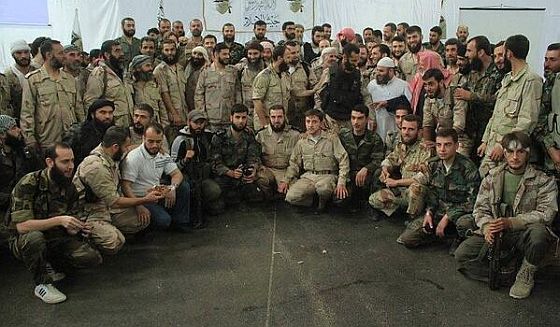
Hassan notes that in the liberated areas of Syria, Salafi-leaning fighters are now dominant and among these the newly formed Jaish al-Islam (“the Army of Islam”) composed of at least 50 groups operating mainly around Damascus, has now displaced the FSA as the strongest rebel force.
The emerging trend, far from that of Syria being taken over by foreign fighters, may actually be going in the opposite direction:
Significant grassroots hostility is building in liberated Syrian areas against foreign-funded extremists and al Qaeda affiliates. These tensions do not always develop into sustained clashes — for almost all rebel groups, toppling the regime is the priority, not fighting extremist forces, which have proved indispensable in the battlefield.
According to an activist based in the northern city of Raqqa, when clashes erupted between the al Qaeda-affiliated ISIS and Ahfad al-Rasoul in August, local residents threw their support behind one or the other side — but the strongest condemnation was for the infighting itself. “When they see the regime’s warplanes shelling the city without a single shot in their direction, they get angry at the fighters who could do something,” the activist explained.
The size of extremist groups is not an accurate indicator of the support for their ideology within Syrian society. Fighting groups are also not ideologically homogenous, as many fighters join groups for their effectiveness on the battlefield and disciple — not their religious beliefs. Ahrar al-Sham members in Daraa, for example, can be remarkably different in terms of religiosity from members in more conservative northern areas such as Idlib or the Aleppo countryside.
The situation inside the country is more fluid and nuanced than many groups’ hard-line slogans would suggest. Moderates can be members of hard-line groups and vice versa. Some groups, such as Suqour al-Sham, include both secular members and Islamist veterans of the insurgency against the U.S. occupation of Iraq. For example, a former judge at Aleppo’s cassation court, a secular Syrian who does not pray, nevertheless supports an Islamic identity to the state.
For this reason, many moderate fighters are more concerned with the foreign networks and leaders than the rank-and-file members of hard-line groups. “We are not too worried about Jabhat al-Nusra,” said one FSA-affiliated officer in the eastern governorate of Deir Ezzor who said he worked in intelligence operations. “Once the fighting ends, we’ll bring them back. We know them. They’re our brothers, cousins, and neighbors — they’re the sons of our tribes. Our true struggle will be against [ISIS] and the Nusra leaders.”