Category Archives: Issues

What Al Qaeda couldn’t defeat: The military-political bureaucracy

Andrew Cohen writes: “It’s a very tricky theme to play out politically,” law professor and longtime Obama devotee Geoffrey Stone is quoted saying without a trace of irony or regret near the end of The Terror Courts: Rough Justice at Guantanamo Bay, Jess Bravin’s excellent new book. The book focuses on the epic and continuing failure of America’s military tribunals to process suspects following the terrorist attacks of September 11, 2001. “You are asking people to be better than they have to be.”

It’s a quote that could be the epitaph for the whole disgraceful affair. At nearly every step of the way, for more than 11 years, our elected officials, military leaders, and judges have failed or refused to be “better than they have to be” when it comes to the treatment of the detainees. “You’ve got to be kidding me,” then-Attorney General John Ashcroft says prophetically, early in Bravin’s book. When Ashcroft comes off as a Wise Man you know something is terribly amiss.

Indeed, over and over, when faced with a moral or legal choice as to how to proceed, our government officials chose poorly– violating foreign and domestic law, precluding civilian trials, sabotaging our own national security, stifling internal dissent, confounding our allies, rewarding bureaucratic mindlessness, and setting up the vaunted military tribunals to fail in a hundred different ways which, of course, they have in the 4,212 days since the Twin Towers fell.

Which is why you should read this book now, while the hunger strike at Guantanamo Bay is growing. You should read it now, while there is a pending request by the Pentagon to spend another $49 million for a new prison on Cuba. You should read it now, while John Yoo is still the go-to guy for quotes about interrogations, and while Senators John McCain and Lindsey Graham, crows on a wire, are still offering up terrible advice about prosecuting detainees. [Continue reading…]


Facebooktwittermail

The Guantánamo hunger strike

McClatchy reports: It’s lunchtime on the communal cellblocks for cooperative captives, and detainees dressed in tan and white camp uniforms are steadfastly refusing the guards’ offer to wheel in food carts.

Only if a prisoner pulls shut a gate to a chute called a sally port can a soldier lock it remotely and send in the meals. And one by one, every block but Delta Block refuses. Some captives call out that they don’t want the food.

Over at Charlie Block, an angular looking detainee is stubbornly ignoring his guards, sitting at an empty, stainless-steel picnic table, watching footage from Mecca on Saudi TV.

Within an hour, the guards systematically trash a lunch that looks like it could feed 100. Unopened juice bottles go in the garbage first, then Styrofoam boxes of pita bread and special dietary meals. Buffet tins of stewed tomatoes, rice and sweet-and-sour stir-fried beef follow.

It’s hunger-strike time at Guantánamo. And while the military and their captives dispute when it started and how widespread it is, it was clear from a three-day visit to the prison-camp compound this past week that the guard force is confronted with its most complex challenge in years. [Continue reading…]

Facebooktwittermail

The death of the two-state solution

Andrew O’Hehir writes: Let’s give Mitt Romney some credit for candor on the Middle East, if for almost nothing else. President Obama’s soaring rhetoric in his campaign-style speech this week in Jerusalem, when he urged the Israeli public to “create the change that you want to see” and laid out a moral and philosophical case for a two-state solution to the Israeli-Palestinian problem, showed us the leader of the free world at the top of his oratorical game. But Obama didn’t go to Israel with any concrete plan to restart negotiations between Israeli Prime Minister Benjamin Netanyahu and Palestinian Authority president Mahmoud Abbas, a pair of weakened politicians who lack clear mandates from their own people. Despite vague promises to send Secretary of State John Kerry into the breach in coming weeks, it’s by no means clear that he has one.

In contrast, Romney’s infamous private summary of his Middle East policy – “we kick the ball down the field and hope that, ultimately, somehow, something will happen and resolve it” (he never used the phrase “kick the can down the road,” although that’s how it has entered the popular discourse) – has the unmistakable tang of realpolitik rather than wishful thinking. Given the long history of failure by all sides in this arena, it’s not even cynical to suggest that this is precisely Obama’s strategy: Try to soften attitudes on the ground a little, win over a few hearts and minds on both sides, and then gratefully hand over the problem to another hopelessly conflicted president in 2017.

What we can also detect in Romney’s remark and, a little deeper below the surface, in Obama’s Jerusalem speech is the growing sense in many quarters that the two-state solution is dead – that it’s no longer practical or possible to establish an independent Palestinian nation alongside the Jewish state of Israel, if it ever was. While the “one-state solution,” however conceived, remains a semi-forbidden zone in mainstream international policy discourse, it keeps cropping up all over the place on both the right and the left. Within a few weeks last summer, leading Israeli settler activist Dani Dayan published an Op-Ed in the New York Times urging the international community to give up “its vain attempts to attain the unattainable two-state solution,” while radical journalists Antony Loewenstein and Ahmed Moor published an anthology of writing by academics and activists entitled “After Zionism: One State for Israel and Palestine.”

Less than a month later came the English translation of eminent Israeli sociologist Yehouda Shenhav’s explosive essay, “Beyond the Two-State Solution,” which imagines a bi-national, bilingual federal democracy of Jews and Arabs that would encompass the entire territory of present-day Israel, Gaza and the West Bank. Shenhav, Dayan, Loewenstein, Moor and the leadership of Israel’s staunch enemies Hamas and Hezbollah might agree about nothing else, including which day follows Tuesday and whether the sky is blue. But they’d all agree that a negotiated two-state solution won’t work. Indeed, Israeli film director Dror Moreh, who made the Oscar-nominated documentary “The Gatekeepers” and falls somewhere toward the pragmatic center of Israeli politics, recently told me the same thing. He sounded rueful about holding that opinion and thinks it’s still worth trying but suspects it’s simply too late. [Continue reading…]

Facebooktwittermail

Hope in Hebron

David Shulman writes: On March 16, I joined some twenty-five children, aged about eight to thirteen, who had gathered with Palestinian peace activists in a house in Hebron city to write letters to President Obama on the eve of his visit to Jerusalem. March 16 was the start of the third Selma-to-Montgomery march, led by Martin Luther King, in 1965, a defining moment in the history of the American civil rights movement, and the children—Palestinians who were mostly from the H2 area of Hebron under direct Israeli military control—had come to learn about Martin Luther King and nonviolent resistance.

Most of the letters began by begging the US president: “Open Shuhada Street”—once the main thoroughfare of central Hebron, now almost completely barred to Palestinians, its shops bolted, the doors of its houses welded shut by the Israeli army. Others said simply: “Enough Occupation” or “Free Palestine” or “Down with the Wall.” One slightly older boy quoted a line of poetry: “Either we live, all of us, or we die together.” Some drew pictures: a soldier in khaki uniform standing with his rifle under an olive tree; a child’s map of Hebron, encircled, closed, with its deserted main street, in blue, cutting through to the city center.

A visit to Hebron eats into one’s soul. As of last week, Israel has a new government which, like the previous one, is in the hands of the settlers. Their parties have control of the Housing Ministry and the crucial Finance Committee of the Knesset, among other plums. Their not-so-secret plan is to put a million Jews in the West Bank, and they now have the political means to carry it out. There will be a surge of construction in the West Bank settlements, and new “illegal outposts” will mushroom on the hills. No one should expect the so-called centrists, or moderates, in the coalition to hold back the extremists.

Yair Lapid’s party, optimistically named “There is a Future,” came in second in the elections. But like most of the Israeli mainstream, Lapid seems all too ready to go along with the extreme program of the right. Tzipi Livni, former head of the opposition, ran on a platform demanding that Israel re-open negotiations with the Palestinians; she has been given the Ministry of Justice, but she is entirely unequal to the task of pleading the cause of peace—and in any case, Netanyahu is committed to blocking any progress in that area. For his part, Barack Obama, on his belated first visit to Israel as president, has articulated the hope for peace and the urgent need for a free Palestinian state with a directness and clarity perhaps never heard before in Jerusalem. Netanyahu responded with his usual niggardly, narrow-hearted non-vision. [Continue reading…]

Facebooktwittermail

A public indictment could shed light on CIA’s secret program

By Cora Currier, ProPublica, March 22, 2013

Federal prosecutors in Brooklyn unsealed an indictment Wednesday charging Ibrahim Suleiman Adnan Adam Harun with six terrorism-related counts.

The announcement that Harun is in U.S. custody in New York may also shed light on a small part one of the most secretive aspects of U.S. counterterrorism operations during the Bush administration: What became of terror suspects held by the CIA in its network of “black-site” prisons around the world? Or disappeared into foreign cells in extraordinary renditions?

With their indictment of Harun, prosecutors offered a basic account of how the 43-year-old Nigerian 2013 described as “a prototype Al Qaeda Operative” 2013 spent the last decade. He fought U.S. forces in Afghanistan, prosecutors said, before leaving for Africa, where he allegedly conspired to bomb U.S. diplomatic facilities. Harun, also known by his alias Spin Ghul, eventually wound up in Libyan prison for six years before he was released amid the turmoil of the uprising against Muammar Qaddafi.

Did the U.S. know that he was in Libya, and did they play a role in his detention? Did the CIA work with the Libyans to then obtain information from him?

Testimony from an alleged former CIA detainee, a leaked document from the military prison at Guantanamo Bay, and evidence from cases of others rendered to Libya suggest that might be so.

Continue reading

Facebooktwittermail

Afghanistan: The way to peace

Anatol Lieven writes: A very strange idea has spread in the Western media concerning Afghanistan: that the US military is withdrawing from the country next year, and that the present Afghan war has therefore entered into an “endgame.” The use of these phrases reflects a degree of unconscious wishful thinking that amounts to collective self-delusion.

In fact, according a treaty signed by the United States and the Karzai administration, US military bases, aircraft, special forces, and advisers will remain in Afghanistan at least until the treaty expires in 2024. These US forces will be tasked with targeting remaining elements of al-Qaeda and other international terrorist groups operating from Afghanistan and Pakistan; but equally importantly, they will be there to prop up the existing Afghan state against overthrow by the Taliban. The advisers will continue to train the Afghan security forces. So whatever happens in Afghanistan after next year, the United States military will be in the middle of it—unless of course it is forced to evacuate in a hurry.

As to the use of the word “endgame,” this might be appropriate if next year, upon the departure of US ground forces, the entire Afghan population, overcome with sorrow at the loss of their beloved allies, rolls over and dies on the spot. The struggle for power in Afghanistan will not “end” and US policymakers should not, as in the past, hop away from a swamp they’ve done much to create.

Two major new books, together with a number of lesser works, are crucial to an understanding of Afghanistan, the flaws of the Western project there, the enemies that we are facing, and therefore of possible future policies. Barnett Rubin, senior adviser to the US special representative for Pakistan and Afghanistan in the first Obama term, has been consistently among the wisest and most sensible of US expert voices on Afghanistan. His book Afghanistan from the Cold War Through the War on Terror is a compilation of his essays and briefing papers over the years, framed by passages looking back at the sweep of Afghan history and the US involvement there since 1979.

Peter Bergen is a former journalist and long-standing commentator and writer on the region now working at the New America Foundation in Washington, D.C.1 He has edited and introduces Talibanistan, a frequently brilliant collection of essays by different experts on the Taliban in Afghanistan and Pakistan, including an analysis of the extent to which their past links with al-Qaeda represent an enduring threat to the West, and of how far a peace settlement with them may be possible. Rubin’s and Bergen’s works should be read in conjunction with a fascinatingly detailed new book by Vahid Brown and Don Rassler on the Haqqani network, the insurgent group led by Mawlawi Jalaluddin Haqqani and his son, which operates on both sides of the Afghan–Pakistani border. Its title, Fountainhead of Jihad, is the name of a magazine published by the Haqqanis. [Continue reading…]

Facebooktwittermail

Kurdish rebels declare formal ceasefire with Turkey

Reuters reports: The Kurdistan Workers Party (PKK) militant group declared a “formal and clear ceasefire” with Turkey on Saturday after the rebels’ jailed leader this week ordered a halt to the decades-long armed campaign for autonomy.

“Since March 21 and from now on, we as a movement, as the PKK … officially and clearly declare a ceasefire,” said Murat Karayilan, the PKK’s field commander, in a video message apparently taped at a rebel holdout in northern Iraq.

His comments were translated from Kurdish in the video posted on Firat News, a website with links to the militants.

Abdullah Ocalan, held in an island prison since his 1999 conviction for treason, called on the PKK to cease fire and withdraw from Turkey in a letter read to hundreds of thousands of supporters in the main Kurdish city of Diyarbakir on March 21, the Kurds’ traditional new year holiday.

Facebooktwittermail

Obama’s choice: Real diplomacy (or war) with Iran

Hillary Mann Leverett and Flynt Leverett write: Contrary to conventional wishful thinking in American policy circles, developments in the nuclear talks between Iran and the P5+1 and the Iran-related messages coming out of President Obama’s trip to Israel strongly suggest that the risk of a US-initiated military confrontation with Tehran during Obama’s second term are rising, not falling. This is because Obama’s administration has made an ill-considered wager that it can “diplomatically” coerce Iran’s abandonment of indigenous nuclear fuel cycle capabilities. This is dangerous, for it will become clear over the next year or so – the timeframe Obama himself has set before he would consider Iran able to build nuclear weapons – that the bet has failed. If the administration does not change course and accept Iran’s strategic independence and rising regional influence – including accepting the principle and reality of internationally-safeguarded uranium enrichment in Iran, it will eventually be left with no fallback from which to resist pressure from Israel and its friends in Washington for military strikes, at least against Iranian nuclear facilities.

The just-concluded technical discussions in Istanbul between Iran and the P5+1 should dispel triumphalist optimism about the prospects for progress in nuclear diplomacy with Tehran. After higher-level political talks in Kazakhstan last month, some prominent Iran experts declared that US-instigated sanctions had gotten the Iranians back to the table, perhaps ready to make a deal along lines dictated by the Obama administration.

But a sober reading of the Istanbul meeting says otherwise: Iran has not been “softened up” by sanctions (based on our observations in Iran, only those who haven’t been there recently could possibly think that sanctions are “working” to bring Iran’s population to its knees and change official decision-making). Tehran’s conditions for a long-term deal remain fundamentally what they have been for years – above all, US acceptance of Iran’s revolution and its independence, including its right to enrich under international safeguards. Just as importantly, the Obama administration is no more prepared than prior administrations to accept the Islamic Republic and put forward a proposal that might actually interest Tehran. And Obama’s ability to modify sanctions in the course of negotiations – or lift them as part of a deal – is tightly circumscribed by laws that he himself signed, belying the argument that sanctions are somehow a constructive diplomatic tool. [Continue reading…]

Facebooktwittermail

Dying Iraq war veteran Tomas Young explains decision to end his life

A Message to George W. Bush and Dick Cheney From a Dying Veteran

To: George W. Bush and Dick Cheney
From: Tomas Young

I write this letter on the 10th anniversary of the Iraq War on behalf of my fellow Iraq War veterans. I write this letter on behalf of the 4,488 soldiers and Marines who died in Iraq. I write this letter on behalf of the hundreds of thousands of veterans who have been wounded and on behalf of those whose wounds, physical and psychological, have destroyed their lives. I am one of those gravely wounded. I was paralyzed in an insurgent ambush in 2004 in Sadr City. My life is coming to an end. I am living under hospice care.

I write this letter on behalf of husbands and wives who have lost spouses, on behalf of children who have lost a parent, on behalf of the fathers and mothers who have lost sons and daughters and on behalf of those who care for the many thousands of my fellow veterans who have brain injuries. I write this letter on behalf of those veterans whose trauma and self-revulsion for what they have witnessed, endured and done in Iraq have led to suicide and on behalf of the active-duty soldiers and Marines who commit, on average, a suicide a day. I write this letter on behalf of the some 1 million Iraqi dead and on behalf of the countless Iraqi wounded. I write this letter on behalf of us all—the human detritus your war has left behind, those who will spend their lives in unending pain and grief.

I write this letter, my last letter, to you, Mr. Bush and Mr. Cheney. I write not because I think you grasp the terrible human and moral consequences of your lies, manipulation and thirst for wealth and power. I write this letter because, before my own death, I want to make it clear that I, and hundreds of thousands of my fellow veterans, along with millions of my fellow citizens, along with hundreds of millions more in Iraq and the Middle East, know fully who you are and what you have done. You may evade justice but in our eyes you are each guilty of egregious war crimes, of plunder and, finally, of murder, including the murder of thousands of young Americans—my fellow veterans—whose future you stole. [Continue reading…]

Facebooktwittermail

Pentagon wants $49 million to build new prison at Guantánamo

The New York Times reports: The United States Southern Command has requested $49 million to build a new prison building at Guantánamo Bay, Cuba, for “special” detainees on top of other renovations it says are necessary since Congress has decided to keep it open indefinitely. That brings the potential taxpayer bill for upgrading the deteriorating facilities to an estimated $195.7 million, the military said on Thursday.

That overall price tag is significantly higher than the estimate of $150 million to $170 million that General John F. Kelly, the Southcom commander, gave in Congressional testimony on Wednesday. The special detainee facility was not included on the list of requested construction projects released by Southcom on Wednesday when reporters asked for details.

The project appears to be a proposed replacement for Camp 7, where so-called high-value detainees who were formerly held by the Central Intelligence Agency – like Khalid Shaikh Mohammed, the self-described architect of the terrorist attacks of Sept. 11, 2001 – are housed. While the existence of Camp 7 is widely known, the military generally refuses to discuss it. [Continue reading…]

Facebooktwittermail

Zionism has become an obstacle to Jewish welfare and security

Ian S. Lustick asks: How close is Israel to pariah status? Quite close. Americans know that ratings for Congress are now in the single digits: below traffic jams, colonoscopies and cockroaches, though still above North Korea and telemarketers. If Israel were included in that survey it would of course do better than Congress — among Americans. But not in the world at large.

In a 2003 European Union-sponsored poll, Israel was seen as more dangerous to world peace than any other country. In 2006, an Israeli government poll conducted in 35 countries found Israel had the worst public image in every category it tested. In 2012, the BBC reported that 50% of 24,090 people polled worldwide thought Israel had a “mostly negative” impact on the world, tied with North Korea and exceeded only by Pakistan and Iran.

Worried about “delegitimization” as an “existential threat,” the Israeli government and its U.S. friends have funded a host of rebranding PR efforts. But Israel’s image has suffered more from repeated outrages to the world’s sense of fairness than from bad public relations.

Israeli leaders have repeatedly threatened to attack Iran, a signatory to the nuclear nonproliferation treaty, for developing nuclear technology with weapons potential, even as they refuse to join the NPT or acknowledge Israel’s own immense nuclear force. Israeli governments have launched several onslaughts against the Gaza Strip and Lebanon, inflicting collateral damage to innocents that has hugely exceeded Israeli casualties. In response to the United Nation’s decision to recognize Palestine as an observer state, the Israeli government announced radical expansion of Jewish settlement in sensitive areas of Jerusalem and the West Bank. Jews living in Palestine thousands of years ago are cited to justify a right of 21st century Jews to “return,” while Palestinian demands to return after 65 years of exile are deemed absurd.

Such policies and actions have shaped the international image of the Jewish state as defiant rather than courageous, belligerent rather than reasonable, dangerous rather than reliable.

Netanyahu and his allies can be blamed for many of Israel’s current excesses. But there are much deeper forces at work. One of them is the still-unrecognized reality of post-Zionism. Israel’s founding ideology has not adapted gradually to a changing world, and the American colossus has protected it from the consequences. When adaptation cannot occur gradually, it occurs suddenly. It is wrenching and disorienting. This is the sort of change in store for Israel. [Continue reading…]

Facebooktwittermail

Turkey, Israel make U.S.-brokered peace after Mavi Marmara apology

Today’s Zaman reports: Israeli Prime Minister Benjamin Netanyahu offered an apology to Turkey for a 2010 raid on an aid flotilla that resulted in the deaths of eight Turks and a Turkish American, ending a deep crisis in ties between the two former allies.

In a statement carried by Reuters, Netanyahu said he “expressed apology” to the Turkish people for any error that could have led to loss of life in the flotilla incident. He also said Israel has agreed to pay compensation to the families of the victims and that Israel and Turkey agree to work together to improve the humanitarian situation in the Palestinian territories.

A Turkish official in Ankara confirmed the apology, telling Today’s Zaman that Netanyahu called Erdoğan to offer an apology and that Erdoğan accepted it.

Facebooktwittermail

Obama’s expanding empire of drone bases advances across Africa

The Washington Post reports: The newest outpost in the U.S. government’s empire of drone bases sits behind a razor-wire-topped wall outside this West African capital, blasted by 110-degree heat and the occasional sandstorm blowing from the Sahara.

The U.S. Air Force began flying a handful of unarmed Predator drones from here last month. The gray, mosquito-shaped aircraft emerge sporadically from a borrowed hangar and soar north in search of al-Qaeda fighters and guerrillas from other groups hiding in the region’s untamed deserts and hills.

The harsh terrain of North and West Africa is rapidly emerging as yet another front in the United States’ long-running war against terrorist networks, a conflict that has fueled a revolution in drone warfare.

Since taking office in 2009, President Obama has relied heavily on drones for operations, both declared and covert, in Afghanistan, Iraq, Pakistan, Yemen, Libya and Somalia. U.S. drones also fly from allied bases in Turkey, Italy, Saudi Arabia, Qatar, the United Arab Emirates and the Philippines.

Now, they are becoming a fixture in Africa. The U.S. military has built a major drone hub in Djibouti, on the Horn of Africa, and flies unarmed Reaper drones from Ethiopia. Until recently, it conducted reconnaissance flights over East Africa from the island nation of the Seychelles. [Continue reading…]

Facebooktwittermail

Kirkuk: the time-bomb that didn’t explode

Der Spiegel reports: Kirkuk is a multiethnic city thousands of years old and claimed by Kurds, Arabs and Turkmen alike. American occupiers already viewed it as the predetermined breaking point of the new Iraq. They predicted that the various groups in the “Mesopotamian Jerusalem” would begin attacking each other after US troops had withdrawn.

The first oil in Iraq was discovered in Kirkuk in 1927. Since the 1930s, gas flares have been burning day and night on the city’s outskirts, serving as a reminder of the riches that whoever controls the region has access to. An American colonel once said that this city could plunge the entire country into ruin.

It’s looking that way at the moment, but not, as was once predicted, because of the city’s residents. In Kirkuk, where the local television station broadcasts in four languages, Muslims and Christians, Kurds, Arabs and Turkmen coexist more peacefully than they did years ago.

Although the parties are still at odds over voter registration problems, residents are increasingly indifferent to the issue. “We just want to live normally,” says Murah Salah, a Turkmen mechanic. “We want to have jobs, electricity, security, a functioning garbage-collection service and,” he adds with a smile, “to be able to drive out to barbecues on the weekend!”

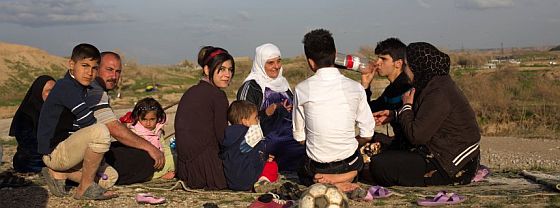
He is referring to the sort of outing that’s taking place on a large meadow outside the city today. Mohammed Hilmi and his family are picnicking directly next to the Salah family. Yes, things have improved, he says. “In the past, people sat on their blankets, far apart from each other, and no one spoke with anyone else. Those days are now gone.”

Delwar Abdul Aziz, a Kurdish pharmacist, says: “After Saddam, we just needed time to become normal again. There was deep-seated fear and mistrust. Now people trust each other again. The attacks are certainly a problem, but the terrorists are definitely not from here.”

Defusing Kirkuk ‘s Conflict

Neither Kurds nor Arabs nor Turkmen alone control Kirkuk and its population of 900,000. But that circumstance has probably kept things relatively stable in the city, which has put coexistence to the test for centuries, and which, in addition to the three main ethnic groups, is home to religious groups like the Yazidis, Kakai and Assyrian Christians. Jews are the only religious group to have left Kirkuk, in the 1950s.

When competing groups are forced to hammer out compromises, the result is checks and balances. Perhaps another reason for the city’s stability is that the Kirkukis got rid of their corrupt governor two years ago and elected a new one, whose nickname is the “Bulldozer.”

Najmuddin Karim, a Kurdish neurosurgeon who lived in the United States for 35 years, has fired corrupt officials, built roads, bridges and a new market, and created a few thousand temporary administrative jobs. Now that Karim is in office, electricity is available for 20 instead of four hours a day, and there are even streetlights, in Kurdish, Arab and Turkmen neighborhoods alike.

Although Karim hasn’t managed to end the conflict over Kirkuk, he has defused it. “We must treat everyone as a citizen, something we failed to do in the past,” says Karim, who is in his mid-60s. “Of course I would like to see Kirkuk become part of the Kurdish region. But it won’t work if the Sunnis and Turkmen don’t agree!” [Continue reading…]

Facebooktwittermail

Rethinking Israel-Palestine: Beyond bantustans, beyond reservations

Noura Erakat writes: Due to the insistence upon maintaining a Jewish demographic majority, Israel’s establishment and maintenance has necessitated the ongoing forced displacement of Muslim and Christian Palestinians. Well before Israel’s establishment, David Ben-Gurion, Israel’s chief architect and two-time prime minister, said that in order to be successful, Jews must comprise 80 percent of the population, hardly a plausible ratio in light of a vibrant Palestinian society in 1948. As put by the Israeli historian Benny Morris during an interview discussing his book, The Birth of the Palestinian Refugee Problem Revisited,

Ben Gurion…understood that there could be no Jewish state with a large and hostile Arab minority in its midst…that has to be clear, it’s impossible to evade it. Without the uprooting of the Palestinians, a Jewish state would not have arisen there.

And so based on that vision, Zionists demolished 531 Arab villages and expelled some 700,000 Palestinians from what is today Israel proper. The “problem,” so to speak, is that Zionist forces did not expel all Palestinians. Instead, the 100,000 Palestinians remaining within Israel at the conclusion of the 1948 war today constitute a 1.2 million-person population, approximately 20 percent of Israel’s total population.

Had Israel declared its borders along the 1949 armistice line, maintaining an 80 percent demographic balance may have been possible. Israel, however, has never declared any borders and, in accordance with a plan first elaborated by Deputy Prime Minister Yigal Allon immediately after the 1967 war, it has steadily expanded into the rest of Mandate Palestine, home now to 4 million Palestinians.

As of October 2012, the balance of Jews to non-Jews throughout Israel and the OPT was approximately 5.9 million Jewish Israelis, including the settler population, and 6.1 million Palestinians.

At this juncture, Israel could abandon its commitment to a Jewish demographic majority and establish a state for all its citizens without distinction to religion. Its leaders and supporters reject this pluralistic, democratic option outright and equate it with the destruction of Israel. [Continue reading…]

Facebooktwittermail

Weapons experts raise doubts about Israel’s Iron Dome antimissile system

The New York Times reports: After President Obama arrived in Israel, his first stop on Wednesday was to inspect an installation of Iron Dome, the antimissile system hailed as a resounding success in the Gaza conflict in November. The photo op, celebrating a technological wonder built with the help of American dollars, came with considerable symbolism as Mr. Obama sought to showcase support for Israel after years of tensions over Jewish settlements and how to curb Iran’s nuclear ambitions.

Unstated amid the good will, though, was an intensifying debate over whether Iron Dome’s feats of warhead destruction were more illusory than real.

Israeli officials initially claimed success rates of up to 90 percent. Michael Oren, Israel’s ambassador to the United States, hailed the antimissile system as the first to succeed in combat. Congress recently called the system “very effective” and pledged an additional $680 million for deployments through 2015.

But a growing chorus of weapons experts in the United States and in Israel say their studies — based largely on analyses of hits and misses captured on video — suggest that Iron Dome destroyed no more than 40 percent of incoming warheads and perhaps far fewer. Many rockets, they argue, were simply crippled or deflected — failures that often let intact or dying rockets fall on populated areas.

“They’re smart people,” Richard M. Lloyd, a weapons expert who has written a critique of Iron Dome for engineers and weapons designers, said of the system’s makers in an interview. “But the problems go on and on.”

Behind that skepticism lie the messy realities of combat, as well as a half-century of global antimissile failures. “No military system is 90 percent effective,” said Philip E. Coyle III, who once ran the Pentagon’s weapons-testing program and recently left a White House security post.

For Iron Dome, the performance issue is important, in part, because defense bears strongly on offense. Israel’s decision on whether to bomb Iran’s nuclear sites — as it has repeatedly threatened to do — could hinge on its estimate of the retaliatory costs, including damage inflicted by rockets fired from southern Lebanon and the Gaza Strip. [Continue reading…]

Facebooktwittermail

Obama whispers sweet nothings while heading for the exit

In Haaretz, Aluf Benn writes: U.S. President Barack Obama said Wednesday his visit to Israel was meant to be a reassuring one. He is here to make it clear to Israelis that America stands behind them and will ensure their security, even though the neighborhood has become tougher.

What President Shimon Peres and Prime Minister Benjamin Netanyahu wanted to hear was Obama making a firm commitment to prevent Iran from acquiring nuclear weapons and to cushion the shock waves that could result from Syria’s disintegration.

It is premature to assess whether Peres and Netanyahu were satisfied by the promises made by the visitor, who asked for time for diplomatic negotiations with Iran and demanded that Syrian President Bashar Assad guard his chemical weapons.

The visit comes at a time when the United States is withdrawing from its deep involvement in the Middle East, amid the growing fear of Israel and other regional allies that America will abandon them to radical Islamic forces.

America entered the region with all its might, as its dependence on oil imports increased. But following the development of new oil and natural gas production methods in North America, the United States is gradually freeing itself of reliance on external energy sources.

In a few years it will become an oil exporter. The Middle East is still important, but it is less vital than it was a decade or two ago.

America has tired of the wars in the Middle East that consumed its resources and robbed its attention in the past decade, without resulting in a decisive victory. Obama has already pulled the U.S. Army out of Iraq, and will take it out of Afghanistan this term. The old regional order, with its reliance on secular military dictatorships and pro-American monarchies, has collapsed under the revolutions of the Arab Spring and the strengthening of the region’s Islamic movements.

The United States has discovered it cannot control these upheavals, and it doesn’t want to get involved in civil wars like the one in Syria. It prefers to stand by and see who wins.

Under these circumstances, pressure on Israel will increase. Until now, Israel has benefited from American safeguards in the region that have bolstered its deterrence capability, helped to safeguard the peace accords with Egypt and Jordan, and protected it from distant regional powers like Iran and Iraq. And when Israel is worried, or when it feels that its security concerns are not being given the attention they deserve in Washington, it has a tendency to take risks and use military force to perpetuate the strategic status quo.

Obama is projecting very different images domestically and overseas: He is trying to draw his country inward while telling his allies in the Middle East that, despite what they may be witnessing, the United States is just as committed to them as ever.

This attitude is reminiscent of Richard Nixon. In 1969 Nixon laid out the American foreign policy strategy that came to be known as the Guam Doctrine or the Nixon Doctrine, which made it clear that Washington would no longer undertake the defense of the free nations of the world. That was the first step toward an eventual American withdrawal from Vietnam, and Nixon, who had to sell the idea to his allies in Asia, assured them that everything would be fine.

The best way for Israel to ensure that the Americans remain committed is to threaten some unilateral action that would drag in the United States. That’s exactly what Netanyahu did Wednesday in his public appearances with Obama. He kept on talking about Israel’s right to defend itself. In rough translation from diplo-speak, that means, “If you don’t take action to get Iran to thwart its nuclear project, we will be forced to act alone − and you’ll suffer the consequences as much as we will.”

In the meantime, Obama has no clear-cut solution to the Iranian problem, or to the disintegration of Syria. He’s also finding it hard to bring his influence to bear on the political crisis in Egypt and to assuage Israeli concerns that the Muslim Brotherhood is planning to annul the Israel-Egypt peace treaty. So he’s playing for time by reassuring Israel, by whispering sweet nothings of unconditional love and support into the ears of the Israeli people, and by publicly referring to the prime minister by his nickname.

And there’s a good chance it will work. With every passing day, Israel becomes less capable of taking out Iran’s nuclear facilities by itself, while its dependence on the United States for military superiority just keeps growing.

Facebooktwittermail