Category Archives: Issues

Obama is channeling Bush fever in Iran

Falguni A. Sheth writes: Iran has no intentions of attacking Israel. One obvious reason is that Iran has no plausible ability to attack Israel. As the erudite journalist and political analyst Nima Shirazi has documented carefully and exhaustively here, here, here, here, and perhaps crystallized most clearly here, Iran presents no threat, nuclear or otherwise, to Israel. None. Zilch. Nada. President Obama knows this. Shimon Peres knows this. Bibi knows this. As Shirazi writes:

Netanyahu deliberately ignored the fact that Iran’s stockpile of enriched uranium remains far from weapons-grade and that Iran has, for over a year now, been systematically converting much of its 19.75% enriched stock to fuel plates that precludes the possibility of being diverted to military purposes.

Of course, the fact that Iran has an inalienable legal right to a fully-functioning nuclear energy program – including the indigenous mastery of the nuclear fuel cycle – was not addressed at all. For Netanyahu and his acolytes, any Iranian nuclear program is synonymous with a weapons program – and not only that, but a weapons program designed to “exterminate” Israel’s “Jewish people.” Facts remain irrelevant.

Hans Blix, the UN Inspector who repeatedly declared in 2002 that there were no weapons of mass destruction in Iraq, knows this (a fact that our liberal pundit class has only now come to acknowledge. See Beinart et al. above). He has again affirmed there are no weapons of mass destruction in Iran. As reported by an Australian news site, Blix insists:

“Memories of the failure and tragic mistakes in Iraq are not taken sufficiently seriously.”

“In the case of Iraq, there was an attempt made by some states to eradicate weapons of mass destruction that did not exist, and today there is talk of going on Iran to eradicate intentions that may not exist. I hope that will not happen.”

Today, Mr Blix believes that the international community has even less evidence of the existence of atomic weapons in Iran, which is facing international pressures over its controversial nuclear program.

Moreover, even senior Israeli officials with close ties to the intelligence community are unconvinced of Iran’s danger to the United States or to Israel:

Beyond being obvious that Iran poses literally no threat to the United States, numerous Israeli military and intelligence officials openly reject the notion that a nuclear-armed Iran would “present an existential threat to Israel.” Former Mossad chief Ephraim Halevy recently told the UK Zionist Federation that Israel’s existence “is not in danger and shouldn’t be questioned.”

(ThinkProgress.org lists Israeli officials who are not concerned about Iran’s threat to Israel here.)

In essence, the increasingly menacing public posture of U.S. officials toward Iran — coming in the same month as the 10-year anniversary of the jingoistic, imperially smug, and devastatingly destructive invasion of Iraq — cannot but remind us of the spurious calls for war made back in 2002.


Facebooktwittermail

Israel’s anti-missile system ‘likely to leave civilians exposed in event of war’

The Guardian reports: Israel’s vaunted missile defence system is likely to leave the civilian population exposed to an incoming barrage of rockets in the event of a war as it is deployed to protect key strategic and military sites, according the country’s commander of the home front.

Despite the success of the Iron Dome anti-missile batteries at intercepting rockets launched from Gaza during November’s eight-day conflict, the five units currently operational are insufficient to protect against the superior firepower of Hezbollah in Lebanon.

“I will recommend protecting the country’s functional continuity and the ability to maintain an [Israeli Defence Forces] offensive effort over time, until the war is won,” Major General Eyal Eisenberg, head of the home front command, said in an interview with Haaretz.

Facebooktwittermail

Why many American workers should be more afraid of their employers than al Qaeda

The New York Times reports: Sheri Farley walks with a limp. The only job she could hold would be one where she does not have to stand or sit longer than 20 minutes, otherwise pain screams down her spine and up her legs.

“Damaged goods,” Ms. Farley describes herself, recalling how she recently overheard a child whispering to her mother about whether the “crippled lady” was a meth addict.

For about five years, Ms. Farley, 45, stood alongside about a dozen other workers, spray gun in hand, gluing together foam cushions for chairs and couches sold under brand names like Broyhill, Ralph Lauren and Thomasville. Fumes from the glue formed a yellowish fog inside the plant, and Ms. Farley’s doctors say that breathing them in eventually ate away at her nerve endings, resulting in what she and her co-workers call “dead foot.”

A chemical she handled — known as n-propyl bromide, or nPB — is also used by tens of thousands of workers in auto body shops, dry cleaners and high-tech electronics manufacturing plants across the nation. Medical researchers, government officials and even chemical companies that once manufactured nPB have warned for over a decade that it causes neurological damage and infertility when inhaled at low levels over long periods, but its use has grown 15-fold in the past six years.

Such hazards demonstrate the difficulty, despite decades of effort, of ensuring that Americans can breathe clean air on the job. Even as worker after worker fell ill, records from the Occupational Safety and Health Administration show that managers at Royale Comfort Seating, where Ms. Farley was employed, repeatedly exposed gluers to nPB levels that exceeded levels federal officials considered safe, failed to provide respirators and turned off fans meant to vent fumes.

But the story of the rise of nPB and the decline of Ms. Farley’s health is much more than the tale of one company, or another chapter in the national debate over the need for more, or fewer, government regulations. Instead, it is a parable about the law of unintended consequences.

It shows how an Environmental Protection Agency program meant to prevent the use of harmful chemicals fostered the proliferation of one, and how a hard-fought victory by OSHA in controlling one source of deadly fumes led workers to be exposed to something worse — a phenomenon familiar enough to be lamented in government parlance as “regrettable substitution.”

It demonstrates how businesses at once both suffer from and exploit the fitful and disjointed way that the government tries to protect workers, and why occupational illnesses have proved so hard to prevent.

And it highlights a startling fact: OSHA, the watchdog agency that many Americans love to hate and industry often faults as overzealous, has largely ignored long-term threats. Partly out of pragmatism, the agency created by President Richard M. Nixon to give greater attention to health issues has largely done the opposite.

OSHA devotes most of its budget and attention to responding to here-and-now dangers rather than preventing the silent, slow killers that, in the end, take far more lives. Over the past four decades, the agency has written new standards with exposure limits for 16 of the most deadly workplace hazards, including lead, asbestos and arsenic. But for the tens of thousands of other dangerous substances American workers handle each day, employers are largely left to decide what exposure level is safe. [Continue reading…]

Over a decade of war, a massively bloated defense budget, the creation of the Department of Homeland Security along with cancerous growth of the intelligence community — all have been justified on the basis of a miniscule threat to American lives posed by a handful of terrorists.

At the same time, the deaths of tens of thousands of American workers, along with the incapacitation of hundreds of thousands more, is all regarded as part of the price of doing business.

When it comes to national security, no expense is spared, but when it comes to commerce, all is subservient to the pursuit of profit.

Chronic ailments caused by toxic workplace air — black lung, stonecutter’s disease, asbestosis, grinder’s rot, pneumoconiosis — incapacitate more than 200,000 workers in the United States annually. More than 40,000 Americans die prematurely each year from exposure to toxic substances at work — 10 times as many as those who die from the refinery explosions, mine collapses and other accidents that grab most of the news media attention.

Occupational illnesses and injuries like Ms. Farley’s cost the American economy roughly $250 billion per year because of medical expenses and lost productivity, according to government data analyzed by J. Paul Leigh, an economist at the University of California, Davis, more than the cost of diabetes or chronic obstructive pulmonary disease. Roughly 40 percent of medical expenses from workplace hazards, or about $27 billion a year, is paid by public programs like Medicare and Medicaid.

Facebooktwittermail

The invisible victims of America’s wars

Glenn Greenwald writes: Yesterday I had the privilege to watch Dirty Wars, an upcoming film directed by Richard Rowley that chronicles the investigations of journalist Jeremy Scahill into America’s global covert war under President Obama and specifically his ever-growing kill lists. I will write comprehensively about this film closer to the date when it and the book by the same name will be released. For now, it will suffice to say that the film is one of the most important I’ve seen in years: gripping and emotionally affecting in the extreme, with remarkable, news-breaking revelations even for those of us who have intensely followed these issues. The film won awards at Sundance and rave reviews in unlikely places such as Variety and the Hollywood Reporter. But for now, I want to focus on just one small aspect of what makes the film so crucial.

The most propagandistic aspect of the US War on Terror has been, and remains, that its victims are rendered invisible and voiceless. They are almost never named by newspapers. They and their surviving family members are virtually never heard from on television. The Bush and Obama DOJs have collaborated with federal judges to ensure that even those who everyone admits are completely innocent have no access to American courts and thus no means of having their stories heard or their rights vindicated. Radical secrecy theories and escalating attacks on whistleblowers push these victims further into the dark.

It is the ultimate tactic of Othering: concealing their humanity, enabling their dehumanization, by simply relegating them to nonexistence. As Ashleigh Banfield put it her 2003 speech denouncing US media coverage of the Iraq war just months before she was demoted and then fired by MSNBC: US media reports systematically exclude both the perspectives of “the other side” and the victims of American violence. Media outlets in predominantly Muslim countries certainly report on their plight, but US media outlets simply do not, which is one major reason for the disparity in worldviews between the two populations. They know what the US does in their part of the world, but Americans are kept deliberately ignorant of it.

What makes Dirty Wars so important is that it viscerally conveys the effects of US militarism on these invisible victims: by letting them speak for themselves. Scahill and his crew travel to the places most US journalists are unwilling or unable to go: to remote and dangerous provinces in Afghanistan, Yemen and Somalia, all to give voice to the victims of US aggression. We hear from the Afghans whose family members (including two pregnant women) were slaughtered by US Special Forces in 2010 in the Paktia Province, despite being part of the Afghan Police, only for NATO to outright lie and claim the women were already dead from “honor killings” by the time they arrived (lies uncritically repeated, of course, by leading US media outlets). [Continue reading…]

Facebooktwittermail

The Islamophobia of the New Atheists

Nathan Lean reviews some of the latest Islamophobic rants from Richard Dawkins and fellow militant atheists: Dawkins’ quest to “liberate” Muslim women and smack them with a big ol’ heaping dose of George W. Bush freedom caused him to go berzerk over news that a University College of London debate, hosted by an Islamic group, offered a separate seating option for conservative, practicing Muslims. Without researching the facts, Dawkins assumed that gendered seating was compulsory, not voluntary, and quickly fired off this about the “gender apartheid” of the supposedly suppressed Muslims: “At UC London debate between a Muslim and Lawrence Krauss, males and females had to sit separately. Krauss threatened to leave.” And then this: “Sexual apartheid. Maybe these odious religious thugs will get their come-uppance?”

Of course, the fact that the Barclays Center in New York recently offered gender-separate seating options for Orthodox Jews during a recent concert by Israeli violinist Itzhak Perlman didn’t compute in Dawkins’ reasoning. Neither did the case of El Al Airlines, the flag carrier of Israel, when, in August of 2012, a stewardess forced a Florida woman to swap seats to accommodate the religious practice of a haredi Orthodox man. Even if Dawkins were aware of these episodes, he likely wouldn’t have made a fuss about them. They undermine the conclusion he has already reached, that is, that only Muslims are freedom-haters, gender-separating “thugs.”

Where exactly Dawkins gets his information about Islam is unclear (perhaps Fox News?). What is clear, though, is that his unique brand of secular fundamentalism cozies up next to that screeched out by bloggers on the pages of some of the Web’s most vicious anti-Muslim hate sites. In a recent comment he posted on his own Web site, Dawkins references a site called Islam Watch, placing him in eerily close proximity to the likes of one of the page’s founders, Ali Sina, an activist who describes himself as “probably the biggest anti-Islam person alive.” Sina is a board member for the hate group, Stop the Islamization of Nations, which was founded by anti-Muslim activists Pamela Geller and Robert Spencer and which has designated as a hate group by the Southern Poverty Law Center.

Dawkins is also on record praising the far-right Dutch politician Geert Wilders, a man who says that he “hates Islam” and that Muslims who desire to remain in the Netherlands should “rip out half of the Koran” (Later, he blabbed that the Muslim holy book should be banned entirely). The peroxide-blonde leader of the Party of Freedom, who faced trial in 2009 for hate speech, produced an amateurish flick called “Fitna” the year before. The 17-minute film was chockablock with racist images such as Muhammad’s head attached to a ticking time bomb and juxtapositions of Muslims and Nazis. For Dawkins, it was pure bliss. “On the strength of ‘Fitna’ alone, I salute you as a man of courage who has the balls to stand up to a monstrous enemy,” he wrote. [Continue reading…]

Facebooktwittermail

Portugal’s humanistic and pragmatic approach to drug use

Der Spiegel reports: Twelve years ago, Portugal eliminated criminal penalties for drug users. Since then, those caught with small amounts of marijuana, cocaine or heroin go unindicted and possession is a misdemeanor on par with illegal parking. Experts are pleased with the results.

Before he got involved in the global war on drugs, João Goulão was a family physician with his own practice in Faro, on Portugal’s Algarve coast. Arriving in his small office in Lisbon, the 58-year-old tosses his jacket aside, leaving his shirt collar crooked. He looks a little tired from the many trips he’s taken lately — the world wants to know exactly how the experiment in Portugal is going. Goulão is no longer able to accept all the invitations he receives. He adds his latest piece of mail to the mountain of papers on his desk.

From this office, where the air conditioning stopped working this morning, Goulão keeps watch over one of the world’s largest experiments in drug policy.

One gram of heroin, two grams of cocaine, 25 grams of marijuana leaves or five grams of hashish: These are the drug quantities one can legally purchase and possess in Portugal, carrying them through the streets of Lisbon in a pants pocket, say, without fear of repercussion. MDMA — the active ingredient in ecstasy — and amphetamines — including speed and meth — can also be possessed in amounts up to one gram. That’s roughly enough of each of these drugs to last 10 days.

These are the amounts listed in a table appended to Portugal’s Law 30/2000. Goulão participated in creating this law, which has put his country at the forefront of experimental approaches to drug control. Portugal paved a new path when it decided to decriminalize drugs of all kinds.

“We figured perhaps this way we would be better able get things under control,” Goulão explains. “Criminalization certainly wasn’t working all that well.”

As part of its war on drugs, Portugal has stopped prosecuting users. The substances listed in the Law 30/2000 table are still illegal in Portugal — “Otherwise we would have gotten into trouble with the UN,” Goulão explains — but using these drugs is nothing more than a misdemeanor, much the same as a parking violation. [Continue reading…]

Facebooktwittermail

This is how corporate ‘democracy’ works

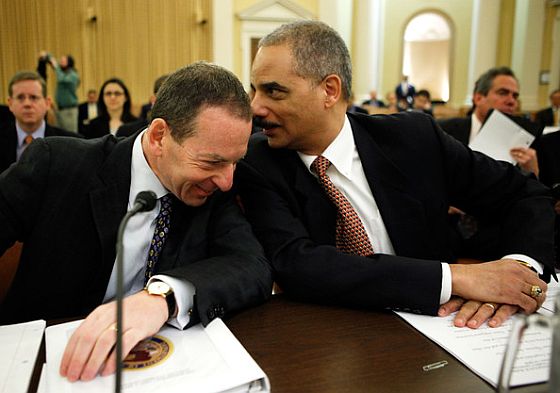
Covington & Burling lawyers Lanny Breuer and Eric Holder on federal sabbatical.

The New York Times reports: Coming off a grueling four-year stint at the Justice Department, Lanny A. Breuer is poised to make a soft landing in the private sector.

Covington & Burling, a prominent law firm, plans to announce on Thursday that Mr. Breuer will be its vice chairman. The firm created the role especially for Mr. Breuer, a Washington insider who most recently led the Justice Department’s investigation into the financial crisis.

For Mr. Breuer, who will now shift to defending large corporations, Covington is familiar turf. He previously spent nearly two decades there.

“There’s a strong emotional pull to the firm,” Mr. Breuer, who departed as the Justice Department’s criminal division chief on March 1, said in an interview. “It’s my professional home.”

Mr. Breuer is expected to earn about $4 million in his first year at Covington. In addition to representing clients, he will serve as an ambassador of sorts for the firm as it seeks to grow overseas.

The move is his latest turn through Washington’s revolving door, the symbolic portal connecting government service and private practice. Mr. Breuer, who began his career as an assistant district attorney in Manhattan and later represented President Bill Clinton during his impeachment hearings, is joining Covington for the third time.

Like Mr. Breuer, Covington operates at the nexus of Washington and Wall Street. It has represented several financial clients facing federal scrutiny, including the New York Stock Exchange, JPMorgan Chase and the former chief executive of IndyMac.

And perhaps when Breuer’s former boss Attorney General Eric Holder steps down, he too will return to his former employer, Covington, and there, along with servicing the interests of Wall Street, they can assist the law firm’s other famous clients like Xe Services (Blackwater), Phillip Morris, and Halliburton.

If you’re not familiar with Breuer, watch The Untouchables to learn about his role in letting Wall Street off the hook following the 2008 financial crisis.

Facebooktwittermail

Guantanamo hunger striker: ‘We all died when Obama indefinitely detained us’

RT.com interviewed federal public defender Carlos Warner who read a statement from one of the prisoners, Faiz al-Kandari.

CW: He said:

“I scare myself when I look in the mirror. Let them kill us as we have nothing to lose. We died when Obama indefinitely detained us. Respect us or kill us. It is your choice. The US must take off its mask and kill us.”

That was his statement as of today. I saw him last week. I have many clients there but I did see him last week and it was a shock to see what I saw. He was a man who was down more than 30 pounds less than a month ago. He refused all nourishment. His cheeks were sunk in. He was exhausted, weak, he could not stand. It was a scary, scary meeting for me.

RT: And his message is respect us or kill us. Will his wish come true or will he now be prepared to die?

CW: Well, I think many of the men, the ones that are indefinitely detained have zero hope. They have no hope because of the administration. I think many of them are ready die. The question is how and when will they die? They have no hope of being released from that place and unless a human being has some hope, it is very difficult to live. And many of them are prepared to die.

RT: Has this man been cleared for release years ago, and if so why hasn’t he been released?

CW: Faiz is not on the list of 86 innocent men who are cleared for release and those 86 men, it was unanimous decision by the US government, our government to release them. But Faiz is not on that list. But let’s be clear, everyone in Guantanamo is indefinitely detained. No one is being released – cleared for release or not.

Facebooktwittermail

Google’s fight against genericide

When a company’s brand becomes so successful that their brand name turns into a generic term — like Xerox or Aspirin — I would have thought that such companies would welcome this measure of brand dominance.

Apparently not.

Google, like many companies before, has its legal jackboots marching around the world trying to police where and how people use the word google and its variants. In the latest instance, it wants to dictate how Swedes define “ogooglebar”.

Wall Street Journal: The global war over trademarks has pitted two heavyweights – Sweden and Google – against each other in a language-related spat. And, it appears the search engine has the upper hand.

Google, the increasingly pervasive search engine and Web service provider, has apparently weighed in on Sweden’s right to formalize the word “ogooglebar,” or “ungoogleable.” According to the Swedish Language Council, the government agency was pressured by Google to remove it from a list of new words because of copyright concerns.

The issue stems back to the council’s decision last year to include “ogooglebar” on the list alongside other Swedish neologisms, including “emoji” (an animated symbol used to express emotions in electronic text); “grexit” (Greece’s potential exit from the euro zone); and “kopimism” (a religious and political ideology focused on freedom of information.)

“Ogooglebar” refers to something “impossible to find on the Internet using a search engine,” according to the agency. Google sought to have the definition clarified so that it directly relates to the Google search tool, not just any search engine.

Rather than haggle over the definition, the council decided this week to remove the word from the list. But the word isn’t dying a quiet death.

“We neither have the time nor the will to pursue the outdrawn process that Google is trying to start,” the council’s president Ann Cederberg said in a harshly worded article posted on the council’s web site, under the headline “Google doesn’t own the language!”

In a statement, Google said: While Google, like many businesses, takes routine steps to protect our trademark, we are pleased that users connect the Google name with great search results.”

So who does own the language? According to the Swedes, its users.

“If we want ‘ogooglebar’ in the language, we should use it, and it is our usage which determines the meaning, not a multinational company with its means of pressure,” Ms. Cederberg said.

It turns out the Merriam-Webster is much more willing to kowtow to corporate dictates. It defines the verb “google”: “to use the Google search engine to obtain information about (as a person) on the World Wide Web.”

I guess whenever googling falls short, it’s always worth trying a bing.

Facebooktwittermail

Corporate theft: Your DNA isn’t yours — it’s been patented

Medical Express: Humans don’t “own” their own genes, the cellular chemicals that define who they are and what diseases they might be at risk for. Through more than 40,000 patents on DNA molecules, companies have essentially claimed the entire human genome for profit, report two researchers who analyzed the patents on human DNA. Their study, published March 25 in the journal Genome Medicine, raises an alarm about the loss of individual “genomic liberty.”

In their new analysis, the research team examined two types of patented DNA sequences: long and short fragments. They discovered that 41 percent of the human genome is covered by longer DNA patents that often cover whole genes. They also found that, because many genes share similar sequences within their genetic structure, if all of the “short sequence” patents were allowed in aggregate, they could account for 100 percent of the genome.

Furthermore, the study’s lead author, Dr. Christopher E. Mason of Weill Cornell Medical College, and the study’s co-author, Dr. Jeffrey Rosenfeld, an assistant professor of medicine at the University of Medicine & Dentistry of New Jersey and a member of the High Performance and Research Computing Group, found that short sequences from patents also cover virtually the entire genome — even outside of genes.

“If these patents are enforced, our genomic liberty is lost,” says Dr. Mason, an assistant professor of physiology and biophysics and computational genomics in computational biomedicine at the Institute for Computational Biomedicine at Weill Cornell. “Just as we enter the era of personalized medicine, we are ironically living in the most restrictive age of genomics. You have to ask, how is it possible that my doctor cannot look at my DNA without being concerned about patent infringement?”

The U.S. Supreme Court will review genomic patent rights in an upcoming hearing on April 15. At issue is the right of a molecular diagnostic company to claim patents not only on two key breast and ovarian cancer genes—BRCA1 and BRCA2—but also on any small sequence of code within BRCA1, including a striking patent for only 15 nucleotides.

In its study, the research team matched small sequences within BRCA1 to other genes and found that just this one molecular diagnostic company’s patents also covered at least 689 other human genes—most of which have nothing to do with breast or ovarian cancer; rather, its patents cover 19 other cancers as well as genes involved in brain development and heart functioning.

“This means if the Supreme Court upholds the current scope of the patents, no physician or researcher can study the DNA of these genes from their patients, and no diagnostic test or drug can be developed based on any of these genes without infringing a patent,” says Dr. Mason. [Continue reading…]

Facebooktwittermail

Sanctions may be speeding Iran’s nuclear advancement

Christian Science Monitor reports: Even Iranian officials now admit that the US-led sanctions regime against Iran is damaging its economy.

But the pressure has failed in its primary aim: to slow Iran’s nuclear progress. That has become obvious to the US and European officials imposing crippling sanctions, as has the fact that sanctions may have even sped up Iran’s nuclear advancement.

A report released today – based on 30 in-depth interviews with Iranian officials, analysts, and businessmen – explains that dilemma and Iran’s determined defiance to Western policymakers, who will conduct a fifth round of nuclear negotiations with Iran in Kazakhstan next week.

The report’s conclusions provide a rare glimpse from high levels in Iran of how sanctions have and have not worked, which could directly affect decisions by Western nuclear negotiators, and a US Congress keen on adding more sanctions, but reluctant to offer enough sanctions relief to convince Iran to stop its most sensitive nuclear work. [Continue reading…]

Facebooktwittermail

Anthony Lewis saw how Israelis destroyed Palestine’s ‘Biblical appearance’

Raja Shehadeh writes: In 1991 I went for a hike in the hills north of Ramallah with the journalist Anthony Lewis, who passed away on Monday. He was in his early 60s at the time and was not in the best of shape, but he was game, as always.

We scrambled down unmarked stony paths toward Wadi Matar, a valley that meanders between undulating hills. Tony looked around with wonder at the surrounding slopes, the drapes of grapevines and the dots of olive trees. When we got to the wadi we heard a pack of wild dogs barking. They were coming toward us. I pulled out a “dog stop,” one of those small tubes that, when pressed, emits a sound humans cannot hear but that is designed to scatter dogs. Or so I was told by that shopkeeper in London who had sold it to me. I hadn’t tried the gadget before, and when I heard the dogs coming our way, I pressed down on the tube as hard as I could. It let out an unearthly screech, and Tony fell to the ground. The dogs were never seen.

Two years later he was back in Ramallah, and ever the good sport, he agreed to walk through that valley with me again. The Oslo Accords had been signed in the meantime, and I showed him the illegal road that some Jewish settlers had built through the valley to connect two of their settlements, Dolev and Beit El. His face assumed a pained expression. He wrote about that valley and its transformation in his 2002 introduction to my memoir “Strangers in the House”: “It has been destroyed by Jewish settlements and the bypass roads that connect them to Israel. The story is the same in much of the West Bank. The occupiers’ bulldozers have carved up the hills that gave the West Bank what visitors thought of as its Biblical appearance.” Tony could wield a pen to poignant effect, especially in the service of justice and the rule of law. [Continue reading…]

Facebooktwittermail

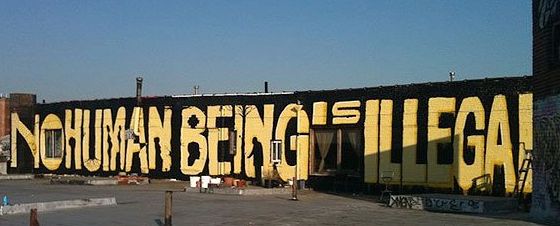
No human being is illegal

Rebel Diaz Arts Collective, South Bronx

As others have said: judge a state’s respect for human rights by the way it treats its prisoners.

In what kind of country would people, convicted of no crime, be put into solitary confinement because they are mentally ill, or gay, or Muslim?

The United States — a country that dehumanizes many foreigners by branding them illegal aliens.

How pervasive and bipartisan is xenophobia in America?

Consider the response to drone warfare. Thousands of people have been killed in Pakistan provoking nothing more than a very marginal outcry over here. Why? Because none of the dead have been Americans.

Only after three U.S. citizens were killed in drone strikes in Yemen did the legality of Obama’s assassination program start to receive wider scrutiny and for most of those Americans troubled by the issue, concern about a disregard for the constitutional rights of Americans, seemed to be uppermost in their minds.

This is a nation that bathes in a sense of its own innocence. Its innocents can take for granted that all are presumed innocent until proven guilty — unless they happen to be foreigners.

When it comes to foreigners suspected of being terrorists, suspicion is as good as conviction. “Suspected terrorist” and “terrorist” are not exactly exchangeable terms since the exchange only goes in one direction — by dropping the qualification “suspected.”

Add to the xenophobia the racism that pervades what remains a white-ruled society and it should come as no surprise that the worst treatment for some of the least fortunate among us is often dished out to those whose double offense is that they are both foreign and have darker skins.

The New York Times reports: On any given day, about 300 immigrants are held in solitary confinement at the 50 largest detention facilities that make up the sprawling patchwork of holding centers nationwide overseen by Immigration and Customs Enforcement officials, according to new federal data.

Nearly half are isolated for 15 days or more, the point at which psychiatric experts say they are at risk for severe mental harm, with about 35 detainees kept for more than 75 days.

While the records do not indicate why immigrants were put in solitary, an adviser who helped the immigration agency review the numbers estimated that two-thirds of the cases involved disciplinary infractions like breaking rules, talking back to guards or getting into fights. Immigrants were also regularly isolated because they were viewed as a threat to other detainees or personnel or for protective purposes when the immigrant was gay or mentally ill.

The United States has come under sharp criticism at home and abroad for relying on solitary confinement in its prisons more than any other democratic nation in the world. While Immigration and Customs Enforcement places only about 1 percent of its jailed immigrants in solitary, this practice is nonetheless startling because those detainees are being held on civil, not criminal, charges. As such, they are not supposed to be punished; they are simply confined to ensure that they appear for administrative hearings.

After federal immigration authorities caught up with him, Rashed BinRashed, an illegal arrival from Yemen, was sent to a detention center in Juneau, Wis. He was put in solitary confinement, he says, after declining to go to the jail’s eating area and refusing meals because he wanted to fast during Ramadan.

Federal officials confined Delfino Quiroz, a gay immigrant from Mexico, in solitary for four months in 2010, saying it was for his own protection, he recalls. He sank into a deep depression as he overheard three inmates attempt suicide. “Please, God,” he remembers praying, “don’t let me be the same.” [Continue reading…]

Facebooktwittermail

For the media, soda matters more than civil rights in New York City

Blake Zeff writes: In New York City, Mayor Michael Bloomberg’s NYPD is stopping large numbers of innocent people walking down the street each day — questioning them as to their whereabouts and invasively frisking their bodies in a hunt for weapons and drugs. The stops are almost entirely (nearly nine in ten) targeting young black and Latino men. The overwhelming majority of those stopped are doing nothing wrong (just 6 percent of stops lead to arrests, and a small fraction of those are ever prosecuted). And it’s having a deleterious effect on the psyche of the targets (as well as community relations with police).

How disconcerting is the program’s execution — which currently allows officers to stop anyone committing a “furtive” movement (whatever that is)? This past week, a federal judge in Manhattan, Shira Scheindlin, heard arguments as to whether the stops — whose numbers have soared to roughly 700,000 per year, according to the force’s own estimates — are actually even constitutional. During the course of the proceedings, it was revealed that NYPD engaged in an illegal quota system and that officers were intentionally targeting young black men.

Of course, if you watched any number of interviews with Mayor Bloomberg on national TV this past week or two, you’d have no idea of any of this. [Continue reading…]

Facebooktwittermail

Drone war: Out of sight, out of mind

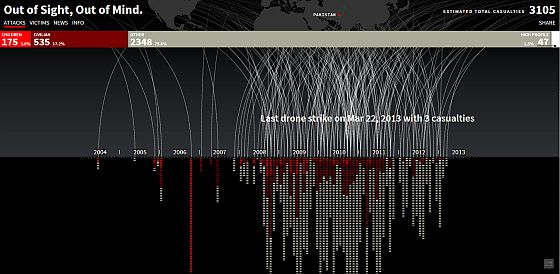
Click on the image above to view the “Out of Sight, Out of Mind” interactive graphic on the drone war in which an estimated 3,105 people have been killed in Pakistan of whom only 47 were so-called “high value” suspected terrorists.

A note on the producer of this interactive graphic: It comes from Pitch Interactive, an information visualization studio based in Berkeley, California. Their clients range from AT&T to Google to Fortune Magazine.

“The primary data used in this visualization comes from a dataset maintained by the Bureau of Investigative Journalism (BIJ)” — which is good because BIJ has compiled more information than anyone else has on the results of America’s drone war.

“This project helps to bring light on the topic of drones. Not to speak for or against, but to inform and to allow you to see for yourself whether you can support drone usage or not.”

Wes Grubbs, the studio’s founder, tweets: “We made this because it had to be made”.

Facebooktwittermail

McChrystal: America’s drone war risks provoking another attack on New York City

Retired General Stanley McChrystal: Anywhere you have undergoverned or ungoverned areas, organizations like al Qaeda have a tremendous opportunity to get a foothold. And when they can get a foothold, they can start to operate and spread from there.

Foreign Affairs: So what do you do with places like Mali and Yemen?

Well, you can’t solve all of them. You certainly don’t want to put Western forces in all of these countries. The initial reaction that says, “We will simply operate by drone strikes” is also problematic, because the inhabitants of that area and the world have significant problems watching Western forces, particularly Americans, conduct drone strikes inside the terrain of another country. So that’s got to be done very carefully, on occasion. It’s not a strategy in itself; it’s a short-term tactic.

It seems like the methods you pioneered in Iraq have been embraced by the U.S. government and the American public as a general approach to managing small-scale irregular warfare, and doing so in a way short of putting lots of boots on the ground or walking away entirely. Some would argue that this is the true legacy of Stan McChrystal — the creation of an approach to counterterrorism that is halfway between war and peace, at such a low cost and with such a light footprint that it’s politically viable for the long term in a way that war and disengagement are not. Do you disagree?

I question its universal validity. If you go back to the British tactics on the North-West Frontier, the “butcher and bolt” tactics, where they would burn an area and punish the people and say, “Don’t do that anymore,” and simultaneously offer a stipend to the leader while saying, “If you will remain friendly for a period of time, we’ll pay you” — that approach worked for a fair amount of time. It managed problems on their periphery. But it certainly didn’t solve the problems.

The tactics that we developed do work, but they don’t produce decisive effects absent other, complementary activities. We did an awful lot of capturing and killing in Iraq for several years before it started to have a real effect, and that came only when we were partnered with an effective counterinsurgency approach. Just the strike part of it can never do more than keep an enemy at bay. And although to the United States, a drone strike seems to have very little risk and very little pain, at the receiving end, it feels like war.

Americans have got to understand that. If we were to use our technological capabilities carelessly — I don’t think we do, but there’s always the danger that you will — then we should not be upset when someone responds with their equivalent, which is a suicide bomb in Central Park, because that’s what they can respond with.

Facebooktwittermail

Most Americans think ‘innocent until proven guilty’ only applies to Americans

Gallup poll: Nearly two-thirds of Americans (65%) think the U.S. government should use drones to launch airstrikes in other countries against suspected terrorists. Americans are, however, much less likely to say the U.S. should use drones to launch airstrikes in other countries against U.S. citizens living abroad who are suspected terrorists (41%); to launch airstrikes in the U.S. against suspected terrorists living here (25%); and to launch airstrikes in the U.S. against U.S. citizens living here who are suspected terrorists (13%).

Facebooktwittermail