



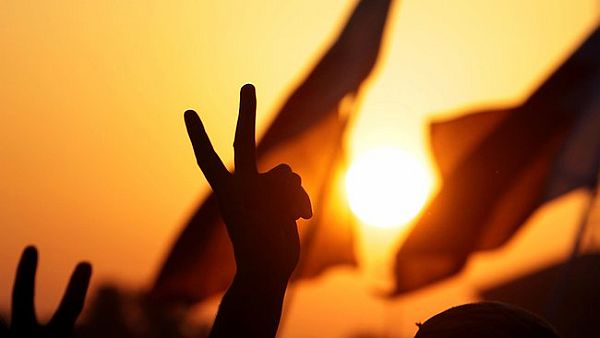
Christopher Dickey writes: Westerners have long felt the need to lecture Arabs about Arab history. “We know the civilization of Egypt better than we know the civilization of any other country,” Lord Balfour told the British Parliament in 1910. “We know it further back; we know it more intimately; we know more about it.” Indeed, the unmistakable message of this quintessential colonialist was that “we” know the Arab world better than the Arabs do, which is why “we” have every right to rule in their lands, whether directly or indirectly. As the late historian Edward Said observed, this “orientalism” became a sort of justification for colonialism “in advance.”
More than 100 years after Balfour, and after the demise of so many erstwhile empires, it’s amazing the extent to which Western pundits (even some from Muslim backgrounds) still echo his sentiments. Having utterly failed to predict the revolutionary movements that erupted in Tunisia and Egypt a year ago, they continue prognosticating with shameless confidence about the eventual triumph of “counterrevolutionary” forces of dictatorship and demagoguery.
“There are many possible outcomes—from restoration of the old order to military takeover, from unruly fragmentation and civil war to creeping Islamization,” the usually-smarter-than-this Robert Malley and Hussein Agha wrote in The New York Review of Books in September. “But the result that many outsiders had hoped for—a victory by the original protesters—is almost certainly foreclosed.” In other words, the ineluctable forces of the Arab world’s sorry history will decide the Arabs’ sorry future.
Yet the most striking thing about these revolutionary movements has been the extent to which they put history aside, both their own and that invented for them by foreigners. How else to explain the resilience of the Tahrir Square protesters, many of whom vented their violent rage against elections they feared were rigged, then voted anyway—and enthusiastically! How to fathom the sheer endurance of the locked-down population of Syria’s embattled city of Homs week after week, month after month? Where would you find the precedent?
As Al Jazeera analyst Marwan Bishara writes in his forthcoming book, The Invisible Arab: “Never has the power of the people appeared so humane, so inspiring, so personal, so determined as in Tunisia, so daring as in Syria, so diverse as in Yemen, so humble as in Bahrain, so courageous as in Libya, or so humorous as in Egypt. If, as one keen observer noted, every joke is a tiny revolution, the Arabs, and most notably the Egyptians, are revolutionaries par excellence.” And the biggest joke is the received wisdom that in the Arab world the past always determines the future. [Continue reading…]

David Kristjanson-Gural writes: The most significant accomplishment for Occupy Wall Street (OWS) to date is that the Occupiers have managed to poke a hole in the legitimacy of neoliberal capitalism and its central claim that unregulated markets provide opportunity and freedom.
The Occupiers have accomplished this feat in a surprising way, peacefully, with home-made signs, signs that say things like, “If I had a lobbyist, I wouldn’t need this sign.”
OWS has punctured the neoliberal façade simply by having the audacity to gather in public, in bold defiance of the police and to bear witness, by their solidarity and cooperation, to the idea that the Washington Consensus has long denied – that a different world is possible.
Phil Rockstroh puts it this way: “the walls of the neoliberal prison are cracking … We are no longer isolated, enclosed in our alienation, imprisoned by a concretized sense of powerlessness; daylight is beginning to pierce the darkness of our desolate cells.”
At the core of this neoliberal ideology is a simple assertion – economic exchanges promote freedom because they are voluntary and, thus, they only occur if both parties believe they will benefit. Unregulated market exchanges thus allow individuals to engage with others in complex social arrangements without coercion, without impinging on individual liberty. Government is needed, but only to define and enforce property rights and to create and regulate the currency individuals need to undertake market exchanges.
Liberal Keynesians, who argue for expanding government in order to regulate or oversee individual exchange, are denigrated because they seek to interrupt these free and voluntary agreements and they, therefore, undermine individual liberty. Reagan, who ushered in the neoliberal era, said it this way: “Government is not the solution to the problem; Government is the problem.” In this extreme libertarian view, capitalism is the champion of democracy, the champion of freedom.
The flaw in this neoliberal reasoning is not hard to see. Ownership of wealth obviously confers power; it gives some individuals an upper hand in the “voluntary” exchanges they make with others. Lacking the means otherwise to support ourselves, most of us must hire out our ability to do work in exchange for wages. We might do quite well if we are educated and talented, lucky or white, but even so, we ultimately produce more value than we are paid – that is, after all, the reason we are hired.
Wealth ownership, thus, gives an upper hand to employers in these voluntary exchanges with working people. The extra value we create flows steadily into the hands of wealth holders and we don’t have a say over what it is used for. [Continue reading…]
Larbi Sadiki writes: It was an act of self-immolation that would change the course of Arab political history. That is the significance of Mohamed Bouazizi one year on. It will be years before December 17, 2010 and the subsequent chain of events his act set off in Tunisia – and later on across the Arab world – are profoundly grasped by historians and social scientists.
The man and the act spawned a hugely unprecedented movement, forever altering the Arab political landscape, delivering the much-vaunted ‘breakthrough’ in the fight against autocracy.
That breakthrough was akin to an inexplicable ‘big bang’ which created its own chain reaction, irreversibly converting singularity into plurality across an emerging Arab Spring geography.
Theoretically, Bouazizi lacked the kind of pedigree that qualifies one entry into history books. He had no wider horizon beyond being a street vendor. He was not elite – his family was modest in every sense – and his town was on the margins of Tunisia both politically and economically. In fact, Tunisians living in the coastal areas and the north knew very little of the central and southern regions.
This ‘south’ was treated as if it were an empty space. It never was. Tunisians read the country’s luminary Abu al Qasim al Chabbi, the poet whose verse about ‘popular will’ Bouazizi translated into an astonishingly practical act.
Partly, this was what motivated me to visit his place of burial in my first trip back to Tunisia back in January 2011 after Bin Ali’s ouster. Bouazizi – not Ghannushi in London, not Merzouki in Paris – and not the rest of us polyglots, university-educated and bi-national Tunisians in the Diaspora – precipitated that ouster with his indomitable will when he chose to protest against humiliation and marginalisation.
Salon reports: When President Barack Obama decided in early November to delay a decision on TransCanada’s Keystone XL pipeline until after the next election, America’s environmental movement celebrated one of its biggest victories in recent memory. And no doubt the news came as a blow to Alberta’s tar sands industry, and to Canada’s oft-stated dream of becoming the next global energy superpower.
But behind activists’ jubilation lurked a somber reality, an untold story with much wider implications. The broader fight to reform Alberta’s tar sands, the one which actually stood a chance of breaking America’s addiction to the continent’s most polluting road fuel, has been quietly abandoned over the past several years. For that we can thank the planet’s richest oil companies and their Canadian government allies, who’ve together waged a stealthy war against President Obama’s climate change ambitions.
Their battle-plan is revealed in more 300 pages of personal emails obtained through a Freedom of Information request to the Alberta government. The story in the emails, reported for the first time here in Salon and The Tyee, Canada’s leading independent online news site, traces a year in the relationship of Michael Whatley, a GOP-connected oil industry lobbyist and his friend, Gary Mar, a smooth-talking and ambitious diplomat at the Canadian embassy in the Washington, DC.
The messages lay bare a sophisticated and stealthy public relations offensive, one designed to manipulate the U.S. political system; to deluge the media with messages favorable to the tar-sands industry; to sway key legislators at state and federal levels; and most importantly, to defeat any attempt to make the gasoline and diesel pumped everyday into U.S. vehicles less damaging to the climate. The goal of it all? “Defeat” Obama’s effort to reduce carbon consumption and keep America hooked on Canada’s $441 billion tar sands industry, no matter what the cost to our planet’s future.
That campaign has largely succeeded too, with only a small group of players any the wiser.
Reuters reports: Environmental opponents of the Keystone XL tar sands pipeline aimed to deluge the White House and Congress with phone calls on Friday, slamming a Republican plan to speed approval of the project in exchange for extending a payroll tax cut.
“Red alert – call the White House and tell them not to back down to big oil on Keystone,” environmental activist Bill McKibben said in a tweet. McKibben mobilized some 10,000 demonstrators outside the White House earlier this year to protest the pipeline.
A spokesman for Friends of the Earth said a call for grassroots opposition to the deal generated more than 10,000 phone calls to U.S. senators on Friday.
“We are surprised at the extent to which the Republicans have decided to go to bat for Big Oil here,” said Nick Berning, a spokesman for the group. “We’re urging the Democrats to stand strong with the position they’ve articulated and not to cave.”
House Republicans warned last week they planned to include approval of the Keystone pipeline to a payroll tax cut bill, a challenge to President Barack Obama, who has said he would veto such a bill if the pipeline deal is part of it.
But on Friday, a White House spokesman left open the possibility that Obama might consider approving the legislation to get the extended tax cut.
Glenn Greenwald writes: Condemnation of President Obama is intense, and growing, as a result of his announced intent to sign into law the indefinite detention bill embedded in the 2012 National Defense Authorization Act (NDAA). These denunciations come not only from the nation’s leading civil liberties and human rights groups, but also from the pro-Obama New York Times Editorial Page, which today has a scathing Editorial describing Obama’s stance as “a complete political cave-in, one that reinforces the impression of a fumbling presidency” and lamenting that “the bill has so many other objectionable aspects that we can’t go into them all,” as well as from vocal Obama supporters such as Andrew Sullivan, who wrote yesterday that this episode is “another sign that his campaign pledge to be vigilant about civil liberties in the war on terror was a lie.” In damage control mode, White-House-allied groups are now trying to ride to the rescue with attacks on the ACLU and dismissive belittling of the bill’s dangers.
For that reason, it is very worthwhile to briefly examine — and debunk — the three principal myths being spread by supporters of this bill, and to do so very simply: by citing the relevant provisions of the bill, as well as the relevant passages of the original 2001 Authorization to Use Military Force (AUMF), so that everyone can judge for themselves what this bill actually includes (this is all above and beyond the evidence I assembled in writing about this bill yesterday): [Continue reading…]
Joseph Dana writes: Residents of Nabi Saleh in the West Bank have been demonstrating, each week for the past two years, against the slow encroachment on their land by Israeli settlers.
Gathering in the village centre on Friday afternoons, villagers along with Israeli and international activists attempt to march, under the watchful eye of soldiers, to a disputed agricultural spring which was confiscated recently by Israeli settlers.
Often protesters never even reach the edge of the village; crowd-control measures by the military regularly include barrages of tear gas and rubber bullets.
Palestinian villagers claim that hundreds of protesters have been injured, some seriously, in the Nabi Saleh demonstrations.
But no one had been killed there – until last week.
The death of 28-year-old Mustafa Tamimi may seem to have little in common with the more numerous deaths of protesters in Cairo over the past few days.
Indeed the demonstrations are different from each other in many ways. But in protests from Tunis to Cairo to little Nabi Saleh, the use of tear gas by authorities, and the increasing number of related fatalities, has become a common thread in recent months.
The New York Times reports: The death toll from renewed violence in Egypt’s capital rose overnight as clashes between Egyptian soldiers and protesters entered a second day on Saturday.
According to media reports, soldiers swept into Tahrir Square here on Saturday, chasing protesters and beating them with sticks.
Early Saturday, according to The Associated Press, hundreds of protesters hurled stones at security forces who sealed off the streets around Parliament with barbed wire and large concrete blocks. Soldiers on rooftops pelted the crowds below with stones, prompting many of the protesters to pick up helmets, satellite dishes or sheets of metal to try to shield themselves.
Reuters reported that protesters fled into side streets to escape the troops in riot gear, who grabbed people and battered them repeatedly even after they had been beaten to the ground.
Stones, dirt and shattered glass littered the streets downtown, while flames leapt out of the windows of a two-story building set ablaze near Parliament, sending thick plumes of black smoke into the sky, according to media reports. Soldiers set fire to tents inside the square, The A.P. reported, and swept through buildings where television crews were filming from and confiscated their equipment and briefly detained journalists.
In footage filmed by Reuters one soldier in a line of charging troops drew a pistol and fired a shot at retreating protesters.
The clashes began in the center of Cairo on Friday and at vote-counting centers around the country, preceding a decision by a new civilian advisory council to suspend its operations. That move, embarrassing to the country’s military rulers, was done in protest over the military’s deadly but ineffective treatment of peaceful demonstrators.
The Associated Press reports: Iran deliberately delayed its announcement that it had captured an American surveillance drone to test U.S. reaction, the country’s foreign minister said Saturday.
Ali Akbar Salehi said Tehran finally went public with its possession of the RQ-170 Sentinel stealth drone to disprove contradictory statements from U.S. officials.
Iran, which put the aircraft on display last week, has tried to trumpet the downing of the drone as a feat of Iran’s military in a complicated technological and intelligence battle with the U.S. Tehran also has rejected a formal U.S. request to return the plane, calling it’s incursion an “invasion” and a “hostile act.”
“When our armed forces nicely brought down the stealth American surveillance drone, we didn’t announce it for several days to see what the other party (U.S.) says and to test their reaction,” Salehi told the official IRNA news agency. “Days after Americans made contradictory statements, our friends at the armed forces put this drone on display.”
Jason Hickel writes: The leading tagline of the Occupy Wall Street movement reads: “Protest for World Revolution.” This is an ambitious claim, to be sure. And in most respects it seems to ring quite true: the movement has successfully taken root not only in cities and towns throughout the United States but also in major urban centers around the world. On October 15, Occupy Wall Street’s success inspired a broad wave of coordinated occupations across Europe. I was a founding participant in the one that began in London.
But the Occupy movement has been notably absent outside of North America and Europe. Not for want of trying, of course: in southern Africa, where I am originally from, small groups of committed activists tried to instigate occupations in a few key regional cities, but without much success. In South Africa, a society divided by violent inequalities that proceed directly from neoliberal policy, Occupy managed to attract only a few dozen souls – a poor showing for a country known for one of the highest protest rates in the world.
What accounts for the failure of Occupy to capture the imagination of the global South, which comprises precisely the people whose lives have been most brutally affected by the recent global financial crisis? And in what sense can Occupy claim to be a world revolution if it leaves out – and in some cases even alienates – the vast, non-white majority of humanity?
Occupy is “international” at the moment only inasmuch as it exists in many different countries at the same time. But each of the occupations is primarily concerned with particular local or national issues. For instance, Occupy Wall Street is focused on corporate personhood, the Glass-Steagall Act, and collateralized debt obligations, while Occupy London is worried about tuition hikes, preserving the National Health Service, and reversing Thatcher’s 1986 financial deregulation bonanza.
Yes, the occupations communicate, and yes, they stand in solidarity with one another. But they are not united around concerns that are recognizably global in scope.
True, Occupy protestors and their sympathizers have helped sound the alarm on issues of international concern like fossil fuels and climate change, as we saw recently at the COP17 meetings in Durban. But as it presently stands the Occupy agenda is rather provincial – even Eurocentric. Aside from its radical elements, most of the movement’s American and European supporters simply want to reclaim their rights to live decent, dignified, middle-class lives. [Continue reading…]
Mohammed Ayoob writes: It is time for world leaders to recognize the inevitability of Iran acquiring nuclear weapons capability, even if it remains untested, with Tehran following the policy and adopting the rhetoric of deliberate ambiguity. Moreover, the major powers that act as the self-appointed guardians of the current international nuclear order need to recognize that treaties and other legal documents are not the primary determinants when it comes to state decisions regarding acquisition of nuclear capability. It is a country’s strategic environment that principally determines such a decision.
Iran’s strategic environment is such that it makes the decision by Iran’s policy makers to acquire nuclear weapons appear rational both to themselves and to the wider Iranian public. This is why leading opposition figures are as opposed to suspending uranium enrichment as regime hard-liners. The foremost opposition presidential candidate, Mir-Hossein Moussavi, in an interview with the Financial Times in the run-up to the elections in 2009, stated categorically: “No one in Iran would accept suspension.”
The strategic rationality of such a policy was recognized in a candid moment by none other than Israel’s defense minister, Ehud Barak.
Schmidt on keeping America’s secrets
Iran releases video of alleged drone
Iran’s nuclear ambitions cause tensionIn an appearance on “Charlie Rose” last month, Barak was asked whether he would want to acquire nuclear weapons if he were an Iranian government minister. Barak responded very candidly: “Probably, probably. I know it’s not — I mean I don’t delude myself that they are doing it just because of Israel. They look around, they see the Indians are nuclear, the Chinese are nuclear, Pakistan is nuclear, not to mention the Russians.”
While downplaying the Israeli nuclear weapons capability, Barak neglected to mention that Iran’s policy makers perceive the American nuclear and non-nuclear armada in the Persian Gulf and the Arabian Sea as the greatest threat to their security.
All this obviously makes for a dangerous strategic environment as far as Tehran is concerned, regardless of the nature of the Iranian regime. The American decision to invade non-nuclear Iraq while desisting from militarily confronting a nuclear North Korea surely tells Iran’s rulers that even rudimentary nuclear capability can deter potential American and allied designs to attack Iran, whether to topple its regime or impair its nuclear capacity.
BBC News reports: Banks stand to lose millions of dollars in debt repayments if the biggest municipal bankruptcy in American history is allowed to proceed.
But the real victims of the financial collapse in the US state of Alabama’s most populous county are its poorest residents – forced to bathe in bottled water and use portable toilets after being cut off from the mains supply.
And there is widespread anger in Jefferson County that swingeing sewerage rate hikes could have been avoided but for the greed, corruption and incompetence of local politicians, government officials and Wall Street financiers.
Tammy Lucas is the human face of a financial and political scandal that has brought one of the most deprived communities in America’s south to the point of what some local people believe is collapse.
She says: “If the sewer bill gets higher, my light might get cut off and if I try to catch up the light, my water might get cut off. So we’re in between. We can’t make it like this.”
Mrs Lucas’s monthly sewerage rate bills – the amount levied by the county to flush away waste and provide water for baths and showers – has quadrupled in the past 15 years. She says it is currently running at $150 (£97) a month, which leaves little left out of her $600 social security cheque for food and electricity.
Andy Kroll reports: On Thursday evening, residents of 83 towns and cities throughout the country—places like Marietta, Georgia, and East Troy, Wisconsin, and Anchorage, Alaska—will make their way to the home of a friend or neighbor or outright stranger for a night of partying. But these aren’t holiday parties. They’re the ground-level rumblings of a growing campaign to roll back one of the most game-changing Supreme Court decisions in recent memory, Citizens United v. Federal Election Commission.
In a year packed with populist uprisings, in which Time named "the protester" its person of the year, the fight against Citizens United is gaining momentum with battle fronts in Congress, statehouses, city halls, and the homes of hundreds of Americans. The decision, handed down in January 2010 by the court’s five conservative justices, effectively gave corporations the same free speech rights as people, gutted key provisions of the 2002 McCain-Feingold campaign finance law, and green-lighted unlimited spending by corporations and labor unions in American elections. Fred Wertheimer, president of Democracy 21, a pro-reform campaign finance organization, called it "the most radical and destructive campaign finance decision in Supreme Court history."
The campaign to counter Citizens United sprang to life immediately after the ruling was announced. Led by Public Citizen, the good government group founded by Ralph Nader, its goal is to pass a constitutional amendment that neutralizes the ruling’s effects. But the effort didn’t fully take off until this year—the public needed time to see what the decision had wrought. To influence the 2010 midterm elections, super-PACs and other independent spending outfits that sprung in the wake of Citizens United spent hundreds of millions of dollars.