Category Archives: Issues

Fragile and unbalanced in 2012

Nouriel Roubini writes: The outlook for the global economy in 2012 is clear, but it isn’t pretty: recession in Europe, anaemic growth at best in the United States, and a sharp slowdown in China and in most emerging-market economies. Asian economies are exposed to China. Latin America is exposed to lower commodity prices (as both China and the advanced economies slow). Central and Eastern Europe are exposed to the eurozone. And turmoil in the Middle East is causing serious economic risks – both there and elsewhere – as geopolitical risk remains high and thus high oil prices will constrain global growth.

At this point, a eurozone recession is certain. While its depth and length cannot be predicted, a continued credit crunch, sovereign-debt problems, lack of competitiveness, and fiscal austerity imply a serious downturn.

The US – growing at a snail’s pace since 2010 – faces considerable downside risks from the eurozone crisis. It must also contend with significant fiscal drag, ongoing deleveraging in the household sector (amid weak job creation, stagnant incomes, and persistent downward pressure on real estate and financial wealth), rising inequality and political gridlock.

Elsewhere among the major advanced economies, the United Kingdom is double-dipping, as front-loaded fiscal consolidation and eurozone exposure undermine growth. In Japan, the post-earthquake recovery will fizzle out as weak governments fail to implement structural reforms.

Meanwhile, flaws in China’s growth model are becoming obvious. Falling property prices are starting a chain reaction that will have a negative effect on developers, investment and government revenue. The construction boom is starting to stall, just as net exports have become a drag on growth, owing to weakening US and especially eurozone demand. Having sought to cool the property market by reining in runaway prices, Chinese leaders will be hard put to restart growth.

They are not alone. On the policy side, the US, Europe and Japan, too, have been postponing the serious economic, fiscal and financial reforms that are needed to restore sustainable and balanced growth.

Facebooktwittermail

Obama administration considers censoring Twitter

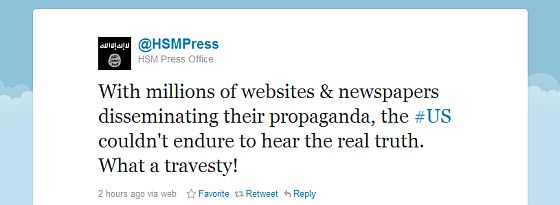
With millions of websites & newspapers disseminating their propaganda, the #US couldn't endure to hear the real truth. What a travesty!

Tweet from Harakat Al-Shabaab Al Mujahideen, Somalia's Islamist insurgent movement.

How dangerous can 140 characters be?

Apparently if those 140 characters are being fired onto the web through the Twitter account of al Shabib, Somalia’s militant jihadist movement, then the national security of the United States could be in jeopardy.

The New York Times reports:

American officials say they may have the legal authority to demand that Twitter close the Shabab’s account, @HSMPress, which had more than 4,600 followers as of Monday night.

The most immediate effect of the Obama administration’s threat appears to have been that @HSMPress (which has so far only made 114 tweets) has subsequently gained hundreds of new followers.

Is Twitter itself about to take a stand in defense of freedom of speech?

A company spokesman, Matt Graves, said [to a Times reporter] on Monday, “I appreciate your offer for Twitter to provide perspective for the story, but we are declining comment on this one.”

Last Wednesday, the New York Times reported from Nairobi in Kenya:

Somalia’s powerful Islamist insurgents, the Shabab, best known for chopping off hands and starving their own people, just opened a Twitter account, and in the past week they have been writing up a storm, bragging about recent attacks and taunting their enemies.

“Your inexperienced boys flee from confrontation & flinch in the face of death,” the Shabab wrote in a post to the Kenyan Army.

It is an odd, almost downright hypocritical move from brutal militants in one of world’s most broken-down countries, where millions of people do not have enough food to eat, let alone a laptop. The Shabab have vehemently rejected Western practices — banning Western music, movies, haircuts and bras, and even blocking Western aid for famine victims, all in the name of their brand of puritanical Islam — only to embrace Twitter, one of the icons of a modern, networked society.

On top of that, the Shabab clearly have their hands full right now, facing thousands of African Union peacekeepers, the Kenyan military, the Ethiopian military and the occasional American drone strike all at the same time.

But terrorism experts say that Twitter terrorism is part of an emerging trend and that several other Qaeda franchises — a few years ago the Shabab pledged allegiance to Al Qaeda — are increasingly using social media like Facebook, MySpace, YouTube and Twitter. The Qaeda branch in Yemen has proved especially adept at disseminating teachings and commentary through several different social media networks.

“Social media has helped terrorist groups recruit individuals, fund-raise and distribute propaganda more efficiently than they have in the past,” said Seth G. Jones, a political scientist at the RAND Corporation.

The Times reporter, Jeffrey Gettleman, sounds quite indignant that al Shabib should have the audacity to be using Twitter, so he can hardly have been surprised that his article prompted this exchange between @HSMPress and one of their followers:
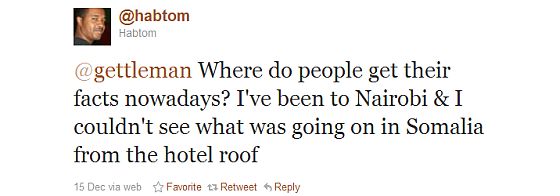
@gettleman Where do people get their facts nowadays? I've been to Nairobi & I couldn't see what was going on in Somalia from the hotel roof
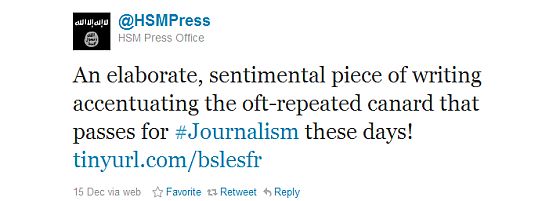
An elaborate, sentimental piece of writing accentuating the oft-repeated canard that passes for #Journalism these days!
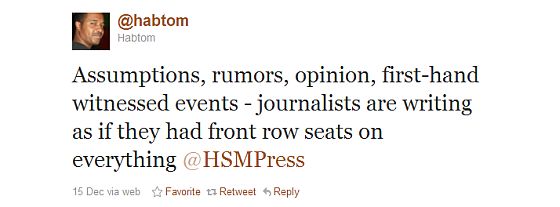
Assumptions, rumors, opinion, first-hand witnessed events - journalists are writing as if they had front row seats on everything @HSMPress
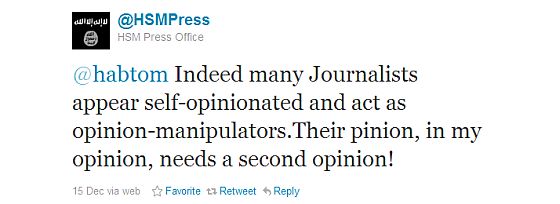
@habtom Indeed many Journalists appear self-opinionated and act as opinion-manipulators.Their pinion, in my opinion, needs a second opinion!
Somalia is not the only front in the new war on Twitter.

The Washington Post reports on Twitter battles in Afghanistan:

U.S. military officials assigned to the International Security Assistance Force, or ISAF, as the coalition is known, took the first shot in what has become a near-daily battle waged with broadsides that must be kept to 140 characters.

“How much longer will terrorists put innocent Afghans in harm’s way,” @isafmedia demanded of the Taliban spokesman on the second day of the embassy attack, in which militants lobbed rockets and sprayed gunfire from a building under construction.

“I dnt knw. U hve bn pttng thm n ‘harm’s way’ fr da pst 10 yrs. Razd whole vilgs n mrkts. n stil hv da nrve to tlk bout ‘harm’s way,’ ” responded Abdulqahar Balkhi, one of the Taliban’s Twitter warriors, who uses the handle ­@ABalkhi….

U.S. military officials say the dramatic assault on the diplomatic compound convinced them that they needed to seize the propaganda initiative — and that in Twitter, they had a tool at hand that could shape the narrative much more quickly than news releases or responses to individual queries.

“That was the day ISAF turned the page from being passive,” said Navy Lt. Cmdr. Brian Badura, a military spokesman, explaining how @isafmedia evolved after the attack. “It used to be a tool to regurgitate the company line. We’ve turned it into what it can be.”

So how’s @isafmedia exploiting the power of Twitter? With tweets like this?
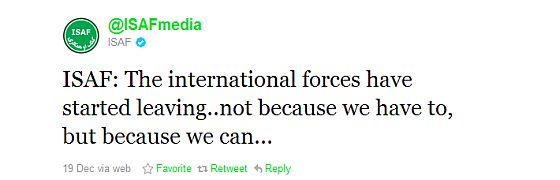
A we’re-winning-the-war tweet like this might sound good inside ISAF’s Twitter Command Center, but I don’t think it’s going to impress anyone else.

The problem the Obama administration is up against is not the threat posed by its adversaries on Twitter; it is that its own ventures into social media are predictably inept. Official tweets lack wit and tend to sound like the clumsy propaganda. But when losing an argument, the solution is not to look for ways to gag your opponent — that’s how dictators operate.

The Pentagon prides itself on its smart bombs. Can’t it come up with a few smart tweets?

Facebooktwittermail

Israel’s emerging ‘Jewish Hezbollah’?

Mark Perry writes: Seven months ago, during the early morning hours of May 30, Jewish settlers visiting Joseph’s Tomb in Nablus in the Palestinian West Bank engaged in a shoving match with IDF soldiers deployed to protect them. Within minutes, the confrontation escalated; several soldiers were punched by Jewish worshippers and rocks rained down on the soldiers from settlers atop the tomb. A YouTube video of the incident was later circulated on the internet at the request of the IDF. The Nablus incident was among the first in a growing series of confrontations between settlers and the Israeli military — and it sent shock waves through the Israeli military establishment. Brig. General Yoav Mordechai called the settlers “irresponsible lawbreakers” and pointed out that the IDF in the West Bank was deployed to protect settlers from “terrorists.” His message was clear: the settler confrontation had placed the lives of his soldiers at risk.

Mordechai’s statement must have brought wry smiles to Palestinian villagers near Nablus, whose olive groves have been burned and mosques desecrated by the same settlers who attacked the IDF detachment. But the Joseph’s Tomb incident was only the beginning: throughout July and August, settlers from Yitzhar — a hotbed of settler extremism — forced a series of confrontations with the IDF until, in August, a stone-throwing incident pitting settlers against Palestinians threatened to get out of control, with the IDF pushing Palestinians away from the settlers in order to protect them from the violence — and not the other way around. “It was an amazing scene,” a Palestinian organizer who witnessed the incident said during a recent trip to Washington. “At one point, one of the IDF commanders turned to me and said, ‘why don’t you do us a favor and just shoot these people?'”

The settler-on-IDF confrontations have increased over the last weeks, sending ripples of concern through the Israeli establishment. While no senior Israeli elected official has yet to suggest that the program of settlement expansion needs to be rethought, the viewpoint is the subject of sotto voce reflections throughout the Jewish state. After all, the unstated goal of the national settlement enterprise is to put obstacles in the way of Palestinian national claims — not to seed a nascent and nasty internal conflict. Now, and particularly if the confrontations continue (or escalate), Israeli officials will have to ask themselves whether it is wise to continue a program that is providing the equivalent of a Palestinian fifth column. It’s not as if the Palestinians haven’t noticed. Asked about the recent settler-IDF dust-ups near Nablus, a serving Palestinian legislator waves away a question about whether or not Abu Mazen and company will return to the peace talks: “What we ought to do is sit back and watch,” he says, “while Israel starts to unravel.”

“I don’t want to exaggerate, but it’s time to call this what it is,” a veteran IDF officer noted in a recent telephone conversation on the Nablus incident. “It might be news in America, but it’s no secret in Israel. This is a very real crisis. What we have here is the birth of a state within a state. The birth of a kind of Jewish Hezbollah.” [Continue reading…]

Facebooktwittermail

The Arab Spring and the West: seven lessons from history

Seumas Milne writes: There’s a real sense in which, more than any other part of the former colonial world, the Middle East has never been fully decolonised. Sitting on top of the bulk of the globe’s oil reserves, the Arab world has been the target of continual interference and intervention ever since it became formally independent.

Carved into artificial states after the first world war, it’s been bombed and occupied – by the US, Israel, Britain and France – and locked down with US bases and western-backed tyrannies. As the Palestinian blogger Lina Al-Sharif tweeted on Armistice Day this year, the “reason World War One isn’t over yet is because we in the Middle East are still living the consequences”.

The Arab uprisings that erupted in Tunisia a year ago have focused on corruption, poverty and lack of freedom, rather than western domination or Israeli occupation. But the fact that they kicked off against western-backed dictatorships meant they posed an immediate threat to the strategic order.

Since the day Hosni Mubarak fell in Egypt, there has been a relentless counter-drive by the western powers and their Gulf allies to buy off, crush or hijack the Arab revolutions. And they’ve got a deep well of experience to draw on: every centre of the Arab uprisings, from Egypt to Yemen, has lived through decades of imperial domination. All the main Nato states that bombed Libya, for example – the US, Britain, France and Italy – have had troops occupying the country well within living memory.

If the Arab revolutions are going to take control of their future, then, they’ll need to have to keep an eye on their recent past. So here are seven lessons from the history of western Middle East meddling, courtesy of the archive of Pathé News, colonial-era voice of Perfidious Albion itself. [Continue reading…]

Facebooktwittermail

Don’t break the internet

At Stanford Law Review, Mark Lemley, David S. Levine, and David G. Post, write: Two bills now pending in Congress—the PROTECT IP Act of 2011 (Protect IP) in the Senate and the Stop Online Piracy Act (SOPA) in the House—represent the latest legislative attempts to address a serious global problem: large-scale online copyright and trademark infringement. Although the bills differ in certain respects, they share an underlying approach and an enforcement philosophy that pose grave constitutional problems and that could have potentially disastrous consequences for the stability and security of the Internet’s addressing system, for the principle of interconnectivity that has helped drive the Internet’s extraordinary growth, and for free expression.

To begin with, the bills represent an unprecedented, legally sanctioned assault on the Internet’s critical technical infrastructure. Based upon nothing more than an application by a federal prosecutor (or, in certain circumstances, an intellectual property rights holder) alleging that a foreign website is “dedicated to infringing activities,” Protect IP authorizes courts to order all U.S. Internet service providers, domain name registries, domain name registrars, and operators of domain name servers—a category that includes hundreds of thousands of small and medium-sized businesses, colleges, universities, nonprofit organizations, and the like—to take steps to prevent the offending site’s domain name from translating to the correct Internet protocol address. These orders can be issued even when the domains in question are located outside of the United States and registered in top-level domains (e.g., .fr, .de, or .jp) whose operators are themselves located outside the United States; indeed, some of the bills’ remedial provisions are directed solely at such domains.

Directing the remedial power of the courts towards the Internet’s core technical infrastructure in this sledgehammer fashion has impact far beyond intellectual property rights enforcement—it threatens the fundamental principle of interconnectivity that is at the very heart of the Internet. The Internet’s Domain Name System (DNS) is a foundational block upon which the Internet has been built and upon which its continued functioning critically depends; it is among a handful of protocols upon which almost every other protocol, and countless Internet applications, rely to operate smoothly. Court-ordered removal or replacement of entries from the series of interlocking databases that reside in domain name servers and domain name registries around the globe undermines the principle of domain name universality—the principle that all domain name servers, wherever they may be located across the network, will return the same answer when queried with respect to the Internet address of any specific domain name. Much Internet communication, and many of the thousands of protocols and applications that together provide the platform for that communication, are premised on this principle.

Facebooktwittermail

Saudi prince invests $300 million in Twitter

Owning three percent of Twitter might not amount to a controlling stake, but when the Saudis start investing in social media you can bet that making money is not their only interest.

The New York Times reports: Prince Walid bin Talal of Saudi Arabia announced a $300 million stake in the social media site Twitter, as the billionaire expands his holdings in the United States.

The investment by Prince Walid and his investment company, Kingdom Holding, represents roughly 3 percent of the company. Prince Walid, who owns 95 percent of Kingdom Holding, said in a statement that the purchase was part of a strategy “to invest in promising, high-growth businesses with a global impact.”

With Twitter, Prince Walid — who also own stakes in American blue chip companies including Citigroup, General Motors and Apple — gains a foothold in the fast-growing social networking space. The microblogging service, which has more than 100 million active users, is part of an elite group of Internet companies that have rapidly attracted users in recent years and that have garnered multi-billion dollar valuations.

Twitter has been increasingly popular in the Arab world, where it was credited with playing a role in the recent uprisings across North Africa and the Gulf. Arabic is now the fastest growing language used on Twitter, according to the data intelligence company Semiocast. The volume of Arabic messages increased by 2,146 percent in the 12 months ending in October.

“We believe that social media will fundamentally change the media industry landscape in the coming years. Twitter will capture and monetize this positive trend,” Ahmed Reda Halawani, Kingdom Holding’s executive director of private equity and international investments, said in a statement.

Facebooktwittermail

Egyptian army targets women protesters

Egyptian army soldiers beat a woman protester

Al-Masry Al-Youm reports: Local human rights watchdogs on Sunday accused the Egyptian military of systematically targeting female political activists, and demanded that Egypt’s military rulers admit to violations committed against demonstrators.

In a joint statement, five human rights organizations accused military rulers of exercising “unprecedented violence against protesters, with the targeting of female activists being a distinctive feature of the proceedings to disperse sit-ins, as depicted in pictures and video clips showing protesters being arrested, beaten, dragged and stripped of their clothes.”

In this video, army soldiers are seen beating an older female activist named Khadiga al-Hennawy.

While this video shows army soldiers dragging, beating and striping a female protester in the street.

The statement was signed by Nazra for Feminist Studies, the Cairo Institute for Human Rights Studies, the Association for Freedom of Thought and Expression, the Hisham Mubarak Law Center and the Women and Memory Association.

They also called for the establishment of an independent judicial committee to investigate crimes against peaceful protestors.

Facebooktwittermail

The battle for Upper Egypt

Lauren E. Bohn writes: Assiut feels far away from the famed epicenter of Tahrir Square. The oft-neglected peripheral region of Upper Egypt (the cultivated valley of the Nile from Cairo in the north to Aswan, 535 miles south) has been plagued by institutional apathy for years, long dismissed as a dead-end, from where one travels to the capital for work and never returns. When Egypt’s contentious de-facto leaders, the Supreme Council of the Armed Forces (SCAF), speak of a silent but loyal majority, or “liberals,” fret about the backward religious and violence-prone rural areas, they have cities like Assiut in mind. But the reality is far more complicated. Assiut and Tahrir are bound together by personal connections and shared concerns — inextricable ties that suggest a far more nuanced emerging Egypt than is generally felt from the central nerve of Cairo.

The new Assiut, which prides itself on being the capital of Upper Egypt, features a distinct pastiche of Salafis, felool, or remnants (a word used to describe holdovers from the Mubarak era), the popular Muslim Brotherhood, a smattering of activists, and a vaguely Egyptian brand of tribalism. Officials from the Mubarak era still cling to power, while Tahrir’s activists find few points of entry into a skeptical environment. Outside the city’s few main streets, Assiut’s mustard-hazed landscape is home to 3.5 million people spread throughout some 1,000 villages. With 24 parliamentary seats, it was a major target, and now bellwether, in the new electoral competition reshaping Egyptian politics.

Though some activists will tell you they had their own “Tahrir Square” in Assiut, by and large, the countryside remained marginally engaged with the uprisings that took Cairo by hold. Protestors continue to call for a prompt end to military rule, blaming SCAF for their inept, and even malevolent, handling of Egypt’s transition to democracy. But, it is easy to find indifference or even hostility to ongoing protests in places where most people get their news from a largely pro-SCAF state television and almost nobody has access to follow revolutionaries on Twitter. Ayad Hamza, 46, a barber in the small village of Ezbet El Geish dismisses Tahrir as a farce. “These kids are stupid. They have nothing else to do but cause trouble,” he said, mopping his cracked floor. “It’s not a revolution they’re making, but a nightmare.” This is the kind of sentiment SCAF has been banking on — one they say resonates in Egypt. But it misses important linkages between the periphery and the political battles waged in Cairo, and naively exaggerates their indifference.

Facebooktwittermail

Bleak future for returning U.S. veterans

The Economist reports: Brett Quinzon did two tours in Iraq before leaving active duty in May. Originally from Minnesota, Mr Quinzon now lives in Thomaston, a small town around 65 miles south of Atlanta. A grey December morning found him filling out forms in Atlanta’s large veterans’ hospital, seeking treatment for depression. Since returning from Iraq, he says he has “more anger issues”, and finds himself “more watchful and on-guard in public situations” than he was before he deployed. That is not unusual: many soldiers return from the battlefield with psychological scars. Between January and May, as he prepared to leave active duty, Mr Quinzon applied for hundreds of jobs. The search proved difficult: like many veterans, he enlisted right after high-school, and lacks a college degree. But persistence paid off. He is now an apprentice at a heating and air-conditioning company, and is being trained as a heavy-equipment operator.

Not all recent veterans are so lucky. Around 800,000 veterans are jobless, 1.4m live below the poverty line, and one in every three homeless adult men in America is a veteran. Though the overall unemployment rate among America’s 21m veterans in November (7.4%) was lower than the national rate (8.6%), for veterans of Iraq and Afghanistan it was 11.1%. And for veterans between the ages of 18 and 24, it was a staggering 37.9%, up from 30.4% just a month earlier.

If demography is indeed destiny, perhaps this figure should not be surprising. More soldiers are male than female, and the male jobless rate exceeds women’s. Since so many soldiers lack a college degree, the fact that the recession has been particularly hard on the less educated hits veterans disproportionately. Large numbers of young veterans work—or worked—in stricken industries such as manufacturing and construction. Whatever the cause, this bleak trend is occurring as the last American troops leave Iraq at the end of this year, and as more than 1m new veterans are expected to join the civilian labour force over the next four years.

Facebooktwittermail

How to halt the expansion of inequality in the U.S.

Former Supreme Court justice Louis D. Brandeis once said, “We may have democracy, or we may have wealth concentrated in the hands of a few, but we cannot have both.”

Professors Ian Ayres and Aaron S. Edlin say we have reached the Brandeis tipping point. Yet even while acknowledging this level of inequality undermines democracy, rather than try to reverse the trend, they propose a mechanism that would simply cap it. I guess this falls under the category, better than nothing.

What we call the Brandeis Ratio — the ratio of the average income of the nation’s richest 1 percent to the median household income — has skyrocketed since Ronald Reagan took office. In 1980 the average 1-percenter made 12.5 times the median income, but in 2006 (the latest year for which data is available) the average income of our richest 1 percent was a whopping 36 times greater than that of the median household.

Brandeis understood that at some point the concentration of economic power could undermine the democratic requisite of dispersed political power. This concern looms large in today’s America, where billionaires are allowed to spend unlimited amounts of money on their own campaigns or expressly advocating the election of others.

We believe that we have reached the Brandeis tipping point. It would be bad for our democracy if 1-percenters started making 40 or 50 times as much as the median American.

Enough is enough. Congress should reform our tax law to put the brakes on further inequality. Specifically, we propose an automatic extra tax on the income of the top 1 percent of earners — a tax that would limit the after-tax incomes of this club to 36 times the median household income.

Importantly, our Brandeis tax does not target excessive income per se; it only caps inequality. Billionaires could double their current income without the tax kicking in — as long as the median income also doubles. The sky is the limit for the rich as long as the “rising tide lifts all boats.” Indeed, the tax gives job creators an extra reason to make sure that corporate wealth does in fact trickle down.

The New York Times reports on the property market for those with ‘infinite money’: Pierre Buljan guided his black Mercedes S.U.V. around the winding roads of the Hillsborough hills and into Atherton, where the mansions of Silicon Valley technology barons hide behind thick stone walls, wrought-iron gates and tall, manicured hedges.

“These people have essentially infinite money,” said Mr. Buljan, who has been a Realtor on the Peninsula for more than 30 years. He pointed at a sloping four-acre property that included a large redwood grove with a private creek.

“If someone falls in love with a property like this,” he said, “the price doesn’t matter.”

Everywhere Mr. Buljan turned, a historic transition was under way. A generation ago, many of these properties were second homes for San Francisco’s elite families. These days, most are being bought, for cash, by international tycoons or the youthful leaders of local technology companies.

While the wider Bay Area has suffered, along with the rest of the country, with falling property values and rising foreclosures, the luxury housing market has remained robust, analysts said. That is especially true in Silicon Valley, where an arms race for talent among emerging social networking companies has raised salaries for executives and engineers, and a resurgent market for initial public stock offerings is creating hundreds of new millionaires.

Some of the sales are eye-popping. In March, the Russian billionaire Yuri Milner, an investor in Facebook, Groupon and Zynga, bought a French-style chateau in Los Altos Hills for a reported $100 million. Some buyers have hidden their identities behind companies.

In September, an Atherton estate formerly owned by the great-grandniece of Levi Strauss sold for $53 million, while the home of Sue Burns, a major investor in the San Francisco Giants, was sold for $20 million by her estate.

“It’s going to take a while for the wider economy to recover, but there are enough people to make a difference at the high end of the housing market,” keeping demand high, said Steve Levy, director of the Center for Continuing Study of the California Economy, a think tank in Palo Alto, where the median single-family home price last week was $1,838,750.

Facebooktwittermail

Secret U.S., Taliban talks reach turning point

Reuters reports: After 10 months of secret dialogue with Afghanistan’s Taliban insurgents, senior U.S. officials say the talks have reached a critical juncture and they will soon know whether a breakthrough is possible, leading to peace talks whose ultimate goal is to end the Afghan war.

As part of the accelerating, high-stakes diplomacy, Reuters has learned, the United States is considering the transfer of an unspecified number of Taliban prisoners from the Guantanamo Bay military prison into Afghan government custody.

It has asked representatives of the Taliban to match that confidence-building measure with some of their own. Those could include a denunciation of international terrorism and a public willingness to enter formal political talks with the government headed by Afghan President Hamid Karzai.

The officials acknowledged that the Afghanistan diplomacy, which has reached a delicate stage in recent weeks, remains a long shot. Among the complications: U.S. troops are drawing down and will be mostly gone by the end of 2014, potentially reducing the incentive for the Taliban to negotiate.

Still, the senior officials, all of whom insisted on anonymity to share new details of the mostly secret effort, suggested it has been a much larger piece of President Barack Obama’s Afghanistan policy than is publicly known.

U.S. officials have held about half a dozen meetings with their insurgent contacts, mostly in Germany and Doha with representatives of Mullah Omar, leader of the Taliban’s Quetta Shura, the officials said.

The stakes in the diplomatic effort could not be higher. Failure would likely condemn Afghanistan to continued conflict, perhaps even civil war, after NATO troops finish turning security over to Karzai’s weak government by the end of 2014.

Success would mean a political end to the war and the possibility that parts of the Taliban – some hardliners seem likely to reject the talks – could be reconciled.

The effort is now at a pivot point.

“We imagine that we’re on the edge of passing into the next phase. Which is actually deciding that we’ve got a viable channel and being in a position to deliver” on mutual confidence-building measures, said a senior U.S. official.

While some U.S.-Taliban contacts have been previously reported, the extent of the underlying diplomacy and the possible prisoner transfer have not been made public until now.

Facebooktwittermail

Hamas moves away from violence in deal with Palestinian Authority

The Guardian reports: Hamas has confirmed that it will shift tactics away from violent attacks on Israel as part of a rapprochement with the Palestinian Authority.

A spokesman for the Hamas prime minister, Ismail Haniya, told the Guardian that the Islamic party, which has controlled Gaza for the past five years, was shifting its emphasis from armed struggle to non-violent resistance.

“Violence is no longer the primary option but if Israel pushes us, we reserve the right to defend ourselves with force,” said the spokesman, Taher al-Nounu. On this understanding, he said, all Palestinian factions operating in the Gaza Strip have agreed to halt the firing of rockets and mortars into Israel.

The announcement on Sunday does not qualify as a full repudiation of violence, but marks a step away from violent extremism by the Hamas leadership towards the more progressive Islamism espoused by groups such as the Muslim Brotherhood in Cairo.

The Associated Press reports: Bans on women smoking water pipes in public and male coiffeurs styling women’s hair are no longer being strictly enforced in the Hamas-controlled Gaza Strip, apparent signs of greater tolerance as the Islamic militant group acknowledges mistakes in seeking to impose a religious lifestyle.

In explaining the change, several senior members said Hamas has matured in five years in power and learned lessons from the Arab Spring. Islamic groups that have scored election victories in the wake of pro-democracy uprisings in the region now find themselves trying to allay fears they seek Islamic rule.

Since seizing Gaza, Hamas had largely silenced opponents and tried to impose stricter religious rules on an already conservative society. Modesty squads asked young couples seen in public to show proof of marriage, told beachgoers to put on more clothes and ordered shopowners to cover up mannequins. High school girls came under pressure from teachers to wear headscarves.

In recent months, there’s been a change in atmosphere, say rights activists and even political rivals of Hamas.

“Things are freer than before,” said Nasser Radwan, whose family restaurant is one of the places where women again come to smoke water pipes.

Hamas spokesman Fawzi Barhoum said “some mistakes were made” under Hamas rule, though he blamed individual security commanders and overzealous activists, not the government, for heavy-handed tactics.

“They don’t represent the ideology and policy of the Hamas movement,” Barhoum said. “Our policy is that we are not going to dictate anything to anyone.”

Facebooktwittermail

The U.S. is blind to the price of war that is still being borne by the Iraqi people

Gary Younge writes: According to Christopher Gelpi, a political science professor at Duke University who specialises in public attitudes to foreign policy, the most important single factor shaping Americans’ opinions about any war is whether they think America will win. This solipsistic worldview is hardly conducive to the kind of introspection that might translate remorse into redemption.

It’s a mindset that understands the war in Vietnam as being wrong not because an independent country was invaded, flattened, millions murdered and thousands tortured. It was wrong because the US lost.

And it pervades the political spectrum. Even when the war’s critics slam the blood and treasure squandered, they usually refer only to American lives and American money. This is also the way pollsters frame it. A recent CBS poll asked: “Do you think removing Saddam Hussein from power was worth the loss of American life and other costs of attacking Iraq, or not?” (50% no, 41% yes), and “Do you think the result of the war with Iraq was worth the loss of American lives and other costs of attacking Iraq, or not?” (67% no, 24% yes). The cost to Iraqis simply does not feature.

“It is the end for the Americans only,” wrote Emad Risn, argued an Iraqi columnist in a government-funded newspaper. “Nobody knows if the war will end for Iraqis too.” And few Americans seem to care. It’s been some time since Iraq featured at all on the nation’s priorities, let alone high. Rightly Americans fret about the fate of veterans returning to a depressed economy with a range of both physical and mental disabilities. But Iraqi civilians barely get a look-in.

Facebooktwittermail

How the U.S. is helping crush Bahrain’s pro-democracy movement

Nicholas Kristof writes: When President Obama decides soon whether to approve a $53 million arms sale to our close but despotic ally Bahrain, he must weigh the fact that America has a major naval base here and that Bahrain is a moderate, modernizing bulwark against Iran.

Yet he should also understand the systematic, violent repression here, the kind that apparently killed a 14-year-old boy, Ali al-Sheikh, and continues to torment his family.

Ali grew up here in Sitra, a collection of poor villages far from the gleaming bank towers of Bahrain’s skyline. Almost every day pro-democracy protests still bubble up in Sitra, and even when they are completely peaceful they are crushed with a barrage of American-made tear gas.

People here admire much about America and welcomed me into their homes, but there is also anger that the tear gas shells that they sweep off the streets each morning are made by a Pennsylvania company, NonLethal Technologies. It is a private company that declined to comment, but the American government grants it a license for these exports — and every shell fired undermines our image.

In August, Ali joined one of the protests. A policeman fired a shell at Ali from less than 15 feet away, according to the account of the family and human-rights groups. The shell apparently hit the boy in the back of the neck, and he died almost immediately, a couple of minutes’ walk from his home.


NonLethal Technologies, Inc., Homer City, Pennsylvania

Facebooktwittermail

Political crisis in Iraq as U.S. withdraws

Al Jazeera reports: The last US troops withdrew from Iraq this morning, but the story has barely merited a mention on Iraqi television; local media are instead focused on a deepening political crisis, which includes – among other issues – an arrest warrant for the vice-president.

The latest development came on Saturday night, when Nouri al-Maliki, the Iraqi prime minister, called for a no-confidence vote on his deputy, Salah al-Mutlaq, state media reported.

Meanwhile, the Iraqi interior ministry has reportedly issued an arrest warrant for Vice-President Tariq al-Hashimi. Several of his security guards have been under investigation over a bombing last month in the green zone, the heavily-fortified district in central Baghdad that houses senior politicians and foreign embassies.

The bomb was assembled inside the green zone, according to Iraqi security officials, but went off prematurely. Both Maliki and Osama al-Nujaifi, the parliament speaker, have claimed to be the intended target.

The interior ministry was supposed to release details of its investigation in a press conference on Saturday night; the ministry said it would announce that Iraqi politicians, presumably referring to Hashimi, were linked to the bombing.

But officials from the ministry announced late on Saturday that they were postponing the press conference because of a request from the judiciary.

Facebooktwittermail

Egyptian soldiers shoot, chase, and beat unarmed protesters in Cairo

The New York Times reports: Egypt’s military rulers escalated a bloody crackdown on street protesters on Saturday, chasing down and beating unarmed civilians, even while the prime minister was denying in a televised news conference that security forces were using any force.

In one of the most incendiary developments, video cameras captured soldiers stripping the clothes off women they were beating on the pavement of Tahrir Square.

The contradiction in the military-led government’s statements and actions appeared to represent a shift in strategy by the military council. After trying for months to preserve some credibility and collaboration with the Egyptian political elite, the ruling generals on Saturday scarcely acknowledged the demands made by their newly appointed civilian advisory council the night before that the military cease its violence and apologize to demonstrators.

Instead, as the crackdown entered its second day, the military council appeared to be playing to those Egyptians impatient with the continuing protests and eager for a return to stability. Crowds of supporters turned out downtown on Saturday morning to cheer on the military police, hand them drinks of water and help them close off Tahrir Square from demonstrators massing to get in.

Protesters, for their part, charged that the military rulers were provoking the clashes to derail or discredit the continuing election of a new Parliament that could challenge their power. “The military council is responsible for everything that happens,” Ziad el-Elaimy, a newly elected member of Parliament who was beaten Friday by the military police, said in a television interview.

Facebooktwittermail

Scores of unintended civilian casualties in NATO bombing of Libya

The New York Times reports: NATO’s seven-month air campaign in Libya, hailed by the alliance and many Libyans for blunting a lethal crackdown by Col. Muammar el-Qaddafi and helping to push him from power, came with an unrecognized toll: scores of civilian casualties the alliance has long refused to acknowledge or investigate.

By NATO’s telling during the war, and in statements since sorties ended on Oct. 31, the alliance-led operation was nearly flawless — a model air war that used high technology, meticulous planning and restraint to protect civilians from Colonel Qaddafi’s troops, which was the alliance’s mandate.

“We have carried out this operation very carefully, without confirmed civilian casualties,” the secretary general of NATO, Anders Fogh Rasmussen, said in November.

But an on-the-ground examination by The New York Times of airstrike sites across Libya — including interviews with survivors, doctors and witnesses, and the collection of munitions remnants, medical reports, death certificates and photographs — found credible accounts of dozens of civilians killed by NATO in many distinct attacks. The victims, including at least 29 women or children, often had been asleep in homes when the ordnance hit.

In all, at least 40 civilians, and perhaps more than 70, were killed by NATO at these sites, available evidence suggests. While that total is not high compared with other conflicts in which Western powers have relied heavily on air power, and less than the exaggerated accounts circulated by the Qaddafi government, it is also not a complete accounting. Survivors and doctors working for the anti-Qaddafi interim authorities point to dozens more civilians wounded in these and other strikes, and they referred reporters to other sites where civilian casualties were suspected.

Two weeks after being provided a 27-page memorandum from The Times containing extensive details of nine separate attacks in which evidence indicated that allied planes had killed or wounded unintended victims, NATO modified its stance.

Facebooktwittermail