The Palestinian Authority’s bid to the United Nations for Palestinian statehood is, at least in theory, supposed to circumvent the failed peace process. But in two crucial respects, the ill-conceived gambit actually makes things worse, amplifying the flaws of the process it seeks to replace. First, it excludes the Palestinian people from the decision-making process. And second, it entirely disconnects the discourse about statehood from reality.
Most discussions of the UN bid pit Israel and the United States on one side, fiercely opposing it, and Palestinian officials and allied governments on the other. But this simplistic portrayal ignores the fact that among the Palestinian people themselves there is precious little support for the effort. The opposition, and there is a great deal of it, stems from three main sources: the vague bid could lead to unintended consequences; pursuing statehood above all else endangers equality and refugee rights; and there is no democratic mandate for the Palestinian Authority to act on behalf of Palestinians or to gamble with their rights and future.
Underscoring the lack of public support, numerous Palestinian civil society organizations and grassroots leaders, academics, and activists have been loudly criticizing the strategy. The Boycott National Committee (BNC) — the steering group of the global Palestinian-led campaign for boycott, divestment, and sanctions against Israel that has been endorsed by almost 200 Palestinian organizations — warned in August that the UN bid could end up sidelining the PLO as the official representative of all Palestinians and in turn disenfranchise Palestinians inside Israel and the refugees in the diaspora. A widely disseminated legal opinion by the Oxford scholar Guy Goodwin-Gill underscored the point, arguing that the PLO could be displaced from the UN by a toothless and illusory “State of Palestine” that would, at most, nominally represent only Palestinians in the West Bank and Gaza Strip.
The FBI has publicly declared that its counterterrorism training seminars linking “mainstream” Muslims to terrorists was a “one time only” affair that began and ended in April 2011. But two months later, the Bureau employee who delivered those controversial briefings gave a similar lecture to a gathering of dozens of law enforcement officials at an FBI-sponsored public-private partnership in New York City.
And during that June presentation, the FBI’s William Gawthrop told his audience that the fight against al-Qaida is a “waste,” compared to the threat presented by the ideology of Islam itself.
“At the operational level, you have groups such as Hamas, Hezbollah, al-Qaida. Like teeth in a shark, it is irrelevant if you take one group out,” Gawthrop said during his lecture to the New York Metro Infragard at the World Financial Center in downtown Manhattan.
This June 8 lecture is controversial in a different way. In Gawthrop’s worldview, the struggle against al-Qaida is really just an afterthought in a broader war. The group that knocked down the World Trade Center and rammed a jet into the Pentagon is a mere distraction. These are the professional assessments of a representative from the nation’s top domestic counterterrorism agency — a man considered so expert in understanding militant strategy that the FBI had him training agents on the subject.
“We waste a lot of analytic effort talking about the type of weapon, the timing, the tactics. All of that is irrelevant … if you have an Islamic motivation for actions,” Gawthrop said. Even taking down hostile states like Iran is futile, since “there are still internal forces that will seek to exert Islamic rule again.”
The best strategy for undermining militants, Gawthrop suggested, is to go after Islam itself. To undermine the validity of key Islamic scriptures and key Muslim leaders.
“If you remember Star Wars, that ventilation shaft that goes down to into the depths of the Death Star, they shot a torpedo down there. That’s a critical vulnerability,” Gawthrop told his audience. Then he waved a laser pointer at his projected PowerPoint slide, calling attention to the words “Holy Texts” and “Clerics.”
“We should be looking at, should be aiming at, these,” Gawthrop said.
Outside counterterrorists disagree — strongly — with Gawthrop’s take. “This is mind-numbingly stupid and dangerous,” says Aki Peritz, a former intelligence analyst at the National Counterterrorism Center, now with the Third Way think-tank in Washington. “If we were to follow his idea to a logical extension, that means we have individuals in every single government agency, at top levels, from CIA to the Defense Department to members of Congress, that are part of this cabal to destroy Western civilization. If you truly believe that, then this is McCarthyism on steroids.”
Gawthrop’s views are fully in line with other members of the Islamophobia network for whom one of the central tenets of their thesis is the idea that Islam is not a religion; it is an ideology.
This idea that the West is engaged in a deadly ideological struggle with Islam appears in many ways to not simply be a recreation of Cold War thinking in which communism has been substituted by Islam. It actually looks like the product of Cold War brains incapable of seeing the world in any other way than one in which the United States/The West is locked in combat with an enemy it must destroy.
To those who became entrenched in this mindset through the 1970s and 80s (and earlier), the end of the Cold War, with the Soviet Union quietly breaking apart rather than being incinerated, must have come as something of a disappointment.
How then will these Cold Warriors-turned Islamophobic ideologues conceive of “victory” in their war against Islam?
The ease with which the communist world fell apart had a great deal to do with the fact that communism’s ideological guardians had already passed away and the remaining ranks of its true believers were pretty thin. Islam, on the other hand, is clearly much more vibrant, so what for those who present Islam as the threat, do they think its “defeat” might look like?
A few years ago, the security analyst Michael Vlahos provided some clues:
I have had many “Defense World” conversations that have ended with: “the time may come when we will have to kill millions of Muslims,” or, “history shows that to win over a people you have to kill at least 10 percent of them, like the Romans” (for comparison, we killed or contributed to the death of about five percent of Japan from 1944-46, while Russia has killed at least eight percent of the Chechen people). Or consider the implications of “Freeper” talk-backs to an article of mine in The American Conservative: “History shows that wars only end with a totally defeated enemy otherwise they go on … Either Islam or us will quit in total destruction.”
Total destruction?
Let’s be clear: they’re talking about another Holocaust.
Declaring that the time of autocracies is over, Turkish Prime Minister Tayyip Erdoğan stated on Friday that the autocratic regime in Syria will collapse just like those in Egypt, Tunisia and Libya.
“I was in Tunisia yesterday; I greeted people who carried out the Jasmine Revolution. Two days before that, I was in Egypt and I greeted people who have initiated the Arab Spring. Today, I am with you,” Erdoğan said, addressing an enthusiastic crowd on Martyrs’ Square, which was renamed from the Gaddafi-era Green Square. When the crowd chanted slogans against Syrian President Bashar al-Assad, Erdoğan said: “Those who repress their own people in Syria will not survive. The time of autocracies is over. Totalitarian regimes are disappearing. The rule of the people is coming.”
Increasingly convinced that President Bashar al-Assad of Syria will not be able to remain in power, the Obama administration has begun to make plans for American policy in the region after he exits.
In coordination with Turkey, the United States has been exploring how to deal with the possibility of a civil war among Syria’s Alawite, Druse, Christian and Sunni sects, a conflict that could quickly ignite other tensions in an already volatile region.
While other countries have withdrawn their ambassadors from Damascus, Obama administration officials say they are leaving in place the American ambassador, Robert S. Ford, despite the risks, so he can maintain contact with opposition leaders and the leaders of the country’s myriad sects and religious groups.
Officials at the State Department have also been pressing Syria’s opposition leaders to unite as they work to bring down the Assad government, and to build a new government.
The Obama administration is determined to avoid a repeat of the aftermath of the American invasion of Iraq. Though the United States did not stint in its effort to oust Saddam Hussein, many foreign policy experts now say that the undertaking came at the expense of detailed planning about how to manage Iraq’s warring factions after his removal.
Syria is sure to be discussed when President Obama meets Tuesday with Prime Minister Recep Tayyip Erdogan of Turkey on the periphery of the United Nations General Assembly meeting in New York, administration officials say. A senior administration official said the abandonment of Mr. Assad by Turkey, Saudi Arabia and European nations would increase his isolation, particularly as his military became more exhausted by the lengthening crackdown.
A newly assertive Turkey offered on Sunday a vision of a starkly realigned Middle East, where the country’s former allies in Syria and Israel fall into deeper isolation, and a burgeoning alliance with Egypt underpins a new order in a region roiled by revolt and revolution.
The portrait was described by Foreign Minister Ahmet Davutoglu of Turkey in an hourlong interview before he was to leave for the United Nations, where a contentious debate was expected this week over a Palestinian bid for recognition as a state. Viewed by many as the architect of a foreign policy that has made Turkey one of the most relevant players in the Muslim world, Mr. Davutoglu pointed to that issue and others to describe a region in the midst of a transformation. Turkey, he said, was “right at the center of everything.”
He declared that Israel was solely responsible for the near collapse in relations with Turkey, once an ally, and he accused Syria’s president of lying to him after Turkish officials offered the government there a “last chance” to salvage power by halting its brutal crackdown on dissent.
Strikingly, he predicted a partnership between Turkey and Egypt, two of the region’s militarily strongest and most populous and influential countries, which he said could create a new axis of power at a time when American influence in the Middle East seems to be diminishing.
“This is what we want,” Mr. Davutoglu said.
“This will not be an axis against any other country — not Israel, not Iran, not any other country, but this will be an axis of democracy, real democracy,” he added. “That will be an axis of democracy of the two biggest nations in our region, from the north to the south, from the Black Sea down to the Nile Valley in Sudan.”
At least 21 people have been killed and over 100 injured in fresh clashes on the streets of the Yemeni capital, Sanaa, a day after 26 anti-government protesters were shot dead and hundreds wounded by troops and gunmen loyal to President Ali Abdullah Saleh.
According to reports, Monday’s deaths occurred as snipers fired upon passers-by and peaceful protesters demonstrating at Change Square.
“Help me, oh my God look at his slaughter!” said the father of a boy who died from a gunshot wound to the head.
“We were just in the car on Hayel Street (near the fighting). I stepped out to get some food and left my two boys in the car and I heard the older one scream. The little one was shot straight through the head.”
The clashes came as protesters tried to push further into territory held by government forces after extending their camp overnight.
The violent crisis which many of us have been warning would result from neglecting Yemen and allowing its political stalemate to grind on has now arrived. The Sana’a massacre should be a crystal clear signal that the Yemeni status quo is neither stable nor sustainable, and that the failure to find a political resolution ensures escalating bloodshed and humanitarian crisis. It is time to push for an immediate political transition — and one which does not include immunity for Saleh’s men.
It has been difficult to get anyone to pay attention to Yemen. For months, ever since President Ali Abdullah Saleh had been rushed to Saudi Arabia for treatment of wounds from an apparent assassination attempt. Distracted by hot wars in Libya and Syria, the struggling transition in Egypt, and the diplomatic train wreck between Israel and the Palestinians, the U.S. and most of the region put Yemen on the back burner. Even though thousands of incredibly determined and resilient Yemenis continued to protest regularly, and analysts warned with increasing desperation that missing the opportunity to bring about a transition would be a disastrous mistake, the urgency faded away. Indeed, Saleh’s regime counted on that fading external urgency as part of its strategy of delay and distraction, hoping to outlast, confuse, divide, and where possible crush the protest movement. Now, Yemenis are paying for that neglect in blood.
The U.S., the GCC, the U.N., and Yemen’s opposition need to push for Saleh to leave power now and for Yemen to immediately begin a meaningful political transition. Not in a few months, not in a few years, and not empty promises of future change which no Yemeni any longer believes. This does not mean calling for military intervention. After Libya and the debate over Syria, military action has regrettably become many peoples’ first rather than last instinct even when it is very clearly neither appropriate nor likely. It means throwing full political support to Yemen’s opposition, making clear that Yemeni officials will be held accountable before international tribunals for their role in violence against civilians, and pushing hard to end a stalemate which too many saw as an acceptable state of affairs.
On Friday, Palestinian Authority president Mahmoud Abbas laid out his plans to seek full membership at the United Nations Security Council this week. In order for the vote to succeed, it needs nine votes and no veto, and then approval by a two-thirds majority of members of the General Assembly. Alternatively, the Palestinians can seek to win only limited membership as a non-voting member in the General Assembly as a fallback option.
ThinkProgress has reviewed the positions of the 13 Security Council members. Five members are firm supporters of the Palestinian bid, while two, like the United States are opposed. The largest group of countries is the undecided: [Continue reading…]
Here are some numbers President Obama should think about: Americans currently view him less favorably than they do UN recognition of Palestine! Obama’s approval rating is 43% while 45% support Palestine.
In a poll conducted for the BBC, Americans (among 20,446 citizens from 19 countries) were asked the following question:
As you may know, the Palestinian Authority is planning to request that the UN General Assembly recognize the Palestinian Territories as a state and as a member of the UN. Do you think [RESPONDENT’S COUNTRY] should vote for or against this request?
The response from Americans was 45% in favor, 36% opposed, 2% abstain, 17% undecided.
Globally, the public is five to two in favor of UN recognition of Palestine.
Even though less than a majority of Americans polled support the move, that number along with the large number who are undecided, needs to be put into perspective.
US media coverage of the Israeli-Palestinian conflict is heavily skewed in favor of the Israelis. Israel’s political leaders and Israel’s American supporters have characterized the Palestinian initiative as an attempt to delegitimize the Jewish state. The Palestinians do not have a charismatic leader whose face can serve as an iconic, positive and internationally recognized image of Palestinian nationalism. And yet in spite of the prevailing pressure to oppose the move, more Americans than those who think otherwise, support Palestine’s admission to the UN.
Most likely, this has much less to do with an interest or understanding of the conflict than it is an expression of an idea that most Americans readily accept: people should be allowed to govern themselves.
Gabriela Shalev, Israel’s ambassador to the UN from 2008-2010, was interviewed by Shalom Yerushalmi for Israel’s Hebrew daily, Maariv. Translation provided by Viktoria Lymar (Watching America).
September is already here, and professor Gabriela Shalev, Israel’s previous ambassador to the U.N., is more pessimistic than ever: “We have no tools, we’re in trouble.”
Gaby Shalev, formerly Israel’s ambassador to the U.N., has a joke on the occasion of the beginning of the school year. Someone turns to his mom and complains in the corner: “I don’t want to go to school. All the teachers hate me, and I hate them. All the students hate me, and I hate them.” “You don’t have a choice,” responds the mother. “You’re the principal.”
Israel has no choice as well. Neither does the former ambassador. She had to return daily to a place where she felt condemned and despised. Today, exactly one year after finishing her term, she’s sitting in her beautiful house in Even Yehuda, still overcome by fear. September is in the doorway, and she sees that Israel will be engulfed in the wave of an unprecedented political tsunami, at the end [of which] Israel will be thrown outside of the fence, subject to heavy sanctions and boycotts.
After taking off the diplomat suit, Shalev speaks eloquently and daringly, trying to confront the failures of public relations, acknowledging weaknesses and mistakes and even how she was fundamentally unsuitable for the role she was asigned to.
“Operation Cast Lead [the Gaza War] broke out. The Netanyahu government came to power, the talks with the Palestinians were stopped, the Goldstone report loomed into prominence, and the Marmara affair struck waves in the world,” analyzes Shalev. “Add to this the rewarding diplomatic effort of the Palestinians and Arab countries, and you’ll fathom why Israel is at a political nadir in the U.N. that we have never before been driven to. The U.N. is a drainage collector of all the hostility toward Israel and the global delegitimization of Israel. There, they already don’t recognize our right to exist. These days are the gravest of all you can possibly recollect.”
But the United States is with us.
“Not precisely. We’re going from bad to worse, and losing the United States as well on the way. U.S. Ambassador Dan Shapiro may say that relations are steadfast, strong and good, but this is no longer the same type of relationship and support. A rapport between the leaders is not the most important thing, but even that is nonexistent. Obama is not opening his arms to us. He’s different. In my view, this is very impressive. Distant, noble. He is a cold and rational person. He thinks unusually. Esther Brimmer, Clinton’s assistant secretary of state, told me once, “Help us to help you.” In short, these are not the days of John Bolton, who was the American ambassador to the U.N., but everybody thought he was the Israeli delegate.
What has changed?
“You should comprehend the totality of the new interests of the United States. It wants to be the leader of the world, not to isolate itself from it. Ambassador Susan Rice remarked that the U.N. is not perfect, but it’s impossible [to do] without it. There is new black elite in America today: Barack Obama, his wife Michelle, Susan Rice, Esther Brimmer who is very close to the president and the others. Everyone went to Harvard. They became very associated with the blacks from Africa, from the islands. Susan Rice became attached to them, socially and politically. We remained outside. We are the separatists, we help neither our friends nor ourselves.”
What’s going to happen in September?
“It’s terrifying. I don’t call this ‘the black September’ only because my son was born in September, but the state of affairs is serious. The president of the [General] Assembly will be Abdelaziz al-Nasser, Qatar’s ambassador to the U.N. He used to be my friend, despite Qatar being extremely against us. The president of the Security Council (which changes according to monthly rotation) will be the Lebanese ambassador. From our standpoint, that is an intolerable condition. They are chairing meetings, bringing up proposals, setting the agenda, gaining control of the whole show.
Meanwhile, there are no talks between us and the Palestinians, there is an absolute standstill. Sept. 20 may yield a resolution for the recognition of the Palestinian state within 1967 borders. There’s no way it won’t be accepted.
At a conference of experts organized by the Knesset’s Foreign Affairs and Defense Committee last May, you noted that “As soon as the declaration on the disputable territories is received, the Yesha areas [West Bank] will not be considered as anything other than territories under occupation.”
“It is actually beyond that. Several of my fellow jurists comment that with the declaration, we won’t be regarded as an occupying power but instead, an invading force. This involves international sanctions, and they have fateful significance. Should the Palestinians be admitted as a member state in the U.N. through the Security Council, — we’re in complete trouble.”
Aren’t the Americans going to exercise their veto?
”The Americans are not our puppets. They are not in our pocket. You should remember that sanctions could be imposed on us even without agreement in the Security Council. The matter is based on the Resolution 377, adopted under the name ‘Uniting for Peace.’ Whatever will happen after the declaration, Israel will look like South Africa during the apartheid.”
What is the American president going to say to his citizens? What will he say to the citizens of the world? How will he rationalize his country’s opposition to recognizing a Palestinian state? How will he explain his position, which runs counter to the position of the enlightened – and less enlightened – world?
And above all, what will Barack Obama say to himself before he goes to bed? That the Palestinians don’t deserve a state? That they have a chance to get it through negotiations with Israel? That they do not have equal rights in the new world that we thought he was going to establish? Will he admit to himself that, because of opportunistic election considerations – yes, Obama is now being exposed as quite an opportunist – he is also harming his country’s interests as well as the (real) interests of Israel, and is acting against his own conscience too?
It is difficult now to understand Obama’s America. The man who promised change is turning out to be the father of American conservatives. With regard to Israel, there is no difference between him and the last of the celebrants at the Tea Party. We did not expect a great deal from Hillary Clinton; she can continue to recite hollow speeches about negotiations-shmegotiations – but Obama?
Et tu, Brute? After all, in your Cairo speech you promised a new dawn for the Muslim world, you promised a new America to the Arab world. And what came of this? The same old American wolf – which blindly and automatically supports every whim of Israel’s to such an extent that it is not clear which is the world power and which is the protectorate – and not even dressed in sheep’s clothing. The riddle remains unsolved: How is it that the supposedly new America is continuing to sing the same old songs from its evil past? How is it that Obama is behaving as if he does not understand that the Palestinians will no longer agree to live another four decades without civil rights, certainly not in view of all that is taking place around them in the awakening Arab world?
The riddle remains unsolved because it is difficult to comprehend how a black president, who believes in justice and equality, can bow down with such unbearable lightness to a right-wing government in Israel, to narrow election considerations in America, and to Jewish and Christian lobbies. It is difficult to comprehend how his America does not understand that it is shooting itself with a lethal bullet in the heart by supporting the Israeli refusal to make peace. After all, deep in his heart this American president knows that the Palestinians’ demand is justified because they too are worthy, finally, of becoming independent – and that Israel supports occupation. Why does one have to wait for the book of memoirs that he will surely write one day in order to hear this? He knows that the Arab Spring, that erupted to a certain extent in the wake of his promising Cairo speech, will now turn its anger and hatred toward America, once more toward America, simply because of its insistent opposition to Palestinian freedom.
Obama is also supposed to know that concern for Israel’s future, and genuine friendship toward Israel, must include support for the establishment of a Palestinian state. That is the only way to neutralize the explosive fuse that is going to set off the entire region, against Israel and against the United States. He also knows that America’s stance against the entire world will once again arouse the hostility of the world against the U.S. leader. And all of that – for what? For a handful of votes in the next elections. That cannot be considered an excuse on the part of someone who was seen as so promising a leader with such a highly developed awareness of history. A person who sells his country’s interests and his own weltanschauung during his first term of office will display similar opportunism during the second term.
How pathetic is the vision of the two American emissaries who are once again shuttling back and forth now in the region and distributing threats. And to whom? To the Palestinians who are turning to a new diplomatic route, but not to the Israeli government for its destructive refusal. How pathetic it is to see Dennis Ross, the eternal American Mr. Negotiations of almost all its administrations, scuttling around with nothing to do between Ramallah and Jerusalem as he has been doing for decades. That is the old, bad America, as if there were no Obama.
The American president this week has the historic opportunity of improving the status of his country, of justifying retroactively the Nobel Prize for Peace that he was awarded, of demonstrating real commitment to imposing peace in the most dangerous region for the fate of the world, and of showing genuine concern for the well-being of Israel – but what do we get instead?
Meir Rubinstein pulls out a directive from Israel’s Defense Ministry that brought to a halt of construction of 210 apartments last year. The mayor of Beitar Illit, the most populous Jewish community in land acquired by Israel in the 1967 Six Day War, Rubinstein says he needs to build at least 1,000 units a year just to keep up with demand.
“There was a freeze for the past five or six years. Twice there was an approval for 300 units so instead of 6,000 apartments – every year we need 1,000 flats – we got just 600, just 10%,” Rubinstein told The Media Line.
Nearly a year after the Israeli government lifted a 10-month ban on housing construction in land acquired in 1967, there’s a building boom underway. It comes as peace talks remained deadlocked and the Palestinians are seeking unilateral recognition of their state by the United Nations.
Rubinstein and other mayors and community leaders say they are eager to build new houses and apartments, so eager that since the building freeze ended last October organizations like Peace Now, which monitors construction, assert they are constructing homes at twice the per capita rate of the rest of the country.
Republican presidential candidate Michele Bachmann on Friday decried the “Arab Spring” that has toppled three dictators and given rise to pro-democracy protests across the Middle East for promoting the “rise of radical elements” across the region.
In a speech to about 400 Republicans gathered for the state party’s fall convention here, the three-term Minnesota congresswoman blamed President Obama for “the hostilities of the Arab spring” and expressed regret that “we saw (Egyptian) President (Hosni) Mubarak fall while President Obama sat on his hands.”
She got her biggest applause line of the evening when she accused Obama of asking Israel to return to its “indefensible” pre-1967 borders. Obama in May said a peace deal between Israel and the Palestinians should be based on the borders — with land swaps –before the Six-Day War in 1967 between Israel and its Arab neighbors, a position that angered some in Israel and Israel’s conservative supporters in the U.S.
There were numerous reasons that Stephen Walt and John Mearsheimer were accused in prominent venues of all sorts of crimes — including anti-Semitism — when they published The Israel Lobby, but the most common cause was the book’s central theme: that there is a very powerful lobby in the U.S. which is principally devoted to Israel and causes U.S. political leaders to act to advance the interests of this foreign nation over their own. In The New York Times today, Tom Friedman — long one of Israel’s most stalwart American supporters — wrote the following as the second paragraph of his column, warning that the U.S. was about to incur massive damage in order to block Palestinian statehood:
This has also left the U.S. government fed up with Israel’s leadership but a hostage to its ineptitude, because the powerful pro-Israel lobby in an election season can force the administration to defend Israel at the U.N., even when it knows Israel is pursuing policies not in its own interest or America’s.
Isn’t that exactly Walt and Mearseimer’s main theme, what caused them to be tarred and feathered with the most noxious accusations possible? Indeed it is; here’s how the academic duo, in The Israel Lobby, described the crux of their argument as first set forth in an article on which the book was based:
After describing the remarkable level of material and diplomatic support that the United States provides to Israel, we argued that his support could not be fully explained on either strategic or moral grounds Instead, it was due largely to the political power of the Israel lobby, a loose coalition of individuals and groups that seeks to influence American foreign policy in ways that will benefit Israel . . . We suggested that these policies were not in the U.S. national interest and were in fact harmful to Israel’s long-term interests as well.
Is that not exactly the point which The New York Times‘ most “pro-Israel” columnist himself just voiced today?
A paper special U.S. peace envoys David Hale and Dennis Ross presented to Palestinian Authority President Mahmoud Abbas on Thursday that was supposed to sway him away from going to the United Nations was what caused Abbas to take a final stand in favor of going, according to Nabil Shaath, a member of Abbas’ Fatah Central Committee.
Abbas told the Palestinian people on Friday that he is going to the Security Council to ask for membership in spite of strong U.S. objections and attempts to have him change his mind.
Shaath, speaking in Ramallah on Saturday, said the U.S. paper Hale and Ross had presented to Abbas when they met him at his headquarters and that was supposed to get him to decide against going to the U.N. has actually increased his resolve to go.
“It was the last straw” that got Abbas to take the decision in favor of going to the U.N. to ask for membership, Shaath said. “It seems that it [the paper] was designed to be rejected,” he said.
The American paper, Shaath said, was worse than a statement the U.S. had wanted the Middle East quartet — the U.S., the U.N., Russia and the European Union — to adopt two months ago and which the quartet members had then rejected.
The U.S. paper, he said, referred to the controversial settlements Israel had been building on Palestinian land occupied since 1967 as “demographic changes.” This, he said, would actually legalize the settlements, which the entire world, including the U.S., had so far considered as illegal.
Turkish Prime Minister Recep Tayyip Erdoğan has reiterated his response to Arabs who were discontent with the prime minister’s call to build a secular state, saying that his words were mistranslated and that secularism does not mean being against the religion.
Erdoğan’s ruling Justice and Development Party (AK Party), which was successful in marrying Islam and democracy, has become a model for much of the Egypt’s Muslim Brotherhood and other political groups such as Tunisia’s long banned Ennahda movement, as they prepare for the first free vote since decades-old rule in Egypt and Tunisia were ended earlier this year.
Erdoğan spoke about secularism in Egypt earlier this week, saying Turkey prefers a model of secularism that is not identical to the “Anglo-Saxon or Western model,” without elaborating. “Individuals cannot be secular, states are. A devout Muslim can successfully govern a secular state,” Erdoğan then said.
Erdoğan, while speaking in Tunisia about secularism, said his “secularism” term was translated as “irreligiousness” in Egypt that caused a confusion among Arabs. He offered an explanation for the Muslim Brotherhood’s anger at his words in Cairo and said his words were misunderstood because of a translation mistake.
Asked about his secularism remarks in Libya on Friday during a press conference with Libya’s National Transitional Council (NTC) leader Mustafa Abdel Jalil, Erdoğan reiterated that his remarks were mistranslated and that secularism is not about being an enemy of religion.
Only when I reached Suq al-Juma, Tripoli’s sprawling eastern suburb of 400,000, three days after the rebels entered the city on August 21, did I feel I was somewhere free of Muammar Qaddafi’s yoke. In contrast to the deserted, shuttered streets elsewhere in the capital, the alleyways behind its manned barricades were a hive of activity. Children played outside until after midnight. Women drove cars. The mosques broadcast takbir, the celebratory chants reserved for Eid, the end of Ramadan, that God is Great, greater even than the colonel. Replacing absent Egyptian laborers, volunteers harvested tomatoes and figs in the garden allotments. The grocer proudly told me that he was really an oil exploration technician, charged with running a store his neighborhood had opened the day of the uprising—August 20—to keep their community fed. Others had dug wells to ensure that water flowed, and used their connections with the local refinery to maintain supplies of gasoline. While its price elsewhere in Tripoli had risen a hundredfold to $7.50 a liter, in Suq al-Juma it was distributed for free.
While the barricades kept out Qaddafi’s regime, they offered its enemies a safe haven from the snipers and other remnants of Qaddafi’s rule; the residents fed rebels homemade Ramadan sweets and washed their clothes. A rebel brigade from Misrata pitched camp in a whitewashed branch of Mohammed Qaddafi’s Internet company, LTT, due to open this summer. A mosque sheltered dozens of pale and dazed inmates, rebels liberated from Tripoli’s complex of political prisons in Abu Salim. The people there helped them bridge their missing years by projecting Arabic satellite television on its wall. (When Qaddafi’s image appeared, a few flung stones at the mosque.) In a school turned makeshift prison, police officers back at work interrogated a motley assembly of suspected mercenaries, saboteurs, and regime militiamen.
Suq al-Juma claims to have been Tripoli’s first neighborhood to rally to Qaddafi’s revolution in 1969, and the first to turn against it thirty-nine years ago. (It is still punished with unpaved streets.) It prides itself on its cohesiveness. Unlike Tripoli’s other suburbs, which are magnets for urban migration, its residents claim descent from families who founded the neighborhood centuries ago. Several suburbs responded to the alarm the mosques sounded as the faithful broke their fast after sundown on August 20, but the organization and scale of Suq al-Juma’s uprising was unmatched. Within minutes, the entire district had cobbled together barricades out of old fridges, burned-out cars, and other war detritus, and stationed armed men at its gates. Trucks drove through the streets distributing homemade Molotov cocktails and grenades called gelatine, and, later that night, guns they had bought over the previous six months at 3,000 dinars apiece. Based on a precompiled blacklist, vigilantes broke into the homes of a thousand regime henchmen, or farment, Tripoli’s bastardized vernacular for “informant,” and disarmed them and hauled them away.




 The FBI has publicly declared that its counterterrorism training seminars linking “mainstream” Muslims to terrorists was a “one time only” affair that began and ended in April 2011. But two months later, the Bureau employee who delivered those controversial briefings gave a similar lecture to a gathering of dozens of law enforcement officials at an FBI-sponsored public-private partnership in New York City.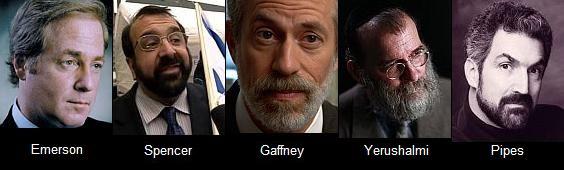

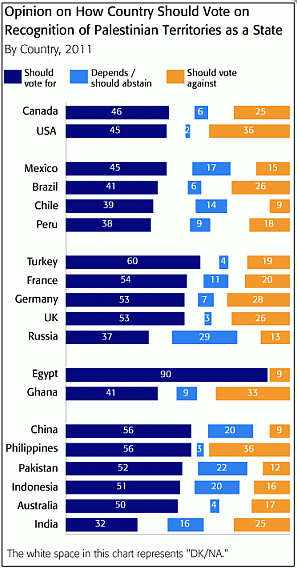 Here are some numbers President Obama should think about: Americans currently view him less favorably than they do UN recognition of Palestine!
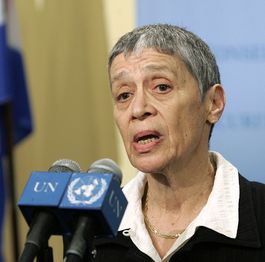 September is already here, and professor Gabriela Shalev, Israel’s previous ambassador to the U.N., is more pessimistic than ever: “We have no tools, we’re in trouble.”
