In ‘Free Libya’: Hey, who, exactly, is in charge here?
It’s easy to find the headquarters of the Libyan opposition in Benghazi, the country’s second city and the hotbed of the uprising against the regime of Muammar Gaddafi. Just head down to the Corniche, the city’s Mediterranean waterfront, and follow the cheering crowds hanging Gaddafi in effigy to the city’s district courthouse, where the revolution began on Feb. 17 as a protest by the city’s lawyers and judges. But once inside the now battle-scarred and graffitied building, it’s hard to figure out who, exactly, is in charge.
Scores of newly minted revolutionary officials — middle-aged volunteers from the city’s professional and business classes — have many meetings but appear to make few decisions. They hold press conferences in what used to be a courtroom, while about a dozen opposition spokesmen roam the halls trying to be helpful but often offering conflicting information. Trucks full of eggs and baby formula arrive at the courthouse doors without an apparent system for delivering them to the needy and without clear reports of shortages. And though spirits are high, especially among the young volunteers sporting Che Guevara–style berets, the institutional vibe is more like that of a steering committee of a future liberal-arts college than of a guerrilla movement gearing up for a long fight. “The problem is that we don’t have anyone with any political experience whatsoever,” says Iman Bugahaighis, a professor of dentistry now acting as an unofficial spokesperson. “We didn’t have any institutions other than regime. That was part of Gaddafi’s plan: to make everyone loyal only to him.” (Time)
Rebels claim to have shot down jet
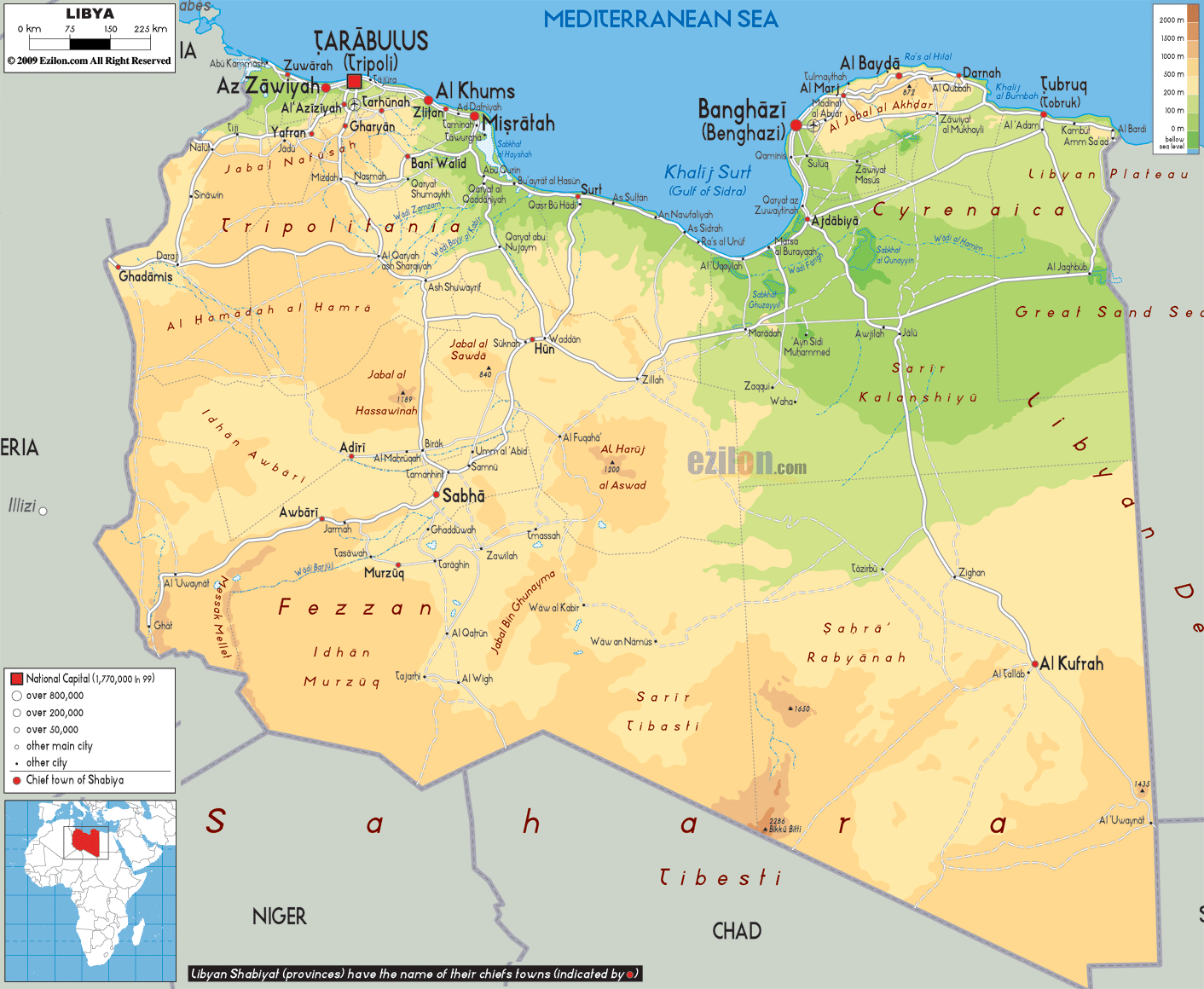
Rebels claimed to have downed a military aircraft as they fought a government bids to take back Libya’s third city, Misrata, and the strategic oil refinery town of Zawieh.
Libyan forces have been launched fresh offensives again Zawieh, 30 miles from Tripoli, and Misrata, 125 miles to the east. Rebels said some 2,000 troops loyal to the regime had surrounded Zawieh, but that they had succeeded in holding on to the town centres.
“An aircraft was shot down this morning while it was firing on the local radio station,” a witness, who was identified only as Mohamed, said by telephone from Misrata. (Telegraph)
Libya’s terra incognita
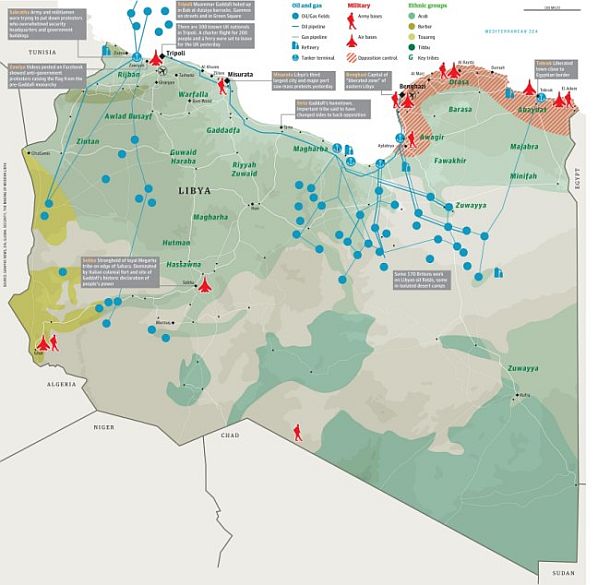
For four decades, Libya has been largely terra incognita, a place where the outsized personality of its quixotic leader and a byzantine bureaucracy obscured an informal network of constantly shifting power brokers. Even before the current unrest, working with these figures was uncertain at best — “like throwing darts at balloons in a dark room,” as one senior Western diplomat put it to me in 2009.
In the near future, even with Qaddafi gone, the country may face a continued contest between the forces of a free Libya and the regime’s die-hard elements. In particular, Qaddafi’s sons — Saif al-Islam, Khamis, Al-Saadi, and Mutassim — and their affiliated militias may not go quietly into the night; the struggle to root them out may be violent and protracted (think, for example, of Saddam Hussein’s sons, Uday and Qusay). Saif al-Islam, who was known for years in the West as Libya’s supposed champion of reform, revealed his true character as a reactionary much like his father by promising a “bloodbath” in a televised speech last week. On the ground, many of the attacks against demonstrators and their suspected sympathizers are being ordered by Captain Khamis al-Qaddafi, who heads the 32nd Brigade, the regime’s best-trained and best-equipped force. As the current unrest unfolded, Al-Saadi’s star was on the rise: as a brigadier in the special forces, he was dispatched to placate and then suppress the brewing revolt in Benghazi on February 16. Lastly, Mutassim, Libya’s National Security Council adviser, reportedly sought in 2008 to establish his own militia to keep up with his brothers and has strong ties to a number of hard-liners. (Foreign Affairs)
International pressure on Qaddafi intensifies
An international campaign to force Col. Muammar el-Qaddafi out of office gathered pace on Monday as the European Union adopted an arms embargo and other sanctions, the opposition showed increasing signs of organization in the east, and Secretary of State Hillary Rodham Clinton bluntly told the Libyan leader to surrender power “now, without further violence or delay.”
With the rebel and loyalist forces locked in an increasingly tense stand-off on the ground, the prime ministers of France and Britain echoed Mrs. Clinton’s call for Colonel Qaddafi to go, Germany proposed a 60-day ban on financial transactions, and a spokeswoman for Catherine Ashton, the European Union’s foreign policy chief, said that contacts were being established with the opposition.
Italy’s foreign minister on Sunday suspended a nonaggression treaty with Libya on the grounds that the Libyan state “no longer exists,” while Mrs. Clinton said the United States was reaching out to the rebels to “offer any kind of assistance.” (New York Times)
Exile an option for Gaddafi, White House says
Going into exile would be one option for Libyan leader Muammar Gaddafi in meeting international demands that he leave power, White House spokesman Jay Carney said on Monday.
Carney, asked by reporters whether the United States would help facilitate exile for Gaddafi, said this was a bit of speculation that he would not discuss. (Reuters)
U.S. and allies weigh Libya no-fly zone
Obama administration officials held talks on Sunday with European and other allied governments as they readied plans for the possible imposition of a no-fly zone over Libya to prevent further killings of civilians by forces loyal to Col. Muammar el-Qaddafi.
Further increasing international pressure on Colonel Qaddafi, the Libyan leader, Italy suspended a 2008 treaty with Libya that includes a nonaggression clause, a move that could allow it to take part in future peacekeeping operations in Libya or enable the use of its military bases in any possible intervention. (New York Times)
France begins ‘massive’ aid effort for Libyan opposition
France says it is flying medical aid to the eastern Libyan city of Benghazi in what it calls the start of a “massive” operation to support opposition forces trying to topple Libyan leader Moammar Gadhafi.
French Prime Minister Francois Fillon said two planes were due to leave for Benghazi Monday, carrying doctors, nurses, medicine and medical equipment for the Libyan people in what he described as “liberated” areas. (VOA)




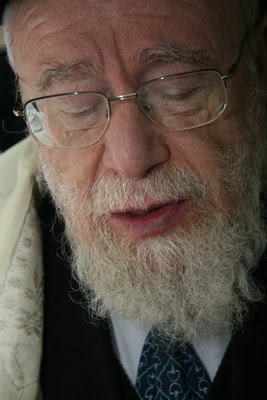 The wretchedness of the law in the face of Rabbi Dov Lior has many meanings, and Lior’s refusal to be interrogated over his support for “The King’s Torah – The Laws for Killing Gentiles” – only marginally gets at the heart of the matter.