Category Archives: Issues

The rise of the new plutocracy

At the Atlantic, Chrystia Freeland writes:

If you happened to be watching NBC on the first Sunday morning in August last summer, you would have seen something curious. There, on the set of Meet the Press, the host, David Gregory, was interviewing a guest who made a forceful case that the U.S. economy had become “very distorted.” In the wake of the recession, this guest explained, high-income individuals, large banks, and major corporations had experienced a “significant recovery”; the rest of the economy, by contrast—including small businesses and “a very significant amount of the labor force”—was stuck and still struggling. What we were seeing, he argued, was not a single economy at all, but rather “fundamentally two separate types of economy,” increasingly distinct and divergent.

This diagnosis, though alarming, was hardly unique: drawing attention to the divide between the wealthy and everyone else has long been standard fare on the left. (The idea of “two Americas” was a central theme of John Edwards’s 2004 and 2008 presidential runs.) What made the argument striking in this instance was that it was being offered by none other than the former five-term Federal Reserve Chairman Alan Greenspan: iconic libertarian, preeminent defender of the free market, and (at least until recently) the nation’s foremost devotee of Ayn Rand. When the high priest of capitalism himself is declaring the growth in economic inequality a national crisis, something has gone very, very wrong.

This widening gap between the rich and non-rich has been evident for years. In a 2005 report to investors, for instance, three analysts at Citigroup advised that “the World is dividing into two blocs—the Plutonomy and the rest”:

In a plutonomy there is no such animal as “the U.S. consumer” or “the UK consumer”, or indeed the “Russian consumer”. There are rich consumers, few in number, but disproportionate in the gigantic slice of income and consumption they take. There are the rest, the “non-rich”, the multitudinous many, but only accounting for surprisingly small bites of the national pie.

Before the recession, it was relatively easy to ignore this concentration of wealth among an elite few. The wondrous inventions of the modern economy—Google, Amazon, the iPhone—broadly improved the lives of middle-class consumers, even as they made a tiny subset of entrepreneurs hugely wealthy. And the less-wondrous inventions—particularly the explosion of subprime credit—helped mask the rise of income inequality for many of those whose earnings were stagnant.

But the financial crisis and its long, dismal aftermath have changed all that. A multibillion-dollar bailout and Wall Street’s swift, subsequent reinstatement of gargantuan bonuses have inspired a narrative of parasitic bankers and other elites rigging the game for their own benefit. And this, in turn, has led to wider—and not unreasonable—fears that we are living in not merely a plutonomy, but a plutocracy, in which the rich display outsize political influence, narrowly self-interested motives, and a casual indifference to anyone outside their own rarefied economic bubble.

Facebooktwittermail

Islamists and the democratization of the Middle East

Olivier Roy notes that there was no visible Islamist dimension to the uprising in Tunisia.

Instead, the protesters were calling for freedom, democracy and multi-party elections. Put more simply, they just wanted to get rid of the kleptocratic ruling family.

At the end, when the real “Islamist” leaders returned from exile in the West (yes they were in the West, not in Afghanistan or Saudi Arabia), they, like Rached Ghannouchi, spoke of elections, coalition government and stability, all the while keeping a low profile.

Have the Islamists disappeared?

No. But in North Africa, at least, most of them have become democrats. True, fringe groups have followed the path of a nomadic global jihad and are roaming the Sahel in search of hostages, but they have no real support in the population. That is why they went to the desert.

Nevertheless, these highway robbers are still branded as a strategic threat by Western governments at a loss to design a long-term policy. Other Islamists have just given up politics and closed their door, pursuing a pious, conservative, but apolitical way of life. They put a burqa on their lives as well as on their wives.

But the bulk of the former Islamists have come to the same conclusion of the generation that founded the Justice and Development Party in Turkey: There is no third way between democracy and dictatorship. There is just dictatorship and democracy.

Facebooktwittermail

The role of Al Jazeera and the internet in the Tunisian revolution

Marc Lynch talks about the role of Al Jazeera, the internet and social media, as facilitators supporting the Tunisian revolution.

Laila Lalami writes:

What is striking about the Tunisian revolution is how little attention it received in the mainstream American press. The Washington Post mentioned the protests for the first time on January 5, two and a half weeks into the unrest, when it ran a wire report about the burial of Bouazizi. Time ran its first piece about the protests later yet, on January 12. Even those who, like Thomas Friedman, specialize in diagnosing the ills of the “Arab street” did not show much interest.

When the mainstream press finally paid attention, it was often to explain the success of the Tunisian revolution in terms of technology. “Tunisian Protests Fueled by Social Media Networks,” read one typical headline, from CNN. Was it Twitter, which allowed activists to communicate swiftly and widely with one another? Was it YouTube, where videos of protesters and police abuse were posted? Or was it WikiLeaks, whose cables revealed that Ben Ali and his entourage were mind-bogglingly corrupt? But Twitter seemed to be most helpful in keeping those of us outside the country informed, since few in the Western media were reporting the story; YouTube was censored in the country; and WikiLeaks didn’t reveal anything that the Tunisian people did not already know.

In contrast, the Iran uprising of 2009 captured much of the American media’s attention. The Atlantic‘s Andrew Sullivan posted videos, tweets and eyewitness accounts during the weekend following the Iranian elections. William Kristol took to the pages of the Washington Post to applaud the brave protesters. In The Weekly Standard Michael Goldfarb urged the president to speak up for the Iranians on the street. Although Twitter, YouTube and Facebook were used widely to disseminate information, Ahmadinejad remained in power, highlighting the limits both of social networks and foreign media in affecting internal developments.

The Tunisian revolution occurred thanks primarily to the men and women who protested despite the intimidation, beatings, tear gas and bullets. The death of Bouazizi, the refusal of Gen. Rachid Ammar to obey Ben Ali’s orders to shoot, the arrest of dissident Hamma Hammami and the solidarity of trade unions and professionals with college students—all these factors played an incremental role in keeping the momentum going. In this modern revolution, the protesters had access to Internet tools that made it easier for them to get the word out, but those tools on their own could not topple a dictator.

The initial lack of interest by the American press in the Tunisian protests may have something to do with the fact that there was no Islamic angle: the Tunisians were not trying to oust an Islamic regime, nor were they supporters of a religious ideology. In other words, this particular struggle for freedom was not couched in simple terms that are familiar to the Western media—Islam, bad; America, good—so it took a while for our commentariat to notice.

Facebooktwittermail

Tunisia’s Islamist democrats

The New York Times reports:

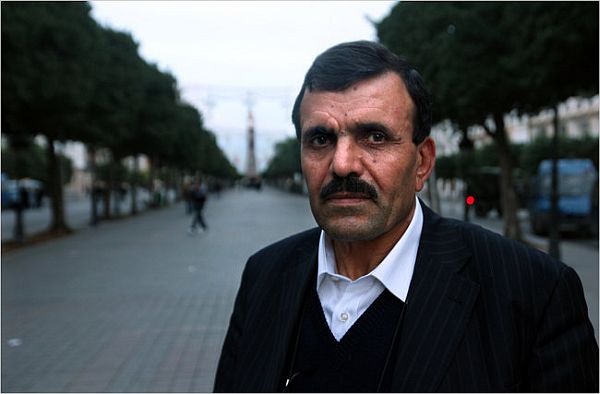
Ali Larayedh was imprisoned and tortured for 14 years for his role as a leader of the outlawed Islamist movement here, then hounded for the past six years by the omnipresent Tunisian secret police.

But six days after the ouster of this country’s dictator, Zine el-Abidine Ben Ali, Mr. Larayedh now basks in a singular celebrity. He is one of the few remaining leaders of the only credible opposition movement in Tunisia’s history. And in the aftermath of Mr. Ben Ali’s flight, that movement’s potential reincarnation is perhaps the most significant variable in Tunisia’s post-revolutionary future — yearned for by legions of working-class and rural Tunisians, viewed with just as much apprehension by the cosmopolitan coastal elite.

In an interview in the lobby of the Africa Hotel here, Mr. Larayedh insisted that his party posed no threat to Tunisians or to tourists sipping French wine in their bikinis along the Mediterranean beaches. Years of contemplation in prison and exile had helped his party, known as Al-Nahda, or the Renaissance, to “enlarge our views to encompass Western values,” he said. The result, he said, is a uniquely liberal version of Islamist politics, though one that remains unapologetic about its past calls for violence against American interests in the region.

“We are still against the political agenda of American interference in Arabic countries,” he said. “America is still supporting some dictatorships in Arabian countries, for example Ben Ali.”

But on other matters, Mr. Larayedh struck a conciliatory note.

“We are Muslim, but we are not against modernism,” he said. And he cited his party’s strong embrace of women’s rights, even to the point of advocating a quota to ensure a minimum representation of women in Parliament, “until they get their voices.”

Facebooktwittermail

Islamophobia ‘acceptable’ in UK

Al Jazeera reports:

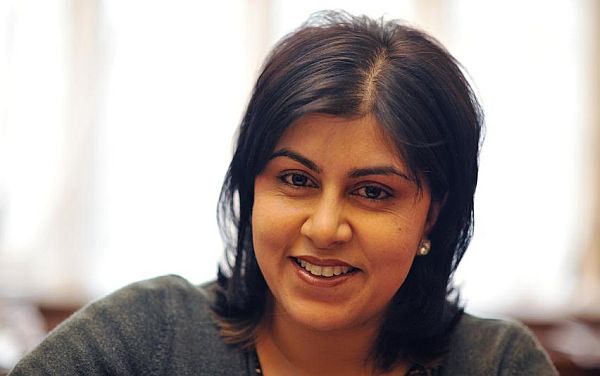
Prejudice against Muslims has “passed the dinner-table test” and become socially acceptable in Britain, the chairwoman of the country’s ruling Conservative party has said.

Sayeeda Warsi, the first British Muslim woman to join the country’s cabinet, said in a speech at the University of Leicester on Thursday that Britain is becoming a less tolerant place for believers.

Warsi said that dividing Muslims into “moderate” and “extremist” fuels intolerance as does “the patronising, superficial way faith is discussed in certain quarters, including the media”.

The Pakistan-born minister has previously criticised parts of British society for demonizing Muslims in response to the threat from small numbers of extremists.

Facebooktwittermail

U.N. resolution on Israeli settlements puts Obama in a diplomatic bind

Tony Karon writes:

It was always going to be a struggle for the U.S. to dissuade its Arab allies from going ahead with a U.N. Security Council resolution condemning Israeli settlements. But last week’s “people power” rebellion in Tunisia has made Washington’s effort to lobby against the plan more difficult. Tunisia has given the autocratic leaders of countries such as Egypt and Jordan more reason to fear their own people. For those regimes, symbolically challenging unconditional U.S. support for Israel is a low-cost gesture that will play well on restive streets.

Going ahead with the resolution, which was discussed on Wednesday at the Security Council and demands an immediate halt to all Israeli settlement construction in the West Bank and East Jerusalem, is, of course, a vote of no-confidence in U.S. peacemaking efforts. And it creates a headache for the Obama Administration over whether to invoke the U.S. veto — as Washington has traditionally done on Council resolutions critical of Israel. The twist this time: the substance of the resolution largely echoes the Administration’s own stated positions.

Washington had hoped that signaling its intention to veto such a resolution would force the Palestinians and their Arab backers to hold it back. But they went ahead and placed it on the Council’s agenda (a vote is unlikely for a few more weeks), putting the U.S. on the spot. After all, the Obama Administration has demanded that Israel end settlement construction to allow peace talks to go forward. After a 10-month partial moratorium expired last September, Israel resumed vigorous construction, and has resisted pressure from Washington for any further freeze. U.S. Deputy U.N. Ambassador Rosemary DiCarlo said on Wednesday that the U.S. opposed bringing the settlement issue to the Council “because such action moves us no closer to a goal of a negotiated final settlement” and could even undermine progress toward it. But that argument is unlikely to convince most of the international community, given the obvious stalemate in the peace process — there are no negotiations under way, and the Palestinians have refused to restart them until Israel halts its settlement construction. Initial responses at the Security Council reflect unanimous international support for the demand that Israel stop building settlements. If a vote were held today, the U.S. would be the only possible nay.

Facebooktwittermail

Self-fulfilling prophecy: Dennis Ross doesn’t think anything can get accomplished

Ali Gharib lays out the multiplicity of reasons why Dennis Ross — “a three-time-loser on Israeli-Palestinian peace-making” — lacks the competence for any role in the Middle East.

I was struck by an article by Nathan Guttman in the legendary Jewish Daily Forward about Dennis Ross and George Mitchell jockeying for the position of Obama Administration’s point-person in the Middle East peace process. The whole thing is a fascinating read, but this line really jumped out at me:

Others have also described Ross as more skeptical [than Mitchell] about the chances of peace, based on his decades-long experience with trying to bring together the parties.

I don’t want to get all new-agey, but if you think something is difficult or impossible to do, the chances of being able to do it are greatly diminished from the get-go.

So why does this Ross guy keep getting jobs that he doesn’t think are possible? I picked up Ross’ book off of my shelf here in D.C., and it amazed me how many times he says you cannot make any kind of deal with the Iranians. Then, Obama put him in charge of making a deal with the Iranians. Ross, we now learn, doubts that a peace deal can be reached in Israel-Palestine, and Obama gives him a job making peace in Israel-Palestine.

So what does this tell us about Obama? That he’s beholden to AIPAC; that he lacks courage, creativity and imagination. Above all, that lacking confidence in his own capacities of leadership he pays undue deference to the “qualification” that a subordinate possesses talent for no better reason than that he is an old hand — and that’s where Ross has “out performed” George Mitchell: more frequent flyer miles clocked up between the US and the Middle East.

Facebooktwittermail

The escalation in racism among Israeli students

Ynet reports:

Three weeks after the publication of a petition calling on Education Minister Gideon Sa’ar to take action against racism spreading within schools and the general public, teachers told Ynet about the harsh reality they are forced to face daily.

In one case, a 12th grade student of a northern Israeli school wrote “Death to the Arabs” on a test in civics class. In another case, a high school student from Tel Aviv stood up during class, and to the horror of his teacher declared that his dream is to volunteer for the Border Guard, “so that I can spray Arabs to death.” His friends welcomed the announcement with applause.

Moreover, civics teachers around the country have been finding graffiti on the walls of their classrooms, bearing slogans ranging from “Kahane was right” to “A good Arab is a dead Arab.” Other statements incite against the ultra-Orthodox sector and against refugees.

Facebooktwittermail

Tunisia: “The Islamists want democracy”

The Guardian reports:

Tunisia’s interim president, Foued Mebazaa, yesterday vowed “a complete break with the past” to calm fears that the revolution was being hijacked by the presence of the dictatorship’s ruling party in the interim government.

In his first televised speech, Mebazaa promised a “revolution of dignity and freedom” following the ousting of Tunisia’s dictator president, Zine al-Abidine Ben Ali, after four weeks of street protests. Mebazaa promised to honour “all the legitimate aspirations of the uprising”.

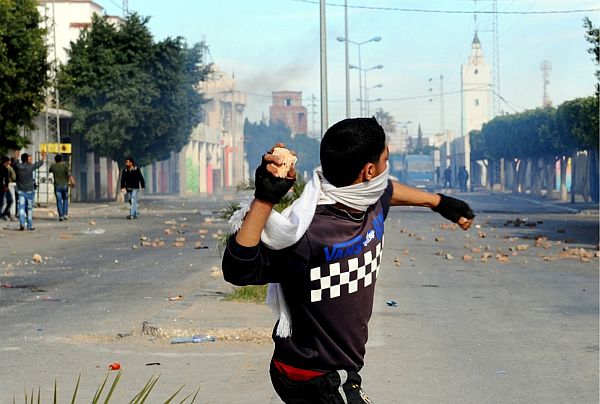
Yesterday, as the interim cabinet held its first meeting, around 500 protestors, mostly the radical left and trade unions, took to the streets in central Tunis demanding that the ruling RCD party be excluded. But the mood in the capital was lightening.

Unlike previous days, the protesters on Bourguiba Avenue were not teargassed or beaten but were instead allowed to stand peacefully protesting until nightfall. Political prisoners, including a key dissident journalist, began to be released, the curfew was shortened, cafes reopened and people milled to work. In the narrow streets of the old medina, tourists were bartering over bags.

On Bourguiba Avenue, Azizi Tej stood in the crowd of demonstrators chanting “Tunisia is free”. An activist in the once banned Islamist Ennahda party, he had been imprisoned three times, tortured, had staged a series of hunger strikes, and had now taken to the streets with the secular radical left. He wanted the remnants of Tunisia’s old regime, the RCD party, to be excluded from the temporary caretaker government.

“The Islamists want democracy,” Tej said. “Lots of us were tortured, it was our Guantánamo Bay. We’ve paid a high price and now some people want to paint us as monsters, we’re not. My religion teaches that I must accept others. We’re proud to share the same God, Jews and Christians are our brothers. We don’t refuse women’s freedoms, we don’t refuse tourism – people would die of hunger if we didn’t have tourism.”

Facebooktwittermail

Why America is like imperial Spain

Michael Vlahos writes:

The Spain of Quixote was in 1568 a world empire — and the king’s holdings covered the globe. Its fleets and armies seemed to be everywhere. So, too, is the United States today. With 700 overseas bases, its military personnel are equally omnipresent.

Spanish world authority in the 16th century and that of the United States today are at the core challenged not by “peer competitors” — but by marginal non-state communities at the very rim of civilization itself. How did this happen?

Spain for its part faced insurgents in a place that had only recently become part of its realm, such as the northern provinces of the Netherlands. Areas like Friesland had always been fractious, and no big state had ever succeeded in taming them. Sound familiar?

The Netherlands had for so long been a menagerie of principalities with only the loosest governance. Spain took over and began to make something new — the essence of nation building. In addition, the Spanish effort was determinedly focused on a “whole of government” solution, with their Catholic Church franchise prefiguring the U.S. State Department’s heavy involvement in Afghanistan today. [Continue reading…]

Part Two: Imperial self-destructive perseverance

Facebooktwittermail

Worse than Bush

While George W Bush was president it was possible to sustain what turned out to be a naive hope: that much of the harm he had done could be undone once he was out of office and the neoconservatives had been dislodged from power. But the harm personified by Bush and Cheney is now being institutionalized and by the removal of ideological baggage, lightened, with the effect that the post-Bush era is nowhere near in sight.

As President Obama sucks up to Wall Street (a sure way of financing his 2012 campaign, given that he will not be able to rely on the same level of grassroots support he enjoyed in 2008) and as his Justice Department argues that whistle-blowers are more dangerous than Americans who commit treason, Glenn Greenwald notes that the latest neocon singing Obama’s praise is Dick Cheney:

In the early months of Obama’s presidency, the American Right did to him what they do to every Democratic politician: they accused him of being soft on defense (specifically “soft on Terror”) and leaving the nation weak and vulnerable to attack. But that tactic quickly became untenable as everyone (other than his hardest-core followers) was forced to acknowledge that Obama was embracing and even expanding — rather than reversing — the core Bush/Cheney approach to Terrorism. As a result, leading right-wing figures began lavishing Obama with praise — and claiming vindication — based on Obama’s switch from harsh critic of those policies (as a candidate) to their leading advocate (once in power).

As early as May, 2009, former Bush OLC lawyer Jack Goldsmith wrote in The New Republic that Obama was not only continuing Bush/Cheney Terrorism policies, but was strengthening them — both because he was causing them to be codified in law and, more important, converting those policies from right-wing dogma into harmonious bipartisan consensus. Obama’s decision “to continue core Bush terrorism policies is like Nixon going to China,” Goldsmith wrote. Last October, former Bush NSA and CIA Director Michael Hayden — one of the most ideological Bush officials, whose confirmation as CIA chief was opposed by then-Sen. Obama on the ground he had overseen the illegal NSA spying program — gushed with praise for Obama: “there’s been a powerful continuity between the 43rd and the 44th president.” James Jay Carafano, a homeland-security expert at the Heritage Foundation, told The New York Times’ Peter Baker last January: “I don’t think it’s even fair to call it Bush Lite. It’s Bush. It’s really, really hard to find a difference that’s meaningful and not atmospheric.”

Those are the nation’s most extreme conservatives praising Obama’s Terrorism policies. And now Dick Cheney himself — who once led the “soft on Terror” attacks — is sounding the same theme. [Continue reading…]

Facebooktwittermail

Stuxnet attack on Bushehr: Russia warns of ‘Iranian Chernobyl’

Following Saturday’s New York Times report that the Stuxnet malware targeting Iran’s nuclear program was a joint US-Israeli operation, the Daily Telegraph reports that Russian nuclear scientists are concerned that the Bushehr nuclear plant could suffer catastrophic damage.

Fuel rods were inserted in the new reactor at the end of November and the plant is due to start producing electricity in the coming weeks. Ralph Langner, whose German team first identified Iran’s nuclear program as Stuxnet’s target, says the plant’s steam turbine is vulnerable to attack and in November wrote: “If you blow a 1000 Megawatt turbine, you will very likely be able to see the impact by satellite imagery.”

Con Coughlin writes:

Russian scientists working at the plant have become so concerned by Iran’s apparent disregard for nuclear safety issues that they have lobbied the Kremlin directly to postpone activation until at least the end of the year, so that a proper assessment can be made of the damage caused to its computer operations by Stuxnet.

The Iranian government is bitterly opposed to any further delay, which it would regard as another blow to national pride on a project that is more than a decade behind schedule. While Western intelligence officials believe Iran’s nuclear programme is aimed at producing nuclear weapons, Iran insists the project’s goals are peaceful.

The Russian scientists’ report to the Kremlin, a copy of which has been seen by The Daily Telegraph, concludes that, despite “performing simple, basic tests” on the Bushehr reactor, the Russian team “cannot guarantee safe activation of the reactor”.

It also accuses the Iranian management team, which is under intense political pressure to stick to the deadline, of “not exhibiting the professional and moral responsibility” that is normally required. They accuse the Iranians of having “disregard for human life” and warn that Russia could find itself blamed for “another Chernobyl” if it allows Bushehr to go ahead.

While it’s natural that the Russians would be concerned about being blamed, in such a scenario it’s a bit difficult to see how US interests would be served if vital shipping lanes and America’s Gulf allies were also put in jeopardy.

An American expert in nuclear intelligence told the New York Times “that Israel worked in collaboration with the United States in targeting Iran, but that Washington was eager for ‘plausible deniability'” — plausible deniability that the US no longer has.

Does this raise the possibility that the US might need to discreetly intervene to prevent an Israeli-made disaster?

Facebooktwittermail

In the Middle East, no one thinks Obama is serious about democracy

In Washington, when a cabinet level official is facing calls for his resignation, he is likely to take cover behind that regal phrase, “I serve at the president’s pleasure.” Most of the Arab world’s autocratic leaders could use the same expression since most would find their positions untenable without American support.

Last Wednesday, when Hillary Clinton said “we are not taking sides,” as demonstrators clashed with Tunisian security forces, she could have dispensed with protocol and said with more honesty, “we are no longer taking sides.”

Up until that moment the United States had unequivocally taken sides with Tunisia’s dictatorial ruler, Zine el-Abidine Ben Ali, but thereafter he knew he was on his own. He rapidly lost his grip on power.

The Obama administration’s relationship with the Tunisian regime was mirrored on a smaller scale by that of the Washington Media Group, a consulting firm that severed its contract with the Tunisian government on January 6.

“We felt on principle that we could not work for a government that was shooting its own citizens and violating their civil rights with such abuse,” said WMG’s President Gregory L. Vistica. Was he claiming that his client’s record had suddenly taken a turn for the worse, or that his firm had only just discovered it had principles?

The point is that WMG, just like the US government, prefers to blur the distinction between statements of principle and actions of self-interest.

On Friday, when President Obama said, “I applaud the courage and dignity of the Tunisian people,” observers across the region might have appreciated the sentiment yet seen no reason to attach much gravity to his words. After, Ben Ali had already fled.

“No one thinks Obama is serious about democracy,” says Shadi Hamid from Brookings Doha Center. “In some ways they have given up hope. And that I think is one of the key post-Cairo Speech stories: that after a lot of optimism about Obama’s election, people realized that when it comes to the issue of democracy-promotion in the Arab world — and that is a very important one for many Arabs — Obama’s really not on board.”

What more damning an indictment could be made against an American president than to say that he does not support democracy?

Hamid is joined in conversation with fellow Middle East analyst Issandr El Amrani from The Arabist, for a fascinating discussion on the implications on the people’s uprising in Tunisia.

Facebooktwittermail

Social media and the internet as an arena for revolutionary fantasy

On Friday, Andrew Sullivan — who heralded Iranian unrest 18 months ago as the Twitter revolution — was quick to dub the popular uprising in Tunisia a “WikiLeaks revolution” :

There seems little doubt that the Wikileaks-released cable describing the opulence of now former president Ben Ali’s lifestyle played a key part in bringing him down.

But what did WikiLeaks reveal?

In a July 2009 cable published by The Guardian on December 7, US Ambassador Robert F. Godec wrote:

The problem is clear: Tunisia has been ruled by the same president for 22 years. He has no successor. And, while President Ben Ali deserves credit for continuing many of the progressive policies of President Bourguiba, he and his regime have lost touch with the Tunisian people. They tolerate no advice or criticism, whether domestic or international. Increasingly, they rely on the police for control and focus on preserving power. And, corruption in the inner circle is growing. Even average Tunisians are now keenly aware of it, and the chorus of complaints is rising. Tunisians intensely dislike, even hate, First Lady Leila Trabelsi and her family. In private, regime opponents mock her; even those close to the government express dismay at her reported behavior. Meanwhile, anger is growing at Tunisia’s high unemployment and regional inequities. As a consequence, the risks to the regime’s long-term stability are increasing.

Average Tunisians were keenly aware of the corruption of their rulers, hated the president’s wife and his family and were expressing growing anger about unemployment — and all of this put the regime at risk. And yet — here’s the inexplicable element — somehow, all of these observable facts once encapsulated in a cable from the US embassy and then leaked by WikiLeaks became a “revelation” confirming what the average Tunisian already knew.

Tunisia is a small country that usually garners little international attention, so WikiLeaks can be given some credit for enlightening the rest of the world about the political instability of this Arab backwater, but to claim that WikiLeaks “played a key part” in bringing down the Tunisian president seems a bit of a stretch.

If the cable did include an important revelation, it was one unlikely to fuel Tunisians’ revolutionary fervor: that the Obama administration was being advised by it embassy to be less openly critical of the regime than the Bush administration had been.

For several years, the United States has been out in front — publicly and privately — criticizing the GOT [Government of Tunisia] for the absence of democracy and the lack of respect for human rights. There is a place for such criticism, and we do not advocate abandoning it. We do recommend a more pragmatic approach, however, whereby we would speak to the Tunisians very clearly and at a very high level about our concerns regarding Tunisia’s democracy and human rights practices, but dial back the public criticism.

In other words, the United States under Barack Obama’s presidency, would not stray from the longstanding American approach which attaches a higher value to stability than democracy — that sees US interests deeply invested in the continuity of autocratic rule in most of the Arab world’s so-called “moderate” states.

If dictators in the Middle East are seen as the bulwark preventing the rise to power of Islamists, then the US will nod in the direction of the oppressed by making calls for “democratic reform” even if the prospect of democracy is nowhere in sight. Indeed, democratic reform rather than being a stepping stone towards democracy is more likely seen as a preferable substitute, since democracy itself opens the door to those dreaded Islamists.

If the current administration preferred a “pragmatic” approach towards Tunisia and the instrumental role of WikiLeaks has been overstated, what about the influence of social media? Yesterday, Ben Wedeman from CNN tweeted: “No one I spoke to in Tunis today mentioned twitter, facebook or wikileaks. It’s all about unemployment, corruption, oppression.”

Jamal Dajani, who was in Tunis at the beginning of the month, writes:

It is very easy, but over-simplistic and naive to decide on a social media interpretation for the Jasmine Revolution, as we have been witnessing by many bloggers and self-appointed Middle East experts, many of whom neither speak Arabic nor have spent an extended period of time in the Middle East. They desperately want to convince us that Tunisians needed an external technological Western invention in order to succeed. A Twitter revolution of some sorts, as they previously labeled the Iranian Velvet Revolution, as though Arab masses were not capable on their own of saying “enough is enough.”

Certainly social media was used as a communication tool for Tunisians to air their frustrations with the economy, unemployment, censorship, and corruption. But many factors lead to its success, such as a well organized trade unions movement, and the most potent weapon in the Arab world, the youth.

Likewise during the 2009 summer uprising in Iran, Twitter only had a very minor role. In the London Review of Books, James Harkin notes:

In 2009, according to a firm called Sysomos which analyses social media, there were 19,235 Twitter accounts in Iran – 0.03 per cent of the population. Researchers at al-Jazeera found only 60 Twitter accounts active in Tehran at the time of the demonstrations, which fell to six after the crackdown.

Also, to the extent that the internet and social media did serve as revolutionary tools in Iran, they also served as a means to thwart the revolution.

Evgeny Morozov writes:

As we know from the post-protest crackdown in Iran, the Internet has proved a very rich source of incriminating details about activists; the police scrutinized Facebook groups, tweets, and even email groups very closely. Furthermore, the Iran government may have also analyzed Internet traffic and phone communications related to the opposition.

Now, Tunisia is no in Iran. Its long-ruling dictator is now gone and the new government is unlikely to engage in repressions on the same scale. Yet if Ben Ali’s regime didn’t fall, it appears certain to that the authorities would be brutally going after anyone who has ever posted a damning Facebook post or an angry email. As we have seen in the few weeks leading to Ali’s exit, the Tunisian cyber-police have proved to be far more skilled in Internet repression than their counterparts abroad: it’s safe to assume they would have dug as much evidence as the Iranians.

This brings me to a somewhat depressing conclusion: if the dictator doesn’t fall in the end, the benefits of social mobilization afforded by the Internet are probably outweighed by its costs (i.e. the ease of tracking down dissidents – let alone organizers of the protests).

It’s easy those of us in the West to celebrate a distant revolution from the comfort of an armchair, facing no risk of getting shot or being imprisoned, yet experiencing an illusion of participation through the immediacy of social media.

Swiftly named the Jasmine Revolution and now viewed as a domino that might lead to the collapse of authoritarian regimes across the region, it’s too early to know whether this is indeed a revolution.

AFP reports that Prime Minister Mohammed Ghannouchi:

… held consultations with the leaders of the main opposition parties in Tunis on the formation of a national unity government to fill the power vacuum left by Ben Ali’s abrupt departure after 23 years in power.

Two parties banned under Ben Ali — the Communist party and the Islamist Ennahdha party — have been excluded from the government talks.

Whatever the eventual outcome of the turmoil now raging in Tunisia, it may end up causing as much alarm on the Arab street as it does among the autocratic rulers. As Stephen Walt warns:

Tunisia’s experience may not look very attractive over the next few weeks or months, especially if the collapse of the government leads to widespread anarchy, violence and economic hardship. If that is the case, then restive populations elsewhere may be less inclined to challenge unpopular leaders, reasoning that “hey, our government sucks, but it’s better than no government at all.”

Brian Whitaker notes the fallout from Tunisia has already spread to Libya where demonstrators have clashed with security forces.

Will it develop into anything bigger? A month ago, I would have said the likelihood of that was zero. Post-Tunisia, though, it’s difficult to be quite so sure..

We can expect to see many more incidents like this over the coming months in various Arab countries. Inspired by the Tunisian uprising, people are going to be more assertive about their grievances and start probing, to see how far they can push the authorities. In the light of Tunisia we can also expect a tendency, each time disturbances happen, to suggest (or hope) that they are the start of some new Arab revolution. The reality, though, is that almost all of them will quickly fizzle out or get crushed. But one day – who knows when? – another of them will grow wings and bring down a regime.

Contrary to what many people imagine, protests and even large-scale riots are not uncommon in the Arab countries. They occur mostly in marginalised regions or among marginalised sections of the population and, normally, they pose no great threat to the regime.

Last month – one day before the trouble started in Tunisia – there was a Sunni-versus-Shia riot in the Saudi city of Medina. Eight hundred people are said to have taken part; windows were smashed and dozens of cars damaged or destroyed. Outside the kingdom, hardly anyone noticed.

Facebooktwittermail

What was Israel’s connection to the AQ Khan nuclear network?

The New York Times reports that the Stuxnet worm which was designed to attack Iran’s nuclear enrichment program was a joint US-Israeli operation. One of the crucial elements in developing the plan was being able to test the malware’s ability to disable P-1 centrifuges — the type that Iran employs in cascades of thousands of centrifuges in it Natanz enrichment facility. Israel has row upon row of this type of centrifuge at its clandestine nuclear weapons production facility in Dimona.

The question is: how did Israel come to possess so many P-1 centrifuges? Did Israel obtain the centrifuges from AQ Khan?

The CIA was tracking the AQ Khan network for decades before it eventually shut it down in 2003. Douglas Frantz, co-author of Fallout: The True Story of the CIA’s Secret War on Nuclear Trafficking, told NPR: “By the time they finally acted in 2003, an enormous amount of the world’s most dangerous technology had been sold to the world’s most dangerous regimes. And that, in our view, was a policy failure, a policy failure of enormous proportions, really.”

Perhaps the most secretive part of the Stuxnet story centers on how the theory of cyberdestruction was tested on enrichment machines to make sure the malicious software did its intended job.

The account starts in the Netherlands. In the 1970s, the Dutch designed a tall, thin machine for enriching uranium. As is well known, A. Q. Khan, a Pakistani metallurgist working for the Dutch, stole the design and in 1976 fled to Pakistan.

The resulting machine, known as the P-1, for Pakistan’s first-generation centrifuge, helped the country get the bomb. And when Dr. Khan later founded an atomic black market, he illegally sold P-1’s to Iran, Libya, and North Korea.

The P-1 is more than six feet tall. Inside, a rotor of aluminum spins uranium gas to blinding speeds, slowly concentrating the rare part of the uranium that can fuel reactors and bombs.

How and when Israel obtained this kind of first-generation centrifuge remains unclear, whether from Europe, or the Khan network, or by other means. But nuclear experts agree that Dimona came to hold row upon row of spinning centrifuges.

“They’ve long been an important part of the complex,” said Avner Cohen, author of “The Worst-Kept Secret” (2010), a book about the Israeli bomb program, and a senior fellow at the Monterey Institute of International Studies. He added that Israeli intelligence had asked retired senior Dimona personnel to help on the Iranian issue, and that some apparently came from the enrichment program.

Facebooktwittermail

Will Tunisia be a turning point for Arab democracy?

Michael Hanna writes:

For observers throughout the Arab world, the significance of the Tunisian uprising is near-impossible to understate. During this era of retrenchment by aging descendants of revolutionary regimes, the prospect of democratic change had long-ago vanished as a believable possibility. The closest point of reference to the civil unrest in Tunisia is the protest movement that erupted in Iran following the contested presidential elections of June 2009. But the significance of Iran’s post-election events has been minimal in the Arab world, reflecting the Arab-Iranian cultural chasm and the ingrained sense of Arab chauvinism that guides Arab perceptions of international affairs. The Shiite theocracy established in the wake of the 1979 Iranian revolution has always been something of a curiosity for the Arab world and its heavily Sunni population. While the chimerical dreams of Arabism are long gone, events within the Arabic-speaking world – such as Tunisia’s protests – carry special resonance. Since Arab nationalism’s heyday under the 1950s and ’60s stewardship of Egyptian president Gamal ‘Abd al-Nasser, that collective identity has remained, held together by shared media and culture. The role once played by the radio broadcasts of Sawt al-‘Arab (Voice of the Arabs), the Egyptian-run radio station established during the Nasser era, is now filled by the saturation coverage of such Arab satellite stations as al-Jazeera and al-‘Arabiyya. The networks often focus on intra-Arab issues. The protests on the streets of Tunisia were seen far and wide, in real time, by millions of Arabs, with no need for translation or cultural filtering.

With Tunisia’s reputation as something of a stable but sleepy backwater, the events of recent weeks have come as a complete surprise to the world. The uprising remains in flux, its ultimate outcome unclear, and there is no certainty that the country is on its way to a democratic transition, let alone a smooth one. However, the demonstration effect of this uprising is likely not lost on the region’s aging autocrats. A pilot who refused to fly Ben Ali’s family out of Tunisia, interviewed on live television, explained that they were “war criminals.” As the region’s other autocratic rulers retire to bed, this forthright message will be a chilling reminder that their people’s quiescence is not guaranteed, nor is it the same thing as legitimacy. If nothing else, the protests have demonstrated that an Arab head-of-state can be toppled from below and, for leaders as well as activists, have expanded popular notions of the possible. While the U.S. invasion of Iraq and the protests of the “green movement” in Iran have had far-ranging regional ramifications, when it comes to promoting Arab democracy, Tunisia’s 2011 uprising may eclipse them both.

As much as democracy poses a threat to the Arab world’s autocratic leaders, it also threatens Israel. If a day ever comes that the Jewish state is surrounded by democracies, its real identity as a racist ethnocracy will be fully exposed.

Facebooktwittermail