Category Archives: Issues

Ashamed to be an Israeli

Amnon Danker, former editor of Israel’s popular Hebrew newspaper, Maariv, writes:

… I have felt lately that it has become shameful to be an Israeli, and a decent person must feel this shame and blush deeply and clear his throat and whisper to himself the question, what should we do, what should we do, for heaven’s sake, and perhaps even reach far-reaching conclusions.

Because it is fairly clear already that if our life here continues as it has been developing, then decent, moderate, balanced and humane people will not be able to live here. Before our eyes, with growing speed, Israeli society is changing, the political culture is changing, balances are disrupted and checks are tossed to the blazes, in the terrible wind that is blowing in our lives and quickly colouring them in darkening shades of black.

It seems that things that were bottled up in the Israeli soul, well hidden due to the shame, are suddenly erupting with a sense of release and capering in a disgraceful manner in full view. It is now permissible to be a racist, and permissible to take pride in it, and it is permissible to kick democracy and take pride in that, and it is permissible to cause injustice and exploitation and trample people’s rights, if the people in question are Arabs, and it is permissible to take pride in this too. There are MKs [members of Israel’s parliament] that engage in all this with great skill, and with smiles that cannot fail to send a shiver down one’s back. There are entire parties whose colour and music arouse shocking and horrific memories.

Sometimes I try to do the following exercise: To think that I went to sleep sometime in the 1980s or 1990s, and what I have been experiencing here recently is no more than a nightmare. After all, this cannot be. Not here. Not among Jews. And yet—it is happening.

When people comment on this venomously around the world, we object almost instinctively and say, no, that is too much already. It is only anti-Semitic hate propaganda. But with a hand on the heart — are we not becoming, from year to year, more and more like our monstrous caricature, which is drawn by our worst enemies? For really, where are we going? Think for yourselves, as unpleasant as this may be: Are we becoming more or less racist? More or less democratic? More or less decent? And alas, in our decline to brutality, within this terrible deterioration, if only we could at least take comfort in the fact that we were perhaps becoming worse and more contemptible, but also safer and better protected. But once again, with a hand on the heart: Is this true, or is it exactly the opposite?

For it is not only a disgrace to be an Israeli today, it is also deathly frightening. [Continue reading…]

[H/t Ann El Khoury.]

Facebooktwittermail

Facebook in Gaza

Karma Nabulsi writes:

Last weekend the Observer carried a dramatic account of ‘The Gaza Youth Manifesto’, written in English by a handful of young people in Gaza and posted on Facebook. Given the thousands of people in the West who have said they ‘like’ it on Facebook or posted positive comments, the manifesto is said to herald a new movement for change in occupied Palestine.

Because of Palestinians’ lengthy predicament of expulsion, dispossession and military occupation, there is a rich tradition of Palestinian manifestos and declarations: hundreds of them have been written since 1948. ‘Bayan Harakatina’ (‘Our Movement’s Statement’, 1959) played an important role in recruiting the first wave of young people to the Palestinian National Liberation Movement-Fateh, and in unifying their political consciousness. It was distributed clandestinely, ‘entrusting’ its readers with the key ideas of the new movement. Later documents, such as the founding manifesto of the Popular Front for the Liberation of Palestine (1967), were distributed more openly. These manifestos were written by organised Palestinian youth as mobilising documents, exclusively for young Palestinians.

Manifestos have been written by everyone: ‘Workers of Palestine Unite’ was issued by the General Provisional Committee of the Workers of Palestine in 1962; the Unified National Command of the Intifada released 46 communiqués between 1988 and 1990; ‘The Palestinian Civil Society Call for Boycott, Divestment and Sanctions against Israel’ was published on 9 July 2005; ‘The Palestine Manifesto’ was published last year by the National Committee for the Defence of the Inalienable Rights of the Palestinian People; dozens of statements have been issued by right of return committees in the refugee camps since 1998; Palestinian political prisoners in Israeli jails, from all parties, released the now famous ‘National Reconciliation Document’ in 2006.

Palestinian manifestos and declarations tend to do four things: 1. engage critically with the current situation and its historical context; 2. outline a response, clearly stating the principles that should underpin it; 3. announce the emergence of an organised group to carry out that response; and 4. call on Palestinian youth to join the movement. The wording is careful and has usually been negotiated at length between a variety of people and organisations. In short, the manifestos are purposive and geared towards some form of collective action.
The ‘Gaza Youth Breaks Out’ manifesto does not belong to this tradition: it does not put forth any clear analysis of the current historical situation, or outline a response to it. It does not declare the existence of an organised group, or invite anyone to join anything. Its tone is denunciatory rather than analytical. Its language is apolitical: the terminology of resistance common to Palestinian manifestos is replaced here by use of the f-word. And it lacks any mobilisational dimension. It’s unsurprising, then, that it has received little attention in the Arab world. [Continue reading…]

Facebooktwittermail

Do we have Ahmadinejad all wrong?

Reza Aslan writes:

Is it possible that Iran’s blustering president Mahmoud Ahmadinejad, long thought to be a leading force behind some of Iran’s most hard-line and repressive policies, is actually a reformer whose attempts to liberalize, secularize, and even “Persianize” Iran have been repeatedly stymied by the country’s more conservative factions? That is the surprising impression one gets reading the latest WikiLeaks revelations, which portray Ahmadinejad as open to making concessions on Iran’s nuclear program and far more accommodating to Iranians’ demands for greater freedoms than anyone would have thought. Two episodes in particular deserve special scrutiny not only for what they reveal about Ahmadinejad but for the light they shed on the question of who really calls the shots in Iran.

In October 2009, Ahamdinejad’s chief nuclear negotiator, Saeed Jalili, worked out a compromise with world power representatives in Geneva on Iran’s controversial nuclear program. But the deal, in which Iran agreed to ship nearly its entire stockpile of low enriched uranium to Russia and France for processing, collapsed when it failed to garner enough support in Iran’s parliament, the Majles.

According to a U.S. diplomatic cable recently published by WikiLeaks, Ahmadinejad, despite all of his tough talk and heated speeches about Iran’s right to a nuclear program, fervently supported the Geneva arrangement, which would have left Iran without enough enriched uranium to make a nuclear weapon. But, inside the often opaque Tehran government, he was thwarted from pursuing the deal by politicians on both the right and the left who saw the agreement as a “defeat” for the country and who viewed Ahmadinejad as, in the words of Ali Larijani, the conservative Speaker of the Majles, “fooled by the Westerners.”

Facebooktwittermail

The reflexive call for fewer liberties

Glenn Greenwald writes:

William Galston — former Clinton adviser and current Brookings Institution Senior Fellow — has a column in The New Republic about the Gabrielle Giffords shooting that illustrates the mentality endlessly eroding basic American liberty: namely, the belief that every tragedy must lead to new government powers and new restrictions on core liberties. The lesson of the Arizona tragedy, he argues, is that it’s too difficult to force citizens into mental institutions against their will. This, he says, is the fault of “civil libertarians,” who began working in the 1970s on legal reforms to require a higher burden of proof for involuntary commitment (generally: it must be proven that the person is a danger to himself or to others). As a result, Galston wants strict new laws imposing a litany of legal obligations on the mentally ill, their friends and family, and even acquaintances, as well as dramatically expanded powers to lock away those with mental illness (with broader definitions of what that means).

Listen to what he proposes: “first, those who acquire credible evidence of an individual’s mental disturbance should be required to report it to both law enforcement authorities and the courts, and the legal jeopardy for failing to do so should be tough enough to ensure compliance”; those reporting obligations should apply not only to family and friends, but extend to “school authorities and other involved parties.” And “second, the law should no longer require, as a condition of involuntary incarceration, that seriously disturbed individuals constitute a danger to themselves or others”; instead, involuntary commitment should be imposed whenever there is “delusional loss of contact with reality.” He concludes on this melodramatic note: ‘How many more mass murders and assassinations do we need before we understand that the rights-based hyper-individualism of our laws governing mental illness is endangering the security of our community and the functioning of our democracy?”

There’s so much warped reasoning embedded in this argument that it’s hard to know where to begin. Galston seems to be unaware of this, but what motivated the reforms in this area were the decades of severe, horrifying abuses which those with mental illnesses — and even those who had none — suffered as a result of permissive involuntary commitment standards and prolonged forced incarceration. Those who suffered mental illnesses were locked away for years and sometimes decades despite having done nothing wrong and despite not being a threat to anyone, while countless people who simply exhibited strange or out-of-the-ordinary behavior were deemed mentally ill and similarly consigned. The psychitaric social worker Alicia Curtis provided just one example: “There is also a large history of the forced treatment of homosexuality as mental ‘illness’.” Indeed, involuntarily committing people in mental hospitals is a time-honored way for stifling any individuality and dissent; see this 2010 New York Times article on how China uses that repressive tactic.

Then there are the factually incoherent claims Galston makes. He harkens back to some sort of Golden Age of the 1960s when thousands of people were incarcerated against their will who did nothing wrong — as though that era were relatively free of political assassinations because all the “crazies” were where locked up where they belonged. Of course, the opposite is true: there were far more violent attacks on political figures back then (MLK, JFK, RFK, George Wallace, Malcolm X, etc.) than there have been during the relatively peaceful time beginning in the 1980s when involuntary commitment became much more difficult.

Worse, Galston assumes, without offering any evidence, that there is a significant correlation between mental illness and violence, but the reality is the opposite: the vast, vast majority of people with mental illnesses never hurt anyone. [Continue reading…]

Facebooktwittermail

Does Israel wish it might become invisible?

Humiliating journalists might not be a good way of generating positive coverage for ones country, but perhaps the treatment of foreign reporters covering a speech by Prime Minister Benjamin Netanyahu had a different purpose: to try and persuade the world’s media to ignore Israel altogether.

Either that, or this and two other stories below represent the small but unsightly rips in a nation that has set itself on a path of self-destruction.

Dimi Reider posts a statement released by the Foreign Press Association in Israel:

The Foreign Press Association is outraged over the treatment members received at the hands of Israeli security personnel during Tuesday night’s invitation-only gathering with the prime minister. While we appreciate the need for security, it is not remotely acceptable to invite people for cocktails at a five-star hotel and then make them undress at the door.

Several members were forced to remove their underwear, waiting for as long as 20 minutes in this humiliating situation while security checked their documents. Others, including the bureau chief of The Wall Street Journal, were strip-searched and forced to take off their pants. A number of members walked out of the event in disgust following this despicable treatment.

It is incomprehensible that anyone would think such humiliating treatment is necessary at such an event. All GPO card holders are known to authorities and have already undergone extensive background checks. All participants emptied their pockets, submitted their equipment to inspection and went through metal detectors to enter.

The Shin Bet has its responsibilities but it must also operate within reasonable parameters. In a democratic country security services are not permitted to do as they please. For a government trying to usher in a new era of relations with the foreign media, it is a peculiar way to start. We are confident the prime minister would not accept such abusive security checks for his friends or family.

We ask for assurances that this will not happen again or we will respectfully decline further invitations.

Meanwhile, in the latest expression of rabbinical contempt for non-Jews, sterile Jewish couples are being discouraged from taking the risk of producing “barbaric offspring” which would result the use of Gentile sperm.

Rabbi Dov Lior, a senior authority on Jewish law in the Religious Zionism movement, asserted recently that a Jewish woman should never get pregnant using sperm donated by a non-Jewish man – even if it is the last option available.

According to Lior, a baby born through such an insemination will have the “negative genetic traits that characterize non-Jews.” Instead, he advised sterile couples to adopt.

Lior addressed the issue during a women’s health conference held recently at the Puah Institute, a fertility clinic. His conservative stance negated a ruling widely accepted by rabbis, which states that sperm donated by a non-Jew is preferable to that of an anonymous Jew, who might pose a genealogical risk.

“Sefer HaChinuch (a book of Jewish law) states that the character traits of the father pass on to the son,” he said in the lecture. “If the father in not Jewish, what character traits could he have? Traits of cruelty, of barbarism! These are not traits that characterize the people of Israel.”

And if that wasn’t enough, Richard Silverstein writes about a rabbinical appeal for the extermination of Palestinians.

Back in the days of the Shoah, one of the slogans of the Jew haters was: “Jews to the Ovens.” Now, it causes me anguish to say, we have Israeli Orthodox rabbis saying the same about the Palestinians.

Thanks to Cicero for pointing me to a shocking passage in an Israeli Orthodox “family magazine,” Fountains of Salvation, which suggests that Israel will create death camps for Palestinians in order to wipe them out like Amalek.

Facebooktwittermail

Israel’s public relations policy: never apologise, always confuse

Jesse Rosenfeld and Joseph Dana write:

Never believe the Israeli army killed an unarmed civilian until it’s officially denied. This paraphrasing of Mark Twain’s “never believe anything until it has officially been denied,” should become a mantra for journalists operating in the Middle East.

It is a point reinforced recently by the death of a West Bank Palestinian resident, Jawaher abu Rahmah, who died from tear gas exposure during the recent demonstration against Israel’s separation wall and land annexation in the village of Bil’in.

It has become an almost predictable pattern: a Palestinian civilian is killed during a demonstration or Israeli military incursion and the evidence and witness testimony clearly demonstrates Israeli culpability. Then, military sources give farfetched and contradictory statements that become the central focus in Israeli and American media reports.

Facebooktwittermail

Why the demise of the Middle East ‘peace process’ may be a good thing

Alastair Crooke writes:

Establishing a Palestinian state has been a sine qua non of Western foreign policy for the last 20 years. For some, the evident demise of the “peace process” has given rise to a sense of bereavement nearly on par with the end of civilization. A Palestinian state, for many, was a banner of conscience, a matter of justice. It was perceived, too, as the essential remedy for the wider maladies of the Middle East. Its final exhaustion would seem to edge the region closer to an abyss.

Paradoxically, this breakdown may well be a good thing. It finally puts to rest the fiction that a Palestinian state will emerge from even the best intentions of the West instead of from the political realities of the Middle East itself.

A Palestinian state has been pursued since the Madrid Conference of 1991 set it as an objective after the first Gulf War. But meanings shift with time. Ideas become hollowed out like shells whose internal living organisms have long since withered.

“Statehood” no longer means what it once meant. It now veils an opposite concept: Statehood no longer signifies autonomy and independence, but an “alleviated occupation” that is really a management strategy of control and containment.

Perhaps under this concept of statehood a new Palestinian elite could live more comfortably, albeit amid persistent general poverty. Perhaps the visible tools of occupation and control over Palestinian life would be better concealed from the naked eye, even operated remotely through new technology. Such “statehood” would still be an occupation nonetheless, with the Palestinian internal security conduct, borders, airspace, water, economy and even its “electro-magnetic” field under the unchallengeable security control of Israel. Jerusalem, the refugees, and even the status of the Jordan Valley would be left pending for the never-arriving longer term. [Continue reading…]

Facebooktwittermail

Israel’s descent into ‘this unfortunate world’

As Israeli bulldozers demolish the Shepherd Hotel in East Jerusalem to make way for Jews-only apartments funded by the American Zionist, Irving Moskowitz, a retired casino magnate who lives in Miami Beach, Jeffrey Goldberg writes:

Peace will not come without the birth of a Palestinian state on the West Bank which has its capital in East Jerusalem. I’m as sure of that as I am of anything in the Middle East. Of course, peace may not come even with the birth of this state — I’m no longer quite so sure in the possiblity, or at least in the availability, of peace — but it will surely never happen without it. This is why, of course, certain right-wing Jewish groups, aided and abetted by different factions in Israel’s chaotic government, are seeking to populate East Jerusalem with Jews: to prevent the birth of a Palestinian state. These particular Jews operate under the delusion that Israel can keep control of the Arab neighborhoods of Jerusalem forever, and most of the West Bank forever, without negative consequences. They are drastically wrong. Eventually, something is going to give. At a certain point in the not-so-distant future, Israel will either cease to be a Jewish state, or it will cease to be a democracy. Attempts to abort the birth of a Palestinian state only hasten this moment of decision.

Israel will survive without the Arab neighborhoods of East Jerusalem. It will not survive if it becomes a pariah state, and, in this unfortunate world in which we must exist, Israel is in danger of becoming an outcast among nations.

When referring to “this unfortunate world in which we must exist,” Goldberg seems to be saying that Israel must reconcile itself to the fact that it cannot effectively divorce itself from the rest of the world — as if to say, if Israel could separate itself from the rest of the world and survive, then such a divorce would be desirable — as if in its dealings with “this unfortunate world” Israel necessarily succumbs to some of the world’s polluting influence.

The idea that Israel might benefit — not merely survive — through improving its relations with others, doesn’t come into the picture.

Facebooktwittermail

The great food crisis of 2011

Lester Brown writes:

As the new year begins, the price of wheat is setting an all-time high in the United Kingdom. Food riots are spreading across Algeria. Russia is importing grain to sustain its cattle herds until spring grazing begins. India is wrestling with an 18-percent annual food inflation rate, sparking protests. China is looking abroad for potentially massive quantities of wheat and corn. The Mexican government is buying corn futures to avoid unmanageable tortilla price rises. And on January 5, the U.N. Food and Agricultural organization announced that its food price index for December hit an all-time high.

But whereas in years past, it’s been weather that has caused a spike in commodities prices, now it’s trends on both sides of the food supply/demand equation that are driving up prices. On the demand side, the culprits are population growth, rising affluence, and the use of grain to fuel cars. On the supply side: soil erosion, aquifer depletion, the loss of cropland to nonfarm uses, the diversion of irrigation water to cities, the plateauing of crop yields in agriculturally advanced countries, and — due to climate change — crop-withering heat waves and melting mountain glaciers and ice sheets. These climate-related trends seem destined to take a far greater toll in the future.

There’s at least a glimmer of good news on the demand side: World population growth, which peaked at 2 percent per year around 1970, dropped below 1.2 percent per year in 2010. But because the world population has nearly doubled since 1970, we are still adding 80 million people each year. Tonight, there will be 219,000 additional mouths to feed at the dinner table, and many of them will be greeted with empty plates. Another 219,000 will join us tomorrow night. At some point, this relentless growth begins to tax both the skills of farmers and the limits of the earth’s land and water resources.

Beyond population growth, there are now some 3 billion people moving up the food chain, eating greater quantities of grain-intensive livestock and poultry products. The rise in meat, milk, and egg consumption in fast-growing developing countries has no precedent. Total meat consumption in China today is already nearly double that in the United States.

The third major source of demand growth is the use of crops to produce fuel for cars. In the United States, which harvested 416 million tons of grain in 2009, 119 million tons went to ethanol distilleries to produce fuel for cars. That’s enough to feed 350 million people for a year. The massive U.S. investment in ethanol distilleries sets the stage for direct competition between cars and people for the world grain harvest. In Europe, where much of the auto fleet runs on diesel fuel, there is growing demand for plant-based diesel oil, principally from rapeseed and palm oil. This demand for oil-bearing crops is not only reducing the land available to produce food crops in Europe, it is also driving the clearing of rainforests in Indonesia and Malaysia for palm oil plantations.

The combined effect of these three growing demands is stunning: a doubling in the annual growth in world grain consumption from an average of 21 million tons per year in 1990-2005 to 41 million tons per year in 2005-2010. Most of this huge jump is attributable to the orgy of investment in ethanol distilleries in the United States in 2006-2008. [Continue reading…]

Facebooktwittermail

Julian Assange’s fight to remain in the free world (outside the US)

The Guardian reported yesterday:

Julian Assange, the founder of WikiLeaks, could be at “real risk” of the death penalty or detention in Guantánamo Bay if he is extradited to Sweden on accusations of rape and sexual assault, his lawyers claim.

In a skeleton summary of their defence against attempts by the Swedish director of public prosecutions to extradite him, released today, Assange’s legal team argue that there is a similar likelihood that the US would subsequently seek his extradition “and/or illegal rendition”, “where there will be a real risk of him being detained at Guantánamo Bay or elsewhere”.

“Indeed, if Mr Assange were rendered to the USA, without assurances that the death penalty would not be carried out, there is a real risk that he could be made subject to the death penalty. It is well known that prominent figures have implied, if not stated outright, that Mr Assange should be executed.”

Glenn Greenwald notes:

Paragraphs 92-99 of the outline detail Sweden’s history of violating the Convention Against Torture by rendering War on Terror suspects to Egypt to be tortured, and concludes: “based on its record as condemned by the United Nations Committee against Torture and the Human Rights Committee, Sweden would bow to US pressure and/or rely naively on diplomatic assurances from the USA that Mr. Assange would not be mistreated, with the consequence that he would be deported/expelled to the USA, where he would suffer serious ill-treatment.” This danger is legally relevant because the governing Extradition Act bars the expulsion of a prisoner where “extradition would be [in]compatible with the Convention rights within the meaning of the Human Rights Act 1998.” The outline also cited vigilante calls from leading right-wing figures for Assange’s murder (yesterday, it was discovered that a prominent right-wing blogger, Melissa Clouthier, had registered the website JulianAssangeMustDie.com).

It’s quite notable that the mere threat of ending up in American custody is considered (at least by Assange’s lawyers) to be a viable basis for contesting extradition on human rights grounds. Indeed, this argument is not unusual. Numerous countries often demand, as a condition for extradition to the U.S., assurances from the U.S. Government that the death penalty will not be applied. Similarly, there are currently cases pending in EU courts contesting the extradition of War on Terror detainees to the U.S. on the ground that they will be treated inhumanely by virtue of the type of prolonged, intensive solitary confinement to which Bradley Manning — and thousands of other actual convicts — are subjected.

And now we have the spectacle of Julian Assange’s lawyers citing the Obama administration’s policies of rendition and indefinite detention at Guantanamo as a reason why human rights treaties bar his extradition to any country (such as Sweden) which might transfer him to American custody. Indeed, almost every person with whom I’ve spoken who has or had anything to do with WikiLeaks expresses one fear above all others: the possibility that they will end up in American custody and subjected to its lawless War on Terror “justice system.” Americans still like to think of themselves as “leaders of the free world,” but in the eyes of many, it’s exactly the “free world” to which American policies are so antithetical and threatening.

A statement released by WikiLeaks, innumerates the many instances in which prominent figures in the US media have called for Assange’s murder:

WikiLeaks staff and contributors have also been the target of unprecedented violent rhetoric by US prominent media personalities, including Sarah Palin, who urged the US administration to “Hunt down the WikiLeaks chief like the Taliban”. Prominent US politician Mike Huckabee called for the execution of WikiLeaks spokesman Julian Assange on his Fox News program last November, and Fox News commentator Bob Beckel, referring to Assange, publicly called for people to “illegally shoot the son of a bitch.” US radio personality Rush Limbaugh has called for pressure to “Give [Fox News President Roger] Ailes the order and [then] there is no Assange, I’ll guarantee you, and there will be no fingerprints on it.”, while the Washington Times columnist Jeffery T. Kuhner titled his column “Assassinate Assange” captioned with a picture Julian Assange overlayed with a gun site, blood spatters, and “WANTED DEAD or ALIVE” with the alive crossed out.

John Hawkins of Townhall.com has stated “If Julian Assange is shot in the head tomorrow or if his car is blown up when he turns the key, what message do you think that would send about releasing sensitive American data?”

Christian Whiton in a Fox News opinion piece called for violence against WikiLeaks publishers and editors, saying the US should “designate WikiLeaks and its officers as enemy combatants, paving the way for non-judicial actions against them.”

WikiLeaks spokesman Julian Assange said: “No organisation anywhere in the world is a more devoted advocate of free speech than Wikileaks but when senior politicians and attention seeking media commentators call for specific individuals or groups of people to be killed they should be charged with incitement — to murder. Those who call for an act of murder deserve as significant share of the guilt as those raising a gun to pull the trigger.”

Facebooktwittermail

Why the destruction of the Shepherd Hotel in East Jerusalem could be a good thing for democracy

Joseph Dana writes that the destruction of the Shepherd Hotel in East Jerusalem confirms that the two-state solution is finished and that it is time to start fighting for democratic rights for all of the residents of the land under Israeli military rule.

Israel and Palestine are under full Israeli military control. Everything going in and out of the Palestinian areas, West Bank and Gaza, passes through Israeli control. Every baby born in Gaza is registered in an Israeli controlled census. Instead of thinking about what would be in the future perhaps we should start from what is in the present. We live in one state.

So what does this state look like? It is a state in which eighty percent of the population, the Jewish population, enjoys full democratic, civil and human rights. The remaining residents of Israel within the 1948 green line borders are the Palestinian citizens of Israel who live in a system of institutionalized discrimination much like the Jim Crow South of the 1950′s.

In the occupied West Bank, Palestinians live in an apartheid-like system where the term ‘separate and unequal’ reaches its full potential. Different infrastructure, different and unequal court systems, unequal access to resources such as water and lack of freedom of movement constitute their lifestyle. That leaves us with Gaza, which is basically an open air prison, fenced in and controlled by Israel. These are the current parameters of the one state which is known as ‘Israel and Palestine’ or ‘Israel and its occupied territories’.

Facebooktwittermail

The pitfalls of generalizing from the particular — what Jared Lee Loughner does and doesn’t tell us about the state of America

Was the shooting of Representative Gabrielle Giffords an historic moment in American politics?

The media frenzy, a presidential response and now a national moment of silence — all join together to suggest that at 10am on January 8, something happened not just in Tuscon, Arizona, but across the whole of America.

I suppose historic moments are by their nature social fabrications, yet some have a palpable authenticity that others lack.

The Tuscon shootings might have provided an opportunity for some national soul searching on the vitriol that now pollutes American political discourse, but it’s a bit premature to conclude that the wider phenomenon and Saturday’s bloodshed can be reduced to cause and effect.

The idle willingness with which the actions of individuals are treated as representations of the character of social groups is no more justifiable when Jared Lee Loughner is instantly tied to Sarah Palin and the Tea Party, than it is when Major Nidal Malik Hasan is tied to the American Muslim community. Granted, Palin and others on the right should now have pause to reconsider what kind of language and imagery they use, but in trying to understand why Loughner pulled the trigger it seems just as likely that he was motivated by anticipation of the reaction he would provoke as much as anything else.

At Salon, Laura Miller challenges those who want to read a great deal into Loughner’s reading favorites — books that ranged the gamut from Hitler’s Mein Kampf to Herman Hesse’s Siddhartha. She writes:

Loughner is almost certainly insane and, like the countless other mentally disturbed people who send similar ravings to media outlets around the world, his ideas would have been ignored as incoherent and irrelevant if he hadn’t fired a gun into a crowd of people Saturday. The fact that he did fire that gun, however, doesn’t make his delusions suddenly meaningful. It doesn’t make his list of favorite books significant. Crazy people who make headlines and change history are still crazy.

By studying Loughner’s book list for clues to the political leanings that somehow “drove” him to commit murder, commentators are behaving a lot like crazy people themselves. Paranoids are prone to scouring newspaper articles and the monologues of late-night comedians for imaginary coded messages that confirm their “secret knowledge” about the world. But those coded messages aren’t there — it’s just random stuff with no special significance. The truth about mental illness is that it strikes without regard to political affiliation or ideological orientation, and it turns beautiful minds into nonsense factories. We can debate a social order that allows its victims access to firearms and talk about finding better ways to intervene before the minority of mentally disturbed individuals with violent impulses are able to act on those impulses. But trying to find the cause for this disease in politics, ideas or books is just plain nuts.

The willingness of a journalist to glibly write that mental illness “turns beautiful minds into nonsense factories,” says less about the nature of mental illness than it says about the degree to which introspective reflection is undervalued in the contemporary world, fixated as we are on the stuff around us at the expense of our interior life.

It’s easy to marginalize the mentally ill by regarding them as people with broken minds filled with nonsense, but that neither advances a wider understanding of mental illness as it exists within the wild territory of human experience, nor addresses the need to bridge a divide between the mentally ill and the society in which they lack support.

Alienation — which can be described as the feeling of not being heard and of becoming socially invisible — is not a marginal dimension of modern life. On the contrary, the quest for identity in a world where electronic connections increasingly serve as substitutes for physical relationships, is an expression of the degree to which alienation has become so ordinary, universal and normal, that it is also now regarded as natural and thus unworthy of being named.

Mental illness exists on the continuum of alienation and although most people’s experience might not extend so far out on that continuum, those who regard themselves as mentally healthy derive a false comfort in imagining that the Loughners in our world merely reveal the distortions of their own troubled minds and nothing about the world they struggle to inhabit.

Facebooktwittermail

Amateur hour at DHS as anti-Semitism is raised as possible motive in Giffords’ shooting

“Gabrielle Gifford [sic] is the first Jewish female elected to such a high position in the US government.”

This comes from a Department of Homeland Security internal memo obtained by Fox News. Whether no name is attached to the memo or whether Fox wanted to save the author some embarrassment isn’t clear.

Memo to the DHS: Dianne Feinstein and Barbara Boxer are both Jewish US senators and they took office before Gabrielle Giffords had even decided she was Jewish (after visiting Israel in 2001), let alone sought high office.

The DHS memo also links Giffords’ assailant, Jared Lee Loughner, to a rightwing group called American Renaissance. “The group’s ideology is anti government, anti immigration, anti ZOG (Zionist Occupational Government), anti Semitic.”

American Renaissance refutes the accusation: “AR is not anti-government, anti-Semitic, or anti-ZOG, as is clear from the 20 years of back issues that are posted on our website. The expression “ZOG” has never appeared in the pages of AR, and we have has always welcomed Jewish participation in our work. Many of the speakers at American Renaissance conferences have been Jewish.”

The organization’s own testimony might seem less than persuasive but a report from the Southern Poverty Law Center adds some weight this claim. Referring to Jared Taylor, who edits American Renaissance, the report says:

One issue that has proven problematic for Taylor and his foundation [the New Century Foundation] has been anti-Semitism. Taylor, unlike many on the radical right, is known for his lack of anti-Semitism and for including racist Jews in his events. He told MSNBC-TV interviewer Phil Donahue in 2003 that Jews “are fine by me” and “look white to me.” At one point, he even banned discussion of the so-called “Jewish question” from American Renaissance venues, and, by 1997, he had kicked Holocaust deniers and neo-Nazis off his E-mail list. Despite these efforts, Taylor also has continued to allow people like Don Black, the former Klan leader who runs the neo-Nazi Stormfront.org web forum, and Jamie Kelso, a Stormfront moderator, to attend his biannual American Renaissance Conferences. The problem for Taylor is that many of the most active participants at the American Renaissance Conferences and the most committed members of the American radical right are openly and passionately anti-Semitic. To ban them would devastate Taylor’s efforts to make his journal and conferences flagship institutions of American radical right.

However prevalent anti-Semitism might be in the organization Loughner is being linked to, this doesn’t tell us that much about his own views. Even so, when someone attempts to assassinate a Jewish member of Congress one might expect that anti-Semitism would rank high among the possible motives.

Thus far the Anti-Defamation League has resisted suggesting this might be the gunman’s motive, and neither does anti-Semitism seem to have figured much in the vigorous wider debate the shootings have provoked. Is this because anti-Semitism has so frequently been linked to criticism of Israel that if Israel doesn’t enter the picture then neither does anti-Semitism?

Facebooktwittermail

In WikiLeaks fight, U.S. journalists take the Fifth

Nancy A. Youssef, reporting for McClatchy Newspapers, writes:

Not so long ago, WikiLeaks founder Julian Assange could count on American journalists to support his campaign to publish secret documents that banks and governments didn’t want the world to see.

But just three years after a major court confrontation that saw many of America’s most important journalism organizations file briefs on WikiLeaks’ behalf, much of the U.S. journalistic community has shunned Assange — even as reporters write scores, if not hundreds, of stories based on WikiLeaks’ trove of leaked State Department cables.

Some call him a traitor, responsible for what’s arguably one of the biggest U.S. national security breaches ever. Others say a man who calls for government transparency has been too opaque about how he obtained the documents.

The freedom of the press committee of the Overseas Press Club of America in New York City declared him “not one of us.” The Associated Press, which once filed legal briefs on Assange’s behalf, refuses to comment about him. And the National Press Club in Washington, the venue less than a year ago for an Assange news conference, has decided not to speak out about the possibility that he’ll be charged with a crime.

With a few notable exceptions, it’s been left to foreign journalism organizations to offer the loudest calls for the U.S. to recognize WikiLeaks’ and Assange’s right to publish under the U.S. Constitution’s First Amendment.

Facebooktwittermail

The myth of Talqaeda

Alex Strick van Linschoten writes:

The purported merger of the Taliban and al-Qaeda is the WMD of the Afghan war. This myth is almost as old as the two groups themselves. There’s so much writing on Afghanistan that it’s always going to be easy to find wild theories and dodgy “scholarship”, but this supposed morphing between militant Islamist groups along the Afghan-Pakistani border has grown into more than just the theories of a few crackpots; in some ways, it’s part of national security discourse and debate.

My colleague, Felix Kuehn, and I have tackled the topic from the perspective of the Afghan Taliban, drawing in as much actual evidence as we could. For the easy question to ask after reading one or another of the proponents of “TalQaeda” – as we propose the purported behemoth be called – is “what’s the evidence for that?”

Two pieces were published in the last month which reminded me how enduring the myth is, so I thought it’d be useful just to examine them openly, in the harsh light of day, since they are pretty representative. I’d like to hope that 2011 will be the year this hoary old chestnut comes to rest, but I think we’ll be fighting this one for a good while yet.

Facebooktwittermail

The gun — preeminent symbol of the impotence of the American citizen

A paradox embedded in many popular symbols of power is that their greatest appeal is often found among those who perceive themselves as the most weak. Nowhere is this marriage of power and weakness more evident than in the American fetish of the handgun.

Jared Lee Loughner is apparently none too enamored with the US Constitution (though chooses right now to seek its protection), but if in the coming weeks he reveals more about the inner workings of his mind, it should come as no surprise if it turns out that he targeted Representative Gabrielle Giffords not solely because of what she represented politically but also in part because she was a woman. For an alienated young man in America, it is all too easy for sexual frustration to seek violent release through the culturally-validated possession and use of a gun.

Predictably there will now be renewed calls for stronger forms of federal gun control, though if she recovers, whether Giffords will modify her own position on gun control seems doubtful. She believes gun ownership is a constitutional right and an “Arizona tradition” and like her assailant, owns a Glock handgun.

The rational arguments in favor of tight restrictions on gun ownership are so numerous and so easy to grasp, the one thing their lack of traction makes clear is that thanks to the efforts of the gun lobby, “gun rights” has been turned into such an emotive issue that it has effectively been sequestered from rational debate.

Were any other major country to suddenly declare that it was going to adopt the American way and provide its citizens with ready access to weapons and ammunition, most observers — including most Americans — would surely recognize this as an act of national lunacy.

Gun rights in America rest solely on the claim that they represent a dimension of America’s national heritage and the character of its people. In other words, the right to bear arms can be reduced to a reason impervious to reason: because we are Americans — the Second Amendment is just a fig leaf.

But in spite of this rational dead end, I still can’t help wonder whether some leverage might be derived from linking the issue to other aspects of the American way of life which are regulated by law with little protest.

There is as far as I’m aware no movement defending the right of Americans to drive their automobiles without a licence or insurance — even though nothing underpins the American way of life more clearly than the right to drive.

If this American right can nevertheless by girded by legal restrictions, why should there not be limitations at least as equally rigorous on the ownership of guns?

If the use of a car is potentially so dangerous that it cannot be allowed without insurance, why shouldn’t someone who wants to own a lethal weapon also be required to have insurance? If legislators can’t agree on the risks involved in gun ownership, I doubt that insurance actuaries would suffer the same problem.

And if someone driving a car is required to carry a photo ID showing that they are licensed to drive, why shouldn’t every American who owns a gun?

When Arizona last summer made it legal to carry a concealed weapon without a permit, one of the cockeyed arguments among the proponents of the law was that armed Arizonans would be able to defend themselves when under attack.

It turned out yesterday in Tuscon that only one man had taken full advantage of the new law: Jared Loughner.

Facebooktwittermail

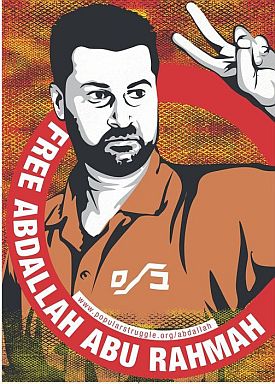
Israel’s effort to squash the popular struggle movement in the West Bank continues in military court

The Popular Struggle Coordination Committee in the West Bank just released a statement saying:

After ordering to keep Abdallah Abu Rahmah in detention past his release date on the 18th of November, the Military Court of appeals will deliver its verdict on the prosecution’s appeal demanding to aggravate the one-year sentence imposed on Abu Rahmah. The prosecution is asking the court to harshen the sentence so that it exceeds two years imprisonment.

Despite international outrage over the mishandling of Abu Rahmah, the prosecution openly argues that the sentence should be extended for political reasons, namely “to serve as a deterrence not only to [Abu Rahmah] himself, but also to others who may follow in his footsteps.” Abdallah Abu Rahmah served as the coordinator of the Bil’in Popular Committee Against the Wall and Settlements, until his arrest last year. Such arguments by the prosecution expose the real motivation behind the countless arrests of anti-Wall organizers and activists recently which is to squash the popular struggle movement in the West Bank.

On October 11th, Abu Rahmah was sentenced to twelve months imprisonment for his prominent role in his village’s successful campaign against the construction of Israel’s Separation Barrier on its lands. Abu Rahmah was convicted of two Freedom of Expression charges – incitement and organizing illegal demonstrations, but was cleared of all charges connecting him with direct violence.

Abu Rahmah was to be released from prison on November 18th, when the prison term he was sentenced to ended, but was kept in jail on the order of the Military Court of Appeals. The controversial decision directly conflicts with the jurisprudence of the Israeli Hight Court on the issue, instructing that a prisoner should only be kept under arrest after his term was over in the most extenuating of circumstances.

Abu Rahmah was declared a human rights defender by the European Union, and his conviction and sentence generated international outrage, and was denounced by human rights organizations and the international community alike, including EU foreign policy chief, Catherine Ashton.

Background
Abu Rahmah, the coordinator of the Bil’in Popular Committee Against the Wall and Settlements, was arrested last year by soldiers who raided his home at the middle of the night and was subsequently indicted before an Israeli military court on unsubstantiated charges that included stone-throwing and arms possession. Abu Rahmah was cleared of both the stone-throwing and arms possession charges, but convicted of organizing illegal demonstrations and incitement.

An exemplary case of mal-use of the Israeli military legal system in the West Bank for the purpose of silencing legitimate political dissent, Abu Rahmah’s conviction was subject to harsh international criticism. The EU foreign policy chief, Catherine Ashton, expressed her deep concern “that the possible imprisonment of Mr Abu Rahma is intended to prevent him and other Palestinians from exercising their legitimate right to protest[…]”, after EU diplomats attended all hearings in Abu Rahmah’s case. Ashton’s statement was followed by one from the Spanish Parliament.

Renowned South African human right activist, Archbishop Desmond Tutu, called on Israel to overturn Abu Rahmah’s conviction on behalf of the Elders, a group of international public figures noted as elder statesmen, peace activists, and human rights advocates, brought together by Nelson Mandela. Members of the Elders, including Tutu, have met with Abu Rahmah on their visit to Bil’in prior to his arrest.

International human rights organization Amnesty International condemned Abu Rahmah’s conviction as an assault on the right to freedom of expression. Human Rights Watch denounced the conviction, pronouncing the whole process “an unfair trial”.

Israeli organizations also distributed statements against the conviction – including a statement by B’Tselem which raises the issue of questionable testimonies by minors used to convict Abu Rahme, and The Association for Civil Rights in Israel (ACRI) which highlights the impossibility of organizing legal demonstrations for Palestinians in the West Bank.

Legal Background
Abu Rahmah, the coordinator of the Bil’in Popular Committee Against the Wall and Settlements, was acquitted of two out of the four charges brought against him in the indictment – stone-throwing and a ridiculous and vindictive arms possession charge. According to the indictment, Abu Rahmah collected used tear-gas projectiles and bullet casings shot at demonstrators, with the intention of exhibiting them to show the violence used against demonstrators. This absurd charge is a clear example of how eager the military prosecution is to use legal procedures as a tool to silence and smear unarmed dissent.

The court did, however, find Abu Rahmah guilty of two of the most draconian anti-free speech articles in military legislation: incitement, and organizing and participating in illegal demonstrations. It did so based only on testimonies of minors who were arrested in the middle of the night and denied their right to legal counsel, and despite acknowledging significant ills in their questioning.

The court was also undeterred by the fact that the prosecution failed to provide any concrete evidence implicating Abu Rahmah in any way, despite the fact that all demonstrations in Bil’in are systematically filmed by the army.

Under military law, incitement is defined as “The attempt, verbally or otherwise, to influence public opinion in the Area in a way that may disturb the public peace or public order” (section 7(a) of the Order Concerning Prohibition of Activities of Incitement and Hostile Propaganda (no.101), 1967), and carries a 10 years maximal sentence.

Facebooktwittermail

The myth of “Good Israel” vs. “Bad Israel”

Liberal Zionists like Jeffrey Goldberg want to believe Israel is being corrupted by a number of course trends whose combined influence now threatens the secular democratic Israel that supposedly once represented a more authentic expression of the Jewish state.

Goldberg says:

I’m speaking here of four groups, each ascendant to varying degrees: The haredim, the ultra-Orthodox Jews, whose community continues to grow at a rapid clip; the working-class religious Sephardim — Jews from Arab countries, mainly — whose interests are represented in the Knesset by the obscurantist rabbis of the Shas Party; the settler movement, which still seems to get whatever it needs in order to grow; and the million or so recent immigrants from Russia, who support, in distressing numbers, the Putin-like Avigdor Lieberman, Israel’s foreign minister and leader of the “Israel is Our Home” party.

Noam Sheizaf writes:

This is a return to the old “good Israel” vs. “Bad Israel” theory. According to this idea, there are the peace-loving, democratic and liberal Israeli Jews, who represent the “real” values on which the country was born, and there are the “bad”, Sephardic Jews, Ultra-orthodox and Russian immigrants, who are to blame for all the current hiccups what was a model democracy until not that long ago. Goldberg is actually angry with them for taking away “his” Israel. I think he represents many in saying that

the Israel that I see today is not the Israel I was introduced to more than twenty years ago. The rise to power of the four groups I mentioned above has changed, in some very serious ways (which I will write about later) the nature and character of the Jewish state.

Let’s not deal with what some see as latent racism in these assumptions (I don’t think this is the case with Goldberg), and talk politics instead. First, Shas, is actually weaker than at any point since the mid nineties. The party is going through an internal crisis (some say it will split once its spiritual leader, Ovadia Yosef, passes away). The other Orthodox party, United Torah Judaism, has five seats – roughly the same number it always had. As for Avigdor Lieberman, the conventional wisdom is that only 60-something percent of his votes were from Russian immigrants and the rest came from ordinary middle class Jews. Pollsters claim that those middle class voters are the reason for Lieberman’s rise in the last elections (and probably, in the next ones).
We are left with Goldberg’s favorite target, the settlers. Contrary to the common belief, the settlers are also weaker than ever: the National Religious Party, which used to represent their interests, split into two, and the only real hard-core, rightwing party (The National Unity) has only four Knesset seats and was left out of the government by Netanyahu.

So, If the settlers and the orthodox might be so weak– or at least, not stronger than ever – how come we end up with the most racist, rightwing Knesset in the country’s history?

The answer is as simple as it is unpleasant: it’s Israel’s “good guys” that turned bad – and maybe they weren’t that good in the first place. The Israeli middle class, the good ole’ boys, are the ones supporting the racist bills in the Knesset and the anti-democratic initiatives. In other words, we always had Rabbis like Shmuel Eliyahu and members of Knesset like Kahane’s student Michael Ben-Ari. The difference is that now, we have Kadima and Likud backing them.

Facebooktwittermail