
Why is it that a country that defines itself in terms of existential threats and the need to provide a safe refuge for the Jewish people, nevertheless seems strangely remiss in securing its own autonomy?
 Even if Israel stands out as the preeminent military power in the Middle East, it has only been able to acquire this status through its dependence on the United States. It often masks that dependence by behaving like a brash teenager who is secretly terrified by the thought of leaving home.
Last week, Rabbi Ovadia Yosef, the former Sephardi Chief Rabbi of Israel and spiritual leader of the Shas party — part of Netanyahu’s ruling coalition — made his latest inflammatory statement. In August Yosef called for the annihilation of the Palestinian people. This time he showed his contempt for humanity — at least that rather large portion which happens not to be Jewish, the Goyim.
Goyim were born only to serve us. Without that, they have no place in the world; only to serve the People of Israel …Why are gentiles needed? They will work, they will plow, they will reap. We will sit like an effendi [lord] and eat…
Yosef’s comments and the lack of censure they received from Israeli politicians, drew swift criticism from the Anti-Defamation League (ADL) Director Abraham Foxman and David Harris, executive director of the American Jewish Committee. Foxman warned that this might have a detrimental effect on Israel’s relations with American Jewry.
While leaders of the American Jewish community acknowledged the damage Yosef’s words could cause, they did not attempt to analyse them.
The Israeli-born anti-Zionist activist and musician, Gilad Atzmon suffers no such reservations.
In just a few words Rabbi Yossef expresses the depth of Judaic contempt towards labour.
The senior Rabbi provides us with a devastating glimpse into the Judaic alienation from these aspects of the human condition and human experience. In an unequivocal manner, Rabbi Yosef depicts a clear dichotomy: Jews are the master race and the Goyim are nothing but a work force. The Goyim are there to sweat and struggle while the Jew is ‘sitting’ and ‘eating.’ I guess that Rabbi Yossef has managed, in just a few words, to portray the intrinsic relationships between Judaism and Capitalism.
But in fact, Rabbi Yossef didn’t invent anything new here — his Saturday sermon sounds familiar enough to me. Karl Marx in his paper “On The Jewish Question,” identified aspects of Jewish ideology at the heart of Capitalism: “It is mankind (both Christians and Jews) that needs to emancipate itself from Judaism.”
Marx managed to identify an inclination towards exploitation at the heart of Jewish culture.
However, being a humanist, Marx wanted to believe that mankind (Jews and others) could overcome this tendency. Many early Zionists too, were also convinced that in Zion, Jews would liberate themselves and eventually become a nation like other nations, through productivity and labour.
Seemingly though, Rabbi Ovadia Yosef is not that impressed with either Marx, or some of the ideals within the early Zionist dream: Rabbi Yossef is brave (or foolish) enough to sketch the inherent bond between Jewish culture and Capital.
The only question that is still open is, for how long can the rest of humanity tolerate that kind of Rabbinical arrogance?
Meanwhile, the publication of a “millionaire’s list” last week, revealed Netanyahu’s complete dependence on foreign money for his fundraising efforts. His office in an attempt to explain his donor preferences released a statement in which they made the implausible claim: “His approach is that funds should be raised abroad so as not to put anyone in a potential conflict of interests, and this is the reason he prefers donations from abroad.”
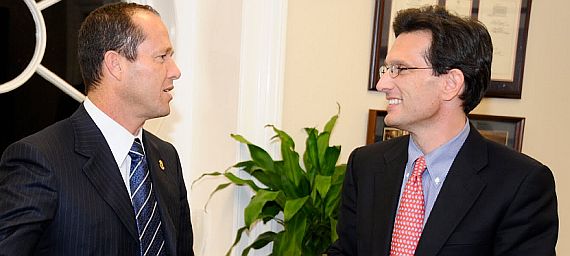
On Capitol Hill, U.S. Rep. Eric Cantor, the Republican whip and the only Jewish Republican in the House of Representatives, is concerned that a GOP-led Congress which aims to cut foreign aid could make Israel vulnerable, since it receives more aid than any other country. A possible solution would be that aid to Israel be part of the US defense budget, adding new meaning to the idea that Israel and US interests are indivisible.
Israel demands that it be recognized as a Jewish state by the Palestinians. “Affirmation of Israel’s Jewishness…, is the very foundation of peace, its DNA,” says Israel’s ambassador to the US, Michael Oren. Yet in the shadow of this fixation on Jewish identity, we see a singular lack of interest in autonomy expressed through a religious leader’s contempt for work, a prime minister’s appetite for foreign money, and a Congressman’s concern that the umbilical chord tying Israel to the US not suffer any interruption or constriction in the steady supply of US tax dollars required for supporting the Jewish state.
Where in this condition is any understanding of the real meaning of sovereignty? Might not Israel’s greatest existential threats be the ones of its own making?







 What kind of institutional entity do the hacks in Washington constitute such that they can have a “dean”?
 When
When 


 On that basis, it’s easy to adopt a live-and-let-live philosophy — well encapsulated in the COEXIST bumper sticker — in which tolerance is a kind of benign indifference. But coexistence in healthily functioning pluralistic societies must really go much further.
