Category Archives: Issues

Speculation dismounts on Obama Middle East peace plan

I claim no special knowledge of the inside workings of the Obama administration — merely an ear that notes the difference between substance and flatulence and to my ear what sounded like a farting contest started on April 7 with a column by David Ignatius: “Obama weighs new peace plan for the Middle East.”

According to Ignatius — which is to say, according to the nameless officials he had been talking to — Obama was “seriously considering” proposing a peace plan. Chatter, chatter, chatter.

Even as late as Thursday, Ignatius wasn’t ready to completely pull the plug on the story he’d started. After all, one of the primary reasons it had been taken so seriously was because it came from such an august columnist. A Middle East peace plan is on Obama’s foreign policy checklist and he’s “still working on it,” Ignatius wrote last week.

Even yesterday, Agence France Press reported: “Washington’s foreign policy echo chamber is reverberating with speculation that President Barack Obama could try to blow open the deadlock between Israelis and Palestinians with his own peace plan.”

Enough. The man has now spoken — Rahm Emanuel, that is.

The Jewish Telegraph Agency reports:

The time is not ripe for a U.S.-promoted Middle East peace plan, President Obama’s chief of staff said.

“A number of people have advocated that,” Rahm Emanuel said Monday on the Charlie Rose show on Bloomberg Television.

“That time is not now,” Emanuel said. The “time now is to get back to the proximity talks, have those conversations that eventually will lead to direct negotiations…”

I guess George Mitchell can carry on snoozing in the back of his limo as he waits to start shuttling between Jerusalem and Ramallah.

Facebooktwittermail

Nuclear terrorism and climate change

Graham Allison, who has for years been issuing graves warnings about the danger of nuclear terrorism, writes about last week’s nuclear security summit in Washington:

With all the immediate challenges demanding President Obama’s attention today, his choice to invest so much of his own mind-share and political capital in an issue seemingly so remote is remarkable.

We are accustomed to the triumph of the urgent over the important. In assembling the largest number of heads of foreign governments by an American president since FDR invited leaders to San Francisco to create the United Nations, this president demonstrated his ability to distinguish between the vivid and the vital.

The question remains: So what? How is the world different today? How will it be different a year from now?

To score this undertaking, it is necessary to assess performance on four dimensions. First, what is the single largest national security threat to the lives of American citizens? Far-fetched as it still appears to many, President Obama’s answer is unambiguous. As he said Monday: Nuclear terrorism is “the single biggest threat to U.S. security, short term, medium term and long term.”

Nuclear terrorism — a bigger threat to American security than climate change? Hardly.

The critical difference is that unlike the threat of nuclear terrorism, with climate change there will probably be no singlular event that will result in any particular political leader being called to task to explain how they could have allowed this unfolding calamity to happen.

So when it comes to the exercises in self-protection that consume a significant amount of time and energy for the world’s political leaders, the issue of nuclear terrorism is indeed more vexing than climate change. Obama’s attention to this issue does not — at least as far as I’m concerned — indicate his willingness to distinguish between the vivid and the vital.

Facebooktwittermail

Iran’s nuclear capabilities

Thomas Schelling, a Nobel laureate and an expert in nuclear strategy, spoke at the New America Foundation in Washington last week.

Having recently attended the highly influential Herzliya Conference in Israel, Schelling said:

I was impressed with how many Israelis speculate that what Iran wants to do is to get just about where Japan is in terms of nuclear capability. Get to where they could have a few bombs in a few months, or maybe a few weeks, but not overtly test anything to prove they have it and maybe not to claim they have it.

I don’t know where the Iranians might get that idea, but I’d heard about it for a couple of years from Americans who study Iranian apparent nuclear policy and it strikes me as an idea that might not occur to the Iranians but it strikes me as a good idea. I don’t see any way to make them back down from where they are, but it might be possible to persuade them not to take the final step…

Israel’s President Shimon Peres, who also attended the Herzliya Conference yet lacks the slightest nuance in his assessment of Iran’s intentions, yesterday declared that Iran poses a threat to the whole civilized world.

“A threat to the peace of the Jewish people always carries the danger of turning into a threat to the civilized world as a whole,” Peres said in Jerusalem on Sunday.

That’s a statement eerily reminiscent of something the Israeli historian, Martin van Creveld, said a few years ago while referring to Israel’s own nuclear arsenal: “We have the capability to take the world down with us. And I can assure you that that will happen before Israel goes under.”

Which begs the question, given that Israel has an arsenal of several hundred nuclear weapons and Iran so far has none: Of which state should we be more afraid?

In considering the Iranian nuclear threat, there is another reason for thinking that the Iranians may well have calculated that attaining a nuclear capability without assembling a nuclear arsenal is in their best interests — not simply because of the international ramifications but because of the regime’s own internally complex and fractious power dynamics.

For Iran to actually acquire the bomb and not simply the means to produce it, begs difficult questions of command and control. Could the regime withstand a potential power struggle that might ensue over how weapons might be dispersed and under whose authority? The prospect of the Iranian Revolutionary Guards becoming Iran’s nuclear masters might be sufficiently galling to everyone outside the IRG, that nuclear capability appears as full a measure of nuclear power that the Islamic state can safely handle.

When it comes to assessing Iran’s nuclear intentions there is an abundance of evidence that it is indeed a rational actor and virtually none that it operates in the thrall of an apocalyptic vision of the future.

Facebooktwittermail

Who’s behind the Gates memo leak?

The New York Times reports on a “secret three-page memorandum” that Defense Secretary Robert Gates sent to National Security Adviser Gen James Jones in January, warning that “the United States does not have an effective long-range policy for dealing with Iran’s steady progress toward nuclear capability,” according to unnamed officials who leaked the information.

The narrative line here which is presumably the line which was being fed to the New York Times‘ ever-obliging reporters, was that the there are gaps in the US strategy for dealing with Iran’s nuclear ambitions. It’s far from clear that this was actually the thrust of Gates’ memo.

[I]n his memo, Mr. Gates wrote of a variety of concerns, including the absence of an effective strategy should Iran choose the course that many government and outside analysts consider likely: Iran could assemble all the major parts it needs for a nuclear weapon — fuel, designs and detonators — but stop just short of assembling a fully operational weapon.

In that case, Iran could remain a signatory of the Nuclear Nonproliferation Treaty while becoming what strategists call a “virtual” nuclear weapons state.

To say that the US lacks a strategy here, is itself a statement so vague as to be meaningless. It lacks a strategy to prevent Iran becoming a virtual nuclear state? Or it lacks a strategy for dealing with Iran in such an eventuality? Or it lacks a strategy for dealing with the fact that it may not actually know whether Iran has acquired this form of nuclear capability?

There is no indication in this account that the New York Times reporters saw the memo (and it seems reasonable to infer that they did not), so as is so often the case, it’s likely that the most significant detail in this story is the one that will not be revealed: the identity of the senior official who is the primary source of the narrative.

Was it Dennis Ross? He’d certainly fit the profile of someone in the administration who probably feels like it’s time to change the subject and shift attention away from Israel and back to Iran. As another US official recently told Laura Rozen, “He [Ross] seems to be far more sensitive to Netanyahu’s coalition politics than to U.S. interests.”

Facebooktwittermail

Kucinich: White House assassination policy is extrajudicial

Jeremy Scahill writes in The Nation:

There has been almost universal silence among Congressional Democrats on the Obama administration’s recently revealed decision to authorize the assassination of a US citizen, Anwar al-Awlaki. Al-Awlaki, who now lives in Yemen, has been accused of providing inspiration for Umar Farouk Abdulmutallab, the alleged “underwear bomber,” and Major Nidal Malik Hasan, the alleged Fort Hood shooter. In recent weeks, there has been a dramatic surge in US government chatter about the alleged threat posed by al-Awlaki, with anonymous US officials accusing him of directly participating in terror “plots” (his family passionately disputes this).

Several Democrats refused, through spokespeople, to comment on the assassination plan when contacted by The Nation, including Senator Russ Feingold and Representative Jan Schakowsky, both of whom serve on the Intelligence Committees. Representative Jane Harman, who serves on the Homeland Security Committee, said recently that Awlaki is “probably the person, the terrorist, who would be terrorist No. 1 in terms of threat against us.”

An issue related to this assassination plan that has thus far received no attention is its implications for the court martial of Nidal Malik Hasan. If Anwar al-Awlaki was arrested and brought back to the United States, he would undoubtedly be a key witness in Hasan’s trial, given the widely reported email correspondence between the Texas shooter and Awlaki. Won’t killing a potential witness prejudice the outcome of the trial?

Facebooktwittermail

US Army researchers: Why the Kandahar offensive could backfire

At Wired, Nathan Hodge reports:

The southern Afghan province of Kandahar trusts the Taliban more than the government. And that’s according to a survey commissioned by the U.S. Army.

Kandahar is expected to be the focal point of operations for U.S. and NATO troops this summer, but a poll recently conducted by the Army’s controversial social science program, the Human Terrain System (HTS), is warning that rampant local corruption, and a lack of security, could undermine coalition efforts to win the support of the local population.

Among other things, the survey’s authors warned that a lack of confidence in the Afghan government “sets conditions for a disenfranchised population to respond either by not supporting the government due to its inability to deliver improvements in the quality of life or, worse yet, by supporting the Taliban.”

Facebooktwittermail

An empire decomposed: American foreign relations in the early 21st century

A must-read speech on the militarization of American diplomacy, by Chas Freeman, former US ambassador to Saudi Arabia, and the first casualty in the Israel lobby’s efforts to rein in what in its early days might have looked like a dangerously independent Obama administration.

Americans are accustomed to foreigners following us. After all, for forty years, we led the industrial democracies against the former USSR and its captive entourage. After the Soviet collapse, we bestrode the world as its sole colossus. For a while, we imagined we could do pretty much anything we wanted to do on our own. This, in the opinion of some, made followers irrelevant and leadership unnecessary.
Still, on reflection, we thought things might go better with a garland of allies and a garnish of friends. So we accepted some help from NATO members and some other foreign auxiliaries in Afghanistan. And, when we marched into the ambush of Iraq, we recruited a few other nations eager to ingratiate themselves with us to tag along in what became known as “the coalition of the billing.” In the end, however, in Iraq, it came down to us and our faithful British collaborators. Then, without even a “yo! Bush,” the Brits too were gone. And when we looked for other allies to follow us back into Afghanistan, they weren’t there.

All this should remind us that power, no matter how immense, is not by itself enough to ordain leadership. Power must be informed by vision, guided by wisdom, and embodied in strategy if it is to inspire companions and followers. We’re a bit short of believers in our leadership these days, not just on the battlefields of West Asia but at global financial gatherings, the United Nations, meetings of the G-20, among human rights and environmental activists, in the world’s regions, including our own hemisphere, and so forth. There are few places where we Americans still enjoy the credibility and command the deference we once did. A year or so ago, we decided that military means were not always the best way to solve problems and that having diplomatic allies could really help do so. But it isn’t happening.

The excesses that brought about the wide-ranging devaluation of our global standing originate, I think, in our politically self-serving reinterpretation of the Cold War soon after it ended. As George Kennan predicted, the Soviet Union was eventually brought down by the infirmities of its system. The USSR thus lost its Cold War with America and our allies. We were still standing when it fell. They lost. We won, if only by default. Yet Americans rapidly developed the conviction that military prowess and Ronald Reagan’s ideological bravado — not the patient application of diplomatic and military “containment” to a gangrenous Soviet system — had brought us victory. Ours was a triumph of grand strategy in which a strong American military backed political and economic measures short of war to enable us to prevail without fighting. Ironically, however, our politicians came to portray this as a military victory. The diplomacy and alliance management that went into it were forgotten. It was publicly transmuted into a triumph based on the formidable capabilities of our military-industrial complex, supplemented by our righteous denunciation of evil.

Many things followed from this neo-conservative-influenced myth. One conclusion was the notion that diplomacy is for losers. If military superiority was the key to “victory” in the Cold War, it followed for many that we should bear any burden and pay any price to sustain that superiority in every region of the world, no matter what people in these regions felt about this. This was a conclusion that our military-industrial complex heard with approval. It had fattened on the Cold War but was beginning to suffer from enemy deprivation syndrome — that is, the disorientation and queasy apprehension about future revenue one gets when one’s enemy has irresponsibly dropped dead. With no credible enemy clearly in view, how was the defense industrial base to be kept in business? The answer was to make the preservation of global military hegemony our objective. With no real discussion and little fanfare, we did so. This led to increases in defense spending despite the demise of the multifaceted threat posed by the USSR. In other words, it worked.

Only a bit over sixty percent of our military spending is in the Department of Defense budget, with the rest hidden like Easter eggs in the nooks and crannies of other federal departments and agencies’ budgets. If you put it all together, however, defense-related spending comes to about $1.2 trillion, or about eight percent of our GDP. That is quite a bit more than the figure usually cited, which is the mere $685 billion (or 4.6 percent of GDP) of our official defense budget. Altogether, we spend more on military power than the rest of the world — friend or foe — combined. (This way we can be sure we can defeat everyone in the world if they all gang up on us. Don’t laugh! If we are sufficiently obnoxious, we might just drive them to it.) No one questions this level of spending or asks what it is for. Politicians just tell us it is short of what we require. We have embraced the cult of the warrior. The defense budget is its totem.

The rest of this speech can be read here. Thanks to War in Context reader Delia Ruhe for bringing this to my attention.

Facebooktwittermail

UC Berkeley divestment vote — it isn’t over yet

Cecilie Surasky, Deputy Director of Jewish Voice for Peace, reports on the coalition effort to pass a divestment bill at Berkeley. If passed, the bill would call on the University of California to withdraw its investments in companies that support the Israeli occupation of Palestinian territories.

After a ten-hour meeting, an earlier veto of the bill by the Senate president was not overturned but at this point this looks like a bump in the road rather than an effective roadblock. Support for divestment is overwhelming.

For anyone who was there last night and until 7:30 this morning when the forum ended, it was clear what the future looks like.

For one, the smart money is on the members of UC Berkeley’s Students for Justice with Palestine (SJP), the group leading this effort. They are a remarkable multi-ethnic group that seemingly includes every race, religion and ethnicity including Muslims and Jews, and Israelis and Palestinians. They are just brilliant thinkers and organizers and driven by a clear sense of justice and empathy. They spent a year researching and writing the divestment bill, and I can’t express how much I love and respect them and how much hope they make me feel. And there are students just like them on every other campus in the world.

Second, the feeling on campus and in the room was electric. We filled an enormous room that fits 900. Most stayed through the entire night. If you can imagine, the evening started with remarkable statements by divestment supporters Judith Butler, Holocaust survivor Hedy Epstein, Richard Falk, Hatem Bazian and George Bisharat. And then the extraordinary parade of students and community members who spoke on both sides of the issue until it was past sunrise.

And though the final vote still hangs in the balance, the fact remains that the vast majority of the Senate voted to divest. The bill garnered the support of some of the most famous moral voices in the world, a good chunk of the Israeli left (9 groups and counting), nearly 40 campus groups (almost all student of color groups and one queer organization) plus another 40 US off-campus groups.

In addition, the room was filled with Jewish divestment supporters of every age including grandmothers and aunts and uncles and students. Our staff, activist members, and Advisory Board members like Naomi Klein, Judith Butler, Daniel Boyarin, Rabbi Lynn Gottlieb and Noam Chomsky each played critical roles in the effort. And of course, all of you who generated over 5,000 letters of support.

So much has changed since Gaza. Just 2 years ago we secured only 4 pages of Jewish endorsement letters for a similar selective divestment effort. This time, we put together 29 pages of major Jewish endorsement statements (which you can download here), and the list continues to grow by the day. We also made 400 bright green stickers that said “Another (fill in the blank) for human rights. Divest from the Israeli occupation” and gave every single last one away.

As attorney Reem Salahi said to me, “When I was a student here in law school 2 years ago, no one spoke about divestment. Now everyone is talking about it.”

For those of us there, it was clear–the room was with divestment. The senators were with divestment. And given the endorsements that kept pouring in up to the last second, from Nobel prize winners, from Israeli peace groups, from leading academics and activists–it seemed like the whole world was with divestment.

Facebooktwittermail

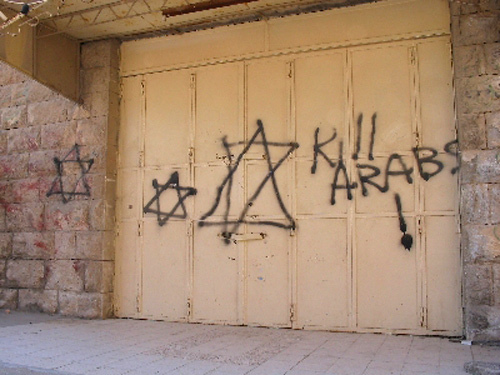
Is the Star of David the new swastika?

Salon‘s headline (which I also used) is unusually daring for a popular publication. The article’s author, Judy Mandelbaum, draws attention to a phenomenon otherwise ignored by the American media: the use of the Star of David as an expression of Jewish hatred.

Time was when Nazis used to slather swastikas on synagogues and Jewish businesses to prepare the local population for expulsion or much worse. It’s sad that this sort of behavior persists around the world, as a new study by Tel Aviv University shows. But it’s even sadder to see Israelis regularly defacing Palestinian property with Stars of David with equal glee and with what appears to be the same brain-dead mindset.

Your local paper might not have covered it, but in the wee hours of Wednesday morning a gang of Israeli settlers attacked the West Bank village of Hawara. “Palestinians reported two torched cars on the village’s central road early yesterday,” Haaretz writes. “A small village mosque, used only on the weekend, had the word ‘Muhammad’ sprayed in Hebrew and a Star of David. Haaretz also found graffiti with the Jewish prayer ‘Praise be onto him for not making me a gentile.'” The attackers also took the opportunity to destroy some three hundred olive trees, a major source of local income.

Facebooktwittermail

Obama’s indiscriminate killing program

In The Price of Assassination, Robert Wright reflects on the pitfalls of President Obama’s policy of so-called targeted killing.

Wright comes closest to hitting the right target when he says:

Terrorists are nourished ultimately by a grass-roots sense of injustice.

And one good way to stoke a sense of injustice is to fire missiles into cars, homes and offices in hopes of killing terrorists, while in fact killing no few innocent civilians. Estimates of the ratio of civilians to militants killed are all over the map — 50 to 1 or 10 to 1 or 1 to 2 or 1 to 10 — but the estimate of the Pakistani people, which is all that matters, tends toward the higher end.

The higher end is actually off the scale that Wright cites since he only looks at American sources. And since it seems reasonable to assume that the Pakistanis count their own dead more carefully than Americans do, the high end, as reported by Dawn newspaper, may also be a more accurate count and measure of the accuracy of Obama’s targeted killing program: 140 innocents civilians killed each time an al Qaeda or Taliban “target” was hit in 2009.

Any policy of targeted killing — whether conducted by the US or Israel — faces an obvious problem that must surely have given rise to the name, targeted killing. These actions result in a significant amount of indiscriminate killing, yet indiscriminate killing is, we are constantly reminded, the province of terrorism.

So how does a state counter the charge that its methods mirror those of terrorists? By claiming — without much foundation — that the carnage it causes is precise. We are highly discriminating killers who hit our targets with pinpoint accuracy — pinpoints that often turn out to be occupied by an unfortunate number of untargeted people.

But to turn to another of Wright’s points — that terrorists are nourished by a grass-roots sense of injustice — here he glides over the issue that the very term terrorism is designed to conceal: that just causes very often spawn acts of violence and that those engaged in this violence are genuinely dedicated to those causes, not merely being nourished by them.

In other words, by invoking the word terrorism we refuse to look at its political roots. And even in those cases where a just political cause is widely acknowledged — such as with the Palestinian national movement — we imagine that its violent manifestations can be legitimately marginalized rather than seen as a compelling gauge of the depth of the grievance.

Facebooktwittermail

Obama ain’t no Spock

A US resolution to the Middle East conflict has become a national imperative and a logical necessity. Therefore it will happen.

At least it would if we lived in a world governed by logic…

I confess I don’t pay unswerving attention to everything that’s happening in Washington, so when I saw a headline in today’s New York Times, Obama Speech Signals a U.S. Shift on Middle East, my first reaction was: Huh. Obama gave a speech on the Middle East and I never even heard it was scheduled. How about that?

Then I read the article to find out when and where he gave this speech but it wasn’t mentioned. Then I read the headline again. Aha! Caught again by those cunning New York Times headline writers – Obama speech, not Obama’s speech.

Why does the so-called newspaper of record have to be parsed as carefully as the Soviet Izvestia?

OK. So the speech in question turns out to be a phrase: “vital national security interest.” That being, the vital national security interest that will be served to the United States by a resolution to the Middle East conflict.

This does indeed mark an important shift in perspective. But here’s the real question: Will that shift in perspective lead to a significant shift in policy?

Generally speaking, to call something out as a “vital national security interest” should demand a bold course of action. You can’t point to a vital national security interest and then do little to address it, can you?

In the minds of many observers, the shift Obama has signaled, will almost inevitably lead to a US peace plan. “It increases the likelihood that Mr. Obama, frustrated by the inability of the Israelis and the Palestinians to come to terms, will offer his own proposed parameters for an eventual Palestinian state,” the Times reported.

But did anything else Obama said at the same juncture indicate that he’s ready to act decisively? No.

Progress will be halting, Obama said. Indeed.

Moreover, and this might have been the most telling remark he made: “we can’t want it more than they do.”

So, if resolving the Middle East conflict is a vital national security interest of the United States, the US will nevertheless be held hostage by the willingness of the Israelis and Palestinians to resolve the conflict.

We must, but we can’t…

I guess it won’t become a campaign slogan.

Facebooktwittermail

Obama: Middle East peace “is a very hard thing to do”

Amid swirling rumors and grand propositions, President Obama spoke yesterday on the so-called peace process and among peace-process professionals his words will be duly noted as an effort to “manage expectations”.

But for those of us who do not have an investment in the idea that the show must go on, what he said can be boiled down to this: Obama doesn’t see the necessary desire among the antagonists for the conflict to be resolved any time soon or under any amount of American pressure. No imposed US peace plan. No big speech in Jerusalem.

I think that the need for peace between Israelis and Palestinians and the Arab states remains as critical as ever.

It is a very hard thing to do. And I know that even if we are applying all of our political capital to that issue, the Israeli people through their government, and the Palestinian people through the Palestinian Authority, as well as other Arab states, may say to themselves, we are not prepared to resolve this — these issues — no matter how much pressure the United States brings to bear.

And the truth is, in some of these conflicts the United States can’t impose solutions unless the participants in these conflicts are willing to break out of old patterns of antagonism. I think it was former Secretary of State Jim Baker who said, in the context of Middle East peace, we can’t want it more than they do.

But what we can make sure of is, is that we are constantly present, constantly engaged, and setting out very clearly to both sides our belief that not only is it in the interests of each party to resolve these conflicts but it’s also in the interest of the United States. It is a vital national security interest of the United States to reduce these conflicts because whether we like it or not, we remain a dominant military superpower, and when conflicts break out, one way or another we get pulled into them. And that ends up costing us significantly in terms of both blood and treasure.

So I’m going to keep on at it. But I think on all these issues — nuclear disarmament, nuclear proliferation, Middle East peace — progress is going to be measured not in days, not in weeks. It’s going to take time. And progress will be halting. And sometimes we’ll take one step forward and two steps back, and there will be frustrations. And so it’s not going to run on the typical cable news 24/7 news cycle. But if we’re persistent, and we’ve got the right approach, then over time, I think that we can make progress.

And who will be most reassured by this message of persistent hope on the long and winding road to Middle East peace? Why, the Israelis of course. Surprise, surprise.

Facebooktwittermail

Why Netanyahu stayed away from Washington

There’s been plenty of speculation about Benjamin Netanyahu’s last-minute cancellation of his plan to attend the Nuclear Security Summit in Washington. The official explanation was that it was to avoid facing criticism from Turkey, Egypt and other Middle East states over Israel’s nuclear program. Such criticism was long anticipated so that was never a credible explanation, but maybe the real reason became apparent this afternoon when President Obama said Israel should sign the Nuclear Non-Proliferation Treaty.

This is what he said in a news conference:

Scott Wilson, Washington Post: You have spoken often about the need to bring U.S. policy in line with its treaty obligations internationally to eliminate the perception of hypocrisy that some of the world sees toward the United States and its allies. In that spirit and in that venue, will you call on Israel to declare its nuclear program and sign the Non-Proliferation Treaty? And if not, why wouldn’t other countries see that as an incentive not to sign on to the treaty that you say is important to strengthen?

President Obama: Well, Scott, initially you were talking about U.S. behavior and then suddenly we’re talking about Israel. Let me talk about the United States. I do think that as part of the NPT our obligation as the largest nuclear power in the world is to take steps to reducing our nuclear stockpile. And that’s what the START treaty was about — sending a message that we are going to meet our obligations.

And as far as Israel goes, I’m not going to comment on their program. What I’m going to point to is the fact that consistently we have urged all countries to become members of the NPT.

So there’s no contradiction there. We think it is important that we have a international approach that is universal and that rests on three pillars: that those of us who have nuclear weapons are making serious efforts to reduce those stockpiles; that we all are working against the proliferation of nuclear weapons and those countries that don’t currently have nuclear weapons make the decision not to pursue nuclear weapons; and that all countries have access to peaceful nuclear energy.

And so whether we’re talking about Israel or any other country, we think that becoming part of the NPT is important.

US Under Secretary of State for Arms Control and International Security Affairs Ellen Tauscher spoke with Deputy Foreign Minister Daniel Ayalon last week and said that the US was going to adopt a policy of “calculated ambiguity” towards friendly nuclear nations that are outside the NPT.

That calculated ambiguity may be exactly what spooked Netanyahu. In a play on Israel’s own policy (which is that it will not be the first country to introduce nuclear weapons to the Middle East), did the Obama administration merely promise the Israelis that at the summit the US would not “introduce” the topic of Israel’s need to sign the NPT?

Facebooktwittermail

Fighting American wars from on high

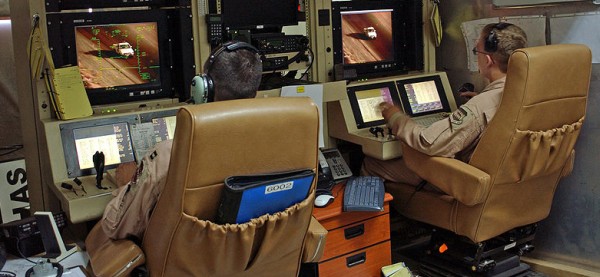
Tom Engelhardt reflects on the detachment with which the US military, operating from a position akin to that of Olympian gods, has turned people into targets:

[I]n the cities, towns, and villages of the distant lands where Americans tend to make war, civilians die regularly and repeatedly at our hands. Each death may contain its own uniquely nightmarish details, but the overall story remains remarkably repetitious. Such “incidents” are completely predictable. Even General McChrystal, determined to “protect the population” in Afghanistan as part of his counterinsurgency war, has proven remarkably incapable of changing the nature of our style of warfare. Curtail air strikes, rein in Special Operations night attacks — none of it will, in the long run, matter. Put in a nutshell: If you arrive from the heavens, they will die.

Having watched the video of the death of the 22-year-old Reuters photographer Namir Noor-Eldeen in that July 2007 video, his father said: “At last the truth has been revealed, and I’m satisfied God revealed the truth… If such an incident took place in America, even if an animal were killed like this, what would they do?”

Putting aside the controversy during the 2008 presidential campaign over the hunting of wolves from helicopters in Alaska, Noor-Eldeen may not have gone far enough. For that helicopter crew, his son was indeed the wartime equivalent of a hunted animal. An article on the front page of the New York Times recently captured this perspective, however inadvertently, when, speaking of the CIA’s aerial war over Pakistan’s tribal borderlands, it described the Agency’s unmanned drones as “observing and tracking targets, then unleashing missiles on their quarry.”

“Quarry” has quite a straightforward definition: “a hunted animal; prey.” Indeed, the al-Qaeda leaders, Taliban militants, and local civilians in the region are all “prey” which, of course, makes us the predators. That the majority of drones cruising those skies 24/7 and repeatedly launching their Hellfire missiles are named “Predators” should, then, come as no surprise.

Americans are unused to being the prey in war and so essentially incapable of imagining what that actually means, day in, day out, year after year. We prefer to think of their deaths as so many accidents or mistakes — “collateral damage” — when they are the norm, not the exception, not what’s collateral in such wars. We prefer to imagine ourselves bringing the best (of values and intentions) to a backward, ignorant world and so invariably make ourselves sound far kindlier than we are. Like the gods of Olympus, we have a tendency to flatter ourselves, even as we continually remake the “rules of engagement,” those ROEs, to suit our changing tastes and needs, while creating a language of war that suits our tender sensibilities about ourselves.

In this way, for instance, assassination-by-drone has become an ever more central part of the Obama administration’s foreign and war policy, and yet the word “assassination” — with all its negative implications, legal and otherwise — has been displaced by the far more anodyne, more bureaucratic “targeted killing.” In a sense, in fact, what “enhanced interrogation techniques” (aka torture) were to the Bush administration, “targeted killing” is to the Obama administration.

Facebooktwittermail

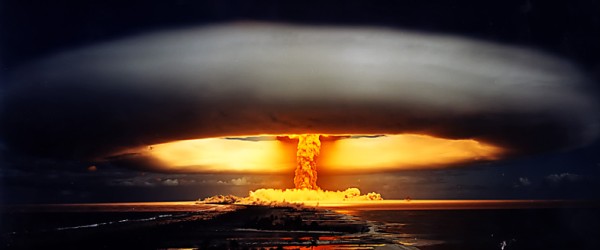
The nuclear paradox

Here’s how President Obama states the nuclear paradox:

The risk of a nuclear confrontation between nations has gone down, but the risk of a nuclear attack has gone up.

Here’s how I define it:

Hypothetical nuclear threats provoke more fear than real nuclear threats.

Nowhere is this paradox more evident than in Tel Aviv and Tehran.

Which city is currently in greater jeopardy of nuclear annihilation? Tehran.

Which city’s residents are repeatedly being told by their political leaders they should be afraid of nuclear annihilation? Tel Aviv’s.

So, to return to Obama’s assessment, when he says the risk of nuclear confrontation between nations has gone down, he’s saying something that’s both obvious and deceptive. What’s obvious is that the Cold War risk of a nuclear war between nuclear-armed states has diminished, but what he purposefully did not say is that the risk of any nuclear-armed state actually using its nuclear weapons has gone down.

The risk that Israel could use tactical nuclear weapons to destroy Iran’s nuclear facilities is real. I don’t believe that Israel is likely to do so because its current leadership — despite its willingness to engage in hyperbolic rhetoric — probably recognizes that the regional and global impact of the first use of nuclear weapons in warfare since 1945 would seal Israel’s fate as a pariah state.

Still, the risk that Israel might use nuclear weapons is indisputably greater than the risk of nuclear weapons being used by any organization or state that is not currently armed with such weapons.

The risk of nuclear terrorism should not be dismissed, but as Brian Michael Jenkins notes, it’s important to distinguish between nuclear terrorism and nuclear terror. In 2008 he wrote:

Will terrorists go nuclear? It is a question that worried public officials and frightened citizens have been asking for decades. It is no less of a worry today, as we ponder the seventh anniversary of 9/11.

Might Iran’s nuclear weapons ambitions lead eventually to arming Hizbollah or Hamas with nuclear weapons? Might a financially desperate North Korea sell the wherewithal for nuclear weapons to terrorist buyers? Might a political upheaval in always turbulent Pakistan put a nuclear weapon in the hands of extremists? Could there, ultimately, be a nuclear 9/11?

We have to take the long-shot possibility of nuclear terrorism seriously, but we must not allow ourselves to be terrorized by it.

Nuclear terrorism and nuclear terror reside in different domains. Nuclear terrorism is about a serious threat — the possibility that terrorists might somehow obtain and detonate a nuclear weapon — while nuclear terror is about the anticipation of that event. Nuclear terrorism is about terrorists’ capabilities, while nuclear terror is about imagination.

Fear is not free. Fear can pave the way for circumventing established procedures for the collection of intelligence, for attempts to operate outside the courts, and perhaps for torture. Distinguished scholars discuss the durability of the U.S. Constitution in the face of nuclear terrorism.

Frightened populations are intolerant. Frightened people worry incessantly about subversion from within. They worry about substandard zeal. Frightened people look for visible displays to confirm unity of belief–lapel pin patriotism.

Fear creates its own orthodoxy. It demands unquestioning obeisance to a determined order of apprehension.

During the Cold War an all-out nuclear exchange would have meant planetary suicide. Today, we face one tyrant in North Korea with a handful of nuclear weapons, an aspirant in Iran enthralled by first-use fantasies, and a terrorist organization with an effective propaganda machine-dangerous, vexing, but not the end of the world, not the end of the nation, not the end of a single city.

Undoubtedly, a terrorist nuclear explosion of any size would have a huge psychological impact on America. But whether it would lead to social anarchy would depend heavily on the attitudes of the nation’s citizens and the behavior and communications of its leadership.

We may not be able to prevent an act of nuclear terrorism. But we can avoid destroying our democracy as a consequence of nuclear terrorism.

Whether or not we as citizens yield to nuclear terror is our decision.

John Mueller from Ohio State University’s department of political science wrote last year:

The evidence of al-Qaeda’s desire to go atomic, and about its progress in accomplishing this exceedingly difficult task, is remarkably skimpy, if not completely negligible. The scariest stuff — a decade’s worth of loose nuke rumor — seems to have no substance whatever. For the most part, terrorists seem to be heeding the advice found in an al-Qaeda laptop seized in Pakistan: “Make use of that which is available … rather than waste valuable time becoming despondent over that which is not within your reach.”

As Mueller and Mark G. Stewart note in an article in the current edition of Foreign Affairs, if America’s counterterrorism policy was actually based on objective risk assessment, we’d understand that the risk al Qaeda poses to each American is about the same as the risk posed by kitchen appliances.

As a hazard to human life in the United States, or in virtually any country outside of a war zone, terrorism under present conditions presents a threat that is hardly existential. Applying widely accepted criteria established after much research by regulators and decision-makers, the risks from terrorism are low enough to be deemed acceptable. Overall, vastly more lives could have been saved if counterterrorism funds had instead been spent on combating hazards that present unacceptable risks.

This elemental observation is unlikely to change anything, however. The cumulative increased cost of counterterrorism for the United States alone since 9/11 — the federal, state, local, and private expenditures as well as the opportunity costs (but not the expenditures on the wars in Iraq or Afghanistan) — is approaching $1 trillion. However dubious and wasteful, this enterprise has been internalized, becoming, in Washington parlance, a “self-licking ice cream cone,” and it will likely last as long as terrorism does. Since terrorism, like crime, can never be fully expunged, the United States seems to be in for a long and expensive siege.

Facebooktwittermail

Yes we can… No you can’t

Zbigniew Brzezinski and Stephen Solarz write in the Washington Post:

More than three decades ago, Israeli statesman Moshe Dayan, speaking about an Egyptian town that controlled Israel’s only outlet to the Red Sea, declared that he would rather have Sharm el-Sheikh without peace than peace without Sharm el-Sheikh. Had his views prevailed, Israel and Egypt would still be in a state of war. Today, Prime Minister Binyamin Netanyahu, with his pronouncements about the eternal and undivided capital of Israel, is conveying an updated version of Dayan’s credo — that he would rather have all of Jerusalem without peace than peace without all of Jerusalem.

This is unfortunate, because a comprehensive peace agreement is in the interest of all parties. It is in the U.S. national interest because the occupation of the West Bank and the enforced isolation of the Gaza Strip increases Muslim resentment toward the United States, making it harder for the Obama administration to pursue its diplomatic and military objectives in the region. Peace is in the interest of Israel; its own defense minister, Ehud Barak, recently said that the absence of a two-state solution is the greatest threat to Israel’s future, greater even than an Iranian bomb. And an agreement is in the interest of the Palestinians, who deserve to live in peace and with the dignity of statehood.

However, a routine unveiling of a U.S. peace proposal, as is reportedly under consideration, will not suffice. Only a bold and dramatic gesture in a historically significant setting can generate the political and psychological momentum needed for a major breakthrough. Anwar Sadat’s courageous journey to Jerusalem three decades ago accomplished just that, paving the way for the Camp David accords between Israel and Egypt.

Similarly, President Obama should travel to the Knesset in Jerusalem and the Palestinian Legislative Council in Ramallah to call upon both sides to negotiate a final status agreement based on a specific framework for peace. He should do so in the company of Arab leaders and members of the Quartet, the diplomatic grouping of the United States, Russia, the European Union and the United Nations that is involved in the peace process. A subsequent speech by Obama in Jerusalem’s Old City, addressed to all the people in the region and evocative of his Cairo speech to the Muslim world in June 2009, could be the culminating event in this journey for peace.

Meanwhile, Aaron David Miller thinks the Obama administration seems intent on pushing Netanyahu out of the way.

There’s a widespread view — almost a conviction in Washington these days — that Netanyahu just isn’t capable of reaching a deal, and that the Palestinians and Arabs will never trust him. So why expend months of effort starting a process with Netanyahu that you can’t possibly conclude with him?

The remedy, if regime change is the goal, is to hang tough on settlements, create conditions for starting negotiations that are reasonable but that Netanyahu’s coalition can’t accept, and not-so-subtly suggest that Netanyahu can’t be a real partner in a peace process. The administration’s recent leak that it’s considering putting out its own peace plan will only further undermine any chance of partnership.

Sooner or later, the thinking goes, it would become clear in Israel that the prime minister can’t manage the nation’s most important relationship, and that he is putting settlements above Israeli security at a time when the Iranian threat looms large and close ties with the U.S. are more important than ever. The American hope would be that public and political pressure would mount, forcing Netanyahu to broaden his government or even impelling a change at the top.

The only problem with this line of thinking is that the odds of success are slim to none.

Facebooktwittermail

Respect — the currency of infinite value

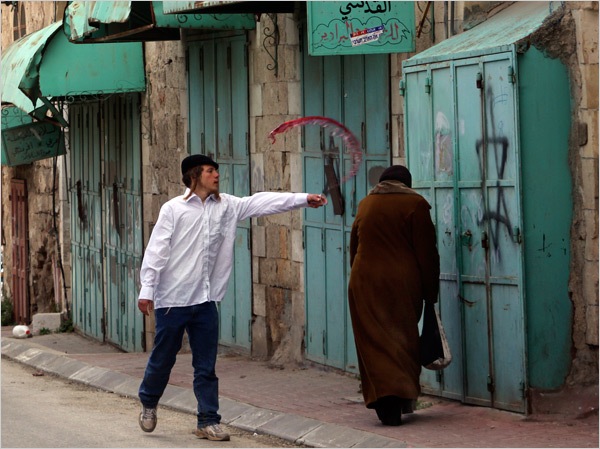
A Jewish settler tosses wine at a Palestinian woman on Shuhada Street in Hebron, the West Bank.

Four years ago, Rory Stewart wrote:

A great many of the failures in Afghanistan and Iraq arise from a single problem: the American-led coalitions’ lack of trust in local politicians. Repeatedly the Western powers, irritated by a lack of progress, have overruled local leaders, rejected compromises and tried to force through their own strategies. But the Westerners’ capacity is limited: they have little understanding of Afghan or Iraqi politics and rely too heavily on troops and money to solve what are fundamentally political and religious problems.

The coalitions cannot achieve political change in the absence of strong local support. And when they try to do so, they undermine their local allies. Iraqi and Afghan national and regional leaders have a far better understanding of the limits and possibilities of the local political scenes; they are more flexible and creative in finding compromises; and unlike the coalition officials, they are elected. They must be given real power and authority. This may seem an obvious prescription — but in fact the coalitions are not allowing it to happen.

Underneath the lack of trust that Stewart correctly identified, is a more fundamental issue: the hubris of power.

We have the guns, the cash, and represent the most powerful nation on Earth. You need to respect us but we really don’t need to respect you. Respect is something we expect but will also on occasions dish out if or when it seems expedient.

Americans, shaped by a culture that tends to place a higher value on power than anything else, are inclined to view respect as simply an element in a power equation. In one situation respect might seem essential, in another merely useful, and in yet another it can be dispensed with. Rarely is it held up as the most vital component in all human relationships.

After President Obama showed up in Kabul just over a week ago, President Karzai showed his uninvited guest and paymaster the courtesy of inviting him to dinner. Obama, the New York Times tells us, returned the courtesy with a thank-you note. “It was a respectful letter,” General James Jones, Obama’s national security adviser told reporters.

The significance of this incident, supposedly, is that it signals an overdue change in tone as the administration registers that its repeated admonitions of the Afghan president have proved counterproductive.

Ironically, an American president whose arrival in office was supposed to herald an historic shift in America’s approach to the world — one which would reinstate the value of soft power — has been a surprisingly clumsy diplomat.

So, if the White House now understands that it must not underestimate the value of respectfulness, that’s a good thing — but let’s not pretend a thank-you note is all it takes.

* * *

Respect is one of those words we use so often we rarely pause to consider its meaning. It describes an attitude, yet its latin root, specere, to look, indicates that this is really a form of attention.

To be respectful is to attentively incline oneself towards the other in recognition of their autonomy and integrity.

There is no one we can respect and simultaneously try to change. When we coerce or manipulate someone, we cannot respect them because our attention is focused not on them but on what we want.

If one views respect as a resource, nowhere is it generally more scarce than among the powerful.

The conceit of power is that power elicits respect, when in truth the tokens of respect bestowed on the powerful are rarely more than expressions of fear, envy or duty. (Hence an underlying paranoia haunts the powerful: they know they are the beneficiaries of a social investment that could, if things turn sour, be swiftly withdrawn.)

Respect is not the fruit of power, but on the contrary, it is a self-propagating virtue that becomes mirrored through its own expression.

Meanwhile, behind what might sound like an overly abstract reflection on respect, another topic floating in the background is Israel, since if one drills to the core of the Middle East conflict, it cannot be reduced to land or religion. It’s about respect.

Can Jews who claimed their “birthright” by dispossessing hundreds of thousands of Palestinians, somehow make peace with those people and their descendants without also acknowledging the Palestinians’ rights to dignity and respect? Yet can such respect be conferred without also calling into question the legitimacy of the Jewish state?

Where is the actual ground for mutual respect when the affirmation of one people’s rights has for six decades depended on the denial of another’s?

Facebooktwittermail

Israeli military order will enable mass deportation from West Bank

For those of us who in a practical sense really don’t know what it means to be living under a military occupation, “the occupation” — as Israel’s military control of the West Bank has come to be known — has after 43 years acquired an ambiance of normality. Yet as an Israeli such as Michel Warschawski understands, to be living under occupation, resonates for many Jews with their own experience of living in German-occupied Europe.

Amira Hass now reports on the latest move to impose punitive regulations on the Palestinian residents of the West Bank.

A new military order aimed at preventing infiltration will come into force this week, enabling the deportation of tens of thousands of Palestinians from the West Bank, or their indictment on charges carrying prison terms of up to seven years.

When the order comes into effect, tens of thousands of Palestinians will automatically become criminal offenders liable to be severely punished.

Given the security authorities’ actions over the past decade, the first Palestinians likely to be targeted under the new rules will be those whose ID cards bear home addresses in the Gaza Strip – people born in Gaza and their West Bank-born children – or those born in the West Bank or abroad who for various reasons lost their residency status. Also likely to be targeted are foreign-born spouses of Palestinians.

Until now, Israeli civil courts have occasionally prevented the expulsion of these three groups from the West Bank. The new order, however, puts them under the sole jurisdiction of Israeli military courts.

The new order defines anyone who enters the West Bank illegally as an infiltrator, as well as “a person who is present in the area and does not lawfully hold a permit.” The order takes the original 1969 definition of infiltrator to the extreme, as the term originally applied only to those illegally staying in Israel after having passed through countries then classified as enemy states – Jordan, Egypt, Lebanon and Syria.

The order’s language is both general and ambiguous, stipulating that the term infiltrator will also be applied to Palestinian residents of Jerusalem, citizens of countries with which Israel has friendly ties (such as the United States) and Israeli citizens, whether Arab or Jewish. All this depends on the judgment of Israel Defense Forces commanders in the field.

The Hamoked Center for the Defense of the Individual was the first Israeli human rights to issue warnings against the order, signed six months ago by then-commander of IDF forces in Judea and Samaria Area Gadi Shamni.

Two weeks ago, Hamoked director Dalia Kerstein sent GOC Central Command Avi Mizrahi a request to delay the order, given “the dramatic change it causes in relation to the human rights of a tremendous number of people.”

According to the provisions, “a person is presumed to be an infiltrator if he is present in the area without a document or permit which attest to his lawful presence in the area without reasonable justification.” Such documentation, it says, must be “issued by the commander of IDF forces in the Judea and Samaria area or someone acting on his behalf.”

The instructions, however, are unclear over whether the permits referred to are those currently in force, or also refer to new permits that military commanders might issue in the future. The provision are also unclear about the status of bearers of West Bank residency cards, and disregards the existence of the Palestinian Authority and the agreements Israel signed with it and the PLO.

The order stipulates that if a commander discovers that an infiltrator has recently entered a given area, he “may order his deportation before 72 hours elapse from the time he is served the written deportation order, provided the infiltrator is deported to the country or area from whence he infiltrated.”

The order also allows for criminal proceedings against suspected infiltrators that could produce sentences of up to seven years. Individuals able to prove that they entered the West Bank legally but without permission to remain there will also be tried, on charges carrying a maximum sentence of three years. (According to current Israeli law, illegal residents typically receive one-year sentences.)

The new provision also allow the IDF commander in the area to require that the infiltrator pay for the cost of his own detention, custody and expulsion, up to a total of NIS 7,500.

The fear that Palestinians with Gaza addresses will be the first to be targeted by this order is based on measures that Israel has taken in recent years to curtail their right to live, work, study or even visit the West Bank. These measures violated the Oslo Accords.

According to a decision by the West Bank commander that was not backed by military legislation, since 2007, Palestinians with Gaza addresses must request a permit to stay in the West Bank. Since 2000, they have been defined as illegal sojourners if they have Gaza addresses, as if they were citizens of a foreign state. Many of them have been deported to Gaza, including those born in the West Bank.

Currently, Palestinians need special permits to enter areas near the separation fence, even if their homes are there, and Palestinians have long been barred from the Jordan Valley without special authorization. Until 2009, East Jerusalemites needed permission to enter Area A, territory under full PA control.

Another group expected to be particularly harmed by the new rules are Palestinians who moved to the West Bank under family reunification provisions, which Israel stopped granting for several years.

In 2007, amid a number of Hamoked petitions and as a goodwill gesture to Palestinian President Mahmoud Abbas, tens of thousands of people received Palestinian residency cards. The PA distributed the cards, but Israel had exclusive control over who could receive them. Thousands of Palestinians, however, remained classified as “illegal sojourners,” including many who are not citizens of any other country.

The new order is the latest step by the Israeli government in recent years to require permits that limit the freedom of movement and residency previously conferred by Palestinian ID cards. The new regulations are particularly sweeping, allowing for criminal measures and the mass expulsion of people from their homes.

The IDF Spokesman’s Office said in response, “The amendments to the order on preventing infiltration, signed by GOC Central Command, were issued as part of a series of manifests, orders and appointments in Judea and Samaria, in Hebrew and Arabic as required, and will be posted in the offices of the Civil Administration and military courts’ defense attorneys in Judea and Samaria. The IDF is ready to implement the order, which is not intended to apply to Israelis, but to illegal sojourners in Judea and Samaria.”


Facebooktwittermail