he lesson that Israel must learn from the Holocaust is that it can never get security through fences, walls and guns,” Archbishop Emeritus Desmond Tutu of South Africa told Haaretz Thursday.
Commenting on Prime Minister Benjamin Netanyahu’s statement in Germany Thursday that the lesson of the Holocaust is that Israel should always defend itself, Tutu noted that “in South Africa, they tried to get security from the barrel of a gun. They never got it. They got security when the human rights of all were recognized and respected.”
The Nobel Prize laureate spoke to Haaretz in Jerusalem as the organization The Elders concluded its tour of Israel and the West Bank. He said the West was consumed with guilt and regret toward Israel because of the Holocaust, “as it should be.”
“But who pays the penance? The penance is being paid by the Arabs, by the Palestinians. I once met a German ambassador who said Germany is guilty of two wrongs. One was what they did to the Jews. And now the suffering of the Palestinians.” Continue reading →
A little over 24 hours after the polls closed, President Obama stepped out on the White House South Lawn last week to pronounce the Afghanistan presidential elections something of a success.
“This was an important step forward in the Afghan people’s effort to take control of their future, even as violent extremists are trying to stand in their way,” Mr. Obama said. “I want to congratulate the Afghanistan people on carrying out this historic election.”
But now, as reports mount of widespread fraud in the balloting, including allegations that supporters of the Afghan president, Hamid Karzai, illegally stuffed ballot boxes in the south and ripped up ballots cast for his opponents, Mr. Obama’s early praise may soon come back to haunt him. [continued…]
The Obama administration is racing to demonstrate visible headway in the faltering war in Afghanistan, convinced it has only until next summer to slow a hemorrhage in U.S. support and win more time for the military and diplomatic strategy it hopes can rescue the 8-year-old effort.
But the challenge in Afghanistan is becoming more difficult in the face of gains by the Taliban, rising U.S. casualties, a weak Afghan government widely viewed as corrupt, and a sense among U.S. commanders that they must start the military effort largely from scratch nearly eight years after it began.
A turnaround is crucial because military strategists believe they will not be able to get the additional troops they feel they need in coming months if they fail to show that their new approach is working, U.S. officials and advisors say. [continued…]
If Israel attempts such a high-risk and destabilizing strike against Iran, President Obama will probably learn of the operation from CNN rather than the CIA. History shows that although Washington seeks influence over Israel’s military operations, Israel would rather explain later than ask for approval in advance of launching preventive or preemptive attacks. Those hoping that the Obama administration will be able to pressure Israel to stand down from attacking Iran as diplomatic efforts drag on are mistaken.
The current infighting among Iran’s leaders also has led some to incorrectly believe that Tehran’s nuclear efforts will stall. As Friday’s International Atomic Energy Agency report on Iran’s nuclear programs revealed, throughout the political crises of the last three months, Iran’s production rate for centrifuges has remained steady, as has its ability to produce uranium hexafluoride to feed into the centrifuges. [continued…]
International nuclear inspectors reported on Friday that Iran had significantly increased its ability to produce nuclear fuel over the summer, even while slowing the pace at which it was enriching the uranium that the West fears could one day fuel nuclear weapons.
The slowdown puzzled the inspectors, and Iran offered no clues about whether technical problems or political considerations accounted for its action.
Nonetheless, outside nuclear experts who dissected the agency’s latest report — a critical one because it comes just as the United States and its European allies are debating far more damaging sanctions against Iran — said that if Iran’s current stockpile of low-enriched uranium was further purified, it would have nearly two warheads’ worth of bomb fuel. [continued…]
Deep among the documents released to the ACLU on Monday afternoon was a curious memo dated 30 December 2004 and directed to Dan Levin, then acting head of the Justice Department’s Office of Legal Counsel. The fax cover sheet has a brief note, “Dan, a generic description of the process.” The name of the sender, based at the CIA, has been obliterated. You can view the document here.
The document provides a step-by-step manual for extraordinary renditions.
The process starts with “capture shock.” The detainee is subject to a medical examination prior to his flight. During the flight, the detainee is securely shackled, and is deprived of sight and sound through the use of blindfolds, earmuffs and hoods. [continued…]
In the spring of 2003, long before Abu Ghraib or secret prisons became part of the American vocabulary, a pair of recently hired lawyers at the American Civil Liberties Union noticed a handful of news reports about allegations of abuse of prisoners in American custody.
The lawyers, Jameel Jaffer and Amrit Singh, wondered: Was there a broader pattern of abuse, and could a Freedom of Information Act request uncover it? Some of their colleagues, more experienced with the frustrations of such document demands, were skeptical. One made a tongue-in-cheek offer of $1 for every page they turned up.
Six years later, the detention document request and subsequent lawsuit are among the most successful in the history of public disclosure, with 130,000 pages of previously secret documents released to date and the prospect of more. [continued…]
The founder of Blackwater USA deliberately caused the deaths of innocent civilians in a series of shootings in Iraq, attorneys for Iraqis suing the security contractor told a federal judge Friday.
The attorneys singled out Erik Prince, a former Navy SEAL who is the company’s owner, for blame in the deaths of more than 20 Iraqis between 2005 and 2007. Six former Blackwater guards were criminally charged in 14 of the shootings, and family members and victims’ estates sued Prince, Blackwater (now called Xe Services LLC) and a group of related companies.
“The person responsible for these deaths is Mr. Prince,” Susan L. Burke, an attorney for the plaintiffs, said in U.S. District Court in Alexandria. “He had the intent, he provided the weapons, he provided the instructions, and they were done by his agents and they were war crimes.” [continued…]
The United States has accused Pakistan of illegally modifying American-made missiles to expand its capability to strike land targets, a potential threat to India, according to senior administration and Congressional officials.
The charge, which set off a new outbreak of tensions between the United States and Pakistan, was made in an unpublicized diplomatic protest in late June to Prime Minister Yusuf Raza Gilani and other top Pakistani officials.
The accusation comes at a particularly delicate time, when the administration is asking Congress to approve $7.5 billion in aid to Pakistan over the next five years, and when Washington is pressing a reluctant Pakistani military to focus its attentions on fighting the Taliban, rather than expanding its nuclear and conventional forces aimed at India. [continued…]
Lahore’s High Court yesterday ordered that all restrictions be lifted on Dr AQ Khan, Pakistan’s infamous rogue nuclear scientist, believed by many to be the founder of a clandestine weapons proliferation network.
Acting on a petition filed by the scientist, the court said that as of August 28, Dr Khan was a “free man” and would no longer have to alert police to his whereabouts. The decision is likely to raise concern in the United States, where Dr Khan is still considered a proliferation risk.
“Of course I was delighted when my lawyer called me up to give me this good news,” Dr Khan said a few hours after the decision was announced. “I have been waiting for the day when I can move around easily and not be questioned and restricted at every step.” [continued…]
The highlight of Thursday’s event at the Heritage Foundation was analyst Marvin Weinbaum’s scathing review of the Afghan elections. Weinbaum, who served as a member of Barack Obama’s advisory task force on Afghanistan, is a former analyst for the State Department’s Bureau of Intelligence and Research (INR). His report on the election, where he served as an observer during the vote, contrasted sharply with the happy talk from the administration and from official and semi-official Afghan agencies who presented the vote as an inspiring exercise in democracy.
It wasn’t.
Weinbaum warned that the election was so grievously flawed that it may serve to further de-legitimize the regime of President Karzai. Turnout was abysmally low, with only about one-third of Afghans going to the polls, and in some districts — especially in the Pashtun-dominated south — perhaps between 5 and 15 percent of people voted, he said. On top of that, Weinbaum said, there is evidence of widespread fraud, and virtually all of the main opposition candidates are charging that the election was rigged. More than a thousand specific complaints have been lodged already, he said, adding that he himself saw properly marked ballots for opposition candidates that had been destroyed and left scattered along a roadside. He suggested that it’s likely that evidence of fraud and vote-rigging will emerge in the coming weeks, helping to convince Afghans that the election was illegitimate. [continued…]
Yesterday afternoon at the Brookings Institution, four analysts portrayed a bleak and terrifying vision of the current state of affairs in Afghanistan in the wake of the presidential election. All four were hawkish, reflecting a growing consensus in the Washington establishment that the Afghanistan war is only just beginning.
Their conclusions: (1) A significant escalation of the war will be necessary to avoid utter defeat. (2) Even if tens of thousands of troops are added to the US occupation, it won’t be possible to determine if the US/NATO effort is succeeding until eighteen months later. (3) Even if the United States turns the tide in Afghanistan, no significant drawdown of US forces will take place until five years have passed. [continued…]
The US special envoy to Afghanistan has held an “explosive” meeting with Afghan President Hamid Karzai over the country’s election, the BBC has learnt.
Richard Holbrooke raised concerns about ballot-stuffing and fraud, by a number of candidates’ teams, sources say.
The US envoy also said a second-round run-off could make the election process more credible, the sources said. [continued…]
Three interlocking factors shaped the Afghan election day: large disparities in turnout across the country; the threat of Taliban violence; and allegations, as yet largely unproved, of systematic electoral fraud on behalf of Mr Karzai. Western military commanders claimed that the Taliban had failed to disrupt the election, with only 26 people killed on polling day. But the Taliban’s strategy was one of intimidation, designed to deter rather than kill voters. In that they were successful.
During the poll there were some 400 insurgent incidents, making it the most violent day this year. Many seemed intended just to register the presence of insurgents in the area. In Wardak, for instance, a rocket landed in the general area of every polling centre. Threats to cut off fingers marked with the indelible ink used to prevent double voting turned out to be almost entirely baseless. But they worked as a deterrent.
In a relatively benign northern arc, from Herat in the west to Nangarhar in the east, turnout was as high as 60% in some areas, though in Nangarhar it fell to about 35%, and overall turnout was well below the level achieved in the previous presidential poll in 2004. In parts of the south, however, intimidation and apathy kept turnout extremely low. “The Taliban are patrolling the area. Nobody voted and nobody could vote,” said Haji Ahmad Shah Khan, an elder in Nad Ali district of Helmand. On election day the chief of the Independent Election Commission (IEC) in Helmand, Abdul Hadee, estimated turnout in the province at under 10%. In some districts no votes were cast at all. [continued…]
Western troops have killed far fewer Afghan civilians since the top U.S. general imposed strict new rules of engagement aimed at addressing one of the most contentious issues of the conflict, according to newly declassified U.S. military figures.
However, the data cover a relatively short period of eight weeks, and make it clear that civilians are still dying in large numbers, a pattern blamed in part on the Taliban’s campaign of violence surrounding last week’s national elections. [continued…]
State Department spokesman said on Friday that the Obama administration will be flexible on pre-conditions for all parties involved in Middle East peace negotiations.
“We put forward our ideas, publicly and privately, about what it will take for negotiations to be restarted, but ultimately it’ll be up to the parties themselves, with our help, to determine whether that threshold has been met,” spokesman P.J. Crowley said, adding that the U.S. position on an Israeli settlement freeze remains unchanged.
“Ultimately,” he added, “this is not a process by which the United States will impose conditions on Israel, on the Palestinian Authority, on other countries.
“We’re asking them to meet their commitments under the Roadmap, but most importantly, we’re asking them what they’re prepared to do and to demonstrate the steps that that they are prepared to take that allow us to have confidence that these negotiations can be restarted,” he said. Continue reading →
The chairman of the Joint Chiefs of Staff has written a searing critique of government efforts at “strategic communication” with the Muslim world, saying that no amount of public relations will establish credibility if American behavior overseas is perceived as arrogant, uncaring or insulting.
The critique by the chairman, Adm. Mike Mullen, comes as the United States is widely believed to be losing ground in the war of ideas against extremist Islamist ideology. The issue is particularly relevant as the Obama administration orders fresh efforts to counter militant propaganda, part of its broader strategy to defeat the Taliban and Al Qaeda in Afghanistan and Pakistan.
“To put it simply, we need to worry a lot less about how to communicate our actions and much more about what our actions communicate,” Admiral Mullen wrote in the critique, an essay to be published Friday by Joint Force Quarterly, an official military journal. [continued…]
he family of one of the youngest prisoners ever held at Guantanamo plans to sue the U.S. government to compensate him for mistreatment and an adolescence lost to nearly seven years in a cell, his lawyers said Thursday.
Mohammed Jawad returned to Afghanistan this week after a military judge ruled that he was coerced into confessing that he threw a grenade at an unmarked vehicle in the capital in 2002. The attack wounded two American soldiers and their interpreter.
Afghan police delivered Jawad into U.S. custody and about a month later he was sent to the U.S. detention center at Guantanamo Bay, Cuba.
Jawad and his family say he was 12 when he was arrested, and that he is now 19 years old. The Pentagon has said a bone scan showed he was about 17 when taken into custody. His defense lawyers decline to give an exact age for Jawad, who does not have a birth certificate, but say photos taken in Guantanamo showed that he had not gone through puberty. [continued…]
With the appointment of a prosecutor to investigate detainee abuses, long-simmering conflicts between the Central Intelligence Agency and the Justice Department burst into plain view this week, threatening relations between two critical players on President Obama’s national security team.
The tension between the agencies complicates how the administration handles delicate national security issues, particularly the tracking and capturing of suspected terrorists overseas. It also may distract Mr. Obama, who is trying to move beyond the battles of the Bush years to focus on an ambitious domestic agenda, most notably health care legislation.
The strains became evident inside the administration in the past several weeks. In July, Leon E. Panetta, the C.I.A. director, tried to head off the investigation, administration officials said. He sent the C.I.A.’s top lawyer, Stephen W. Preston, to Justice to persuade aides to Attorney General Eric H. Holder Jr. to abandon any plans for an inquiry. [continued…]
Iran’s political crisis could prevent the nation from making any swift move to ratchet up its nuclear program, said analysts and officials, giving President Obama and Western allies more time to grapple with the issue.
The chaos over the disputed reelection of hard-line President Mahmoud Ahmadinejad brings into question who calls the shots in Tehran, and what any deal with the Islamic Republic involving its nuclear program would look like.
The Obama administration, concerned that Tehran is seeking to amass the materials needed to manufacture nuclear weapons, set an informal deadline of September for Iran to respond positively to an offer to discuss the matter rather than risk new economic sanctions. [continued…]
Iran’s president called Friday for the prosecution of opposition leaders over the postelection turmoil, saying that senior activists currently on trial shouldn’t be the only ones punished.
Mahmoud Ahmadinejad’s call stepped up the pressure against reformers in the continuing unrest that has gripped the country following the June 12 presidential election.
“Serious confrontation has to be against the leaders and key elements, against those who organized and provoked [the riots] and carried out the enemy’s plan. They have to be dealt with seriously,” Mr. Ahmadinejad told a crowd of thousands in Tehran before Friday prayers. [continued…]
The Obama administration will largely preserve Bush-era procedures allowing the government to search — without suspicion of wrongdoing — the contents of a traveler’s laptop computer, cellphone or other electronic device, although officials said new policies would expand oversight of such inspections.
The policy, disclosed Thursday in a pair of Department of Homeland Security directives, describes more fully than did the Bush administration the procedures by which travelers’ laptops, iPods, cameras and other digital devices can be searched and seized when they cross a U.S. border. And it sets time limits for completing searches.
But representatives of civil liberties and travelers groups say they see little substantive difference between the Bush-era policy, which prompted controversy, and this one. [continued…]
It was a heated debate during the Bush administration: What to do about evidence that Afghanistan’s powerful defense minister was involved in drug trafficking? Officials from the time say they needed him to help run the troubled country. So the answer, in the end: look the other way.
Today that debate will be even more fraught for a new administration, for the former defense minister, Marshal Muhammad Qasim Fahim, stands a strong chance of becoming the next vice president of Afghanistan.
In his bid for re-election, President Hamid Karzai of Afghanistan has surrounded himself with checkered figures who could bring him votes: warlords suspected of war crimes, corruption and trafficking in the country’s lucrative poppy crop. But none is as influential as Marshal Fahim, his running mate, whose trajectory in and out of power, and American favor, says much about the struggle the United States has had in dealing with corruption in Afghanistan. [continued…]
This city is no stranger to bombings. There have been many here over the years of war. But the one on Tuesday night — the deadliest — may have done more than any other to deepen Kandahar’s sense of isolation and tip its people into despair that someone, anyone, has the power to halt the mayhem that surrounds them.
The bombing produced an entire city block of devastation, gutting shops and homes and reducing many of the structures to mounds of rubble. On Wednesday, residents searched at the scene and hospitals for missing loved ones, as the death toll rose to 41, with more than 60 wounded.
Abdul Nabi, 45, a shopkeeper, could find only two of his six sons in the wreckage. “I rushed to the hospital and found my sons in very bad condition,” he said. “Three of my sons are still unconscious. One 7-year-old son just opened his eyes now.
“To whom shall I complain?” he asked. [continued…]
2009 turned out to be a much more violent year [than 2004 when elections took place], with Taliban attacks reaching the heart of the capital and the Kabul administration and its international allies having lost credibility both in terms of delivering peace or improving the people’s living conditions. And yet millions of Afghans risked their lives, ventured out and cast their votes fully aware that voting meant taking a serious risk and knowing very well that the election would be fraudulent and the candidates most probably either lying or making empty promises. Afghan and international observers celebrate this as evidence that Afghanistan has moved forward and is no longer an essentially tribal society upon whom the West has imposed democracy by sheer force of military. In brief, a success story.
The recently published preliminary results based on a random sample of one million votes tell a different story. According to the sample, the people’s verdict has given rise to two leaders, Karzai closely followed by Abdullah Abdullah. In other words, a Pashtun leader followed closely by a half-Tajik leader with a majority Tajik support base. This is what analysts call “identity voting”. The preliminary results show that Karzai’s attempt at nation-building has failed and most Afghans’ loyalty lies first with their ethnic group, and then the nation as a whole. Karzai’s critics have repeatedly pointed out that his nation-building attempts have been largely superficial, consisting on throwing dinner parties for discredited leaders of ethnic and religious minority groups. In the words of presidential candidate Ramazan Bashardost, making a Hazara leader sit next to nomadic Pashtun leader at dinner is not exactly nation-building. The many mass graves scattered around the country bear witness to the ethnic rivalries that followed the Soviet army’s withdrawal from Afghanistan and led to the civil wars of the early 1990s. During the presidential election campaign, ex-Taliban commander turned candidate Mullah Rocketi was the only contender to openly admit that ethnic mistrust was the only reason why Afghans so easily became tools in the service of foreign powers and hence carried on fighting. Nation-building has a long way to go in Afghanistan but as economist Paul Collier argues, leaders must build a nation before they can build a state. [continued…]
The Taliban are attempting to exact revenge on Afghan voters and disrupt the ballot count — part of a campaign to exploit the political uncertainty after last week’s presidential election and try to undermine the results.
Since the Aug. 20 election, Taliban fighters have launched nearly a dozen attacks. They have severed the fingers of voters, stolen ballot boxes, and murdered government officials. Afghan police have been reluctant to move into Taliban-controlled areas to quell the violence. [continued…]
Relations between Iraq and Syria plunged abruptly on Tuesday after Baghdad recalled its ambassador to Damascus over the recent bombings in the Iraqi capital in which 100 Iraqis were killed.
The attacks, which ripped through government buildings on August 19, were the worst in Iraq in over 12 months and came just a day after Prime Minister Nuri al-Maliki wrapped up a state visit to Syria. While there he boosted political and economic relations with Syria and jump-started bilateral committees to see that security is strongly monitored on the Syrian-Iraqi border.
Since then, however, a tug-of-war has erupted within Iraq between those who blame al-Qaeda and the outlawed Ba’ath Party and those who blame Iran for the Black Wednesday attacks.
Maliki blames both, while Defense Minister Abdul Qadir Obeidi said the weapons used for the attacks had been “made in Iran”. Syria’s name emerged rather suddenly on Sunday, when a former policeman appeared on Iraqi state-run media, claiming responsibility for the attacks, saying they had been ordered by two Saddam loyalists based in Syria. [continued…]
One of the towering figures of post-Saddam Hussein Iraq, Abdul Aziz al-Hakim, a Shiite who had longstanding ties with Iran but was also a supporter of the American invasion, died on Wednesday.
His death from cancer, at age 59, was a blow to the political group he led, the Supreme Iraqi Islamic Council, which emerged from the war as the country’s dominant political party. But it has steadily lost support over the past year, and this week it announced a new alliance with the party loyal to the scion of another revered Shiite family, the anti-American cleric Moktada al-Sadr.
Still, Supreme Council members hold positions atop important ministries and in Parliament. The group runs charitable organizations, libraries and schools and has a large network of support that stretches back to when Mr. Hakim’s father, Grand Ayatollah Mohsen al-Hakim, was one of the top Shiite spiritual leaders in the world. [continued…]
It is increasingly clear that torture was Dick Cheney’s special project and that he was personally and deeply involved in it. And the CIA report has some amazing nuggets that show Cheney’s hand. In 2003, after Jay Bybee departed OLC, Cheney struggled to have John Yoo installed as his successor, but ultimately John Ashcroft’s candidate, Jack Goldsmith, prevailed. Goldsmith quickly backtracked on the torture authorizations that Yoo and Bybee gave. The result? The CIA stopped taking its cue from OLC and instead turned to the White House for guidance. It is remarkably vague on the particulars, and blackouts emerge just as passages seem to be getting interesting. But there’s little doubt that Dick Cheney and his staff were pushing the process from behind the scenes. [continued…]
The Justice Department prosecutor appointed this week to examine the CIA’s interrogation program will revisit long-dormant abuse cases involving the agency’s civilian contractors, bringing new attention to a little-known but controversial element of the Bush administration’s war on terrorism.
Civilian contractors used by the CIA at secret overseas facilities were accused of detainee abuses and deaths in a series of cases in the years following the U.S.-led invasions of Afghanistan and Iraq, but only one was ever prosecuted.
The contractors also played a key but secret role in the CIA’s interrogations of top Al Qaeda suspects at “black site” prisons overseas. [continued…]
Barack Obama is close to brokering an Israeli-Palestinian deal that will allow him to announce a resumption of the long-stalled Middle East peace talks before the end of next month, according to US, Israeli, Palestinian and European officials.
Key to bringing Israel on board is a promise by the US to adopt a much tougher line with Iran over its alleged nuclear weapons programme. The US, along with Britain and France, is planning to push the United Nations security council to expand sanctions to include Iran’s oil and gas industry, a move that could cripple its economy.
In return, the Israeli government will be expected to agree to a partial freeze on the construction of settlements in the Middle East. In the words of one official close to the negotiations: “The message is: Iran is an existential threat to Israel; settlements are not.” [continued…]
Editor’s Comment — A US-brokered Israeli-Palestinian deal – in other words, how Obama got shafted by Netanyahu and the Palestinians and Iran’s reformist movement got thrown under the bus, all for what? A little Clinton-era nostalgia in the form of a Rose Garden handshake between Netanyahu and Abbas while Rahm Emanuel gets to re-live the good old nineties?
Updated: Perhaps a hasty judgment on my part.
Laura Rozen writes: “In meetings with news editors in London Monday, Netanyahu seemed to describe Israeli and U.S. positions moving closer together on a settlements deal, policy towards Iran, and other issues, according to sources familiar with the discussion.”
I thus infer that The Guardian, having been honored to be able to sit at Bibi’s feet, thought that they should thereafter try and perform like his parrot.
The idea that the Obama administration can advance the Middle East peace process by having Israel freeze its construction of Jewish settlements in the West Bank stretches credulity.
Does any serious observer of the region believe that Israel’s appetite for land – owned and occupied for generations by Palestinians – is going to abate?
The Israeli land grab has continued for four decades, in defiance of international law and most US presidents. US Middle East envoy George Mitchell has been trying to secure a halt, but his efforts follow a well-worn path that typically ends in charade. [continued…]
Palestinian Prime Minister Salam Fayyad released a government plan Tuesday calling for the establishment of a de facto Palestinian state by the end of 2011 regardless of the outcome of negotiations with Israel.
The plan faces significant practical hurdles and raised worries that Mr. Fayyad was advocating the sort of unilateral actions toward statehood long opposed by the U.S. and Israel. Implementing it would mean overcoming likely Israeli opposition to key elements and Mr. Fayyad’s own weak domestic political standing, and would also require hefty financial-aid commitments from foreign donors, such as the U.S., European Union, and Arab states.
But the plan also reflected an unprecedented Palestinian emphasis on the nuts and bolts of self-rule. It lays out the broad outlines of a state on Palestinian lands occupied by Israel in 1967 with East Jerusalem as its capital, and details each government ministry and its functions. [continued…]
The expected release Thursday of a key United Nations report on Tehran’s nuclear program kicks off a month of international diplomacy that could severely test the Obama administration’s Iran policy, said U.S. and Western diplomats.
Washington and other Western powers are pressing Mohamed ElBaradei, director-general of the U.N.’s International Atomic Energy Agency, to include in the report a detailed summary of Tehran’s alleged efforts to weaponize its nuclear technologies, said these diplomats.
U.S. and other Western officials view the information as potentially crucial to the Obama administration’s efforts to rally international support for new economic sanctions on Tehran. President Barack Obama has set a late September deadline for Iran to respond to his calls for direct talks on the nuclear issue or face greater financial penalties.
Many U.S. and European officials who are focused on the IAEA, however, said they remain doubtful Mr. ElBaradei will include the summary Western countries want. Mr. ElBaradei will head his last Board of Governors meeting next month before handing power to Japan’s Yukiya Amano in November. [continued…]
Iranian prosecutors called for the death penalty in a mass trial of some of the country’s leading reformists, including six former ministers, who stand accused of fomenting riots in the wake of June’s disputed presidential elections.
The prosecution said that the men, including a key instigator of Iran’s reformist movement, had been plotting to topple the Islamic regime. It called the huge street demonstrations against alleged electoral fraud an attempt to stage a “soft coup” against the government.
Reformist critics denounced the proceedings as a “show trial”. It was the fourth mass trial so far in what opponents of the theocratic regime see as a concerted attempt to uproot all moderate opposition to the hardline leadership of President Mahmoud Ahmedinejad. [continued…]
An Iranian opposition leader on Monday released what he said was an account by a prisoner raped by his jailers in a challenge to the country’s leadership which has sought to silence claims of torture and abuses in the postelection crackdown.
The allegations of torture and even rapes against imprisoned opposition protesters have become a source of embarrassment to the government of President Mahmoud Ahmadinejad and Iran’s clerical leadership as they try to put behind them the turmoil of the disputed June presidential election. [continued…]
Ian, whose nuclear facilities are under threat of possible Israeli military strikes, has enlisted the support of more than 100 non-aligned nations in its push for a ban on such attacks.
The 118-nation Nonaligned Movement backs Tehran in a letter submitted to the International Atomic Energy Agency endorsing Iran’s plan to submit a resolution on the topic when IAEA nations meet next month. [continued…]
As security deteriorates in Baghdad, there’s a new cause for worry: The head of the U.S.-trained Iraqi National Intelligence Service (INIS) has quit in a long-running quarrel with Prime Minister Nouri al-Maliki — depriving that country of a key leader in the fight against sectarian terrorism.
Gen. Mohammed Shahwani, the head of Iraqi intelligence since 2004, resigned this month because of what he viewed as Maliki’s attempts to undermine his service and allow Iranian spies to operate freely. The CIA, which has worked closely with Shahwani since he went into exile in the 1990s and has spent hundreds of millions of dollars training the INIS, was apparently caught by surprise by his departure.
The chaotic conditions in Iraq that triggered Shahwani’s resignation are illustrated by several recent events — each of which suggests that without the backstop of U.S. support, Iraqi authorities are now desperately vulnerable to pressure, especially from neighboring Iran.
An early warning was the brazen July 28 robbery of the state-run Rafidain Bank in central Baghdad, apparently by members of an Iraqi security force. Gunmen broke into the bank and stole about 5.6 billion Iraqi dinars, or roughly $5 million. After a battle that left eight dead, the robbers fled to a newspaper run by Adel Abdul Mahdi, one of the country’s vice presidents.
Abdul Mahdi, once an American favorite, has admitted that one of the robbers was a member of his security detail but denied personal involvement, according to Iraqi news reports. Some of the money has been recovered, but the rest is believed to be in Iran, along with some members of the robbery team. [continued…]
Two 17-watt fluorescent-tube bulbs — no more, no less — illuminated each cell, 24 hours a day. White noise played constantly but was never to exceed 79 decibels. A prisoner could be doused with 41-degree water but for only 20 minutes at a stretch.
The Central Intelligence Agency’s secret interrogation program operated under strict rules, and the rules were dictated from Washington with the painstaking, eye-glazing detail beloved by any bureaucracy.
The first news reports this week about hundreds of pages of newly released documents on the C.I.A. program focused on aberrations in the field: threats of execution by handgun or assault by power drill; a prisoner lifted off the ground by his arms, which were tied behind his back; another detainee repeatedly knocked out with pressure applied to the carotid artery.
But the strong impression that emerges from the documents, many with long passages blacked out for secrecy, is by no means one of gung-ho operatives running wild. It is a portrait of overwhelming control exercised from C.I.A. headquarters and the Department of Justice — control Bush administration officials say was intended to ensure that the program was safe and legal. [continued…]
Editor’s Comment — An obsessive allegiance to bureaucratic process — this is the indelible signature of a human being unwilling to accept personal responsibility for their own actions.
When it comes to the issue of torture, there really are much larger questions than the questions of legality since there is nothing inherently moral about complying with law. Far from it — just as easily as law can protect, it can also be turned into an exquisitely refined instrument of tyranny. Throughout history there have been those whose faithfulness to law was the very means through which they quietly strangled their own conscience.
If America is to ever atone for the war on terrorism, bringing the guilty to justice will not complete the process.
GOP Congressman Peter King — the ranking member of the House Homeland Security Committee — had this rancid outburst today in Politico regarding Eric Holder’s decision to investigate whether laws were broken by the Bush administration’s torture:
“It’s bullshit. It’s disgraceful. You wonder which side they’re on. [It’s’ a] declaration of war against the CIA, and against common sense. . . . When Holder was talking about being ‘shocked’ [before the report’s release], I thought they were going to have cutting guys’ fingers off or something — or that they actually used the power drill. . . ”
Pressed on whether interrogators had actually broken the law, King said he didn’t think the Geneva Convention “applies to terrorists.”
Never mind that the Supreme Court in Hamdan ruled exactly the opposite: that Common Article 3 of the Geneva Conventions applies to all detainees, including accused Terrorists. Never mind that the War Crimes Act makes it a felony to inflict “prolonged mental harm caused by or resulting from . . . the threat of imminent death; or the threat that another person will imminently be subjected to death, severe physical pain or suffering. . . .” and that these acts are therefore criminal whether or not King likes them. [continued…]
I wrote earlier today about Eric Holder’s decision to “review” whether criminal prosecutions are warranted in connection with the torture of Terrorism suspects — that can be read here — but I want to write separately about the release today of the 2004 CIA’s Inspector General Report (.pdf), both because it’s extraordinary in its own right and because it underscores how unjust it would be to prosecute only low-level interrogators rather than the high-level officials who implemented the torture regime. Initially, it should be emphasized that yet again, it is not the Congress or the establishment media which is uncovering these abuses and forcing disclosure of government misconduct. Rather, it is the ACLU (with which I consult) that, along with other human rights organizations, has had to fill the void left by those failed institutions, using their own funds to pursue litigation to compel disclosure. Without their efforts, we would know vastly less than we know now about the crimes our government committed. [continued…]
The CIA and the Obama Administration continue to keep secret some of the most shocking allegations involving the spy agency’s interrogation program: three deaths and several other detainees whose whereabouts could not be determined, according to a former senior intelligence official who has read the full, unredacted version.
Of the 109 pages in the 2004 report, 36 were completely blacked out in the version made public Monday, and another 30 were substantially redacted for “national security” reasons.
The blacked-out portions hide the Inspector General’s findings on the circumstances that led to the deaths of at least three of the detainees in the CIA’s program, the official said. Two of the men reportedly died in CIA in Iraq and the third died in Afghanistan. [continued…]
As the session begins, the detainee stands naked, except for a hood covering his head. Guards shackle his arms and legs, then slip a small collar around his neck. The collar will be used later; according to CIA guidelines for interrogations, it will serve as a handle for slamming the detainee’s head against a wall.
After removing the hood, the interrogator opens with a slap across the face — to get the detainee’s attention — followed by other slaps, the guidelines state. Next comes the head-slamming, or “walling,” which can be tried once “to make a point,” or repeated again and again.
“Twenty or thirty times consecutively” is permissible, the guidelines say, “if the interrogator requires a more significant response to a question.” And if that fails, there are far harsher techniques to be tried. [continued…]
The Obama administration will continue the Bush administration’s practice of sending terrorism suspects to third countries for detention and interrogation, but pledges to closely monitor their treatment to ensure that they are not tortured, administration officials said Monday.
Human rights advocates condemned the decision, saying that continuing the practice, known as rendition, would still allow the transfer of prisoners to countries with a history of torture. They said that promises from other countries of humane treatment, called “diplomatic assurances,” were no protection against abuse.
“It is extremely disappointing that the Obama administration is continuing the Bush administration practice of relying on diplomatic assurances, which have been proven completely ineffective in preventing torture,” said Amrit Singh, a lawyer with the American Civil Liberties Union, who tracked rendition cases under President George W. Bush. [continued…]
This website or its third-party tools use cookies, which are necessary to its functioning. By closing this banner, you agree to the use of cookies.





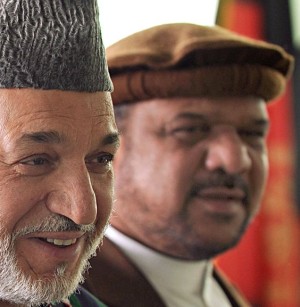 t was a heated debate during the Bush administration: What to do about evidence that Afghanistan’s powerful defense minister was involved in drug trafficking? Officials from the time say they needed him to help run the troubled country. So the answer, in the end: look the other way.