Category Archives: Issues

NEWS, ANALYSIS & OPINION: NIE reverberations continue

Why the Pentagon is happy about the NIE

The latest National Intelligence Estimate on Iran was the final factor in a military equation that now appears to guarantee that there will be no war with Iran during the Bush Administration. It meshes with the views of the operational types at the Pentagon, who have steadfastly resisted the march to war led by some Administration hawks. The anti-war group was composed of Defense Secretary Robert Gates; Admiral Michael Mullen, chairman of the Joint Chiefs; and Admiral William Fallon, who oversees the U.S. forces that would have had to wage that war. In recent months, all have pushed back privately and publicly, on the wisdom of going to war with Tehran. Indeed, the Pentagon’s intelligence units were instrumental in forming the NIE’s conclusions.

The U.S. military contributes nine of the 16 intelligence agencies whose views are cobbled together in NIEs: the Counterintelligence Field Activity, the Air Force Intelligence, Surveillance and Reconnaissance Agency, Army Intelligence, the Defense Intelligence Agency, the Marine Corps Intelligence Activity, the National Geospatial-Intelligence Agency, the National Reconnaissance Office, the National Security Agency, and the Office of Naval Intelligence. Some critics have suggested that the military simply found a public way to quiet the drumbeat for war coming from Vice President Dick Cheney and his shrinking band of allies in the Administration.

There was no formal response from the Pentagon. It is evident, however, that the U.S. military, already strained by wars in Afghanistan and Iraq, has no appetite for a third war. That’s true even if a series of strikes against nuclear and other targets inside Iran were carried out by the Air Force and Navy, the two services who have sat, somewhat frustrated, on the sidelines as the Army and Marine Corps has done the heavy lifting in the two wars now under way. Some Pentagon officials welcomed the new NIE as evidence that the intelligence community is not tied to ideology, as some critics argued was true during the buildup to the Iraq war in 2003. [complete article]

Details in military notes led to shift on Iran, U.S. says

American intelligence agencies reversed their view about the status of Iran’s nuclear weapons program after they obtained notes last summer from the deliberations of Iranian military officials involved in the weapons development program, senior intelligence and government officials said on Wednesday.

The notes included conversations and deliberations in which some of the military officials complained bitterly about what they termed a decision by their superiors in late 2003 to shut down a complex engineering effort to design nuclear weapons, including a warhead that could fit atop Iranian missiles.

The newly obtained notes contradicted public assertions by American intelligence officials that the nuclear weapons design effort was still active. But according to the intelligence and government officials, they give no hint of why Iran’s leadership decided to halt the covert effort. [complete article]

Bush tells Iran to disclose nuclear activities

President Bush called on Iran to “come clean” about the scope of its nuclear activities Wednesday, as the White House made it clear there will be no change in its policy toward Tehran despite new intelligence questioning his claims about the country’s nuclear ambitions.

Traveling here for a political fundraiser, Bush indicated that he still sees Iran as a serious threat. He demanded that its leaders fully disclose details of its nuclear weapons program, which the intelligence community said Monday was shut down in the fall of 2003.

“The Iranians have a strategic choice to make,” Bush told reporters. “They can come clean with the international community about the scope of their nuclear activities and fully accept” the U.S. offer to negotiate if they suspend their nuclear enrichment program — “or they can continue on a path of isolation.” [complete article]

Iran’s nukes: now they tell us?

In August, National Intelligence Director McConnell ordered CIA Director Michael Hayden to have ready by Labor Day a new intelligence estimate reflecting the latest information. Hayden said he needed more time. McConnell set a Nov. 30 deadline. Because some of the information sources were new, Hayden decided to launch a “red team” counter-intelligence operation to make sure that the U.S. wasn’t falling for Iranian disinformation. In late October, the Persia House and red-team analysts offered their findings to Hayden and his deputy, Steve Kappes, around the coffee table in Hayden’s office. The red team found that the possibility of Iranian disinformation was “plausible but not likely.” That assessment led two of the 16 intelligence agencies, but not the CIA, to dissent from the final “high” degree of certainty that Iran had stopped its weapons program in 2003. On the other hand, there was general agreement on a “moderate” finding that Iran had not restarted the program. The National Intelligence Board met and reached its conclusions on Tuesday, Nov. 27. “The meeting took a little more than two hours,” a senior intelligence official told me. “There have been times when it has taken multiple meetings that went on for hours and hours to reach a consensus, especially when dealing with one of Iran’s neighbors.”

Hayden and his senior Iran analysts briefed President Bush on the new NIE on Wednesday, Nov. 28. But it seems apparent the President made little effort to figure out how his Administration could leverage the shocking candor of the intelligence report to his advantage in dealing with Iran. “He could have said to the Iranians, ‘This document shows that we’re not rushing to war. We’re not out to get you,'” said Kenneth Pollack, a National Security Council staff member during the Clinton Administration and author of The Persian Puzzle. “‘But we — and the rest of the world — are very concerned about your uranium-enrichment program, and so let’s sit down and talk about it.'”

Oddly, Bush didn’t seem to ask for a delay in the release of the report. He could easily have requested a few weeks for his Administration to chew over the import of the NIE, discuss it with our allies, organize a new diplomatic initiative to negotiate with the Iranians. As it was, Under Secretary of State Nicholas Burns briefed the U.N. Security Council members who had been considering a new round of sanctions against Iran about the same time that word of the NIE broke in the press. When it did, the Chinese, who had seemed surprisingly ready to approve the sanctions, started backing away from that position. [complete article]

See also, Spinning the NIE Iran report (Tony Karon), A pattern of deception (Dan Froomkin), White House Iran intel story 2.0 (TPM).


Facebooktwittermail

NEWS: Mosul “center of gravity for the insurgency”; Gates cautiously optimistic; Cheney irrationally exuberant

Pushed out of Baghdad, insurgents move north

Sunni insurgents pushed out of Baghdad and Anbar Provinces have migrated to this northern Iraqi city and have been trying to turn it into a major hub for their operations, according to American commanders.

A growing number of insurgents have relocated here and other places in northern Iraq as the additional forces sent by President Bush have mounted operations in the Iraqi capital and American commanders have made common cause with Sunni tribes in the western part of the country.

The insurgents who have ventured north include Abu Ayyub-al Masri, the leader of Al Qaeda in Mesopotamia, a predominantly Iraqi group that American intelligence says has foreign leadership. American officials say the insurgent leader has twice slipped in and out of Mosul in Nineveh Province to try to rally fellow militants and put end to infighting. [complete article]

Gates cautiously upbeat on Iraq

Defense Secretary Robert M. Gates said Wednesday that a stable and democratic Iraq is “within reach.” But he cautioned that threats remain, pointing to insurgent efforts to create a stronghold in northern Iraq as U.S. commanders seek more than 1,400 additional Iraqi and U.S. troops there.

Gates, who during Senate confirmation hearings a year ago stated that the United States was neither winning nor losing in Iraq, was unusually upbeat in his remarks. He said several recent trends have given him hope, including the lowest levels of violence since early 2006, a substantial increase in the number of displaced Iraqis returning to their homeland, rising international investments and the willingness of more than 70,000 Iraqis to volunteer to protect their neighborhoods.

“More than ever, I believe that the goal of a secure, stable and democratic Iraq is within reach,” Gates said at a news conference in the fortified Green Zone. “We need to be patient, but we also need to be absolutely resolved in our desire to see the nascent signs of hope across Iraq expand and flourish.” [complete article]

Top U.S. military brass in Iraq resist quick drawdown

The U.S. military’s internal debate over how fast to reduce its force in Iraq has intensified in recent weeks as commanders in Baghdad resist suggestions from Pentagon officials for a quicker drawdown.

Army Lt. Gen. Raymond T. Odierno, the day-to-day military commander in Iraq, said he was worried that significant improvements in security conditions would sway policymakers to move too quickly to pull out troops next year.

“The most important thing to me is we cannot lose what we have gained,” Odierno said in an interview last week with The Times after he toured Nahrawan, a predominantly Shiite city of about 100,000 northeast of Baghdad with a market that is now showing signs of life. “We won’t do that.” [complete article]

Cheney: Iraq to be self-governing by 2009

Vice President Cheney today predicted Iraq will be a self-governing democracy by the time he leaves office, calling the current U.S. surge strategy “a remarkable success story” that will be studied for years to come.

In an interview with Politico, Cheney offered a remarkably upbeat view of Iraq, despite continued violence and political paralysis in the war-torn nation.

Cheney, who has been widely criticized for overly optimistic — and sometime flat wrong — projections in the past, sounded as confident as ever that the Bush administration will achieve its objectives in Iraq. [complete article]

Facebooktwittermail

EDITORIAL: When reason prevails

When reason prevails

To some political observers there is something vaguely disappointing about witnessing events shaped by reason. Reasonable behavior is somewhat predictable and lacks the zest and drama of the unexpected.

In as much as news-watching is driven by the stimulating effect of the shock of the new, there is then a tendency for one revelation to trigger a desire that this be followed by a cascade of revelations. In the current context, this is provoking a notion that now, anything could happen.

In a game of whack-a-mole, as soon as the National Intelligence Estimate had knocked down the notion of the “mad mullahs”, the image of “mad dog” Israel popped up.

For the past several years, U.S. intelligence analysts have doubted hawkish U.S. and Israeli rhetoric that Iran is dominated by “mad mullahs” — clerics whose fanatical religious views might lead to irrational decisions. In the new NIE, the analysts forcefully posit an alternative view of an Iran that is rational, susceptible to diplomatic pressure and, in that sense, can be “deterred.”

“Tehran’s decisions are guided by a cost-benefit approach rather than a rush to a weapon irrespective of the political, economic and military costs,” states the NIE. Asked if this meant the Iranian regime would be “deterrable” if it did obtain a weapon, a senior official responded, “That is the implication.” He added: “Diplomacy works. That’s the message.”

But not so fast, says Seymour Hersh — “there’s always Israel… Israel can always decide to take military action.” And on CNN last night, Hersh continued. “I’m told that Olmert had a private discussion with Bush about it during Annapolis — before Annapolis. Bush briefed him about it.” This contradicts National Security Adviser Stephen Hadley’s claim that Bush was not briefed on the NIE until Wednesday — the day after the Annapolis Conference. Indeed, there is further evidence that the Israelis were informed well before the conference.

In today’s Haaretz, Amos Harel writes:

Israel has known about the report for more than a month. The first information on it was passed on to Defense Minister Ehud Barak, and to Shaul Mofaz, who is the minister responsible for the strategic dialog with the Americans. The issue was also discussed at the Annapolis summit by Barak and U.S. Secretary of Defense Robert Gates, and it seems also between Bush and Prime Minister Ehud Olmert.

What surprised Israel is the sharp turn from the previous line presented by the DNI [Director of National Intelligence, Mike McConnell], and the fact the report was made public. Based on his short comments yesterday, it seems Barak, like Olmert, is trying to avoid open disagreement with the U.S. government.

But the issue of the NIE is expected to create tension on two levels. It will cloud the tight cooperation between the two countries intelligence agencies, since now it will no longer look as if it is only a disagreement over timing, but a fundamental disagreement over Iran’s intentions. It will also cause a feeling of distress on the Israeli side, as now it will seem that the U.S. is abandoning Israel to fight alone.

But is there really much likelihood that Israel would take on the fight alone?

Some would argue that Israel’s September 6 strike on Syria was intended as a warning shot — a signal to Tehran that “mad dog” Israel can, if it chooses, just as easily strike Iranian targets. At the time, it was certainly easy to accept such an interpretation. Now, things look different.

It seems more reasonable — in accordance with the principle of Ockham’s razor (cleaving to the simplest explanation) — to believe that bombs dropped on Syria were intended to send a message to Syria, not Iran. The message? Just because of last summer’s mess in Lebanon, don’t get the idea that you’d stand a chance in a military confrontation with Israel. We can hit you whenever we want, wherever we want. Now we’ve made that clear, we’re ready to talk.

When it comes to Iran, the political challenge now is for those who until very recently were hysterically presenting Iran as the greatest threat to the world, to make an about face without losing face and say that Iran can now effectively be engaged.

Those still feeling the sting of the NIE’s claims will predictably revive Rumsfeld’s line of reasoning that the absence of evidence is not evidence of absence. But this always was, and remains, a faultless yet deceptive line of reasoning since the absence of evidence is not evidence of concealment. Just as there are still those who believe that Saddam Hussein’s WMD were never found because they were so well hidden, the same line is being used again: “The Israelis interpret the evidence to mean the Iranians have almost certainly continued to conduct their military nuclear program in secret.”

That’s all well and good, but while the masters-of-secrecy argument might have some limited value in sustaining the image of Iran’s government as a nefarious and deceptive entity, at the same time, it’s hard to plausibly argue in favor of missile strikes on targets so well hidden that their locations are unknown.

The neocons know the game is up and some of them are being surprisingly quick to concede the fact. Norman Podhoretz sees the intelligence community engaged in a scheme to “head off the possibility that the President may order air strikes on the Iranian nuclear installations.” But even if the father of neoconservatism doesn’t like what he sees, he concedes that the plot has worked.

Robert Kagan, perhaps the most nimble-minded among the neocons, says, “With its policy tools broken, the Bush administration can sit around isolated for the next year. Or it can seize the initiative, and do the next administration a favor, by opening direct talks with Tehran.” Part of Kagan’s motive for advocating talks now is that this “would give the United States a better chance to frame the discussion, at home and abroad.” Which is to say, a better chance for Kagan and his friends to frame the issues.

Be that as it may, the opportunity that has now opened up needs to be grasped. The question is, who is going to quickest off the mark in becoming the strongest advocate of a bold and strategic policy shift? Those who have nothing to advocate will do no more than sustain the culture of political reactivity in which nothing really gets said and nothing much gets done.

So far there are no signs that inside Bush’s brain there are any new neuronal pathways being tickled by an action potential. It’s time for Iran to “come clean” he says — and Ahmadinejad could say just the same. If the absence of cunning is a precondition for U.S.-Iranian talks, they’re not going to happen.

But Bush’s isn’t the only voice that needs to be heard right now. There are a bunch of folks waltzing around America at the moment claiming they want to lead the nation. OK. Now’s the time to show your mettle. And just in case anyone needs reminding: whether or not Iran has an active program for developing nuclear weapons, it does remain the strategically most important country in the Middle East.

The release of the NIE may have the effect of making presidential candidates think that Iran can quietly be dropped from the political agenda. This would be a mistake. The opportunity here is not limited to finding a new way to approach Iran; with some courage and imagination the conversation could actually start to shift away from its myopic focus on national security threats and towards a new focus on engagement. Instead of talking about how America must lead the world, save the world or protect itself from the world, it’s time to start talking about working together and raising America’s awareness of a convergence of national and global interests.

Facebooktwittermail

NEWS & ANALYSIS: Evolving perspectives on Iran

Time has come for U.S. to pursue talks with Iran

The American intelligence report that makes the option of a military strike against Iran – and possibly the next dose of sanctions – less likely to materialize gives us an important time-out to try a new avenue vis-a-vis the Islamic Republic.

That route would center on diplomacy aimed at neutralizing Tehran’s motivation to further pursue the development of nuclear arms. For some time now, Iran has held an internal debate – which sometimes reaches the Iranian media – on how far Tehran can go in defying international pressure to abandon its nuclear program. [complete article]

Europeans see murkier case for sanctions

The Bush administration’s new intelligence assessment that Iran halted its nuclear weapons program in 2003 is likely to complicate efforts to impose new sanctions on Iran at the United Nations Security Council, European officials said Monday.

The officials, who declined to be identified under normal diplomatic rules, stressed that their governments were formally studying the new assessment of Iran’s nuclear intentions and capabilities by the administration’s intelligence agencies.

But they added that they were struggling to understand why the United States chose to issue the report just two days after the six powers involved in negotiating with Iran — the United States, Russia, China, France, Britain and Germany — had decided to press ahead with a new Security Council resolution.

“Officially, we will study the document carefully; unofficially, our efforts to build up momentum for another resolution are gone,” said one European official involved in the diplomacy. [complete article]

Anatomy of an about-face on Iran

The new intelligence was considered compelling enough to call it to Bush’s attention in August. In a news conference at the White House on Tuesday, Bush said that the nation’s intelligence director, J. Michael McConnell, “came in and said, ‘We have some new information.’ ”

Bush said that McConnell did not provide details. “He didn’t tell me what the information was,” Bush said. “He did tell me it was going to take awhile to analyze.”

The decision to hold those details back has come under question because Bush and others in the administration continued in the succeeding months to use heated rhetoric to warn of the dangers posed by a nuclear-armed Iran. In October, Bush described that scenario as potentially pointing to World War III.

But U.S. intelligence officials said they felt compelled to employ that level of caution in part because of the searing experience surrounding the war in Iraq.

“Back in 2002, one of the knocks on the process at the time was that information was not vetted by analysts and was being rushed into the Oval Office,” said the senior U.S. intelligence official.

That experience showed, the official said, that bringing unvetted intelligence to senior officials could backfire.

This time, even as they vetted the new intelligence and launched into major revisions of the estimate on Iran’s nuclear program, intelligence officials said, they deliberately shielded analysts from administration officials and policymakers. [complete article]

Spies show Bush a way forward on Iran

The NIE does refer to the role of “international pressures” in halting Iran’s program, but contrary to Hadley’s argument, it suggests that the decision to halt weaponization was not prompted by threats and pressure. The key finding of the estimate also indicates that the intelligence community believes Iran is more likely to forego the nuclear weapons option if the United States deals with its security and political interests than if it relies on threats and sanctions.

The estimate concludes that the halt in the weapons program was ordered “in response to increasing international scrutiny and pressure resulting from exposure of Iran’s previously undeclared nuclear work”. That is a reference to the situation facing the Iranian leadership in 2003, when its acquisition of nuclear technology from Pakistani Abdul Qadeer Khan’s network had already been exposed but there was no threat of either military action or economic sanctions against Iran over the nuclear issue.

A major feature of the diplomatic situation in the autumn of 2003 was the willingness of Britain, France and Germany to negotiate an agreement with Iran on a wider range of security issues, based on voluntary Iranian suspension of uranium enrichment. [complete article]

Diplomatic “disaster” led to Iran intel spill?

The National Intelligence Estimate on Iran’s nukes has been in the works for months. So why did it get released now? Various commentators are guessing that hardening opposition had “caused Cheney and his team to fold their cards,” or that a Democratic-controlled Congress pushed the Director of National Intelligence, or that the spooks are trying to undermine Bush. The latter two, respectively, appear to be untrue and ridiculous, and Cheney’s team folding its cards sounds unlikely in the extreme.

Another possibility exists, though: the Bush administration may have wanted to salvage negotiations with Iran after the “disaster” this weekend in London. This story has been largely lost in the NIE furor, but the new Iranian nuclear negotiator, Saeed Jalili, told diplomats that all proposals made in previous negotiations over the nuclear issue were irrelevant – that the diplomatic efforts to date were for naught. This led to intimations that the negotiations would shut down, with one official quoted saying “we can’t do business with these guys at this point.” [complete article]

Facebooktwittermail

NEWS: “More a cease-fire than a peace” in Iraq

A calmer Iraq: fragile, and possibly fleeting

The reduced violence in Iraq in recent months stems from three significant developments, but the clock is running on all of them, Iraqi officials and analysts warn.

“It’s more a cease-fire than a peace,” said Deputy Prime Minister Barham Salih, a Kurd, in words that were repeated by Qassim Daoud, a Shiite member of Parliament.

Officials attribute the relative calm to a huge increase in the number of Sunni Arab rebels who have turned their guns on jihadists instead of American troops; a six-month halt to military action by the militia of a top Shiite leader, Moktada al-Sadr; and the increased number of American troops on the streets here.

They stress that all of these changes can be reversed, and on relatively short notice. The Americans have already started to reduce troop levels and Mr. Sadr, who has only three months to go on his pledge, has issued increasingly bellicose pronouncements recently. [complete article]

Facebooktwittermail

EDITORIAL: The diplomatic shift

The who-knew-what-when questions and the larger story

According to President Bush, “it wasn’t until last week that I was briefed on the NIE that is now public.” National Security Adviser, Stephen Hadley, was yesterday even more specific: “…the intelligence community finally came to the judgments that they came to on this issue Tuesday of last week. The President was briefed on Wednesday.” Was that before or after Israel’s foreign delegation in Washington had been briefed?

Haaretz today reports that the findings of the National Intelligence Estimate, “did not catch the Israeli leadership by surprise. During their visit to Washington last week, Prime Minister Ehud Olmert, Foreign Minister Tzipi Livni and Defense Minister Ehud Barak were briefed on the report.” The Israelis arrived on Sunday and left on Wednesday evening.

So, given that the subtext for the Annapolis Conference was the configuration of an alliance aimed at containing Iran, are we to believe that just before Olmert left Washington (and just after Bush had been briefed), the Israeli prime minister was pulled aside by administration officials who said, “Oh, by the way, we’d like to share our latest intelligence findings on Iran’s nuclear weapons program – or lack thereof. We think you’ll find them interesting.” I suspect that didn’t happen. When Hadley says Bush was briefed on Wednesday, he’s probably being economical with the truth and might under cross-examination concede that “briefed” merely means being shown the final draft of a text with which Bush was already familiar. I’ll leave it to bloggers more tenacious than me to get to the bottom of this. It’s not that these aren’t interesting questions, but they risk generating more heat than light.

reflections.jpg

The hyperfocus on a major news day in Washington has the unfortunate effect of reinforcing the kinds of perception that were summed up today in the New York Times by the line, “Rarely, if ever, has a single intelligence report so completely, so suddenly, and so surprisingly altered a foreign policy debate here.”

There has actually been a build up to this watershed event, but because the build up didn’t fit the conventional wisdom, it has largely been unnoticed. The conventional wisdom has been that the administration — until yesterday — was on a fairly steady trajectory in the direction of a military confrontation with Iran. But over the last few months there have been a number of signs that inside the administration, the proponents of military action had in fact already lost the argument.

The resurgence of diplomacy has been quietly driven by Defense Secretary Robert Gates. Gates’ low-profile approach has meant that his efforts have frequently escaped the attention of the media. Even so, to be neither the focus of cable news nor blogosphere banter, is not to be politically ineffective. The pivotal role Gates has played in shifting the administration’s approach is described in Newsweek:

Late this summer, Secretary of Defense Robert Gates traveled to the Middle East, to Saudi Arabia, Egypt, Jordan, Kuwait and the United Arab Emirates. At each stop, high-ranking Arab officials anxiously asked him: was the United States preparing to attack Iran? Gates reassured them all that the United States had no plans to do so, at least any time soon. He wasn’t dramatic about it, says a Defense Department official who accompanied Gates on the trip but declined to be identified discussing secret talks. “He didn’t grab anyone’s arm and say, ‘I’ve got Cheney under control, wink, wink’,” says this official. But Gates was low-key, straightforward, steadying—calming, even soothing in a dry and matter-of-fact way. A little later, at the end of September, Gates met with the Democratic Senate Policy Committee (something his predecessor, Donald Rumsfeld, would never do). One of the senators nervously asked if the Bush administration was looking for a reason to bomb Tehran. “It would be a strategic calamity to attack Iran at this time,” Gates replied. Sen. Evan Bayh, who was at the meeting, told Newsweek: “You could almost feel the relief around the table. It was, ‘Well, I guess he’s not here just to repeat the party line.’ It was just such a breath of fresh air from Rumsfeld and the ‘my way or the highway’ attitude of others.”

While among Bush critics it has often been assumed that the so-called reality-based community only exists outside the administration, it seems clear that Gates belongs to this community and that while Bush and Cheney are unlikely to admit as much, it is under Gates’ tutelage that they are now willing to give diplomacy a chance. Cheney might remain a skeptic but the ball — at least for now — is out of his hands.

The time is now ripe for an initiative. Bush alluded to such a possibility today when he said, “There has been a moment during my presidency in which diplomacy provided a way forward for the Iranians. And our hope is we can get back on that path again.” He was harking back to 2003 but engaging in a bit of revisionism by neglecting to mention that it was he and the vice president who then refused to receive the diplomatic ball when it was being tossed in their direction by Iran. Is it now possible — even with Khatami partially out of the picture — that the administration is hinting that it might be open to another grand bargain?

Facebooktwittermail

NEWS & ANALYSIS: NIE fallout

Israel unconvinced Iran has dropped nuclear program

Israel today took a darker view of Iran’s nuclear ambitions than the assessment released by United States intelligence agencies yesterday, saying it was convinced that Iran was pursuing nuclear weapons.

It said Iran had probably resumed the nuclear weapons program the American report said was stopped in the fall of 2003. “It is apparently true that in 2003 Iran stopped pursuing its military nuclear program for a certain period of time,” Defense Minister Ehud Barak told Israeli Army Radio. “But in our estimation, since then it is apparently continuing with its program to produce a nuclear weapon.” [complete article]

A blow to Bush’s Tehran policy

President Bush got the world’s attention this fall when he warned that a nuclear-armed Iran might lead to World War III. But his stark warning came at least a month or two after he had first been told about fresh indications that Iran had actually halted its nuclear weapons program.

The new intelligence report released yesterday not only undercut the administration’s alarming rhetoric over Iran’s nuclear ambitions but could also throttle Bush’s effort to ratchet up international sanctions and take off the table the possibility of preemptive military action before the end of his presidency.

Iran had been shaping up as perhaps the dominant foreign policy issue of Bush’s remaining year in office and of the presidential campaign to succeed him. Now leaders at home and abroad will have to rethink what they thought they knew about Tehran’s intentions and capabilities. [complete article]

U.S. spies concoct a potent Iran brew

The timing of the report’s release is curious, coinciding both with Iranian President Mahmud Ahmadinejad’s crucial meeting with the heads of states of the Gulf Cooperation Council, where Ahmadinejad has made substantial progress in confidence-building by advancing the idea of security and economic cooperation in the region, and with critical discussions with the so-called “Five plus One” countries regarding the next United Nations steps against Iran. The Five plus One includes the five permanent members of the UN security Council – United States, the United Kingdom, France, Russia and China – plus Germany.

Irrespective of Hadley’s comments, the new NIE actually undermines much of the rationale behind the US-led push for a third round of US sanctions on Iran, by flatly contradicting what until now has been held as an article of faith by US politicians and much of the media. That is, the notion that Iran has been pursuing an open weapons program via its uranium-enrichment and reprocessing activities. [complete article]

‘Bomb, bomb, bomb; bomb, bomb, Iran’

There has been a lot of loose talk about Iran’s nuclear capabilities out on the campaign trail. Here is a sampling of campaign rhetoric undercut by the publication of the latest National Intelligence Estimate on Iran, representing the consensus view of the CIA and other U.S. intelligence agencies. [complete article]

Candidates hold to their stances on Iran

The campaigns of the leading Democratic candidates seized Monday on an intelligence report showing that Iran had halted its development of nuclear weapons, saying the findings justified their more cautious approach to Tehran.

Senator Hillary Rodham Clinton’s national security director, Lee Feinstein, said the report’s findings “expose the latest effort by the Bush administration to distort intelligence to pursue its ideological ends.” He added that the report “vindicates” Mrs. Clinton’s approach, which he described as “vigorous American-led diplomacy, close international cooperation and effective economic pressure, with the prospect of carefully calibrated incentives if Iran addresses our concerns.”

In fact, in September Mrs. Clinton, Democrat of New York, voted in favor of a Senate measure declaring the Iranian Revolutionary Guards “proliferators of mass destruction,” a vote that was condemned by her rivals in the Democratic field. After the vote, her aides issued a statement saying, “The Revolutionary Guards are deeply involved in Iran’s nuclear program.” [complete article]

How did a 2005 estimate on Iran go awry?

In the summer of 2005, senior American intelligence officials began traveling the world with a secret slide show drawn from thousands of pages that they said were downloaded from a stolen Iranian laptop computer, trying to prove that Iran was lying when it said it had no interest in building a nuclear weapon.

The slides detailed efforts to build what looked like a compact warhead for an Iranian missile and were portrayed by the Americans as suggesting that the Iranian military was working to solve the technical problems in building a bomb.

Now, that assertion has been thrown into doubt by a surprising reversal: the conclusion, contained in the declassified summary of a new National Intelligence Estimate on Iran’s nuclear programs, that Iran’s effort to master the technology of building a nuclear weapon had halted two years before those briefings. [complete article]

Facebooktwittermail

NEWS & EDITOR’S COMMENT: Intelligence community puts Cheney in restraints

U.S. says Iran ended atomic arms work

A new assessment by American intelligence agencies concludes that Iran halted its nuclear weapons program in 2003 and that the program remains on hold, contradicting an assessment two years ago that Tehran was working inexorably toward building a bomb.

The conclusions of the new assessment are likely to be major factor in the tense international negotiations aimed at getting Iran to halt its nuclear energy program. Concerns about Iran were raised sharply after President Bush had suggested in October that a nuclear-armed Iran could lead to “World War III,” and Vice President Dick Cheney promised “serious consequences” if the government in Tehran did not abandon its nuclear program.

The findings also come in the middle of a presidential campaign during which a possible military strike against Iran’s nuclear program has been discussed.

The assessment, a National Intelligence Estimate that represents the consensus view of all 16 American spy agencies, states that Tehran’s ultimate intentions about gaining a nuclear weapon remain unclear, but that Iran’s “decisions are guided by a cost-benefit approach rather than a rush to a weapon irrespective of the political, economic and military costs.” [complete article]

Editor’s Comment — This is a major defeat for Dick Cheney – perhaps even great enough to describe as a politically fatal blow. As Gareth Porter reported last month:

The US National Intelligence Estimate (NIE) on Iran has been held up for more than a year in an effort to force the intelligence community to remove dissenting judgments on the Iranian nuclear program. The aim is to make the document more supportive of Vice President Dick Cheney’s militarily aggressive policy toward Iran, according to accounts provided by participants in the NIE process to two former Central Intelligence Agency (CIA) officers.

But Cheney lost — big time. The White House’s response — peppered with phrases like “positive news,” “we have made progress,” the “estimate offers grounds for hope,” a solution can be found “without the use of force” — amounts to what Cheney and his neocon supporters should regard as a strategic defeat. The intelligence community (no doubt with strong support from defense secretary Gates and his allies) has effectively kneecapped the vice president.

Facebooktwittermail

NEWS, OPINION & EDITOR’S COMMENT: Time to get out, not dig in

Iraqi insurgents regrouping, says Sunni resistance leader

Iraq’s main Sunni-led resistance groups have scaled back their attacks on US forces in Baghdad and parts of Anbar province in a deliberate strategy aimed at regrouping, retraining, and waiting out George Bush’s “surge”, a key insurgent leader has told the Guardian.

US officials recently reported a 55% drop in attacks across Iraq. One explanation they give is the presence of 30,000 extra US troops deployed this summer. The other is the decision by dozens of Sunni tribal leaders to accept money and weapons from the Americans in return for confronting al-Qaida militants who attack civilians. They call their movement al-Sahwa (the Awakening).

The resistance groups are another factor in the complex equation in Iraq’s Sunni areas. “We oppose al-Qaida as well as al-Sahwa,” the director of the political department of the 1920 Revolution Brigades told the Guardian in Damascus in a rare interview with a western reporter. [complete article]

U.S. No. 2 general in Iraq cites 25-30 percent reduction in foreign fighters entering Iraq

The U.S. second-in-command in Iraq said Sunday there has been a 25 percent to 30 percent reduction in foreign fighters entering Iraq, and he credited Syria with taking steps to limit the flow.

The Americans and Iraqi officials have demanded that Syria do more to stop foreign fighters from crossing its borders to fight in Iraq, where they threaten U.S. forces as well as Iraqi civilians.

Damascus says it has taken all necessary measures but that it is impossible to fully control the sprawling desert along the porous 570-kilometer (354-mile) border. Syrian authorities say they have increased the number of outposts to one every 400 meters (yards) in some zones along the frontier. [complete article]

Iraq as a Pentagon construction site

The title of the agreement, signed by President Bush and Iraqi Prime Minister Maliki in a “video conference” last week, and carefully labeled as a “non-binding” set of principles for further negotiations, was a mouthful: a “Declaration of Principles for a Long-Term Relationship of Cooperation and Friendship Between the Republic of Iraq and the United States of America.” Whew!

Words matter, of course. They seldom turn up by accident in official documents or statements. Last week, in the first reports on this “declaration,” one of those words that matter caught my attention. Actually, it wasn’t in the declaration itself, where the key phrase was “long-term relationship” (something in the lives of private individuals that falls just short of a marriage), but in a “fact-sheet” issued by the White House. Here’s the relevant line: “Iraq’s leaders have asked for an enduring relationship with America, and we seek an enduring relationship with a democratic Iraq.” Of course, “enduring” there bears the same relationship to permanency as “long-term relationship” does to marriage.

In a number of the early news reports, that word “enduring,” part of the “enduring relationship” that the Iraqi leadership supposedly “asked for,” was put into (or near) the mouths of “Iraqi leaders” or of the Iraqi prime minister himself. It also achieved a certain prominence in the post-declaration “press gaggle” conducted by the man coordinating this process out of the Oval Office, the President’s so-called War Tsar, Gen. Douglas Lute. He said of the document: “It signals a commitment of both their government and the United States to an enduring relationship based on mutual interests.” [complete article]

See also, Big Media blackout on Iraq (Jeffrey Feldman).

Editor’s Comment — The fact that the U.S. military is now offering some qualified credit to both Syria and Iran for the reduction of violence in Iraq is a tacit acknowledgment that even while it claims “success” in the surge, the current respite is as much a gift — it can easily be taken away. This is the time to get out — not dig in.

Facebooktwittermail

NEWS, ANALYSIS & OPINION: The unfolding complexity of the Iran narrative

Iran turns the charm on its neighbors

By engaging Iran and welcoming Ahmadinejad, the GCC states (Bahrain, Kuwait, Oman, Qatar, Saudi Arabia and the United Arab Emirates – UAE) led by Saudi Arabia, which recently offered to set up a regional facility for producing nuclear fuel for Iran, are hoping to play an effective, moderating influence on Tehran, which has been rattling them with what the GCC media routinely refer to as “extreme statements by Iran”.

But, Ahmadinejad, who last week told a visiting foreign dignitary that “through love and kindness the regional problems can disappear”, is now about to resurrect the “charm offensive” that one of his predecessors, former president Hashemi Rafsanjani, tried with the GCC states a decade and a half ago.

Iran’s new charm offensive is packed with substantially more weight, however, as Iran is broadly viewed in the region as a clear winner of the Iraq war, “controlling the main centers of power within the Iraqi state”, according to a Saudi commentary, not to mention the influence it wields in Lebanon and, potentially, among Shi’ite minorities in eastern Saudi Arabia and elsewhere in the GCC region. [complete article]

A partner for dealing with Iran?

The effort to resolve by negotiations North Korea’s defiance of the global nonproliferation regime may yet prove successful. If so, does that experience offer a guide for coping with the challenge posed by Iran’s expanding nuclear program? Would a comprehensive dialogue on this issue between America and China be useful?

If, indeed, the prolonged negotiations with North Korea result in a constructive resolution of the dangers posed by Pyongyang’s open pursuit of nuclear weapons, it will have been largely due to decisive changes in the public postures of both the United States and China. America belatedly committed itself to, and then actively promoted, serious and prolonged multilateral negotiations among five concerned states and North Korea’s rulers. Even more important, China’s abandonment of its initial reticence eventually proved vital to convincing Pyongyang that its own political intransigence could become suicidal.

I recently visited China, where I had the opportunity to engage Chinese leaders in wide-ranging private conversations. I returned with two strong impressions regarding China’s attitude toward the Iranian problem. The first is that the magnitude of China’s internal transformation makes it vulnerable to global political and economic instability. China is especially worried about the consequences of any major eruption of violence in the Persian Gulf. This concern is palpable and justified if one considers the likely financial and political effects of a major U.S.-Iran collision. Thus China, despite its meteoric rise toward global preeminence, currently is geopolitically a status quo power. [complete article]

In Iraq, U.S. shifts its tone on Iran

Not long ago, U.S. military officials in Iraq routinely displayed rockets, mortars and jagged chunks of metal to reporters and insisted that they were Iranian-made arms being fired at American bases. Collaboration between Tehran and Washington on stabilizing Iraq seemed doubtful at best.

In the last two months, though, there has been a shift in U.S. military and diplomatic attitudes toward Iran. Officials have backed away from sweeping accusations that the Iranian leadership is orchestrating massive smuggling of arms, agents and ammunition. Instead, they have agreed to a new round of talks with Iranian and Iraqi officials over security in Iraq. The meeting is expected to take place this month.

The U.S. also freed nine Iranian men last month, some of whom it had been holding since 2004. Iran denied U.S. accusations that many of them had been assisting anti-U.S. militias in Iraq, and had demanded their release in a series of testy exchanges with U.S. officials.

When the U.S. freed them, it did not allude to the Iranian demands. It said only that they no longer posed a threat.

Pentagon officials and analysts cite several reasons for the change, including U.S. concern that provoking Iran could set off a confrontation that military commanders are keen to avoid, and the realization that better relations with Iran would help stabilize Iraq. [complete article]

See also, U.S. says too soon to trust Iran on Iraq (AFP).

Iranian pushes nuclear talks back to square 1

In a sign that Iran has hardened its position on its nuclear program, its new nuclear negotiator said in talks in London on Friday that all proposals made in past negotiations were irrelevant and that further discussion of a curb on Iran’s uranium enrichment was unnecessary, senior officials briefed on the meeting said.

The Iranian official, Saeed Jalili, also told Javier Solana, who represented the United States, Russia, China, Britain, France and Germany in the five-hour talks, that United Nations Security Council resolutions punishing Iran for not suspending its enriched uranium activities were illegal, the officials said.

Representatives of the six countries met in Paris on Saturday afternoon to discuss further punitive Security Council measures against Iran after the final talks in London failed to produce a breakthrough. [complete article]

Iran’s reformers to U.S.: Let’s talk

Former Iranian President Mohammad Khatami and Nobel Peace Prize-winner Shirin Ebadi are among several key Iranian public figures saying that only direct, unconditional talks with the US can ease spiraling tensions.

Mr. Khatami – the reformist cleric who was twice elected in landslide victories – and Ms. Ebadi – a human rights lawyer who just launched a National Peace Council – are suggesting that hard-liners in the US and Iran should no longer dictate the terms of division. One Iranian analyst says: It’s time to call the bluff on both sides – and talk.

“The solution is for both sides to resort to logic, refrain from provocative rhetoric, and put the emphasis on negotiations,” Khatami told the Monitor. [complete article]

Facebooktwittermail

NEWS, ANALYSIS & OPINION: After Annapolis

One PA – with Hamas

As much as the Annapolis conference sought to be “in favor” of the peace process, it measured its success in its ability to be “against” – against Iran, against Hezbollah, against Syria and against Hamas. This is an ostensibly simple and convincing method of measurement. The more Arab leaders at the conference’s gala dinner, the greater the victory of the “against” forces: Iran became more isolated, Hamas was pushed into a corner and Hezbollah remained alone. This is one way to assess the conference, but it will turn out to be meaningless when the time comes soon to pay the Annapolis IOUs.

Take, for example, the question of isolating Hamas. This chapter should particularly interest Israel because Hamas is the key to Palestinian Authority President Mahmoud Abbas’ ability to demonstrate his “partnerability.” According to the “Bush test,” which requires “destroying the infrastructures of terror,” there is no gray area: Hamas must be dismantled. Abbas not only needs to disarm the Hamas army, crush the Qassam cells and jail the wanted men. He must also take apart Hamas’ organizational framework, its civic infrastructure, schools and health clinics. He will be judged by these steps, which Israel will require as initial proof of implementing the road map.

But what about the many people who support Hamas – not because they are more religious, but because the movement was perceived a year ago as a worthy alternative to the Palestine Liberation Organization’s corruption? Even today, despite a drop in Hamas’ popularity, especially after its takeover of Gaza in June and the street battles against ordinary citizens, Hamas is regarded as more than a terror organization. It is seen as a political movement that does not recognize Israel and rejects negotiations with it – principles that have considerable support among the Palestinian people. [complete article]

Olmert: ‘If talks fail, Israel will be finished’

The state of Israel would be “finished” if prospects of a two-state solution collapsed, its Prime Minister Ehud Olmert has warned. Two opinion polls have shown widespread scepticism among the Israeli public about this week’s Annapolis summit.

Mr Olmert told the liberal daily Haaretz: “If the day comes when the two-state solution collapses, and we face a South African-style struggle for equal voting rights (also for the Palestinians in the territories), then, as soon as that happens, the state of Israel is finished.”

Mr Olmert’s warning – raising however obliquely a highly sensitive comparison with apartheid South Africa – came as a poll in the newspaper showed that only 17 per cent thought the Annapolis conference a “success” – compared with 42 per cent who thought it was a “failure”. [complete article]

Will Annapolis change anything?

Sift through all the hype about President Bush’s Annapolis peace conference, and it’s hard to find grounds for optimism that much has changed in the dynamics shaping the Mideast s core conflict. Sure, Israelis and Palestinians agreed to talk about the “final status” issues of creating a Palestinian state, with the U.S. urging them on. But the governments representing the two sides in Annapolis may actually be further apart on the substance of some of those issues than were their predecessors who failed at Camp David.

At Annapolis, the parties agreed to talk, again, about the issues of Jerusalem, the borders of a Palestinian state and the fate of refugees and water rights, setting the goal of reaching agreement by the end of 2008. The key statement in the declaration adopted at Annapolis, however, is in its concluding paragraph: “Implementation of the future peace treaty will be subject to the implementation of the road map, as judged by the United States.” In other words, the discussions launched by Annapolis will simply flesh out a political “horizon” as an incentive to implement President Bush’s 2003 Roadmap. And therein lies the problem. [complete article]

Moscow may host Middle East follow-up

Russia and the United States are tentatively planning a second Middle East peace conference, in Moscow in early 2008, with major parties hoping to begin a comprehensive peace effort that would include direct talks between Israel and Syria, according to U.S., Russian, Arab and European officials.

Syria’s delegate to this week’s talks in Annapolis said yesterday that Damascus wants a Moscow gathering in order to begin negotiations between Syria and Israel over the Golan Heights, a border region seized by Israel during the 1967 war. “It is our hope that we can revive the Syrian track in Moscow,” Syria’s Deputy Foreign Minister Fayssal Mekdad said in an interview before departing Washington.

Israeli Prime Minister Ehud Olmert indicated that he hopes at some point to resume talks with Syria but cautioned that the time is not yet ripe. He said Syria must change its behavior, notably its support for Lebanon’s Shiite militia Hezbollah. [complete article]

A peace conference for friends only

What if you gave a peace conference and no enemies came, just friends? That was the essence of the Bush administration’s one-day international pageant at Annapolis.

Apparently the Bush administration has concluded that it is impossible to deal with Iran and its protégés, Hezbollah and Hamas, but it is possible to unite Israel and the Arab states against them, increasing their isolation and, ultimately, forcing them to accept Israel’s and America’s dominance in the Persian Gulf and Middle East.

The trouble is that the Annapolis formula ignores the profound changes in the balance of power in the Gulf and the alterations in the allegiance of the Lebanese and Palestinians – changes in favor of Iran. Forcing Iran to play the role of the wicked fairy at the party may coincide with the Bush administration’s strange view of that country, but it is no way to make peace. [complete article]

Facebooktwittermail

OPINION: Obama observers find his voice

Who’s afraid of Barack Obama?

Just 24 hours after Hillary Clinton mowed down a skeptical Katie Couric with her certitude that she would win the Democratic nomination — “It will be me!” — her husband showed exactly how she could lose it.

By telling an Iowa audience on Tuesday night that he had opposed the Iraq war “from the beginning,” Bill Clinton committed a double pratfall. Not only did he refocus attention on his wife’s most hazardous issue, Iraq, just as it was receding as the nation’s Topic A, but he also revived unhappy memories of the truth-dodging nadirs of the Clinton White House.

Whatever his caveats, Mr. Clinton did not explicitly oppose the Iraq war from the beginning. But Al Gore did unequivocally and loudly in a public speech before the beginning, as did an obscure Illinois state senator named Barack Obama. What if Mrs. Clinton had led an insurrection against the war authorization in the Senate? Might she have helped impede America’s rush into one of the greatest fiascos in our history? [complete article]

Facebooktwittermail

NEWS & ANALYSIS: Is the militia surge out of control?

U.S. sponsorship of Sunni groups worries Iraq’s government

The American campaign to turn Sunni Muslims against Islamic extremists is growing so quickly that Iraq’s Shiite Muslim leaders fear that it’s out of control and threatens to create a potent armed force that will turn against the government one day.

The United States, which credits much of the drop in violence to the campaign, is enrolling hundreds of people daily in “concerned local citizens” groups. More than 5,000 have been sworn in in the last eight days, for a total of 77,542 as of Tuesday. As many as 10 groups were created in the past week, bringing the total number to 192, according to the American military. [complete article]

Why American troops can’t go home

A recent Washington Post political cartoon by Tom Toles captured the irony and tragedy of this “five-year plan.” A big sign on the White House lawn has the message “We can’t leave Iraq because it’s going…” and a workman is adjusting a dial from “Badly” to “Well.”

This cartoon raises the relevant question: If things are “going well” in Iraq, then why aren’t American troops being withdrawn? This is a point raised persuasively by Robert Dreyfuss in a recent Tomdispatch post in which he argues that the decline in three major forms of violence (car bombs, death-squad executions, and roadside IEDs) should be the occasion for a reduction, and then withdrawal, of the American military presence. But, as Dreyfuss notes, the Bush administration has no intention of organizing such a withdrawal; nor, it seems, does the Democratic Party leadership — as indicated by their refusal to withhold funding for the war, and by the promises of the leading presidential candidates to maintain significant levels of American troops in Iraq, at least through any first term in office.

The question that emerges is why stay this course? If violence has been reduced by more than 50%, why not begin to withdraw significant numbers of troops in preparation for a complete withdrawal? The answer can be stated simply: A reduction in the violence does not mean that things are “going well,” only that they are going “less badly.” [complete article]

Nonstop theft and bribery are staggering Iraq

Jobless men pay $500 bribes to join the police. Families build houses illegally on government land, carwashes steal water from public pipes, and nearly everything the government buys or sells can now be found on the black market.

Painkillers for cancer (from the Ministry of Health) cost $80 for a few capsules; electricity meters (from the Ministry of Electricity) go for $200 each, and even third-grade textbooks (stolen from the Ministry of Education) must be bought at bookstores for three times what schools once charged.

“Everyone is stealing from the state,” said Adel Adel al-Subihawi, a prominent Shiite tribal leader in Sadr City, throwing up his hands in disgust. “It’s a very large meal, and everyone wants to eat.” [complete article]

Bush-Maliki agreement defies US laws, Iraqi parliament

Monday’s “declaration of principles” between President Bush and Iraqi Prime Minister Nouri Al Maliki indicates the US will maintain a “long-term” presence in Iraq and involve itself closely in the Iraqi oil trade, backsliding on rules made in this year’s two largest defense laws.

The 2008 Defense Appropriations Act, which Bush signed into law in mid-November, bars the United States from establishing permanent bases in Iraq and from exerting control over Iraqi oil. The 2008 Defense Authorization Act, which has passed the House and Senate and is expected to be sent to the president sometime in the next few weeks, contains similar language.

Under both acts, the US is forbidden “to establish any military installation or base for the purpose of providing for the permanent stationing of United States Armed Forces in Iraq.” Although when Bush approved the Appropriations Act, he released a signing statement exempting himself from several of the law’s provisions, the proscription against permanent bases was not one of them. [complete article]

Facebooktwittermail

NEWS, OPINION & EDITOR’S COMMENT: America has abandoned the rule of law

Jordan’s spy agency: holding cell for the CIA

Over the past seven years, an imposing building on the outskirts of this city has served as a secret holding cell for the CIA.

The building is the headquarters of the General Intelligence Department, Jordan’s powerful spy and security agency. Since 2000, at the CIA’s behest, at least 12 non-Jordanian terrorism suspects have been detained and interrogated here, according to documents and former prisoners, human rights advocates, defense lawyers and former U.S. officials.
[…]
Bush administration officials have said they do not hand over terrorism suspects to countries that are likely to abuse them. For several years, however, the State Department has cited widespread allegations of torture by Jordan’s security agencies in its annual report cards on human rights.

Independent monitors have become increasingly critical of Jordan’s record. Since 2006, the United Nations, Amnesty International and Human Rights Watch have issued reports on abuses in Jordan, often singling out the General Intelligence Department.

Former prisoners have reported that their captors were expert in two practices in particular: falaqa, or beating suspects on the soles of their feet with a truncheon and then, often, forcing them to walk barefoot and bloodied across a salt-covered floor; and farruj, or the “grilled chicken,” in which prisoners are handcuffed behind their legs, hung upside down by a rod placed behind their knees, and beaten. [complete article]

Editor’s Comment — The White House has a page on its web site devoted to “Tales of Saddam’s Brutality.” There it refers to falaqa as Uday Hussein’s “favourite punishment.”

U.S. says it has right to kidnap British citizens

America has told Britain that it can “kidnap” British citizens if they are wanted for crimes in the United States.

A senior lawyer for the American government has told the Court of Appeal in London that kidnapping foreign citizens is permissible under American law because the US Supreme Court has sanctioned it.

The admission will alarm the British business community after the case of the so-called NatWest Three, bankers who were extradited to America on fraud charges. More than a dozen other British executives, including senior managers at British Airways and BAE Systems, are under investigation by the US authorities and could face criminal charges in America. [complete article]

The torture compromise of 2007

A friend at a dinner party on the East coast found herself in an argument in which she was the only person opposed to torture. The other invitees, all graduates of favored preparatory schools and Ivy League colleges, worked in the law, investment banking, urban planning and the arts. They agreed that President Bush was incompetent and untrustworthy; but his fundamental mistake about torture had been to go after the law. Torture, they said, cannot be a policy, and a law that permits torture cannot be on the books. What is wanted is a leader who will break the law selectively, in a way we can trust. Torture should be allowable, but only by the right people and for the right reason. To a man and woman, the guests who held this view were supporters of Hillary Clinton. [complete article]

The Violent Radicalization and Homegrown Terrorism Prevention Act

There has been a long tradition of fear-mongering legislation in the United States directed against groups and individuals believed to threaten the established order. The first such measures were the Alien and Sedition Acts passed by Congress in 1798 during the administration of the second president of the United States John Adams. The Acts, consisting of four separate laws, made it more difficult to become a citizen, sought to control real or imagined foreign agents operating in the United States, and also gave the government broad powers to control “sedition.” Sedition was defined as “resisting any law of the United States or any act of the President” punishable by a prison sentence of up to two years. It also made illegal “false, scandalous or malicious writing” directed against either the government or government officials. The next President, Thomas Jefferson declared that three out of the four laws were unconstitutional and pardoned everyone who had been convicted under them. [complete article]

Witness names to be withheld from detainee

Defense lawyers preparing for the war crimes trial of a 21-year-old Guantánamo detainee have been ordered by a military judge not to tell their client — or anyone else — the identity of witnesses against him, newly released documents show.

The case of the detainee, Omar Ahmed Khadr, is being closely watched because it may be the first Guantánamo prosecution to go to trial, perhaps as soon as May.

Defense lawyers say military prosecutors have sought similar orders to keep the names of witnesses secret in other military commission cases, which have been a centerpiece of the Bush administration’s policies for detainees at Guantánamo Bay, Cuba.

Some legal experts and defense lawyers said the judge’s order, issued on Oct. 15 without public disclosure, underscored the gap between military commission procedures and traditional American rules that the accused has a right to a public trial and to confront the witnesses against him. [complete article]

Facebooktwittermail

EDITORIAL: Diplomacy on the ascent

A “different dynamic” in American diplomacy

If war follows the failure of diplomacy, it’s natural that the failure of war should lead to the resurrection of diplomacy. George Bush might not clearly grasp this, but there are strong indications that it is obvious to many of his closest advisers. The latest evidence comes from Lebanon.

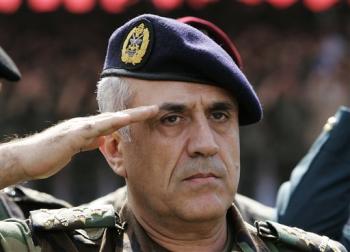
genmichelsuleiman.jpgFor the last week, Lebanon has been without a president but now, after a standoff that has lasted months, the political factions (always simplistically described in the Western media as being pro-Western or pro-Syrian) appear to have agreed on a compromise. Washington didn’t make it happen but it could have stood in the way. Instead, the administration is now willing to accept that Lebanon’s next president, Syria’s preferred candidate, will be General Michel Suleiman.

Some commentators predicted this outcome months ago. Back on August 15, a blogger calling himself, “Outlaw Josey Wales,” wrote, “The powers-that-be have decided General Michel Suleiman/Sleiman will be the next president of Lebanon.” Today, the Wall Street Journal (via Syria Comment) reports:

In recent days [pro-Western] March 14 politicians, with Washington’s consent, agreed to a compromise candidate for the presidency. Gen. Michel Suleiman, commander of the Lebanese Armed Forces, worked closely with Damascus during its military occupation of Lebanon and is already receiving support from some of Syria’s Lebanese political allies.

March 14 leaders say the general’s selection, while not their first choice, could help stabilize Lebanon, because of his leadership of a Lebanese military increasingly viewed as a unifying force in their country.

“Michel Suleiman is well-known to the Hezbollah and the Syrians,” said Walid Jumblatt, a key leader of March 14. “If the Syrians don’t want Suleiman, it means they don’t want stability in Lebanon.”

The concession on the Lebanese president comes amid a broader push by the U.S. and its allies to re-engage Damascus in other ways. American and Israeli strategists view this initiative as aimed at breaking Syria’s alliance with Iran, Hezbollah and the Palestinian militant group Hamas, which have all increased their influence across the Middle East in recent years. It is also aimed at gaining greater support from Syria in cutting off militants infiltrating into Iraq.

The administration wants to characterize the Lebanese presidential choice as a concession by its allies:

A high-ranking US official was quoted by the Kuwait News Agency (KUNA) as saying that Washington has no objections to agreements among the Lebanese on the election of army commander General Michel Suleiman for president. “The US did not strike any deal with Syria regarding Lebanon at the Annapolis conference,” the official, who spoke on condition of anonymity told KUNA. “We understand the concerns of the Lebanese on this issue,” he added. “The US is separating Lebanon from the other pending problems in the region.” The US official said that Lebanon is not up for negotiation, especially not with Syria. “We only refer to Lebanese-Syrian relations when we are calling on Damascus to stop meddling in Lebanon’s internal affairs,” he said.

Mark those words carefully: If the US did not strike any deal with Syria regarding Lebanon at the Annapolis conference it was because the deal had been struck in advance. This is what the New York Times reports:

Syria, the most important outside influence over Lebanese politics, had hesitated until the last minute over whether to attend the conference.

Immediately after the talks, Syrian allies in Lebanon endorsed the first major political breakthrough. Analysts say the talks could thaw strained relations between Syria and the United States.

“The Syrians did not want to go to Annapolis, and without them the conference would have been a failure and would have weakened the Arabs,” said Talal Atrissi, a political analyst and sociologist at Lebanese University. “The Syrians traded their participation, which did not cost them anything, with a deal on the Lebanese presidency.”

Another breakthrough then came after the conference when on Thursday, Christian leader Michel Aoun, a retired general and a former army chief who was seeking the presidency himself and is backed by Syria, indicated that he is “open” to Suleiman becoming president. Lebanese commentator, Michael Young, that day had written, “Aoun will swallow poison before saying yes to Suleiman.” I guess the poison was less bitter than Young imagined.

So why should observers in the United States be surprised by the latest turn of events in the generally mystifying process of Lebanese politics? Here’s why. This is what the astute Syrian political analyst and journalist Sami Moubayed has to say:

…if the Syrians are able to get their way, they would opt for Michel Suleiman, the current army commander. Washington DC is not too enthusiastic about him because he is politically independent; too independent for Washington’s taste. He is committed to combating Israel, supporting Hizbullah, and friendship with Syria. His one slogan has been “Israel is the enemy”, something that greatly pleases Damascus but is frowned upon by 14 March. If elected, he would certainly work for a greater role for Hizbullah in the government, and might even turn a blind eye to their activities in south Lebanon, as did Elias Hrawi in the early 1990s, and Lahoud in 1998-2006. Also to the displeasure of 14 March was a recent remark by the army commander, “Fatah Al-Islam is linked to Al-Qaeda not Syria.”

Washington has plenty of reasons not to like Suleiman. The fact that they have now given their consent to his becoming Lebanon’s next president makes it quite transparent: the realpolitik faction inside the administration is not simply ready to do business with Syria — business is already underway.

Facebooktwittermail

NEWS, OPINION & EDITOR’S COMMENT: Islamophobia goes unchallenged

Foes use Obama’s Muslim ties to fuel rumors about him

In his speeches and often on the Internet, the part of Sen. Barack Obama’s biography that gets the most attention is not his race but his connections to the Muslim world.

Since declaring his candidacy for president in February, Obama, a member of a congregation of the United Church of Christ in Chicago, has had to address assertions that he is a Muslim or that he had received training in Islam in Indonesia, where he lived from ages 6 to 10. While his father was an atheist and his mother did not practice religion, Obama’s stepfather did occasionally attend services at a mosque there.

Despite his denials, rumors and e-mails circulating on the Internet continue to allege that Obama (D-Ill.) is a Muslim, a “Muslim plant” in a conspiracy against America, and that, if elected president, he would take the oath of office using a Koran, rather than a Bible, as did Rep. Keith Ellison (D-Minn.), the only Muslim in Congress, when he was sworn in earlier this year. [complete article]

WaPo reporter responds to all the criticism of front-page Obama Muslim piece

Okay, the Washington Post reporter who wrote today’s front page article on the rumors that Obama is a Muslim has now responded to all the criticism of the piece he’s been getting from readers and elsewhere today.

A number of you have written in to us to say that you had emailed the reporter, Perry Bacon, Jr., and that you had received responses from him. So I went to Bacon, and he sent over a shortened version of the statement he’s been sending back to readers:

I thought the facts that 1. these falsehoods persist and 2. Obama make mentions of his time living in a Muslim country on the campaign trail as part of his foreign policy were both worth remarking. I think the story makes clear, including in the candidate’s own words, he is a Christian.

Anyway, that’s Bacon’s response. Enter it into the record forthwith.

Update: In a chat with readers today, WaPo reporter Lois Romano addressed the controversy over the story. She observed that Obama has denied being a Muslim, adding that “airing some of this and giving him a chance to deny its accuracy could be viewed as setting the record straight.”

Right, but the problem here is that WaPo, and not just Obama, should have “denied the accuracy” of the Obama-is-a-Muslim nonsense. The Obama Muslim smear is based on lies, not “rumors.” Bacon in his statement above calls the Obama Muslim smears “falsehoods.” But they aren’t identified as such in the piece. That’s what everyone is yelling about. [complete article]

Editor’s Comment — Let’s suppose that the word flying around the rightwing blogosphere was that Obama was Jewish. Would anyone be referring to that as a smear? Obama and others would point out that he’s a Christian, not a Jew, but we would not be hearing about the Obama “Jewish smears.”

In the outrage being expressed about the Obama “Muslim smear”, where is the outrage at the fact that in pluralistic, democratic America the label Muslim can be used as a smear? Apparently it goes without saying that Islamophobia is a socially acceptable current in presidential politics.

If the editor’s of the Washington Post want to salvage their newspaper’s reputation, how about reporting on the parallels between American images of Communists during the McCarthy era and the bipartisan vilification of Islam and Muslims that exists as an unchallenged bigotry in much of America today?

Facebooktwittermail

FEATURE: The proliferation game

How the world helped Pakistan build its bomb

Globalization, what a concept. You can get a burger prepared your way practically anywhere in the world. The Nike Swoosh appears at elite athletic venues across the United States and on the skinny frames of t-shirted children playing in the streets of Calcutta. For those interested in buying an American automobile — a word of warning — it is not so unusual to find more “American content” in a Japanese car than one built by Detroit’s Big Three.

So don’t kid yourself about the Pakistani bomb. From burgers to bombs, globalization has had an impact. Pakistan’s nuclear arsenal — as many as 120 weapons — is no more Pakistani than your television set is Japanese. Or is that American? It was a concept developed in one country and, for the most part, built in another. Its creation was an example of globalization before the term was even coined.

So where to begin? Some argue that Pakistan started down the nuclear road under President Dwight D. Eisenhower’s 1953 Atoms for Peace program, billed as a humanitarian gesture aimed at sharing the peaceful potential of atomic energy with the world. But Atoms for Peace was a misnomer — a plan to divert growing domestic and international concern over radioactive fallout from America’s nuclear tests. It would prove to be a White House public relations campaign to dwarf all others.

In fact, Atoms for Peace educated thousands of scientists from around the world in nuclear science and then dispatched them home, where many later pursued secret weapons programs. [complete article]

Facebooktwittermail

NEWS, ANALYSIS & EDITOR’S COMMENT: U.S. Special Forces inside Iran?

U.S. wages covert war on Iraq-Iran border

While the PKK has been in the international spotlight in recent weeks, with Turkey mounting cross-border raids and threatening to launch an invasion of Iraq, not so much attention has been given to the Iranian offshoot, the PJAK. The group has been waging an insurgency against Tehran since 2004, which recently has escalated. A guerrilla leader told the New York Times last month that PJAK fighters had killed at least 150 Iranian soldiers and officials in Iran since August.

Iran accuses Washington of backing the group, and while the US denies this, local and foreign intelligence sources say the accusation is most likely true. According to a former US Special Forces (SF) commando currently based in Iraq who spoke on condition of anonymity, Special Forces troops are currently operating inside Iran, working with insurgent forces like the PJAK. “That’s what the SF does,” he said. “They train and build up indigenous anti-government forces.”

“The primary function of the Special Forces is to stand up guerrilla forces or counter-guerrilla forces,” said another former SF soldier, retired Major Mark Smith. While he was not specifically aware of SF teams training the PJAK, he said it would not be surprising if they were. And “they would be training in an obscure border area or in a location denied to anyone not directly involved”, he said.

He added that SF teams in Iran would be conducting strategic reconnaissance of possible nuclear and biological weapons sites, army headquarters, and significant individuals. “If they’re not doing these things in Iran, then they are remiss in their duties at the upper echelons of their command,” he said. [complete article]

Petraeus sought to prevent release of Iranians

Recent statements by the U.S. military that Iran had pledged to stop supplying weapons to Shi’ite militias in Iraq and that this alleged flow of arms may have stopped in August were part of a behind-the-scenes struggle over whether the George W. Bush administration should make a gesture to Iran by releasing five Iranian prisoners held since January.

When U.S. military experts found evidence that recently discovered weapons caches probably dated back to early 2007, it strengthened the hand of those in the administration arguing for the release and weakened the position of Vice President Dick Cheney and Gen. David Petraeus, who sought to scuttle any release by insisting that there was no evidence that Iran had changed its alleged policy of destabilizing Iraq. [complete article]

Annapolis and Iran

Is there room in these last months of a lame duck presidency to craft a modest opening to Iran, while maintaining a stout anti-Iranian coalition? Well, if we are to heed the cries of alarm emanating from the neo-conservatives as they watch their grandiose plans to add a third front to the War on Terror crumple into the dustbin of history, perhaps there really is something going on here.

Nevertheless, since this is a policy that dare not speak its name, even if these titillating signals are true, no turning point will be announced in blaring trumpets, and the message about Iran will be cloaked in vitriol and bile to prevent creating undue alarm among American conservatives and among the Arabs who are only now signing on to a long-term strategy to counter the “Iranian threat” but who also deeply fear the possibility of a sudden deal between the United States and Iran. (They can’t forget the shah and Iran-contra.)

The two individuals most likely to view these developments with quiet satisfaction are James Baker and Lee Hamilton, whose original policy prescriptions in the Iraq Study Group all seem to be coming true as George W. Bush approaches the precipice of his presidency. [complete article]

Editor’s Comment — The fundamental problem in trying to decipher the intention behind the administration’s mixed messages on Iran is that this presumes that the administration has an intention. Just as likely, these mixed messages are the expression of multiple intentions as conflicting factions inside the administration jostle for the upper hand, each acutely aware that a president who does not know his own mind, can be swayed.

Iranians say sanctions hurt them, not government

Banks HSBC, Credit Suisse and UBS cut business ties with Iran last year followed by Deutsche Bank, Commerzbank and BNP Paribas in 2007.

“Almost every month we get notes from European banks about ceasing their cooperation with Iran,” said an employee of an Iranian bank, who asked not to be identified.

A doctor, who also spoke on condition of anonymity, said: “We cannot open Letters of Credit in banks. Importing necessary material for medicines to treat patients who suffer cancer is becoming more difficult every day.”

Personal stories are common of how the financial sanctions are affecting those mostly well-off people who have foreign bank accounts or earn income from abroad.

Some say they will leave Iran if the United Nations imposes tougher sanctions; others are forced to use unofficial channels to get their cash.

Maryam Sharifa is one of many Iranians whose dollar account with a Western bank was closed in the past few months. Like many Iranians who lived abroad, she had kept her account open since returning to Iran.

“I had this account for 13 years in France. Do I look like a terrorist? Should I be punished just for being an Iranian?” said the 39-year-old mother of two. “I had to bring all that money with me here and buy a small apartment in Tehran.” [complete article]

Iran’s secret weapon: The Pope

The diplomatic chess game around Iran’s nuclear program includes an unlikely bishop. According to several well-placed Rome sources, Iranian officials are quietly laying the groundwork necessary to turn to Pope Benedict XVI and top Vatican diplomats for mediation if the showdown with the United States should escalate toward a military intervention. The 80-year-old Pope has thus far steered clear of any strong public comments about either Iran’s failure to fully comply with U.N. nuclear weapons inspectors or the drumbeat of war coming from some corners in Washington. But Iran, which has had diplomatic relations with the Holy See for 53 years, may be trying to line up Benedict as an ace in the hole for staving off a potential attack in the coming months. “The Vatican seems to be part of their strategy,” a senior Western diplomat in Rome said of the Iranian leadership. “They’ll have an idea of when the 11th hour is coming. And they know an intervention of the Vatican is the most open and amenable route to Western public opinion. It could buy them time.” [complete article]

Facebooktwittermail