Category Archives: Palestinians

Palestinians vent anger at U.S. over statehood issue

McClatchy reports:

Palestinian protesters burned effigies of President Barack Obama and stomped on U.S. flags Thursday in one of the largest recent displays of anti-American sentiment here, sparked by the United States’ pledge to veto any request for U.N. membership for a Palestinian state.

Gathered outside the residence of Palestinian Authority President Mahmoud Abbas, who’s expected to address the U.N. General Assembly in New York on Friday, the protesters denounced Obama, whom they accused of siding with Israel in the lengthy impasse over peace negotiations.

“Obama betrayed the Palestinian people. He sided with Israel against us, and showed what kind of leader he is and what America truly thinks of Palestine,” said Mahmoud Abouta, 17, who carried a sign with Obama’s name crossed out.

Abbas is expected to appeal for U.N. membership during his speech Friday and has said he’ll submit a formal application to U.N. Secretary-General Ban Ki-moon that will propose a state that would comprise the West Bank, East Jerusalem and the Gaza Strip. Ban then would pass that application to the Security Council for consideration. As one of five permanent members, the United States has the power to veto anything that comes before the Security Council.

Israel has opposed the bid, and the United States has echoed its position, calling the proposed application a unilateral step that hurts peace negotiations between the countries. “Peace will not come through statements and resolutions at the U.N,,” Obama told the General Assembly on Wednesday, “If it were that easy, it would have been accomplished by now.”

But a U.S. veto of the Palestinians’ application for U.N. membership is certain to stoke anti-American ferment to new heights here, and also is likely to affect the United States’ diminishing status in the Middle East, where the Arab Spring toppled what had been a staunchly pro-American regime in Egypt.

“The U.S. has shown its true colors, as a puppet of Israel. If they use that veto, that is it. We will never forget,” Abouta said, expressing a sentiment heard here frequently Thursday.

Facebooktwittermail

Palestinians declare independence from the U.S.

“Israel and the US are one and the same: the US is Israel, and Israel is the US. Israel doesn’t want to give the Palestinians anything and Obama can’t do anything without Israel because Congress is pro-Israel.”

That’s how Marwan Jubeh, a shop owner in Ramallah, neatly sums up the situation.

If there was an honest element in President Obama’s speech at the UN General Assembly yesterday, it was implicit rather than directly spelled out: it was in effect a declaration of impotence.

And as Obama shifts into gear in his campaign for re-election, he will be grateful for the kosher seal of approval he just got from Israel’s political leaders which he can deploy as often as necessary over the next twelve months to signal that for both Democrats and Republicans, Israel and the US are one and indivisible — even when the president’s middle name is Hussein.

“I think it’s in our national interest, and Israel’s national interest, that we have a strong partnership and that the president is perceived as a friend and ally of Israel. While he does that, everybody should be happy.” So says Bob Turner who — even though he just rode to victory in New York’s 9th Congressional district through a campaign that presented Obama as no friend of Israel — now says that he does not see Israel as a wedge issue.

So now that Obama has once again burnished his credentials as a stalwart friend of Israel, he will be only too happy to set aside any expectation that the US, under his leadership, has a constructive role to play in ending the conflict.

Meanwhile, as Obama insists that the current Palestinian bid for statehood will make no difference, as Henry Siegman argues, it may actually completely change the power dynamics as the Palestinians begin to assert their right of self-determination.

The outpouring of commentary on the request that Palestinians intend to submit to the United Nations to affirm their right to statehood within the pre-1967 borders has fallen into two categories. The first supports the Israeli and American view that sees the Palestinian initiative as endangering the Oslo Accords and prospects for a two-state solution. As described by President Obama, it is a “distraction” from the serious business at hand. The second view supports the Palestinian right to apply for UN membership, or for non-member-state observer status, and rejects the notion that this would set back the peace process.

However, both approaches believe that UN action will not result in any practical changes on the ground and that Palestinians will have to return to the U.S.-orchestrated “peace process” to achieve a two-state solution. And both have in common a profound misreading of the significance of the Palestinian initiative, which is likely to be transformative, changing the rules of the game for Israeli-Palestinian peacemaking.

According to the prevailing rules, every aspect of the Palestinians’ existence depends on Israel. Whether Palestinians can travel from town to town within the areas to which they are restricted, open a new business venture, see their homes demolished by an Israeli bulldozer—indeed whether they will live or die—are Israeli decisions, often made by armed Israeli eighteen-year-olds just out of high school.

The Oslo Accords, requiring as they do that Israel withdraw its occupation in stages from the West Bank, were intended to change that reality. But Oslo was quickly undermined by Prime Minister Yitzhak Rabin, who declared—“unilaterally”—that the dates established in the accords for the withdrawals are not “holy” and can be ignored by Israel. Furthermore, as noted by Uri Savir, who headed Israel’s Foreign Ministry at the time, Rabin had no intention of returning the Jordan Valley or of sharing Jerusalem. (He might well have changed his views on these issues, as he did on some others, had he not been assassinated by a settler.)

Although the Oslo Accords did not mention a Palestinian state, statehood was the goal implicit in the agreement’s terms and the permanent-status issues slated for negotiations between the parties. But the peace process overseen by the United States was based on an unstated principle that fatally undermined the achievement of a Palestinian state: that any change in the Palestinians’ status as a people under Israel’s occupation depended entirely on Israel’s consent. This effectively excluded everyone other than the occupiers from a role in deciding the Palestinians’ fate. The UN, which was established to assure compliance with international law and to facilitate the self-determination of peoples living under colonial domination, was shunted aside. Above all, this principle excluded the Palestinian people themselves.

To be sure, President Obama recently proposed that negotiations begin at the 1967 lines, with territorial swaps. What he failed to say is that if the parties cannot reach agreement on the swaps, the lines will be drawn by the Security Council. Indeed, he said the opposite—that peace terms cannot be imposed on Israel. His proposal therefore changed nothing. Netanyahu can continue to make demands he knows no Palestinian leader can accept, and the occupation persists.

The real meaning of the Palestinians’ decision to defy the United States is that they will no longer accept their occupier’s role in their quest for statehood. They demand national self-determination as a right—indeed, as a “peremptory norm” that in international law takes precedence over all other considerations—and not as an act of charity by their occupiers.

The American insistence on aborting the Palestinians’ initiative and returning them to a peace process in which their fate remains dependent on Israel is shameful. It stains America’s honor. It will not succeed, for the Palestinian decision to defy the American demand is itself a declaration of independence; that genie cannot be returned to the bottle.

On the ground, little will be changed by a UN affirmation of Palestinian statehood. But nothing will be the same again in the Palestinians’ dealings with Israel and the United States. The notion that Israel will decide where negotiations begin and what parts of Palestine it will keep is history. It is sad that America, of all nations, has failed to understand this simple truth, even in the wake of the Arab Spring. Sadder still is Israel’s continuing blindness not only to the injustice but also to the impossibility of its colonial dream. That dream may now turn into a nightmare as the international community increasingly sees Israel as a rogue state and treats it accordingly.

Facebooktwittermail

Obama’s passivity could pave the way to a civil uprising against Israel

Akiva Eldar writes:

To realize the extent to which the lame-duck candidate has regressed from the positions of the new and promising President Obama, the speech to the United Nations in September 2011 should be compared to one he gave in Cairo in 2009. At that time he pledged to “personally pursue this outcome with all the patience that the task requires,” and said “… it is time for all of us to live up to our responsibilities.” Yesterday he sent the occupied and the occupier, the strong and the weak, to solve the core issues on their own.

In Cairo he recalled, along with Jewish suffering in the Holocaust, the “daily humiliations … that come with the occupation.” And he added: “Let there be no doubt: The situation for the Palestinian people is intolerable.” He even compared the struggle of the Palestinians for freedom to the struggle of black people in the United States for equal rights. On Wednesday, Obama paid pursed lip service to the legitimate aspirations and forgot to mention the occupation.

In June 2009, Obama spoke of “the obligations that the parties have agreed to under the road map.” He meant, among other things, and perhaps mainly, Israel’s obligation to completely stop construction in the settlements and dismantle the outposts built after March 2001. To remove all doubt, he stated resolutely: “It is time for these settlements to stop.”

On Wednesday, not one word of criticism was heard about Israel creating unilateral physical facts on the ground. To the 2011-model Obama, only the Palestinians’ approach to the United Nations is unilateral, objectionable and meriting the death penalty.

Facebooktwittermail

Obama to UN: yada yada yada — Israelis applaud

In case anyone is in any doubt that President Obama’s comments on the Israeli-Palestinian conflict, delivered to the UN General Assembly this morning, were nothing more than a string of worthless peace-process platitudes, then listen to the rave review he got from Israeli foreign minister Avigdor Lieberman: “I congratulate President Obama, and I am ready to sign on this speech with both hands.” Prime Minister Netanyahu and opposition leader Tzipi Livni were similarly pleased.

As usual Israel and the United States are speaking with one voice: Israel’s.

One year ago, I stood at this podium and called for an independent Palestine. I believed then – and I believe now – that the Palestinian people deserve a state of their own. But what I also said is that genuine peace can only be realized between Israelis and Palestinians themselves. One year later, despite extensive efforts by America and others, the parties have not bridged their differences. Faced with this stalemate, I put forward a new basis for negotiations in May. That basis is clear, and well known to all of us here. Israelis must know that any agreement provides assurances for their security. Palestinians deserve to know the territorial basis of their state.

I know that many are frustrated by the lack of progress. So am I. But the question isn’t the goal we seek – the question is how to reach it. And I am convinced that there is no short cut to the end of a conflict that has endured for decades. Peace will not come through statements and resolutions at the UN – if it were that easy, it would have been accomplished by now. Ultimately, it is Israelis and Palestinians who must live side by side. Ultimately, it is Israelis and Palestinians – not us – who must reach agreement on the issues that divide them: on borders and security; on refugees and Jerusalem.

Peace depends upon compromise among peoples who must live together long after our speeches are over, and our votes have been counted. That is the lesson of Northern Ireland, where ancient antagonists bridged their differences. That is the lesson of Sudan, where a negotiated settlement led to an independent state. And that is the path to a Palestinian state.

We seek a future where Palestinians live in a sovereign state of their own, with no limit to what they can achieve. There is no question that the Palestinians have seen that vision delayed for too long. And it is precisely because we believe so strongly in the aspirations of the Palestinian people that America has invested so much time and effort in the building of a Palestinian state, and the negotiations that can achieve one.

America’s commitment to Israel’s security is unshakeable, and our friendship with Israel is deep and enduring. And so we believe that any lasting peace must acknowledge the very real security concerns that Israel faces every single day. Let’s be honest: Israel is surrounded by neighbors that have waged repeated wars against it. Israel’s citizens have been killed by rockets fired at their houses and suicide bombs on their buses. Israel’s children come of age knowing that throughout the region, other children are taught to hate them. Israel, a small country of less than eight million people, looks out at a world where leaders of much larger nations threaten to wipe it off of the map. The Jewish people carry the burden of centuries of exile, persecution, and the fresh memory of knowing that six million people were killed simply because of who they were.

These facts cannot be denied. The Jewish people have forged a successful state in their historic homeland. Israel deserves recognition. It deserves normal relations with its neighbors. And friends of the Palestinians do them no favors by ignoring this truth, just as friends of Israel must recognize the need to pursue a two state solution with a secure Israel next to an independent Palestine.

That truth – that each side has legitimate aspirations – is what makes peace so hard. And the deadlock will only be broken when each side learns to stand in each other’s shoes. That’s what we should be encouraging. This body – founded, as it was, out of the ashes of war and genocide; dedicated, as it is, to the dignity of every person – must recognize the reality that is lived by both the Palestinians and the Israelis. The measure of our actions must always be whether they advance the right of Israeli and Palestinian children to live in peace and security, with dignity and opportunity. We will only succeed in that effort if we can encourage the parties to sit down together, to listen to each other, and to understand each other’s hopes and fears. That is the project to which America is committed. And that is what the United Nations should be focused on in the weeks and months to come.

The New York Times reports:

Less than an hour after Mr. Obama spoke, President Nicolas Sarkozy of France stood at the same podium in a sharp repudiation, calling for a General Assembly resolution that would upgrade the Palestinians to “observer status,” as a bridge towards statehood. “Let us cease our endless debates on the parameters,” Mr. Sarkozy said. “Let us begin negotiations and adopt a precise timetable.”

For Mr. Obama, the challenge in crafting the much-anticipated General Assembly address on Wednesday was how to address the incongruities of the administration’s position: the president who committed himself to making peace between the Israelis and the Palestinians a priority from Day One, who still has not been able to even get peace negotiations going after two and a half years; the president who opened the door to Palestinian state membership at the United Nations last year ending up threatening to veto that very membership; the president who was determined to get on the right side of Arab history ending up, in the views of many on the Arab street, on the wrong side of it on the Palestinian issue.

The US-Israeli message to Palestinians remains now what it has long been: the Palestinians deserve a state, but not just yet.

So if you’re looking for Palestine, all you need to do is find your way to the end of the peace process rainbow — it’s right there, alongside a pot of gold.

But if the White House is still willing to collude with its Israeli partners in refusing to set a deadline for the creation of a Palestinian state, France’s president issued Obama a stern warning:

“Each of us knows that Palestine cannot immediately obtain full and complete recognition of the status of United Nations member state,” he said. “But who could doubt that a veto at the Security Council risks engendering a cycle of violence in the Middle East?”

Those who still declare their belief that a two-state solution is the only viable solution to the conflict must move beyond their endless repetition of the parameters of such a solution and declare without equivocation when a Palestinian state must be created.

Without a date there will be no state.

Facebooktwittermail

U.S. should recognize Palestinian state

Zvi Bar’el writes:

Memory is short and forgetfulness is often deliberate, but 23 years ago the UN General Assembly decided to move its session from New York to Switzerland so that Palestine Liberation Organization head Yasser Arafat could deliver a speech. The reason: U.S. Secretary of State George Schultz refused to issue Yasser Arafat an entry visa to the United States.

Today too, with the opening of the session of the General Assembly, Washington is standing like a fortified wall blocking the entry of Palestine to the UN building. Although Palestinian Authority President Mahmoud Abbas has no problem getting a visa, when he comes to ask for a state for the Palestinians he is put on a roller coaster. The list of threats and future punishments to be imposed on him and his country, if it is established, guarantees that this will be a state that is battered from birth.

Here is colonialism in all its glory. After all, the United States agrees that there should be a Palestinian state, it even twisted the arm of Prime Minister Benjamin Netanyahu a little bit, cautiously so it wouldn’t hurt, so that he would blurt out the necessary formula “two states for two peoples.” U.S. President Barack Obama even spoke about the optimal borders of the Palestinian state and Abbas was not yet required to recognize Israel.

After all, Arafat already recognized it. Palestine fulfilled all the threshold conditions. And still, this state has only one chance of being born the American way. Through negotiations that will lead to a consensual agreement and a handshake. And if Israel’s hand is missing, never mind, the Palestinians will wait until it grows.

But Abbas has learned a thing or two from Israel. The main lesson he has learned is that his real negotiations are not with Israel but with Washington. The second lesson: The negotiations must not take place on a playing field that is convenient for Obama, but rather at the United Nations. There Obama is not facing a beggarly Palestinian Authority that can be frightened with a shout, but 193 countries, each of which must be negotiated with.

New York is not Ramallah. Abbas saw how Israel chose its own playing field in the U.S. Congress, and carefully responded in kind. Instead of going out on a limb, he planted the tree by himself, nurtured it, diligently recruited most of the countries in the world, was helped substantially by Israel’s mistakes, took good advantage of Jerusalem’s isolation, examined the pros and cons and decided that even in loss there would be great gain.

If the United States casts a veto in the UN Security Council, it will cause more damage to Washington than to Abbas; if he makes do with recognition in the General Assembly, it will be in exchange for an American commitment to support a Palestinian state if negotiations fail, as they will.

Abbas caused Washington to be embroiled in a dispute with its European colleagues, and presented Israel as a cripple. He is forcing the United Nations to do what it usually fails to do: to find a peaceful solution to conflicts. As a bonus he caused Netanyahu to say that he is going to deliver a “speech of truth” at the United Nations, thereby admitting in effect that until now he has been lying.

The panic in Washington is genuine. It was evident when David Hale, Obama’s special envoy, was unable to control his temper and simply shouted at Abbas when he understood that he had no intention of retreating from his initiative.

Anger and helplessness could also be detected in the voice of U.S. Secretary of State Hillary Clinton, when she announced that the United States would cast a veto in the Security Council. Suddenly she realized that the Israeli-Palestinian conflict is not only “the business of the parties involved” but threatens Washington’s regional and international status.

If the United States fails to recognize the Palestinian state, it will have difficulty sidelining its rivals in the new Middle East, where the public has more power than the rulers; if it recognizes the Palestinian state, it will have to ensure its sustainability, in other words, to direct the sanctions against Israel. Truly a bad situation for a great power that aspires to draw the map of the new Middle East.

Had it only made an effort to achieve genuine negotiations when that was still possible, had it invested its efforts into reaching an agreement that it is now investing in preventing the declaration of independence, had it shared the threats equally between the PA and Israel, it may not have found itself in this difficult situation.

It should at least recognize the state now. It should recall what has happened since it refused to grant Arafat his visa.

Facebooktwittermail

Living under Israeli occupation in the West Bank

Younes Arar from the Center for Freedom and Justice in Beit Ommar talks to Robert Wright at Bloggingheads.tv. See also the Palestine Solidarity Project.

Earlier this month, the International Middle East Media Center reported:

As Israel decided to further arm the settlers by providing them with stun grenades and tear gas bombs, the settlers, supported by extremist right wing factions in Israel, are preparing a plan to “respond to any popular Palestinian move that will likely take place as the Palestinian leadership asks the United Nations this month to recognize a Palestinian State with East Jerusalem as its capital.

Extremist right-wing factions in Israel are preparing a plan dubbed “children against children, women and women”, as part of settlers’ activities and attacks against the unnamed Palestinian population in the West Bank and in occupied East Jerusalem.

Jewish settlers, illegally living in the occupied territories, are a largely armed population and well trained for combat situations.

The settlers currently own more than half a million automatic rifles, and practically unlimited amounts of ammunition.

A number of fundamentalist settler organizations confirmed that the preparations started last month, and that plans to attack Palestinian areas are already in place to contain the anticipated Palestinian popular activities.

Facebooktwittermail

Where the 13 United Nations Security Council members stand on the upcoming Palestine vote

On Friday, Palestinian Authority president Mahmoud Abbas laid out his plans to seek full membership at the United Nations Security Council this week. In order for the vote to succeed, it needs nine votes and no veto, and then approval by a two-thirds majority of members of the General Assembly. Alternatively, the Palestinians can seek to win only limited membership as a non-voting member in the General Assembly as a fallback option.

ThinkProgress has reviewed the positions of the 13 Security Council members. Five members are firm supporters of the Palestinian bid, while two, like the United States are opposed. The largest group of countries is the undecided: [Continue reading…]

Facebooktwittermail

Americans support UN recognition of Palestine

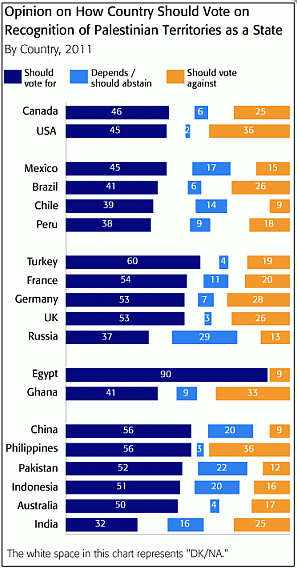
Here are some numbers President Obama should think about: Americans currently view him less favorably than they do UN recognition of Palestine! Obama’s approval rating is 43% while 45% support Palestine.

In a poll conducted for the BBC, Americans (among 20,446 citizens from 19 countries) were asked the following question:

As you may know, the Palestinian Authority is planning to request that the UN General Assembly recognize the Palestinian Territories as a state and as a member of the UN. Do you think [RESPONDENT’S COUNTRY] should vote for or against this request?

The response from Americans was 45% in favor, 36% opposed, 2% abstain, 17% undecided.

Globally, the public is five to two in favor of UN recognition of Palestine.

Even though less than a majority of Americans polled support the move, that number along with the large number who are undecided, needs to be put into perspective.

US media coverage of the Israeli-Palestinian conflict is heavily skewed in favor of the Israelis. Israel’s political leaders and Israel’s American supporters have characterized the Palestinian initiative as an attempt to delegitimize the Jewish state. The Palestinians do not have a charismatic leader whose face can serve as an iconic, positive and internationally recognized image of Palestinian nationalism. And yet in spite of the prevailing pressure to oppose the move, more Americans than those who think otherwise, support Palestine’s admission to the UN.

Most likely, this has much less to do with an interest or understanding of the conflict than it is an expression of an idea that most Americans readily accept: people should be allowed to govern themselves.

Facebooktwittermail

‘Israel will look like South Africa during the apartheid’ — Israeli ambassador Shalev

Gabriela Shalev, Israel’s ambassador to the UN from 2008-2010, was interviewed by Shalom Yerushalmi for Israel’s Hebrew daily, Maariv. Translation provided by Viktoria Lymar (Watching America).

September is already here, and professor Gabriela Shalev, Israel’s previous ambassador to the U.N., is more pessimistic than ever: “We have no tools, we’re in trouble.”

Gaby Shalev, formerly Israel’s ambassador to the U.N., has a joke on the occasion of the beginning of the school year. Someone turns to his mom and complains in the corner: “I don’t want to go to school. All the teachers hate me, and I hate them. All the students hate me, and I hate them.” “You don’t have a choice,” responds the mother. “You’re the principal.”

Israel has no choice as well. Neither does the former ambassador. She had to return daily to a place where she felt condemned and despised. Today, exactly one year after finishing her term, she’s sitting in her beautiful house in Even Yehuda, still overcome by fear. September is in the doorway, and she sees that Israel will be engulfed in the wave of an unprecedented political tsunami, at the end [of which] Israel will be thrown outside of the fence, subject to heavy sanctions and boycotts.

After taking off the diplomat suit, Shalev speaks eloquently and daringly, trying to confront the failures of public relations, acknowledging weaknesses and mistakes and even how she was fundamentally unsuitable for the role she was asigned to.

“Operation Cast Lead [the Gaza War] broke out. The Netanyahu government came to power, the talks with the Palestinians were stopped, the Goldstone report loomed into prominence, and the Marmara affair struck waves in the world,” analyzes Shalev. “Add to this the rewarding diplomatic effort of the Palestinians and Arab countries, and you’ll fathom why Israel is at a political nadir in the U.N. that we have never before been driven to. The U.N. is a drainage collector of all the hostility toward Israel and the global delegitimization of Israel. There, they already don’t recognize our right to exist. These days are the gravest of all you can possibly recollect.”

But the United States is with us.

“Not precisely. We’re going from bad to worse, and losing the United States as well on the way. U.S. Ambassador Dan Shapiro may say that relations are steadfast, strong and good, but this is no longer the same type of relationship and support. A rapport between the leaders is not the most important thing, but even that is nonexistent. Obama is not opening his arms to us. He’s different. In my view, this is very impressive. Distant, noble. He is a cold and rational person. He thinks unusually. Esther Brimmer, Clinton’s assistant secretary of state, told me once, “Help us to help you.” In short, these are not the days of John Bolton, who was the American ambassador to the U.N., but everybody thought he was the Israeli delegate.

What has changed?

“You should comprehend the totality of the new interests of the United States. It wants to be the leader of the world, not to isolate itself from it. Ambassador Susan Rice remarked that the U.N. is not perfect, but it’s impossible [to do] without it. There is new black elite in America today: Barack Obama, his wife Michelle, Susan Rice, Esther Brimmer who is very close to the president and the others. Everyone went to Harvard. They became very associated with the blacks from Africa, from the islands. Susan Rice became attached to them, socially and politically. We remained outside. We are the separatists, we help neither our friends nor ourselves.”

What’s going to happen in September?

“It’s terrifying. I don’t call this ‘the black September’ only because my son was born in September, but the state of affairs is serious. The president of the [General] Assembly will be Abdelaziz al-Nasser, Qatar’s ambassador to the U.N. He used to be my friend, despite Qatar being extremely against us. The president of the Security Council (which changes according to monthly rotation) will be the Lebanese ambassador. From our standpoint, that is an intolerable condition. They are chairing meetings, bringing up proposals, setting the agenda, gaining control of the whole show.

Meanwhile, there are no talks between us and the Palestinians, there is an absolute standstill. Sept. 20 may yield a resolution for the recognition of the Palestinian state within 1967 borders. There’s no way it won’t be accepted.

At a conference of experts organized by the Knesset’s Foreign Affairs and Defense Committee last May, you noted that “As soon as the declaration on the disputable territories is received, the Yesha areas [West Bank] will not be considered as anything other than territories under occupation.”

“It is actually beyond that. Several of my fellow jurists comment that with the declaration, we won’t be regarded as an occupying power but instead, an invading force. This involves international sanctions, and they have fateful significance. Should the Palestinians be admitted as a member state in the U.N. through the Security Council, — we’re in complete trouble.”

Aren’t the Americans going to exercise their veto?

”The Americans are not our puppets. They are not in our pocket. You should remember that sanctions could be imposed on us even without agreement in the Security Council. The matter is based on the Resolution 377, adopted under the name ‘Uniting for Peace.’ Whatever will happen after the declaration, Israel will look like South Africa during the apartheid.”

Facebooktwittermail

Obama is about to squander an historic opportunity

Gideon Levy writes:

What is the American president going to say to his citizens? What will he say to the citizens of the world? How will he rationalize his country’s opposition to recognizing a Palestinian state? How will he explain his position, which runs counter to the position of the enlightened – and less enlightened – world?

And above all, what will Barack Obama say to himself before he goes to bed? That the Palestinians don’t deserve a state? That they have a chance to get it through negotiations with Israel? That they do not have equal rights in the new world that we thought he was going to establish? Will he admit to himself that, because of opportunistic election considerations – yes, Obama is now being exposed as quite an opportunist – he is also harming his country’s interests as well as the (real) interests of Israel, and is acting against his own conscience too?

It is difficult now to understand Obama’s America. The man who promised change is turning out to be the father of American conservatives. With regard to Israel, there is no difference between him and the last of the celebrants at the Tea Party. We did not expect a great deal from Hillary Clinton; she can continue to recite hollow speeches about negotiations-shmegotiations – but Obama?

Et tu, Brute? After all, in your Cairo speech you promised a new dawn for the Muslim world, you promised a new America to the Arab world. And what came of this? The same old American wolf – which blindly and automatically supports every whim of Israel’s to such an extent that it is not clear which is the world power and which is the protectorate – and not even dressed in sheep’s clothing. The riddle remains unsolved: How is it that the supposedly new America is continuing to sing the same old songs from its evil past? How is it that Obama is behaving as if he does not understand that the Palestinians will no longer agree to live another four decades without civil rights, certainly not in view of all that is taking place around them in the awakening Arab world?

The riddle remains unsolved because it is difficult to comprehend how a black president, who believes in justice and equality, can bow down with such unbearable lightness to a right-wing government in Israel, to narrow election considerations in America, and to Jewish and Christian lobbies. It is difficult to comprehend how his America does not understand that it is shooting itself with a lethal bullet in the heart by supporting the Israeli refusal to make peace. After all, deep in his heart this American president knows that the Palestinians’ demand is justified because they too are worthy, finally, of becoming independent – and that Israel supports occupation. Why does one have to wait for the book of memoirs that he will surely write one day in order to hear this? He knows that the Arab Spring, that erupted to a certain extent in the wake of his promising Cairo speech, will now turn its anger and hatred toward America, once more toward America, simply because of its insistent opposition to Palestinian freedom.

Obama is also supposed to know that concern for Israel’s future, and genuine friendship toward Israel, must include support for the establishment of a Palestinian state. That is the only way to neutralize the explosive fuse that is going to set off the entire region, against Israel and against the United States. He also knows that America’s stance against the entire world will once again arouse the hostility of the world against the U.S. leader. And all of that – for what? For a handful of votes in the next elections. That cannot be considered an excuse on the part of someone who was seen as so promising a leader with such a highly developed awareness of history. A person who sells his country’s interests and his own weltanschauung during his first term of office will display similar opportunism during the second term.

How pathetic is the vision of the two American emissaries who are once again shuttling back and forth now in the region and distributing threats. And to whom? To the Palestinians who are turning to a new diplomatic route, but not to the Israeli government for its destructive refusal. How pathetic it is to see Dennis Ross, the eternal American Mr. Negotiations of almost all its administrations, scuttling around with nothing to do between Ramallah and Jerusalem as he has been doing for decades. That is the old, bad America, as if there were no Obama.

The American president this week has the historic opportunity of improving the status of his country, of justifying retroactively the Nobel Prize for Peace that he was awarded, of demonstrating real commitment to imposing peace in the most dangerous region for the fate of the world, and of showing genuine concern for the well-being of Israel – but what do we get instead?

George Bush. George Bush for the poor.

Facebooktwittermail

The mainstreaming of Walt and Mearsheimer

Glenn Greenwald writes:

There were numerous reasons that Stephen Walt and John Mearsheimer were accused in prominent venues of all sorts of crimes — including anti-Semitism — when they published The Israel Lobby, but the most common cause was the book’s central theme: that there is a very powerful lobby in the U.S. which is principally devoted to Israel and causes U.S. political leaders to act to advance the interests of this foreign nation over their own.  In The New York Times today, Tom Friedman — long one of Israel’s most stalwart American supporters — wrote the following as the second paragraph of his column, warning that the U.S. was about to incur massive damage in order to block Palestinian statehood:

This has also left the U.S. government fed up with Israel’s leadership but a hostage to its ineptitude, because the powerful pro-Israel lobby in an election season can force the administration to defend Israel at the U.N., even when it knows Israel is pursuing policies not in its own interest or America’s.

Isn’t that exactly Walt and Mearseimer’s main theme, what caused them to be tarred and feathered with the most noxious accusations possible?  Indeed it is; here’s how the academic duo, in The Israel Lobby, described the crux of their argument as first set forth in an article on which the book was based:

After describing the remarkable level of material and diplomatic support that the United States provides to Israel, we argued that his support could not be fully explained on either strategic or moral grounds  Instead, it was due largely to the political power of the Israel lobby, a loose coalition of individuals and groups that seeks to influence American foreign policy in ways that will benefit Israel . . . We suggested that these policies were not in the U.S. national interest and were in fact harmful to Israel’s long-term interests as well.

Is that not exactly the point which The New York Times‘ most “pro-Israel” columnist himself just voiced today?

Facebooktwittermail

U.S. envoys’ paper emboldens Abbas to go before U.N.

The Los Angeles Times reports:

A paper special U.S. peace envoys David Hale and Dennis Ross presented to Palestinian Authority President Mahmoud Abbas on Thursday that was supposed to sway him away from going to the United Nations was what caused Abbas to take a final stand in favor of going, according to Nabil Shaath, a member of Abbas’ Fatah Central Committee.

Abbas told the Palestinian people on Friday that he is going to the Security Council to ask for membership in spite of strong U.S. objections and attempts to have him change his mind.

Shaath, speaking in Ramallah on Saturday, said the U.S. paper Hale and Ross had presented to Abbas when they met him at his headquarters and that was supposed to get him to decide against going to the U.N. has actually increased his resolve to go.

“It was the last straw” that got Abbas to take the decision in favor of going to the U.N. to ask for membership, Shaath said. “It seems that it [the paper] was designed to be rejected,” he said.

The American paper, Shaath said, was worse than a statement the U.S. had wanted the Middle East quartet — the U.S., the U.N., Russia and the European Union — to adopt two months ago and which the quartet members had then rejected.

The U.S. paper, he said, referred to the controversial settlements Israel had been building on Palestinian land occupied since 1967 as “demographic changes.” This, he said, would actually legalize the settlements, which the entire world, including the U.S., had so far considered as illegal.

Facebooktwittermail

Israel does not want a Palestinian state. Period.

Gideon Levy writes:

What will we tell the world next week, at the UN? What could we say? Whether in the General Assembly or the Security Council, we will be exposed in all our nakedness: Israel does not want a Palestinian state. Period. And it doesn’t have a single persuasive argument against the establishment and the international recognition of such a state.

So what will we say, that we’re opposed? Four prime ministers, Benjamin Netanyahu among them, have said that they’re in favor, that it must be accomplished through negotiations, so why haven’t we done it yet? Is our argument that we object to it’s being a unilateral measure? What’s more unilateral than the settlements that we insist on continuing to build? Or perhaps we will say that the route to a Palestinian state runs through Ramallah and Jerusalem, not New York, a la the U.S. secretary of state. The State of Israel itself was created, in part, in the United Nations.

Next week will be Israel’s moment of truth, or more precisely the moment in which its deception will be revealed. Be it the president, the prime minister or the ambassador to the UN, even the greatest of public speakers will be incapable of standing before the representatives of the nations of the world and explaining Israeli logic; none of the three will be able to convince them that there is any merit to Israel’s position.

Thirty-two years ago, Israel signed a peace agreement with Egypt in which it undertook “to recognize the legitimate rights of the Palestinian people” and to establish an autonomous authority in the West Bank and Gaza Strip within five years. Nothing happened.

Eighteen years ago the prime minister of Israel signed the Oslo Accords, in which Israel undertook to conduct talks in order to achieve a final-status agreement with the Palestinians, including the core issues, within five years. That, too, did not occur. Most of the provisions of the agreement have foundered since then – in the majority of cases because of Israel. What will Israel’s advocate at the UN say about this?

For years, Israel claimed that Yasser Arafat was the sole obstacle to peace with the Palestinians. Arafat died – and once again nothing happened. Israel claimed that if only the terror were to stop, a solution would appear. The terror stopped – and nothing. Israel’s excuses became increasingly empty and the naked truth was increasingly exposed. Israel does not want to reach a peace arrangement that would involve the establishment of a Palestinian state. This can no longer be covered up in the UN. And what did Netanyahu’s Israel expect the Palestinians to do in this case – another round of photo ops, like the ones with Ehud Barak, Ehud Olmert and Tzipi Livni that led nowhere?

The truth is that the Palestinians have just three options, not four: to surrender unconditionally and go on living under Israeli occupation for another 42 years at least; to launch a third intifada; or to mobilize the world on their behalf. They picked the third option, the lesser of all evils even from Israel’s perspective. What could Israel say about this – that it’s a unilateral step, as it and the United States have said? But it didn’t agree to stop construction in the settlements, the mother of all unilateral steps. What did the Palestinians have left? The international arena. And if that won’t save them, then another popular uprising in the territories.

The Palestinians in the West Bank, 3.5 million today, will not live without civil rights for another 42 years. We might as well get used to the fact that the world won’t stand for it. Can Netanyahu or Shimon Peres explain why the Palestinians do not deserve their own state? Do they have even the slightest of arguments? Nothing. And why not now? We have already seen, especially of late, that time only reduces the possible alternatives in the region. So even that weak excuse is dead.

Yesterday, a coalition of Israeli peace organizations published a list of 50 reasons for Israel to support a Palestinian state. Assuming that you only accept five of them, isn’t that enough? What exactly is the alternative, now that the heavens are closing in around us? Can anyone, can Peres or Netanyahu, seriously contend that the regional hostility toward us would not have lessened had the occupation already ended and a Palestinian state been established?

The truths are so basic, so banal, that it hurts even to repeat them. But, unfortunately, they’re the only ones we have. And so, a simple question to whoever will be representing us at the UN next week: Why not, for heaven’s sake? Why “no” once again? And to what will we say “yes”?

Facebooktwittermail

With success or failure for Palestinians at the UN, Israel still wins

Whatever the outcome of the bid for Palestinian statehood being presented at the UN, Joseph Massad argues that only Israel’s interests will be served.

If the UN votes for the PA statehood status, this would have several immediate implications:

(1) The PLO will cease to represent the Palestinian people at the UN, and the PA will replace it as their presumed state.

(2) The PLO, which represents all Palestinians (about 12 million people in historic Palestine and in the diaspora), and was recognised as their “sole” representative at the UN in 1974, will be truncated to the PA, which represents only West Bank Palestinians (about 2 million people). Incidentally this was the vision presented by the infamous “Geneva Accords” that went nowhere.

(3) It will politically weaken Palestinian refugees’ right to return to their homes and be compensated, as stipulated in UN resolutions. The PA does not represent the refugees, even though it claims to represent their “hopes” of establishing a Palestinian state at their expense. Indeed, some international legal experts fear it could even abrogate the Palestinians’ right of return altogether. It will also forfeit the rights of Palestinian citizens of Israel who face institutional and legal racism in the Israeli state, as it presents them with a fait accompli of the existence of a Palestinian state (its phantasmatic nature notwithstanding). This will only give credence to Israeli claims that the Jews have a state and the Palestinians now have one too and if Palestinian citizens of Israel were unhappy, or even if they were happy, with their third-class status in Israel, they should move or can be forced to move to the Palestinian state at any rate.

(4) Israel could ostensibly come around soon after a UN vote in favour of Palestinian statehood and inform the PA that the territories it now controls (a small fraction of the West Bank) is all the territory Israel will concede and that this will be the territorial basis of the PA state. The Israelis do not tire of reminding the PA that the Palestinians will not have sovereignty, an army, control of their borders, control of their water resources, control over the number of refugees it could allow back, or even jurisdiction over Jewish colonial settlers. Indeed, the Israelis have already obtained UN assurances about their right to “defend” themselves and to preserve their security with whatever means they think are necessary to achieve these goals. In short, the PA will have the exact same Bantustan state that Israel and the US have been promising to grant it for two decades!

(5) The US and Israel could also, through their many allies, inject a language of “compromise” in the projected UN recognition of the PA state, stipulating that such a state must exist peacefully side by side with the “Jewish State” of Israel. This would in turn exact a precious UN recognition of Israel’s “right” to be a Jewish state, which the UN and the international community, the US excepted, have refused to recognize thus far. This will directly link the UN recognition of a phantasmatic non-existent Palestinian state to UN recognition of an actually existing state of Israel that discriminates legally and institutionally against non-Jews as a “Jewish state”.

(6) The US and Israel will insist after a positive vote that, while the PA is right to make certain political demands as a member state, it would have to abrogate its recent reconciliation agreement with Hamas. Additionally, sanctions could befall the PA state itself for associating with Hamas, which the US and Israel consider a terrorist group. The US Congress has already threatened to punish the PA and will not hesitate to urge the Obama administration to add Palestine to its list of “State Sponsors of Terrorism” along with Cuba, Iran, Sudan and Syria.

All of these six outcomes will advance Israeli interests immeasurably, while the only inconvenience to Israel would be the ability of the PA to demand that international law and legal jurisdiction be applied to Israel so as to exact more concessions from that country. However, at every turn the US will block and will shield Israel from its effects. In short, Israeli interests will be maximised at the cost of some serious but not detrimental inconvenience.

Facebooktwittermail

How can Israel survive without growing up?

“Which prosperous ally gets $3 billion a year in aid, and a veto power over America’s entire Mid-East foreign policy? Which ally refuses to cooperate with its military and political protector – even to the point of humiliating a duly elected American president? Which ally violates the Non-Proliferation treaty and manages to get its super-power protector to maintain total silence on this glaring fact? Which ally is threatening conventional warfare if its own nuclear monopoly in the region is in any way threatened?” asks Andrew Sullivan.

“Israel is the exception to every rule. And its intransigence is beginning to force the US toward a horrible choice between allying ourselves with the tectonic democratic forces in the region, or backing a fundamentalist-dominated state bent on expansion and war.”

Sullivan hasn’t turned into a fringe anti-Zionist blogger. He’s merely echoing views that are expressed much more freely in Washington than mainstream media reports generally reveal.

Robert Gates, having served as defense secretary for both presidents Bush and Obama, clearly wasn’t a political maverick when he ran the Pentagon, yet his assessment of Israel was no less blunt than Sullivan’s.

As Bloomberg columnist Jeffrey Goldberg recounted last week:

In a meeting of the National Security Council Principals Committee held not long before his retirement this summer, Gates coldly laid out the many steps the administration has taken to guarantee Israel’s security — access to top- quality weapons, assistance developing missile-defense systems, high-level intelligence sharing — and then stated bluntly that the U.S. has received nothing in return, particularly with regard to the peace process.

Senior administration officials told me that Gates argued to the president directly that Netanyahu is not only ungrateful, but also endangering his country by refusing to grapple with Israel’s growing isolation and with the demographic challenges it faces if it keeps control of the West Bank. According to these sources, Gates’s analysis met with no resistance from other members of the committee.

Gates has expressed his frustration with Netanyahu’s government before. Last year, when Vice President Joe Biden’s visit to Israel was marred by an announcement of plans to build new housing units for Jews in East Jerusalem, Gates told several people that if he had been Biden, he would have returned to Washington immediately and told the prime minister to call Obama when he was serious about negotiations.

Even so, having thoroughly alienated himself from the Obama administration, who does Netanyahu turn to in a desperate situation?

Former Director of the Mossad Efraim Halevy, speaking in New York on Monday night, described the predicament the Israeli prime minister found himself in on Friday as protesters in Cairo were storming the Israeli embassy and six Israelis remained trapped inside.

[Netanyahu] turned to one man, to the President of the United States, and he spoke to him. And the president of the United States, without having much time to consult with Congress, and with the media, and with the analysts and with all of the other people who have to be consulted on major and grave decisions. He took a decision to take up the telephone and get on the line with the powers that be in Egypt, and get them to order the release of these six people, and the detail of the Egyptian commando forces entered and saved them.

I think that this decision by President Obama was a unique decision in many ways. Because I don’t have to tell you, and this was just said time and time and over again this afternoon/this evening, that the United States is not in a position the way it was many years ago in the Middle East, it has its problems, it has its considerations, and rightly so. But I believe the leadership that the President of the United States showed on that night was a leadership of historic dimensions. It was he who took the ultimate decision that night which prevented what could have been a sad outcome—instead of six men coming home, the arrival in Israel of six body bags.

And I want to say to you very openly and very clearly that had there been six body bags, there would have been a much different Israel today than we have been used to seeing over recent years. This would not have been one more incident, one more operation, one event. And the man who brought this about was one man and that was President Barack Hussein Obama.

And I believe it is our duty as Israelis, as citizens of the free world, to say, not simply thank you President Obama, but also we respect you for the way and the manner in which you took this decision.

Note first the ominous way in which Halevy says that had these Israelis died this would not have been “one more incident” — unlike, say, the deaths of six Egyptian border guards shot by Israelis in late August, or the deaths of nine Turkish activists killed by Israeli commandos on board the Mavi Marmara just over a year ago.

But note also that Israel, while pursuing what a senior Israeli official describes as a “porcupine policy” to defend itself, when caught in this particular corner found its prickles of no use and instead was compelled to turn to its only reliable protector, the United States.

As Tzipi Livni, the head of the Kadima Party, told Goldberg: “For Israelis, when they wake up in the morning and ask themselves, what is the general situation today, the litmus test for them is the health of the relationship between Israel and the United States.”

And thus we see the contradiction which is Israel — forever pumping itself up, flexing its muscles and showing its neighbors that no one should risk messing with the mighty Zionist state, yet all the while knowing that without the protection of the United States, Israel’s survival would depend on a revolutionary transformation.

Absent American protection, Israel, for the first time, would have to seriously take on the challenge of getting along with its neighbors and not, as it has for the last two decades, simply use diplomacy as a facade behind which it can pursue its policies of territorial expansion.

Is the West’s spoiled child ready to grow up? And is the United States ready to see that its own patronage is what has allowed the Jewish state to trap itself in such a prolonged adolescence?

Facebooktwittermail

A Palestinian autumn in New York — what to expect at the U.N.

The Associated Press reports:

The Palestinians will ask the Security Council next week to accept them as a full member of the United Nations, the Palestinian foreign minister said Thursday, a move that would defy Washington’s threat to veto the statehood bid.

The remarks by Riad Malki came just ahead of the arrival in the West Bank of a senior U.S. diplomatic team that was in the region in a last-ditch effort to persuade the Palestinians to drop the UN bid. Although Mr. Malki did not close the door on compromise, his comments signalled the chances of breakthrough were slim.

With a diplomatic showdown looming, Israeli Prime Minister Benjamin Netanyahu announced Thursday that he would travel to the UN next week to lead the opposition to the Palestinian initiative.

The emerging scenario would constitute a blow to U.S. diplomacy by forcing Washington to veto a proposal whose outcome – a Palestinian state – in principle is supported by most of the world, including the White House and many in Israel as well.

However, both the U.S. and Israel say a Palestinian state can be established only through negotiations.

It could also drag out the manoeuver at the United Nations for months.

The process would have to play out in the Security Council before the Palestinians turn to the General Assembly, where they are likely to find the needed majority for a lesser form of recognition as a “nonmember observer state.”

Mr. Malki said the Palestinian president, Mahmoud Abbas, will personally submit the Palestinian request for membership to UN Secretary-General Ban Ki-moon after addressing the General Assembly on the afternoon of Sept. 23. In the meantime, he said the Palestinians would listen to suggested alternatives.

Daniel Levy writes:

While neither the United States nor the Palestinians will emerge unscathed from a Security Council showdown, this course of action might actually be the easiest fix for preserving the status quo (undesirable as that is). The Palestinian leadership could rue the injustice of the world and indulge in its favored pastime of righteous indignation, but it would be spared the hard choices associated with going down the path of accumulating leverage and challenging Israel. The journey back to the golden cage of Palestinian Authority (PA) co-habitation with Israeli occupation is a shorter one from the Security Council than it is from the General Assembly.

Israel could much more easily brush off a Palestinian Security Council failure than a General Assembly success. One can imagine Israeli Prime Minister Netanyahu berating Palestinian President Abbas but asserting that he is still ready for negotiations without conditions at any time — a tri-fecta of domestic political win, great PR message, and an easier path for continuing to work with the PA as if nothing had happened (remembering that the continued functioning of the PA and security cooperation are above all an Israeli interest). Israeli messaging might even encourage Congress to maintain its PA and especially PA security funding.

Facebooktwittermail